Cambridge A Level Law 9084 — 2012 May/June Paper 4 · Variant 1
9084/41/M/J/12 · 75 marks · ≈84 min
The question paper and its mark scheme, free to read here and free to download. This is Cambridge’s own paper, exactly as it was sat.
Question paper4 pages

Mark scheme7 pages
Answers below. Sit the paper first if you are practising.
Paper as text
Question paper, page 1
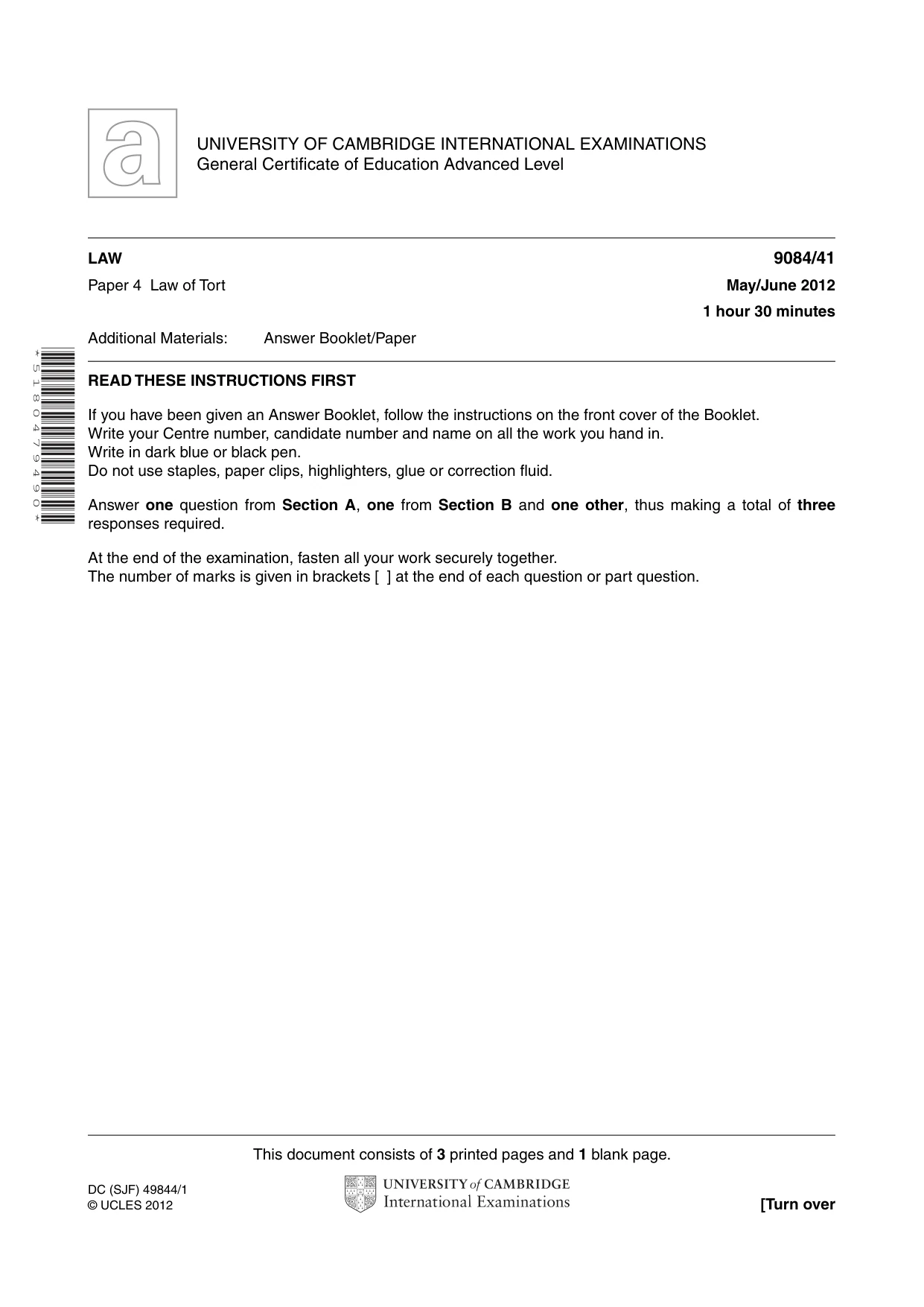
This document consists of 3 printed pages and 1 blank page. DC (SJF) 49844/1 © UCLES 2012 [Turn over UNIVERSITY OF CAMBRIDGE INTERNATIONAL EXAMINATIONS General Certificate of Education Advanced Level * 5 1 8 0 4 7 9 4 9 0 * LAW 9084/41 Paper 4 Law of Tort May/June 2012 1 hour 30 minutes Additional Materials: Answer Booklet/Paper READ THESE INSTRUCTIONS FIRST If you have been given an Answer Booklet, follow the instructions on the front cover of the Booklet. Write your Centre number, candidate number and name on all the work you hand in. Write in dark blue or black pen. Do not use staples, paper clips, highlighters, glue or correction fluid. Answer one question from Section A, one from Section B and one other, thus making a total of three responses required. At the end of the examination, fasten all your work securely together. The number of marks is given in brackets [ ] at the end of each question or part question.
Question paper, page 2
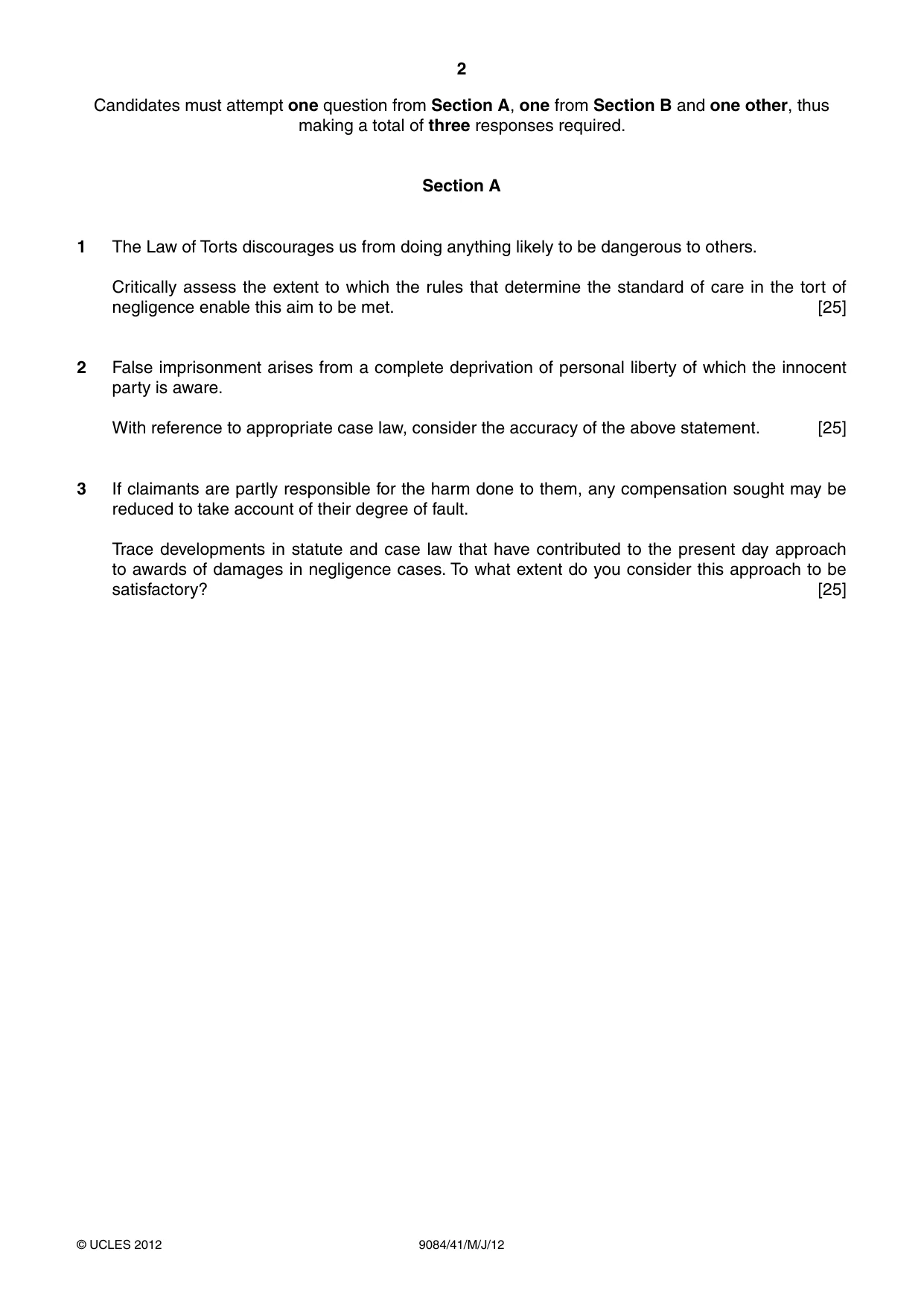
2 9084/41/M/J/12 © UCLES 2012 Candidates must attempt one question from Section A, one from Section B and one other, thus making a total of three responses required. Section A 1 The Law of Torts discourages us from doing anything likely to be dangerous to others. Critically assess the extent to which the rules that determine the standard of care in the tort of negligence enable this aim to be met. [25] 2 False imprisonment arises from a complete deprivation of personal liberty of which the innocent party is aware. With reference to appropriate case law, consider the accuracy of the above statement. [25] 3 If claimants are partly responsible for the harm done to them, any compensation sought may be reduced to take account of their degree of fault. Trace developments in statute and case law that have contributed to the present day approach to awards of damages in negligence cases. To what extent do you consider this approach to be satisfactory? [25]
Question paper, page 3
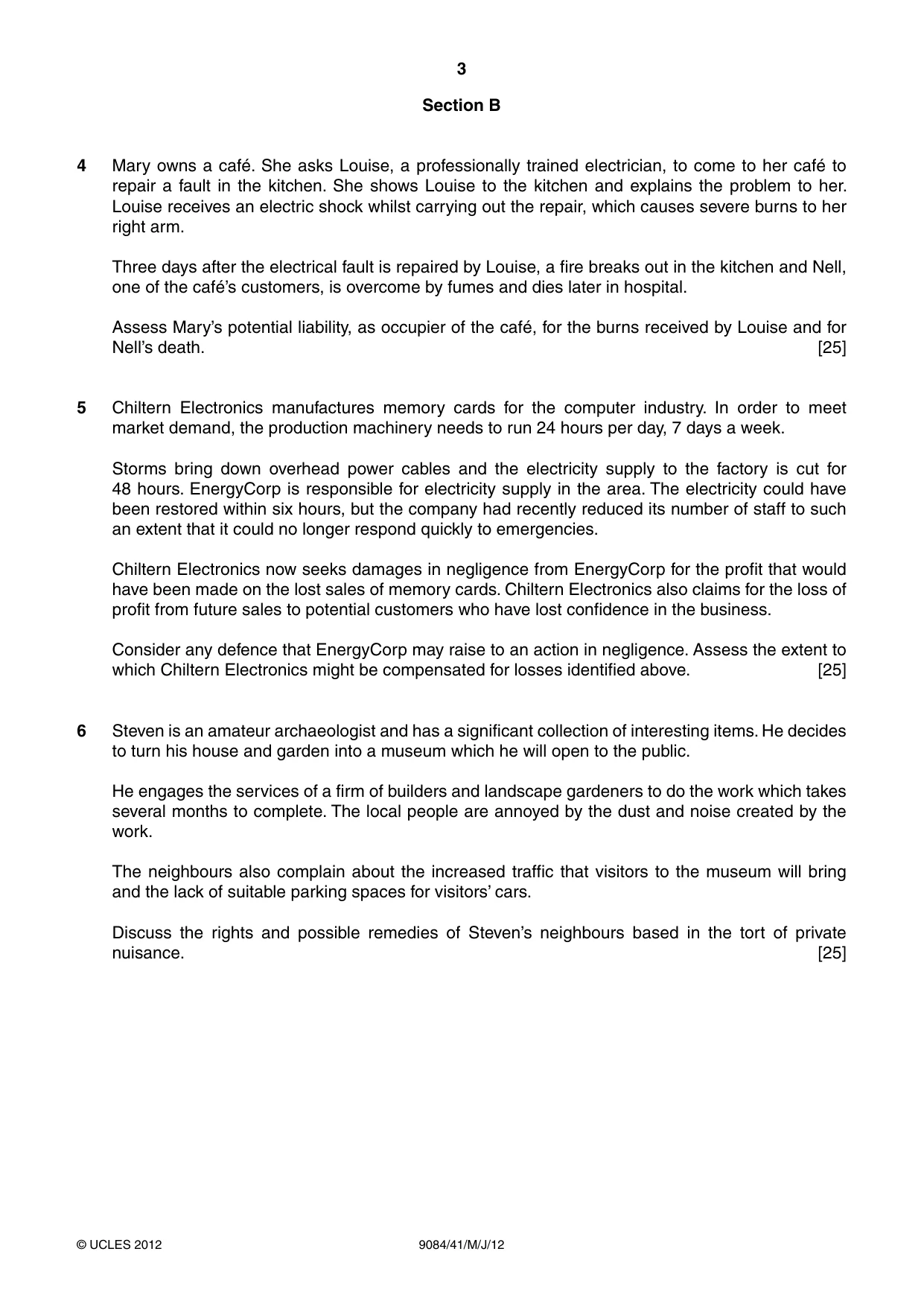
3 9084/41/M/J/12 © UCLES 2012 Section B 4 Mary owns a café. She asks Louise, a professionally trained electrician, to come to her café to repair a fault in the kitchen. She shows Louise to the kitchen and explains the problem to her. Louise receives an electric shock whilst carrying out the repair, which causes severe burns to her right arm. Three days after the electrical fault is repaired by Louise, a fire breaks out in the kitchen and Nell, one of the café’s customers, is overcome by fumes and dies later in hospital. Assess Mary’s potential liability, as occupier of the café, for the burns received by Louise and for Nell’s death. [25] 5 Chiltern Electronics manufactures memory cards for the computer industry. In order to meet market demand, the production machinery needs to run 24 hours per day, 7 days a week. Storms bring down overhead power cables and the electricity supply to the factory is cut for 48 hours. EnergyCorp is responsible for electricity supply in the area. The electricity could have been restored within six hours, but the company had recently reduced its number of staff to such an extent that it could no longer respond quickly to emergencies. Chiltern Electronics now seeks damages in negligence from EnergyCorp for the profit that would have been made on the lost sales of memory cards. Chiltern Electronics also claims for the loss of profit from future sales to potential customers who have lost confidence in the business. Consider any defence that EnergyCorp may raise to an action in negligence. Assess the extent to which Chiltern Electronics might be compensated for losses identified above. [25] 6 Steven is an amateur archaeologist and has a significant collection of interesting items. He decides to turn his house and garden into a museum which he will open to the public. He engages the services of a firm of builders and landscape gardeners to do the work which takes several months to complete. The local people are annoyed by the dust and noise created by the work. The neighbours also complain about the increased traffic that visitors to the museum will bring and the lack of suitable parking spaces for visitors’ cars. Discuss the rights and possible remedies of Steven’s neighbours based in the tort of private nuisance. [25]
Question paper, page 4
4 9084/41/M/J/12 © UCLES 2012 Permission to reproduce items where third-party owned material protected by copyright is included has been sought and cleared where possible. Every reasonable effort has been made by the publisher (UCLES) to trace copyright holders, but if any items requiring clearance have unwittingly been included, the publisher will be pleased to make amends at the earliest possible opportunity. University of Cambridge International Examinations is part of the Cambridge Assessment Group. Cambridge Assessment is the brand name of University of Cambridge Local Examinations Syndicate (UCLES), which is itself a department of the University of Cambridge. BLANK PAGE
Mark scheme, page 1
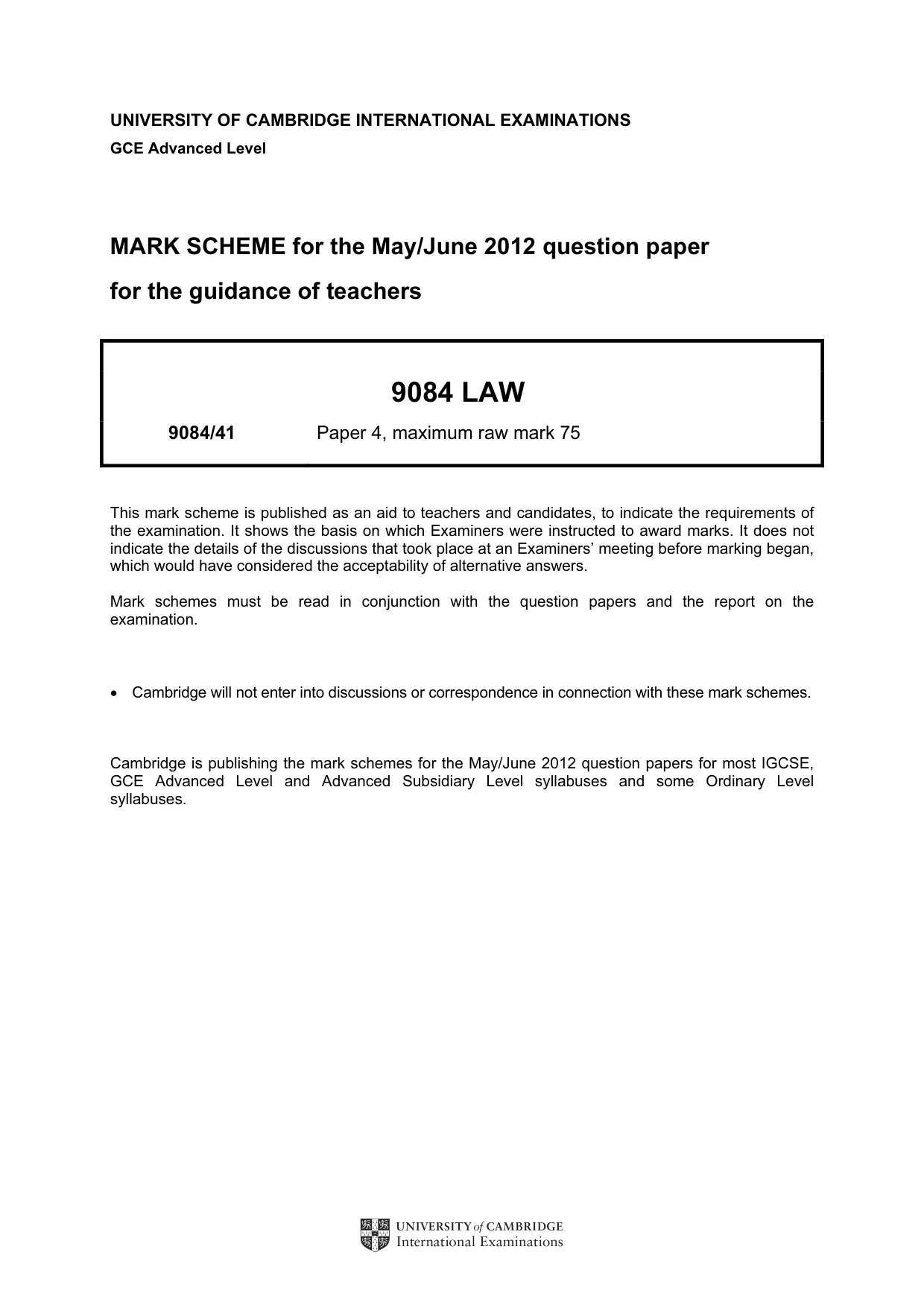
UNIVERSITY OF CAMBRIDGE INTERNATIONAL EXAMINATIONS GCE Advanced Level MARK SCHEME for the May/June 2012 question paper for the guidance of teachers 9084 LAW 9084/41 Paper 4, maximum raw mark 75 This mark scheme is published as an aid to teachers and candidates, to indicate the requirements of the examination. It shows the basis on which Examiners were instructed to award marks. It does not indicate the details of the discussions that took place at an Examiners’ meeting before marking began, which would have considered the acceptability of alternative answers. Mark schemes must be read in conjunction with the question papers and the report on the examination. • Cambridge will not enter into discussions or correspondence in connection with these mark schemes. Cambridge is publishing the mark schemes for the May/June 2012 question papers for most IGCSE, GCE Advanced Level and Advanced Subsidiary Level syllabuses and some Ordinary Level syllabuses.
Mark scheme, page 2
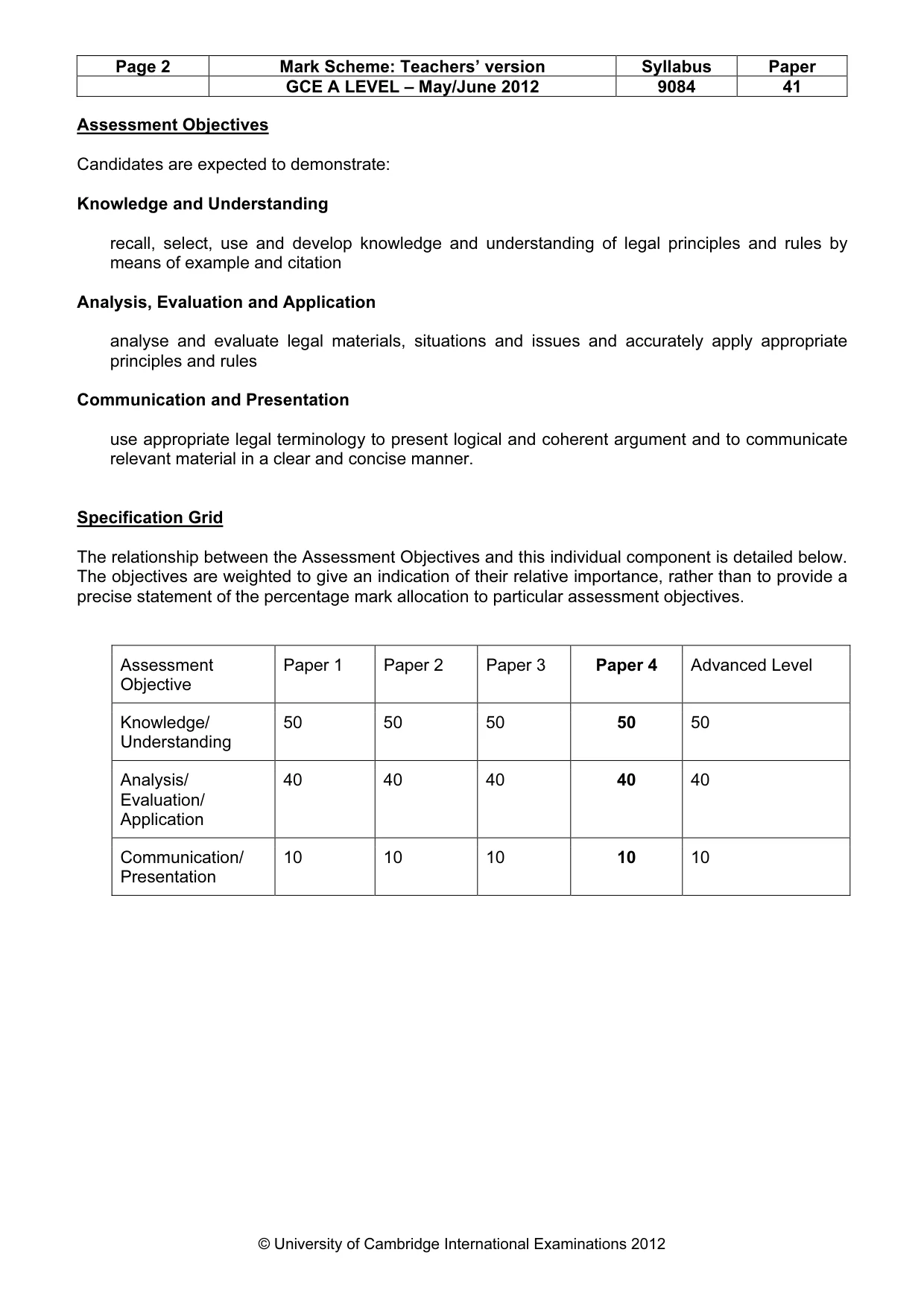
Page 2 Mark Scheme: Teachers’ version Syllabus Paper GCE A LEVEL – May/June 2012 9084 41 © University of Cambridge International Examinations 2012 Assessment Objectives Candidates are expected to demonstrate: Knowledge and Understanding recall, select, use and develop knowledge and understanding of legal principles and rules by means of example and citation Analysis, Evaluation and Application analyse and evaluate legal materials, situations and issues and accurately apply appropriate principles and rules Communication and Presentation use appropriate legal terminology to present logical and coherent argument and to communicate relevant material in a clear and concise manner. Specification Grid The relationship between the Assessment Objectives and this individual component is detailed below. The objectives are weighted to give an indication of their relative importance, rather than to provide a precise statement of the percentage mark allocation to particular assessment objectives. Assessment Objective Paper 1 Paper 2 Paper 3 Paper 4 Advanced Level Knowledge/ Understanding 50 50 50 50 50 Analysis/ Evaluation/ Application 40 40 40 40 40 Communication/ Presentation 10 10 10 10 10
Mark scheme, page 3
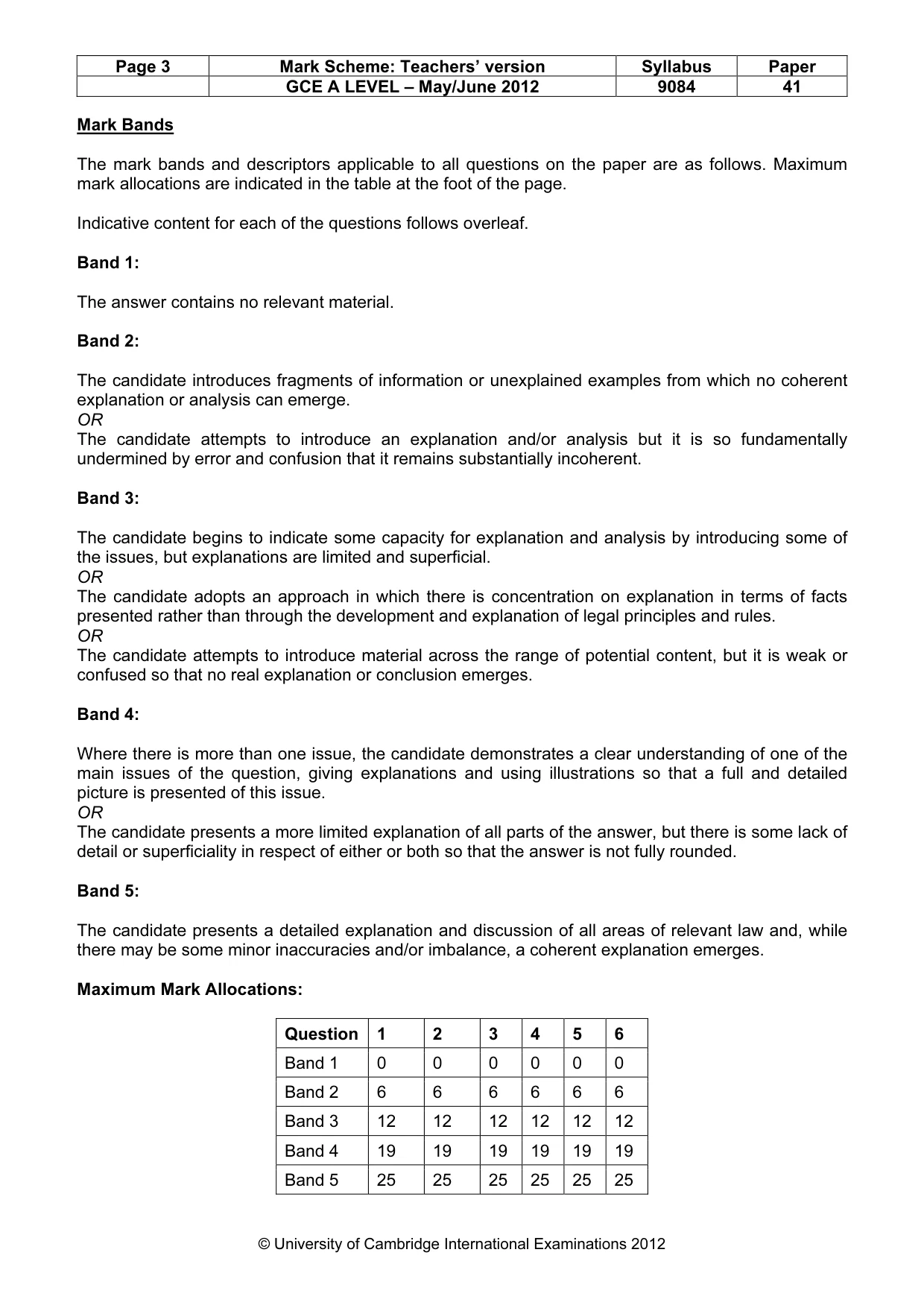
Page 3 Mark Scheme: Teachers’ version Syllabus Paper GCE A LEVEL – May/June 2012 9084 41 © University of Cambridge International Examinations 2012 Mark Bands The mark bands and descriptors applicable to all questions on the paper are as follows. Maximum mark allocations are indicated in the table at the foot of the page. Indicative content for each of the questions follows overleaf. Band 1: The answer contains no relevant material. Band 2: The candidate introduces fragments of information or unexplained examples from which no coherent explanation or analysis can emerge. OR The candidate attempts to introduce an explanation and/or analysis but it is so fundamentally undermined by error and confusion that it remains substantially incoherent. Band 3: The candidate begins to indicate some capacity for explanation and analysis by introducing some of the issues, but explanations are limited and superficial. OR The candidate adopts an approach in which there is concentration on explanation in terms of facts presented rather than through the development and explanation of legal principles and rules. OR The candidate attempts to introduce material across the range of potential content, but it is weak or confused so that no real explanation or conclusion emerges. Band 4: Where there is more than one issue, the candidate demonstrates a clear understanding of one of the main issues of the question, giving explanations and using illustrations so that a full and detailed picture is presented of this issue. OR The candidate presents a more limited explanation of all parts of the answer, but there is some lack of detail or superficiality in respect of either or both so that the answer is not fully rounded. Band 5: The candidate presents a detailed explanation and discussion of all areas of relevant law and, while there may be some minor inaccuracies and/or imbalance, a coherent explanation emerges. Maximum Mark Allocations: Question 1 2 3 4 5 6 Band 1 0 0 0 0 0 0 Band 2 6 6 6 6 6 6 Band 3 12 12 12 12 12 12 Band 4 19 19 19 19 19 19 Band 5 25 25 25 25 25 25
Mark scheme, page 4
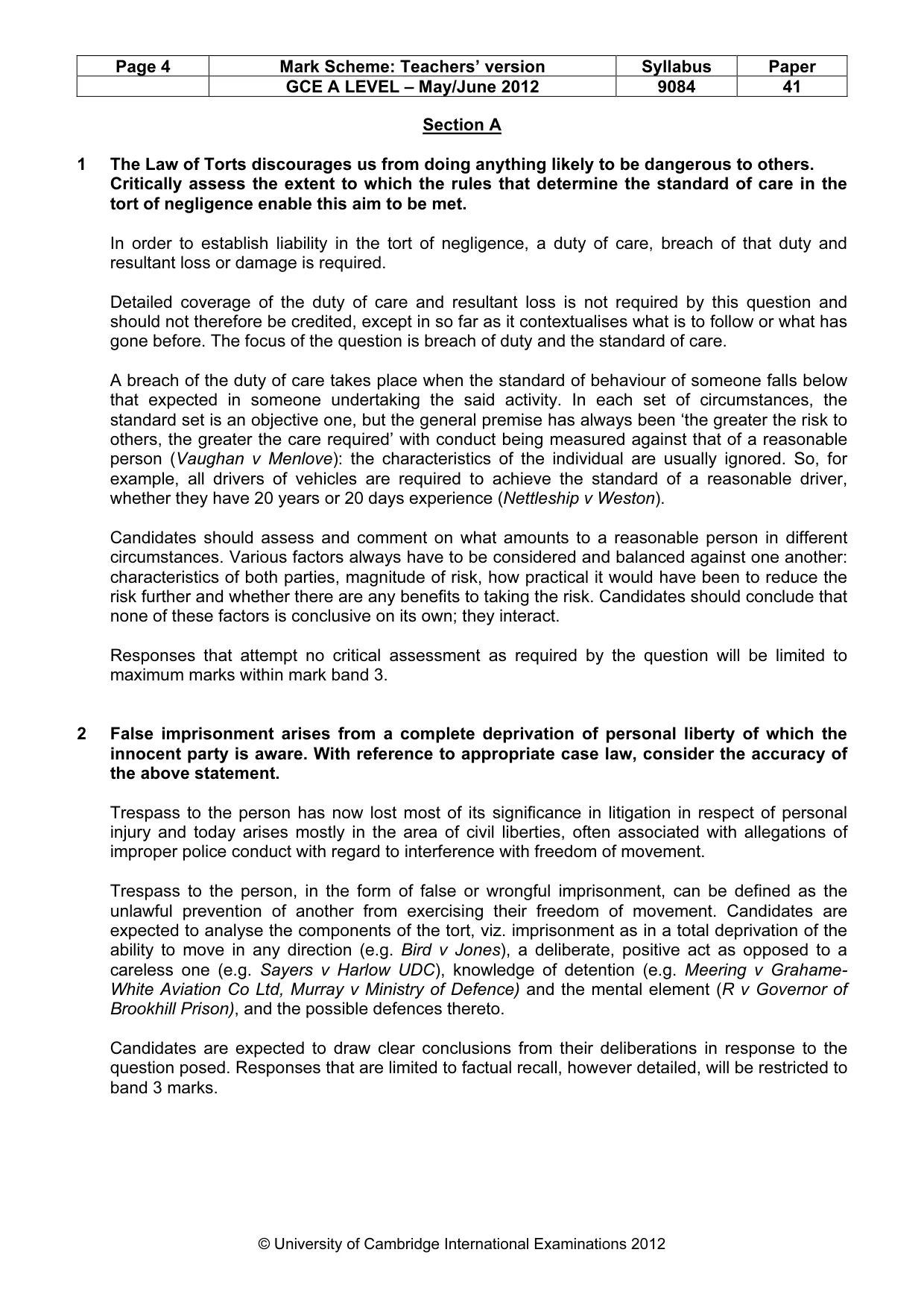
Page 4 Mark Scheme: Teachers’ version Syllabus Paper GCE A LEVEL – May/June 2012 9084 41 © University of Cambridge International Examinations 2012 Section A 1 The Law of Torts discourages us from doing anything likely to be dangerous to others. Critically assess the extent to which the rules that determine the standard of care in the tort of negligence enable this aim to be met. In order to establish liability in the tort of negligence, a duty of care, breach of that duty and resultant loss or damage is required. Detailed coverage of the duty of care and resultant loss is not required by this question and should not therefore be credited, except in so far as it contextualises what is to follow or what has gone before. The focus of the question is breach of duty and the standard of care. A breach of the duty of care takes place when the standard of behaviour of someone falls below that expected in someone undertaking the said activity. In each set of circumstances, the standard set is an objective one, but the general premise has always been ‘the greater the risk to others, the greater the care required’ with conduct being measured against that of a reasonable person (Vaughan v Menlove): the characteristics of the individual are usually ignored. So, for example, all drivers of vehicles are required to achieve the standard of a reasonable driver, whether they have 20 years or 20 days experience (Nettleship v Weston). Candidates should assess and comment on what amounts to a reasonable person in different circumstances. Various factors always have to be considered and balanced against one another: characteristics of both parties, magnitude of risk, how practical it would have been to reduce the risk further and whether there are any benefits to taking the risk. Candidates should conclude that none of these factors is conclusive on its own; they interact. Responses that attempt no critical assessment as required by the question will be limited to maximum marks within mark band 3. 2 False imprisonment arises from a complete deprivation of personal liberty of which the innocent party is aware. With reference to appropriate case law, consider the accuracy of the above statement. Trespass to the person has now lost most of its significance in litigation in respect of personal injury and today arises mostly in the area of civil liberties, often associated with allegations of improper police conduct with regard to interference with freedom of movement. Trespass to the person, in the form of false or wrongful imprisonment, can be defined as the unlawful prevention of another from exercising their freedom of movement. Candidates are expected to analyse the components of the tort, viz. imprisonment as in a total deprivation of the ability to move in any direction (e.g. Bird v Jones), a deliberate, positive act as opposed to a careless one (e.g. Sayers v Harlow UDC), knowledge of detention (e.g. Meering v Grahame- White Aviation Co Ltd, Murray v Ministry of Defence) and the mental element (R v Governor of Brookhill Prison), and the possible defences thereto. Candidates are expected to draw clear conclusions from their deliberations in response to the question posed. Responses that are limited to factual recall, however detailed, will be restricted to band 3 marks.
Mark scheme, page 5
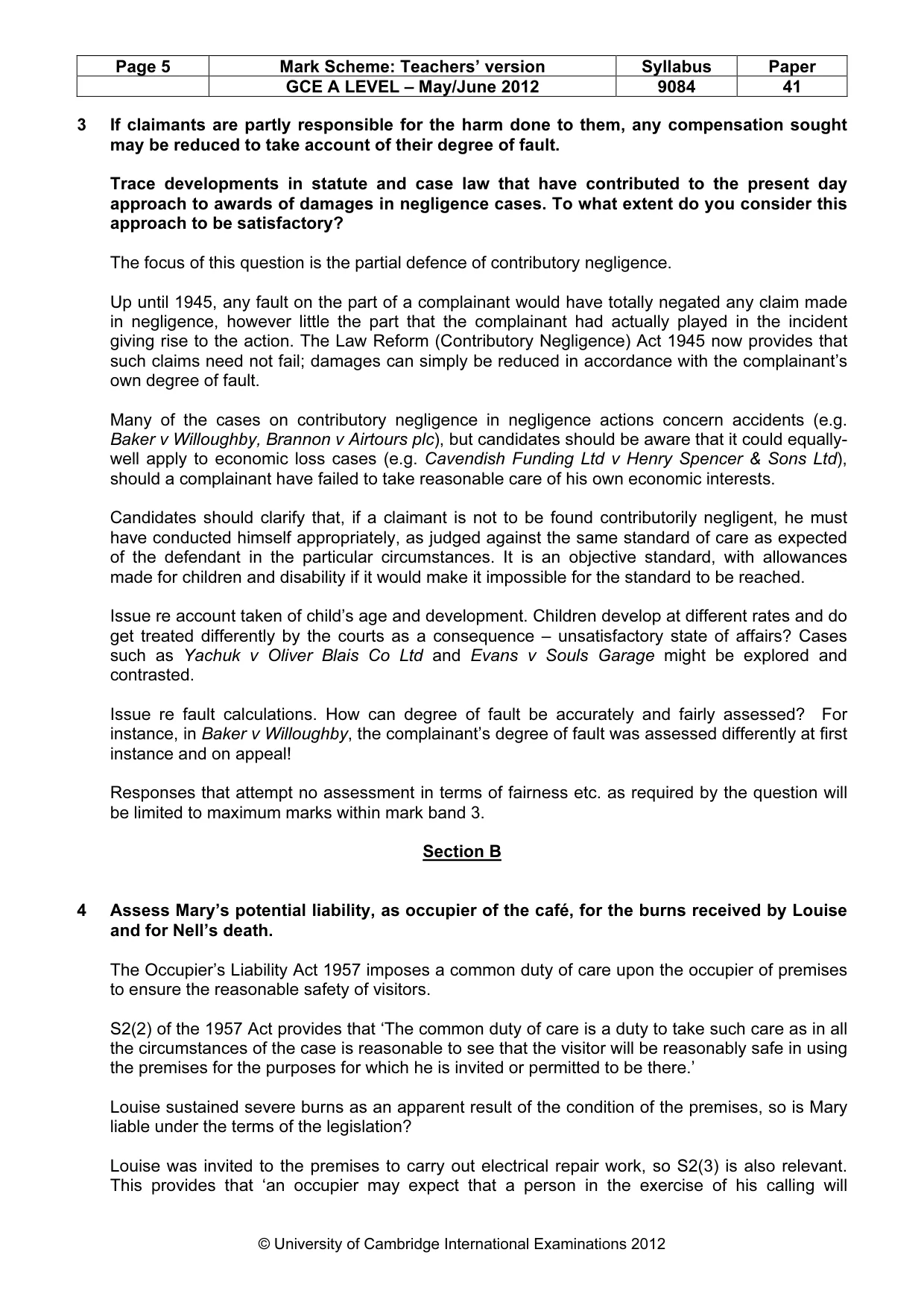
Page 5 Mark Scheme: Teachers’ version Syllabus Paper GCE A LEVEL – May/June 2012 9084 41 © University of Cambridge International Examinations 2012 3 If claimants are partly responsible for the harm done to them, any compensation sought may be reduced to take account of their degree of fault. Trace developments in statute and case law that have contributed to the present day approach to awards of damages in negligence cases. To what extent do you consider this approach to be satisfactory? The focus of this question is the partial defence of contributory negligence. Up until 1945, any fault on the part of a complainant would have totally negated any claim made in negligence, however little the part that the complainant had actually played in the incident giving rise to the action. The Law Reform (Contributory Negligence) Act 1945 now provides that such claims need not fail; damages can simply be reduced in accordance with the complainant’s own degree of fault. Many of the cases on contributory negligence in negligence actions concern accidents (e.g. Baker v Willoughby, Brannon v Airtours plc), but candidates should be aware that it could equally- well apply to economic loss cases (e.g. Cavendish Funding Ltd v Henry Spencer & Sons Ltd), should a complainant have failed to take reasonable care of his own economic interests. Candidates should clarify that, if a claimant is not to be found contributorily negligent, he must have conducted himself appropriately, as judged against the same standard of care as expected of the defendant in the particular circumstances. It is an objective standard, with allowances made for children and disability if it would make it impossible for the standard to be reached. Issue re account taken of child’s age and development. Children develop at different rates and do get treated differently by the courts as a consequence – unsatisfactory state of affairs? Cases such as Yachuk v Oliver Blais Co Ltd and Evans v Souls Garage might be explored and contrasted. Issue re fault calculations. How can degree of fault be accurately and fairly assessed? For instance, in Baker v Willoughby, the complainant’s degree of fault was assessed differently at first instance and on appeal! Responses that attempt no assessment in terms of fairness etc. as required by the question will be limited to maximum marks within mark band 3. Section B 4 Assess Mary’s potential liability, as occupier of the café, for the burns received by Louise and for Nell’s death. The Occupier’s Liability Act 1957 imposes a common duty of care upon the occupier of premises to ensure the reasonable safety of visitors. S2(2) of the 1957 Act provides that ‘The common duty of care is a duty to take such care as in all the circumstances of the case is reasonable to see that the visitor will be reasonably safe in using the premises for the purposes for which he is invited or permitted to be there.’ Louise sustained severe burns as an apparent result of the condition of the premises, so is Mary liable under the terms of the legislation? Louise was invited to the premises to carry out electrical repair work, so S2(3) is also relevant. This provides that ‘an occupier may expect that a person in the exercise of his calling will
Mark scheme, page 6
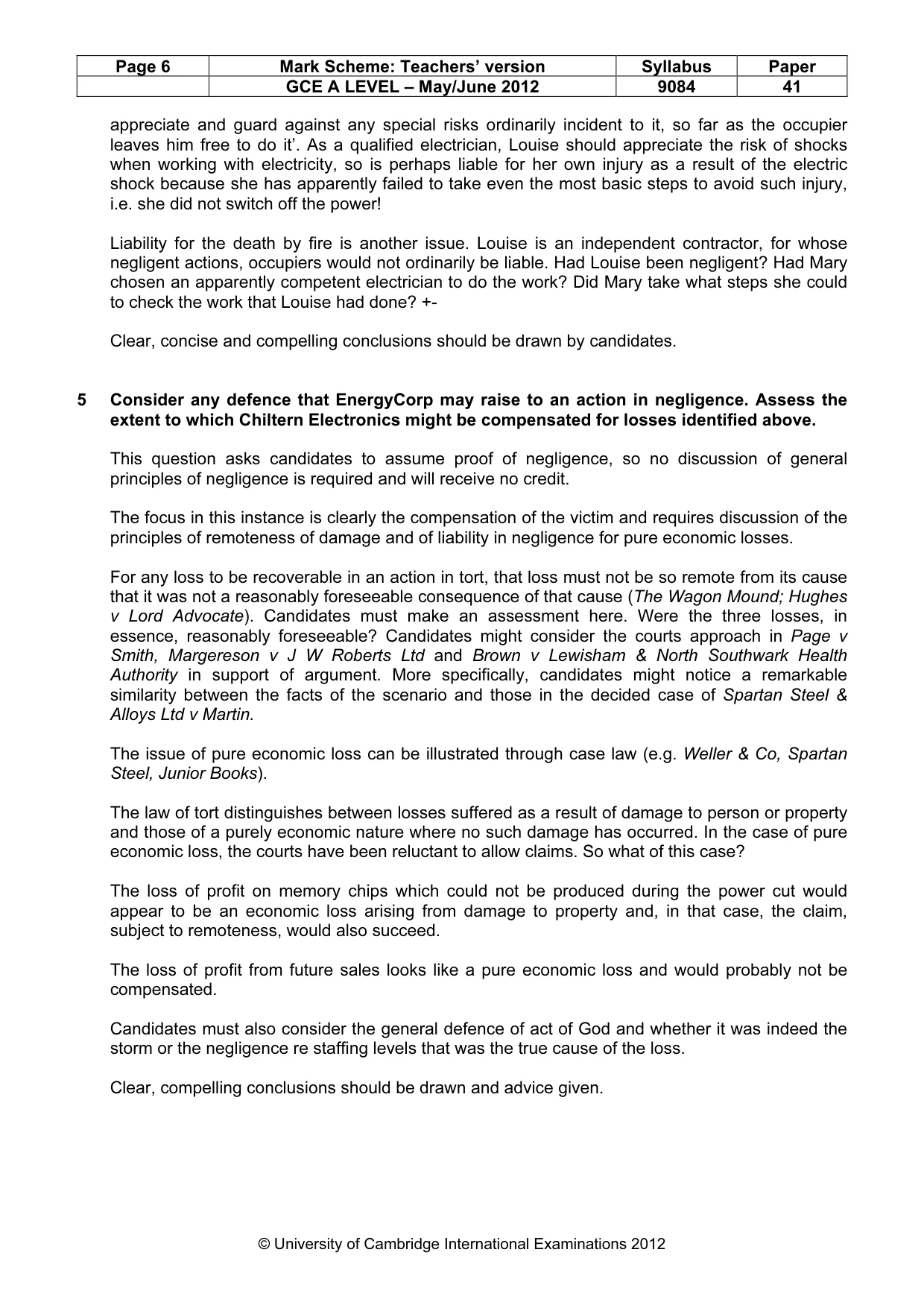
Page 6 Mark Scheme: Teachers’ version Syllabus Paper GCE A LEVEL – May/June 2012 9084 41 © University of Cambridge International Examinations 2012 appreciate and guard against any special risks ordinarily incident to it, so far as the occupier leaves him free to do it’. As a qualified electrician, Louise should appreciate the risk of shocks when working with electricity, so is perhaps liable for her own injury as a result of the electric shock because she has apparently failed to take even the most basic steps to avoid such injury, i.e. she did not switch off the power! Liability for the death by fire is another issue. Louise is an independent contractor, for whose negligent actions, occupiers would not ordinarily be liable. Had Louise been negligent? Had Mary chosen an apparently competent electrician to do the work? Did Mary take what steps she could to check the work that Louise had done? +- Clear, concise and compelling conclusions should be drawn by candidates. 5 Consider any defence that EnergyCorp may raise to an action in negligence. Assess the extent to which Chiltern Electronics might be compensated for losses identified above. This question asks candidates to assume proof of negligence, so no discussion of general principles of negligence is required and will receive no credit. The focus in this instance is clearly the compensation of the victim and requires discussion of the principles of remoteness of damage and of liability in negligence for pure economic losses. For any loss to be recoverable in an action in tort, that loss must not be so remote from its cause that it was not a reasonably foreseeable consequence of that cause (The Wagon Mound; Hughes v Lord Advocate). Candidates must make an assessment here. Were the three losses, in essence, reasonably foreseeable? Candidates might consider the courts approach in Page v Smith, Margereson v J W Roberts Ltd and Brown v Lewisham & North Southwark Health Authority in support of argument. More specifically, candidates might notice a remarkable similarity between the facts of the scenario and those in the decided case of Spartan Steel & Alloys Ltd v Martin. The issue of pure economic loss can be illustrated through case law (e.g. Weller & Co, Spartan Steel, Junior Books). The law of tort distinguishes between losses suffered as a result of damage to person or property and those of a purely economic nature where no such damage has occurred. In the case of pure economic loss, the courts have been reluctant to allow claims. So what of this case? The loss of profit on memory chips which could not be produced during the power cut would appear to be an economic loss arising from damage to property and, in that case, the claim, subject to remoteness, would also succeed. The loss of profit from future sales looks like a pure economic loss and would probably not be compensated. Candidates must also consider the general defence of act of God and whether it was indeed the storm or the negligence re staffing levels that was the true cause of the loss. Clear, compelling conclusions should be drawn and advice given.
Mark scheme, page 7
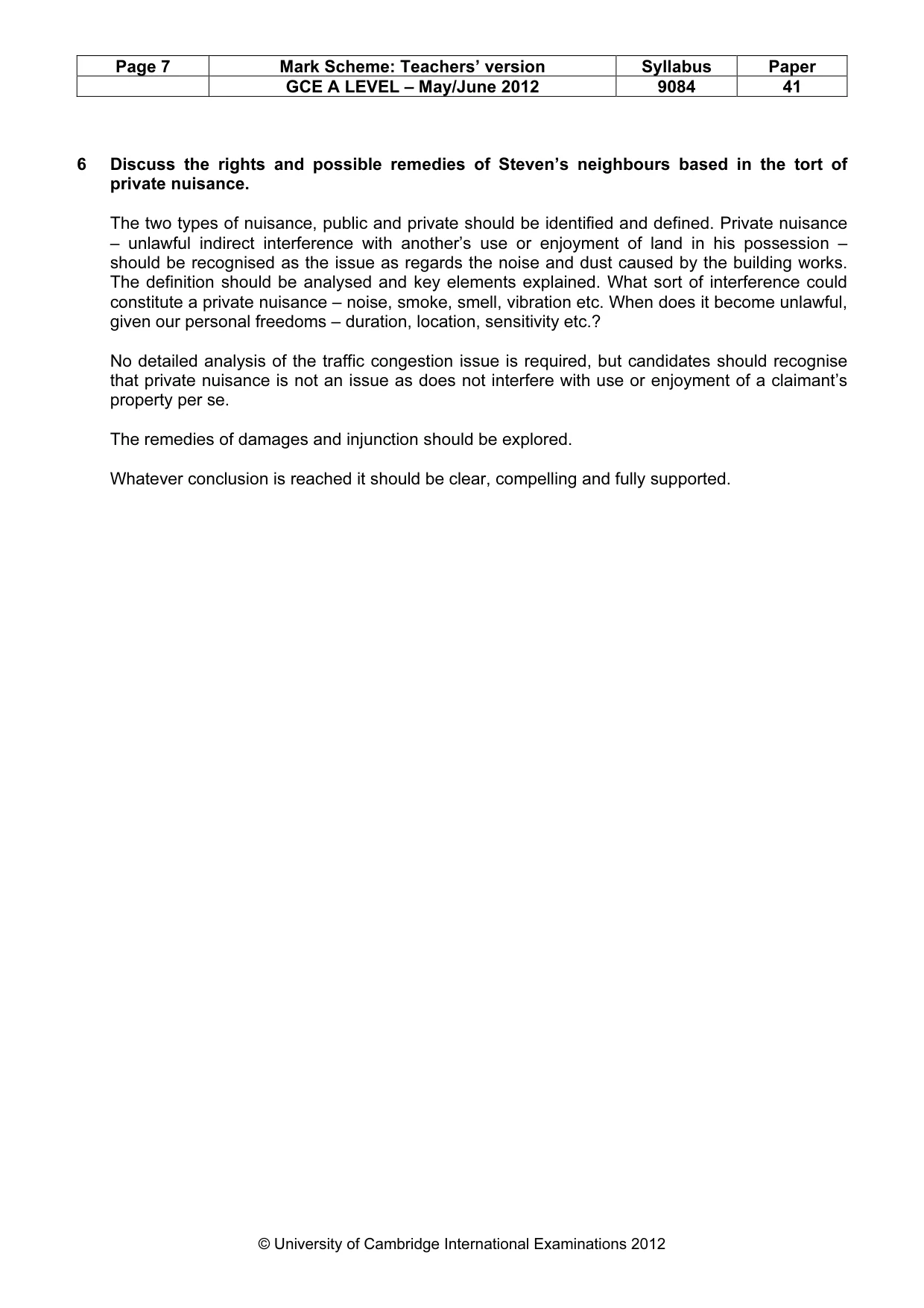
Page 7 Mark Scheme: Teachers’ version Syllabus Paper GCE A LEVEL – May/June 2012 9084 41 © University of Cambridge International Examinations 2012 6 Discuss the rights and possible remedies of Steven’s neighbours based in the tort of private nuisance. The two types of nuisance, public and private should be identified and defined. Private nuisance – unlawful indirect interference with another’s use or enjoyment of land in his possession – should be recognised as the issue as regards the noise and dust caused by the building works. The definition should be analysed and key elements explained. What sort of interference could constitute a private nuisance – noise, smoke, smell, vibration etc. When does it become unlawful, given our personal freedoms – duration, location, sensitivity etc.? No detailed analysis of the traffic congestion issue is required, but candidates should recognise that private nuisance is not an issue as does not interfere with use or enjoyment of a claimant’s property per se. The remedies of damages and injunction should be explored. Whatever conclusion is reached it should be clear, compelling and fully supported.
What you needed in this session
Cambridge’s own grade thresholds for 2012 May/June, Paper 4 · Variant 1. A higher threshold means an easier paper — the bar moves with how the cohort did.