Cambridge A Level Law 9084 — 2012 May/June Paper 4 · Variant 3
9084/43/M/J/12 · 75 marks · ≈84 min
The question paper and its mark scheme, free to read here and free to download. This is Cambridge’s own paper, exactly as it was sat.
Question paper4 pages

Mark scheme7 pages
Answers below. Sit the paper first if you are practising.
Paper as text
Question paper, page 1
This document consists of 3 printed pages and 1 blank page. DC (SJF) 49846/3 © UCLES 2012 [Turn over UNIVERSITY OF CAMBRIDGE INTERNATIONAL EXAMINATIONS General Certificate of Education Advanced Level * 9 2 7 5 6 5 0 1 9 3 * LAW 9084/43 Paper 4 Law of Tort May/June 2012 1 hour 30 minutes Additional Materials: Answer Booklet/Paper READ THESE INSTRUCTIONS FIRST If you have been given an Answer Booklet, follow the instructions on the front cover of the Booklet. Write your Centre number, candidate number and name on all the work you hand in. Write in dark blue or black pen. Do not use staples, paper clips, highlighters, glue or correction fluid. Answer one question from Section A, one from Section B and one other, thus making a total of three responses required. At the end of the examination, fasten all your work securely together. The number of marks is given in brackets [ ] at the end of each question or part question.
Question paper, page 2
2 9084/43/M/J/12 © UCLES 2012 Candidates must attempt one question from Section A, one from Section B and one other, thus making a total of three responses required. Section A 1 An award of damages in tort is based on the principle of restitutio in integrum (restitution in full). Critically assess the extent to which this aim of the principal remedy in tort is achieved. [25] 2 That wrongdoers should be liable for their own actions is a fundamental principle on which the law of tort is based. Critically analyse how the concept of vicarious liability might seem to contradict this principle and explain why it is deemed necessary. [25] 3 ‘There is no need for the torts of trespass to land and private nuisance to co-exist as they both protect the same interests.’ Compare the elements of these torts and explain the extent to which you agree with this statement. [25]
Question paper, page 3
3 9084/43/M/J/12 © UCLES 2012 Section B 4 Adam is self-employed and repairs roads. Adam is at work when he carelessly damages an electricity cable under the road whilst driving a mechanical digger. As a result of the incident, the power supply is cut to properties in the surrounding area and cannot be restored for three days. One property which suffers loss of power is an ice-cream shop which belongs to Joyanna. The power cut causes Joyanna to close the shop. Her stock of ice-cream valued at £2000 melts and she loses an estimated £400 profit on lost ice-cream sales. In addition, damage is caused to the shop’s computer system and she has to pay Computer Care £200 to rebuild the system. Advise Joyanna of the likely success of any action brought against Adam to recover losses and costs incurred as a consequence of the incident with the digger. [25] 5 Josh teaches at Barchester College. He leads a group of students on a field-trip to the North of England to an area well-known for bad weather conditions. On the second day of the trip, the group suddenly finds itself in thick fog. The group decides to return to the hostel in which they are staying but they soon get lost in the fog. Josh has no means of finding the way back to the hostel and the group waits until the fog clears. When it gets dark and the group has failed to return, the manager of the hostel contacts the local police and arranges for a number of his friends to form a search party to go out and look for the group. The search party finds the group a few hours later, but not before Josh and Len (one of the search party’s members) require medical attention. Len has fallen on rocks in the dark and suffered severe head injuries. Josh is suffering from exposure to the cold weather. One of the students takes a video of Josh and Len being put into an ambulance and this video soon appears as part of a bulletin on a television news programme. Len’s sister, Elsie, sees the news bulletin and suffers severe shock as she sees that Len has been badly injured during the incident. Advise Len, Elsie and Josh as to their respective rights and liabilities in the tort of negligence. [25] 6 Victor is a supporter of United, his local football club. He is watching a match between United and City when the referee, Willy, awards a penalty against United and City score a goal. Willy sees Victor trying to get on to the pitch. He hears Victor shout: ‘Cheating referee, I’ll kill you!’ Victor’s attempt to get on to the pitch is prevented by Ulysses, a steward, who grabs hold of him and escorts him from the spectator area and locks him in a room until the match is over. Victor is then allowed to leave the stadium. As he is walking through the car park he sees Willy and punches him in the face because United lost the match 1-0. Willy sustains a broken nose and loses two teeth. Discuss the potential liability of Victor and Ulysses in the tort of trespass to the person arising from these incidents. [25]
Question paper, page 4
4 9084/43/M/J/12 © UCLES 2012 BLANK PAGE Permission to reproduce items where third-party owned material protected by copyright is included has been sought and cleared where possible. Every reasonable effort has been made by the publisher (UCLES) to trace copyright holders, but if any items requiring clearance have unwittingly been included, the publisher will be pleased to make amends at the earliest possible opportunity. University of Cambridge International Examinations is part of the Cambridge Assessment Group. Cambridge Assessment is the brand name of University of Cambridge Local Examinations Syndicate (UCLES), which is itself a department of the University of Cambridge.
Mark scheme, page 1
UNIVERSITY OF CAMBRIDGE INTERNATIONAL EXAMINATIONS GCE Advanced Level MARK SCHEME for the May/June 2012 question paper for the guidance of teachers 9084 LAW 9084/43 Paper 4, maximum raw mark 75 This mark scheme is published as an aid to teachers and candidates, to indicate the requirements of the examination. It shows the basis on which Examiners were instructed to award marks. It does not indicate the details of the discussions that took place at an Examiners’ meeting before marking began, which would have considered the acceptability of alternative answers. Mark schemes must be read in conjunction with the question papers and the report on the examination. • Cambridge will not enter into discussions or correspondence in connection with these mark schemes. Cambridge is publishing the mark schemes for the May/June 2012 question papers for most IGCSE, GCE Advanced Level and Advanced Subsidiary Level syllabuses and some Ordinary Level syllabuses.
Mark scheme, page 2
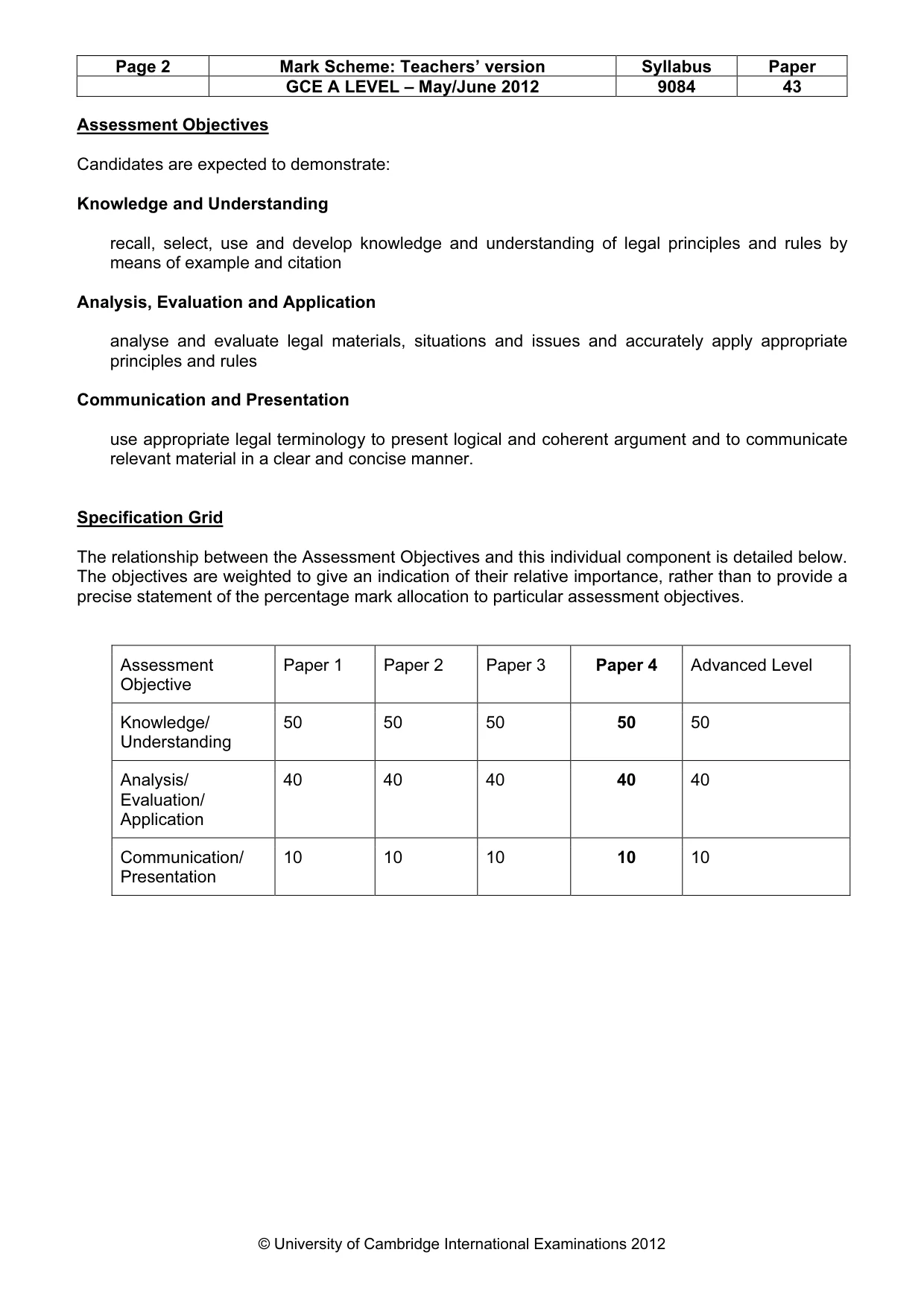
Page 2 Mark Scheme: Teachers’ version Syllabus Paper GCE A LEVEL – May/June 2012 9084 43 © University of Cambridge International Examinations 2012 Assessment Objectives Candidates are expected to demonstrate: Knowledge and Understanding recall, select, use and develop knowledge and understanding of legal principles and rules by means of example and citation Analysis, Evaluation and Application analyse and evaluate legal materials, situations and issues and accurately apply appropriate principles and rules Communication and Presentation use appropriate legal terminology to present logical and coherent argument and to communicate relevant material in a clear and concise manner. Specification Grid The relationship between the Assessment Objectives and this individual component is detailed below. The objectives are weighted to give an indication of their relative importance, rather than to provide a precise statement of the percentage mark allocation to particular assessment objectives. Assessment Objective Paper 1 Paper 2 Paper 3 Paper 4 Advanced Level Knowledge/ Understanding 50 50 50 50 50 Analysis/ Evaluation/ Application 40 40 40 40 40 Communication/ Presentation 10 10 10 10 10
Mark scheme, page 3
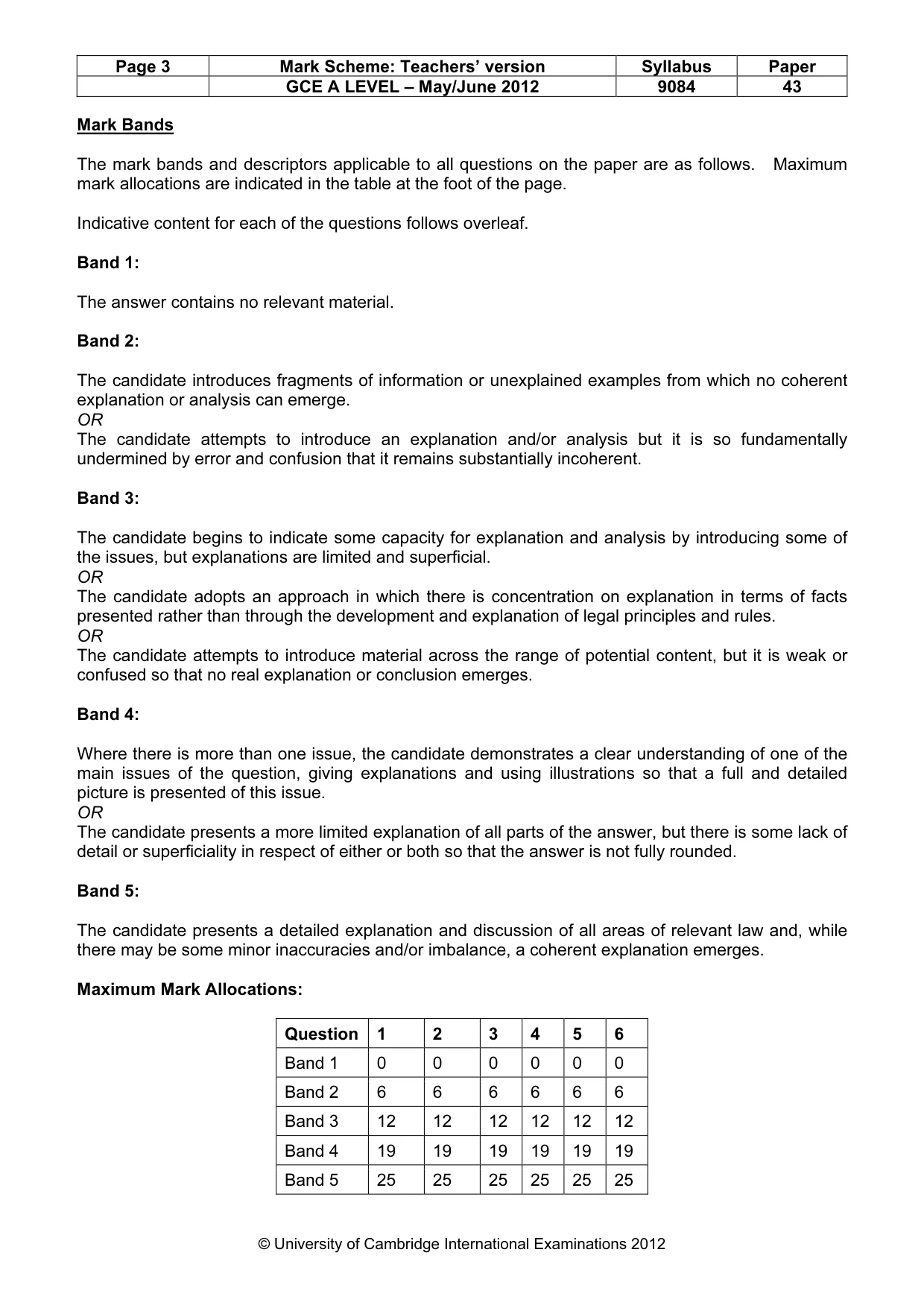
Page 3 Mark Scheme: Teachers’ version Syllabus Paper GCE A LEVEL – May/June 2012 9084 43 © University of Cambridge International Examinations 2012 Mark Bands The mark bands and descriptors applicable to all questions on the paper are as follows. Maximum mark allocations are indicated in the table at the foot of the page. Indicative content for each of the questions follows overleaf. Band 1: The answer contains no relevant material. Band 2: The candidate introduces fragments of information or unexplained examples from which no coherent explanation or analysis can emerge. OR The candidate attempts to introduce an explanation and/or analysis but it is so fundamentally undermined by error and confusion that it remains substantially incoherent. Band 3: The candidate begins to indicate some capacity for explanation and analysis by introducing some of the issues, but explanations are limited and superficial. OR The candidate adopts an approach in which there is concentration on explanation in terms of facts presented rather than through the development and explanation of legal principles and rules. OR The candidate attempts to introduce material across the range of potential content, but it is weak or confused so that no real explanation or conclusion emerges. Band 4: Where there is more than one issue, the candidate demonstrates a clear understanding of one of the main issues of the question, giving explanations and using illustrations so that a full and detailed picture is presented of this issue. OR The candidate presents a more limited explanation of all parts of the answer, but there is some lack of detail or superficiality in respect of either or both so that the answer is not fully rounded. Band 5: The candidate presents a detailed explanation and discussion of all areas of relevant law and, while there may be some minor inaccuracies and/or imbalance, a coherent explanation emerges. Maximum Mark Allocations: Question 1 2 3 4 5 6 Band 1 0 0 0 0 0 0 Band 2 6 6 6 6 6 6 Band 3 12 12 12 12 12 12 Band 4 19 19 19 19 19 19 Band 5 25 25 25 25 25 25
Mark scheme, page 4
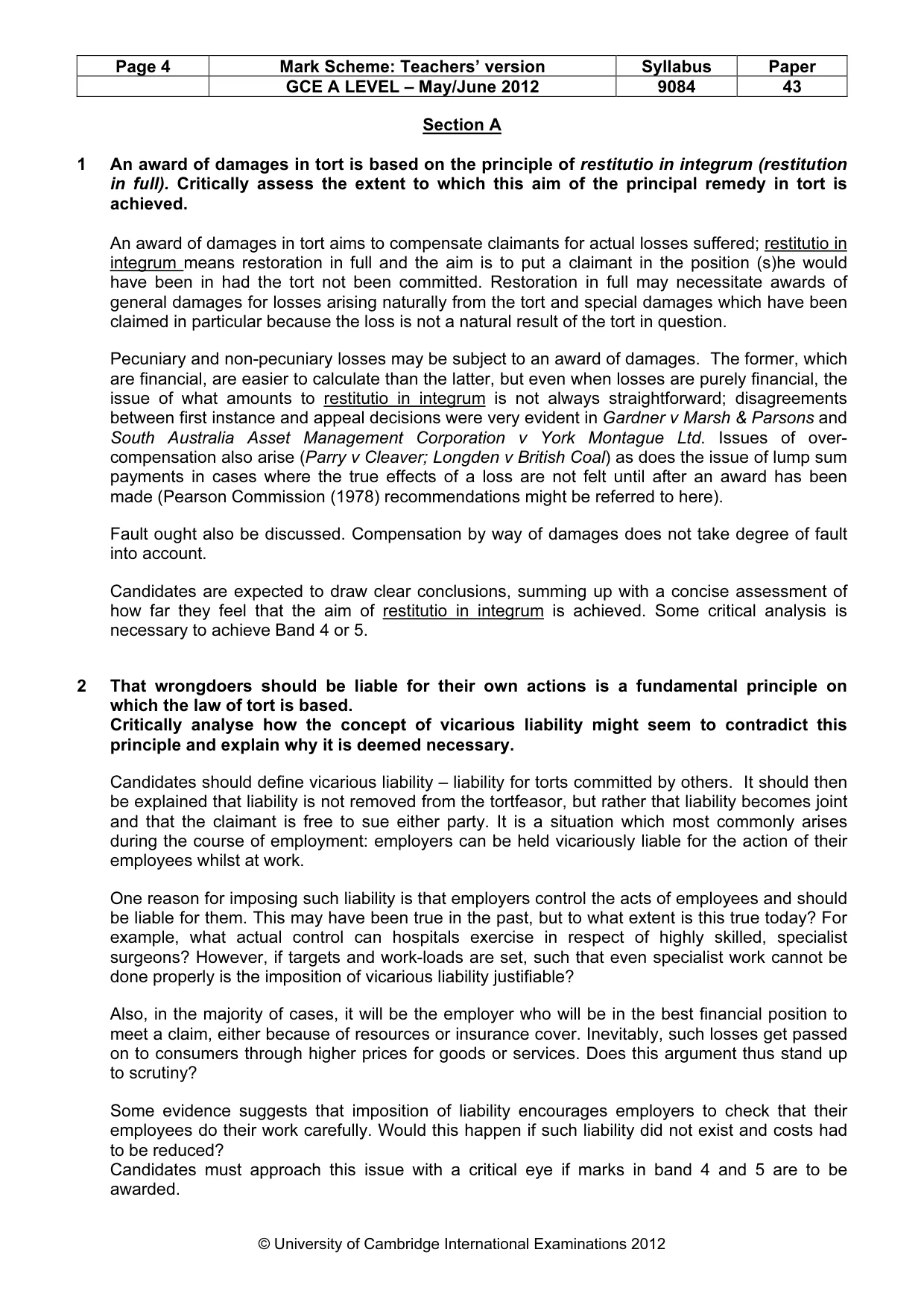
Page 4 Mark Scheme: Teachers’ version Syllabus Paper GCE A LEVEL – May/June 2012 9084 43 © University of Cambridge International Examinations 2012 Section A 1 An award of damages in tort is based on the principle of restitutio in integrum (restitution in full). Critically assess the extent to which this aim of the principal remedy in tort is achieved. An award of damages in tort aims to compensate claimants for actual losses suffered; restitutio in integrum means restoration in full and the aim is to put a claimant in the position (s)he would have been in had the tort not been committed. Restoration in full may necessitate awards of general damages for losses arising naturally from the tort and special damages which have been claimed in particular because the loss is not a natural result of the tort in question. Pecuniary and non-pecuniary losses may be subject to an award of damages. The former, which are financial, are easier to calculate than the latter, but even when losses are purely financial, the issue of what amounts to restitutio in integrum is not always straightforward; disagreements between first instance and appeal decisions were very evident in Gardner v Marsh & Parsons and South Australia Asset Management Corporation v York Montague Ltd. Issues of over- compensation also arise (Parry v Cleaver; Longden v British Coal) as does the issue of lump sum payments in cases where the true effects of a loss are not felt until after an award has been made (Pearson Commission (1978) recommendations might be referred to here). Fault ought also be discussed. Compensation by way of damages does not take degree of fault into account. Candidates are expected to draw clear conclusions, summing up with a concise assessment of how far they feel that the aim of restitutio in integrum is achieved. Some critical analysis is necessary to achieve Band 4 or 5. 2 That wrongdoers should be liable for their own actions is a fundamental principle on which the law of tort is based. Critically analyse how the concept of vicarious liability might seem to contradict this principle and explain why it is deemed necessary. Candidates should define vicarious liability – liability for torts committed by others. It should then be explained that liability is not removed from the tortfeasor, but rather that liability becomes joint and that the claimant is free to sue either party. It is a situation which most commonly arises during the course of employment: employers can be held vicariously liable for the action of their employees whilst at work. One reason for imposing such liability is that employers control the acts of employees and should be liable for them. This may have been true in the past, but to what extent is this true today? For example, what actual control can hospitals exercise in respect of highly skilled, specialist surgeons? However, if targets and work-loads are set, such that even specialist work cannot be done properly is the imposition of vicarious liability justifiable? Also, in the majority of cases, it will be the employer who will be in the best financial position to meet a claim, either because of resources or insurance cover. Inevitably, such losses get passed on to consumers through higher prices for goods or services. Does this argument thus stand up to scrutiny? Some evidence suggests that imposition of liability encourages employers to check that their employees do their work carefully. Would this happen if such liability did not exist and costs had to be reduced? Candidates must approach this issue with a critical eye if marks in band 4 and 5 are to be awarded.
Mark scheme, page 5
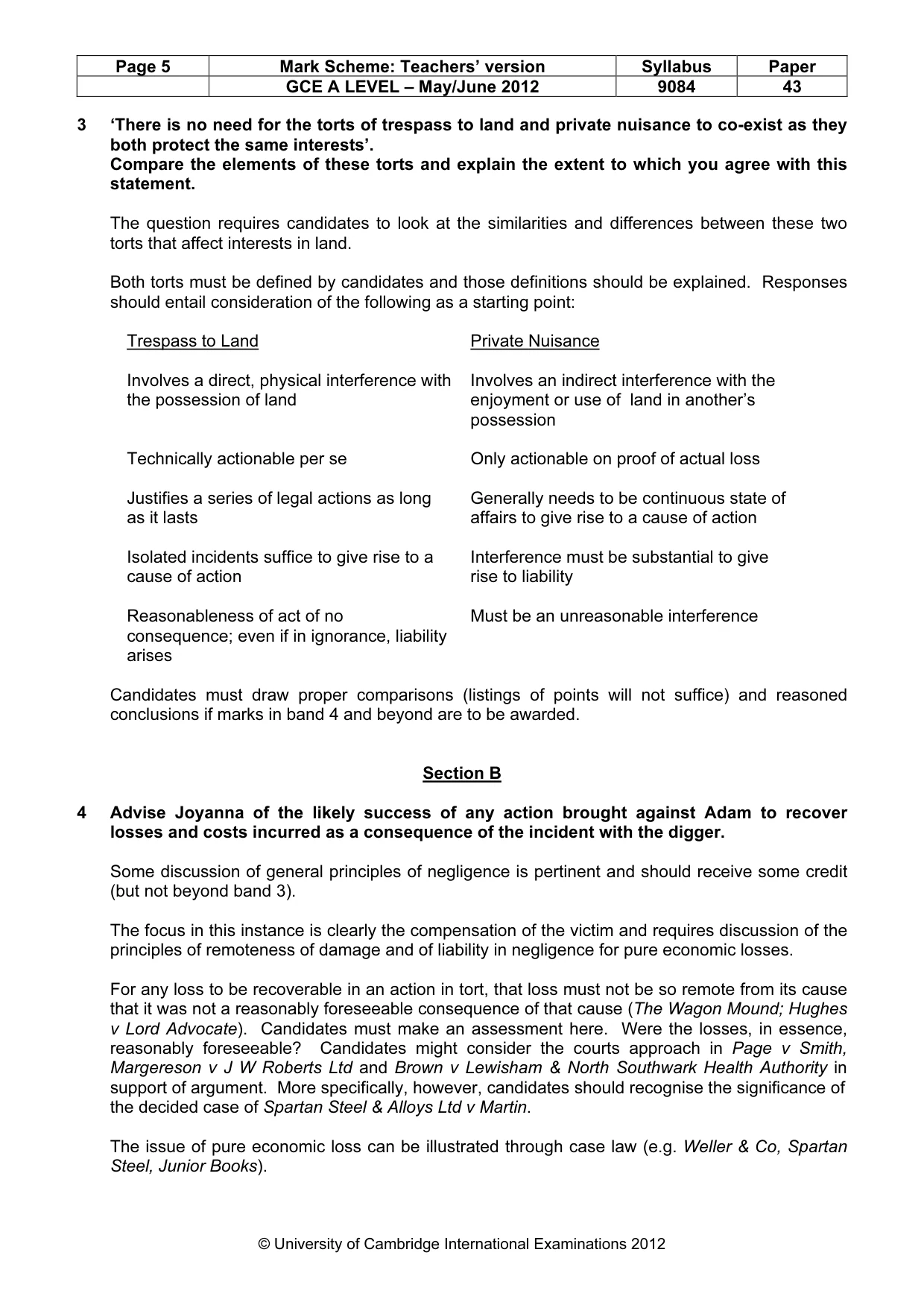
Page 5 Mark Scheme: Teachers’ version Syllabus Paper GCE A LEVEL – May/June 2012 9084 43 © University of Cambridge International Examinations 2012 3 ‘There is no need for the torts of trespass to land and private nuisance to co-exist as they both protect the same interests’. Compare the elements of these torts and explain the extent to which you agree with this statement. The question requires candidates to look at the similarities and differences between these two torts that affect interests in land. Both torts must be defined by candidates and those definitions should be explained. Responses should entail consideration of the following as a starting point: Trespass to Land Private Nuisance Involves a direct, physical interference with the possession of land Involves an indirect interference with the enjoyment or use of land in another’s possession Technically actionable per se Only actionable on proof of actual loss Justifies a series of legal actions as long as it lasts Generally needs to be continuous state of affairs to give rise to a cause of action Isolated incidents suffice to give rise to a cause of action Interference must be substantial to give rise to liability Reasonableness of act of no consequence; even if in ignorance, liability arises Must be an unreasonable interference Candidates must draw proper comparisons (listings of points will not suffice) and reasoned conclusions if marks in band 4 and beyond are to be awarded. Section B 4 Advise Joyanna of the likely success of any action brought against Adam to recover losses and costs incurred as a consequence of the incident with the digger. Some discussion of general principles of negligence is pertinent and should receive some credit (but not beyond band 3). The focus in this instance is clearly the compensation of the victim and requires discussion of the principles of remoteness of damage and of liability in negligence for pure economic losses. For any loss to be recoverable in an action in tort, that loss must not be so remote from its cause that it was not a reasonably foreseeable consequence of that cause (The Wagon Mound; Hughes v Lord Advocate). Candidates must make an assessment here. Were the losses, in essence, reasonably foreseeable? Candidates might consider the courts approach in Page v Smith, Margereson v J W Roberts Ltd and Brown v Lewisham & North Southwark Health Authority in support of argument. More specifically, however, candidates should recognise the significance of the decided case of Spartan Steel & Alloys Ltd v Martin. The issue of pure economic loss can be illustrated through case law (e.g. Weller & Co, Spartan Steel, Junior Books).
Mark scheme, page 6
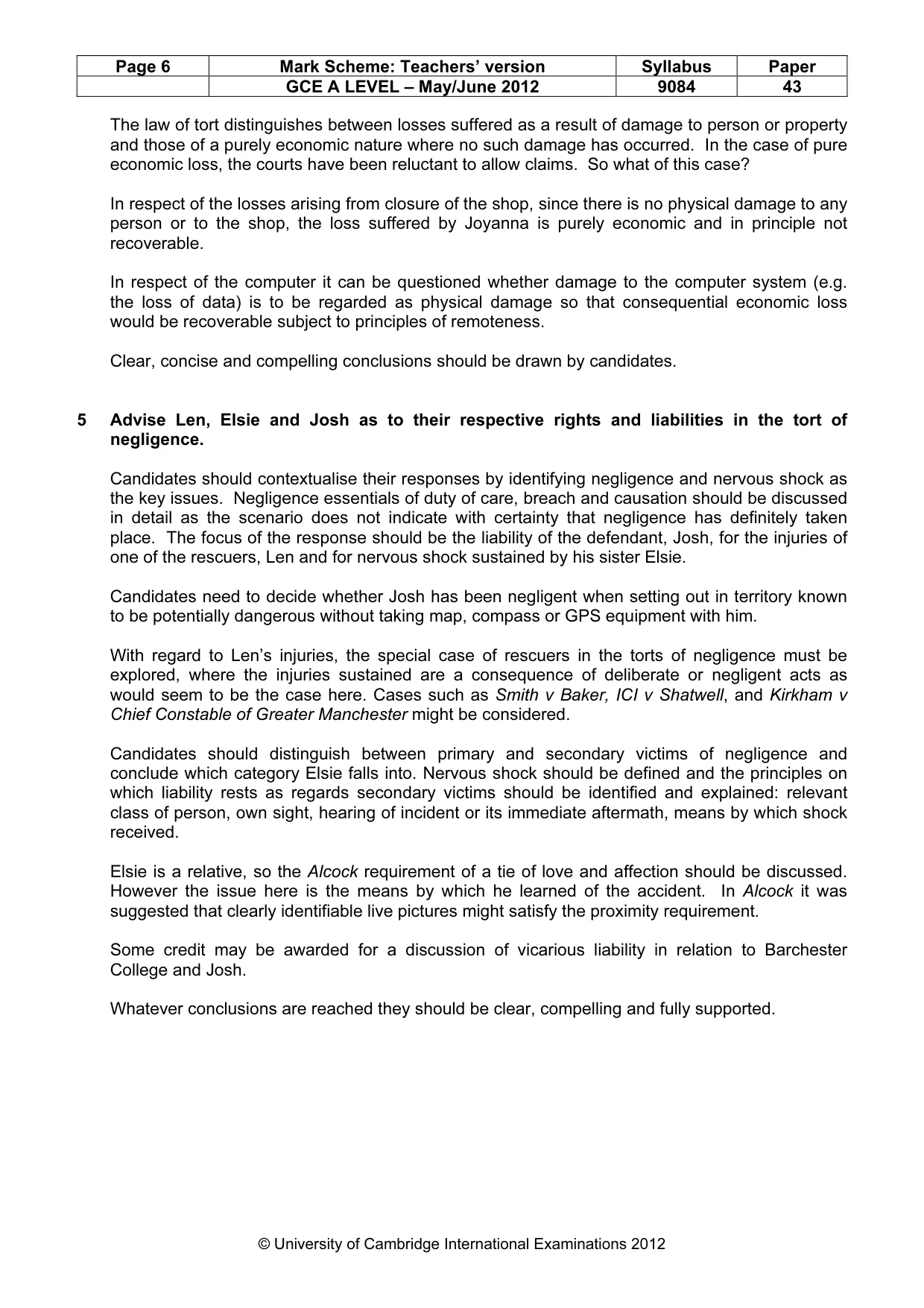
Page 6 Mark Scheme: Teachers’ version Syllabus Paper GCE A LEVEL – May/June 2012 9084 43 © University of Cambridge International Examinations 2012 The law of tort distinguishes between losses suffered as a result of damage to person or property and those of a purely economic nature where no such damage has occurred. In the case of pure economic loss, the courts have been reluctant to allow claims. So what of this case? In respect of the losses arising from closure of the shop, since there is no physical damage to any person or to the shop, the loss suffered by Joyanna is purely economic and in principle not recoverable. In respect of the computer it can be questioned whether damage to the computer system (e.g. the loss of data) is to be regarded as physical damage so that consequential economic loss would be recoverable subject to principles of remoteness. Clear, concise and compelling conclusions should be drawn by candidates. 5 Advise Len, Elsie and Josh as to their respective rights and liabilities in the tort of negligence. Candidates should contextualise their responses by identifying negligence and nervous shock as the key issues. Negligence essentials of duty of care, breach and causation should be discussed in detail as the scenario does not indicate with certainty that negligence has definitely taken place. The focus of the response should be the liability of the defendant, Josh, for the injuries of one of the rescuers, Len and for nervous shock sustained by his sister Elsie. Candidates need to decide whether Josh has been negligent when setting out in territory known to be potentially dangerous without taking map, compass or GPS equipment with him. With regard to Len’s injuries, the special case of rescuers in the torts of negligence must be explored, where the injuries sustained are a consequence of deliberate or negligent acts as would seem to be the case here. Cases such as Smith v Baker, ICI v Shatwell, and Kirkham v Chief Constable of Greater Manchester might be considered. Candidates should distinguish between primary and secondary victims of negligence and conclude which category Elsie falls into. Nervous shock should be defined and the principles on which liability rests as regards secondary victims should be identified and explained: relevant class of person, own sight, hearing of incident or its immediate aftermath, means by which shock received. Elsie is a relative, so the Alcock requirement of a tie of love and affection should be discussed. However the issue here is the means by which he learned of the accident. In Alcock it was suggested that clearly identifiable live pictures might satisfy the proximity requirement. Some credit may be awarded for a discussion of vicarious liability in relation to Barchester College and Josh. Whatever conclusions are reached they should be clear, compelling and fully supported.
Mark scheme, page 7
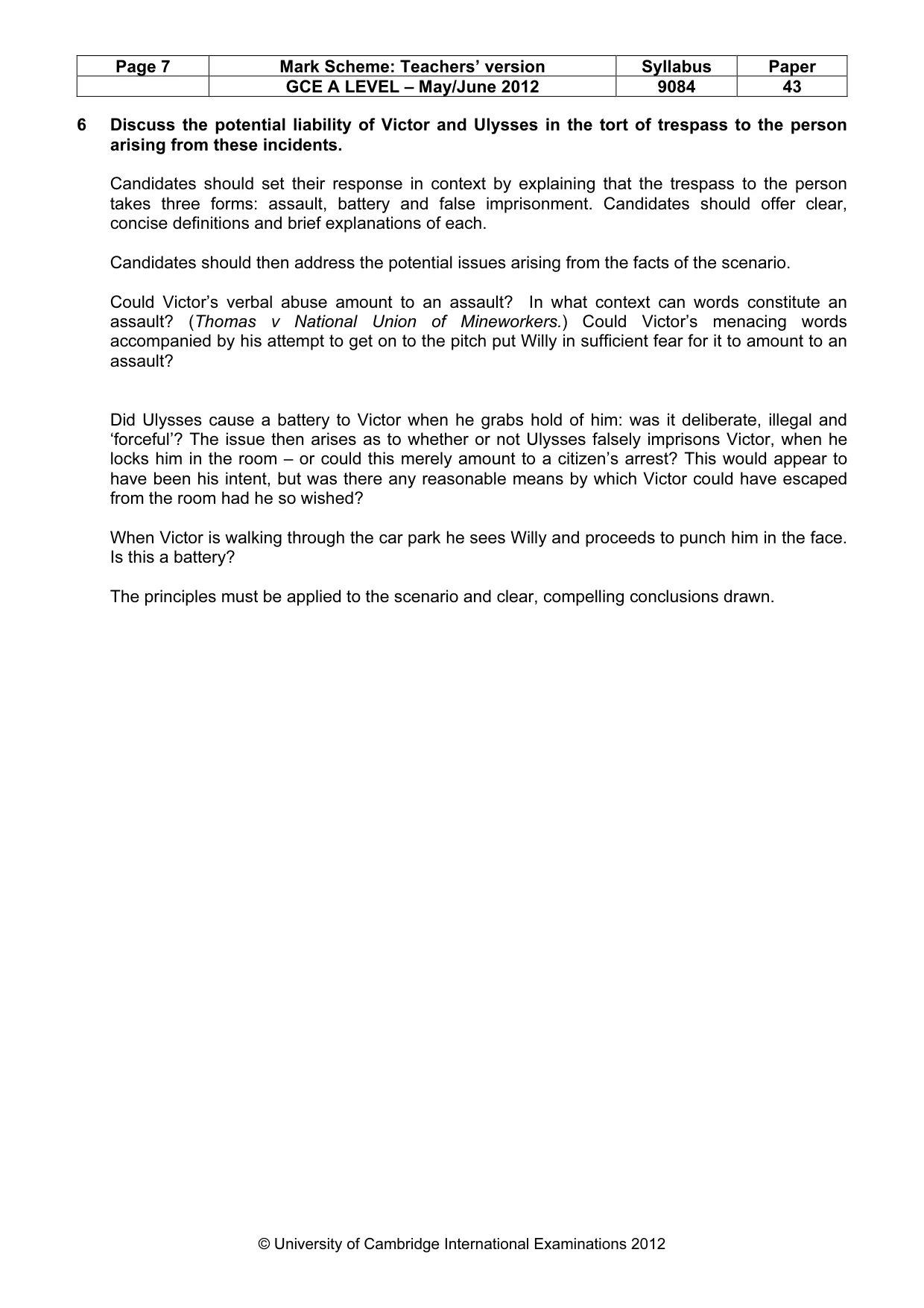
Page 7 Mark Scheme: Teachers’ version Syllabus Paper GCE A LEVEL – May/June 2012 9084 43 © University of Cambridge International Examinations 2012 6 Discuss the potential liability of Victor and Ulysses in the tort of trespass to the person arising from these incidents. Candidates should set their response in context by explaining that the trespass to the person takes three forms: assault, battery and false imprisonment. Candidates should offer clear, concise definitions and brief explanations of each. Candidates should then address the potential issues arising from the facts of the scenario. Could Victor’s verbal abuse amount to an assault? In what context can words constitute an assault? (Thomas v National Union of Mineworkers.) Could Victor’s menacing words accompanied by his attempt to get on to the pitch put Willy in sufficient fear for it to amount to an assault? Did Ulysses cause a battery to Victor when he grabs hold of him: was it deliberate, illegal and ‘forceful’? The issue then arises as to whether or not Ulysses falsely imprisons Victor, when he locks him in the room – or could this merely amount to a citizen’s arrest? This would appear to have been his intent, but was there any reasonable means by which Victor could have escaped from the room had he so wished? When Victor is walking through the car park he sees Willy and proceeds to punch him in the face. Is this a battery? The principles must be applied to the scenario and clear, compelling conclusions drawn.
What you needed in this session
Cambridge’s own grade thresholds for 2012 May/June, Paper 4 · Variant 3. A higher threshold means an easier paper — the bar moves with how the cohort did.