Cambridge A Level Law 9084 — 2012 May/June Paper 3 · Variant 1
9084/31/M/J/12 · 75 marks · ≈84 min
The question paper and its mark scheme, free to read here and free to download. This is Cambridge’s own paper, exactly as it was sat.
Question paper4 pages
Mark scheme7 pages
Answers below. Sit the paper first if you are practising.
Paper as text
Question paper, page 1
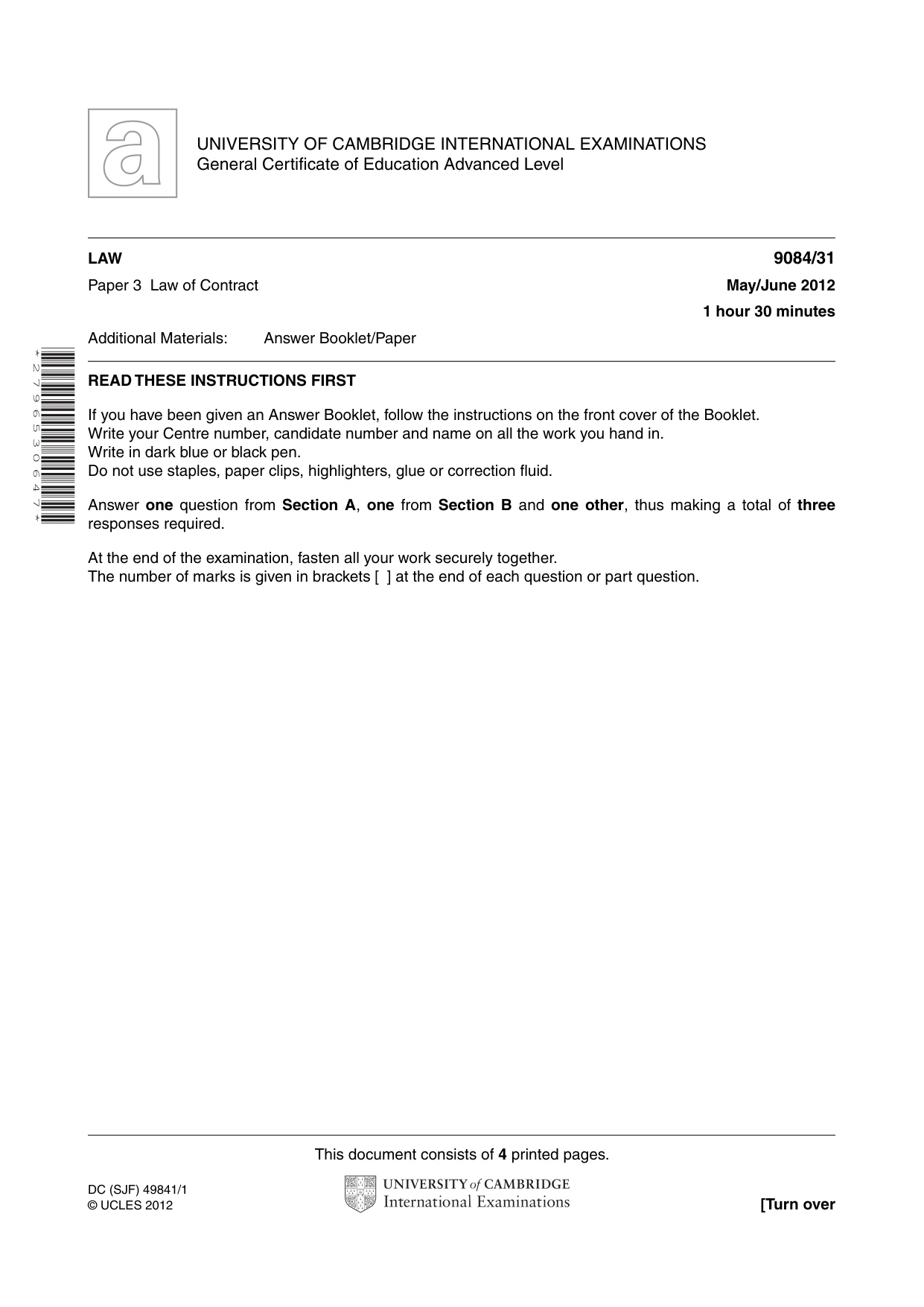
This document consists of 4 printed pages. DC (SJF) 49841/1 © UCLES 2012 [Turn over UNIVERSITY OF CAMBRIDGE INTERNATIONAL EXAMINATIONS General Certificate of Education Advanced Level * 2 7 9 6 5 3 0 6 4 7 * LAW 9084/31 Paper 3 Law of Contract May/June 2012 1 hour 30 minutes Additional Materials: Answer Booklet/Paper READ THESE INSTRUCTIONS FIRST If you have been given an Answer Booklet, follow the instructions on the front cover of the Booklet. Write your Centre number, candidate number and name on all the work you hand in. Write in dark blue or black pen. Do not use staples, paper clips, highlighters, glue or correction fluid. Answer one question from Section A, one from Section B and one other, thus making a total of three responses required. At the end of the examination, fasten all your work securely together. The number of marks is given in brackets [ ] at the end of each question or part question.
Question paper, page 2
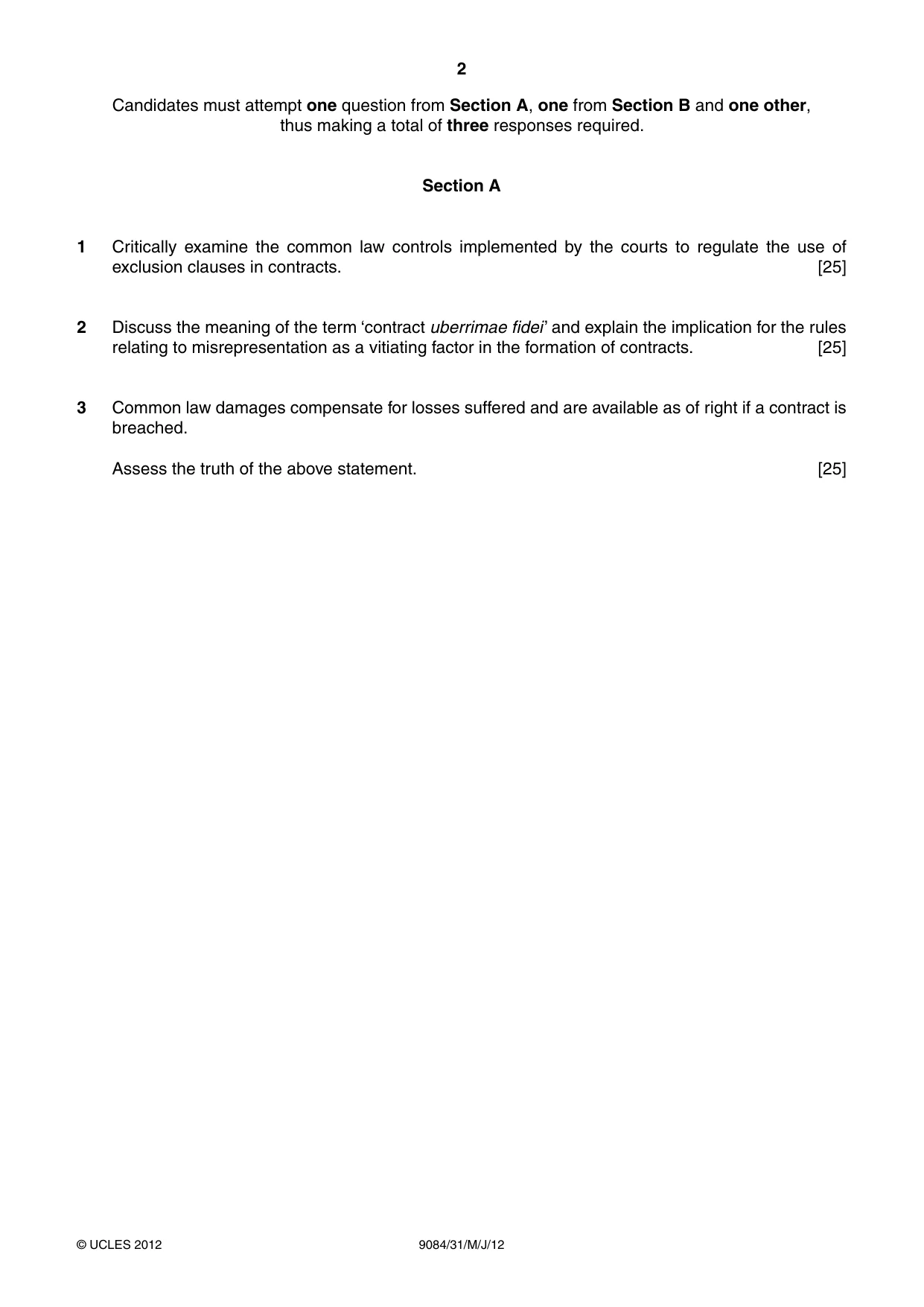
2 9084/31/M/J/12 © UCLES 2012 Candidates must attempt one question from Section A, one from Section B and one other, thus making a total of three responses required. Section A 1 Critically examine the common law controls implemented by the courts to regulate the use of exclusion clauses in contracts. [25] 2 Discuss the meaning of the term ‘contract uberrimae fidei’ and explain the implication for the rules relating to misrepresentation as a vitiating factor in the formation of contracts. [25] 3 Common law damages compensate for losses suffered and are available as of right if a contract is breached. Assess the truth of the above statement. [25]
Question paper, page 3
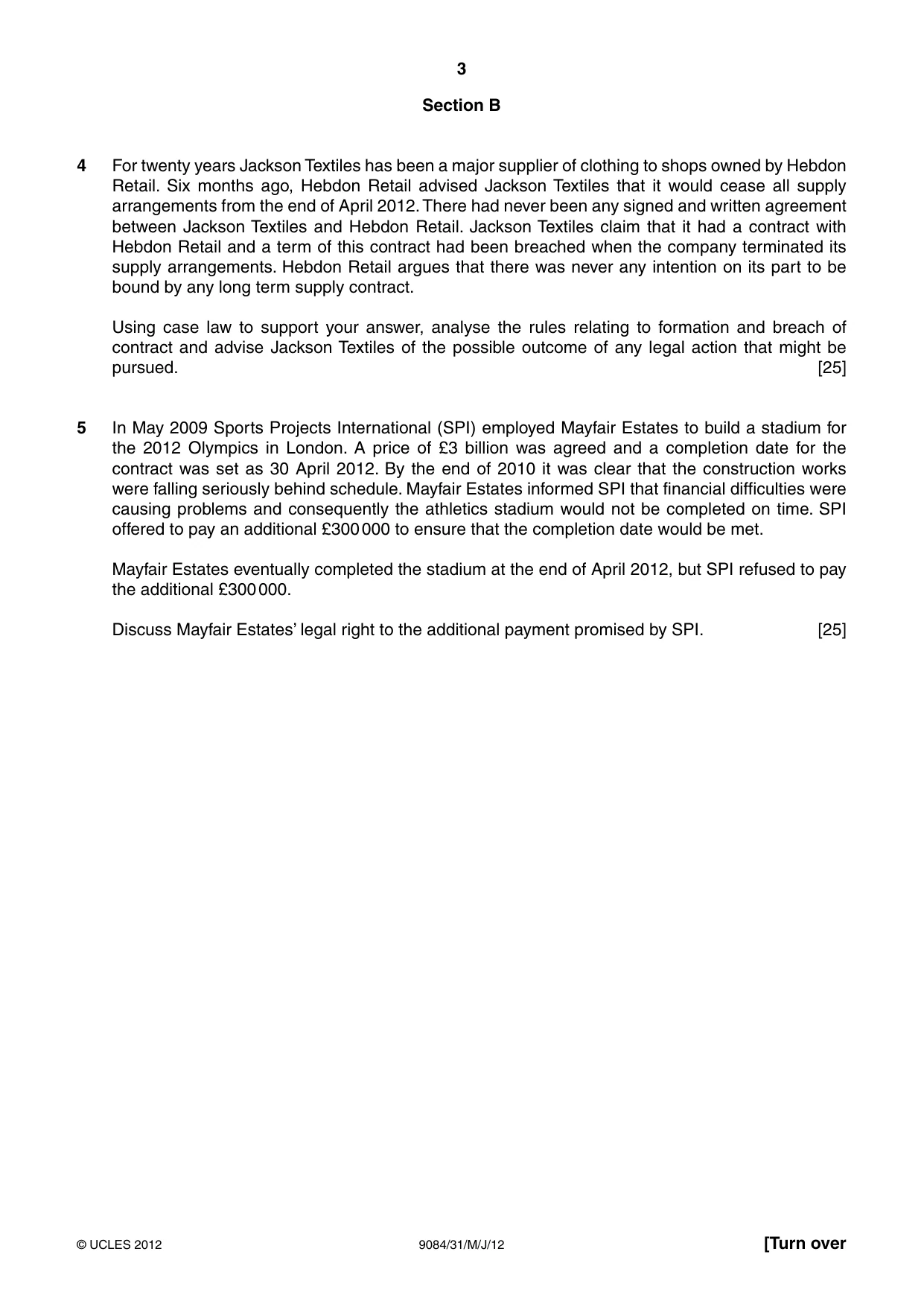
3 9084/31/M/J/12 © UCLES 2012 [Turn over Section B 4 For twenty years Jackson Textiles has been a major supplier of clothing to shops owned by Hebdon Retail. Six months ago, Hebdon Retail advised Jackson Textiles that it would cease all supply arrangements from the end of April 2012. There had never been any signed and written agreement between Jackson Textiles and Hebdon Retail. Jackson Textiles claim that it had a contract with Hebdon Retail and a term of this contract had been breached when the company terminated its supply arrangements. Hebdon Retail argues that there was never any intention on its part to be bound by any long term supply contract. Using case law to support your answer, analyse the rules relating to formation and breach of contract and advise Jackson Textiles of the possible outcome of any legal action that might be pursued. [25] 5 In May 2009 Sports Projects International (SPI) employed Mayfair Estates to build a stadium for the 2012 Olympics in London. A price of £3 billion was agreed and a completion date for the contract was set as 30 April 2012. By the end of 2010 it was clear that the construction works were falling seriously behind schedule. Mayfair Estates informed SPI that financial difficulties were causing problems and consequently the athletics stadium would not be completed on time. SPI offered to pay an additional £300 000 to ensure that the completion date would be met. Mayfair Estates eventually completed the stadium at the end of April 2012, but SPI refused to pay the additional £300 000. Discuss Mayfair Estates’ legal right to the additional payment promised by SPI. [25]
Question paper, page 4
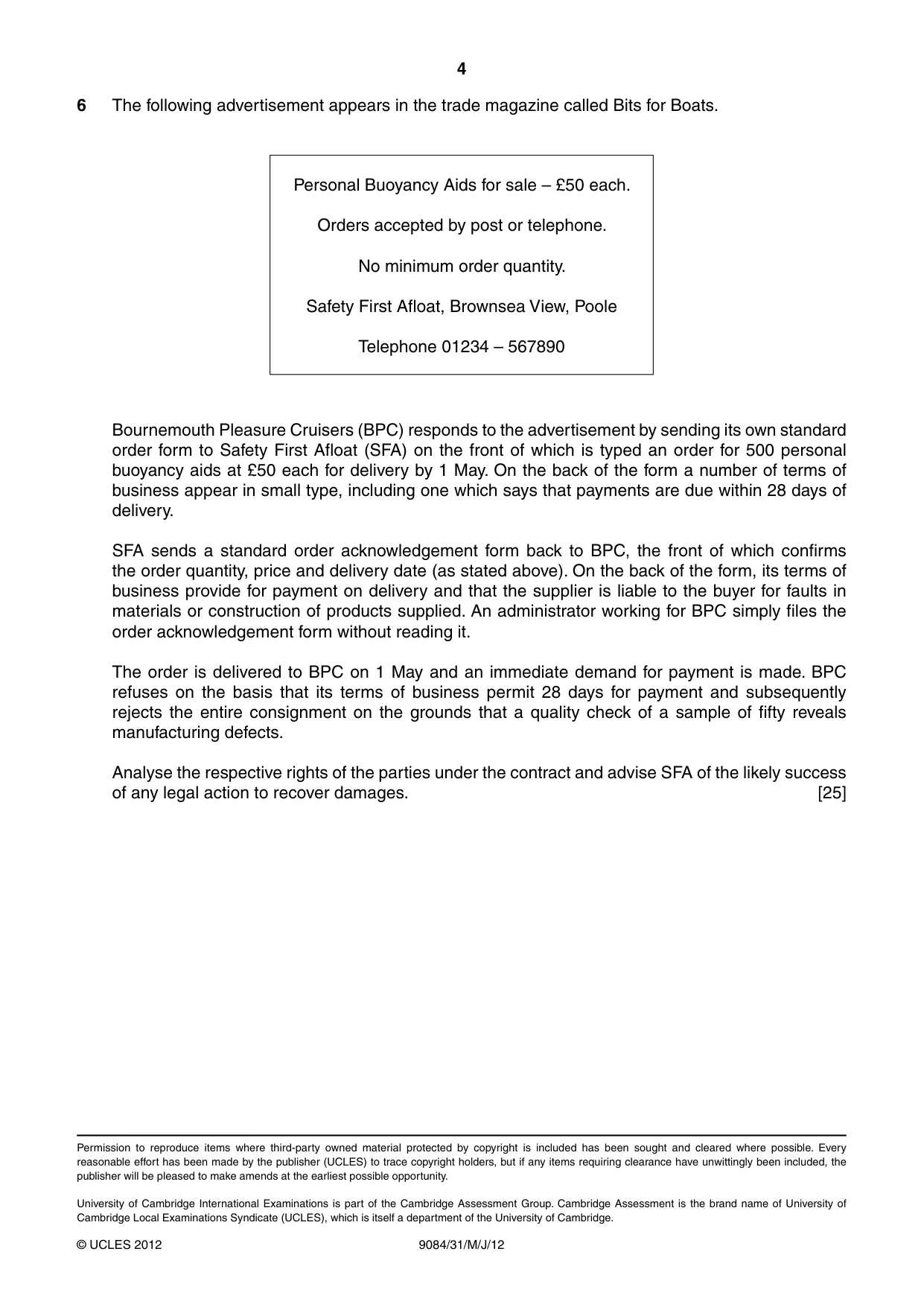
4 9084/31/M/J/12 © UCLES 2012 Permission to reproduce items where third-party owned material protected by copyright is included has been sought and cleared where possible. Every reasonable effort has been made by the publisher (UCLES) to trace copyright holders, but if any items requiring clearance have unwittingly been included, the publisher will be pleased to make amends at the earliest possible opportunity. University of Cambridge International Examinations is part of the Cambridge Assessment Group. Cambridge Assessment is the brand name of University of Cambridge Local Examinations Syndicate (UCLES), which is itself a department of the University of Cambridge. 6 The following advertisement appears in the trade magazine called Bits for Boats. Personal Buoyancy Aids for sale – £50 each. Orders accepted by post or telephone. No minimum order quantity. Safety First Afloat, Brownsea View, Poole Telephone 01234 – 567890 Bournemouth Pleasure Cruisers (BPC) responds to the advertisement by sending its own standard order form to Safety First Afloat (SFA) on the front of which is typed an order for 500 personal buoyancy aids at £50 each for delivery by 1 May. On the back of the form a number of terms of business appear in small type, including one which says that payments are due within 28 days of delivery. SFA sends a standard order acknowledgement form back to BPC, the front of which confirms the order quantity, price and delivery date (as stated above). On the back of the form, its terms of business provide for payment on delivery and that the supplier is liable to the buyer for faults in materials or construction of products supplied. An administrator working for BPC simply files the order acknowledgement form without reading it. The order is delivered to BPC on 1 May and an immediate demand for payment is made. BPC refuses on the basis that its terms of business permit 28 days for payment and subsequently rejects the entire consignment on the grounds that a quality check of a sample of fifty reveals manufacturing defects. Analyse the respective rights of the parties under the contract and advise SFA of the likely success of any legal action to recover damages. [25]
Mark scheme, page 1
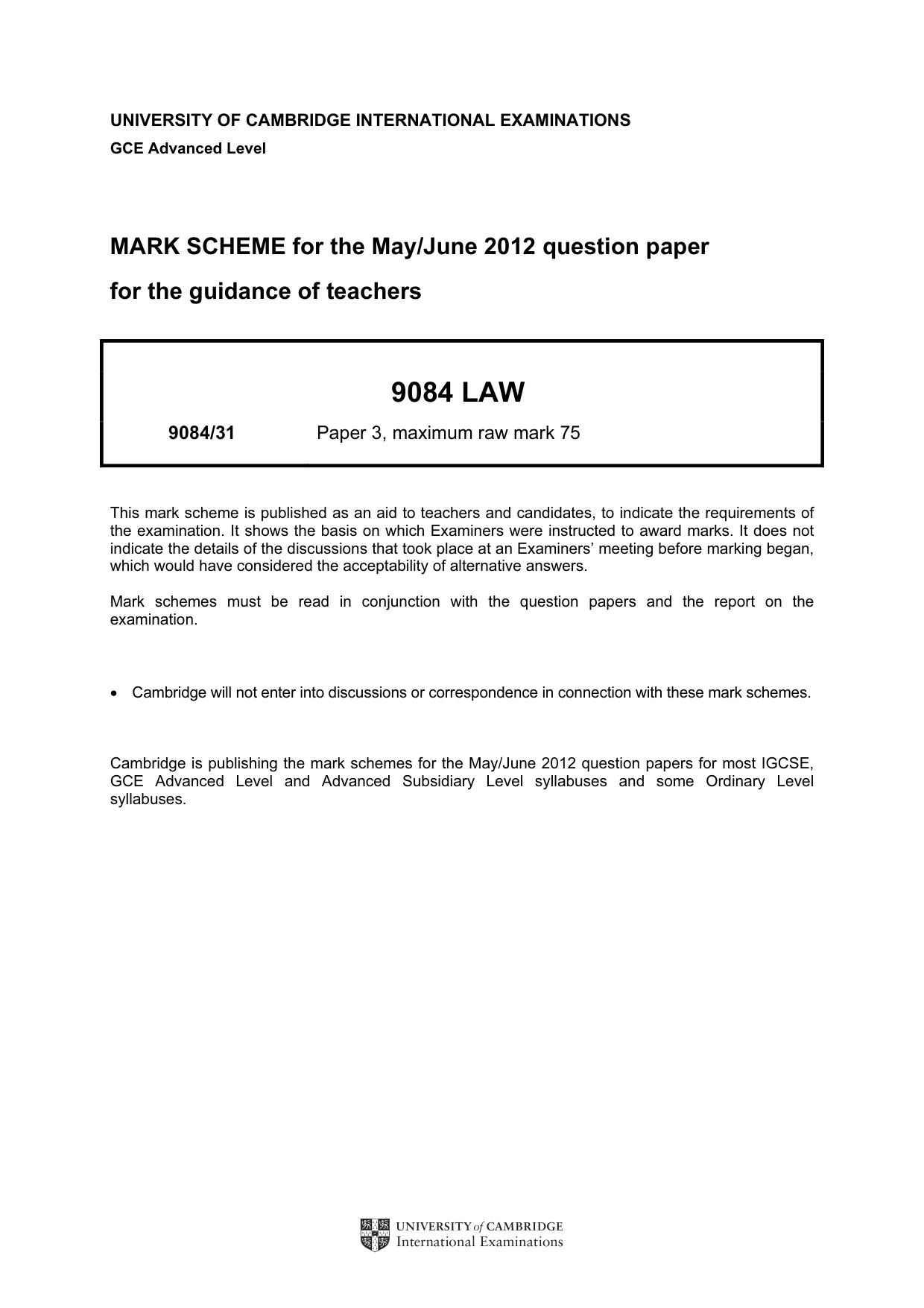
UNIVERSITY OF CAMBRIDGE INTERNATIONAL EXAMINATIONS GCE Advanced Level MARK SCHEME for the May/June 2012 question paper for the guidance of teachers 9084 LAW 9084/31 Paper 3, maximum raw mark 75 This mark scheme is published as an aid to teachers and candidates, to indicate the requirements of the examination. It shows the basis on which Examiners were instructed to award marks. It does not indicate the details of the discussions that took place at an Examiners’ meeting before marking began, which would have considered the acceptability of alternative answers. Mark schemes must be read in conjunction with the question papers and the report on the examination. • Cambridge will not enter into discussions or correspondence in connection with these mark schemes. Cambridge is publishing the mark schemes for the May/June 2012 question papers for most IGCSE, GCE Advanced Level and Advanced Subsidiary Level syllabuses and some Ordinary Level syllabuses.
Mark scheme, page 2
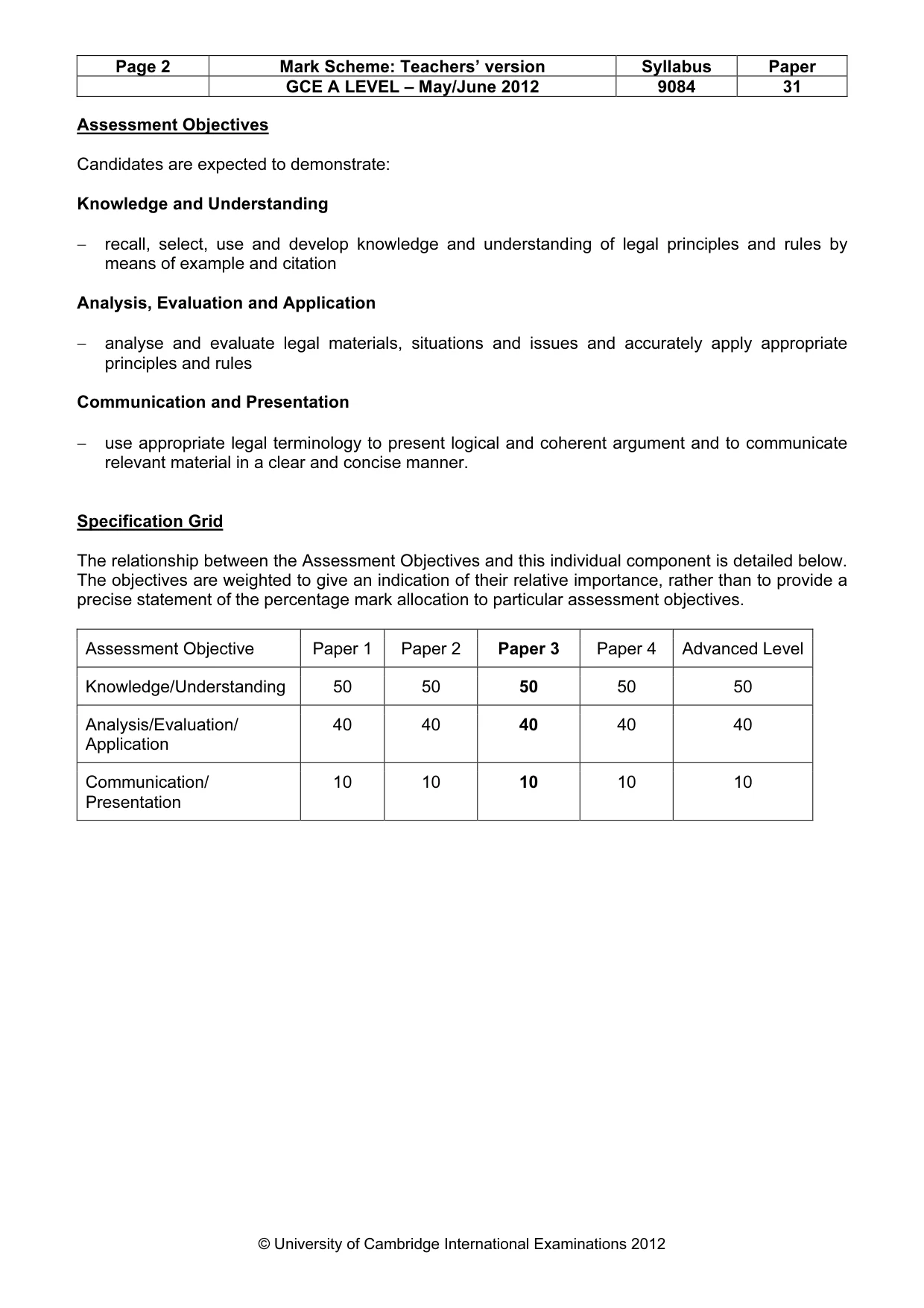
Page 2 Mark Scheme: Teachers’ version Syllabus Paper GCE A LEVEL – May/June 2012 9084 31 © University of Cambridge International Examinations 2012 Assessment Objectives Candidates are expected to demonstrate: Knowledge and Understanding − recall, select, use and develop knowledge and understanding of legal principles and rules by means of example and citation Analysis, Evaluation and Application − analyse and evaluate legal materials, situations and issues and accurately apply appropriate principles and rules Communication and Presentation − use appropriate legal terminology to present logical and coherent argument and to communicate relevant material in a clear and concise manner. Specification Grid The relationship between the Assessment Objectives and this individual component is detailed below. The objectives are weighted to give an indication of their relative importance, rather than to provide a precise statement of the percentage mark allocation to particular assessment objectives. Assessment Objective Paper 1 Paper 2 Paper 3 Paper 4 Advanced Level Knowledge/Understanding 50 50 50 50 50 Analysis/Evaluation/ Application 40 40 40 40 40 Communication/ Presentation 10 10 10 10 10
Mark scheme, page 3
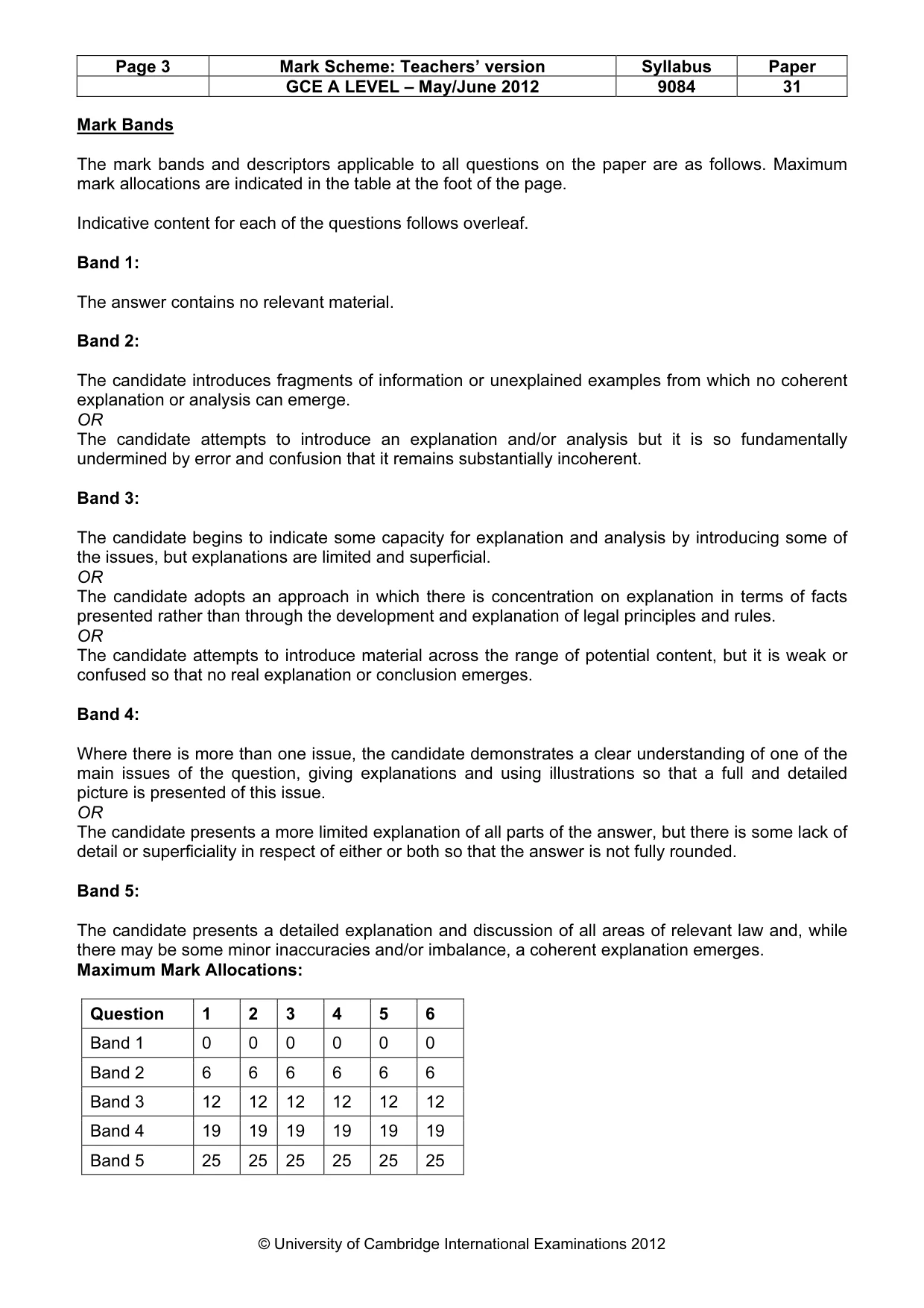
Page 3 Mark Scheme: Teachers’ version Syllabus Paper GCE A LEVEL – May/June 2012 9084 31 © University of Cambridge International Examinations 2012 Mark Bands The mark bands and descriptors applicable to all questions on the paper are as follows. Maximum mark allocations are indicated in the table at the foot of the page. Indicative content for each of the questions follows overleaf. Band 1: The answer contains no relevant material. Band 2: The candidate introduces fragments of information or unexplained examples from which no coherent explanation or analysis can emerge. OR The candidate attempts to introduce an explanation and/or analysis but it is so fundamentally undermined by error and confusion that it remains substantially incoherent. Band 3: The candidate begins to indicate some capacity for explanation and analysis by introducing some of the issues, but explanations are limited and superficial. OR The candidate adopts an approach in which there is concentration on explanation in terms of facts presented rather than through the development and explanation of legal principles and rules. OR The candidate attempts to introduce material across the range of potential content, but it is weak or confused so that no real explanation or conclusion emerges. Band 4: Where there is more than one issue, the candidate demonstrates a clear understanding of one of the main issues of the question, giving explanations and using illustrations so that a full and detailed picture is presented of this issue. OR The candidate presents a more limited explanation of all parts of the answer, but there is some lack of detail or superficiality in respect of either or both so that the answer is not fully rounded. Band 5: The candidate presents a detailed explanation and discussion of all areas of relevant law and, while there may be some minor inaccuracies and/or imbalance, a coherent explanation emerges. Maximum Mark Allocations: Question 1 2 3 4 5 6 Band 1 0 0 0 0 0 0 Band 2 6 6 6 6 6 6 Band 3 12 12 12 12 12 12 Band 4 19 19 19 19 19 19 Band 5 25 25 25 25 25 25
Mark scheme, page 4
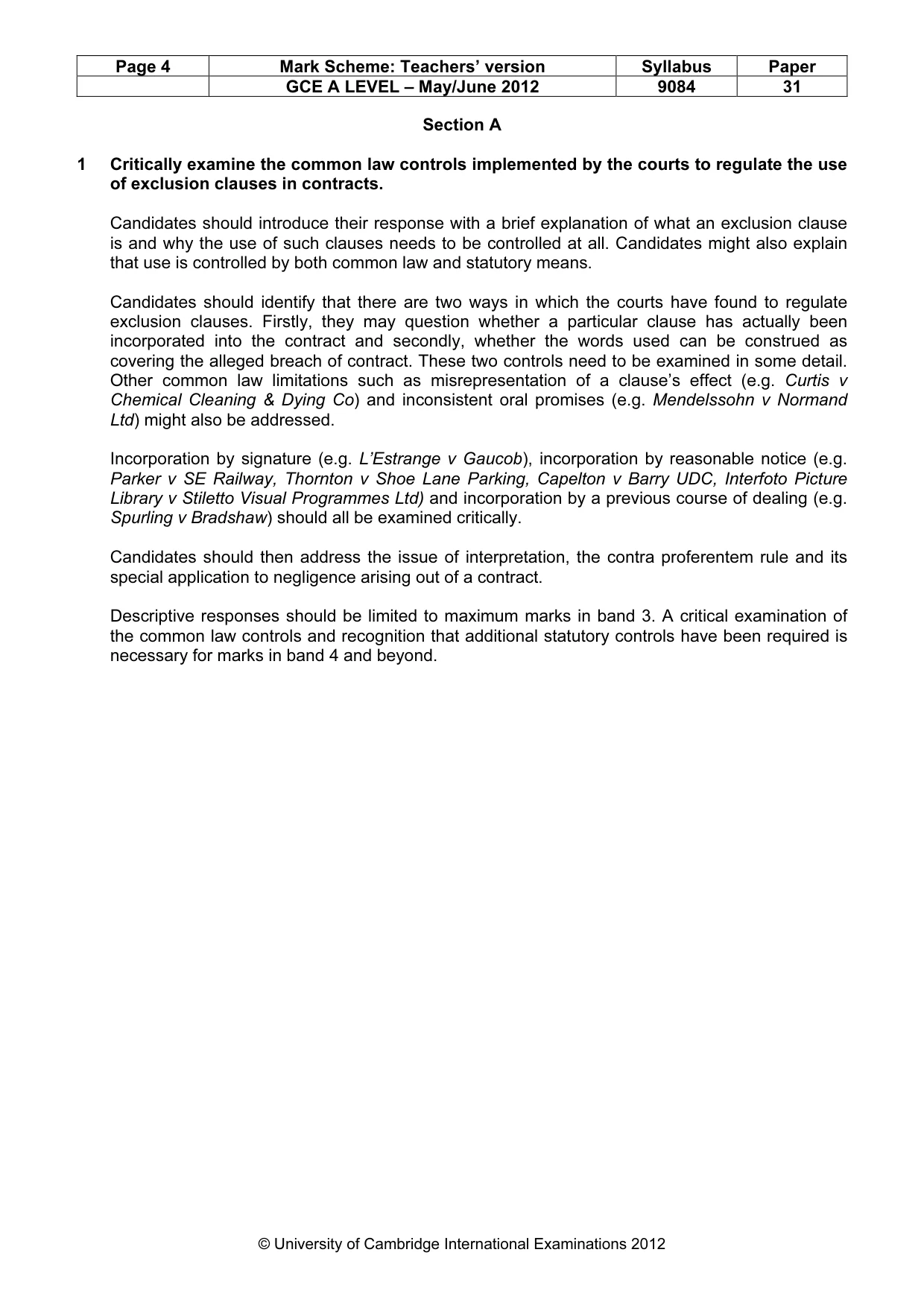
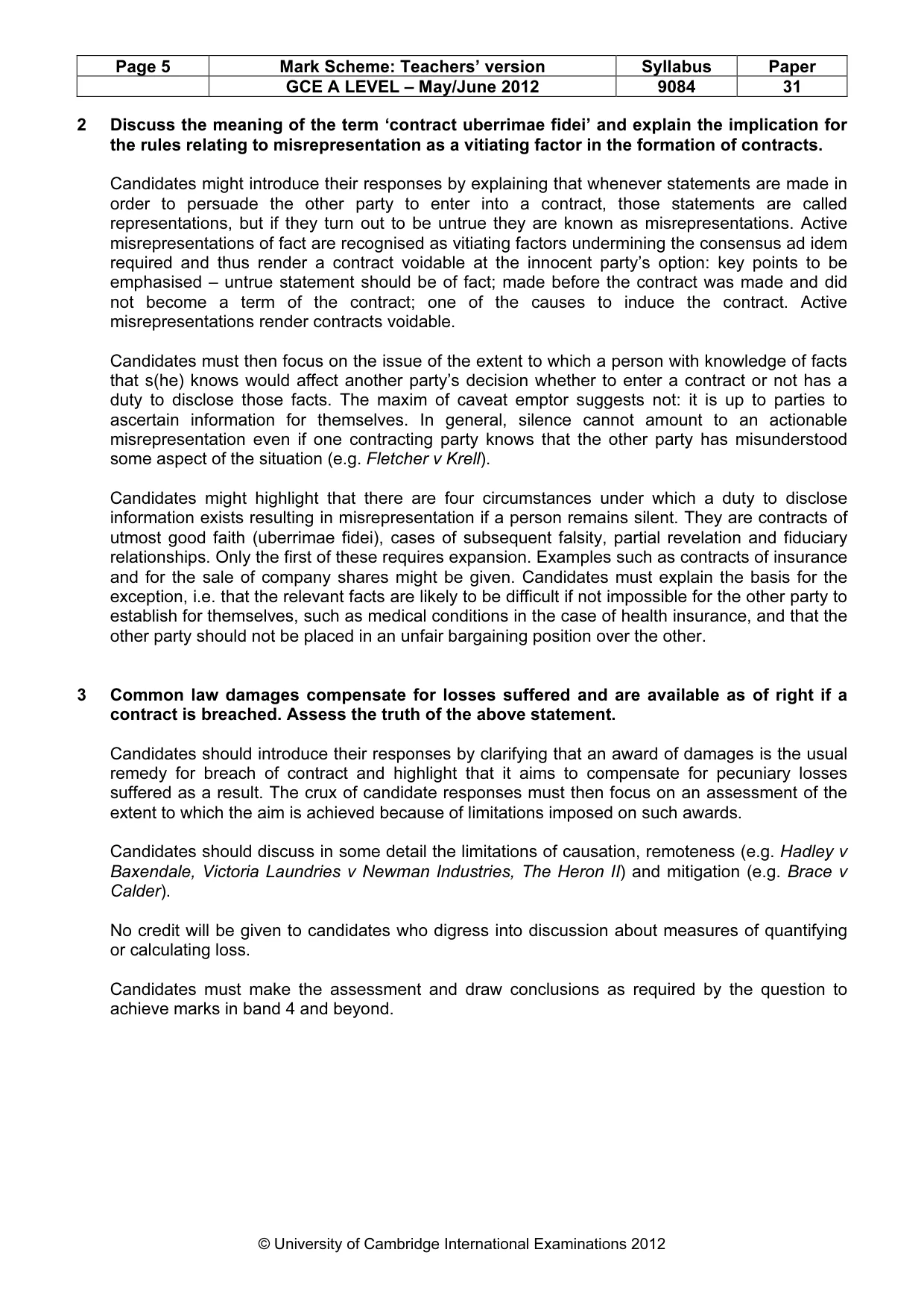
Page 4 Mark Scheme: Teachers’ version Syllabus Paper GCE A LEVEL – May/June 2012 9084 31 © University of Cambridge International Examinations 2012 Section A 1 Critically examine the common law controls implemented by the courts to regulate the use of exclusion clauses in contracts. Candidates should introduce their response with a brief explanation of what an exclusion clause is and why the use of such clauses needs to be controlled at all. Candidates might also explain that use is controlled by both common law and statutory means. Candidates should identify that there are two ways in which the courts have found to regulate exclusion clauses. Firstly, they may question whether a particular clause has actually been incorporated into the contract and secondly, whether the words used can be construed as covering the alleged breach of contract. These two controls need to be examined in some detail. Other common law limitations such as misrepresentation of a clause’s effect (e.g. Curtis v Chemical Cleaning & Dying Co) and inconsistent oral promises (e.g. Mendelssohn v Normand Ltd) might also be addressed. Incorporation by signature (e.g. L’Estrange v Gaucob), incorporation by reasonable notice (e.g. Parker v SE Railway, Thornton v Shoe Lane Parking, Capelton v Barry UDC, Interfoto Picture Library v Stiletto Visual Programmes Ltd) and incorporation by a previous course of dealing (e.g. Spurling v Bradshaw) should all be examined critically. Candidates should then address the issue of interpretation, the contra proferentem rule and its special application to negligence arising out of a contract. Descriptive responses should be limited to maximum marks in band 3. A critical examination of the common law controls and recognition that additional statutory controls have been required is necessary for marks in band 4 and beyond.
Mark scheme, page 5
Page 5 Mark Scheme: Teachers’ version Syllabus Paper GCE A LEVEL – May/June 2012 9084 31 © University of Cambridge International Examinations 2012 2 Discuss the meaning of the term ‘contract uberrimae fidei’ and explain the implication for the rules relating to misrepresentation as a vitiating factor in the formation of contracts. Candidates might introduce their responses by explaining that whenever statements are made in order to persuade the other party to enter into a contract, those statements are called representations, but if they turn out to be untrue they are known as misrepresentations. Active misrepresentations of fact are recognised as vitiating factors undermining the consensus ad idem required and thus render a contract voidable at the innocent party’s option: key points to be emphasised – untrue statement should be of fact; made before the contract was made and did not become a term of the contract; one of the causes to induce the contract. Active misrepresentations render contracts voidable. Candidates must then focus on the issue of the extent to which a person with knowledge of facts that s(he) knows would affect another party’s decision whether to enter a contract or not has a duty to disclose those facts. The maxim of caveat emptor suggests not: it is up to parties to ascertain information for themselves. In general, silence cannot amount to an actionable misrepresentation even if one contracting party knows that the other party has misunderstood some aspect of the situation (e.g. Fletcher v Krell). Candidates might highlight that there are four circumstances under which a duty to disclose information exists resulting in misrepresentation if a person remains silent. They are contracts of utmost good faith (uberrimae fidei), cases of subsequent falsity, partial revelation and fiduciary relationships. Only the first of these requires expansion. Examples such as contracts of insurance and for the sale of company shares might be given. Candidates must explain the basis for the exception, i.e. that the relevant facts are likely to be difficult if not impossible for the other party to establish for themselves, such as medical conditions in the case of health insurance, and that the other party should not be placed in an unfair bargaining position over the other. 3 Common law damages compensate for losses suffered and are available as of right if a contract is breached. Assess the truth of the above statement. Candidates should introduce their responses by clarifying that an award of damages is the usual remedy for breach of contract and highlight that it aims to compensate for pecuniary losses suffered as a result. The crux of candidate responses must then focus on an assessment of the extent to which the aim is achieved because of limitations imposed on such awards. Candidates should discuss in some detail the limitations of causation, remoteness (e.g. Hadley v Baxendale, Victoria Laundries v Newman Industries, The Heron II) and mitigation (e.g. Brace v Calder). No credit will be given to candidates who digress into discussion about measures of quantifying or calculating loss. Candidates must make the assessment and draw conclusions as required by the question to achieve marks in band 4 and beyond.
Mark scheme, page 6
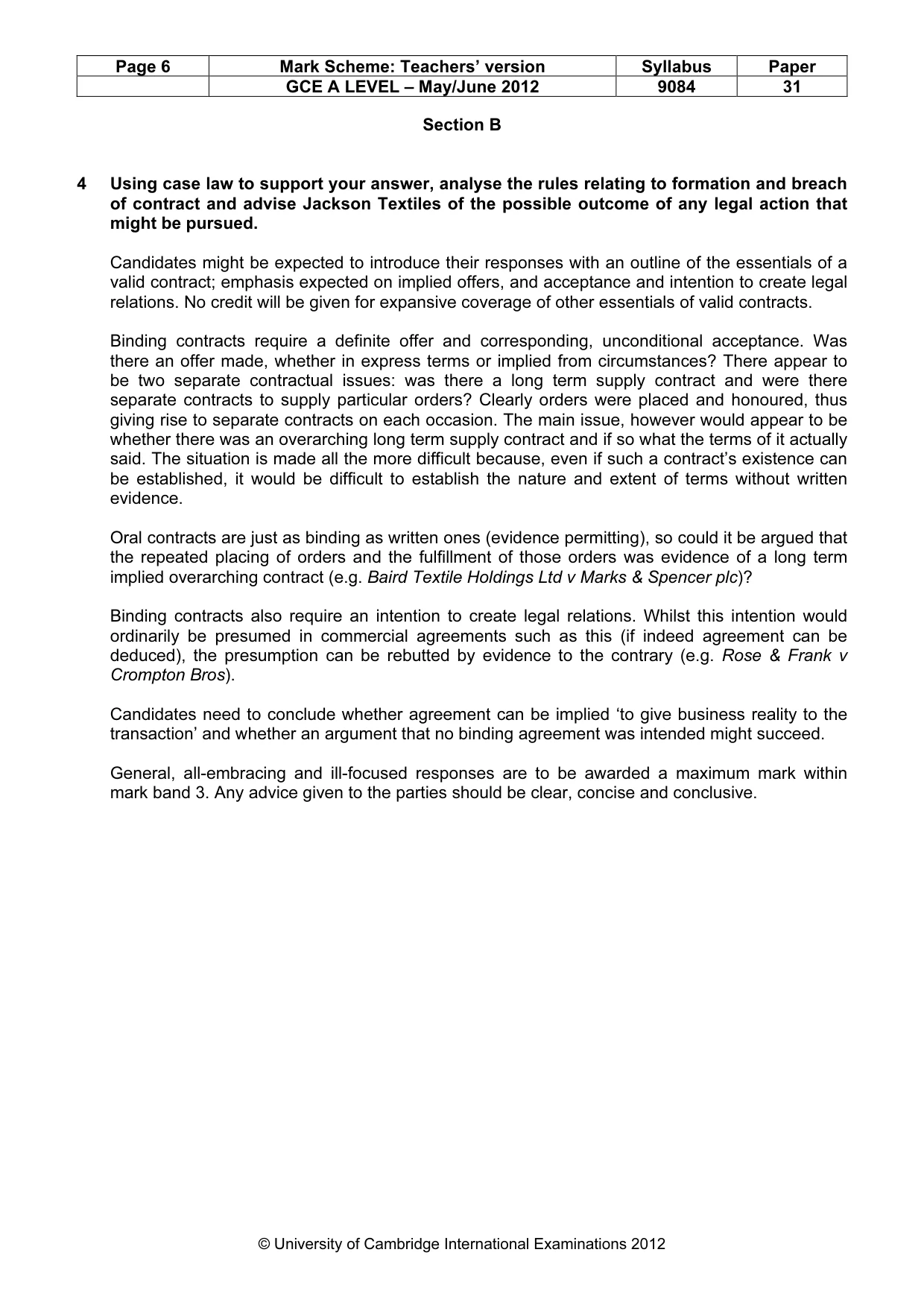
Page 6 Mark Scheme: Teachers’ version Syllabus Paper GCE A LEVEL – May/June 2012 9084 31 © University of Cambridge International Examinations 2012 Section B 4 Using case law to support your answer, analyse the rules relating to formation and breach of contract and advise Jackson Textiles of the possible outcome of any legal action that might be pursued. Candidates might be expected to introduce their responses with an outline of the essentials of a valid contract; emphasis expected on implied offers, and acceptance and intention to create legal relations. No credit will be given for expansive coverage of other essentials of valid contracts. Binding contracts require a definite offer and corresponding, unconditional acceptance. Was there an offer made, whether in express terms or implied from circumstances? There appear to be two separate contractual issues: was there a long term supply contract and were there separate contracts to supply particular orders? Clearly orders were placed and honoured, thus giving rise to separate contracts on each occasion. The main issue, however would appear to be whether there was an overarching long term supply contract and if so what the terms of it actually said. The situation is made all the more difficult because, even if such a contract’s existence can be established, it would be difficult to establish the nature and extent of terms without written evidence. Oral contracts are just as binding as written ones (evidence permitting), so could it be argued that the repeated placing of orders and the fulfillment of those orders was evidence of a long term implied overarching contract (e.g. Baird Textile Holdings Ltd v Marks & Spencer plc)? Binding contracts also require an intention to create legal relations. Whilst this intention would ordinarily be presumed in commercial agreements such as this (if indeed agreement can be deduced), the presumption can be rebutted by evidence to the contrary (e.g. Rose & Frank v Crompton Bros). Candidates need to conclude whether agreement can be implied ‘to give business reality to the transaction’ and whether an argument that no binding agreement was intended might succeed. General, all-embracing and ill-focused responses are to be awarded a maximum mark within mark band 3. Any advice given to the parties should be clear, concise and conclusive.
Mark scheme, page 7
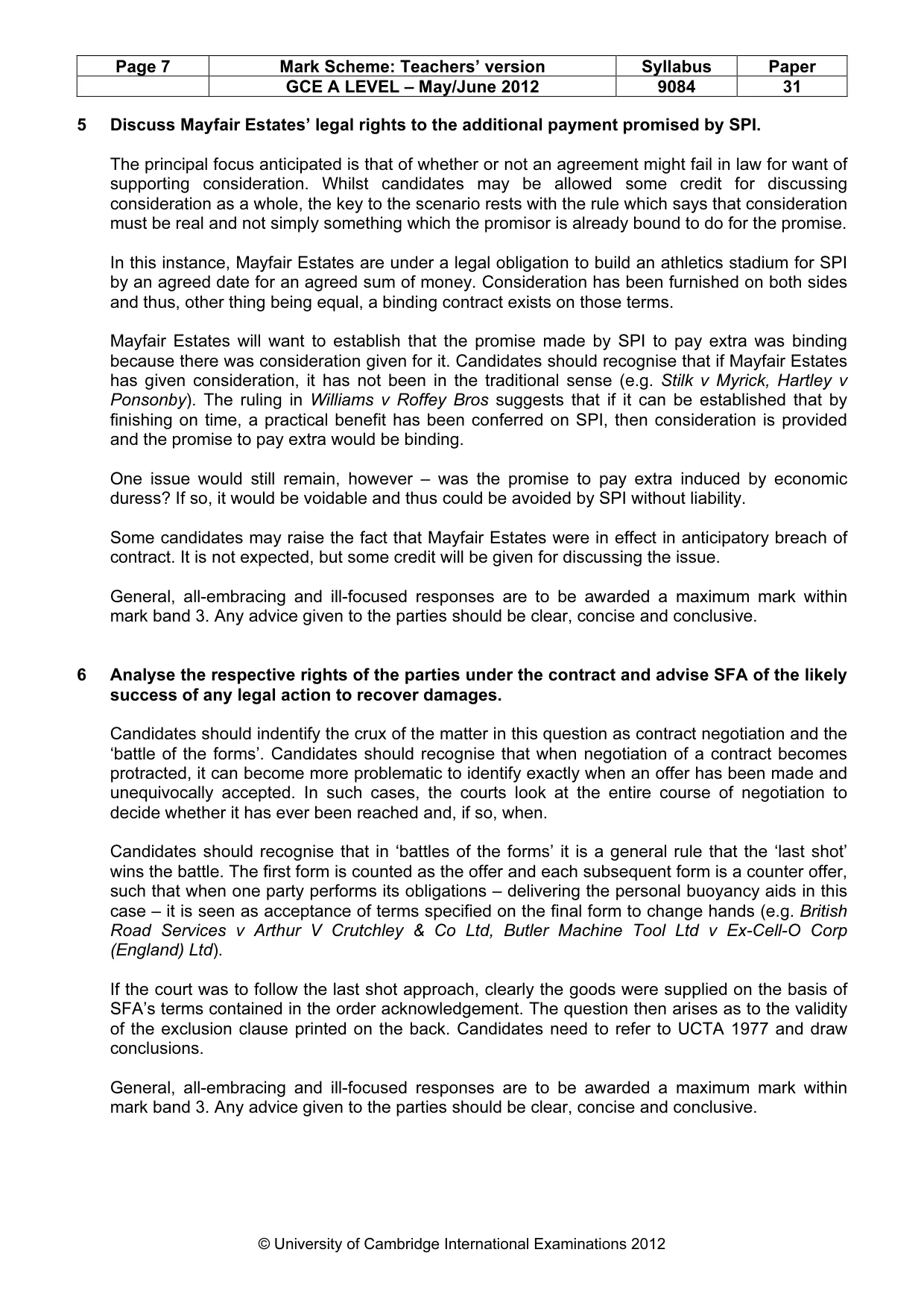
Page 7 Mark Scheme: Teachers’ version Syllabus Paper GCE A LEVEL – May/June 2012 9084 31 © University of Cambridge International Examinations 2012 5 Discuss Mayfair Estates’ legal rights to the additional payment promised by SPI. The principal focus anticipated is that of whether or not an agreement might fail in law for want of supporting consideration. Whilst candidates may be allowed some credit for discussing consideration as a whole, the key to the scenario rests with the rule which says that consideration must be real and not simply something which the promisor is already bound to do for the promise. In this instance, Mayfair Estates are under a legal obligation to build an athletics stadium for SPI by an agreed date for an agreed sum of money. Consideration has been furnished on both sides and thus, other thing being equal, a binding contract exists on those terms. Mayfair Estates will want to establish that the promise made by SPI to pay extra was binding because there was consideration given for it. Candidates should recognise that if Mayfair Estates has given consideration, it has not been in the traditional sense (e.g. Stilk v Myrick, Hartley v Ponsonby). The ruling in Williams v Roffey Bros suggests that if it can be established that by finishing on time, a practical benefit has been conferred on SPI, then consideration is provided and the promise to pay extra would be binding. One issue would still remain, however – was the promise to pay extra induced by economic duress? If so, it would be voidable and thus could be avoided by SPI without liability. Some candidates may raise the fact that Mayfair Estates were in effect in anticipatory breach of contract. It is not expected, but some credit will be given for discussing the issue. General, all-embracing and ill-focused responses are to be awarded a maximum mark within mark band 3. Any advice given to the parties should be clear, concise and conclusive. 6 Analyse the respective rights of the parties under the contract and advise SFA of the likely success of any legal action to recover damages. Candidates should indentify the crux of the matter in this question as contract negotiation and the ‘battle of the forms’. Candidates should recognise that when negotiation of a contract becomes protracted, it can become more problematic to identify exactly when an offer has been made and unequivocally accepted. In such cases, the courts look at the entire course of negotiation to decide whether it has ever been reached and, if so, when. Candidates should recognise that in ‘battles of the forms’ it is a general rule that the ‘last shot’ wins the battle. The first form is counted as the offer and each subsequent form is a counter offer, such that when one party performs its obligations – delivering the personal buoyancy aids in this case – it is seen as acceptance of terms specified on the final form to change hands (e.g. British Road Services v Arthur V Crutchley & Co Ltd, Butler Machine Tool Ltd v Ex-Cell-O Corp (England) Ltd). If the court was to follow the last shot approach, clearly the goods were supplied on the basis of SFA’s terms contained in the order acknowledgement. The question then arises as to the validity of the exclusion clause printed on the back. Candidates need to refer to UCTA 1977 and draw conclusions. General, all-embracing and ill-focused responses are to be awarded a maximum mark within mark band 3. Any advice given to the parties should be clear, concise and conclusive.
What you needed in this session
Cambridge’s own grade thresholds for 2012 May/June, Paper 3 · Variant 1. A higher threshold means an easier paper — the bar moves with how the cohort did.