Cambridge A Level Law 9084 — 2011 Oct/Nov Paper 4 · Variant 1
9084/41/O/N/11 · 75 marks · ≈84 min
The question paper and its mark scheme, free to read here and free to download. This is Cambridge’s own paper, exactly as it was sat.
Question paper4 pages

Mark scheme7 pages
Answers below. Sit the paper first if you are practising.
Paper as text
Question paper, page 1
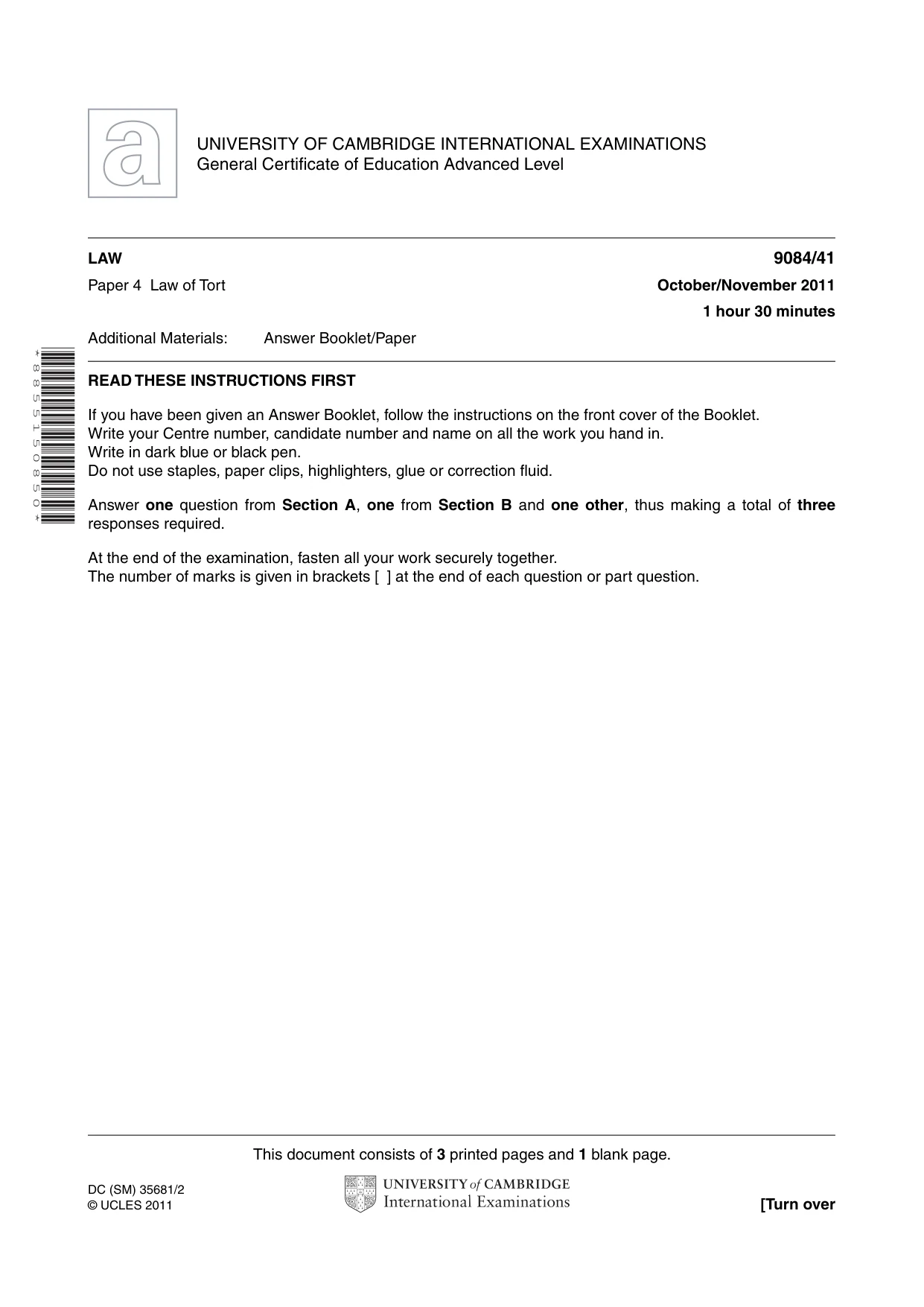
This document consists of 3 printed pages and 1 blank page. DC (SM) 35681/2 © UCLES 2011 [Turn over UNIVERSITY OF CAMBRIDGE INTERNATIONAL EXAMINATIONS General Certificate of Education Advanced Level * 8 8 5 5 1 5 0 8 5 0 * LAW 9084/41 Paper 4 Law of Tort October/November 2011 1 hour 30 minutes Additional Materials: Answer Booklet/Paper READ THESE INSTRUCTIONS FIRST If you have been given an Answer Booklet, follow the instructions on the front cover of the Booklet. Write your Centre number, candidate number and name on all the work you hand in. Write in dark blue or black pen. Do not use staples, paper clips, highlighters, glue or correction fluid. Answer one question from Section A, one from Section B and one other, thus making a total of three responses required. At the end of the examination, fasten all your work securely together. The number of marks is given in brackets [ ] at the end of each question or part question.
Question paper, page 2
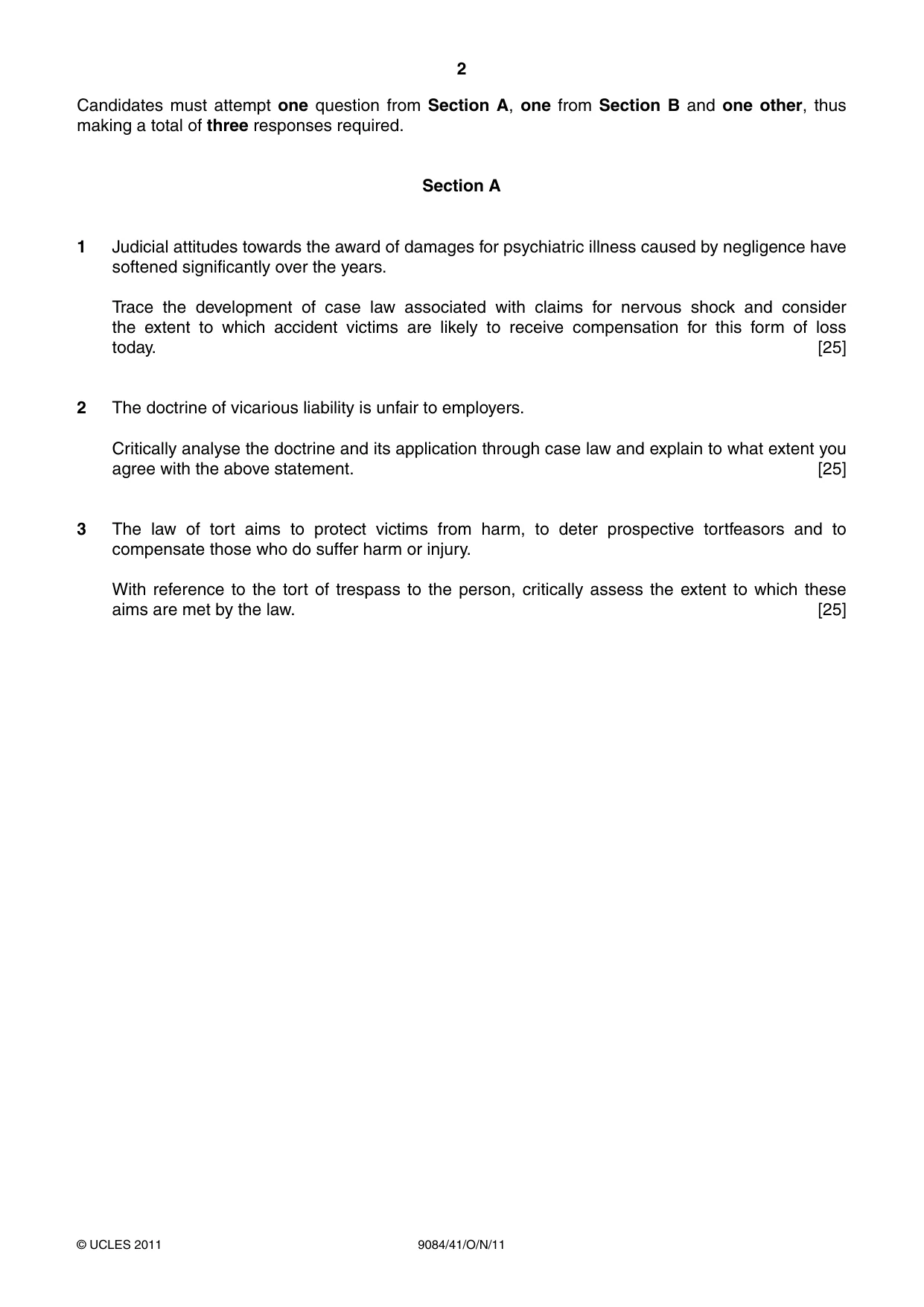
2 9084/41/O/N/11 © UCLES 2011 Candidates must attempt one question from Section A, one from Section B and one other, thus making a total of three responses required. Section A 1 Judicial attitudes towards the award of damages for psychiatric illness caused by negligence have softened significantly over the years. Trace the development of case law associated with claims for nervous shock and consider the extent to which accident victims are likely to receive compensation for this form of loss today. [25] 2 The doctrine of vicarious liability is unfair to employers. Critically analyse the doctrine and its application through case law and explain to what extent you agree with the above statement. [25] 3 The law of tort aims to protect victims from harm, to deter prospective tortfeasors and to compensate those who do suffer harm or injury. With reference to the tort of trespass to the person, critically assess the extent to which these aims are met by the law. [25]
Question paper, page 3
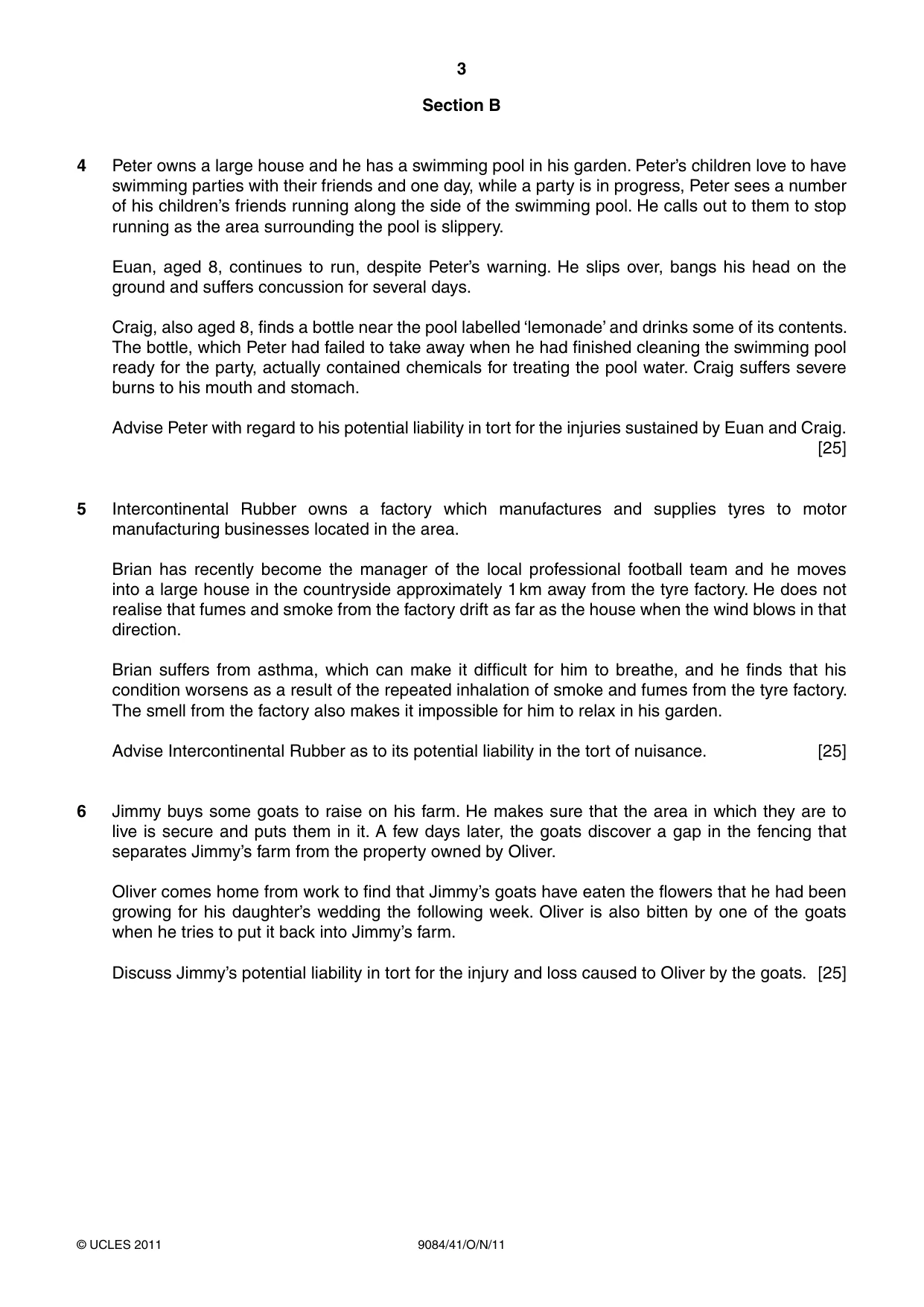
3 9084/41/O/N/11 © UCLES 2011 Section B 4 Peter owns a large house and he has a swimming pool in his garden. Peter’s children love to have swimming parties with their friends and one day, while a party is in progress, Peter sees a number of his children’s friends running along the side of the swimming pool. He calls out to them to stop running as the area surrounding the pool is slippery. Euan, aged 8, continues to run, despite Peter’s warning. He slips over, bangs his head on the ground and suffers concussion for several days. Craig, also aged 8, finds a bottle near the pool labelled ‘lemonade’ and drinks some of its contents. The bottle, which Peter had failed to take away when he had finished cleaning the swimming pool ready for the party, actually contained chemicals for treating the pool water. Craig suffers severe burns to his mouth and stomach. Advise Peter with regard to his potential liability in tort for the injuries sustained by Euan and Craig. [25] 5 Intercontinental Rubber owns a factory which manufactures and supplies tyres to motor manufacturing businesses located in the area. Brian has recently become the manager of the local professional football team and he moves into a large house in the countryside approximately 1 km away from the tyre factory. He does not realise that fumes and smoke from the factory drift as far as the house when the wind blows in that direction. Brian suffers from asthma, which can make it difficult for him to breathe, and he finds that his condition worsens as a result of the repeated inhalation of smoke and fumes from the tyre factory. The smell from the factory also makes it impossible for him to relax in his garden. Advise Intercontinental Rubber as to its potential liability in the tort of nuisance. [25] 6 Jimmy buys some goats to raise on his farm. He makes sure that the area in which they are to live is secure and puts them in it. A few days later, the goats discover a gap in the fencing that separates Jimmy’s farm from the property owned by Oliver. Oliver comes home from work to find that Jimmy’s goats have eaten the flowers that he had been growing for his daughter’s wedding the following week. Oliver is also bitten by one of the goats when he tries to put it back into Jimmy’s farm. Discuss Jimmy’s potential liability in tort for the injury and loss caused to Oliver by the goats. [25]
Question paper, page 4
4 9084/41/O/N/11 © UCLES 2011 Permission to reproduce items where third-party owned material protected by copyright is included has been sought and cleared where possible. Every reasonable effort has been made by the publisher (UCLES) to trace copyright holders, but if any items requiring clearance have unwittingly been included, the publisher will be pleased to make amends at the earliest possible opportunity. University of Cambridge International Examinations is part of the Cambridge Assessment Group. Cambridge Assessment is the brand name of University of Cambridge Local Examinations Syndicate (UCLES), which is itself a department of the University of Cambridge. BLANK PAGE
Mark scheme, page 1
UNIVERSITY OF CAMBRIDGE INTERNATIONAL EXAMINATIONS GCE Advanced Level MARK SCHEME for the October/November 2011 question paper for the guidance of teachers 9084 LAW 9084/41 Paper 4, maximum raw mark 75 This mark scheme is published as an aid to teachers and candidates, to indicate the requirements of the examination. It shows the basis on which Examiners were instructed to award marks. It does not indicate the details of the discussions that took place at an Examiners’ meeting before marking began, which would have considered the acceptability of alternative answers. Mark schemes must be read in conjunction with the question papers and the report on the examination. • Cambridge will not enter into discussions or correspondence in connection with these mark schemes. Cambridge is publishing the mark schemes for the October/November 2011 question papers for most IGCSE, GCE Advanced Level and Advanced Subsidiary Level syllabuses and some Ordinary Level syllabuses.
Mark scheme, page 2
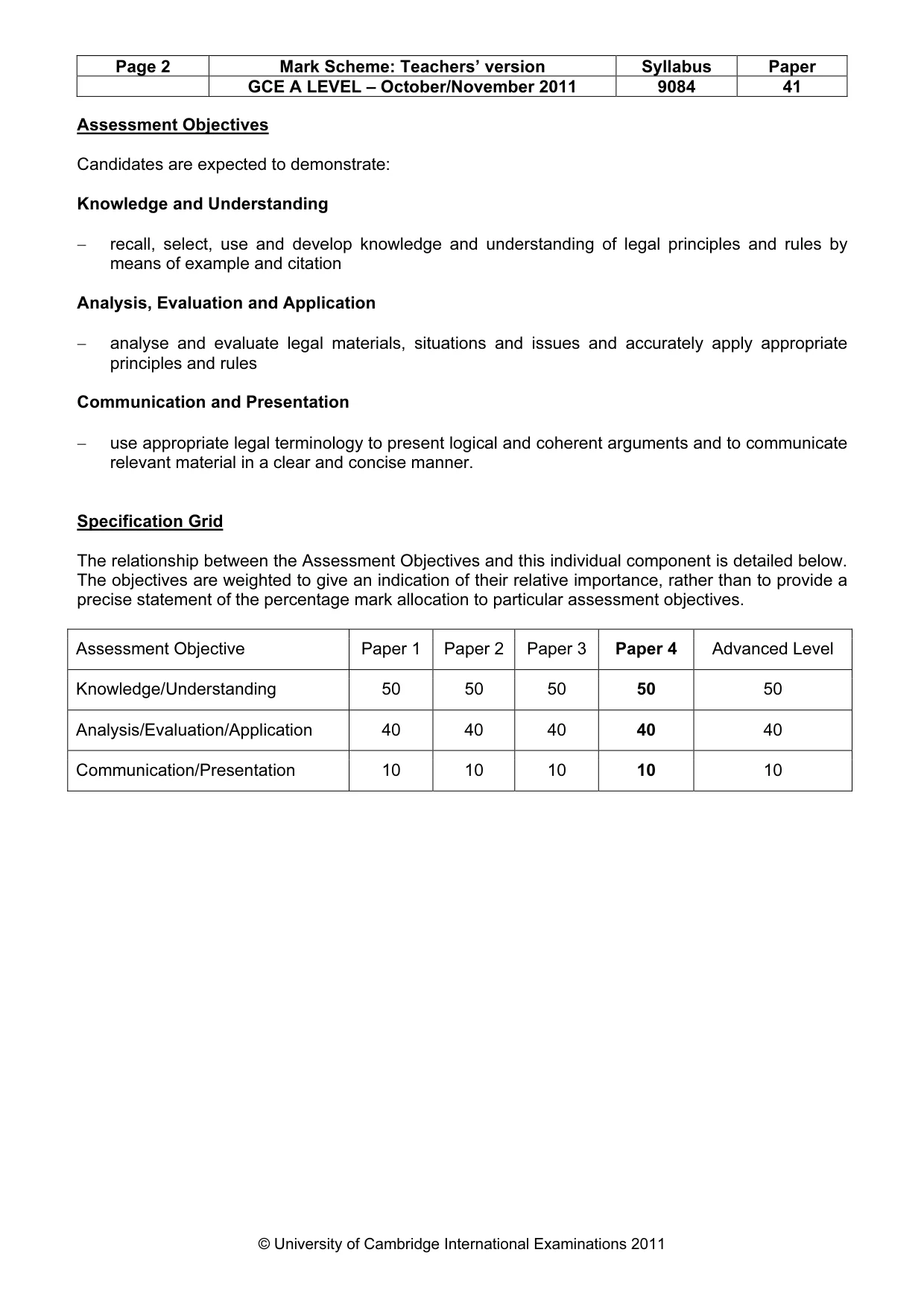
Page 2 Mark Scheme: Teachers’ version Syllabus Paper GCE A LEVEL – October/November 2011 9084 41 © University of Cambridge International Examinations 2011 Assessment Objectives Candidates are expected to demonstrate: Knowledge and Understanding − recall, select, use and develop knowledge and understanding of legal principles and rules by means of example and citation Analysis, Evaluation and Application − analyse and evaluate legal materials, situations and issues and accurately apply appropriate principles and rules Communication and Presentation − use appropriate legal terminology to present logical and coherent arguments and to communicate relevant material in a clear and concise manner. Specification Grid The relationship between the Assessment Objectives and this individual component is detailed below. The objectives are weighted to give an indication of their relative importance, rather than to provide a precise statement of the percentage mark allocation to particular assessment objectives. Assessment Objective Paper 1 Paper 2 Paper 3 Paper 4 Advanced Level Knowledge/Understanding 50 50 50 50 50 Analysis/Evaluation/Application 40 40 40 40 40 Communication/Presentation 10 10 10 10 10
Mark scheme, page 3
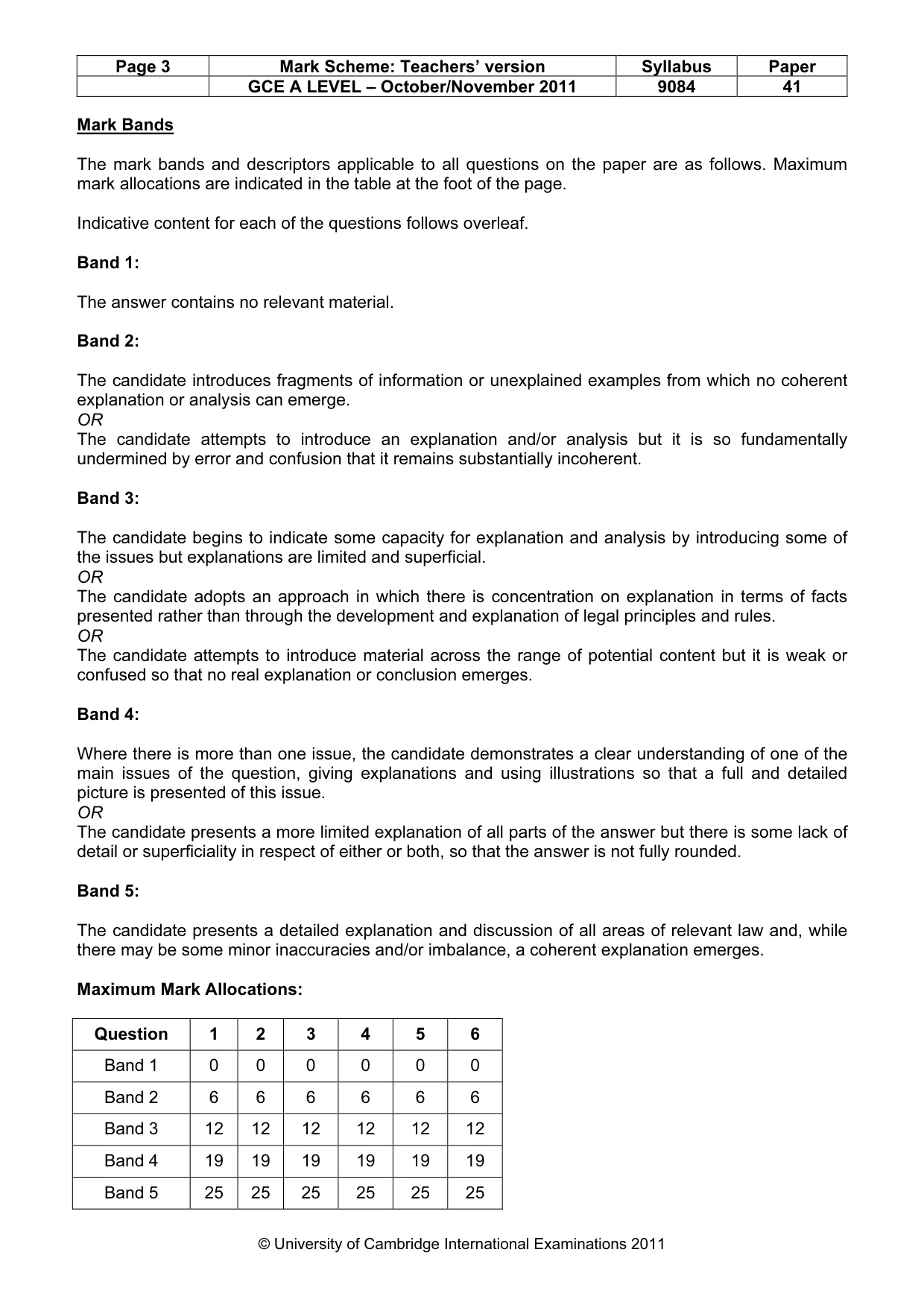
Page 3 Mark Scheme: Teachers’ version Syllabus Paper GCE A LEVEL – October/November 2011 9084 41 © University of Cambridge International Examinations 2011 Mark Bands The mark bands and descriptors applicable to all questions on the paper are as follows. Maximum mark allocations are indicated in the table at the foot of the page. Indicative content for each of the questions follows overleaf. Band 1: The answer contains no relevant material. Band 2: The candidate introduces fragments of information or unexplained examples from which no coherent explanation or analysis can emerge. OR The candidate attempts to introduce an explanation and/or analysis but it is so fundamentally undermined by error and confusion that it remains substantially incoherent. Band 3: The candidate begins to indicate some capacity for explanation and analysis by introducing some of the issues but explanations are limited and superficial. OR The candidate adopts an approach in which there is concentration on explanation in terms of facts presented rather than through the development and explanation of legal principles and rules. OR The candidate attempts to introduce material across the range of potential content but it is weak or confused so that no real explanation or conclusion emerges. Band 4: Where there is more than one issue, the candidate demonstrates a clear understanding of one of the main issues of the question, giving explanations and using illustrations so that a full and detailed picture is presented of this issue. OR The candidate presents a more limited explanation of all parts of the answer but there is some lack of detail or superficiality in respect of either or both, so that the answer is not fully rounded. Band 5: The candidate presents a detailed explanation and discussion of all areas of relevant law and, while there may be some minor inaccuracies and/or imbalance, a coherent explanation emerges. Maximum Mark Allocations: Question 1 2 3 4 5 6 Band 1 0 0 0 0 0 0 Band 2 6 6 6 6 6 6 Band 3 12 12 12 12 12 12 Band 4 19 19 19 19 19 19 Band 5 25 25 25 25 25 25
Mark scheme, page 4
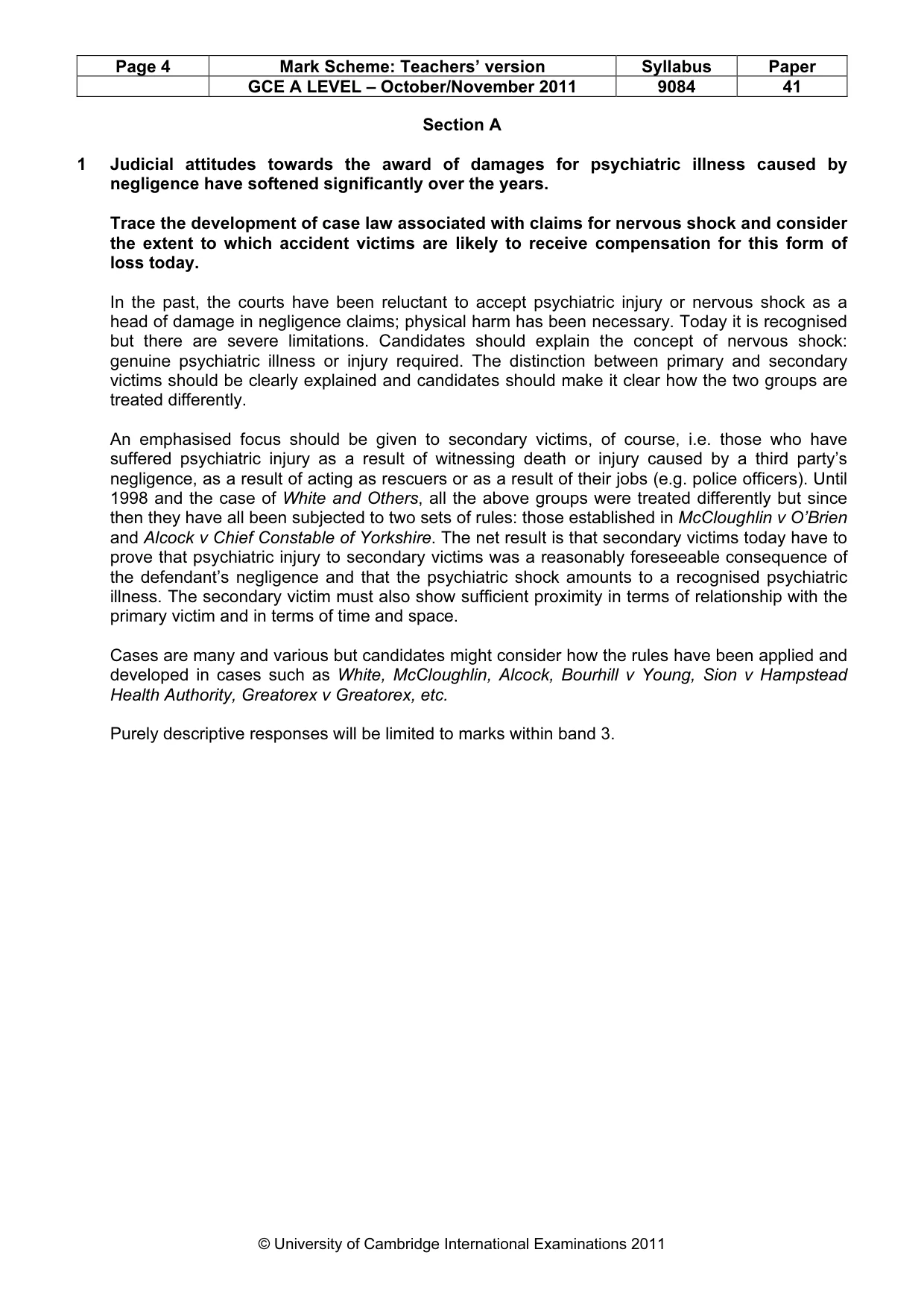
Page 4 Mark Scheme: Teachers’ version Syllabus Paper GCE A LEVEL – October/November 2011 9084 41 © University of Cambridge International Examinations 2011 Section A 1 Judicial attitudes towards the award of damages for psychiatric illness caused by negligence have softened significantly over the years. Trace the development of case law associated with claims for nervous shock and consider the extent to which accident victims are likely to receive compensation for this form of loss today. In the past, the courts have been reluctant to accept psychiatric injury or nervous shock as a head of damage in negligence claims; physical harm has been necessary. Today it is recognised but there are severe limitations. Candidates should explain the concept of nervous shock: genuine psychiatric illness or injury required. The distinction between primary and secondary victims should be clearly explained and candidates should make it clear how the two groups are treated differently. An emphasised focus should be given to secondary victims, of course, i.e. those who have suffered psychiatric injury as a result of witnessing death or injury caused by a third party’s negligence, as a result of acting as rescuers or as a result of their jobs (e.g. police officers). Until 1998 and the case of White and Others, all the above groups were treated differently but since then they have all been subjected to two sets of rules: those established in McCloughlin v O’Brien and Alcock v Chief Constable of Yorkshire. The net result is that secondary victims today have to prove that psychiatric injury to secondary victims was a reasonably foreseeable consequence of the defendant’s negligence and that the psychiatric shock amounts to a recognised psychiatric illness. The secondary victim must also show sufficient proximity in terms of relationship with the primary victim and in terms of time and space. Cases are many and various but candidates might consider how the rules have been applied and developed in cases such as White, McCloughlin, Alcock, Bourhill v Young, Sion v Hampstead Health Authority, Greatorex v Greatorex, etc. Purely descriptive responses will be limited to marks within band 3.
Mark scheme, page 5
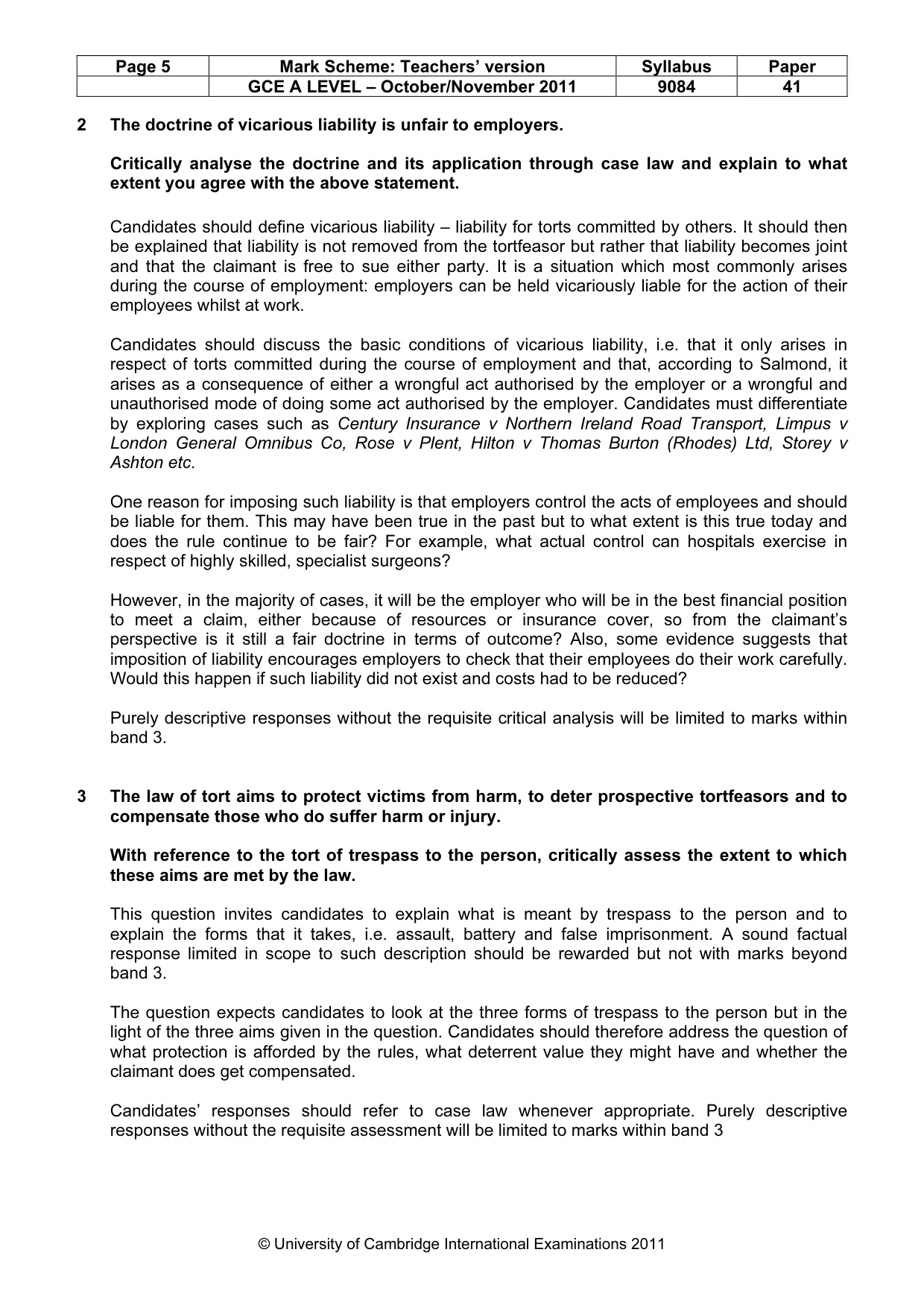
Page 5 Mark Scheme: Teachers’ version Syllabus Paper GCE A LEVEL – October/November 2011 9084 41 © University of Cambridge International Examinations 2011 2 The doctrine of vicarious liability is unfair to employers. Critically analyse the doctrine and its application through case law and explain to what extent you agree with the above statement. Candidates should define vicarious liability – liability for torts committed by others. It should then be explained that liability is not removed from the tortfeasor but rather that liability becomes joint and that the claimant is free to sue either party. It is a situation which most commonly arises during the course of employment: employers can be held vicariously liable for the action of their employees whilst at work. Candidates should discuss the basic conditions of vicarious liability, i.e. that it only arises in respect of torts committed during the course of employment and that, according to Salmond, it arises as a consequence of either a wrongful act authorised by the employer or a wrongful and unauthorised mode of doing some act authorised by the employer. Candidates must differentiate by exploring cases such as Century Insurance v Northern Ireland Road Transport, Limpus v London General Omnibus Co, Rose v Plent, Hilton v Thomas Burton (Rhodes) Ltd, Storey v Ashton etc. One reason for imposing such liability is that employers control the acts of employees and should be liable for them. This may have been true in the past but to what extent is this true today and does the rule continue to be fair? For example, what actual control can hospitals exercise in respect of highly skilled, specialist surgeons? However, in the majority of cases, it will be the employer who will be in the best financial position to meet a claim, either because of resources or insurance cover, so from the claimant’s perspective is it still a fair doctrine in terms of outcome? Also, some evidence suggests that imposition of liability encourages employers to check that their employees do their work carefully. Would this happen if such liability did not exist and costs had to be reduced? Purely descriptive responses without the requisite critical analysis will be limited to marks within band 3. 3 The law of tort aims to protect victims from harm, to deter prospective tortfeasors and to compensate those who do suffer harm or injury. With reference to the tort of trespass to the person, critically assess the extent to which these aims are met by the law. This question invites candidates to explain what is meant by trespass to the person and to explain the forms that it takes, i.e. assault, battery and false imprisonment. A sound factual response limited in scope to such description should be rewarded but not with marks beyond band 3. The question expects candidates to look at the three forms of trespass to the person but in the light of the three aims given in the question. Candidates should therefore address the question of what protection is afforded by the rules, what deterrent value they might have and whether the claimant does get compensated. Candidates’ responses should refer to case law whenever appropriate. Purely descriptive responses without the requisite assessment will be limited to marks within band 3
Mark scheme, page 6
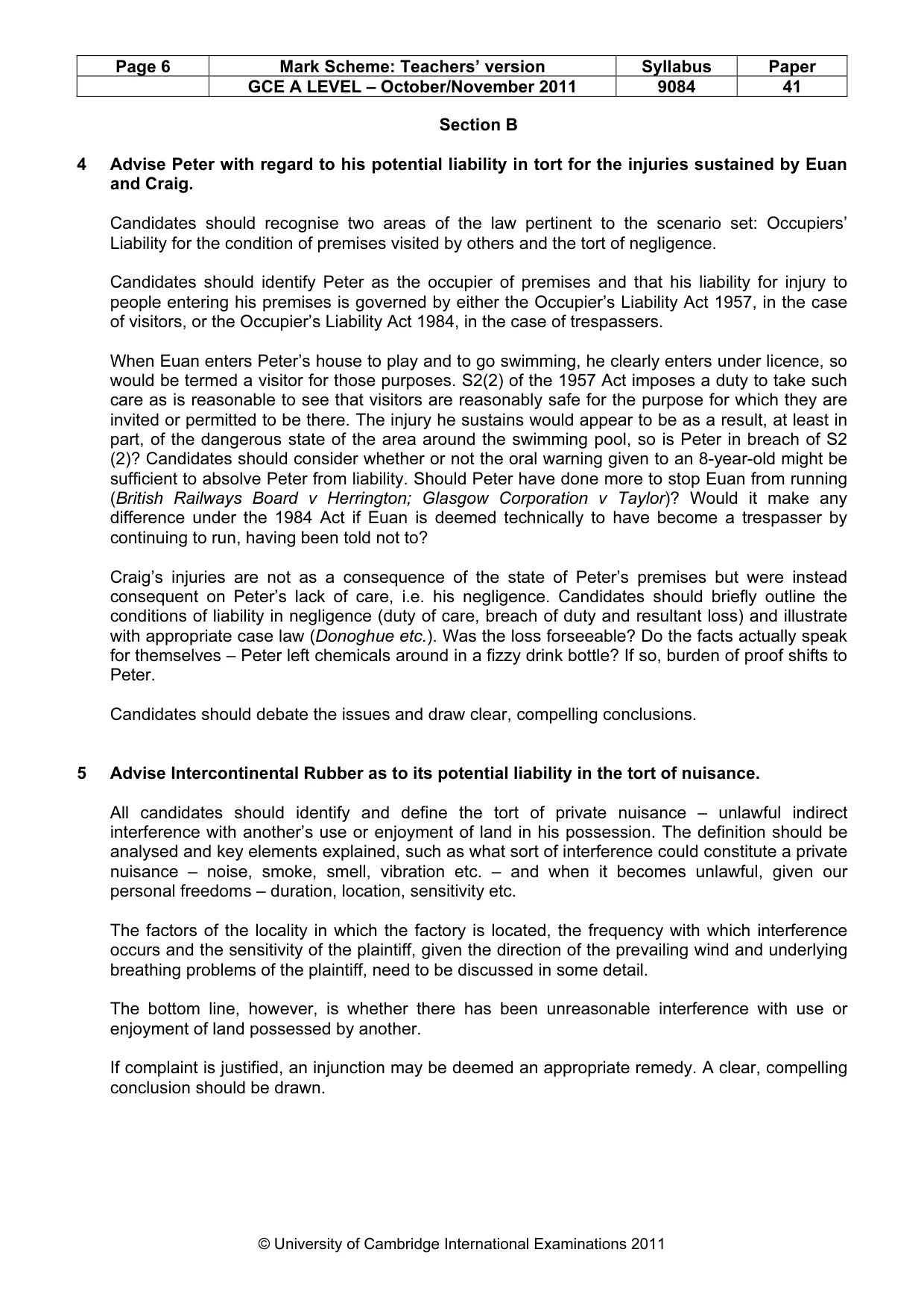
Page 6 Mark Scheme: Teachers’ version Syllabus Paper GCE A LEVEL – October/November 2011 9084 41 © University of Cambridge International Examinations 2011 Section B 4 Advise Peter with regard to his potential liability in tort for the injuries sustained by Euan and Craig. Candidates should recognise two areas of the law pertinent to the scenario set: Occupiers’ Liability for the condition of premises visited by others and the tort of negligence. Candidates should identify Peter as the occupier of premises and that his liability for injury to people entering his premises is governed by either the Occupier’s Liability Act 1957, in the case of visitors, or the Occupier’s Liability Act 1984, in the case of trespassers. When Euan enters Peter’s house to play and to go swimming, he clearly enters under licence, so would be termed a visitor for those purposes. S2(2) of the 1957 Act imposes a duty to take such care as is reasonable to see that visitors are reasonably safe for the purpose for which they are invited or permitted to be there. The injury he sustains would appear to be as a result, at least in part, of the dangerous state of the area around the swimming pool, so is Peter in breach of S2 (2)? Candidates should consider whether or not the oral warning given to an 8-year-old might be sufficient to absolve Peter from liability. Should Peter have done more to stop Euan from running (British Railways Board v Herrington; Glasgow Corporation v Taylor)? Would it make any difference under the 1984 Act if Euan is deemed technically to have become a trespasser by continuing to run, having been told not to? Craig’s injuries are not as a consequence of the state of Peter’s premises but were instead consequent on Peter’s lack of care, i.e. his negligence. Candidates should briefly outline the conditions of liability in negligence (duty of care, breach of duty and resultant loss) and illustrate with appropriate case law (Donoghue etc.). Was the loss forseeable? Do the facts actually speak for themselves – Peter left chemicals around in a fizzy drink bottle? If so, burden of proof shifts to Peter. Candidates should debate the issues and draw clear, compelling conclusions. 5 Advise Intercontinental Rubber as to its potential liability in the tort of nuisance. All candidates should identify and define the tort of private nuisance – unlawful indirect interference with another’s use or enjoyment of land in his possession. The definition should be analysed and key elements explained, such as what sort of interference could constitute a private nuisance – noise, smoke, smell, vibration etc. – and when it becomes unlawful, given our personal freedoms – duration, location, sensitivity etc. The factors of the locality in which the factory is located, the frequency with which interference occurs and the sensitivity of the plaintiff, given the direction of the prevailing wind and underlying breathing problems of the plaintiff, need to be discussed in some detail. The bottom line, however, is whether there has been unreasonable interference with use or enjoyment of land possessed by another. If complaint is justified, an injunction may be deemed an appropriate remedy. A clear, compelling conclusion should be drawn.
Mark scheme, page 7
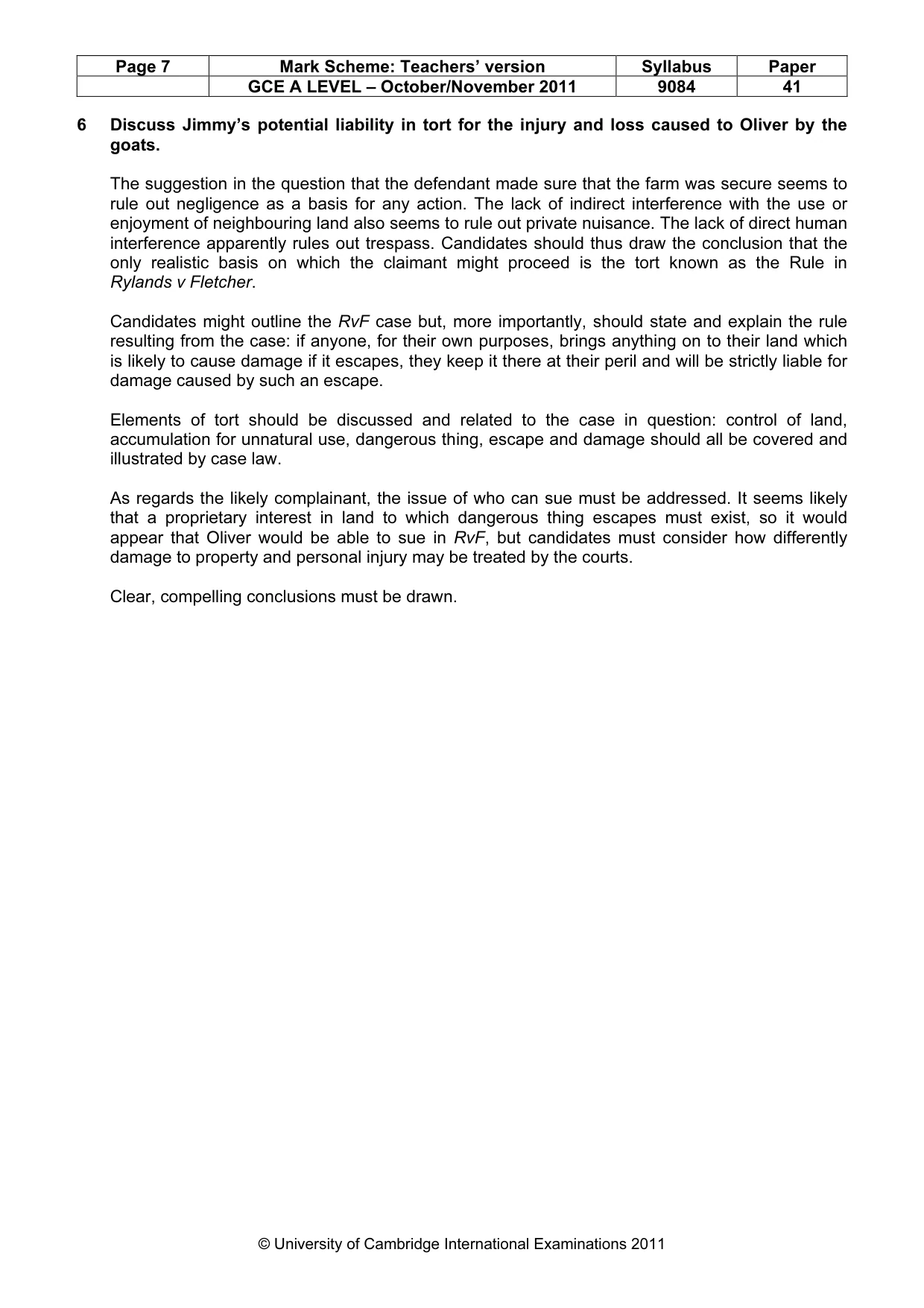
Page 7 Mark Scheme: Teachers’ version Syllabus Paper GCE A LEVEL – October/November 2011 9084 41 © University of Cambridge International Examinations 2011 6 Discuss Jimmy’s potential liability in tort for the injury and loss caused to Oliver by the goats. The suggestion in the question that the defendant made sure that the farm was secure seems to rule out negligence as a basis for any action. The lack of indirect interference with the use or enjoyment of neighbouring land also seems to rule out private nuisance. The lack of direct human interference apparently rules out trespass. Candidates should thus draw the conclusion that the only realistic basis on which the claimant might proceed is the tort known as the Rule in Rylands v Fletcher. Candidates might outline the RvF case but, more importantly, should state and explain the rule resulting from the case: if anyone, for their own purposes, brings anything on to their land which is likely to cause damage if it escapes, they keep it there at their peril and will be strictly liable for damage caused by such an escape. Elements of tort should be discussed and related to the case in question: control of land, accumulation for unnatural use, dangerous thing, escape and damage should all be covered and illustrated by case law. As regards the likely complainant, the issue of who can sue must be addressed. It seems likely that a proprietary interest in land to which dangerous thing escapes must exist, so it would appear that Oliver would be able to sue in RvF, but candidates must consider how differently damage to property and personal injury may be treated by the courts. Clear, compelling conclusions must be drawn.
What you needed in this session
Cambridge’s own grade thresholds for 2011 Oct/Nov, Paper 4 · Variant 1. A higher threshold means an easier paper — the bar moves with how the cohort did.