Cambridge A Level Law 9084 — 2011 Oct/Nov Paper 4 · Variant 2
9084/42/O/N/11 · 75 marks · ≈84 min
The question paper and its mark scheme, free to read here and free to download. This is Cambridge’s own paper, exactly as it was sat.
Question paper4 pages
Mark scheme7 pages
Answers below. Sit the paper first if you are practising.
Paper as text
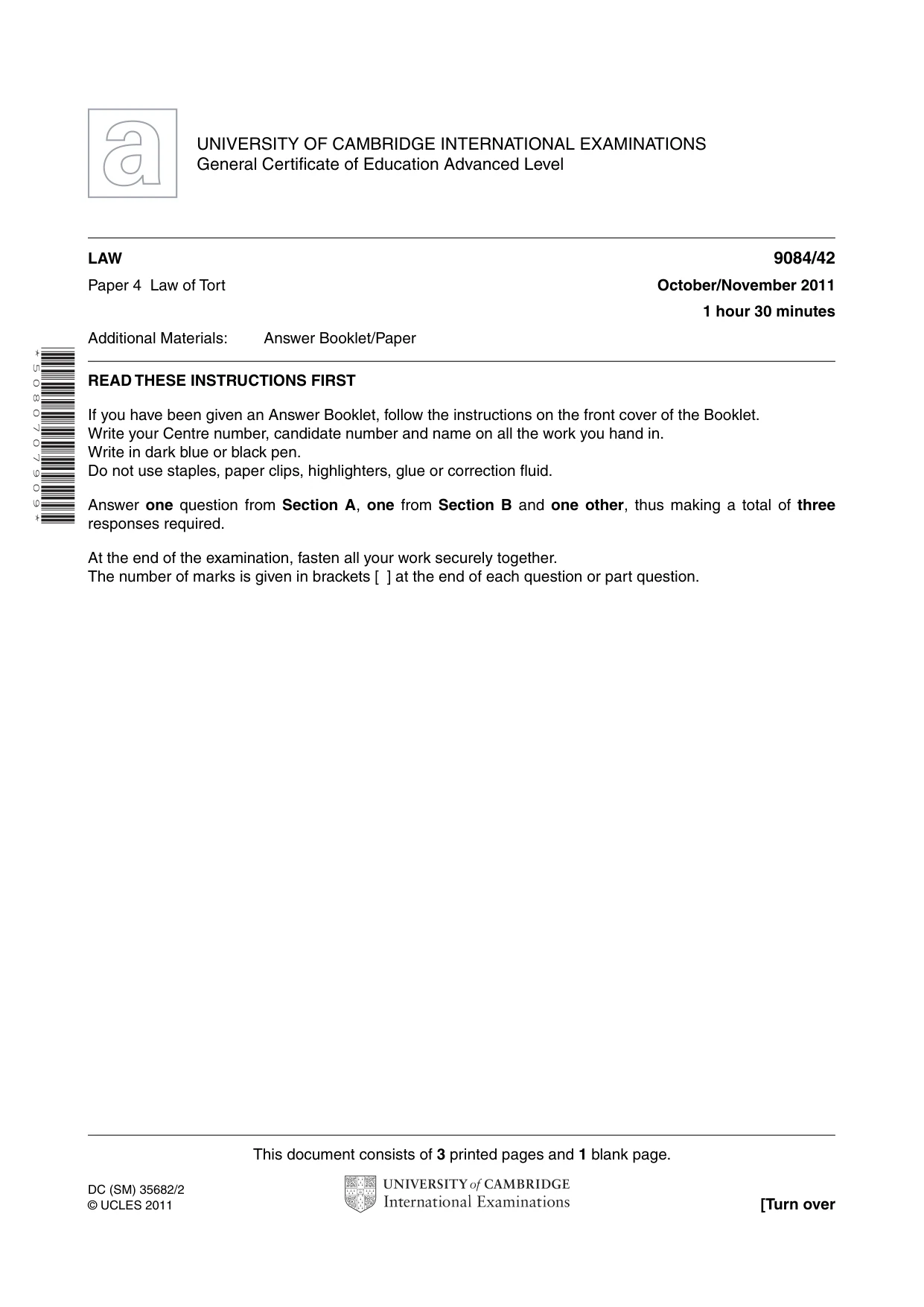
Question paper, page 1
This document consists of 3 printed pages and 1 blank page. DC (SM) 35682/2 © UCLES 2011 [Turn over UNIVERSITY OF CAMBRIDGE INTERNATIONAL EXAMINATIONS General Certificate of Education Advanced Level * 5 0 8 0 7 0 7 9 0 9 * LAW 9084/42 Paper 4 Law of Tort October/November 2011 1 hour 30 minutes Additional Materials: Answer Booklet/Paper READ THESE INSTRUCTIONS FIRST If you have been given an Answer Booklet, follow the instructions on the front cover of the Booklet. Write your Centre number, candidate number and name on all the work you hand in. Write in dark blue or black pen. Do not use staples, paper clips, highlighters, glue or correction fluid. Answer one question from Section A, one from Section B and one other, thus making a total of three responses required. At the end of the examination, fasten all your work securely together. The number of marks is given in brackets [ ] at the end of each question or part question.
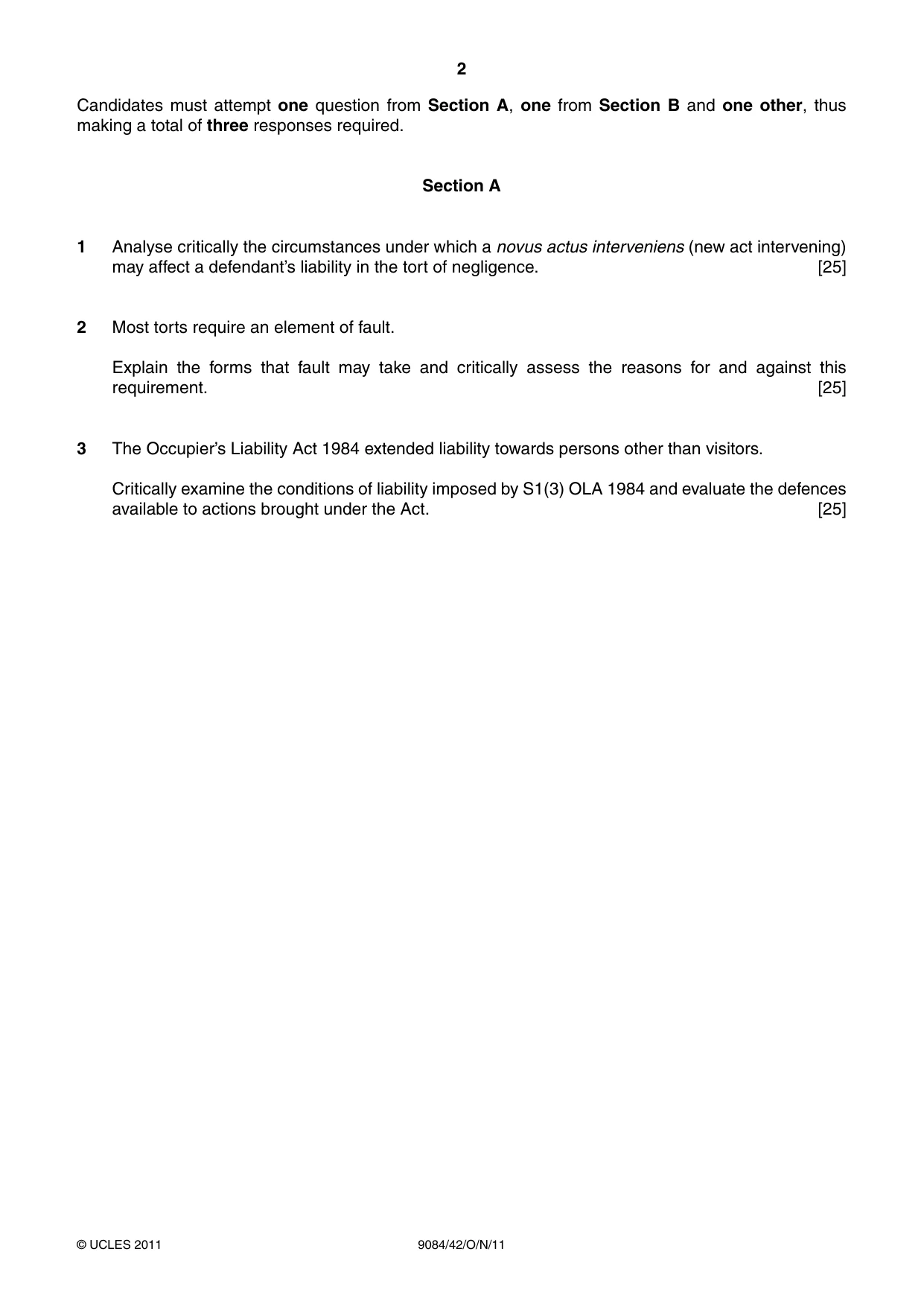
Question paper, page 2
2 9084/42/O/N/11 © UCLES 2011 Candidates must attempt one question from Section A, one from Section B and one other, thus making a total of three responses required. Section A 1 Analyse critically the circumstances under which a novus actus interveniens (new act intervening) may affect a defendant’s liability in the tort of negligence. [25] 2 Most torts require an element of fault. Explain the forms that fault may take and critically assess the reasons for and against this requirement. [25] 3 The Occupier’s Liability Act 1984 extended liability towards persons other than visitors. Critically examine the conditions of liability imposed by S1(3) OLA 1984 and evaluate the defences available to actions brought under the Act. [25]
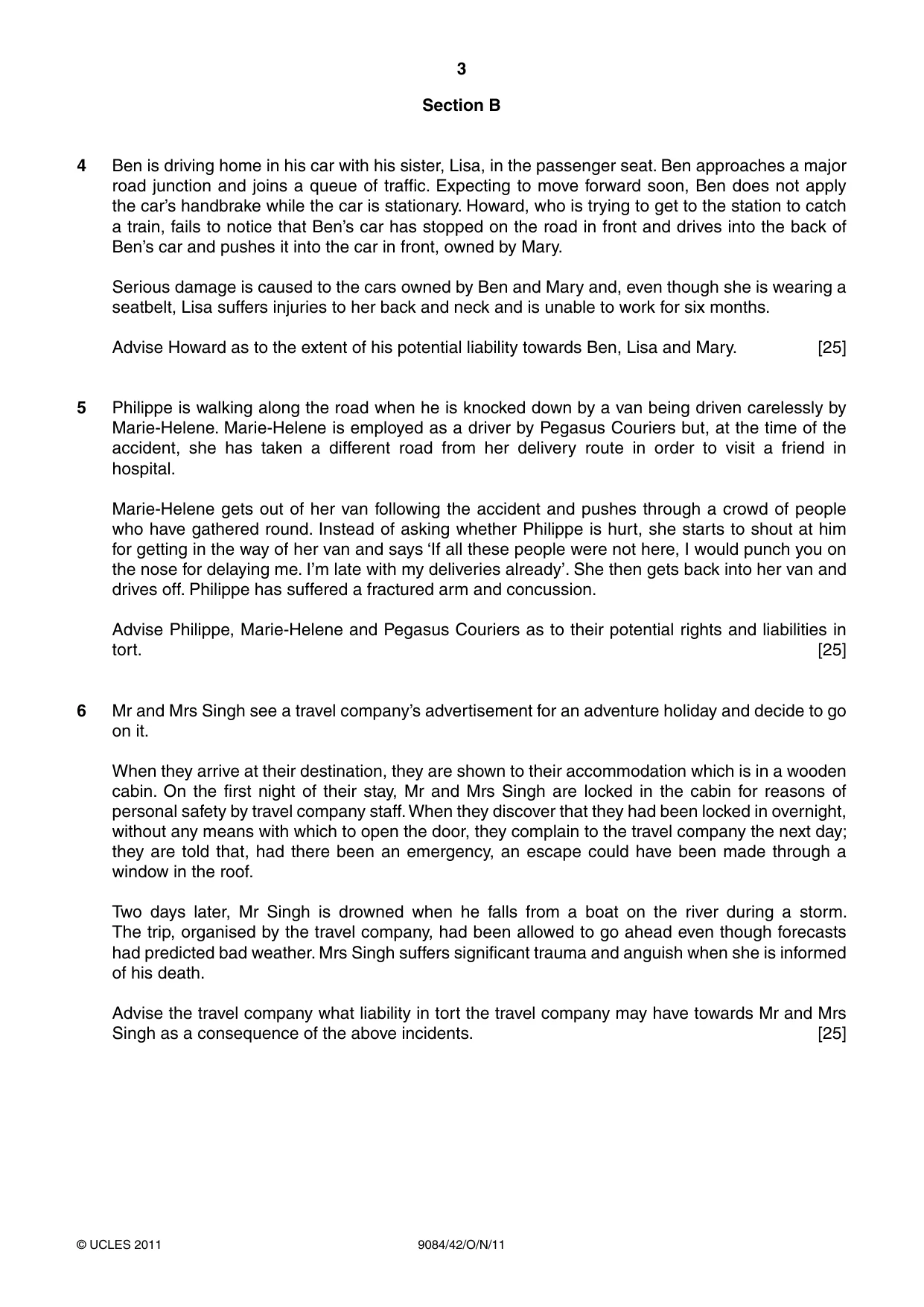
Question paper, page 3
3 9084/42/O/N/11 © UCLES 2011 Section B 4 Ben is driving home in his car with his sister, Lisa, in the passenger seat. Ben approaches a major road junction and joins a queue of traffic. Expecting to move forward soon, Ben does not apply the car’s handbrake while the car is stationary. Howard, who is trying to get to the station to catch a train, fails to notice that Ben’s car has stopped on the road in front and drives into the back of Ben’s car and pushes it into the car in front, owned by Mary. Serious damage is caused to the cars owned by Ben and Mary and, even though she is wearing a seatbelt, Lisa suffers injuries to her back and neck and is unable to work for six months. Advise Howard as to the extent of his potential liability towards Ben, Lisa and Mary. [25] 5 Philippe is walking along the road when he is knocked down by a van being driven carelessly by Marie-Helene. Marie-Helene is employed as a driver by Pegasus Couriers but, at the time of the accident, she has taken a different road from her delivery route in order to visit a friend in hospital. Marie-Helene gets out of her van following the accident and pushes through a crowd of people who have gathered round. Instead of asking whether Philippe is hurt, she starts to shout at him for getting in the way of her van and says ‘If all these people were not here, I would punch you on the nose for delaying me. I’m late with my deliveries already’. She then gets back into her van and drives off. Philippe has suffered a fractured arm and concussion. Advise Philippe, Marie-Helene and Pegasus Couriers as to their potential rights and liabilities in tort. [25] 6 Mr and Mrs Singh see a travel company’s advertisement for an adventure holiday and decide to go on it. When they arrive at their destination, they are shown to their accommodation which is in a wooden cabin. On the first night of their stay, Mr and Mrs Singh are locked in the cabin for reasons of personal safety by travel company staff. When they discover that they had been locked in overnight, without any means with which to open the door, they complain to the travel company the next day; they are told that, had there been an emergency, an escape could have been made through a window in the roof. Two days later, Mr Singh is drowned when he falls from a boat on the river during a storm. The trip, organised by the travel company, had been allowed to go ahead even though forecasts had predicted bad weather. Mrs Singh suffers significant trauma and anguish when she is informed of his death. Advise the travel company what liability in tort the travel company may have towards Mr and Mrs Singh as a consequence of the above incidents. [25]
Question paper, page 4
4 9084/42/O/N/11 © UCLES 2011 Permission to reproduce items where third-party owned material protected by copyright is included has been sought and cleared where possible. Every reasonable effort has been made by the publisher (UCLES) to trace copyright holders, but if any items requiring clearance have unwittingly been included, the publisher will be pleased to make amends at the earliest possible opportunity. University of Cambridge International Examinations is part of the Cambridge Assessment Group. Cambridge Assessment is the brand name of University of Cambridge Local Examinations Syndicate (UCLES), which is itself a department of the University of Cambridge. BLANK PAGE
Mark scheme, page 1
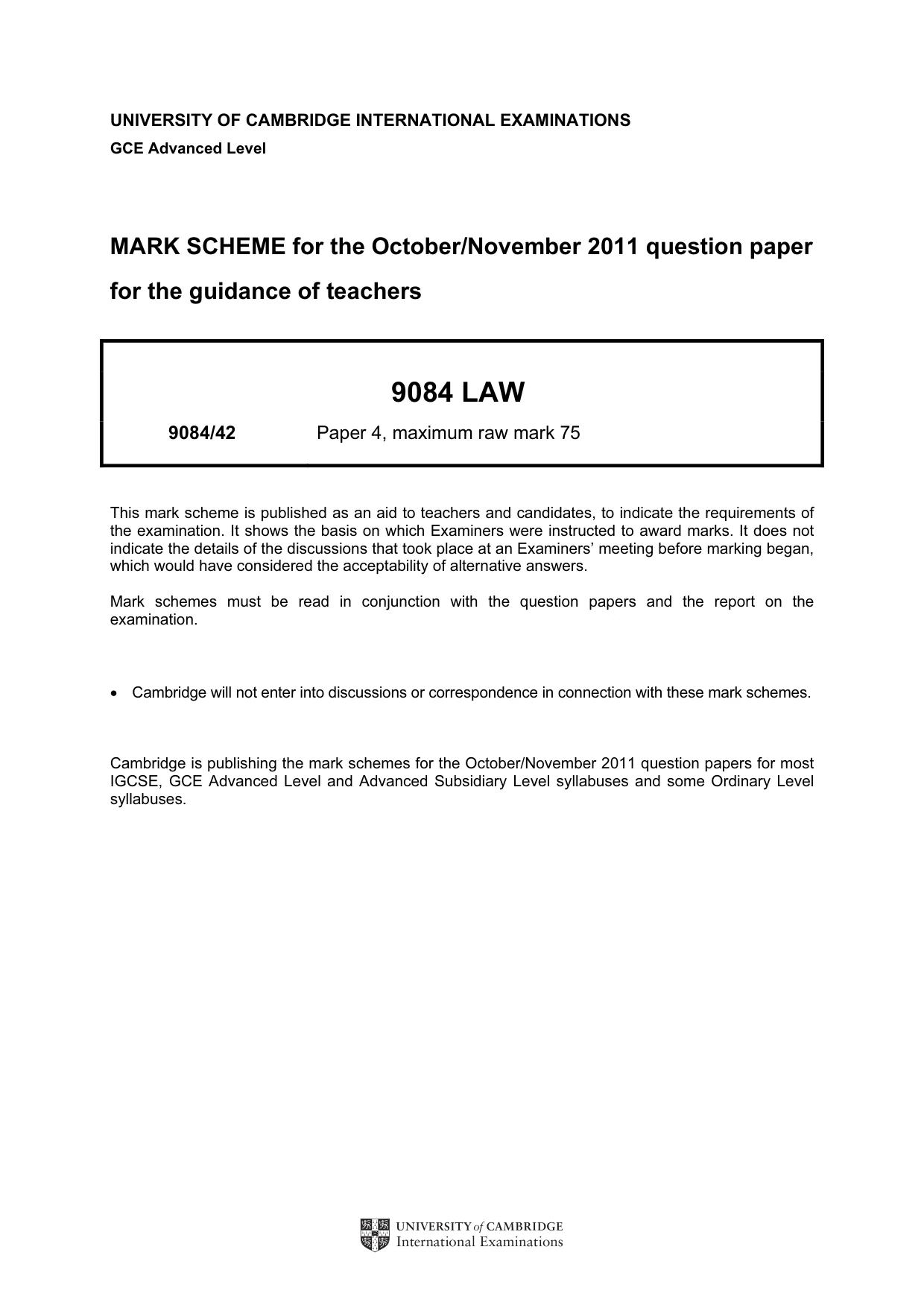
UNIVERSITY OF CAMBRIDGE INTERNATIONAL EXAMINATIONS GCE Advanced Level MARK SCHEME for the October/November 2011 question paper for the guidance of teachers 9084 LAW 9084/42 Paper 4, maximum raw mark 75 This mark scheme is published as an aid to teachers and candidates, to indicate the requirements of the examination. It shows the basis on which Examiners were instructed to award marks. It does not indicate the details of the discussions that took place at an Examiners’ meeting before marking began, which would have considered the acceptability of alternative answers. Mark schemes must be read in conjunction with the question papers and the report on the examination. • Cambridge will not enter into discussions or correspondence in connection with these mark schemes. Cambridge is publishing the mark schemes for the October/November 2011 question papers for most IGCSE, GCE Advanced Level and Advanced Subsidiary Level syllabuses and some Ordinary Level syllabuses.
Mark scheme, page 2
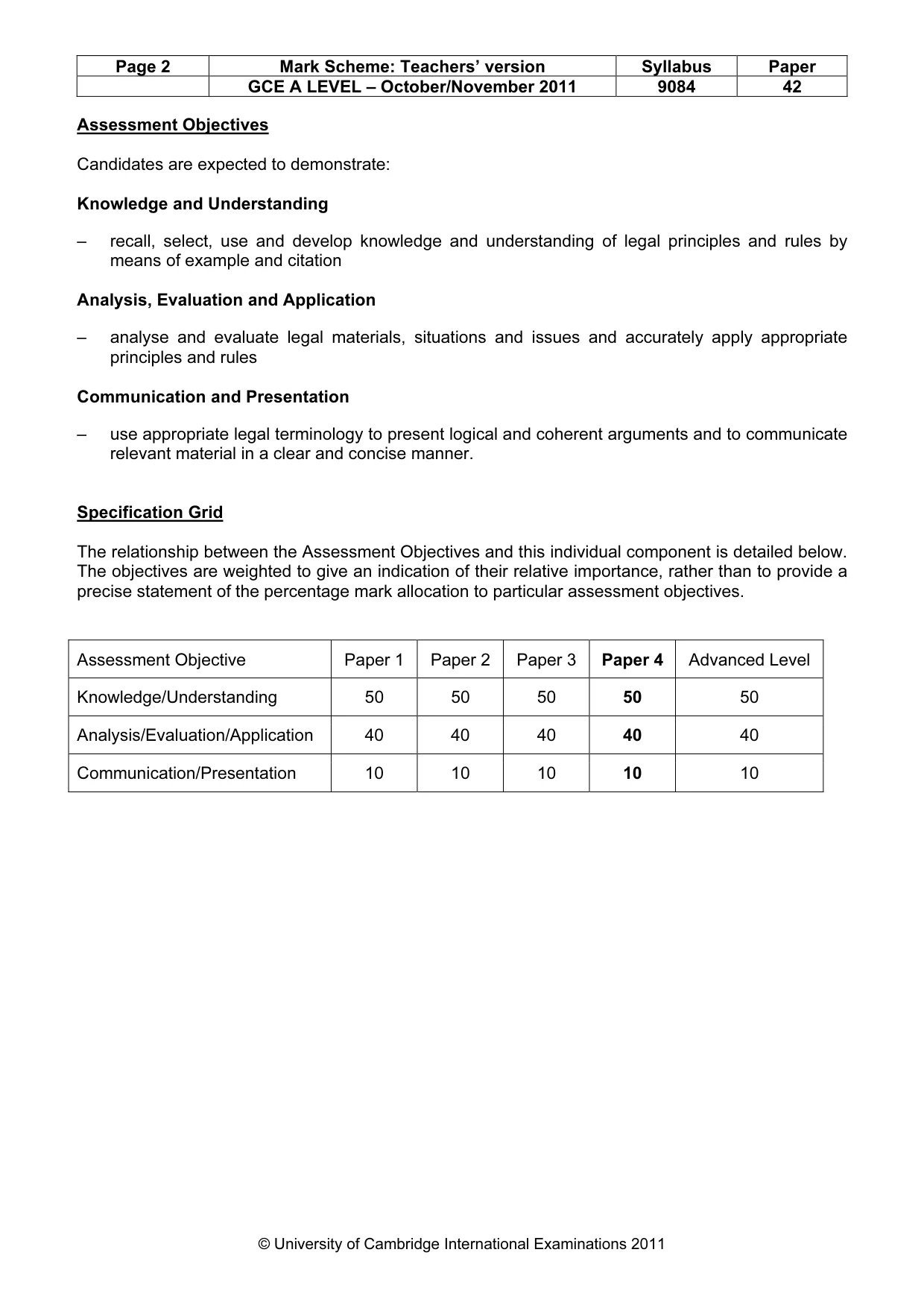
Page 2 Mark Scheme: Teachers’ version Syllabus Paper GCE A LEVEL – October/November 2011 9084 42 © University of Cambridge International Examinations 2011 Assessment Objectives Candidates are expected to demonstrate: Knowledge and Understanding – recall, select, use and develop knowledge and understanding of legal principles and rules by means of example and citation Analysis, Evaluation and Application – analyse and evaluate legal materials, situations and issues and accurately apply appropriate principles and rules Communication and Presentation – use appropriate legal terminology to present logical and coherent arguments and to communicate relevant material in a clear and concise manner. Specification Grid The relationship between the Assessment Objectives and this individual component is detailed below. The objectives are weighted to give an indication of their relative importance, rather than to provide a precise statement of the percentage mark allocation to particular assessment objectives. Assessment Objective Paper 1 Paper 2 Paper 3 Paper 4 Advanced Level Knowledge/Understanding 50 50 50 50 50 Analysis/Evaluation/Application 40 40 40 40 40 Communication/Presentation 10 10 10 10 10
Mark scheme, page 3
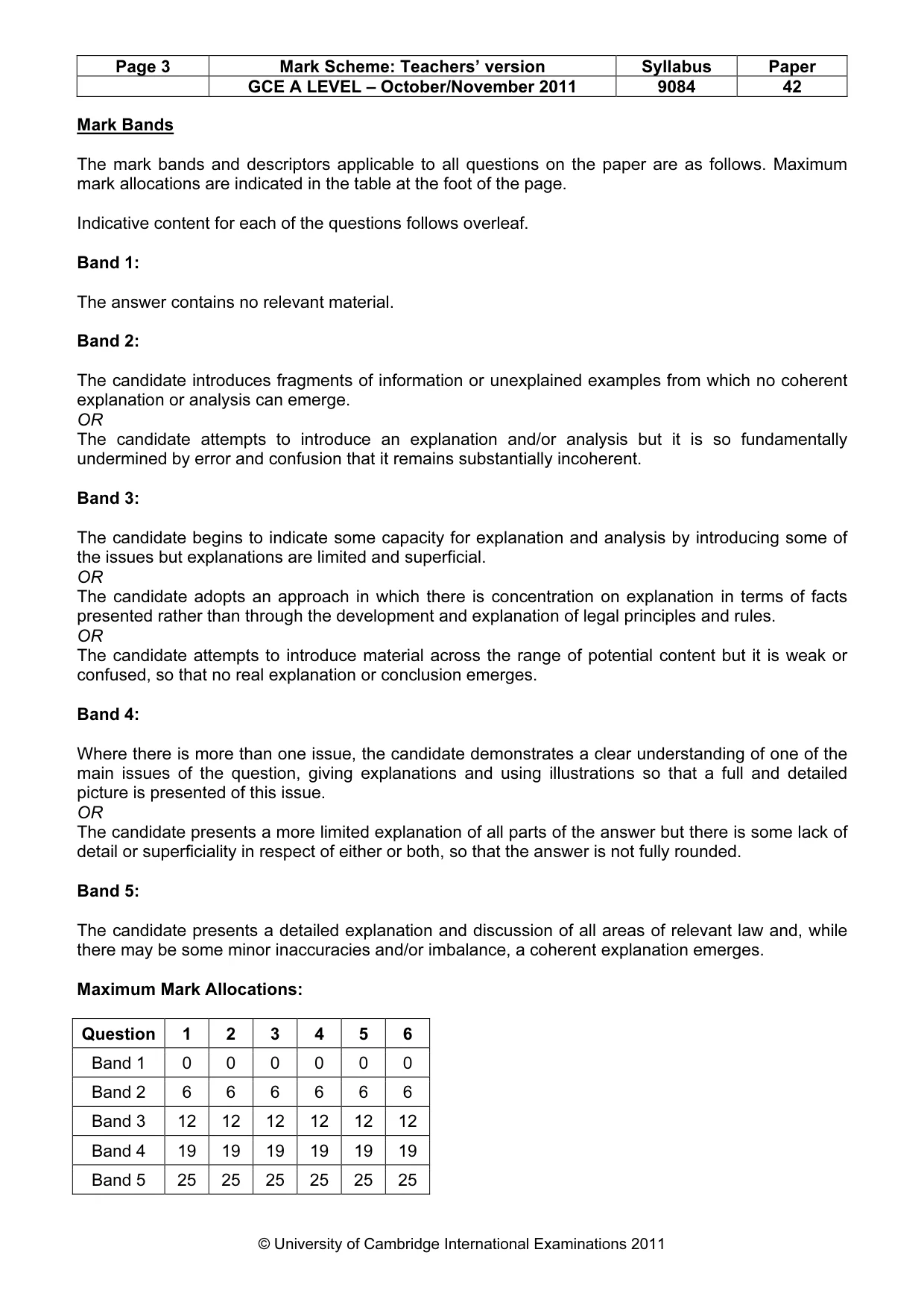
Page 3 Mark Scheme: Teachers’ version Syllabus Paper GCE A LEVEL – October/November 2011 9084 42 © University of Cambridge International Examinations 2011 Mark Bands The mark bands and descriptors applicable to all questions on the paper are as follows. Maximum mark allocations are indicated in the table at the foot of the page. Indicative content for each of the questions follows overleaf. Band 1: The answer contains no relevant material. Band 2: The candidate introduces fragments of information or unexplained examples from which no coherent explanation or analysis can emerge. OR The candidate attempts to introduce an explanation and/or analysis but it is so fundamentally undermined by error and confusion that it remains substantially incoherent. Band 3: The candidate begins to indicate some capacity for explanation and analysis by introducing some of the issues but explanations are limited and superficial. OR The candidate adopts an approach in which there is concentration on explanation in terms of facts presented rather than through the development and explanation of legal principles and rules. OR The candidate attempts to introduce material across the range of potential content but it is weak or confused, so that no real explanation or conclusion emerges. Band 4: Where there is more than one issue, the candidate demonstrates a clear understanding of one of the main issues of the question, giving explanations and using illustrations so that a full and detailed picture is presented of this issue. OR The candidate presents a more limited explanation of all parts of the answer but there is some lack of detail or superficiality in respect of either or both, so that the answer is not fully rounded. Band 5: The candidate presents a detailed explanation and discussion of all areas of relevant law and, while there may be some minor inaccuracies and/or imbalance, a coherent explanation emerges. Maximum Mark Allocations: Question 1 2 3 4 5 6 Band 1 0 0 0 0 0 0 Band 2 6 6 6 6 6 6 Band 3 12 12 12 12 12 12 Band 4 19 19 19 19 19 19 Band 5 25 25 25 25 25 25
Mark scheme, page 4
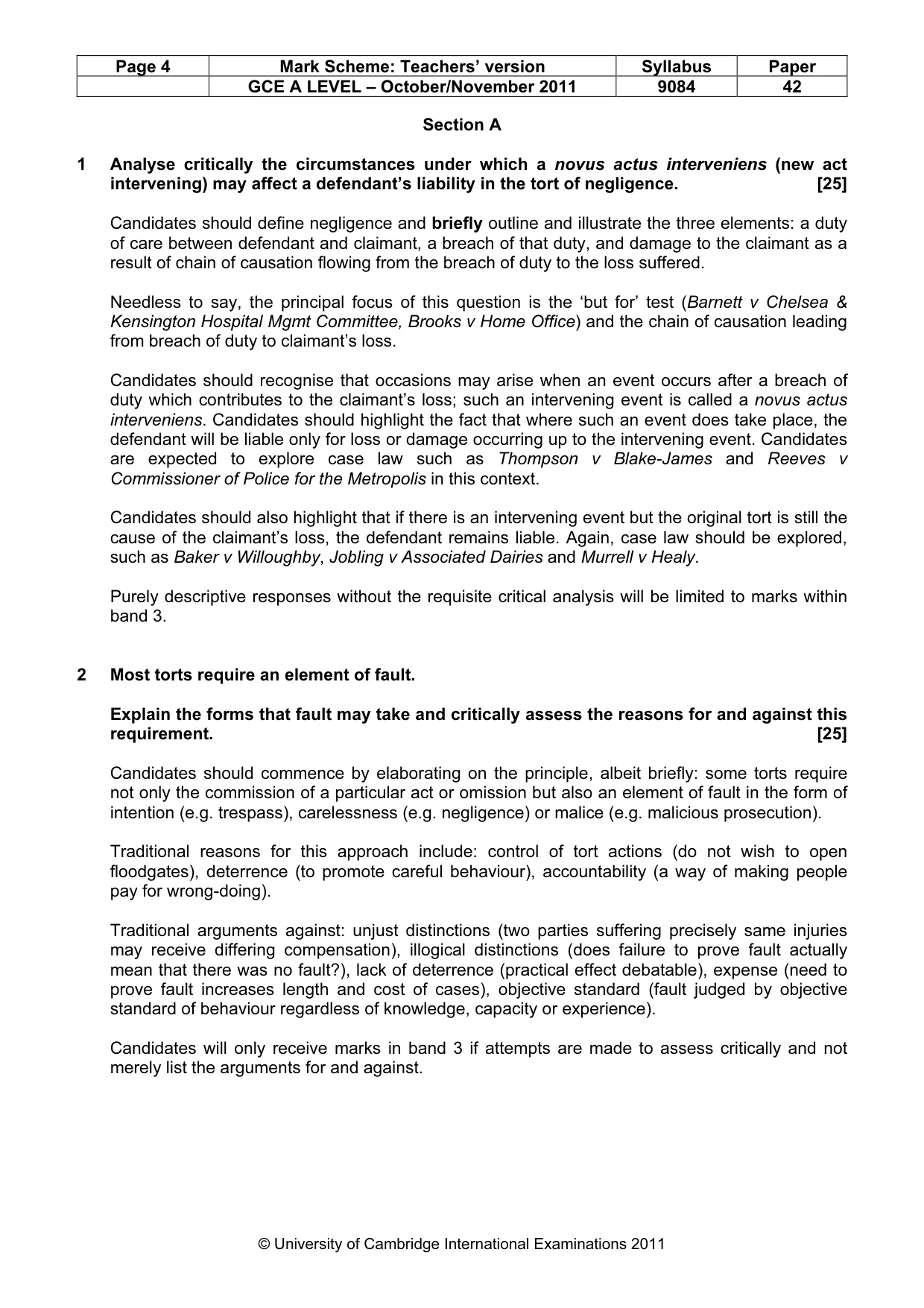
Page 4 Mark Scheme: Teachers’ version Syllabus Paper GCE A LEVEL – October/November 2011 9084 42 © University of Cambridge International Examinations 2011 Section A 1 Analyse critically the circumstances under which a novus actus interveniens (new act intervening) may affect a defendant’s liability in the tort of negligence. [25] Candidates should define negligence and briefly outline and illustrate the three elements: a duty of care between defendant and claimant, a breach of that duty, and damage to the claimant as a result of chain of causation flowing from the breach of duty to the loss suffered. Needless to say, the principal focus of this question is the ‘but for’ test (Barnett v Chelsea & Kensington Hospital Mgmt Committee, Brooks v Home Office) and the chain of causation leading from breach of duty to claimant’s loss. Candidates should recognise that occasions may arise when an event occurs after a breach of duty which contributes to the claimant’s loss; such an intervening event is called a novus actus interveniens. Candidates should highlight the fact that where such an event does take place, the defendant will be liable only for loss or damage occurring up to the intervening event. Candidates are expected to explore case law such as Thompson v Blake-James and Reeves v Commissioner of Police for the Metropolis in this context. Candidates should also highlight that if there is an intervening event but the original tort is still the cause of the claimant’s loss, the defendant remains liable. Again, case law should be explored, such as Baker v Willoughby, Jobling v Associated Dairies and Murrell v Healy. Purely descriptive responses without the requisite critical analysis will be limited to marks within band 3. 2 Most torts require an element of fault. Explain the forms that fault may take and critically assess the reasons for and against this requirement. [25] Candidates should commence by elaborating on the principle, albeit briefly: some torts require not only the commission of a particular act or omission but also an element of fault in the form of intention (e.g. trespass), carelessness (e.g. negligence) or malice (e.g. malicious prosecution). Traditional reasons for this approach include: control of tort actions (do not wish to open floodgates), deterrence (to promote careful behaviour), accountability (a way of making people pay for wrong-doing). Traditional arguments against: unjust distinctions (two parties suffering precisely same injuries may receive differing compensation), illogical distinctions (does failure to prove fault actually mean that there was no fault?), lack of deterrence (practical effect debatable), expense (need to prove fault increases length and cost of cases), objective standard (fault judged by objective standard of behaviour regardless of knowledge, capacity or experience). Candidates will only receive marks in band 3 if attempts are made to assess critically and not merely list the arguments for and against.
Mark scheme, page 5
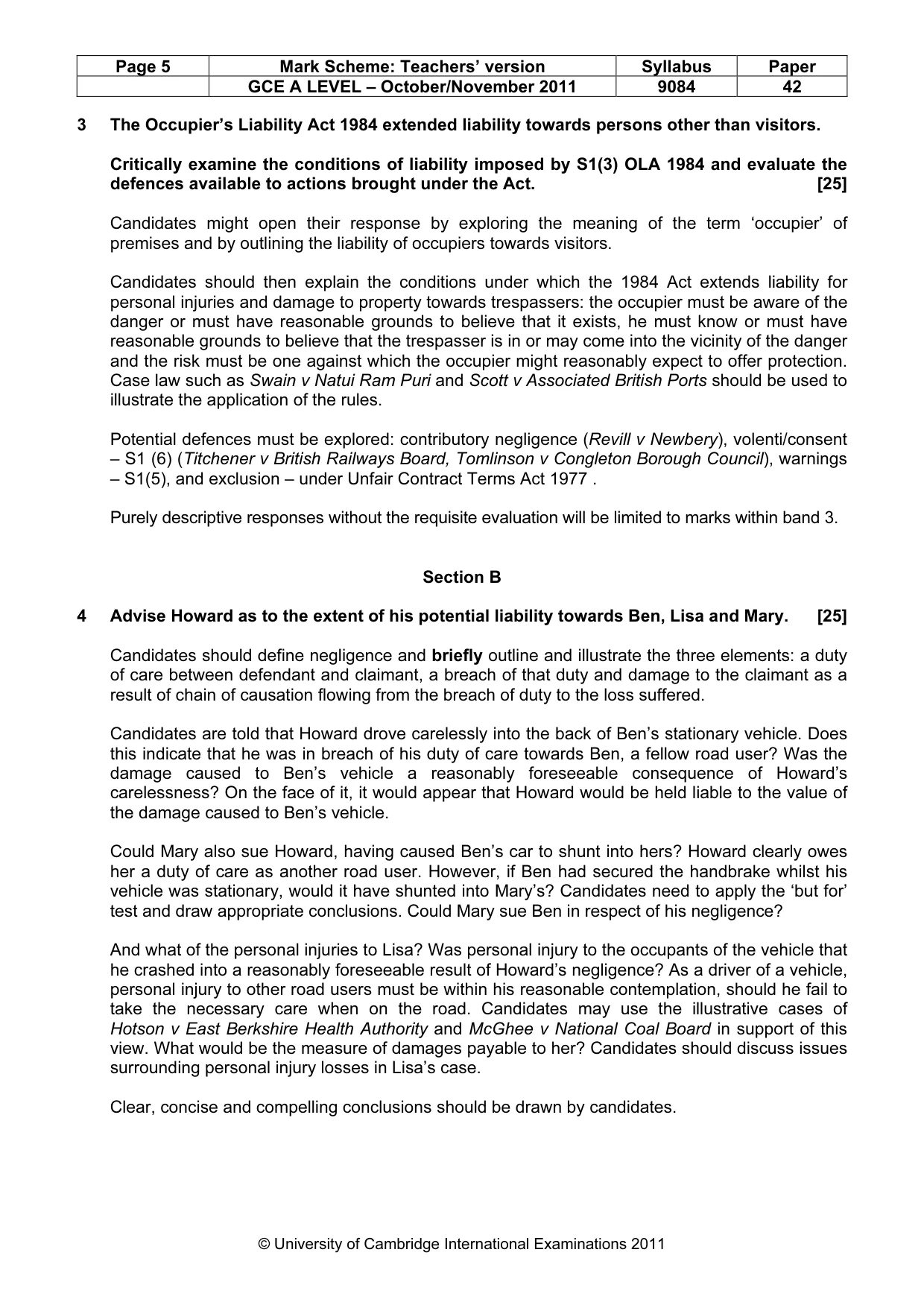
Page 5 Mark Scheme: Teachers’ version Syllabus Paper GCE A LEVEL – October/November 2011 9084 42 © University of Cambridge International Examinations 2011 3 The Occupier’s Liability Act 1984 extended liability towards persons other than visitors. Critically examine the conditions of liability imposed by S1(3) OLA 1984 and evaluate the defences available to actions brought under the Act. [25] Candidates might open their response by exploring the meaning of the term ‘occupier’ of premises and by outlining the liability of occupiers towards visitors. Candidates should then explain the conditions under which the 1984 Act extends liability for personal injuries and damage to property towards trespassers: the occupier must be aware of the danger or must have reasonable grounds to believe that it exists, he must know or must have reasonable grounds to believe that the trespasser is in or may come into the vicinity of the danger and the risk must be one against which the occupier might reasonably expect to offer protection. Case law such as Swain v Natui Ram Puri and Scott v Associated British Ports should be used to illustrate the application of the rules. Potential defences must be explored: contributory negligence (Revill v Newbery), volenti/consent – S1 (6) (Titchener v British Railways Board, Tomlinson v Congleton Borough Council), warnings – S1(5), and exclusion – under Unfair Contract Terms Act 1977 . Purely descriptive responses without the requisite evaluation will be limited to marks within band 3. Section B 4 Advise Howard as to the extent of his potential liability towards Ben, Lisa and Mary. [25] Candidates should define negligence and briefly outline and illustrate the three elements: a duty of care between defendant and claimant, a breach of that duty and damage to the claimant as a result of chain of causation flowing from the breach of duty to the loss suffered. Candidates are told that Howard drove carelessly into the back of Ben’s stationary vehicle. Does this indicate that he was in breach of his duty of care towards Ben, a fellow road user? Was the damage caused to Ben’s vehicle a reasonably foreseeable consequence of Howard’s carelessness? On the face of it, it would appear that Howard would be held liable to the value of the damage caused to Ben’s vehicle. Could Mary also sue Howard, having caused Ben’s car to shunt into hers? Howard clearly owes her a duty of care as another road user. However, if Ben had secured the handbrake whilst his vehicle was stationary, would it have shunted into Mary’s? Candidates need to apply the ‘but for’ test and draw appropriate conclusions. Could Mary sue Ben in respect of his negligence? And what of the personal injuries to Lisa? Was personal injury to the occupants of the vehicle that he crashed into a reasonably foreseeable result of Howard’s negligence? As a driver of a vehicle, personal injury to other road users must be within his reasonable contemplation, should he fail to take the necessary care when on the road. Candidates may use the illustrative cases of Hotson v East Berkshire Health Authority and McGhee v National Coal Board in support of this view. What would be the measure of damages payable to her? Candidates should discuss issues surrounding personal injury losses in Lisa’s case. Clear, concise and compelling conclusions should be drawn by candidates.
Mark scheme, page 6
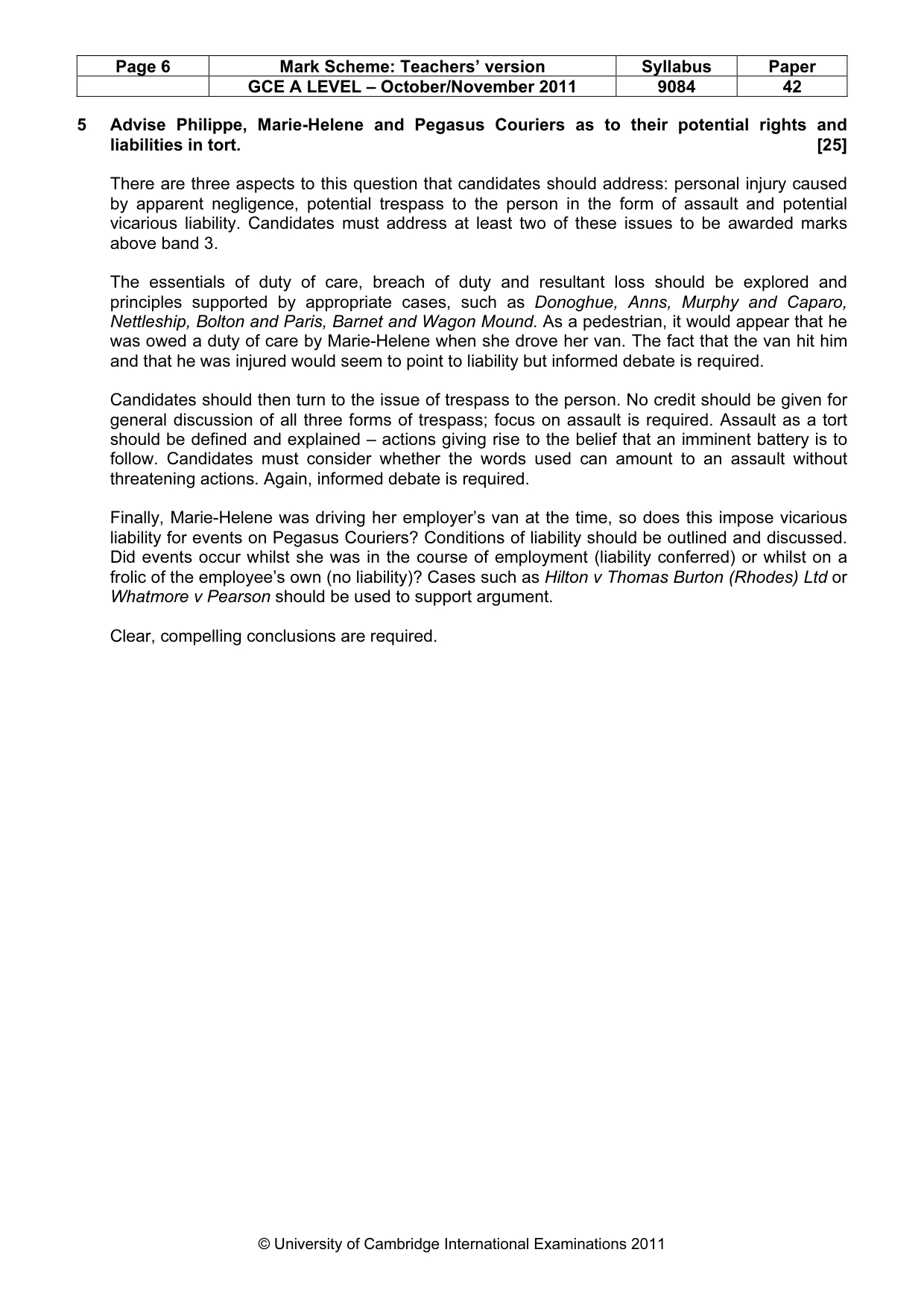
Page 6 Mark Scheme: Teachers’ version Syllabus Paper GCE A LEVEL – October/November 2011 9084 42 © University of Cambridge International Examinations 2011 5 Advise Philippe, Marie-Helene and Pegasus Couriers as to their potential rights and liabilities in tort. [25] There are three aspects to this question that candidates should address: personal injury caused by apparent negligence, potential trespass to the person in the form of assault and potential vicarious liability. Candidates must address at least two of these issues to be awarded marks above band 3. The essentials of duty of care, breach of duty and resultant loss should be explored and principles supported by appropriate cases, such as Donoghue, Anns, Murphy and Caparo, Nettleship, Bolton and Paris, Barnet and Wagon Mound. As a pedestrian, it would appear that he was owed a duty of care by Marie-Helene when she drove her van. The fact that the van hit him and that he was injured would seem to point to liability but informed debate is required. Candidates should then turn to the issue of trespass to the person. No credit should be given for general discussion of all three forms of trespass; focus on assault is required. Assault as a tort should be defined and explained – actions giving rise to the belief that an imminent battery is to follow. Candidates must consider whether the words used can amount to an assault without threatening actions. Again, informed debate is required. Finally, Marie-Helene was driving her employer’s van at the time, so does this impose vicarious liability for events on Pegasus Couriers? Conditions of liability should be outlined and discussed. Did events occur whilst she was in the course of employment (liability conferred) or whilst on a frolic of the employee’s own (no liability)? Cases such as Hilton v Thomas Burton (Rhodes) Ltd or Whatmore v Pearson should be used to support argument. Clear, compelling conclusions are required.
Mark scheme, page 7
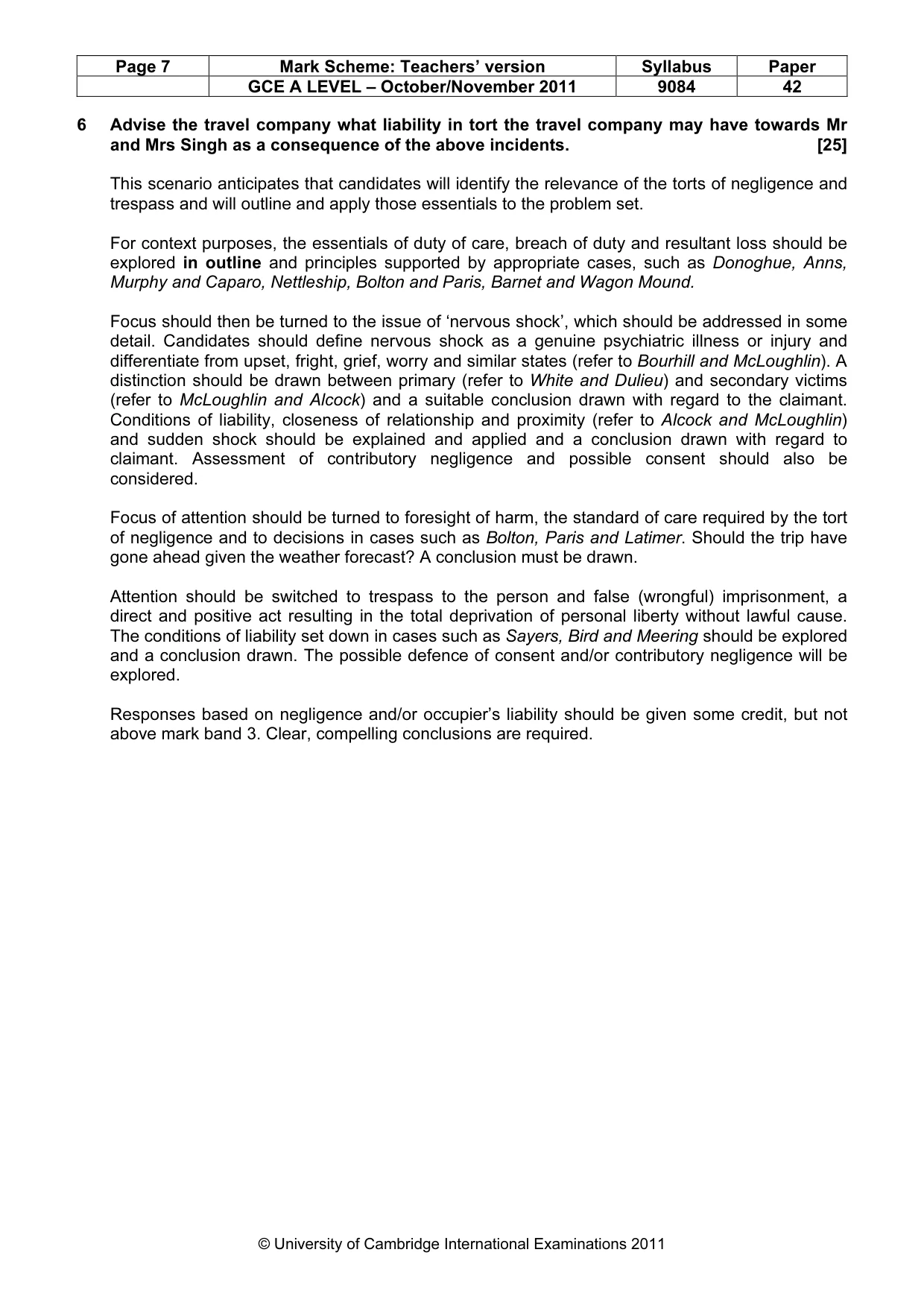
Page 7 Mark Scheme: Teachers’ version Syllabus Paper GCE A LEVEL – October/November 2011 9084 42 © University of Cambridge International Examinations 2011 6 Advise the travel company what liability in tort the travel company may have towards Mr and Mrs Singh as a consequence of the above incidents. [25] This scenario anticipates that candidates will identify the relevance of the torts of negligence and trespass and will outline and apply those essentials to the problem set. For context purposes, the essentials of duty of care, breach of duty and resultant loss should be explored in outline and principles supported by appropriate cases, such as Donoghue, Anns, Murphy and Caparo, Nettleship, Bolton and Paris, Barnet and Wagon Mound. Focus should then be turned to the issue of ‘nervous shock’, which should be addressed in some detail. Candidates should define nervous shock as a genuine psychiatric illness or injury and differentiate from upset, fright, grief, worry and similar states (refer to Bourhill and McLoughlin). A distinction should be drawn between primary (refer to White and Dulieu) and secondary victims (refer to McLoughlin and Alcock) and a suitable conclusion drawn with regard to the claimant. Conditions of liability, closeness of relationship and proximity (refer to Alcock and McLoughlin) and sudden shock should be explained and applied and a conclusion drawn with regard to claimant. Assessment of contributory negligence and possible consent should also be considered. Focus of attention should be turned to foresight of harm, the standard of care required by the tort of negligence and to decisions in cases such as Bolton, Paris and Latimer. Should the trip have gone ahead given the weather forecast? A conclusion must be drawn. Attention should be switched to trespass to the person and false (wrongful) imprisonment, a direct and positive act resulting in the total deprivation of personal liberty without lawful cause. The conditions of liability set down in cases such as Sayers, Bird and Meering should be explored and a conclusion drawn. The possible defence of consent and/or contributory negligence will be explored. Responses based on negligence and/or occupier’s liability should be given some credit, but not above mark band 3. Clear, compelling conclusions are required.
What you needed in this session
Cambridge’s own grade thresholds for 2011 Oct/Nov, Paper 4 · Variant 2. A higher threshold means an easier paper — the bar moves with how the cohort did.