Cambridge A Level Law 9084 — 2011 Oct/Nov Paper 3 · Variant 1
9084/31/O/N/11 · 75 marks · ≈84 min
The question paper and its mark scheme, free to read here and free to download. This is Cambridge’s own paper, exactly as it was sat.
Question paper4 pages
Mark scheme7 pages
Answers below. Sit the paper first if you are practising.
Paper as text
Question paper, page 1
This document consists of 4 printed pages. DC (SM) 36033/2 © UCLES 2011 [Turn over UNIVERSITY OF CAMBRIDGE INTERNATIONAL EXAMINATIONS General Certificate of Education Advanced Level * 0 0 9 9 2 7 1 5 1 7 * LAW 9084/31 Paper 3 Law of Contract October/November 2011 1 hour 30 minutes Additional Materials: Answer Booklet/Paper READ THESE INSTRUCTIONS FIRST If you have been given an Answer Booklet, follow the instructions on the front cover of the Booklet. Write your Centre number, candidate number and name on all the work you hand in. Write in dark blue or black pen. Do not use staples, paper clips, highlighters, glue or correction fluid. Answer one question from Section A, one from Section B and one other, thus making a total of three responses required. At the end of the examination, fasten all your work securely together. The number of marks is given in brackets [ ] at the end of each question or part question.
Question paper, page 2
2 9084/31/O/N/11 © UCLES 2011 Candidates must attempt one question from Section A, one from Section B and one other, thus making a total of three responses required. Section A 1 A solution is available for every breach of contract. Analyse the range of common law and equitable remedies available for actions based in contract law and, using suitable examples, critically assess the truth of the above statement. [25] 2 The doctrine of equitable or promissory estoppel enables the enforcement of rights under a contract. Discuss the circumstances which gave rise to the introduction of the doctrine and analyse the extent to which you would agree with this proposition. [25] 3 The limitations imposed on the validity of contracts made by minors make it extremely difficult for young people to make their way in the modern world. Discuss the reasons why the law imposes these limitations and assess the extent to which they need to be revised. [25]
Question paper, page 3
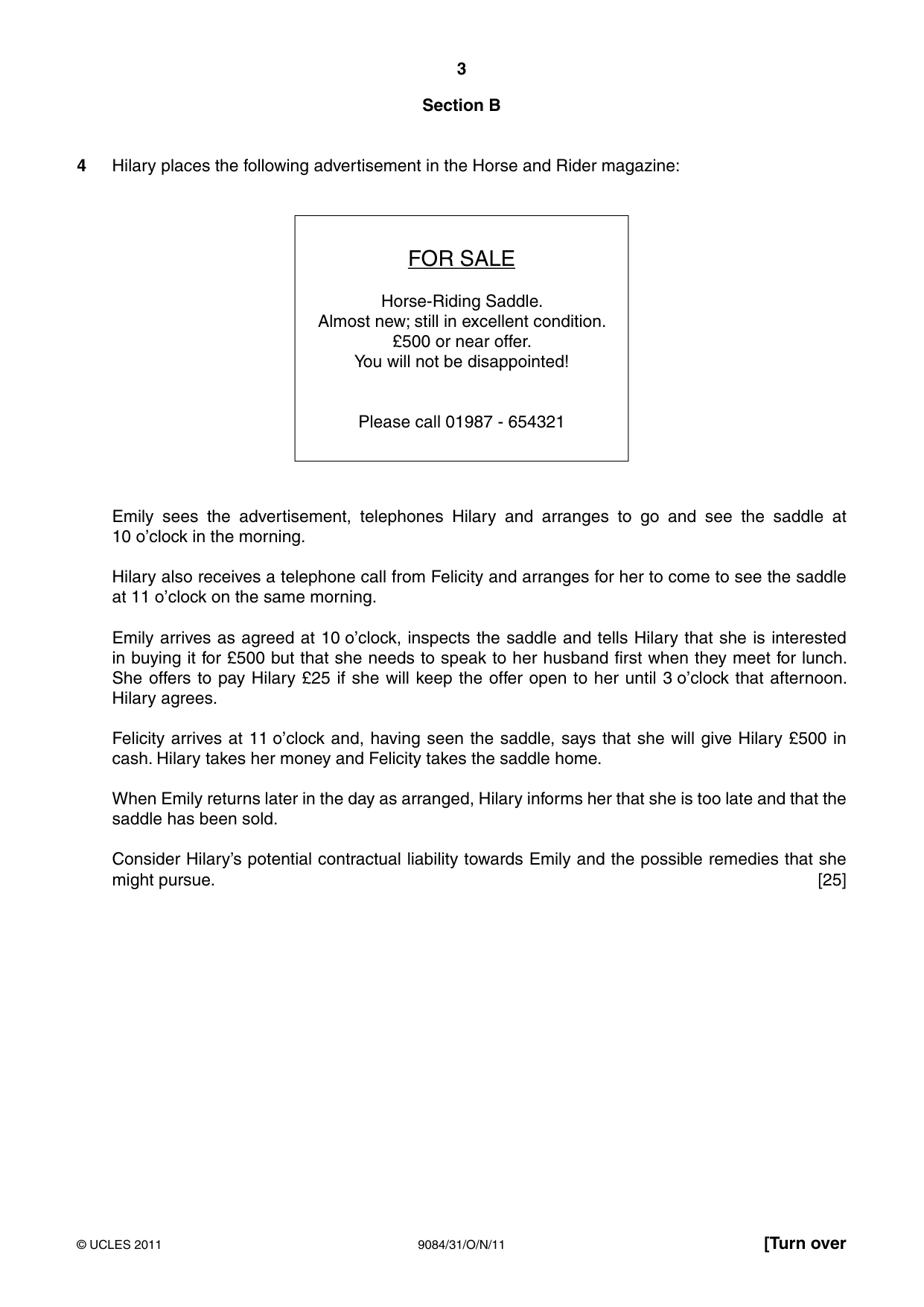
3 9084/31/O/N/11 © UCLES 2011 [Turn over Section B 4 Hilary places the following advertisement in the Horse and Rider magazine: FOR SALE Horse-Riding Saddle. Almost new; still in excellent condition. £500 or near offer. You will not be disappointed! Please call 01987 - 654321 Emily sees the advertisement, telephones Hilary and arranges to go and see the saddle at 10 o’clock in the morning. Hilary also receives a telephone call from Felicity and arranges for her to come to see the saddle at 11 o’clock on the same morning. Emily arrives as agreed at 10 o’clock, inspects the saddle and tells Hilary that she is interested in buying it for £500 but that she needs to speak to her husband first when they meet for lunch. She offers to pay Hilary £25 if she will keep the offer open to her until 3 o’clock that afternoon. Hilary agrees. Felicity arrives at 11 o’clock and, having seen the saddle, says that she will give Hilary £500 in cash. Hilary takes her money and Felicity takes the saddle home. When Emily returns later in the day as arranged, Hilary informs her that she is too late and that the saddle has been sold. Consider Hilary’s potential contractual liability towards Emily and the possible remedies that she might pursue. [25]
Question paper, page 4
4 9084/31/O/N/11 © UCLES 2011 Permission to reproduce items where third-party owned material protected by copyright is included has been sought and cleared where possible. Every reasonable effort has been made by the publisher (UCLES) to trace copyright holders, but if any items requiring clearance have unwittingly been included, the publisher will be pleased to make amends at the earliest possible opportunity. University of Cambridge International Examinations is part of the Cambridge Assessment Group. Cambridge Assessment is the brand name of University of Cambridge Local Examinations Syndicate (UCLES), which is itself a department of the University of Cambridge. 5 Mercedes breeds pedigree dogs. She has a contract with K9 Petfoods for the supply of food for her dogs and she normally buys enough for a month. The contract states that Mercedes must inform the supplier of any problems with either the quantity or quality of dog food supplied within 10 working days of delivery and that the supplier’s liability is limited to the contract price paid for the relevant delivery of supplies. Mercedes has recently taken delivery of supplies for two months, costing £1000. Three weeks later, she finds that at least some of the last delivery of dog food is contaminated and three of her dogs, each worth £500, have died having eaten it. Advise Mercedes as to her right to compensation under the terms of the contract made with K9 Petfoods. [25] 6 John is the owner of a small company. Marie works for him as a secretary. Her role requires her to ask John to sign documents and one day she places a small pile of documents in front of him for signature. She tells John that they are to authorise payments to one of the company’s suppliers. He signs the documents without reading them. At a later date he discovers that one of the documents that he signed is in fact a guarantee of Marie’s bank overdraft. Consider the extent, if any, to which John is legally bound by the document that he signed to guarantee Marie’s overdraft. [25]
Mark scheme, page 1
UNIVERSITY OF CAMBRIDGE INTERNATIONAL EXAMINATIONS GCE Advanced Level MARK SCHEME for the October/November 2011 question paper for the guidance of teachers 9084 LAW 9084/31 Paper 3, maximum raw mark 75 This mark scheme is published as an aid to teachers and candidates, to indicate the requirements of the examination. It shows the basis on which Examiners were instructed to award marks. It does not indicate the details of the discussions that took place at an Examiners’ meeting before marking began, which would have considered the acceptability of alternative answers. Mark schemes must be read in conjunction with the question papers and the report on the examination. • Cambridge will not enter into discussions or correspondence in connection with these mark schemes. Cambridge is publishing the mark schemes for the October/November 2011 question papers for most IGCSE, GCE Advanced Level and Advanced Subsidiary Level syllabuses and some Ordinary Level syllabuses.
Mark scheme, page 2
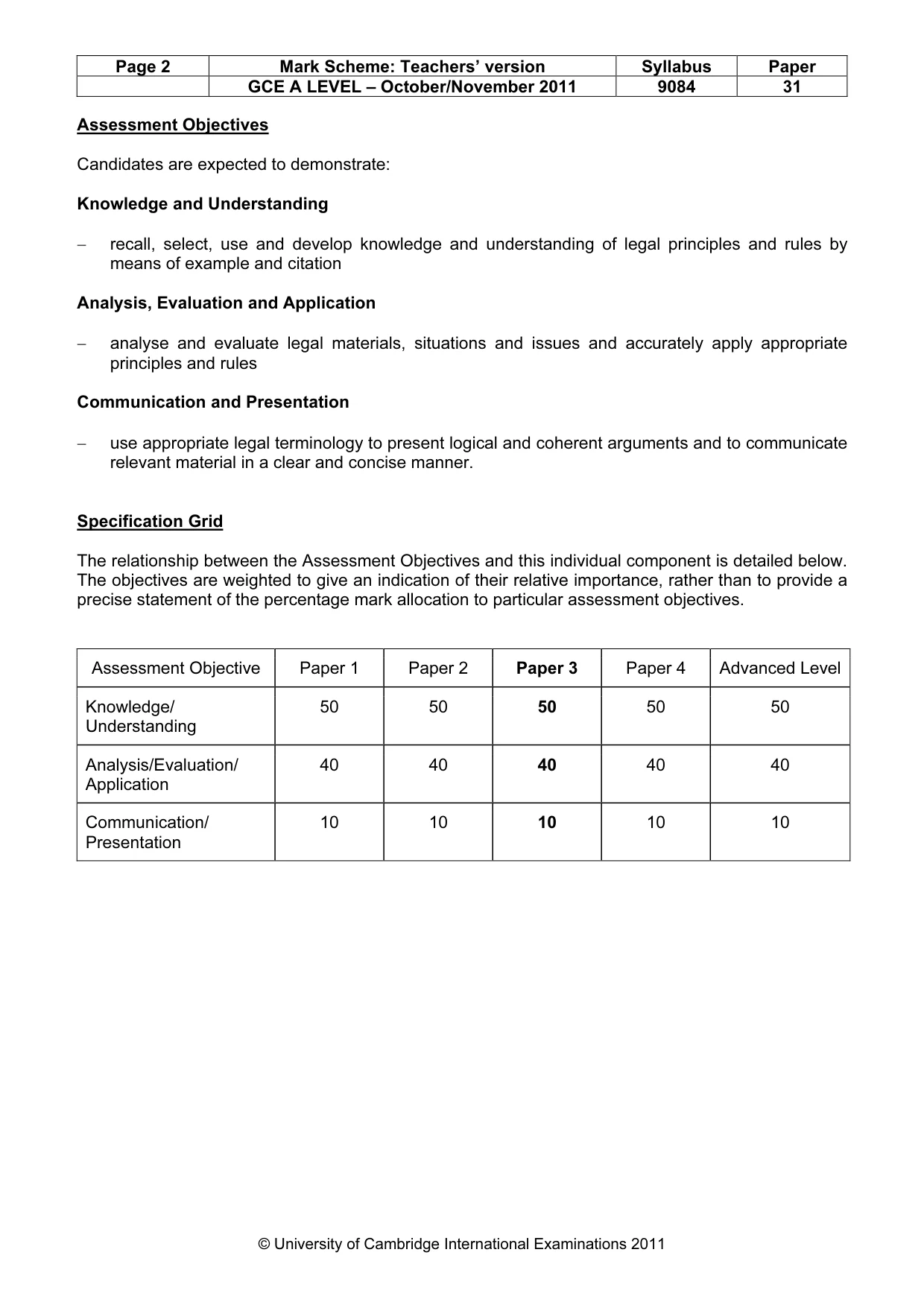
Page 2 Mark Scheme: Teachers’ version Syllabus Paper GCE A LEVEL – October/November 2011 9084 31 © University of Cambridge International Examinations 2011 Assessment Objectives Candidates are expected to demonstrate: Knowledge and Understanding − recall, select, use and develop knowledge and understanding of legal principles and rules by means of example and citation Analysis, Evaluation and Application − analyse and evaluate legal materials, situations and issues and accurately apply appropriate principles and rules Communication and Presentation − use appropriate legal terminology to present logical and coherent arguments and to communicate relevant material in a clear and concise manner. Specification Grid The relationship between the Assessment Objectives and this individual component is detailed below. The objectives are weighted to give an indication of their relative importance, rather than to provide a precise statement of the percentage mark allocation to particular assessment objectives. Assessment Objective Paper 1 Paper 2 Paper 3 Paper 4 Advanced Level Knowledge/ Understanding 50 50 50 50 50 Analysis/Evaluation/ Application 40 40 40 40 40 Communication/ Presentation 10 10 10 10 10
Mark scheme, page 3
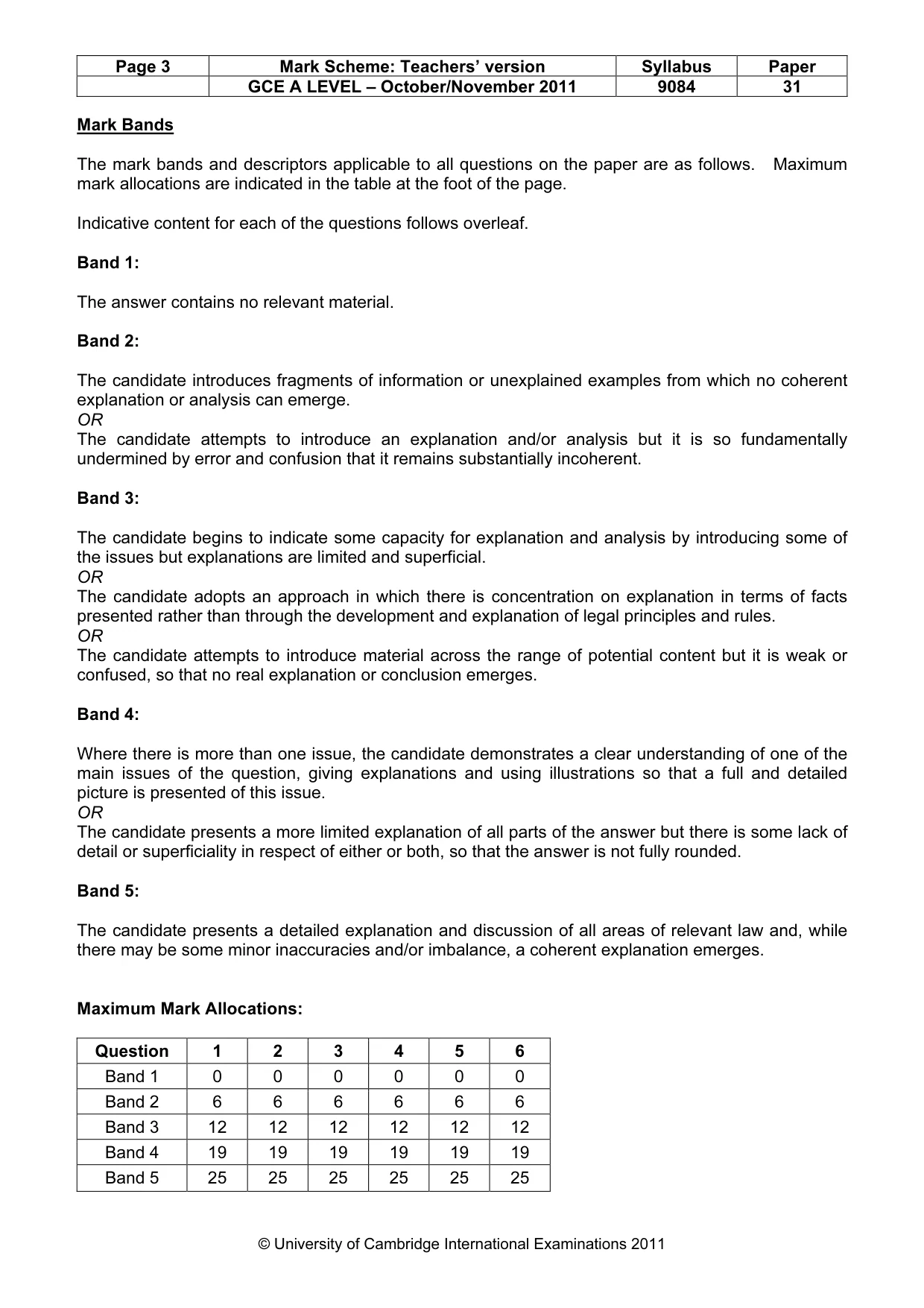
Page 3 Mark Scheme: Teachers’ version Syllabus Paper GCE A LEVEL – October/November 2011 9084 31 © University of Cambridge International Examinations 2011 Mark Bands The mark bands and descriptors applicable to all questions on the paper are as follows. Maximum mark allocations are indicated in the table at the foot of the page. Indicative content for each of the questions follows overleaf. Band 1: The answer contains no relevant material. Band 2: The candidate introduces fragments of information or unexplained examples from which no coherent explanation or analysis can emerge. OR The candidate attempts to introduce an explanation and/or analysis but it is so fundamentally undermined by error and confusion that it remains substantially incoherent. Band 3: The candidate begins to indicate some capacity for explanation and analysis by introducing some of the issues but explanations are limited and superficial. OR The candidate adopts an approach in which there is concentration on explanation in terms of facts presented rather than through the development and explanation of legal principles and rules. OR The candidate attempts to introduce material across the range of potential content but it is weak or confused, so that no real explanation or conclusion emerges. Band 4: Where there is more than one issue, the candidate demonstrates a clear understanding of one of the main issues of the question, giving explanations and using illustrations so that a full and detailed picture is presented of this issue. OR The candidate presents a more limited explanation of all parts of the answer but there is some lack of detail or superficiality in respect of either or both, so that the answer is not fully rounded. Band 5: The candidate presents a detailed explanation and discussion of all areas of relevant law and, while there may be some minor inaccuracies and/or imbalance, a coherent explanation emerges. Maximum Mark Allocations: Question 1 2 3 4 5 6 Band 1 0 0 0 0 0 0 Band 2 6 6 6 6 6 6 Band 3 12 12 12 12 12 12 Band 4 19 19 19 19 19 19 Band 5 25 25 25 25 25 25
Mark scheme, page 4
Page 4 Mark Scheme: Teachers’ version Syllabus Paper GCE A LEVEL – October/November 2011 9084 31 © University of Cambridge International Examinations 2011 Section A 1 A solution is available for every breach of contract. Analyse the range of common law and equitable remedies available for actions based in contract law and, using suitable examples, critically assess the truth of the above statement. Cursory examination of the remedies available for breach of contract might indeed suggest that there is a solution for every sort of breach. However, closer examination discloses two main gaps in provision: in relation to interests protected and to practicalities. The law focuses mainly on one type of loss: financial loss to the innocent party to the breach. In general, the law ignores mental distress, anxiety and inconvenience caused by breach. Candidates might consider the sort of situation where, for example, under the terms of a contract, a customer pays a builder a large sum of money to buy materials and get a job started, only for the builder to start the job, having spent very little of the customer’s money, and then fail to return to do any more. If the builder fails to return to do the job, not only is the customer financially out of pocket but s(he) will often experience considerable mental distress trying to cope with the financial loss, which is seldom if ever recoverable. Even where available remedies would provide an adequate solution, it would often be totally impractical for a claim to be made, because the costs and/or the time and effort required to undertake litigation are disproportionately high when compared with the amount that could be claimed. 2 The doctrine of equitable or promissory estoppel enables the enforcement of rights under a contract. Discuss the circumstances which gave rise to the introduction of the doctrine and analyse the extent to which you would agree with this proposition. Candidates are expected to set the question in context by saying that this is an equitable doctrine introduced by the High Trees Case as a means of mitigating undue hardship (at least temporarily) that would result from the strict application of the rules of consideration in the law of contract. Responses should be further contextualised by reference to the harshness of the rigid application of the common law rule in Pinnel’s case – examples ought to be given. The rule itself should be stated and explained and candidates should then, using relevant case law, go through situations in which the doctrine will not apply, i.e. where there is no pre-existing contract, where a promise has been made place no reliance on the promise to forego strict rights, where it would be inequitable to allow the doctrine to apply etc.
Mark scheme, page 5
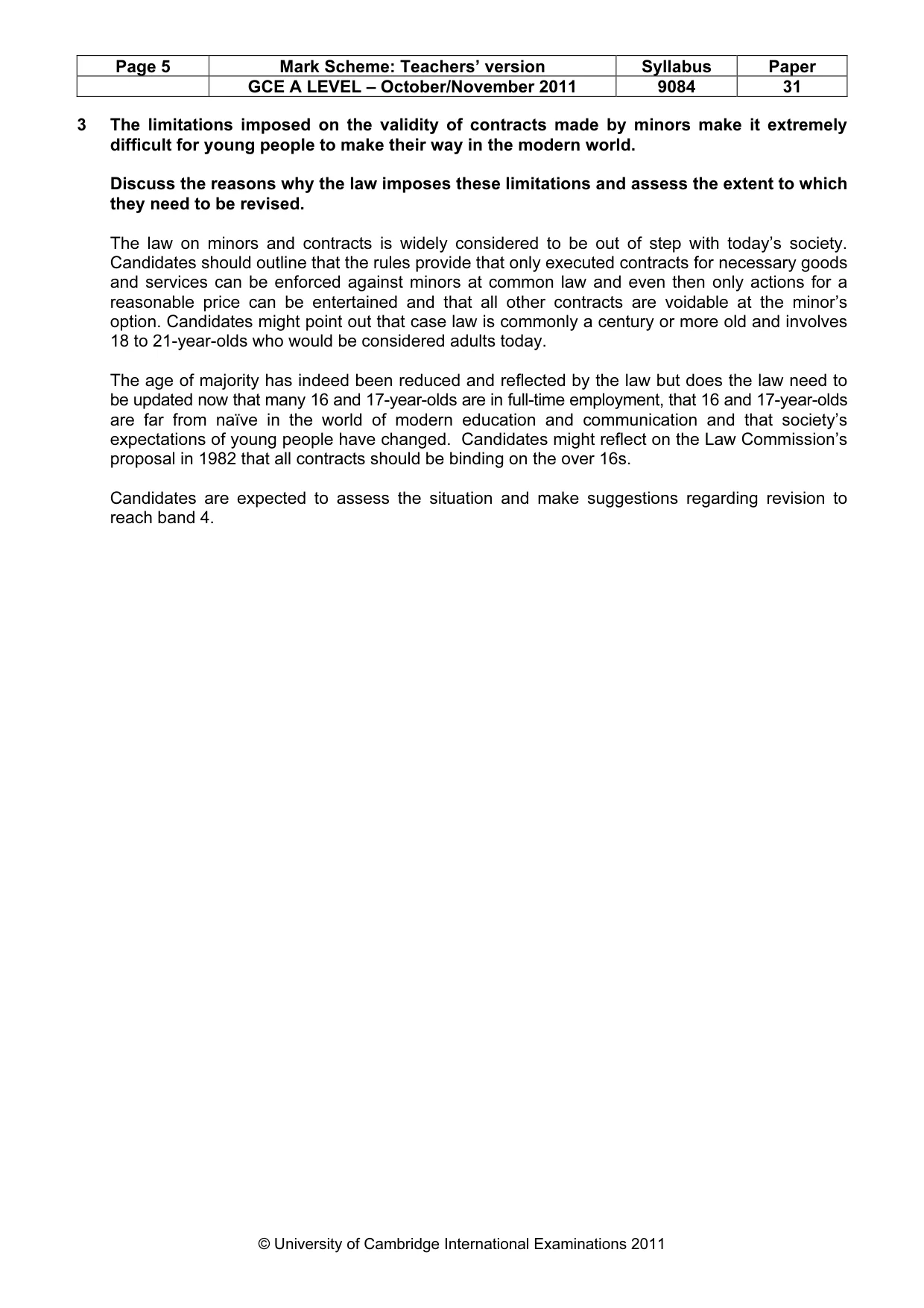
Page 5 Mark Scheme: Teachers’ version Syllabus Paper GCE A LEVEL – October/November 2011 9084 31 © University of Cambridge International Examinations 2011 3 The limitations imposed on the validity of contracts made by minors make it extremely difficult for young people to make their way in the modern world. Discuss the reasons why the law imposes these limitations and assess the extent to which they need to be revised. The law on minors and contracts is widely considered to be out of step with today’s society. Candidates should outline that the rules provide that only executed contracts for necessary goods and services can be enforced against minors at common law and even then only actions for a reasonable price can be entertained and that all other contracts are voidable at the minor’s option. Candidates might point out that case law is commonly a century or more old and involves 18 to 21-year-olds who would be considered adults today. The age of majority has indeed been reduced and reflected by the law but does the law need to be updated now that many 16 and 17-year-olds are in full-time employment, that 16 and 17-year-olds are far from naïve in the world of modern education and communication and that society’s expectations of young people have changed. Candidates might reflect on the Law Commission’s proposal in 1982 that all contracts should be binding on the over 16s. Candidates are expected to assess the situation and make suggestions regarding revision to reach band 4.
Mark scheme, page 6
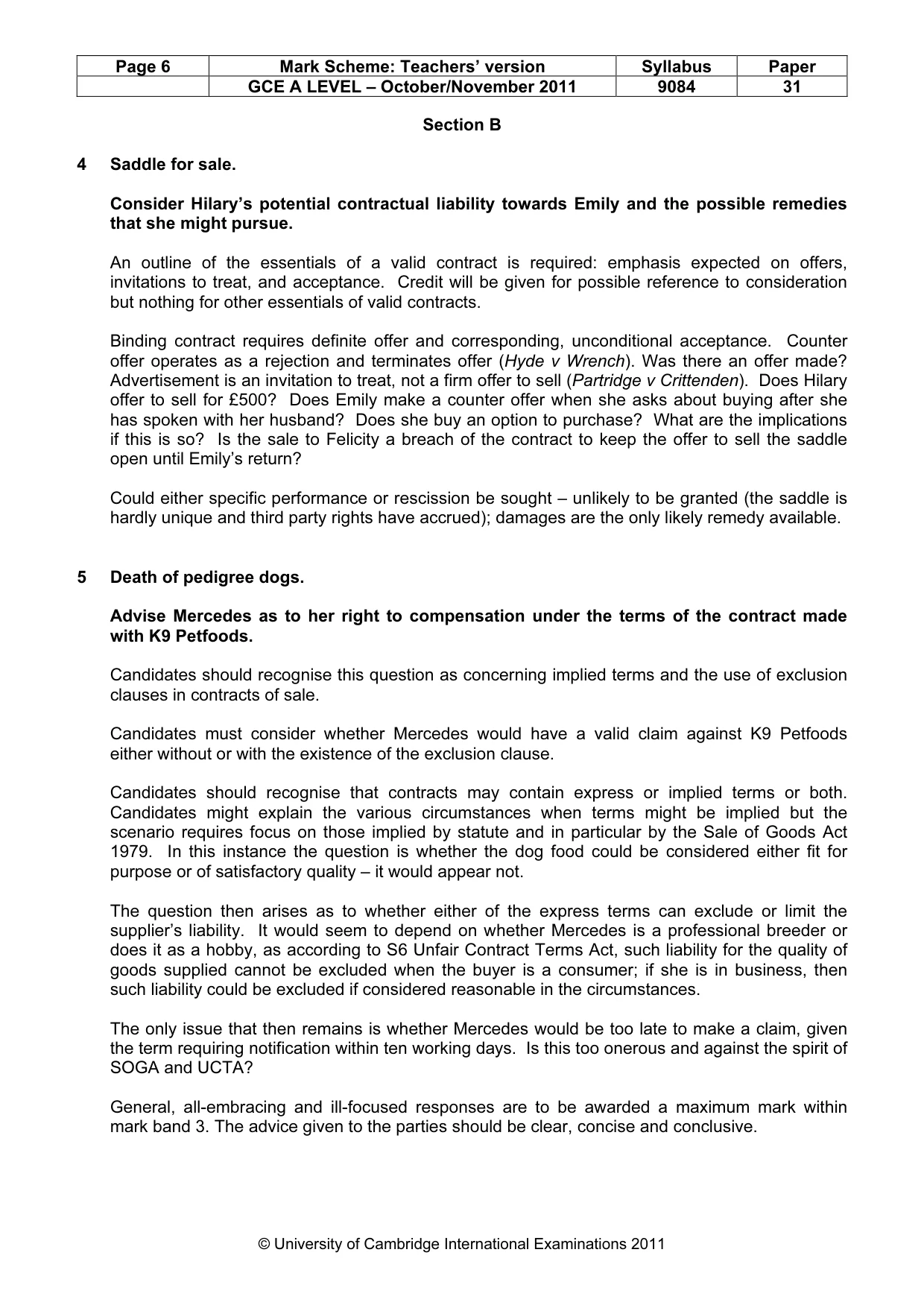
Page 6 Mark Scheme: Teachers’ version Syllabus Paper GCE A LEVEL – October/November 2011 9084 31 © University of Cambridge International Examinations 2011 Section B 4 Saddle for sale. Consider Hilary’s potential contractual liability towards Emily and the possible remedies that she might pursue. An outline of the essentials of a valid contract is required: emphasis expected on offers, invitations to treat, and acceptance. Credit will be given for possible reference to consideration but nothing for other essentials of valid contracts. Binding contract requires definite offer and corresponding, unconditional acceptance. Counter offer operates as a rejection and terminates offer (Hyde v Wrench). Was there an offer made? Advertisement is an invitation to treat, not a firm offer to sell (Partridge v Crittenden). Does Hilary offer to sell for £500? Does Emily make a counter offer when she asks about buying after she has spoken with her husband? Does she buy an option to purchase? What are the implications if this is so? Is the sale to Felicity a breach of the contract to keep the offer to sell the saddle open until Emily’s return? Could either specific performance or rescission be sought – unlikely to be granted (the saddle is hardly unique and third party rights have accrued); damages are the only likely remedy available. 5 Death of pedigree dogs. Advise Mercedes as to her right to compensation under the terms of the contract made with K9 Petfoods. Candidates should recognise this question as concerning implied terms and the use of exclusion clauses in contracts of sale. Candidates must consider whether Mercedes would have a valid claim against K9 Petfoods either without or with the existence of the exclusion clause. Candidates should recognise that contracts may contain express or implied terms or both. Candidates might explain the various circumstances when terms might be implied but the scenario requires focus on those implied by statute and in particular by the Sale of Goods Act 1979. In this instance the question is whether the dog food could be considered either fit for purpose or of satisfactory quality – it would appear not. The question then arises as to whether either of the express terms can exclude or limit the supplier’s liability. It would seem to depend on whether Mercedes is a professional breeder or does it as a hobby, as according to S6 Unfair Contract Terms Act, such liability for the quality of goods supplied cannot be excluded when the buyer is a consumer; if she is in business, then such liability could be excluded if considered reasonable in the circumstances. The only issue that then remains is whether Mercedes would be too late to make a claim, given the term requiring notification within ten working days. Is this too onerous and against the spirit of SOGA and UCTA? General, all-embracing and ill-focused responses are to be awarded a maximum mark within mark band 3. The advice given to the parties should be clear, concise and conclusive.
Mark scheme, page 7
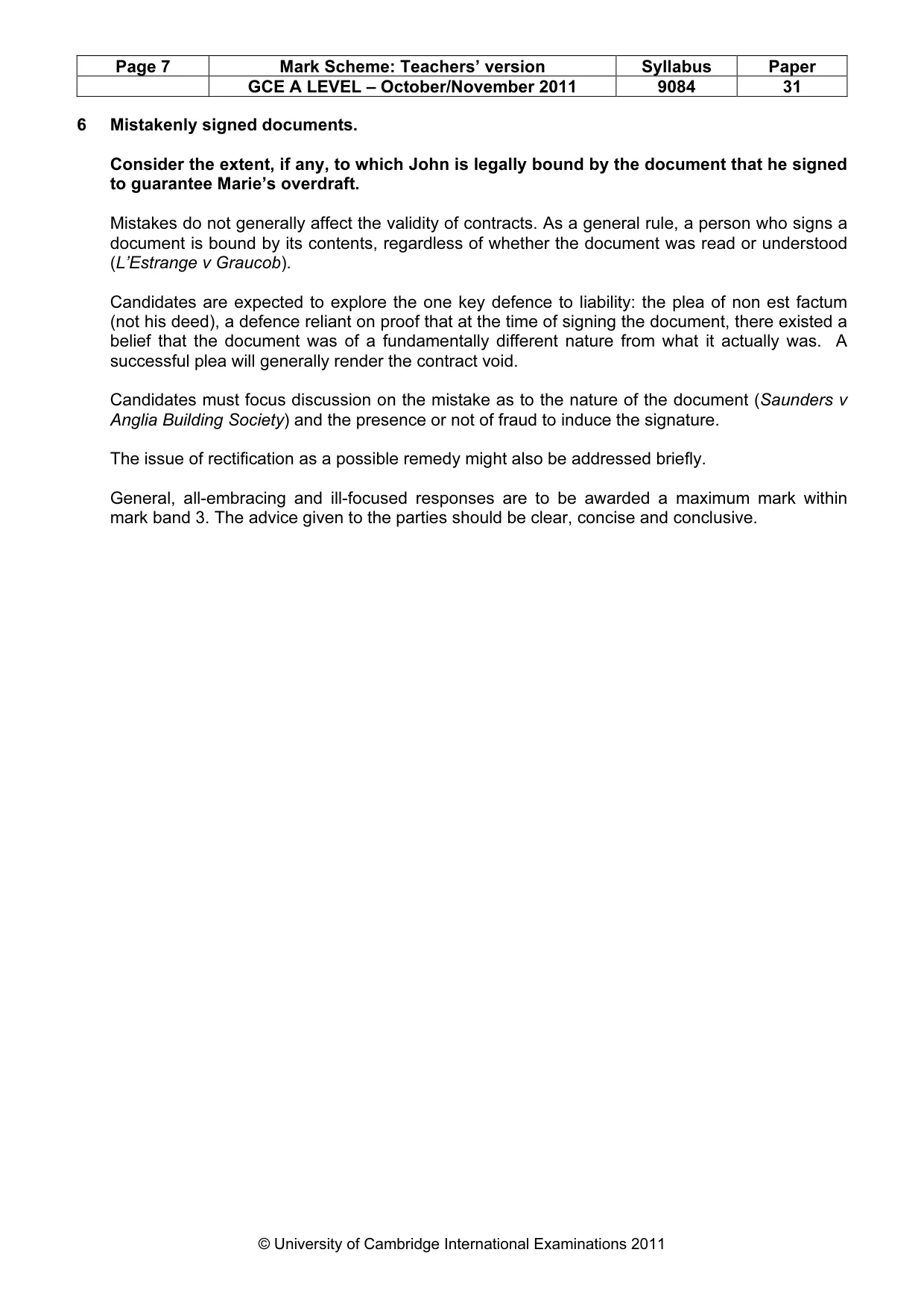
Page 7 Mark Scheme: Teachers’ version Syllabus Paper GCE A LEVEL – October/November 2011 9084 31 © University of Cambridge International Examinations 2011 6 Mistakenly signed documents. Consider the extent, if any, to which John is legally bound by the document that he signed to guarantee Marie’s overdraft. Mistakes do not generally affect the validity of contracts. As a general rule, a person who signs a document is bound by its contents, regardless of whether the document was read or understood (L’Estrange v Graucob). Candidates are expected to explore the one key defence to liability: the plea of non est factum (not his deed), a defence reliant on proof that at the time of signing the document, there existed a belief that the document was of a fundamentally different nature from what it actually was. A successful plea will generally render the contract void. Candidates must focus discussion on the mistake as to the nature of the document (Saunders v Anglia Building Society) and the presence or not of fraud to induce the signature. The issue of rectification as a possible remedy might also be addressed briefly. General, all-embracing and ill-focused responses are to be awarded a maximum mark within mark band 3. The advice given to the parties should be clear, concise and conclusive.
What you needed in this session
Cambridge’s own grade thresholds for 2011 Oct/Nov, Paper 3 · Variant 1. A higher threshold means an easier paper — the bar moves with how the cohort did.