Cambridge A Level Law 9084 — 2011 Oct/Nov Paper 1 · Variant 2
9084/12/O/N/11 · 75 marks · ≈84 min
The question paper and its mark scheme, free to read here and free to download. This is Cambridge’s own paper, exactly as it was sat.
Question paper2 pages
Mark scheme4 pages
Answers below. Sit the paper first if you are practising.
Paper as text
Question paper, page 1
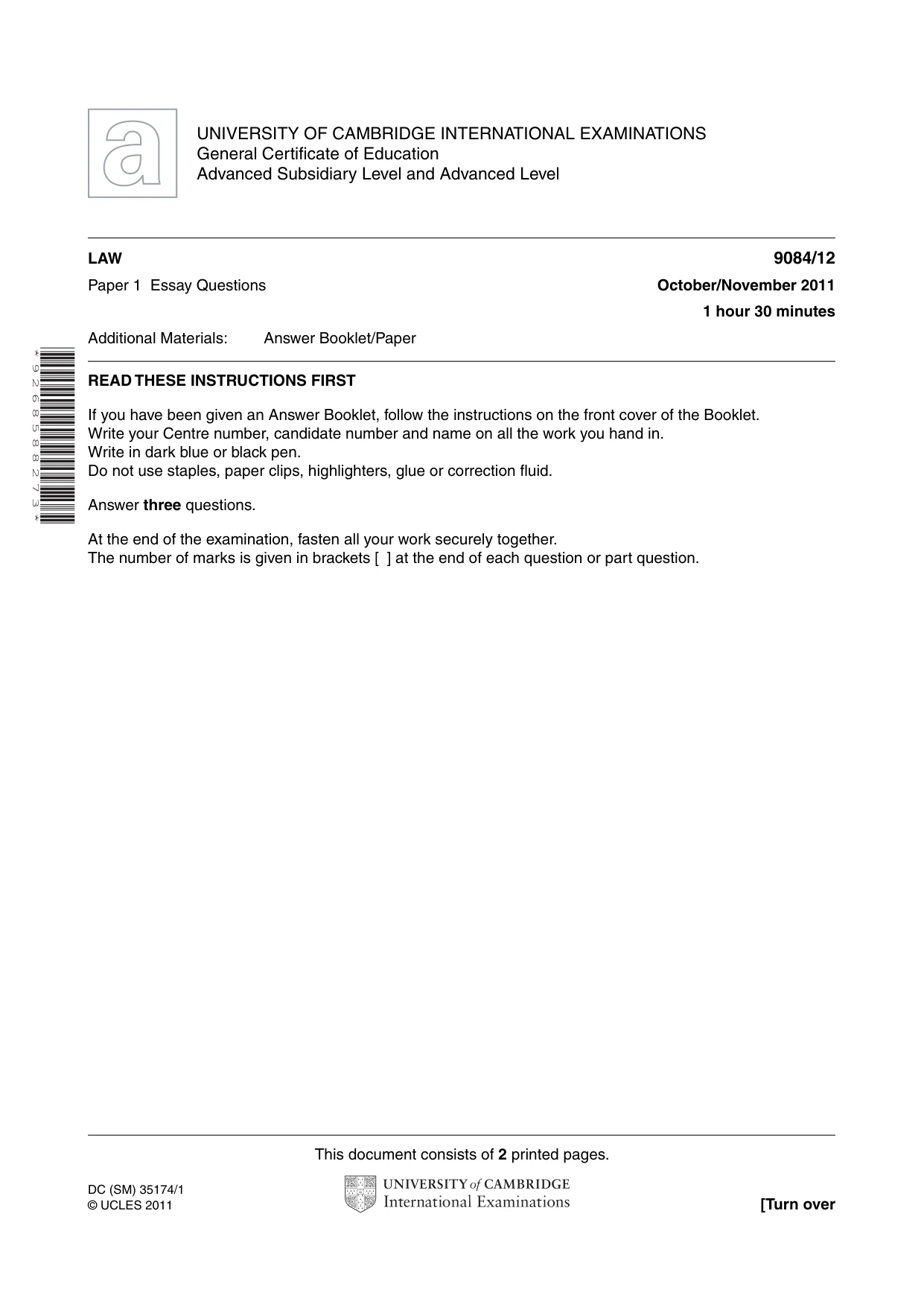
This document consists of 2 printed pages. DC (SM) 35174/1 © UCLES 2011 [Turn over UNIVERSITY OF CAMBRIDGE INTERNATIONAL EXAMINATIONS General Certificate of Education Advanced Subsidiary Level and Advanced Level * 9 2 6 8 5 8 8 2 7 3 * LAW 9084/12 Paper 1 Essay Questions October/November 2011 1 hour 30 minutes Additional Materials: Answer Booklet/Paper READ THESE INSTRUCTIONS FIRST If you have been given an Answer Booklet, follow the instructions on the front cover of the Booklet. Write your Centre number, candidate number and name on all the work you hand in. Write in dark blue or black pen. Do not use staples, paper clips, highlighters, glue or correction fluid. Answer three questions. At the end of the examination, fasten all your work securely together. The number of marks is given in brackets [ ] at the end of each question or part question.
Question paper, page 2
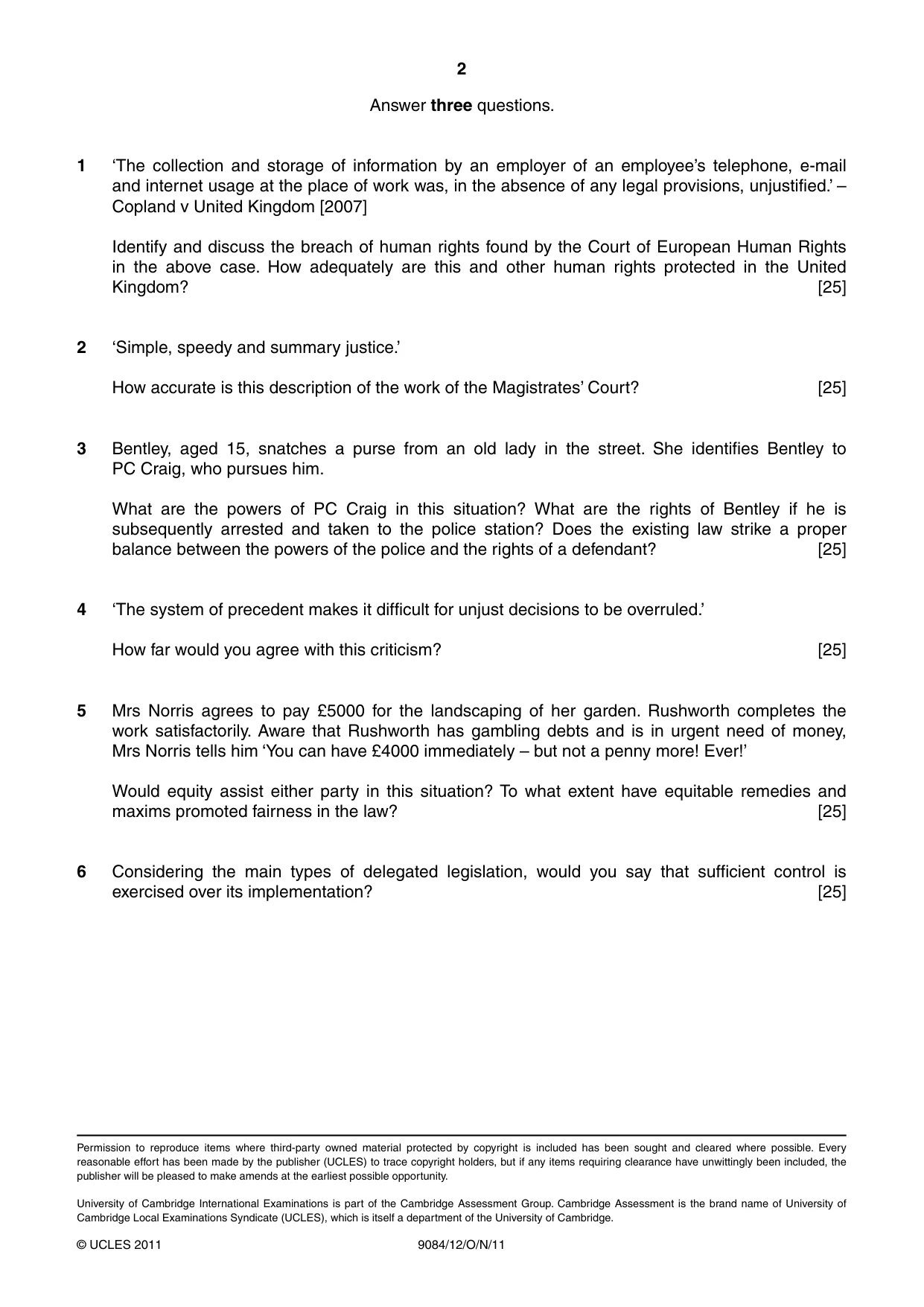
2 9084/12/O/N/11 © UCLES 2011 Permission to reproduce items where third-party owned material protected by copyright is included has been sought and cleared where possible. Every reasonable effort has been made by the publisher (UCLES) to trace copyright holders, but if any items requiring clearance have unwittingly been included, the publisher will be pleased to make amends at the earliest possible opportunity. University of Cambridge International Examinations is part of the Cambridge Assessment Group. Cambridge Assessment is the brand name of University of Cambridge Local Examinations Syndicate (UCLES), which is itself a department of the University of Cambridge. Answer three questions. 1 ‘The collection and storage of information by an employer of an employee’s telephone, e-mail and internet usage at the place of work was, in the absence of any legal provisions, unjustified.’ – Copland v United Kingdom [2007] Identify and discuss the breach of human rights found by the Court of European Human Rights in the above case. How adequately are this and other human rights protected in the United Kingdom? [25] 2 ‘Simple, speedy and summary justice.’ How accurate is this description of the work of the Magistrates’ Court? [25] 3 Bentley, aged 15, snatches a purse from an old lady in the street. She identifies Bentley to PC Craig, who pursues him. What are the powers of PC Craig in this situation? What are the rights of Bentley if he is subsequently arrested and taken to the police station? Does the existing law strike a proper balance between the powers of the police and the rights of a defendant? [25] 4 ‘The system of precedent makes it difficult for unjust decisions to be overruled.’ How far would you agree with this criticism? [25] 5 Mrs Norris agrees to pay £5000 for the landscaping of her garden. Rushworth completes the work satisfactorily. Aware that Rushworth has gambling debts and is in urgent need of money, Mrs Norris tells him ‘You can have £4000 immediately – but not a penny more! Ever!’ Would equity assist either party in this situation? To what extent have equitable remedies and maxims promoted fairness in the law? [25] 6 Considering the main types of delegated legislation, would you say that sufficient control is exercised over its implementation? [25]
Mark scheme, page 1
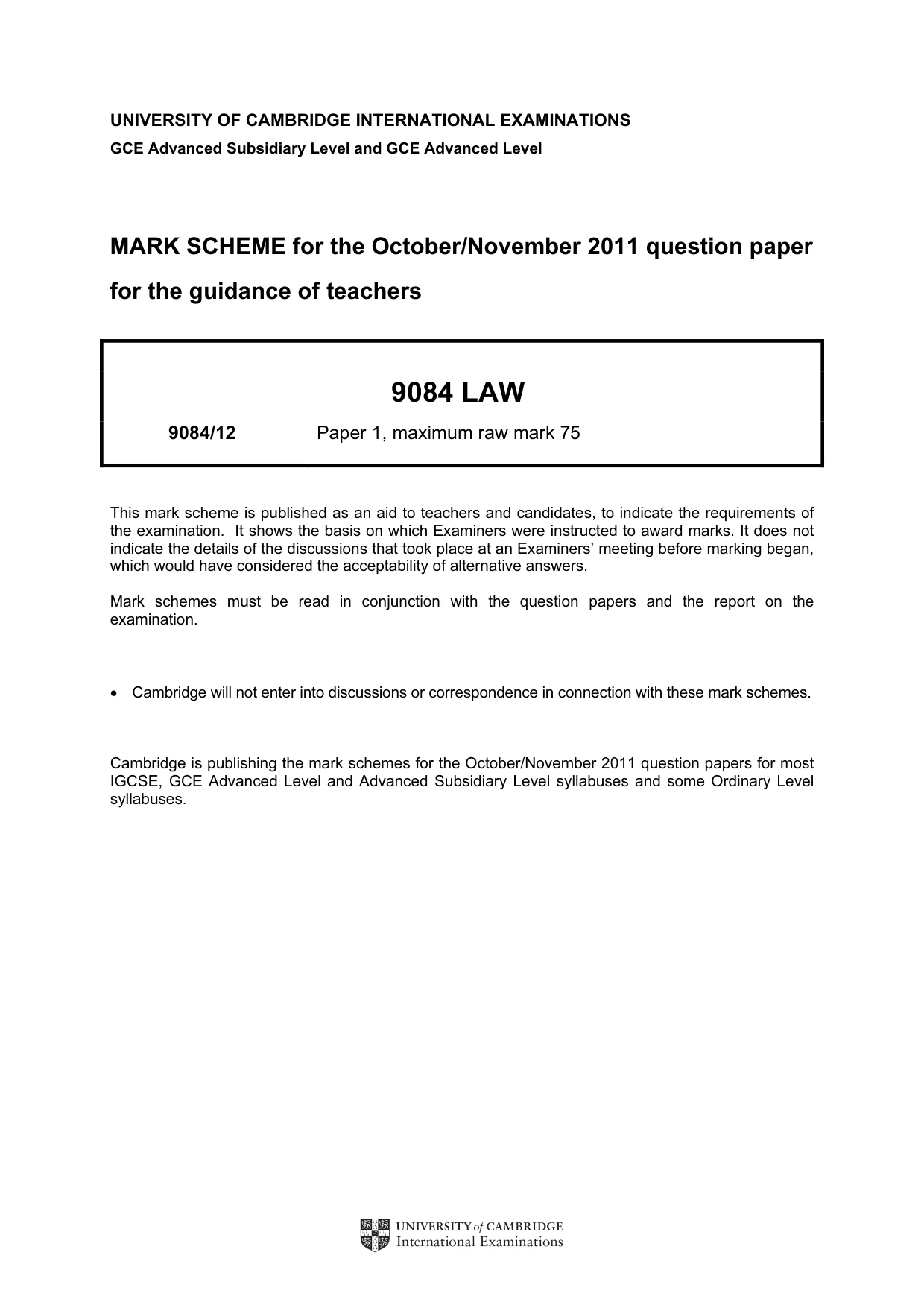
UNIVERSITY OF CAMBRIDGE INTERNATIONAL EXAMINATIONS GCE Advanced Subsidiary Level and GCE Advanced Level MARK SCHEME for the October/November 2011 question paper for the guidance of teachers 9084 LAW 9084/12 Paper 1, maximum raw mark 75 This mark scheme is published as an aid to teachers and candidates, to indicate the requirements of the examination. It shows the basis on which Examiners were instructed to award marks. It does not indicate the details of the discussions that took place at an Examiners’ meeting before marking began, which would have considered the acceptability of alternative answers. Mark schemes must be read in conjunction with the question papers and the report on the examination. • Cambridge will not enter into discussions or correspondence in connection with these mark schemes. Cambridge is publishing the mark schemes for the October/November 2011 question papers for most IGCSE, GCE Advanced Level and Advanced Subsidiary Level syllabuses and some Ordinary Level syllabuses.
Mark scheme, page 2
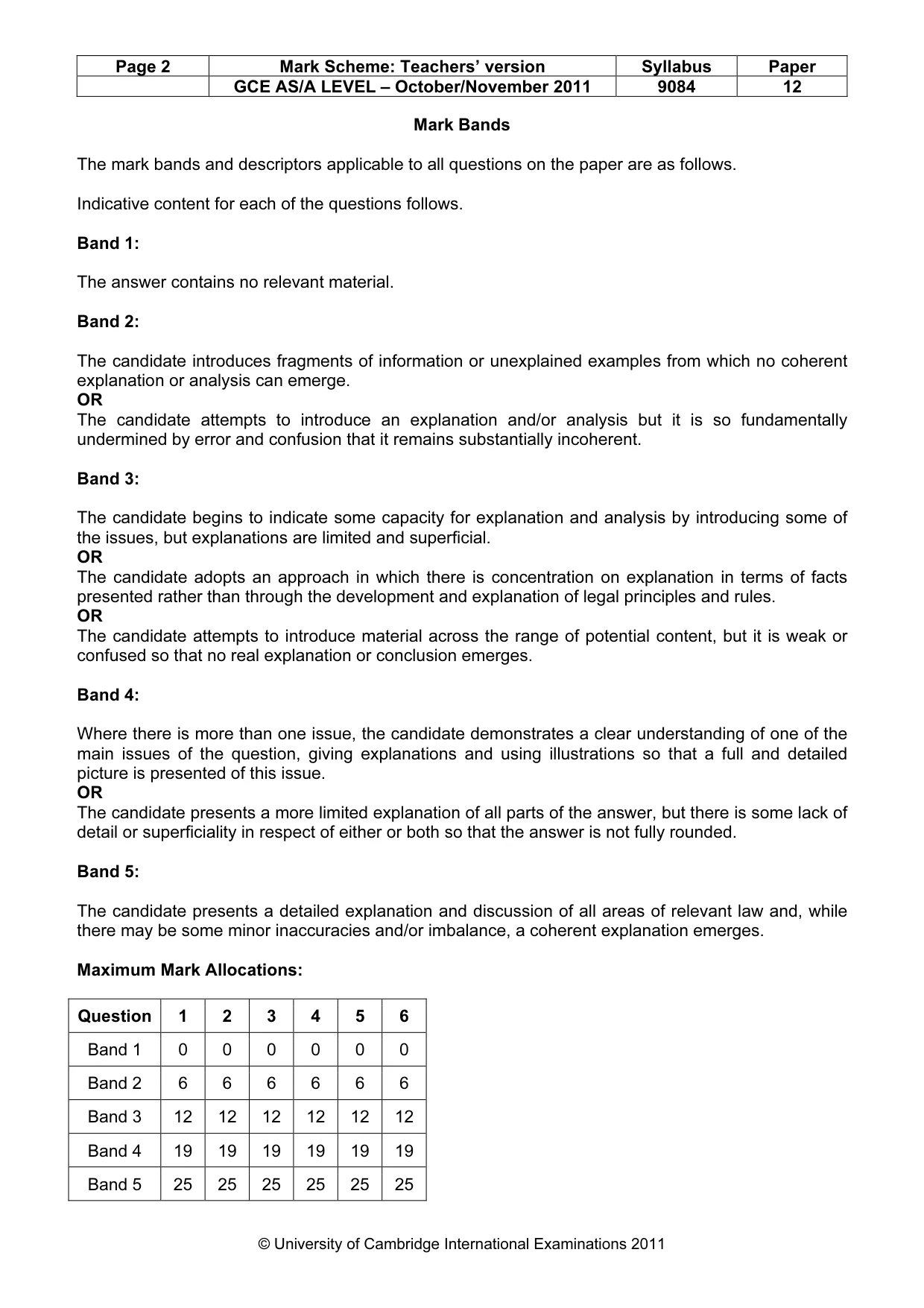
Page 2 Mark Scheme: Teachers’ version Syllabus Paper GCE AS/A LEVEL – October/November 2011 9084 12 © University of Cambridge International Examinations 2011 Mark Bands The mark bands and descriptors applicable to all questions on the paper are as follows. Indicative content for each of the questions follows. Band 1: The answer contains no relevant material. Band 2: The candidate introduces fragments of information or unexplained examples from which no coherent explanation or analysis can emerge. OR The candidate attempts to introduce an explanation and/or analysis but it is so fundamentally undermined by error and confusion that it remains substantially incoherent. Band 3: The candidate begins to indicate some capacity for explanation and analysis by introducing some of the issues, but explanations are limited and superficial. OR The candidate adopts an approach in which there is concentration on explanation in terms of facts presented rather than through the development and explanation of legal principles and rules. OR The candidate attempts to introduce material across the range of potential content, but it is weak or confused so that no real explanation or conclusion emerges. Band 4: Where there is more than one issue, the candidate demonstrates a clear understanding of one of the main issues of the question, giving explanations and using illustrations so that a full and detailed picture is presented of this issue. OR The candidate presents a more limited explanation of all parts of the answer, but there is some lack of detail or superficiality in respect of either or both so that the answer is not fully rounded. Band 5: The candidate presents a detailed explanation and discussion of all areas of relevant law and, while there may be some minor inaccuracies and/or imbalance, a coherent explanation emerges. Maximum Mark Allocations: Question 1 2 3 4 5 6 Band 1 0 0 0 0 0 0 Band 2 6 6 6 6 6 6 Band 3 12 12 12 12 12 12 Band 4 19 19 19 19 19 19 Band 5 25 25 25 25 25 25
Mark scheme, page 3
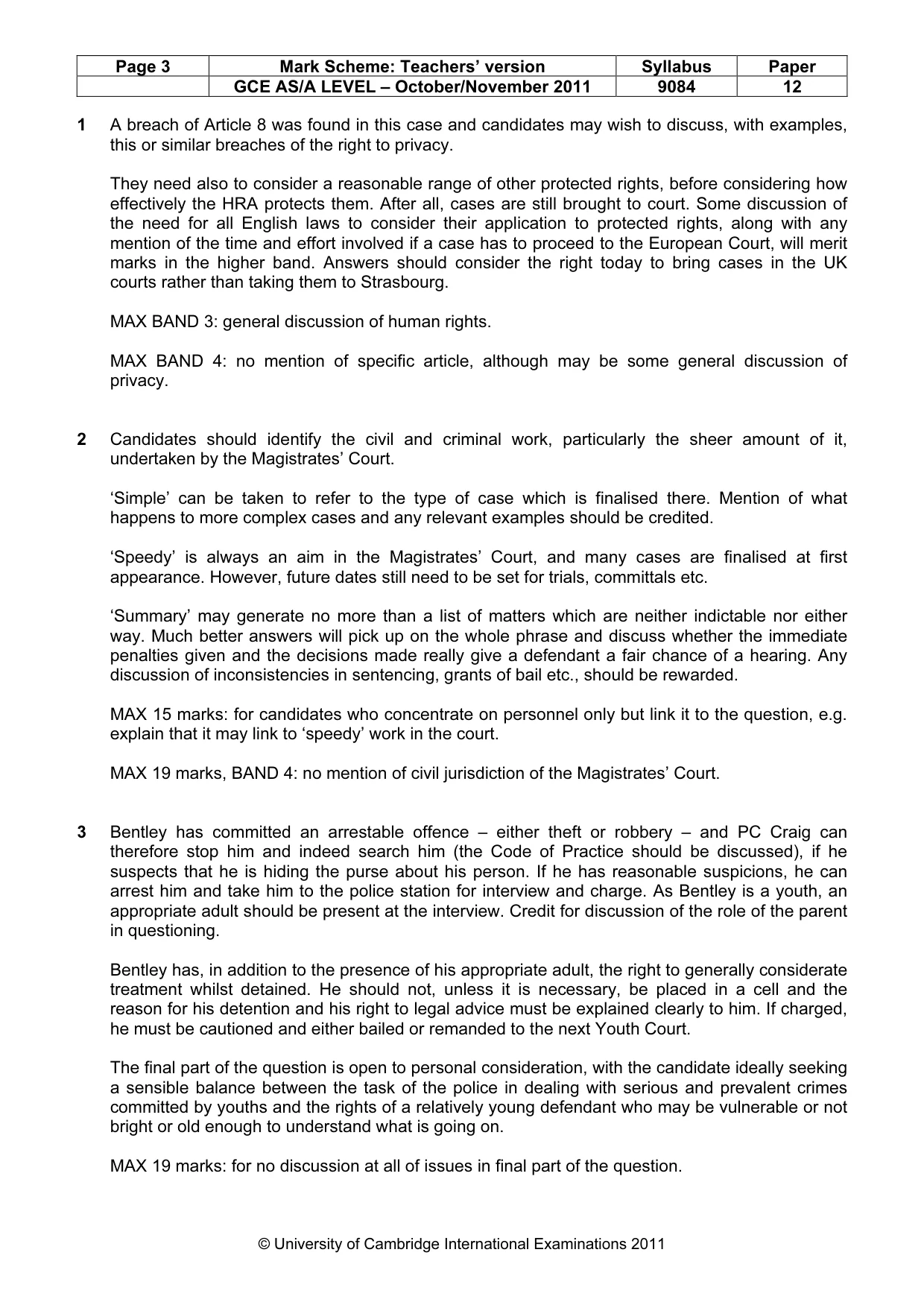
Page 3 Mark Scheme: Teachers’ version Syllabus Paper GCE AS/A LEVEL – October/November 2011 9084 12 © University of Cambridge International Examinations 2011 1 A breach of Article 8 was found in this case and candidates may wish to discuss, with examples, this or similar breaches of the right to privacy. They need also to consider a reasonable range of other protected rights, before considering how effectively the HRA protects them. After all, cases are still brought to court. Some discussion of the need for all English laws to consider their application to protected rights, along with any mention of the time and effort involved if a case has to proceed to the European Court, will merit marks in the higher band. Answers should consider the right today to bring cases in the UK courts rather than taking them to Strasbourg. MAX BAND 3: general discussion of human rights. MAX BAND 4: no mention of specific article, although may be some general discussion of privacy. 2 Candidates should identify the civil and criminal work, particularly the sheer amount of it, undertaken by the Magistrates’ Court. ‘Simple’ can be taken to refer to the type of case which is finalised there. Mention of what happens to more complex cases and any relevant examples should be credited. ‘Speedy’ is always an aim in the Magistrates’ Court, and many cases are finalised at first appearance. However, future dates still need to be set for trials, committals etc. ‘Summary’ may generate no more than a list of matters which are neither indictable nor either way. Much better answers will pick up on the whole phrase and discuss whether the immediate penalties given and the decisions made really give a defendant a fair chance of a hearing. Any discussion of inconsistencies in sentencing, grants of bail etc., should be rewarded. MAX 15 marks: for candidates who concentrate on personnel only but link it to the question, e.g. explain that it may link to ‘speedy’ work in the court. MAX 19 marks, BAND 4: no mention of civil jurisdiction of the Magistrates’ Court. 3 Bentley has committed an arrestable offence – either theft or robbery – and PC Craig can therefore stop him and indeed search him (the Code of Practice should be discussed), if he suspects that he is hiding the purse about his person. If he has reasonable suspicions, he can arrest him and take him to the police station for interview and charge. As Bentley is a youth, an appropriate adult should be present at the interview. Credit for discussion of the role of the parent in questioning. Bentley has, in addition to the presence of his appropriate adult, the right to generally considerate treatment whilst detained. He should not, unless it is necessary, be placed in a cell and the reason for his detention and his right to legal advice must be explained clearly to him. If charged, he must be cautioned and either bailed or remanded to the next Youth Court. The final part of the question is open to personal consideration, with the candidate ideally seeking a sensible balance between the task of the police in dealing with serious and prevalent crimes committed by youths and the rights of a relatively young defendant who may be vulnerable or not bright or old enough to understand what is going on. MAX 19 marks: for no discussion at all of issues in final part of the question.
Mark scheme, page 4
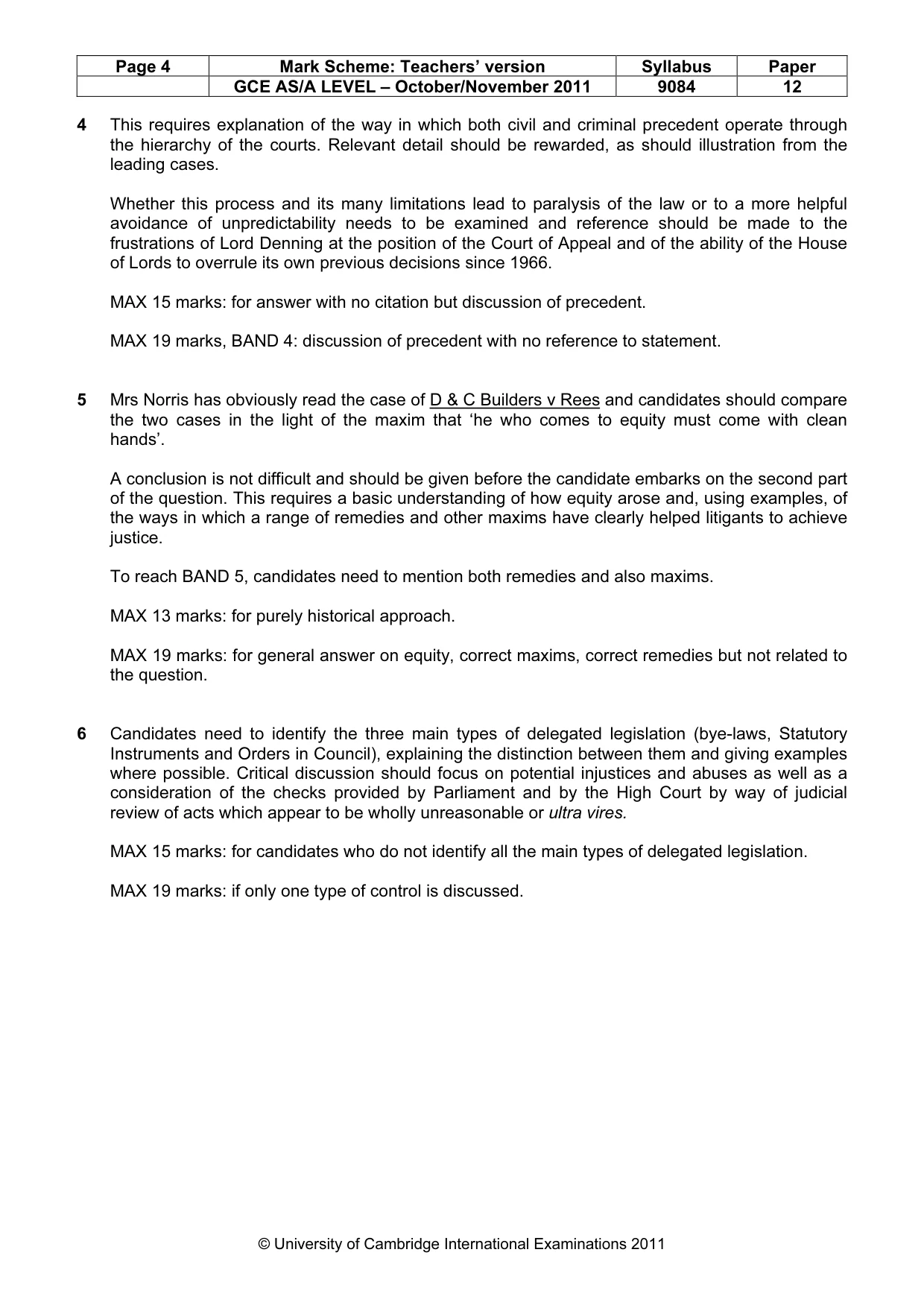
Page 4 Mark Scheme: Teachers’ version Syllabus Paper GCE AS/A LEVEL – October/November 2011 9084 12 © University of Cambridge International Examinations 2011 4 This requires explanation of the way in which both civil and criminal precedent operate through the hierarchy of the courts. Relevant detail should be rewarded, as should illustration from the leading cases. Whether this process and its many limitations lead to paralysis of the law or to a more helpful avoidance of unpredictability needs to be examined and reference should be made to the frustrations of Lord Denning at the position of the Court of Appeal and of the ability of the House of Lords to overrule its own previous decisions since 1966. MAX 15 marks: for answer with no citation but discussion of precedent. MAX 19 marks, BAND 4: discussion of precedent with no reference to statement. 5 Mrs Norris has obviously read the case of D & C Builders v Rees and candidates should compare the two cases in the light of the maxim that ‘he who comes to equity must come with clean hands’. A conclusion is not difficult and should be given before the candidate embarks on the second part of the question. This requires a basic understanding of how equity arose and, using examples, of the ways in which a range of remedies and other maxims have clearly helped litigants to achieve justice. To reach BAND 5, candidates need to mention both remedies and also maxims. MAX 13 marks: for purely historical approach. MAX 19 marks: for general answer on equity, correct maxims, correct remedies but not related to the question. 6 Candidates need to identify the three main types of delegated legislation (bye-laws, Statutory Instruments and Orders in Council), explaining the distinction between them and giving examples where possible. Critical discussion should focus on potential injustices and abuses as well as a consideration of the checks provided by Parliament and by the High Court by way of judicial review of acts which appear to be wholly unreasonable or ultra vires. MAX 15 marks: for candidates who do not identify all the main types of delegated legislation. MAX 19 marks: if only one type of control is discussed.
What you needed in this session
Cambridge’s own grade thresholds for 2011 Oct/Nov, Paper 1 · Variant 2. A higher threshold means an easier paper — the bar moves with how the cohort did.