Cambridge A Level Law 9084 — 2011 Oct/Nov Paper 1 · Variant 1
9084/11/O/N/11 · 75 marks · ≈84 min
The question paper and its mark scheme, free to read here and free to download. This is Cambridge’s own paper, exactly as it was sat.
Question paper2 pages
Mark scheme4 pages
Answers below. Sit the paper first if you are practising.
Paper as text
Question paper, page 1
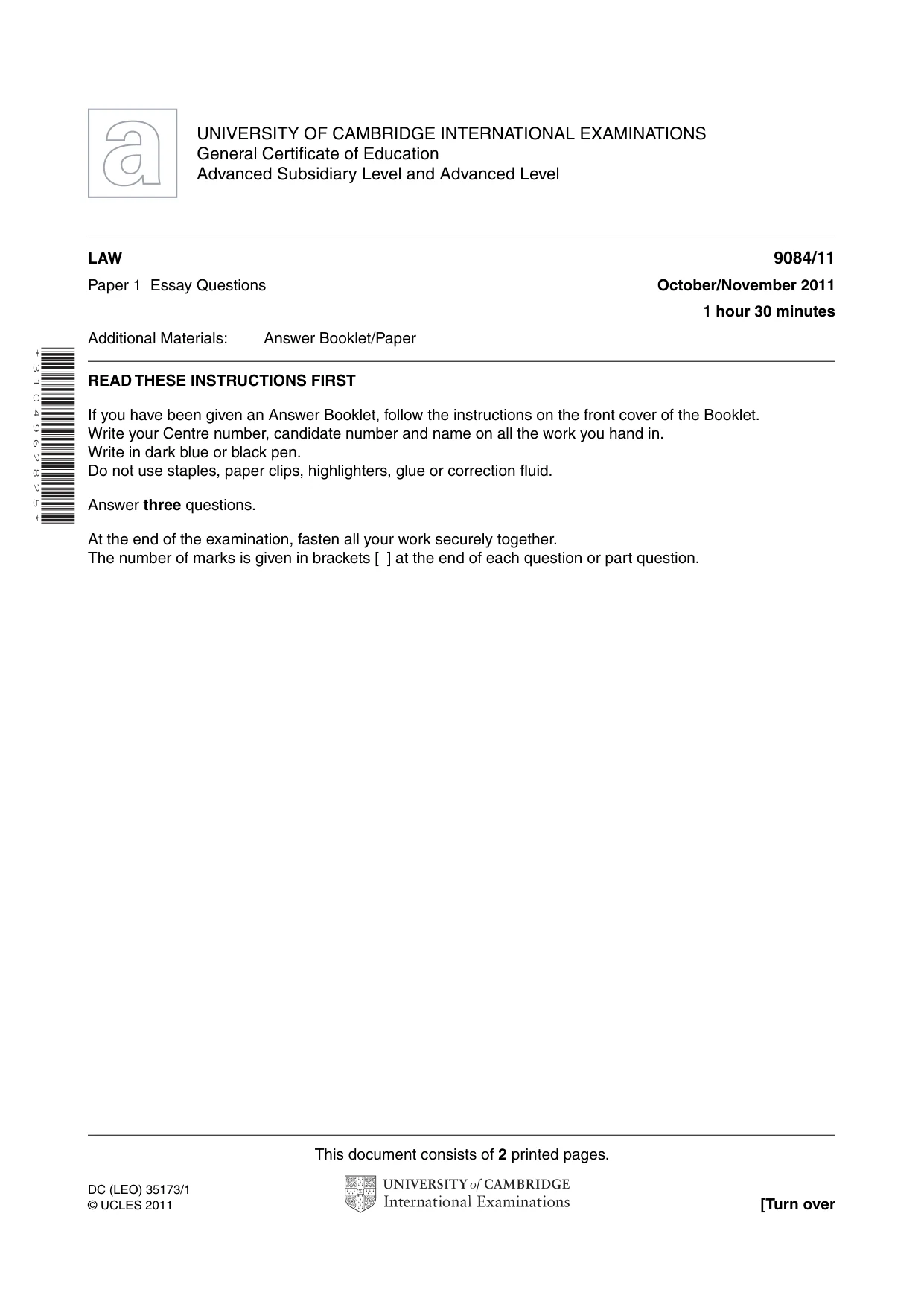
This document consists of 2 printed pages. DC (LEO) 35173/1 © UCLES 2011 [Turn over UNIVERSITY OF CAMBRIDGE INTERNATIONAL EXAMINATIONS General Certificate of Education Advanced Subsidiary Level and Advanced Level * 3 1 0 4 9 6 2 8 2 5 * LAW 9084/11 Paper 1 Essay Questions October/November 2011 1 hour 30 minutes Additional Materials: Answer Booklet/Paper READ THESE INSTRUCTIONS FIRST If you have been given an Answer Booklet, follow the instructions on the front cover of the Booklet. Write your Centre number, candidate number and name on all the work you hand in. Write in dark blue or black pen. Do not use staples, paper clips, highlighters, glue or correction fluid. Answer three questions. At the end of the examination, fasten all your work securely together. The number of marks is given in brackets [ ] at the end of each question or part question.
Question paper, page 2
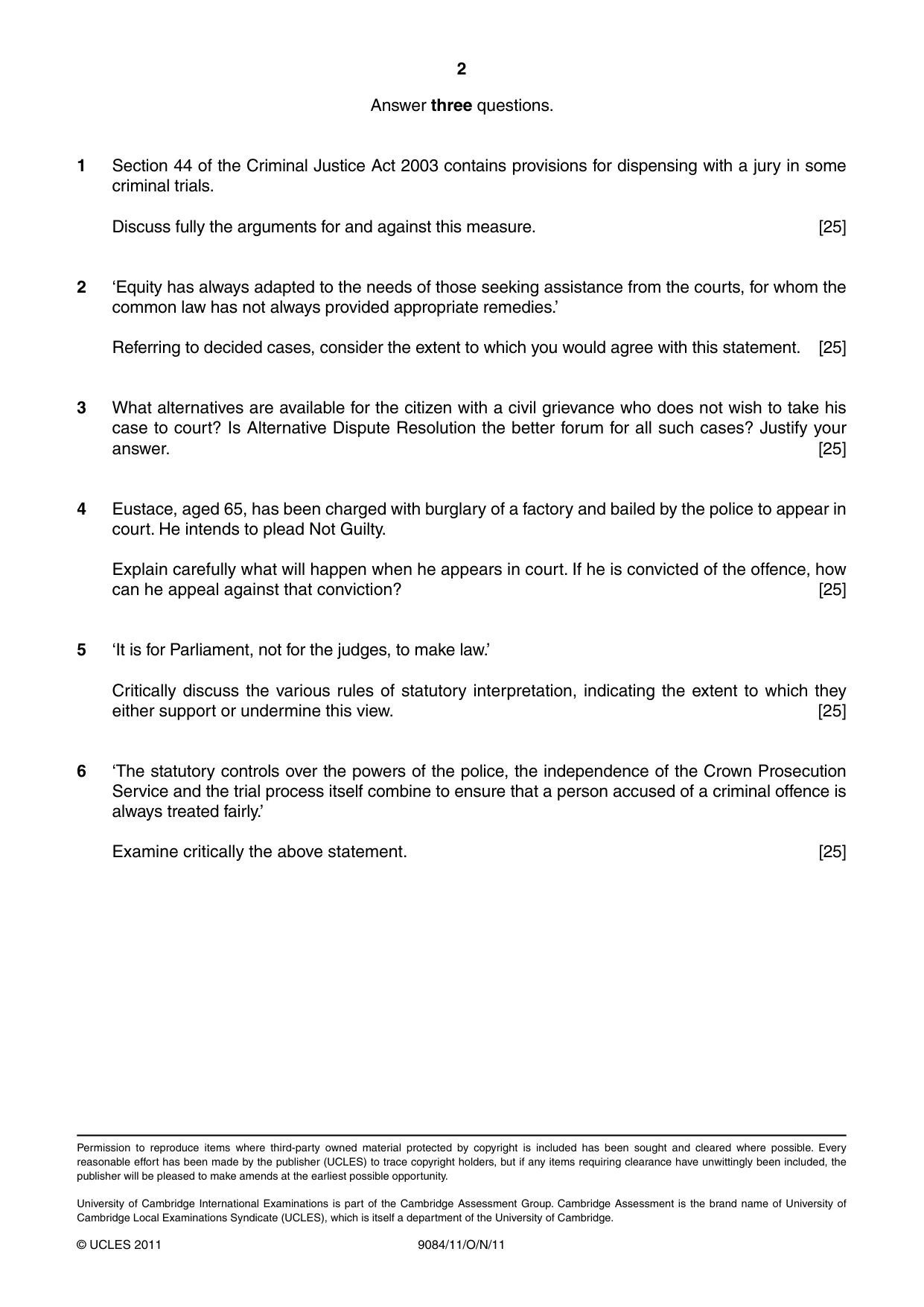
2 9084/11/O/N/11 © UCLES 2011 Permission to reproduce items where third-party owned material protected by copyright is included has been sought and cleared where possible. Every reasonable effort has been made by the publisher (UCLES) to trace copyright holders, but if any items requiring clearance have unwittingly been included, the publisher will be pleased to make amends at the earliest possible opportunity. University of Cambridge International Examinations is part of the Cambridge Assessment Group. Cambridge Assessment is the brand name of University of Cambridge Local Examinations Syndicate (UCLES), which is itself a department of the University of Cambridge. Answer three questions. 1 Section 44 of the Criminal Justice Act 2003 contains provisions for dispensing with a jury in some criminal trials. Discuss fully the arguments for and against this measure. [25] 2 ‘Equity has always adapted to the needs of those seeking assistance from the courts, for whom the common law has not always provided appropriate remedies.’ Referring to decided cases, consider the extent to which you would agree with this statement. [25] 3 What alternatives are available for the citizen with a civil grievance who does not wish to take his case to court? Is Alternative Dispute Resolution the better forum for all such cases? Justify your answer. [25] 4 Eustace, aged 65, has been charged with burglary of a factory and bailed by the police to appear in court. He intends to plead Not Guilty. Explain carefully what will happen when he appears in court. If he is convicted of the offence, how can he appeal against that conviction? [25] 5 ‘It is for Parliament, not for the judges, to make law.’ Critically discuss the various rules of statutory interpretation, indicating the extent to which they either support or undermine this view. [25] 6 ‘The statutory controls over the powers of the police, the independence of the Crown Prosecution Service and the trial process itself combine to ensure that a person accused of a criminal offence is always treated fairly.’ Examine critically the above statement. [25]
Mark scheme, page 1
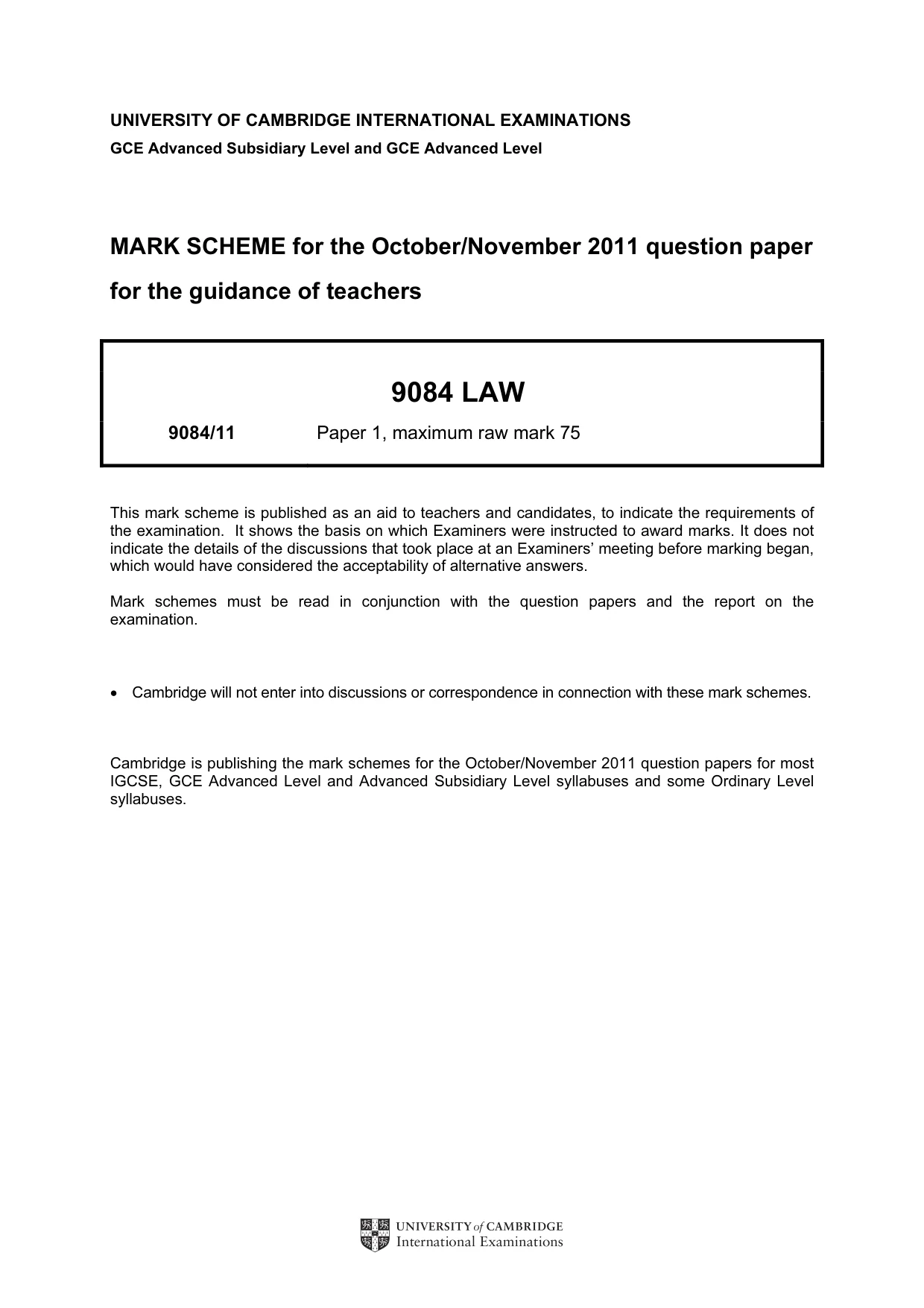
UNIVERSITY OF CAMBRIDGE INTERNATIONAL EXAMINATIONS GCE Advanced Subsidiary Level and GCE Advanced Level MARK SCHEME for the October/November 2011 question paper for the guidance of teachers 9084 LAW 9084/11 Paper 1, maximum raw mark 75 This mark scheme is published as an aid to teachers and candidates, to indicate the requirements of the examination. It shows the basis on which Examiners were instructed to award marks. It does not indicate the details of the discussions that took place at an Examiners’ meeting before marking began, which would have considered the acceptability of alternative answers. Mark schemes must be read in conjunction with the question papers and the report on the examination. • Cambridge will not enter into discussions or correspondence in connection with these mark schemes. Cambridge is publishing the mark schemes for the October/November 2011 question papers for most IGCSE, GCE Advanced Level and Advanced Subsidiary Level syllabuses and some Ordinary Level syllabuses.
Mark scheme, page 2
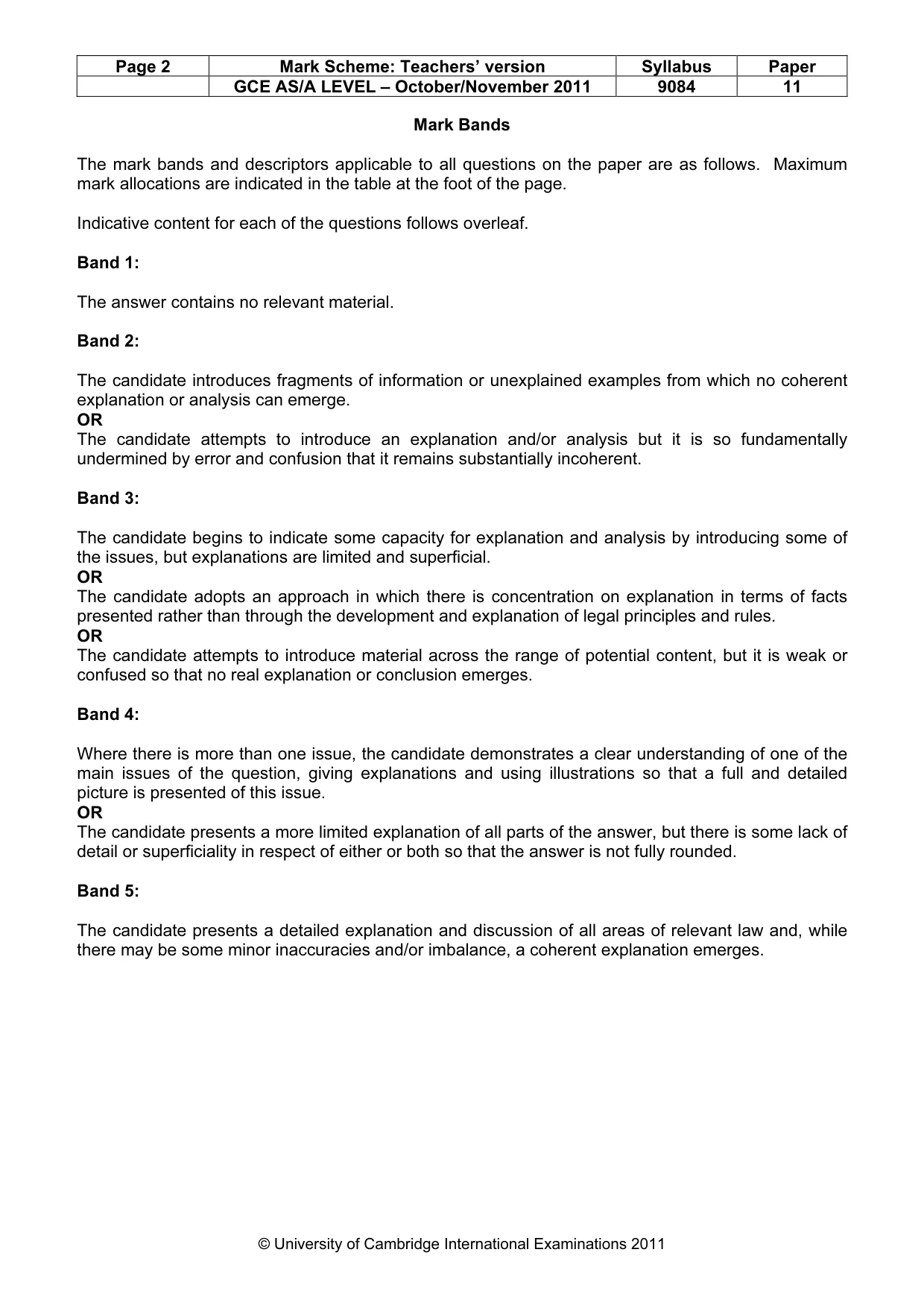
Page 2 Mark Scheme: Teachers’ version Syllabus Paper GCE AS/A LEVEL – October/November 2011 9084 11 © University of Cambridge International Examinations 2011 Mark Bands The mark bands and descriptors applicable to all questions on the paper are as follows. Maximum mark allocations are indicated in the table at the foot of the page. Indicative content for each of the questions follows overleaf. Band 1: The answer contains no relevant material. Band 2: The candidate introduces fragments of information or unexplained examples from which no coherent explanation or analysis can emerge. OR The candidate attempts to introduce an explanation and/or analysis but it is so fundamentally undermined by error and confusion that it remains substantially incoherent. Band 3: The candidate begins to indicate some capacity for explanation and analysis by introducing some of the issues, but explanations are limited and superficial. OR The candidate adopts an approach in which there is concentration on explanation in terms of facts presented rather than through the development and explanation of legal principles and rules. OR The candidate attempts to introduce material across the range of potential content, but it is weak or confused so that no real explanation or conclusion emerges. Band 4: Where there is more than one issue, the candidate demonstrates a clear understanding of one of the main issues of the question, giving explanations and using illustrations so that a full and detailed picture is presented of this issue. OR The candidate presents a more limited explanation of all parts of the answer, but there is some lack of detail or superficiality in respect of either or both so that the answer is not fully rounded. Band 5: The candidate presents a detailed explanation and discussion of all areas of relevant law and, while there may be some minor inaccuracies and/or imbalance, a coherent explanation emerges.
Mark scheme, page 3
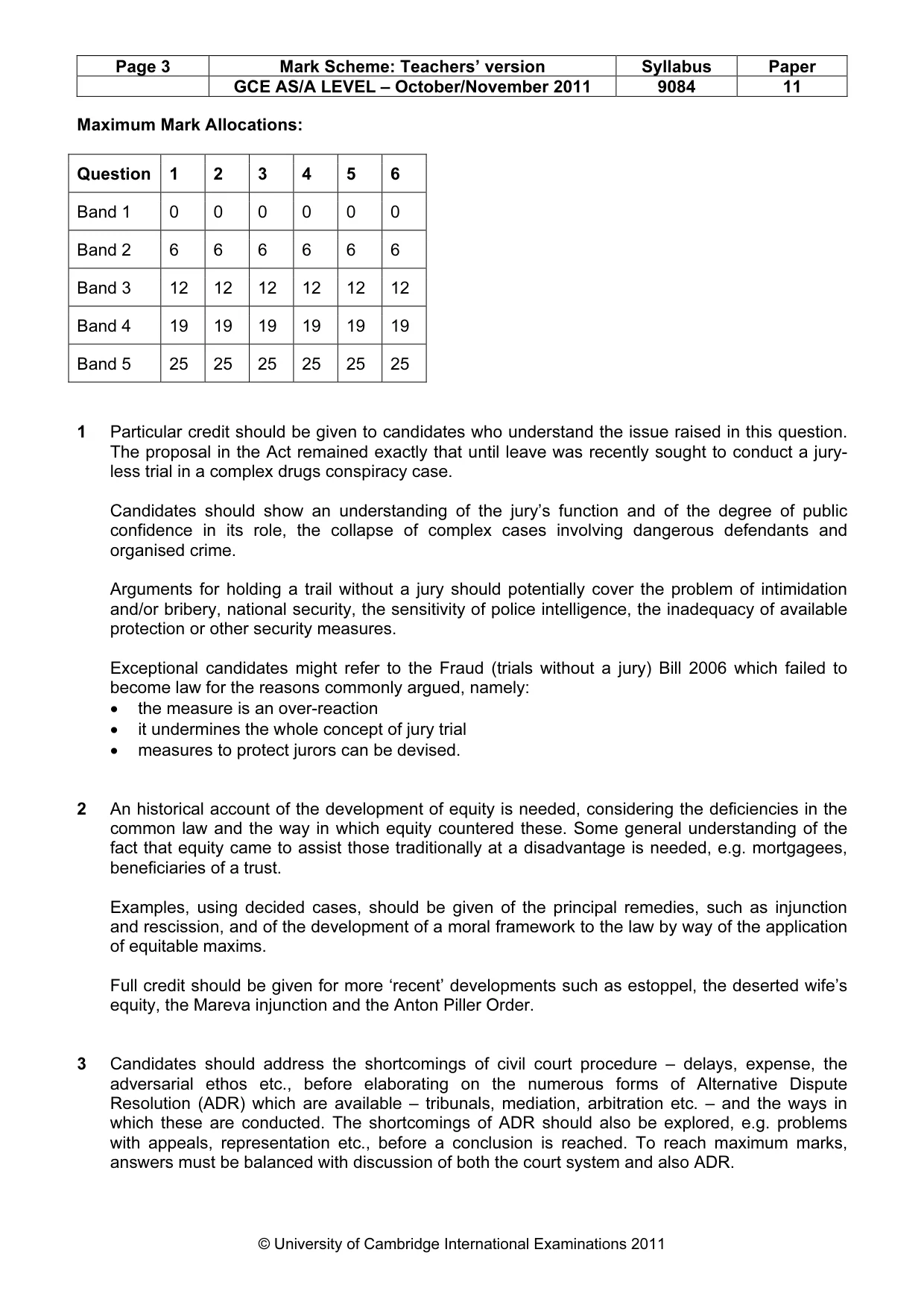
Page 3 Mark Scheme: Teachers’ version Syllabus Paper GCE AS/A LEVEL – October/November 2011 9084 11 © University of Cambridge International Examinations 2011 Maximum Mark Allocations: Question 1 2 3 4 5 6 Band 1 0 0 0 0 0 0 Band 2 6 6 6 6 6 6 Band 3 12 12 12 12 12 12 Band 4 19 19 19 19 19 19 Band 5 25 25 25 25 25 25 1 Particular credit should be given to candidates who understand the issue raised in this question. The proposal in the Act remained exactly that until leave was recently sought to conduct a jury- less trial in a complex drugs conspiracy case. Candidates should show an understanding of the jury’s function and of the degree of public confidence in its role, the collapse of complex cases involving dangerous defendants and organised crime. Arguments for holding a trail without a jury should potentially cover the problem of intimidation and/or bribery, national security, the sensitivity of police intelligence, the inadequacy of available protection or other security measures. Exceptional candidates might refer to the Fraud (trials without a jury) Bill 2006 which failed to become law for the reasons commonly argued, namely: • the measure is an over-reaction • it undermines the whole concept of jury trial • measures to protect jurors can be devised. 2 An historical account of the development of equity is needed, considering the deficiencies in the common law and the way in which equity countered these. Some general understanding of the fact that equity came to assist those traditionally at a disadvantage is needed, e.g. mortgagees, beneficiaries of a trust. Examples, using decided cases, should be given of the principal remedies, such as injunction and rescission, and of the development of a moral framework to the law by way of the application of equitable maxims. Full credit should be given for more ‘recent’ developments such as estoppel, the deserted wife’s equity, the Mareva injunction and the Anton Piller Order. 3 Candidates should address the shortcomings of civil court procedure – delays, expense, the adversarial ethos etc., before elaborating on the numerous forms of Alternative Dispute Resolution (ADR) which are available – tribunals, mediation, arbitration etc. – and the ways in which these are conducted. The shortcomings of ADR should also be explored, e.g. problems with appeals, representation etc., before a conclusion is reached. To reach maximum marks, answers must be balanced with discussion of both the court system and also ADR.
Mark scheme, page 4
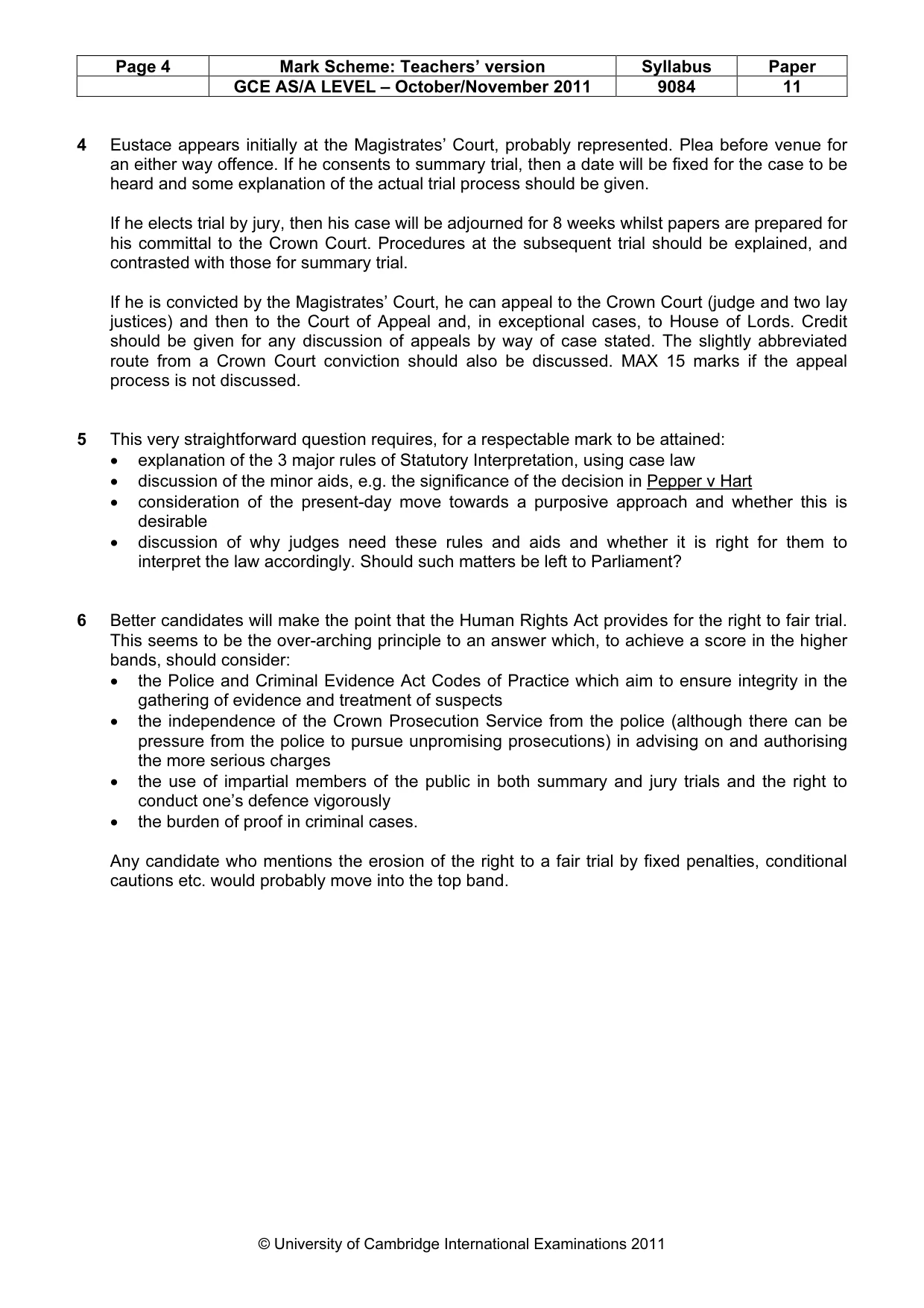
Page 4 Mark Scheme: Teachers’ version Syllabus Paper GCE AS/A LEVEL – October/November 2011 9084 11 © University of Cambridge International Examinations 2011 4 Eustace appears initially at the Magistrates’ Court, probably represented. Plea before venue for an either way offence. If he consents to summary trial, then a date will be fixed for the case to be heard and some explanation of the actual trial process should be given. If he elects trial by jury, then his case will be adjourned for 8 weeks whilst papers are prepared for his committal to the Crown Court. Procedures at the subsequent trial should be explained, and contrasted with those for summary trial. If he is convicted by the Magistrates’ Court, he can appeal to the Crown Court (judge and two lay justices) and then to the Court of Appeal and, in exceptional cases, to House of Lords. Credit should be given for any discussion of appeals by way of case stated. The slightly abbreviated route from a Crown Court conviction should also be discussed. MAX 15 marks if the appeal process is not discussed. 5 This very straightforward question requires, for a respectable mark to be attained: • explanation of the 3 major rules of Statutory Interpretation, using case law • discussion of the minor aids, e.g. the significance of the decision in Pepper v Hart • consideration of the present-day move towards a purposive approach and whether this is desirable • discussion of why judges need these rules and aids and whether it is right for them to interpret the law accordingly. Should such matters be left to Parliament? 6 Better candidates will make the point that the Human Rights Act provides for the right to fair trial. This seems to be the over-arching principle to an answer which, to achieve a score in the higher bands, should consider: • the Police and Criminal Evidence Act Codes of Practice which aim to ensure integrity in the gathering of evidence and treatment of suspects • the independence of the Crown Prosecution Service from the police (although there can be pressure from the police to pursue unpromising prosecutions) in advising on and authorising the more serious charges • the use of impartial members of the public in both summary and jury trials and the right to conduct one’s defence vigorously • the burden of proof in criminal cases. Any candidate who mentions the erosion of the right to a fair trial by fixed penalties, conditional cautions etc. would probably move into the top band.
What you needed in this session
Cambridge’s own grade thresholds for 2011 Oct/Nov, Paper 1 · Variant 1. A higher threshold means an easier paper — the bar moves with how the cohort did.