Cambridge A Level Islamic Studies (AS Level only) 8053 — 2018 Oct/Nov Paper 1 · Variant 2
8053/12/O/N/18 · 100 marks · ≈113 min
The question paper and its mark scheme, free to read here and free to download. This is Cambridge’s own paper, exactly as it was sat.
Question paper4 pages
Mark scheme10 pages
Answers below. Sit the paper first if you are practising.
Paper as text
Question paper, page 1
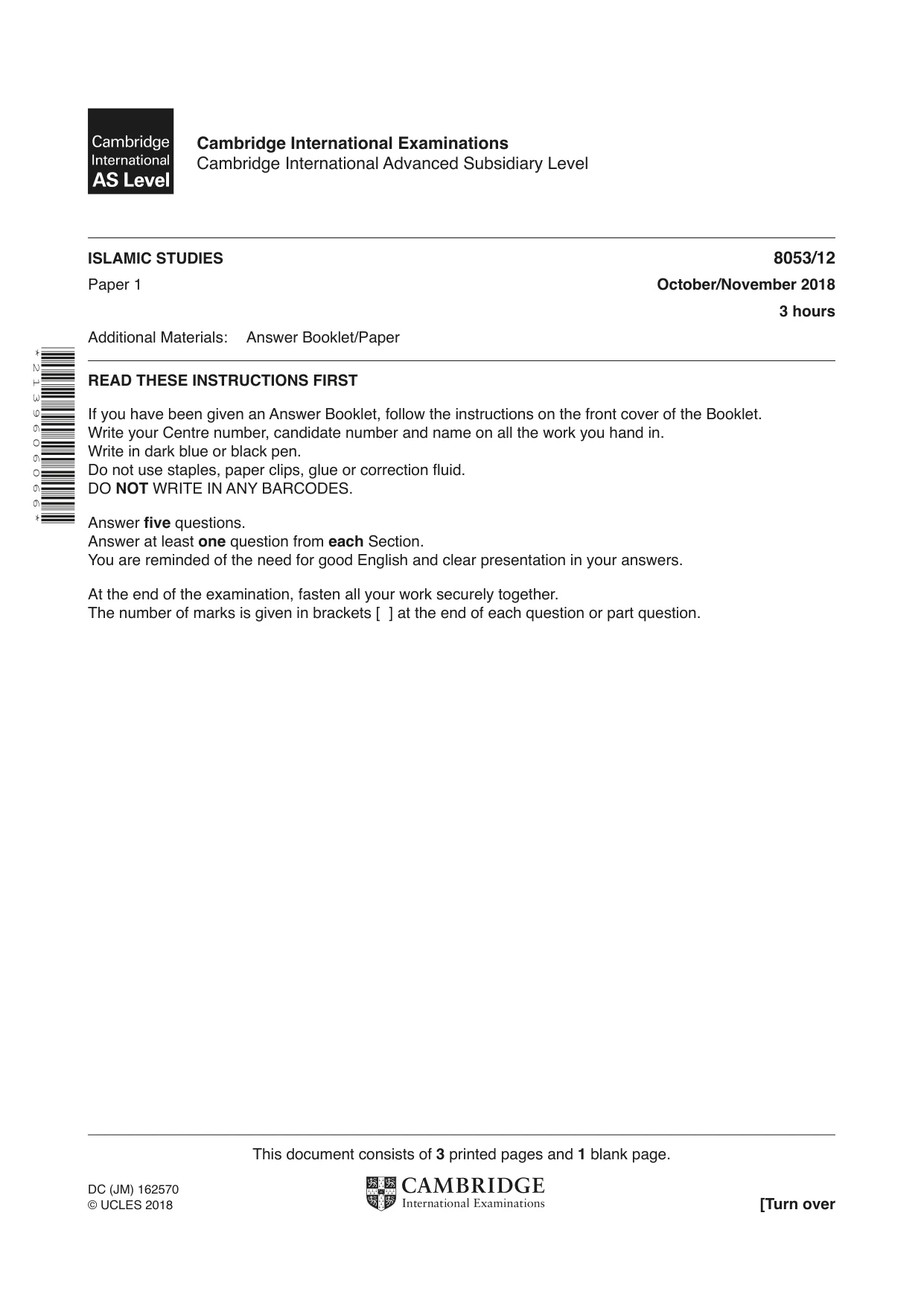
* 2 1 3 9 6 0 6 0 6 6 * This document consists of 3 printed pages and 1 blank page. DC (JM) 162570 © UCLES 2018 [Turn over Cambridge International Examinations Cambridge International Advanced Subsidiary Level ISLAMIC STUDIES 8053/12 Paper 1 October/November 2018 3 hours Additional Materials: Answer Booklet/Paper READ THESE INSTRUCTIONS FIRST If you have been given an Answer Booklet, follow the instructions on the front cover of the Booklet. Write your Centre number, candidate number and name on all the work you hand in. Write in dark blue or black pen. Do not use staples, paper clips, glue or correction fluid. DO NOT WRITE IN ANY BARCODES. Answer five questions. Answer at least one question from each Section. You are reminded of the need for good English and clear presentation in your answers. At the end of the examination, fasten all your work securely together. The number of marks is given in brackets [ ] at the end of each question or part question.
Question paper, page 2
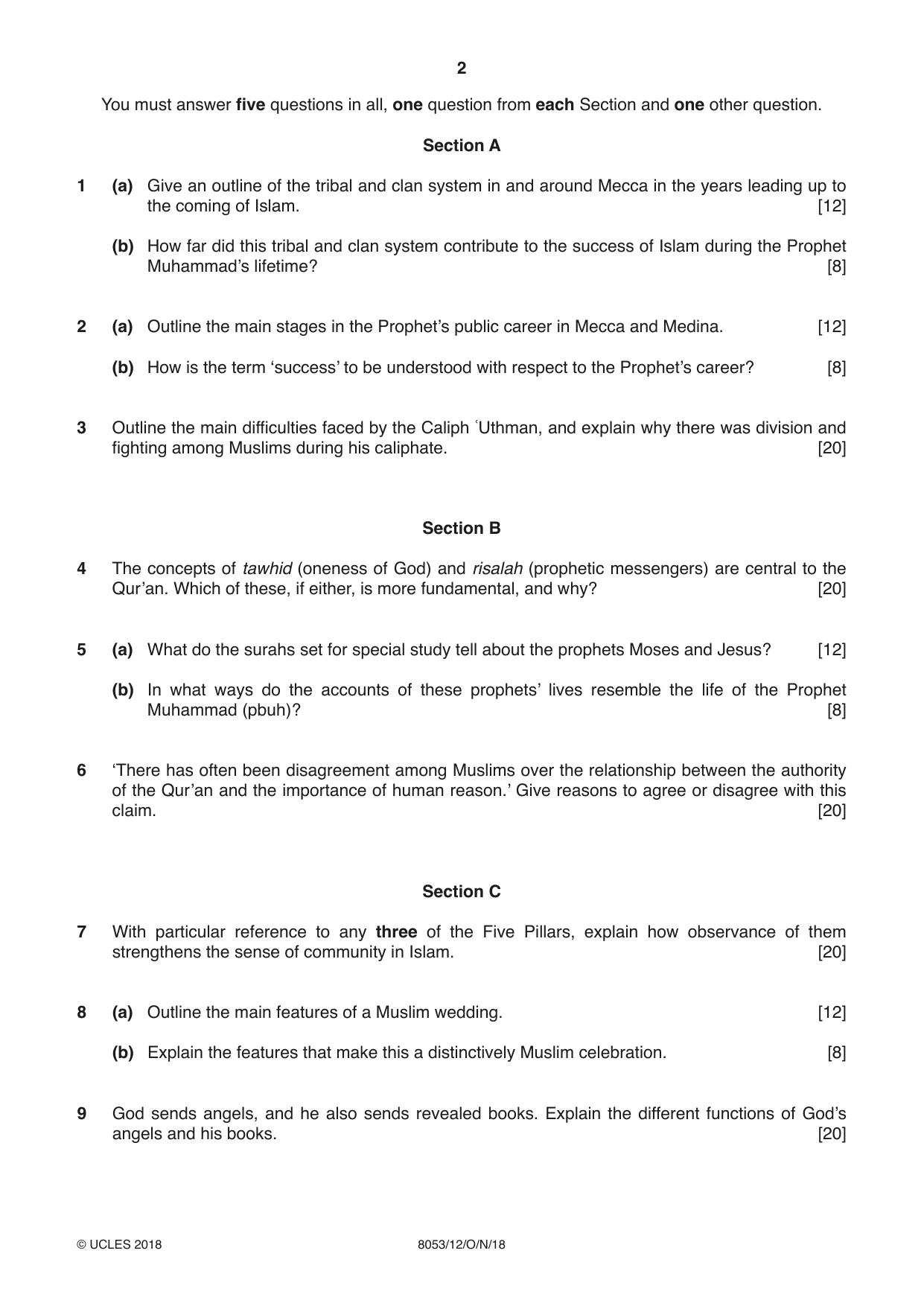
2 8053/12/O/N/18 © UCLES 2018 You must answer five questions in all, one question from each Section and one other question. Section A 1 (a) Give an outline of the tribal and clan system in and around Mecca in the years leading up to the coming of Islam. [12] (b) How far did this tribal and clan system contribute to the success of Islam during the Prophet Muhammad’s lifetime? [8] 2 (a) Outline the main stages in the Prophet’s public career in Mecca and Medina. [12] (b) How is the term ‘success’ to be understood with respect to the Prophet’s career? [8] 3 Outline the main difficulties faced by the Caliph ʿUthman, and explain why there was division and fighting among Muslims during his caliphate. [20] Section B 4 The concepts of tawhid (oneness of God) and risalah (prophetic messengers) are central to the Qur’an. Which of these, if either, is more fundamental, and why? [20] 5 (a) What do the surahs set for special study tell about the prophets Moses and Jesus? [12] (b) In what ways do the accounts of these prophets’ lives resemble the life of the Prophet Muhammad (pbuh)? [8] 6 ‘There has often been disagreement among Muslims over the relationship between the authority of the Qur’an and the importance of human reason.’ Give reasons to agree or disagree with this claim. [20] Section C 7 With particular reference to any three of the Five Pillars, explain how observance of them strengthens the sense of community in Islam. [20] 8 (a) Outline the main features of a Muslim wedding. [12] (b) Explain the features that make this a distinctively Muslim celebration. [8] 9 God sends angels, and he also sends revealed books. Explain the different functions of God’s angels and his books. [20]
Question paper, page 3
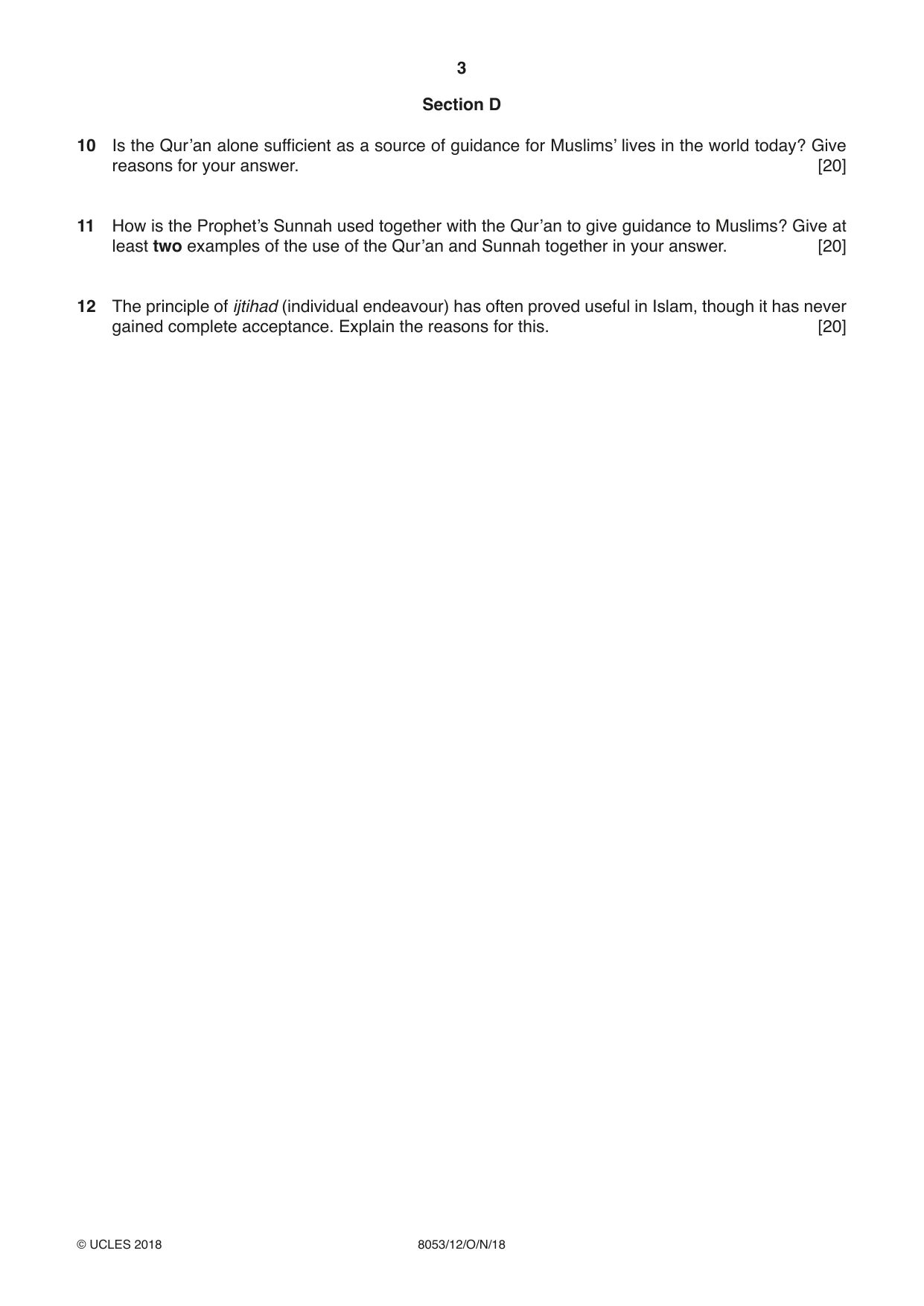
3 8053/12/O/N/18 © UCLES 2018 Section D 10 Is the Qur’an alone sufficient as a source of guidance for Muslims’ lives in the world today? Give reasons for your answer. [20] 11 How is the Prophet’s Sunnah used together with the Qur’an to give guidance to Muslims? Give at least two examples of the use of the Qur’an and Sunnah together in your answer. [20] 12 The principle of ijtihad (individual endeavour) has often proved useful in Islam, though it has never gained complete acceptance. Explain the reasons for this. [20]
Question paper, page 4
4 8053/12/O/N/18 © UCLES 2018 BLANK PAGE Permission to reproduce items where third-party owned material protected by copyright is included has been sought and cleared where possible. Every reasonable effort has been made by the publisher (UCLES) to trace copyright holders, but if any items requiring clearance have unwittingly been included, the publisher will be pleased to make amends at the earliest possible opportunity. To avoid the issue of disclosure of answer-related information to candidates, all copyright acknowledgements are reproduced online in the Cambridge International Examinations Copyright Acknowledgements Booklet. This is produced for each series of examinations and is freely available to download at www.cie.org.uk after the live examination series. Cambridge International Examinations is part of the Cambridge Assessment Group. Cambridge Assessment is the brand name of University of Cambridge Local Examinations Syndicate (UCLES), which is itself a department of the University of Cambridge.
Mark scheme, page 1
This document consists of 10 printed pages. © UCLES 2018 [Turn over Cambridge Assessment International Education Cambridge International Advanced Subsidiary Level ISLAMIC STUDIES 8053/12 Paper 1 October/November 2018 MARK SCHEME Maximum Mark: 100 Published This mark scheme is published as an aid to teachers and candidates, to indicate the requirements of the examination. It shows the basis on which Examiners were instructed to award marks. It does not indicate the details of the discussions that took place at an Examiners’ meeting before marking began, which would have considered the acceptability of alternative answers. Mark schemes should be read in conjunction with the question paper and the Principal Examiner Report for Teachers. Cambridge International will not enter into discussions about these mark schemes. Cambridge International is publishing the mark schemes for the October/November 2018 series for most Cambridge IGCSE™, Cambridge International A and AS Level components and some Cambridge O Level components.
Mark scheme, page 2
8053/12 Cambridge International AS Level – Mark Scheme PUBLISHED October/November 2018 © UCLES 2018 Page 2 of 10 Generic Marking Principles These general marking principles must be applied by all examiners when marking candidate answers. They should be applied alongside the specific content of the mark scheme or generic level descriptors for a question. Each question paper and mark scheme will also comply with these marking principles. GENERIC MARKING PRINCIPLE 1: Marks must be awarded in line with: • the specific content of the mark scheme or the generic level descriptors for the question • the specific skills defined in the mark scheme or in the generic level descriptors for the question • the standard of response required by a candidate as exemplified by the standardisation scripts. GENERIC MARKING PRINCIPLE 2: Marks awarded are always whole marks (not half marks, or other fractions). GENERIC MARKING PRINCIPLE 3: Marks must be awarded positively: • marks are awarded for correct/valid answers, as defined in the mark scheme. However, credit is given for valid answers which go beyond the scope of the syllabus and mark scheme, referring to your Team Leader as appropriate • marks are awarded when candidates clearly demonstrate what they know and can do • marks are not deducted for errors • marks are not deducted for omissions • answers should only be judged on the quality of spelling, punctuation and grammar when these features are specifically assessed by the question as indicated by the mark scheme. The meaning, however, should be unambiguous. GENERIC MARKING PRINCIPLE 4: Rules must be applied consistently e.g. in situations where candidates have not followed instructions or in the application of generic level descriptors. GENERIC MARKING PRINCIPLE 5: Marks should be awarded using the full range of marks defined in the mark scheme for the question (however; the use of the full mark range may be limited according to the quality of the candidate responses seen). GENERIC MARKING PRINCIPLE 6: Marks awarded are based solely on the requirements as defined in the mark scheme. Marks should not be awarded with grade thresholds or grade descriptors in mind.
Mark scheme, page 3
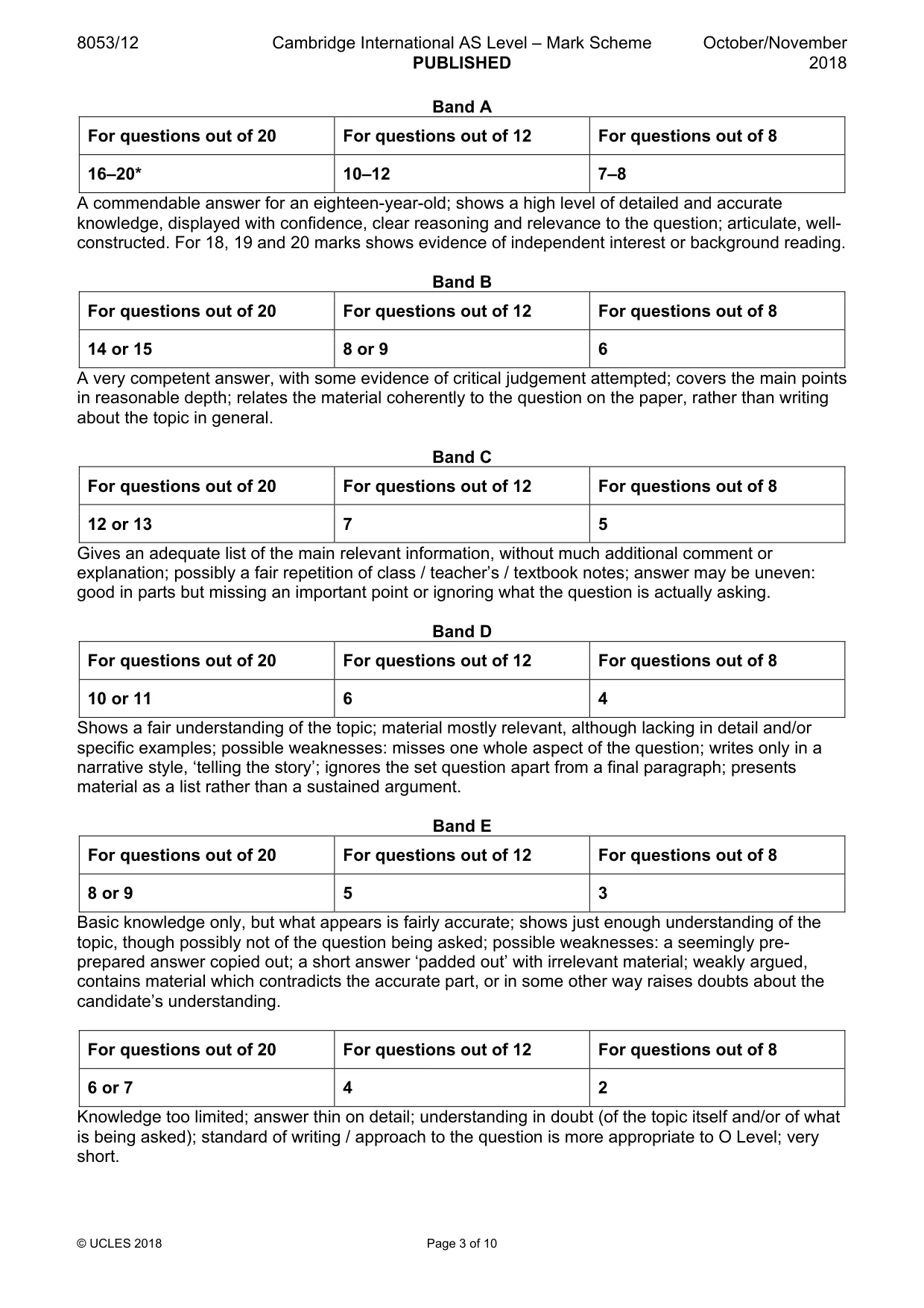
8053/12 Cambridge International AS Level – Mark Scheme PUBLISHED October/November 2018 © UCLES 2018 Page 3 of 10 Band A For questions out of 20 For questions out of 12 For questions out of 8 16–20* 10–12 7–8 A commendable answer for an eighteen-year-old; shows a high level of detailed and accurate knowledge, displayed with confidence, clear reasoning and relevance to the question; articulate, well- constructed. For 18, 19 and 20 marks shows evidence of independent interest or background reading. Band B For questions out of 20 For questions out of 12 For questions out of 8 14 or 15 8 or 9 6 A very competent answer, with some evidence of critical judgement attempted; covers the main points in reasonable depth; relates the material coherently to the question on the paper, rather than writing about the topic in general. Band C For questions out of 20 For questions out of 12 For questions out of 8 12 or 13 7 5 Gives an adequate list of the main relevant information, without much additional comment or explanation; possibly a fair repetition of class / teacher’s / textbook notes; answer may be uneven: good in parts but missing an important point or ignoring what the question is actually asking. Band D For questions out of 20 For questions out of 12 For questions out of 8 10 or 11 6 4 Shows a fair understanding of the topic; material mostly relevant, although lacking in detail and/or specific examples; possible weaknesses: misses one whole aspect of the question; writes only in a narrative style, ‘telling the story’; ignores the set question apart from a final paragraph; presents material as a list rather than a sustained argument. Band E For questions out of 20 For questions out of 12 For questions out of 8 8 or 9 5 3 Basic knowledge only, but what appears is fairly accurate; shows just enough understanding of the topic, though possibly not of the question being asked; possible weaknesses: a seemingly pre- prepared answer copied out; a short answer ‘padded out’ with irrelevant material; weakly argued, contains material which contradicts the accurate part, or in some other way raises doubts about the candidate’s understanding. For questions out of 20 For questions out of 12 For questions out of 8 6 or 7 4 2 Knowledge too limited; answer thin on detail; understanding in doubt (of the topic itself and/or of what is being asked); standard of writing / approach to the question is more appropriate to O Level; very short.
Mark scheme, page 4
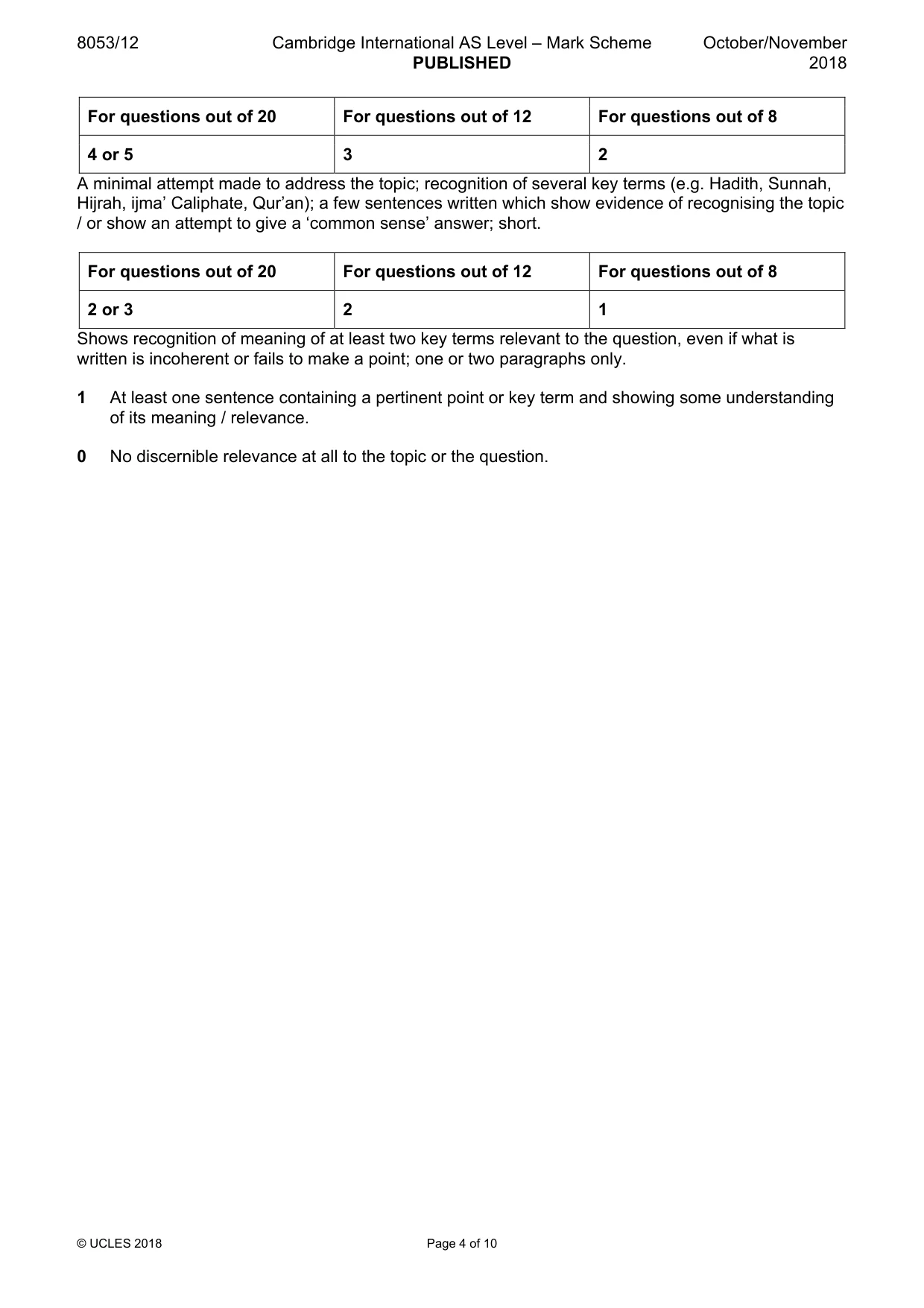
8053/12 Cambridge International AS Level – Mark Scheme PUBLISHED October/November 2018 © UCLES 2018 Page 4 of 10 For questions out of 20 For questions out of 12 For questions out of 8 4 or 5 3 2 A minimal attempt made to address the topic; recognition of several key terms (e.g. Hadith, Sunnah, Hijrah, ijma’ Caliphate, Qur’an); a few sentences written which show evidence of recognising the topic / or show an attempt to give a ‘common sense’ answer; short. For questions out of 20 For questions out of 12 For questions out of 8 2 or 3 2 1 Shows recognition of meaning of at least two key terms relevant to the question, even if what is written is incoherent or fails to make a point; one or two paragraphs only. 1 At least one sentence containing a pertinent point or key term and showing some understanding of its meaning / relevance. 0 No discernible relevance at all to the topic or the question.
Mark scheme, page 5
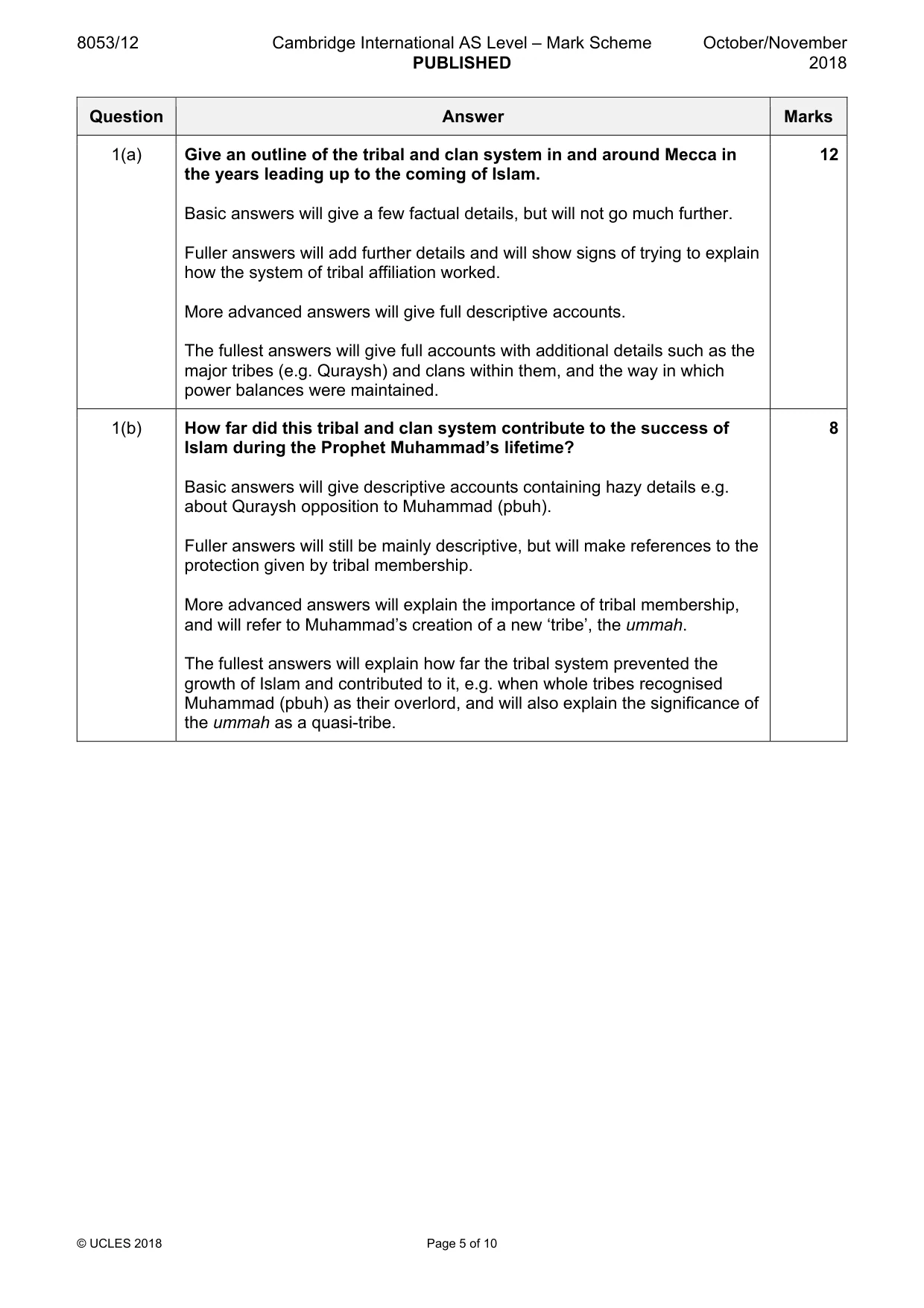
8053/12 Cambridge International AS Level – Mark Scheme PUBLISHED October/November 2018 © UCLES 2018 Page 5 of 10 Question Answer Marks 1(a) Give an outline of the tribal and clan system in and around Mecca in the years leading up to the coming of Islam. Basic answers will give a few factual details, but will not go much further. Fuller answers will add further details and will show signs of trying to explain how the system of tribal affiliation worked. More advanced answers will give full descriptive accounts. The fullest answers will give full accounts with additional details such as the major tribes (e.g. Quraysh) and clans within them, and the way in which power balances were maintained. 12 1(b) How far did this tribal and clan system contribute to the success of Islam during the Prophet Muhammad’s lifetime? Basic answers will give descriptive accounts containing hazy details e.g. about Quraysh opposition to Muhammad (pbuh). Fuller answers will still be mainly descriptive, but will make references to the protection given by tribal membership. More advanced answers will explain the importance of tribal membership, and will refer to Muhammad’s creation of a new ‘tribe’, the ummah. The fullest answers will explain how far the tribal system prevented the growth of Islam and contributed to it, e.g. when whole tribes recognised Muhammad (pbuh) as their overlord, and will also explain the significance of the ummah as a quasi-tribe. 8
Mark scheme, page 6
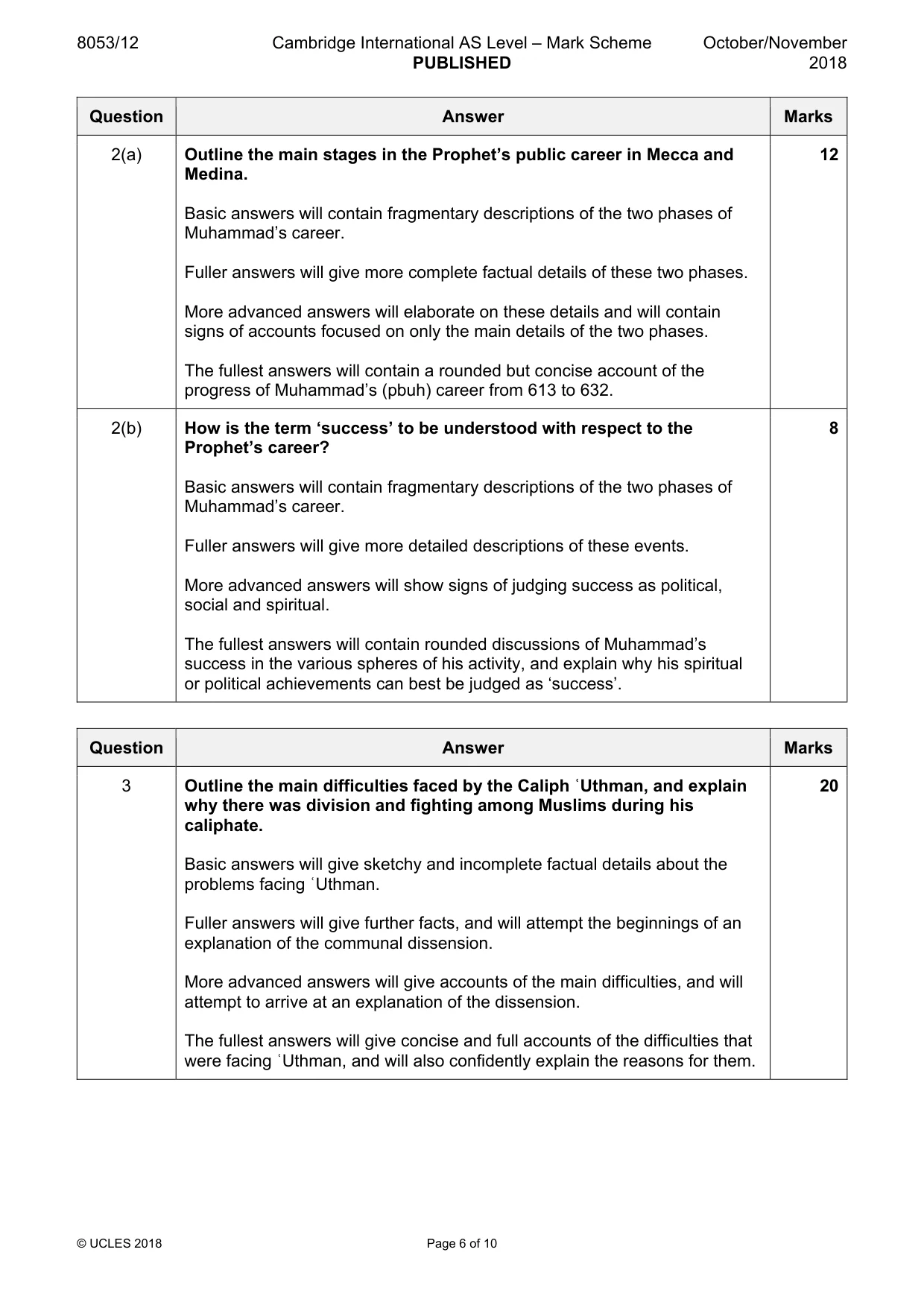
8053/12 Cambridge International AS Level – Mark Scheme PUBLISHED October/November 2018 © UCLES 2018 Page 6 of 10 Question Answer Marks 2(a) Outline the main stages in the Prophet’s public career in Mecca and Medina. Basic answers will contain fragmentary descriptions of the two phases of Muhammad’s career. Fuller answers will give more complete factual details of these two phases. More advanced answers will elaborate on these details and will contain signs of accounts focused on only the main details of the two phases. The fullest answers will contain a rounded but concise account of the progress of Muhammad’s (pbuh) career from 613 to 632. 12 2(b) How is the term ‘success’ to be understood with respect to the Prophet’s career? Basic answers will contain fragmentary descriptions of the two phases of Muhammad’s career. Fuller answers will give more detailed descriptions of these events. More advanced answers will show signs of judging success as political, social and spiritual. The fullest answers will contain rounded discussions of Muhammad’s success in the various spheres of his activity, and explain why his spiritual or political achievements can best be judged as ‘success’. 8 Question Answer Marks 3 Outline the main difficulties faced by the Caliph ʿUthman, and explain why there was division and fighting among Muslims during his caliphate. Basic answers will give sketchy and incomplete factual details about the problems facing ʿUthman. Fuller answers will give further facts, and will attempt the beginnings of an explanation of the communal dissension. More advanced answers will give accounts of the main difficulties, and will attempt to arrive at an explanation of the dissension. The fullest answers will give concise and full accounts of the difficulties that were facing ʿUthman, and will also confidently explain the reasons for them. 20
Mark scheme, page 7
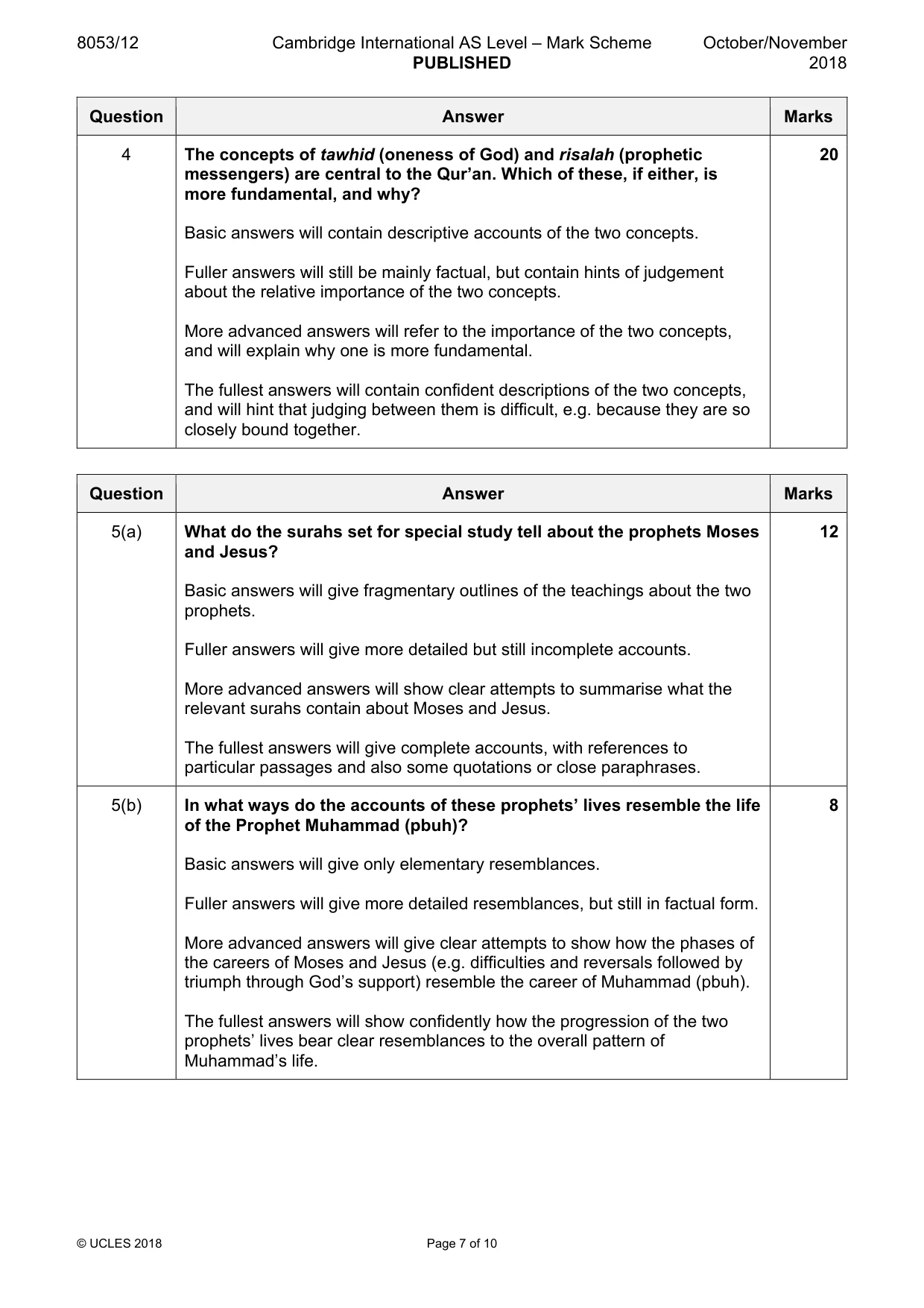
8053/12 Cambridge International AS Level – Mark Scheme PUBLISHED October/November 2018 © UCLES 2018 Page 7 of 10 Question Answer Marks 4 The concepts of tawhid (oneness of God) and risalah (prophetic messengers) are central to the Qur’an. Which of these, if either, is more fundamental, and why? Basic answers will contain descriptive accounts of the two concepts. Fuller answers will still be mainly factual, but contain hints of judgement about the relative importance of the two concepts. More advanced answers will refer to the importance of the two concepts, and will explain why one is more fundamental. The fullest answers will contain confident descriptions of the two concepts, and will hint that judging between them is difficult, e.g. because they are so closely bound together. 20 Question Answer Marks 5(a) What do the surahs set for special study tell about the prophets Moses and Jesus? Basic answers will give fragmentary outlines of the teachings about the two prophets. Fuller answers will give more detailed but still incomplete accounts. More advanced answers will show clear attempts to summarise what the relevant surahs contain about Moses and Jesus. The fullest answers will give complete accounts, with references to particular passages and also some quotations or close paraphrases. 12 5(b) In what ways do the accounts of these prophets’ lives resemble the life of the Prophet Muhammad (pbuh)? Basic answers will give only elementary resemblances. Fuller answers will give more detailed resemblances, but still in factual form. More advanced answers will give clear attempts to show how the phases of the careers of Moses and Jesus (e.g. difficulties and reversals followed by triumph through God’s support) resemble the career of Muhammad (pbuh). The fullest answers will show confidently how the progression of the two prophets’ lives bear clear resemblances to the overall pattern of Muhammad’s life. 8
Mark scheme, page 8
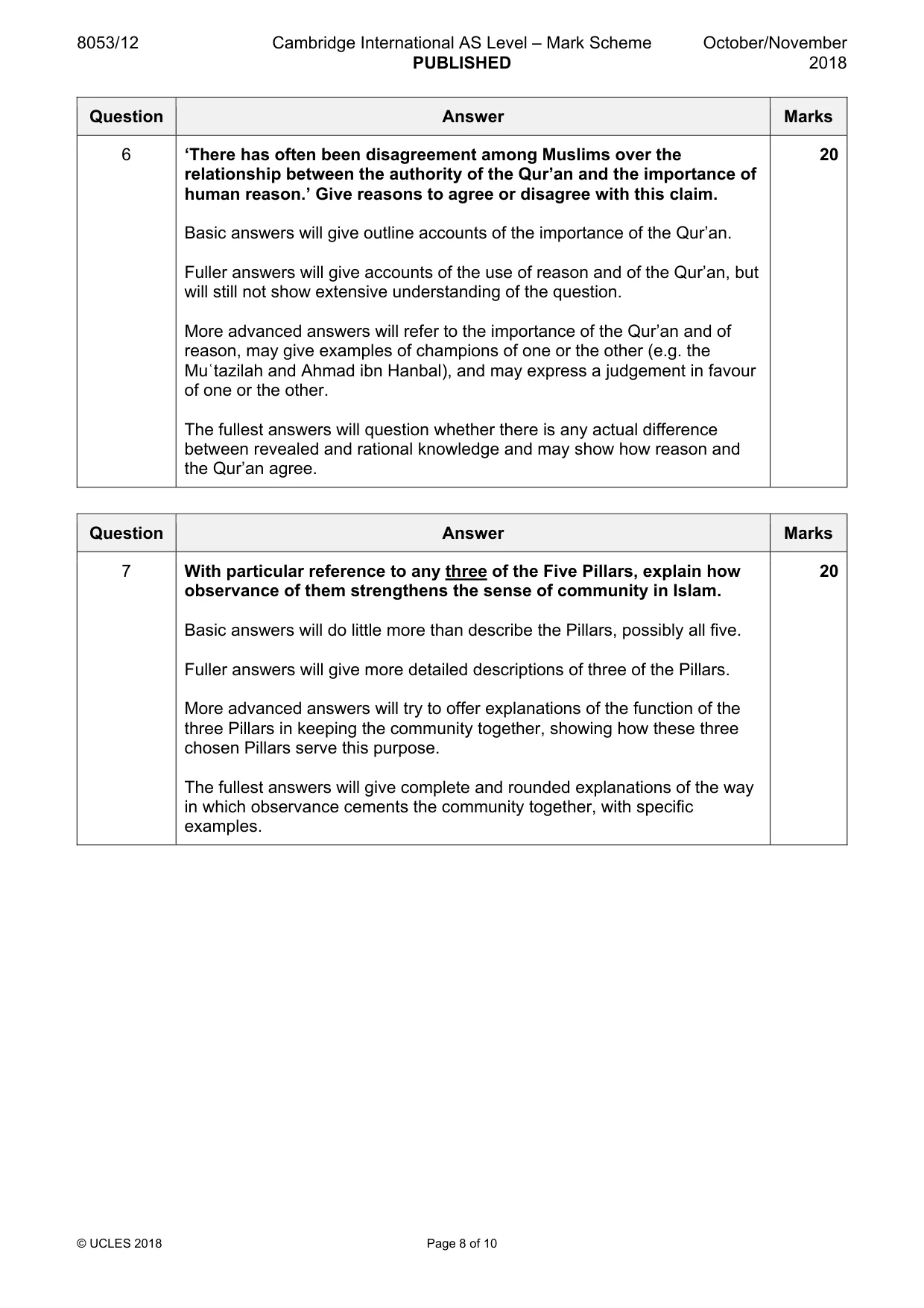
8053/12 Cambridge International AS Level – Mark Scheme PUBLISHED October/November 2018 © UCLES 2018 Page 8 of 10 Question Answer Marks 6 ‘There has often been disagreement among Muslims over the relationship between the authority of the Qur’an and the importance of human reason.’ Give reasons to agree or disagree with this claim. Basic answers will give outline accounts of the importance of the Qur’an. Fuller answers will give accounts of the use of reason and of the Qur’an, but will still not show extensive understanding of the question. More advanced answers will refer to the importance of the Qur’an and of reason, may give examples of champions of one or the other (e.g. the Muʿtazilah and Ahmad ibn Hanbal), and may express a judgement in favour of one or the other. The fullest answers will question whether there is any actual difference between revealed and rational knowledge and may show how reason and the Qur’an agree. 20 Question Answer Marks 7 With particular reference to any three of the Five Pillars, explain how observance of them strengthens the sense of community in Islam. Basic answers will do little more than describe the Pillars, possibly all five. Fuller answers will give more detailed descriptions of three of the Pillars. More advanced answers will try to offer explanations of the function of the three Pillars in keeping the community together, showing how these three chosen Pillars serve this purpose. The fullest answers will give complete and rounded explanations of the way in which observance cements the community together, with specific examples. 20
Mark scheme, page 9
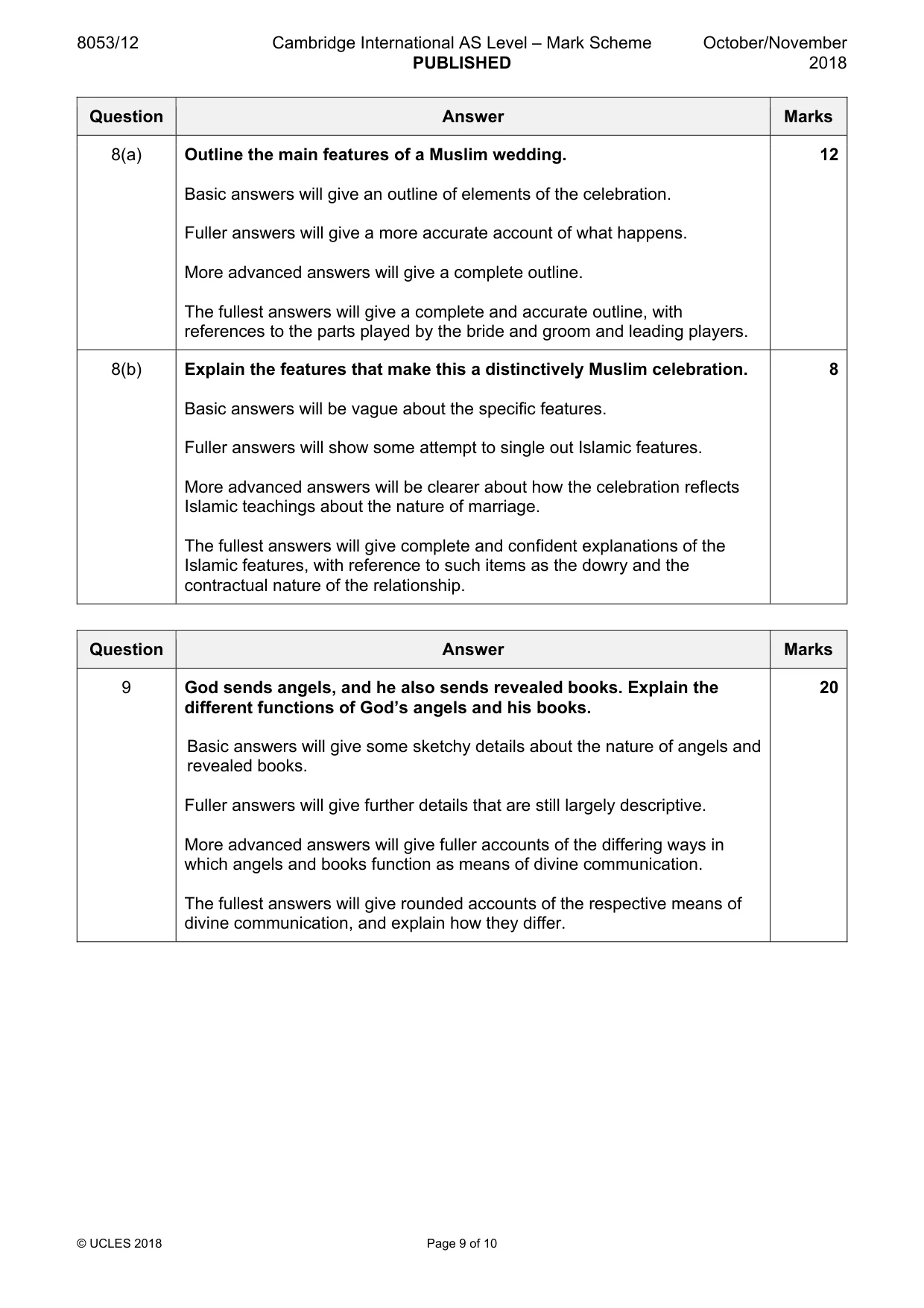
8053/12 Cambridge International AS Level – Mark Scheme PUBLISHED October/November 2018 © UCLES 2018 Page 9 of 10 Question Answer Marks 8(a) Outline the main features of a Muslim wedding. Basic answers will give an outline of elements of the celebration. Fuller answers will give a more accurate account of what happens. More advanced answers will give a complete outline. The fullest answers will give a complete and accurate outline, with references to the parts played by the bride and groom and leading players. 12 8(b) Explain the features that make this a distinctively Muslim celebration. Basic answers will be vague about the specific features. Fuller answers will show some attempt to single out Islamic features. More advanced answers will be clearer about how the celebration reflects Islamic teachings about the nature of marriage. The fullest answers will give complete and confident explanations of the Islamic features, with reference to such items as the dowry and the contractual nature of the relationship. 8 Question Answer Marks 9 God sends angels, and he also sends revealed books. Explain the different functions of God’s angels and his books. Basic answers will give some sketchy details about the nature of angels and revealed books. Fuller answers will give further details that are still largely descriptive. More advanced answers will give fuller accounts of the differing ways in which angels and books function as means of divine communication. The fullest answers will give rounded accounts of the respective means of divine communication, and explain how they differ. 20
Mark scheme, page 10
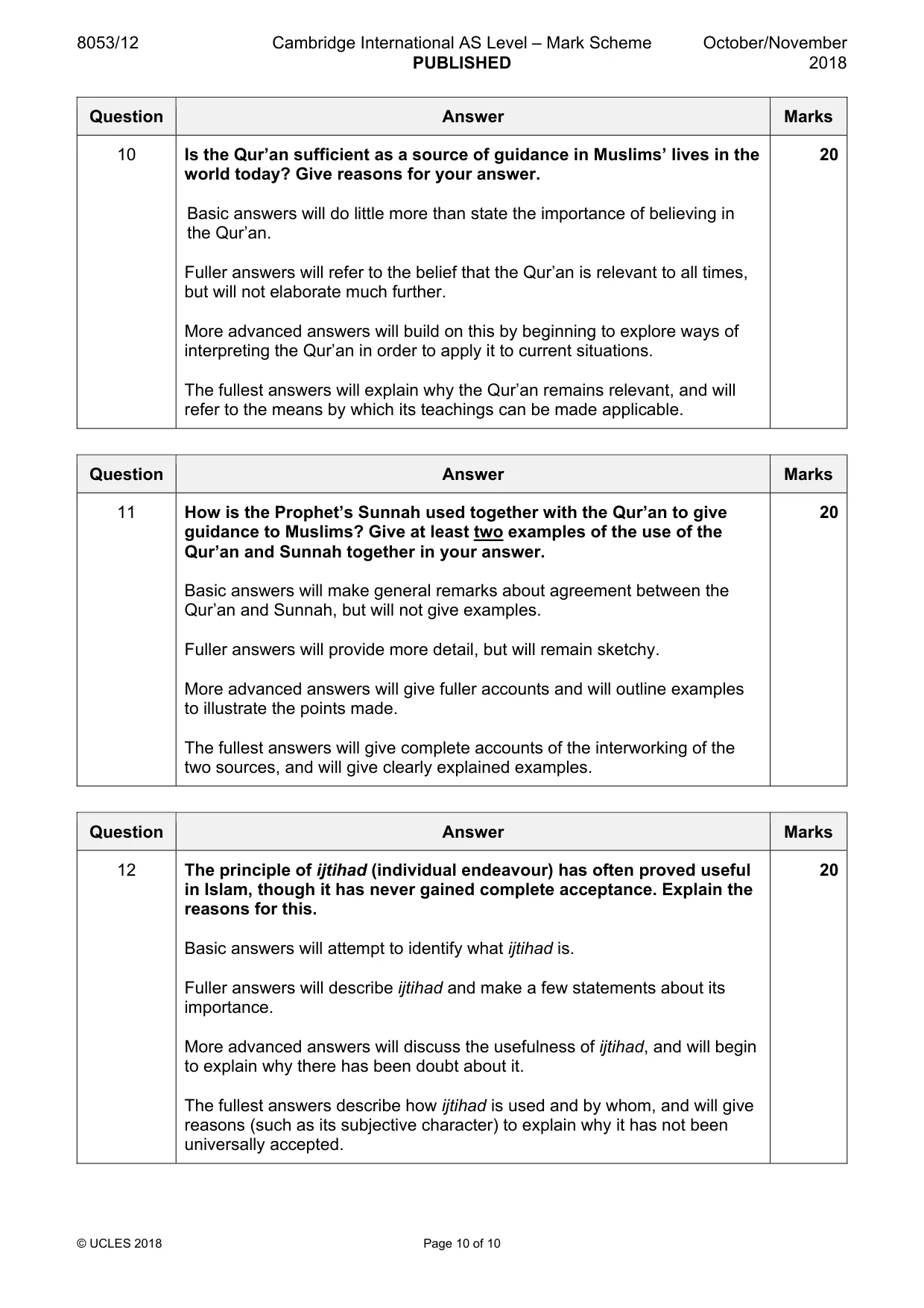
8053/12 Cambridge International AS Level – Mark Scheme PUBLISHED October/November 2018 © UCLES 2018 Page 10 of 10 Question Answer Marks 10 Is the Qur’an sufficient as a source of guidance in Muslims’ lives in the world today? Give reasons for your answer. Basic answers will do little more than state the importance of believing in the Qur’an. Fuller answers will refer to the belief that the Qur’an is relevant to all times, but will not elaborate much further. More advanced answers will build on this by beginning to explore ways of interpreting the Qur’an in order to apply it to current situations. The fullest answers will explain why the Qur’an remains relevant, and will refer to the means by which its teachings can be made applicable. 20 Question Answer Marks 11 How is the Prophet’s Sunnah used together with the Qur’an to give guidance to Muslims? Give at least two examples of the use of the Qur’an and Sunnah together in your answer. Basic answers will make general remarks about agreement between the Qur’an and Sunnah, but will not give examples. Fuller answers will provide more detail, but will remain sketchy. More advanced answers will give fuller accounts and will outline examples to illustrate the points made. The fullest answers will give complete accounts of the interworking of the two sources, and will give clearly explained examples. 20 Question Answer Marks 12 The principle of ijtihad (individual endeavour) has often proved useful in Islam, though it has never gained complete acceptance. Explain the reasons for this. Basic answers will attempt to identify what ijtihad is. Fuller answers will describe ijtihad and make a few statements about its importance. More advanced answers will discuss the usefulness of ijtihad, and will begin to explain why there has been doubt about it. The fullest answers describe how ijtihad is used and by whom, and will give reasons (such as its subjective character) to explain why it has not been universally accepted. 20
What you needed in this session
Cambridge’s own grade thresholds for 2018 Oct/Nov, Paper 1 · Variant 2. A higher threshold means an easier paper — the bar moves with how the cohort did.