Cambridge A Level Islamic Studies (AS Level only) 8053 — 2014 Oct/Nov Paper 1 · Variant 2
8053/12/O/N/14 · 100 marks · ≈113 min
The question paper and its mark scheme, free to read here and free to download. This is Cambridge’s own paper, exactly as it was sat.
Question paper4 pages

Mark scheme7 pages
Answers below. Sit the paper first if you are practising.
Paper as text
Question paper, page 1
This document consists of 3 printed pages and 1 blank page. DC (SJF) 98467 © UCLES 2014 [Turn over Cambridge International Examinations Cambridge International Advanced Subsidiary Level * 0 8 7 4 4 0 0 6 9 0 * ISLAMIC STUDIES 8053/12 Paper 1 October/November 2014 3 hours Additional Materials: Answer Booklet/Paper READ THESE INSTRUCTIONS FIRST If you have been given an Answer Booklet, follow the instructions on the front cover of the Booklet. Write your Centre number, candidate number and name on all the work you hand in. Write in dark blue or black pen. Do not use staples, paper clips, glue or correction fluid. DO NOT WRITE IN ANY BARCODES. Answer five questions. Answer at least one question from each Section. You are reminded of the need for good English and clear presentation in your answers. At the end of the examination, fasten all your work securely together. The number of marks is given in brackets [ ] at the end of each question or part question.
Question paper, page 2
2 8053/12/O/N/14 © UCLES 2014 You must answer five questions in all, one question from each section and one other question. Section A 1 (a) Write an account of (i) worship at the ka‘ba in pre-Islamic times [6] (ii) the beliefs of the hanifs in pre-Islamic Mecca. [6] (b) Explain why the Prophet Muhammad (pbuh) thought it necessary to make the ka‘ba a Muslim centre of worship. [8] 2 (a) Outline the main elements in the Prophet Muhammad’s (pbuh) early preaching that caused conflict with the people of Mecca. [10] (b) What reasons did the Meccans have for not accepting this preaching? [10] 3 The caliph ‘Ali fought against a number of opponents. Write a description of one of his major battles, and explain the reasons why it took place. [20] Section B 4 Write an account of the main differences in character between the Meccan suras and Medinan suras of the Qur’an. [20] 5 It is generally agreed that the order of the suras in the Qur’an is roughly the reverse of the order in which the Prophet received them. Explain the reasons for this. [20] 6 On the basis of the passages you have studied, write an account of the teaching in the Qur’an on tawhid, and explain why this teaching is central to Islam. [20] Section C 7 Why is it important for Muslims not to neglect the Five Pillars of Islam? [20] 8 Many of the annual observances of Islam are linked with the Prophet Abraham. Choose one of these observances, and (a) describe its connections with Abraham, [12] (b) explain the significance of these connections. [8] 9 Write a brief account of the references to the Prophet Muhammad (pbuh) in the Qur’an. What is the significance of these references? [20]
Question paper, page 3
3 8053/12/O/N/14 © UCLES 2014 Section D 10 (a) Outline the principle of consensus (ijma‘ ) in Islamic law. [12] (b) Either explain the ways in which consensus is still useful in present-day legal thinking, or explain why it is not useful any longer. [8] 11 ‘The Qur’an is and always will be fundamental to legal thinking in Islam.’ Give reasons to justify this statement. [20] 12 (a) Giving at least one example, outline the principle of analogy (qiyas) in Islamic legal thinking. [12] (b) Explain why only qualified legal experts are allowed to practise analogy. [8]
Question paper, page 4
4 8053/12/O/N/14 © UCLES 2014 Permission to reproduce items where third-party owned material protected by copyright is included has been sought and cleared where possible. Every reasonable effort has been made by the publisher (UCLES) to trace copyright holders, but if any items requiring clearance have unwittingly been included, the publisher will be pleased to make amends at the earliest possible opportunity. Cambridge International Examinations is part of the Cambridge Assessment Group. Cambridge Assessment is the brand name of University of Cambridge Local Examinations Syndicate (UCLES), which is itself a department of the University of Cambridge. BLANK PAGE
Mark scheme, page 1
® IGCSE is the registered trademark of Cambridge International Examinations. CAMBRIDGE INTERNATIONAL EXAMINATIONS Cambridge International Advanced Subsidiary Level MARK SCHEME for the October/November 2014 series 8053 ISLAMIC STUDIES 8053/12 Paper 1, maximum raw mark 100 This mark scheme is published as an aid to teachers and candidates, to indicate the requirements of the examination. It shows the basis on which Examiners were instructed to award marks. It does not indicate the details of the discussions that took place at an Examiners’ meeting before marking began, which would have considered the acceptability of alternative answers. Mark schemes should be read in conjunction with the question paper and the Principal Examiner Report for Teachers. Cambridge will not enter into discussions about these mark schemes. Cambridge is publishing the mark schemes for the October/November 2014 series for most Cambridge IGCSE®, Cambridge International A and AS Level components and some Cambridge O Level components.
Mark scheme, page 2
Page 2 Mark Scheme Syllabus Paper Cambridge International AS Level – October/November 2014 8053 12 © Cambridge International Examinations 2014 Section A 1 (a) Write an account of (i) worship at the ka`ba in pre-Islamic times [6] (ii) the beliefs of the hanifs in pre-Islamic Mecca. [6] Basic answers will give a few basic details, without showing much knowledge. Fuller answers will add some details and will show signs of understanding how the ka`ba was used, and what the hanifs stood for. More advanced answers will give names of idols in and around the ka`ba, and some details of how the hanifs differed from others in Mecca. The fullest answers will give thorough accounts of both, showing factual awareness and understanding. (b) Explain why the Prophet Muhammad (pbuh) thought it necessary to make the ka`ba a Muslim centre of worship. [8] Basic answers will give some facts about the Muslim capture of Mecca. Fuller answers will add further factual details about the cleansing of the ka`ba. More advanced answers will begin to explain the Prophet’s reasons for his action. The fullest answers will focus on explanation rather than fact, and refer to Qur’anic injunctions, and religious and political expediencies. 2 (a) Outline the main elements in the Prophet Muhammad’s (pbuh) early preaching that caused conflict with the people of Mecca. [10] Basic answers will describe opposition to the Prophet and how he and his followers reacted. Fuller answers will give fuller factual details about the early teachings of the Qur’an and the opposition they caused. More advanced answers will elaborate on these details and begin to say why the teachings caused conflict. The fullest answers will explain the differences between the Qur’an and the beliefs of the Meccans, and give quotations from the Qur’an to illustrate their point. (b) What reasons did the Meccans have for not accepting this preaching? [10] Basic answers will mention the kind of opposition given by the Meccans. Fuller answers will outline the differences between the two sets of beliefs, with some repetition of answers to (a). More advanced answers will show some awareness of the economic elements in the Meccans’ defence of their beliefs, in addition to their loyalties to old ways. The fullest answers will detail a succession of reasons in some details, among them: traditional loyalties; economic interest in maintaining the status quo; risk of leadership being lost; harm to caravan trade.
Mark scheme, page 3
Page 3 Mark Scheme Syllabus Paper Cambridge International AS Level – October/November 2014 8053 12 © Cambridge International Examinations 2014 3 The caliph `Ali fought against a number of opponents. Write a description of one of his major battles, and explain the reasons why it took place. [20] Basic answers will give some facts about one or more battle (most likely, the Camel or Siffin). Fuller answers will give further facts and also some reasons. More advanced answers will give facts of the battle, and refer to the underlying reasons for opposition to `Ali. The fullest answers will give full facts about the course of the battle, and detail a number of major reasons for opposition.
Mark scheme, page 4
Page 4 Mark Scheme Syllabus Paper Cambridge International AS Level – October/November 2014 8053 12 © Cambridge International Examinations 2014 Section B 4 Write an account of the main differences in character between the Meccan surahs and Medinan surahs of the Qur’an. [20] Basic answers will give outline factual details about the history of the Qur’an, from the first revelations in Mecca onwards. Fuller answers will show awareness of the different stages of revelation. More advanced answers will give some characteristics of the generally more allusive Meccan surahs and the generally more narrative and legislative Medinan surahs. The fullest answers will offer a comprehensive account of the different characteristics, together with some examples, and may also refer to the stages within the Meccan surahs. 5 It is generally agreed that the order of the surahs in the Qur’an is roughly the reverse of the order in which the Prophet received them. Explain the reasons for this. [20] Basic answers will show only elementary awareness of this phenomenon. Fuller answers will mention the ways in which the surahs were revealed and also include some details about the process of compiling the Qur’an. More advanced answers will describe the history of revelation, and also give fuller details about the methods of compiling the Qur’an. The fullest answers will refer in detail to the ways in which the text was compiled, and will refer to the reasons suggested for the present arrangement of the text, and may refer to the fact that the precise reason is not known. 6 On the basis of the passages you have studied, write an account of the teaching in the Qur’an on tawhid, and explain why this teaching is central to Islam. [20] Basic answers will refer in the most general terms to tawhid as the most important teaching in Islam. Fuller answers will refer to tawhid in general terms, may mention some of the set passages, and will show some attempt to explain the centrality of the doctrine. More advanced answers will refer to examples from the set passages, and will make some attempt to explain the centrality of the doctrine. The fullest answers will contain developed discussions of what the Qur’an teaches about tawhid by both quoting from relevant passages and basing ideas upon them, and will give in outline clear ideas of how the beliefs and practices of Islam are founded on the doctrine.
Mark scheme, page 5
Page 5 Mark Scheme Syllabus Paper Cambridge International AS Level – October/November 2014 8053 12 © Cambridge International Examinations 2014 Section C 7 Why is it important for Muslims not to neglect the Five Pillars of Islam? [20] Basic answers will mention the Pillars, and may say what observance of each entails. Fuller answers will add comments about the importance to obey what is traditionally taught. More advanced answers will give reasons such as obeying God, remaining focused upon him, and strengthening the community. The fullest answers will give hints about the importance of demonstrating obedience to the teachings of the faith, and may refer to the significance of the words ‘not to neglect’ by suggesting that the Pillars are so characteristic of Islam that to fail to observe them risks abandoning the faith. 8 Many of the annual observances of Islam are linked with the Prophet Abraham. Choose one of these observances, and (a) describe its connections with Abraham, [12] Basic answers will describe one of the annual observances, such as pilgrimage or Eid al- Adha. Fuller answers will give details of how Abraham is linked with the observance. More advanced answers will refer to what the Qur’an says about the link between the observance and Abraham. The fullest answers will give a full and comprehensive account of the observance and locate its elements in the biography of Abraham. (b) explain the significance of these connections. [8] Basic answers will not show understanding of what this is. Fuller answers will begin to show how the link connects worshippers today with Abraham. More advanced answers will refer to the notion of solidarity in the faith effected by united actions through the ages, stretching back to Abraham. The fullest answers will give a full and confident of presentation of this explanation. 9 Write a brief account of the references to the Prophet Muhammad (pbuh) in the Qur’an. What is the significance of these references? [20] Basic answers will refer to a few examples of where the Prophet is mentioned. Fuller answers will give further examples, and may begin to explain how they show the relationship between the Prophet and God. More advanced answers will refer to a range of examples, among them the title Seal of the Prophets, the reference to the Night Journey, the first experiences of revelation, and direct addresses to the Prophet, as in Surah 93. They will mention the evidence given by these verses to the authenticity of the Prophet, and the truth of his call. The fullest answers will give a full though concise account of the main references to the Prophet in the Qur’an, and will explain confidently their importance as guarantees of his status.
Mark scheme, page 6
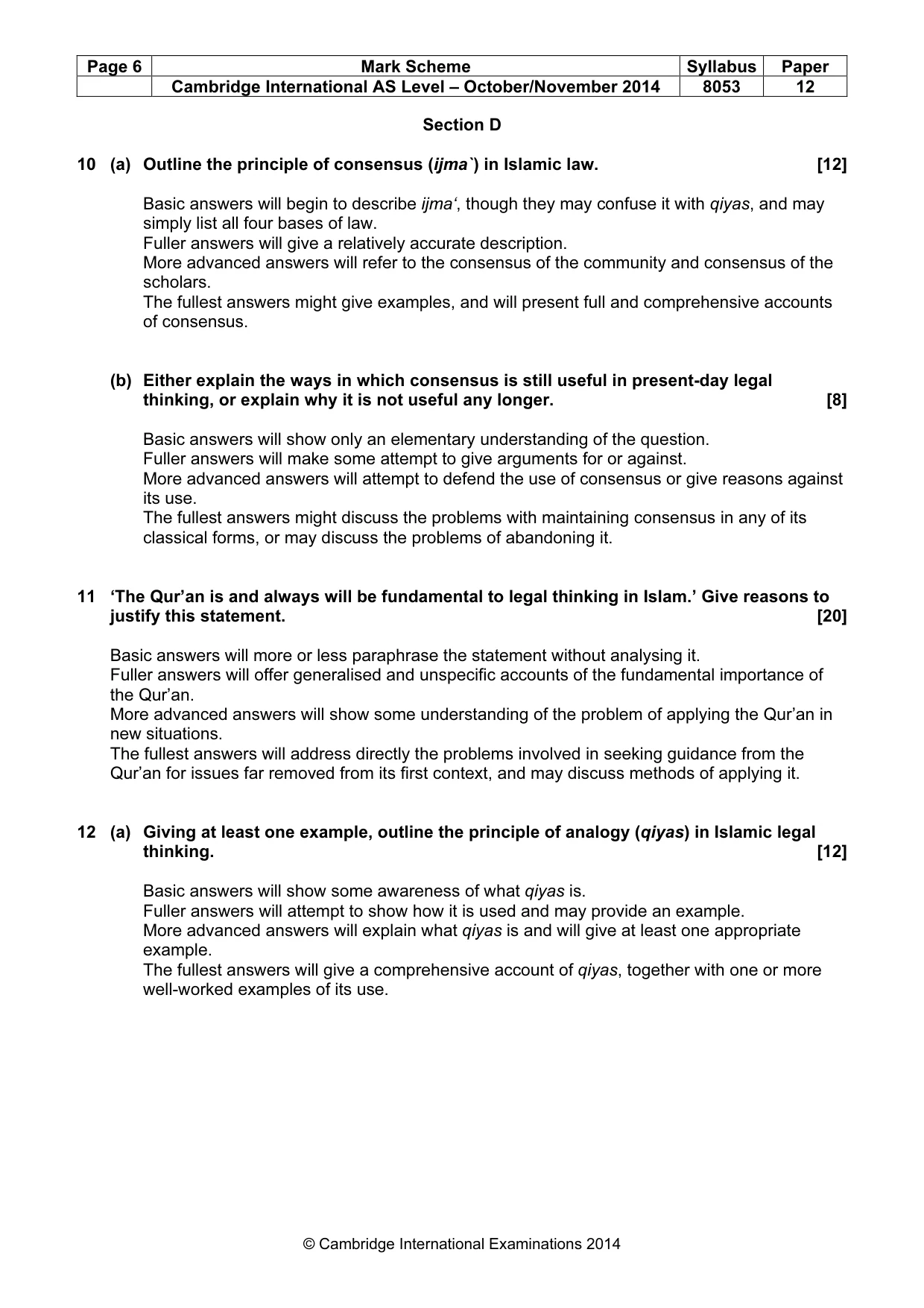
Page 6 Mark Scheme Syllabus Paper Cambridge International AS Level – October/November 2014 8053 12 © Cambridge International Examinations 2014 Section D 10 (a) Outline the principle of consensus (ijma`) in Islamic law. [12] Basic answers will begin to describe ijma‘, though they may confuse it with qiyas, and may simply list all four bases of law. Fuller answers will give a relatively accurate description. More advanced answers will refer to the consensus of the community and consensus of the scholars. The fullest answers might give examples, and will present full and comprehensive accounts of consensus. (b) Either explain the ways in which consensus is still useful in present-day legal thinking, or explain why it is not useful any longer. [8] Basic answers will show only an elementary understanding of the question. Fuller answers will make some attempt to give arguments for or against. More advanced answers will attempt to defend the use of consensus or give reasons against its use. The fullest answers might discuss the problems with maintaining consensus in any of its classical forms, or may discuss the problems of abandoning it. 11 ‘The Qur’an is and always will be fundamental to legal thinking in Islam.’ Give reasons to justify this statement. [20] Basic answers will more or less paraphrase the statement without analysing it. Fuller answers will offer generalised and unspecific accounts of the fundamental importance of the Qur’an. More advanced answers will show some understanding of the problem of applying the Qur’an in new situations. The fullest answers will address directly the problems involved in seeking guidance from the Qur’an for issues far removed from its first context, and may discuss methods of applying it. 12 (a) Giving at least one example, outline the principle of analogy (qiyas) in Islamic legal thinking. [12] Basic answers will show some awareness of what qiyas is. Fuller answers will attempt to show how it is used and may provide an example. More advanced answers will explain what qiyas is and will give at least one appropriate example. The fullest answers will give a comprehensive account of qiyas, together with one or more well-worked examples of its use.
Mark scheme, page 7
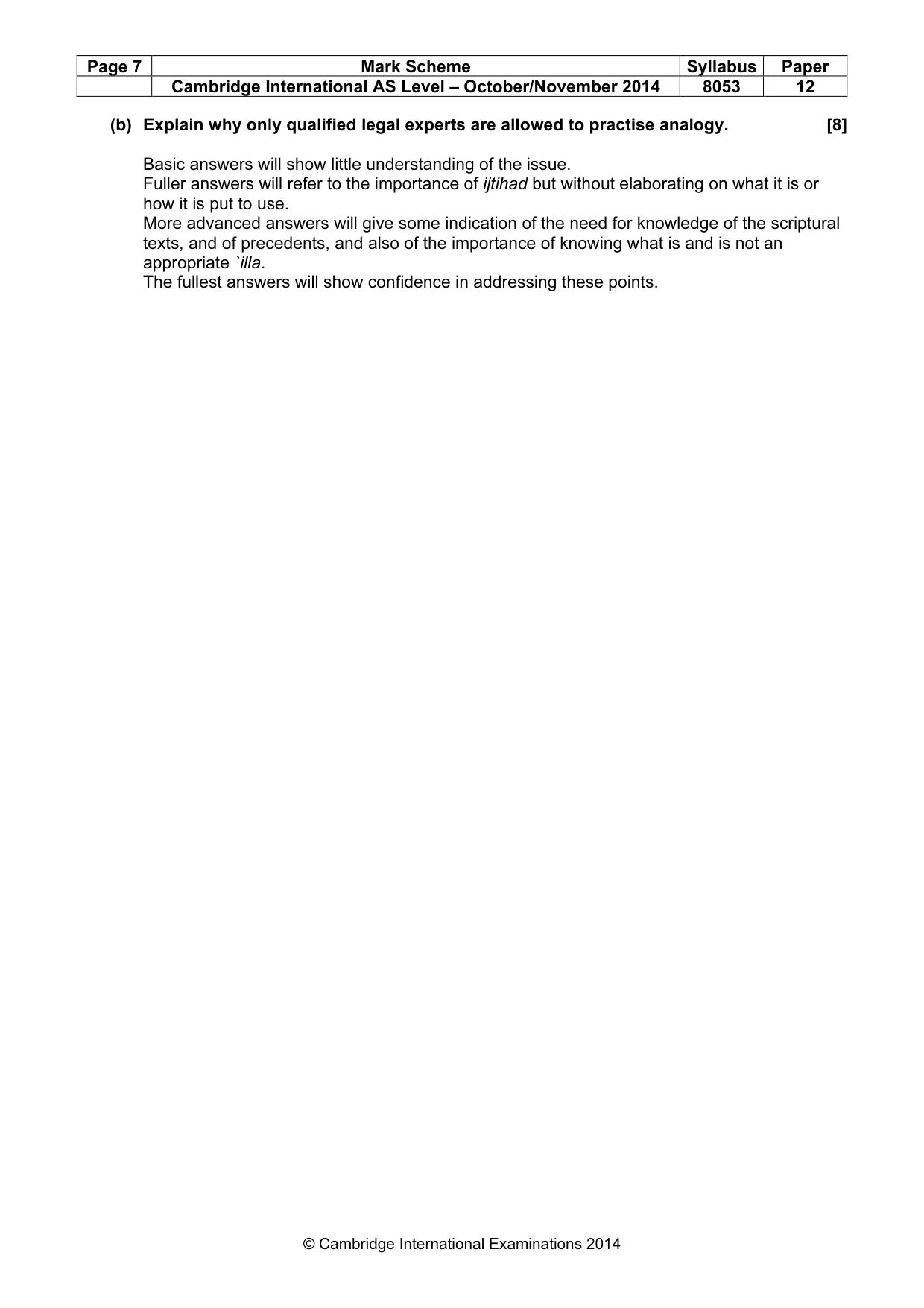
Page 7 Mark Scheme Syllabus Paper Cambridge International AS Level – October/November 2014 8053 12 © Cambridge International Examinations 2014 (b) Explain why only qualified legal experts are allowed to practise analogy. [8] Basic answers will show little understanding of the issue. Fuller answers will refer to the importance of ijtihad but without elaborating on what it is or how it is put to use. More advanced answers will give some indication of the need for knowledge of the scriptural texts, and of precedents, and also of the importance of knowing what is and is not an appropriate `illa. The fullest answers will show confidence in addressing these points.
What you needed in this session
Cambridge’s own grade thresholds for 2014 Oct/Nov, Paper 1 · Variant 2. A higher threshold means an easier paper — the bar moves with how the cohort did.