Cambridge A Level Islamic Studies (AS Level only) 8053 — 2015 Oct/Nov Paper 1 · Variant 2
8053/12/O/N/15 · 100 marks · ≈113 min
The question paper and its mark scheme, free to read here and free to download. This is Cambridge’s own paper, exactly as it was sat.
Question paper4 pages
Mark scheme
No mark scheme is in the library for this paper.
Paper as text
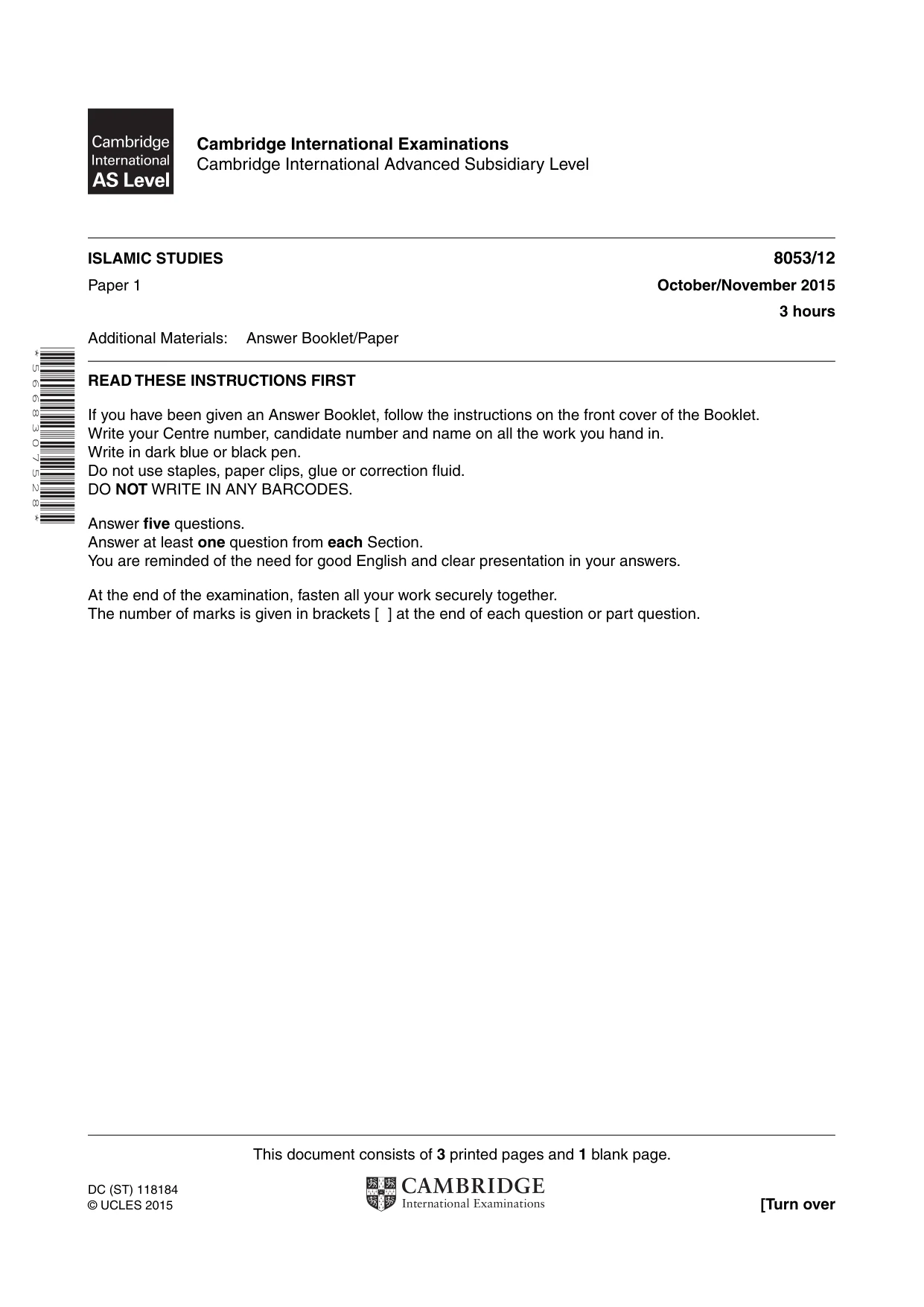
Question paper, page 1
This document consists of 3 printed pages and 1 blank page. DC (ST) 118184 © UCLES 2015 [Turn over Cambridge International Examinations Cambridge International Advanced Subsidiary Level * 5 6 6 8 3 0 7 5 2 8 * ISLAMIC STUDIES 8053/12 Paper 1 October/November 2015 3 hours Additional Materials: Answer Booklet/Paper READ THESE INSTRUCTIONS FIRST If you have been given an Answer Booklet, follow the instructions on the front cover of the Booklet. Write your Centre number, candidate number and name on all the work you hand in. Write in dark blue or black pen. Do not use staples, paper clips, glue or correction fluid. DO NOT WRITE IN ANY BARCODES. Answer five questions. Answer at least one question from each Section. You are reminded of the need for good English and clear presentation in your answers. At the end of the examination, fasten all your work securely together. The number of marks is given in brackets [ ] at the end of each question or part question.
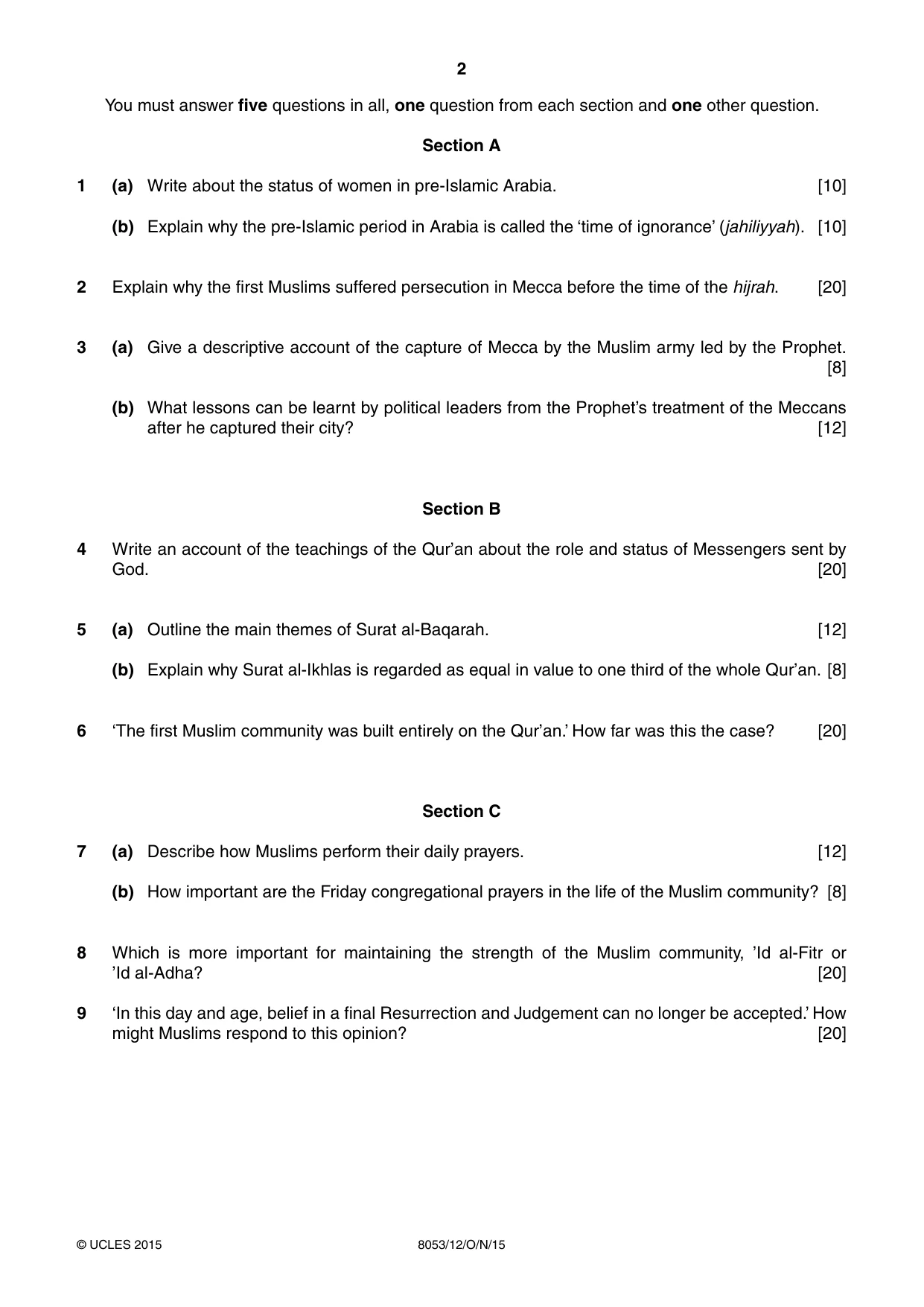
Question paper, page 2
2 8053/12/O/N/15 © UCLES 2015 You must answer five questions in all, one question from each section and one other question. Section A 1 (a) Write about the status of women in pre-Islamic Arabia. [10] (b) Explain why the pre-Islamic period in Arabia is called the ‘time of ignorance’ (jahiliyyah). [10] 2 Explain why the first Muslims suffered persecution in Mecca before the time of the hijrah. [20] 3 (a) Give a descriptive account of the capture of Mecca by the Muslim army led by the Prophet. [8] (b) What lessons can be learnt by political leaders from the Prophet’s treatment of the Meccans after he captured their city? [12] Section B 4 Write an account of the teachings of the Qur’an about the role and status of Messengers sent by God. [20] 5 (a) Outline the main themes of Surat al-Baqarah. [12] (b) Explain why Surat al-Ikhlas is regarded as equal in value to one third of the whole Qur’an. [8] 6 ‘The first Muslim community was built entirely on the Qur’an.’ How far was this the case? [20] Section C 7 (a) Describe how Muslims perform their daily prayers. [12] (b) How important are the Friday congregational prayers in the life of the Muslim community? [8] 8 Which is more important for maintaining the strength of the Muslim community, ’Id al-Fitr or ’Id al-Adha? [20] 9 ‘In this day and age, belief in a final Resurrection and Judgement can no longer be accepted.’ How might Muslims respond to this opinion? [20]
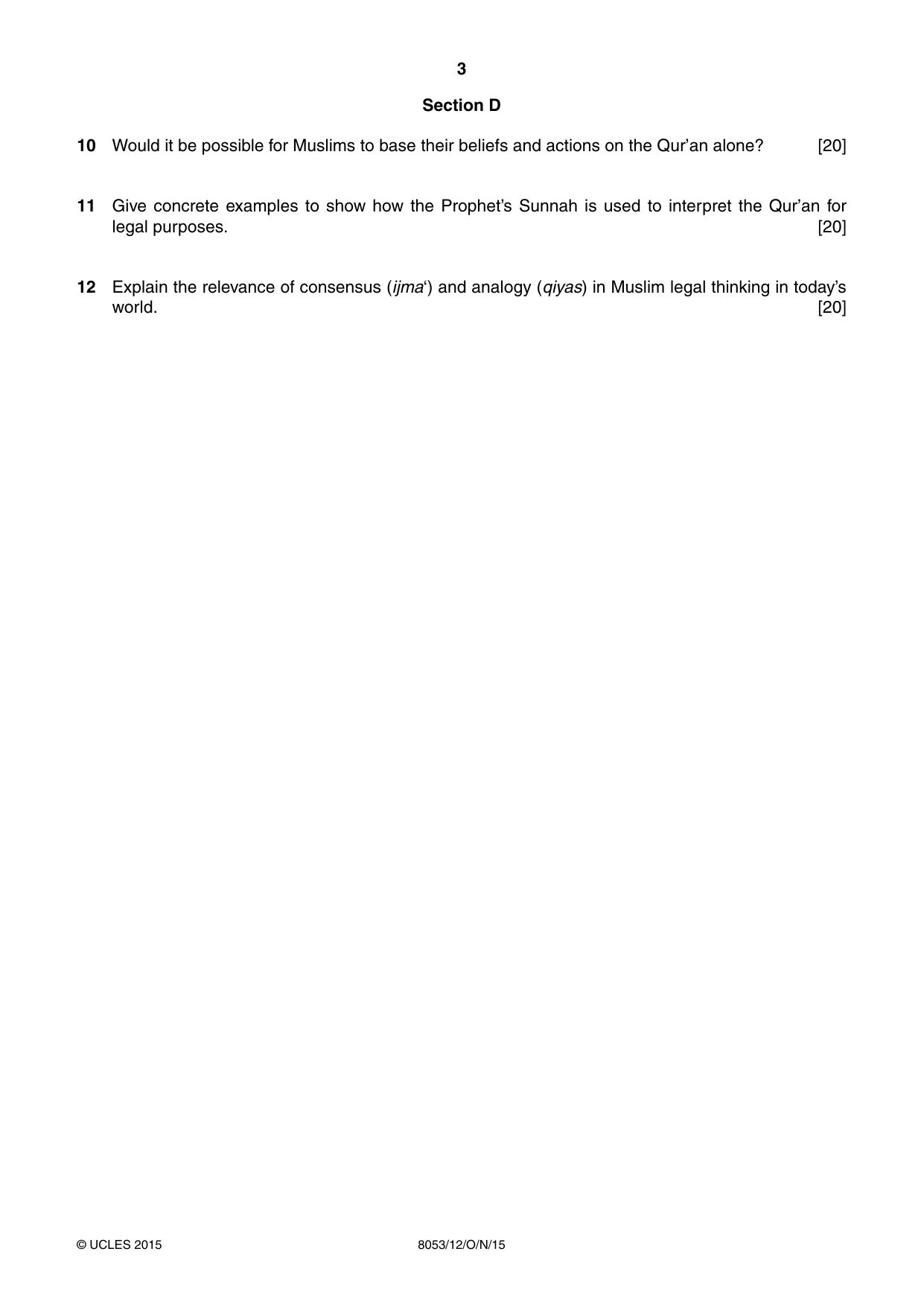
Question paper, page 3
3 8053/12/O/N/15 © UCLES 2015 Section D 10 Would it be possible for Muslims to base their beliefs and actions on the Qur’an alone? [20] 11 Give concrete examples to show how the Prophet’s Sunnah is used to interpret the Qur’an for legal purposes. [20] 12 Explain the relevance of consensus (ijma‘) and analogy (qiyas) in Muslim legal thinking in today’s world. [20]
Question paper, page 4
4 8053/12/O/N/15 © UCLES 2015 BLANK PAGE Permission to reproduce items where third-party owned material protected by copyright is included has been sought and cleared where possible. Every reasonable effort has been made by the publisher (UCLES) to trace copyright holders, but if any items requiring clearance have unwittingly been included, the publisher will be pleased to make amends at the earliest possible opportunity. To avoid the issue of disclosure of answer-related information to candidates, all copyright acknowledgements are reproduced online in the Cambridge International Examinations Copyright Acknowledgements Booklet. This is produced for each series of examinations and is freely available to download at www.cie.org.uk after the live examination series. Cambridge International Examinations is part of the Cambridge Assessment Group. Cambridge Assessment is the brand name of University of Cambridge Local Examinations Syndicate (UCLES), which is itself a department of the University of Cambridge.
What you needed in this session
Cambridge’s own grade thresholds for 2015 Oct/Nov, Paper 1 · Variant 2. A higher threshold means an easier paper — the bar moves with how the cohort did.