Cambridge A Level Islamic Studies (AS Level only) 8053 — 2017 Oct/Nov Paper 1 · Variant 2
8053/12/O/N/17 · 100 marks · ≈113 min
The question paper and its mark scheme, free to read here and free to download. This is Cambridge’s own paper, exactly as it was sat.
Question paper4 pages
Mark scheme8 pages
Answers below. Sit the paper first if you are practising.
Paper as text
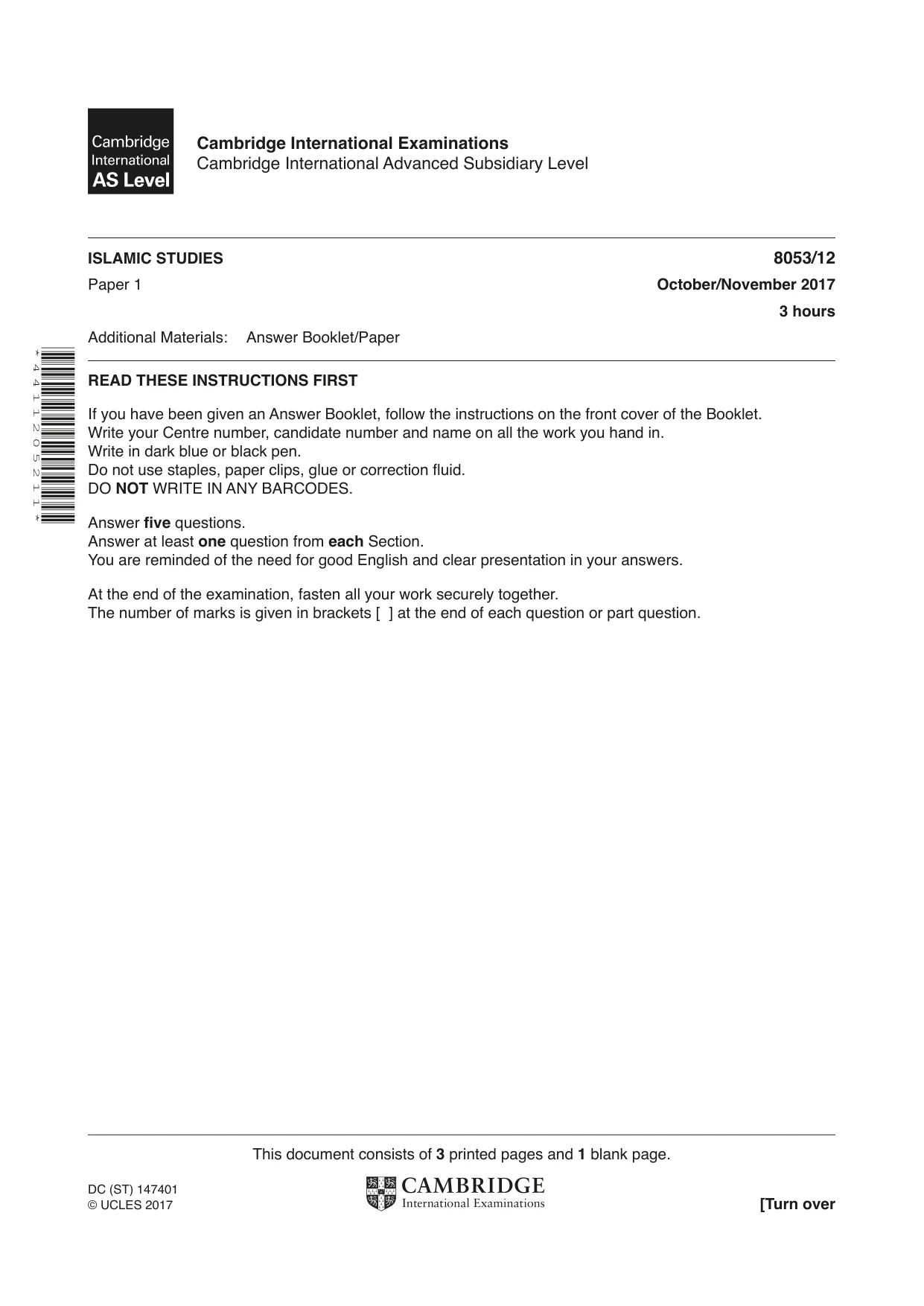
Question paper, page 1
This document consists of 3 printed pages and 1 blank page. DC (ST) 147401 © UCLES 2017 [Turn over Cambridge International Examinations Cambridge International Advanced Subsidiary Level * 4 4 1 1 2 0 5 2 1 1 * ISLAMIC STUDIES 8053/12 Paper 1 October/November 2017 3 hours Additional Materials: Answer Booklet/Paper READ THESE INSTRUCTIONS FIRST If you have been given an Answer Booklet, follow the instructions on the front cover of the Booklet. Write your Centre number, candidate number and name on all the work you hand in. Write in dark blue or black pen. Do not use staples, paper clips, glue or correction fluid. DO NOT WRITE IN ANY BARCODES. Answer five questions. Answer at least one question from each Section. You are reminded of the need for good English and clear presentation in your answers. At the end of the examination, fasten all your work securely together. The number of marks is given in brackets [ ] at the end of each question or part question.
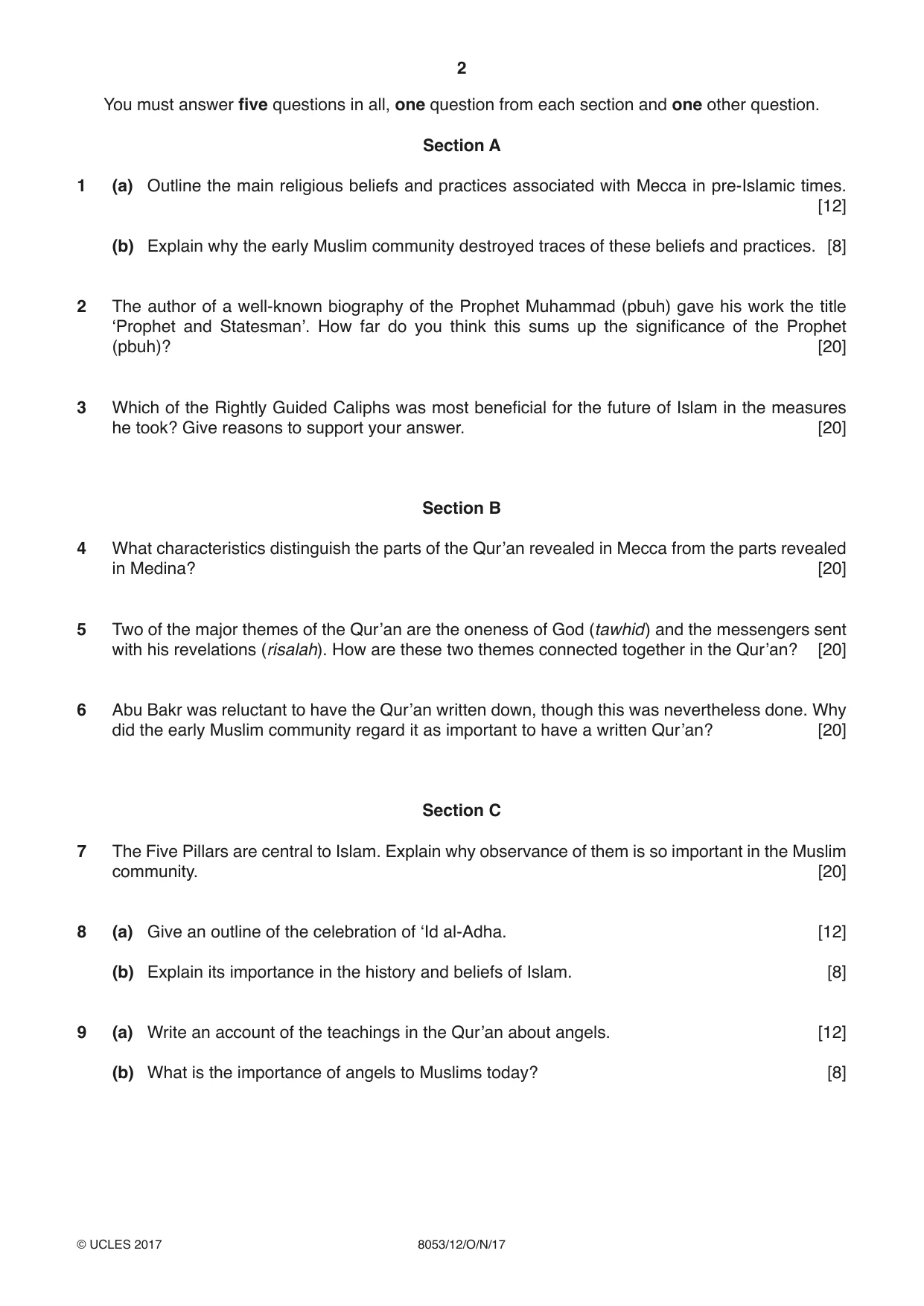
Question paper, page 2
2 8053/12/O/N/17 © UCLES 2017 You must answer five questions in all, one question from each section and one other question. Section A 1 (a) Outline the main religious beliefs and practices associated with Mecca in pre-Islamic times. [12] (b) Explain why the early Muslim community destroyed traces of these beliefs and practices. [8] 2 The author of a well-known biography of the Prophet Muhammad (pbuh) gave his work the title ‘Prophet and Statesman’. How far do you think this sums up the significance of the Prophet (pbuh)? [20] 3 Which of the Rightly Guided Caliphs was most beneficial for the future of Islam in the measures he took? Give reasons to support your answer. [20] Section B 4 What characteristics distinguish the parts of the Qur’an revealed in Mecca from the parts revealed in Medina? [20] 5 Two of the major themes of the Qur’an are the oneness of God (tawhid) and the messengers sent with his revelations (risalah). How are these two themes connected together in the Qur’an? [20] 6 Abu Bakr was reluctant to have the Qur’an written down, though this was nevertheless done. Why did the early Muslim community regard it as important to have a written Qur’an? [20] Section C 7 The Five Pillars are central to Islam. Explain why observance of them is so important in the Muslim community. [20] 8 (a) Give an outline of the celebration of ‘Id al-Adha. [12] (b) Explain its importance in the history and beliefs of Islam. [8] 9 (a) Write an account of the teachings in the Qur’an about angels. [12] (b) What is the importance of angels to Muslims today? [8]
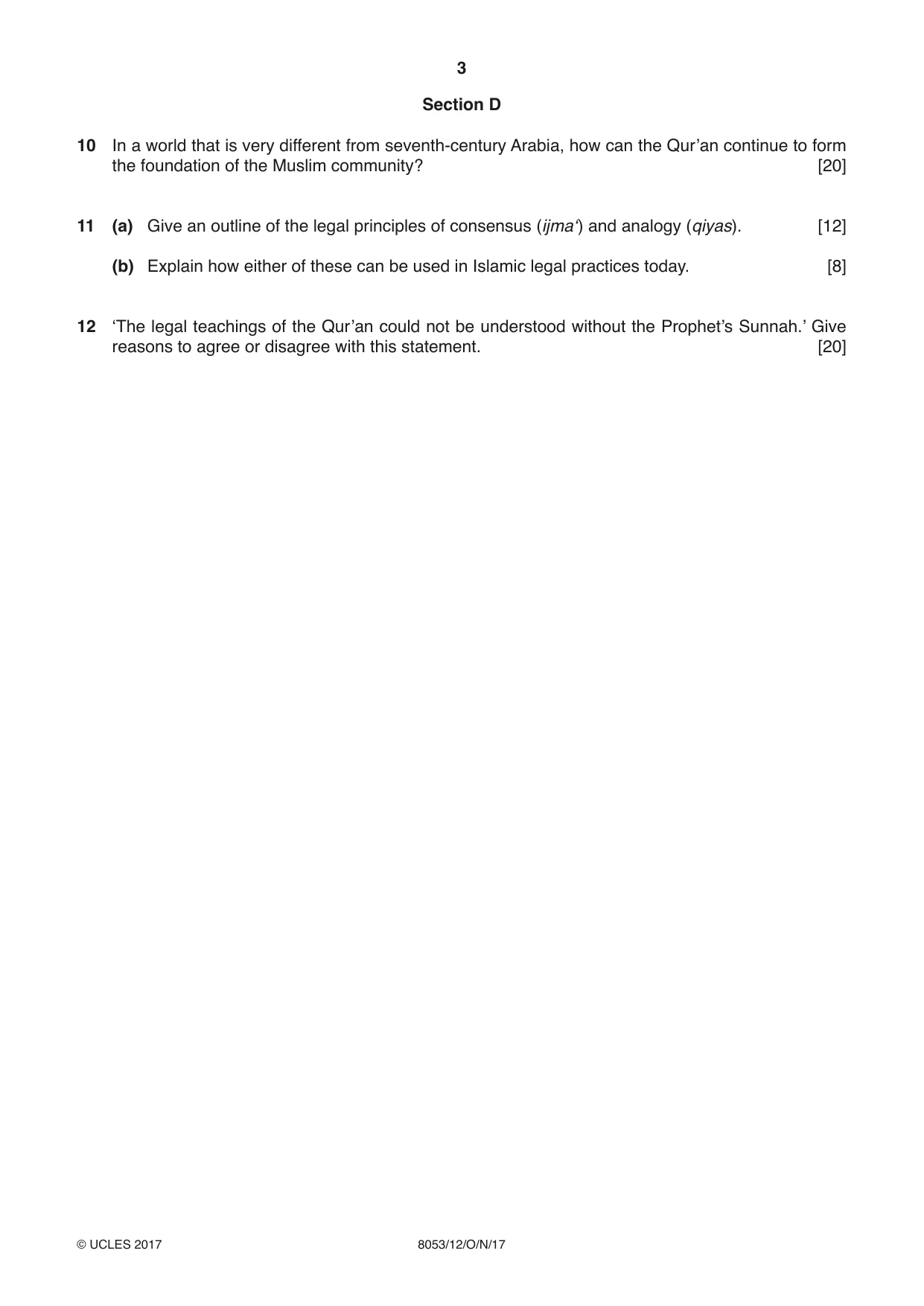
Question paper, page 3
3 8053/12/O/N/17 © UCLES 2017 Section D 10 In a world that is very different from seventh-century Arabia, how can the Qur’an continue to form the foundation of the Muslim community? [20] 11 (a) Give an outline of the legal principles of consensus (ijma‘) and analogy (qiyas). [12] (b) Explain how either of these can be used in Islamic legal practices today. [8] 12 ‘The legal teachings of the Qur’an could not be understood without the Prophet’s Sunnah.’ Give reasons to agree or disagree with this statement. [20]
Question paper, page 4
4 8053/12/O/N/17 © UCLES 2017 BLANK PAGE Permission to reproduce items where third-party owned material protected by copyright is included has been sought and cleared where possible. Every reasonable effort has been made by the publisher (UCLES) to trace copyright holders, but if any items requiring clearance have unwittingly been included, the publisher will be pleased to make amends at the earliest possible opportunity. To avoid the issue of disclosure of answer-related information to candidates, all copyright acknowledgements are reproduced online in the Cambridge International Examinations Copyright Acknowledgements Booklet. This is produced for each series of examinations and is freely available to download at www.cie.org.uk after the live examination series. Cambridge International Examinations is part of the Cambridge Assessment Group. Cambridge Assessment is the brand name of University of Cambridge Local Examinations Syndicate (UCLES), which is itself a department of the University of Cambridge.
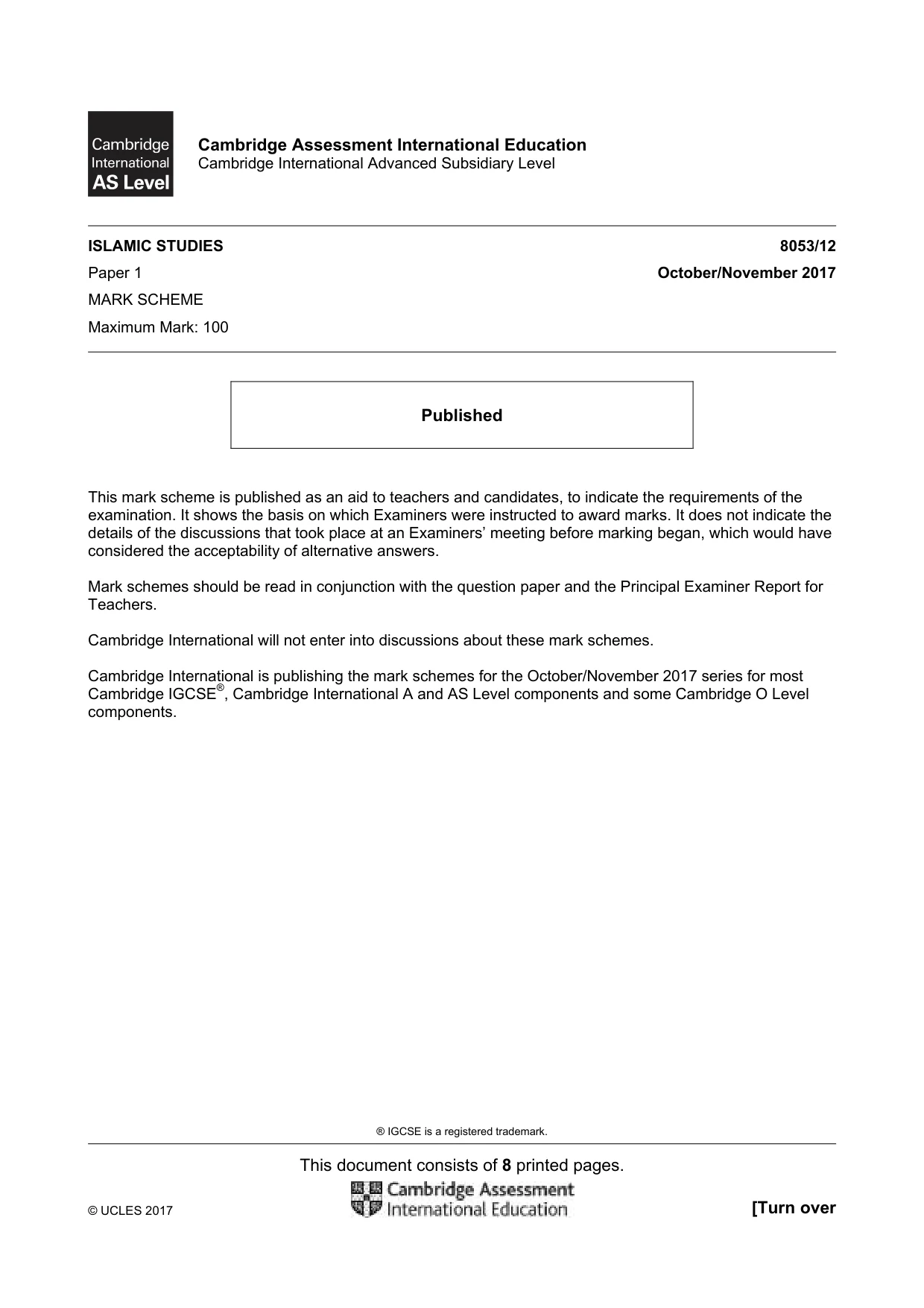
Mark scheme, page 1
® IGCSE is a registered trademark. This document consists of 8 printed pages. © UCLES 2017 [Turn over Cambridge Assessment International Education Cambridge International Advanced Subsidiary Level ISLAMIC STUDIES 8053/12 Paper 1 October/November 2017 MARK SCHEME Maximum Mark: 100 Published This mark scheme is published as an aid to teachers and candidates, to indicate the requirements of the examination. It shows the basis on which Examiners were instructed to award marks. It does not indicate the details of the discussions that took place at an Examiners’ meeting before marking began, which would have considered the acceptability of alternative answers. Mark schemes should be read in conjunction with the question paper and the Principal Examiner Report for Teachers. Cambridge International will not enter into discussions about these mark schemes. Cambridge International is publishing the mark schemes for the October/November 2017 series for most Cambridge IGCSE®, Cambridge International A and AS Level components and some Cambridge O Level components.
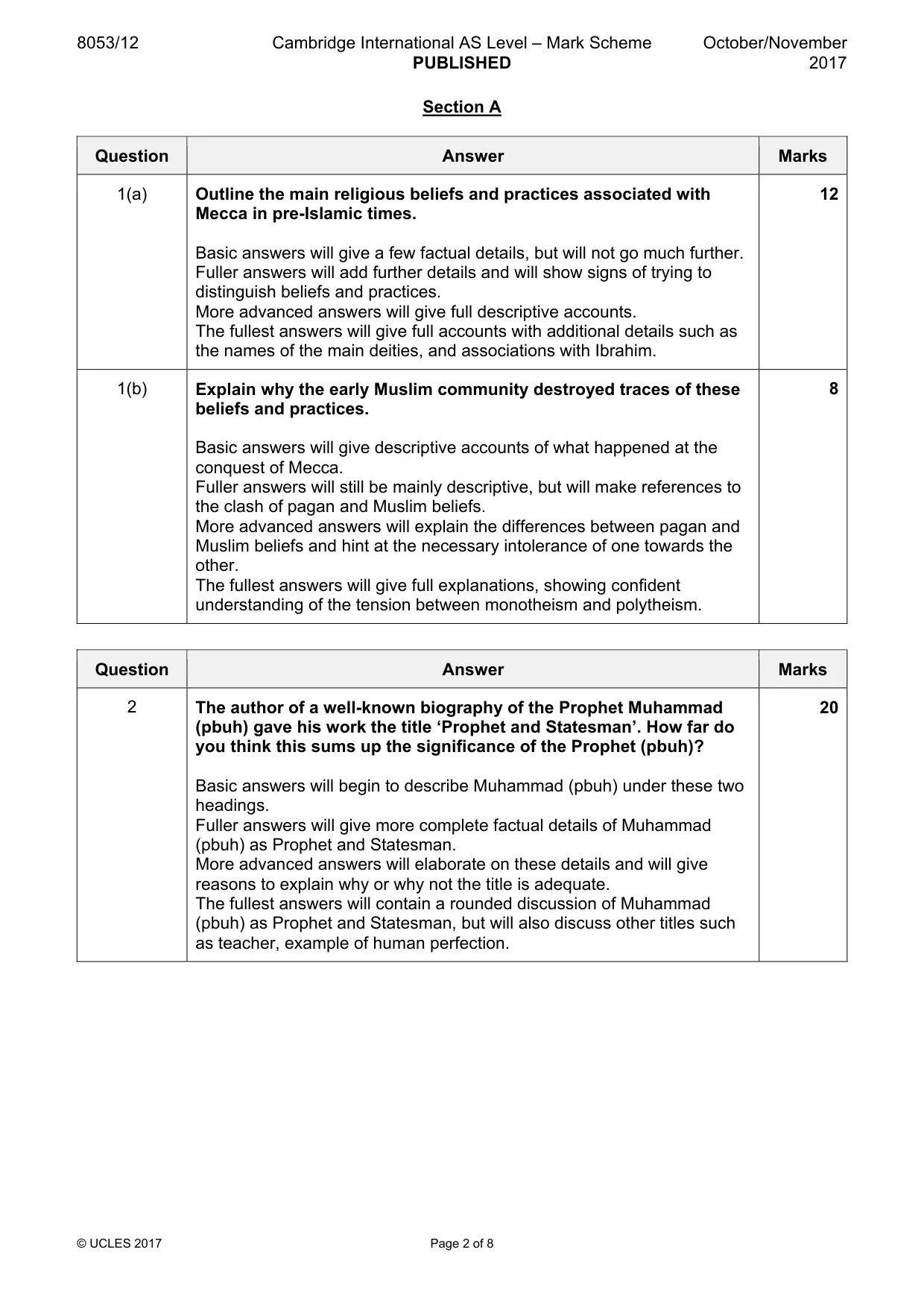
Mark scheme, page 2
8053/12 Cambridge International AS Level – Mark Scheme PUBLISHED October/November 2017 © UCLES 2017 Page 2 of 8 Section A Question Answer Marks 1(a) Outline the main religious beliefs and practices associated with Mecca in pre-Islamic times. Basic answers will give a few factual details, but will not go much further. Fuller answers will add further details and will show signs of trying to distinguish beliefs and practices. More advanced answers will give full descriptive accounts. The fullest answers will give full accounts with additional details such as the names of the main deities, and associations with Ibrahim. 12 1(b) Explain why the early Muslim community destroyed traces of these beliefs and practices. Basic answers will give descriptive accounts of what happened at the conquest of Mecca. Fuller answers will still be mainly descriptive, but will make references to the clash of pagan and Muslim beliefs. More advanced answers will explain the differences between pagan and Muslim beliefs and hint at the necessary intolerance of one towards the other. The fullest answers will give full explanations, showing confident understanding of the tension between monotheism and polytheism. 8 Question Answer Marks 2 The author of a well-known biography of the Prophet Muhammad (pbuh) gave his work the title ‘Prophet and Statesman’. How far do you think this sums up the significance of the Prophet (pbuh)? Basic answers will begin to describe Muhammad (pbuh) under these two headings. Fuller answers will give more complete factual details of Muhammad (pbuh) as Prophet and Statesman. More advanced answers will elaborate on these details and will give reasons to explain why or why not the title is adequate. The fullest answers will contain a rounded discussion of Muhammad (pbuh) as Prophet and Statesman, but will also discuss other titles such as teacher, example of human perfection. 20
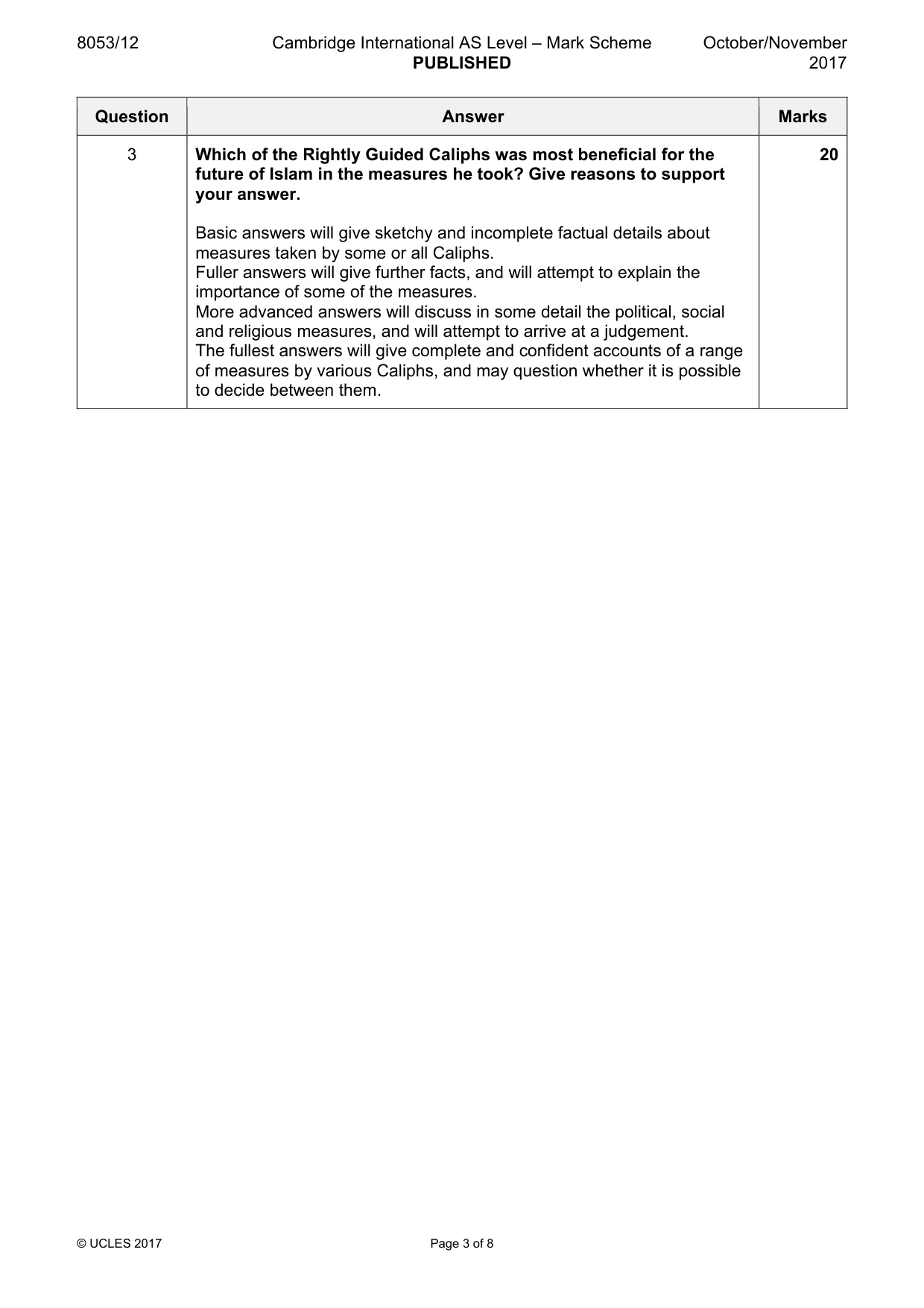
Mark scheme, page 3
8053/12 Cambridge International AS Level – Mark Scheme PUBLISHED October/November 2017 © UCLES 2017 Page 3 of 8 Question Answer Marks 3 Which of the Rightly Guided Caliphs was most beneficial for the future of Islam in the measures he took? Give reasons to support your answer. Basic answers will give sketchy and incomplete factual details about measures taken by some or all Caliphs. Fuller answers will give further facts, and will attempt to explain the importance of some of the measures. More advanced answers will discuss in some detail the political, social and religious measures, and will attempt to arrive at a judgement. The fullest answers will give complete and confident accounts of a range of measures by various Caliphs, and may question whether it is possible to decide between them. 20
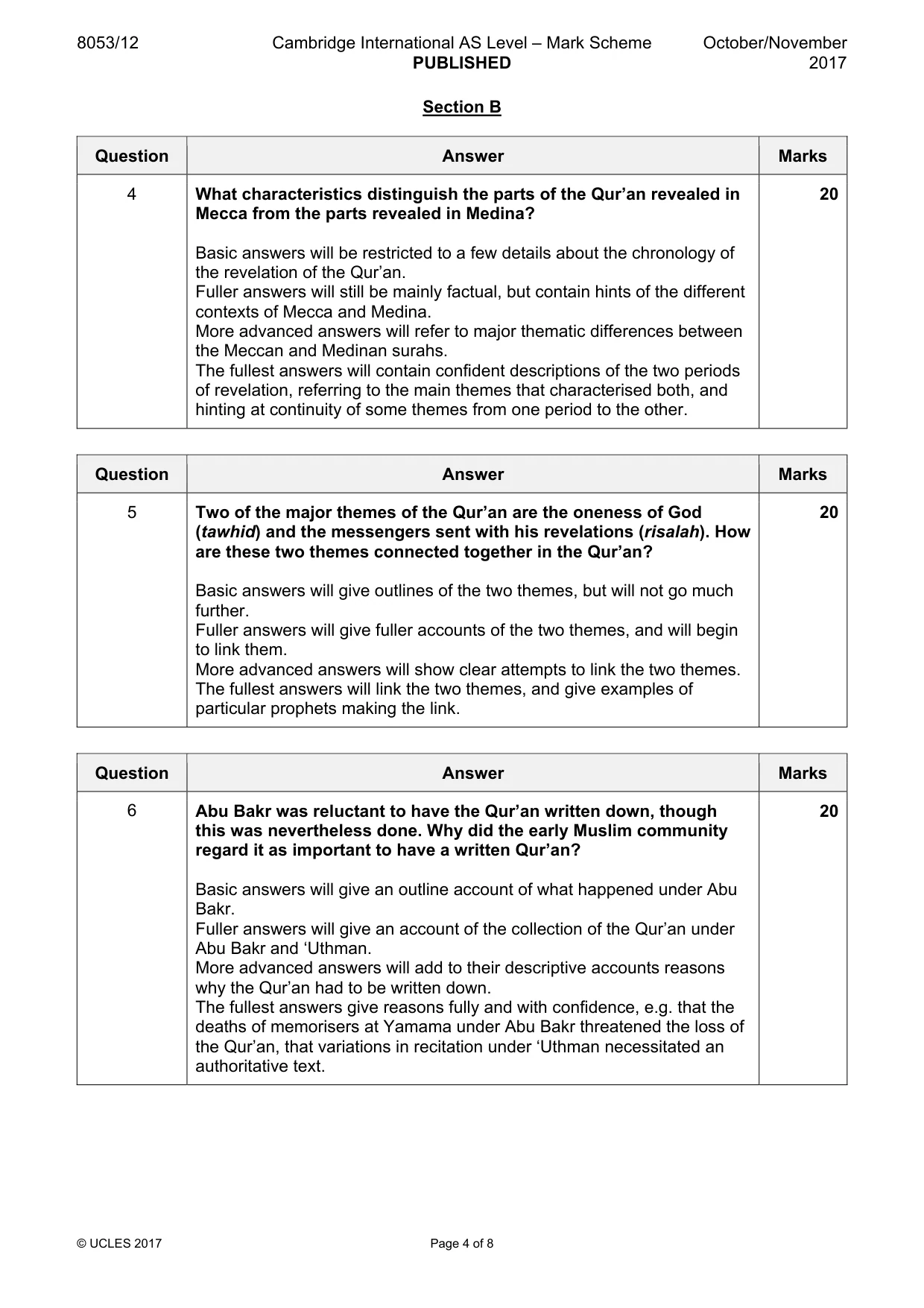
Mark scheme, page 4
8053/12 Cambridge International AS Level – Mark Scheme PUBLISHED October/November 2017 © UCLES 2017 Page 4 of 8 Section B Question Answer Marks 4 What characteristics distinguish the parts of the Qur’an revealed in Mecca from the parts revealed in Medina? Basic answers will be restricted to a few details about the chronology of the revelation of the Qur’an. Fuller answers will still be mainly factual, but contain hints of the different contexts of Mecca and Medina. More advanced answers will refer to major thematic differences between the Meccan and Medinan surahs. The fullest answers will contain confident descriptions of the two periods of revelation, referring to the main themes that characterised both, and hinting at continuity of some themes from one period to the other. 20 Question Answer Marks 5 Two of the major themes of the Qur’an are the oneness of God (tawhid) and the messengers sent with his revelations (risalah). How are these two themes connected together in the Qur’an? Basic answers will give outlines of the two themes, but will not go much further. Fuller answers will give fuller accounts of the two themes, and will begin to link them. More advanced answers will show clear attempts to link the two themes. The fullest answers will link the two themes, and give examples of particular prophets making the link. 20 Question Answer Marks 6 Abu Bakr was reluctant to have the Qur’an written down, though this was nevertheless done. Why did the early Muslim community regard it as important to have a written Qur’an? Basic answers will give an outline account of what happened under Abu Bakr. Fuller answers will give an account of the collection of the Qur’an under Abu Bakr and ‘Uthman. More advanced answers will add to their descriptive accounts reasons why the Qur’an had to be written down. The fullest answers give reasons fully and with confidence, e.g. that the deaths of memorisers at Yamama under Abu Bakr threatened the loss of the Qur’an, that variations in recitation under ‘Uthman necessitated an authoritative text. 20
Mark scheme, page 5
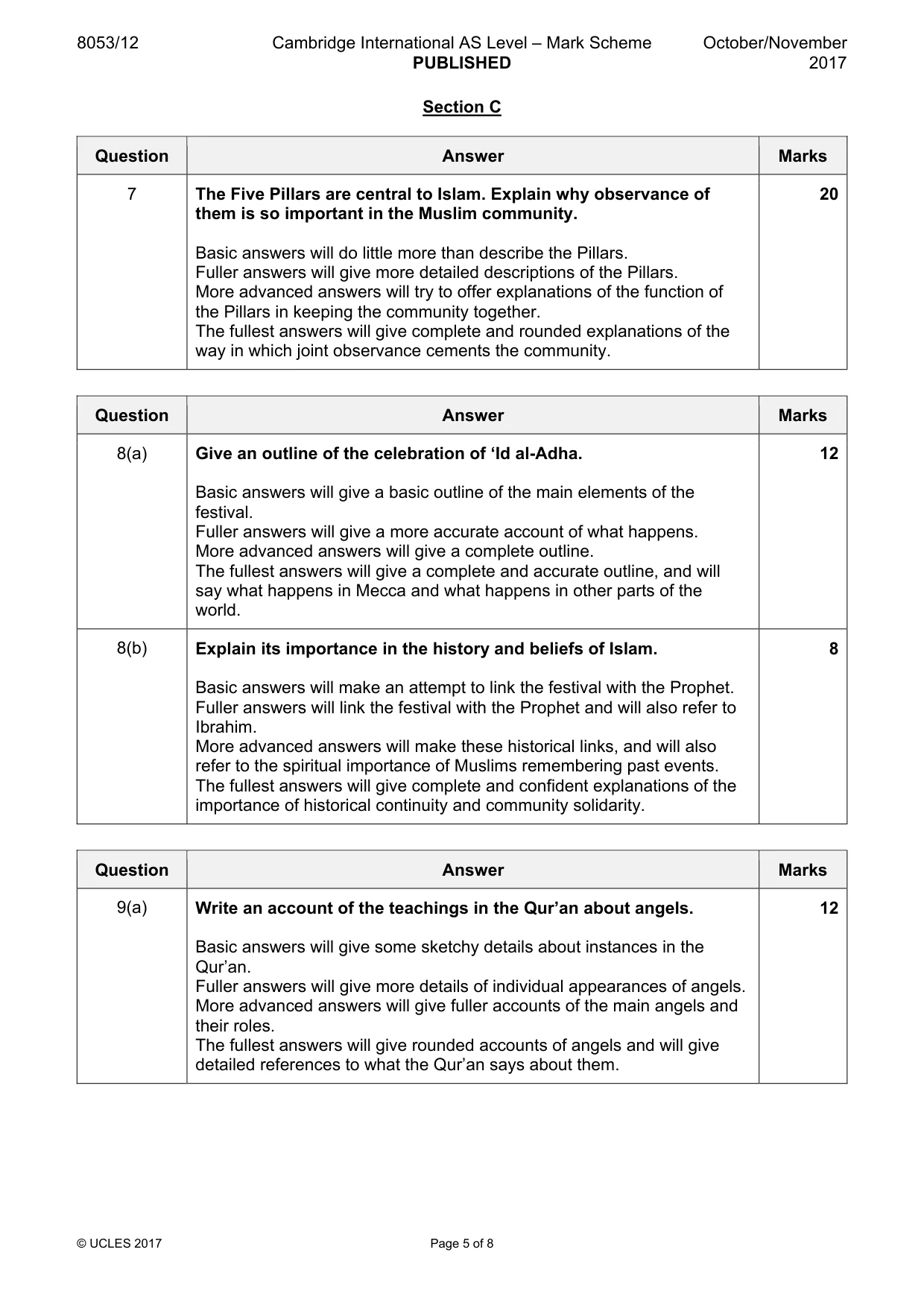
8053/12 Cambridge International AS Level – Mark Scheme PUBLISHED October/November 2017 © UCLES 2017 Page 5 of 8 Section C Question Answer Marks 7 The Five Pillars are central to Islam. Explain why observance of them is so important in the Muslim community. Basic answers will do little more than describe the Pillars. Fuller answers will give more detailed descriptions of the Pillars. More advanced answers will try to offer explanations of the function of the Pillars in keeping the community together. The fullest answers will give complete and rounded explanations of the way in which joint observance cements the community. 20 Question Answer Marks 8(a) Give an outline of the celebration of ‘Id al-Adha. Basic answers will give a basic outline of the main elements of the festival. Fuller answers will give a more accurate account of what happens. More advanced answers will give a complete outline. The fullest answers will give a complete and accurate outline, and will say what happens in Mecca and what happens in other parts of the world. 12 8(b) Explain its importance in the history and beliefs of Islam. Basic answers will make an attempt to link the festival with the Prophet. Fuller answers will link the festival with the Prophet and will also refer to Ibrahim. More advanced answers will make these historical links, and will also refer to the spiritual importance of Muslims remembering past events. The fullest answers will give complete and confident explanations of the importance of historical continuity and community solidarity. 8 Question Answer Marks 9(a) Write an account of the teachings in the Qur’an about angels. Basic answers will give some sketchy details about instances in the Qur’an. Fuller answers will give more details of individual appearances of angels. More advanced answers will give fuller accounts of the main angels and their roles. The fullest answers will give rounded accounts of angels and will give detailed references to what the Qur’an says about them. 12
Mark scheme, page 6
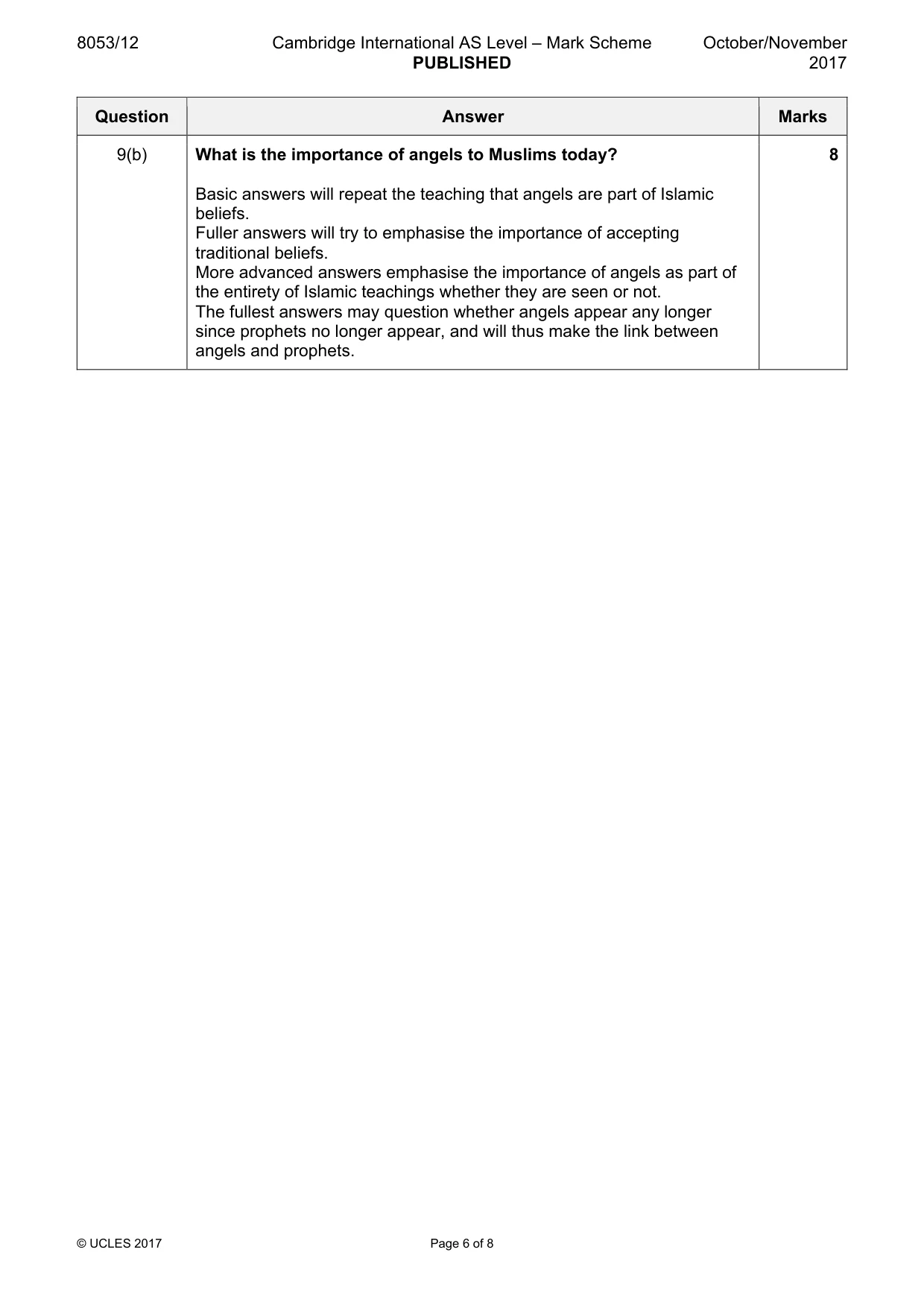
8053/12 Cambridge International AS Level – Mark Scheme PUBLISHED October/November 2017 © UCLES 2017 Page 6 of 8 Question Answer Marks 9(b) What is the importance of angels to Muslims today? Basic answers will repeat the teaching that angels are part of Islamic beliefs. Fuller answers will try to emphasise the importance of accepting traditional beliefs. More advanced answers emphasise the importance of angels as part of the entirety of Islamic teachings whether they are seen or not. The fullest answers may question whether angels appear any longer since prophets no longer appear, and will thus make the link between angels and prophets. 8
Mark scheme, page 7
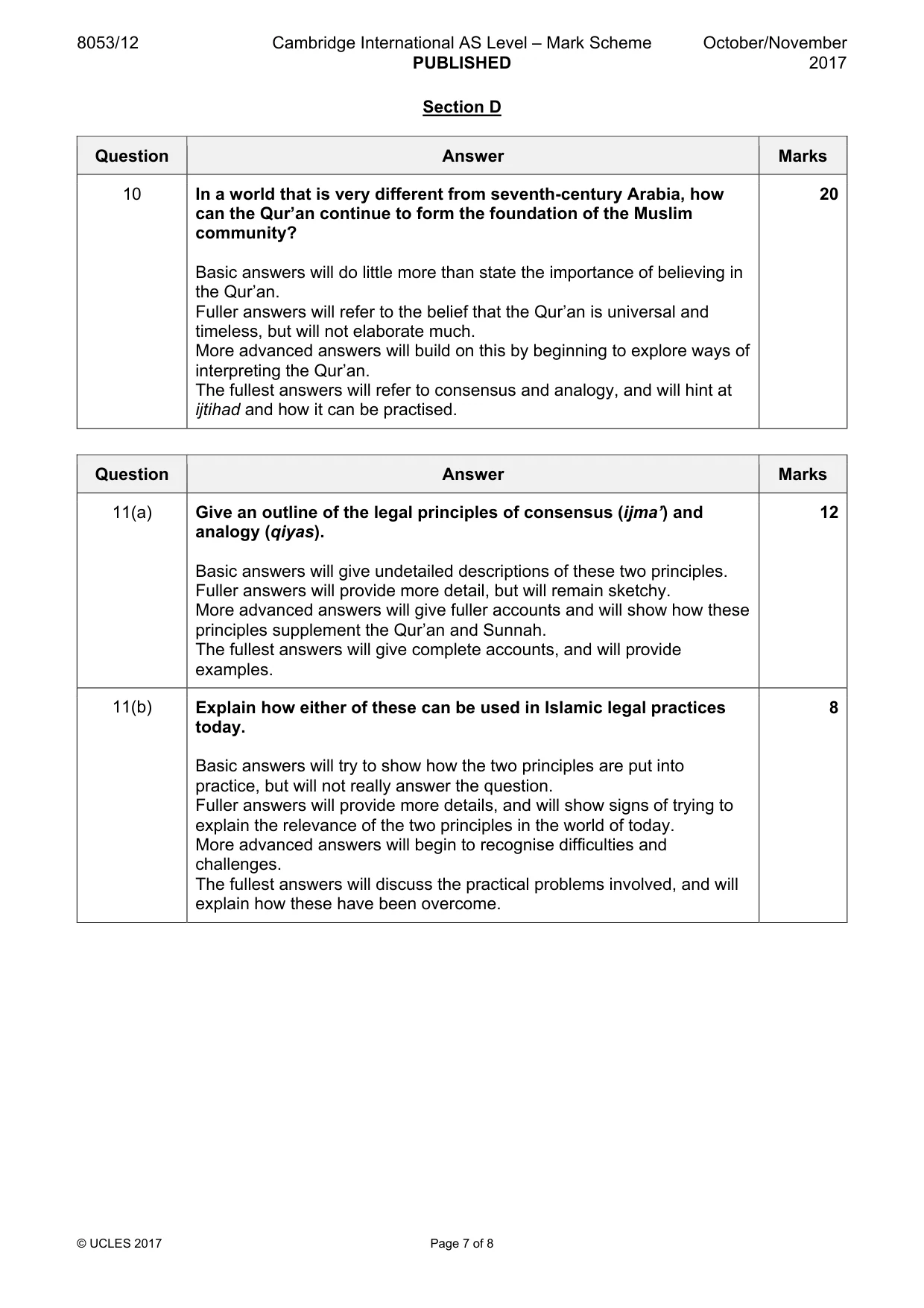
8053/12 Cambridge International AS Level – Mark Scheme PUBLISHED October/November 2017 © UCLES 2017 Page 7 of 8 Section D Question Answer Marks 10 In a world that is very different from seventh-century Arabia, how can the Qur’an continue to form the foundation of the Muslim community? Basic answers will do little more than state the importance of believing in the Qur’an. Fuller answers will refer to the belief that the Qur’an is universal and timeless, but will not elaborate much. More advanced answers will build on this by beginning to explore ways of interpreting the Qur’an. The fullest answers will refer to consensus and analogy, and will hint at ijtihad and how it can be practised. 20 Question Answer Marks 11(a) Give an outline of the legal principles of consensus (ijma’) and analogy (qiyas). Basic answers will give undetailed descriptions of these two principles. Fuller answers will provide more detail, but will remain sketchy. More advanced answers will give fuller accounts and will show how these principles supplement the Qur’an and Sunnah. The fullest answers will give complete accounts, and will provide examples. 12 11(b) Explain how either of these can be used in Islamic legal practices today. Basic answers will try to show how the two principles are put into practice, but will not really answer the question. Fuller answers will provide more details, and will show signs of trying to explain the relevance of the two principles in the world of today. More advanced answers will begin to recognise difficulties and challenges. The fullest answers will discuss the practical problems involved, and will explain how these have been overcome. 8
Mark scheme, page 8
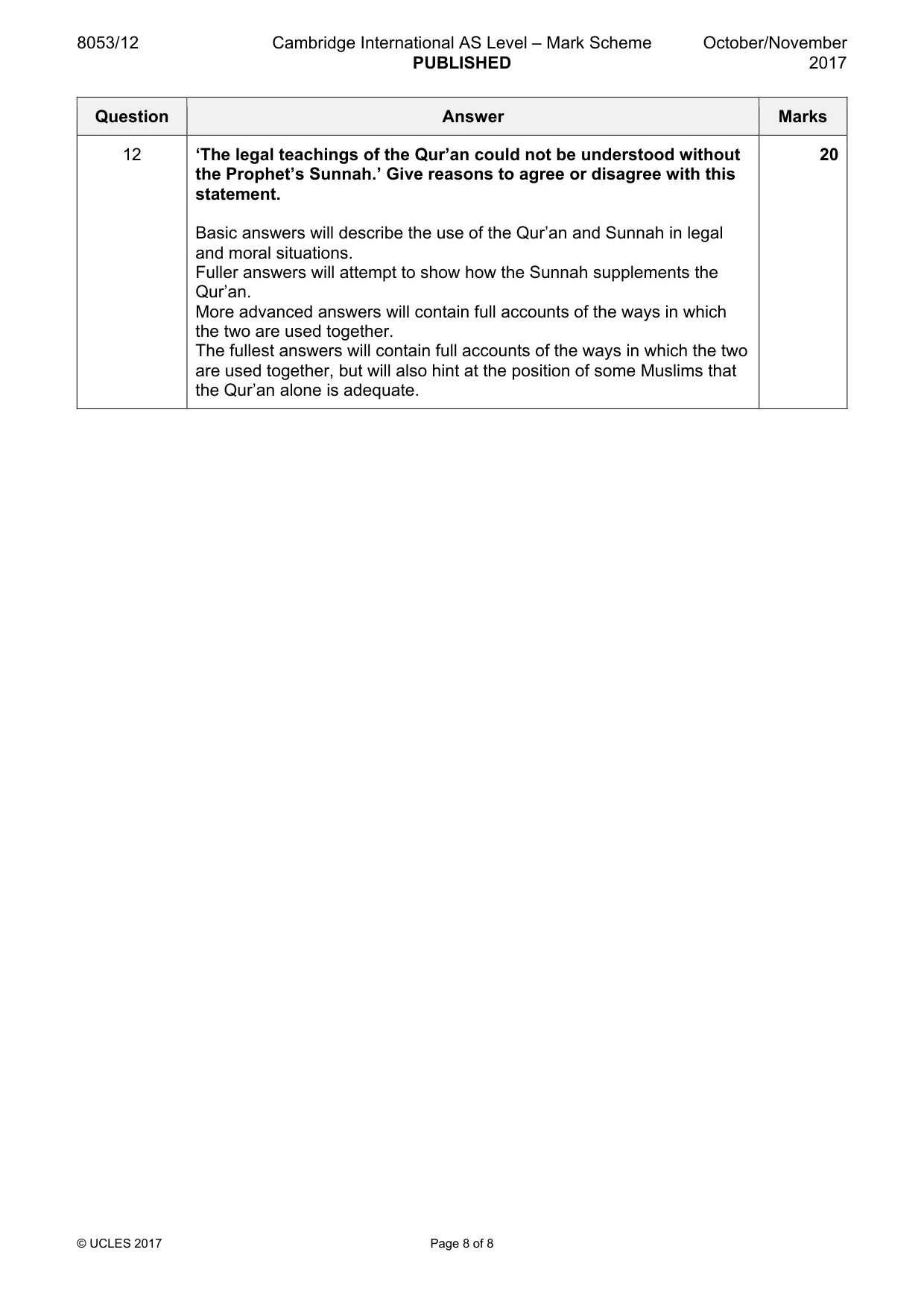
8053/12 Cambridge International AS Level – Mark Scheme PUBLISHED October/November 2017 © UCLES 2017 Page 8 of 8 Question Answer Marks 12 ‘The legal teachings of the Qur’an could not be understood without the Prophet’s Sunnah.’ Give reasons to agree or disagree with this statement. Basic answers will describe the use of the Qur’an and Sunnah in legal and moral situations. Fuller answers will attempt to show how the Sunnah supplements the Qur’an. More advanced answers will contain full accounts of the ways in which the two are used together. The fullest answers will contain full accounts of the ways in which the two are used together, but will also hint at the position of some Muslims that the Qur’an alone is adequate. 20
What you needed in this session
Cambridge’s own grade thresholds for 2017 Oct/Nov, Paper 1 · Variant 2. A higher threshold means an easier paper — the bar moves with how the cohort did.