Cambridge A Level Information Technology (from 2017) 9626 — 2023 Feb/March Paper 1 · Variant 2
9626/12/F/M/23 · 70 marks · ≈79 min
The question paper and its mark scheme, free to read here and free to download. This is Cambridge’s own paper, exactly as it was sat.
Question paper12 pages


Mark scheme10 pages
Answers below. Sit the paper first if you are practising.
Paper as text
Question paper, page 1
This document has 12 pages. Any blank pages are indicated. [Turn over Cambridge International AS & A Level DC (CE) 314537/1 © UCLES 2023 * 4 2 1 9 8 3 7 1 9 6 * INFORMATION TECHNOLOGY 9626/12 Paper 1 Theory February/March 2023 1 hour 45 minutes You must answer on the question paper. No additional materials are needed. INSTRUCTIONS ● Answer all questions. ● Use a black or dark blue pen. ● Write your name, centre number and candidate number in the boxes at the top of the page. ● Write your answer to each question in the space provided. ● Do not use an erasable pen or correction fluid. ● Do not write on any bar codes. ● You may use an HB pencil for any diagrams, graphs or rough working. ● Calculators must not be used in this paper. INFORMATION ● The total mark for this paper is 70. ● The number of marks for each question or part question is shown in brackets [ ].
Question paper, page 2
2 9626/12/F/M/23 © UCLES 2023 1 Data is collected and processed to become information. Many factors affect the quality of the resulting information. (a) Describe what is meant by accurate information. … … … [1] (b) Describe how the use of interviews and questionnaires for collecting data may affect the accuracy of the resulting information. … … … … … … … … … … … … … … [6]
Question paper, page 3
3 9626/12/F/M/23 © UCLES 2023 [Turn over Online processing can be used when goods are purchased. (c) Define what is meant by online processing. … … … [1] (d) Johann has previously registered with an online store. Describe the steps he takes when purchasing goods from the online store. … … … … … … … … … … … … [5]
Question paper, page 4
4 9626/12/F/M/23 © UCLES 2023 2 A linker is a type of system software used during the process of translating high level language programs to machine code. Discuss the benefits and drawbacks of using a linker. … … … … … … … … … … … … … … [6]
Question paper, page 5
5 9626/12/F/M/23 © UCLES 2023 [Turn over 3 Most computer systems have a variety of utility software including anti-virus software. Discuss the benefits and drawbacks of anti-virus software. … … … … … … … … … … … … … … [6]
Question paper, page 6
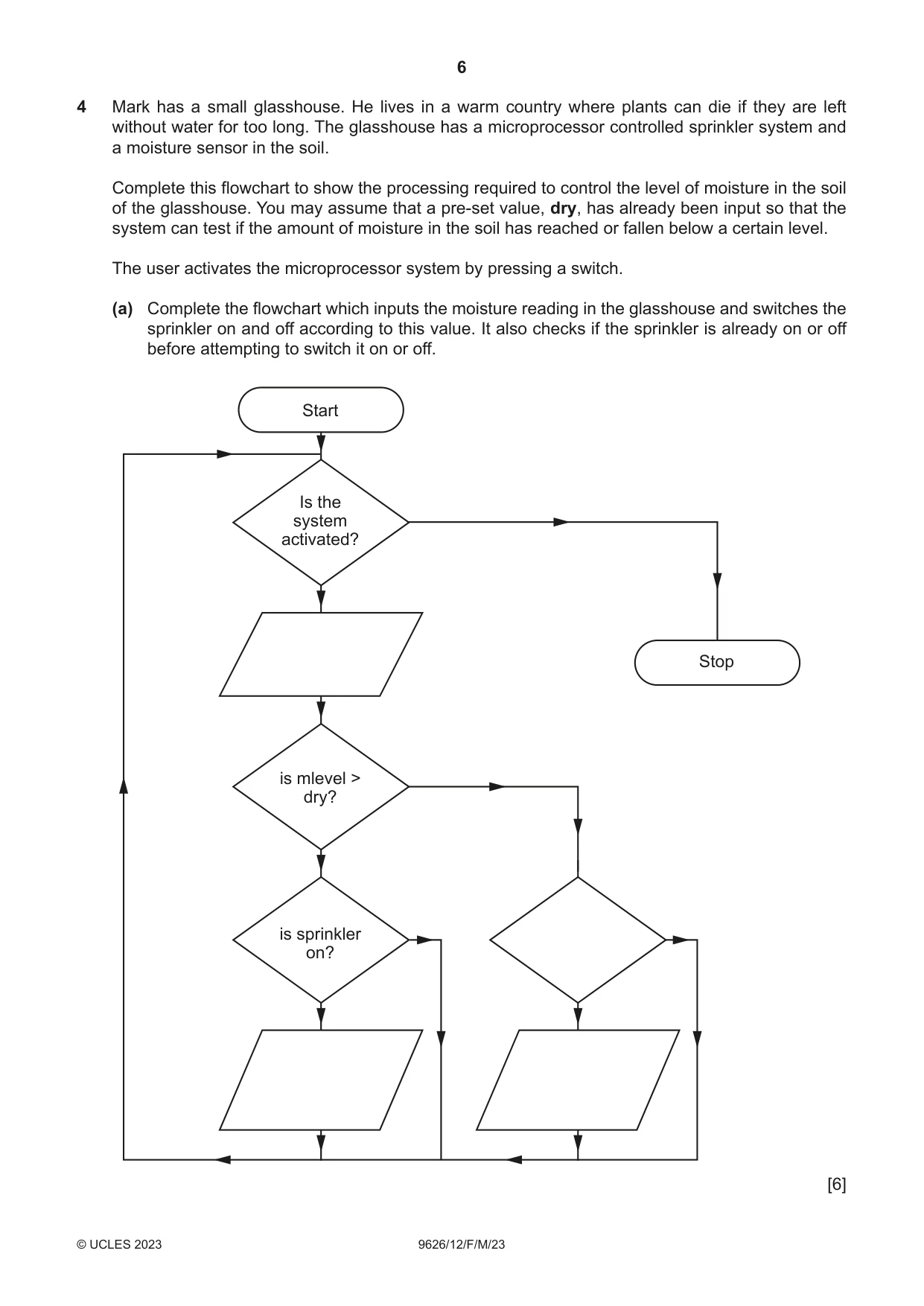
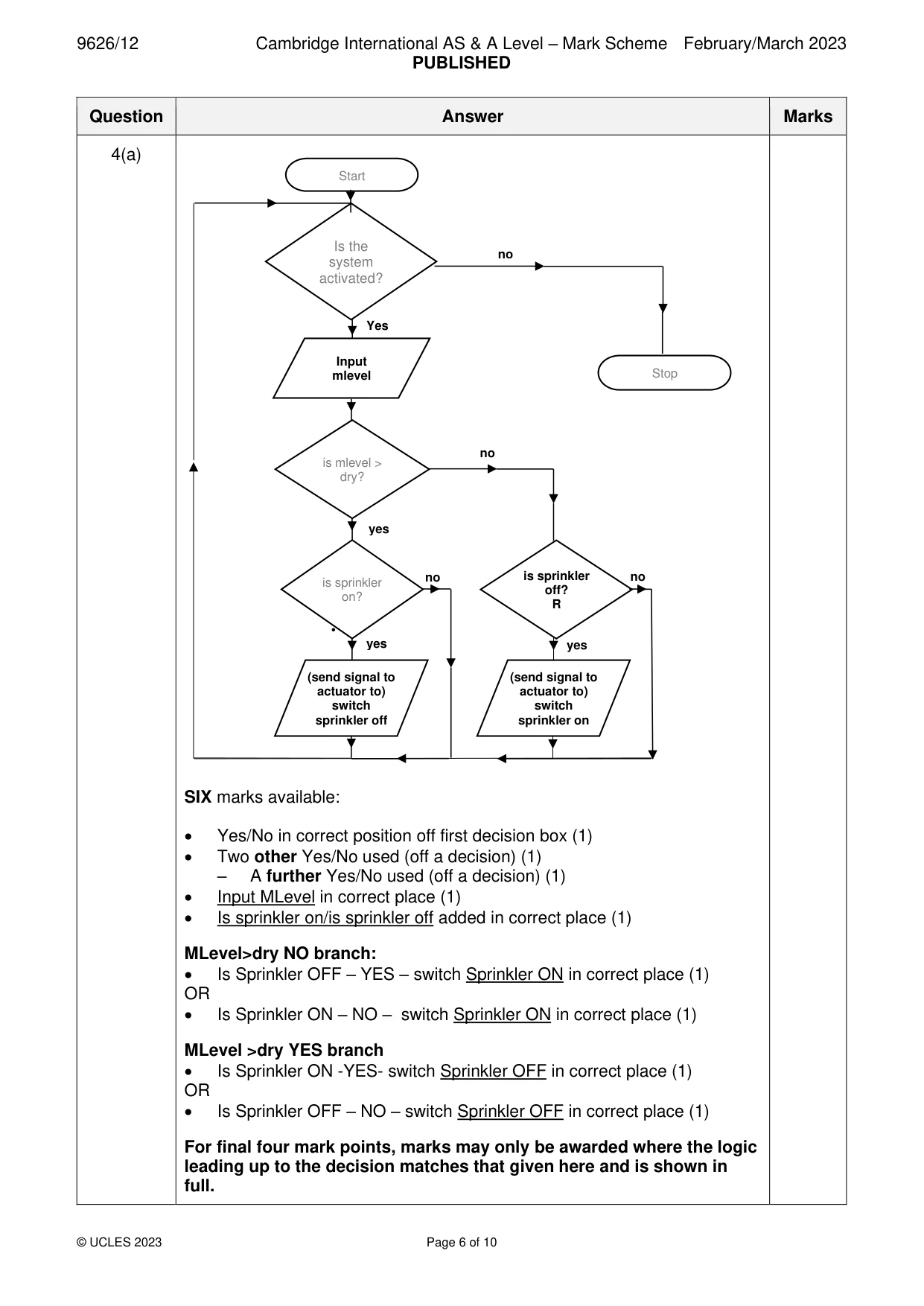
6 9626/12/F/M/23 © UCLES 2023 4 Mark has a small glasshouse. He lives in a warm country where plants can die if they are left without water for too long. The glasshouse has a microprocessor controlled sprinkler system and a moisture sensor in the soil. Complete this flowchart to show the processing required to control the level of moisture in the soil of the glasshouse. You may assume that a pre-set value, dry, has already been input so that the system can test if the amount of moisture in the soil has reached or fallen below a certain level. The user activates the microprocessor system by pressing a switch. (a) Complete the flowchart which inputs the moisture reading in the glasshouse and switches the sprinkler on and off according to this value. It also checks if the sprinkler is already on or off before attempting to switch it on or off. Start Is the system activated? is mlevel > dry? is sprinkler on? Stop [6]
Question paper, page 7
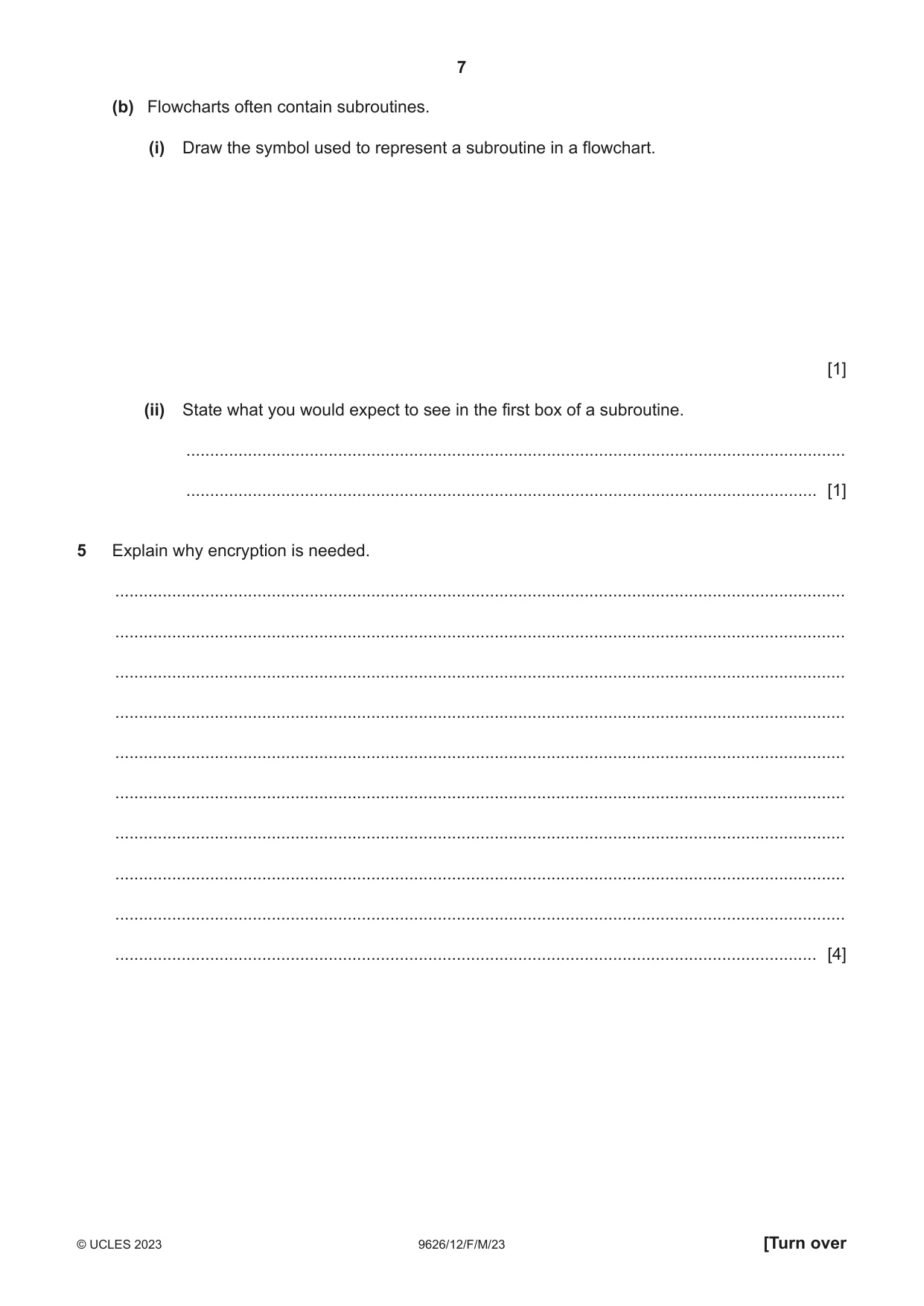
7 9626/12/F/M/23 © UCLES 2023 [Turn over (b) Flowcharts often contain subroutines. (i) Draw the symbol used to represent a subroutine in a flowchart. [1] (ii) State what you would expect to see in the first box of a subroutine. … … [1] 5 Explain why encryption is needed. … … … … … … … … … … [4]
Question paper, page 8
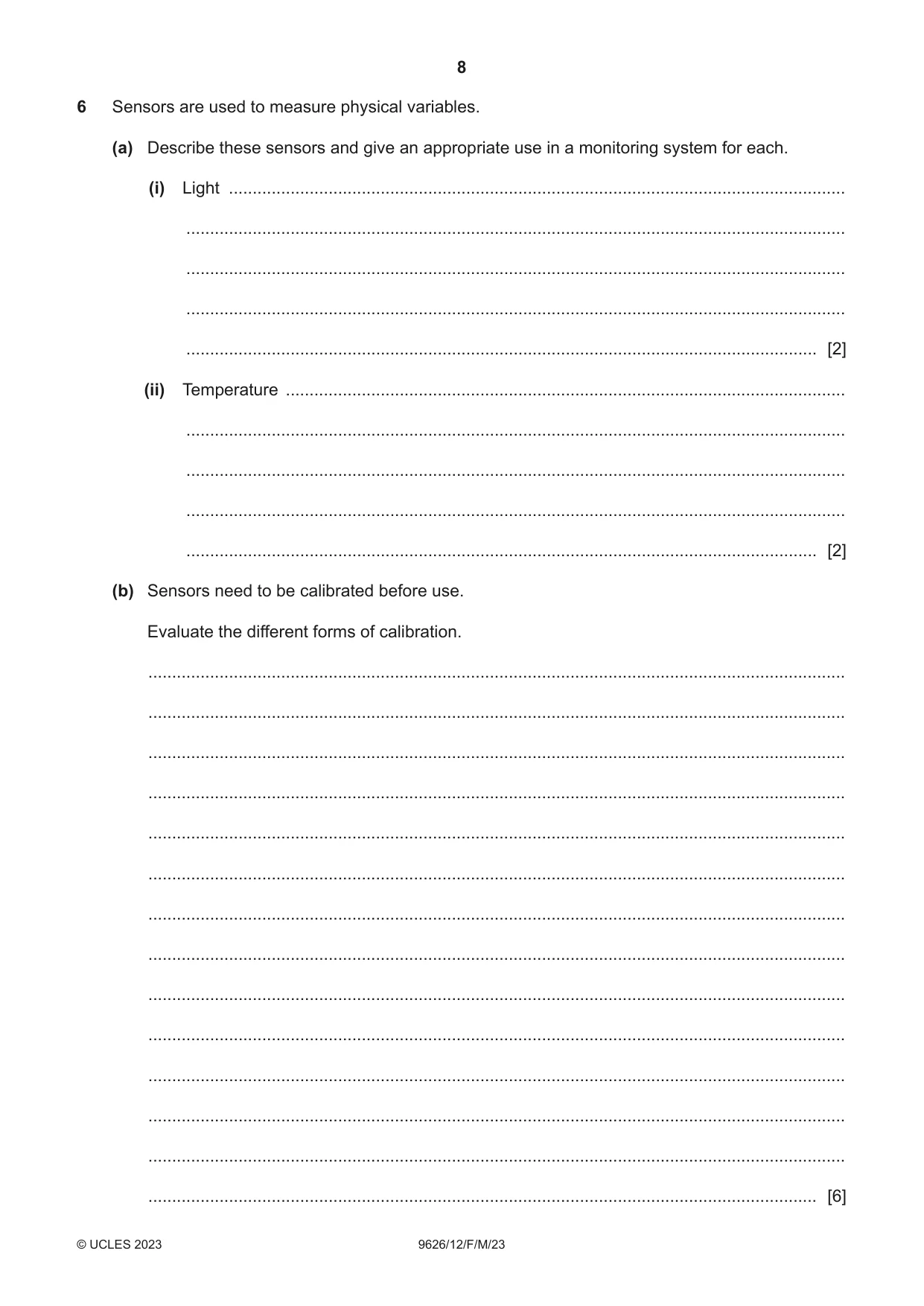
8 9626/12/F/M/23 © UCLES 2023 6 Sensors are used to measure physical variables. (a) Describe these sensors and give an appropriate use in a monitoring system for each. (i) Light … … … … … [2] (ii) Temperature … … … … … [2] (b) Sensors need to be calibrated before use. Evaluate the different forms of calibration. … … … … … … … … … … … … … … [6]
Question paper, page 9
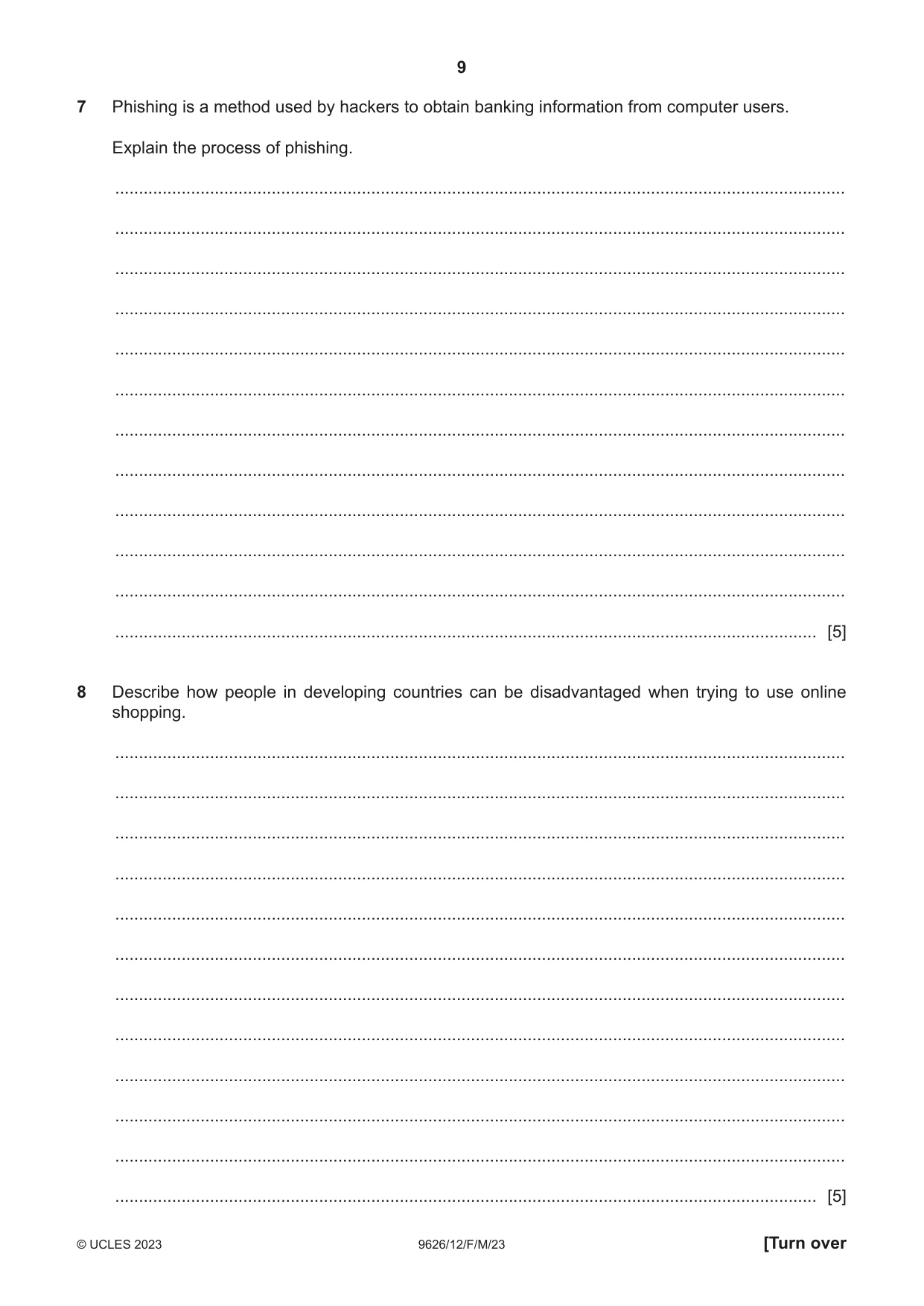
9 9626/12/F/M/23 © UCLES 2023 [Turn over 7 Phishing is a method used by hackers to obtain banking information from computer users. Explain the process of phishing. … … … … … … … … … … … … [5] 8 Describe how people in developing countries can be disadvantaged when trying to use online shopping. … … … … … … … … … … … … [5]
Question paper, page 10
10 9626/12/F/M/23 © UCLES 2023 9 Describe what is meant by the malware terms. (a) worm … … … … … … … … … … [4] (b) Trojan … … … … … … … … … … [4]
Question paper, page 11
11 9626/12/F/M/23 © UCLES 2023 10 Describe what is meant by the term open source file format. Include in your answer an explanation of why open source file formats are needed. … … … … … … … … … … … … [5]
Question paper, page 12
12 9626/12/F/M/23 © UCLES 2023 Permission to reproduce items where third-party owned material protected by copyright is included has been sought and cleared where possible. Every reasonable effort has been made by the publisher (UCLES) to trace copyright holders, but if any items requiring clearance have unwittingly been included, the publisher will be pleased to make amends at the earliest possible opportunity. To avoid the issue of disclosure of answer-related information to candidates, all copyright acknowledgements are reproduced online in the Cambridge Assessment International Education Copyright Acknowledgements Booklet. This is produced for each series of examinations and is freely available to download at www.cambridgeinternational.org after the live examination series. Cambridge Assessment International Education is part of Cambridge Assessment. Cambridge Assessment is the brand name of the University of Cambridge Local Examinations Syndicate (UCLES), which is a department of the University of Cambridge. BLANK PAGE
Mark scheme, page 1
This document consists of 10 printed pages. © UCLES 2023 [Turn over Cambridge International AS & A Level INFORMATION TECHNOLOGY 9626/12 Paper 1 Theory February/March 2023 MARK SCHEME Maximum Mark: 70 Published This mark scheme is published as an aid to teachers and candidates, to indicate the requirements of the examination. It shows the basis on which Examiners were instructed to award marks. It does not indicate the details of the discussions that took place at an Examiners’ meeting before marking began, which would have considered the acceptability of alternative answers. Mark schemes should be read in conjunction with the question paper and the Principal Examiner Report for Teachers. Cambridge International will not enter into discussions about these mark schemes. Cambridge International is publishing the mark schemes for the February/March 2023 series for most Cambridge IGCSE™, Cambridge International A and AS Level components and some Cambridge O Level components.
Mark scheme, page 2
9626/12 Cambridge International AS & A Level – Mark Scheme PUBLISHED February/March 2023 © UCLES 2023 Page 2 of 10 Generic Marking Principles These general marking principles must be applied by all examiners when marking candidate answers. They should be applied alongside the specific content of the mark scheme or generic level descriptors for a question. Each question paper and mark scheme will also comply with these marking principles. GENERIC MARKING PRINCIPLE 1: Marks must be awarded in line with: • the specific content of the mark scheme or the generic level descriptors for the question • the specific skills defined in the mark scheme or in the generic level descriptors for the question • the standard of response required by a candidate as exemplified by the standardisation scripts. GENERIC MARKING PRINCIPLE 2: Marks awarded are always whole marks (not half marks, or other fractions). GENERIC MARKING PRINCIPLE 3: Marks must be awarded positively: • marks are awarded for correct/valid answers, as defined in the mark scheme. However, credit is given for valid answers which go beyond the scope of the syllabus and mark scheme, referring to your Team Leader as appropriate • marks are awarded when candidates clearly demonstrate what they know and can do • marks are not deducted for errors • marks are not deducted for omissions • answers should only be judged on the quality of spelling, punctuation and grammar when these features are specifically assessed by the question as indicated by the mark scheme. The meaning, however, should be unambiguous. GENERIC MARKING PRINCIPLE 4: Rules must be applied consistently, e.g. in situations where candidates have not followed instructions or in the application of generic level descriptors. GENERIC MARKING PRINCIPLE 5: Marks should be awarded using the full range of marks defined in the mark scheme for the question (however; the use of the full mark range may be limited according to the quality of the candidate responses seen). GENERIC MARKING PRINCIPLE 6: Marks awarded are based solely on the requirements as defined in the mark scheme. Marks should not be awarded with grade thresholds or grade descriptors in mind.
Mark scheme, page 3
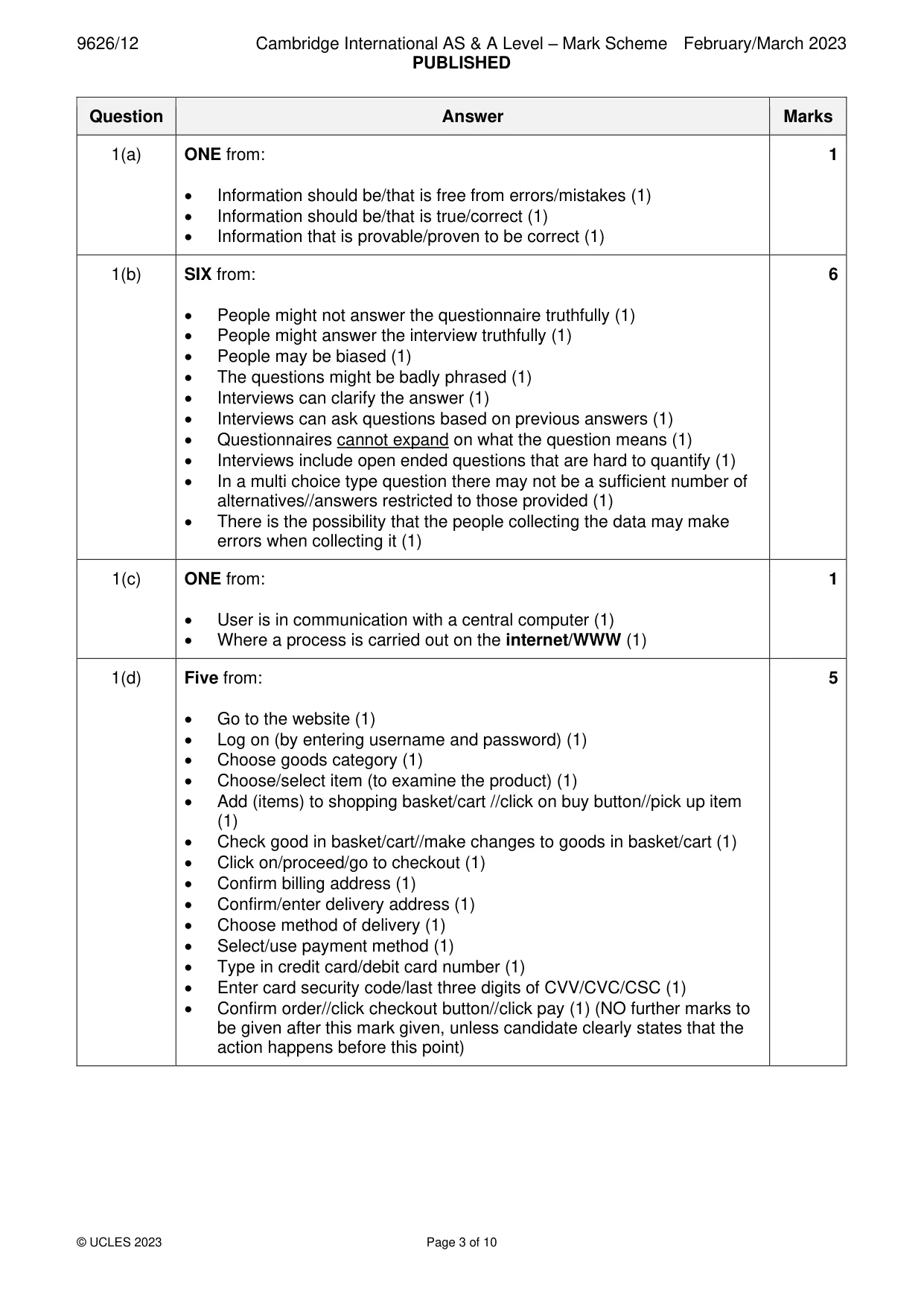
9626/12 Cambridge International AS & A Level – Mark Scheme PUBLISHED February/March 2023 © UCLES 2023 Page 3 of 10 Question Answer Marks 1(a) ONE from: • Information should be/that is free from errors/mistakes (1) • Information should be/that is true/correct (1) • Information that is provable/proven to be correct (1) 1 1(b) SIX from: • People might not answer the questionnaire truthfully (1) • People might answer the interview truthfully (1) • People may be biased (1) • The questions might be badly phrased (1) • Interviews can clarify the answer (1) • Interviews can ask questions based on previous answers (1) • Questionnaires cannot expand on what the question means (1) • Interviews include open ended questions that are hard to quantify (1) • In a multi choice type question there may not be a sufficient number of alternatives//answers restricted to those provided (1) • There is the possibility that the people collecting the data may make errors when collecting it (1) 6 1(c) ONE from: • User is in communication with a central computer (1) • Where a process is carried out on the internet/WWW (1) 1 1(d) Five from: • Go to the website (1) • Log on (by entering username and password) (1) • Choose goods category (1) • Choose/select item (to examine the product) (1) • Add (items) to shopping basket/cart //click on buy button//pick up item (1) • Check good in basket/cart//make changes to goods in basket/cart (1) • Click on/proceed/go to checkout (1) • Confirm billing address (1) • Confirm/enter delivery address (1) • Choose method of delivery (1) • Select/use payment method (1) • Type in credit card/debit card number (1) • Enter card security code/last three digits of CVV/CVC/CSC (1) • Confirm order//click checkout button//click pay (1) (NO further marks to be given after this mark given, unless candidate clearly states that the action happens before this point) 5
Mark scheme, page 4
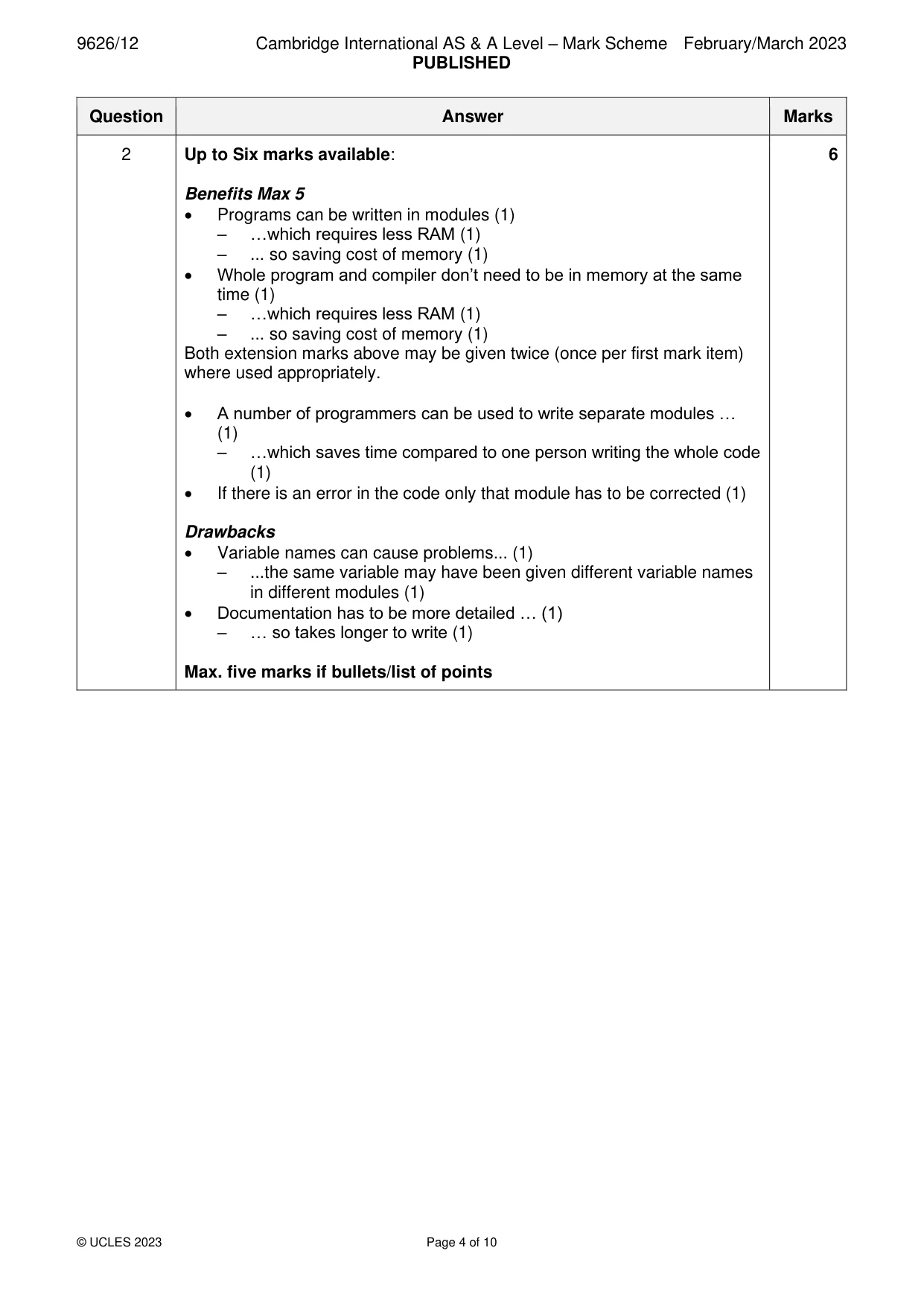
9626/12 Cambridge International AS & A Level – Mark Scheme PUBLISHED February/March 2023 © UCLES 2023 Page 4 of 10 Question Answer Marks 2 Up to Six marks available: Benefits Max 5 • Programs can be written in modules (1) – …which requires less RAM (1) – ... so saving cost of memory (1) • Whole program and compiler don’t need to be in memory at the same time (1) – …which requires less RAM (1) – ... so saving cost of memory (1) Both extension marks above may be given twice (once per first mark item) where used appropriately. • A number of programmers can be used to write separate modules … (1) – …which saves time compared to one person writing the whole code (1) • If there is an error in the code only that module has to be corrected (1) Drawbacks • Variable names can cause problems... (1) – ...the same variable may have been given different variable names in different modules (1) • Documentation has to be more detailed … (1) – … so takes longer to write (1) Max. five marks if bullets/list of points 6
Mark scheme, page 5
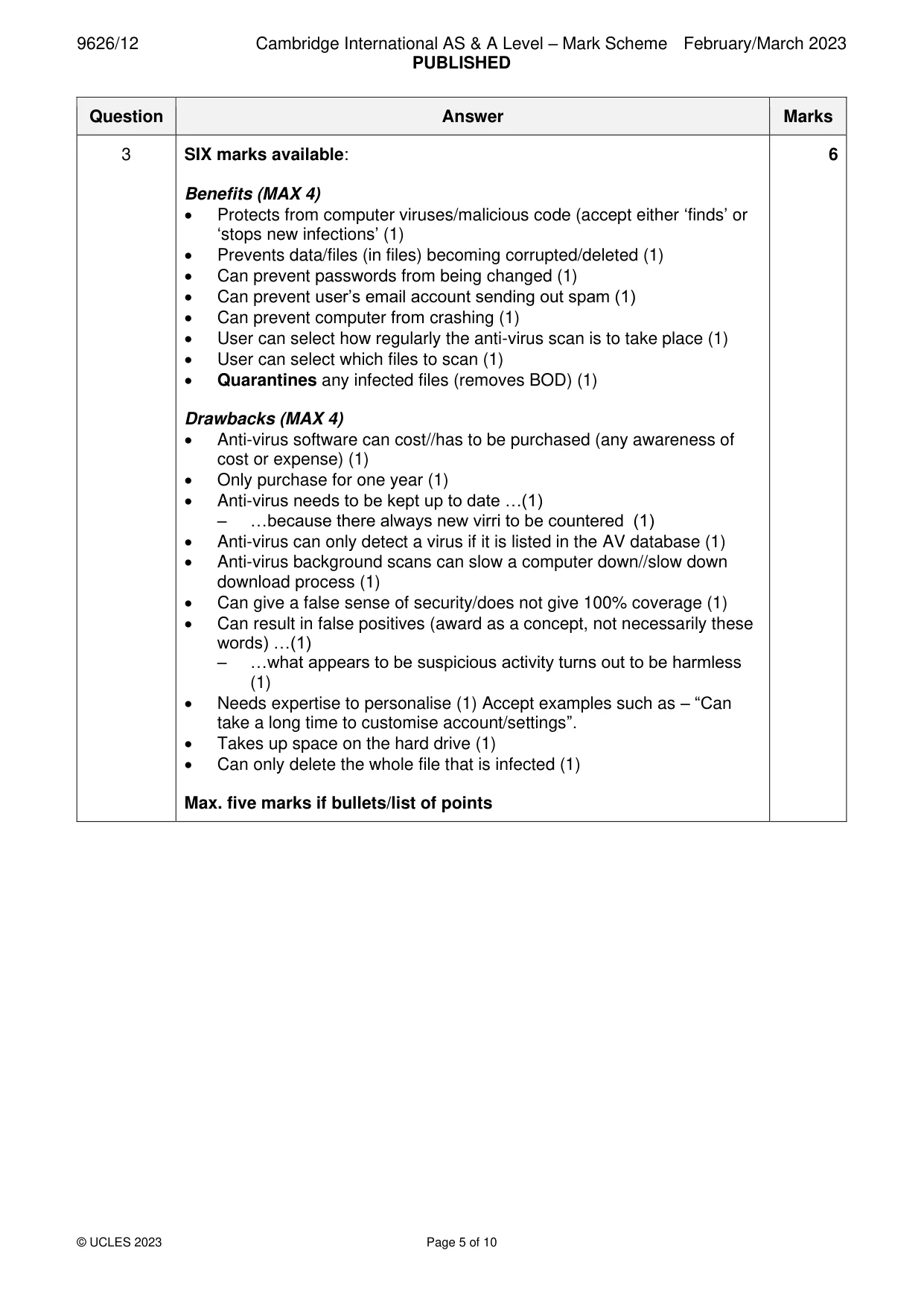
9626/12 Cambridge International AS & A Level – Mark Scheme PUBLISHED February/March 2023 © UCLES 2023 Page 5 of 10 Question Answer Marks 3 SIX marks available: Benefits (MAX 4) • Protects from computer viruses/malicious code (accept either ‘finds’ or ‘stops new infections’ (1) • Prevents data/files (in files) becoming corrupted/deleted (1) • Can prevent passwords from being changed (1) • Can prevent user’s email account sending out spam (1) • Can prevent computer from crashing (1) • User can select how regularly the anti-virus scan is to take place (1) • User can select which files to scan (1) • Quarantines any infected files (removes BOD) (1) Drawbacks (MAX 4) • Anti-virus software can cost//has to be purchased (any awareness of cost or expense) (1) • Only purchase for one year (1) • Anti-virus needs to be kept up to date …(1) – …because there always new virri to be countered (1) • Anti-virus can only detect a virus if it is listed in the AV database (1) • Anti-virus background scans can slow a computer down//slow down download process (1) • Can give a false sense of security/does not give 100% coverage (1) • Can result in false positives (award as a concept, not necessarily these words) …(1) – …what appears to be suspicious activity turns out to be harmless (1) • Needs expertise to personalise (1) Accept examples such as – “Can take a long time to customise account/settings”. • Takes up space on the hard drive (1) • Can only delete the whole file that is infected (1) Max. five marks if bullets/list of points 6
Mark scheme, page 6
9626/12 Cambridge International AS & A Level – Mark Scheme PUBLISHED February/March 2023 © UCLES 2023 Page 6 of 10 Question Answer Marks 4(a) SIX marks available: • Yes/No in correct position off first decision box (1) • Two other Yes/No used (off a decision) (1) – A further Yes/No used (off a decision) (1) • Input MLevel in correct place (1) • Is sprinkler on/is sprinkler off added in correct place (1) MLevel>dry NO branch: • Is Sprinkler OFF – YES – switch Sprinkler ON in correct place (1) OR • Is Sprinkler ON – NO – switch Sprinkler ON in correct place (1) MLevel >dry YES branch • Is Sprinkler ON -YES- switch Sprinkler OFF in correct place (1) OR • Is Sprinkler OFF – NO – switch Sprinkler OFF in correct place (1) For final four mark points, marks may only be awarded where the logic leading up to the decision matches that given here and is shown in full. no Start Stop no (send signal to actuator to) switch sprinkler on is sprinkler off? R no no yes (send signal to actuator to) switch sprinkler off yes is sprinkler on? yes Is the system activated? Input mlevel is mlevel > dry? Yes
Mark scheme, page 7
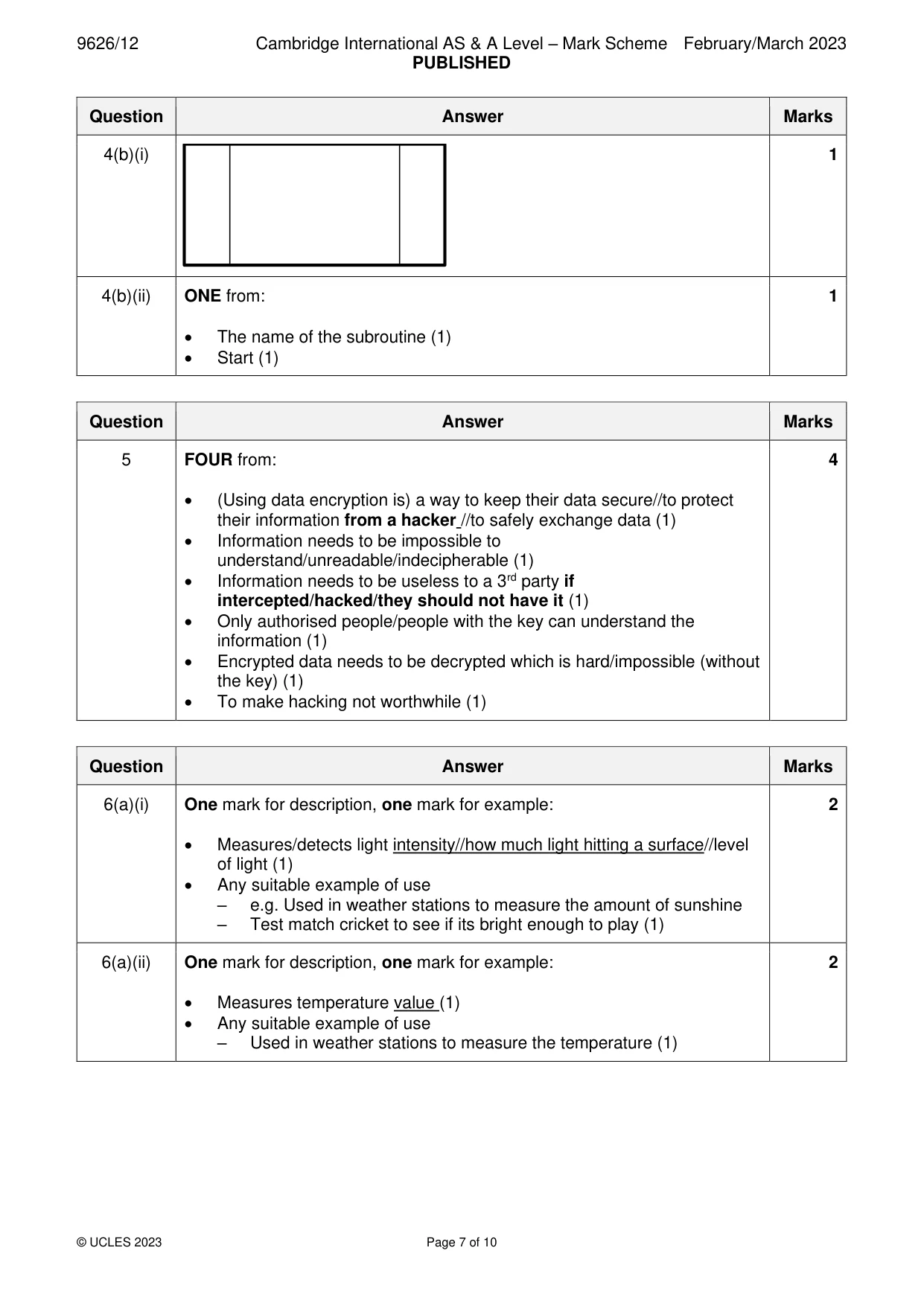
9626/12 Cambridge International AS & A Level – Mark Scheme PUBLISHED February/March 2023 © UCLES 2023 Page 7 of 10 Question Answer Marks 4(b)(i) 1 4(b)(ii) ONE from: • The name of the subroutine (1) • Start (1) 1 Question Answer Marks 5 FOUR from: • (Using data encryption is) a way to keep their data secure//to protect their information from a hacker //to safely exchange data (1) • Information needs to be impossible to understand/unreadable/indecipherable (1) • Information needs to be useless to a 3rd party if intercepted/hacked/they should not have it (1) • Only authorised people/people with the key can understand the information (1) • Encrypted data needs to be decrypted which is hard/impossible (without the key) (1) • To make hacking not worthwhile (1) 4 Question Answer Marks 6(a)(i) One mark for description, one mark for example: • Measures/detects light intensity//how much light hitting a surface//level of light (1) • Any suitable example of use – e.g. Used in weather stations to measure the amount of sunshine – Test match cricket to see if its bright enough to play (1) 2 6(a)(ii) One mark for description, one mark for example: • Measures temperature value (1) • Any suitable example of use – Used in weather stations to measure the temperature (1) 2
Mark scheme, page 8
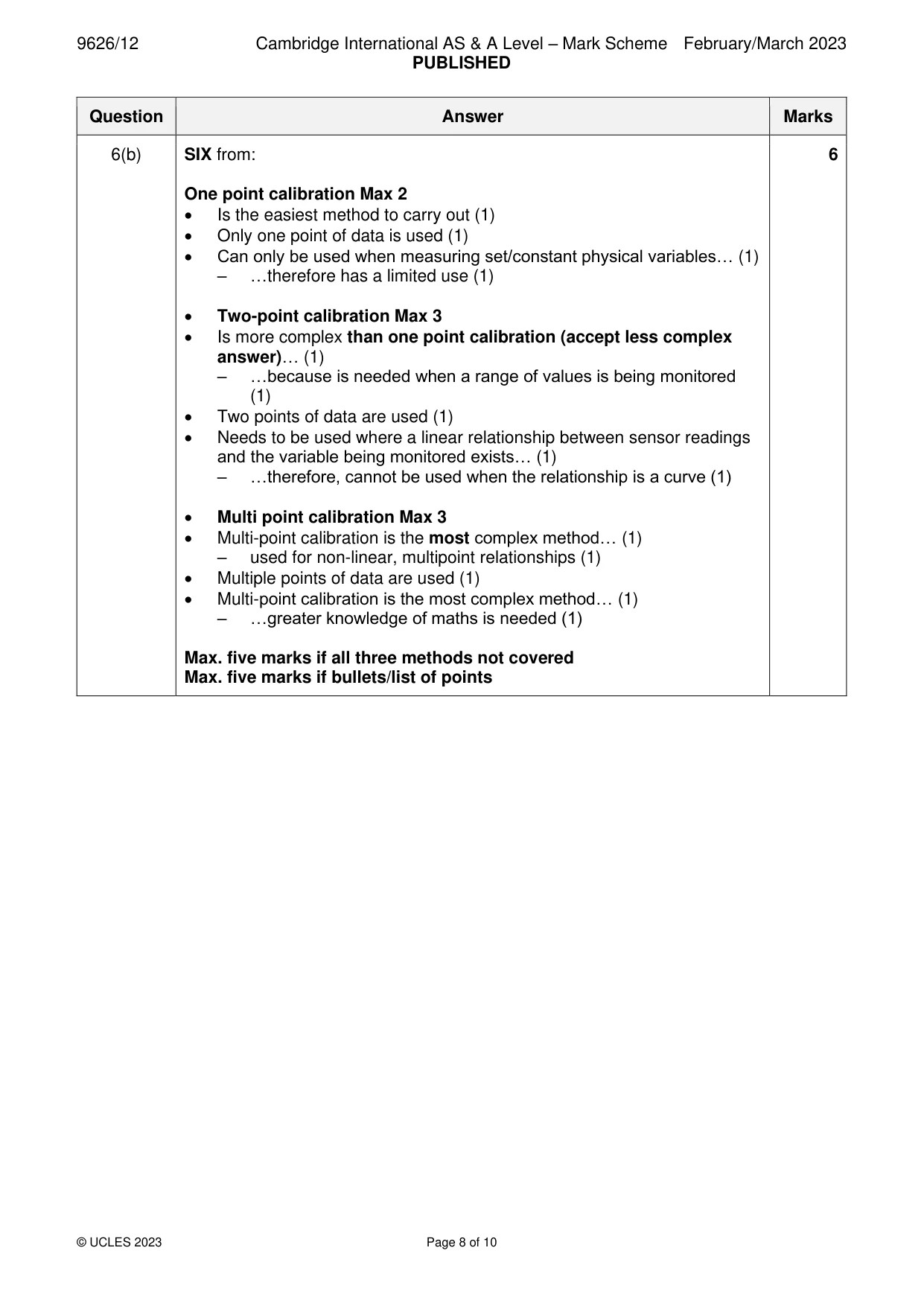
9626/12 Cambridge International AS & A Level – Mark Scheme PUBLISHED February/March 2023 © UCLES 2023 Page 8 of 10 Question Answer Marks 6(b) SIX from: One point calibration Max 2 • Is the easiest method to carry out (1) • Only one point of data is used (1) • Can only be used when measuring set/constant physical variables… (1) – …therefore has a limited use (1) • Two-point calibration Max 3 • Is more complex than one point calibration (accept less complex answer)… (1) – …because is needed when a range of values is being monitored (1) • Two points of data are used (1) • Needs to be used where a linear relationship between sensor readings and the variable being monitored exists… (1) – …therefore, cannot be used when the relationship is a curve (1) • Multi point calibration Max 3 • Multi-point calibration is the most complex method… (1) – used for non-linear, multipoint relationships (1) • Multiple points of data are used (1) • Multi-point calibration is the most complex method… (1) – …greater knowledge of maths is needed (1) Max. five marks if all three methods not covered Max. five marks if bullets/list of points 6
Mark scheme, page 9
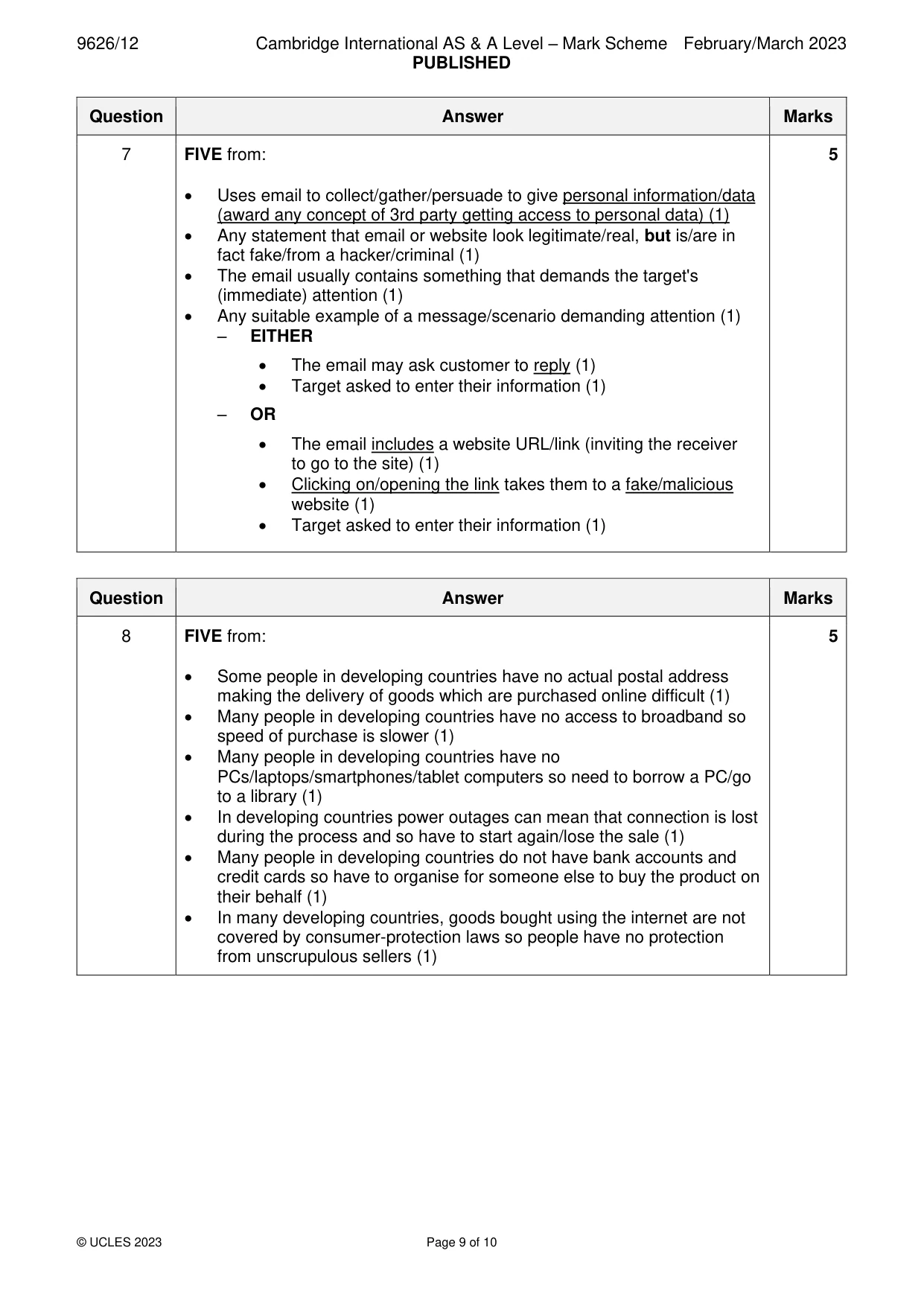
9626/12 Cambridge International AS & A Level – Mark Scheme PUBLISHED February/March 2023 © UCLES 2023 Page 9 of 10 Question Answer Marks 7 FIVE from: • Uses email to collect/gather/persuade to give personal information/data (award any concept of 3rd party getting access to personal data) (1) • Any statement that email or website look legitimate/real, but is/are in fact fake/from a hacker/criminal (1) • The email usually contains something that demands the target's (immediate) attention (1) • Any suitable example of a message/scenario demanding attention (1) – EITHER • The email may ask customer to reply (1) • Target asked to enter their information (1) – OR • The email includes a website URL/link (inviting the receiver to go to the site) (1) • Clicking on/opening the link takes them to a fake/malicious website (1) • Target asked to enter their information (1) 5 Question Answer Marks 8 FIVE from: • Some people in developing countries have no actual postal address making the delivery of goods which are purchased online difficult (1) • Many people in developing countries have no access to broadband so speed of purchase is slower (1) • Many people in developing countries have no PCs/laptops/smartphones/tablet computers so need to borrow a PC/go to a library (1) • In developing countries power outages can mean that connection is lost during the process and so have to start again/lose the sale (1) • Many people in developing countries do not have bank accounts and credit cards so have to organise for someone else to buy the product on their behalf (1) • In many developing countries, goods bought using the internet are not covered by consumer-protection laws so people have no protection from unscrupulous sellers (1) 5
Mark scheme, page 10
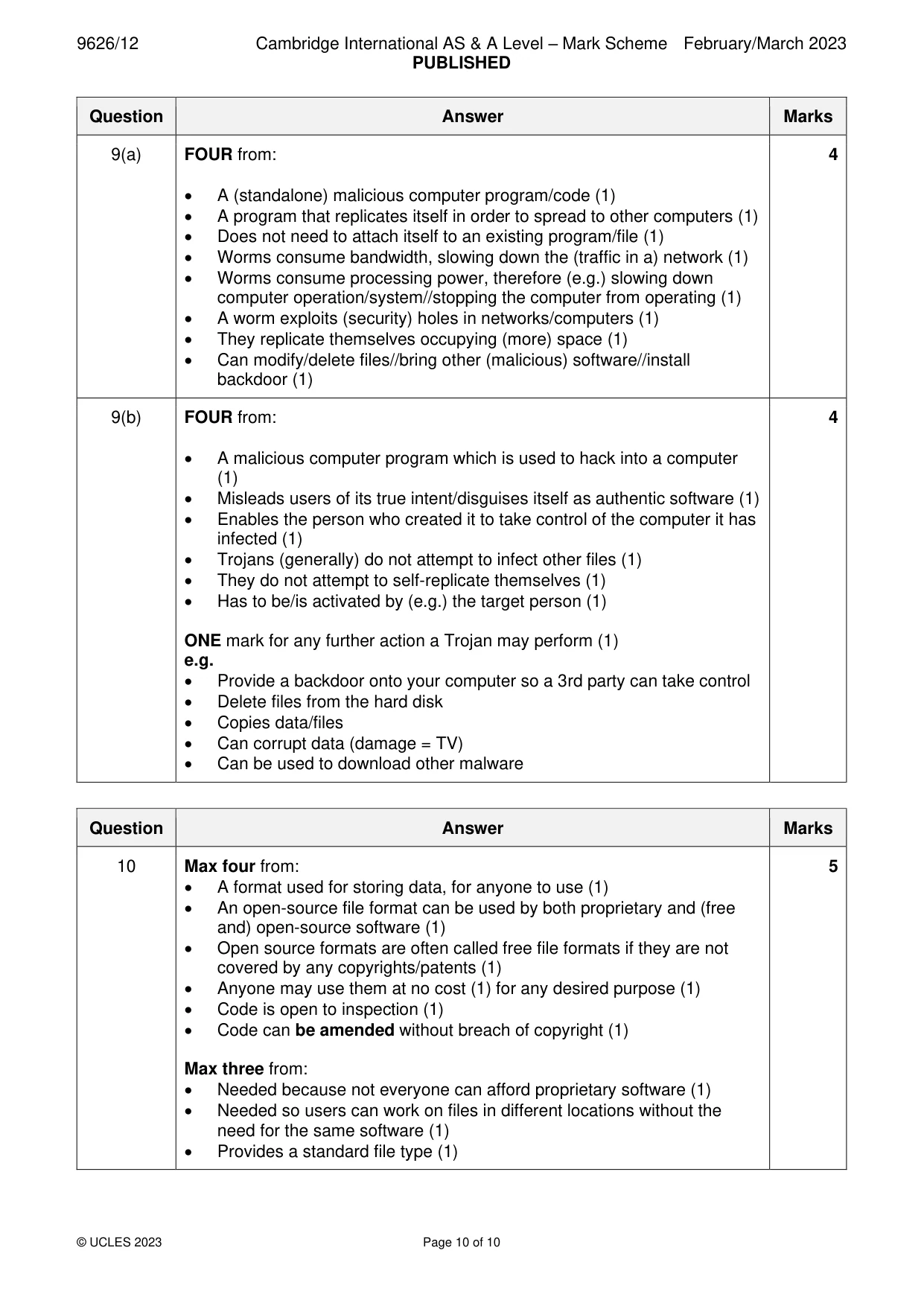
9626/12 Cambridge International AS & A Level – Mark Scheme PUBLISHED February/March 2023 © UCLES 2023 Page 10 of 10 Question Answer Marks 9(a) FOUR from: • A (standalone) malicious computer program/code (1) • A program that replicates itself in order to spread to other computers (1) • Does not need to attach itself to an existing program/file (1) • Worms consume bandwidth, slowing down the (traffic in a) network (1) • Worms consume processing power, therefore (e.g.) slowing down computer operation/system//stopping the computer from operating (1) • A worm exploits (security) holes in networks/computers (1) • They replicate themselves occupying (more) space (1) • Can modify/delete files//bring other (malicious) software//install backdoor (1) 4 9(b) FOUR from: • A malicious computer program which is used to hack into a computer (1) • Misleads users of its true intent/disguises itself as authentic software (1) • Enables the person who created it to take control of the computer it has infected (1) • Trojans (generally) do not attempt to infect other files (1) • They do not attempt to self-replicate themselves (1) • Has to be/is activated by (e.g.) the target person (1) ONE mark for any further action a Trojan may perform (1) e.g. • Provide a backdoor onto your computer so a 3rd party can take control • Delete files from the hard disk • Copies data/files • Can corrupt data (damage = TV) • Can be used to download other malware 4 Question Answer Marks 10 Max four from: • A format used for storing data, for anyone to use (1) • An open-source file format can be used by both proprietary and (free and) open-source software (1) • Open source formats are often called free file formats if they are not covered by any copyrights/patents (1) • Anyone may use them at no cost (1) for any desired purpose (1) • Code is open to inspection (1) • Code can be amended without breach of copyright (1) Max three from: • Needed because not everyone can afford proprietary software (1) • Needed so users can work on files in different locations without the need for the same software (1) • Provides a standard file type (1) 5
What you needed in this session
Cambridge’s own grade thresholds for 2023 Feb/March, Paper 1 · Variant 2. A higher threshold means an easier paper — the bar moves with how the cohort did.