Cambridge A Level Information Technology (from 2017) 9626 — 2023 May/June Paper 1 · Variant 2
9626/12/M/J/23 · 70 marks · ≈79 min
The question paper and its mark scheme, free to read here and free to download. This is Cambridge’s own paper, exactly as it was sat.
Question paper12 pages








Mark scheme9 pages
Answers below. Sit the paper first if you are practising.
Paper as text
Question paper, page 1
This document has 12 pages. Any blank pages are indicated. [Turn over Cambridge International AS & A Level INFORMATION TECHNOLOGY 9626/12 Paper 1 Theory May/June 2023 1 hour 45 minutes You must answer on the question paper. No additional materials are needed. INSTRUCTIONS ● Answer all questions. ● Use a black or dark blue pen. ● Write your name, centre number and candidate number in the boxes at the top of the page. ● Write your answer to each question in the space provided. ● Do not use an erasable pen or correction fluid. ● Do not write on any bar codes. ● You may use an HB pencil for any diagrams, graphs or rough working. ● Calculators must not be used in this paper. INFORMATION ● The total mark for this paper is 70. ● The number of marks for each question or part question is shown in brackets [ ]. * 0 4 3 5 4 6 9 3 1 7 * DC (CJ) 314552/2 © UCLES 2023
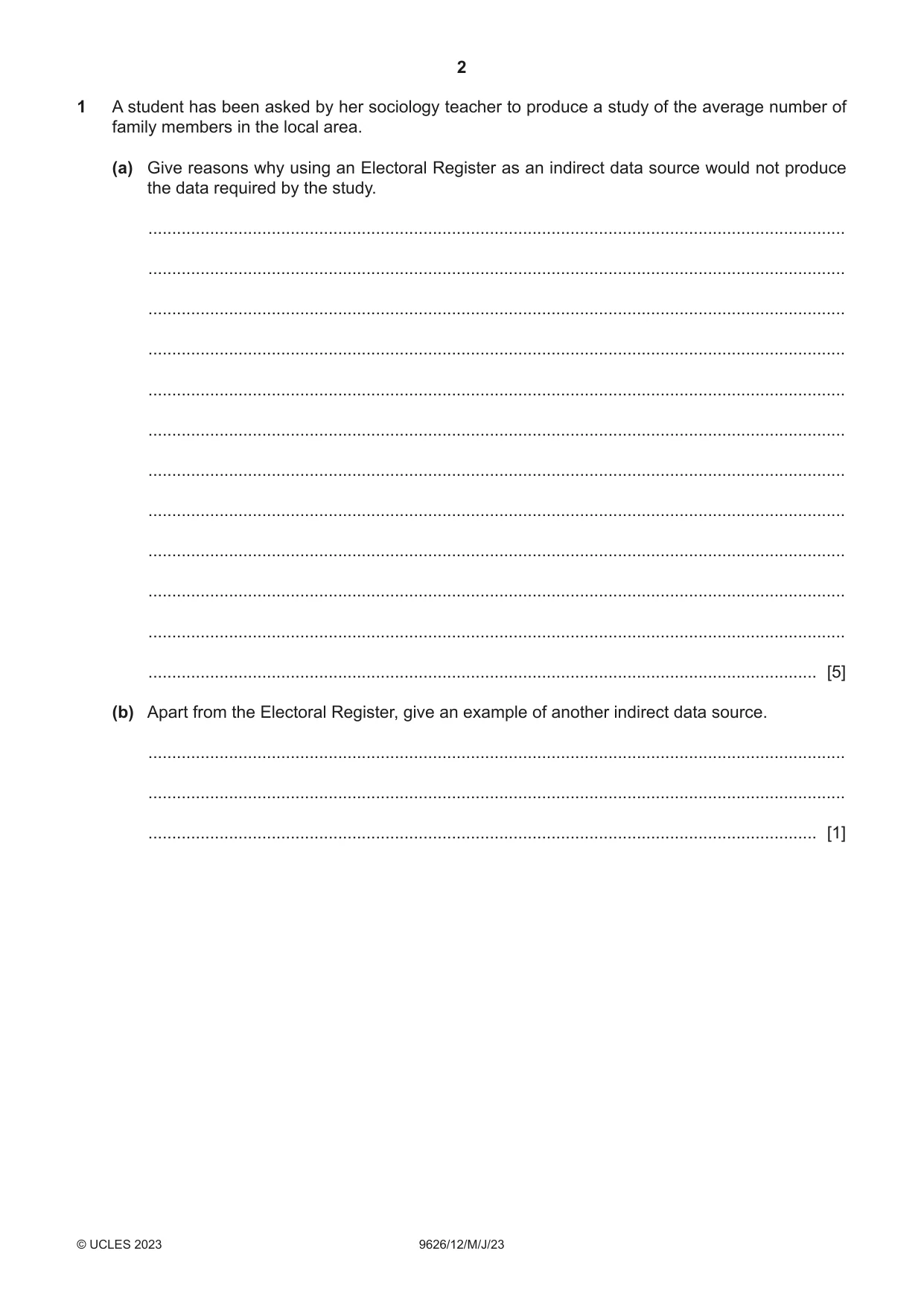
Question paper, page 2
2 9626/12/M/J/23 © UCLES 2023 1 A student has been asked by her sociology teacher to produce a study of the average number of family members in the local area. (a) Give reasons why using an Electoral Register as an indirect data source would not produce the data required by the study. … … … … … … … … … … … … [5] (b) Apart from the Electoral Register, give an example of another indirect data source. … … … [1]
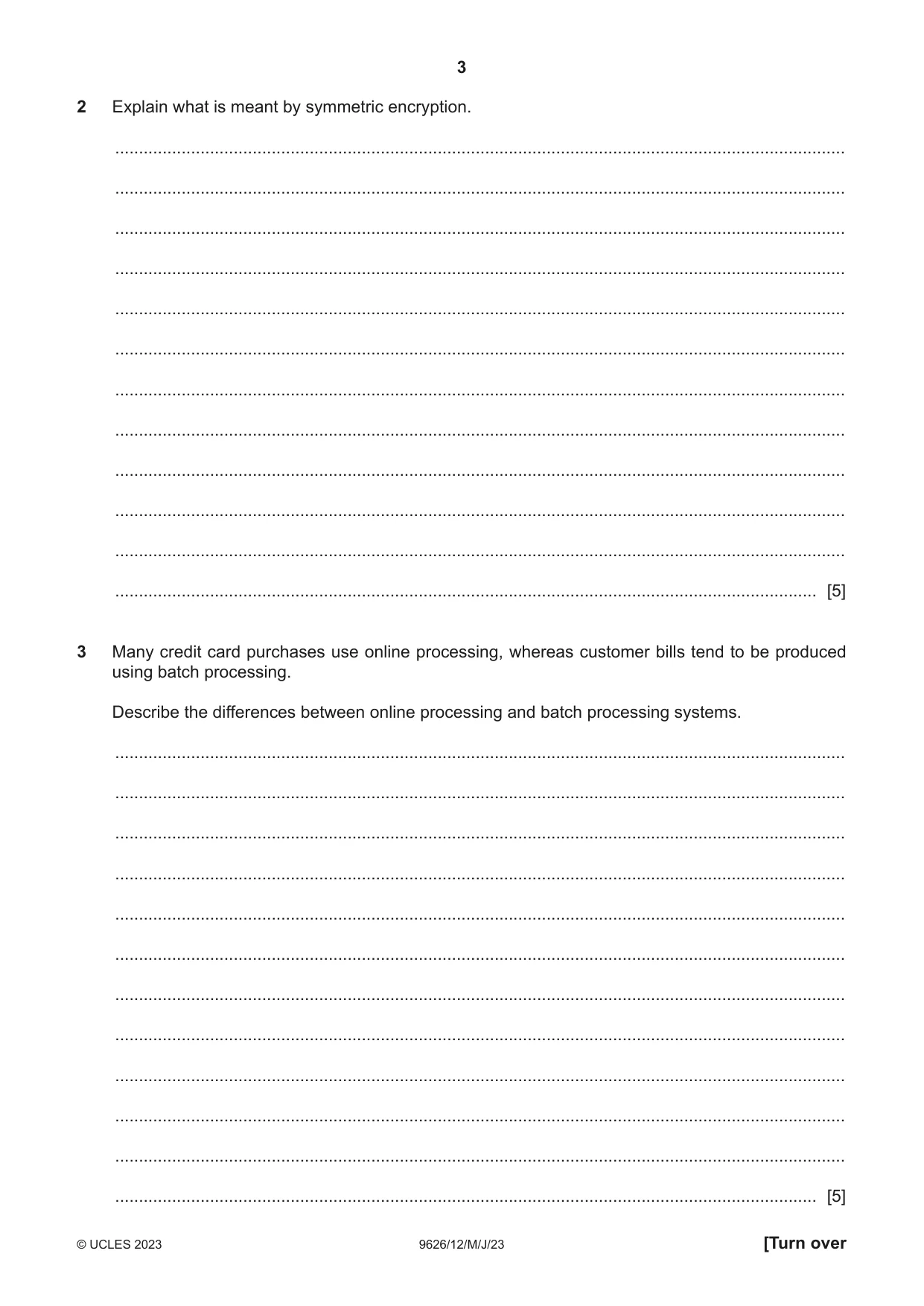
Question paper, page 3
3 9626/12/M/J/23 © UCLES 2023 [Turn over 2 Explain what is meant by symmetric encryption. … … … … … … … … … … … … [5] 3 Many credit card purchases use online processing, whereas customer bills tend to be produced using batch processing. Describe the differences between online processing and batch processing systems. … … … … … … … … … … … … [5]
Question paper, page 4
4 9626/12/M/J/23 © UCLES 2023 4 Some individuals post personal data on social media or in emails. Discuss why personal data needs to be kept confidential. … … … … … … … … … … … … … … … … … … … … [8]
Question paper, page 5
5 9626/12/M/J/23 © UCLES 2023 [Turn over 5 A printer driver is a type of device driver. Explain, using a printer driver as an example, what is meant by a device driver and why it is needed. … … … … … … … … … … … … [5] 6 Sensors are used in monitoring and control to measure physical variables. (a) Describe these sensors. For each sensor, explain how it could be used in a control system. Each system must be different. Infrared … … … … … Ultrasonic … … … … … [4]
Question paper, page 6
6 9626/12/M/J/23 © UCLES 2023 (b) Control technologies are replacing human-controlled car park barriers and timer-controlled traffic lights. Discuss the advantages and disadvantages of the use of control technologies in these scenarios. … … … … … … … … … … … … … … … … … … … … [8]
Question paper, page 7
7 9626/12/M/J/23 © UCLES 2023 [Turn over 7 Explain why there can be a digital divide between different socioeconomic groups. … … … … … … … … … … … … [5]
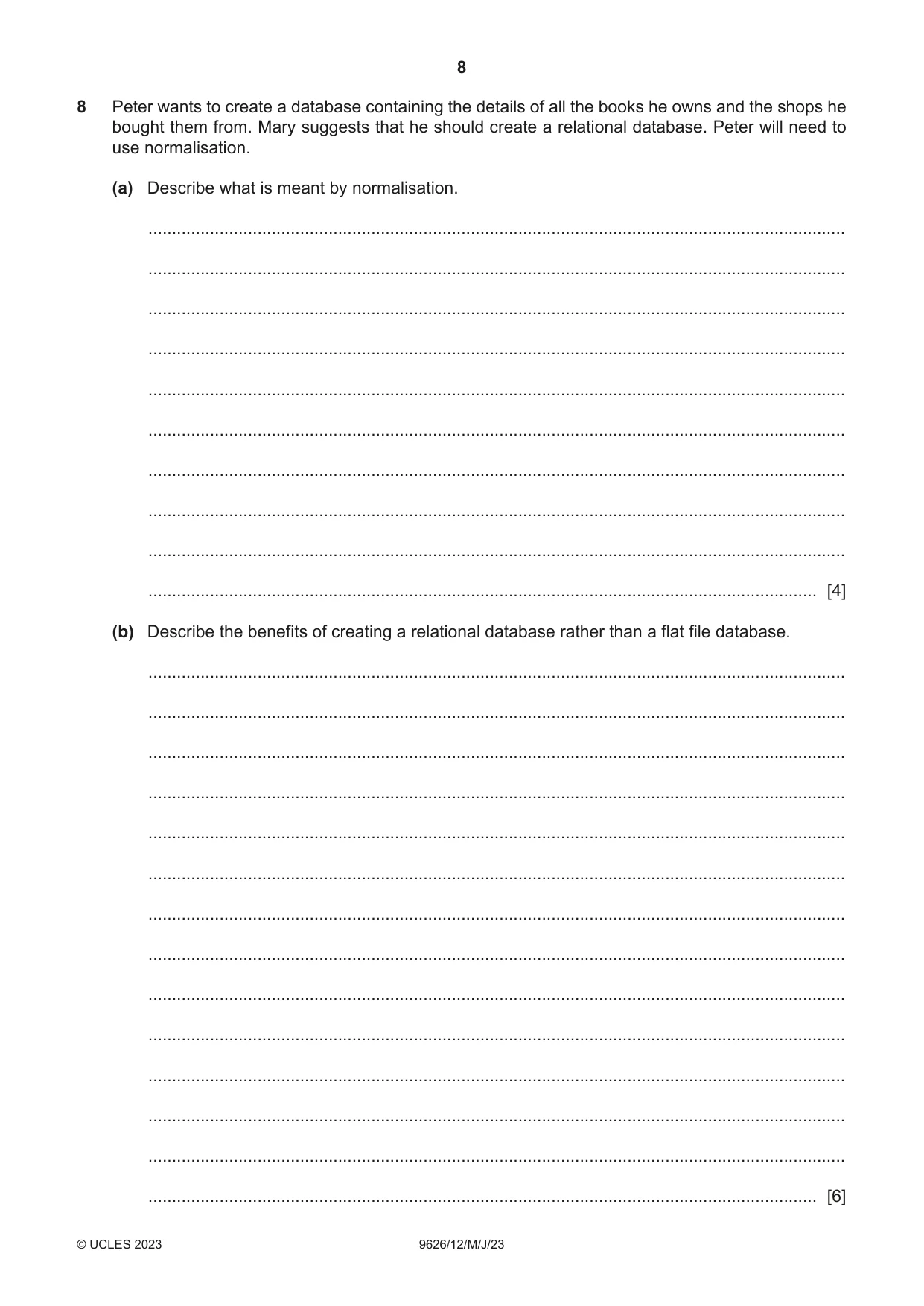
Question paper, page 8
8 9626/12/M/J/23 © UCLES 2023 8 Peter wants to create a database containing the details of all the books he owns and the shops he bought them from. Mary suggests that he should create a relational database. Peter will need to use normalisation. (a) Describe what is meant by normalisation. … … … … … … … … … … [4] (b) Describe the benefits of creating a relational database rather than a flat file database. … … … … … … … … … … … … … … [6]
Question paper, page 9
9 9626/12/M/J/23 © UCLES 2023 [Turn over 9 A doctor uses an expert system to help the doctor diagnose the illnesses of her patients. Explain how an expert system is used to help the doctor produce the diagnosis of an illness. You may assume only forward chaining is involved. … … … … … … … … … … … … … … … … … … … … [8]
Question paper, page 10
10 9626/12/M/J/23 © UCLES 2023 10 Gustav has started to write an algorithm using pseudocode. It will input 6 numbers, all less than 1000, and output the smallest value. Complete the algorithm using pseudocode. count 0 smallest 1000 WHILE count < 6 … … … … … … … … [6]
Question paper, page 11
11 9626/12/M/J/23 © UCLES 2023 BLANK PAGE
Question paper, page 12
12 9626/12/M/J/23 © UCLES 2023 Permission to reproduce items where third-party owned material protected by copyright is included has been sought and cleared where possible. Every reasonable effort has been made by the publisher (UCLES) to trace copyright holders, but if any items requiring clearance have unwittingly been included, the publisher will be pleased to make amends at the earliest possible opportunity. To avoid the issue of disclosure of answer-related information to candidates, all copyright acknowledgements are reproduced online in the Cambridge Assessment International Education Copyright Acknowledgements Booklet. This is produced for each series of examinations and is freely available to download at www.cambridgeinternational.org after the live examination series. Cambridge Assessment International Education is part of Cambridge Assessment. Cambridge Assessment is the brand name of the University of Cambridge Local Examinations Syndicate (UCLES), which is a department of the University of Cambridge. BLANK PAGE
Mark scheme, page 1
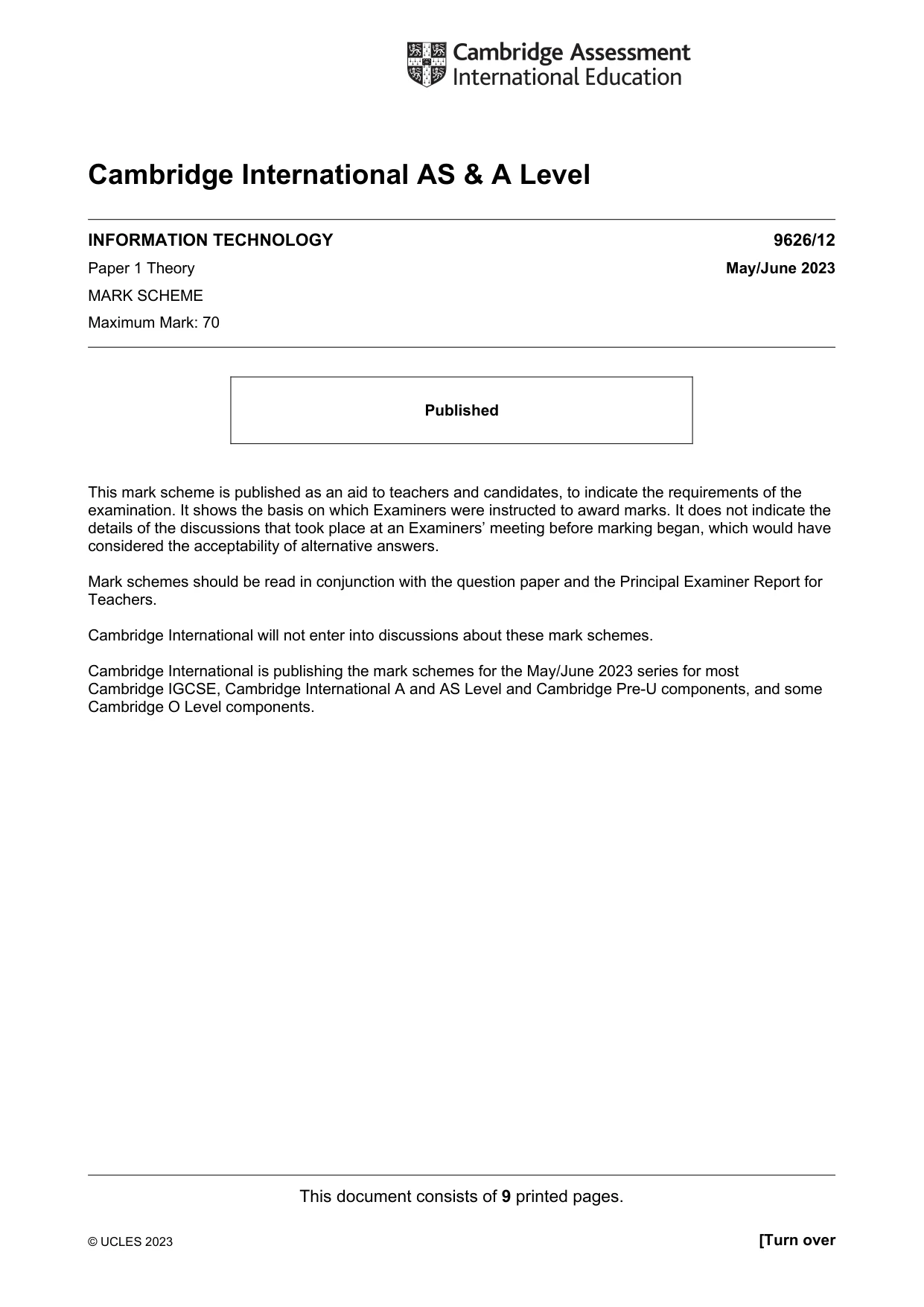
This document consists of 9 printed pages. © UCLES 2023 [Turn over Cambridge International AS & A Level INFORMATION TECHNOLOGY 9626/12 Paper 1 Theory May/June 2023 MARK SCHEME Maximum Mark: 70 Published This mark scheme is published as an aid to teachers and candidates, to indicate the requirements of the examination. It shows the basis on which Examiners were instructed to award marks. It does not indicate the details of the discussions that took place at an Examiners’ meeting before marking began, which would have considered the acceptability of alternative answers. Mark schemes should be read in conjunction with the question paper and the Principal Examiner Report for Teachers. Cambridge International will not enter into discussions about these mark schemes. Cambridge International is publishing the mark schemes for the May/June 2023 series for most Cambridge IGCSE, Cambridge International A and AS Level and Cambridge Pre-U components, and some Cambridge O Level components.
Mark scheme, page 2
9626/12 Cambridge International AS & A Level – Mark Scheme PUBLISHED May/June 2023 © UCLES 2023 Page 2 of 9 Generic Marking Principles These general marking principles must be applied by all examiners when marking candidate answers. They should be applied alongside the specific content of the mark scheme or generic level descriptors for a question. Each question paper and mark scheme will also comply with these marking principles. GENERIC MARKING PRINCIPLE 1: Marks must be awarded in line with: the specific content of the mark scheme or the generic level descriptors for the question the specific skills defined in the mark scheme or in the generic level descriptors for the question the standard of response required by a candidate as exemplified by the standardisation scripts. GENERIC MARKING PRINCIPLE 2: Marks awarded are always whole marks (not half marks, or other fractions). GENERIC MARKING PRINCIPLE 3: Marks must be awarded positively: marks are awarded for correct/valid answers, as defined in the mark scheme. However, credit is given for valid answers which go beyond the scope of the syllabus and mark scheme, referring to your Team Leader as appropriate marks are awarded when candidates clearly demonstrate what they know and can do marks are not deducted for errors marks are not deducted for omissions answers should only be judged on the quality of spelling, punctuation and grammar when these features are specifically assessed by the question as indicated by the mark scheme. The meaning, however, should be unambiguous. GENERIC MARKING PRINCIPLE 4: Rules must be applied consistently, e.g. in situations where candidates have not followed instructions or in the application of generic level descriptors. GENERIC MARKING PRINCIPLE 5: Marks should be awarded using the full range of marks defined in the mark scheme for the question (however; the use of the full mark range may be limited according to the quality of the candidate responses seen). GENERIC MARKING PRINCIPLE 6: Marks awarded are based solely on the requirements as defined in the mark scheme. Marks should not be awarded with grade thresholds or grade descriptors in mind.
Mark scheme, page 3
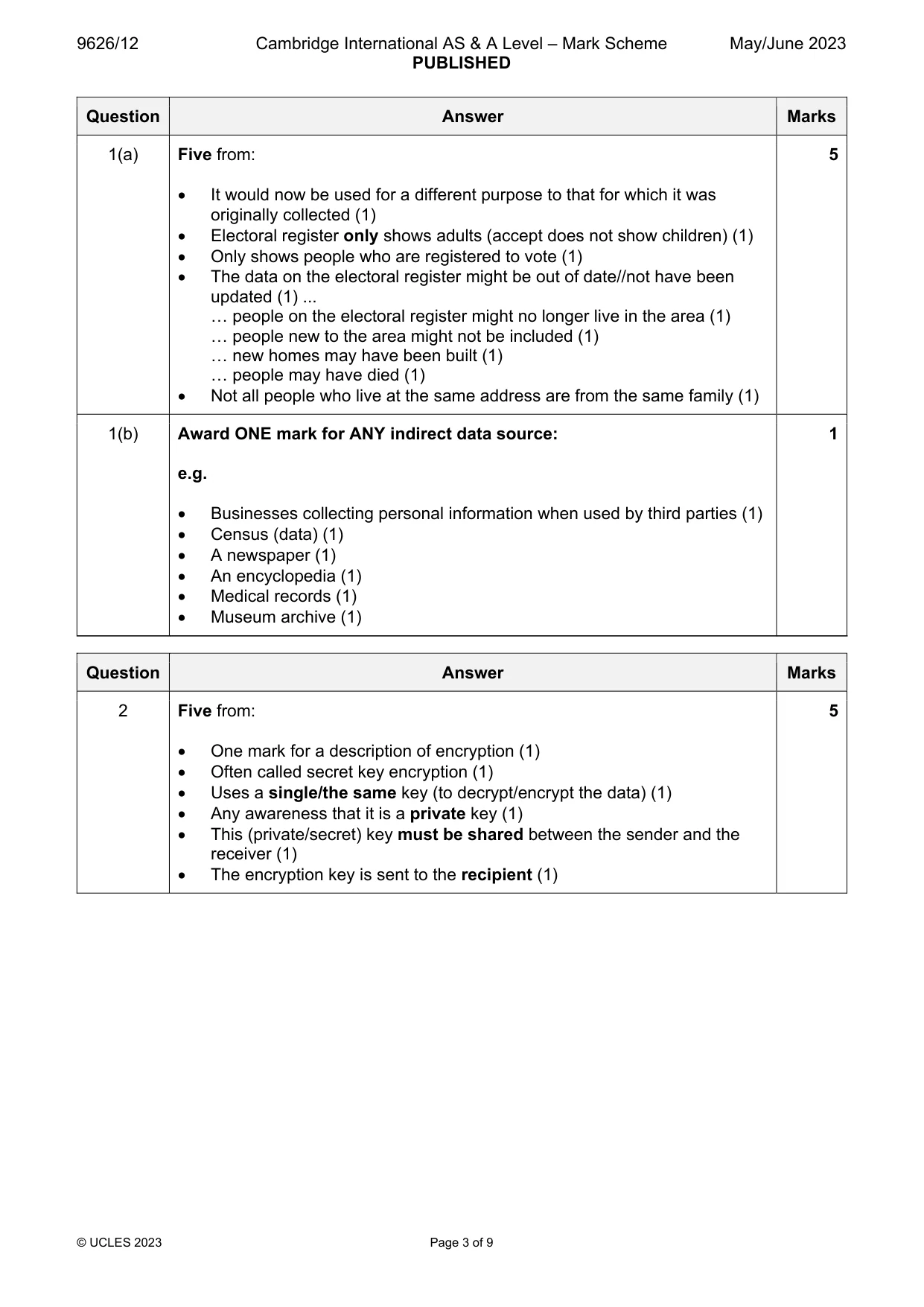
9626/12 Cambridge International AS & A Level – Mark Scheme PUBLISHED May/June 2023 © UCLES 2023 Page 3 of 9 Question Answer Marks 1(a) Five from: It would now be used for a different purpose to that for which it was originally collected (1) Electoral register only shows adults (accept does not show children) (1) Only shows people who are registered to vote (1) The data on the electoral register might be out of date//not have been updated (1) ... … people on the electoral register might no longer live in the area (1) … people new to the area might not be included (1) … new homes may have been built (1) … people may have died (1) Not all people who live at the same address are from the same family (1) 5 1(b) Award ONE mark for ANY indirect data source: e.g. Businesses collecting personal information when used by third parties (1) Census (data) (1) A newspaper (1) An encyclopedia (1) Medical records (1) Museum archive (1) 1 Question Answer Marks 2 Five from: One mark for a description of encryption (1) Often called secret key encryption (1) Uses a single/the same key (to decrypt/encrypt the data) (1) Any awareness that it is a private key (1) This (private/secret) key must be shared between the sender and the receiver (1) The encryption key is sent to the recipient (1) 5
Mark scheme, page 4
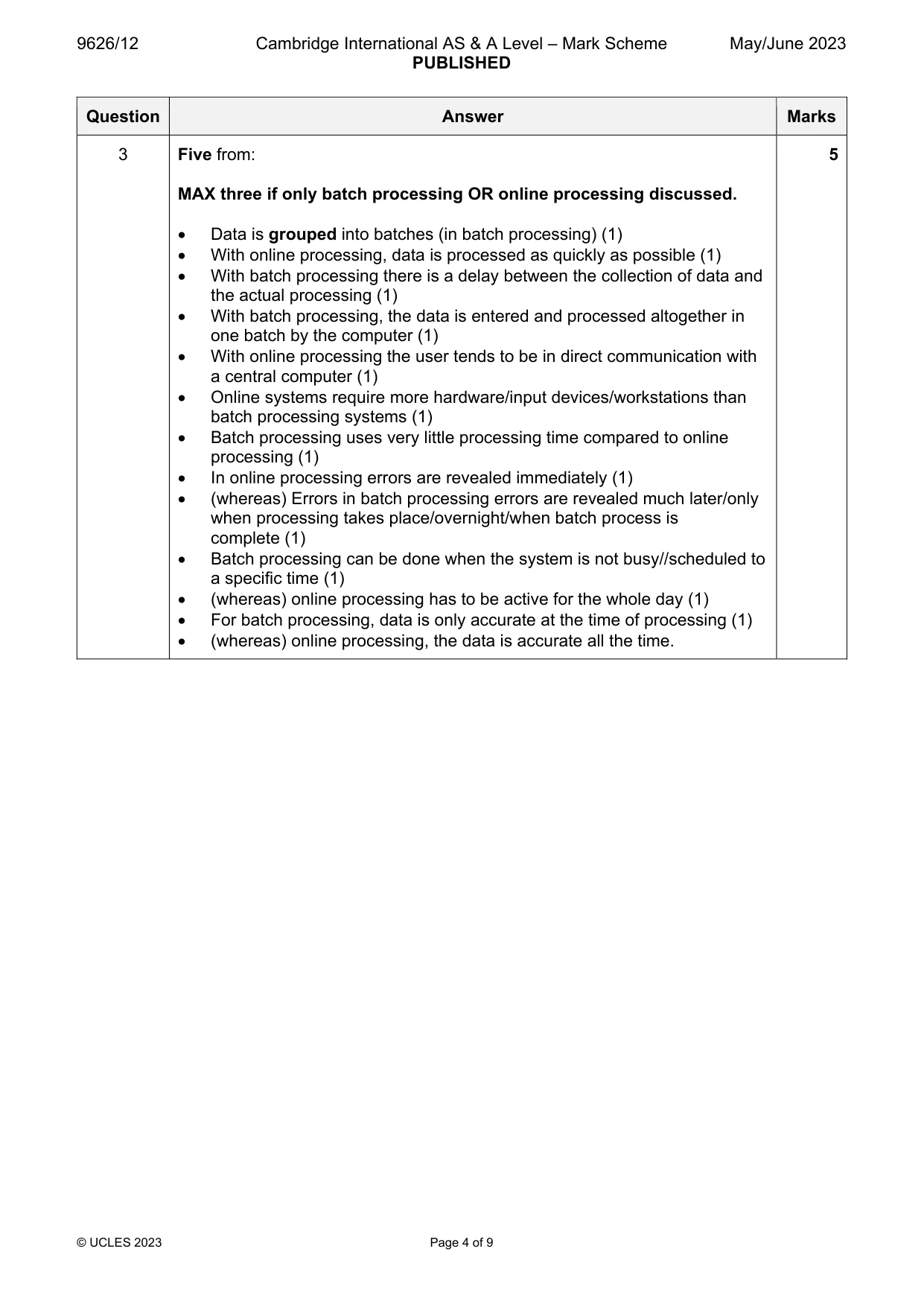
9626/12 Cambridge International AS & A Level – Mark Scheme PUBLISHED May/June 2023 © UCLES 2023 Page 4 of 9 Question Answer Marks 3 Five from: MAX three if only batch processing OR online processing discussed. Data is grouped into batches (in batch processing) (1) With online processing, data is processed as quickly as possible (1) With batch processing there is a delay between the collection of data and the actual processing (1) With batch processing, the data is entered and processed altogether in one batch by the computer (1) With online processing the user tends to be in direct communication with a central computer (1) Online systems require more hardware/input devices/workstations than batch processing systems (1) Batch processing uses very little processing time compared to online processing (1) In online processing errors are revealed immediately (1) (whereas) Errors in batch processing errors are revealed much later/only when processing takes place/overnight/when batch process is complete (1) Batch processing can be done when the system is not busy//scheduled to a specific time (1) (whereas) online processing has to be active for the whole day (1) For batch processing, data is only accurate at the time of processing (1) (whereas) online processing, the data is accurate all the time. 5
Mark scheme, page 5
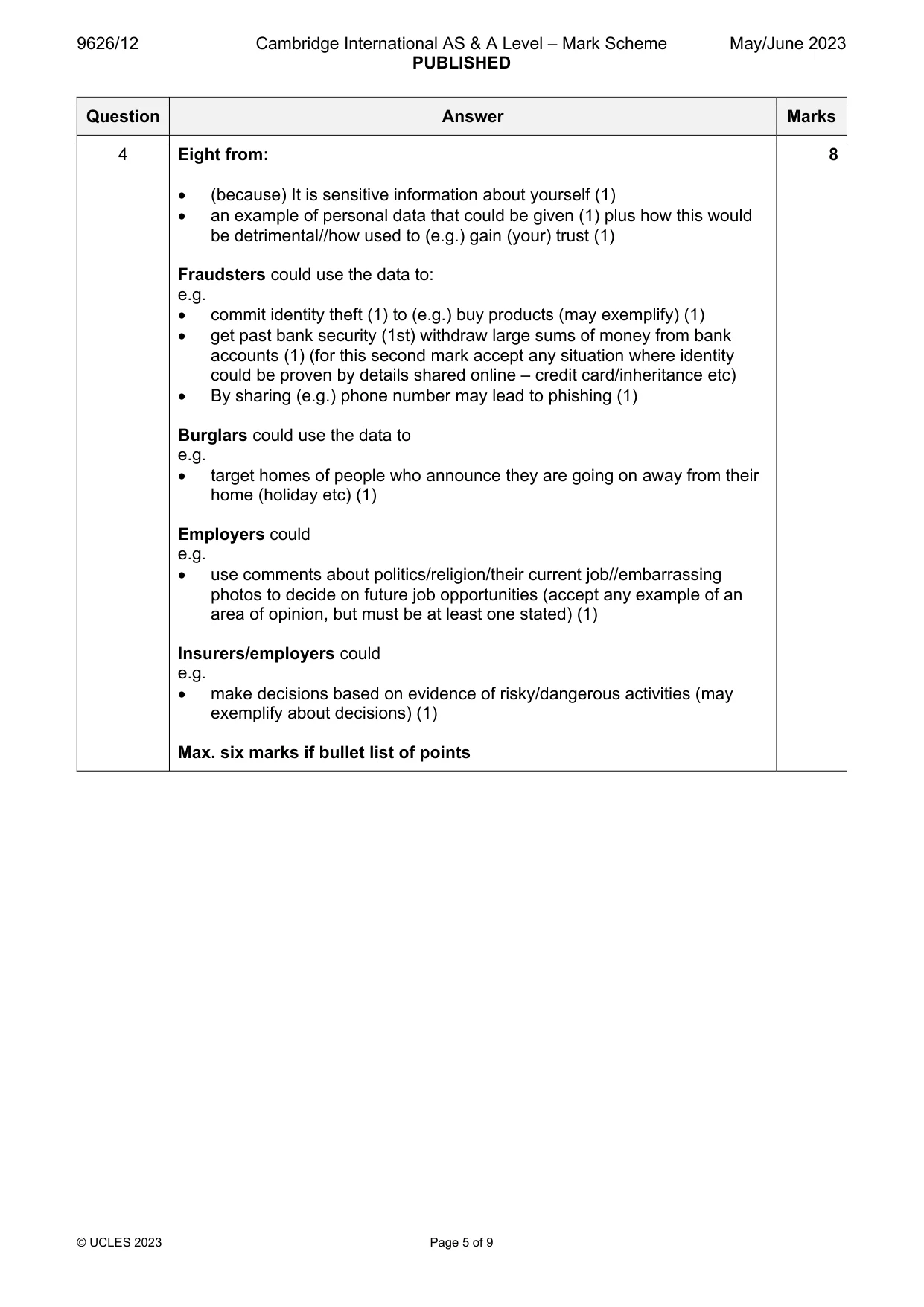
9626/12 Cambridge International AS & A Level – Mark Scheme PUBLISHED May/June 2023 © UCLES 2023 Page 5 of 9 Question Answer Marks 4 Eight from: (because) It is sensitive information about yourself (1) an example of personal data that could be given (1) plus how this would be detrimental//how used to (e.g.) gain (your) trust (1) Fraudsters could use the data to: e.g. commit identity theft (1) to (e.g.) buy products (may exemplify) (1) get past bank security (1st) withdraw large sums of money from bank accounts (1) (for this second mark accept any situation where identity could be proven by details shared online – credit card/inheritance etc) By sharing (e.g.) phone number may lead to phishing (1) Burglars could use the data to e.g. target homes of people who announce they are going on away from their home (holiday etc) (1) Employers could e.g. use comments about politics/religion/their current job//embarrassing photos to decide on future job opportunities (accept any example of an area of opinion, but must be at least one stated) (1) Insurers/employers could e.g. make decisions based on evidence of risky/dangerous activities (may exemplify about decisions) (1) Max. six marks if bullet list of points 8
Mark scheme, page 6
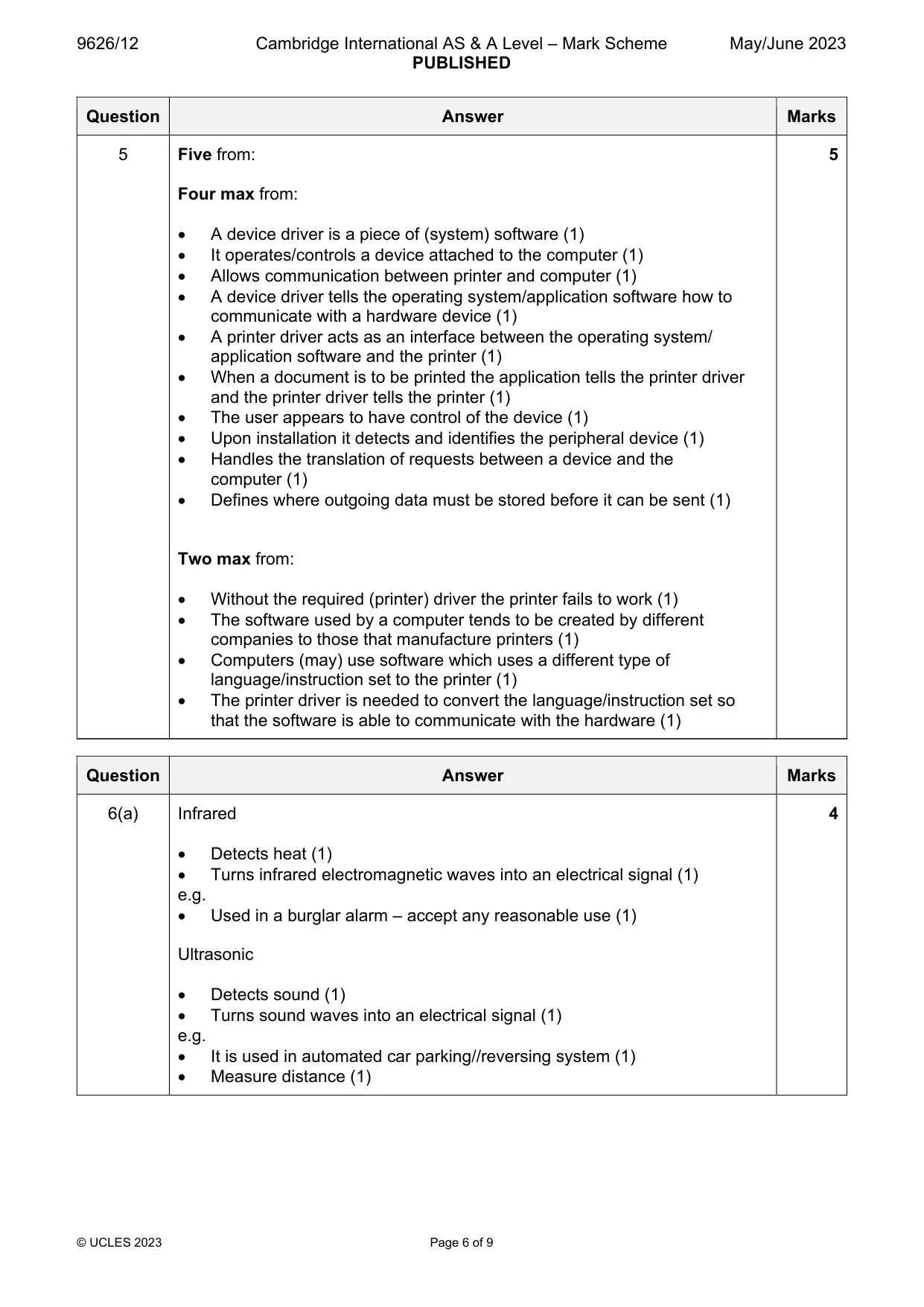
9626/12 Cambridge International AS & A Level – Mark Scheme PUBLISHED May/June 2023 © UCLES 2023 Page 6 of 9 Question Answer Marks 5 Five from: Four max from: A device driver is a piece of (system) software (1) It operates/controls a device attached to the computer (1) Allows communication between printer and computer (1) A device driver tells the operating system/application software how to communicate with a hardware device (1) A printer driver acts as an interface between the operating system/ application software and the printer (1) When a document is to be printed the application tells the printer driver and the printer driver tells the printer (1) The user appears to have control of the device (1) Upon installation it detects and identifies the peripheral device (1) Handles the translation of requests between a device and the computer (1) Defines where outgoing data must be stored before it can be sent (1) Two max from: Without the required (printer) driver the printer fails to work (1) The software used by a computer tends to be created by different companies to those that manufacture printers (1) Computers (may) use software which uses a different type of language/instruction set to the printer (1) The printer driver is needed to convert the language/instruction set so that the software is able to communicate with the hardware (1) 5 Question Answer Marks 6(a) Infrared Detects heat (1) Turns infrared electromagnetic waves into an electrical signal (1) e.g. Used in a burglar alarm – accept any reasonable use (1) Ultrasonic Detects sound (1) Turns sound waves into an electrical signal (1) e.g. It is used in automated car parking//reversing system (1) Measure distance (1) 4
Mark scheme, page 7
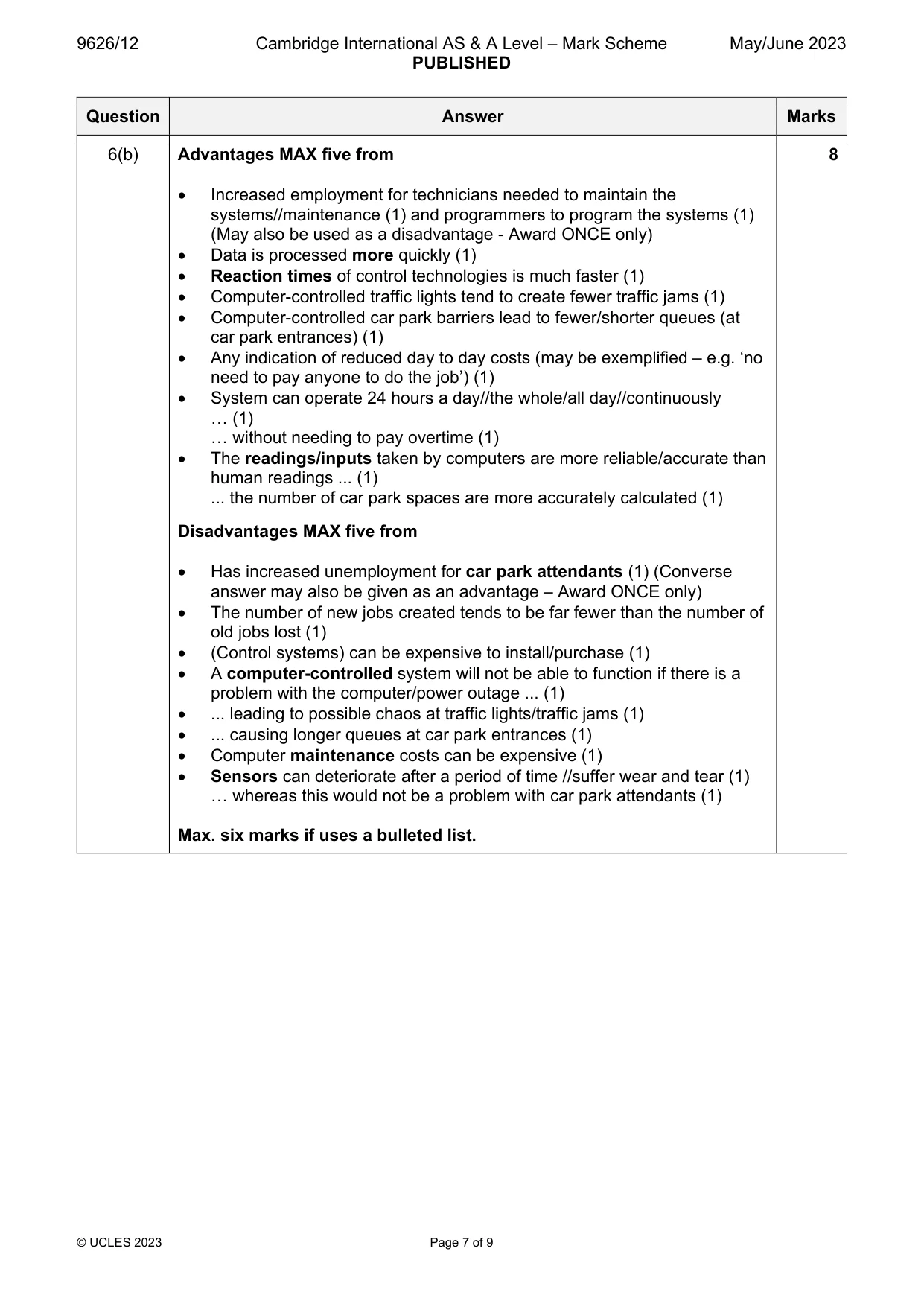
9626/12 Cambridge International AS & A Level – Mark Scheme PUBLISHED May/June 2023 © UCLES 2023 Page 7 of 9 Question Answer Marks 6(b) Advantages MAX five from Increased employment for technicians needed to maintain the systems//maintenance (1) and programmers to program the systems (1) (May also be used as a disadvantage - Award ONCE only) Data is processed more quickly (1) Reaction times of control technologies is much faster (1) Computer-controlled traffic lights tend to create fewer traffic jams (1) Computer-controlled car park barriers lead to fewer/shorter queues (at car park entrances) (1) Any indication of reduced day to day costs (may be exemplified – e.g. ‘no need to pay anyone to do the job’) (1) System can operate 24 hours a day//the whole/all day//continuously … (1) … without needing to pay overtime (1) The readings/inputs taken by computers are more reliable/accurate than human readings ... (1) ... the number of car park spaces are more accurately calculated (1) Disadvantages MAX five from Has increased unemployment for car park attendants (1) (Converse answer may also be given as an advantage – Award ONCE only) The number of new jobs created tends to be far fewer than the number of old jobs lost (1) (Control systems) can be expensive to install/purchase (1) A computer-controlled system will not be able to function if there is a problem with the computer/power outage ... (1) ... leading to possible chaos at traffic lights/traffic jams (1) ... causing longer queues at car park entrances (1) Computer maintenance costs can be expensive (1) Sensors can deteriorate after a period of time //suffer wear and tear (1) … whereas this would not be a problem with car park attendants (1) Max. six marks if uses a bulleted list. 8
Mark scheme, page 8
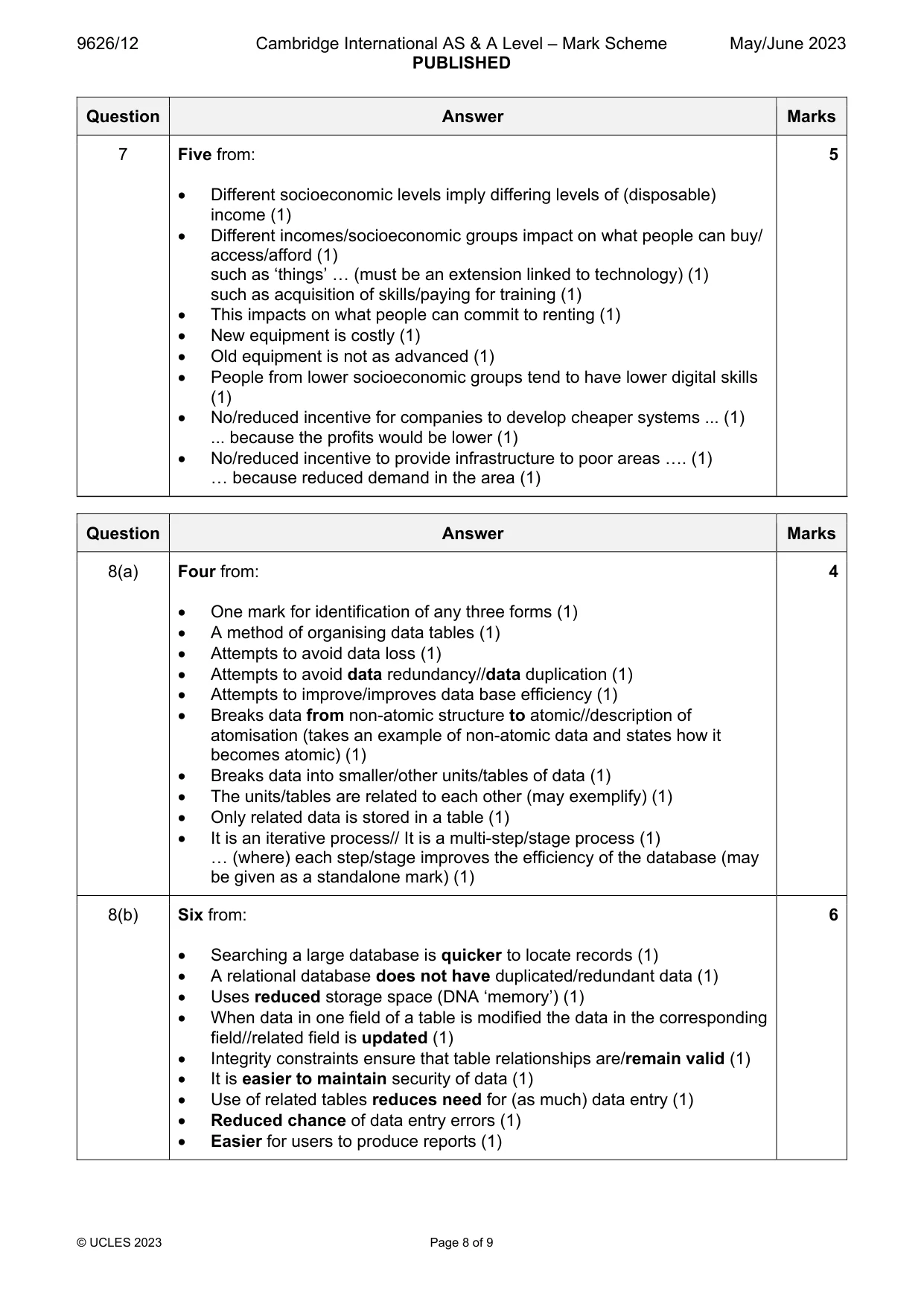
9626/12 Cambridge International AS & A Level – Mark Scheme PUBLISHED May/June 2023 © UCLES 2023 Page 8 of 9 Question Answer Marks 7 Five from: Different socioeconomic levels imply differing levels of (disposable) income (1) Different incomes/socioeconomic groups impact on what people can buy/ access/afford (1) such as ‘things’ … (must be an extension linked to technology) (1) such as acquisition of skills/paying for training (1) This impacts on what people can commit to renting (1) New equipment is costly (1) Old equipment is not as advanced (1) People from lower socioeconomic groups tend to have lower digital skills (1) No/reduced incentive for companies to develop cheaper systems ... (1) ... because the profits would be lower (1) No/reduced incentive to provide infrastructure to poor areas …. (1) … because reduced demand in the area (1) 5 Question Answer Marks 8(a) Four from: One mark for identification of any three forms (1) A method of organising data tables (1) Attempts to avoid data loss (1) Attempts to avoid data redundancy//data duplication (1) Attempts to improve/improves data base efficiency (1) Breaks data from non-atomic structure to atomic//description of atomisation (takes an example of non-atomic data and states how it becomes atomic) (1) Breaks data into smaller/other units/tables of data (1) The units/tables are related to each other (may exemplify) (1) Only related data is stored in a table (1) It is an iterative process// It is a multi-step/stage process (1) … (where) each step/stage improves the efficiency of the database (may be given as a standalone mark) (1) 4 8(b) Six from: Searching a large database is quicker to locate records (1) A relational database does not have duplicated/redundant data (1) Uses reduced storage space (DNA ‘memory’) (1) When data in one field of a table is modified the data in the corresponding field//related field is updated (1) Integrity constraints ensure that table relationships are/remain valid (1) It is easier to maintain security of data (1) Use of related tables reduces need for (as much) data entry (1) Reduced chance of data entry errors (1) Easier for users to produce reports (1) 6
Mark scheme, page 9
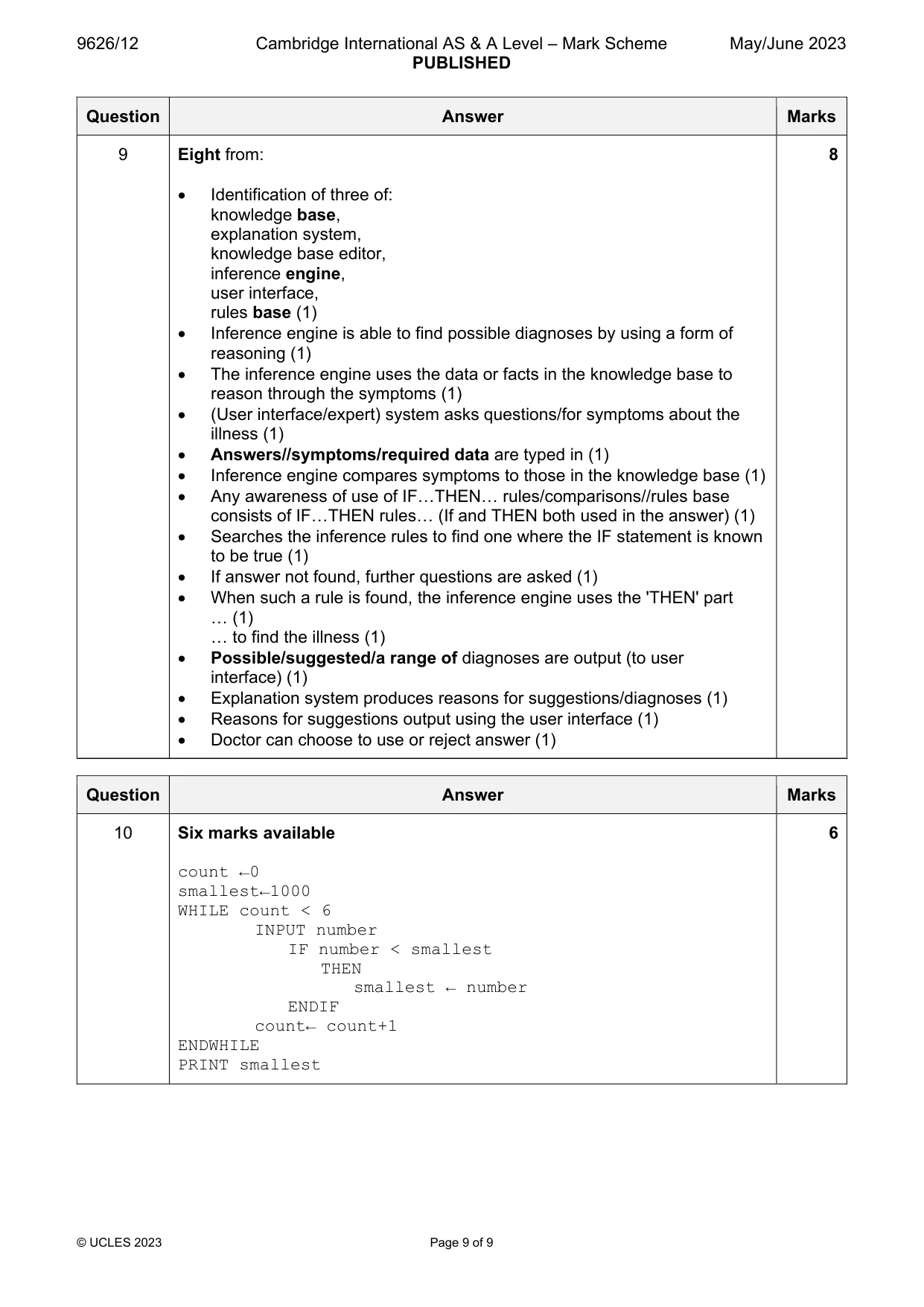
9626/12 Cambridge International AS & A Level – Mark Scheme PUBLISHED May/June 2023 © UCLES 2023 Page 9 of 9 Question Answer Marks 9 Eight from: Identification of three of: knowledge base, explanation system, knowledge base editor, inference engine, user interface, rules base (1) Inference engine is able to find possible diagnoses by using a form of reasoning (1) The inference engine uses the data or facts in the knowledge base to reason through the symptoms (1) (User interface/expert) system asks questions/for symptoms about the illness (1) Answers//symptoms/required data are typed in (1) Inference engine compares symptoms to those in the knowledge base (1) Any awareness of use of IF…THEN… rules/comparisons//rules base consists of IF…THEN rules… (If and THEN both used in the answer) (1) Searches the inference rules to find one where the IF statement is known to be true (1) If answer not found, further questions are asked (1) When such a rule is found, the inference engine uses the 'THEN' part … (1) … to find the illness (1) Possible/suggested/a range of diagnoses are output (to user interface) (1) Explanation system produces reasons for suggestions/diagnoses (1) Reasons for suggestions output using the user interface (1) Doctor can choose to use or reject answer (1) 8 Question Answer Marks 10 Six marks available count ←0 smallest←1000 WHILE count < 6 INPUT number IF number < smallest THEN smallest ← number ENDIF count← count+1 ENDWHILE PRINT smallest 6
What you needed in this session
Cambridge’s own grade thresholds for 2023 May/June, Paper 1 · Variant 2. A higher threshold means an easier paper — the bar moves with how the cohort did.