Cambridge A Level Information Technology (from 2017) 9626 — 2020 May/June Paper 1 · Variant 1
9626/11/M/J/20
The question paper and its mark scheme, free to read here and free to download. This is Cambridge’s own paper, exactly as it was sat.
Question paper16 pages







Mark scheme13 pages
Answers below. Sit the paper first if you are practising.
Paper as text
Question paper, page 1
Cambridge International AS & A Level INFORMATION TECHNOLOGY 9626/11 Paper 1 Theory May/June 2020 1 hour 45 minutes You must answer on the question paper. No additional materials are needed. INSTRUCTIONS ● Answer all questions. ● Use a black or dark blue pen. ● Write your name, centre number and candidate number in the boxes at the top of the page. ● Write your answer to each question in the space provided. ● Do not use an erasable pen or correction fluid. ● Do not write on any bar codes. ● You may use an HB pencil for any diagrams, graphs or rough working. ● Calculators must not be used in this paper. INFORMATION ● The total mark for this paper is 90. ● The number of marks for each question or part question is shown in brackets [ ]. This document has 16 pages. Blank pages are indicated. DC (LK/TP) 180962/4 © UCLES 2020 [Turn over * 3 2 9 4 0 2 8 7 4 2 *
Question paper, page 2
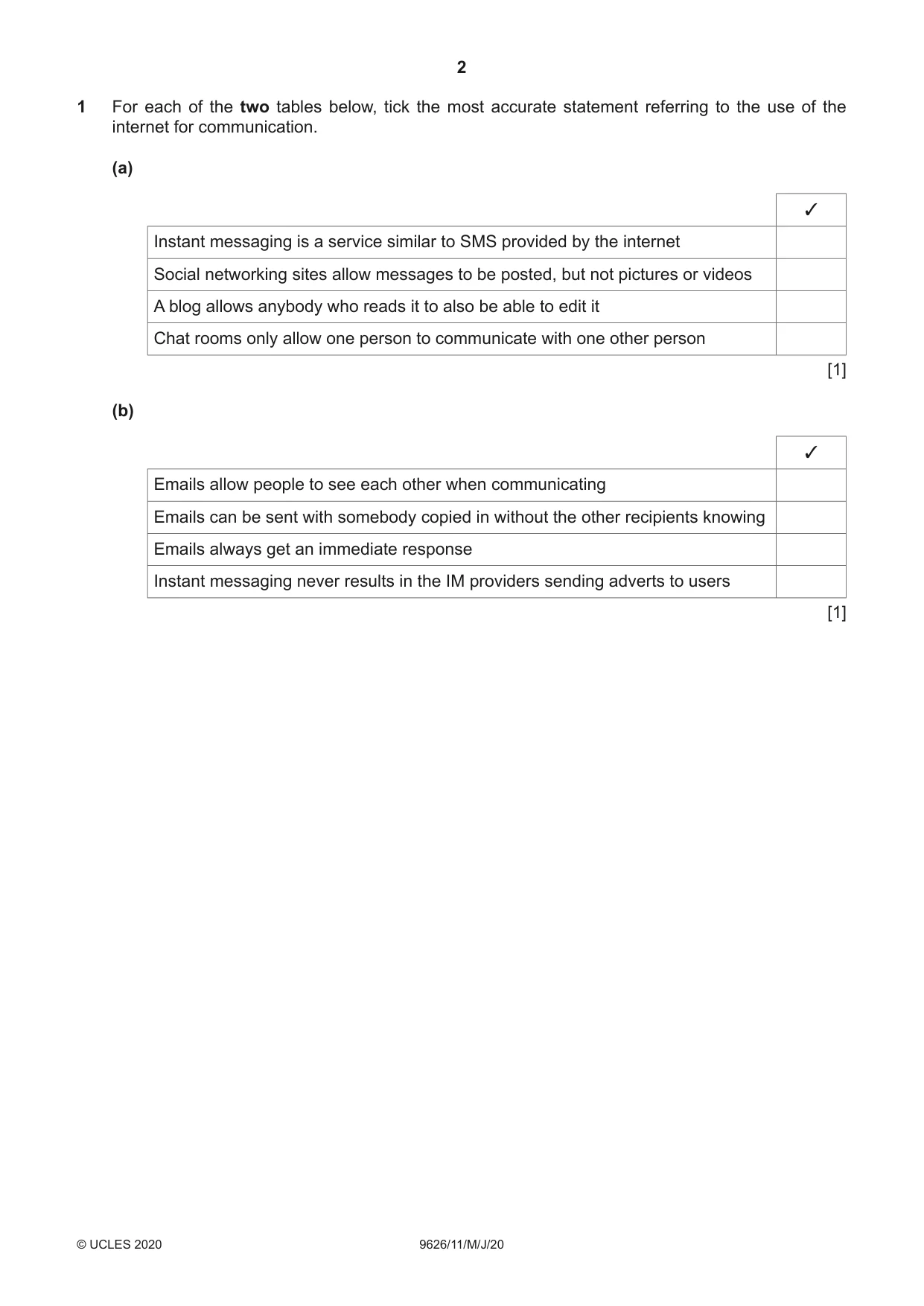
2 9626/11/M/J/20 © UCLES 2020 1 For each of the two tables below, tick the most accurate statement referring to the use of the internet for communication. (a) ✓ Instant messaging is a service similar to SMS provided by the internet Social networking sites allow messages to be posted, but not pictures or videos A blog allows anybody who reads it to also be able to edit it Chat rooms only allow one person to communicate with one other person [1] (b) ✓ Emails allow people to see each other when communicating Emails can be sent with somebody copied in without the other recipients knowing Emails always get an immediate response Instant messaging never results in the IM providers sending adverts to users [1]
Question paper, page 3
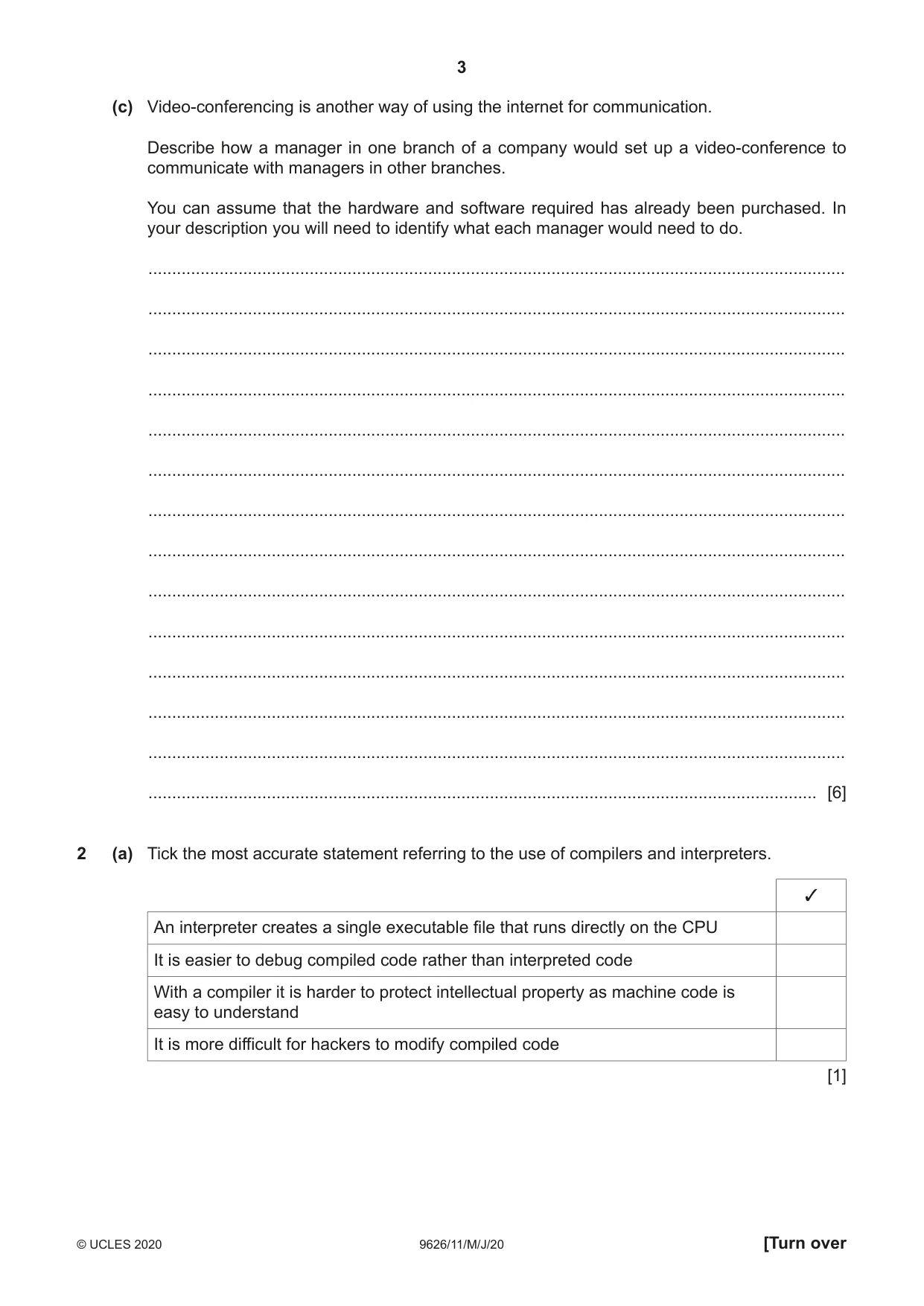
3 9626/11/M/J/20 © UCLES 2020 [Turn over (c) Video-conferencing is another way of using the internet for communication. Describe how a manager in one branch of a company would set up a video-conference to communicate with managers in other branches. You can assume that the hardware and software required has already been purchased. In your description you will need to identify what each manager would need to do. … … … … … … … … … … … … … … [6] 2 (a) Tick the most accurate statement referring to the use of compilers and interpreters. ✓ An interpreter creates a single executable file that runs directly on the CPU It is easier to debug compiled code rather than interpreted code With a compiler it is harder to protect intellectual property as machine code is easy to understand It is more difficult for hackers to modify compiled code [1]
Question paper, page 4
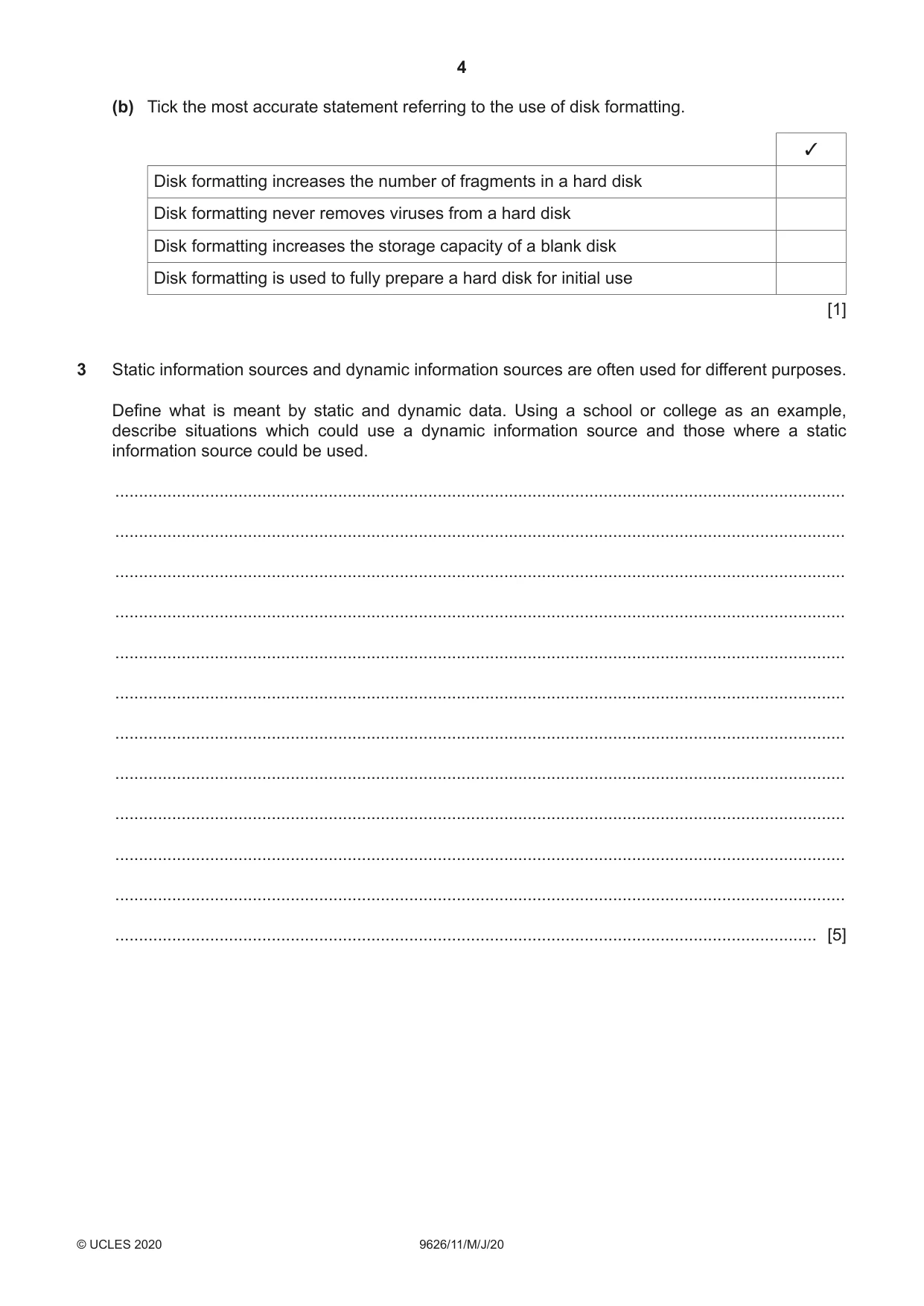
4 9626/11/M/J/20 © UCLES 2020 (b) Tick the most accurate statement referring to the use of disk formatting. ✓ Disk formatting increases the number of fragments in a hard disk Disk formatting never removes viruses from a hard disk Disk formatting increases the storage capacity of a blank disk Disk formatting is used to fully prepare a hard disk for initial use [1] 3 Static information sources and dynamic information sources are often used for different purposes. Define what is meant by static and dynamic data. Using a school or college as an example, describe situations which could use a dynamic information source and those where a static information source could be used. … … … … … … … … … … … … [5]
Question paper, page 5
5 9626/11/M/J/20 © UCLES 2020 [Turn over 4 The digital divide often exists between people in developed countries and those in developing countries. Describe what is meant by the digital divide and how it affects these countries. … … … … … … … … … … … … … … [6]
Question paper, page 6
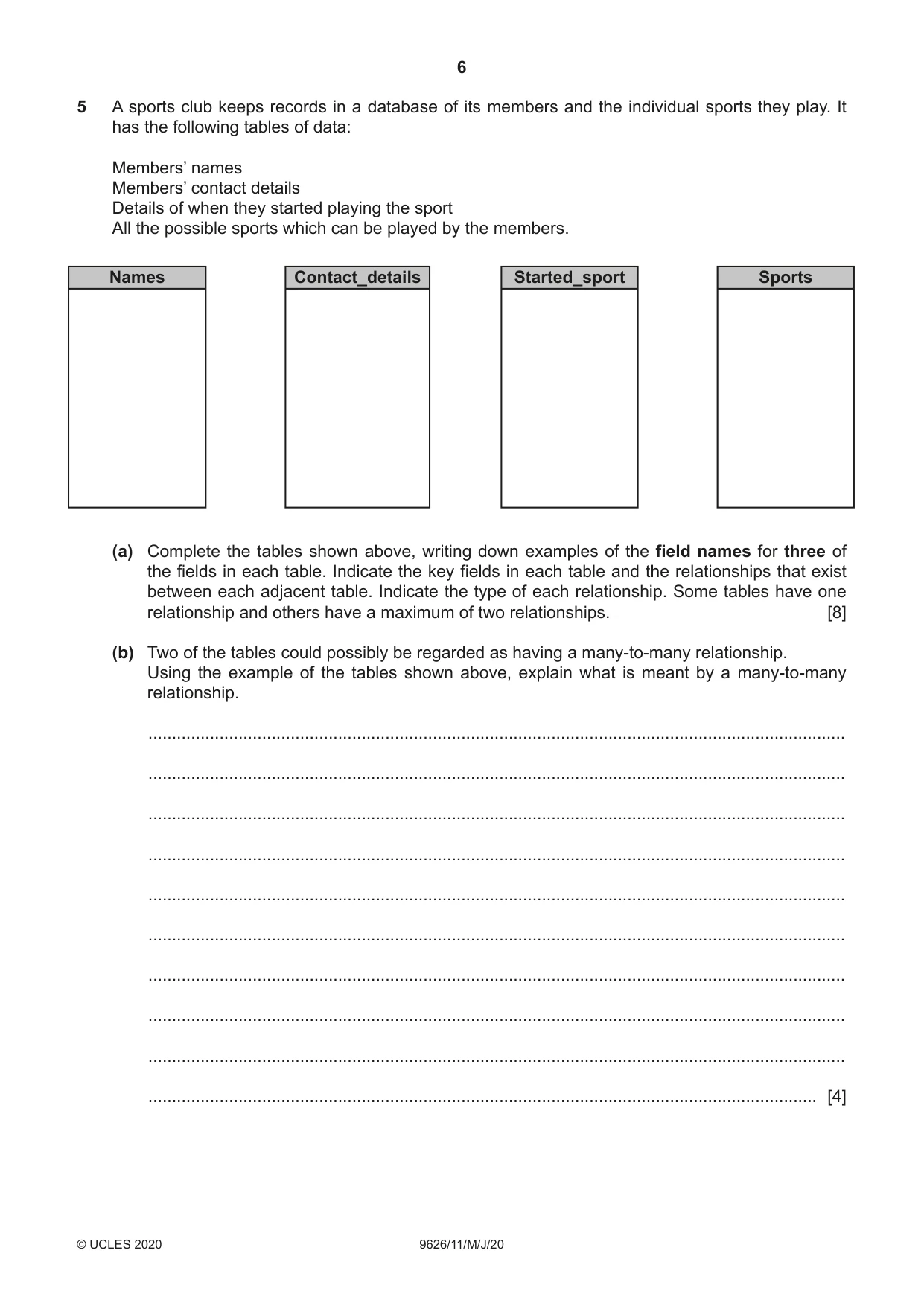
6 9626/11/M/J/20 © UCLES 2020 5 A sports club keeps records in a database of its members and the individual sports they play. It has the following tables of data: Members’ names Members’ contact details Details of when they started playing the sport All the possible sports which can be played by the members. Contact_details Names Started_sport Sports (a) Complete the tables shown above, writing down examples of the field names for three of the fields in each table. Indicate the key fields in each table and the relationships that exist between each adjacent table. Indicate the type of each relationship. Some tables have one relationship and others have a maximum of two relationships. [8] (b) Two of the tables could possibly be regarded as having a many-to-many relationship. Using the example of the tables shown above, explain what is meant by a many-to-many relationship. … … … … … … … … … … [4]
Question paper, page 7
7 9626/11/M/J/20 © UCLES 2020 [Turn over 6 Many companies use batch processing for producing workers’ payslips. (a) Describe, using payroll as an example, what is meant by batch processing. … … … … … … … … … … [4] (b) Explain why batch processing is used instead of real-time processing for an application such as payroll. … … … … … … … … … … [4]
Question paper, page 8
8 9626/11/M/J/20 © UCLES 2020 7 Designers of user interfaces tend to base their designs on what they interpret to be a user’s mental model. Evaluate, by weighing up the advantages and disadvantages, the use of a mental model to design a user interface. … … … … … … … … … … … … … … [6]
Question paper, page 9
9 9626/11/M/J/20 © UCLES 2020 [Turn over 8 Explain how encryption protects data stored on a hard disk. … … … … … … … … … … … … [5]
Question paper, page 10
10 9626/11/M/J/20 © UCLES 2020 9 By explaining what the purpose of each is, describe the differences between verification and validation. … … … … … … … … … … [4] 10 A researcher is interviewing some people. To begin with, she wants to record their personal details using a six-character code. For example, 47FT12 means the person is 47 years old, in full-time employment and left school after year 12. Explain what the code 34PT10 means and why there may be problems with coding other people in this way. Include in your explanation ways of improving this method. … … … … … … … … … … … … … … [6]
Question paper, page 11
11 9626/11/M/J/20 © UCLES 2020 [Turn over 11 Mary has been put in charge of the computerised school weather station. At the moment the system has a monitor to show the outputs. She wants to replace the monitor with a printer. By weighing up the advantages and disadvantages, evaluate the system having a monitor rather than a printer. … … … … … … … … … … … … … … [6]
Question paper, page 12
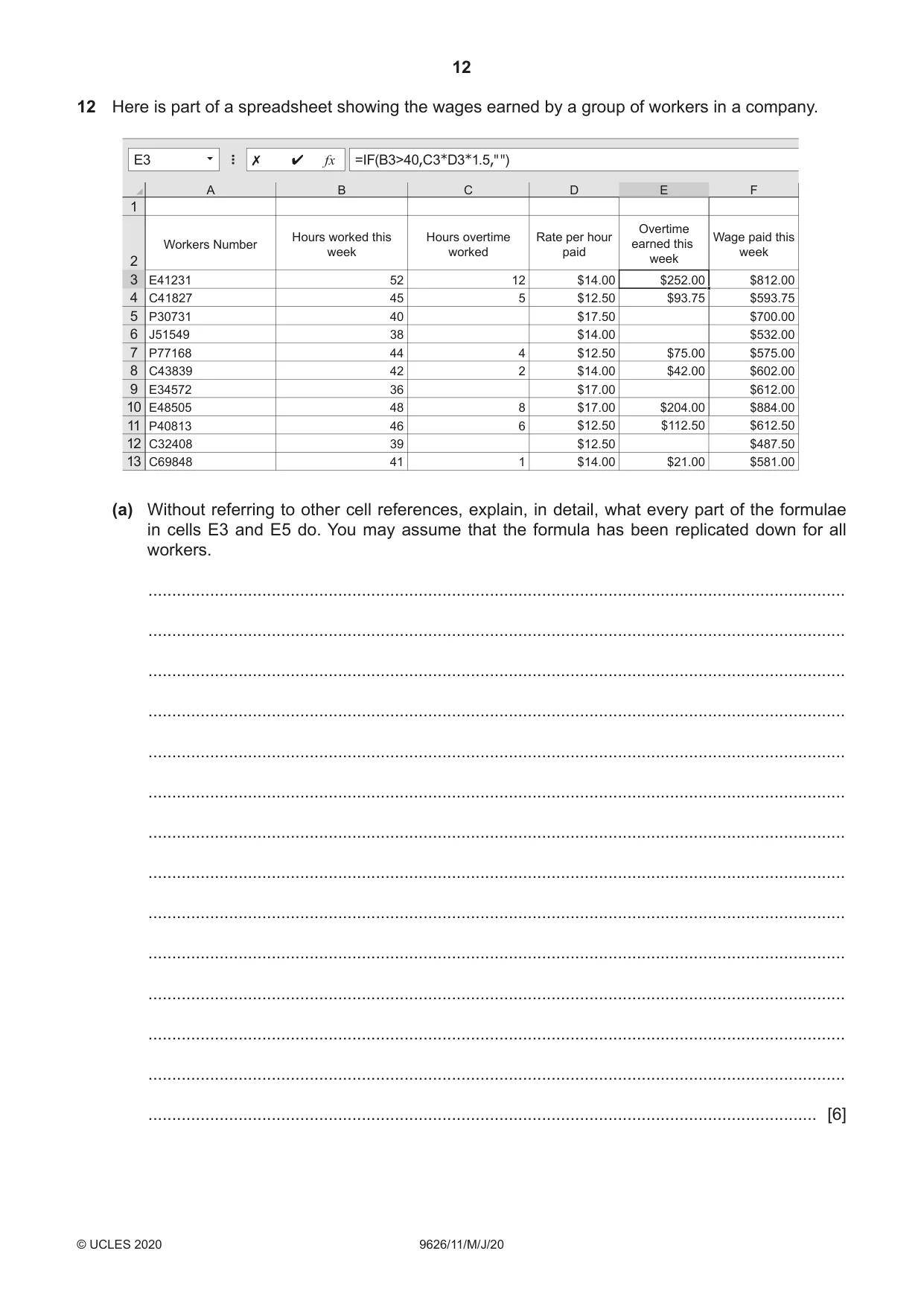
12 9626/11/M/J/20 © UCLES 2020 12 Here is part of a spreadsheet showing the wages earned by a group of workers in a company. A J51549 P30731 C41827 E41231 Workers Number Hours worked this week Hours overtime worked Rate per hour paid Wage paid this week Overtime earned this week P77168 C43839 E34572 E48505 P40813 C32408 C69848 5 12 4 2 8 6 1 48 36 42 44 38 40 45 52 46 39 41 $14.00 $17.50 $12.50 $14.00 $12.50 $14.00 $17.00 $17.00 $12.50 $12.50 $14.00 $93.75 $252.00 $75.00 $42.00 $204.00 $112.50 $21.00 $532.00 $700.00 $593.75 $812.00 $575.00 $602.00 $612.00 $884.00 $612.50 $487.50 $581.00 B C F 1 2 5 6 5 7 8 10 E3 ✗ ✔ fx D E F =IF(B3>40,C3*D3*1.5," ") 9 11 13 12 3 4 (a) Without referring to other cell references, explain, in detail, what every part of the formulae in cells E3 and E5 do. You may assume that the formula has been replicated down for all workers. … … … … … … … … … … … … … … [6]
Question paper, page 13
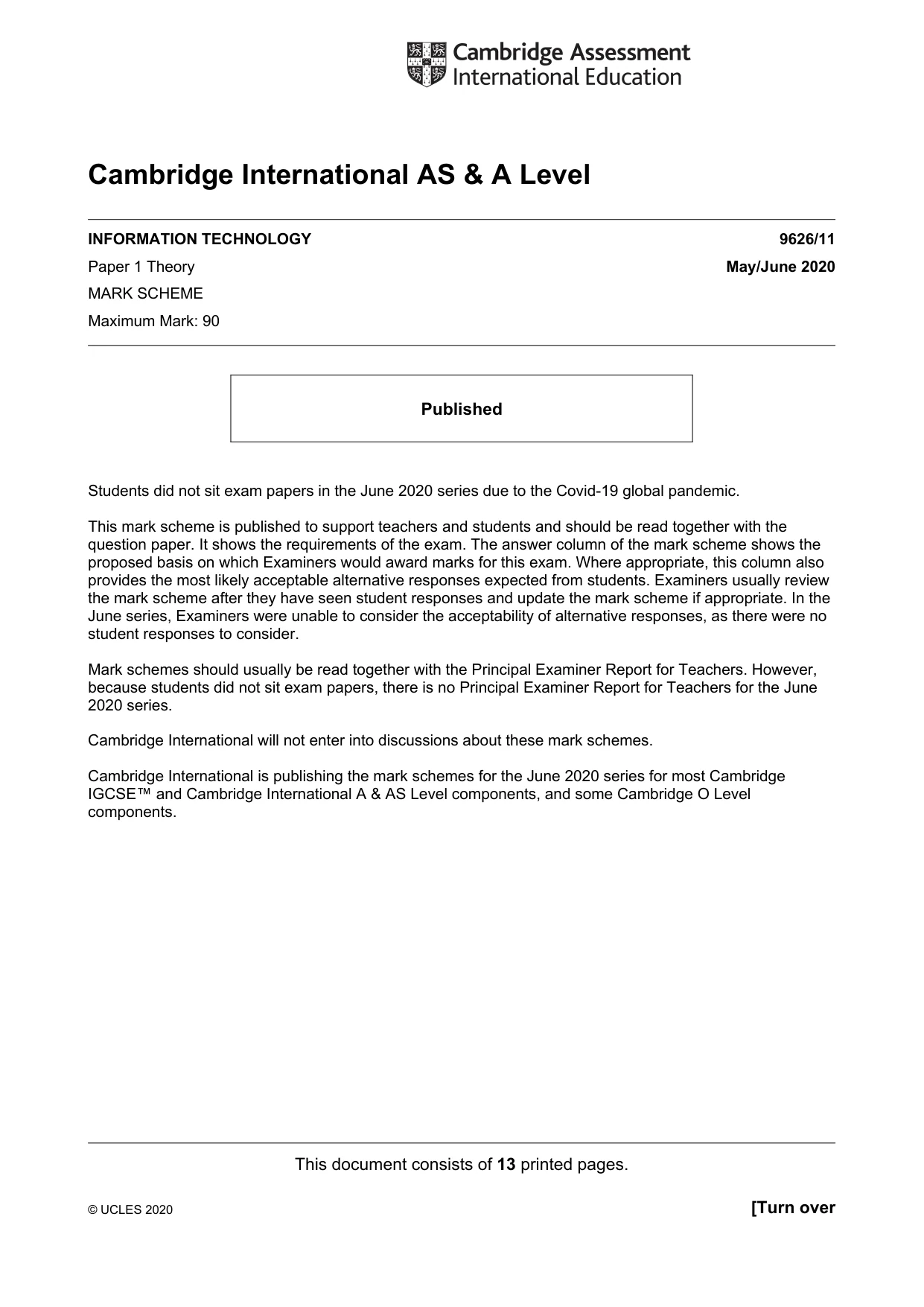
13 9626/11/M/J/20 © UCLES 2020 [Turn over (b) This spreadsheet has not been tested. Describe the test plan you would use to make sure there are no errors in the formulae in column E of this spreadsheet. You can assume that the formula in column C works perfectly and does not need changing. … … … … … … … … … … … … [5] (c) Using only the sort feature explain how you would be able to make the spreadsheet used in part (a) produce this display. A C32408 P77168 C41827 P40813 Workers Number Hours worked this week Hours overtime worked Rate per hour paid Wage paid this week Overtime earned this week E41231 C43839 C69848 J51549 E48505 E34572 P30731 5 6 4 12 2 1 8 38 41 42 52 39 44 45 46 48 36 40 $12.50 $12.50 $12.50 $12.50 $14.00 $14.00 $14.00 $14.00 $17.00 $17.00 $17.50 $93.75 $75.00 $112.50 $252.00 $42.00 $21.00 $204.00 $487.50 $575.00 $593.75 $612.50 $812.00 $602.00 $581.00 $532.00 $884.00 $612.00 $700.00 B C 1 2 6 5 7 8 10 D E F 9 11 13 12 4 3 … … … … … … … … [3]
Question paper, page 14
14 9626/11/M/J/20 © UCLES 2020 13 Computers are often used for environmental monitoring applications such as pollution in rivers. Evaluate, by weighing up the advantages and disadvantages, the use of computers rather than humans in such scenarios. … … … … … … … … … … … … … … … … … … … … … [8]
Question paper, page 15
15 9626/11/M/J/20 © UCLES 2020 BLANK PAGE
Question paper, page 16
16 9626/11/M/J/20 © UCLES 2020 Permission to reproduce items where third-party owned material protected by copyright is included has been sought and cleared where possible. Every reasonable effort has been made by the publisher (UCLES) to trace copyright holders, but if any items requiring clearance have unwittingly been included, the publisher will be pleased to make amends at the earliest possible opportunity. To avoid the issue of disclosure of answer-related information to candidates, all copyright acknowledgements are reproduced online in the Cambridge Assessment International Education Copyright Acknowledgements Booklet. This is produced for each series of examinations and is freely available to download at www.cambridgeinternational.org after the live examination series. Cambridge Assessment International Education is part of the Cambridge Assessment Group. Cambridge Assessment is the brand name of the University of Cambridge Local Examinations Syndicate (UCLES), which itself is a department of the University of Cambridge. BLANK PAGE
Mark scheme, page 1
This document consists of 13 printed pages. © UCLES 2020 [Turn over Cambridge International AS & A Level INFORMATION TECHNOLOGY 9626/11 Paper 1 Theory May/June 2020 MARK SCHEME Maximum Mark: 90 Published Students did not sit exam papers in the June 2020 series due to the Covid-19 global pandemic. This mark scheme is published to support teachers and students and should be read together with the question paper. It shows the requirements of the exam. The answer column of the mark scheme shows the proposed basis on which Examiners would award marks for this exam. Where appropriate, this column also provides the most likely acceptable alternative responses expected from students. Examiners usually review the mark scheme after they have seen student responses and update the mark scheme if appropriate. In the June series, Examiners were unable to consider the acceptability of alternative responses, as there were no student responses to consider. Mark schemes should usually be read together with the Principal Examiner Report for Teachers. However, because students did not sit exam papers, there is no Principal Examiner Report for Teachers for the June 2020 series. Cambridge International will not enter into discussions about these mark schemes. Cambridge International is publishing the mark schemes for the June 2020 series for most Cambridge IGCSE™ and Cambridge International A & AS Level components, and some Cambridge O Level components.
Mark scheme, page 2
9626/11 Cambridge International AS & A Level – Mark Scheme PUBLISHED May/June 2020 © UCLES 2020 Page 2 of 13 Generic Marking Principles These general marking principles must be applied by all examiners when marking candidate answers. They should be applied alongside the specific content of the mark scheme or generic level descriptors for a question. Each question paper and mark scheme will also comply with these marking principles. GENERIC MARKING PRINCIPLE 1: Marks must be awarded in line with: the specific content of the mark scheme or the generic level descriptors for the question the specific skills defined in the mark scheme or in the generic level descriptors for the question the standard of response required by a candidate as exemplified by the standardisation scripts. GENERIC MARKING PRINCIPLE 2: Marks awarded are always whole marks (not half marks, or other fractions). GENERIC MARKING PRINCIPLE 3: Marks must be awarded positively: marks are awarded for correct/valid answers, as defined in the mark scheme. However, credit is given for valid answers which go beyond the scope of the syllabus and mark scheme, referring to your Team Leader as appropriate marks are awarded when candidates clearly demonstrate what they know and can do marks are not deducted for errors marks are not deducted for omissions answers should only be judged on the quality of spelling, punctuation and grammar when these features are specifically assessed by the question as indicated by the mark scheme. The meaning, however, should be unambiguous. GENERIC MARKING PRINCIPLE 4: Rules must be applied consistently e.g. in situations where candidates have not followed instructions or in the application of generic level descriptors.
Mark scheme, page 3
9626/11 Cambridge International AS & A Level – Mark Scheme PUBLISHED May/June 2020 © UCLES 2020 Page 3 of 13 GENERIC MARKING PRINCIPLE 5: Marks should be awarded using the full range of marks defined in the mark scheme for the question (however; the use of the full mark range may be limited according to the quality of the candidate responses seen). GENERIC MARKING PRINCIPLE 6: Marks awarded are based solely on the requirements as defined in the mark scheme. Marks should not be awarded with grade thresholds or grade descriptors in mind.
Mark scheme, page 4
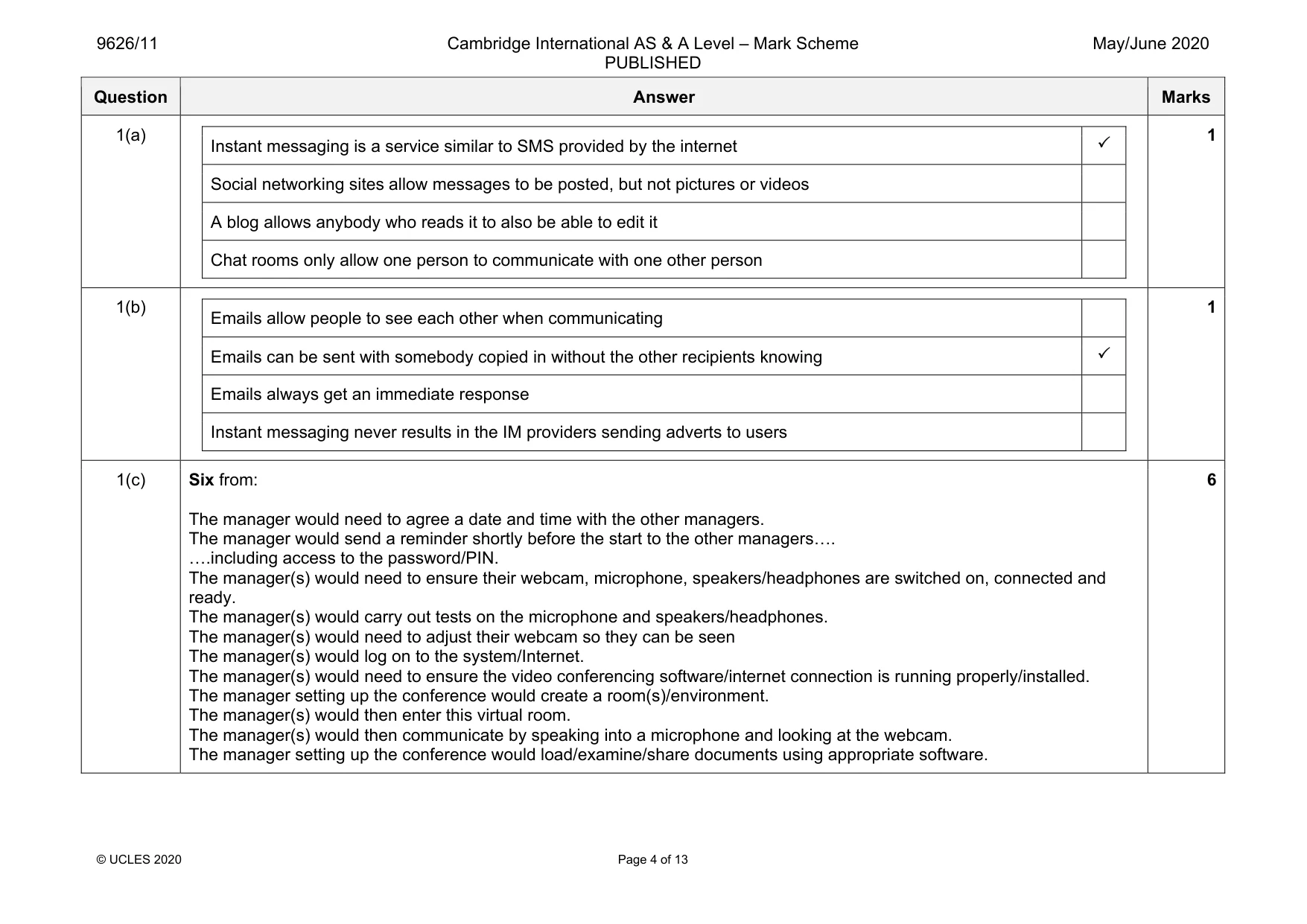
9626/11 Cambridge International AS & A Level – Mark Scheme PUBLISHED May/June 2020 © UCLES 2020 Page 4 of 13 Question Answer Marks 1(a) Instant messaging is a service similar to SMS provided by the internet Social networking sites allow messages to be posted, but not pictures or videos A blog allows anybody who reads it to also be able to edit it Chat rooms only allow one person to communicate with one other person 1 1(b) Emails allow people to see each other when communicating Emails can be sent with somebody copied in without the other recipients knowing Emails always get an immediate response Instant messaging never results in the IM providers sending adverts to users 1 1(c) Six from: The manager would need to agree a date and time with the other managers. The manager would send a reminder shortly before the start to the other managers…. ….including access to the password/PIN. The manager(s) would need to ensure their webcam, microphone, speakers/headphones are switched on, connected and ready. The manager(s) would carry out tests on the microphone and speakers/headphones. The manager(s) would need to adjust their webcam so they can be seen The manager(s) would log on to the system/Internet. The manager(s) would need to ensure the video conferencing software/internet connection is running properly/installed. The manager setting up the conference would create a room(s)/environment. The manager(s) would then enter this virtual room. The manager(s) would then communicate by speaking into a microphone and looking at the webcam. The manager setting up the conference would load/examine/share documents using appropriate software. 6
Mark scheme, page 5
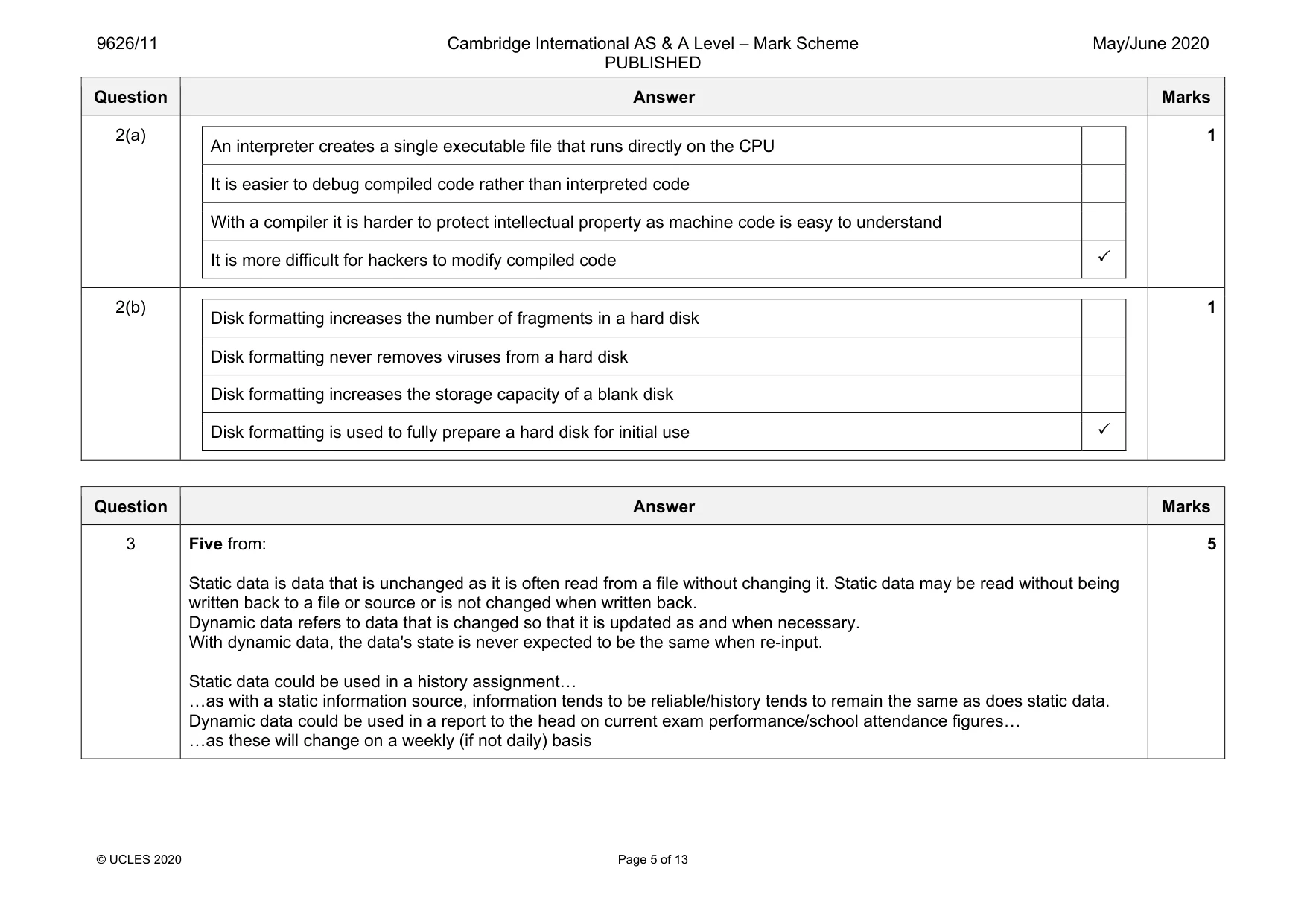
9626/11 Cambridge International AS & A Level – Mark Scheme PUBLISHED May/June 2020 © UCLES 2020 Page 5 of 13 Question Answer Marks 2(a) An interpreter creates a single executable file that runs directly on the CPU It is easier to debug compiled code rather than interpreted code With a compiler it is harder to protect intellectual property as machine code is easy to understand It is more difficult for hackers to modify compiled code 1 2(b) Disk formatting increases the number of fragments in a hard disk Disk formatting never removes viruses from a hard disk Disk formatting increases the storage capacity of a blank disk Disk formatting is used to fully prepare a hard disk for initial use 1 Question Answer Marks 3 Five from: Static data is data that is unchanged as it is often read from a file without changing it. Static data may be read without being written back to a file or source or is not changed when written back. Dynamic data refers to data that is changed so that it is updated as and when necessary. With dynamic data, the data's state is never expected to be the same when re-input. Static data could be used in a history assignment… …as with a static information source, information tends to be reliable/history tends to remain the same as does static data. Dynamic data could be used in a report to the head on current exam performance/school attendance figures… …as these will change on a weekly (if not daily) basis 5
Mark scheme, page 6
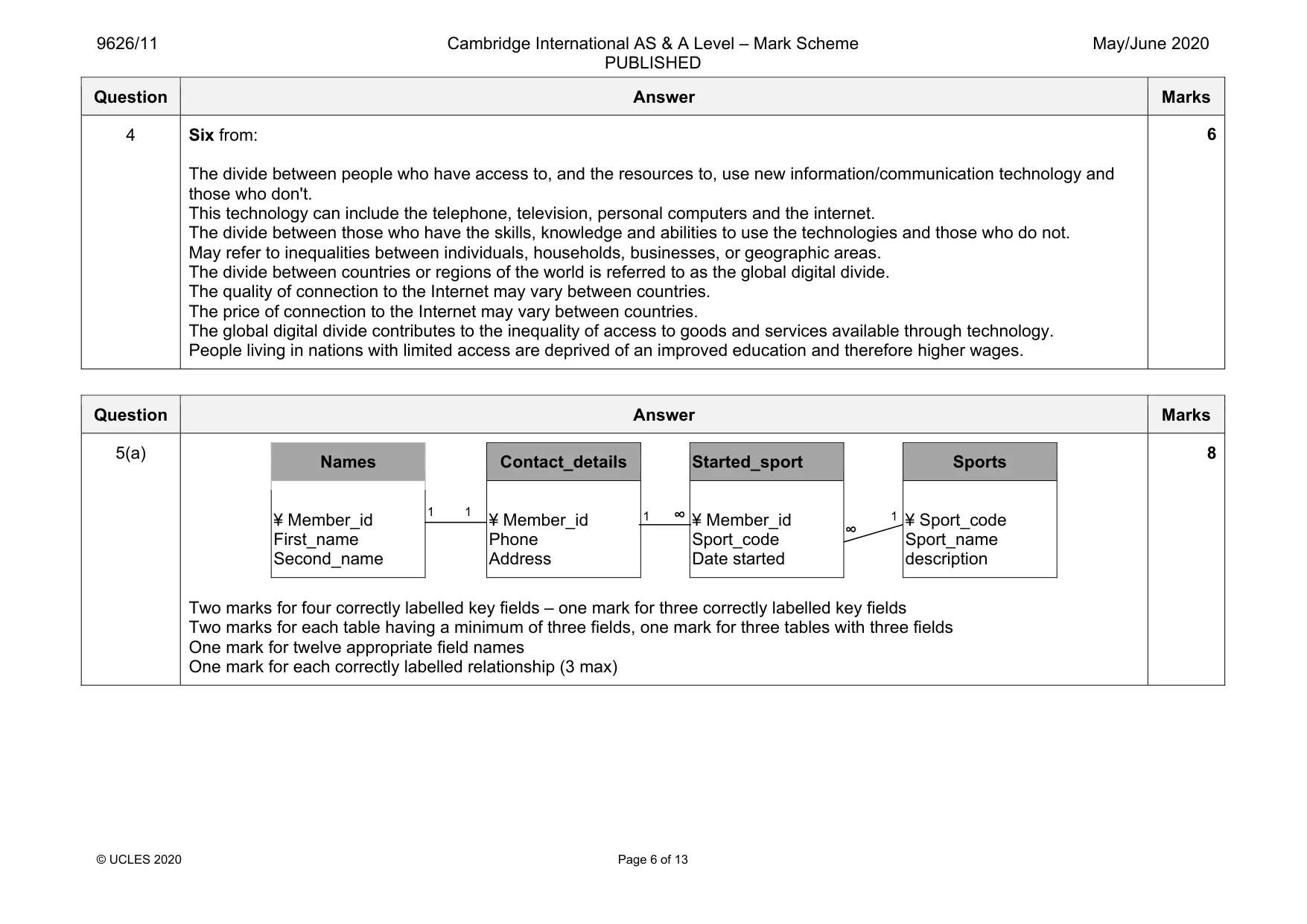
9626/11 Cambridge International AS & A Level – Mark Scheme PUBLISHED May/June 2020 © UCLES 2020 Page 6 of 13 Question Answer Marks 4 Six from: The divide between people who have access to, and the resources to, use new information/communication technology and those who don't. This technology can include the telephone, television, personal computers and the internet. The divide between those who have the skills, knowledge and abilities to use the technologies and those who do not. May refer to inequalities between individuals, households, businesses, or geographic areas. The divide between countries or regions of the world is referred to as the global digital divide. The quality of connection to the Internet may vary between countries. The price of connection to the Internet may vary between countries. The global digital divide contributes to the inequality of access to goods and services available through technology. People living in nations with limited access are deprived of an improved education and therefore higher wages. 6 Question Answer Marks 5(a) Names Contact_details Started_sport Sports ¥ Member_id First_name Second_name 1 1 ¥ Member_id Phone Address 1 ∞ ¥ Member_id Sport_code Date started ¥ Sport_code Sport_name description Two marks for four correctly labelled key fields – one mark for three correctly labelled key fields Two marks for each table having a minimum of three fields, one mark for three tables with three fields One mark for twelve appropriate field names One mark for each correctly labelled relationship (3 max) 8 ∞ 1
Mark scheme, page 7
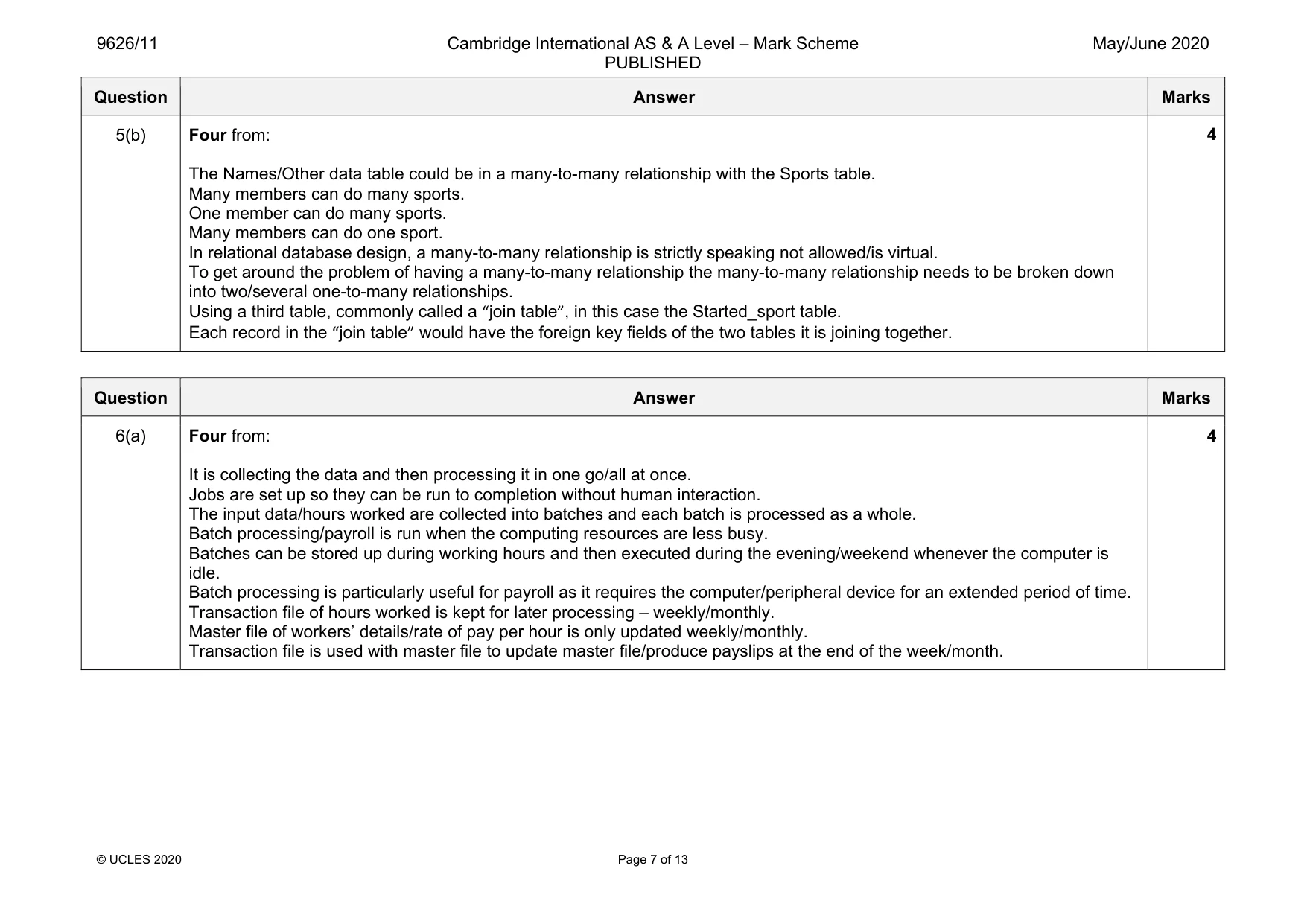
9626/11 Cambridge International AS & A Level – Mark Scheme PUBLISHED May/June 2020 © UCLES 2020 Page 7 of 13 Question Answer Marks 5(b) Four from: The Names/Other data table could be in a many-to-many relationship with the Sports table. Many members can do many sports. One member can do many sports. Many members can do one sport. In relational database design, a many-to-many relationship is strictly speaking not allowed/is virtual. To get around the problem of having a many-to-many relationship the many-to-many relationship needs to be broken down into two/several one-to-many relationships. Using a third table, commonly called a “join table”, in this case the Started_sport table. Each record in the “join table” would have the foreign key fields of the two tables it is joining together. 4 Question Answer Marks 6(a) Four from: It is collecting the data and then processing it in one go/all at once. Jobs are set up so they can be run to completion without human interaction. The input data/hours worked are collected into batches and each batch is processed as a whole. Batch processing/payroll is run when the computing resources are less busy. Batches can be stored up during working hours and then executed during the evening/weekend whenever the computer is idle. Batch processing is particularly useful for payroll as it requires the computer/peripheral device for an extended period of time. Transaction file of hours worked is kept for later processing – weekly/monthly. Master file of workers’ details/rate of pay per hour is only updated weekly/monthly. Transaction file is used with master file to update master file/produce payslips at the end of the week/month. 4
Mark scheme, page 8
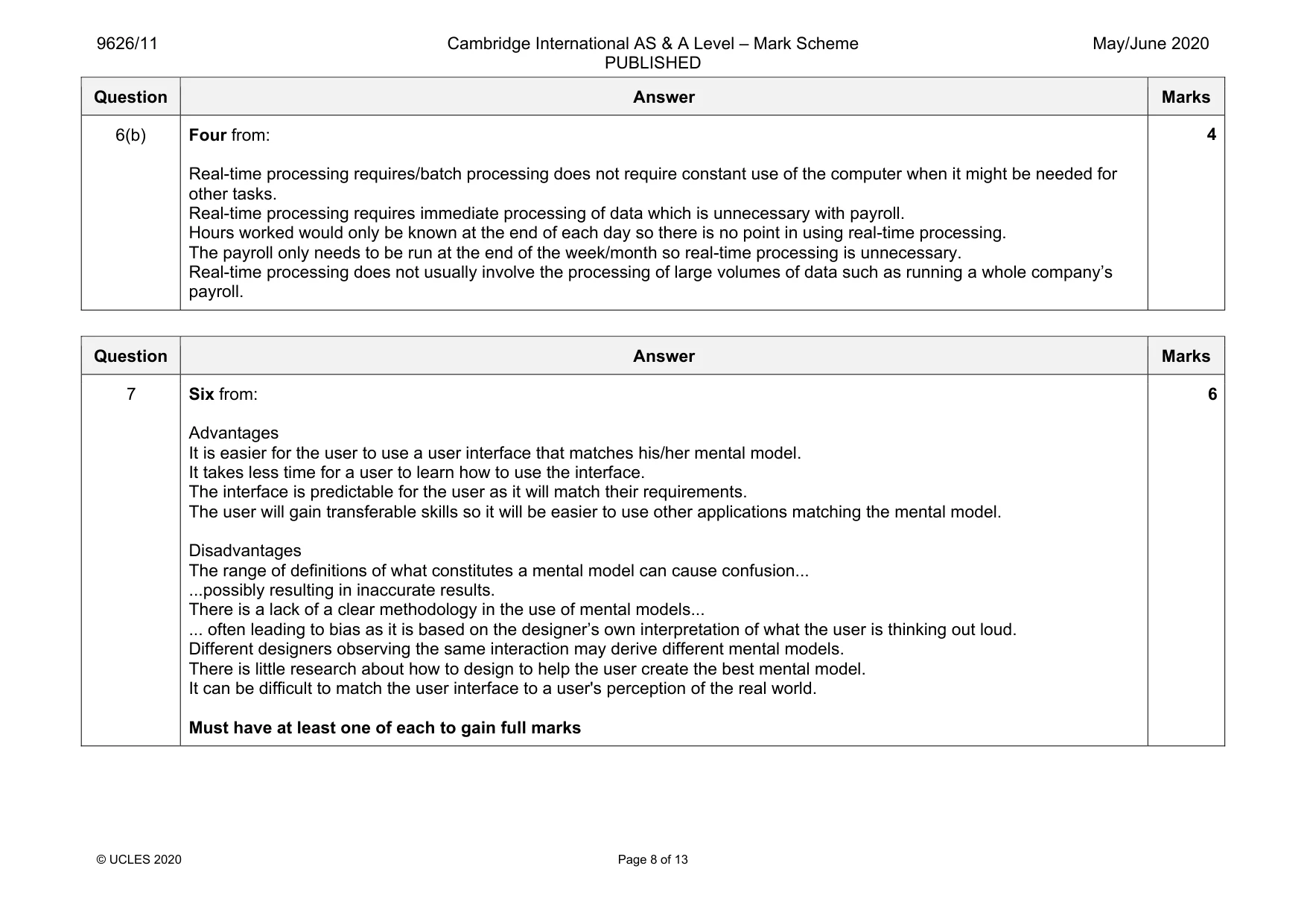
9626/11 Cambridge International AS & A Level – Mark Scheme PUBLISHED May/June 2020 © UCLES 2020 Page 8 of 13 Question Answer Marks 6(b) Four from: Real-time processing requires/batch processing does not require constant use of the computer when it might be needed for other tasks. Real-time processing requires immediate processing of data which is unnecessary with payroll. Hours worked would only be known at the end of each day so there is no point in using real-time processing. The payroll only needs to be run at the end of the week/month so real-time processing is unnecessary. Real-time processing does not usually involve the processing of large volumes of data such as running a whole company’s payroll. 4 Question Answer Marks 7 Six from: Advantages It is easier for the user to use a user interface that matches his/her mental model. It takes less time for a user to learn how to use the interface. The interface is predictable for the user as it will match their requirements. The user will gain transferable skills so it will be easier to use other applications matching the mental model. Disadvantages The range of definitions of what constitutes a mental model can cause confusion... ...possibly resulting in inaccurate results. There is a lack of a clear methodology in the use of mental models... ... often leading to bias as it is based on the designer’s own interpretation of what the user is thinking out loud. Different designers observing the same interaction may derive different mental models. There is little research about how to design to help the user create the best mental model. It can be difficult to match the user interface to a user's perception of the real world. Must have at least one of each to gain full marks 6
Mark scheme, page 9
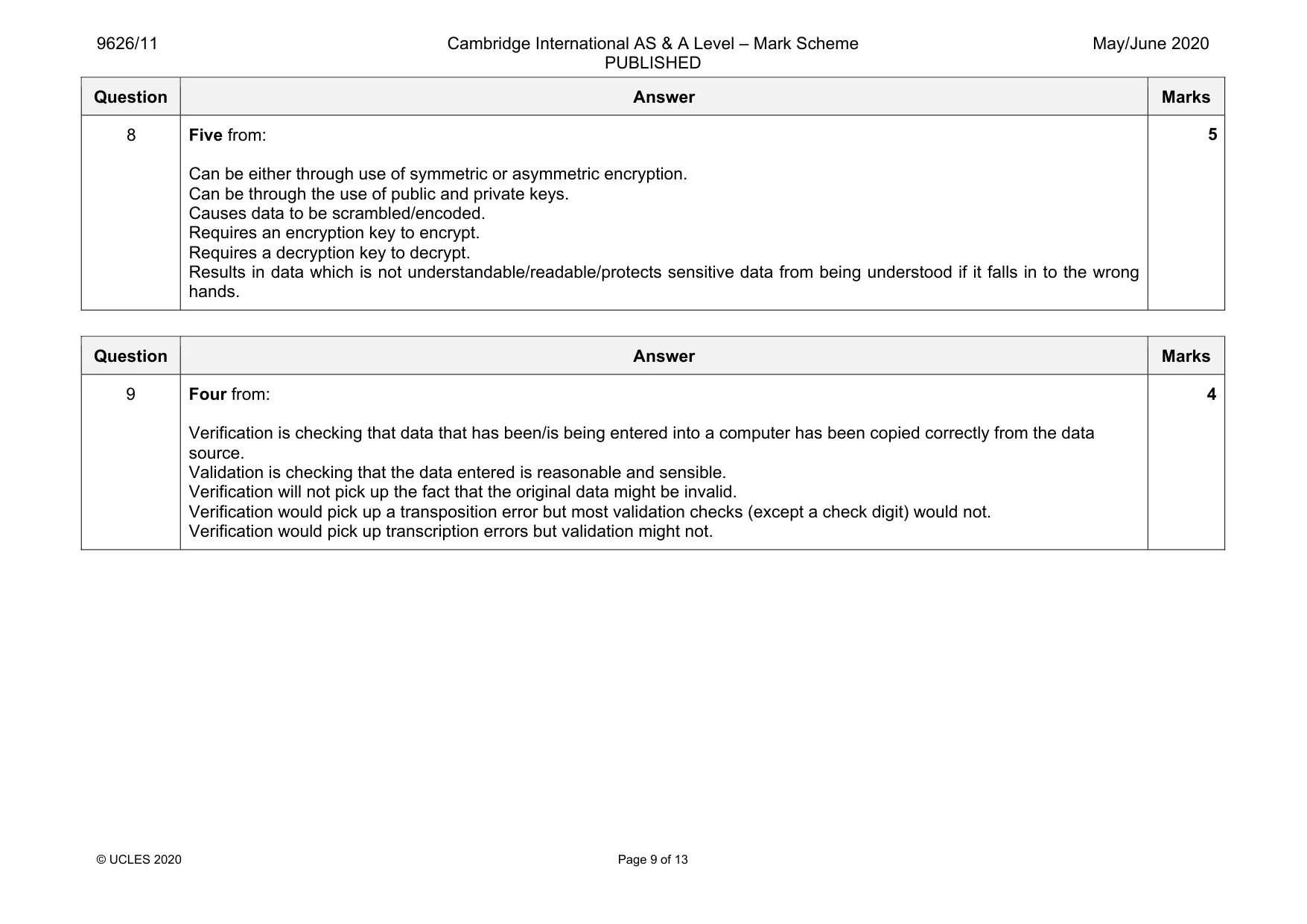
9626/11 Cambridge International AS & A Level – Mark Scheme PUBLISHED May/June 2020 © UCLES 2020 Page 9 of 13 Question Answer Marks 8 Five from: Can be either through use of symmetric or asymmetric encryption. Can be through the use of public and private keys. Causes data to be scrambled/encoded. Requires an encryption key to encrypt. Requires a decryption key to decrypt. Results in data which is not understandable/readable/protects sensitive data from being understood if it falls in to the wrong hands. 5 Question Answer Marks 9 Four from: Verification is checking that data that has been/is being entered into a computer has been copied correctly from the data source. Validation is checking that the data entered is reasonable and sensible. Verification will not pick up the fact that the original data might be invalid. Verification would pick up a transposition error but most validation checks (except a check digit) would not. Verification would pick up transcription errors but validation might not. 4
Mark scheme, page 10
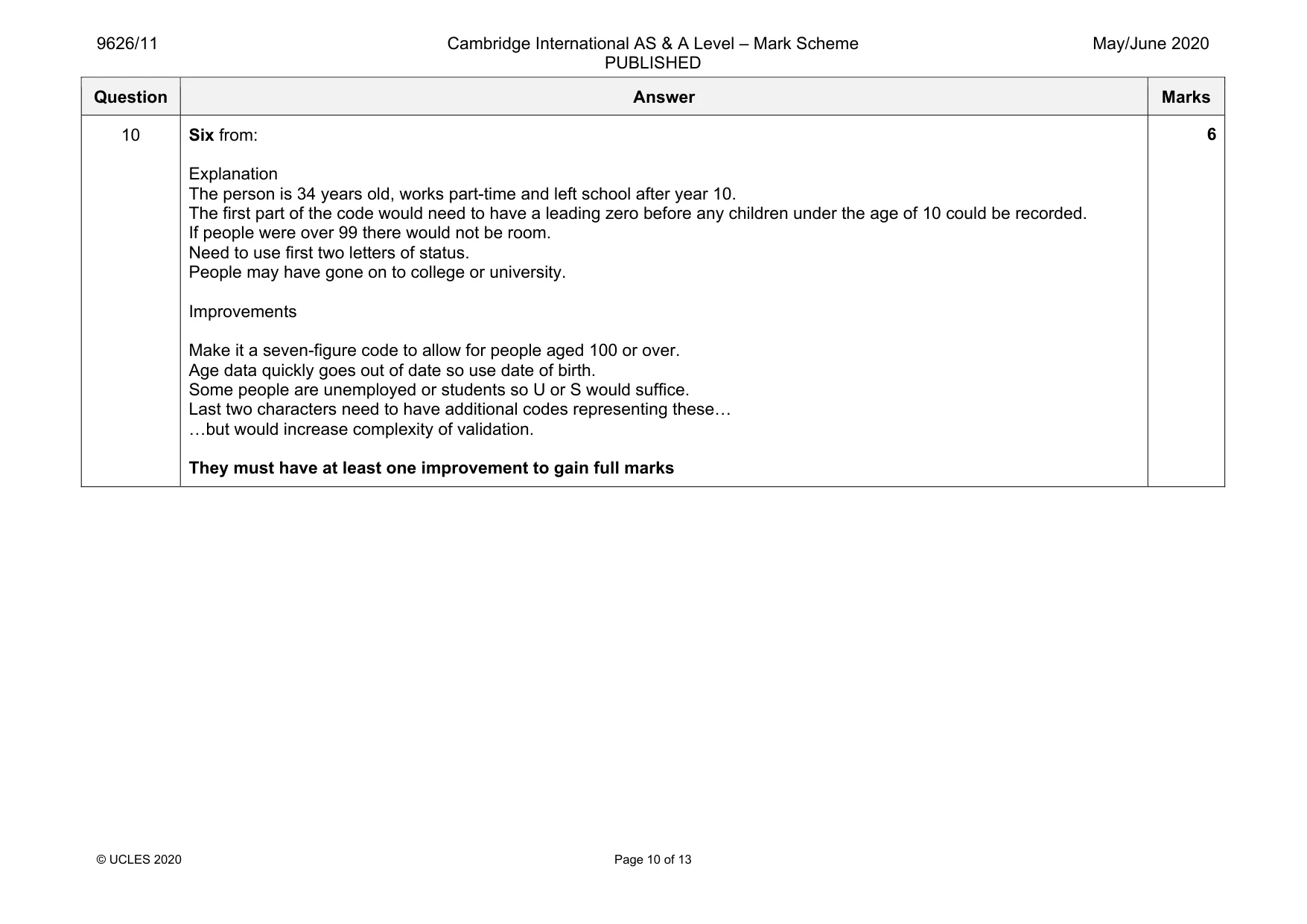
9626/11 Cambridge International AS & A Level – Mark Scheme PUBLISHED May/June 2020 © UCLES 2020 Page 10 of 13 Question Answer Marks 10 Six from: Explanation The person is 34 years old, works part-time and left school after year 10. The first part of the code would need to have a leading zero before any children under the age of 10 could be recorded. If people were over 99 there would not be room. Need to use first two letters of status. People may have gone on to college or university. Improvements Make it a seven-figure code to allow for people aged 100 or over. Age data quickly goes out of date so use date of birth. Some people are unemployed or students so U or S would suffice. Last two characters need to have additional codes representing these… …but would increase complexity of validation. They must have at least one improvement to gain full marks 6
Mark scheme, page 11
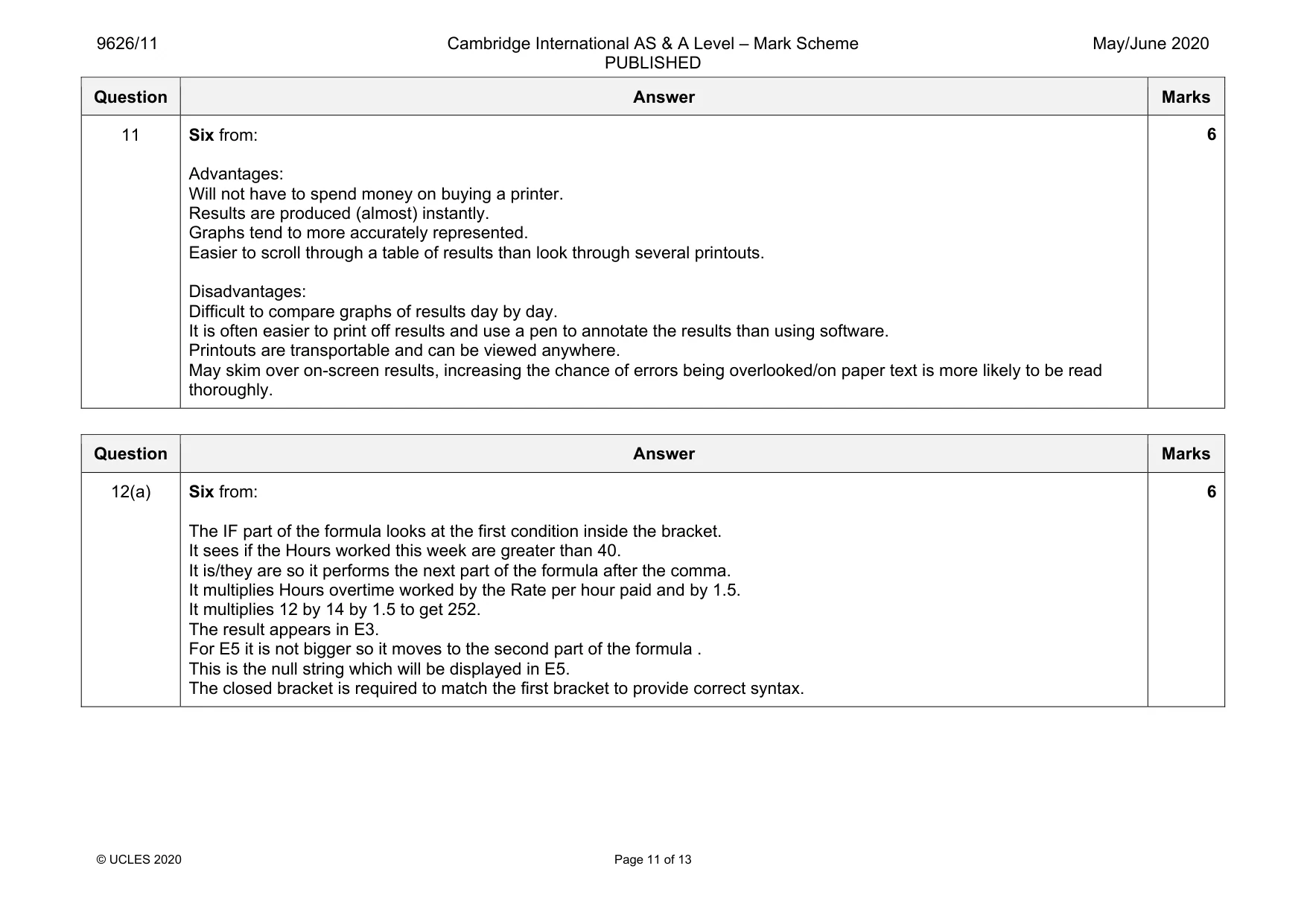
9626/11 Cambridge International AS & A Level – Mark Scheme PUBLISHED May/June 2020 © UCLES 2020 Page 11 of 13 Question Answer Marks 11 Six from: Advantages: Will not have to spend money on buying a printer. Results are produced (almost) instantly. Graphs tend to more accurately represented. Easier to scroll through a table of results than look through several printouts. Disadvantages: Difficult to compare graphs of results day by day. It is often easier to print off results and use a pen to annotate the results than using software. Printouts are transportable and can be viewed anywhere. May skim over on-screen results, increasing the chance of errors being overlooked/on paper text is more likely to be read thoroughly. 6 Question Answer Marks 12(a) Six from: The IF part of the formula looks at the first condition inside the bracket. It sees if the Hours worked this week are greater than 40. It is/they are so it performs the next part of the formula after the comma. It multiplies Hours overtime worked by the Rate per hour paid and by 1.5. It multiplies 12 by 14 by 1.5 to get 252. The result appears in E3. For E5 it is not bigger so it moves to the second part of the formula . This is the null string which will be displayed in E5. The closed bracket is required to match the first bracket to provide correct syntax. 6
Mark scheme, page 12
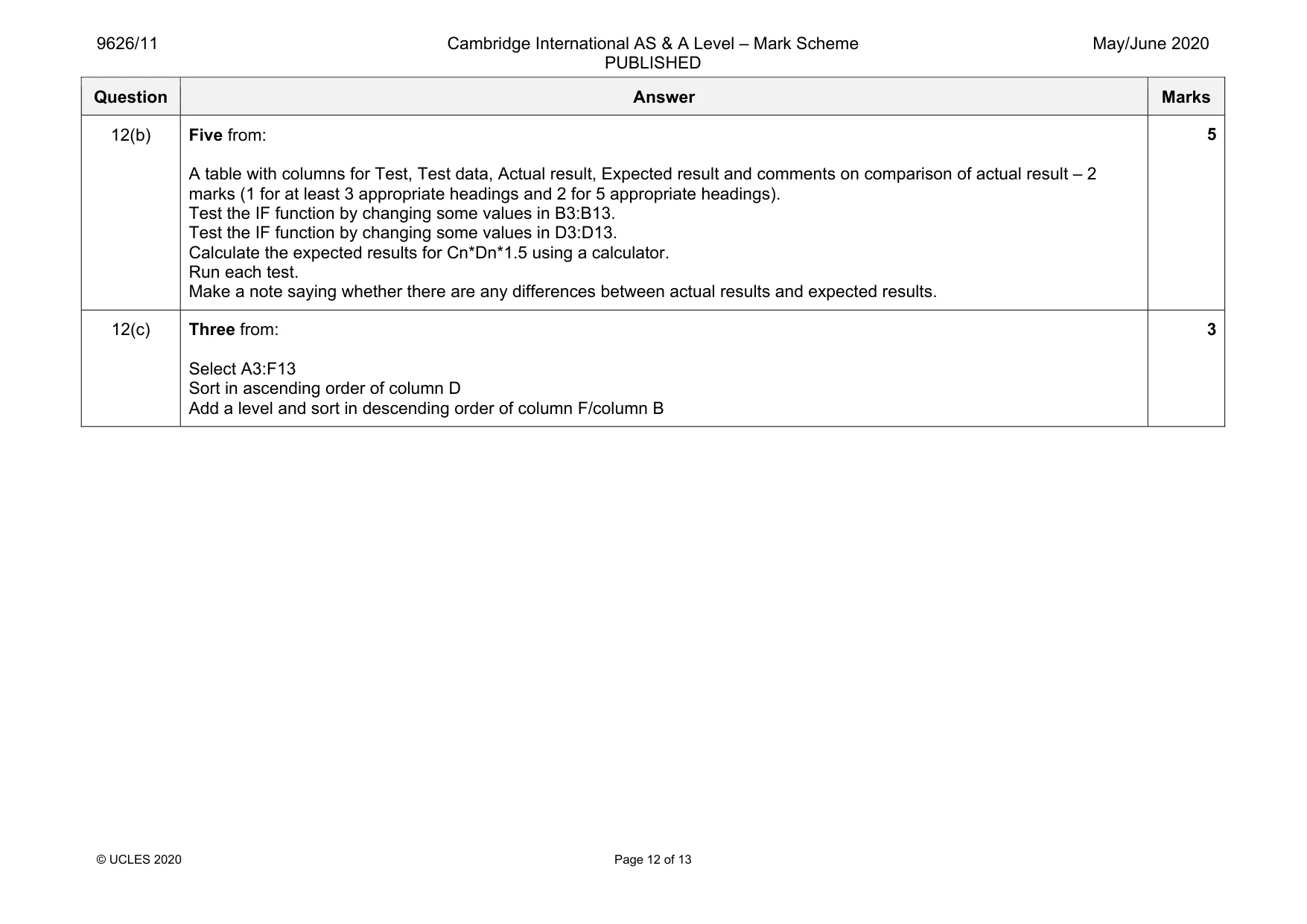
9626/11 Cambridge International AS & A Level – Mark Scheme PUBLISHED May/June 2020 © UCLES 2020 Page 12 of 13 Question Answer Marks 12(b) Five from: A table with columns for Test, Test data, Actual result, Expected result and comments on comparison of actual result – 2 marks (1 for at least 3 appropriate headings and 2 for 5 appropriate headings). Test the IF function by changing some values in B3:B13. Test the IF function by changing some values in D3:D13. Calculate the expected results for Cn*Dn*1.5 using a calculator. Run each test. Make a note saying whether there are any differences between actual results and expected results. 5 12(c) Three from: Select A3:F13 Sort in ascending order of column D Add a level and sort in descending order of column F/column B 3
Mark scheme, page 13
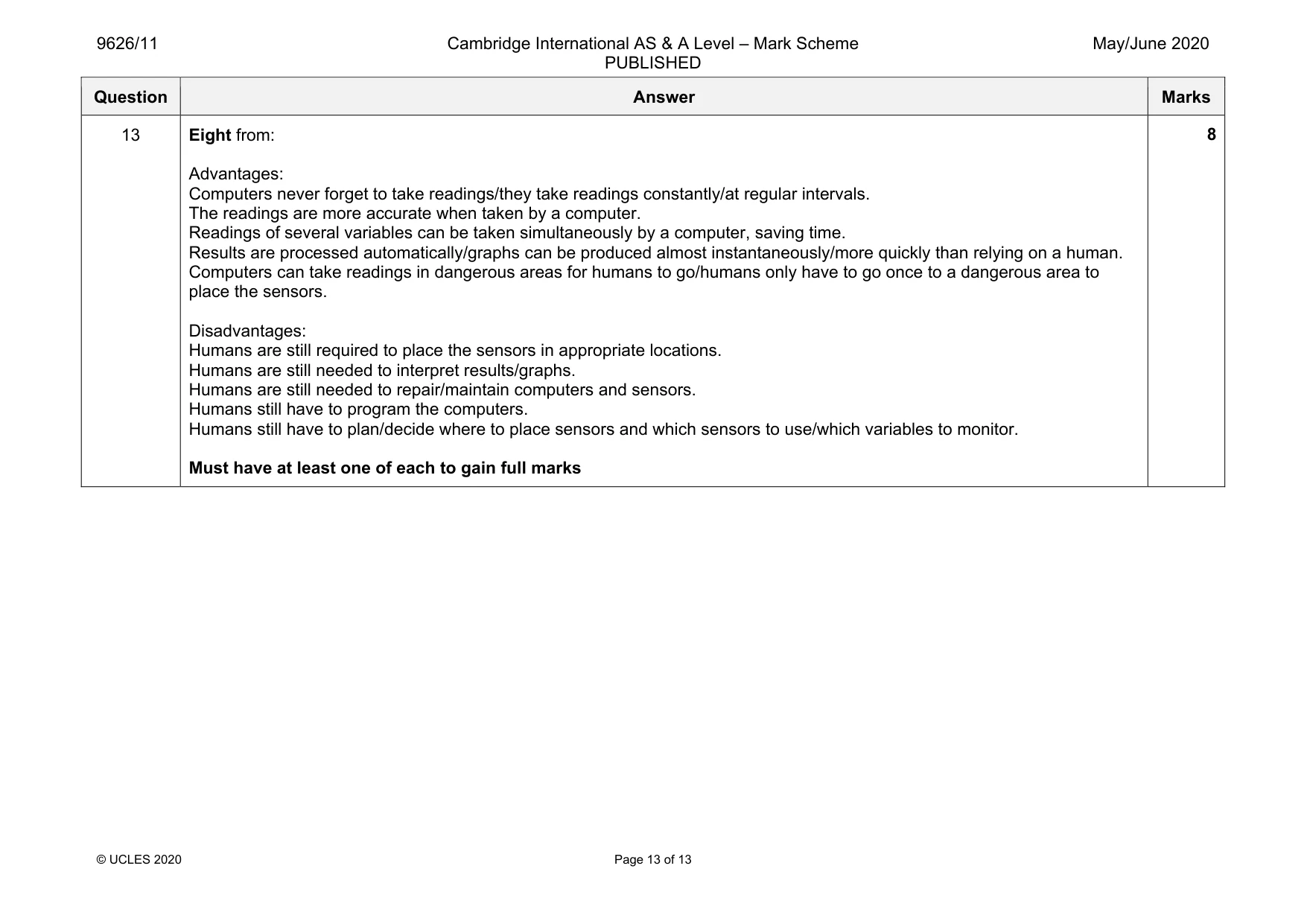
9626/11 Cambridge International AS & A Level – Mark Scheme PUBLISHED May/June 2020 © UCLES 2020 Page 13 of 13 Question Answer Marks 13 Eight from: Advantages: Computers never forget to take readings/they take readings constantly/at regular intervals. The readings are more accurate when taken by a computer. Readings of several variables can be taken simultaneously by a computer, saving time. Results are processed automatically/graphs can be produced almost instantaneously/more quickly than relying on a human. Computers can take readings in dangerous areas for humans to go/humans only have to go once to a dangerous area to place the sensors. Disadvantages: Humans are still required to place the sensors in appropriate locations. Humans are still needed to interpret results/graphs. Humans are still needed to repair/maintain computers and sensors. Humans still have to program the computers. Humans still have to plan/decide where to place sensors and which sensors to use/which variables to monitor. Must have at least one of each to gain full marks 8