Cambridge A Level Information Technology (from 2017) 9626 — 2019 Oct/Nov Paper 1 · Variant 1
9626/11/O/N/19 · 90 marks · ≈101 min
The question paper and its mark scheme, free to read here and free to download. This is Cambridge’s own paper, exactly as it was sat.
Question paper16 pages










Mark scheme12 pages
Answers below. Sit the paper first if you are practising.


Paper as text
Question paper, page 1
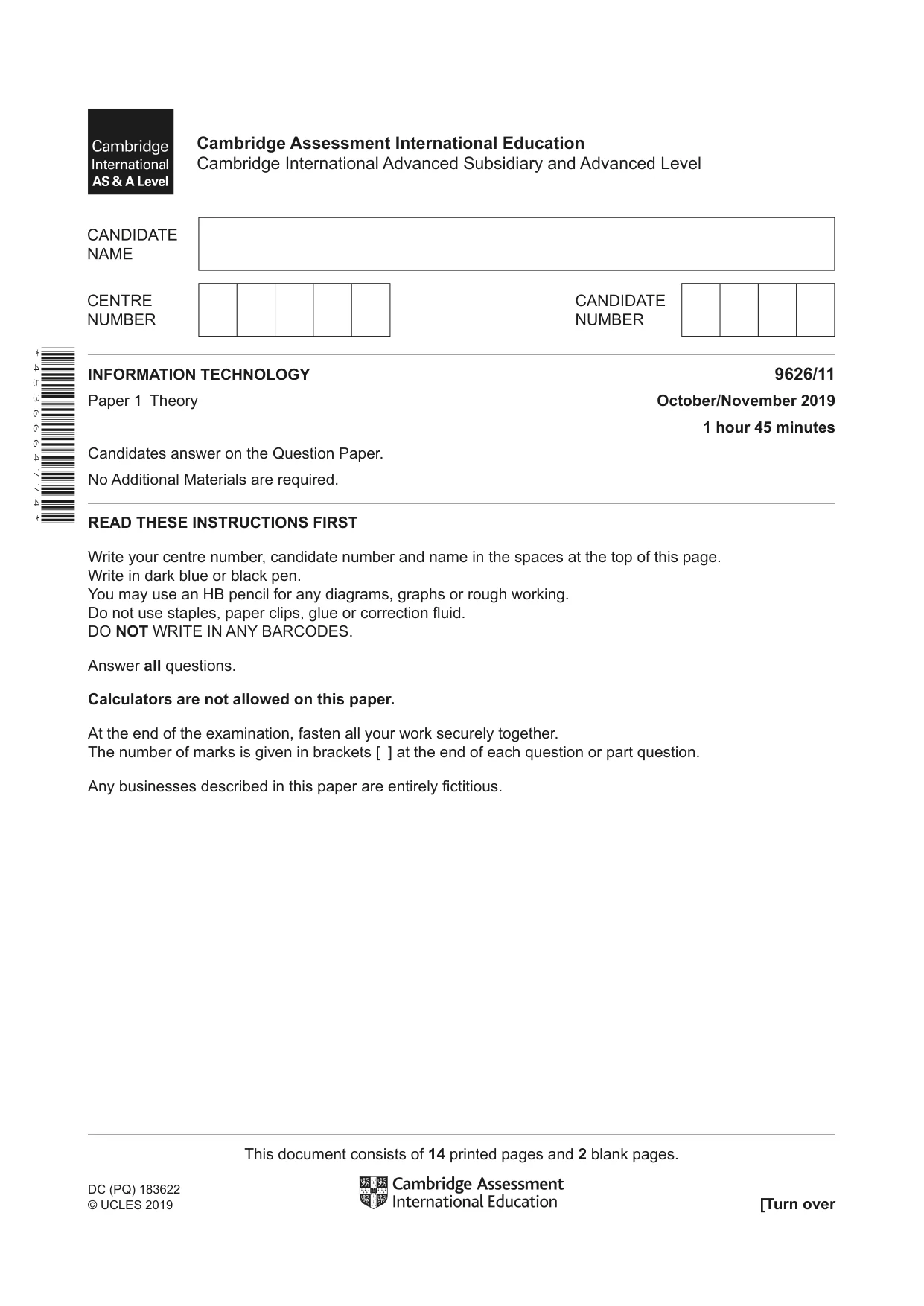
This document consists of 14 printed pages and 2 blank pages. DC (PQ) 183622 © UCLES 2019 [Turn over * 4 5 3 6 6 6 4 7 7 4 * INFORMATION TECHNOLOGY 9626/11 Paper 1 Theory October/November 2019 1 hour 45 minutes Candidates answer on the Question Paper. No Additional Materials are required. READ THESE INSTRUCTIONS FIRST Write your centre number, candidate number and name in the spaces at the top of this page. Write in dark blue or black pen. You may use an HB pencil for any diagrams, graphs or rough working. Do not use staples, paper clips, glue or correction fluid. DO NOT WRITE IN ANY BARCODES. Answer all questions. Calculators are not allowed on this paper. At the end of the examination, fasten all your work securely together. The number of marks is given in brackets [ ] at the end of each question or part question. Any businesses described in this paper are entirely fictitious. Cambridge Assessment International Education Cambridge International Advanced Subsidiary and Advanced Level
Question paper, page 2
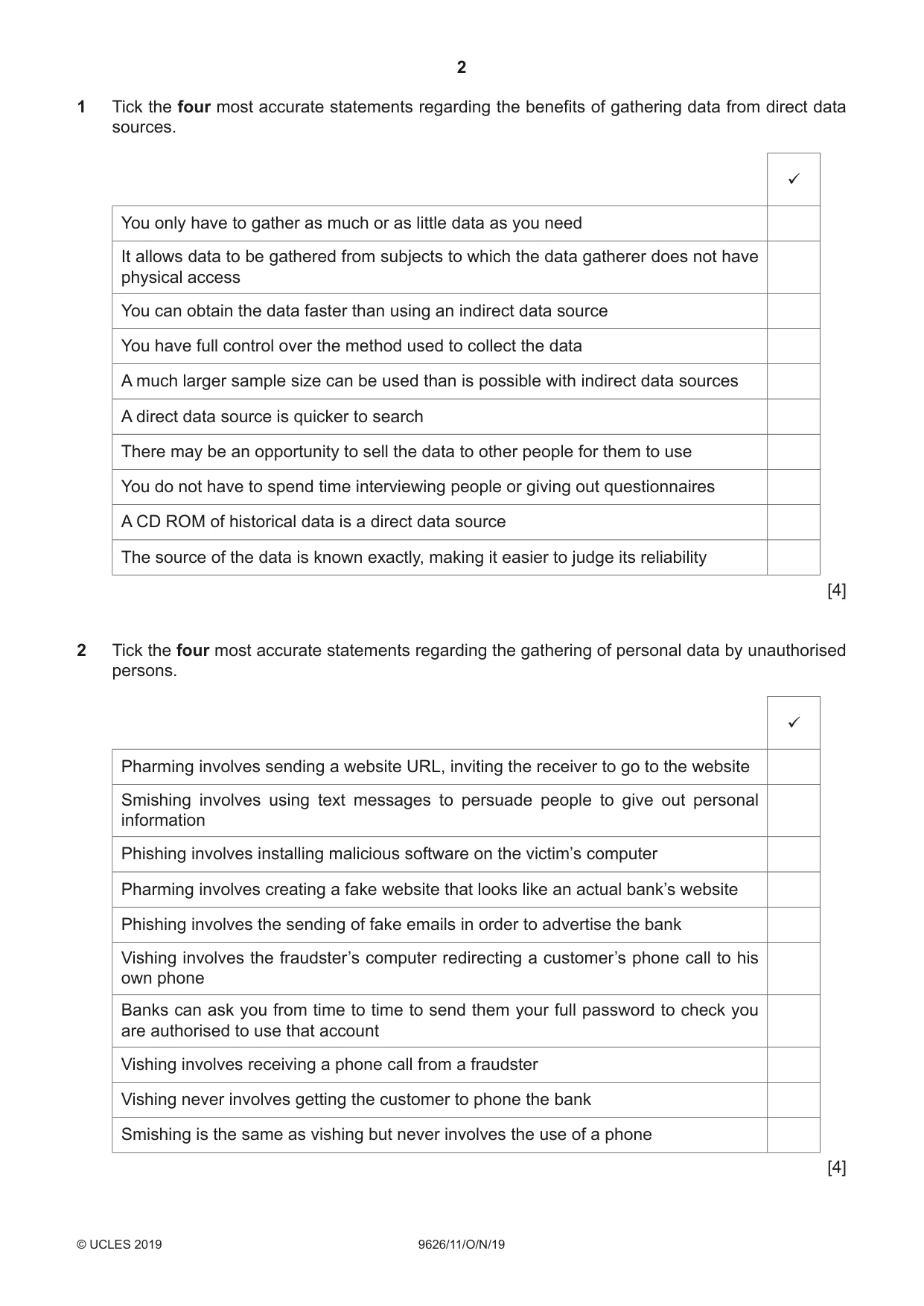
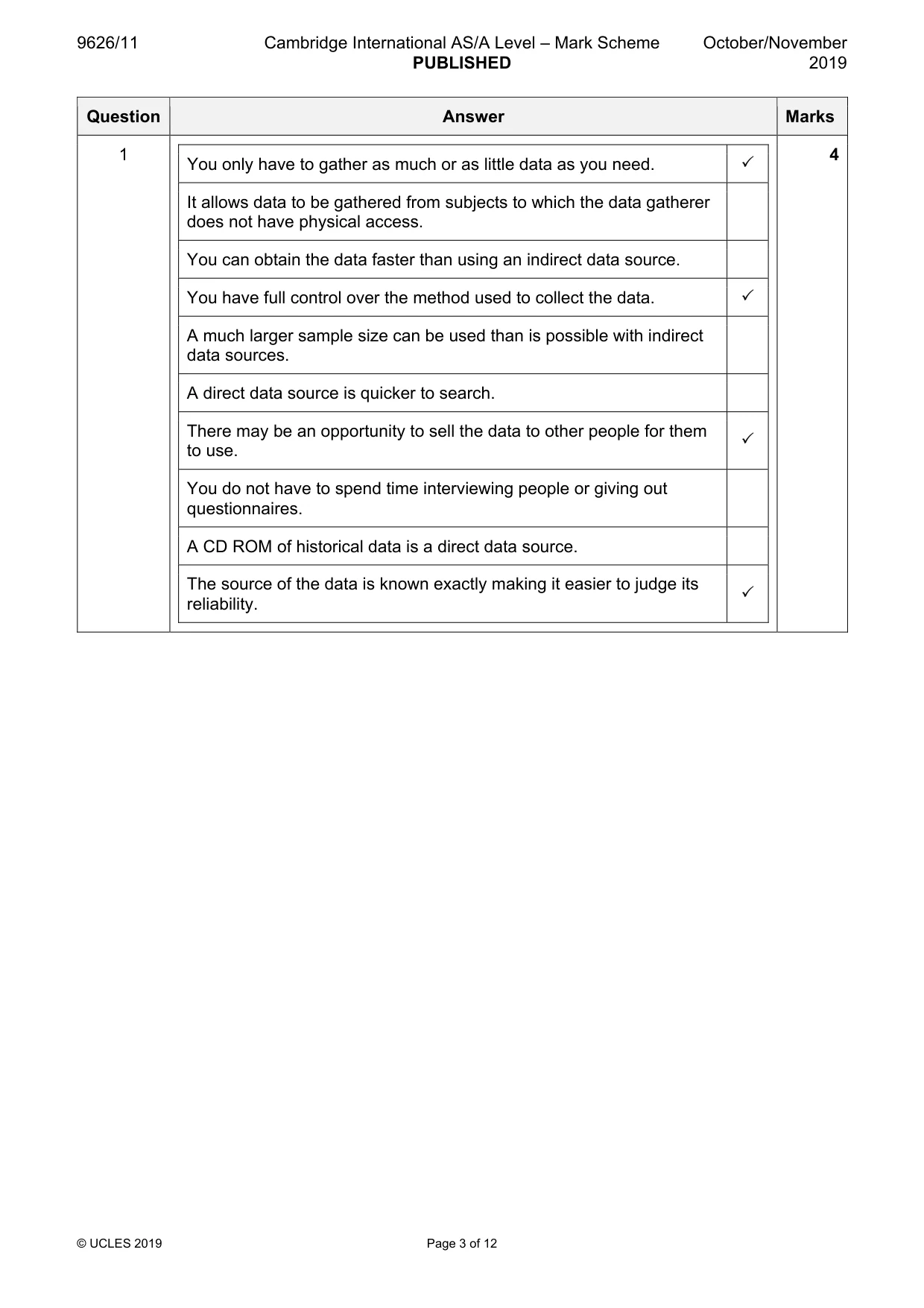
2 9626/11/O/N/19 © UCLES 2019 1 Tick the four most accurate statements regarding the benefits of gathering data from direct data sources. You only have to gather as much or as little data as you need It allows data to be gathered from subjects to which the data gatherer does not have physical access You can obtain the data faster than using an indirect data source You have full control over the method used to collect the data A much larger sample size can be used than is possible with indirect data sources A direct data source is quicker to search There may be an opportunity to sell the data to other people for them to use You do not have to spend time interviewing people or giving out questionnaires A CD ROM of historical data is a direct data source The source of the data is known exactly, making it easier to judge its reliability [4] 2 Tick the four most accurate statements regarding the gathering of personal data by unauthorised persons. Pharming involves sending a website URL, inviting the receiver to go to the website Smishing involves using text messages to persuade people to give out personal information Phishing involves installing malicious software on the victim’s computer Pharming involves creating a fake website that looks like an actual bank’s website Phishing involves the sending of fake emails in order to advertise the bank Vishing involves the fraudster’s computer redirecting a customer’s phone call to his own phone Banks can ask you from time to time to send them your full password to check you are authorised to use that account Vishing involves receiving a phone call from a fraudster Vishing never involves getting the customer to phone the bank Smishing is the same as vishing but never involves the use of a phone [4]
Question paper, page 3
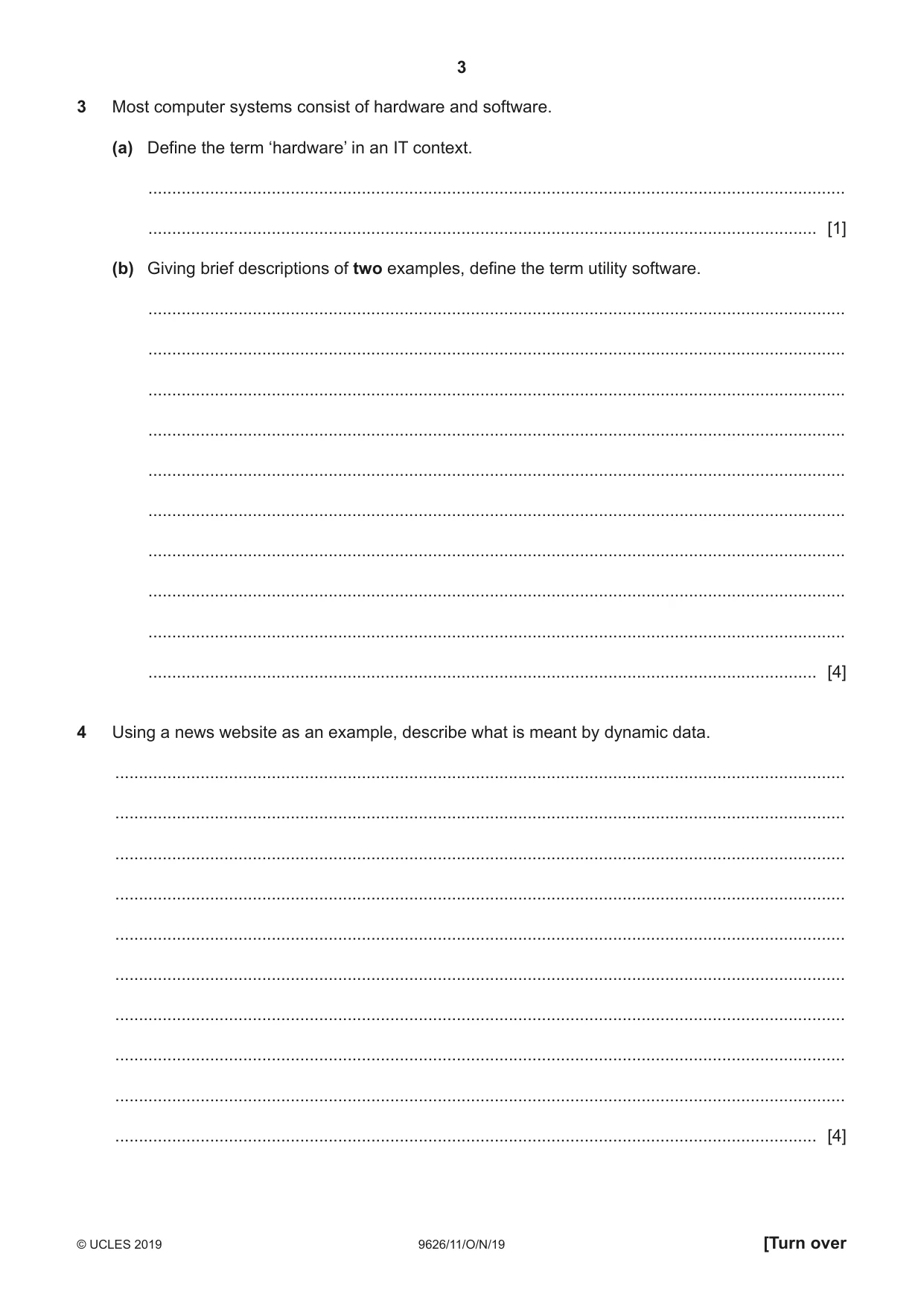
3 9626/11/O/N/19 © UCLES 2019 [Turn over 3 Most computer systems consist of hardware and software. (a) Define the term ‘hardware’ in an IT context. … … [1] (b) Giving brief descriptions of two examples, define the term utility software. … … … … … … … … … … [4] 4 Using a news website as an example, describe what is meant by dynamic data. … … … … … … … … … … [4]
Question paper, page 4
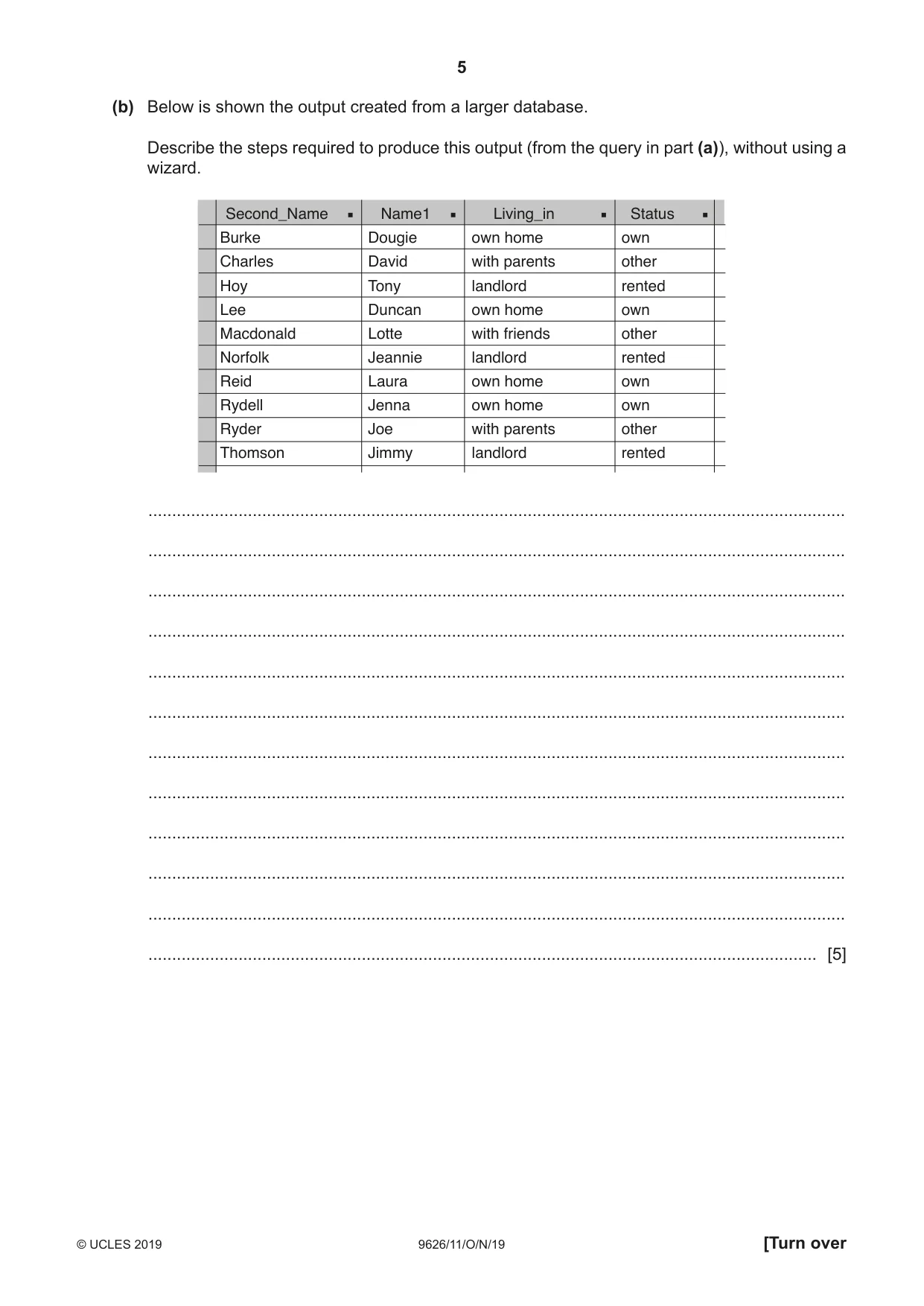
4 9626/11/O/N/19 © UCLES 2019 5 When creating queries, a function IIf() is often used. A table containing a list of where people live and their status could exist so that a query could be constructed: IIf([Living_in]=“own home”,“own”,“other”) This would look in a list of where people lived for the words ‘own home’ and would output the word ‘own’ if a match were found. If it was not ‘own home’ then the word ‘other’ is output. (a) Complete the nested query that would be used to output ‘rented’ for anyone living in accommodation owned by a landlord. This is indicated by the word ‘landlord’ in the Living_in field (see table on page 5). IIf([Living_in]=“own home”,“own” … … [6] You can use the space below for any working you need.
Question paper, page 5
5 9626/11/O/N/19 © UCLES 2019 [Turn over (b) Below is shown the output created from a larger database. Describe the steps required to produce this output (from the query in part (a)), without using a wizard. Burke Charles Hoy Lee Macdonald Norfolk Reid Rydell Ryder Thomson Dougie David Tony Duncan Lotte Jeannie Laura Jenna Joe Jimmy own home with parents landlord own home with friends landlord own home own home with parents landlord own other rented own other rented own own other rented Second_Name Name1 Living_in Status … … … … … … … … … … … … [5]
Question paper, page 6
6 9626/11/O/N/19 © UCLES 2019 6 John, a user interface designer, has been asked by a systems analyst to design an interface for a proposed information system. He will need to consider a mental model of the potential users of the system. (a) Describe what is meant by a mental model in this context. … … … … … … … … … … [4] (b) Describe the features of a user interface which need to be considered when planning its design. Where appropriate, give examples of each feature. … … … … … … … … … … … … … [5]
Question paper, page 7
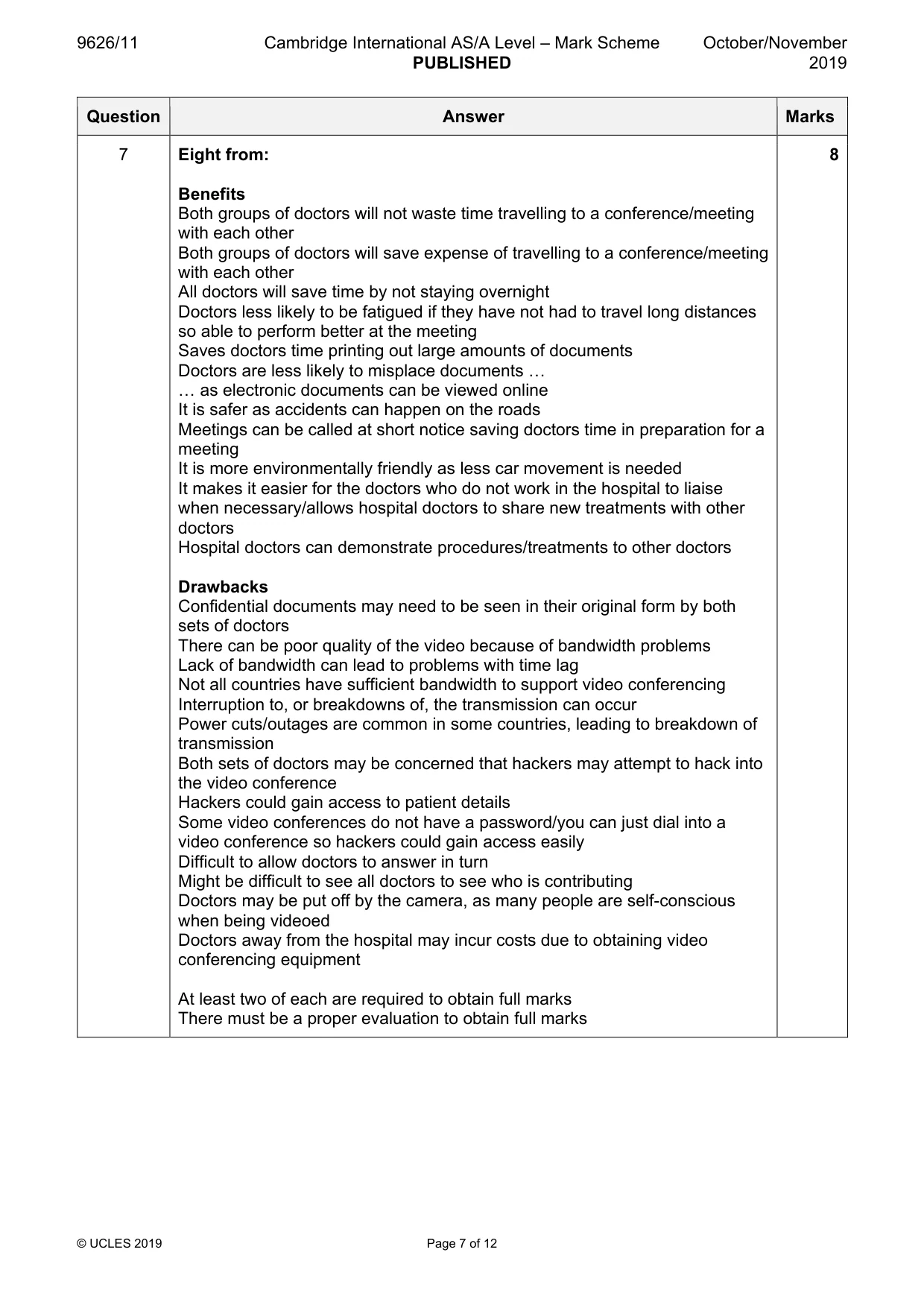
7 9626/11/O/N/19 © UCLES 2019 [Turn over 7 A hospital has installed video-conferencing equipment so that senior doctors in the hospital can stay in touch with other doctors who work in areas away from the hospital. Evaluate the impact of video-conferencing on both groups of doctors. … … … … … … … … … … … … … … … … … … … … [8]
Question paper, page 8
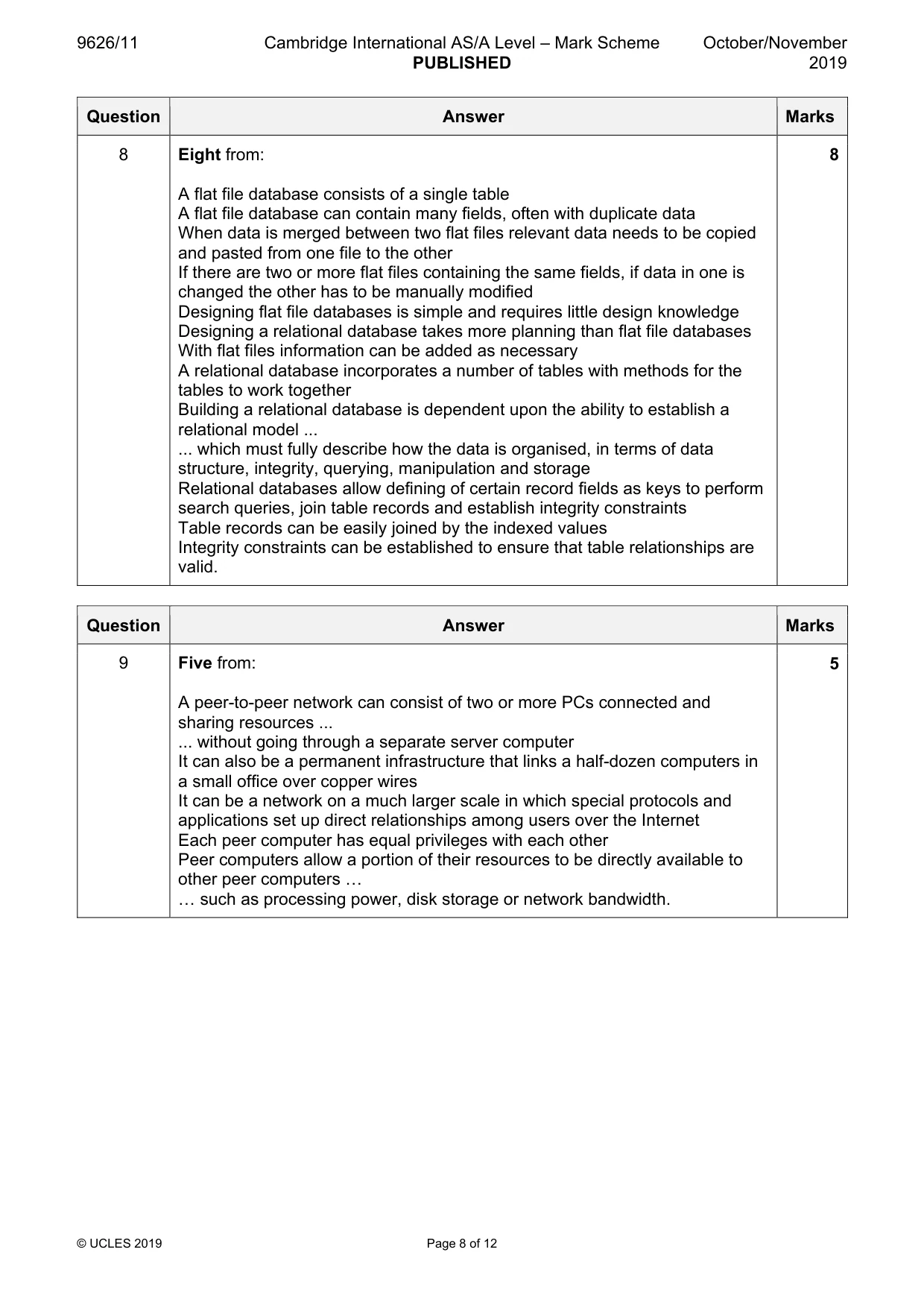
8 9626/11/O/N/19 © UCLES 2019 8 Roger has decided to set up a mail order company. He needs to create a database of customer records and orders. He is not sure whether to create a flat file database or a relational database. Explain the differences between a flat file database and a relational database. … … … … … … … … … … … … … … … … … … … … [8]
Question paper, page 9
9 9626/11/O/N/19 © UCLES 2019 [Turn over 9 Computer networks can often be classified as consisting of two types, peer-to-peer and client- server networks. Describe a peer-to-peer network. … … … … … … … … … … … … … [5]
Question paper, page 10
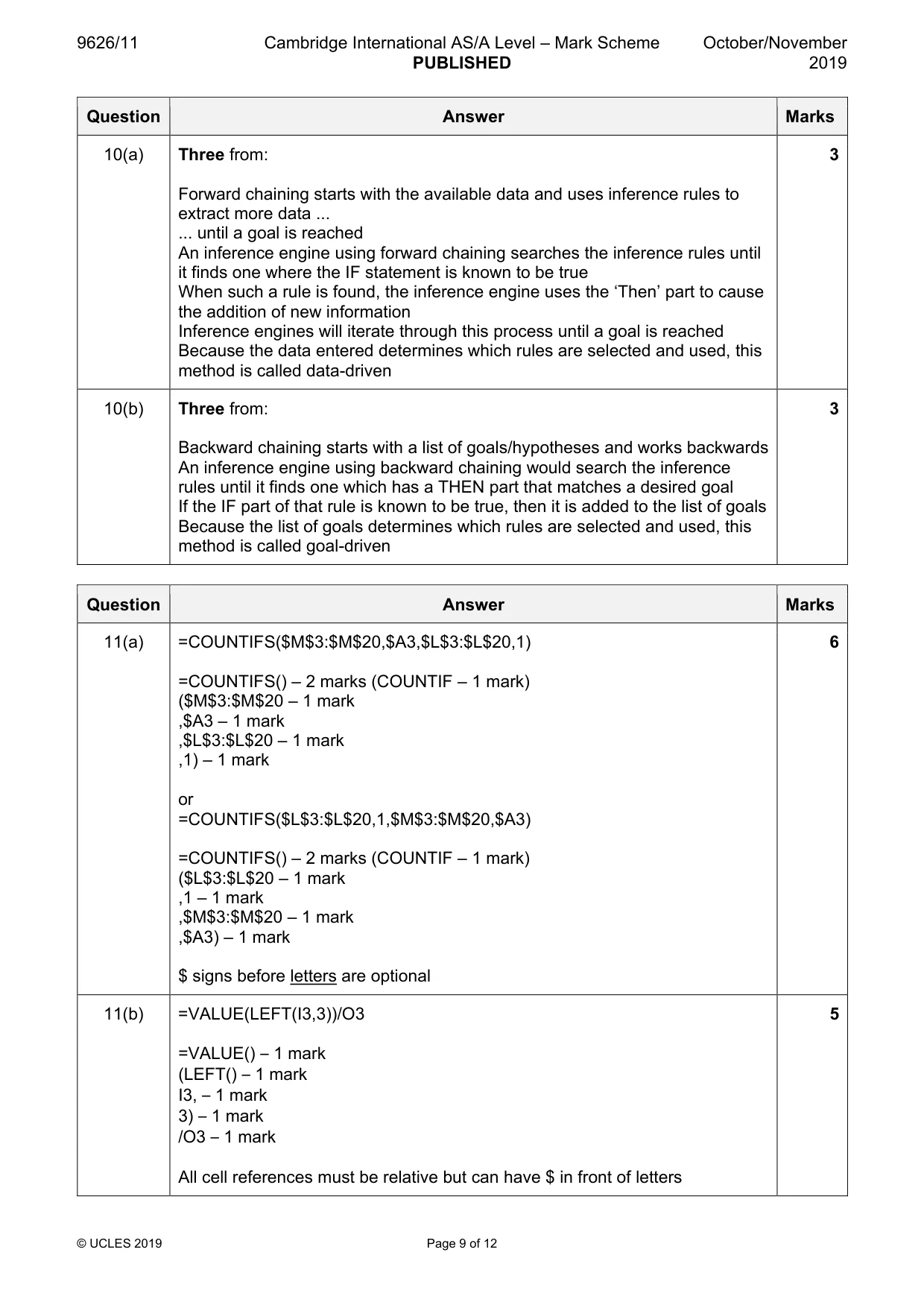
10 9626/11/O/N/19 © UCLES 2019 10 Expert systems often use a mixture of forward chaining and backward chaining to determine the probable solution to a problem. Describe the terms: (a) Forward chaining. … … … … … … … … [3] (b) Backward chaining. … … … … … … … … [3]
Question paper, page 11
11 9626/11/O/N/19 © UCLES 2019 [Turn over 11 Here is a spreadsheet showing the medal winners at some of the 2016 Olympics swimming events. Country code Country name Name of country Gold Silver Bronze Swimmer Distance Stroke Gender Position Time (secs) Code of country Average speed (m/s) A B C D E F G H I J K L M N O P Q 1 2 3 4 5 6 7 8 9 10 11 12 13 14 15 16 17 18 19 20 AUS BEL CAN CHN GBR RSA SWE USA AUS BEL USA CAN USA SWE GBR RSA USA SWE CAN USA CHN RSA USA USA SWE AUS 1 0 1 1 1 0 1 1 0 1 1 0 0 2 1 1 100m 100m 100m 100m 100m 100m 100m 100m 100m 100m 100m 100m 200m 200m 200m 200m 200m 200m Freestyle Freestyle Freestyle Freestyle Freestyle Freestyle Breaststroke Breaststroke Breaststroke Butterfly Butterfly Butterfly Freestyle Freestyle Freestyle Freestyle Freestyle Freestyle 1 0 0 0 0 0 1 4 1 2 3 1 2 3 1 2 3 1 2 3 1 2 3 1 2 3 47.58 47.80 47.85 52.70 52.71 52.99 57.13 58.69 58.87 55.48 56.46 56.63 104.65 105.20 105.23 113.73 114.08 114.92 2.10 2.09 2.09 1.90 1.90 1.89 1.75 1.70 1.70 1.80 1.77 1.77 1.91 1.90 1.90 1.76 1.75 1.74 M M M F F F M M M F F F M M M F F F Kyle Chalmers Pieter Timmers Nathan Adrian Penny Oleksiak Simone Manuel Sarah Sjostrom Adam Peaty Cameron Van der Burgh Codey Miller Sarah Sjostrom Penny Oleksiak Dana Vollmer Yang Sun Chad Le Clos Conor Dwyer Katie Ledecky Sarah Sjostrom Emma McKeon Australia Belgium Canada China Great Britain South Africa Sweden United States Australia Belgium United States Canada United States Sweden Great Britain South Africa United States Sweden Canada United States China South Africa United States United States Sweden Australia (a) Write down the formula which should go in cell D3 to calculate the number of gold medals that Australia won in the events. The formula should be easily replicable to show the number of gold medals won by the other countries. The formula should work even if the swimmer details are changed. = … [6] You can use the space below for any working you need.
Question paper, page 12
12 9626/11/O/N/19 © UCLES 2019 (b) The average speed of each swimmer is calculated by dividing the distance swum by the time taken in seconds. Write down the formula which should go in cell P3 to calculate Kyle Chalmers’ speed. The formula should be easily replicable to show the speeds of the other swimmers. = … [5] You can use the space below for any working you need. (c) Explain how you would amend the spreadsheet so that the cells between M3 to M20 could only accept the country codes listed. If any other code was input an error message informing the user an error had occurred would be output. … … … … … … … … … … [4]
Question paper, page 13
13 9626/11/O/N/19 © UCLES 2019 [Turn over (d) Explain how you would sort the data so that all the female swimmers were grouped together before the male swimmers and with the furthest distance at the top. … … … … … … … … [3]
Question paper, page 14
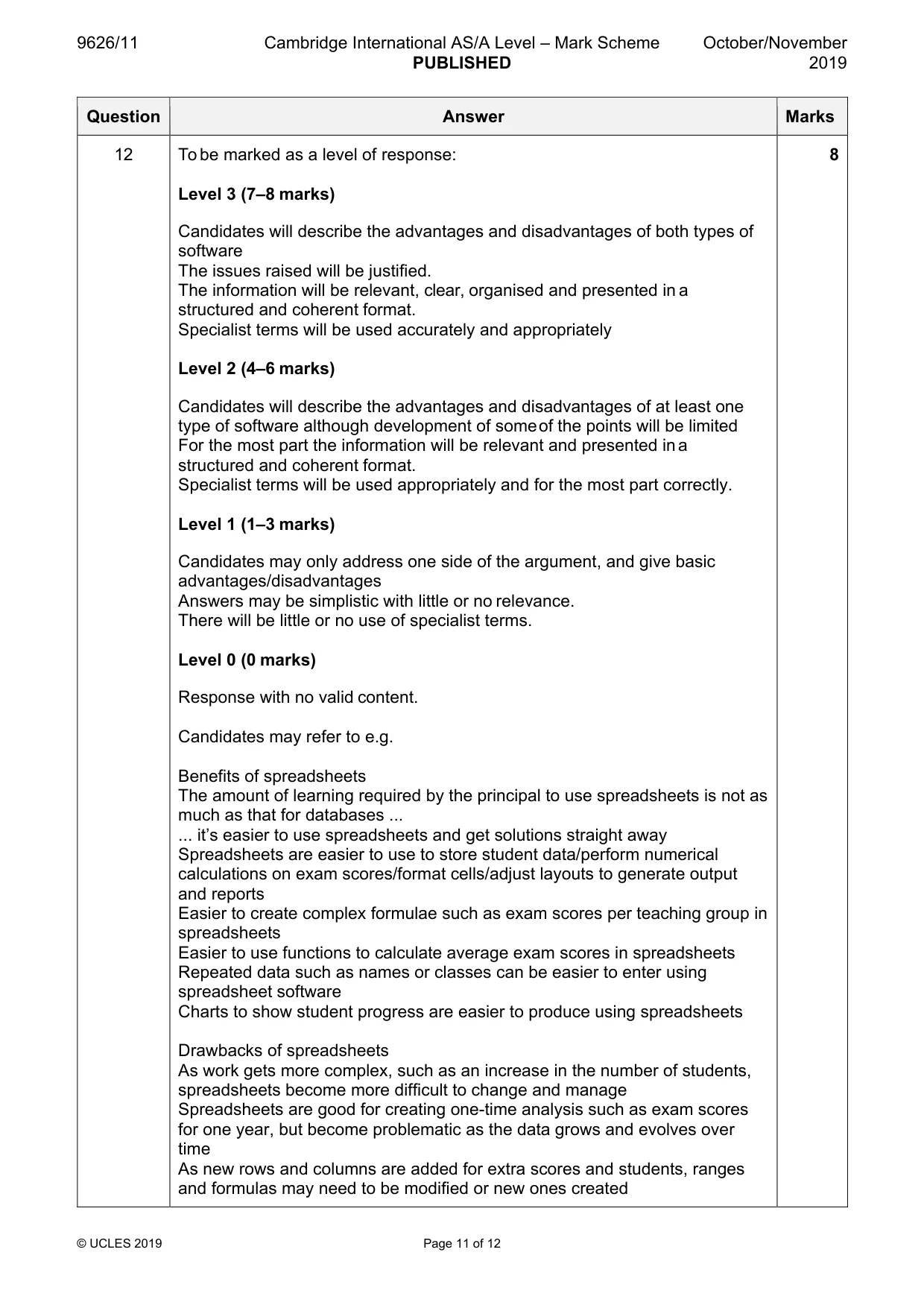
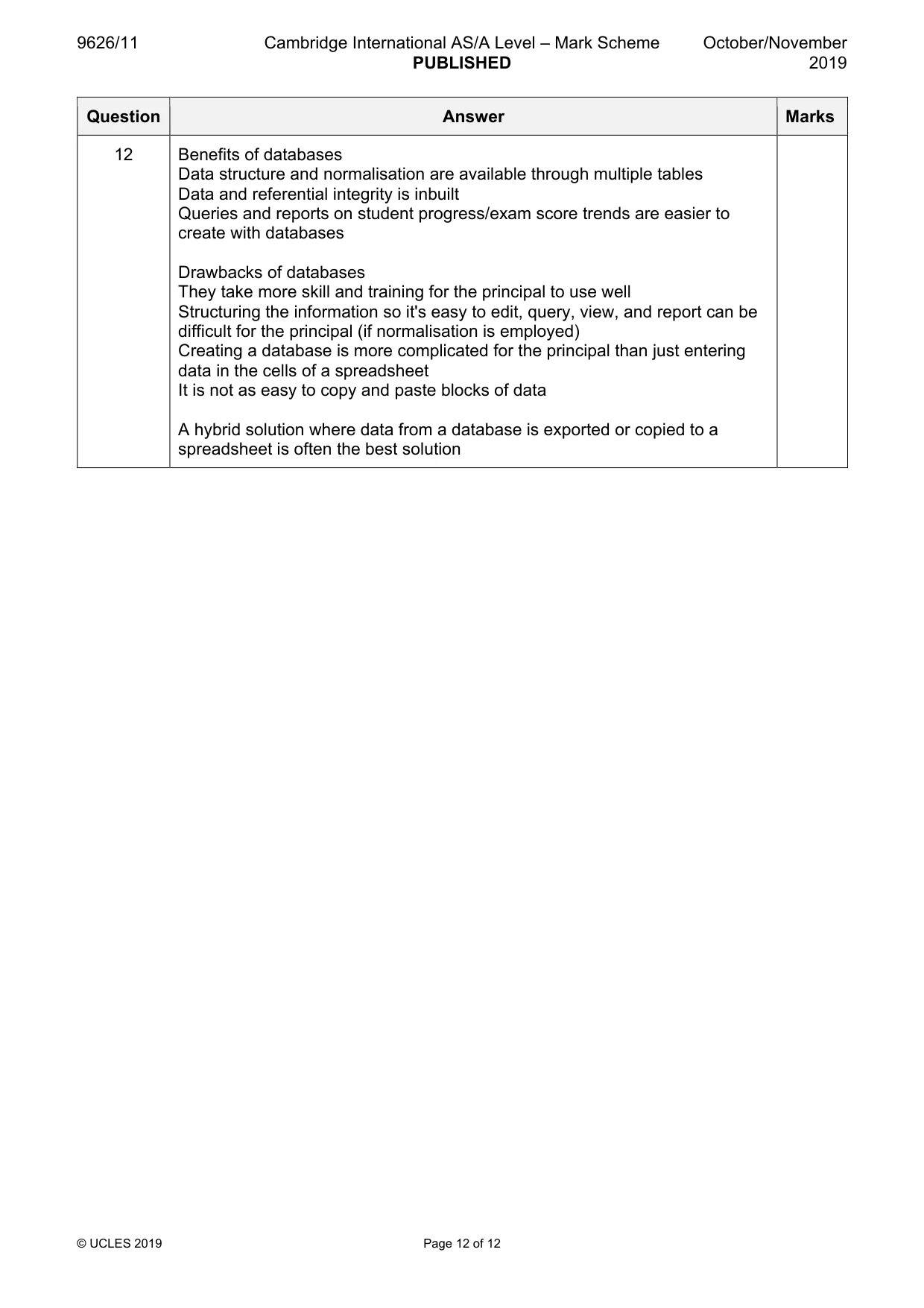
14 9626/11/O/N/19 © UCLES 2019 12 The principal of a college wishes to keep records of all his students’ details including exam scores. He is not sure whether he should use a spreadsheet or a database to do this. Evaluate the use of databases and spreadsheets for such a task. … … … … … … … … … … … … … … … … … … … … [8]
Question paper, page 15
15 9626/11/O/N/19 © UCLES 2019 BLANK PAGE
Question paper, page 16
16 9626/11/O/N/19 © UCLES 2019 Permission to reproduce items where third-party owned material protected by copyright is included has been sought and cleared where possible. Every reasonable effort has been made by the publisher (UCLES) to trace copyright holders, but if any items requiring clearance have unwittingly been included, the publisher will be pleased to make amends at the earliest possible opportunity. To avoid the issue of disclosure of answer-related information to candidates, all copyright acknowledgements are reproduced online in the Cambridge Assessment International Education Copyright Acknowledgements Booklet. This is produced for each series of examinations and is freely available to download at www.cambridgeinternational.org after the live examination series. Cambridge Assessment International Education is part of the Cambridge Assessment Group. Cambridge Assessment is the brand name of the University of Cambridge Local Examinations Syndicate (UCLES), which itself is a department of the University of Cambridge. BLANK PAGE
Mark scheme, page 1
This document consists of 12 printed pages. © UCLES 2019 [Turn over Cambridge Assessment International Education Cambridge International Advanced Subsidiary and Advanced Level INFORMATION TECHNOLOGY 9626/11 Paper 1 Theory October/November 2019 MARK SCHEME Maximum Mark: 90 Published This mark scheme is published as an aid to teachers and candidates, to indicate the requirements of the examination. It shows the basis on which Examiners were instructed to award marks. It does not indicate the details of the discussions that took place at an Examiners’ meeting before marking began, which would have considered the acceptability of alternative answers. Mark schemes should be read in conjunction with the question paper and the Principal Examiner Report for Teachers. Cambridge International will not enter into discussions about these mark schemes. Cambridge International is publishing the mark schemes for the October/November 2019 series for most Cambridge IGCSE™, Cambridge International A and AS Level components and some Cambridge O Level components.
Mark scheme, page 2
9626/11 Cambridge International AS/A Level – Mark Scheme PUBLISHED October/November 2019 © UCLES 2019 Page 2 of 12 Generic Marking Principles These general marking principles must be applied by all examiners when marking candidate answers. They should be applied alongside the specific content of the mark scheme or generic level descriptors for a question. Each question paper and mark scheme will also comply with these marking principles. GENERIC MARKING PRINCIPLE 1: Marks must be awarded in line with: • the specific content of the mark scheme or the generic level descriptors for the question • the specific skills defined in the mark scheme or in the generic level descriptors for the question • the standard of response required by a candidate as exemplified by the standardisation scripts. GENERIC MARKING PRINCIPLE 2: Marks awarded are always whole marks (not half marks, or other fractions). GENERIC MARKING PRINCIPLE 3: Marks must be awarded positively: • marks are awarded for correct/valid answers, as defined in the mark scheme. However, credit is given for valid answers which go beyond the scope of the syllabus and mark scheme, referring to your Team Leader as appropriate • marks are awarded when candidates clearly demonstrate what they know and can do • marks are not deducted for errors • marks are not deducted for omissions • answers should only be judged on the quality of spelling, punctuation and grammar when these features are specifically assessed by the question as indicated by the mark scheme. The meaning, however, should be unambiguous. GENERIC MARKING PRINCIPLE 4: Rules must be applied consistently e.g. in situations where candidates have not followed instructions or in the application of generic level descriptors. GENERIC MARKING PRINCIPLE 5: Marks should be awarded using the full range of marks defined in the mark scheme for the question (however; the use of the full mark range may be limited according to the quality of the candidate responses seen). GENERIC MARKING PRINCIPLE 6: Marks awarded are based solely on the requirements as defined in the mark scheme. Marks should not be awarded with grade thresholds or grade descriptors in mind.
Mark scheme, page 3
9626/11 Cambridge International AS/A Level – Mark Scheme PUBLISHED October/November 2019 © UCLES 2019 Page 3 of 12 Question Answer Marks 1 You only have to gather as much or as little data as you need. 3 It allows data to be gathered from subjects to which the data gatherer does not have physical access. You can obtain the data faster than using an indirect data source. You have full control over the method used to collect the data. 3 A much larger sample size can be used than is possible with indirect data sources. A direct data source is quicker to search. There may be an opportunity to sell the data to other people for them to use. 3 You do not have to spend time interviewing people or giving out questionnaires. A CD ROM of historical data is a direct data source. The source of the data is known exactly making it easier to judge its reliability. 3 4
Mark scheme, page 4
9626/11 Cambridge International AS/A Level – Mark Scheme PUBLISHED October/November 2019 © UCLES 2019 Page 4 of 12 Question Answer Marks 2 Pharming involves sending a website URL, inviting the receiver to go to the site. Smishing involves using text messages to persuade people to give out personal information. 3 Phishing involves installing malicious software on the victim's computer. Pharming involves creating a fake website that looks like an actual bank’s website. 3 Phishing involves the sending of fake emails in order to advertise the bank. Vishing involves the fraudster’s computer redirecting a customer’s phone call to his own phone. 3 Banks can ask you from time to time to send them your full password to check you are authorised to use that account. Vishing involves receiving a phone call from a fraudster. 3 Vishing never involves getting the customer to phone the bank. Smishing is the same as vishing but never involves the use of a phone. 4 Question Answer Marks 3(a) The collection of physical components/devices that constitute/are used in a computer system 1
Mark scheme, page 5
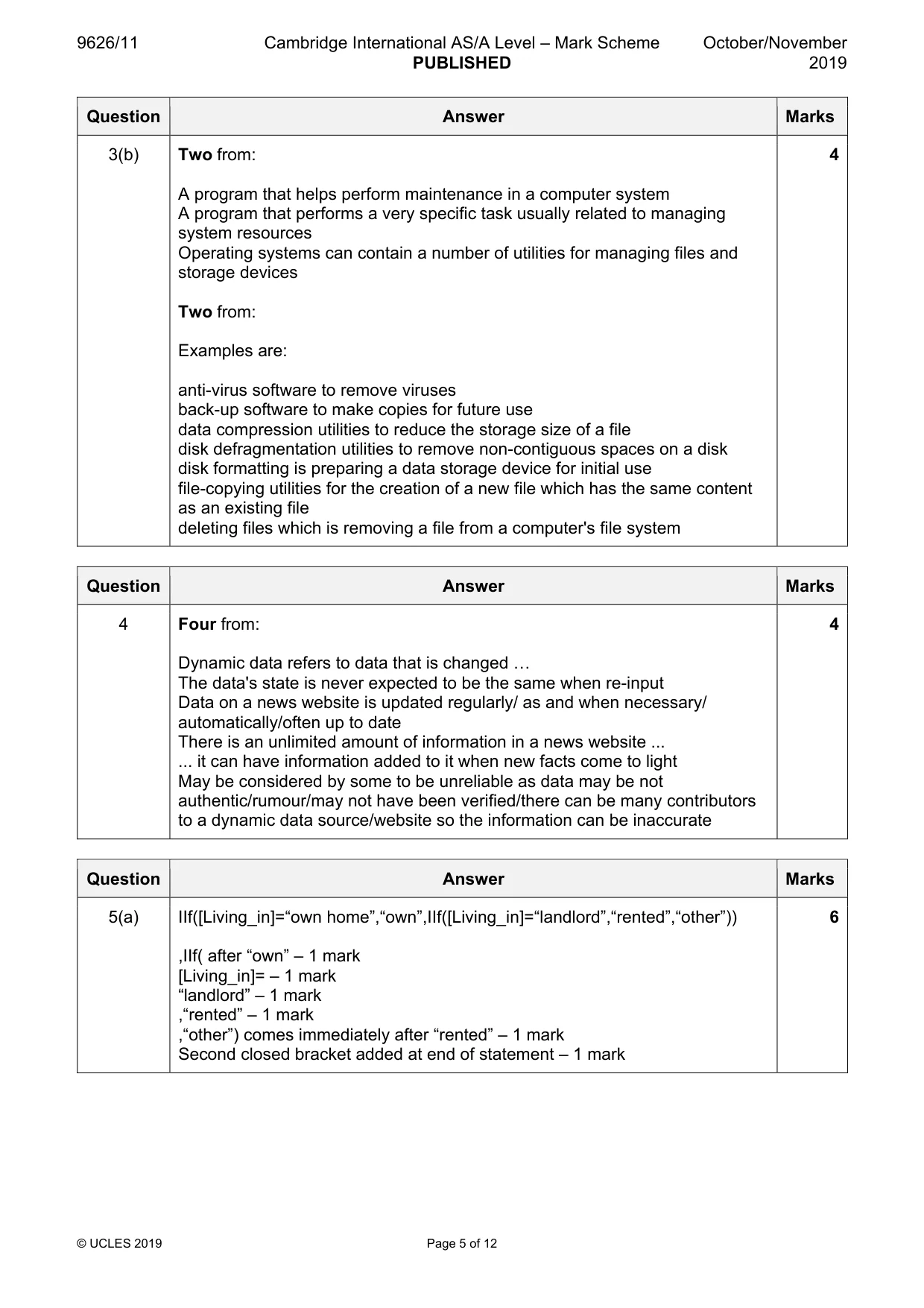
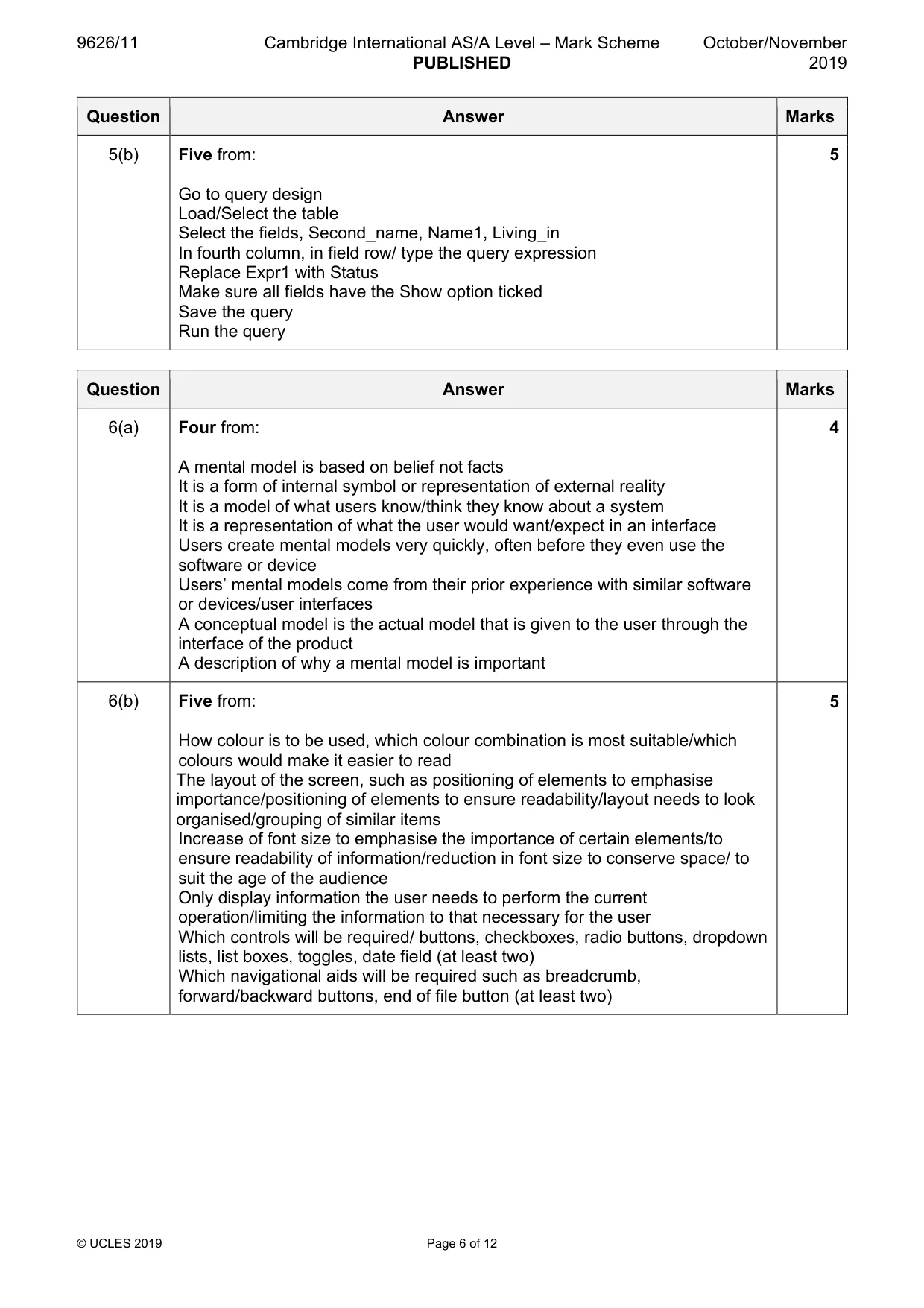
9626/11 Cambridge International AS/A Level – Mark Scheme PUBLISHED October/November 2019 © UCLES 2019 Page 5 of 12 Question Answer Marks 3(b) Two from: A program that helps perform maintenance in a computer system A program that performs a very specific task usually related to managing system resources Operating systems can contain a number of utilities for managing files and storage devices Two from: Examples are: anti-virus software to remove viruses back-up software to make copies for future use data compression utilities to reduce the storage size of a file disk defragmentation utilities to remove non-contiguous spaces on a disk disk formatting is preparing a data storage device for initial use file-copying utilities for the creation of a new file which has the same content as an existing file deleting files which is removing a file from a computer's file system 4 Question Answer Marks 4 Four from: Dynamic data refers to data that is changed « The data's state is never expected to be the same when re-input Data on a news website is updated regularly/ as and when necessary/ automatically/often up to date There is an unlimited amount of information in a news website ... ... it can have information added to it when new facts come to light May be considered by some to be unreliable as data may be not authentic/rumour/may not have been verified/there can be many contributors to a dynamic data source/website so the information can be inaccurate 4 Question Answer Marks 5(a) IIf([Living_in]=“own home”,“own”,IIf([Living_in]=“landlord”,“rented”,“other”)) ,IIf( after “own” – 1 mark [Living_in]= – 1 mark “landlord” – 1 mark ,“rented” – 1 mark ,“other”) comes immediately after “rented” – 1 mark Second closed bracket added at end of statement – 1 mark 6
Mark scheme, page 6
9626/11 Cambridge International AS/A Level – Mark Scheme PUBLISHED October/November 2019 © UCLES 2019 Page 6 of 12 Question Answer Marks 5(b) Five from: Go to query design Load/Select the table Select the fields, Second_name, Name1, Living_in In fourth column, in field row/ type the query expression Replace Expr1 with Status Make sure all fields have the Show option ticked Save the query Run the query 5 Question Answer Marks 6(a) Four from: A mental model is based on belief not facts It is a form of internal symbol or representation of external reality It is a model of what users know/think they know about a system It is a representation of what the user would want/expect in an interface Users create mental models very quickly, often before they even use the software or device Users’ mental models come from their prior experience with similar software or devices/user interfaces A conceptual model is the actual model that is given to the user through the interface of the product A description of why a mental model is important 4 6(b) Five from: How colour is to be used, which colour combination is most suitable/which colours would make it easier to read The layout of the screen, such as positioning of elements to emphasise importance/positioning of elements to ensure readability/layout needs to look organised/grouping of similar items Increase of font size to emphasise the importance of certain elements/to ensure readability of information/reduction in font size to conserve space/ to suit the age of the audience Only display information the user needs to perform the current operation/limiting the information to that necessary for the user Which controls will be required/ buttons, checkboxes, radio buttons, dropdown lists, list boxes, toggles, date field (at least two) Which navigational aids will be required such as breadcrumb, forward/backward buttons, end of file button (at least two) 5
Mark scheme, page 7
9626/11 Cambridge International AS/A Level – Mark Scheme PUBLISHED October/November 2019 © UCLES 2019 Page 7 of 12 Question Answer Marks 7 Eight from: Benefits Both groups of doctors will not waste time travelling to a conference/meeting with each other Both groups of doctors will save expense of travelling to a conference/meeting with each other All doctors will save time by not staying overnight Doctors less likely to be fatigued if they have not had to travel long distances so able to perform better at the meeting Saves doctors time printing out large amounts of documents Doctors are less likely to misplace documents « « as electronic documents can be viewed online It is safer as accidents can happen on the roads Meetings can be called at short notice saving doctors time in preparation for a meeting It is more environmentally friendly as less car movement is needed It makes it easier for the doctors who do not work in the hospital to liaise when necessary/allows hospital doctors to share new treatments with other doctors Hospital doctors can demonstrate procedures/treatments to other doctors Drawbacks Confidential documents may need to be seen in their original form by both sets of doctors There can be poor quality of the video because of bandwidth problems Lack of bandwidth can lead to problems with time lag Not all countries have sufficient bandwidth to support video conferencing Interruption to, or breakdowns of, the transmission can occur Power cuts/outages are common in some countries, leading to breakdown of transmission Both sets of doctors may be concerned that hackers may attempt to hack into the video conference Hackers could gain access to patient details Some video conferences do not have a password/you can just dial into a video conference so hackers could gain access easily Difficult to allow doctors to answer in turn Might be difficult to see all doctors to see who is contributing Doctors may be put off by the camera, as many people are self-conscious when being videoed Doctors away from the hospital may incur costs due to obtaining video conferencing equipment At least two of each are required to obtain full marks There must be a proper evaluation to obtain full marks 8
Mark scheme, page 8
9626/11 Cambridge International AS/A Level – Mark Scheme PUBLISHED October/November 2019 © UCLES 2019 Page 8 of 12 Question Answer Marks 8 Eight from: A flat file database consists of a single table A flat file database can contain many fields, often with duplicate data When data is merged between two flat files relevant data needs to be copied and pasted from one file to the other If there are two or more flat files containing the same fields, if data in one is changed the other has to be manually modified Designing flat file databases is simple and requires little design knowledge Designing a relational database takes more planning than flat file databases With flat files information can be added as necessary A relational database incorporates a number of tables with methods for the tables to work together Building a relational database is dependent upon the ability to establish a relational model ... ... which must fully describe how the data is organised, in terms of data structure, integrity, querying, manipulation and storage Relational databases allow defining of certain record fields as keys to perform search queries, join table records and establish integrity constraints Table records can be easily joined by the indexed values Integrity constraints can be established to ensure that table relationships are valid. 8 Question Answer Marks 9 Five from: A peer-to-peer network can consist of two or more PCs connected and sharing resources ... ... without going through a separate server computer It can also be a permanent infrastructure that links a half-dozen computers in a small office over copper wires It can be a network on a much larger scale in which special protocols and applications set up direct relationships among users over the Internet Each peer computer has equal privileges with each other Peer computers allow a portion of their resources to be directly available to other peer computers « « such as processing power, disk storage or network bandwidth. 5
Mark scheme, page 9
9626/11 Cambridge International AS/A Level – Mark Scheme PUBLISHED October/November 2019 © UCLES 2019 Page 9 of 12 Question Answer Marks 10(a) Three from: Forward chaining starts with the available data and uses inference rules to extract more data ... ... until a goal is reached An inference engine using forward chaining searches the inference rules until it finds one where the IF statement is known to be true When such a rule is found, the inference engine uses the ‘Then’ part to cause the addition of new information Inference engines will iterate through this process until a goal is reached Because the data entered determines which rules are selected and used, this method is called data-driven 3 10(b) Three from: Backward chaining starts with a list of goals/hypotheses and works backwards An inference engine using backward chaining would search the inference rules until it finds one which has a THEN part that matches a desired goal If the IF part of that rule is known to be true, then it is added to the list of goals Because the list of goals determines which rules are selected and used, this method is called goal-driven 3 Question Answer Marks 11(a) =COUNTIFS($M$3:$M$20,$A3,$L$3:$L$20,1) =COUNTIFS() – 2 marks (COUNTIF – 1 mark) ($M$3:$M$20 – 1 mark ,$A3 – 1 mark ,$L$3:$L$20 – 1 mark ,1) – 1 mark or =COUNTIFS($L$3:$L$20,1,$M$3:$M$20,$A3) =COUNTIFS() – 2 marks (COUNTIF – 1 mark) ($L$3:$L$20 – 1 mark ,1 – 1 mark ,$M$3:$M$20 – 1 mark ,$A3) – 1 mark $ signs before letters are optional 6 11(b) =VALUE(LEFT(I3,3))/O3 =VALUE() – 1 mark (LEFT() – 1 mark I3, – 1 mark 3) – 1 mark /O3 – 1 mark All cell references must be relative but can have $ in front of letters 5
Mark scheme, page 10
9626/11 Cambridge International AS/A Level – Mark Scheme PUBLISHED October/November 2019 © UCLES 2019 Page 10 of 12 Question Answer Marks 11(c) Four from: Highlight M3:M20 Click on data then on data validation Ensure Settings is highlighted and click on drop down menu under Allow Click on list then go to Source window Type in =$A$3:$A$10 / individual codes for countries separated by commas and click OK 4 11(d) Highlight cells H3:Q20 « « Sort on column K ascending « « add a level and sort on Column I descending 3
Mark scheme, page 11
9626/11 Cambridge International AS/A Level – Mark Scheme PUBLISHED October/November 2019 © UCLES 2019 Page 11 of 12 Question Answer Marks 12 To be marked as a level of response: Level 3 (7–8 marks) Candidates will describe the advantages and disadvantages of both types of software The issues raised will be justified. The information will be relevant, clear, organised and presented in a structured and coherent format. Specialist terms will be used accurately and appropriately Level 2 (4–6 marks) Candidates will describe the advantages and disadvantages of at least one type of software although development of some of the points will be limited For the most part the information will be relevant and presented in a structured and coherent format. Specialist terms will be used appropriately and for the most part correctly. Level 1 (1–3 marks) Candidates may only address one side of the argument, and give basic advantages/disadvantages Answers may be simplistic with little or no relevance. There will be little or no use of specialist terms. Level 0 (0 marks) Response with no valid content. Candidates may refer to e.g. Benefits of spreadsheets The amount of learning required by the principal to use spreadsheets is not as much as that for databases ... ... it’s easier to use spreadsheets and get solutions straight away Spreadsheets are easier to use to store student data/perform numerical calculations on exam scores/format cells/adjust layouts to generate output and reports Easier to create complex formulae such as exam scores per teaching group in spreadsheets Easier to use functions to calculate average exam scores in spreadsheets Repeated data such as names or classes can be easier to enter using spreadsheet software Charts to show student progress are easier to produce using spreadsheets Drawbacks of spreadsheets As work gets more complex, such as an increase in the number of students, spreadsheets become more difficult to change and manage Spreadsheets are good for creating one-time analysis such as exam scores for one year, but become problematic as the data grows and evolves over time As new rows and columns are added for extra scores and students, ranges and formulas may need to be modified or new ones created 8
Mark scheme, page 12
9626/11 Cambridge International AS/A Level – Mark Scheme PUBLISHED October/November 2019 © UCLES 2019 Page 12 of 12 Question Answer Marks 12 Benefits of databases Data structure and normalisation are available through multiple tables Data and referential integrity is inbuilt Queries and reports on student progress/exam score trends are easier to create with databases Drawbacks of databases They take more skill and training for the principal to use well Structuring the information so it's easy to edit, query, view, and report can be difficult for the principal (if normalisation is employed) Creating a database is more complicated for the principal than just entering data in the cells of a spreadsheet It is not as easy to copy and paste blocks of data A hybrid solution where data from a database is exported or copied to a spreadsheet is often the best solution
What you needed in this session
Cambridge’s own grade thresholds for 2019 Oct/Nov, Paper 1 · Variant 1. A higher threshold means an easier paper — the bar moves with how the cohort did.