Cambridge A Level Information Technology (from 2017) 9626 — 2018 May/June Paper 1 · Variant 3
9626/13/M/J/18 · 90 marks · ≈101 min
The question paper and its mark scheme, free to read here and free to download. This is Cambridge’s own paper, exactly as it was sat.
Question paper16 pages


Mark scheme9 pages
Answers below. Sit the paper first if you are practising.
Paper as text
Question paper, page 1
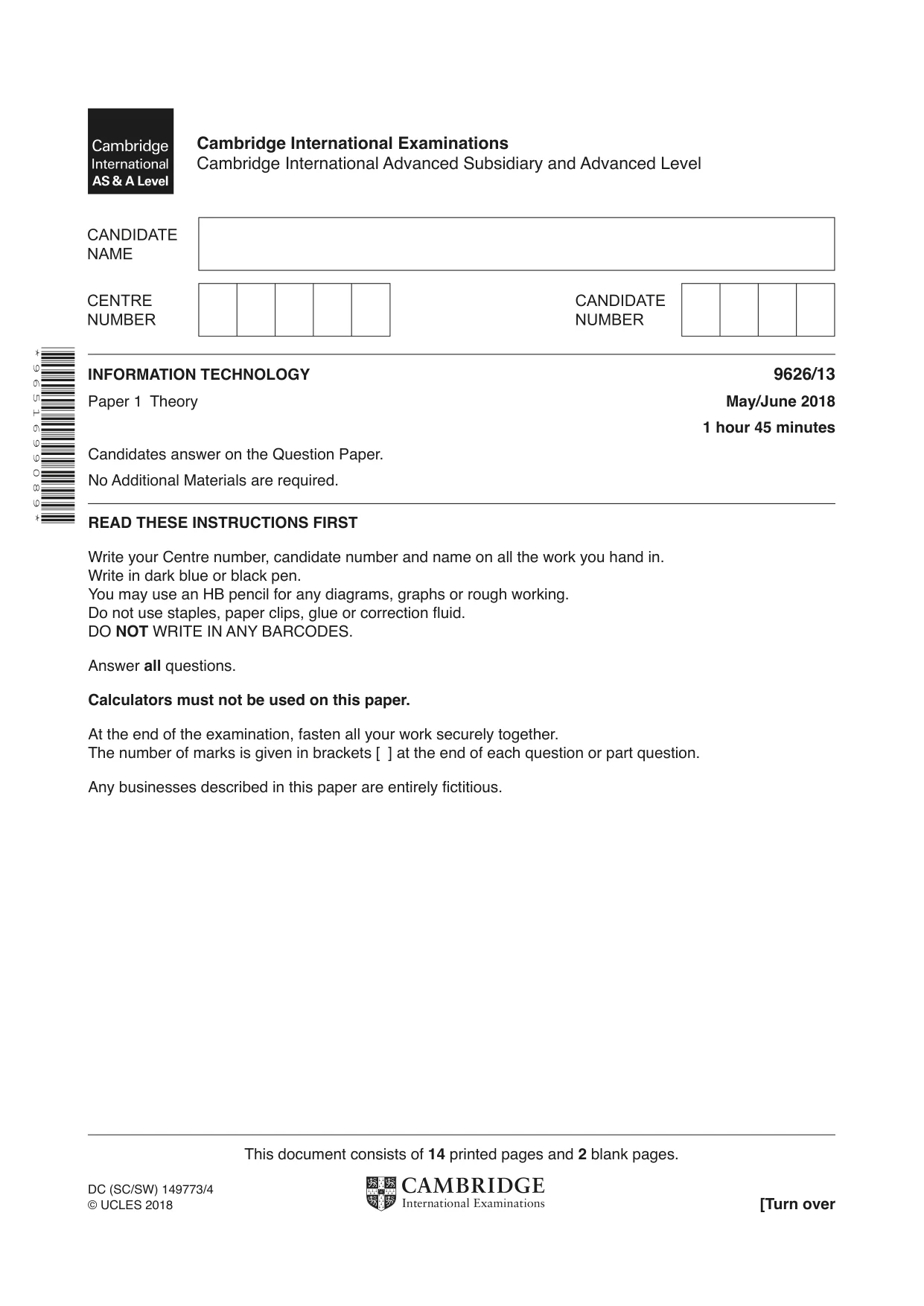
* 9 6 5 1 6 9 9 0 8 9 * This document consists of 14 printed pages and 2 blank pages. DC (SC/SW) 149773/4 © UCLES 2018 [Turn over Cambridge International Examinations Cambridge International Advanced Subsidiary and Advanced Level INFORMATION TECHNOLOGY 9626/13 Paper 1 Theory May/June 2018 1 hour 45 minutes Candidates answer on the Question Paper. No Additional Materials are required. READ THESE INSTRUCTIONS FIRST Write your Centre number, candidate number and name on all the work you hand in. Write in dark blue or black pen. You may use an HB pencil for any diagrams, graphs or rough working. Do not use staples, paper clips, glue or correction fluid. DO NOT WRITE IN ANY BARCODES. Answer all questions. Calculators must not be used on this paper. At the end of the examination, fasten all your work securely together. The number of marks is given in brackets [ ] at the end of each question or part question. Any businesses described in this paper are entirely fictitious.
Question paper, page 2
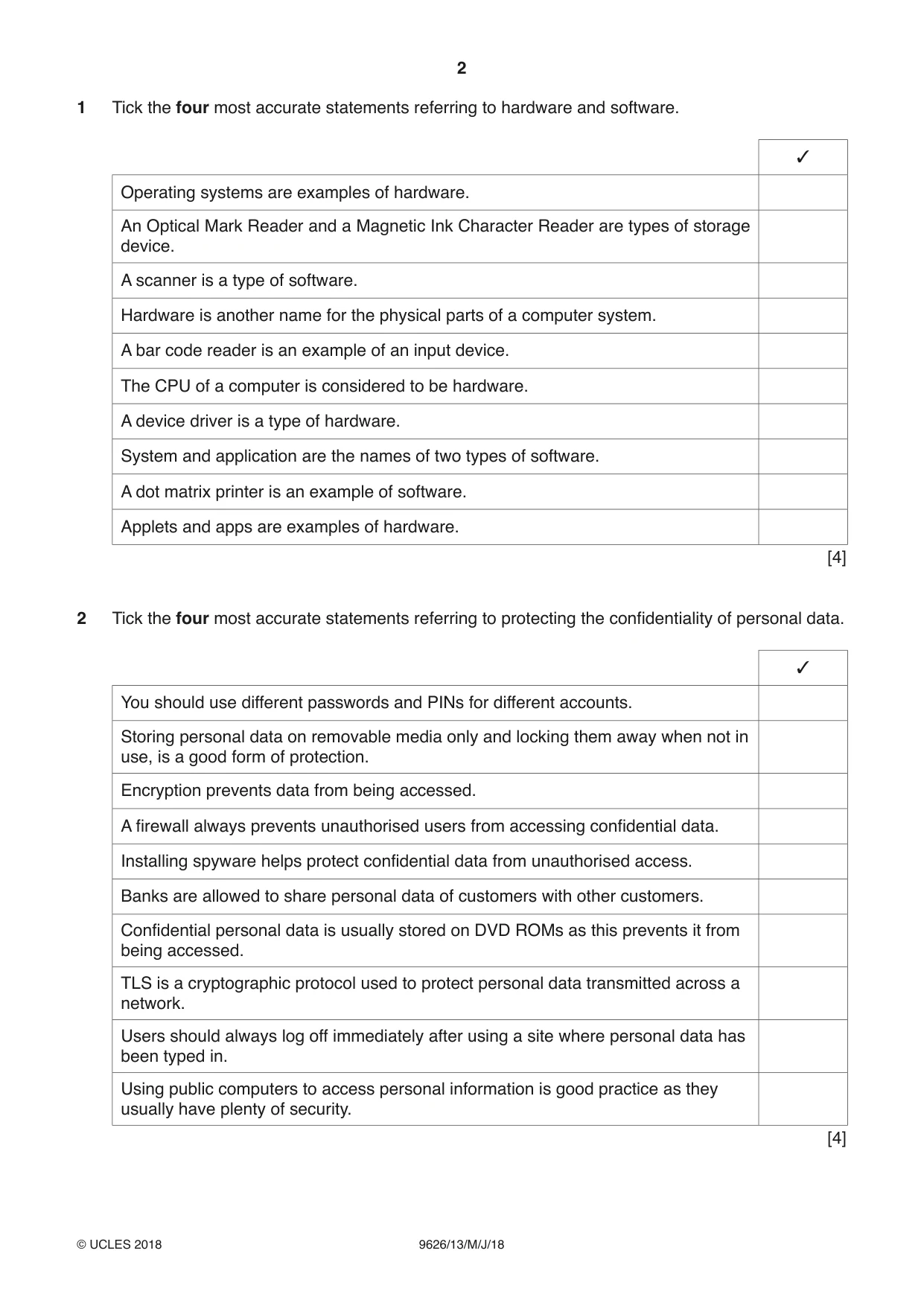
2 9626/13/M/J/18 © UCLES 2018 1 Tick the four most accurate statements referring to hardware and software. 3 Operating systems are examples of hardware. An Optical Mark Reader and a Magnetic Ink Character Reader are types of storage device. A scanner is a type of software. Hardware is another name for the physical parts of a computer system. A bar code reader is an example of an input device. The CPU of a computer is considered to be hardware. A device driver is a type of hardware. System and application are the names of two types of software. A dot matrix printer is an example of software. Applets and apps are examples of hardware. [4] 2 Tick the four most accurate statements referring to protecting the confidentiality of personal data. 3 You should use different passwords and PINs for different accounts. Storing personal data on removable media only and locking them away when not in use, is a good form of protection. Encryption prevents data from being accessed. A firewall always prevents unauthorised users from accessing confidential data. Installing spyware helps protect confidential data from unauthorised access. Banks are allowed to share personal data of customers with other customers. Confidential personal data is usually stored on DVD ROMs as this prevents it from being accessed. TLS is a cryptographic protocol used to protect personal data transmitted across a network. Users should always log off immediately after using a site where personal data has been typed in. Using public computers to access personal information is good practice as they usually have plenty of security. [4]
Question paper, page 3
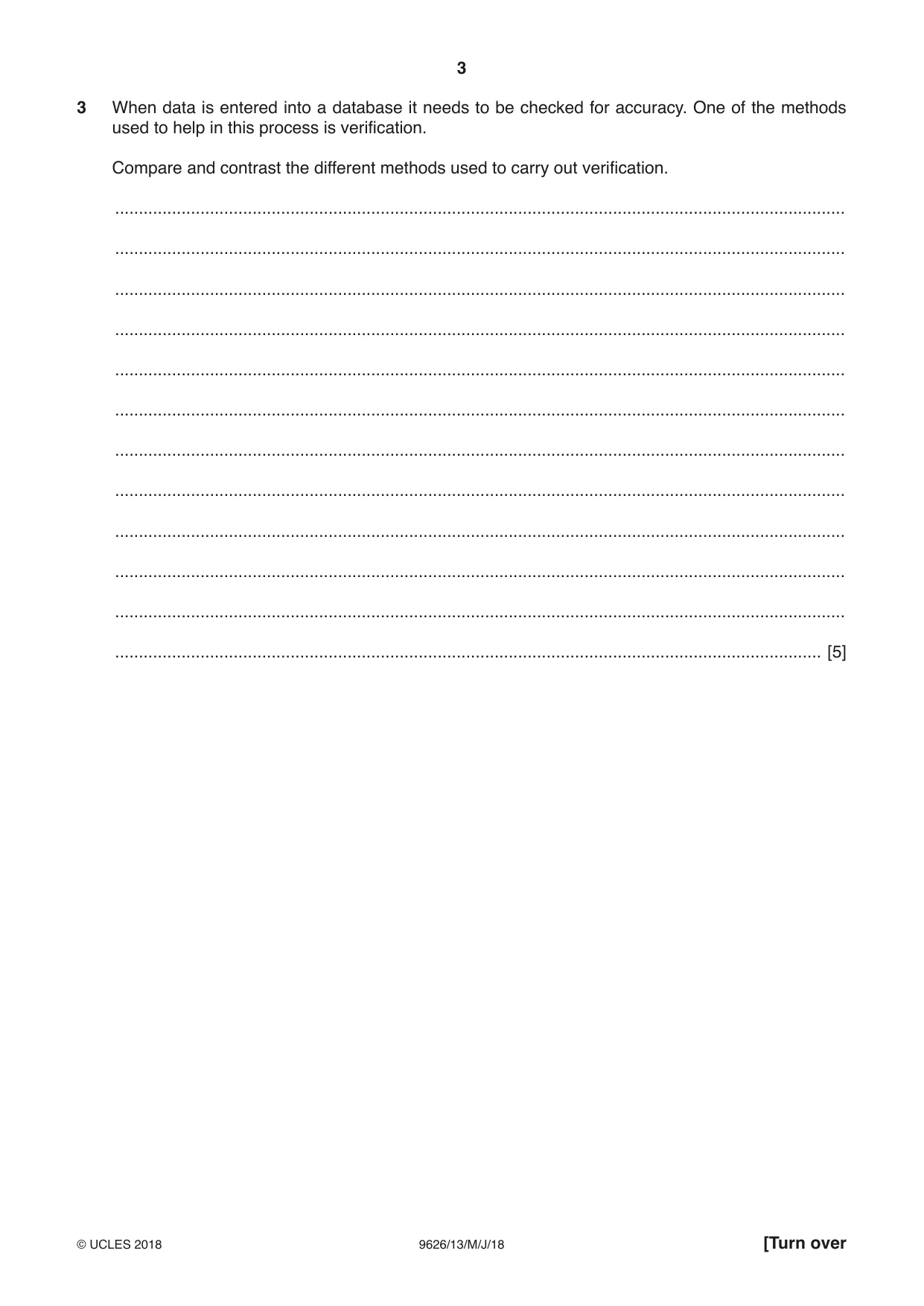
3 9626/13/M/J/18 © UCLES 2018 [Turn over 3 When data is entered into a database it needs to be checked for accuracy. One of the methods used to help in this process is verification. Compare and contrast the different methods used to carry out verification. … … … … … … … … … … … … [5]
Question paper, page 4
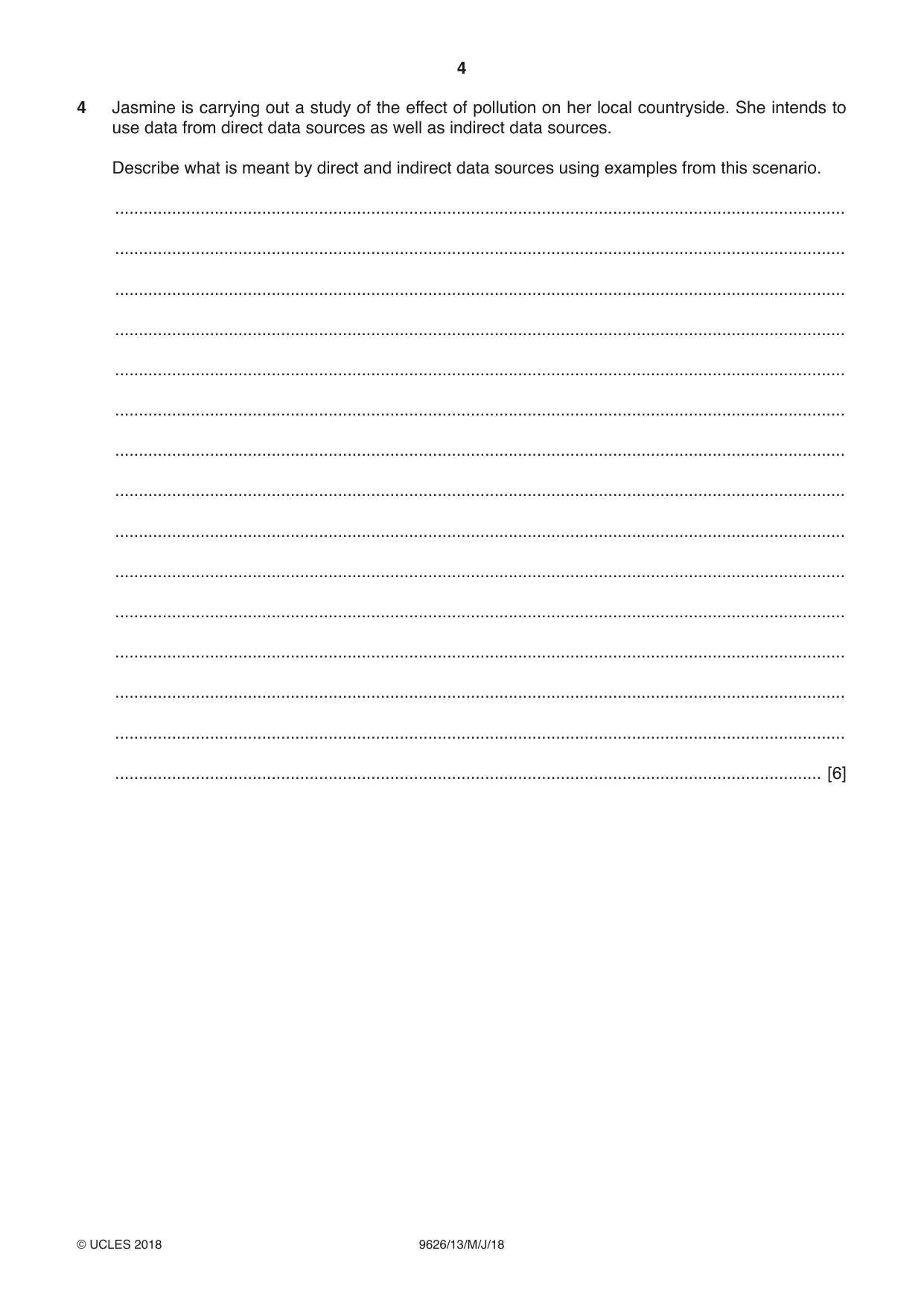
4 9626/13/M/J/18 © UCLES 2018 4 Jasmine is carrying out a study of the effect of pollution on her local countryside. She intends to use data from direct data sources as well as indirect data sources. Describe what is meant by direct and indirect data sources using examples from this scenario. … … … … … … … … … … … … … … … [6]
Question paper, page 5
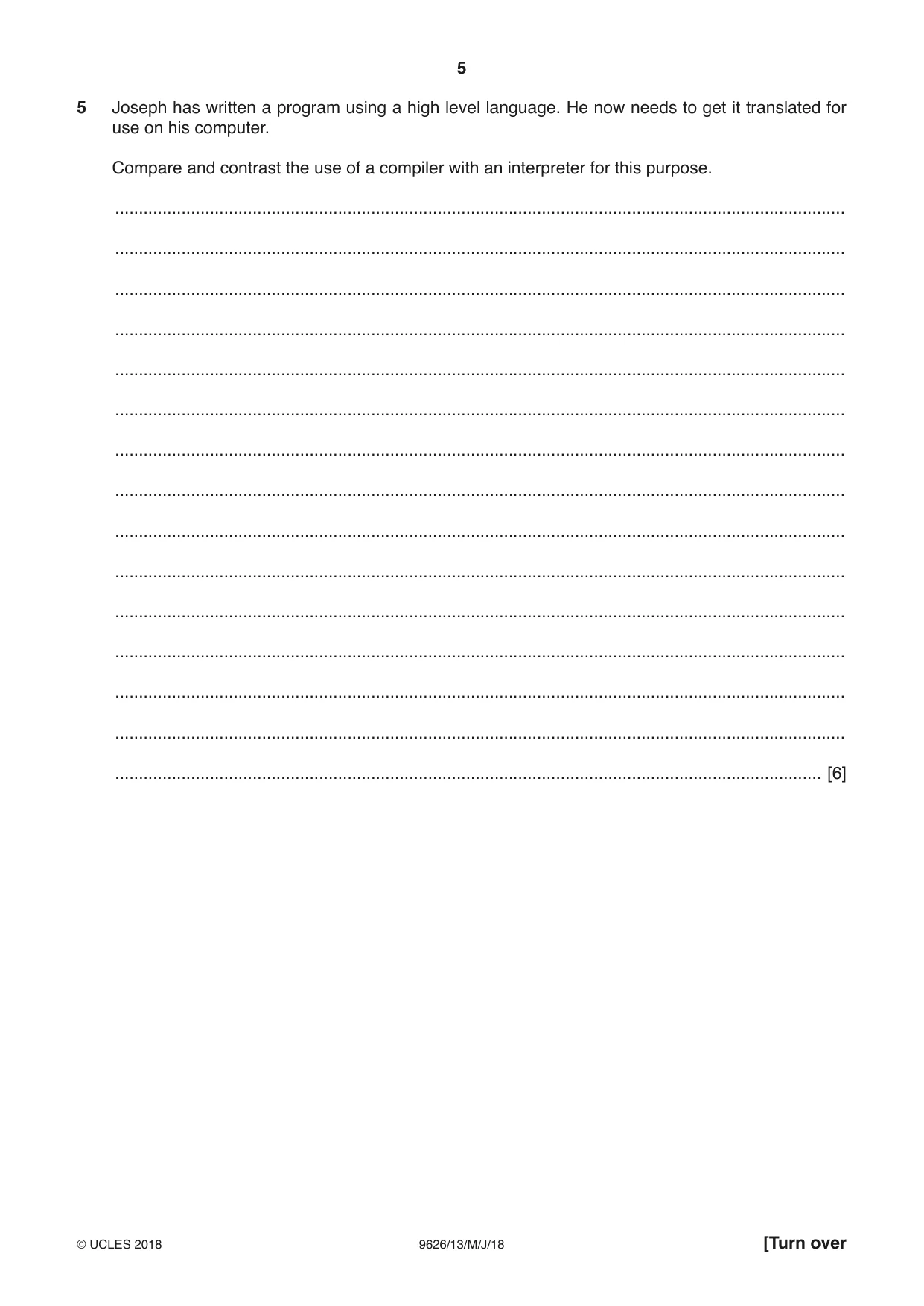
5 9626/13/M/J/18 © UCLES 2018 [Turn over 5 Joseph has written a program using a high level language. He now needs to get it translated for use on his computer. Compare and contrast the use of a compiler with an interpreter for this purpose. … … … … … … … … … … … … … … … [6]
Question paper, page 6
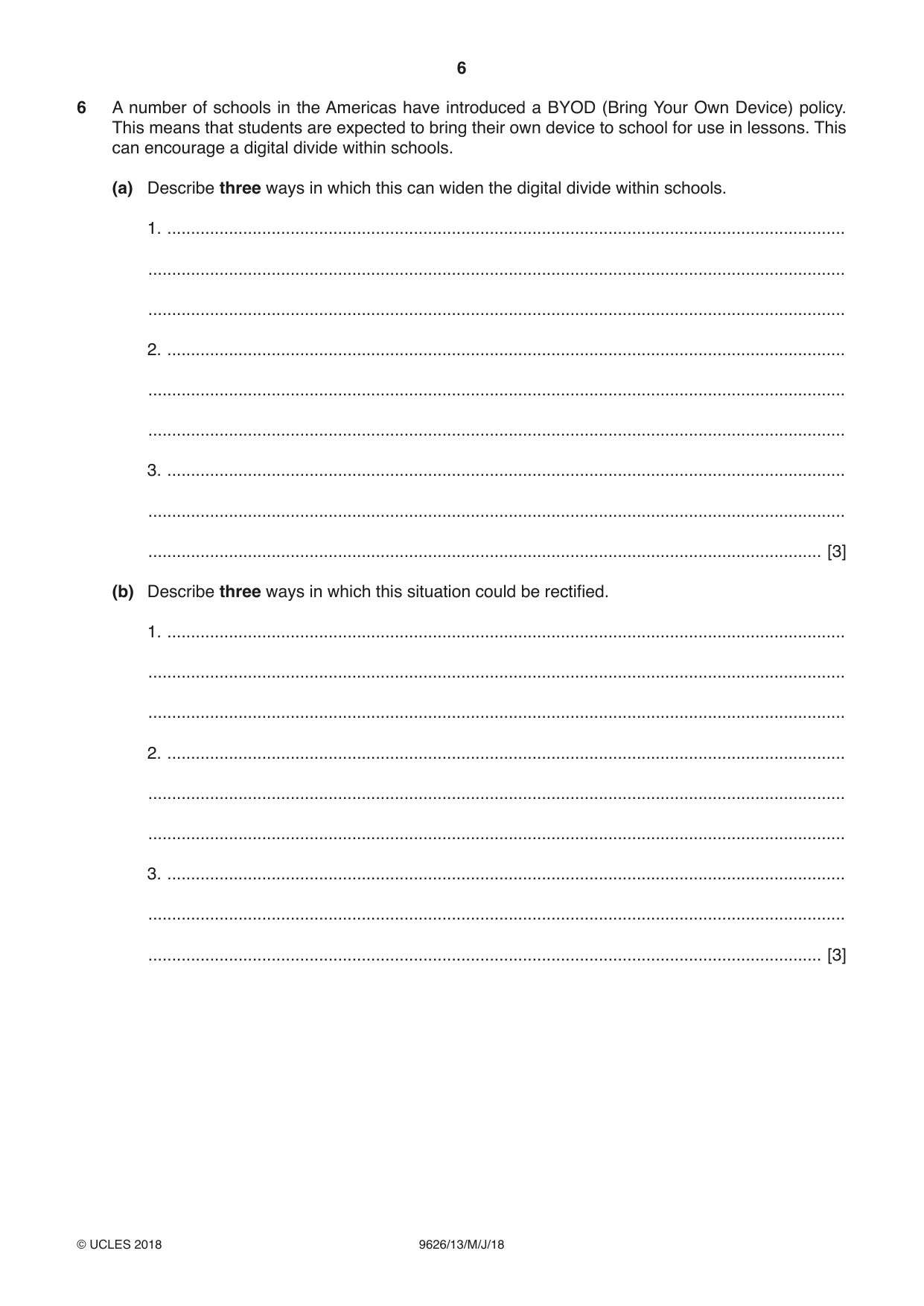
6 9626/13/M/J/18 © UCLES 2018 6 A number of schools in the Americas have introduced a BYOD (Bring Your Own Device) policy. This means that students are expected to bring their own device to school for use in lessons. This can encourage a digital divide within schools. (a) Describe three ways in which this can widen the digital divide within schools. 1. … … … 2. … … … 3. … … … [3] (b) Describe three ways in which this situation could be rectified. 1. … … … 2. … … … 3. … … … [3]
Question paper, page 7
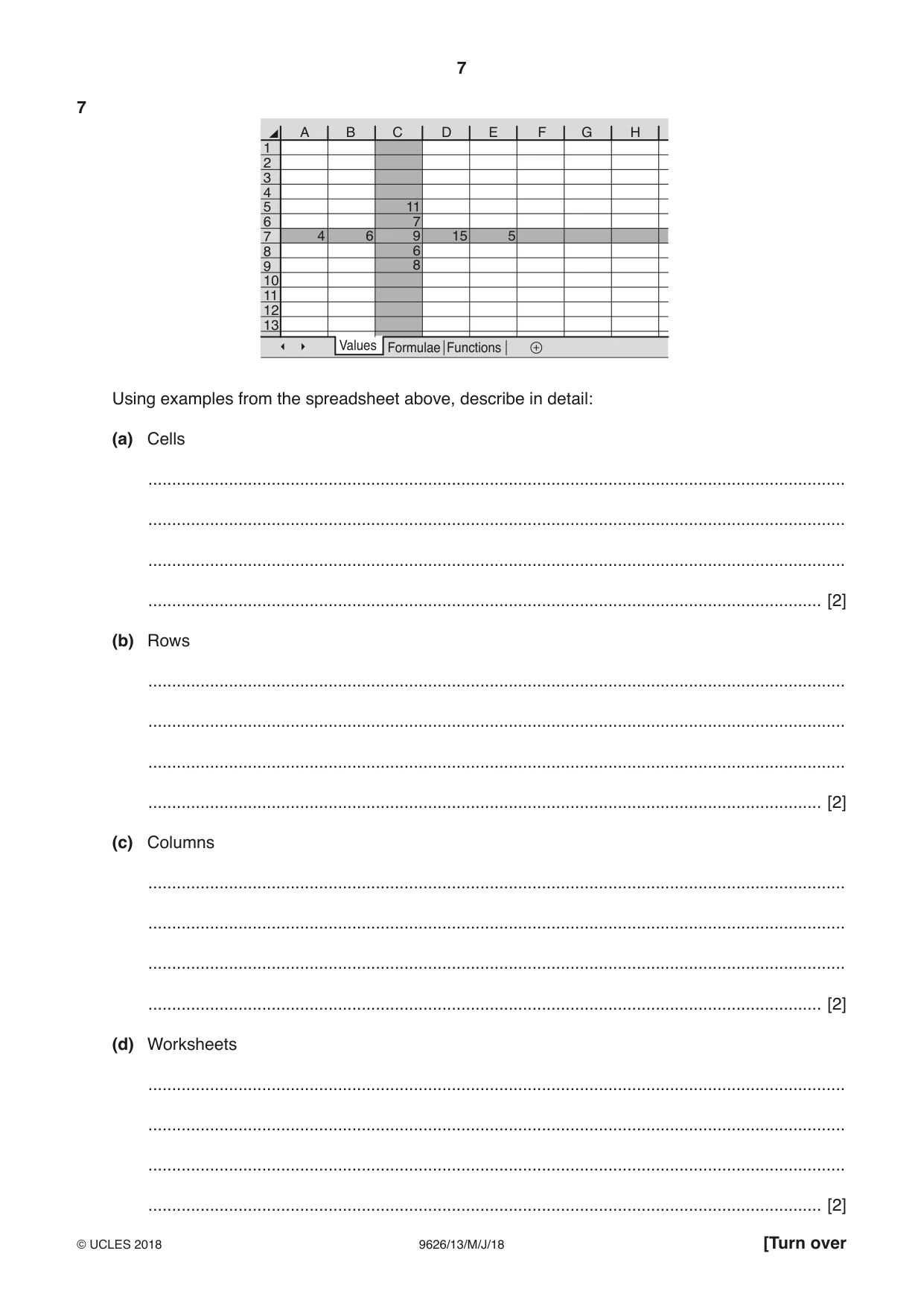
7 9626/13/M/J/18 © UCLES 2018 [Turn over 7 1 2 3 4 5 6 7 8 9 10 11 12 13 A 4 6 9 15 5 7 11 6 8 B C D E F G H Values Formulae Functions Using examples from the spreadsheet above, describe in detail: (a) Cells … … … … [2] (b) Rows … … … … [2] (c) Columns … … … … [2] (d) Worksheets … … … … [2]
Question paper, page 8
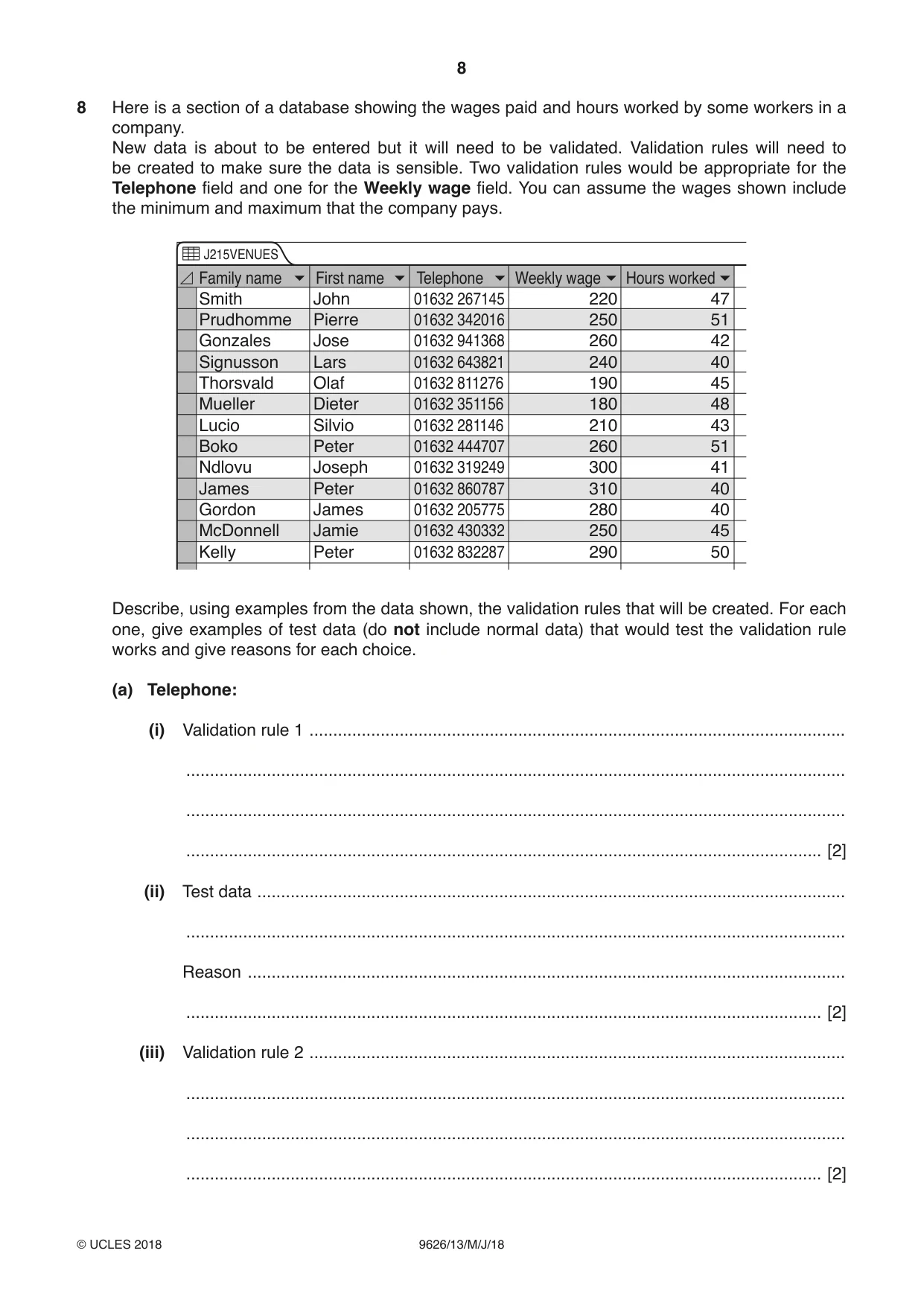
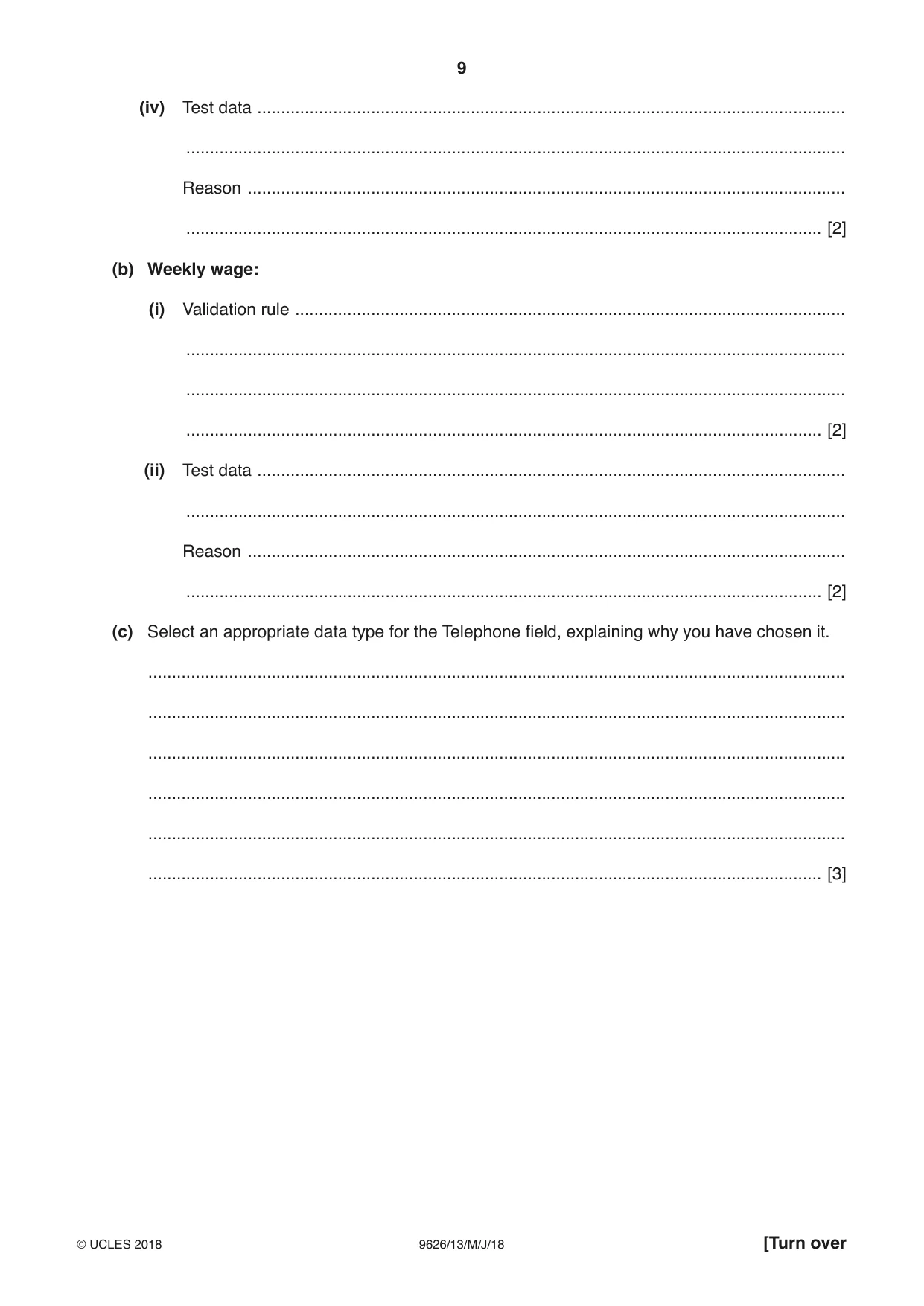
8 9626/13/M/J/18 © UCLES 2018 8 Here is a section of a database showing the wages paid and hours worked by some workers in a company. New data is about to be entered but it will need to be validated. Validation rules will need to be created to make sure the data is sensible. Two validation rules would be appropriate for the Telephone field and one for the Weekly wage field. You can assume the wages shown include the minimum and maximum that the company pays. Smith Prudhomme Gonzales Signusson Thorsvald Mueller Lucio Boko Ndlovu James Gordon McDonnell Kelly Family name J215VENUES First name Telephone Weekly wage Hours worked John Pierre Jose Lars Olaf Dieter Silvio Peter Joseph Peter James Jamie Peter 01632 267145 01632 342016 01632 941368 01632 643821 01632 811276 01632 351156 01632 281146 01632 444707 01632 319249 01632 860787 01632 205775 01632 430332 01632 832287 220 250 260 240 190 180 210 260 300 310 280 250 290 47 51 42 40 45 48 43 51 41 40 40 45 50 Describe, using examples from the data shown, the validation rules that will be created. For each one, give examples of test data (do not include normal data) that would test the validation rule works and give reasons for each choice. (a) Telephone: (i) Validation rule 1 … … … … [2] (ii) Test data … … Reason … … [2] (iii) Validation rule 2 … … … … [2]
Question paper, page 9
9 9626/13/M/J/18 © UCLES 2018 [Turn over (iv) Test data … … Reason … … [2] (b) Weekly wage: (i) Validation rule … … … … [2] (ii) Test data … … Reason … … [2] (c) Select an appropriate data type for the Telephone field, explaining why you have chosen it. … … … … … … [3]
Question paper, page 10
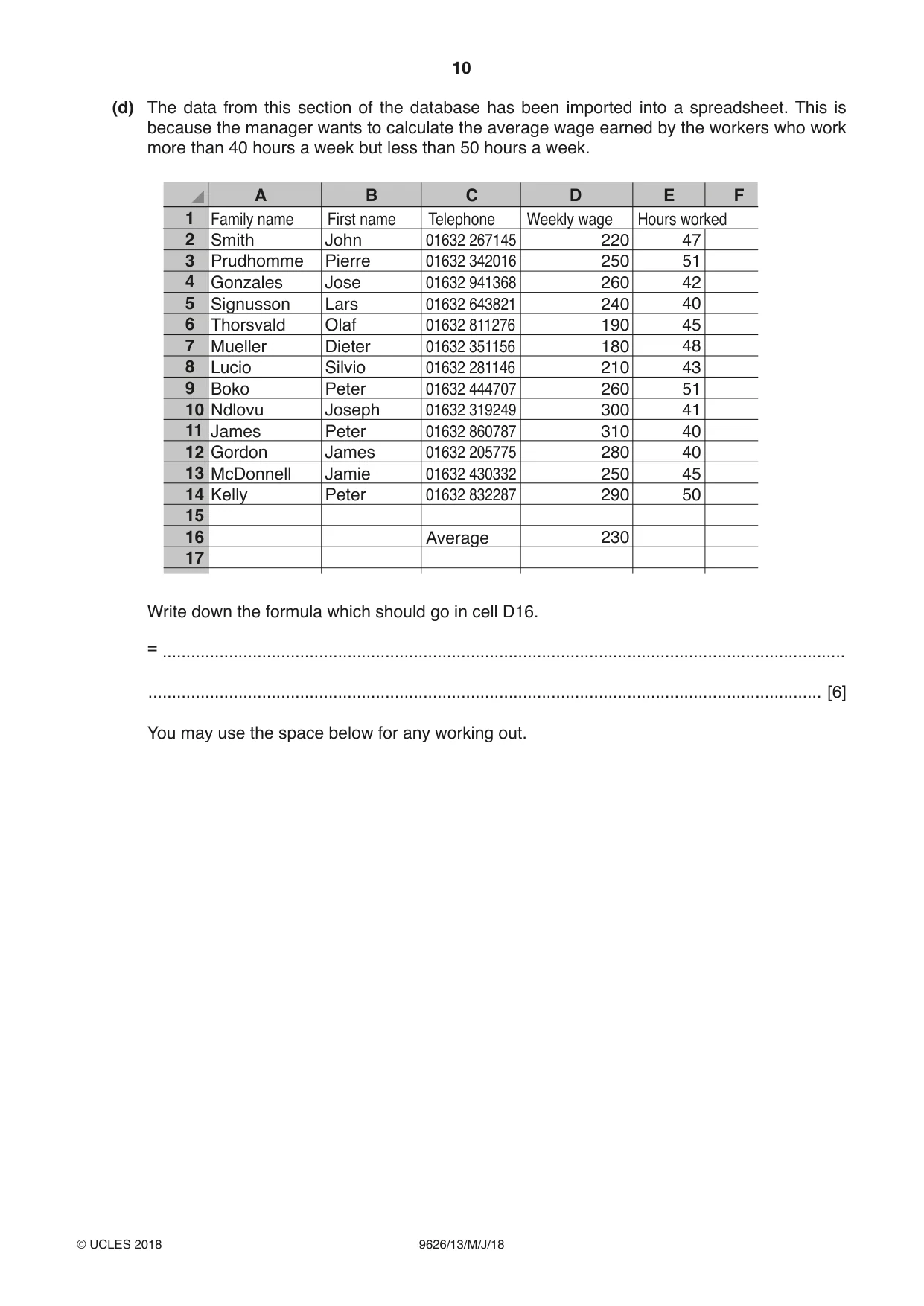
10 9626/13/M/J/18 © UCLES 2018 (d) The data from this section of the database has been imported into a spreadsheet. This is because the manager wants to calculate the average wage earned by the workers who work more than 40 hours a week but less than 50 hours a week. Smith Prudhomme Gonzales Signusson Thorsvald Mueller Lucio Boko Ndlovu James Gordon McDonnell Kelly 1 2 3 4 5 6 7 8 9 10 11 12 13 14 15 16 17 A B C D E F Family name First name Telephone Weekly wage Hours worked John Pierre Jose Lars Olaf Dieter Silvio Peter Joseph Peter James Jamie Peter 01632 267145 01632 342016 01632 941368 01632 643821 01632 811276 01632 351156 01632 281146 01632 444707 01632 319249 01632 860787 01632 205775 01632 430332 01632 832287 Average 220 250 260 240 190 180 210 260 300 310 280 250 290 230 47 51 42 40 45 48 43 51 41 40 40 45 50 Write down the formula which should go in cell D16. = … … [6] You may use the space below for any working out.
Question paper, page 11
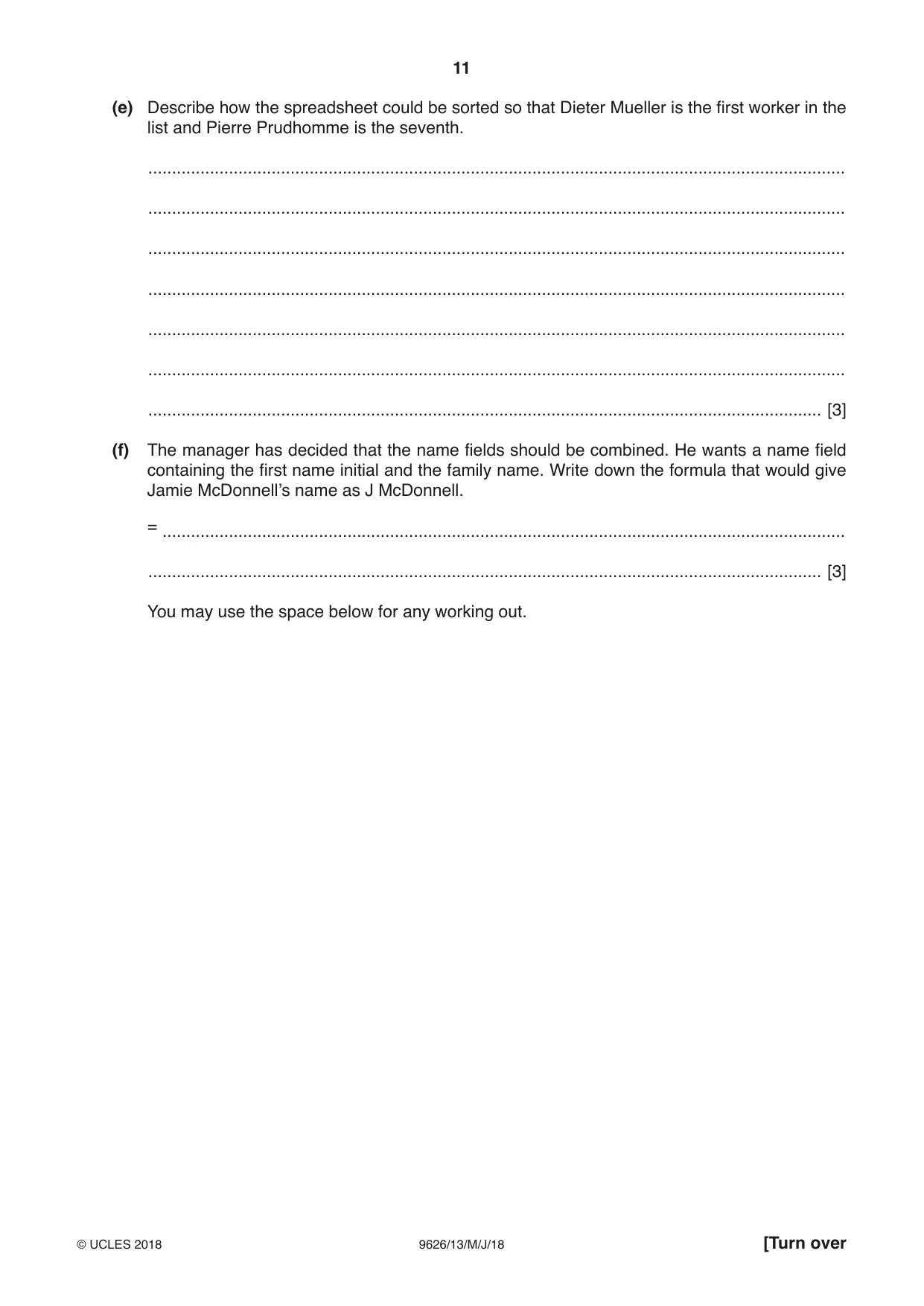
11 9626/13/M/J/18 © UCLES 2018 [Turn over (e) Describe how the spreadsheet could be sorted so that Dieter Mueller is the first worker in the list and Pierre Prudhomme is the seventh. … … … … … … … [3] (f) The manager has decided that the name fields should be combined. He wants a name field containing the first name initial and the family name. Write down the formula that would give Jamie McDonnell’s name as J McDonnell. = … … [3] You may use the space below for any working out.
Question paper, page 12
12 9626/13/M/J/18 © UCLES 2018 9 Some database systems use the indexed sequential method of accessing data. Describe the features of indexed sequential access and how it is used. … … … … … … … … … … … … … … … … … … … … [8]
Question paper, page 13
13 9626/13/M/J/18 © UCLES 2018 [Turn over 10 Magnetic Ink Character Recognition (MICR) and Optical Character Recognition (OCR) are often used in different ways for different purposes. Evaluate the use of MICR and OCR for entering data from documents. … … … … … … … … … … … … … … … … … … … … [8]
Question paper, page 14
14 9626/13/M/J/18 © UCLES 2018 11 Many people use their mobile phones for internet access. Discuss the advantages and disadvantages of mobile networks. … … … … … … … … … … … … … … … … … … … … [8]
Question paper, page 15
15 9626/13/M/J/18 © UCLES 2018 BLANK PAGE
Question paper, page 16
16 9626/13/M/J/18 © UCLES 2018 Permission to reproduce items where third-party owned material protected by copyright is included has been sought and cleared where possible. Every reasonable effort has been made by the publisher (UCLES) to trace copyright holders, but if any items requiring clearance have unwittingly been included, the publisher will be pleased to make amends at the earliest possible opportunity. To avoid the issue of disclosure of answer-related information to candidates, all copyright acknowledgements are reproduced online in the Cambridge International Examinations Copyright Acknowledgements Booklet. This is produced for each series of examinations and is freely available to download at www.cie.org.uk after the live examination series. Cambridge International Examinations is part of the Cambridge Assessment Group. Cambridge Assessment is the brand name of University of Cambridge Local Examinations Syndicate (UCLES), which is itself a department of the University of Cambridge. BLANK PAGE
Mark scheme, page 1
IGCSE™ is a registered trademark. This document consists of 9 printed pages. © UCLES 2018 [Turn over Cambridge Assessment International Education Cambridge International Advanced Subsidiary and Advanced Level INFORMATION TECHNOLOGY 9626/13 Paper 1 Theory May/June 2018 MARK SCHEME Maximum Mark: 90 Published This mark scheme is published as an aid to teachers and candidates, to indicate the requirements of the examination. It shows the basis on which Examiners were instructed to award marks. It does not indicate the details of the discussions that took place at an Examiners’ meeting before marking began, which would have considered the acceptability of alternative answers. Mark schemes should be read in conjunction with the question paper and the Principal Examiner Report for Teachers. Cambridge International will not enter into discussions about these mark schemes. Cambridge International is publishing the mark schemes for the May/June 2018 series for most Cambridge IGCSE™, Cambridge International A and AS Level and Cambridge Pre-U components, and some Cambridge O Level components.
Mark scheme, page 2
9626/13 Cambridge International AS/A Level – Mark Scheme PUBLISHED May/June 2018 © UCLES 2018 Page 2 of 9 Generic Marking Principles These general marking principles must be applied by all examiners when marking candidate answers. They should be applied alongside the specific content of the mark scheme or generic level descriptors for a question. Each question paper and mark scheme will also comply with these marking principles. GENERIC MARKING PRINCIPLE 1: Marks must be awarded in line with: • the specific content of the mark scheme or the generic level descriptors for the question • the specific skills defined in the mark scheme or in the generic level descriptors for the question • the standard of response required by a candidate as exemplified by the standardisation scripts. GENERIC MARKING PRINCIPLE 2: Marks awarded are always whole marks (not half marks, or other fractions). GENERIC MARKING PRINCIPLE 3: Marks must be awarded positively: • marks are awarded for correct/valid answers, as defined in the mark scheme. However, credit is given for valid answers which go beyond the scope of the syllabus and mark scheme, referring to your Team Leader as appropriate • marks are awarded when candidates clearly demonstrate what they know and can do • marks are not deducted for errors • marks are not deducted for omissions • answers should only be judged on the quality of spelling, punctuation and grammar when these features are specifically assessed by the question as indicated by the mark scheme. The meaning, however, should be unambiguous. GENERIC MARKING PRINCIPLE 4: Rules must be applied consistently e.g. in situations where candidates have not followed instructions or in the application of generic level descriptors. GENERIC MARKING PRINCIPLE 5: Marks should be awarded using the full range of marks defined in the mark scheme for the question (however; the use of the full mark range may be limited according to the quality of the candidate responses seen). GENERIC MARKING PRINCIPLE 6: Marks awarded are based solely on the requirements as defined in the mark scheme. Marks should not be awarded with grade thresholds or grade descriptors in mind.
Mark scheme, page 3
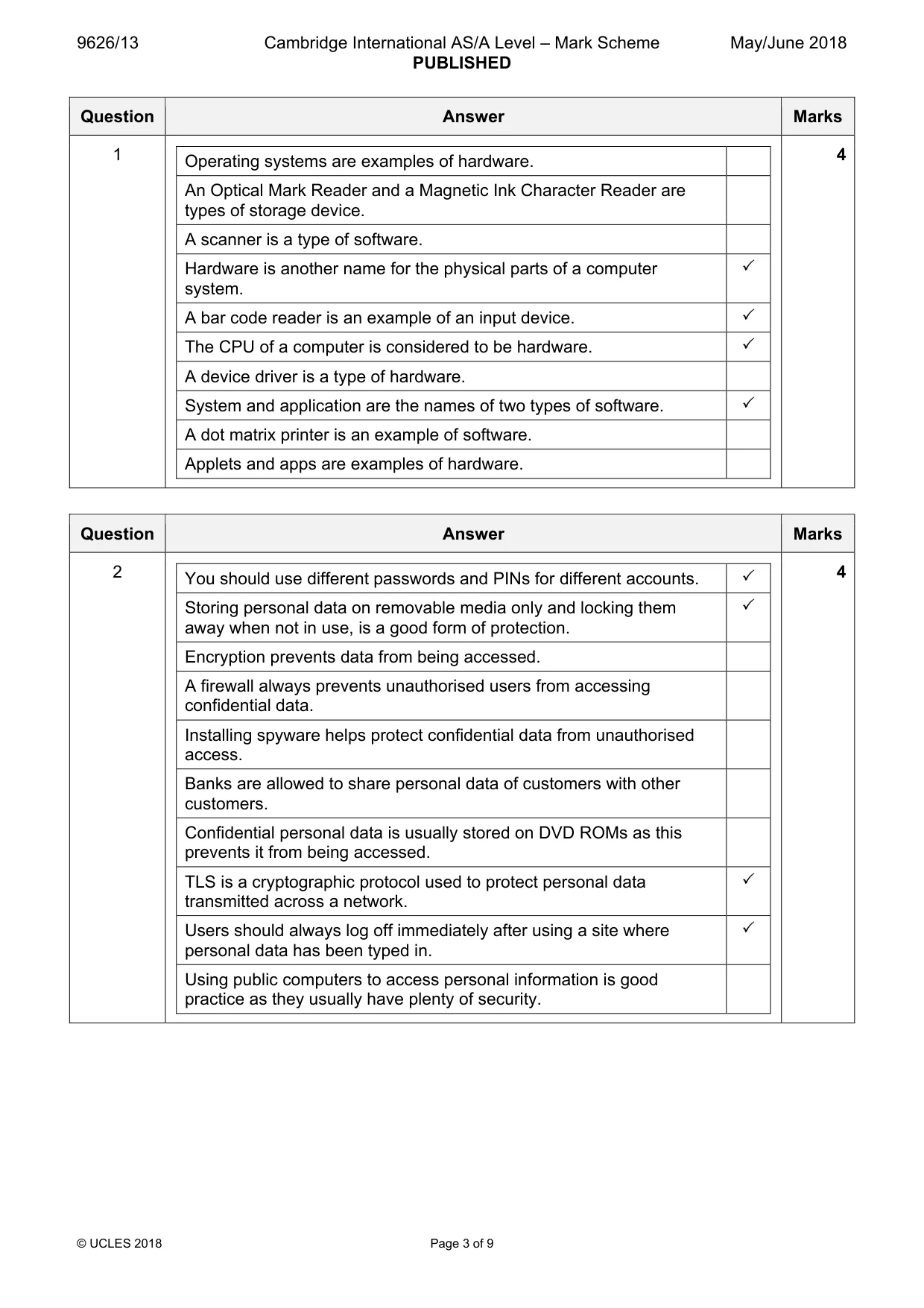
9626/13 Cambridge International AS/A Level – Mark Scheme PUBLISHED May/June 2018 © UCLES 2018 Page 3 of 9 Question Answer Marks 1 Operating systems are examples of hardware. An Optical Mark Reader and a Magnetic Ink Character Reader are types of storage device. A scanner is a type of software. Hardware is another name for the physical parts of a computer system. 3 A bar code reader is an example of an input device. 3 The CPU of a computer is considered to be hardware. 3 A device driver is a type of hardware. System and application are the names of two types of software. 3 A dot matrix printer is an example of software. Applets and apps are examples of hardware. 4 Question Answer Marks 2 You should use different passwords and PINs for different accounts. 3 Storing personal data on removable media only and locking them away when not in use, is a good form of protection. 3 Encryption prevents data from being accessed. A firewall always prevents unauthorised users from accessing confidential data. Installing spyware helps protect confidential data from unauthorised access. Banks are allowed to share personal data of customers with other customers. Confidential personal data is usually stored on DVD ROMs as this prevents it from being accessed. TLS is a cryptographic protocol used to protect personal data transmitted across a network. 3 Users should always log off immediately after using a site where personal data has been typed in. 3 Using public computers to access personal information is good practice as they usually have plenty of security. 4
Mark scheme, page 4
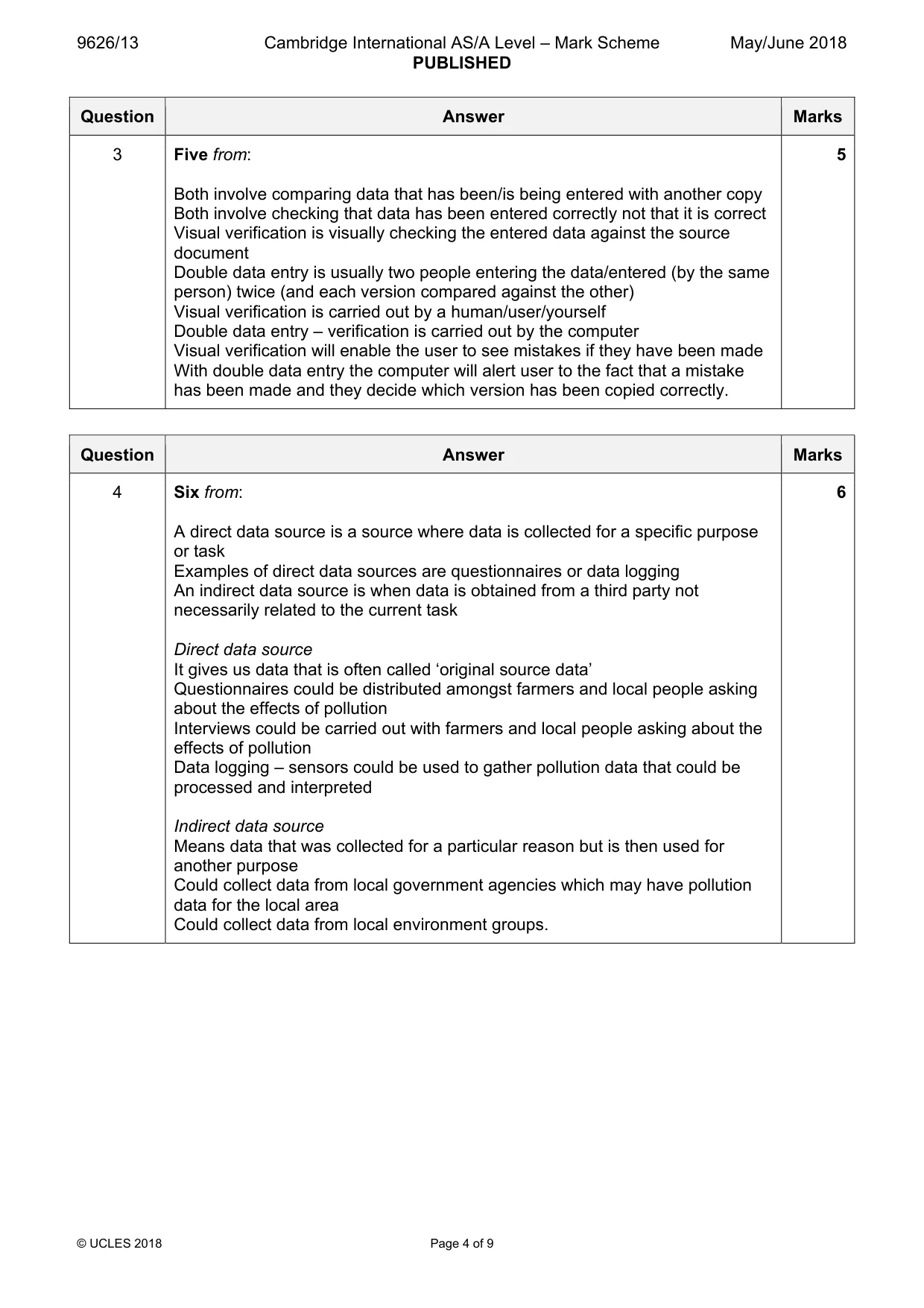
9626/13 Cambridge International AS/A Level – Mark Scheme PUBLISHED May/June 2018 © UCLES 2018 Page 4 of 9 Question Answer Marks 3 Five from: Both involve comparing data that has been/is being entered with another copy Both involve checking that data has been entered correctly not that it is correct Visual verification is visually checking the entered data against the source document Double data entry is usually two people entering the data/entered (by the same person) twice (and each version compared against the other) Visual verification is carried out by a human/user/yourself Double data entry – verification is carried out by the computer Visual verification will enable the user to see mistakes if they have been made With double data entry the computer will alert user to the fact that a mistake has been made and they decide which version has been copied correctly. 5 Question Answer Marks 4 Six from: A direct data source is a source where data is collected for a specific purpose or task Examples of direct data sources are questionnaires or data logging An indirect data source is when data is obtained from a third party not necessarily related to the current task Direct data source It gives us data that is often called ‘original source data’ Questionnaires could be distributed amongst farmers and local people asking about the effects of pollution Interviews could be carried out with farmers and local people asking about the effects of pollution Data logging – sensors could be used to gather pollution data that could be processed and interpreted Indirect data source Means data that was collected for a particular reason but is then used for another purpose Could collect data from local government agencies which may have pollution data for the local area Could collect data from local environment groups. 6
Mark scheme, page 5
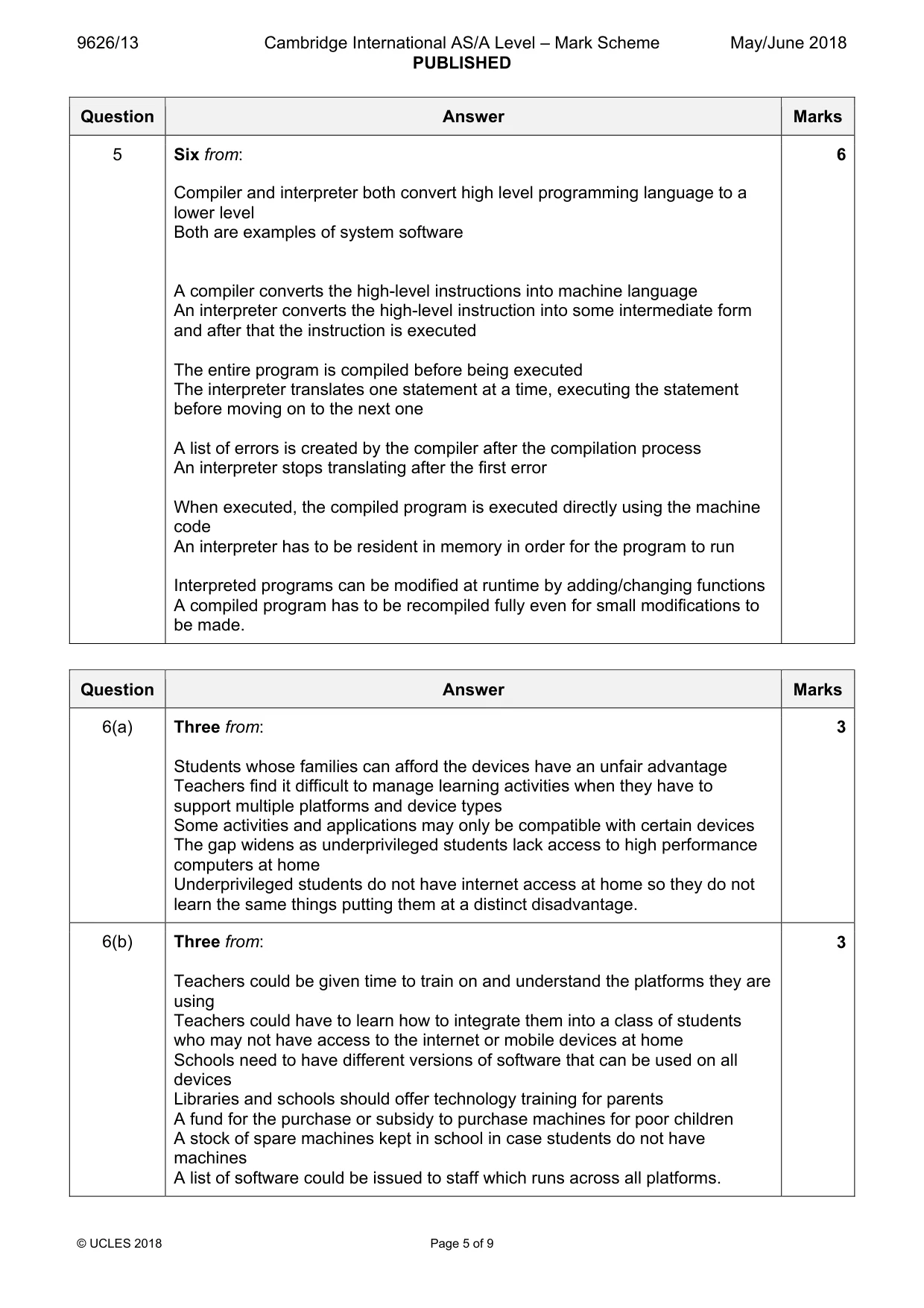
9626/13 Cambridge International AS/A Level – Mark Scheme PUBLISHED May/June 2018 © UCLES 2018 Page 5 of 9 Question Answer Marks 5 Six from: Compiler and interpreter both convert high level programming language to a lower level Both are examples of system software A compiler converts the high-level instructions into machine language An interpreter converts the high-level instruction into some intermediate form and after that the instruction is executed The entire program is compiled before being executed The interpreter translates one statement at a time, executing the statement before moving on to the next one A list of errors is created by the compiler after the compilation process An interpreter stops translating after the first error When executed, the compiled program is executed directly using the machine code An interpreter has to be resident in memory in order for the program to run Interpreted programs can be modified at runtime by adding/changing functions A compiled program has to be recompiled fully even for small modifications to be made. 6 Question Answer Marks 6(a) Three from: Students whose families can afford the devices have an unfair advantage Teachers find it difficult to manage learning activities when they have to support multiple platforms and device types Some activities and applications may only be compatible with certain devices The gap widens as underprivileged students lack access to high performance computers at home Underprivileged students do not have internet access at home so they do not learn the same things putting them at a distinct disadvantage. 3 6(b) Three from: Teachers could be given time to train on and understand the platforms they are using Teachers could have to learn how to integrate them into a class of students who may not have access to the internet or mobile devices at home Schools need to have different versions of software that can be used on all devices Libraries and schools should offer technology training for parents A fund for the purchase or subsidy to purchase machines for poor children A stock of spare machines kept in school in case students do not have machines A list of software could be issued to staff which runs across all platforms. 3
Mark scheme, page 6
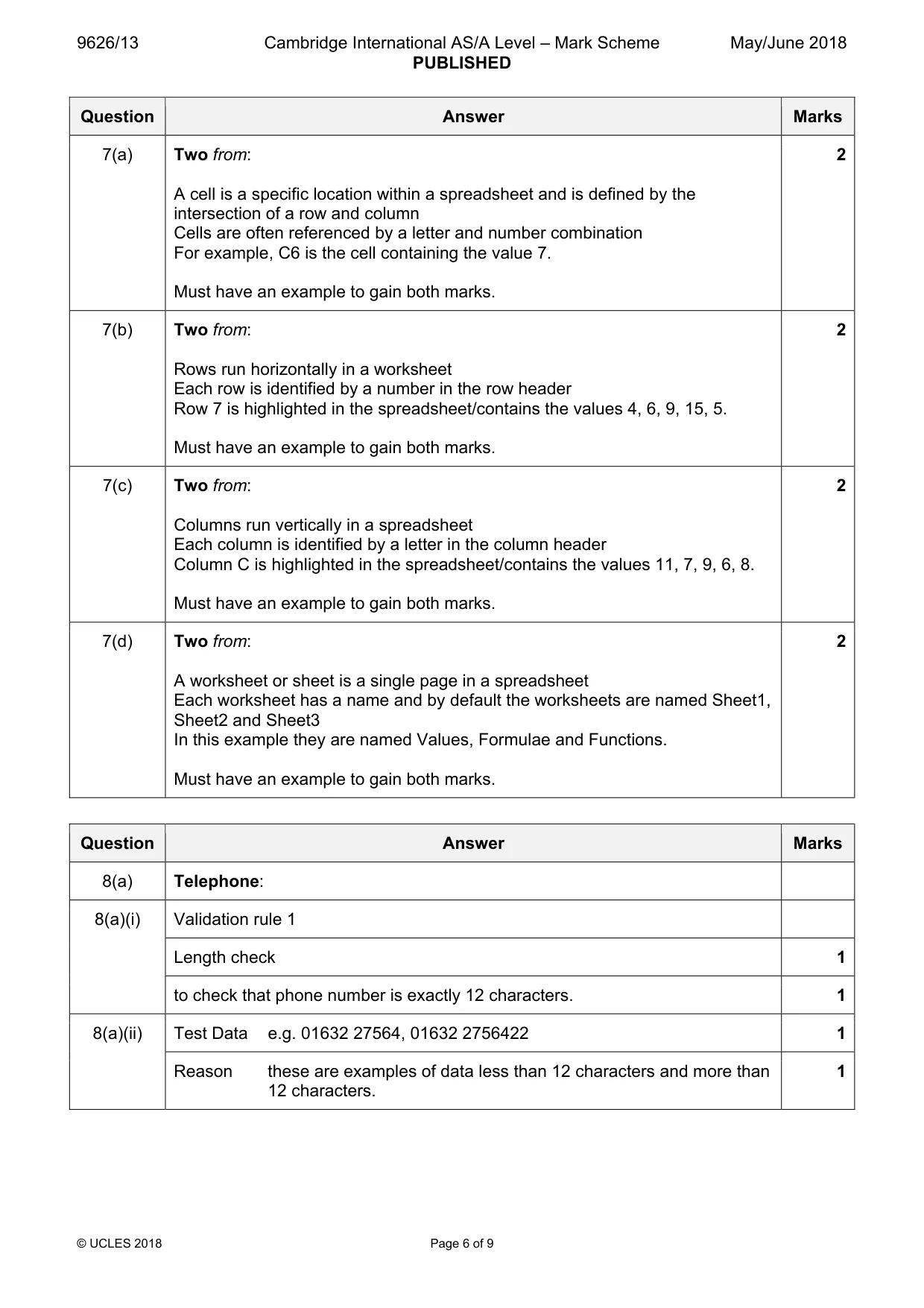
9626/13 Cambridge International AS/A Level – Mark Scheme PUBLISHED May/June 2018 © UCLES 2018 Page 6 of 9 Question Answer Marks 7(a) Two from: A cell is a specific location within a spreadsheet and is defined by the intersection of a row and column Cells are often referenced by a letter and number combination For example, C6 is the cell containing the value 7. Must have an example to gain both marks. 2 7(b) Two from: Rows run horizontally in a worksheet Each row is identified by a number in the row header Row 7 is highlighted in the spreadsheet/contains the values 4, 6, 9, 15, 5. Must have an example to gain both marks. 2 7(c) Two from: Columns run vertically in a spreadsheet Each column is identified by a letter in the column header Column C is highlighted in the spreadsheet/contains the values 11, 7, 9, 6, 8. Must have an example to gain both marks. 2 7(d) Two from: A worksheet or sheet is a single page in a spreadsheet Each worksheet has a name and by default the worksheets are named Sheet1, Sheet2 and Sheet3 In this example they are named Values, Formulae and Functions. Must have an example to gain both marks. 2 Question Answer Marks 8(a) Telephone: 8(a)(i) Validation rule 1 Length check 1 to check that phone number is exactly 12 characters. 1 8(a)(ii) Test Data e.g. 01632 27564, 01632 2756422 1 Reason these are examples of data less than 12 characters and more than 12 characters. 1
Mark scheme, page 7
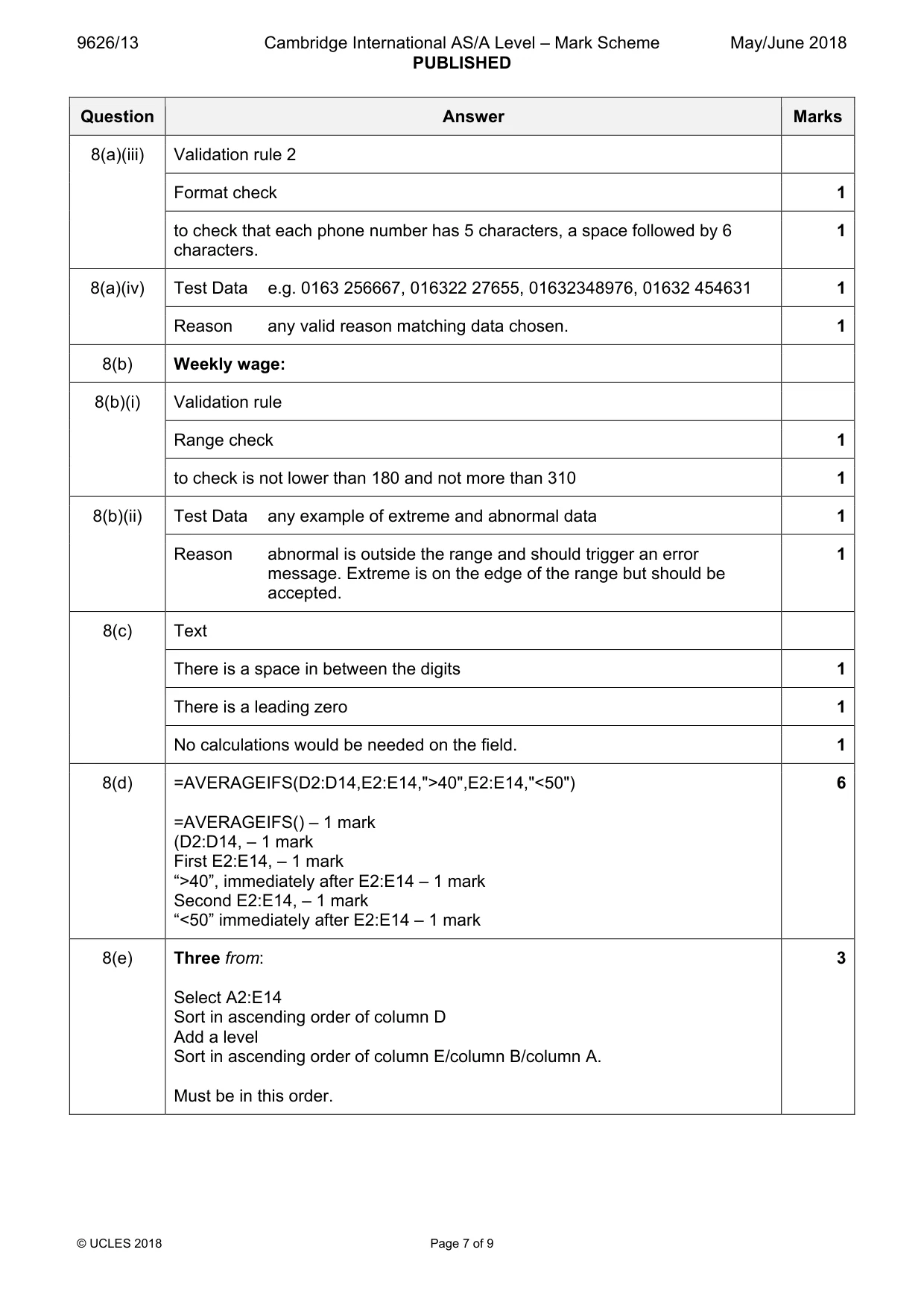
9626/13 Cambridge International AS/A Level – Mark Scheme PUBLISHED May/June 2018 © UCLES 2018 Page 7 of 9 Question Answer Marks 8(a)(iii) Validation rule 2 Format check 1 to check that each phone number has 5 characters, a space followed by 6 characters. 1 8(a)(iv) Test Data e.g. 0163 256667, 016322 27655, 01632348976, 01632 454631 1 Reason any valid reason matching data chosen. 1 8(b) Weekly wage: 8(b)(i) Validation rule Range check 1 to check is not lower than 180 and not more than 310 1 8(b)(ii) Test Data any example of extreme and abnormal data 1 Reason abnormal is outside the range and should trigger an error message. Extreme is on the edge of the range but should be accepted. 1 8(c) Text There is a space in between the digits 1 There is a leading zero 1 No calculations would be needed on the field. 1 8(d) =AVERAGEIFS(D2:D14,E2:E14,">40",E2:E14,"<50") =AVERAGEIFS() – 1 mark (D2:D14, – 1 mark First E2:E14, – 1 mark “>40”, immediately after E2:E14 – 1 mark Second E2:E14, – 1 mark “<50” immediately after E2:E14 – 1 mark 6 8(e) Three from: Select A2:E14 Sort in ascending order of column D Add a level Sort in ascending order of column E/column B/column A. Must be in this order. 3
Mark scheme, page 8
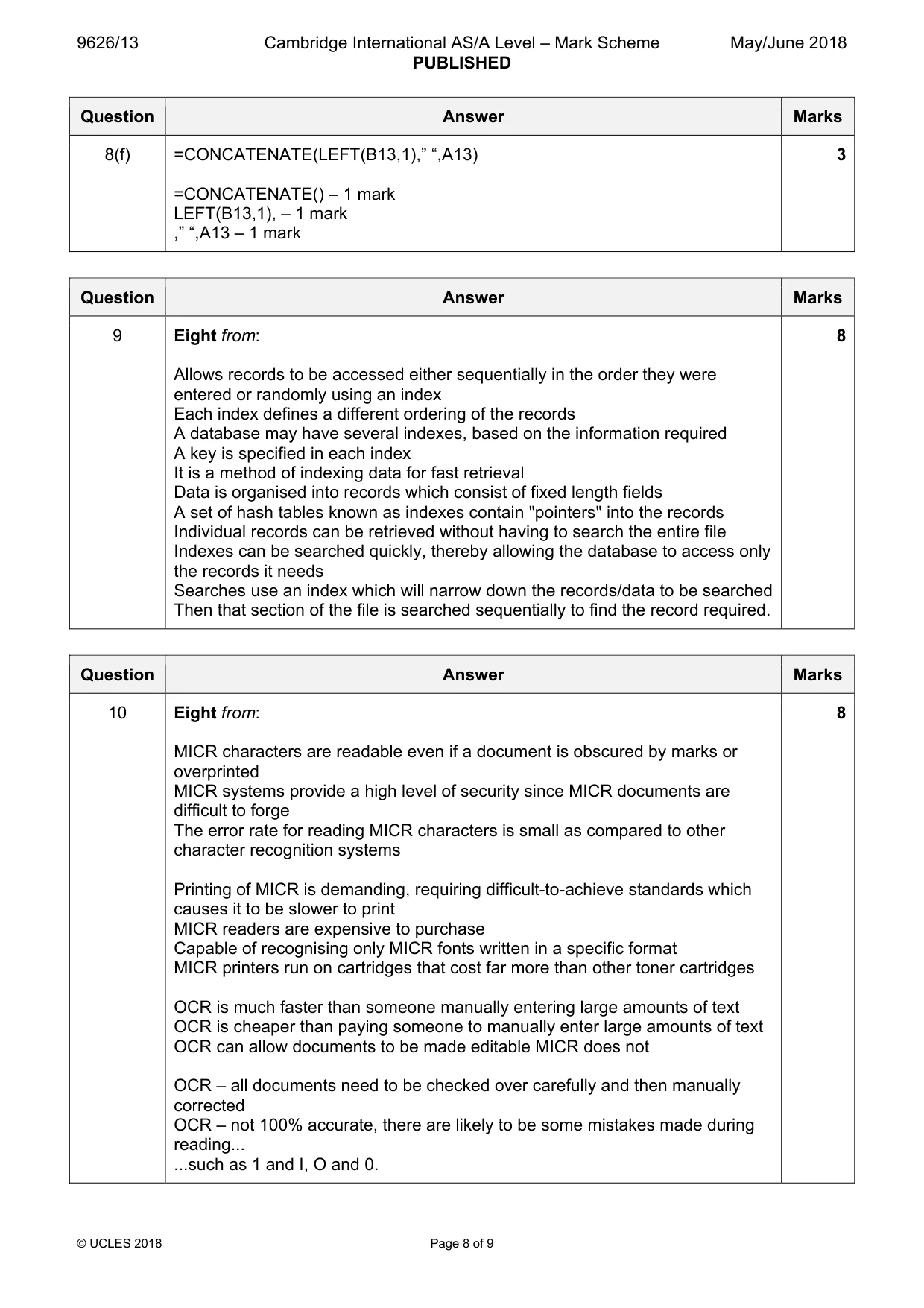
9626/13 Cambridge International AS/A Level – Mark Scheme PUBLISHED May/June 2018 © UCLES 2018 Page 8 of 9 Question Answer Marks 8(f) =CONCATENATE(LEFT(B13,1),” “,A13) =CONCATENATE() – 1 mark LEFT(B13,1), – 1 mark ,” “,A13 – 1 mark 3 Question Answer Marks 9 Eight from: Allows records to be accessed either sequentially in the order they were entered or randomly using an index Each index defines a different ordering of the records A database may have several indexes, based on the information required A key is specified in each index It is a method of indexing data for fast retrieval Data is organised into records which consist of fixed length fields A set of hash tables known as indexes contain "pointers" into the records Individual records can be retrieved without having to search the entire file Indexes can be searched quickly, thereby allowing the database to access only the records it needs Searches use an index which will narrow down the records/data to be searched Then that section of the file is searched sequentially to find the record required. 8 Question Answer Marks 10 Eight from: MICR characters are readable even if a document is obscured by marks or overprinted MICR systems provide a high level of security since MICR documents are difficult to forge The error rate for reading MICR characters is small as compared to other character recognition systems Printing of MICR is demanding, requiring difficult-to-achieve standards which causes it to be slower to print MICR readers are expensive to purchase Capable of recognising only MICR fonts written in a specific format MICR printers run on cartridges that cost far more than other toner cartridges OCR is much faster than someone manually entering large amounts of text OCR is cheaper than paying someone to manually enter large amounts of text OCR can allow documents to be made editable MICR does not OCR – all documents need to be checked over carefully and then manually corrected OCR – not 100% accurate, there are likely to be some mistakes made during reading... ...such as 1 and I, O and 0. 8
Mark scheme, page 9
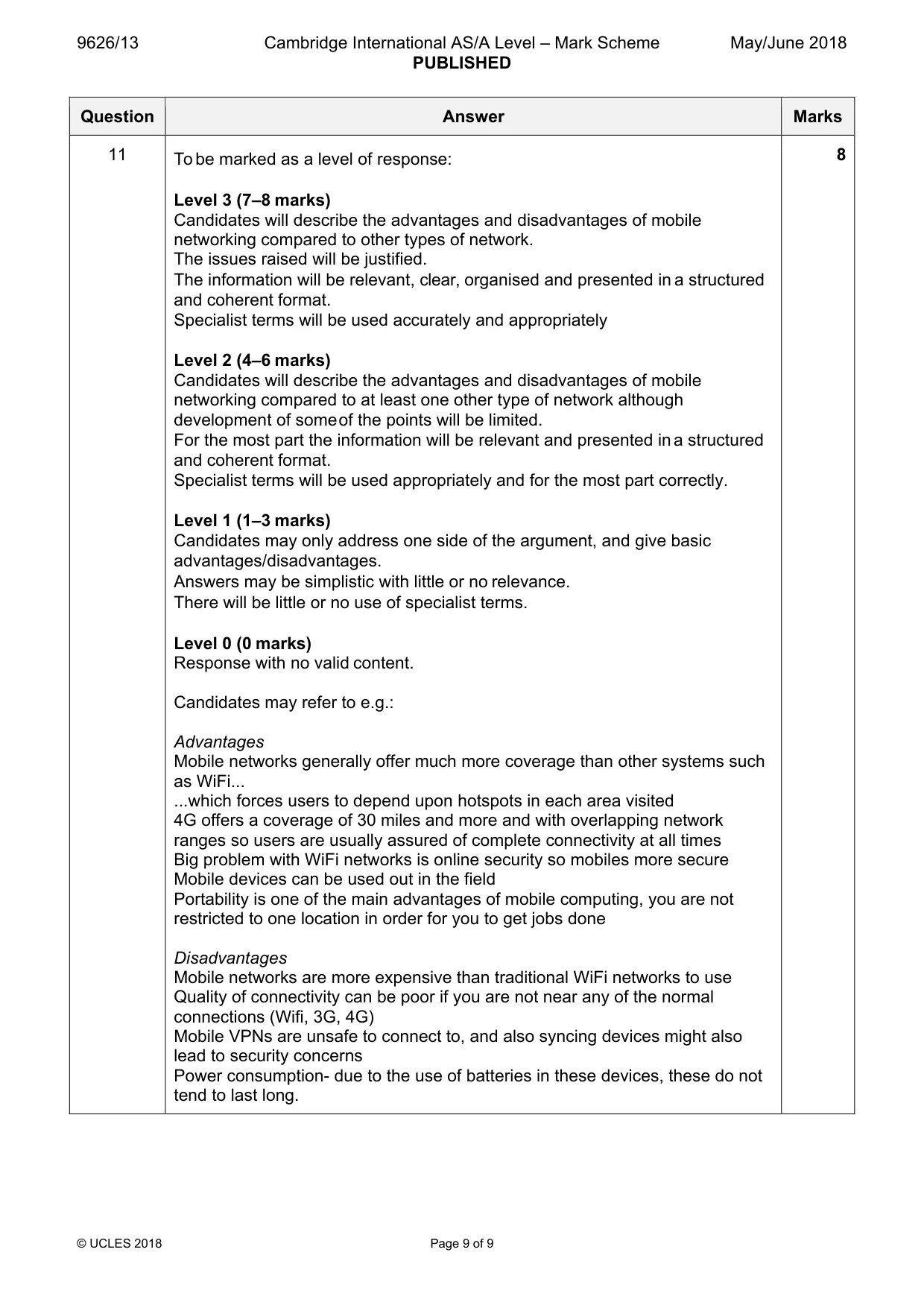
9626/13 Cambridge International AS/A Level – Mark Scheme PUBLISHED May/June 2018 © UCLES 2018 Page 9 of 9 Question Answer Marks 11 To be marked as a level of response: Level 3 (7–8 marks) Candidates will describe the advantages and disadvantages of mobile networking compared to other types of network. The issues raised will be justified. The information will be relevant, clear, organised and presented in a structured and coherent format. Specialist terms will be used accurately and appropriately Level 2 (4–6 marks) Candidates will describe the advantages and disadvantages of mobile networking compared to at least one other type of network although development of some of the points will be limited. For the most part the information will be relevant and presented in a structured and coherent format. Specialist terms will be used appropriately and for the most part correctly. Level 1 (1–3 marks) Candidates may only address one side of the argument, and give basic advantages/disadvantages. Answers may be simplistic with little or no relevance. There will be little or no use of specialist terms. Level 0 (0 marks) Response with no valid content. Candidates may refer to e.g.: Advantages Mobile networks generally offer much more coverage than other systems such as WiFi... ...which forces users to depend upon hotspots in each area visited 4G offers a coverage of 30 miles and more and with overlapping network ranges so users are usually assured of complete connectivity at all times Big problem with WiFi networks is online security so mobiles more secure Mobile devices can be used out in the field Portability is one of the main advantages of mobile computing, you are not restricted to one location in order for you to get jobs done Disadvantages Mobile networks are more expensive than traditional WiFi networks to use Quality of connectivity can be poor if you are not near any of the normal connections (Wifi, 3G, 4G) Mobile VPNs are unsafe to connect to, and also syncing devices might also lead to security concerns Power consumption- due to the use of batteries in these devices, these do not tend to last long. 8
What you needed in this session
Cambridge’s own grade thresholds for 2018 May/June, Paper 1 · Variant 3. A higher threshold means an easier paper — the bar moves with how the cohort did.