Cambridge A Level Information Technology (from 2017) 9626 — 2017 Oct/Nov Paper 1 · Variant 3
9626/13/O/N/17 · 90 marks · ≈101 min
The question paper and its mark scheme, free to read here and free to download. This is Cambridge’s own paper, exactly as it was sat.
Question paper16 pages








Mark scheme9 pages
Answers below. Sit the paper first if you are practising.
Paper as text
Question paper, page 1
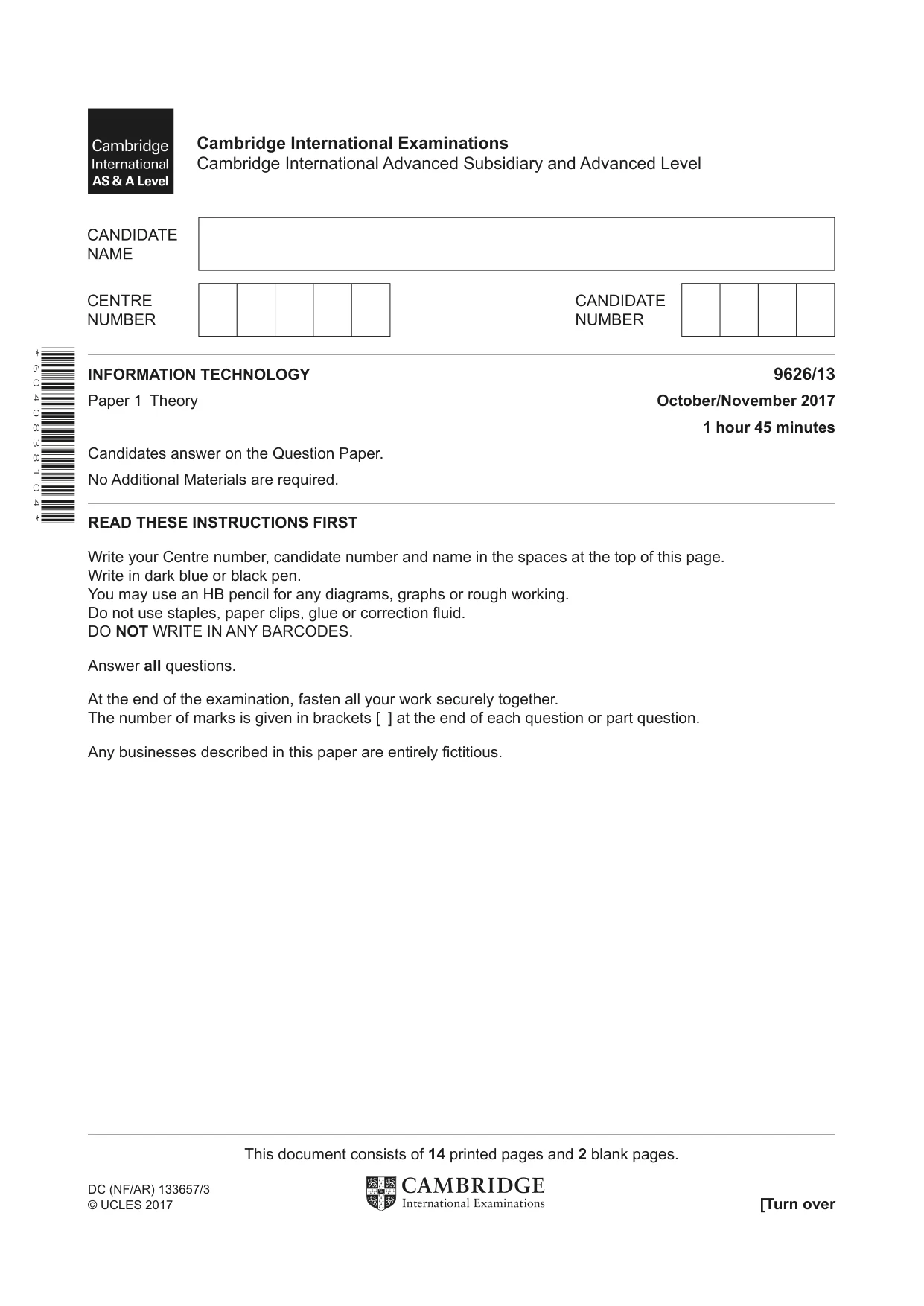
This document consists of 14 printed pages and 2 blank pages. DC (NF/AR) 133657/3 © UCLES 2017 [Turn over Cambridge International Examinations Cambridge International Advanced Subsidiary and Advanced Level * 6 0 4 0 8 3 8 1 0 4 * INFORMATION TECHNOLOGY 9626/13 Paper 1 Theory October/November 2017 1 hour 45 minutes Candidates answer on the Question Paper. No Additional Materials are required. READ THESE INSTRUCTIONS FIRST Write your Centre number, candidate number and name in the spaces at the top of this page. Write in dark blue or black pen. You may use an HB pencil for any diagrams, graphs or rough working. Do not use staples, paper clips, glue or correction fluid. DO NOT WRITE IN ANY BARCODES. Answer all questions. At the end of the examination, fasten all your work securely together. The number of marks is given in brackets [ ] at the end of each question or part question. Any businesses described in this paper are entirely fictitious.
Question paper, page 2
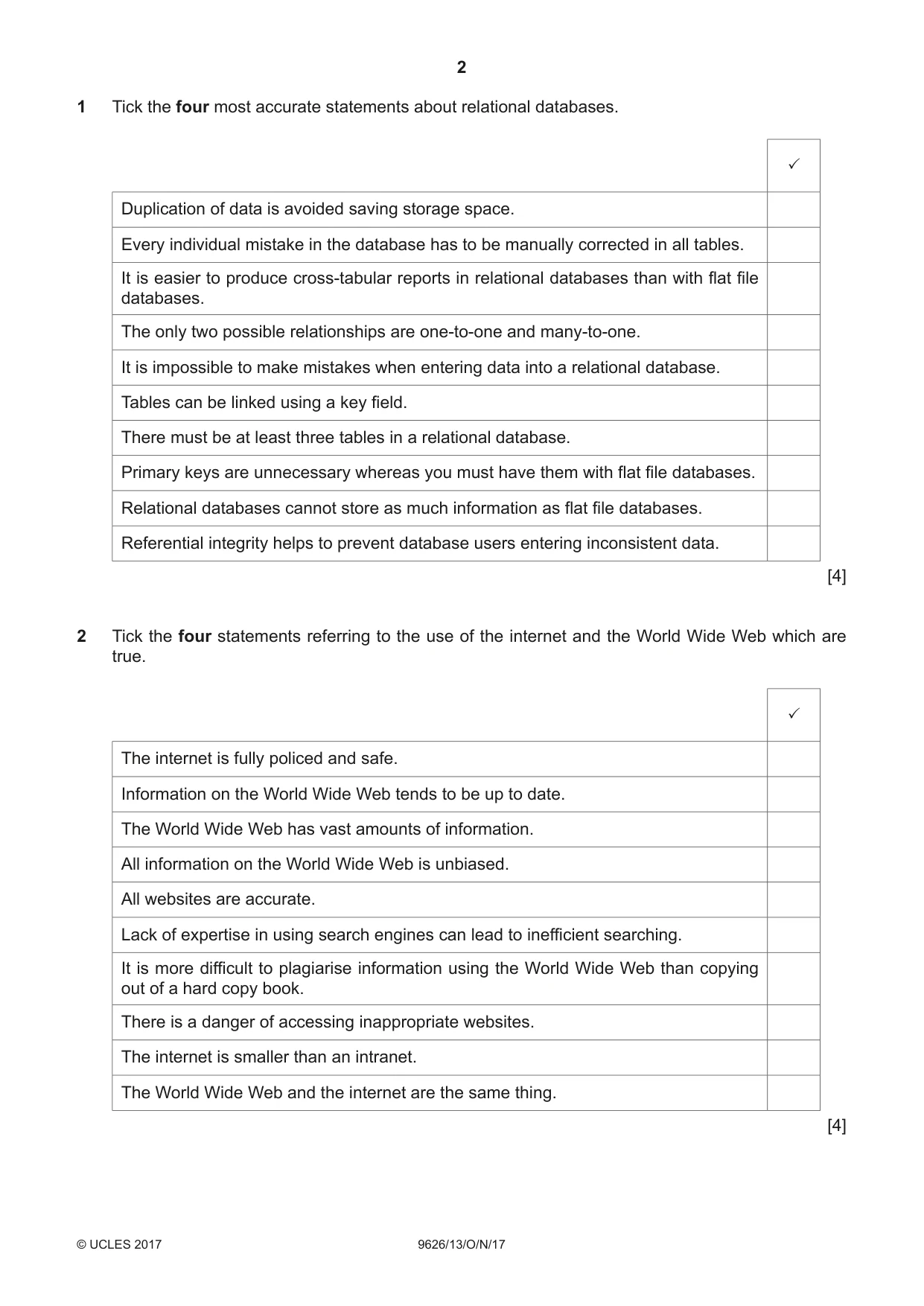
2 9626/13/O/N/17 © UCLES 2017 1 Tick the four most accurate statements about relational databases. P Duplication of data is avoided saving storage space. Every individual mistake in the database has to be manually corrected in all tables. It is easier to produce cross-tabular reports in relational databases than with flat file databases. The only two possible relationships are one-to-one and many-to-one. It is impossible to make mistakes when entering data into a relational database. Tables can be linked using a key field. There must be at least three tables in a relational database. Primary keys are unnecessary whereas you must have them with flat file databases. Relational databases cannot store as much information as flat file databases. Referential integrity helps to prevent database users entering inconsistent data. [4] 2 Tick the four statements referring to the use of the internet and the World Wide Web which are true. P The internet is fully policed and safe. Information on the World Wide Web tends to be up to date. The World Wide Web has vast amounts of information. All information on the World Wide Web is unbiased. All websites are accurate. Lack of expertise in using search engines can lead to inefficient searching. It is more difficult to plagiarise information using the World Wide Web than copying out of a hard copy book. There is a danger of accessing inappropriate websites. The internet is smaller than an intranet. The World Wide Web and the internet are the same thing. [4]
Question paper, page 3
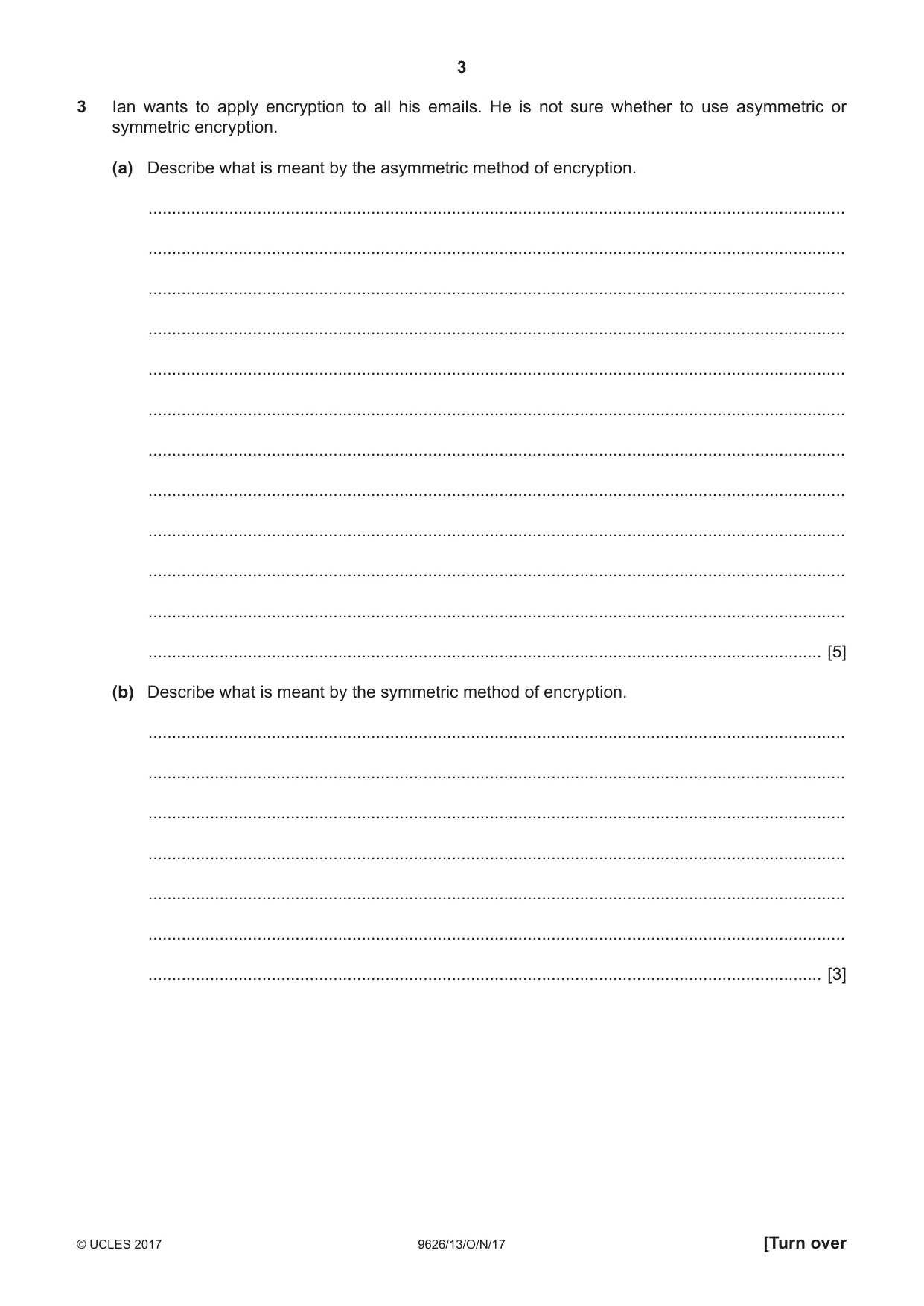
3 9626/13/O/N/17 © UCLES 2017 [Turn over 3 Ian wants to apply encryption to all his emails. He is not sure whether to use asymmetric or symmetric encryption. (a) Describe what is meant by the asymmetric method of encryption. … … … … … … … … … … … … [5] (b) Describe what is meant by the symmetric method of encryption. … … … … … … … [3]
Question paper, page 4
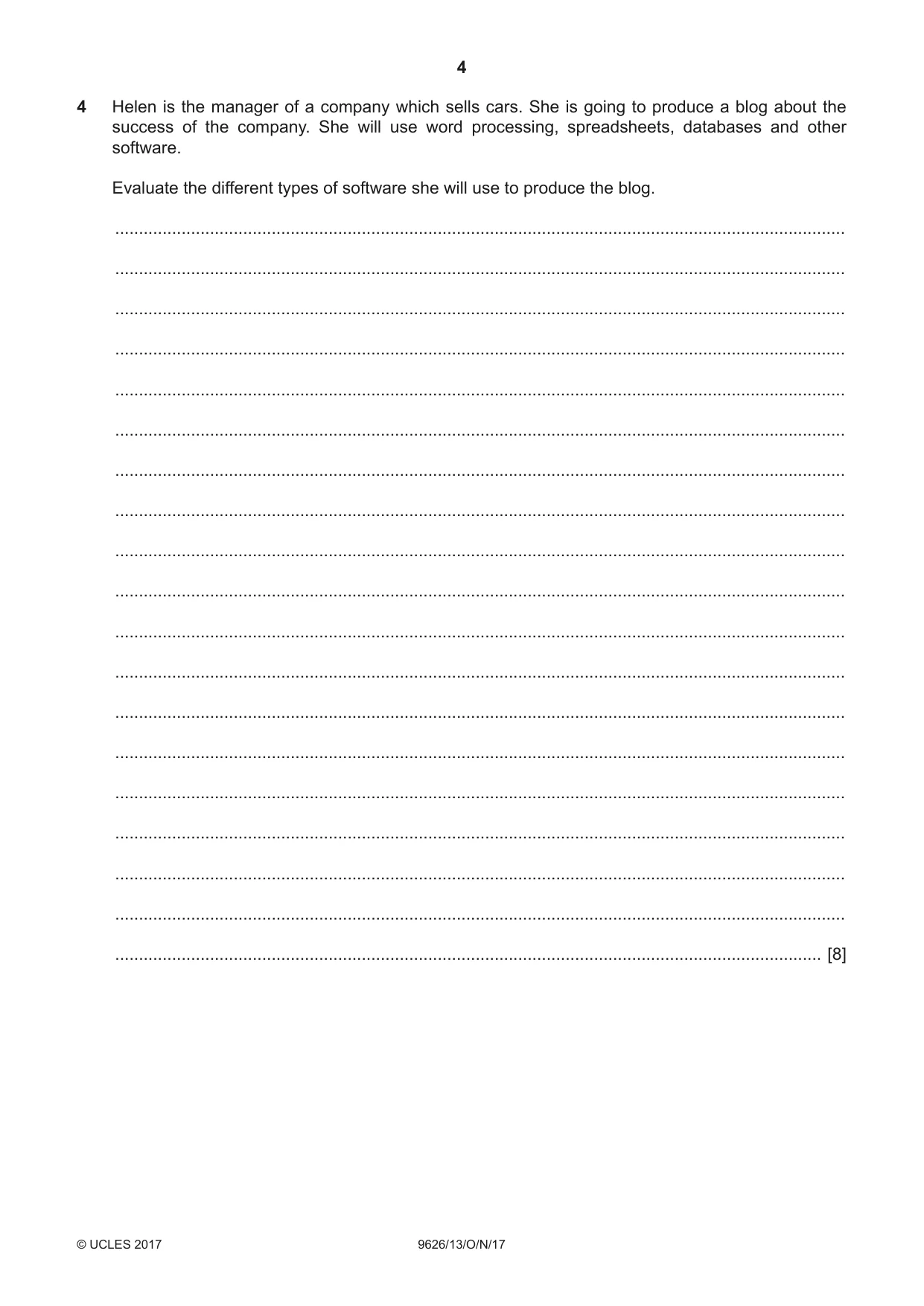
4 9626/13/O/N/17 © UCLES 2017 4 Helen is the manager of a company which sells cars. She is going to produce a blog about the success of the company. She will use word processing, spreadsheets, databases and other software. Evaluate the different types of software she will use to produce the blog. … … … … … … … … … … … … … … … … … … … [8]
Question paper, page 5
5 9626/13/O/N/17 © UCLES 2017 [Turn over 5 The digital divide can exist between different groups of people. Describe the groups of people who are affected and explain why this is the case. … … … … … … … … … … … … … … … [6]
Question paper, page 6
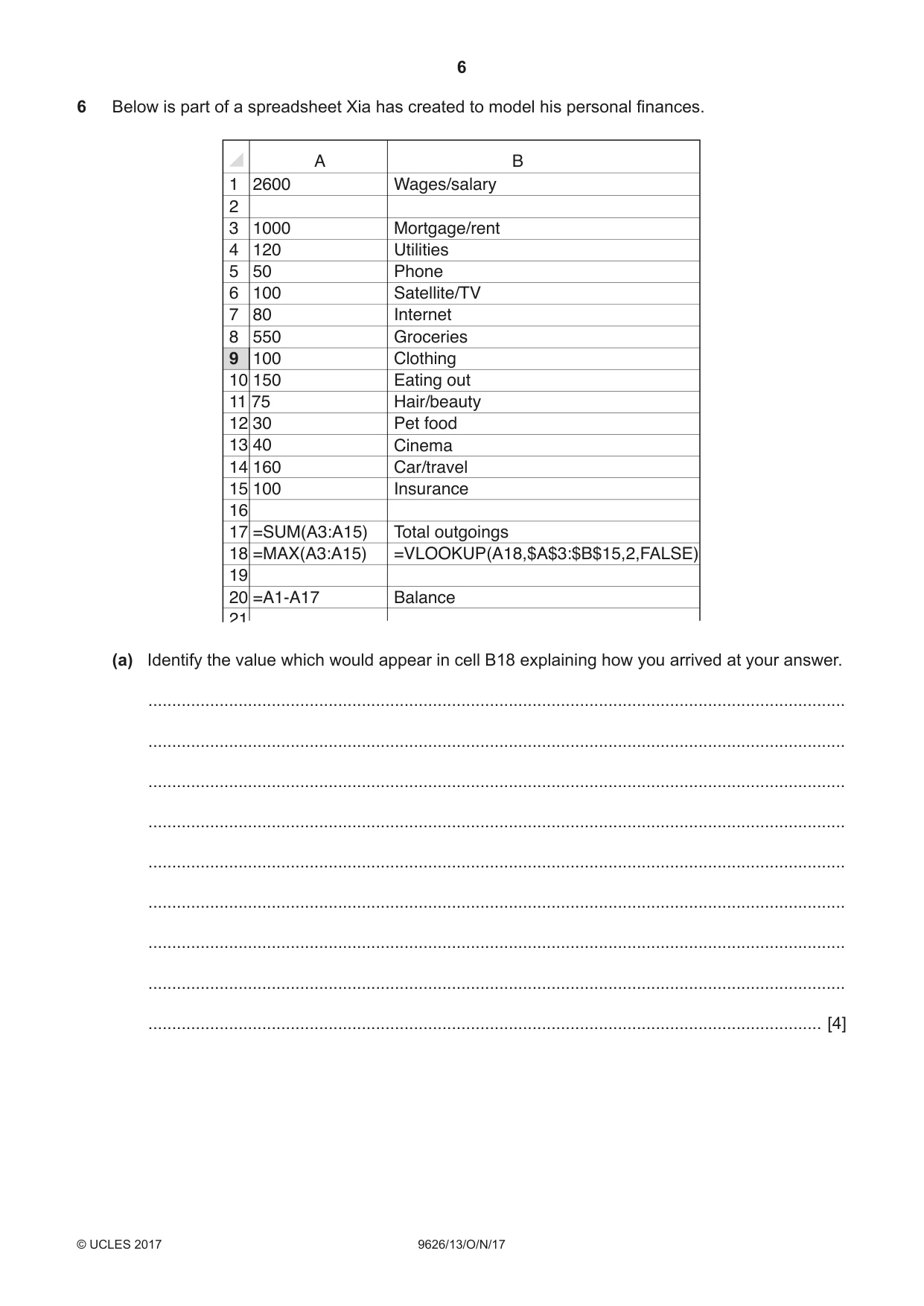
6 9626/13/O/N/17 © UCLES 2017 6 Below is part of a spreadsheet Xia has created to model his personal finances. 1 2600 2 3 1000 4 120 5 50 6 100 7 80 8 550 9 100 10 150 11 75 12 30 13 40 14 160 15 100 16 17 =SUM(A3:A15) 18 =MAX(A3:A15) 19 20 =A1-A17 21 Wages/salary Mortgage/rent Utilities Phone Satellite/TV Internet Groceries Clothing Eating out Hair/beauty Pet food Cinema Car/travel Insurance Total outgoings =VLOOKUP(A18,$A$3:$B$15,2,FALSE) Balance A B (a) Identify the value which would appear in cell B18 explaining how you arrived at your answer. … … … … … … … … … [4]
Question paper, page 7
7 9626/13/O/N/17 © UCLES 2017 [Turn over (b) Xia is not sure whether the spreadsheet would work if some of the values were changed. Describe the test plan you would use to help Xia make sure there are no errors in his spreadsheet. … … … … … … … … … … … … … … … … … … … [8]
Question paper, page 8
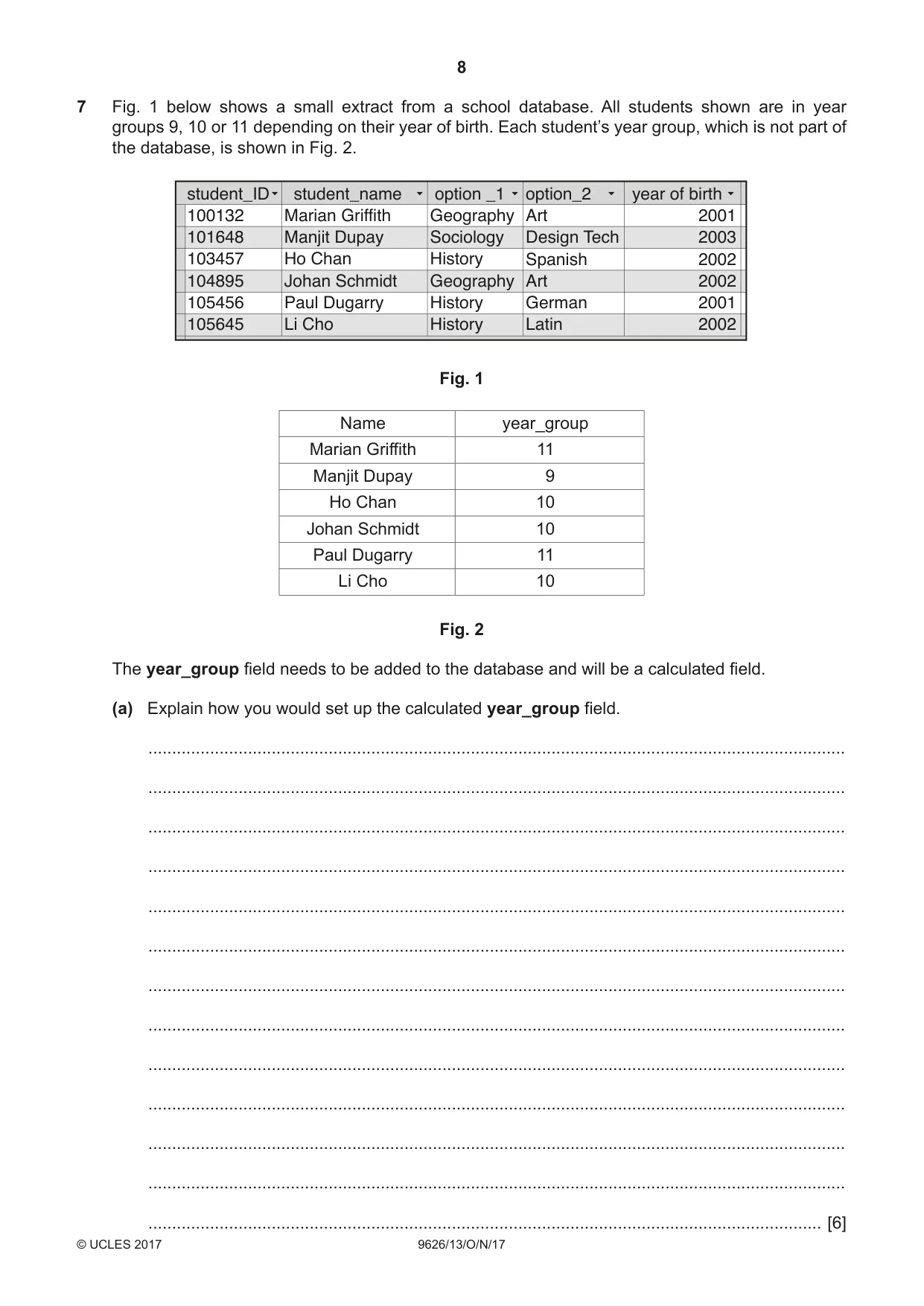
8 9626/13/O/N/17 © UCLES 2017 7 Fig. 1 below shows a small extract from a school database. All students shown are in year groups 9, 10 or 11 depending on their year of birth. Each student’s year group, which is not part of the database, is shown in Fig. 2. student_ID 100132 101648 103457 104895 105456 105645 student_name Marian Griffith Manjit Dupay Ho Chan Johan Schmidt Paul Dugarry Li Cho option _1 Geography Sociology History Geography History History option_2 Art Design Tech Spanish Art German Latin year of birth 2001 2003 2002 2002 2001 2002 Fig. 1 Name year_group Marian Griffith 11 Manjit Dupay 9 Ho Chan 10 Johan Schmidt 10 Paul Dugarry 11 Li Cho 10 Fig. 2 The year_group field needs to be added to the database and will be a calculated field. (a) Explain how you would set up the calculated year_group field. … … … … … … … … … … … … … [6]
Question paper, page 9
9 9626/13/O/N/17 © UCLES 2017 [Turn over (b) You have been asked to produce a well-formatted report showing the year 10 students studying History. The report will contain a list of these students showing only each student’s name, identity number and the total number of students involved. Explain how you would produce such a report. … … … … … … … … … … … … … … … … … … … … [8]
Question paper, page 10
10 9626/13/O/N/17 © UCLES 2017 8 Many people complain about the number of CCTV cameras there are in public places. Discuss the benefits and drawbacks of CCTV monitoring in public places such as on streets or inside shops. … … … … … … … … … … … … … … … … … … … … [8]
Question paper, page 11
11 9626/13/O/N/17 © UCLES 2017 [Turn over 9 Wilhelm has tried importing a word-processed file into his spreadsheet but the software gives the error message ‘file format not valid’. Explain why this has happened and explain what Wilhelm should do to his data to enable him to load it into his spreadsheet. … … … … … … … … … … [4] 10 Describe the characteristics which make spreadsheets suitable for modelling situations. … … … … … … … … … … [4]
Question paper, page 12
12 9626/13/O/N/17 © UCLES 2017 11 Ahmed was overheard saying ‘MIS is a piece of software to store data’. Anjan, his colleague, said ‘I am sure it’s a little more complicated than that.’ By describing the features of a management information system (MIS), explain why Anjan was justified in his statement. … … … … … … … … … … … … … … … [6]
Question paper, page 13
13 9626/13/O/N/17 © UCLES 2017 [Turn over 12 Paul and his team of programmers are writing software for a new project for a large company. Every month, Paul and the programmers report to the company directors by means of a video-conference. Describe how Paul would set up and run this video-conference, assuming that the necessary equipment and software has already been purchased and tested. … … … … … … … … … … … … … … [6]
Question paper, page 14
14 9626/13/O/N/17 © UCLES 2017 13 When an expert system is used to suggest solutions to problems the inference engine uses a form of reasoning involving forward chaining or backward chaining. Explain the differences between forward chaining and backward chaining by describing both terms. … … … … … … … … … … … … … … [6]
Question paper, page 15
15 9626/13/O/N/17 © UCLES 2017 BLANK PAGE
Question paper, page 16
16 9626/13/O/N/17 © UCLES 2017 BLANK PAGE Permission to reproduce items where third-party owned material protected by copyright is included has been sought and cleared where possible. Every reasonable effort has been made by the publisher (UCLES) to trace copyright holders, but if any items requiring clearance have unwittingly been included, the publisher will be pleased to make amends at the earliest possible opportunity. To avoid the issue of disclosure of answer-related information to candidates, all copyright acknowledgements are reproduced online in the Cambridge International Examinations Copyright Acknowledgements Booklet. This is produced for each series of examinations and is freely available to download at www.cie.org.uk after the live examination series. Cambridge International Examinations is part of the Cambridge Assessment Group. Cambridge Assessment is the brand name of University of Cambridge Local Examinations Syndicate (UCLES), which is itself a department of the University of Cambridge.
Mark scheme, page 1
® IGCSE is a registered trademark. This document consists of 9 printed pages. © UCLES 2017 [Turn over Cambridge Assessment International Education Cambridge International Advanced Subsidiary and Advanced Level INFORMATION TECHNOLOGY 9626/13 Paper 1 Theory October/November 2017 MARK SCHEME Maximum Mark: 90 Published This mark scheme is published as an aid to teachers and candidates, to indicate the requirements of the examination. It shows the basis on which Examiners were instructed to award marks. It does not indicate the details of the discussions that took place at an Examiners’ meeting before marking began, which would have considered the acceptability of alternative answers. Mark schemes should be read in conjunction with the question paper and the Principal Examiner Report for Teachers. Cambridge International will not enter into discussions about these mark schemes. Cambridge International is publishing the mark schemes for the October/November 2017 series for most Cambridge IGCSE®, Cambridge International A and AS Level components and some Cambridge O Level components.
Mark scheme, page 2
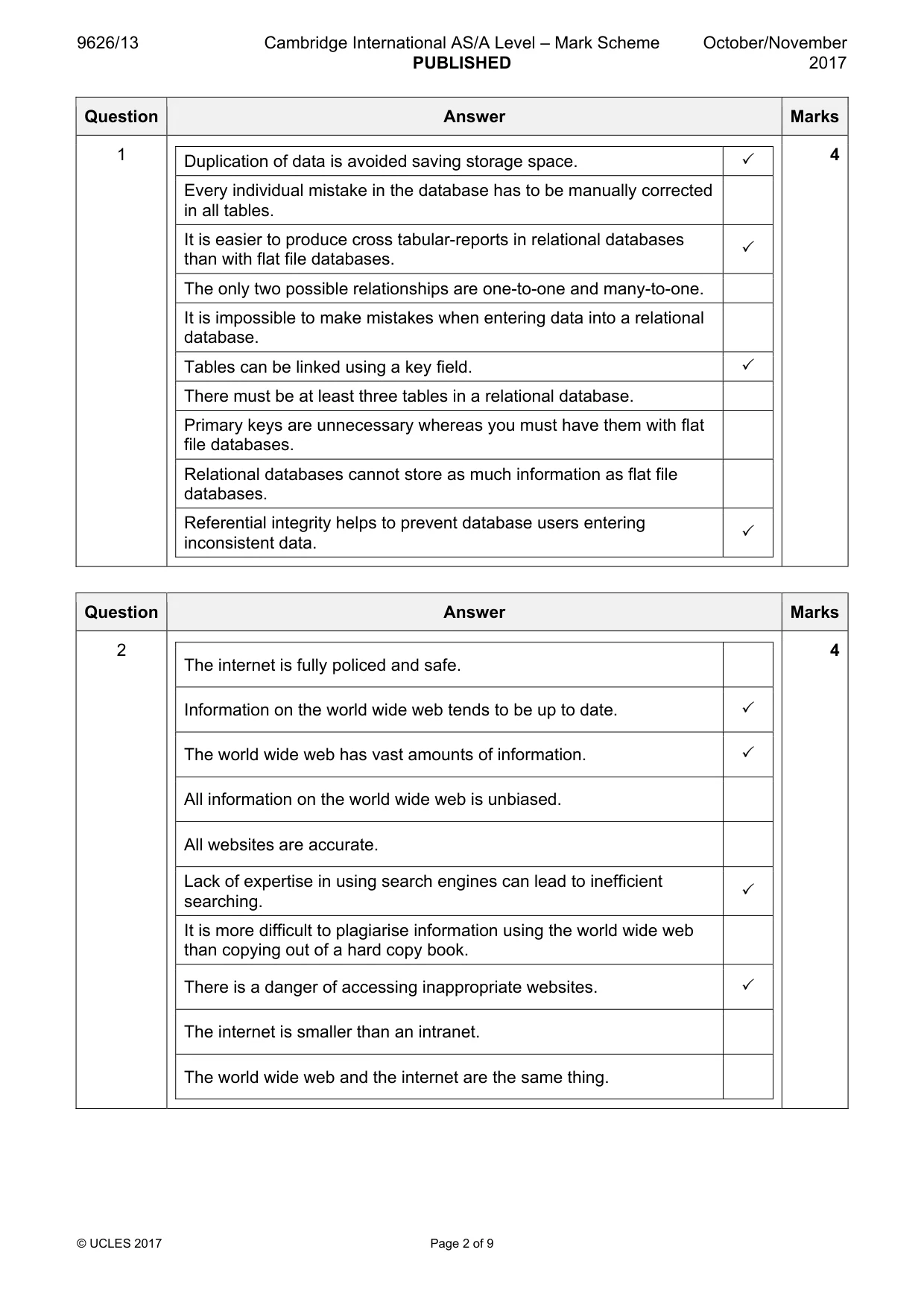
9626/13 Cambridge International AS/A Level – Mark Scheme PUBLISHED October/November 2017 © UCLES 2017 Page 2 of 9 Question Answer Marks 1 Duplication of data is avoided saving storage space. 3 Every individual mistake in the database has to be manually corrected in all tables. It is easier to produce cross tabular-reports in relational databases than with flat file databases. 3 The only two possible relationships are one-to-one and many-to-one. It is impossible to make mistakes when entering data into a relational database. Tables can be linked using a key field. 3 There must be at least three tables in a relational database. Primary keys are unnecessary whereas you must have them with flat file databases. Relational databases cannot store as much information as flat file databases. Referential integrity helps to prevent database users entering inconsistent data. 3 4 Question Answer Marks 2 The internet is fully policed and safe. Information on the world wide web tends to be up to date. 3 The world wide web has vast amounts of information. 3 All information on the world wide web is unbiased. All websites are accurate. Lack of expertise in using search engines can lead to inefficient searching. 3 It is more difficult to plagiarise information using the world wide web than copying out of a hard copy book. There is a danger of accessing inappropriate websites. 3 The internet is smaller than an intranet. The world wide web and the internet are the same thing. 4
Mark scheme, page 3
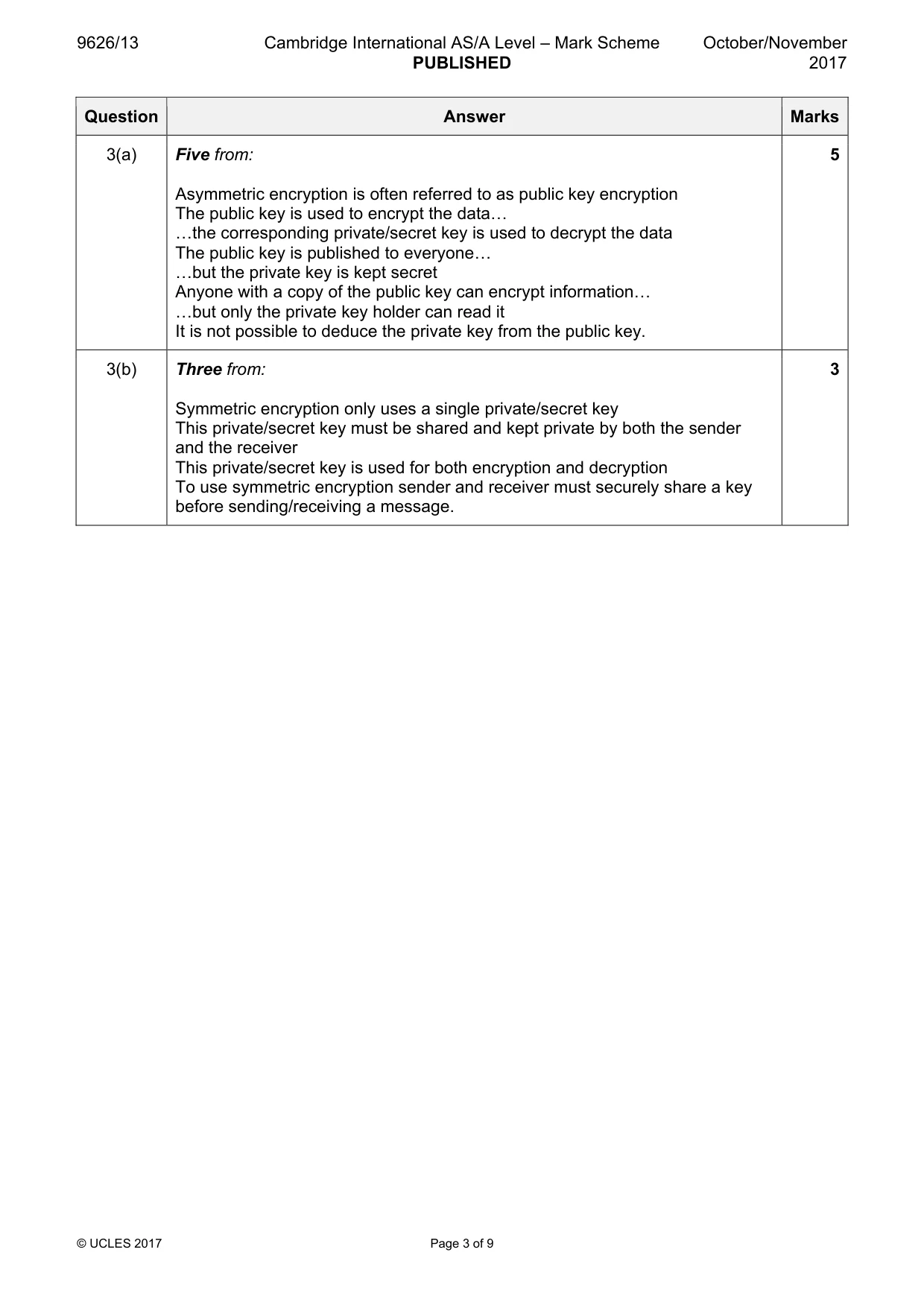
9626/13 Cambridge International AS/A Level – Mark Scheme PUBLISHED October/November 2017 © UCLES 2017 Page 3 of 9 Question Answer Marks 3(a) Five from: Asymmetric encryption is often referred to as public key encryption The public key is used to encrypt the data« «the corresponding private/secret key is used to decrypt the data The public key is published to everyone« «but the private key is kept secret Anyone with a copy of the public key can encrypt information« «but only the private key holder can read it It is not possible to deduce the private key from the public key. 5 3(b) Three from: Symmetric encryption only uses a single private/secret key This private/secret key must be shared and kept private by both the sender and the receiver This private/secret key is used for both encryption and decryption To use symmetric encryption sender and receiver must securely share a key before sending/receiving a message. 3
Mark scheme, page 4
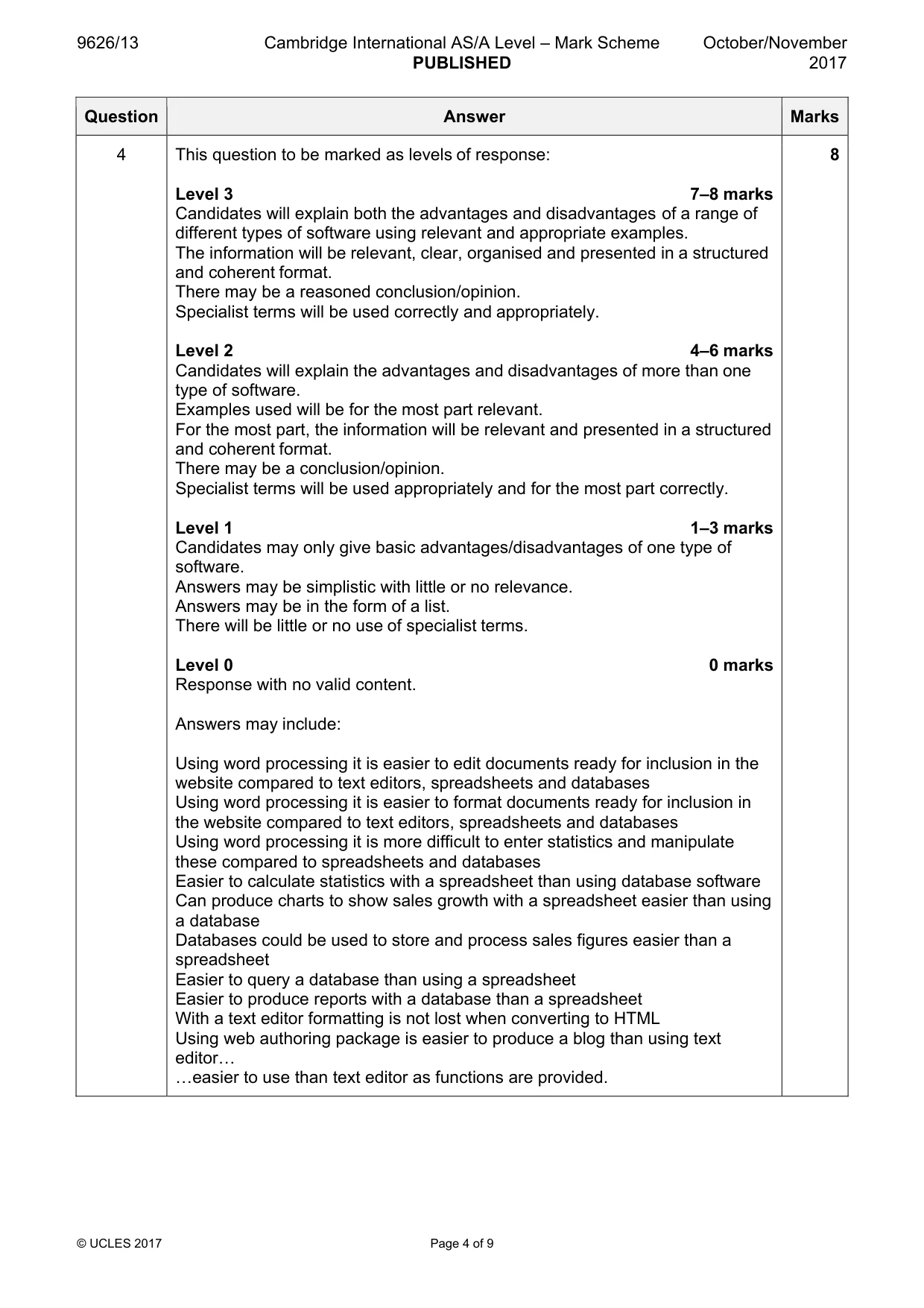
9626/13 Cambridge International AS/A Level – Mark Scheme PUBLISHED October/November 2017 © UCLES 2017 Page 4 of 9 Question Answer Marks 4 This question to be marked as levels of response: Level 3 7–8 marks Candidates will explain both the advantages and disadvantages of a range of different types of software using relevant and appropriate examples. The information will be relevant, clear, organised and presented in a structured and coherent format. There may be a reasoned conclusion/opinion. Specialist terms will be used correctly and appropriately. Level 2 4–6 marks Candidates will explain the advantages and disadvantages of more than one type of software. Examples used will be for the most part relevant. For the most part, the information will be relevant and presented in a structured and coherent format. There may be a conclusion/opinion. Specialist terms will be used appropriately and for the most part correctly. Level 1 1–3 marks Candidates may only give basic advantages/disadvantages of one type of software. Answers may be simplistic with little or no relevance. Answers may be in the form of a list. There will be little or no use of specialist terms. Level 0 0 marks Response with no valid content. Answers may include: Using word processing it is easier to edit documents ready for inclusion in the website compared to text editors, spreadsheets and databases Using word processing it is easier to format documents ready for inclusion in the website compared to text editors, spreadsheets and databases Using word processing it is more difficult to enter statistics and manipulate these compared to spreadsheets and databases Easier to calculate statistics with a spreadsheet than using database software Can produce charts to show sales growth with a spreadsheet easier than using a database Databases could be used to store and process sales figures easier than a spreadsheet Easier to query a database than using a spreadsheet Easier to produce reports with a database than a spreadsheet With a text editor formatting is not lost when converting to HTML Using web authoring package is easier to produce a blog than using text editor« «easier to use than text editor as functions are provided. 8
Mark scheme, page 5
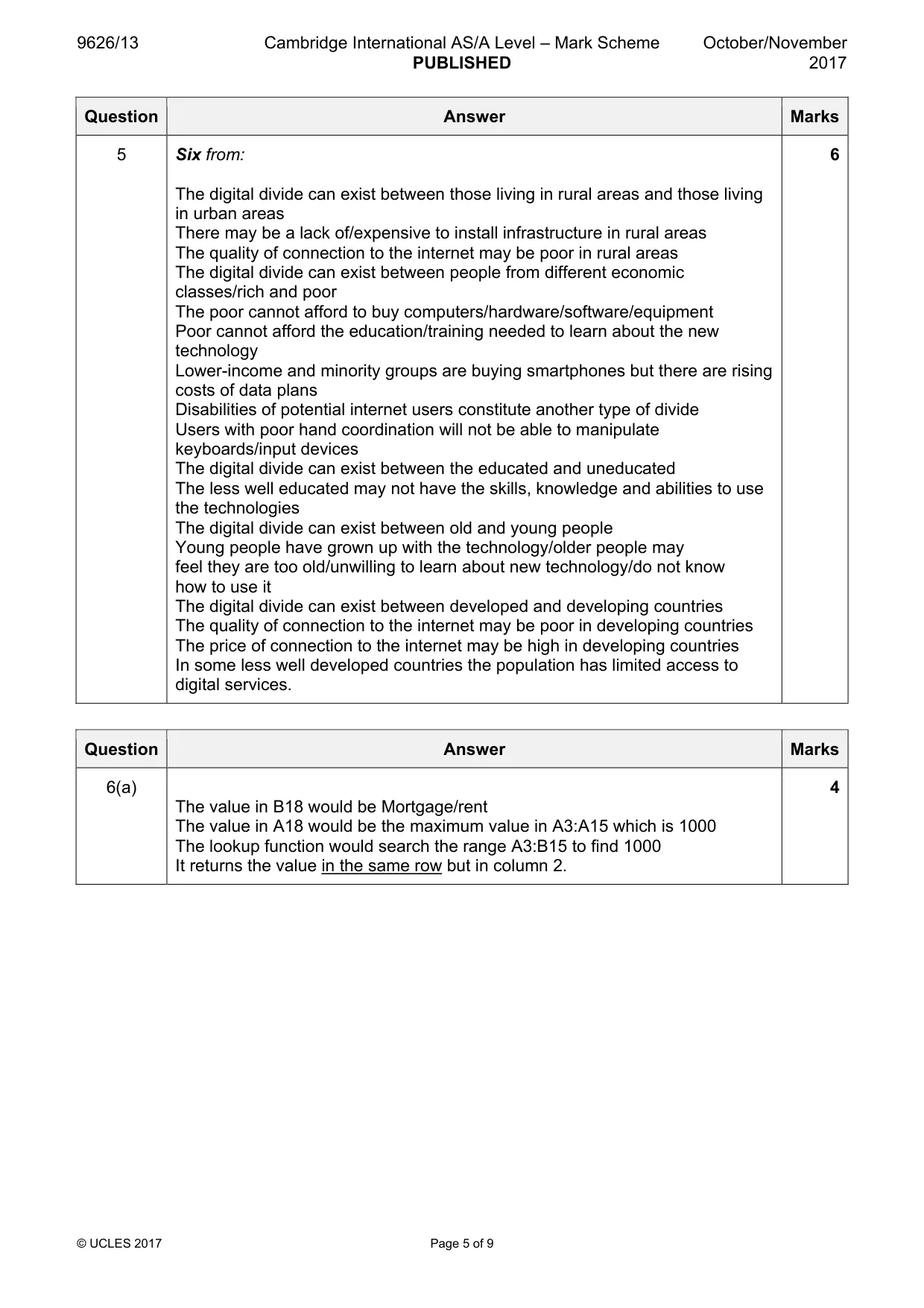
9626/13 Cambridge International AS/A Level – Mark Scheme PUBLISHED October/November 2017 © UCLES 2017 Page 5 of 9 Question Answer Marks 5 Six from: The digital divide can exist between those living in rural areas and those living in urban areas There may be a lack of/expensive to install infrastructure in rural areas The quality of connection to the internet may be poor in rural areas The digital divide can exist between people from different economic classes/rich and poor The poor cannot afford to buy computers/hardware/software/equipment Poor cannot afford the education/training needed to learn about the new technology Lower-income and minority groups are buying smartphones but there are rising costs of data plans Disabilities of potential internet users constitute another type of divide Users with poor hand coordination will not be able to manipulate keyboards/input devices The digital divide can exist between the educated and uneducated The less well educated may not have the skills, knowledge and abilities to use the technologies The digital divide can exist between old and young people Young people have grown up with the technology/older people may feel they are too old/unwilling to learn about new technology/do not know how to use it The digital divide can exist between developed and developing countries The quality of connection to the internet may be poor in developing countries The price of connection to the internet may be high in developing countries In some less well developed countries the population has limited access to digital services. 6 Question Answer Marks 6(a) The value in B18 would be Mortgage/rent The value in A18 would be the maximum value in A3:A15 which is 1000 The lookup function would search the range A3:B15 to find 1000 It returns the value in the same row but in column 2. 4
Mark scheme, page 6
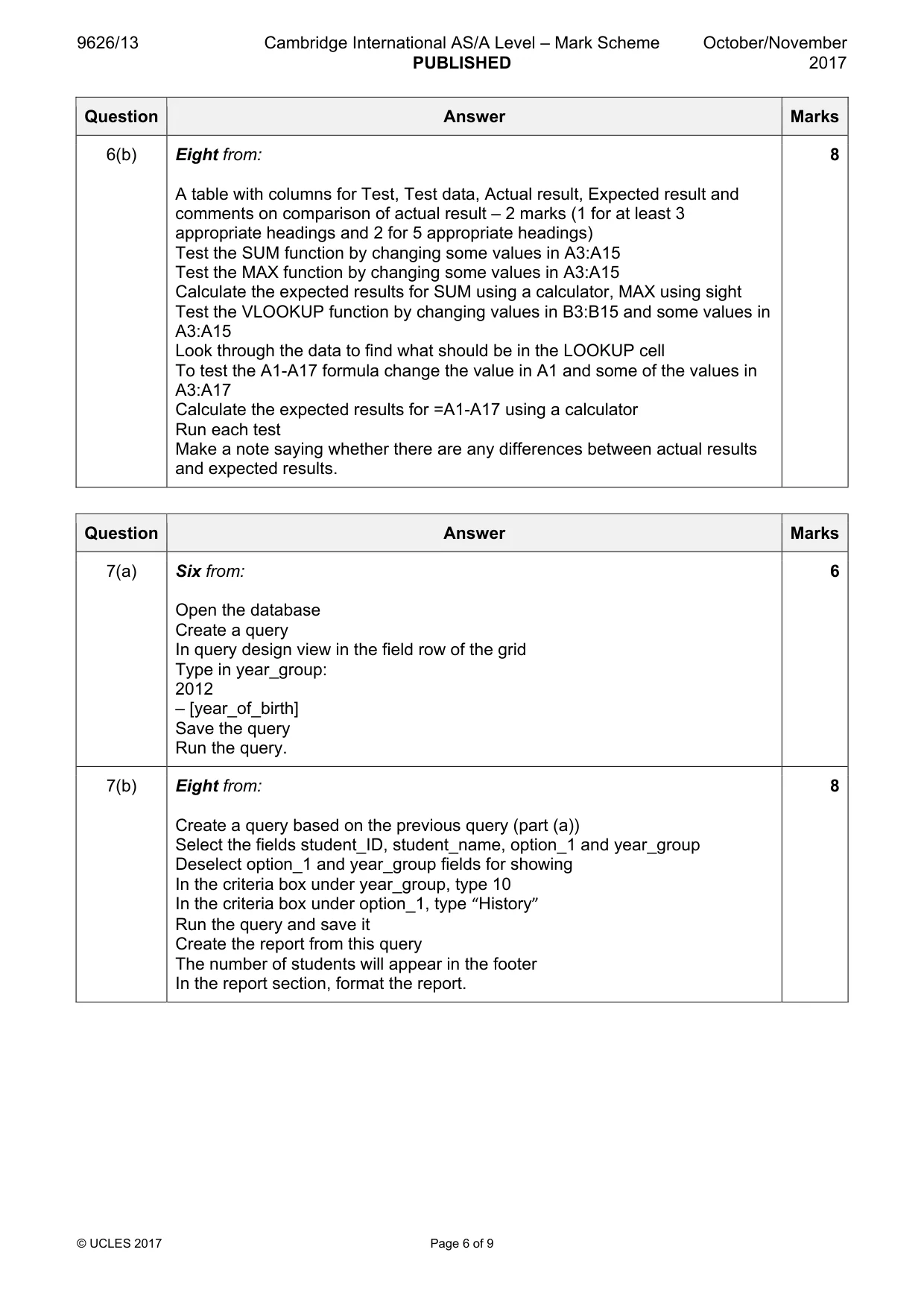
9626/13 Cambridge International AS/A Level – Mark Scheme PUBLISHED October/November 2017 © UCLES 2017 Page 6 of 9 Question Answer Marks 6(b) Eight from: A table with columns for Test, Test data, Actual result, Expected result and comments on comparison of actual result – 2 marks (1 for at least 3 appropriate headings and 2 for 5 appropriate headings) Test the SUM function by changing some values in A3:A15 Test the MAX function by changing some values in A3:A15 Calculate the expected results for SUM using a calculator, MAX using sight Test the VLOOKUP function by changing values in B3:B15 and some values in A3:A15 Look through the data to find what should be in the LOOKUP cell To test the A1-A17 formula change the value in A1 and some of the values in A3:A17 Calculate the expected results for =A1-A17 using a calculator Run each test Make a note saying whether there are any differences between actual results and expected results. 8 Question Answer Marks 7(a) Six from: Open the database Create a query In query design view in the field row of the grid Type in year_group: 2012 – [year_of_birth] Save the query Run the query. 6 7(b) Eight from: Create a query based on the previous query (part (a)) Select the fields student_ID, student_name, option_1 and year_group Deselect option_1 and year_group fields for showing In the criteria box under year_group, type 10 In the criteria box under option_1, type “History” Run the query and save it Create the report from this query The number of students will appear in the footer In the report section, format the report. 8
Mark scheme, page 7
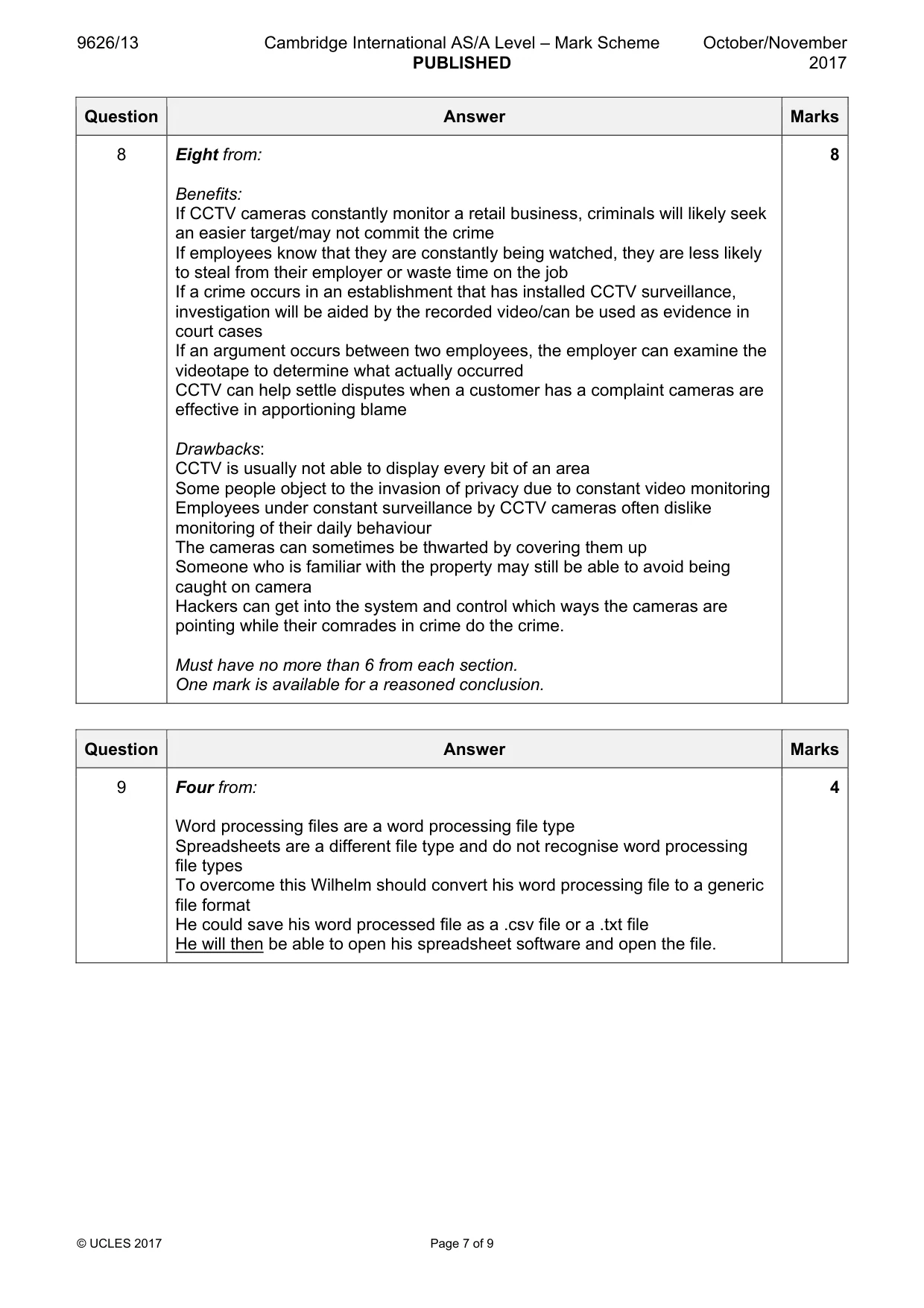
9626/13 Cambridge International AS/A Level – Mark Scheme PUBLISHED October/November 2017 © UCLES 2017 Page 7 of 9 Question Answer Marks 8 Eight from: Benefits: If CCTV cameras constantly monitor a retail business, criminals will likely seek an easier target/may not commit the crime If employees know that they are constantly being watched, they are less likely to steal from their employer or waste time on the job If a crime occurs in an establishment that has installed CCTV surveillance, investigation will be aided by the recorded video/can be used as evidence in court cases If an argument occurs between two employees, the employer can examine the videotape to determine what actually occurred CCTV can help settle disputes when a customer has a complaint cameras are effective in apportioning blame Drawbacks: CCTV is usually not able to display every bit of an area Some people object to the invasion of privacy due to constant video monitoring Employees under constant surveillance by CCTV cameras often dislike monitoring of their daily behaviour The cameras can sometimes be thwarted by covering them up Someone who is familiar with the property may still be able to avoid being caught on camera Hackers can get into the system and control which ways the cameras are pointing while their comrades in crime do the crime. Must have no more than 6 from each section. One mark is available for a reasoned conclusion. 8 Question Answer Marks 9 Four from: Word processing files are a word processing file type Spreadsheets are a different file type and do not recognise word processing file types To overcome this Wilhelm should convert his word processing file to a generic file format He could save his word processed file as a .csv file or a .txt file He will then be able to open his spreadsheet software and open the file. 4
Mark scheme, page 8
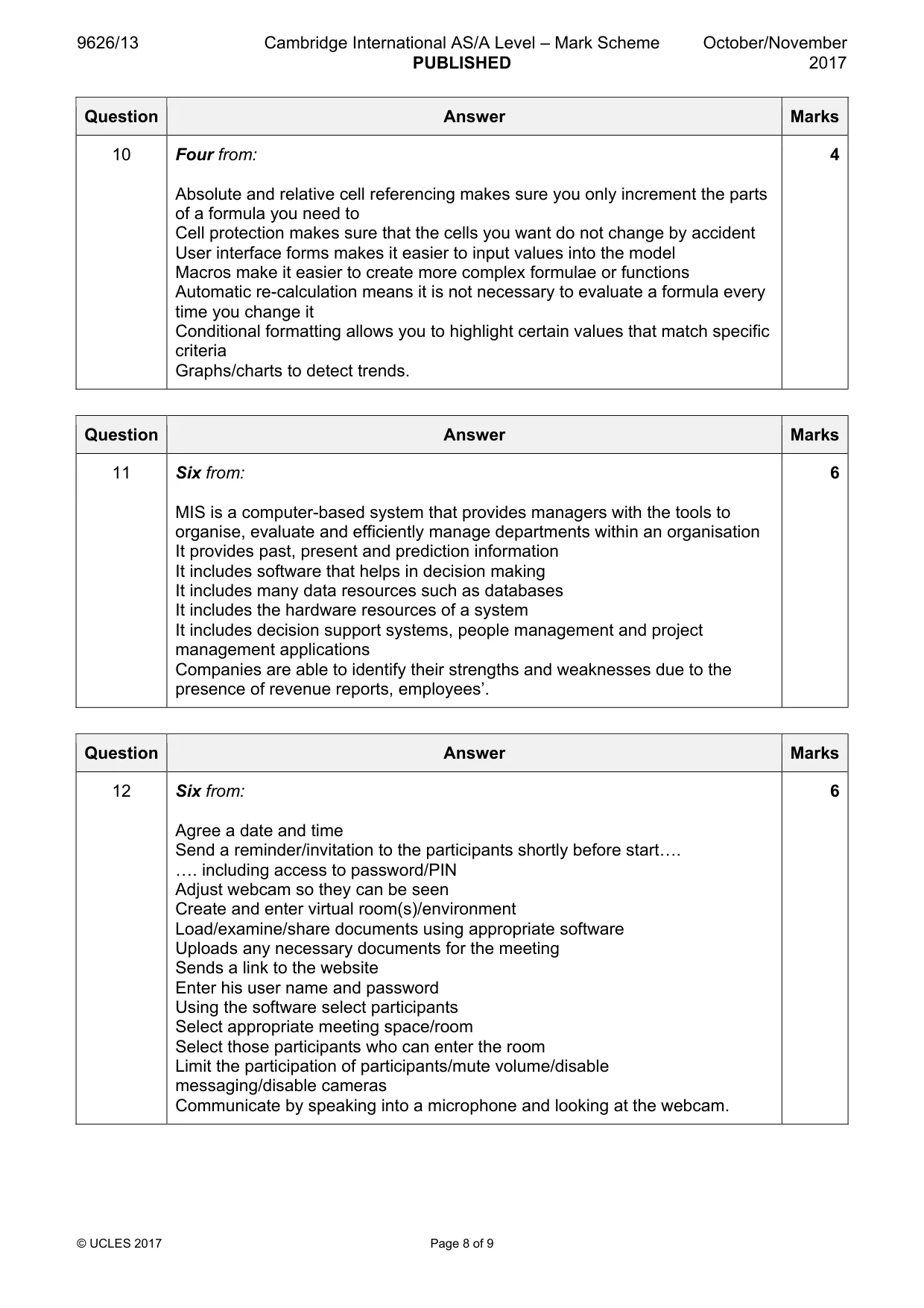
9626/13 Cambridge International AS/A Level – Mark Scheme PUBLISHED October/November 2017 © UCLES 2017 Page 8 of 9 Question Answer Marks 10 Four from: Absolute and relative cell referencing makes sure you only increment the parts of a formula you need to Cell protection makes sure that the cells you want do not change by accident User interface forms makes it easier to input values into the model Macros make it easier to create more complex formulae or functions Automatic re-calculation means it is not necessary to evaluate a formula every time you change it Conditional formatting allows you to highlight certain values that match specific criteria Graphs/charts to detect trends. 4 Question Answer Marks 11 Six from: MIS is a computer-based system that provides managers with the tools to organise, evaluate and efficiently manage departments within an organisation It provides past, present and prediction information It includes software that helps in decision making It includes many data resources such as databases It includes the hardware resources of a system It includes decision support systems, people management and project management applications Companies are able to identify their strengths and weaknesses due to the presence of revenue reports, employees’. 6 Question Answer Marks 12 Six from: Agree a date and time Send a reminder/invitation to the participants shortly before start«. «. including access to password/PIN Adjust webcam so they can be seen Create and enter virtual room(s)/environment Load/examine/share documents using appropriate software Uploads any necessary documents for the meeting Sends a link to the website Enter his user name and password Using the software select participants Select appropriate meeting space/room Select those participants who can enter the room Limit the participation of participants/mute volume/disable messaging/disable cameras Communicate by speaking into a microphone and looking at the webcam. 6
Mark scheme, page 9
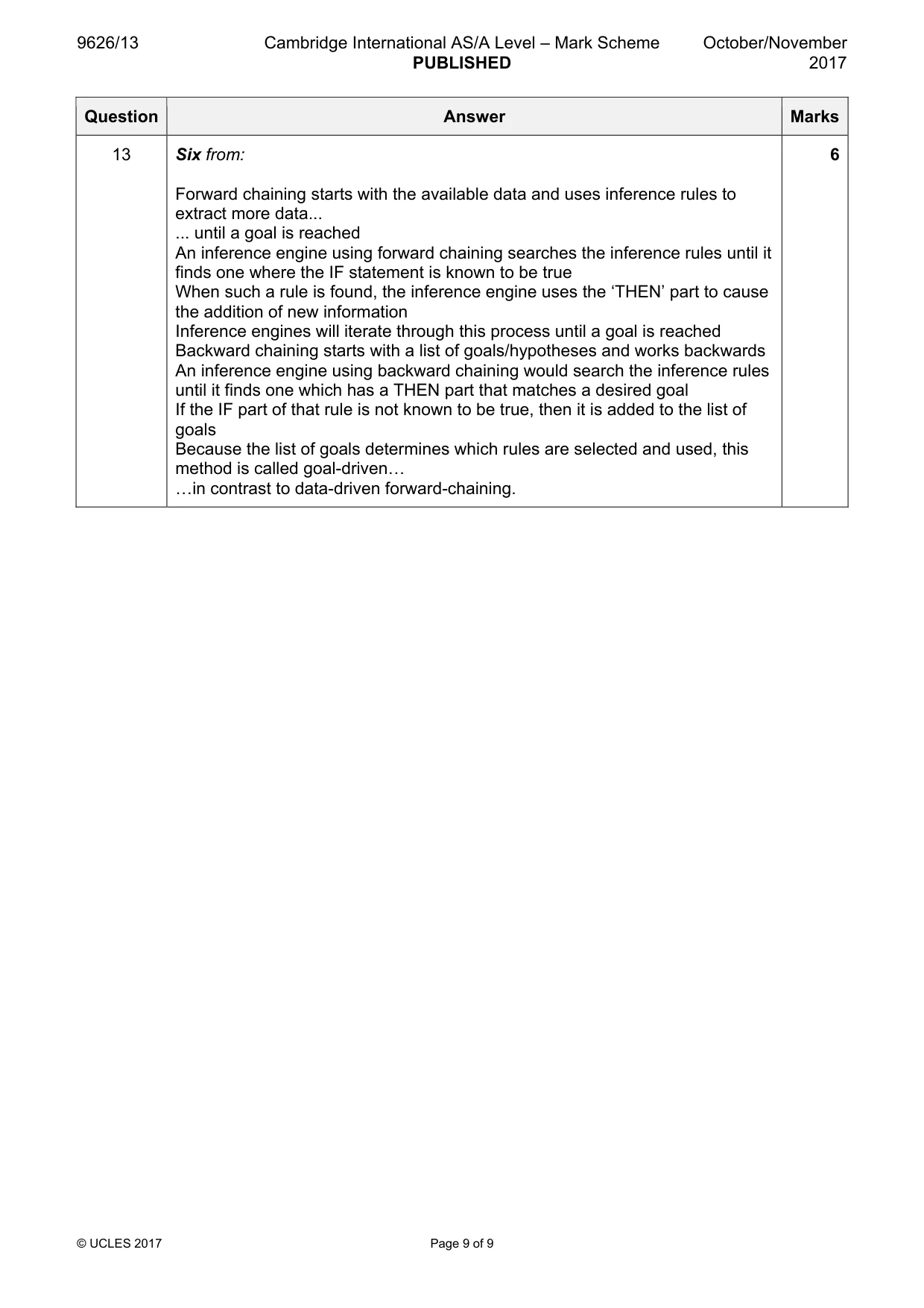
9626/13 Cambridge International AS/A Level – Mark Scheme PUBLISHED October/November 2017 © UCLES 2017 Page 9 of 9 Question Answer Marks 13 Six from: Forward chaining starts with the available data and uses inference rules to extract more data... ... until a goal is reached An inference engine using forward chaining searches the inference rules until it finds one where the IF statement is known to be true When such a rule is found, the inference engine uses the ‘THEN’ part to cause the addition of new information Inference engines will iterate through this process until a goal is reached Backward chaining starts with a list of goals/hypotheses and works backwards An inference engine using backward chaining would search the inference rules until it finds one which has a THEN part that matches a desired goal If the IF part of that rule is not known to be true, then it is added to the list of goals Because the list of goals determines which rules are selected and used, this method is called goal-driven« «in contrast to data-driven forward-chaining. 6
What you needed in this session
Cambridge’s own grade thresholds for 2017 Oct/Nov, Paper 1 · Variant 3. A higher threshold means an easier paper — the bar moves with how the cohort did.