Cambridge A Level History (pre-2015) 9697 — 2014 Oct/Nov Paper 3 · Variant 2
9697/32/O/N/14 · 100 marks · ≈113 min
The question paper and its mark scheme, free to read here and free to download. This is Cambridge’s own paper, exactly as it was sat.
Question paper4 pages
Mark scheme16 pages
Answers below. Sit the paper first if you are practising.
Paper as text
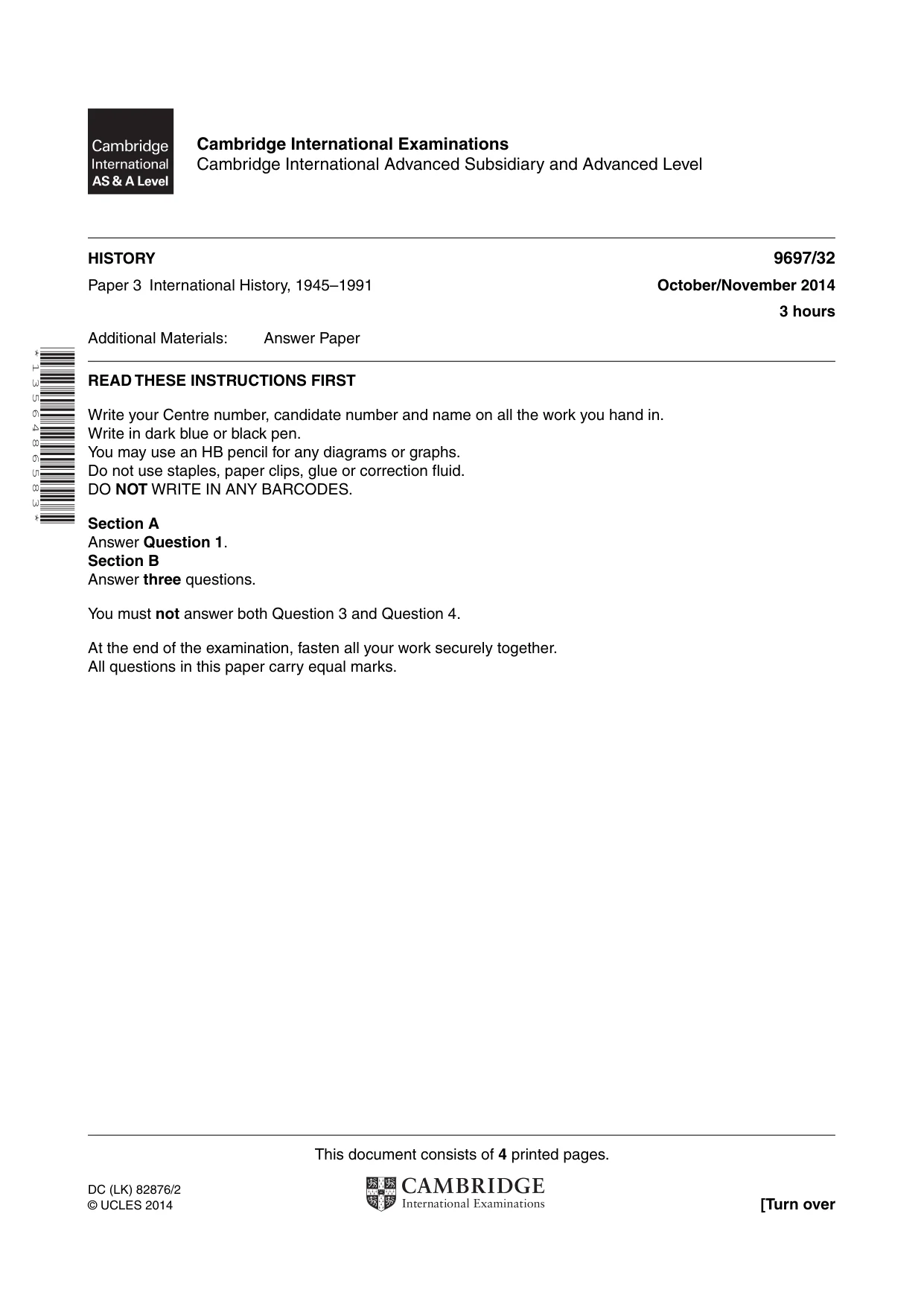
Question paper, page 1
This document consists of 4 printed pages. DC (LK) 82876/2 © UCLES 2014 [Turn over * 1 3 5 6 4 8 6 5 8 3 * HISTORY 9697/32 Paper 3 International History, 1945–1991 October/November 2014 3 hours Additional Materials: Answer Paper READ THESE INSTRUCTIONS FIRST Write your Centre number, candidate number and name on all the work you hand in. Write in dark blue or black pen. You may use an HB pencil for any diagrams or graphs. Do not use staples, paper clips, glue or correction fluid. DO NOT WRITE IN ANY BARCODES. Section A Answer Question 1. Section B Answer three questions. You must not answer both Question 3 and Question 4. At the end of the examination, fasten all your work securely together. All questions in this paper carry equal marks. Cambridge International Examinations Cambridge International Advanced Subsidiary and Advanced Level
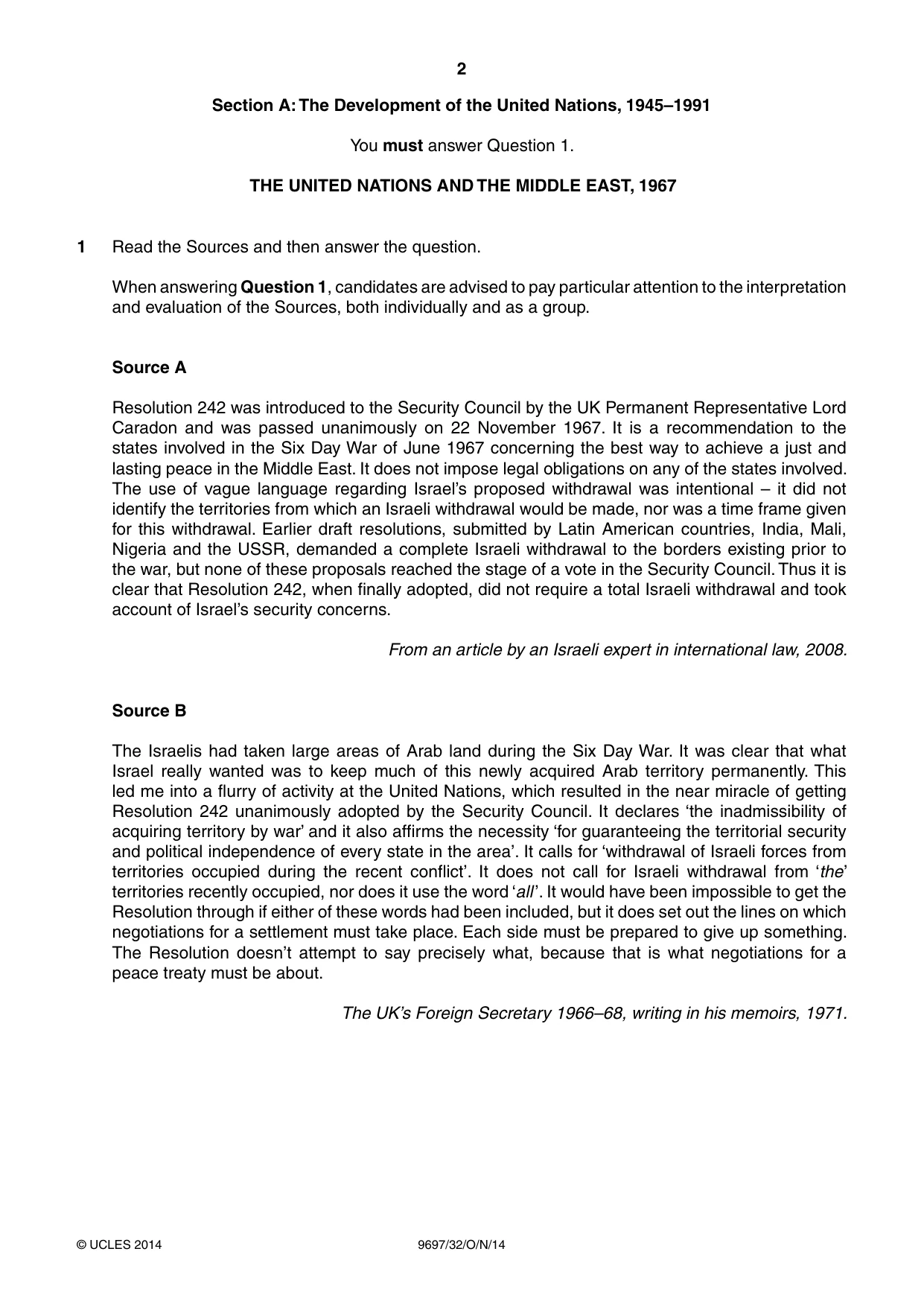
Question paper, page 2
2 9697/32/O/N/14 © UCLES 2014 Section A: The Development of the United Nations, 1945–1991 You must answer Question 1. THE UNITED NATIONS AND THE MIDDLE EAST, 1967 1 Read the Sources and then answer the question. When answering Question 1, candidates are advised to pay particular attention to the interpretation and evaluation of the Sources, both individually and as a group. Source A Resolution 242 was introduced to the Security Council by the UK Permanent Representative Lord Caradon and was passed unanimously on 22 November 1967. It is a recommendation to the states involved in the Six Day War of June 1967 concerning the best way to achieve a just and lasting peace in the Middle East. It does not impose legal obligations on any of the states involved. The use of vague language regarding Israel’s proposed withdrawal was intentional – it did not identify the territories from which an Israeli withdrawal would be made, nor was a time frame given for this withdrawal. Earlier draft resolutions, submitted by Latin American countries, India, Mali, Nigeria and the USSR, demanded a complete Israeli withdrawal to the borders existing prior to the war, but none of these proposals reached the stage of a vote in the Security Council. Thus it is clear that Resolution 242, when finally adopted, did not require a total Israeli withdrawal and took account of Israel’s security concerns. From an article by an Israeli expert in international law, 2008. Source B The Israelis had taken large areas of Arab land during the Six Day War. It was clear that what Israel really wanted was to keep much of this newly acquired Arab territory permanently. This led me into a flurry of activity at the United Nations, which resulted in the near miracle of getting Resolution 242 unanimously adopted by the Security Council. It declares ‘the inadmissibility of acquiring territory by war’ and it also affirms the necessity ‘for guaranteeing the territorial security and political independence of every state in the area’. It calls for ‘withdrawal of Israeli forces from territories occupied during the recent conflict’. It does not call for Israeli withdrawal from ‘the ’ territories recently occupied, nor does it use the word ‘all ’. It would have been impossible to get the Resolution through if either of these words had been included, but it does set out the lines on which negotiations for a settlement must take place. Each side must be prepared to give up something. The Resolution doesn’t attempt to say precisely what, because that is what negotiations for a peace treaty must be about. The UK’s Foreign Secretary 1966–68, writing in his memoirs, 1971.
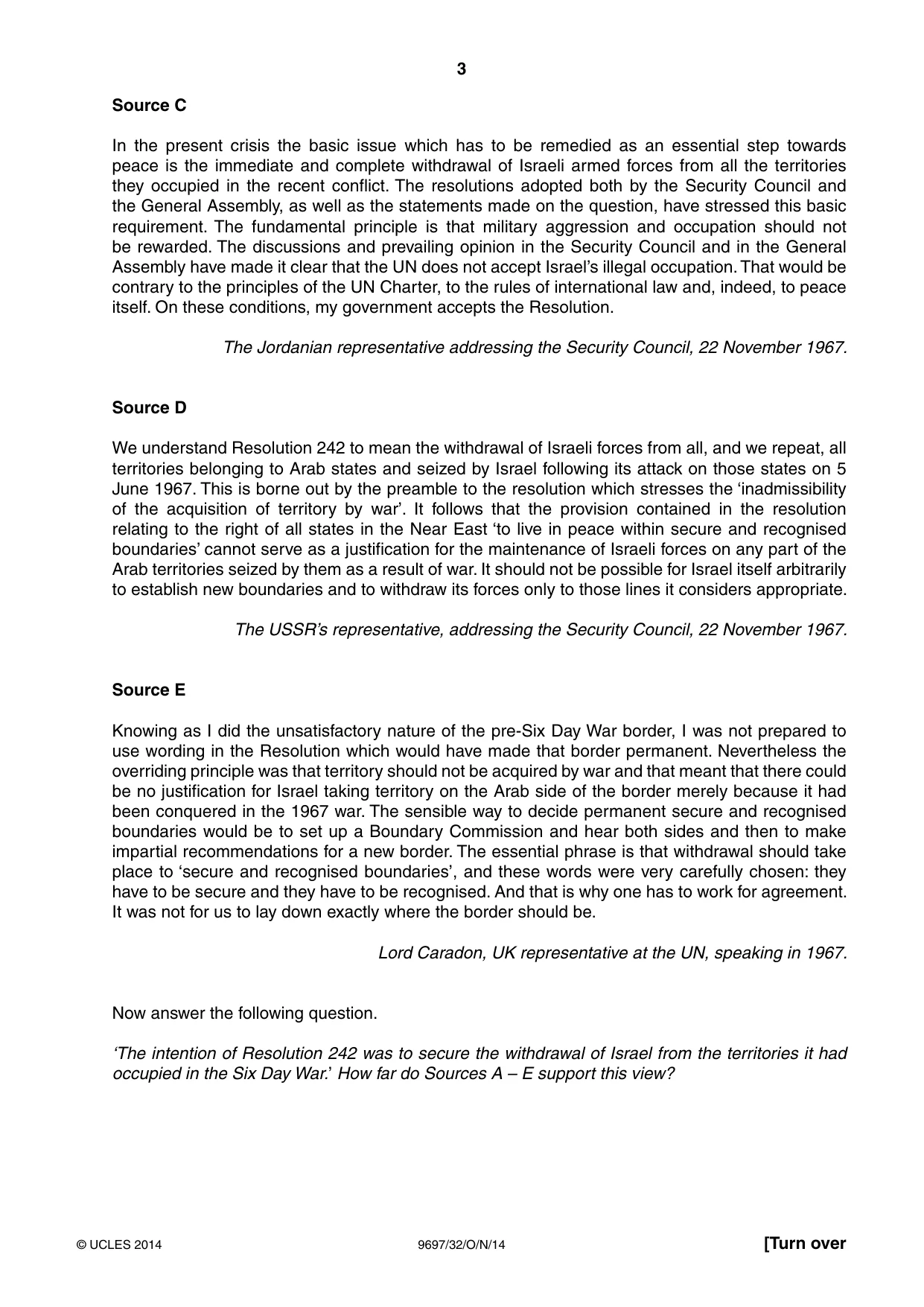
Question paper, page 3
3 9697/32/O/N/14 © UCLES 2014 [Turn over Source C In the present crisis the basic issue which has to be remedied as an essential step towards peace is the immediate and complete withdrawal of Israeli armed forces from all the territories they occupied in the recent conflict. The resolutions adopted both by the Security Council and the General Assembly, as well as the statements made on the question, have stressed this basic requirement. The fundamental principle is that military aggression and occupation should not be rewarded. The discussions and prevailing opinion in the Security Council and in the General Assembly have made it clear that the UN does not accept Israel’s illegal occupation. That would be contrary to the principles of the UN Charter, to the rules of international law and, indeed, to peace itself. On these conditions, my government accepts the Resolution. The Jordanian representative addressing the Security Council, 22 November 1967. Source D We understand Resolution 242 to mean the withdrawal of Israeli forces from all, and we repeat, all territories belonging to Arab states and seized by Israel following its attack on those states on 5 June 1967. This is borne out by the preamble to the resolution which stresses the ‘inadmissibility of the acquisition of territory by war’. It follows that the provision contained in the resolution relating to the right of all states in the Near East ‘to live in peace within secure and recognised boundaries’ cannot serve as a justification for the maintenance of Israeli forces on any part of the Arab territories seized by them as a result of war. It should not be possible for Israel itself arbitrarily to establish new boundaries and to withdraw its forces only to those lines it considers appropriate. The USSR’s representative, addressing the Security Council, 22 November 1967. Source E Knowing as I did the unsatisfactory nature of the pre-Six Day War border, I was not prepared to use wording in the Resolution which would have made that border permanent. Nevertheless the overriding principle was that territory should not be acquired by war and that meant that there could be no justification for Israel taking territory on the Arab side of the border merely because it had been conquered in the 1967 war. The sensible way to decide permanent secure and recognised boundaries would be to set up a Boundary Commission and hear both sides and then to make impartial recommendations for a new border. The essential phrase is that withdrawal should take place to ‘secure and recognised boundaries’, and these words were very carefully chosen: they have to be secure and they have to be recognised. And that is why one has to work for agreement. It was not for us to lay down exactly where the border should be. Lord Caradon, UK representative at the UN, speaking in 1967. Now an swer the following question. ‘The intention of Resolution 242 was to secure the withdrawal of Israel from the territories it had occupied in the Six Day War.’ How far do Sources A – E support this view?
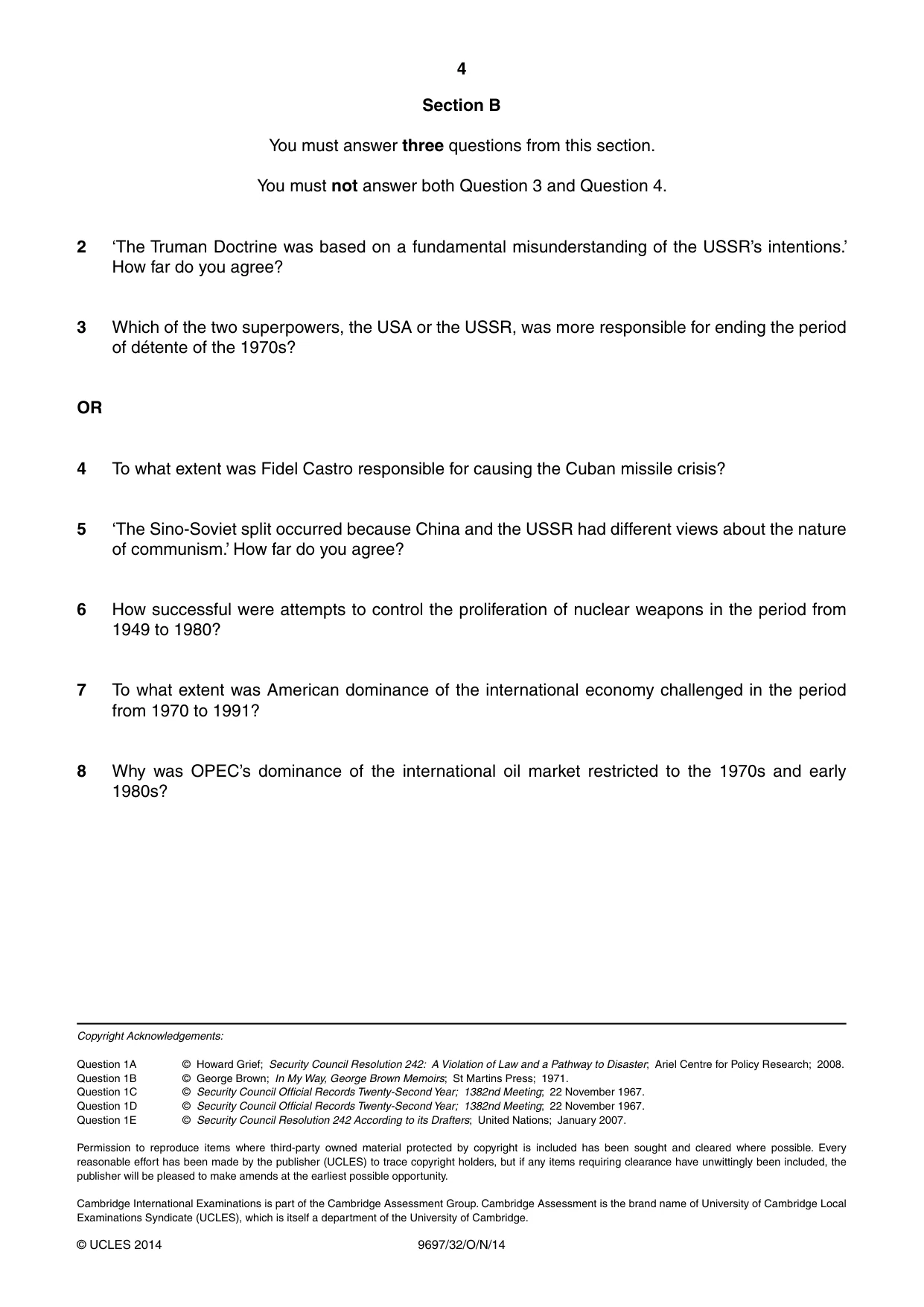
Question paper, page 4
4 9697/32/O/N/14 © UCLES 2014 Copyright Acknowledgements: Question 1A © Howard Grief; Security Council Resolution 242: A Violation of Law and a Pathway to Disaster; Ariel Centre for Policy Research; 2008. Question 1B © George Brown; In My Way, George Brown Memoirs; St Martins Press; 1971. Question 1C © Security Council Official Records Twenty-Second Year; 1382nd Meeting; 22 November 1967. Question 1D © Security Council Official Records Twenty-Second Year; 1382nd Meeting; 22 November 1967. Question 1E © Security Council Resolution 242 According to its Drafters; United Nations; January 2007. Permission to reproduce items where third-party owned material protected by copyright is included has been sought and cleared where possible. Every reasonable effort has been made by the publisher (UCLES) to trace copyright holders, but if any items requiring clearance have unwittingly been included, the publisher will be pleased to make amends at the earliest possible opportunity. Cambridge International Examinations is part of the Cambridge Assessment Group. Cambridge Assessment is the brand name of University of Cambridge Local Examinations Syndicate (UCLES), which is itself a department of the University of Cambridge. Section B You must answer three questions from this section. You must not answer both Question 3 and Question 4. 2 ‘The Truman Doctrine was based on a fundamental misunderstanding of the USSR’s intentions.’ How far do you agree? 3 Which of the two superpowers, the USA or the USSR, was more responsible for ending the period of détente of the 1970s? OR 4 To what extent was Fidel Castro responsible for causing the Cuban missile crisis? 5 ‘The Sino-Soviet split occurred because China and the USSR had different views about the nature of communism.’ How far do you agree? 6 How successful were attempts to control the proliferation of nuclear weapons in the period from 1949 to 1980? 7 To what extent was American dominance of the international economy challenged in the period from 1970 to 1991? 8 Why was OPEC’s dominance of the international oil market restricted to the 1970s and early 1980s?
Mark scheme, page 1
® IGCSE is the registered trademark of Cambridge International Examinations. CAMBRIDGE INTERNATIONAL EXAMINATIONS Cambridge International Advanced Subsidiary and Advanced Level MARK SCHEME for the October/November 2014 series 9697 HISTORY 9697/32 Paper 3, maximum raw mark 100 This mark scheme is published as an aid to teachers and candidates, to indicate the requirements of the examination. It shows the basis on which Examiners were instructed to award marks. It does not indicate the details of the discussions that took place at an Examiners’ meeting before marking began, which would have considered the acceptability of alternative answers. Mark schemes should be read in conjunction with the question paper and the Principal Examiner Report for Teachers. Cambridge will not enter into discussions about these mark schemes. Cambridge is publishing the mark schemes for the October/November 2014 series for most Cambridge IGCSE®, Cambridge International A and AS Level components and some Cambridge O Level components.
Mark scheme, page 2
Page 2 Mark Scheme Syllabus Paper Cambridge International AS/A Level – October/November 2014 9697 32 © Cambridge International Examinations 2014 GENERAL MARKING INSTRUCTIONS Examiners should refer to the CIE booklet ‘Instructions for Examiners’ for detailed guidance. 1 THE ASSESSMENT OBJECTIVES The Assessment Objectives are as follows: (a) the ability to make effective use of relevant factual knowledge to demonstrate the understanding of an historical period or periods in outline and of particular topics in depth; (b) the ability to distinguish and assess different approaches to, interpretations of, and opinions about the past; (c) the ability to express awareness of change and continuity in the past; (d) the ability to present a clear, concise, logical and relevant argument. It is possible that evidence of attainment in any one of the Assessment Objectives may be demonstrated in an answer to an essay question. However, no attempt is made to allocate marks in essay questions to individual Assessment Objectives. 2 GENERAL GUIDE TO THE ASSESSMENT OF SCRIPTS AND THE ESTABLISHMENT OF STANDARDS Each answer should be marked bearing in mind the Assessment Objectives stated above and the following basic criteria: (a) the relevance, accuracy and quantity of factual knowledge; (b) effectiveness of presentation: the ability to communicate arguments and knowledge in a clear, orderly fashion with maximum relevance to the question set. (Examiners with scripts which may be in the candidate’s second language must be particularly vigilant against penalising candidates over and above a self-imposed penalty); (c) evidence of the exercise of informed historical judgement and of the awareness of historical context. It is not intended that examiners should attempt to isolate these qualities and reward them separately because they are inter-related. Their proper application will mean, for example, that long answers crammed with detailed knowledge will not be rewarded highly if the knowledge is not effectively applied and the answers show a lack of historical judgement. Conversely a convincingly argued, highly relevant and perceptive answer may be well rewarded although based on less overtly expressed knowledge. All essay answers should be marked in such a way that the final mark awarded is a true reflection of attainment in the Assessment Objectives. Different answers awarded identical or similar marks may display very different combinations of qualities and marking therefore should be responsive enough to reward answers which demonstrate different combinations of argument and historical knowledge. However, in almost all cases, the generic mark bands and the question-specific mark scheme will provide guidance to examiners on the appropriate marks to be awarded. Examiners should seek the advice of the Principal Examiner about highly unusual approaches to a question.
Mark scheme, page 3
Page 3 Mark Scheme Syllabus Paper Cambridge International AS/A Level – October/November 2014 9697 32 © Cambridge International Examinations 2014 3 ASSESSMENT OF DOCUMENT-BASED QUESTIONS Guidance on the assessment of the Document-based questions is given separately in this Mark Scheme. 4 GENERIC MARK BANDS FOR ESSAY QUESTIONS Examiners will assess which Level of Response best reflects most of the answer. An answer will not be required to demonstrate all of the descriptions in a particular Level to qualify for a Mark Band. In bands of 3 marks, examiners will normally award the middle mark, moderating it up or down according to the particular qualities of the answer. In bands of 2 marks, examiners should award the lower mark if an answer just deserves the band and the higher mark if the answer clearly deserves the band.
Mark scheme, page 4
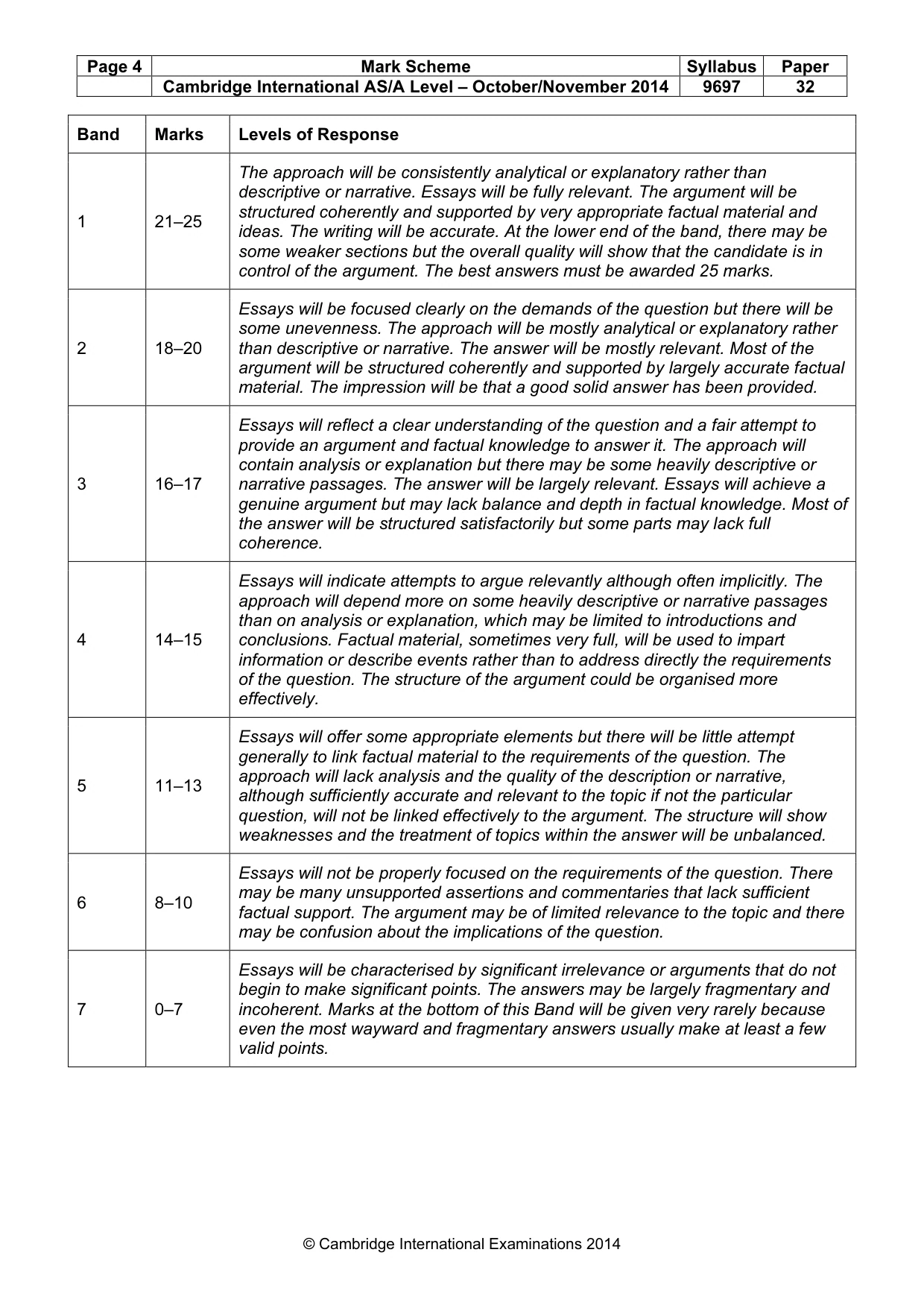
Page 4 Mark Scheme Syllabus Paper Cambridge International AS/A Level – October/November 2014 9697 32 © Cambridge International Examinations 2014 Band Marks Levels of Response 1 21–25 The approach will be consistently analytical or explanatory rather than descriptive or narrative. Essays will be fully relevant. The argument will be structured coherently and supported by very appropriate factual material and ideas. The writing will be accurate. At the lower end of the band, there may be some weaker sections but the overall quality will show that the candidate is in control of the argument. The best answers must be awarded 25 marks. 2 18–20 Essays will be focused clearly on the demands of the question but there will be some unevenness. The approach will be mostly analytical or explanatory rather than descriptive or narrative. The answer will be mostly relevant. Most of the argument will be structured coherently and supported by largely accurate factual material. The impression will be that a good solid answer has been provided. 3 16–17 Essays will reflect a clear understanding of the question and a fair attempt to provide an argument and factual knowledge to answer it. The approach will contain analysis or explanation but there may be some heavily descriptive or narrative passages. The answer will be largely relevant. Essays will achieve a genuine argument but may lack balance and depth in factual knowledge. Most of the answer will be structured satisfactorily but some parts may lack full coherence. 4 14–15 Essays will indicate attempts to argue relevantly although often implicitly. The approach will depend more on some heavily descriptive or narrative passages than on analysis or explanation, which may be limited to introductions and conclusions. Factual material, sometimes very full, will be used to impart information or describe events rather than to address directly the requirements of the question. The structure of the argument could be organised more effectively. 5 11–13 Essays will offer some appropriate elements but there will be little attempt generally to link factual material to the requirements of the question. The approach will lack analysis and the quality of the description or narrative, although sufficiently accurate and relevant to the topic if not the particular question, will not be linked effectively to the argument. The structure will show weaknesses and the treatment of topics within the answer will be unbalanced. 6 8–10 Essays will not be properly focused on the requirements of the question. There may be many unsupported assertions and commentaries that lack sufficient factual support. The argument may be of limited relevance to the topic and there may be confusion about the implications of the question. 7 0–7 Essays will be characterised by significant irrelevance or arguments that do not begin to make significant points. The answers may be largely fragmentary and incoherent. Marks at the bottom of this Band will be given very rarely because even the most wayward and fragmentary answers usually make at least a few valid points.
Mark scheme, page 5
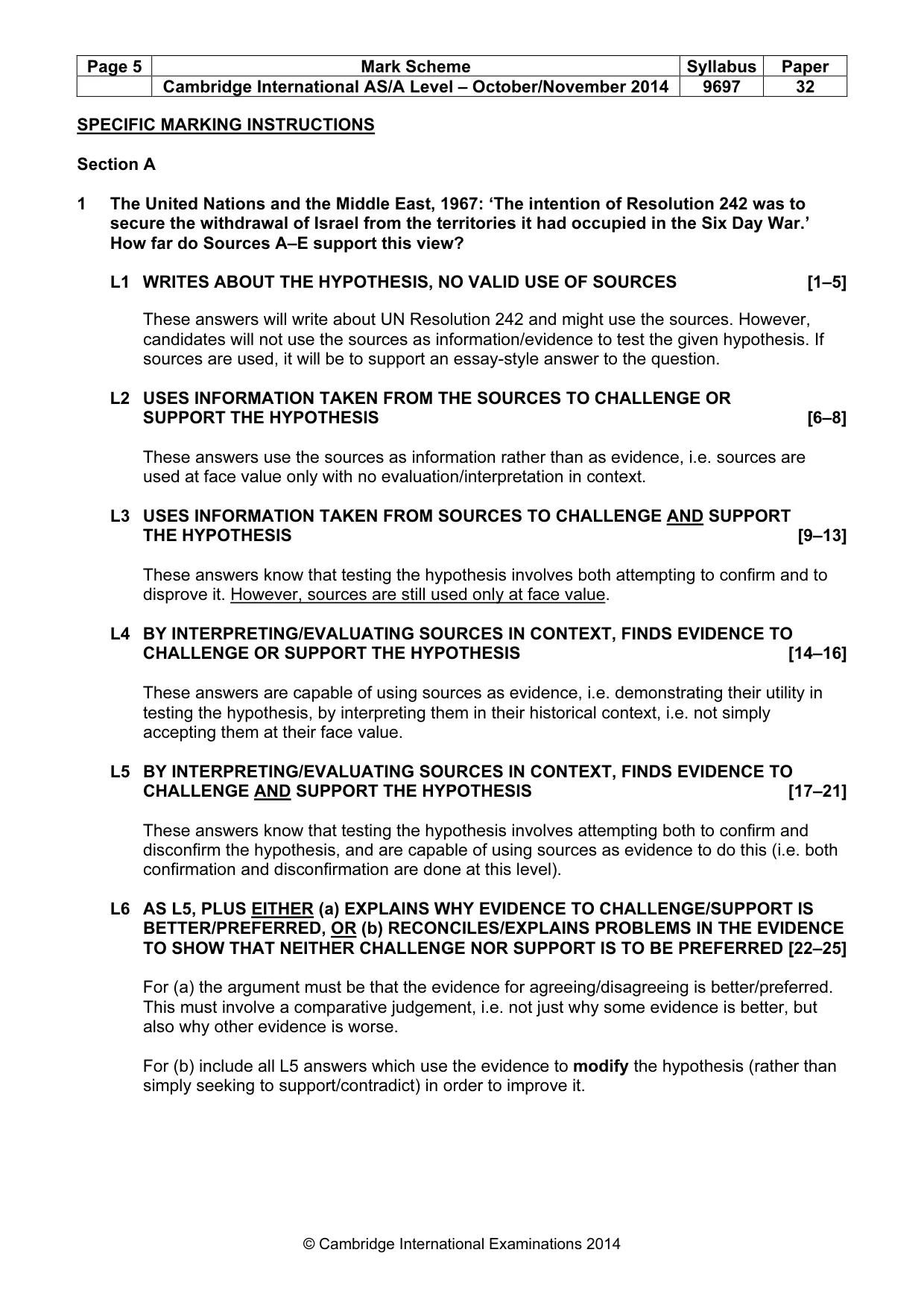
Page 5 Mark Scheme Syllabus Paper Cambridge International AS/A Level – October/November 2014 9697 32 © Cambridge International Examinations 2014 SPECIFIC MARKING INSTRUCTIONS Section A 1 The United Nations and the Middle East, 1967: ‘The intention of Resolution 242 was to secure the withdrawal of Israel from the territories it had occupied in the Six Day War.’ How far do Sources A–E support this view? L1 WRITES ABOUT THE HYPOTHESIS, NO VALID USE OF SOURCES [1–5] These answers will write about UN Resolution 242 and might use the sources. However, candidates will not use the sources as information/evidence to test the given hypothesis. If sources are used, it will be to support an essay-style answer to the question. L2 USES INFORMATION TAKEN FROM THE SOURCES TO CHALLENGE OR SUPPORT THE HYPOTHESIS [6–8] These answers use the sources as information rather than as evidence, i.e. sources are used at face value only with no evaluation/interpretation in context. L3 USES INFORMATION TAKEN FROM SOURCES TO CHALLENGE AND SUPPORT THE HYPOTHESIS [9–13] These answers know that testing the hypothesis involves both attempting to confirm and to disprove it. However, sources are still used only at face value. L4 BY INTERPRETING/EVALUATING SOURCES IN CONTEXT, FINDS EVIDENCE TO CHALLENGE OR SUPPORT THE HYPOTHESIS [14–16] These answers are capable of using sources as evidence, i.e. demonstrating their utility in testing the hypothesis, by interpreting them in their historical context, i.e. not simply accepting them at their face value. L5 BY INTERPRETING/EVALUATING SOURCES IN CONTEXT, FINDS EVIDENCE TO CHALLENGE AND SUPPORT THE HYPOTHESIS [17–21] These answers know that testing the hypothesis involves attempting both to confirm and disconfirm the hypothesis, and are capable of using sources as evidence to do this (i.e. both confirmation and disconfirmation are done at this level). L6 AS L5, PLUS EITHER (a) EXPLAINS WHY EVIDENCE TO CHALLENGE/SUPPORT IS BETTER/PREFERRED, OR (b) RECONCILES/EXPLAINS PROBLEMS IN THE EVIDENCE TO SHOW THAT NEITHER CHALLENGE NOR SUPPORT IS TO BE PREFERRED [22–25] For (a) the argument must be that the evidence for agreeing/disagreeing is better/preferred. This must involve a comparative judgement, i.e. not just why some evidence is better, but also why other evidence is worse. For (b) include all L5 answers which use the evidence to modify the hypothesis (rather than simply seeking to support/contradict) in order to improve it.
Mark scheme, page 6
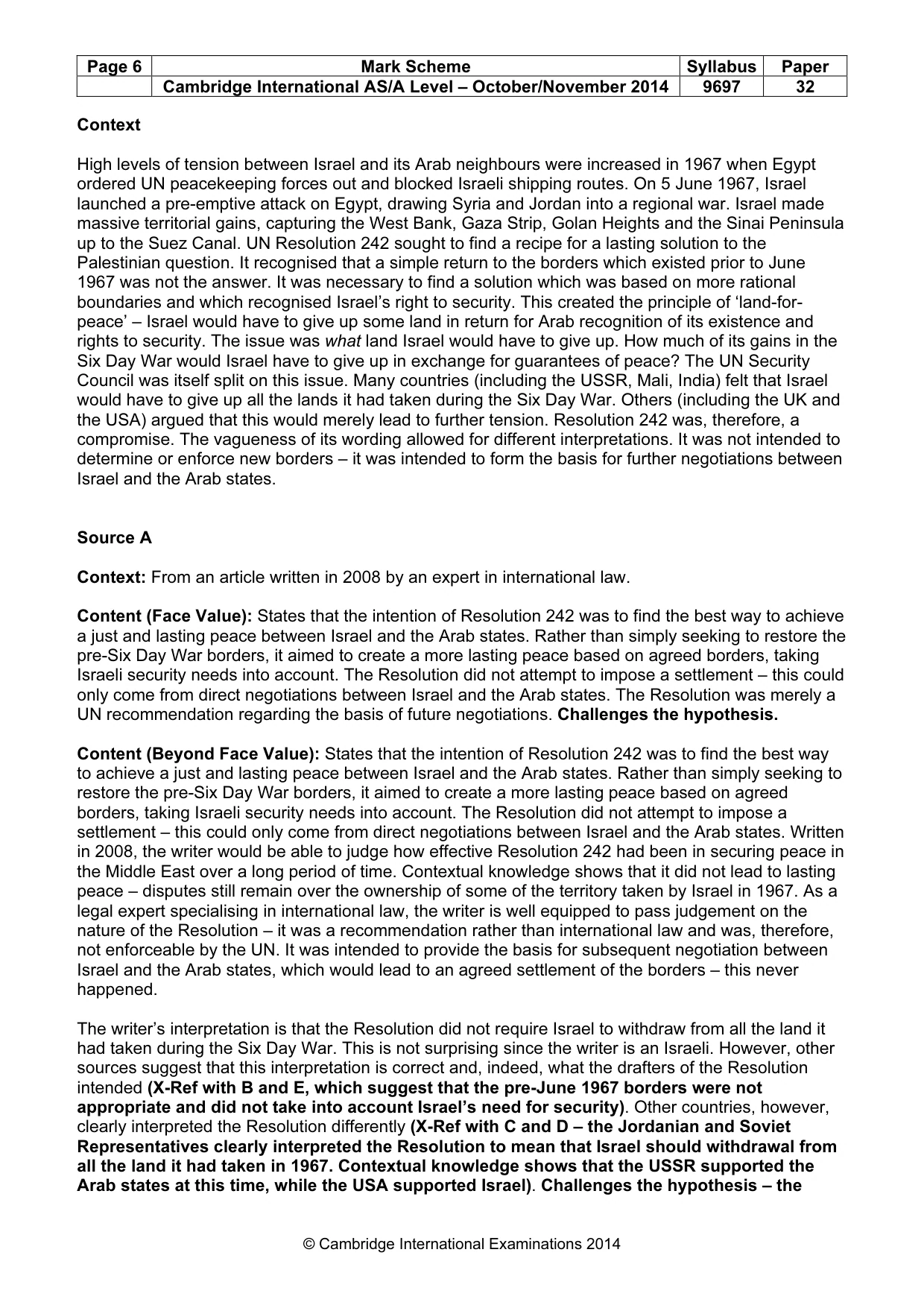
Page 6 Mark Scheme Syllabus Paper Cambridge International AS/A Level – October/November 2014 9697 32 © Cambridge International Examinations 2014 Context High levels of tension between Israel and its Arab neighbours were increased in 1967 when Egypt ordered UN peacekeeping forces out and blocked Israeli shipping routes. On 5 June 1967, Israel launched a pre-emptive attack on Egypt, drawing Syria and Jordan into a regional war. Israel made massive territorial gains, capturing the West Bank, Gaza Strip, Golan Heights and the Sinai Peninsula up to the Suez Canal. UN Resolution 242 sought to find a recipe for a lasting solution to the Palestinian question. It recognised that a simple return to the borders which existed prior to June 1967 was not the answer. It was necessary to find a solution which was based on more rational boundaries and which recognised Israel’s right to security. This created the principle of ‘land-for- peace’ – Israel would have to give up some land in return for Arab recognition of its existence and rights to security. The issue was what land Israel would have to give up. How much of its gains in the Six Day War would Israel have to give up in exchange for guarantees of peace? The UN Security Council was itself split on this issue. Many countries (including the USSR, Mali, India) felt that Israel would have to give up all the lands it had taken during the Six Day War. Others (including the UK and the USA) argued that this would merely lead to further tension. Resolution 242 was, therefore, a compromise. The vagueness of its wording allowed for different interpretations. It was not intended to determine or enforce new borders – it was intended to form the basis for further negotiations between Israel and the Arab states. Source A Context: From an article written in 2008 by an expert in international law. Content (Face Value): States that the intention of Resolution 242 was to find the best way to achieve a just and lasting peace between Israel and the Arab states. Rather than simply seeking to restore the pre-Six Day War borders, it aimed to create a more lasting peace based on agreed borders, taking Israeli security needs into account. The Resolution did not attempt to impose a settlement – this could only come from direct negotiations between Israel and the Arab states. The Resolution was merely a UN recommendation regarding the basis of future negotiations. Challenges the hypothesis. Content (Beyond Face Value): States that the intention of Resolution 242 was to find the best way to achieve a just and lasting peace between Israel and the Arab states. Rather than simply seeking to restore the pre-Six Day War borders, it aimed to create a more lasting peace based on agreed borders, taking Israeli security needs into account. The Resolution did not attempt to impose a settlement – this could only come from direct negotiations between Israel and the Arab states. Written in 2008, the writer would be able to judge how effective Resolution 242 had been in securing peace in the Middle East over a long period of time. Contextual knowledge shows that it did not lead to lasting peace – disputes still remain over the ownership of some of the territory taken by Israel in 1967. As a legal expert specialising in international law, the writer is well equipped to pass judgement on the nature of the Resolution – it was a recommendation rather than international law and was, therefore, not enforceable by the UN. It was intended to provide the basis for subsequent negotiation between Israel and the Arab states, which would lead to an agreed settlement of the borders – this never happened. The writer’s interpretation is that the Resolution did not require Israel to withdraw from all the land it had taken during the Six Day War. This is not surprising since the writer is an Israeli. However, other sources suggest that this interpretation is correct and, indeed, what the drafters of the Resolution intended (X-Ref with B and E, which suggest that the pre-June 1967 borders were not appropriate and did not take into account Israel’s need for security). Other countries, however, clearly interpreted the Resolution differently (X-Ref with C and D – the Jordanian and Soviet Representatives clearly interpreted the Resolution to mean that Israel should withdrawal from all the land it had taken in 1967. Contextual knowledge shows that the USSR supported the Arab states at this time, while the USA supported Israel). Challenges the hypothesis – the
Mark scheme, page 7
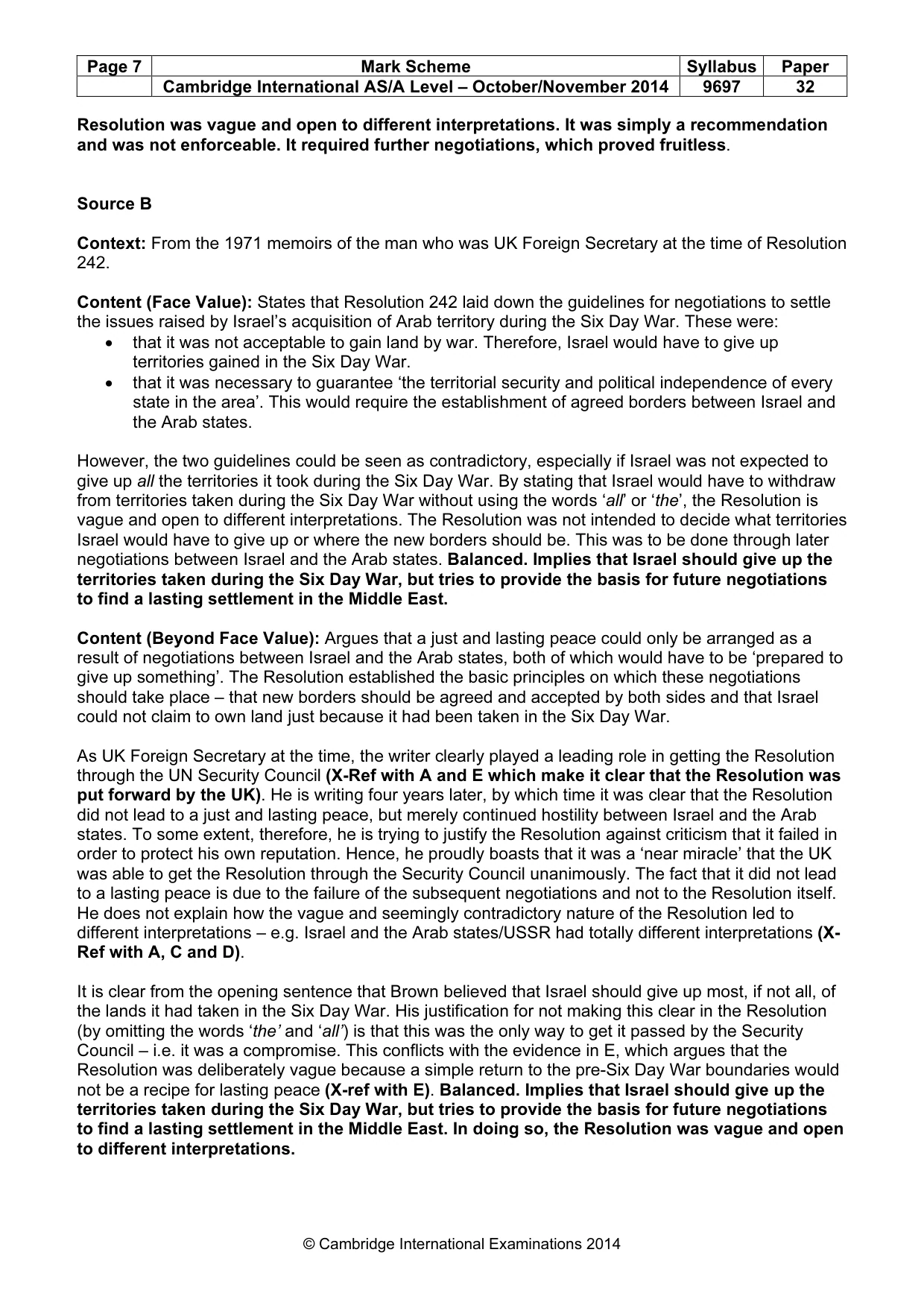
Page 7 Mark Scheme Syllabus Paper Cambridge International AS/A Level – October/November 2014 9697 32 © Cambridge International Examinations 2014 Resolution was vague and open to different interpretations. It was simply a recommendation and was not enforceable. It required further negotiations, which proved fruitless. Source B Context: From the 1971 memoirs of the man who was UK Foreign Secretary at the time of Resolution 242. Content (Face Value): States that Resolution 242 laid down the guidelines for negotiations to settle the issues raised by Israel’s acquisition of Arab territory during the Six Day War. These were: • that it was not acceptable to gain land by war. Therefore, Israel would have to give up territories gained in the Six Day War. • that it was necessary to guarantee ‘the territorial security and political independence of every state in the area’. This would require the establishment of agreed borders between Israel and the Arab states. However, the two guidelines could be seen as contradictory, especially if Israel was not expected to give up all the territories it took during the Six Day War. By stating that Israel would have to withdraw from territories taken during the Six Day War without using the words ‘all’ or ‘the’, the Resolution is vague and open to different interpretations. The Resolution was not intended to decide what territories Israel would have to give up or where the new borders should be. This was to be done through later negotiations between Israel and the Arab states. Balanced. Implies that Israel should give up the territories taken during the Six Day War, but tries to provide the basis for future negotiations to find a lasting settlement in the Middle East. Content (Beyond Face Value): Argues that a just and lasting peace could only be arranged as a result of negotiations between Israel and the Arab states, both of which would have to be ‘prepared to give up something’. The Resolution established the basic principles on which these negotiations should take place – that new borders should be agreed and accepted by both sides and that Israel could not claim to own land just because it had been taken in the Six Day War. As UK Foreign Secretary at the time, the writer clearly played a leading role in getting the Resolution through the UN Security Council (X-Ref with A and E which make it clear that the Resolution was put forward by the UK). He is writing four years later, by which time it was clear that the Resolution did not lead to a just and lasting peace, but merely continued hostility between Israel and the Arab states. To some extent, therefore, he is trying to justify the Resolution against criticism that it failed in order to protect his own reputation. Hence, he proudly boasts that it was a ‘near miracle’ that the UK was able to get the Resolution through the Security Council unanimously. The fact that it did not lead to a lasting peace is due to the failure of the subsequent negotiations and not to the Resolution itself. He does not explain how the vague and seemingly contradictory nature of the Resolution led to different interpretations – e.g. Israel and the Arab states/USSR had totally different interpretations (X- Ref with A, C and D). It is clear from the opening sentence that Brown believed that Israel should give up most, if not all, of the lands it had taken in the Six Day War. His justification for not making this clear in the Resolution (by omitting the words ‘the’ and ‘all’) is that this was the only way to get it passed by the Security Council – i.e. it was a compromise. This conflicts with the evidence in E, which argues that the Resolution was deliberately vague because a simple return to the pre-Six Day War boundaries would not be a recipe for lasting peace (X-ref with E). Balanced. Implies that Israel should give up the territories taken during the Six Day War, but tries to provide the basis for future negotiations to find a lasting settlement in the Middle East. In doing so, the Resolution was vague and open to different interpretations.
Mark scheme, page 8
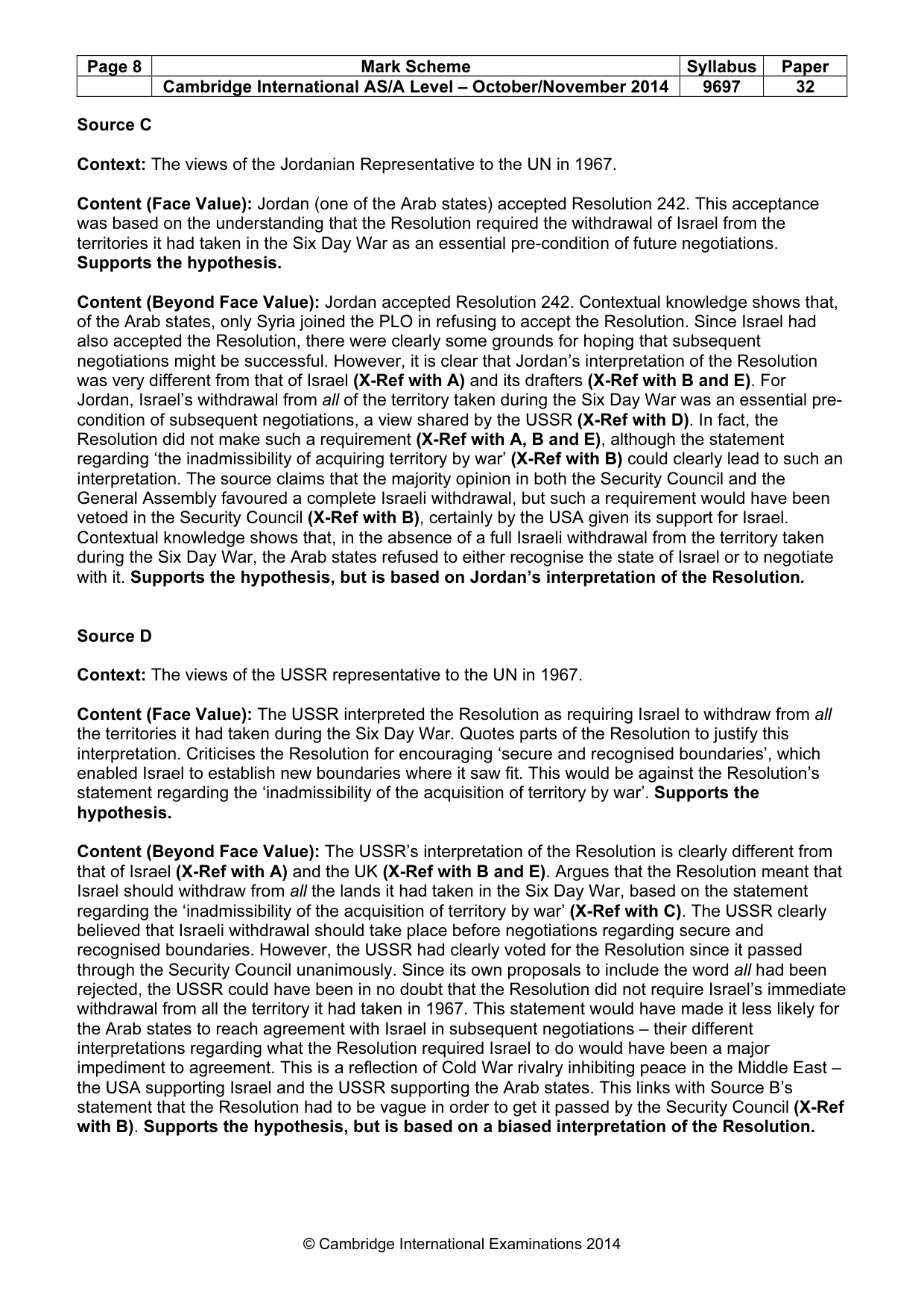
Page 8 Mark Scheme Syllabus Paper Cambridge International AS/A Level – October/November 2014 9697 32 © Cambridge International Examinations 2014 Source C Context: The views of the Jordanian Representative to the UN in 1967. Content (Face Value): Jordan (one of the Arab states) accepted Resolution 242. This acceptance was based on the understanding that the Resolution required the withdrawal of Israel from the territories it had taken in the Six Day War as an essential pre-condition of future negotiations. Supports the hypothesis. Content (Beyond Face Value): Jordan accepted Resolution 242. Contextual knowledge shows that, of the Arab states, only Syria joined the PLO in refusing to accept the Resolution. Since Israel had also accepted the Resolution, there were clearly some grounds for hoping that subsequent negotiations might be successful. However, it is clear that Jordan’s interpretation of the Resolution was very different from that of Israel (X-Ref with A) and its drafters (X-Ref with B and E). For Jordan, Israel’s withdrawal from all of the territory taken during the Six Day War was an essential pre- condition of subsequent negotiations, a view shared by the USSR (X-Ref with D). In fact, the Resolution did not make such a requirement (X-Ref with A, B and E), although the statement regarding ‘the inadmissibility of acquiring territory by war’ (X-Ref with B) could clearly lead to such an interpretation. The source claims that the majority opinion in both the Security Council and the General Assembly favoured a complete Israeli withdrawal, but such a requirement would have been vetoed in the Security Council (X-Ref with B), certainly by the USA given its support for Israel. Contextual knowledge shows that, in the absence of a full Israeli withdrawal from the territory taken during the Six Day War, the Arab states refused to either recognise the state of Israel or to negotiate with it. Supports the hypothesis, but is based on Jordan’s interpretation of the Resolution. Source D Context: The views of the USSR representative to the UN in 1967. Content (Face Value): The USSR interpreted the Resolution as requiring Israel to withdraw from all the territories it had taken during the Six Day War. Quotes parts of the Resolution to justify this interpretation. Criticises the Resolution for encouraging ‘secure and recognised boundaries’, which enabled Israel to establish new boundaries where it saw fit. This would be against the Resolution’s statement regarding the ‘inadmissibility of the acquisition of territory by war’. Supports the hypothesis. Content (Beyond Face Value): The USSR’s interpretation of the Resolution is clearly different from that of Israel (X-Ref with A) and the UK (X-Ref with B and E). Argues that the Resolution meant that Israel should withdraw from all the lands it had taken in the Six Day War, based on the statement regarding the ‘inadmissibility of the acquisition of territory by war’ (X-Ref with C). The USSR clearly believed that Israeli withdrawal should take place before negotiations regarding secure and recognised boundaries. However, the USSR had clearly voted for the Resolution since it passed through the Security Council unanimously. Since its own proposals to include the word all had been rejected, the USSR could have been in no doubt that the Resolution did not require Israel’s immediate withdrawal from all the territory it had taken in 1967. This statement would have made it less likely for the Arab states to reach agreement with Israel in subsequent negotiations – their different interpretations regarding what the Resolution required Israel to do would have been a major impediment to agreement. This is a reflection of Cold War rivalry inhibiting peace in the Middle East – the USA supporting Israel and the USSR supporting the Arab states. This links with Source B’s statement that the Resolution had to be vague in order to get it passed by the Security Council (X-Ref with B). Supports the hypothesis, but is based on a biased interpretation of the Resolution.
Mark scheme, page 9
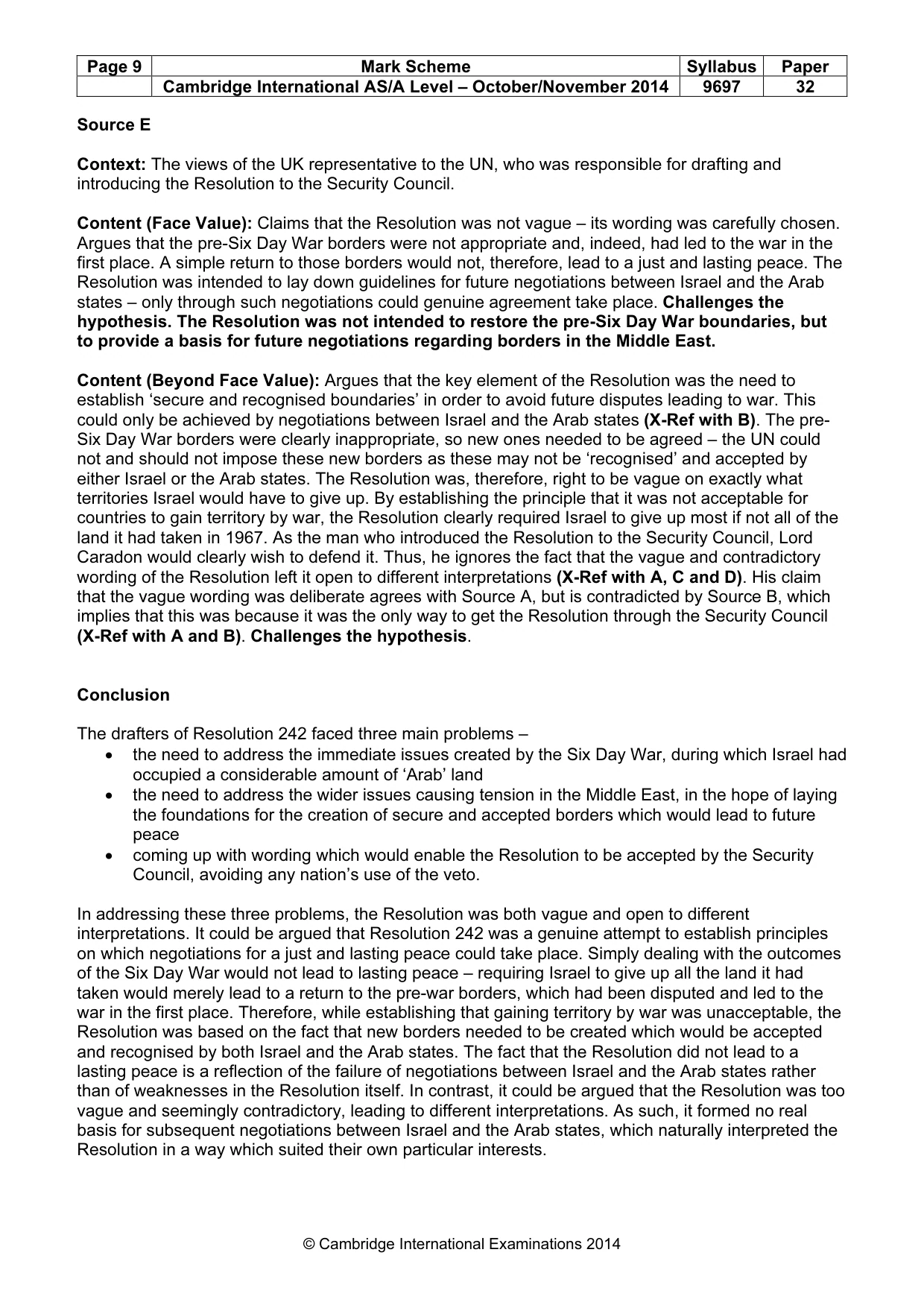
Page 9 Mark Scheme Syllabus Paper Cambridge International AS/A Level – October/November 2014 9697 32 © Cambridge International Examinations 2014 Source E Context: The views of the UK representative to the UN, who was responsible for drafting and introducing the Resolution to the Security Council. Content (Face Value): Claims that the Resolution was not vague – its wording was carefully chosen. Argues that the pre-Six Day War borders were not appropriate and, indeed, had led to the war in the first place. A simple return to those borders would not, therefore, lead to a just and lasting peace. The Resolution was intended to lay down guidelines for future negotiations between Israel and the Arab states – only through such negotiations could genuine agreement take place. Challenges the hypothesis. The Resolution was not intended to restore the pre-Six Day War boundaries, but to provide a basis for future negotiations regarding borders in the Middle East. Content (Beyond Face Value): Argues that the key element of the Resolution was the need to establish ‘secure and recognised boundaries’ in order to avoid future disputes leading to war. This could only be achieved by negotiations between Israel and the Arab states (X-Ref with B). The pre- Six Day War borders were clearly inappropriate, so new ones needed to be agreed – the UN could not and should not impose these new borders as these may not be ‘recognised’ and accepted by either Israel or the Arab states. The Resolution was, therefore, right to be vague on exactly what territories Israel would have to give up. By establishing the principle that it was not acceptable for countries to gain territory by war, the Resolution clearly required Israel to give up most if not all of the land it had taken in 1967. As the man who introduced the Resolution to the Security Council, Lord Caradon would clearly wish to defend it. Thus, he ignores the fact that the vague and contradictory wording of the Resolution left it open to different interpretations (X-Ref with A, C and D). His claim that the vague wording was deliberate agrees with Source A, but is contradicted by Source B, which implies that this was because it was the only way to get the Resolution through the Security Council (X-Ref with A and B). Challenges the hypothesis. Conclusion The drafters of Resolution 242 faced three main problems – • the need to address the immediate issues created by the Six Day War, during which Israel had occupied a considerable amount of ‘Arab’ land • the need to address the wider issues causing tension in the Middle East, in the hope of laying the foundations for the creation of secure and accepted borders which would lead to future peace • coming up with wording which would enable the Resolution to be accepted by the Security Council, avoiding any nation’s use of the veto. In addressing these three problems, the Resolution was both vague and open to different interpretations. It could be argued that Resolution 242 was a genuine attempt to establish principles on which negotiations for a just and lasting peace could take place. Simply dealing with the outcomes of the Six Day War would not lead to lasting peace – requiring Israel to give up all the land it had taken would merely lead to a return to the pre-war borders, which had been disputed and led to the war in the first place. Therefore, while establishing that gaining territory by war was unacceptable, the Resolution was based on the fact that new borders needed to be created which would be accepted and recognised by both Israel and the Arab states. The fact that the Resolution did not lead to a lasting peace is a reflection of the failure of negotiations between Israel and the Arab states rather than of weaknesses in the Resolution itself. In contrast, it could be argued that the Resolution was too vague and seemingly contradictory, leading to different interpretations. As such, it formed no real basis for subsequent negotiations between Israel and the Arab states, which naturally interpreted the Resolution in a way which suited their own particular interests.
Mark scheme, page 10
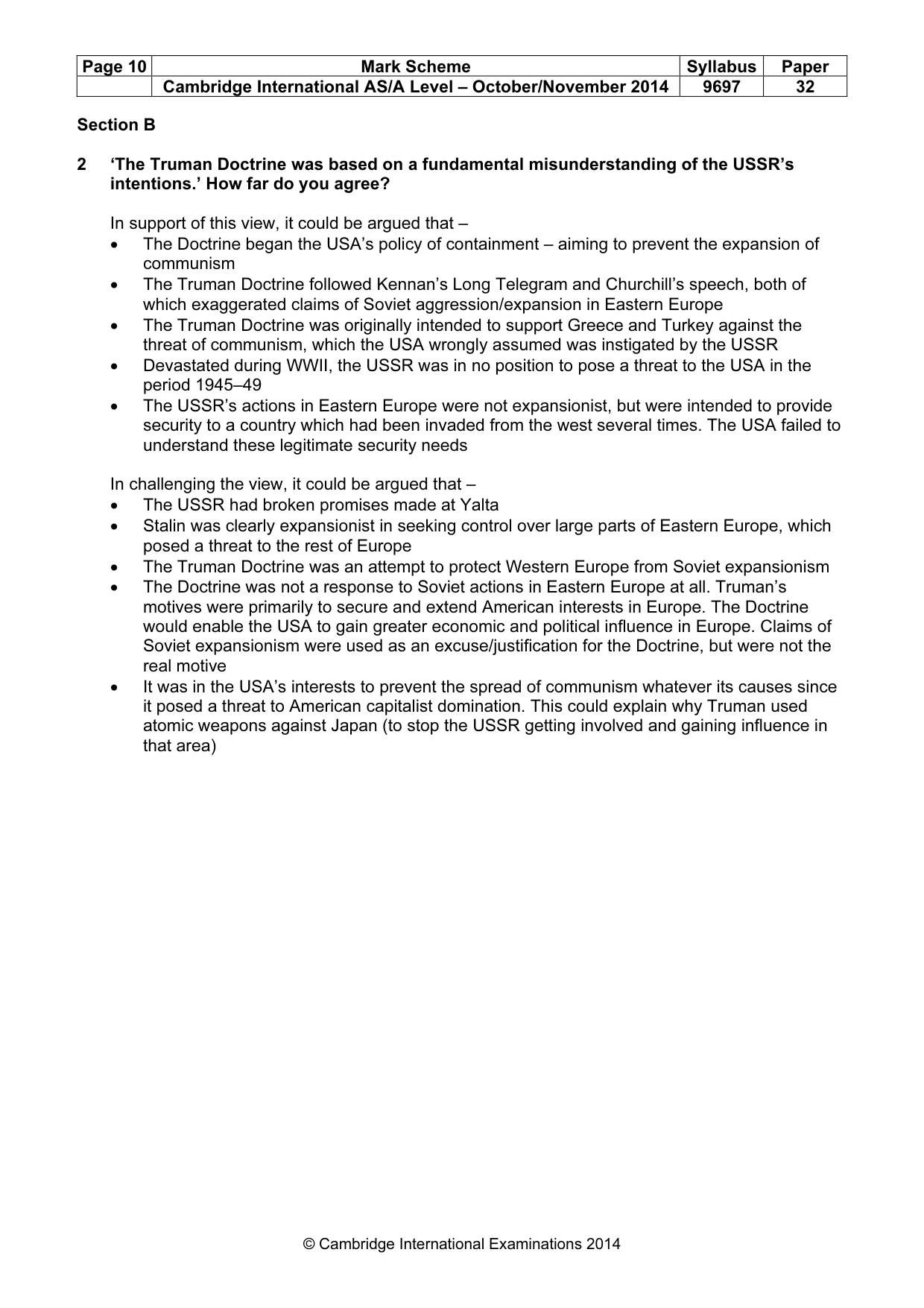
Page 10 Mark Scheme Syllabus Paper Cambridge International AS/A Level – October/November 2014 9697 32 © Cambridge International Examinations 2014 Section B 2 ‘The Truman Doctrine was based on a fundamental misunderstanding of the USSR’s intentions.’ How far do you agree? In support of this view, it could be argued that – • The Doctrine began the USA’s policy of containment – aiming to prevent the expansion of communism • The Truman Doctrine followed Kennan’s Long Telegram and Churchill’s speech, both of which exaggerated claims of Soviet aggression/expansion in Eastern Europe • The Truman Doctrine was originally intended to support Greece and Turkey against the threat of communism, which the USA wrongly assumed was instigated by the USSR • Devastated during WWII, the USSR was in no position to pose a threat to the USA in the period 1945–49 • The USSR’s actions in Eastern Europe were not expansionist, but were intended to provide security to a country which had been invaded from the west several times. The USA failed to understand these legitimate security needs In challenging the view, it could be argued that – • The USSR had broken promises made at Yalta • Stalin was clearly expansionist in seeking control over large parts of Eastern Europe, which posed a threat to the rest of Europe • The Truman Doctrine was an attempt to protect Western Europe from Soviet expansionism • The Doctrine was not a response to Soviet actions in Eastern Europe at all. Truman’s motives were primarily to secure and extend American interests in Europe. The Doctrine would enable the USA to gain greater economic and political influence in Europe. Claims of Soviet expansionism were used as an excuse/justification for the Doctrine, but were not the real motive • It was in the USA’s interests to prevent the spread of communism whatever its causes since it posed a threat to American capitalist domination. This could explain why Truman used atomic weapons against Japan (to stop the USSR getting involved and gaining influence in that area)
Mark scheme, page 11
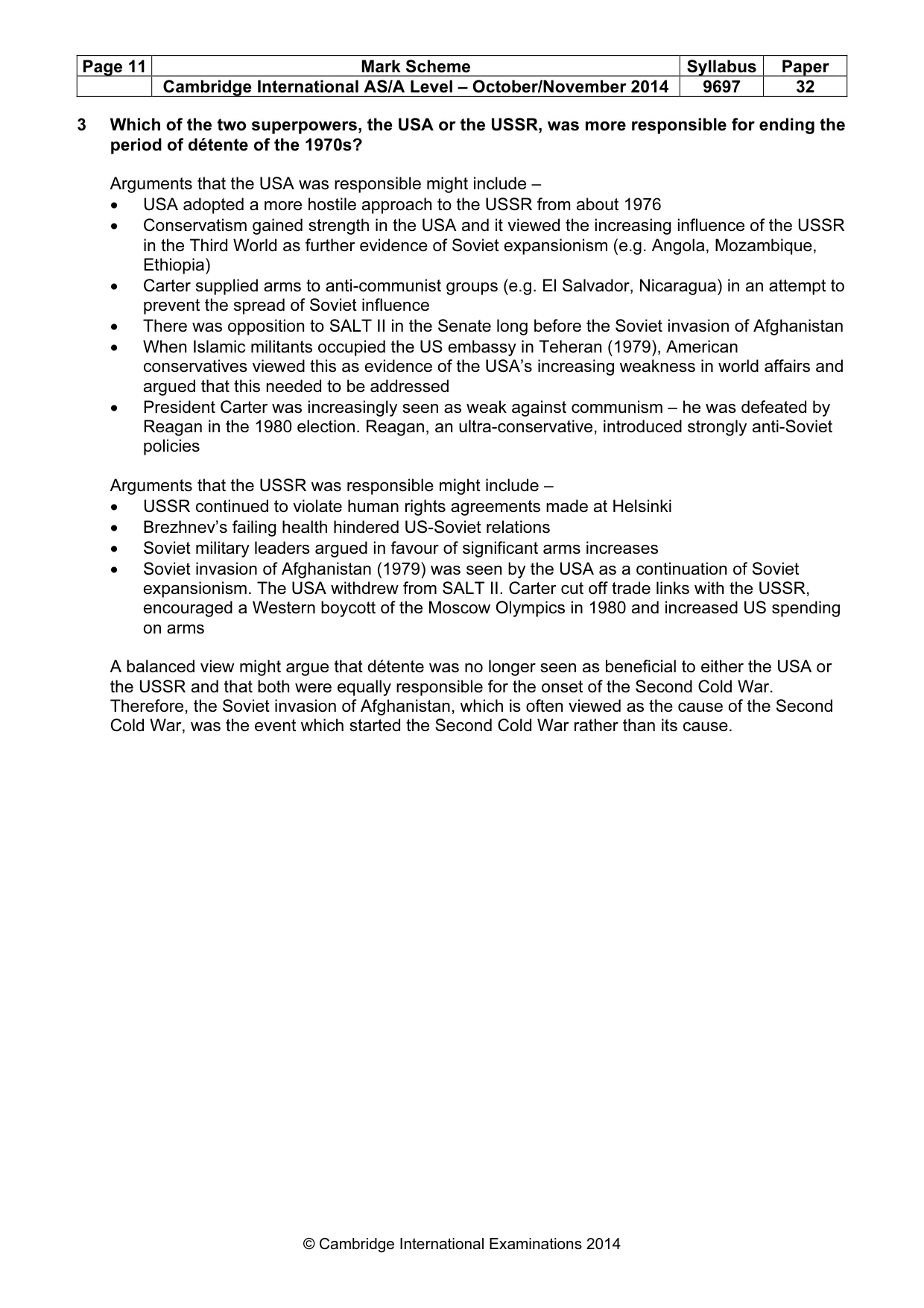
Page 11 Mark Scheme Syllabus Paper Cambridge International AS/A Level – October/November 2014 9697 32 © Cambridge International Examinations 2014 3 Which of the two superpowers, the USA or the USSR, was more responsible for ending the period of détente of the 1970s? Arguments that the USA was responsible might include – • USA adopted a more hostile approach to the USSR from about 1976 • Conservatism gained strength in the USA and it viewed the increasing influence of the USSR in the Third World as further evidence of Soviet expansionism (e.g. Angola, Mozambique, Ethiopia) • Carter supplied arms to anti-communist groups (e.g. El Salvador, Nicaragua) in an attempt to prevent the spread of Soviet influence • There was opposition to SALT II in the Senate long before the Soviet invasion of Afghanistan • When Islamic militants occupied the US embassy in Teheran (1979), American conservatives viewed this as evidence of the USA’s increasing weakness in world affairs and argued that this needed to be addressed • President Carter was increasingly seen as weak against communism – he was defeated by Reagan in the 1980 election. Reagan, an ultra-conservative, introduced strongly anti-Soviet policies Arguments that the USSR was responsible might include – • USSR continued to violate human rights agreements made at Helsinki • Brezhnev’s failing health hindered US-Soviet relations • Soviet military leaders argued in favour of significant arms increases • Soviet invasion of Afghanistan (1979) was seen by the USA as a continuation of Soviet expansionism. The USA withdrew from SALT II. Carter cut off trade links with the USSR, encouraged a Western boycott of the Moscow Olympics in 1980 and increased US spending on arms A balanced view might argue that détente was no longer seen as beneficial to either the USA or the USSR and that both were equally responsible for the onset of the Second Cold War. Therefore, the Soviet invasion of Afghanistan, which is often viewed as the cause of the Second Cold War, was the event which started the Second Cold War rather than its cause.
Mark scheme, page 12
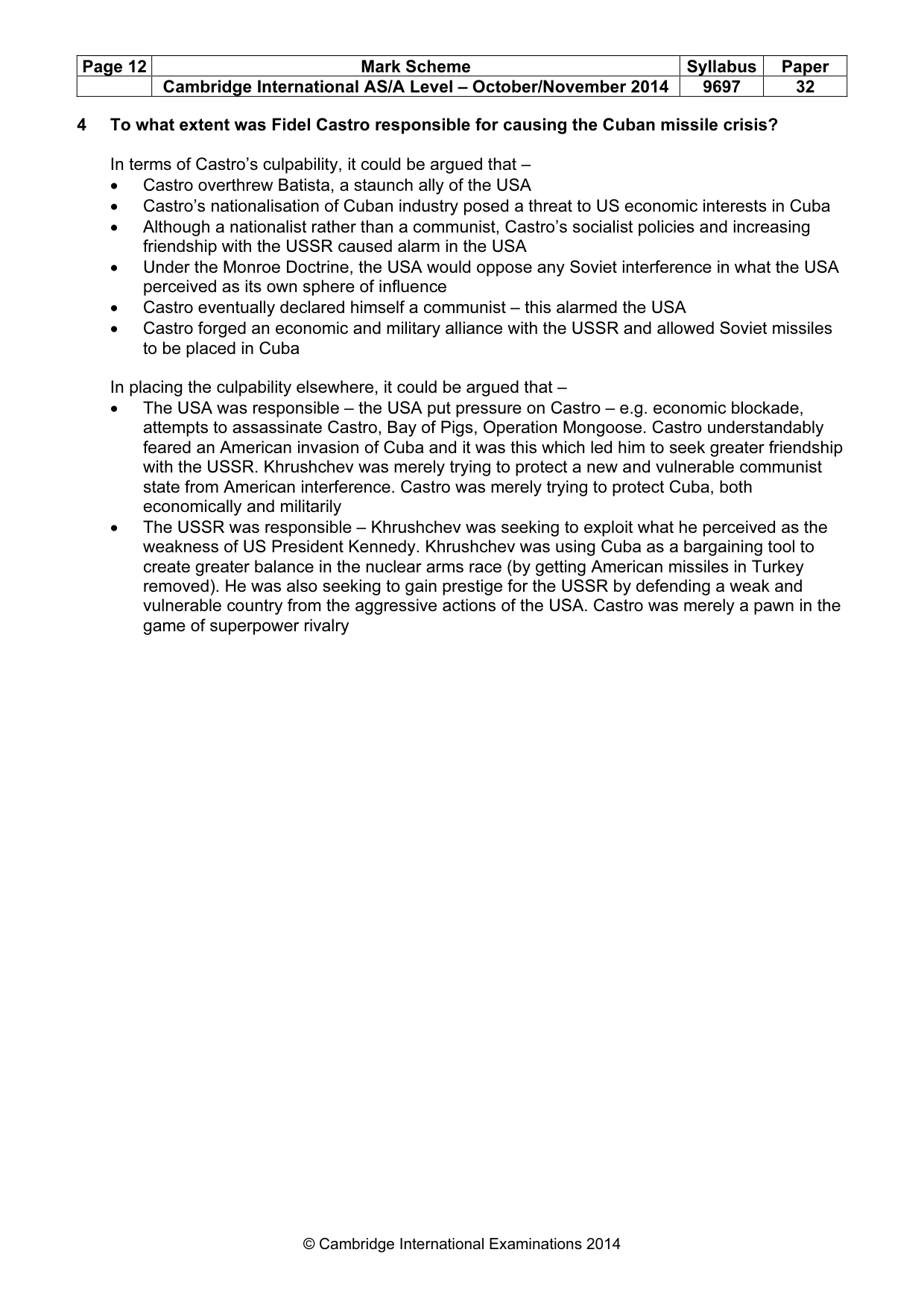
Page 12 Mark Scheme Syllabus Paper Cambridge International AS/A Level – October/November 2014 9697 32 © Cambridge International Examinations 2014 4 To what extent was Fidel Castro responsible for causing the Cuban missile crisis? In terms of Castro’s culpability, it could be argued that – • Castro overthrew Batista, a staunch ally of the USA • Castro’s nationalisation of Cuban industry posed a threat to US economic interests in Cuba • Although a nationalist rather than a communist, Castro’s socialist policies and increasing friendship with the USSR caused alarm in the USA • Under the Monroe Doctrine, the USA would oppose any Soviet interference in what the USA perceived as its own sphere of influence • Castro eventually declared himself a communist – this alarmed the USA • Castro forged an economic and military alliance with the USSR and allowed Soviet missiles to be placed in Cuba In placing the culpability elsewhere, it could be argued that – • The USA was responsible – the USA put pressure on Castro – e.g. economic blockade, attempts to assassinate Castro, Bay of Pigs, Operation Mongoose. Castro understandably feared an American invasion of Cuba and it was this which led him to seek greater friendship with the USSR. Khrushchev was merely trying to protect a new and vulnerable communist state from American interference. Castro was merely trying to protect Cuba, both economically and militarily • The USSR was responsible – Khrushchev was seeking to exploit what he perceived as the weakness of US President Kennedy. Khrushchev was using Cuba as a bargaining tool to create greater balance in the nuclear arms race (by getting American missiles in Turkey removed). He was also seeking to gain prestige for the USSR by defending a weak and vulnerable country from the aggressive actions of the USA. Castro was merely a pawn in the game of superpower rivalry
Mark scheme, page 13
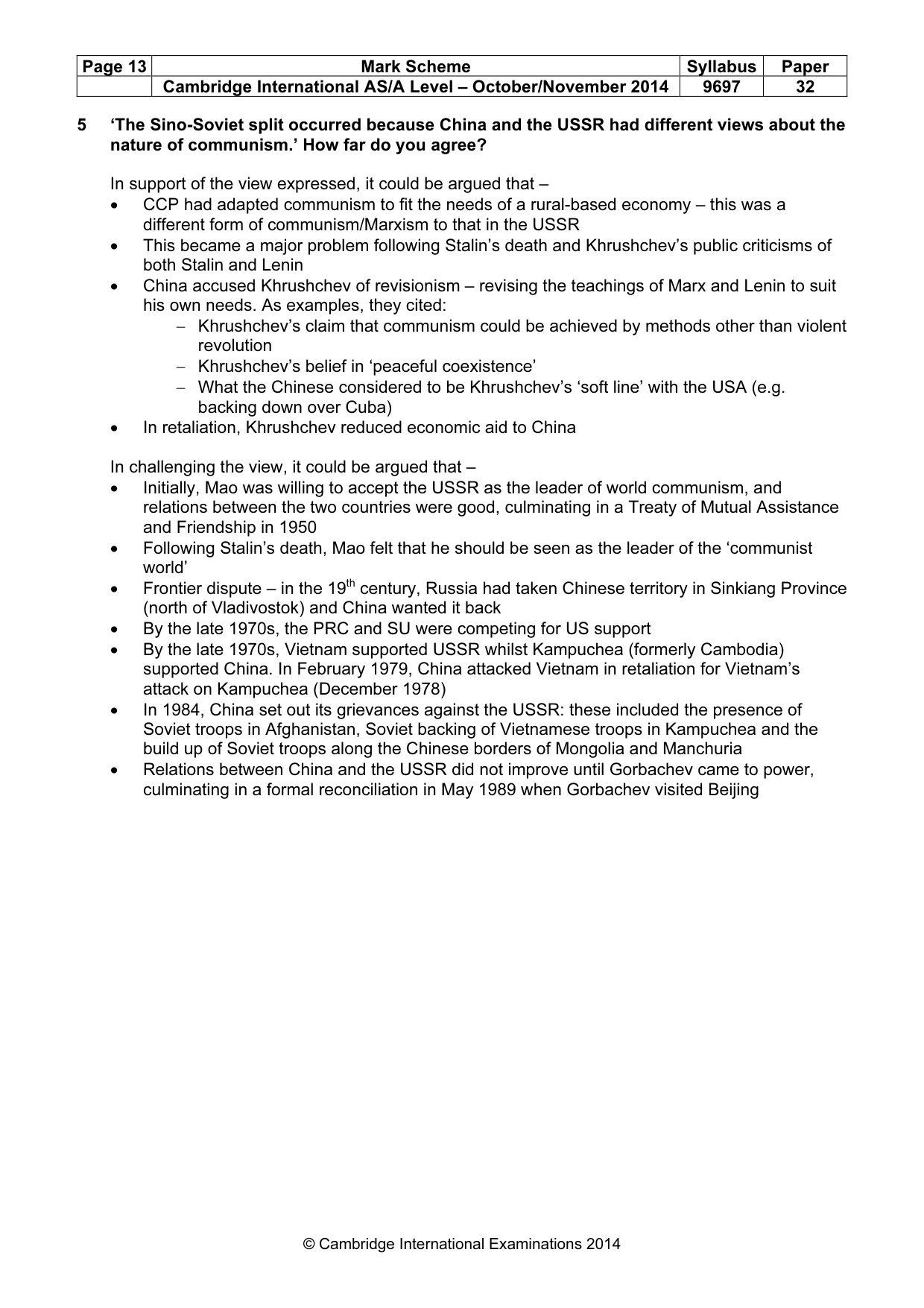
Page 13 Mark Scheme Syllabus Paper Cambridge International AS/A Level – October/November 2014 9697 32 © Cambridge International Examinations 2014 5 ‘The Sino-Soviet split occurred because China and the USSR had different views about the nature of communism.’ How far do you agree? In support of the view expressed, it could be argued that – • CCP had adapted communism to fit the needs of a rural-based economy – this was a different form of communism/Marxism to that in the USSR • This became a major problem following Stalin’s death and Khrushchev’s public criticisms of both Stalin and Lenin • China accused Khrushchev of revisionism – revising the teachings of Marx and Lenin to suit his own needs. As examples, they cited: − Khrushchev’s claim that communism could be achieved by methods other than violent revolution − Khrushchev’s belief in ‘peaceful coexistence’ − What the Chinese considered to be Khrushchev’s ‘soft line’ with the USA (e.g. backing down over Cuba) • In retaliation, Khrushchev reduced economic aid to China In challenging the view, it could be argued that – • Initially, Mao was willing to accept the USSR as the leader of world communism, and relations between the two countries were good, culminating in a Treaty of Mutual Assistance and Friendship in 1950 • Following Stalin’s death, Mao felt that he should be seen as the leader of the ‘communist world’ • Frontier dispute – in the 19th century, Russia had taken Chinese territory in Sinkiang Province (north of Vladivostok) and China wanted it back • By the late 1970s, the PRC and SU were competing for US support • By the late 1970s, Vietnam supported USSR whilst Kampuchea (formerly Cambodia) supported China. In February 1979, China attacked Vietnam in retaliation for Vietnam’s attack on Kampuchea (December 1978) • In 1984, China set out its grievances against the USSR: these included the presence of Soviet troops in Afghanistan, Soviet backing of Vietnamese troops in Kampuchea and the build up of Soviet troops along the Chinese borders of Mongolia and Manchuria • Relations between China and the USSR did not improve until Gorbachev came to power, culminating in a formal reconciliation in May 1989 when Gorbachev visited Beijing
Mark scheme, page 14
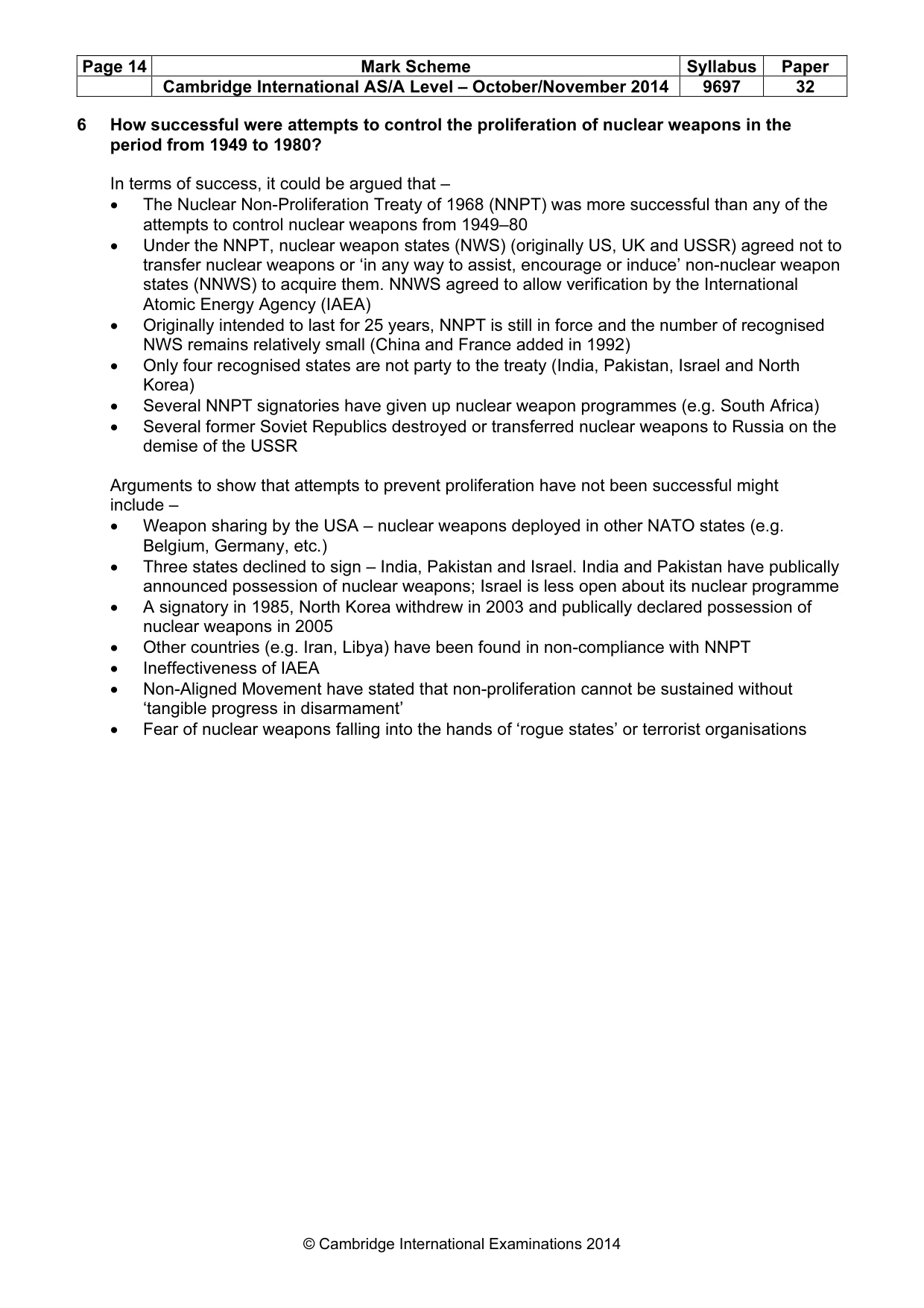
Page 14 Mark Scheme Syllabus Paper Cambridge International AS/A Level – October/November 2014 9697 32 © Cambridge International Examinations 2014 6 How successful were attempts to control the proliferation of nuclear weapons in the period from 1949 to 1980? In terms of success, it could be argued that – • The Nuclear Non-Proliferation Treaty of 1968 (NNPT) was more successful than any of the attempts to control nuclear weapons from 1949–80 • Under the NNPT, nuclear weapon states (NWS) (originally US, UK and USSR) agreed not to transfer nuclear weapons or ‘in any way to assist, encourage or induce’ non-nuclear weapon states (NNWS) to acquire them. NNWS agreed to allow verification by the International Atomic Energy Agency (IAEA) • Originally intended to last for 25 years, NNPT is still in force and the number of recognised NWS remains relatively small (China and France added in 1992) • Only four recognised states are not party to the treaty (India, Pakistan, Israel and North Korea) • Several NNPT signatories have given up nuclear weapon programmes (e.g. South Africa) • Several former Soviet Republics destroyed or transferred nuclear weapons to Russia on the demise of the USSR Arguments to show that attempts to prevent proliferation have not been successful might include – • Weapon sharing by the USA – nuclear weapons deployed in other NATO states (e.g. Belgium, Germany, etc.) • Three states declined to sign – India, Pakistan and Israel. India and Pakistan have publically announced possession of nuclear weapons; Israel is less open about its nuclear programme • A signatory in 1985, North Korea withdrew in 2003 and publically declared possession of nuclear weapons in 2005 • Other countries (e.g. Iran, Libya) have been found in non-compliance with NNPT • Ineffectiveness of IAEA • Non-Aligned Movement have stated that non-proliferation cannot be sustained without ‘tangible progress in disarmament’ • Fear of nuclear weapons falling into the hands of ‘rogue states’ or terrorist organisations
Mark scheme, page 15
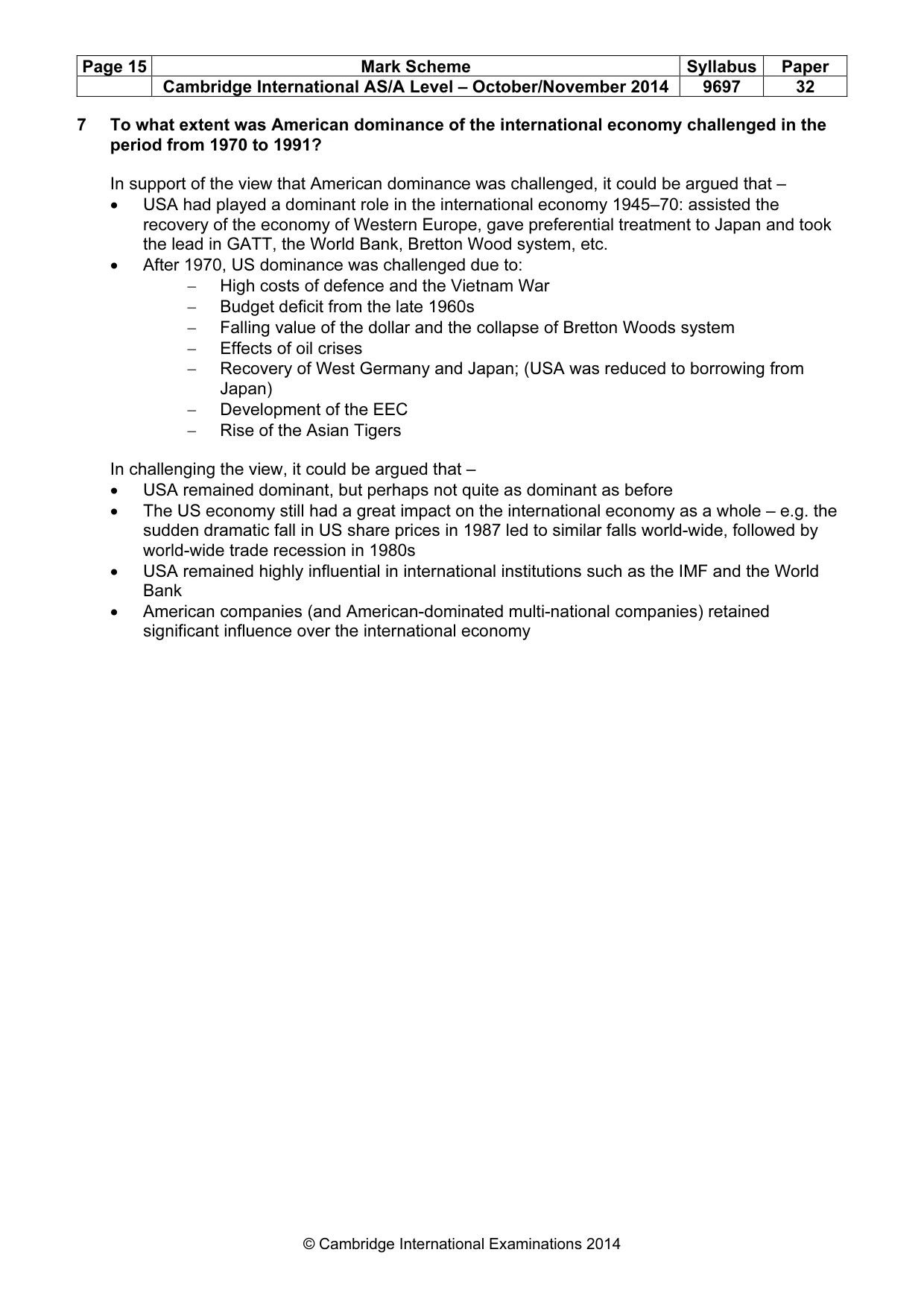
Page 15 Mark Scheme Syllabus Paper Cambridge International AS/A Level – October/November 2014 9697 32 © Cambridge International Examinations 2014 7 To what extent was American dominance of the international economy challenged in the period from 1970 to 1991? In support of the view that American dominance was challenged, it could be argued that – • USA had played a dominant role in the international economy 1945–70: assisted the recovery of the economy of Western Europe, gave preferential treatment to Japan and took the lead in GATT, the World Bank, Bretton Wood system, etc. • After 1970, US dominance was challenged due to: − High costs of defence and the Vietnam War − Budget deficit from the late 1960s − Falling value of the dollar and the collapse of Bretton Woods system − Effects of oil crises − Recovery of West Germany and Japan; (USA was reduced to borrowing from Japan) − Development of the EEC − Rise of the Asian Tigers In challenging the view, it could be argued that – • USA remained dominant, but perhaps not quite as dominant as before • The US economy still had a great impact on the international economy as a whole – e.g. the sudden dramatic fall in US share prices in 1987 led to similar falls world-wide, followed by world-wide trade recession in 1980s • USA remained highly influential in international institutions such as the IMF and the World Bank • American companies (and American-dominated multi-national companies) retained significant influence over the international economy
Mark scheme, page 16
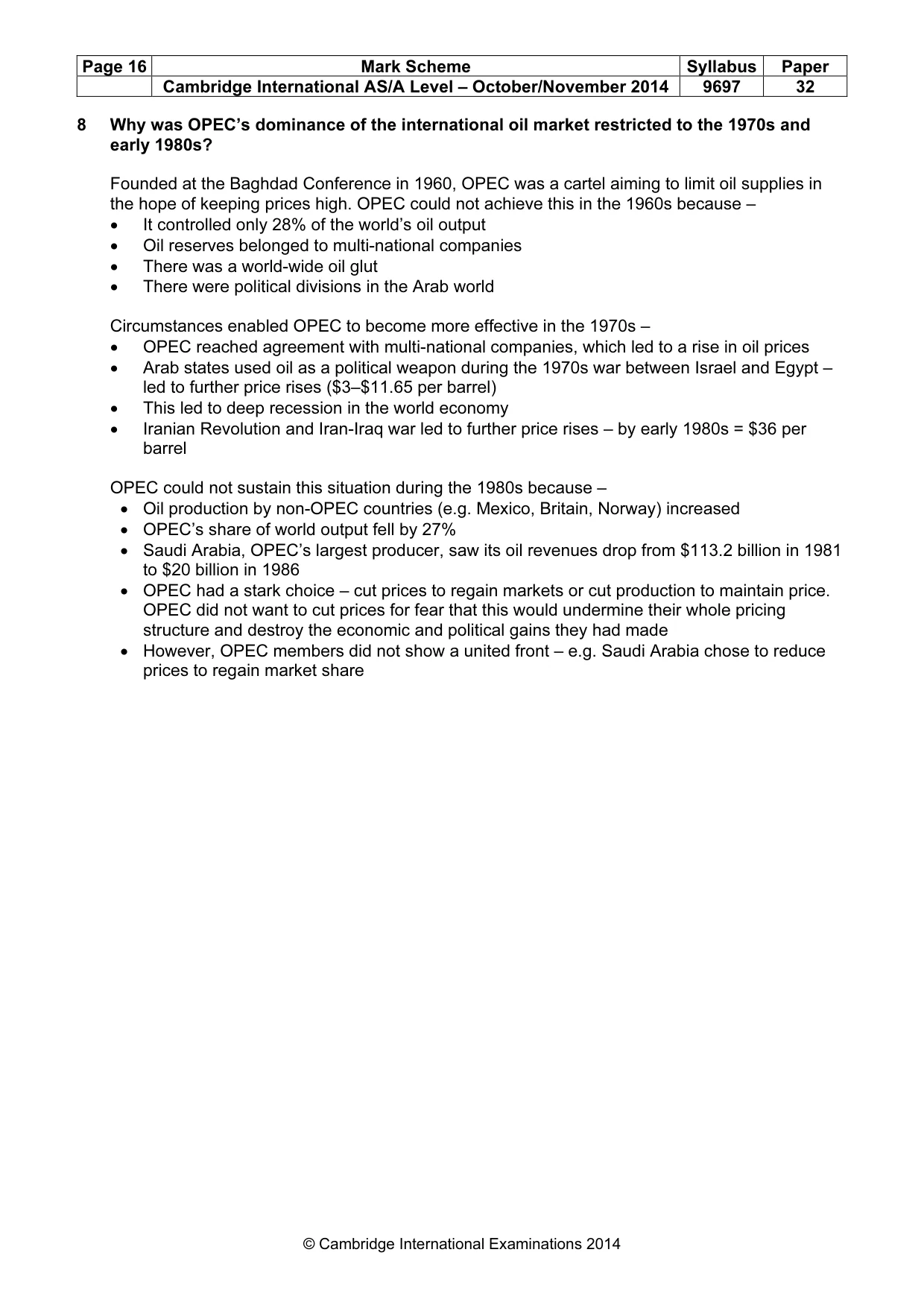
Page 16 Mark Scheme Syllabus Paper Cambridge International AS/A Level – October/November 2014 9697 32 © Cambridge International Examinations 2014 8 Why was OPEC’s dominance of the international oil market restricted to the 1970s and early 1980s? Founded at the Baghdad Conference in 1960, OPEC was a cartel aiming to limit oil supplies in the hope of keeping prices high. OPEC could not achieve this in the 1960s because – • It controlled only 28% of the world’s oil output • Oil reserves belonged to multi-national companies • There was a world-wide oil glut • There were political divisions in the Arab world Circumstances enabled OPEC to become more effective in the 1970s – • OPEC reached agreement with multi-national companies, which led to a rise in oil prices • Arab states used oil as a political weapon during the 1970s war between Israel and Egypt – led to further price rises ($3–$11.65 per barrel) • This led to deep recession in the world economy • Iranian Revolution and Iran-Iraq war led to further price rises – by early 1980s = $36 per barrel OPEC could not sustain this situation during the 1980s because – • Oil production by non-OPEC countries (e.g. Mexico, Britain, Norway) increased • OPEC’s share of world output fell by 27% • Saudi Arabia, OPEC’s largest producer, saw its oil revenues drop from $113.2 billion in 1981 to $20 billion in 1986 • OPEC had a stark choice – cut prices to regain markets or cut production to maintain price. OPEC did not want to cut prices for fear that this would undermine their whole pricing structure and destroy the economic and political gains they had made • However, OPEC members did not show a united front – e.g. Saudi Arabia chose to reduce prices to regain market share
What you needed in this session
Cambridge’s own grade thresholds for 2014 Oct/Nov, Paper 3 · Variant 2. A higher threshold means an easier paper — the bar moves with how the cohort did.