Cambridge A Level History (pre-2015) 9697 — 2012 May/June Paper 3 · Variant 2
9697/32/M/J/12 · 100 marks · ≈113 min
The question paper and its mark scheme, free to read here and free to download. This is Cambridge’s own paper, exactly as it was sat.
Question paper4 pages
Mark scheme11 pages
Answers below. Sit the paper first if you are practising.
Paper as text
Question paper, page 1
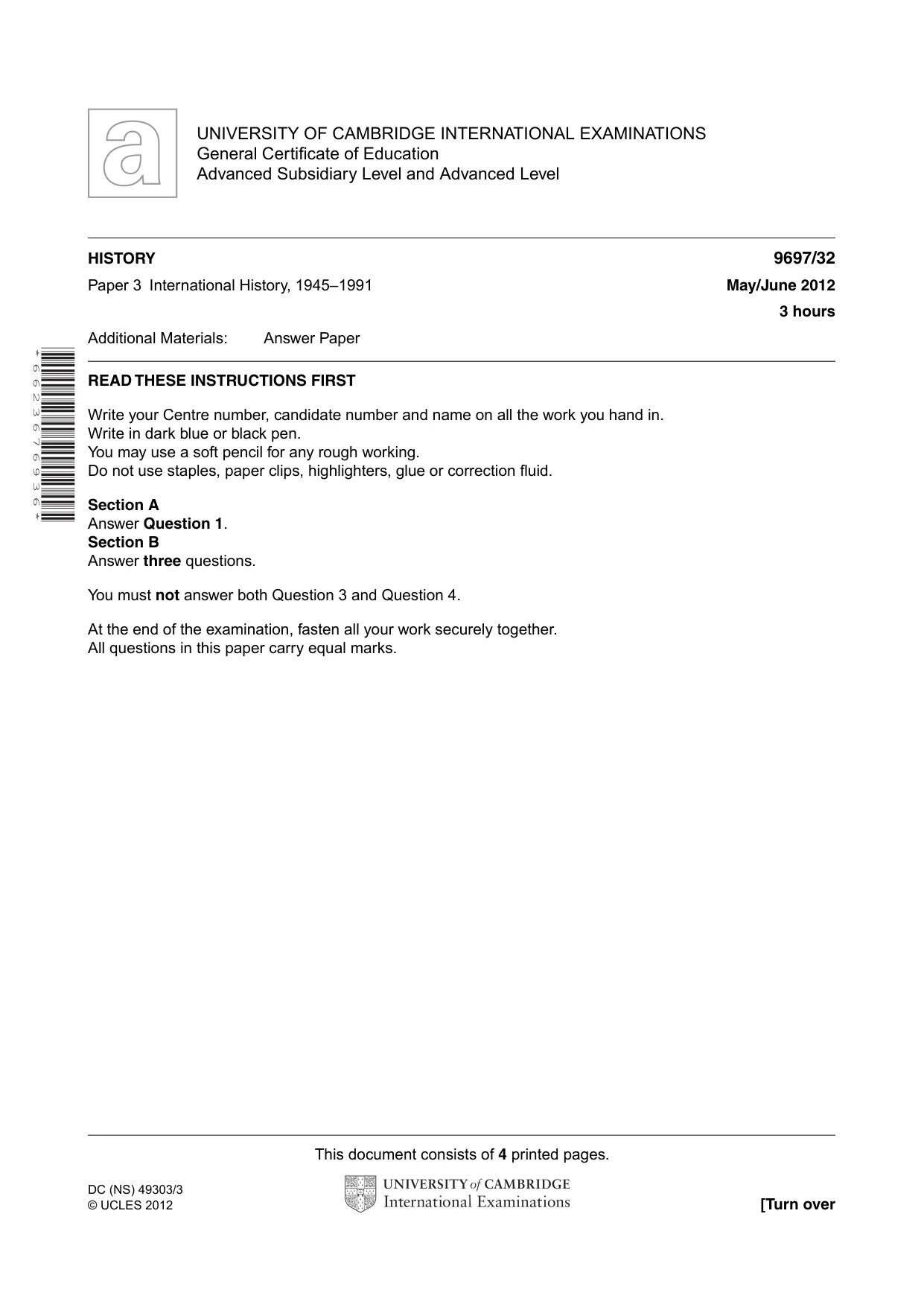
This document consists of 4 printed pages. DC (NS) 49303/3 © UCLES 2012 [Turn over UNIVERSITY OF CAMBRIDGE INTERNATIONAL EXAMINATIONS General Certificate of Education Advanced Subsidiary Level and Advanced Level * 6 6 2 3 6 7 6 9 3 6 * HISTORY 9697/32 Paper 3 International History, 1945–1991 May/June 2012 3 hours Additional Materials: Answer Paper READ THESE INSTRUCTIONS FIRST Write your Centre number, candidate number and name on all the work you hand in. Write in dark blue or black pen. You may use a soft pencil for any rough working. Do not use staples, paper clips, highlighters, glue or correction fluid. Section A Answer Question 1. Section B Answer three questions. You must not answer both Question 3 and Question 4. At the end of the examination, fasten all your work securely together. All questions in this paper carry equal marks.
Question paper, page 2
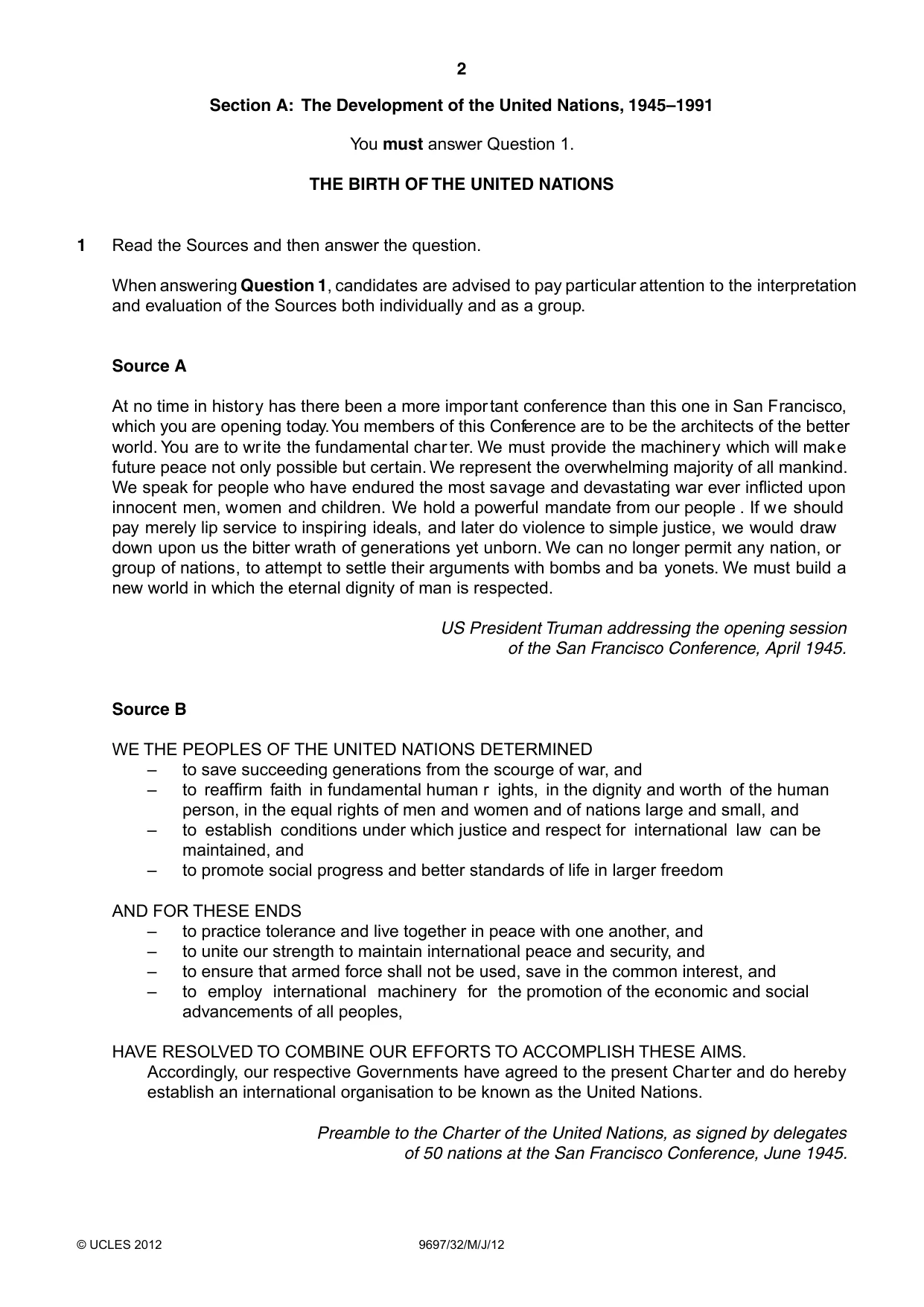
2 9697/32/M/J/12 © UCLES 2012 Section A: The Development of the United Nations, 1945–1991 You must answer Question 1. THE BIRTH OF THE UNITED NATIONS 1 Read the Sources and then answer the question. When answering Question 1, candidates are advised to pay particular attention to the interpretation and evaluation of the Sources both individually and as a group. Source A At no time in history has there been a more important conference than this one in San Francisco, which you are opening today. You members of this Conference are to be the architects of the better world. You are to write the fundamental char ter. We must provide the machinery which will make future peace not only possible but certain. We represent the overwhelming majority of all mankind. We speak for people who have endured the most savage and devastating war ever inflicted upon innocent men, women and children. We hold a powerful mandate from our people . If we should pay merely lip service to inspiring ideals, and later do violence to simple justice, we would draw down upon us the bitter wrath of generations yet unborn. We can no longer permit any nation, or group of nations, to attempt to settle their arguments with bombs and ba yonets. We must build a new world in which the eternal dignity of man is respected. US President Truman addressing the opening session of the San Francisco Conference, April 1945. Source B WE THE PEOPLES OF THE UNITED NATIONS DETERMINED – to save succeeding generations from the scourge of war, and – to reaffirm faith in fundamental human r ights, in the dignity and worth of the human person, in the equal rights of men and women and of nations large and small, and – to establish conditions under which justice and respect for international law can be maintained, and – to promote social progress and better standards of life in larger freedom AND FOR THESE ENDS – to practice tolerance and live together in peace with one another, and – to unite our strength to maintain international peace and security, and – to ensure that armed force shall not be used, save in the common interest, and – to employ international machinery for the promotion of the economic and social advancements of all peoples, HAVE RESOLVED TO COMBINE OUR EFFORTS TO ACCOMPLISH THESE AIMS. Accordingly, our respective Governments have agreed to the present Charter and do hereby establish an international organisation to be known as the United Nations. Preamble to the Charter of the United Nations, as signed by delegates of 50 nations at the San Francisco Conference, June 1945.
Question paper, page 3
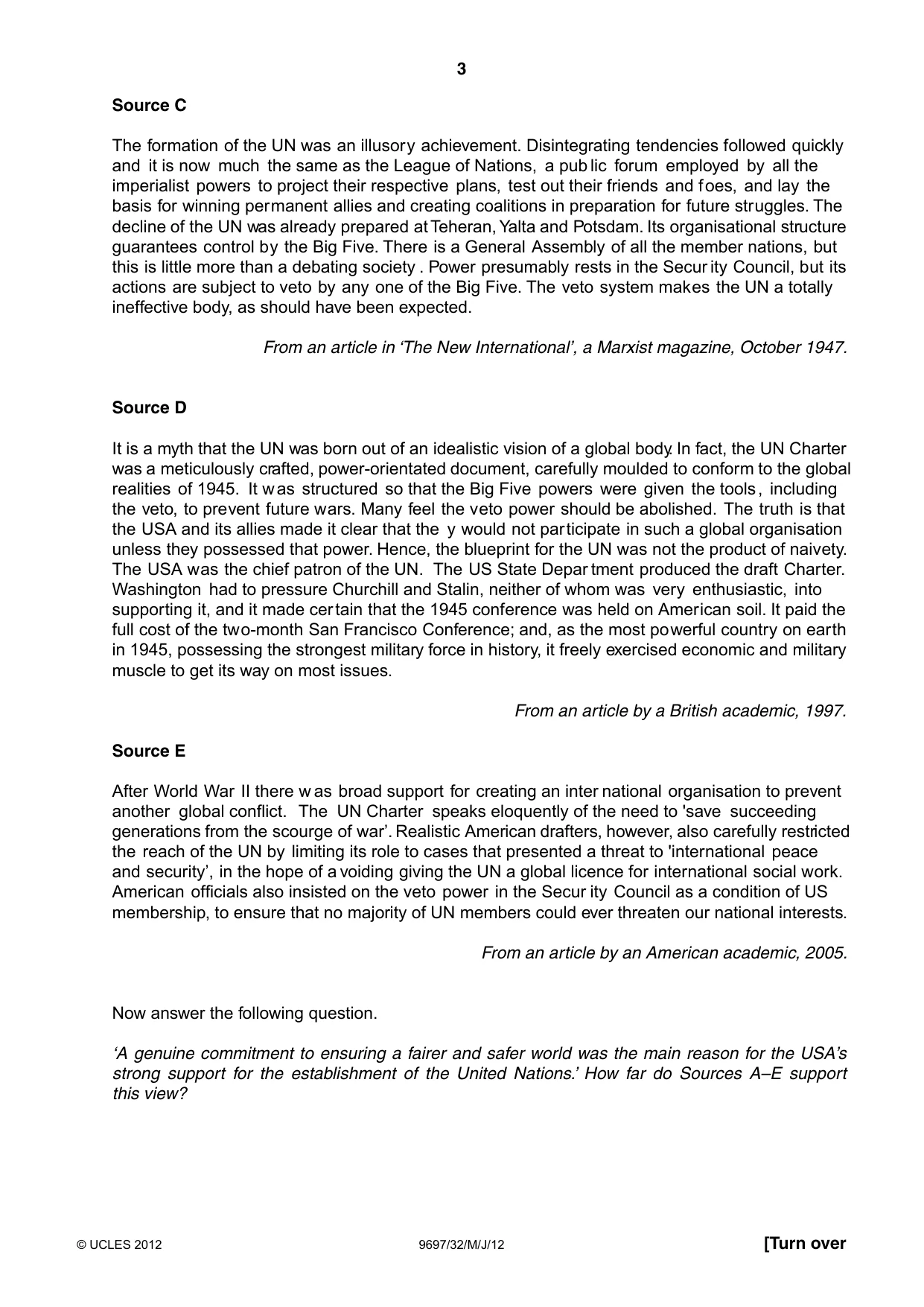
3 9697/32/M/J/12 © UCLES 2012 [Turn over Source C The formation of the UN was an illusory achievement. Disintegrating tendencies followed quickly and it is now much the same as the League of Nations, a pub lic forum employed by all the imperialist powers to project their respective plans, test out their friends and foes, and lay the basis for winning permanent allies and creating coalitions in preparation for future struggles. The decline of the UN was already prepared at Teheran, Yalta and Potsdam. Its organisational structure guarantees control by the Big Five. There is a General Assembly of all the member nations, but this is little more than a debating society . Power presumably rests in the Secur ity Council, but its actions are subject to veto by any one of the Big Five. The veto system makes the UN a totally ineffective body, as should have been expected. From an article in ‘The New International’, a Marxist magazine, October 1947. Source D It is a myth that the UN was born out of an idealistic vision of a global body. In fact, the UN Charter was a meticulously crafted, power-orientated document, carefully moulded to conform to the global realities of 1945. It was structured so that the Big Five powers were given the tools, including the veto, to prevent future wars. Many feel the veto power should be abolished. The truth is that the USA and its allies made it clear that the y would not participate in such a global organisation unless they possessed that power. Hence, the blueprint for the UN was not the product of naivety. The USA was the chief patron of the UN. The US State Depar tment produced the draft Charter. Washington had to pressure Churchill and Stalin, neither of whom was very enthusiastic, into supporting it, and it made certain that the 1945 conference was held on American soil. It paid the full cost of the two-month San Francisco Conference; and, as the most powerful country on earth in 1945, possessing the strongest military force in history, it freely exercised economic and military muscle to get its way on most issues. From an article by a British academic, 1997. Source E After World War II there w as broad support for creating an inter national organisation to prevent another global conflict. The UN Charter speaks eloquently of the need to 'save succeeding generations from the scourge of war’. Realistic American drafters, however, also carefully restricted the reach of the UN by limiting its role to cases that presented a threat to 'international peace and security’, in the hope of a voiding giving the UN a global licence for international social work. American officials also insisted on the veto power in the Secur ity Council as a condition of US membership, to ensure that no majority of UN members could ever threaten our national interests. From an article by an American academic, 2005. Now answer the following question. ‘A genuine commitment to ensuring a fairer and safer world was the main reason for the USA’s strong support for the establishment of the United Nations.’ How far do Sources A–E support this view?
Question paper, page 4
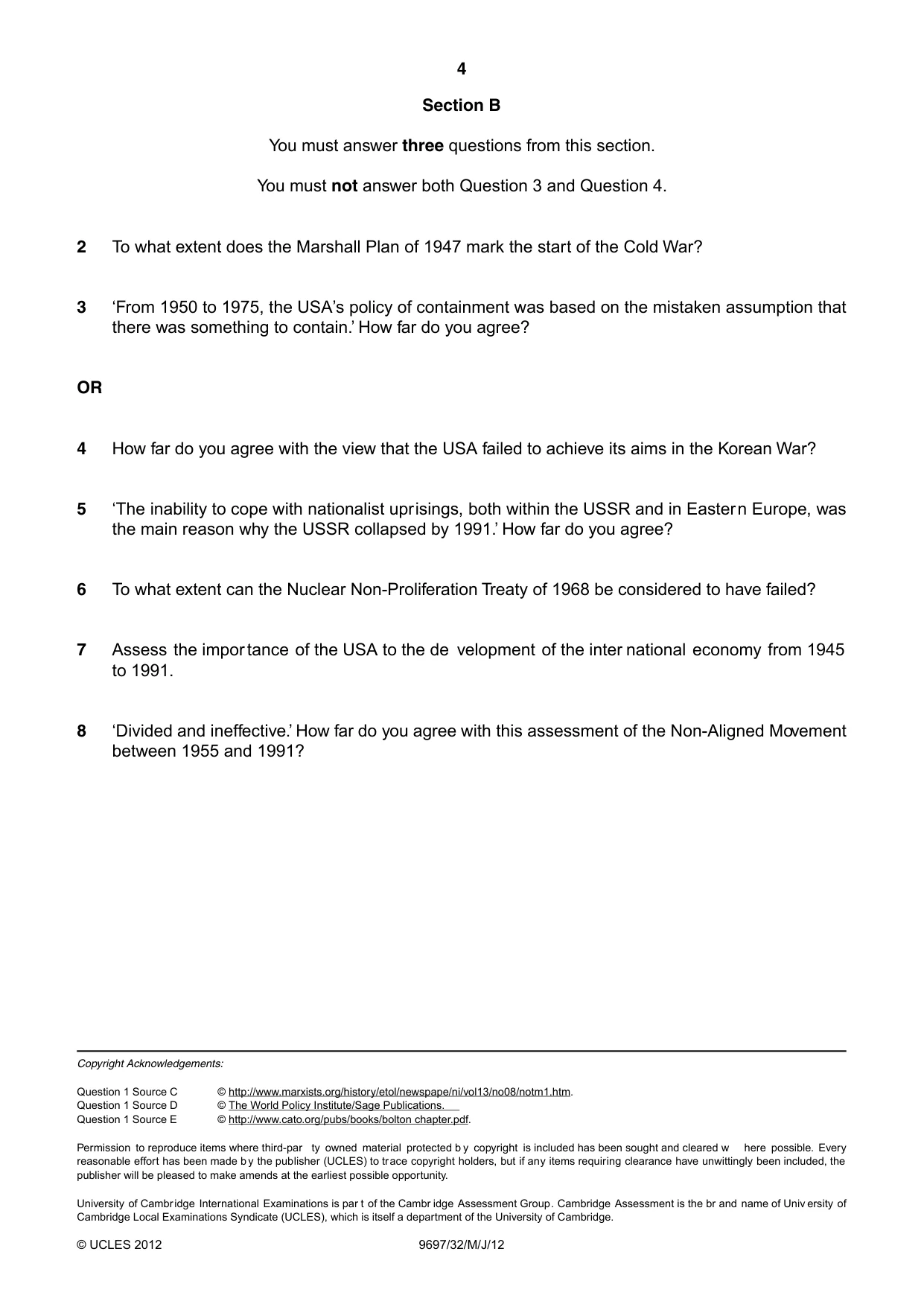
4 9697/32/M/J/12 © UCLES 2012 Section B You must answer three questions from this section. You must not answer both Question 3 and Question 4. 2 To what extent does the Marshall Plan of 1947 mark the start of the Cold War? 3 ‘From 1950 to 1975, the USA’s policy of containment was based on the mistaken assumption that there was something to contain.’ How far do you agree? OR 4 How far do you agree with the view that the USA failed to achieve its aims in the Korean War? 5 ‘The inability to cope with nationalist uprisings, both within the USSR and in Eastern Europe, was the main reason why the USSR collapsed by 1991.’ How far do you agree? 6 To what extent can the Nuclear Non-Proliferation Treaty of 1968 be considered to have failed? 7 Assess the importance of the USA to the de velopment of the inter national economy from 1945 to 1991. 8 ‘Divided and ineffective.’ How far do you agree with this assessment of the Non-Aligned Movement between 1955 and 1991? Copyright Acknowledgements: Question 1 Source C © http://www.marxists.org/history/etol/newspape/ni/vol13/no08/notm1.htm. Question 1 Source D © The World Policy Institute/Sage Publications. Question 1 Source E © http://www.cato.org/pubs/books/bolton chapter.pdf. Permission to reproduce items where third-par ty owned material protected b y copyright is included has been sought and cleared w here possible. Every reasonable effort has been made b y the publisher (UCLES) to trace copyright holders, but if any items requiring clearance have unwittingly been included, the publisher will be pleased to make amends at the earliest possible opportunity. University of Cambridge International Examinations is par t of the Cambr idge Assessment Group. Cambridge Assessment is the br and name of Univ ersity of Cambridge Local Examinations Syndicate (UCLES), which is itself a department of the University of Cambridge.
Mark scheme, page 1
UNIVERSITY OF CAMBRIDGE INTERNATIONAL EXAMINATIONS GCE Advanced Subsidiary Level and GCE Advanced Level MARK SCHEME for the May/June 2012 question paper for the guidance of teachers 9697 HISTORY 9697/32 Paper 3, maximum raw mark 100 This mark scheme is published as an aid to teachers and candidates, to indicate the requirements of the examination. It shows the basis on which Examiners were instructed to award marks. It does not indicate the details of the discussions that took place at an Examiners’ meeting before marking began, which would have considered the acceptability of alternative answers. Mark schemes must be read in conjunction with the question papers and the report on the examination. • Cambridge will not enter into discussions or correspondence in connection with these mark schemes. Cambridge is publishing the mark schemes for the May/June 2012 question papers for most IGCSE, GCE Advanced Level and Advanced Subsidiary Level syllabuses and some Ordinary Level syllabuses.
Mark scheme, page 2
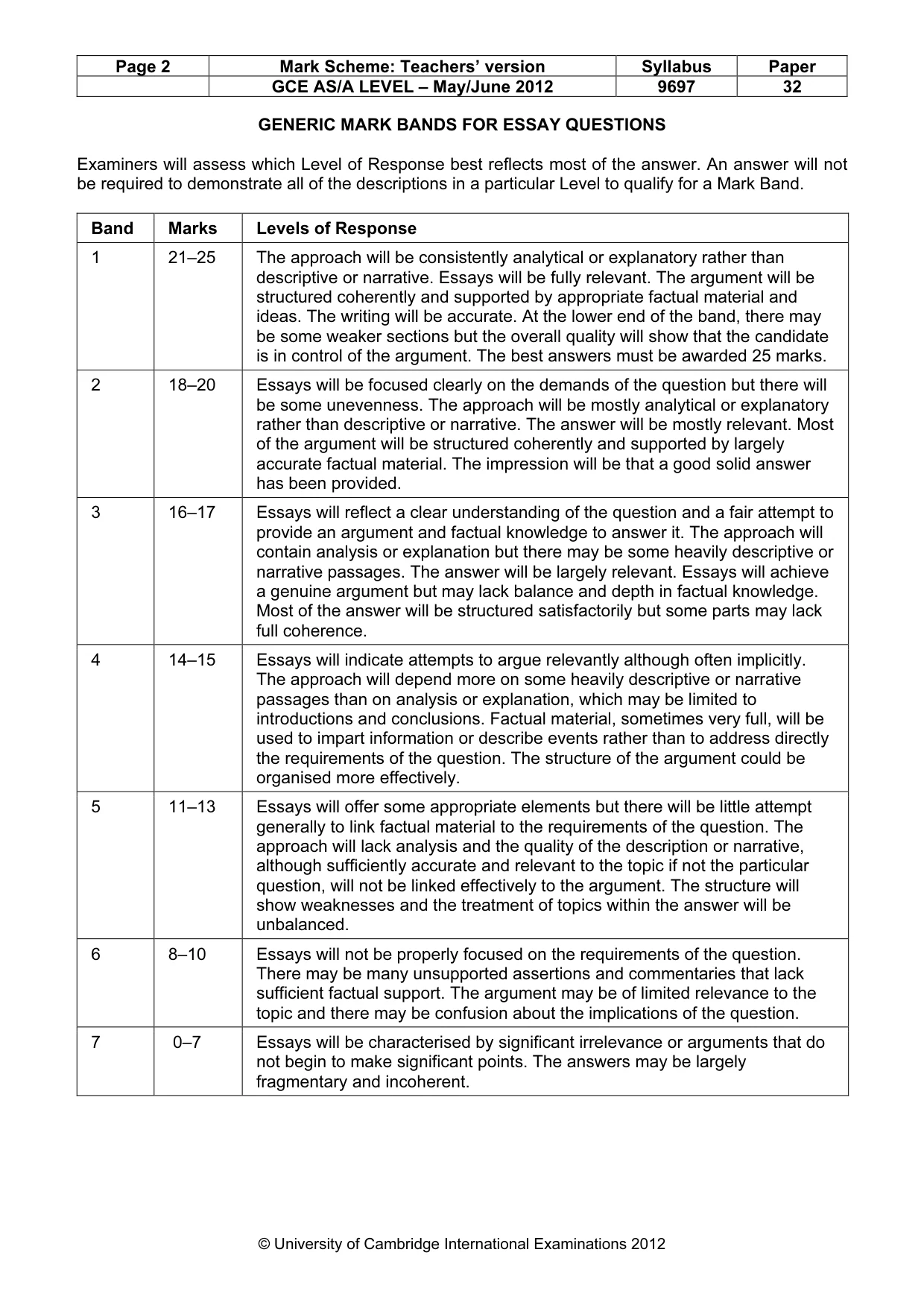
Page 2 Mark Scheme: Teachers’ version Syllabus Paper GCE AS/A LEVEL – May/June 2012 9697 32 © University of Cambridge International Examinations 2012 GENERIC MARK BANDS FOR ESSAY QUESTIONS Examiners will assess which Level of Response best reflects most of the answer. An answer will not be required to demonstrate all of the descriptions in a particular Level to qualify for a Mark Band. Band Marks Levels of Response 1 21–25 The approach will be consistently analytical or explanatory rather than descriptive or narrative. Essays will be fully relevant. The argument will be structured coherently and supported by appropriate factual material and ideas. The writing will be accurate. At the lower end of the band, there may be some weaker sections but the overall quality will show that the candidate is in control of the argument. The best answers must be awarded 25 marks. 2 18–20 Essays will be focused clearly on the demands of the question but there will be some unevenness. The approach will be mostly analytical or explanatory rather than descriptive or narrative. The answer will be mostly relevant. Most of the argument will be structured coherently and supported by largely accurate factual material. The impression will be that a good solid answer has been provided. 3 16–17 Essays will reflect a clear understanding of the question and a fair attempt to provide an argument and factual knowledge to answer it. The approach will contain analysis or explanation but there may be some heavily descriptive or narrative passages. The answer will be largely relevant. Essays will achieve a genuine argument but may lack balance and depth in factual knowledge. Most of the answer will be structured satisfactorily but some parts may lack full coherence. 4 14–15 Essays will indicate attempts to argue relevantly although often implicitly. The approach will depend more on some heavily descriptive or narrative passages than on analysis or explanation, which may be limited to introductions and conclusions. Factual material, sometimes very full, will be used to impart information or describe events rather than to address directly the requirements of the question. The structure of the argument could be organised more effectively. 5 11–13 Essays will offer some appropriate elements but there will be little attempt generally to link factual material to the requirements of the question. The approach will lack analysis and the quality of the description or narrative, although sufficiently accurate and relevant to the topic if not the particular question, will not be linked effectively to the argument. The structure will show weaknesses and the treatment of topics within the answer will be unbalanced. 6 8–10 Essays will not be properly focused on the requirements of the question. There may be many unsupported assertions and commentaries that lack sufficient factual support. The argument may be of limited relevance to the topic and there may be confusion about the implications of the question. 7 0–7 Essays will be characterised by significant irrelevance or arguments that do not begin to make significant points. The answers may be largely fragmentary and incoherent.
Mark scheme, page 3
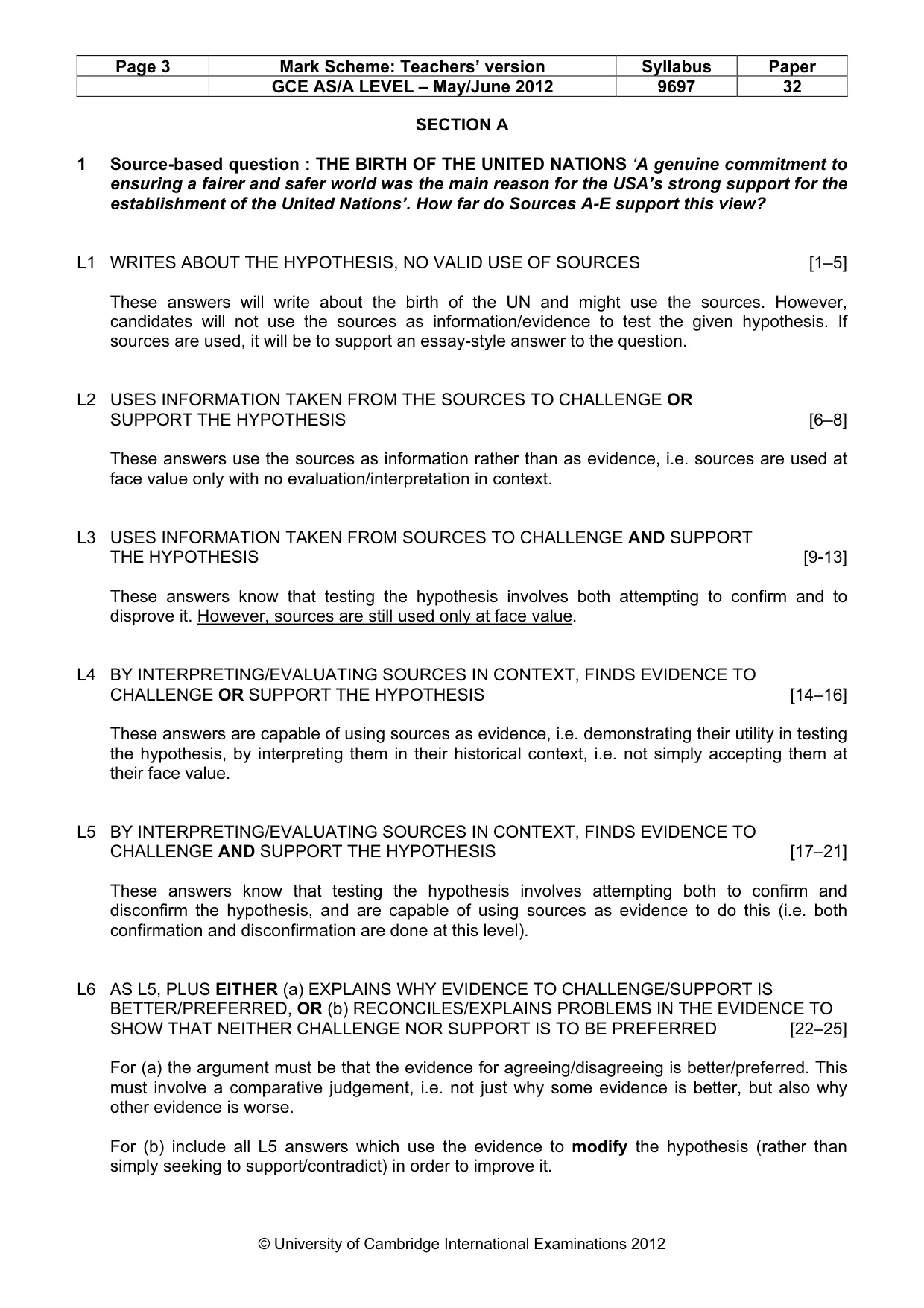
Page 3 Mark Scheme: Teachers’ version Syllabus Paper GCE AS/A LEVEL – May/June 2012 9697 32 © University of Cambridge International Examinations 2012 SECTION A 1 Source-based question : THE BIRTH OF THE UNITED NATIONS ‘A genuine commitment to ensuring a fairer and safer world was the main reason for the USA’s strong support for the establishment of the United Nations’. How far do Sources A-E support this view? L1 WRITES ABOUT THE HYPOTHESIS, NO VALID USE OF SOURCES [1–5] These answers will write about the birth of the UN and might use the sources. However, candidates will not use the sources as information/evidence to test the given hypothesis. If sources are used, it will be to support an essay-style answer to the question. L2 USES INFORMATION TAKEN FROM THE SOURCES TO CHALLENGE OR SUPPORT THE HYPOTHESIS [6–8] These answers use the sources as information rather than as evidence, i.e. sources are used at face value only with no evaluation/interpretation in context. L3 USES INFORMATION TAKEN FROM SOURCES TO CHALLENGE AND SUPPORT THE HYPOTHESIS [9-13] These answers know that testing the hypothesis involves both attempting to confirm and to disprove it. However, sources are still used only at face value. L4 BY INTERPRETING/EVALUATING SOURCES IN CONTEXT, FINDS EVIDENCE TO CHALLENGE OR SUPPORT THE HYPOTHESIS [14–16] These answers are capable of using sources as evidence, i.e. demonstrating their utility in testing the hypothesis, by interpreting them in their historical context, i.e. not simply accepting them at their face value. L5 BY INTERPRETING/EVALUATING SOURCES IN CONTEXT, FINDS EVIDENCE TO CHALLENGE AND SUPPORT THE HYPOTHESIS [17–21] These answers know that testing the hypothesis involves attempting both to confirm and disconfirm the hypothesis, and are capable of using sources as evidence to do this (i.e. both confirmation and disconfirmation are done at this level). L6 AS L5, PLUS EITHER (a) EXPLAINS WHY EVIDENCE TO CHALLENGE/SUPPORT IS BETTER/PREFERRED, OR (b) RECONCILES/EXPLAINS PROBLEMS IN THE EVIDENCE TO SHOW THAT NEITHER CHALLENGE NOR SUPPORT IS TO BE PREFERRED [22–25] For (a) the argument must be that the evidence for agreeing/disagreeing is better/preferred. This must involve a comparative judgement, i.e. not just why some evidence is better, but also why other evidence is worse. For (b) include all L5 answers which use the evidence to modify the hypothesis (rather than simply seeking to support/contradict) in order to improve it.
Mark scheme, page 4
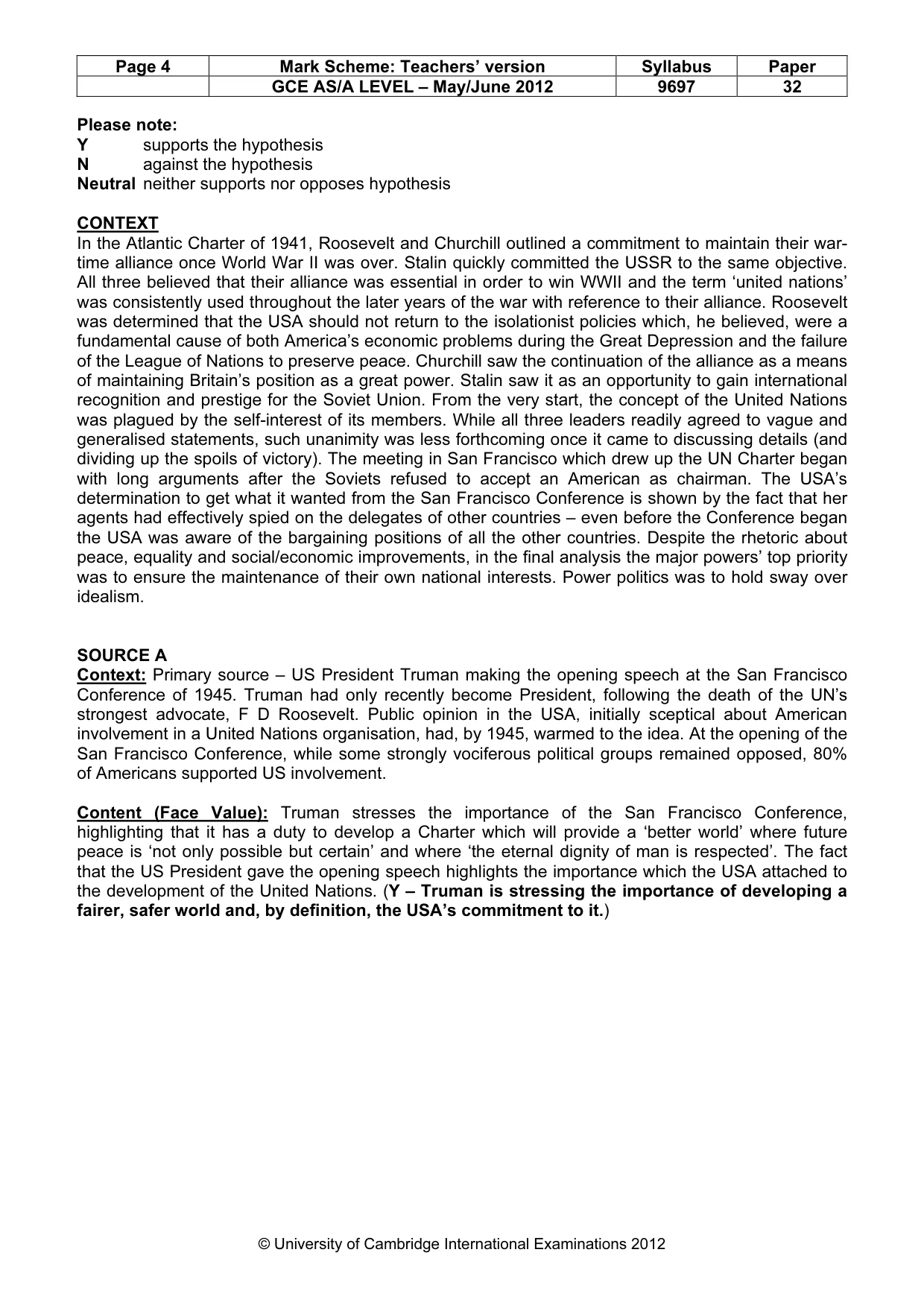
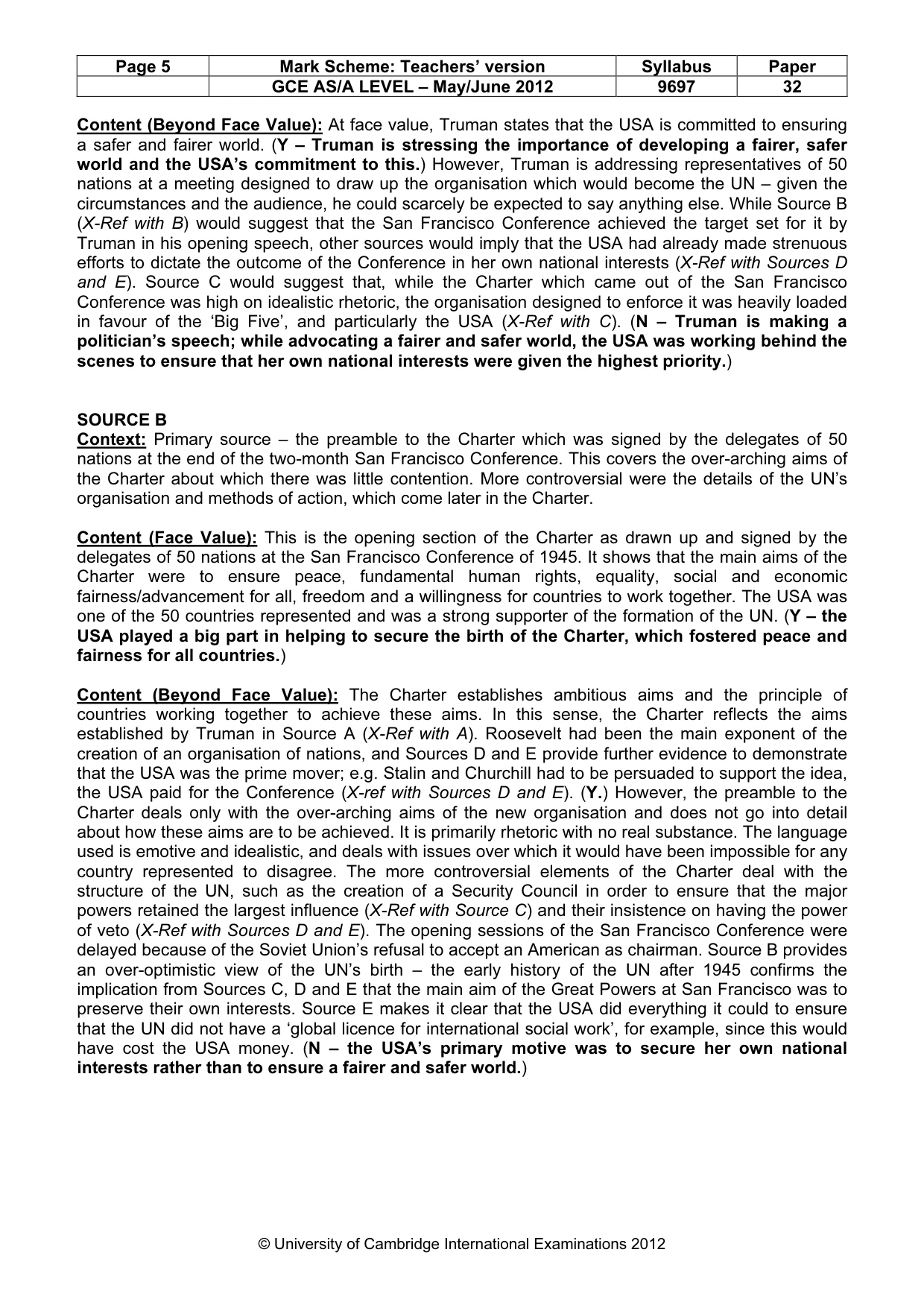
Page 4 Mark Scheme: Teachers’ version Syllabus Paper GCE AS/A LEVEL – May/June 2012 9697 32 © University of Cambridge International Examinations 2012 Please note: Y supports the hypothesis N against the hypothesis Neutral neither supports nor opposes hypothesis CONTEXT In the Atlantic Charter of 1941, Roosevelt and Churchill outlined a commitment to maintain their war- time alliance once World War II was over. Stalin quickly committed the USSR to the same objective. All three believed that their alliance was essential in order to win WWII and the term ‘united nations’ was consistently used throughout the later years of the war with reference to their alliance. Roosevelt was determined that the USA should not return to the isolationist policies which, he believed, were a fundamental cause of both America’s economic problems during the Great Depression and the failure of the League of Nations to preserve peace. Churchill saw the continuation of the alliance as a means of maintaining Britain’s position as a great power. Stalin saw it as an opportunity to gain international recognition and prestige for the Soviet Union. From the very start, the concept of the United Nations was plagued by the self-interest of its members. While all three leaders readily agreed to vague and generalised statements, such unanimity was less forthcoming once it came to discussing details (and dividing up the spoils of victory). The meeting in San Francisco which drew up the UN Charter began with long arguments after the Soviets refused to accept an American as chairman. The USA’s determination to get what it wanted from the San Francisco Conference is shown by the fact that her agents had effectively spied on the delegates of other countries – even before the Conference began the USA was aware of the bargaining positions of all the other countries. Despite the rhetoric about peace, equality and social/economic improvements, in the final analysis the major powers’ top priority was to ensure the maintenance of their own national interests. Power politics was to hold sway over idealism. SOURCE A Context: Primary source – US President Truman making the opening speech at the San Francisco Conference of 1945. Truman had only recently become President, following the death of the UN’s strongest advocate, F D Roosevelt. Public opinion in the USA, initially sceptical about American involvement in a United Nations organisation, had, by 1945, warmed to the idea. At the opening of the San Francisco Conference, while some strongly vociferous political groups remained opposed, 80% of Americans supported US involvement. Content (Face Value): Truman stresses the importance of the San Francisco Conference, highlighting that it has a duty to develop a Charter which will provide a ‘better world’ where future peace is ‘not only possible but certain’ and where ‘the eternal dignity of man is respected’. The fact that the US President gave the opening speech highlights the importance which the USA attached to the development of the United Nations. (Y – Truman is stressing the importance of developing a fairer, safer world and, by definition, the USA’s commitment to it.)
Mark scheme, page 5
Page 5 Mark Scheme: Teachers’ version Syllabus Paper GCE AS/A LEVEL – May/June 2012 9697 32 © University of Cambridge International Examinations 2012 Content (Beyond Face Value): At face value, Truman states that the USA is committed to ensuring a safer and fairer world. (Y – Truman is stressing the importance of developing a fairer, safer world and the USA’s commitment to this.) However, Truman is addressing representatives of 50 nations at a meeting designed to draw up the organisation which would become the UN – given the circumstances and the audience, he could scarcely be expected to say anything else. While Source B (X-Ref with B) would suggest that the San Francisco Conference achieved the target set for it by Truman in his opening speech, other sources would imply that the USA had already made strenuous efforts to dictate the outcome of the Conference in her own national interests (X-Ref with Sources D and E). Source C would suggest that, while the Charter which came out of the San Francisco Conference was high on idealistic rhetoric, the organisation designed to enforce it was heavily loaded in favour of the ‘Big Five’, and particularly the USA (X-Ref with C). (N – Truman is making a politician’s speech; while advocating a fairer and safer world, the USA was working behind the scenes to ensure that her own national interests were given the highest priority.) SOURCE B Context: Primary source – the preamble to the Charter which was signed by the delegates of 50 nations at the end of the two-month San Francisco Conference. This covers the over-arching aims of the Charter about which there was little contention. More controversial were the details of the UN’s organisation and methods of action, which come later in the Charter. Content (Face Value): This is the opening section of the Charter as drawn up and signed by the delegates of 50 nations at the San Francisco Conference of 1945. It shows that the main aims of the Charter were to ensure peace, fundamental human rights, equality, social and economic fairness/advancement for all, freedom and a willingness for countries to work together. The USA was one of the 50 countries represented and was a strong supporter of the formation of the UN. (Y – the USA played a big part in helping to secure the birth of the Charter, which fostered peace and fairness for all countries.) Content (Beyond Face Value): The Charter establishes ambitious aims and the principle of countries working together to achieve these aims. In this sense, the Charter reflects the aims established by Truman in Source A (X-Ref with A). Roosevelt had been the main exponent of the creation of an organisation of nations, and Sources D and E provide further evidence to demonstrate that the USA was the prime mover; e.g. Stalin and Churchill had to be persuaded to support the idea, the USA paid for the Conference (X-ref with Sources D and E). (Y.) However, the preamble to the Charter deals only with the over-arching aims of the new organisation and does not go into detail about how these aims are to be achieved. It is primarily rhetoric with no real substance. The language used is emotive and idealistic, and deals with issues over which it would have been impossible for any country represented to disagree. The more controversial elements of the Charter deal with the structure of the UN, such as the creation of a Security Council in order to ensure that the major powers retained the largest influence (X-Ref with Source C) and their insistence on having the power of veto (X-Ref with Sources D and E). The opening sessions of the San Francisco Conference were delayed because of the Soviet Union’s refusal to accept an American as chairman. Source B provides an over-optimistic view of the UN’s birth – the early history of the UN after 1945 confirms the implication from Sources C, D and E that the main aim of the Great Powers at San Francisco was to preserve their own interests. Source E makes it clear that the USA did everything it could to ensure that the UN did not have a ‘global licence for international social work’, for example, since this would have cost the USA money. (N – the USA’s primary motive was to secure her own national interests rather than to ensure a fairer and safer world.)
Mark scheme, page 6
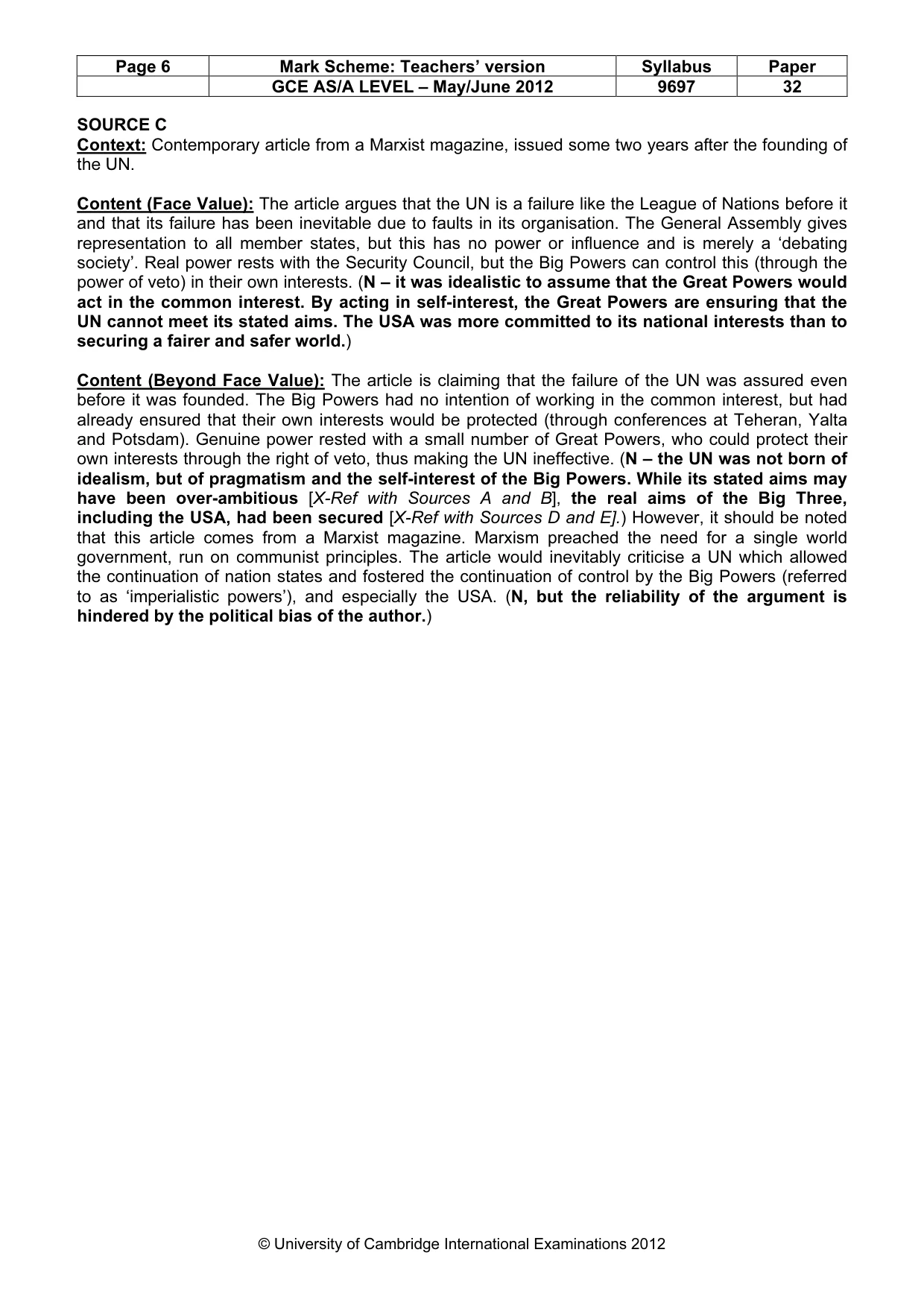
Page 6 Mark Scheme: Teachers’ version Syllabus Paper GCE AS/A LEVEL – May/June 2012 9697 32 © University of Cambridge International Examinations 2012 SOURCE C Context: Contemporary article from a Marxist magazine, issued some two years after the founding of the UN. Content (Face Value): The article argues that the UN is a failure like the League of Nations before it and that its failure has been inevitable due to faults in its organisation. The General Assembly gives representation to all member states, but this has no power or influence and is merely a ‘debating society’. Real power rests with the Security Council, but the Big Powers can control this (through the power of veto) in their own interests. (N – it was idealistic to assume that the Great Powers would act in the common interest. By acting in self-interest, the Great Powers are ensuring that the UN cannot meet its stated aims. The USA was more committed to its national interests than to securing a fairer and safer world.) Content (Beyond Face Value): The article is claiming that the failure of the UN was assured even before it was founded. The Big Powers had no intention of working in the common interest, but had already ensured that their own interests would be protected (through conferences at Teheran, Yalta and Potsdam). Genuine power rested with a small number of Great Powers, who could protect their own interests through the right of veto, thus making the UN ineffective. (N – the UN was not born of idealism, but of pragmatism and the self-interest of the Big Powers. While its stated aims may have been over-ambitious [X-Ref with Sources A and B], the real aims of the Big Three, including the USA, had been secured [X-Ref with Sources D and E].) However, it should be noted that this article comes from a Marxist magazine. Marxism preached the need for a single world government, run on communist principles. The article would inevitably criticise a UN which allowed the continuation of nation states and fostered the continuation of control by the Big Powers (referred to as ‘imperialistic powers’), and especially the USA. (N, but the reliability of the argument is hindered by the political bias of the author.)
Mark scheme, page 7
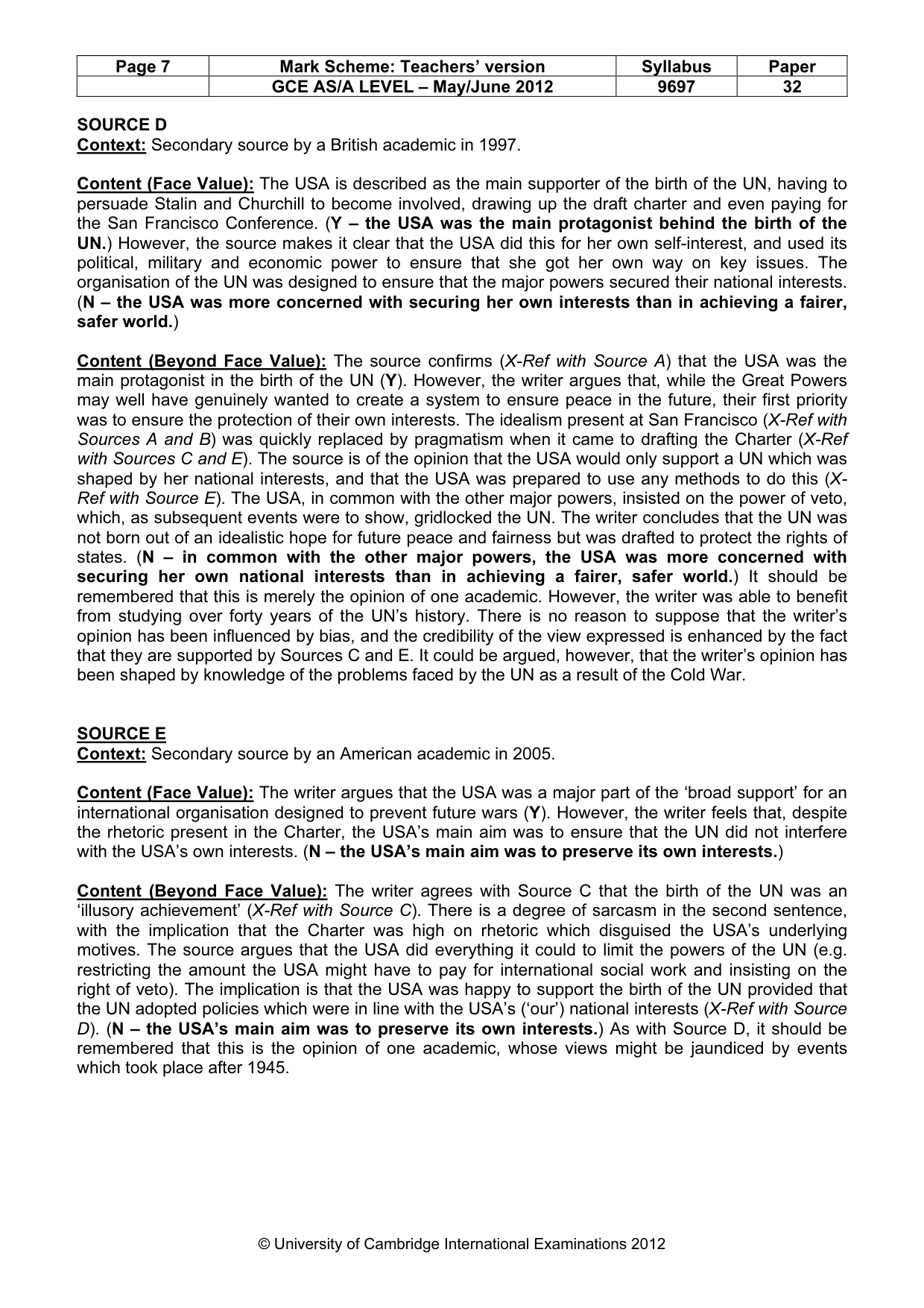
Page 7 Mark Scheme: Teachers’ version Syllabus Paper GCE AS/A LEVEL – May/June 2012 9697 32 © University of Cambridge International Examinations 2012 SOURCE D Context: Secondary source by a British academic in 1997. Content (Face Value): The USA is described as the main supporter of the birth of the UN, having to persuade Stalin and Churchill to become involved, drawing up the draft charter and even paying for the San Francisco Conference. (Y – the USA was the main protagonist behind the birth of the UN.) However, the source makes it clear that the USA did this for her own self-interest, and used its political, military and economic power to ensure that she got her own way on key issues. The organisation of the UN was designed to ensure that the major powers secured their national interests. (N – the USA was more concerned with securing her own interests than in achieving a fairer, safer world.) Content (Beyond Face Value): The source confirms (X-Ref with Source A) that the USA was the main protagonist in the birth of the UN (Y). However, the writer argues that, while the Great Powers may well have genuinely wanted to create a system to ensure peace in the future, their first priority was to ensure the protection of their own interests. The idealism present at San Francisco (X-Ref with Sources A and B) was quickly replaced by pragmatism when it came to drafting the Charter (X-Ref with Sources C and E). The source is of the opinion that the USA would only support a UN which was shaped by her national interests, and that the USA was prepared to use any methods to do this (X- Ref with Source E). The USA, in common with the other major powers, insisted on the power of veto, which, as subsequent events were to show, gridlocked the UN. The writer concludes that the UN was not born out of an idealistic hope for future peace and fairness but was drafted to protect the rights of states. (N – in common with the other major powers, the USA was more concerned with securing her own national interests than in achieving a fairer, safer world.) It should be remembered that this is merely the opinion of one academic. However, the writer was able to benefit from studying over forty years of the UN’s history. There is no reason to suppose that the writer’s opinion has been influenced by bias, and the credibility of the view expressed is enhanced by the fact that they are supported by Sources C and E. It could be argued, however, that the writer’s opinion has been shaped by knowledge of the problems faced by the UN as a result of the Cold War. SOURCE E Context: Secondary source by an American academic in 2005. Content (Face Value): The writer argues that the USA was a major part of the ‘broad support’ for an international organisation designed to prevent future wars (Y). However, the writer feels that, despite the rhetoric present in the Charter, the USA’s main aim was to ensure that the UN did not interfere with the USA’s own interests. (N – the USA’s main aim was to preserve its own interests.) Content (Beyond Face Value): The writer agrees with Source C that the birth of the UN was an ‘illusory achievement’ (X-Ref with Source C). There is a degree of sarcasm in the second sentence, with the implication that the Charter was high on rhetoric which disguised the USA’s underlying motives. The source argues that the USA did everything it could to limit the powers of the UN (e.g. restricting the amount the USA might have to pay for international social work and insisting on the right of veto). The implication is that the USA was happy to support the birth of the UN provided that the UN adopted policies which were in line with the USA’s (‘our’) national interests (X-Ref with Source D). (N – the USA’s main aim was to preserve its own interests.) As with Source D, it should be remembered that this is the opinion of one academic, whose views might be jaundiced by events which took place after 1945.
Mark scheme, page 8
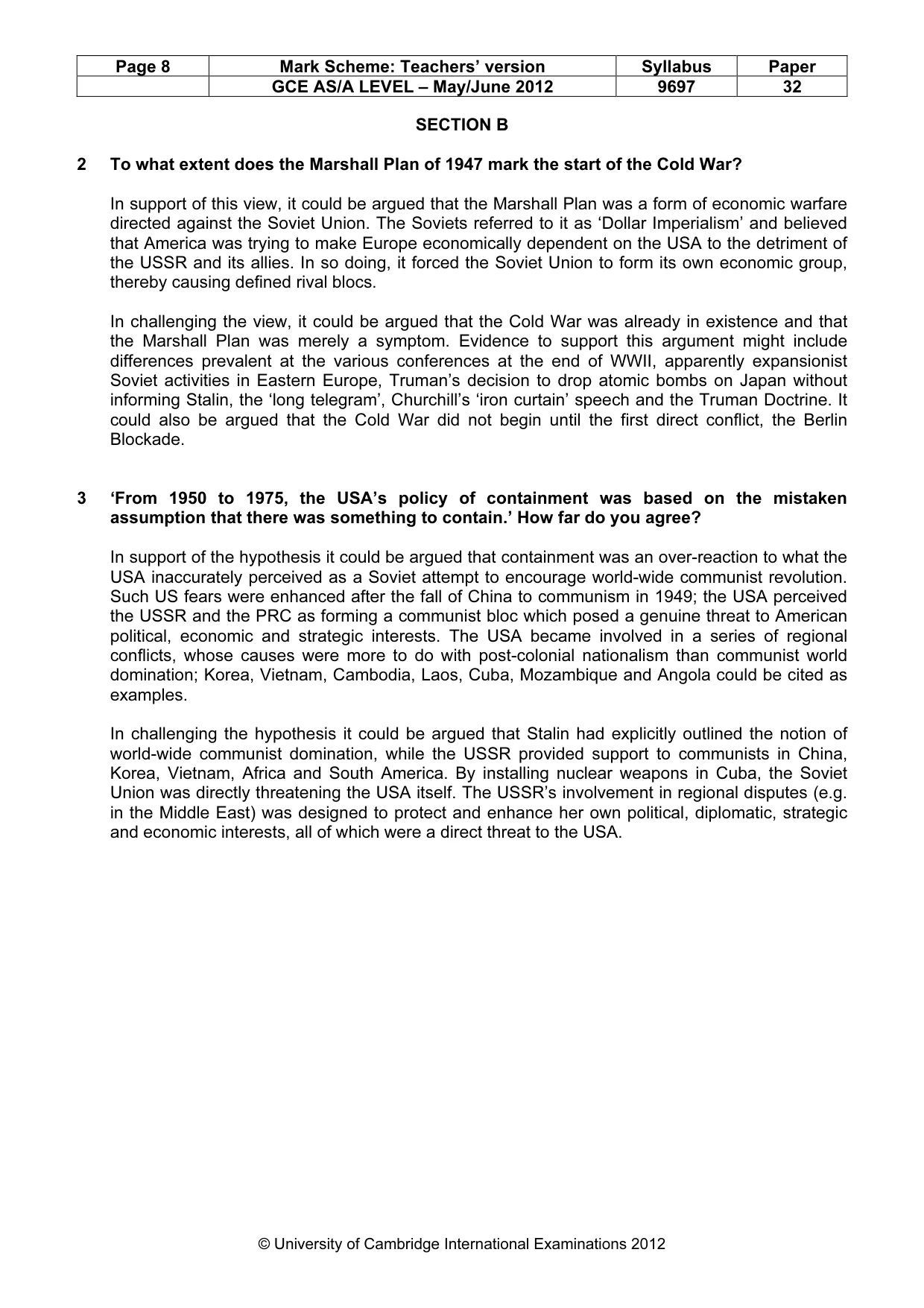
Page 8 Mark Scheme: Teachers’ version Syllabus Paper GCE AS/A LEVEL – May/June 2012 9697 32 © University of Cambridge International Examinations 2012 SECTION B 2 To what extent does the Marshall Plan of 1947 mark the start of the Cold War? In support of this view, it could be argued that the Marshall Plan was a form of economic warfare directed against the Soviet Union. The Soviets referred to it as ‘Dollar Imperialism’ and believed that America was trying to make Europe economically dependent on the USA to the detriment of the USSR and its allies. In so doing, it forced the Soviet Union to form its own economic group, thereby causing defined rival blocs. In challenging the view, it could be argued that the Cold War was already in existence and that the Marshall Plan was merely a symptom. Evidence to support this argument might include differences prevalent at the various conferences at the end of WWII, apparently expansionist Soviet activities in Eastern Europe, Truman’s decision to drop atomic bombs on Japan without informing Stalin, the ‘long telegram’, Churchill’s ‘iron curtain’ speech and the Truman Doctrine. It could also be argued that the Cold War did not begin until the first direct conflict, the Berlin Blockade. 3 ‘From 1950 to 1975, the USA’s policy of containment was based on the mistaken assumption that there was something to contain.’ How far do you agree? In support of the hypothesis it could be argued that containment was an over-reaction to what the USA inaccurately perceived as a Soviet attempt to encourage world-wide communist revolution. Such US fears were enhanced after the fall of China to communism in 1949; the USA perceived the USSR and the PRC as forming a communist bloc which posed a genuine threat to American political, economic and strategic interests. The USA became involved in a series of regional conflicts, whose causes were more to do with post-colonial nationalism than communist world domination; Korea, Vietnam, Cambodia, Laos, Cuba, Mozambique and Angola could be cited as examples. In challenging the hypothesis it could be argued that Stalin had explicitly outlined the notion of world-wide communist domination, while the USSR provided support to communists in China, Korea, Vietnam, Africa and South America. By installing nuclear weapons in Cuba, the Soviet Union was directly threatening the USA itself. The USSR’s involvement in regional disputes (e.g. in the Middle East) was designed to protect and enhance her own political, diplomatic, strategic and economic interests, all of which were a direct threat to the USA.
Mark scheme, page 9
Page 9 Mark Scheme: Teachers’ version Syllabus Paper GCE AS/A LEVEL – May/June 2012 9697 32 © University of Cambridge International Examinations 2012 4 How far do you agree with the view that the USA failed to achieve its aims in the Korean War? In support of the hypothesis it could be argued that 36,940 Americans lost their lives in a three- year war which effectively ended in a stalemate, with Korea still divided along the 38th parallel. Attempts to defeat North Korea by roll-back tactics failed and served to antagonise the Chinese (making the use of nuclear weapons effectively impossible). Given that Korea was not in Acheson’s original defensive perimeter, it could be argued that US involvement in Korea achieved nothing. In challenging the hypothesis it could be argued that the American policy of containment was successfully implemented. Invading North Korean forces were driven out of South Korea, which was successfully ‘saved’ from communism. Convinced that the USSR was behind the North Korean attack, Truman was determined not to repeat the error of appeasing Hitler, and domestic anti-communist public pressure, exacerbated by the fall of China to communism, meant that it was politically expedient for the USA to become involved. Moreover, the USA was able to elicit the support of the UN. It could be argued that the USA’s original intention of using containment to prevent South Korea falling into communist hands had been successful. 5 ‘The inability to cope with nationalist uprisings, both within the USSR and in Eastern Europe, was the main reason why the USSR collapsed by 1991.’ How far do you agree? In support of the hypothesis it could be argued that changes occurred rapidly in Eastern Europe following the success of Solidarity in Poland in 1988. Communist governments were quickly removed in Hungary, East Germany, Czechoslovakia, Bulgaria and Romania. Nationalist uprisings soon followed within the Soviet Union itself (e.g. Nagarno-Karabatch, Lithuania, Latvia, Estonia). Such uprisings caused an enormous and unsustainable strain on limited Soviet resources. In challenging the hypothesis it could be argued that such nationalist uprisings were a symptom rather than a cause of the collapse of the USSR. Gorbachev’s abandonment of the Brezhnev Doctrine meant that uprisings went unchallenged. Meanwhile his glasnost and perestroika reforms failed to solve the massive economic and political problems facing the USSR. Other factors, such as the war in Afghanistan, the enormous financial burden imposed by sustaining the nuclear arms race, political atrophy and pressures imposed by the USA (e.g. SDI) added to the insurmountable problems facing the USSR. Arguably, it was because of these factors that nationalism and anti-communist sentiment developed within the Soviet Union and the states it controlled.
Mark scheme, page 10
Page 10 Mark Scheme: Teachers’ version Syllabus Paper GCE AS/A LEVEL – May/June 2012 9697 32 © University of Cambridge International Examinations 2012 6 To what extent can the Nuclear Non-Proliferation Treaty of 1968 be considered to have failed? It is first necessary to establish ‘success criteria’ – in this case, the fairest criteria would appear to be the original aims and terms of the Treaty itself. In support of the view that the Treaty failed it could be argued that some countries refused to sign (e.g. India, Pakistan, Israel), others have subsequently withdrawn (e.g. North Korea), while others have been found in non-compliance (e.g. Iran, Libya). Verification of compliance by the International Atomic Energy Agency has been largely ineffective. The USA has been accused of breaking the ethos, if not the terms, of the Treaty (e.g. by deploying nuclear weapons in non- nuclear NATO states such as Belgium). The Non-Aligned Movement has stated that non- proliferation cannot be sustained without ‘tangible progress in disarmament’, of which there was precious little before 1991. Nasser argued that ‘basically they did whatever they wanted to do before the NPT and then devised it to prevent others from doing what they themselves have been doing before’. In challenging the view that the Treaty failed it could be argued that, despite the original intention that the NPT should last for 25 years, it is still in force and the number of states with nuclear weapons remains relatively small (China and France added in 1992). Only four recognised states are not party to the NPT. Several NPT signatories have given up nuclear weapon programmes (e.g. South Africa). Several former Soviet Republics destroyed or transferred nuclear weapons to Russia on the demise of the USSR. Much of the criticism of the NPT centres on the fact that nuclear weapons continued to exist in abundance; this is unfair, since the major aim of the Treaty was to limit the proliferation of nuclear weapons. 7 Assess the importance of the USA to the development of the international economy from 1945 to 1991. There is little doubt that the USA played a crucial and dominant role in the international economy in the period from 1945 to 1970. This is evidenced by Marshall Aid, American assistance to Japan, the importance of the US dollar, Bretton-Woods and the USA’s key role in GATT, the World Bank and the IMF. It could be argued that the USA’s importance to the international economy began to decline after 1970. A number of factors led to a downturn in the American economy – e.g. high costs of defence and the Vietnam War, budget deficits from the later 1960s, effects of the oil crises and falling value of the dollar. The collapse of the Bretton-Woods system, the recovery of Japan and West Germany, the development of the EEC and the rise of the Asian Tigers could all be seen as symptomatic of the fact that the international economy was no longer dependent on that of the USA. Nevertheless, fluctuations in the American economy continued to have major knock-on effects in the international economy. This would suggest that the USA remained of vital importance to the international economy up to 1991, even if she were no longer quite as dominant as in the period up to 1970.
Mark scheme, page 11
Page 11 Mark Scheme: Teachers’ version Syllabus Paper GCE AS/A LEVEL – May/June 2012 9697 32 © University of Cambridge International Examinations 2012 8 ‘Divided and ineffective’. How far do you agree with this assessment of the Non-Aligned Movement between 1955 and 1991? In support of the hypothesis it could be argued that, while NAM was intended to be a close alliance (such as NATO or the Warsaw Pact), it demonstrated little cohesion. Many of its members were quite closely aligned with one or other of the great powers – e.g. when the zUSSR invaded Afghanistan in 1979, members of NAM who were allies of the Soviet Union supported the invasion, while others (especially Muslim states) opposed it. Some members were involved in conflicts with other members (e.g. India and Pakistan, Iran and Iraq). NAM placed a strong emphasis on disarmament, yet had little or no impact on the arms race; indeed, both India and Pakistan are nuclear states. In challenging the hypothesis it could be argued that NAM represents 55% of the world’s population. While membership consists of many governments with very different ideologies, it has been unified by its commitment to world peace and security based on the Havana Declaration of 1979 which outlined its purpose as ensuring ‘the national independence, sovereignty, territorial integrity and security of non-aligned countries’ in their struggle against ‘imperialism, colonialism, neo-colonialism, racism and all forms of foreign aggression’. In 1983, NAM described itself as ‘history’s biggest peace movement’. NAM has consistently acted as a pressure group, and has had some success (e.g. in strongly opposing apartheid).
What you needed in this session
Cambridge’s own grade thresholds for 2012 May/June, Paper 3 · Variant 2. A higher threshold means an easier paper — the bar moves with how the cohort did.