Cambridge A Level History (pre-2015) 9697 — 2014 Oct/Nov Paper 3 · Variant 1
9697/31/O/N/14 · 100 marks · ≈113 min
The question paper and its mark scheme, free to read here and free to download. This is Cambridge’s own paper, exactly as it was sat.
Question paper4 pages
Mark scheme16 pages
Answers below. Sit the paper first if you are practising.
Paper as text
Question paper, page 1
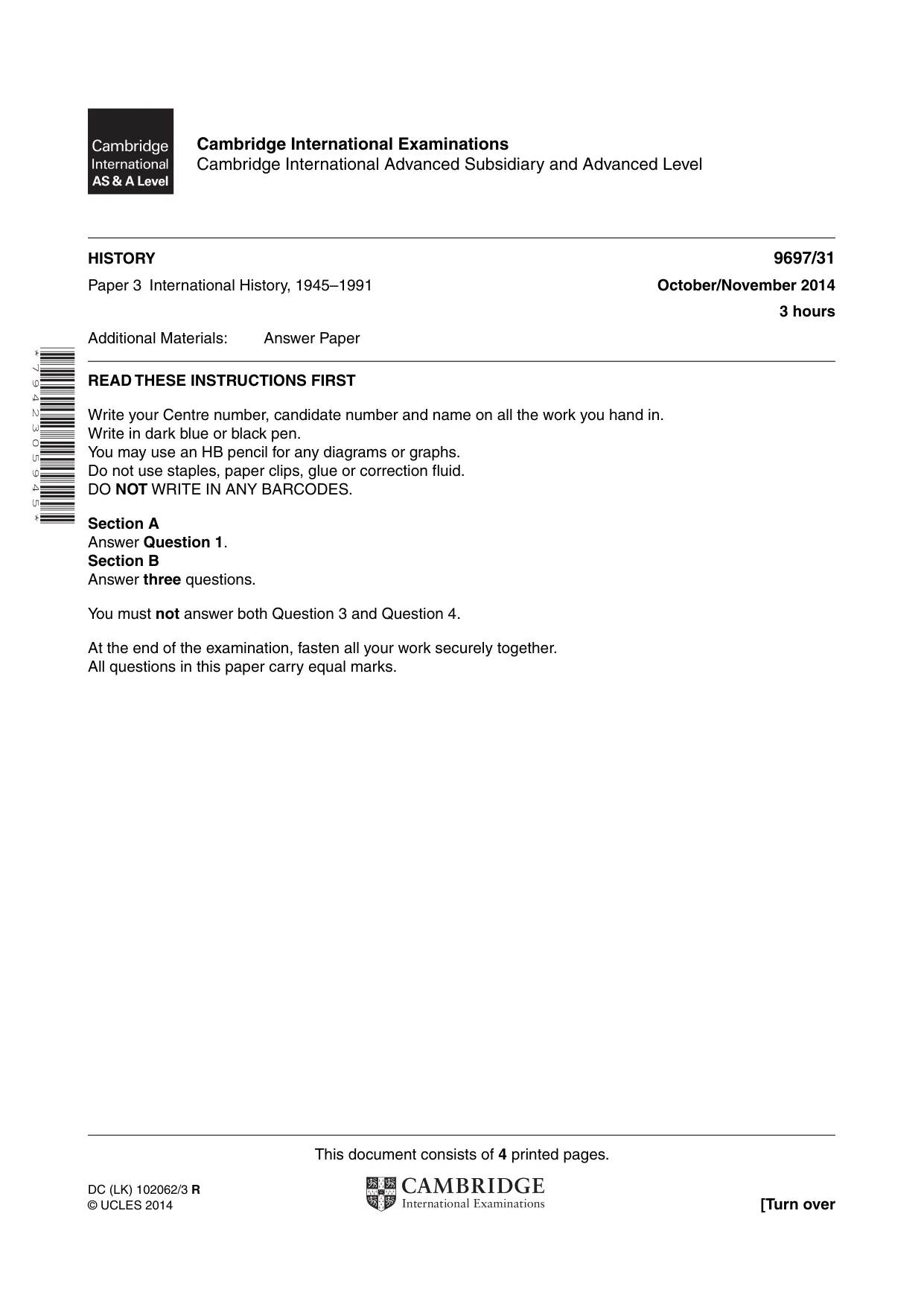
This document consists of 4 printed pages. DC (LK) 102062/3 R © UCLES 2014 [Turn over * 7 9 4 2 3 0 5 9 4 5 * HISTORY 9697/31 Paper 3 International History, 1945–1991 October/November 2014 3 hours Additional Materials: Answer Paper READ THESE INSTRUCTIONS FIRST Write your Centre number, candidate number and name on all the work you hand in. Write in dark blue or black pen. You may use an HB pencil for any diagrams or graphs. Do not use staples, paper clips, glue or correction fluid. DO NOT WRITE IN ANY BARCODES. Section A Answer Question 1. Section B Answer three questions. You must not answer both Question 3 and Question 4. At the end of the examination, fasten all your work securely together. All questions in this paper carry equal marks. Cambridge International Examinations Cambridge International Advanced Subsidiary and Advanced Level
Question paper, page 2
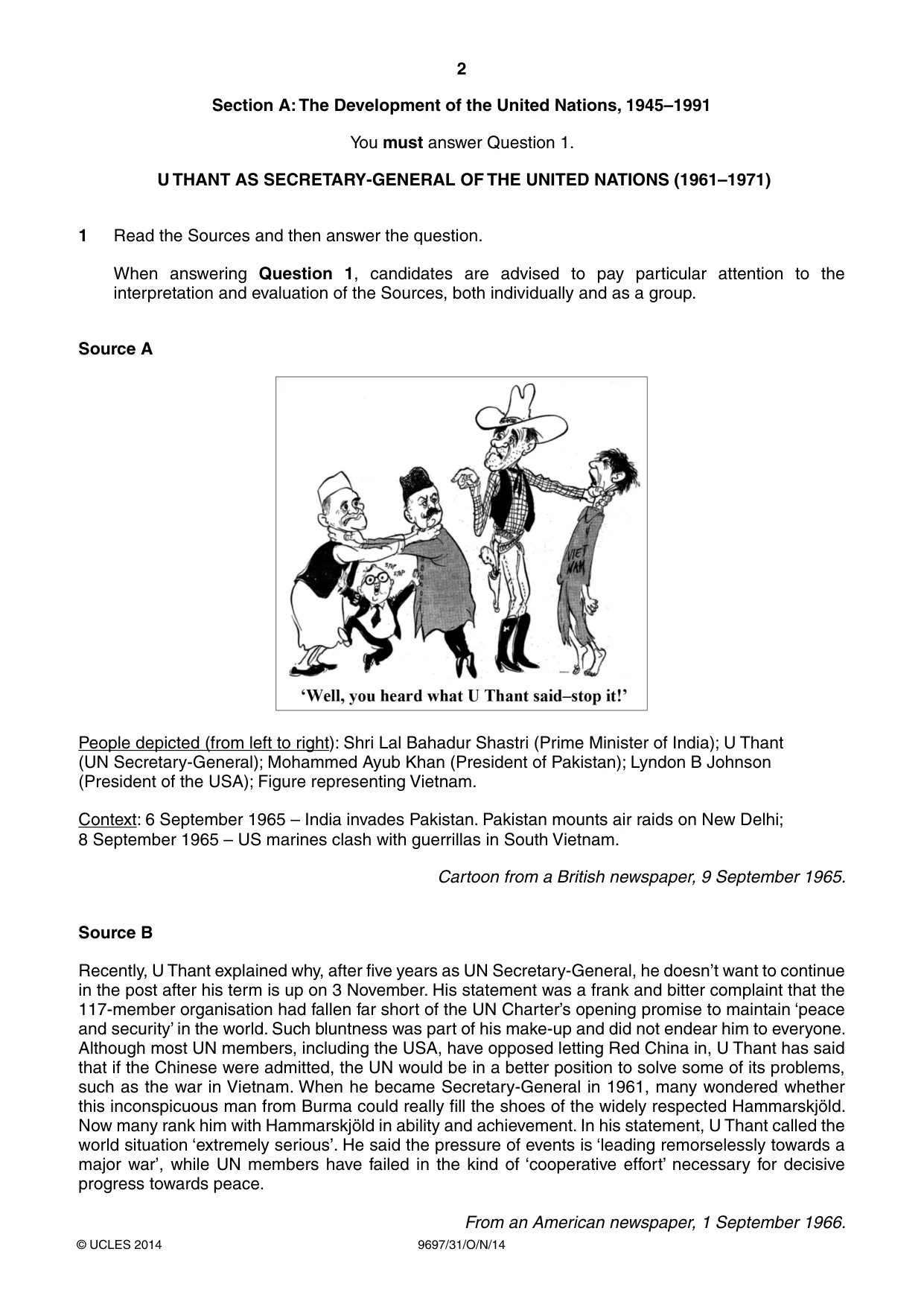
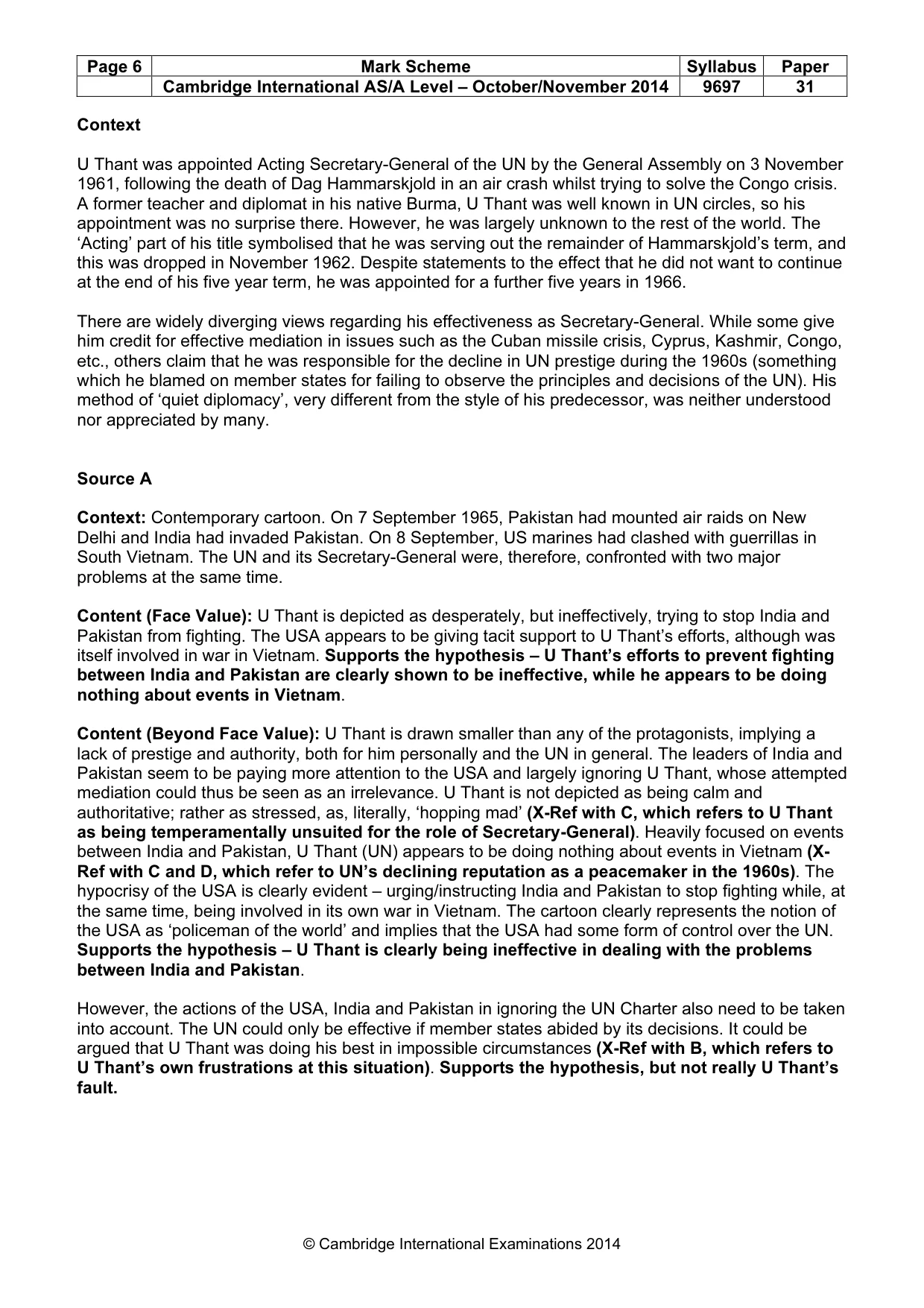
2 9697/31/O/N/14 © UCLES 2014 Section A: The Development of the United Nations, 1945–1991 You must answer Question 1. U THANT AS SECRETARY-GENERAL OF THE UNITED NATIONS (1961–1971) 1 Read the Sources and then answer the question. When answering Question 1, candidates are advised to pay particular attention to the interpretation and evaluation of the Sources, both individually and as a group. Source A People depicted (from left to right): Shri Lal Bahadur Shastri (Prime Minister of India); U Thant (UN Secretary-General); Mohammed Ayub Khan (President of Pakistan); Lyndon B Johnson (President of the USA); Figure representing Vietnam. Context: 6 September 1965 – India invades Pakistan. Pakistan mounts air raids on New Delhi; 8 September 1965 – US marines clash with guerrillas in South Vietnam. Cartoon from a British newspaper, 9 September 1965. Source B Recently, U Thant explained why, after five years as UN Secretary-General, he doesn’t want to continue in the post after his term is up on 3 November. His statement was a frank and bitter complaint that the 117-member organisation had fallen far short of the UN Charter’s opening promise to maintain ‘peace and security’ in the world. Such bluntness was part of his make-up and did not endear him to everyone. Although most UN members, including the USA, have opposed letting Red China in, U Thant has said that if the Chinese were admitted, the UN would be in a better position to solve some of its problems, such as the war in Vietnam. When he became Secretary-General in 1961, many wondered whether this inconspicuous man from Burma could really fill the shoes of the widely respected Hammarskjöld. Now many rank him with Hammarskjöld in ability and achievement. In his statement, U Thant called the world situation ‘extremely serious’. He said the pressure of events is ‘leading remorselessly towards a major war’, while UN members have failed in the kind of ‘cooperative effort’ necessary for decisive progress towards peace. From an American newspaper, 1 September 1966.
Question paper, page 3
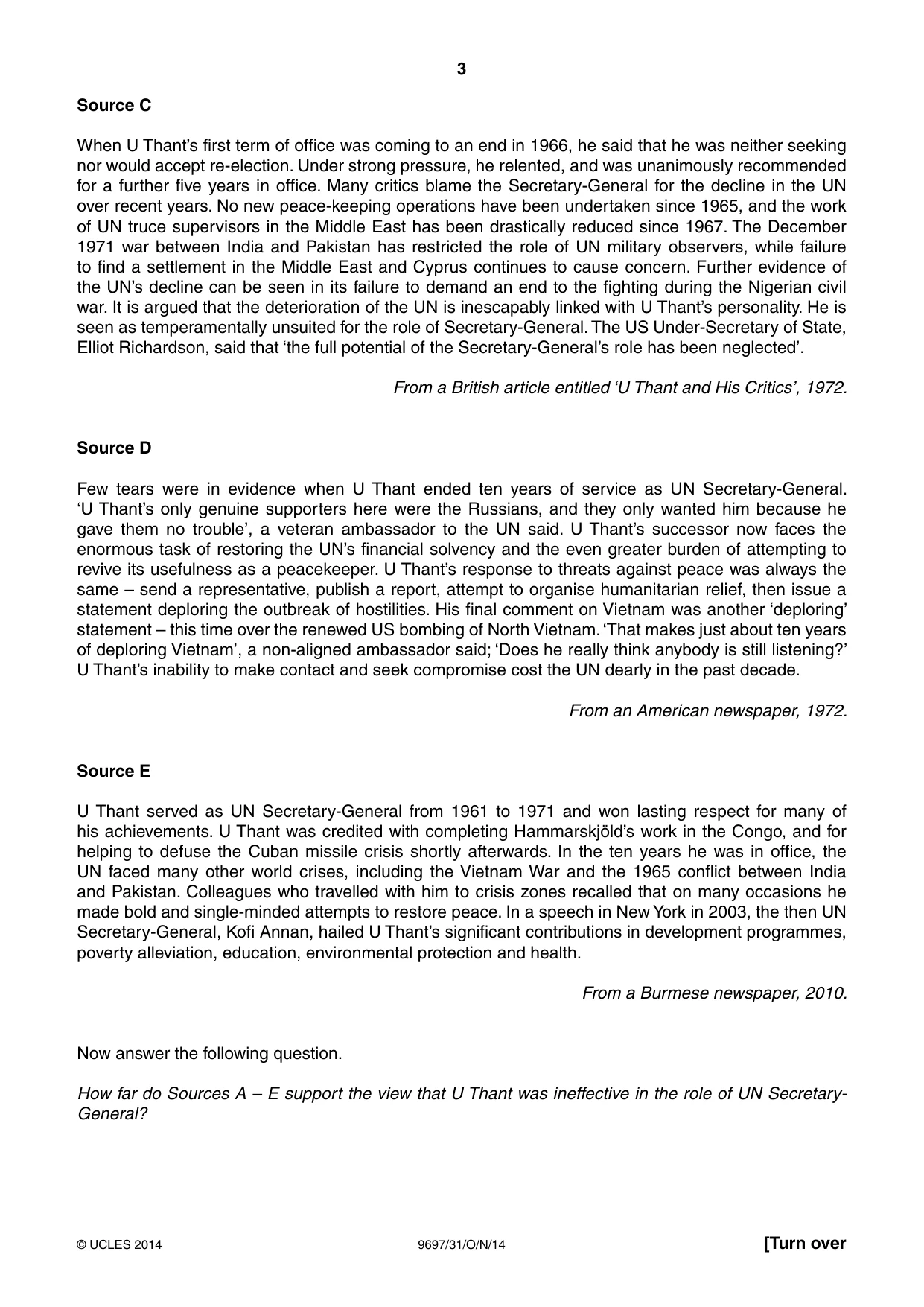
3 9697/31/O/N/14 © UCLES 2014 [Turn over Source C When U Thant’s first term of office was coming to an end in 1966, he said that he was neither seeking nor would accept re-election. Under strong pressure, he relented, and was unanimously recommended for a further five years in office. Many critics blame the Secretary-General for the decline in the UN over recent years. No new peace-keeping operations have been undertaken since 1965, and the work of UN truce supervisors in the Middle East has been drastically reduced since 1967. The December 1971 war between India and Pakistan has restricted the role of UN military observers, while failure to find a settlement in the Middle East and Cyprus continues to cause concern. Further evidence of the UN’s decline can be seen in its failure to demand an end to the fighting during the Nigerian civil war. It is argued that the deterioration of the UN is inescapably linked with U Thant’s personality. He is seen as temperamentally unsuited for the role of Secretary-General. The US Under-Secretary of State, Elliot Richardson, said that ‘the full potential of the Secretary-General’s role has been neglected’. From a British article entitled ‘U Thant and His Critics’, 1972. Source D Few tears were in evidence when U Thant ended ten years of service as UN Secretary-General. ‘U Thant’s only genuine supporters here were the Russians, and they only wanted him because he gave them no trouble’, a veteran ambassador to the UN said. U Thant’s successor now faces the enormous task of restoring the UN’s financial solvency and the even greater burden of attempting to revive its usefulness as a peacekeeper. U Thant’s response to threats against peace was always the same – send a representative, publish a report, attempt to organise humanitarian relief, then issue a statement deploring the outbreak of hostilities. His final comment on Vietnam was another ‘deploring’ statement – this time over the renewed US bombing of North Vietnam. ‘That makes just about ten years of deploring Vietnam’, a non-aligned ambassador said; ‘Does he really think anybody is still listening?’ U Thant’s inability to make contact and seek compromise cost the UN dearly in the past decade. From an American newspaper, 1972. Source E U Thant served as UN Secretary-General from 1961 to 1971 and won lasting respect for many of his achievements. U Thant was credited with completing Hammarskjöld’s work in the Congo, and for helping to defuse the Cuban missile crisis shortly afterwards. In the ten years he was in office, the UN faced many other world crises, including the Vietnam War and the 1965 conflict between India and Pakistan. Colleagues who travelled with him to crisis zones recalled that on many occasions he made bold and single-minded attempts to restore peace. In a speech in New York in 2003, the then UN Secretary-General, Kofi Annan, hailed U Thant’s significant contributions in development programmes, poverty alleviation, education, environmental protection and health. From a Burmese newspaper, 2010. Now answe r the following question. How far do Sources A – E support the view that U Thant was ineffective in the role of UN Secretary- General?
Question paper, page 4
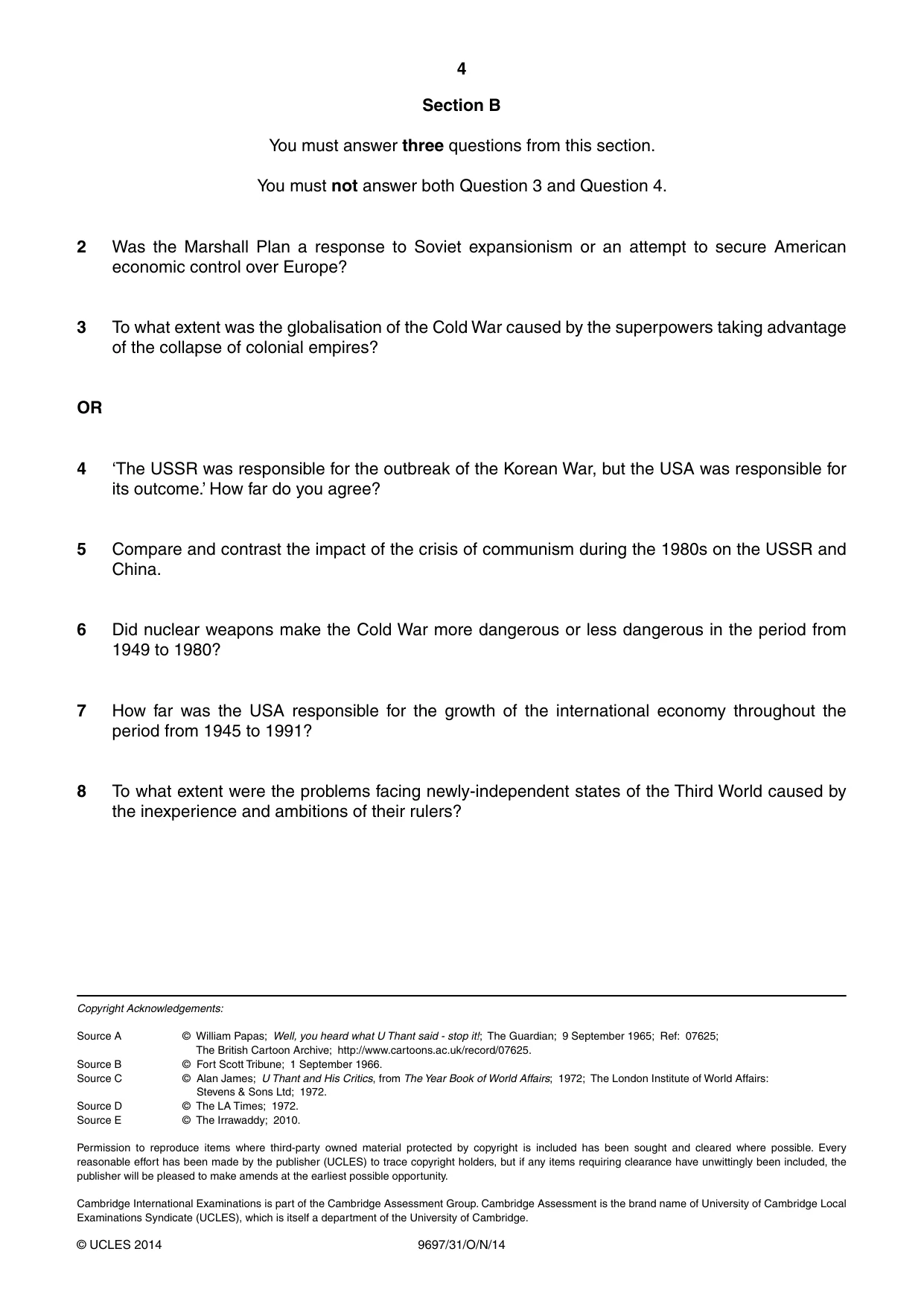
4 9697/31/O/N/14 © UCLES 2014 Section B You must answer three questions from this section. You must not answer both Question 3 and Question 4. 2 Was the Marshall Plan a response to Soviet expansionism or an attempt to secure American economic control over Europe? 3 To what extent was the globalisation of the Cold War caused by the superpowers taking advantage of the collapse of colonial empires? OR 4 ‘The USSR was responsible for the outbreak of the Korean War, but the USA was responsible for its outcome.’ How far do you agree? 5 Compare and contrast the impact of the crisis of communism during the 1980s on the USSR and China. 6 Did nuclear weapons make the Cold War more dangerous or less dangerous in the period from 1949 to 1980? 7 How far was the USA responsible for the growth of the international economy throughout the period from 1945 to 1991? 8 To what extent were the problems facing newly-independent states of the Third World caused by the inexperience and ambitions of their rulers? Copyright Acknowledgements: Source A © William Papas; Well, you heard what U Thant said - stop it!; The Guardian; 9 September 1965; Ref: 07625; The British Cartoon Archive; http://www.cartoons.ac.uk/record/07625. Source B © Fort Scott Tribune; 1 September 1966. Source C © Alan James; U Thant and His Critics, from The Year Book of World Affairs; 1972; The London Institute of World Affairs: Stevens & Sons Ltd; 1972. Source D © The LA Times; 1972. Source E © The Irrawaddy; 2010. Permission to reproduce items where third-party owned material protected by copyright is included has been sought and cleared where possible. Every reasonable effort has been made by the publisher (UCLES) to trace copyright holders, but if any items requiring clearance have unwittingly been included, the publisher will be pleased to make amends at the earliest possible opportunity. Cambridge International Examinations is part of the Cambridge Assessment Group. Cambridge Assessment is the brand name of University of Cambridge Local Examinations Syndicate (UCLES), which is itself a department of the University of Cambridge.
Mark scheme, page 1
® IGCSE is the registered trademark of Cambridge International Examinations. CAMBRIDGE INTERNATIONAL EXAMINATIONS Cambridge International Advanced Subsidiary and Advanced Level MARK SCHEME for the October/November 2014 series 9697 HISTORY 9697/31 Paper 3, maximum raw mark 100 This mark scheme is published as an aid to teachers and candidates, to indicate the requirements of the examination. It shows the basis on which Examiners were instructed to award marks. It does not indicate the details of the discussions that took place at an Examiners’ meeting before marking began, which would have considered the acceptability of alternative answers. Mark schemes should be read in conjunction with the question paper and the Principal Examiner Report for Teachers. Cambridge will not enter into discussions about these mark schemes. Cambridge is publishing the mark schemes for the October/November 2014 series for most Cambridge IGCSE®, Cambridge International A and AS Level components and some Cambridge O Level components.
Mark scheme, page 2
Page 2 Mark Scheme Syllabus Paper Cambridge International AS/A Level – October/November 2014 9697 31 © Cambridge International Examinations 2014 GENERAL MARKING INSTRUCTIONS Examiners should refer to the CIE booklet ‘Instructions for Examiners’ for detailed guidance. 1 THE ASSESSMENT OBJECTIVES The Assessment Objectives are as follows: (a) the ability to make effective use of relevant factual knowledge to demonstrate the understanding of an historical period or periods in outline and of particular topics in depth; (b) the ability to distinguish and assess different approaches to, interpretations of, and opinions about the past; (c) the ability to express awareness of change and continuity in the past; (d) the ability to present a clear, concise, logical and relevant argument. It is possible that evidence of attainment in any one of the Assessment Objectives may be demonstrated in an answer to an essay question. However, no attempt is made to allocate marks in essay questions to individual Assessment Objectives.
Mark scheme, page 3
Page 3 Mark Scheme Syllabus Paper Cambridge International AS/A Level – October/November 2014 9697 31 © Cambridge International Examinations 2014 2 GENERAL GUIDE TO THE ASSESSMENT OF SCRIPTS AND THE ESTABLISHMENT OF STANDARDS Each answer should be marked bearing in mind the Assessment Objectives stated above and the following basic criteria: (a) the relevance, accuracy and quantity of factual knowledge; (b) effectiveness of presentation: the ability to communicate arguments and knowledge in a clear, orderly fashion with maximum relevance to the question set. (Examiners with scripts which may be in the candidate’s second language must be particularly vigilant against penalising candidates over and above a self-imposed penalty); (c) evidence of the exercise of informed historical judgement and of the awareness of historical context. It is not intended that examiners should attempt to isolate these qualities and reward them separately because they are inter-related. Their proper application will mean, for example, that long answers crammed with detailed knowledge will not be rewarded highly if the knowledge is not effectively applied and the answers show a lack of historical judgement. Conversely a convincingly argued, highly relevant and perceptive answer may be well rewarded although based on less overtly expressed knowledge. All essay answers should be marked in such a way that the final mark awarded is a true reflection of attainment in the Assessment Objectives. Different answers awarded identical or similar marks may display very different combinations of qualities and marking therefore should be responsive enough to reward answers which demonstrate different combinations of argument and historical knowledge. However, in almost all cases, the generic mark bands and the question-specific mark scheme will provide guidance to examiners on the appropriate marks to be awarded. Examiners should seek the advice of the Principal Examiner about highly unusual approaches to a question. 3 ASSESSMENT OF DOCUMENT-BASED QUESTIONS Guidance on the assessment of the Document-based questions is given separately in this Mark Scheme. 4 GENERIC MARK BANDS FOR ESSAY QUESTIONS Examiners will assess which Level of Response best reflects most of the answer. An answer will not be required to demonstrate all of the descriptions in a particular Level to qualify for a Mark Band. In bands of 3 marks, examiners will normally award the middle mark, moderating it up or down according to the particular qualities of the answer. In bands of 2 marks, examiners should award the lower mark if an answer just deserves the band and the higher mark if the answer clearly deserves the band.
Mark scheme, page 4
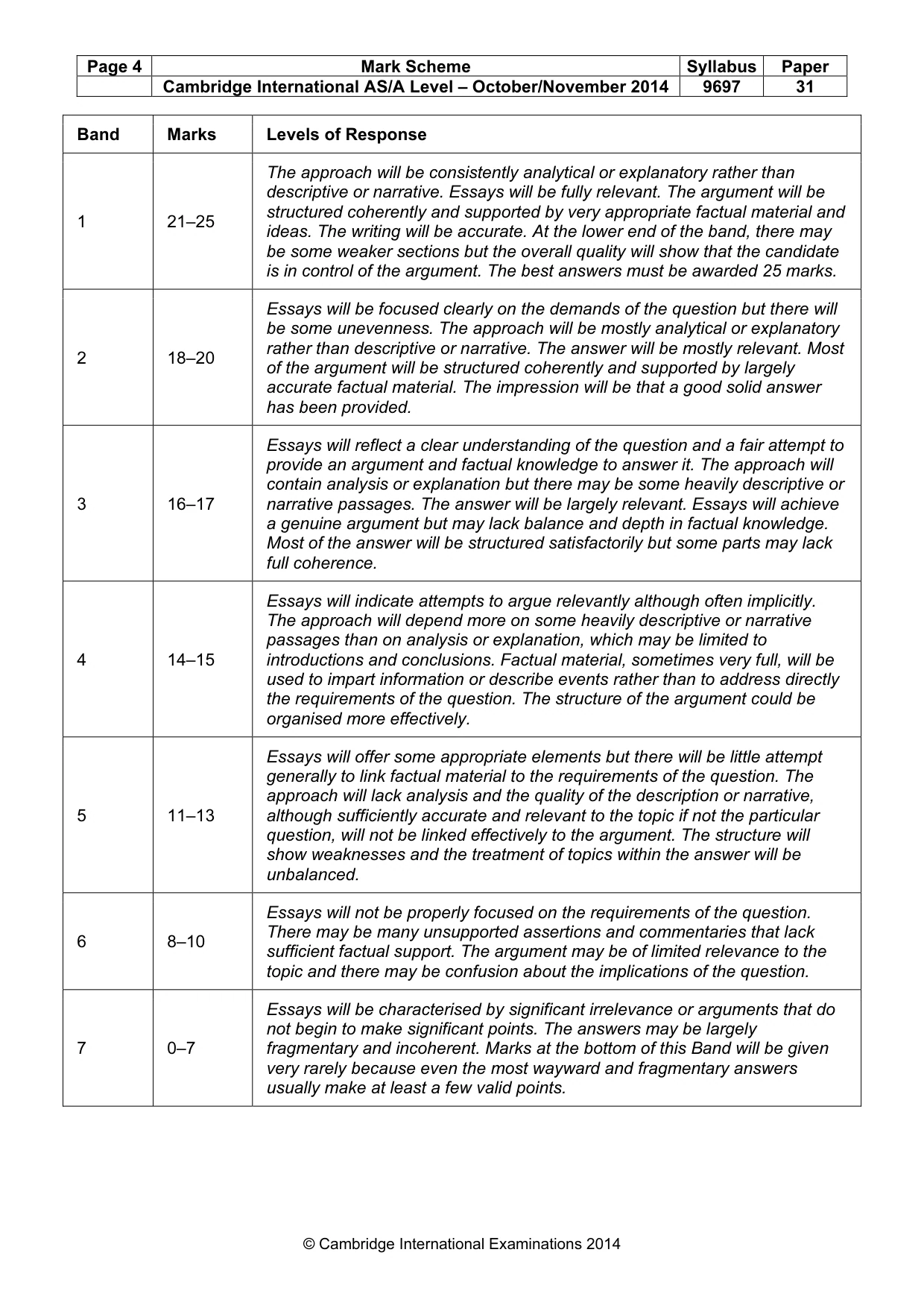
Page 4 Mark Scheme Syllabus Paper Cambridge International AS/A Level – October/November 2014 9697 31 © Cambridge International Examinations 2014 Band Marks Levels of Response 1 21–25 The approach will be consistently analytical or explanatory rather than descriptive or narrative. Essays will be fully relevant. The argument will be structured coherently and supported by very appropriate factual material and ideas. The writing will be accurate. At the lower end of the band, there may be some weaker sections but the overall quality will show that the candidate is in control of the argument. The best answers must be awarded 25 marks. 2 18–20 Essays will be focused clearly on the demands of the question but there will be some unevenness. The approach will be mostly analytical or explanatory rather than descriptive or narrative. The answer will be mostly relevant. Most of the argument will be structured coherently and supported by largely accurate factual material. The impression will be that a good solid answer has been provided. 3 16–17 Essays will reflect a clear understanding of the question and a fair attempt to provide an argument and factual knowledge to answer it. The approach will contain analysis or explanation but there may be some heavily descriptive or narrative passages. The answer will be largely relevant. Essays will achieve a genuine argument but may lack balance and depth in factual knowledge. Most of the answer will be structured satisfactorily but some parts may lack full coherence. 4 14–15 Essays will indicate attempts to argue relevantly although often implicitly. The approach will depend more on some heavily descriptive or narrative passages than on analysis or explanation, which may be limited to introductions and conclusions. Factual material, sometimes very full, will be used to impart information or describe events rather than to address directly the requirements of the question. The structure of the argument could be organised more effectively. 5 11–13 Essays will offer some appropriate elements but there will be little attempt generally to link factual material to the requirements of the question. The approach will lack analysis and the quality of the description or narrative, although sufficiently accurate and relevant to the topic if not the particular question, will not be linked effectively to the argument. The structure will show weaknesses and the treatment of topics within the answer will be unbalanced. 6 8–10 Essays will not be properly focused on the requirements of the question. There may be many unsupported assertions and commentaries that lack sufficient factual support. The argument may be of limited relevance to the topic and there may be confusion about the implications of the question. 7 0–7 Essays will be characterised by significant irrelevance or arguments that do not begin to make significant points. The answers may be largely fragmentary and incoherent. Marks at the bottom of this Band will be given very rarely because even the most wayward and fragmentary answers usually make at least a few valid points.
Mark scheme, page 5
Page 5 Mark Scheme Syllabus Paper Cambridge International AS/A Level – October/November 2014 9697 31 © Cambridge International Examinations 2014 SPECIFIC MARKING INSTRUCTIONS Section A 1 U Thant as Secretary-General of the United Nations (1961–1971): How far do Sources A–E support the view that U Thant was ineffective in the role of UN Secretary-General? L1 WRITES ABOUT THE HYPOTHESIS, NO VALID USE OF SOURCES [1–5] These answers will write about U Thant as UN Secretary-General and might use the sources. However, candidates will not use the sources as information/evidence to test the given hypothesis. If sources are used, it will be to support an essay-style answer to the question. L2 USES INFORMATION TAKEN FROM THE SOURCES TO CHALLENGE OR SUPPORT THE HYPOTHESIS [6–8] These answers use the sources as information rather than as evidence, i.e. sources are used at face value only with no evaluation/interpretation in context. L3 USES INFORMATION TAKEN FROM SOURCES TO CHALLENGE AND SUPPORT THE HYPOTHESIS [9–13] These answers know that testing the hypothesis involves both attempting to confirm and to disprove it. However, sources are still used only at face value. L4 BY INTERPRETING/EVALUATING SOURCES IN CONTEXT, FINDS EVIDENCE TO CHALLENGE OR SUPPORT THE HYPOTHESIS [14–16] These answers are capable of using sources as evidence, i.e. demonstrating their utility in testing the hypothesis, by interpreting them in their historical context, i.e. not simply accepting them at face value. L5 BY INTERPRETING/EVALUATING SOURCES IN CONTEXT, FINDS EVIDENCE TO CHALLENGE AND SUPPORT THE HYPOTHESIS [17–21] These answers know that testing the hypothesis involves attempting both to confirm and disconfirm the hypothesis, and are capable of using sources as evidence to do this (i.e. both confirmation and disconfirmation are done at this level). L6 AS L5, PLUS EITHER (a) EXPLAINS WHY EVIDENCE TO CHALLENGE/SUPPORT IS BETTER/PREFERRED, OR (b) RECONCILES/EXPLAINS PROBLEMS IN THE EVIDENCE TO SHOW THAT NEITHER CHALLENGE NOR SUPPORT IS TO BE PREFERRED [22–25] For (a) the argument must be that the evidence for agreeing/disagreeing is better/preferred. This must involve a comparative judgement, i.e. not just why some evidence is better, but also why other evidence is worse. For (b) include all L5 answers which use the evidence to modify the hypothesis (rather than simply seeking to support/contradict) in order to improve it.
Mark scheme, page 6
Page 6 Mark Scheme Syllabus Paper Cambridge International AS/A Level – October/November 2014 9697 31 © Cambridge International Examinations 2014 Context U Thant was appointed Acting Secretary-General of the UN by the General Assembly on 3 November 1961, following the death of Dag Hammarskjold in an air crash whilst trying to solve the Congo crisis. A former teacher and diplomat in his native Burma, U Thant was well known in UN circles, so his appointment was no surprise there. However, he was largely unknown to the rest of the world. The ‘Acting’ part of his title symbolised that he was serving out the remainder of Hammarskjold’s term, and this was dropped in November 1962. Despite statements to the effect that he did not want to continue at the end of his five year term, he was appointed for a further five years in 1966. There are widely diverging views regarding his effectiveness as Secretary-General. While some give him credit for effective mediation in issues such as the Cuban missile crisis, Cyprus, Kashmir, Congo, etc., others claim that he was responsible for the decline in UN prestige during the 1960s (something which he blamed on member states for failing to observe the principles and decisions of the UN). His method of ‘quiet diplomacy’, very different from the style of his predecessor, was neither understood nor appreciated by many. Source A Context: Contemporary cartoon. On 7 September 1965, Pakistan had mounted air raids on New Delhi and India had invaded Pakistan. On 8 September, US marines had clashed with guerrillas in South Vietnam. The UN and its Secretary-General were, therefore, confronted with two major problems at the same time. Content (Face Value): U Thant is depicted as desperately, but ineffectively, trying to stop India and Pakistan from fighting. The USA appears to be giving tacit support to U Thant’s efforts, although was itself involved in war in Vietnam. Supports the hypothesis – U Thant’s efforts to prevent fighting between India and Pakistan are clearly shown to be ineffective, while he appears to be doing nothing about events in Vietnam. Content (Beyond Face Value): U Thant is drawn smaller than any of the protagonists, implying a lack of prestige and authority, both for him personally and the UN in general. The leaders of India and Pakistan seem to be paying more attention to the USA and largely ignoring U Thant, whose attempted mediation could thus be seen as an irrelevance. U Thant is not depicted as being calm and authoritative; rather as stressed, as, literally, ‘hopping mad’ (X-Ref with C, which refers to U Thant as being temperamentally unsuited for the role of Secretary-General). Heavily focused on events between India and Pakistan, U Thant (UN) appears to be doing nothing about events in Vietnam (X- Ref with C and D, which refer to UN’s declining reputation as a peacemaker in the 1960s). The hypocrisy of the USA is clearly evident – urging/instructing India and Pakistan to stop fighting while, at the same time, being involved in its own war in Vietnam. The cartoon clearly represents the notion of the USA as ‘policeman of the world’ and implies that the USA had some form of control over the UN. Supports the hypothesis – U Thant is clearly being ineffective in dealing with the problems between India and Pakistan. However, the actions of the USA, India and Pakistan in ignoring the UN Charter also need to be taken into account. The UN could only be effective if member states abided by its decisions. It could be argued that U Thant was doing his best in impossible circumstances (X-Ref with B, which refers to U Thant’s own frustrations at this situation). Supports the hypothesis, but not really U Thant’s fault.
Mark scheme, page 7
Page 7 Mark Scheme Syllabus Paper Cambridge International AS/A Level – October/November 2014 9697 31 © Cambridge International Examinations 2014 Source B Context: American newspaper article from the time when U Thant’s first five-year term was coming to an end and before he was pressured into staying in office for a further five-year term. Content (Face Value): The source reflects U Thant’s own frustrations in the role of Secretary- General and states that the UN has failed to live up to the promises made in its Charter. As Secretary- General, U Thant must be held at least partly responsible for this failure. To some extent, this might have been because of his bluntness and his unpopular decisions (such as wanting the PRC to be admitted to the UN). Supports the hypothesis. Content (Beyond Face Value): U Thant’s blunt and outspoken nature would clearly have led to problems in terms of relations between the UN and its member states. The S-G needs to be calm and authoritative, and such frank and bitter statements might be seen as inappropriate (X-Ref with A, which depicts U Thant as being neither calm nor authoritative, and C, which refers to him as being temperamentally unsuited for the role of S-G). Supports the hypothesis. However, U Thant’s frustrations are understandable when he sees UN member states blatantly abrogating their responsibilities/commitments to the UN Charter (X-Ref with A). For U Thant, the ‘extremely serious situation’ facing the world is not because of the failure of the UN itself, but because of the failure of member states to adhere to decisions taken by the UN. While this may imply that he lacks authority, the source clearly shows that many people had enormous respect for him and even ranked him alongside Hammarskjold, his highly respected predecessor (X-Ref with E). The fact that pressure was put on him to stand for a second five-year term and was appointed unanimously (X-Ref with C) might indicate that he was not seen as ineffective. Although, coming from an American newspaper, the source would obviously oppose the admission of ‘Red China’ to the UN, there would have been many member states which would have agreed with U Thant that the PRC’s membership would help the UN to better reflect the situation in the world and deal with its problems. Hence, the source could be seen as challenging the hypothesis. Source C Context: Written at the time of U Thant’s departure from the role of UN S-G, after ten years in office. The last few years of U Thant’s tenure had seen many major incidents (e.g. war in the Middle East 1967, Vietnam War, antagonism between India and Pakistan) and it is a fact that the UN was increasingly being seen as ineffective in terms of peacekeeping. Content (Face Value): U Thant is seen as the reason for the UN’s decline in power and prestige. He is viewed as lacking the personality needed to ensure that the UN can carry out its peacekeeping duties effectively – for example, no new peacekeeping operations since 1965, failure to secure settlements in the Middle East, Cyprus, etc. Supports the hypothesis. However, U Thant was unanimously re-appointed for a second term. This might suggest that he had been more effective in his first term than in his second. Challenges the hypothesis – he must have had some effectiveness or he would not have been unanimously re-elected for a second term. Content (Beyond Face Value): The source provides a great deal of evidence to suggest that the UN has become ineffective in its peacekeeping role – for example, no new peacekeeping missions since 1965, restricted roles of UN personnel in the Middle East and in war between India and Pakistan, failure to find lasting settlement in Cyprus and Middle East, weakness in dealing with Nigerian civil war (X-Ref with Sources B and D). Many believe that this is because of U Thant, whose personality is unsuited to the role of S-G. It is suggested that a stronger S-G might have prevented this decline in UN power and prestige. Supports the hypothesis.
Mark scheme, page 8
Page 8 Mark Scheme Syllabus Paper Cambridge International AS/A Level – October/November 2014 9697 31 © Cambridge International Examinations 2014 However, the title of the paper suggests that the source is bound to be focused on criticisms of U Thant, and there must be doubts regarding how widespread such views really were. The fact that U Thant was re-appointed for a second term unanimously, despite his own reservations (X-Ref with B), would imply that there was considerable support for his achievements in the role. While some UN member states (e.g. USA) might have been happy for U Thant to remain in post even if he was ineffective and kept the UN out of major events (X-ref with D, which refers to the Russians being happy with U Thant because ‘he gave them no trouble’), this could not have been true of all those who had a say in his re-appointment. It could be argued that the 1960s saw a series of major world events which the UN would not have been able to solve regardless of who was S-G – for example, issues in the Middle East, Cyprus and Kashmir have still not been finally settled. U Thant’s UN did at least achieve compromise solutions to prevent continuous war in those areas. U Thant’s reservations about staying on in the role for a second term were clearly due to his frustrations at the actions of UN member states, which basically ignored UN decisions (e.g. USA in Vietnam) (X-Ref with A and B). Challenges the hypothesis. Source D Context: From an American newspaper at the time of U Thant’s departure from office as UN S-G. Content (Face Value): U Thant is seen as an ineffective S-G, whose departure is welcomed by everyone (except the Russians, and they only liked him because ‘he gave them no trouble’). He is seen as the cause of the UN’s weakness in its peacekeeping role and of the UN’s financial problems. The last sentence would suggest that it was U Thant’s personality and inability to develop effective relationships with national leaders that was the cause of the UN’s problems. Supports the hypothesis. Content (Beyond Face Value): U Thant is viewed as ineffective and lacking the support of everyone, except the Russians, who are, perhaps, seen as exploiting his weaknesses. His consistently weak methods are seen as the cause of the UN’s lack of effectiveness in terms of peacekeeping, whilst there is an implied suggestion that he is the reason for the UN’s financial problems. It could be argued that U Thant might have achieved more if he had enjoyed better relationships with key figures, such as US presidents. The fact that a non-aligned ambassador is seen as criticising U Thant is considerably more damaging to his reputation than if the statement had come from an American (X- Ref with A and C). Hammarskjold was heavily criticised by both the USA and the USSR, but always retained the support of the smaller, non-aligned states. Supports the hypothesis. However, it must be remembered that this comes from an American source, and it was US action in Vietnam which U Thant had been constantly criticising for some time. Moreover, given that the UN is constrained in terms of its Charter, it is difficult to see what action U Thant could have taken over some issues – for example, the UN could not take more direct action over Vietnam because the USA could have used the veto in the Security Council. Similarly, the UN’s income is entirely dependent upon donations from member states, many of which (including the USA) were resentful of the high cost of mounting peacekeeping operations (especially those of which they disapproved), and cut their donations accordingly. Over an issue such as the USA’s actions in Vietnam, U Thant could have done little except make public statements deploring events (X-Ref with B, which reveals U Thant’s own frustrations about this situation). Challenges the hypothesis. The UN’s authority and finances were restricted, thus limiting the actions which it could take over certain issues.
Mark scheme, page 9
Page 9 Mark Scheme Syllabus Paper Cambridge International AS/A Level – October/November 2014 9697 31 © Cambridge International Examinations 2014 Source E Context: Recent article from a newspaper serving Burma (U Thant’s birthplace) and SE Asia. Content (Face Value): U Thant is clearly still held in high esteem in Burma. The source mentions his achievements as S-G (e.g. Congo, Cuban missile crisis, etc.). Colleagues saw U Thant as ‘bold and single-minded’ in his quest for peace. U Thant also played a major role in the UN’s other activities (development programmes, poverty alleviation, etc.). A recent UN S-G praised U Thant’s work in 2003. Thus, U Thant’s work is still remembered and respected even 30 years since he left office. Challenges the hypothesis. Content (Beyond Face Value): Praises U Thant for his achievements, both in peacekeeping and in other (less high-profile) aspects of the UN’s work. Challenges the hypothesis. However, it should be remembered that this source comes from a newspaper which serves Burma (U Thant’s homeland, which gained a great deal of kudos from his attainment of such a high position in the UN) and it is likely to want to highlight his successes rather than his failures. The source stresses the international crises faced by the UN during the 1960s and how U Thant made ‘bold and single- minded’ attempts to restore peace (X-Ref with A and B); but it does not actually say that he was successful (X-Ref with A, C and D, which would suggest that he was not). Kofi Annan mentions U Thant’s ‘significant contributions’ to various UN activities, but does not say that U Thant initiated or led them, nor does he mention peacekeeping. As UN S-G, Kofi Annan would scarcely be likely to criticise any of his predecessors in public. In its praise of U Thant, the source seems polite rather than euphoric. Hence, the source could be seen as supporting the hypothesis, not so much because of what it says but because of what it does not say. In its praise of U Thant, the source is both muted and lacking in substance. Conclusion At face value, the sources would appear to confirm the hypothesis. Sources A, C and D all suggest that the UN under U Thant was failing in its primary role of peacekeeping. Moreover, where there is praise for U Thant, as in E, it tends to be rather muted. However, U Thant’s ten years in office saw a number of major international incidents, not least the Vietnam War, and it must be remembered that the UN was restricted in terms of the actions it could take due to the terms of its own Charter (e.g. the veto) and its financial limitations. There is little evidence in the sources to suggest that anyone else could have done better in the role. Indeed, it could be argued that a more charismatic S-G might have done more harm than good. U Thant’s own very obvious frustrations could be seen as evidence that he was ‘temperamentally unsuited’ for the role, or could be seen as evidence that it was the actions of UN member states which caused the world to have so many problems during the 1960s rather than U Thant’s ineffectiveness.
Mark scheme, page 10
Page 10 Mark Scheme Syllabus Paper Cambridge International AS/A Level – October/November 2014 9697 31 © Cambridge International Examinations 2014 Section B 2 Was the Marshall Plan a response to Soviet expansionism or an attempt to secure American economic control over Europe? To interpret the Marshall Plan as a response to Soviet expansionism, it could be argued that – • The Marshall Plan was clearly associated with the Truman Doctrine, which established the USA’s containment policy • The USA established the containment policy because of fears relating to Soviet aggression in Eastern Europe (e.g. Kennan and Churchill) • The USA believed that the USSR was intent on spreading communism across the whole of Europe. Stalin had already broken the agreements made at Yalta by not allowing free elections in Eastern European countries • The Marshall Plan provided financial/economic aid to countries which met certain conditions – these conditions prevented communist countries from receiving the aid • The USA believed that communism thrived in countries where there were poor socio- economic conditions – hence the Marshall Plan was intended to improve these countries’ economies and thus prevent the spread of communism • This fits with the traditional interpretation of the causes of the Cold War To interpret the Marshall Plan as an attempt to secure American economic control over Europe, it could be argued that – • The USA had economic interests in investments in Europe prior to WWII • These interests were threatened by the spread of communism (which did not accept the capitalist principles on which American interests were based) • Providing economic aid to countries in Western Europe would reduce the risk of communism spreading and also enhance American economic interests – e.g. European countries would now have the finances to purchase American products • This would give the USA an economic and political influence over countries in Western Europe, which would be increasingly dependent upon the USA • This fits with the revisionist interpretation of the causes of the Cold War It could be argued that the Marshall Plan was neither of these things, but simply a genuine attempt to assist European countries whose economies had been devastated by WWII.
Mark scheme, page 11
Page 11 Mark Scheme Syllabus Paper Cambridge International AS/A Level – October/November 2014 9697 31 © Cambridge International Examinations 2014 3 To what extent was the globalisation of the Cold War caused by the superpowers taking advantage of the collapse of colonial empires? In support of the view that the globalisation of the Cold War was caused by the collapse of colonial empires/decolonisation, it could be argued that – • Decolonisation caused instability in many regions of the world – e.g. Korea, Vietnam, Africa • This instability led the superpowers to become involved in order to protect and/or extend their own interests, power and prestige • Those involved in regional conflicts often actively encouraged the involvement of superpowers in order to further their own ambitions (e.g. the civil war in the Congo; Kim Il-Sung in Korea) • The superpowers inflamed regional issues by providing military assistance to protagonists • ‘Proxy wars’ often involved countries coming to terms with the impact of recent independence • Decolonisation led to changes in the balance of power within the UN. The USSR saw this as an opportunity to end American dominance of the UN In challenging the view, it could be argued that the globalisation of the Cold War was caused by other factors – • The USSR’s desire to extend communism, which the USA interpreted as expansionism • The USA’s desire to protect and extend its own economic interests • Mistrust and misunderstandings between the superpowers • The fall of China to communism in 1949 led the USA to believe that there was a monolithic plot to extend communism world-wide. This was seen as a threat to American economic interests – hence a strengthening of containment policy, NSC-68 and roll-back • Many globalisation issues were not the result of decolonisation – for example: – Cuba, where the USA wanted to maintain its economic interests which were threatened by Castro’s revolution – Khrushchev saw the opportunity to gain international prestige for the USSR by supporting a new and vulnerable communist state – In the Middle East, the issue was the political implications of the creation and subsequent expansion of Israel. As a strategically important area (e.g. oil) both superpowers became involved
Mark scheme, page 12
Page 12 Mark Scheme Syllabus Paper Cambridge International AS/A Level – October/November 2014 9697 31 © Cambridge International Examinations 2014 4 ‘The USSR was responsible for the outbreak of the Korean War, but the USA was responsible for its outcome.’ How far do you agree? In terms of the USSR’s responsibility for the outbreak of the Korean War, it could be argued that – • Kim Il-Sung gained Stalin’s approval for North Korea’s invasion of South Korea. The USSR can, therefore, be seen as actively encouraging war • However, the war was essentially a war of nationalism and unification rather than a Cold War issue. Stalin made it clear that the USSR would not become directly involved and advised Kim to seek the support of China instead. Although Stalin could see benefits from the unification of Korea under communist control (especially if the USA became involved in the war, thereby distracting it from Europe), his main concern was securing Soviet influence in Europe. Although Korea was not in Acheson’s strategic Asian defence perimeter, the USA felt that it was important to prevent Korea falling to communism because this could threaten American interests (mainly economic) in Japan. In terms of the USA’s responsibility for the outcome of the war, it could be argued that – • Initially, the invasion by North Korea was highly successful. South Korea would have been defeated and Korea unified under a communist government if the USA/UN had not become involved. The USA was primarily responsible for the involvement of the UN and provided the vast majority of its forces in Korea. UN forces, under American leadership, drove the North Koreans back beyond the 38th parallel. It was the change from containment to roll back which brought China into the war, leading to stalemate. The outcome of the war (maintaining the division of North and South Korea at the 38th parallel) was, therefore, largely the result of American action (under the guise of the UN). • However, the outcome of the war was also determined by other factors. For example: − The UN was only involved at all because the USSR had boycotted meetings of the UN Security Council (and, therefore, could not veto the UN’s decision) − The involvement of China − The USSR’s decision to provide North Korea with advisers and weapons, yet not to become directly involved in the war − The role played by the UN and other countries which supported its actions − The mediatory role played by the UN and others
Mark scheme, page 13
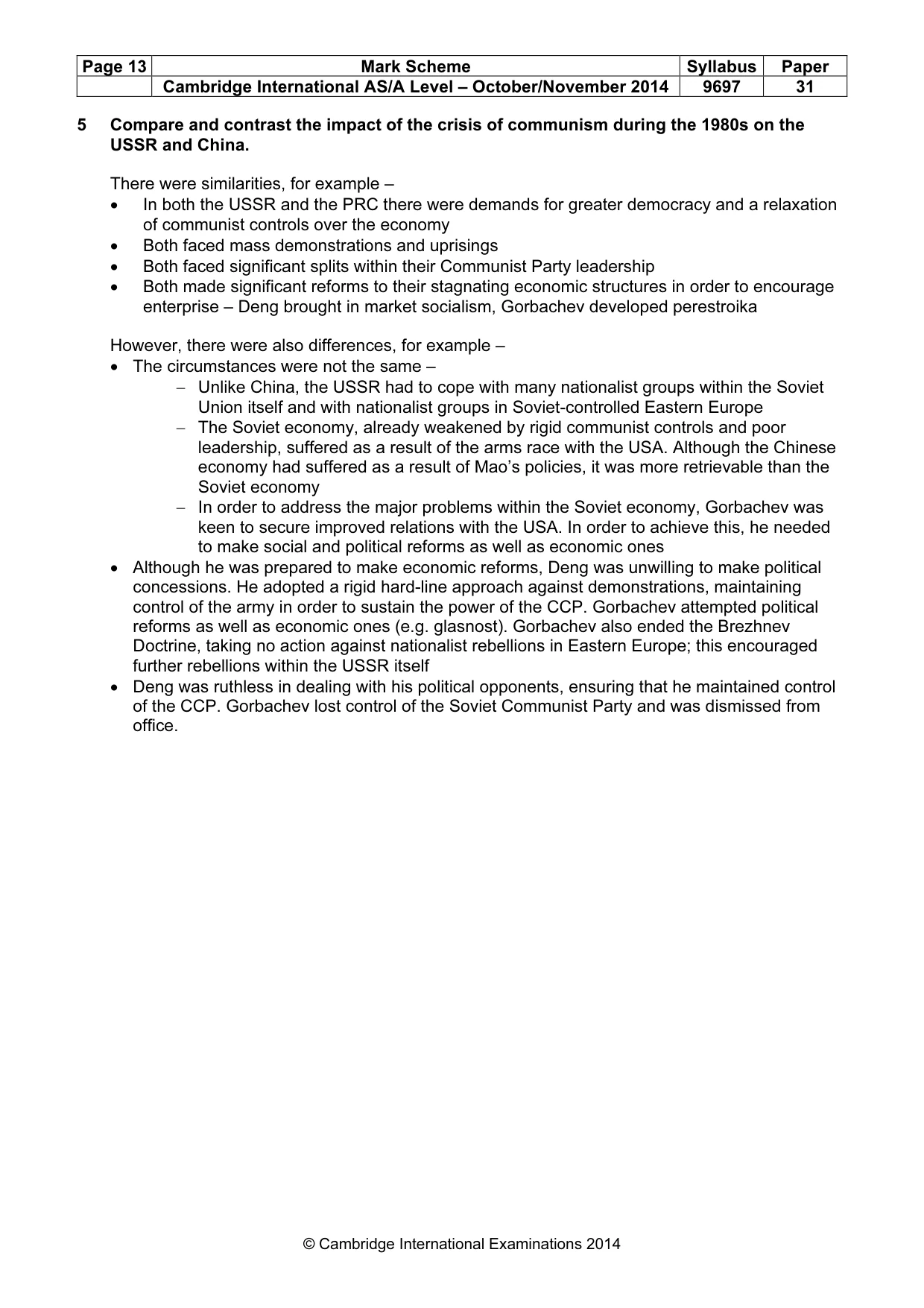
Page 13 Mark Scheme Syllabus Paper Cambridge International AS/A Level – October/November 2014 9697 31 © Cambridge International Examinations 2014 5 Compare and contrast the impact of the crisis of communism during the 1980s on the USSR and China. There were similarities, for example – • In both the USSR and the PRC there were demands for greater democracy and a relaxation of communist controls over the economy • Both faced mass demonstrations and uprisings • Both faced significant splits within their Communist Party leadership • Both made significant reforms to their stagnating economic structures in order to encourage enterprise – Deng brought in market socialism, Gorbachev developed perestroika However, there were also differences, for example – • The circumstances were not the same – − Unlike China, the USSR had to cope with many nationalist groups within the Soviet Union itself and with nationalist groups in Soviet-controlled Eastern Europe − The Soviet economy, already weakened by rigid communist controls and poor leadership, suffered as a result of the arms race with the USA. Although the Chinese economy had suffered as a result of Mao’s policies, it was more retrievable than the Soviet economy − In order to address the major problems within the Soviet economy, Gorbachev was keen to secure improved relations with the USA. In order to achieve this, he needed to make social and political reforms as well as economic ones • Although he was prepared to make economic reforms, Deng was unwilling to make political concessions. He adopted a rigid hard-line approach against demonstrations, maintaining control of the army in order to sustain the power of the CCP. Gorbachev attempted political reforms as well as economic ones (e.g. glasnost). Gorbachev also ended the Brezhnev Doctrine, taking no action against nationalist rebellions in Eastern Europe; this encouraged further rebellions within the USSR itself • Deng was ruthless in dealing with his political opponents, ensuring that he maintained control of the CCP. Gorbachev lost control of the Soviet Communist Party and was dismissed from office.
Mark scheme, page 14
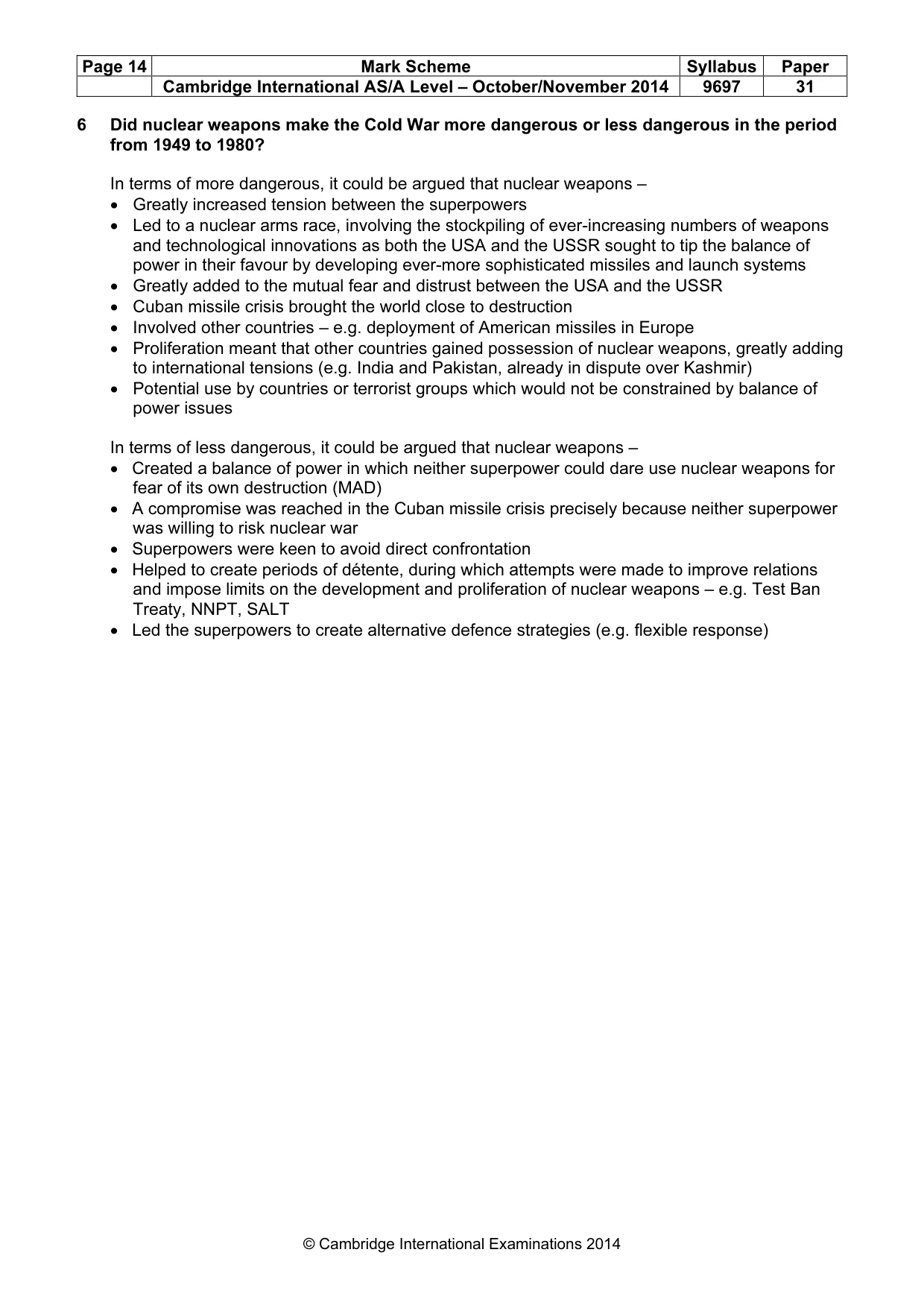
Page 14 Mark Scheme Syllabus Paper Cambridge International AS/A Level – October/November 2014 9697 31 © Cambridge International Examinations 2014 6 Did nuclear weapons make the Cold War more dangerous or less dangerous in the period from 1949 to 1980? In terms of more dangerous, it could be argued that nuclear weapons – • Greatly increased tension between the superpowers • Led to a nuclear arms race, involving the stockpiling of ever-increasing numbers of weapons and technological innovations as both the USA and the USSR sought to tip the balance of power in their favour by developing ever-more sophisticated missiles and launch systems • Greatly added to the mutual fear and distrust between the USA and the USSR • Cuban missile crisis brought the world close to destruction • Involved other countries – e.g. deployment of American missiles in Europe • Proliferation meant that other countries gained possession of nuclear weapons, greatly adding to international tensions (e.g. India and Pakistan, already in dispute over Kashmir) • Potential use by countries or terrorist groups which would not be constrained by balance of power issues In terms of less dangerous, it could be argued that nuclear weapons – • Created a balance of power in which neither superpower could dare use nuclear weapons for fear of its own destruction (MAD) • A compromise was reached in the Cuban missile crisis precisely because neither superpower was willing to risk nuclear war • Superpowers were keen to avoid direct confrontation • Helped to create periods of détente, during which attempts were made to improve relations and impose limits on the development and proliferation of nuclear weapons – e.g. Test Ban Treaty, NNPT, SALT • Led the superpowers to create alternative defence strategies (e.g. flexible response)
Mark scheme, page 15
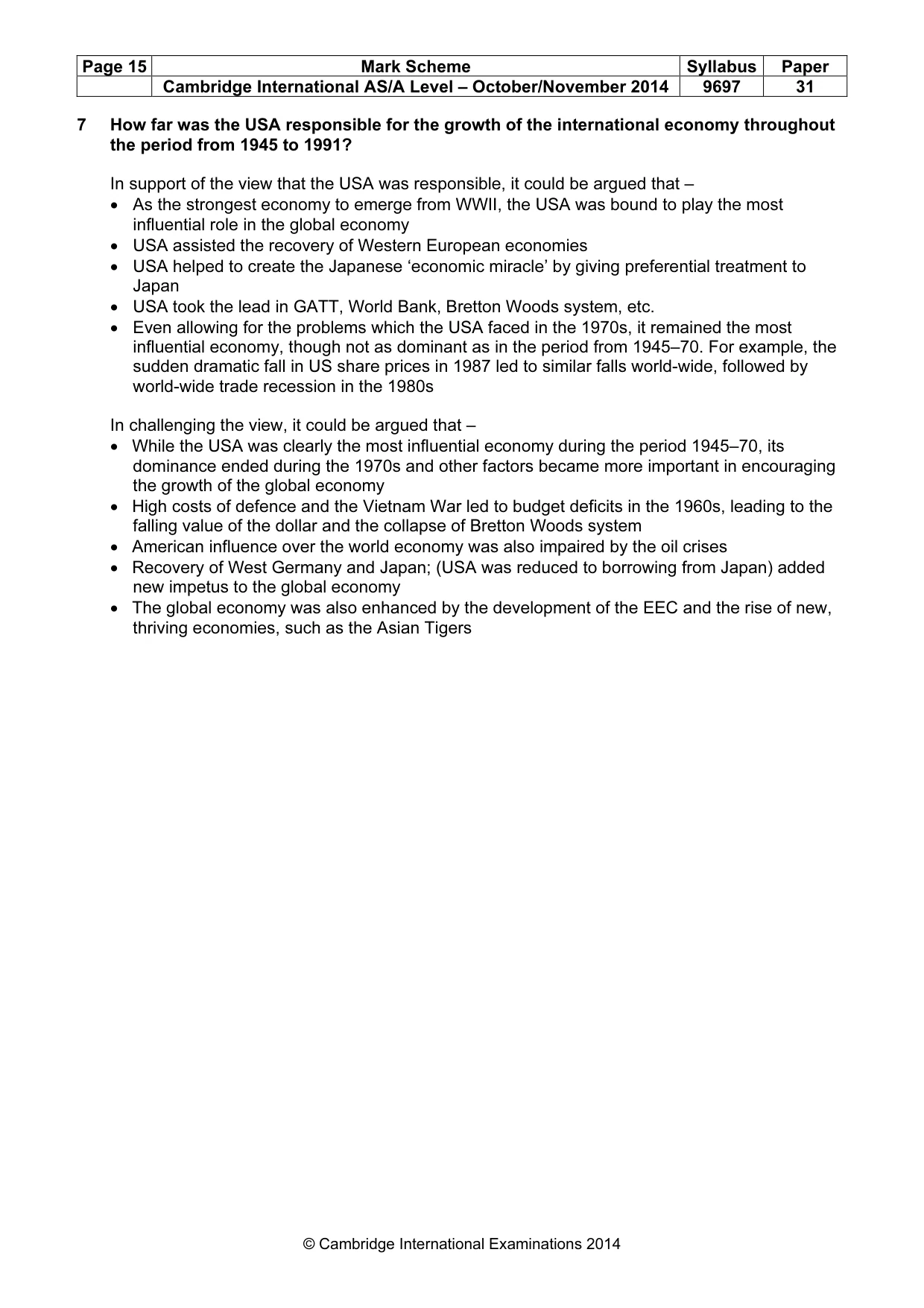
Page 15 Mark Scheme Syllabus Paper Cambridge International AS/A Level – October/November 2014 9697 31 © Cambridge International Examinations 2014 7 How far was the USA responsible for the growth of the international economy throughout the period from 1945 to 1991? In support of the view that the USA was responsible, it could be argued that – • As the strongest economy to emerge from WWII, the USA was bound to play the most influential role in the global economy • USA assisted the recovery of Western European economies • USA helped to create the Japanese ‘economic miracle’ by giving preferential treatment to Japan • USA took the lead in GATT, World Bank, Bretton Woods system, etc. • Even allowing for the problems which the USA faced in the 1970s, it remained the most influential economy, though not as dominant as in the period from 1945–70. For example, the sudden dramatic fall in US share prices in 1987 led to similar falls world-wide, followed by world-wide trade recession in the 1980s In challenging the view, it could be argued that – • While the USA was clearly the most influential economy during the period 1945–70, its dominance ended during the 1970s and other factors became more important in encouraging the growth of the global economy • High costs of defence and the Vietnam War led to budget deficits in the 1960s, leading to the falling value of the dollar and the collapse of Bretton Woods system • American influence over the world economy was also impaired by the oil crises • Recovery of West Germany and Japan; (USA was reduced to borrowing from Japan) added new impetus to the global economy • The global economy was also enhanced by the development of the EEC and the rise of new, thriving economies, such as the Asian Tigers
Mark scheme, page 16
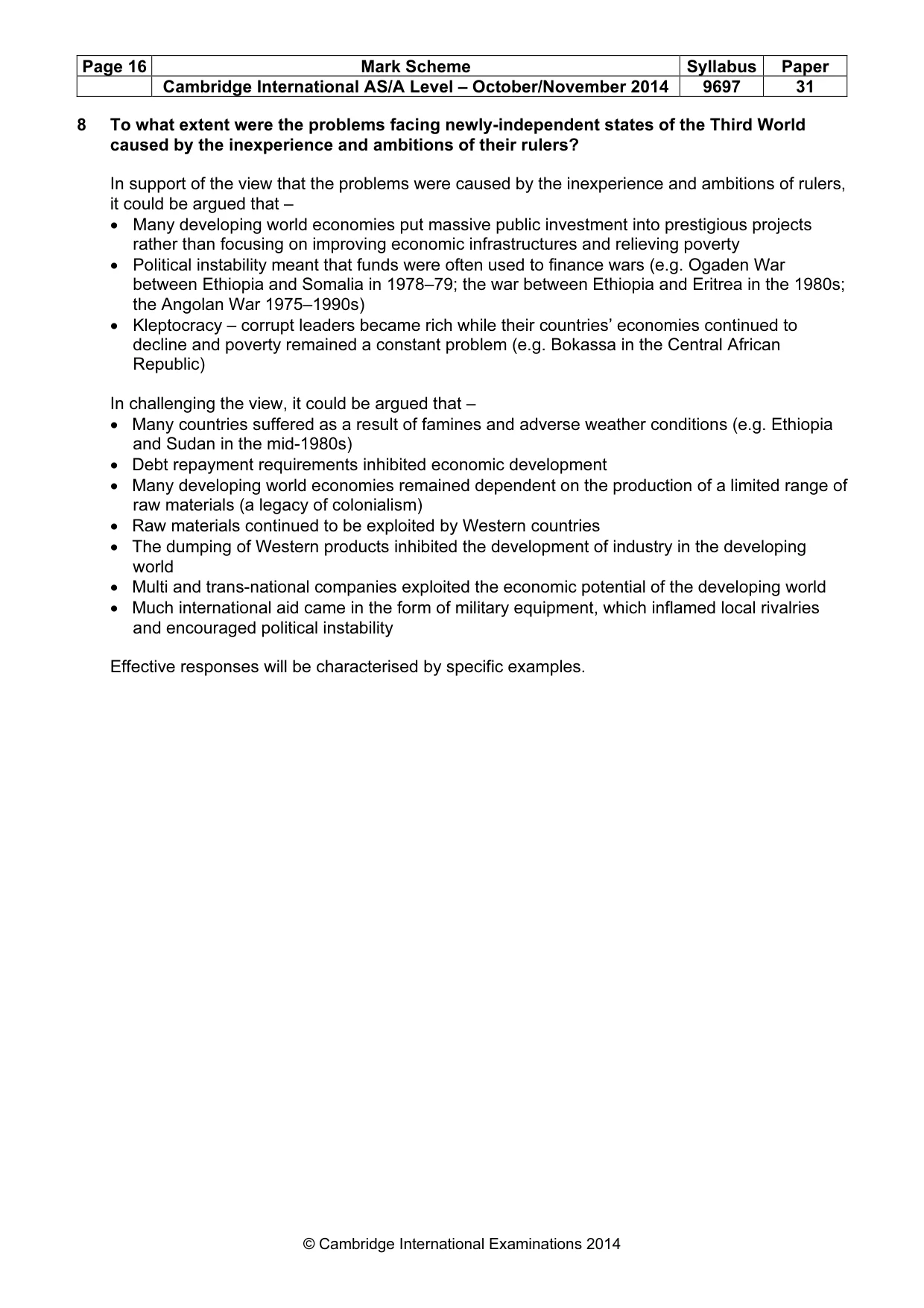
Page 16 Mark Scheme Syllabus Paper Cambridge International AS/A Level – October/November 2014 9697 31 © Cambridge International Examinations 2014 8 To what extent were the problems facing newly-independent states of the Third World caused by the inexperience and ambitions of their rulers? In support of the view that the problems were caused by the inexperience and ambitions of rulers, it could be argued that – • Many developing world economies put massive public investment into prestigious projects rather than focusing on improving economic infrastructures and relieving poverty • Political instability meant that funds were often used to finance wars (e.g. Ogaden War between Ethiopia and Somalia in 1978–79; the war between Ethiopia and Eritrea in the 1980s; the Angolan War 1975–1990s) • Kleptocracy – corrupt leaders became rich while their countries’ economies continued to decline and poverty remained a constant problem (e.g. Bokassa in the Central African Republic) In challenging the view, it could be argued that – • Many countries suffered as a result of famines and adverse weather conditions (e.g. Ethiopia and Sudan in the mid-1980s) • Debt repayment requirements inhibited economic development • Many developing world economies remained dependent on the production of a limited range of raw materials (a legacy of colonialism) • Raw materials continued to be exploited by Western countries • The dumping of Western products inhibited the development of industry in the developing world • Multi and trans-national companies exploited the economic potential of the developing world • Much international aid came in the form of military equipment, which inflamed local rivalries and encouraged political instability Effective responses will be characterised by specific examples.
What you needed in this session
Cambridge’s own grade thresholds for 2014 Oct/Nov, Paper 3 · Variant 1. A higher threshold means an easier paper — the bar moves with how the cohort did.