Cambridge A Level History (pre-2015) 9697 — 2010 May/June Paper 3 · Variant 2
9697/32/M/J/10 · 100 marks · ≈113 min
The question paper and its mark scheme, free to read here and free to download. This is Cambridge’s own paper, exactly as it was sat.
Question paper4 pages
Mark scheme7 pages
Answers below. Sit the paper first if you are practising.
Paper as text
Question paper, page 1
This document consists of 4 printed pages. DC (CW) 26551/1 © UCLES 2010 [Turn over UNIVERSITY OF CAMBRIDGE INTERNATIONAL EXAMINATIONS General Certificate of Education Advanced Subsidiary Level and Advanced Level READ THESE INSTRUCTIONS FIRST If you have been given an Answer Booklet, follow the instructions on the front cover of the Booklet. Write your Centre number, candidate number and name on all the work you hand in. Write in dark blue or black pen. You may use a soft pencil for any diagrams, graphs or rough working. Do not use staples, paper clips, highlighters, glue or correction fluid. Section A Answer Question 1. Section B Answer three questions. At the end of the examination, fasten all your work securely together. All questions in this paper carry equal marks. * 0 5 5 6 8 2 1 5 9 8 * HISTORY 9697/32 Paper 3 International History, 1945–1991 May/June 2010 3 hours Additional Materials: Answer Booklet/Paper
Question paper, page 2
2 9697/32/M/J/10 © UCLES 2010 SECTION A: INTERNATIONAL HISTORY, 1945–1991 You must answer Question 1. U THANT AS SECRETARY-GENERAL 1 Read the Sources and then answer the question. When answering Question 1 candidates are advised to pay particular attention to the interpretation and evaluation of the Sources both individually and as a group. Source A Source B As ambassador to the UN from Burma, U Thant oversaw a decade marked by the Cuban Missile Crisis, the Vietnam War, the invasion of Czechoslovakia and the Six Day War in the Middle East. In spite of his passive nature, U Thant also believed in the Secretary-General’s duty to intervene in such events. His failed efforts to mediate in South Vietnam earned him contempt from Washington while his actions during the Cuban Missile Crisis also infuriated Moscow. History remembers U Thant as weak and essentially invisible. From a British newspaper, ‘The Independent’, 1996. Source C In October 1962, the Cuban Missile Crisis occurred. U Thant quietly facilitated East-West dialogue, though his role was never properly recognized by historians who wrote hundreds of books on the Cuban Missile Crisis. In 1963, political succession struggles in Yemen led to the deployment of a UN observer group of 200 personnel and an air unit. The area of operation was too large to be covered by limited UN aircraft by day and only a few areas could be kept under observation at night. U Thant frankly admitted that the Yemen mission was a failure. From ‘Asia Times’, 2003. Content removed due to copyright restrictions
Question paper, page 3
3 9697/32/M/J/10 © UCLES 2010 [Turn over Source D The United Nations Emergency Force (UNEF) was deployed to the Middle East in the aftermath of the Suez Crisis in 1956. Originally intended to be a short-term ‘emergency’ force, it was clear that UNEF’s presence was a deterrent to further hostilities, and for most politicians and diplomats, this uneasy peace was preferable to an open war in the Middle East. After ten and a half years, UNEF had become a well-recognized fixture in the Egyptian desert. In 1967 the Egyptian leader, Nasser, simply decided to tell the UN to clear out. The message to withdraw UNEF was first conveyed to the commander of UNEF on 16 May 1967. The UNEF commander noted the contents and passed the message on to the Secretary-General. Unfortunately, U Thant believed that the UN could not maintain itself on the Egyptian border without the permission of the host country and recommended a gradual withdrawal. In the meantime, Egypt’s preparations were advancing steadily. Seeing that war was highly likely, Israel, on 5 June 1967, annihilated the Arab air forces on the ground and then proceeded to destroy the combined armies of Egypt, Jordan and Syria. From a British academic writing in 2005. Source E U Thant did not take the same initiatives as his predecessor, but consistently sought to use the prestige of his office to help settle disputes. Moreover, both the General Assembly and the Security Council assigned him to mediate extremely delicate situations. In his annual reports, he put forth proposals on basic issues, such as disarmament and economic and social cooperation, and many of his suggestions were adopted. An early example of a successful initiative taken by U Thant was in connection with the long-standing dispute between Indonesia and the Netherlands over the status of West Irian. In December 1961 fighting broke out between Dutch and Indonesian troops. Appealing to both governments to seek a peaceful solution, the Secretary-General helped them arrive at a settlement. That settlement brought new responsibilities to the office of the Secretary-General. For the first time in UN history, a non-self-governing territory was, for a limited period, administered directly by the world organisation. Throughout his tenure, U Thant was deeply concerned with the question of Vietnam which was never formally debated in the General Assembly. In 1966, he put forward a three-stage proposal to create the conditions necessary for discussion, but it was ignored by the US. From a United Nations publication, 2007. Now answer the following question. How far do Sources A–E support the view that U Thant was a failure as UN Secretary-General?
Question paper, page 4
4 9697/32/M/J/10 © UCLES 2010 SECTION B You must answer three questions from this section. You must not answer both Question 3 and Question 4. 2 Assess the view that neither the USA nor the USSR wanted a Cold War to develop in Europe in the years 1945–1949. 3 How far was the US policy of containment the cause of the globalisation of the Cold War in the years 1950–1980? OR 4 How far do you agree that the Cuban Missile Crisis was the result of the US overreaction to Castro’s coming to power in 1959? 5 Assess the view that the success of China and the failure of the USSR to survive the crisis of the 1980s were due to the quality of political leadership. 6 How far did nuclear weapons make the Cold War less dangerous in the years 1949 to 1980? 7 To what extent was Japan’s ‘economic miracle’ the result of the economic policies of successive Japanese governments? 8 ‘Economic mismanagement, rather than war and famine, was Africa’s most serious problem in the period 1970 to 1991.’ Assess this view. Copyright Acknowledgements: Question 1 Source A © Time Magazine, 1961. Question 1 Source B © http://FINDARTICLES.com/p/Articles. Question 1 Source C © www.atimes.com; 2003. Question 1 Source D © www.sixdaywar.co.uk. Question 1 Source E © www.un.org; 2007. Permission to reproduce items where third-party owned material protected by copyright is included has been sought and cleared where possible. Every reasonable effort has been made by the publisher (UCLES) to trace copyright holders, but if any items requiring clearance have unwittingly been included, the publisher will be pleased to make amends at the earliest possible opportunity. University of Cambridge International Examinations is part of the Cambridge Assessment Group. Cambridge Assessment is the brand name of University of Cambridge Local Examinations Syndicate (UCLES), which is itself a department of the University of Cambridge.
Mark scheme, page 1
UNIVERSITY OF CAMBRIDGE INTERNATIONAL EXAMINATIONS GCE Advanced Subsidiary Level and GCE Advanced Level MARK SCHEME for the May/June 2010 question paper for the guidance of teachers 9697 HISTORY 9697/32 Paper 32, maximum raw mark 100 This mark scheme is published as an aid to teachers and candidates, to indicate the requirements of the examination. It shows the basis on which Examiners were instructed to award marks. It does not indicate the details of the discussions that took place at an Examiners’ meeting before marking began, which would have considered the acceptability of alternative answers. Mark schemes must be read in conjunction with the question papers and the report on the examination. • CIE will not enter into discussions or correspondence in connection with these mark schemes. CIE is publishing the mark schemes for the May/June 2010 question papers for most IGCSE, GCE Advanced Level and Advanced Subsidiary Level syllabuses and some Ordinary Level syllabuses.
Mark scheme, page 2
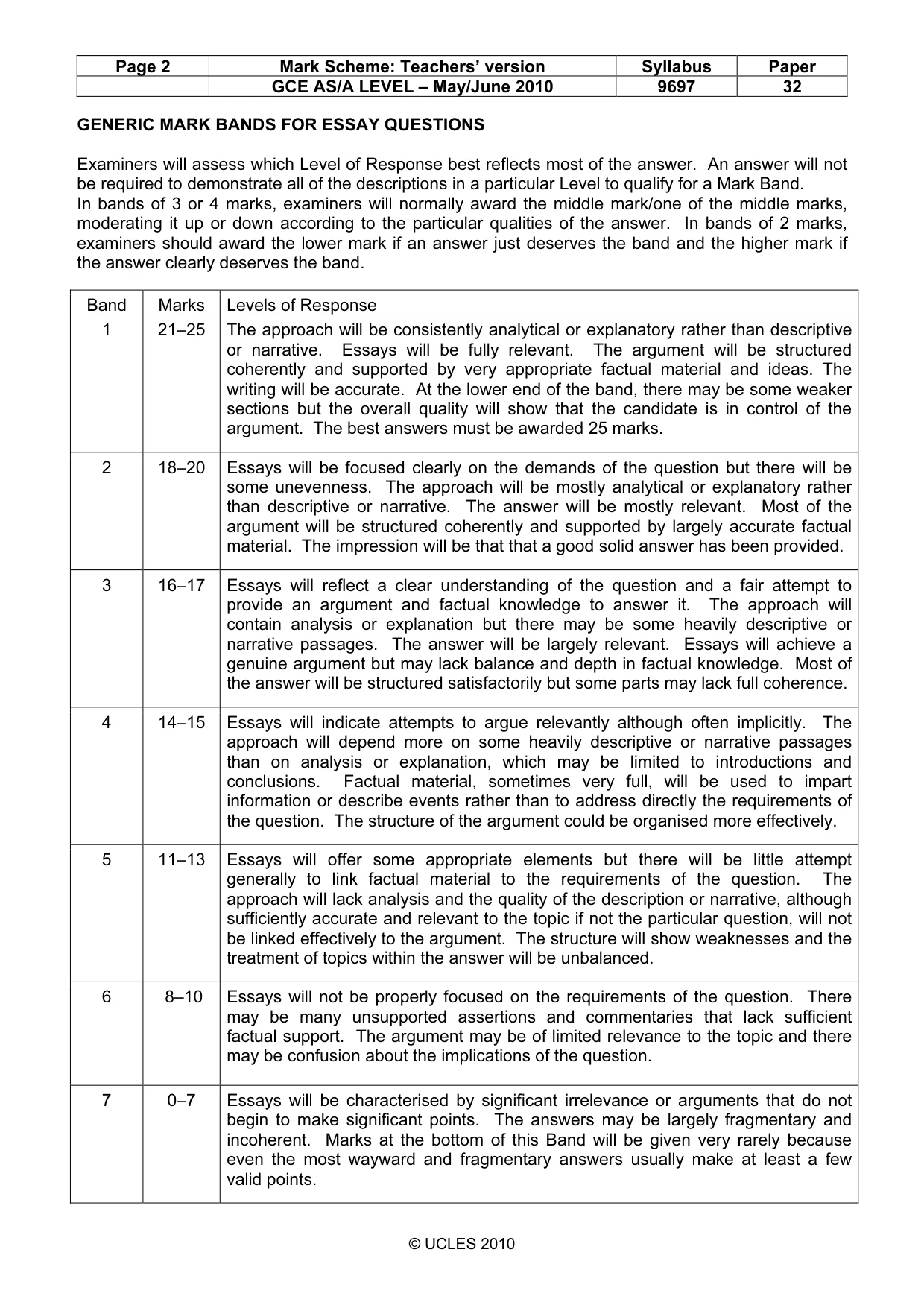
Page 2 Mark Scheme: Teachers’ version Syllabus Paper GCE AS/A LEVEL – May/June 2010 9697 32 © UCLES 2010 GENERIC MARK BANDS FOR ESSAY QUESTIONS Examiners will assess which Level of Response best reflects most of the answer. An answer will not be required to demonstrate all of the descriptions in a particular Level to qualify for a Mark Band. In bands of 3 or 4 marks, examiners will normally award the middle mark/one of the middle marks, moderating it up or down according to the particular qualities of the answer. In bands of 2 marks, examiners should award the lower mark if an answer just deserves the band and the higher mark if the answer clearly deserves the band. Band Marks Levels of Response 1 21–25 The approach will be consistently analytical or explanatory rather than descriptive or narrative. Essays will be fully relevant. The argument will be structured coherently and supported by very appropriate factual material and ideas. The writing will be accurate. At the lower end of the band, there may be some weaker sections but the overall quality will show that the candidate is in control of the argument. The best answers must be awarded 25 marks. 2 18–20 Essays will be focused clearly on the demands of the question but there will be some unevenness. The approach will be mostly analytical or explanatory rather than descriptive or narrative. The answer will be mostly relevant. Most of the argument will be structured coherently and supported by largely accurate factual material. The impression will be that that a good solid answer has been provided. 3 16–17 Essays will reflect a clear understanding of the question and a fair attempt to provide an argument and factual knowledge to answer it. The approach will contain analysis or explanation but there may be some heavily descriptive or narrative passages. The answer will be largely relevant. Essays will achieve a genuine argument but may lack balance and depth in factual knowledge. Most of the answer will be structured satisfactorily but some parts may lack full coherence. 4 14–15 Essays will indicate attempts to argue relevantly although often implicitly. The approach will depend more on some heavily descriptive or narrative passages than on analysis or explanation, which may be limited to introductions and conclusions. Factual material, sometimes very full, will be used to impart information or describe events rather than to address directly the requirements of the question. The structure of the argument could be organised more effectively. 5 11–13 Essays will offer some appropriate elements but there will be little attempt generally to link factual material to the requirements of the question. The approach will lack analysis and the quality of the description or narrative, although sufficiently accurate and relevant to the topic if not the particular question, will not be linked effectively to the argument. The structure will show weaknesses and the treatment of topics within the answer will be unbalanced. 6 8–10 Essays will not be properly focused on the requirements of the question. There may be many unsupported assertions and commentaries that lack sufficient factual support. The argument may be of limited relevance to the topic and there may be confusion about the implications of the question. 7 0–7 Essays will be characterised by significant irrelevance or arguments that do not begin to make significant points. The answers may be largely fragmentary and incoherent. Marks at the bottom of this Band will be given very rarely because even the most wayward and fragmentary answers usually make at least a few valid points.
Mark scheme, page 3
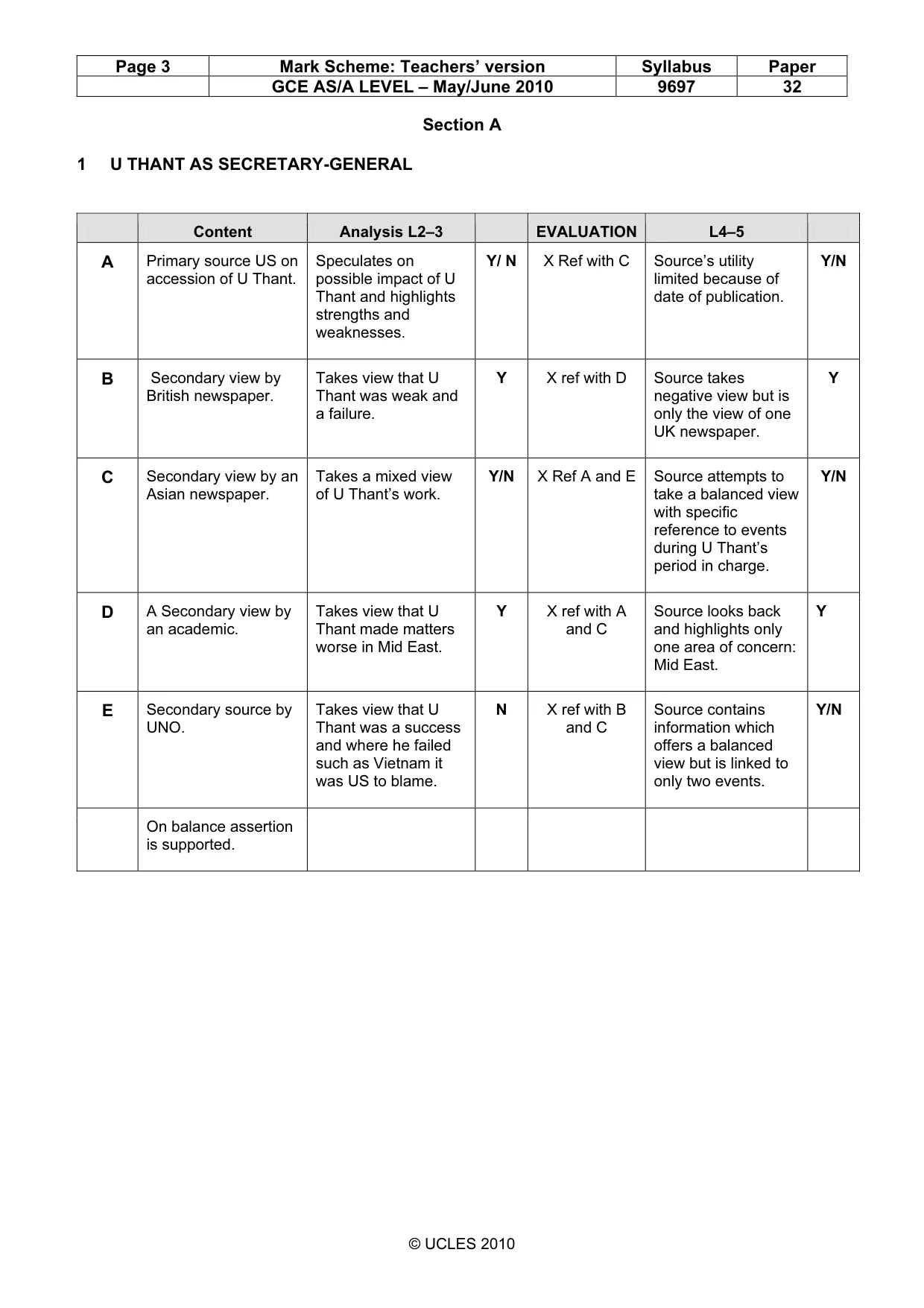
Page 3 Mark Scheme: Teachers’ version Syllabus Paper GCE AS/A LEVEL – May/June 2010 9697 32 © UCLES 2010 Section A 1 U THANT AS SECRETARY-GENERAL Content Analysis L2–3 EVALUATION L4–5 A Primary source US on accession of U Thant. Speculates on possible impact of U Thant and highlights strengths and weaknesses. Y/ N X Ref with C Source’s utility limited because of date of publication. Y/N B Secondary view by British newspaper. Takes view that U Thant was weak and a failure. Y X ref with D Source takes negative view but is only the view of one UK newspaper. Y C Secondary view by an Asian newspaper. Takes a mixed view of U Thant’s work. Y/N X Ref A and E Source attempts to take a balanced view with specific reference to events during U Thant’s period in charge. Y/N D A Secondary view by an academic. Takes view that U Thant made matters worse in Mid East. Y X ref with A and C Source looks back and highlights only one area of concern: Mid East. Y E Secondary source by UNO. Takes view that U Thant was a success and where he failed such as Vietnam it was US to blame. N X ref with B and C Source contains information which offers a balanced view but is linked to only two events. Y/N On balance assertion is supported.
Mark scheme, page 4
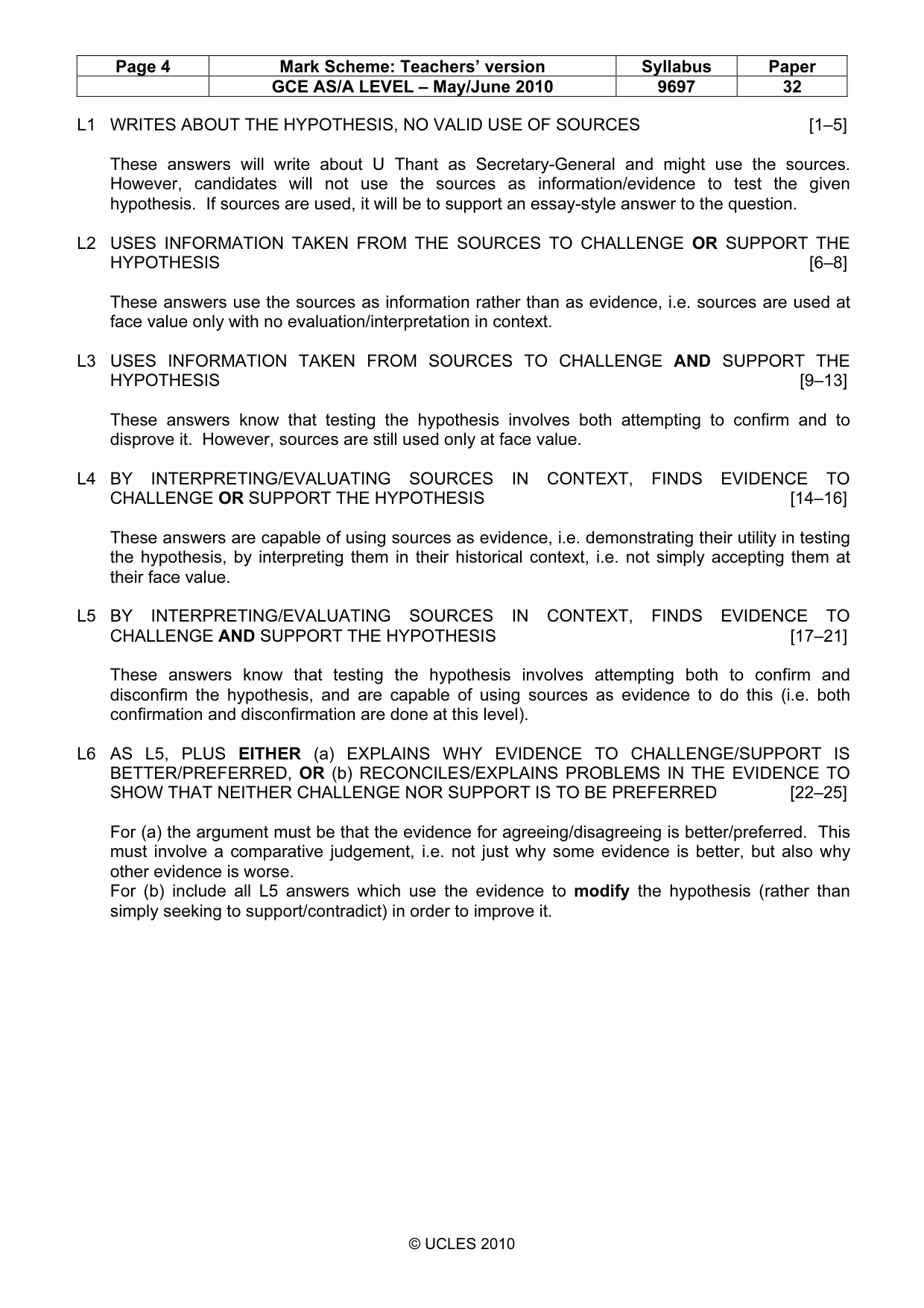
Page 4 Mark Scheme: Teachers’ version Syllabus Paper GCE AS/A LEVEL – May/June 2010 9697 32 © UCLES 2010 L1 WRITES ABOUT THE HYPOTHESIS, NO VALID USE OF SOURCES [1–5] These answers will write about U Thant as Secretary-General and might use the sources. However, candidates will not use the sources as information/evidence to test the given hypothesis. If sources are used, it will be to support an essay-style answer to the question. L2 USES INFORMATION TAKEN FROM THE SOURCES TO CHALLENGE OR SUPPORT THE HYPOTHESIS [6–8] These answers use the sources as information rather than as evidence, i.e. sources are used at face value only with no evaluation/interpretation in context. L3 USES INFORMATION TAKEN FROM SOURCES TO CHALLENGE AND SUPPORT THE HYPOTHESIS [9–13] These answers know that testing the hypothesis involves both attempting to confirm and to disprove it. However, sources are still used only at face value. L4 BY INTERPRETING/EVALUATING SOURCES IN CONTEXT, FINDS EVIDENCE TO CHALLENGE OR SUPPORT THE HYPOTHESIS [14–16] These answers are capable of using sources as evidence, i.e. demonstrating their utility in testing the hypothesis, by interpreting them in their historical context, i.e. not simply accepting them at their face value. L5 BY INTERPRETING/EVALUATING SOURCES IN CONTEXT, FINDS EVIDENCE TO CHALLENGE AND SUPPORT THE HYPOTHESIS [17–21] These answers know that testing the hypothesis involves attempting both to confirm and disconfirm the hypothesis, and are capable of using sources as evidence to do this (i.e. both confirmation and disconfirmation are done at this level). L6 AS L5, PLUS EITHER (a) EXPLAINS WHY EVIDENCE TO CHALLENGE/SUPPORT IS BETTER/PREFERRED, OR (b) RECONCILES/EXPLAINS PROBLEMS IN THE EVIDENCE TO SHOW THAT NEITHER CHALLENGE NOR SUPPORT IS TO BE PREFERRED [22–25] For (a) the argument must be that the evidence for agreeing/disagreeing is better/preferred. This must involve a comparative judgement, i.e. not just why some evidence is better, but also why other evidence is worse. For (b) include all L5 answers which use the evidence to modify the hypothesis (rather than simply seeking to support/contradict) in order to improve it.
Mark scheme, page 5
Page 5 Mark Scheme: Teachers’ version Syllabus Paper GCE AS/A LEVEL – May/June 2010 9697 32 © UCLES 2010 Section B 2 Assess the view that neither the USA nor the USSR wanted a Cold War to develop in Europe in the years 1945 –1949. Candidates have the opportunity to assess the reasons for the origins and development of the Cold War, in the years 1945 –1949, in relation to the historical debate on the issue. The assertion in the question may lead candidates to discuss the post revisionist view. In support of the view they may state that the US misinterpreted the reasons why the USSR established communist regimes in Eastern Europe, in the years 1945 –1949. They may also state that Stalin may have misinterpreted the reasons behind the creation of Bizonia in the US and UK zones of Germany. Ultimately, candidates may state that neither the USA nor the USSR wanted confrontation but it took place anyway. To counter the assertion in the question candidates may refer to the traditional/orthodox view that Stalin deliberately provoked tension through his policies. Alternatively candidates may refer to the revisionist view which tends to lay the blame with Truman and the USA. In each case references to the historical debate will need to be supported by detailed factual evidence. 3 How far was the US policy of containment the cause of the globalisation of the Cold War, in the years 1950–1980? Candidates have the opportunity to assess the reasons behind the globalisation of the Cold War from 1950. They may state that US support for containment was a major contributory factor. They may cite US defence of South Korea from 1950; US involvement in Latin America, most notably Guatemala, Cuba, Dominican Republic, Chile and Nicaragua. They may mention US policy in Indo-China from 1950 to 1975. To counter the assertion candidates may mention the importance of the US policy of Roll Back in the 1950s, such as the invasion of North Korea in 1950. They may also mention the role of the USSR and Communist China in extending their influence, such as Soviet support of Egypt and Syria in the Middle East from the late 1950s. 4 How far do you agree that the Cuban Missile Crisis was the result of the US overreaction to Castro’s coming to power in 1959? Candidates have the opportunity to assess the causes of the Cuban Missile Crisis. In support of the assertion candidates may mention that the US became transfixed by developments in Cuba. Castro’s revolution led to the Eisenhower administration plotting to invade Cuba with anti-Castro forces. This policy was continued by Kennedy who launched the ill-fated Bay of Pigs Invasion in April 1961. By the time Soviet missiles were identified in Cuba by U2 planes in 1962, US reaction through blockade and a direct confrontation with the USSR threatened all out nuclear war. It took the Soviet Union to back down and remove the missiles to prevent war. To counter the argument candidates may mention that the deployment of MRBMs only 90 miles from the USA constituted a major threat to US security. Also the establishment of a communist regime in the western hemisphere led to a major escalation of the Cold War.
Mark scheme, page 6
Page 6 Mark Scheme: Teachers’ version Syllabus Paper GCE AS/A LEVEL – May/June 2010 9697 32 © UCLES 2010 5 Assess the view that the success of China and the failure of the USSR to survive the crisis of the 1980s was due to the quality of political leadership? Candidates have the opportunity to discuss the crises facing the world’s largest communist states in the 1980s. In China the crisis was sparked by the impact of new, liberal economic policies which transformed the Chinese economy rapidly and led to demands for major political reform in 1988–89, culminating in the Tiananmen Square demonstrations and massacre. In the USSR the crisis developed because of the stagnation of the Soviet economy and attempts to reverse decline through the policies of glasnost and perestroika. Candidates may mention that Deng Xiao Ping showed resolute leadership through economic reforms which were bringing greater economic prosperity and in using the PLA to effectively crush political opposition in 1989. Gorbachev, in contrast, failed to reverse the Soviet economic decline and failed to show resolute leadership in face of demands for political reform in Eastern Europe and the USSR in 1989–1991. 6 How far did nuclear weapons make the Cold War less dangerous in the years 1949 to 1980? Candidates have the opportunity to discuss the role of nuclear weapons in the Cold War and how their development affected superpower relations. They may state that the idea of Mutually Assured Destruction (MAD) helped stabilise the Cold War. It meant that neither the USA and nor USSR wanted a head on confrontation. When this did occur over Cuba in 1962 both countries reacted with the Partial Test Ban Treaty of 1963 and the Molink in 1963. The decision, in SALT I, to ban ABM systems further enhanced the stabilising element in nuclear weaponry. However, candidates may mention that the Soviet development of theatre nuclear weapons, such as the SS20 and the US deployment of theatre nuclear weapons in the form of Pershing II and Cruise in 1981–83, destabilised the Cold War leading to a new period of confrontation. Also the US decision to launch the SDI initially led to confrontation but ultimately led the USSR to the conference table in 1986–8 in order to end nuclear confrontation. 7 To what extent was Japan’s ‘economic miracle’ the result of the economic policies of successive Japanese governments? Candidates have the opportunity to assess the reasons behind the Japanese economic miracle. They may mention specific acts by successive Liberal governments which aided Japanese economic growth. There was government support for the Japanese Zaibatsu corporations with direct links between Zaibatsu and the Liberal government in terms of commercial policy, tax and export policy. They may mention the pivotal role of MITI in Japanese government policy on economics. Candidates may also mention factors such as the preferential treatment offered to Japan by the USA in the 1950s, the decline of smokestack industries in the west through lack of modernisation and R and D, the work ethic of the Japanese and the limited military expenditure of Japan who relied on the USA for protection.
Mark scheme, page 7
Page 7 Mark Scheme: Teachers’ version Syllabus Paper GCE AS/A LEVEL – May/June 2010 9697 32 © UCLES 2010 8 ‘Economic mismanagement, rather than war and famine, was Africa’s most serious problem in the period 1970 to 1991.’ Assess this view. Candidates have the opportunity to assess the reasons behind Africa’s continued economic problems from 1970 to 1991. In support of the assertion in the question candidates may refer to the concept of Kleptocracy which afflicted many African states such as Nigeria, Central African Republic and Zaire. They may also mention the economic policies of leaders such as Nyerere in Tanzania, the policies of successive Ghanaian rulers before Rawlings, the policy of Kaunda in Zambia and the policies of the socialist government in Ethiopia which all brought economic problems for their respective states. In contrast, candidates may mention the destructive impact of conflict such as the wars between Ethiopia and Somalia and Eritrea, the civil wars in Angola and Mozambique, civil war in Zaire and wars of liberation in Zimbabwe, Angola and Mozambique. They may also mention the high incidence of famine in the Sahel area of western Africa, Somalia and Ethiopia.
What you needed in this session
Cambridge’s own grade thresholds for 2010 May/June, Paper 3 · Variant 2. A higher threshold means an easier paper — the bar moves with how the cohort did.