Cambridge A Level History (pre-2015) 9697 — 2012 Oct/Nov Paper 5 · Variant 3
9697/53/O/N/12
The question paper and its mark scheme, free to read here and free to download. This is Cambridge’s own paper, exactly as it was sat.
Question paper4 pages
Mark scheme11 pages
Answers below. Sit the paper first if you are practising.
Paper as text
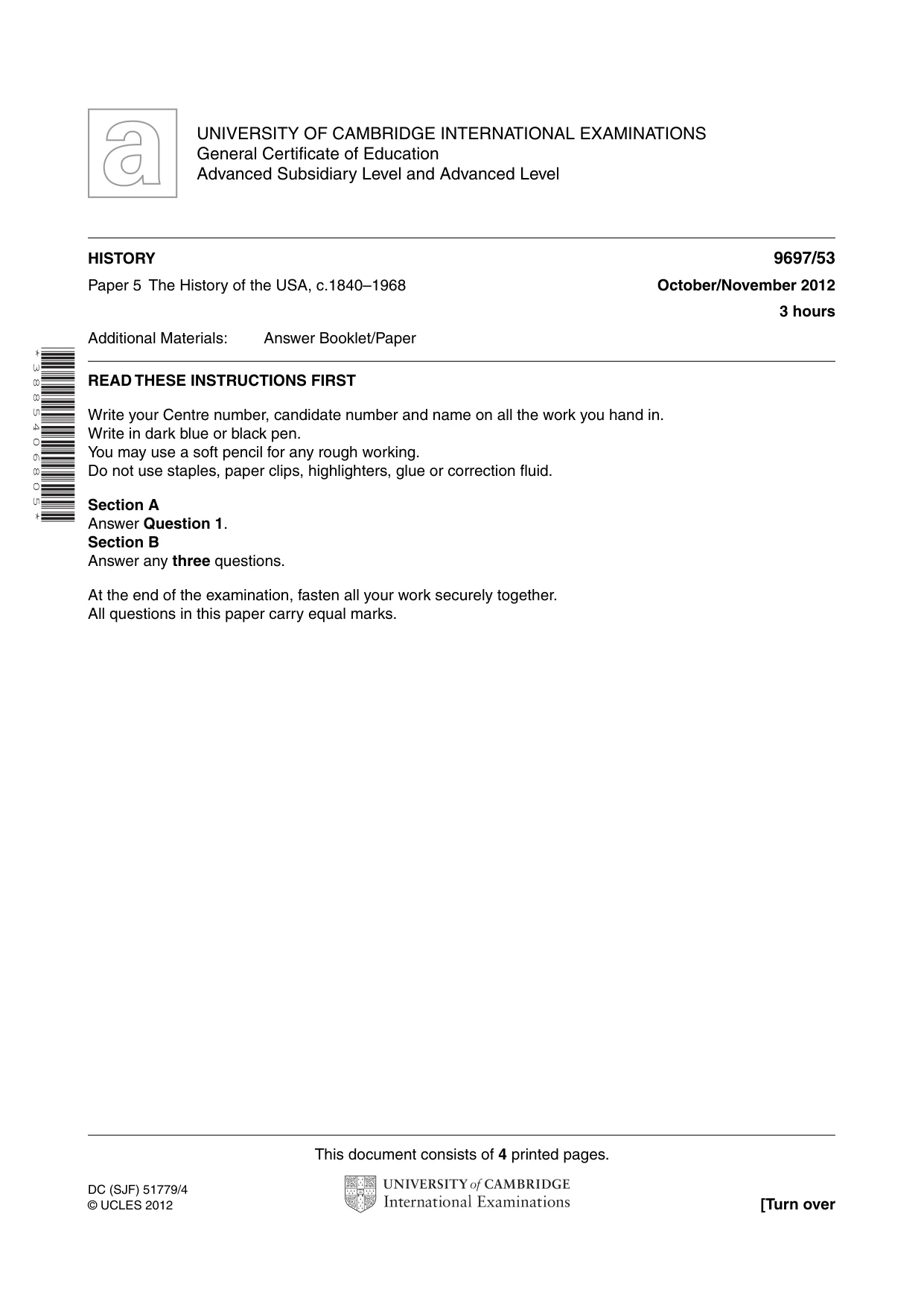
Question paper, page 1
This document consists of 4 printed pages. DC (SJF) 51779/4 © UCLES 2012 [Turn over UNIVERSITY OF CAMBRIDGE INTERNATIONAL EXAMINATIONS General Certificate of Education Advanced Subsidiary Level and Advanced Level * 3 8 8 5 4 0 6 8 0 5 * HISTORY 9697/53 Paper 5 The History of the USA, c.1840–1968 October/November 2012 3 hours Additional Materials: Answer Booklet/Paper READ THESE INSTRUCTIONS FIRST Write your Centre number, candidate number and name on all the work you hand in. Write in dark blue or black pen. You may use a soft pencil for any rough working. Do not use staples, paper clips, highlighters, glue or correction fluid. Section A Answer Question 1. Section B Answer any three questions. At the end of the examination, fasten all your work securely together. All questions in this paper carry equal marks.
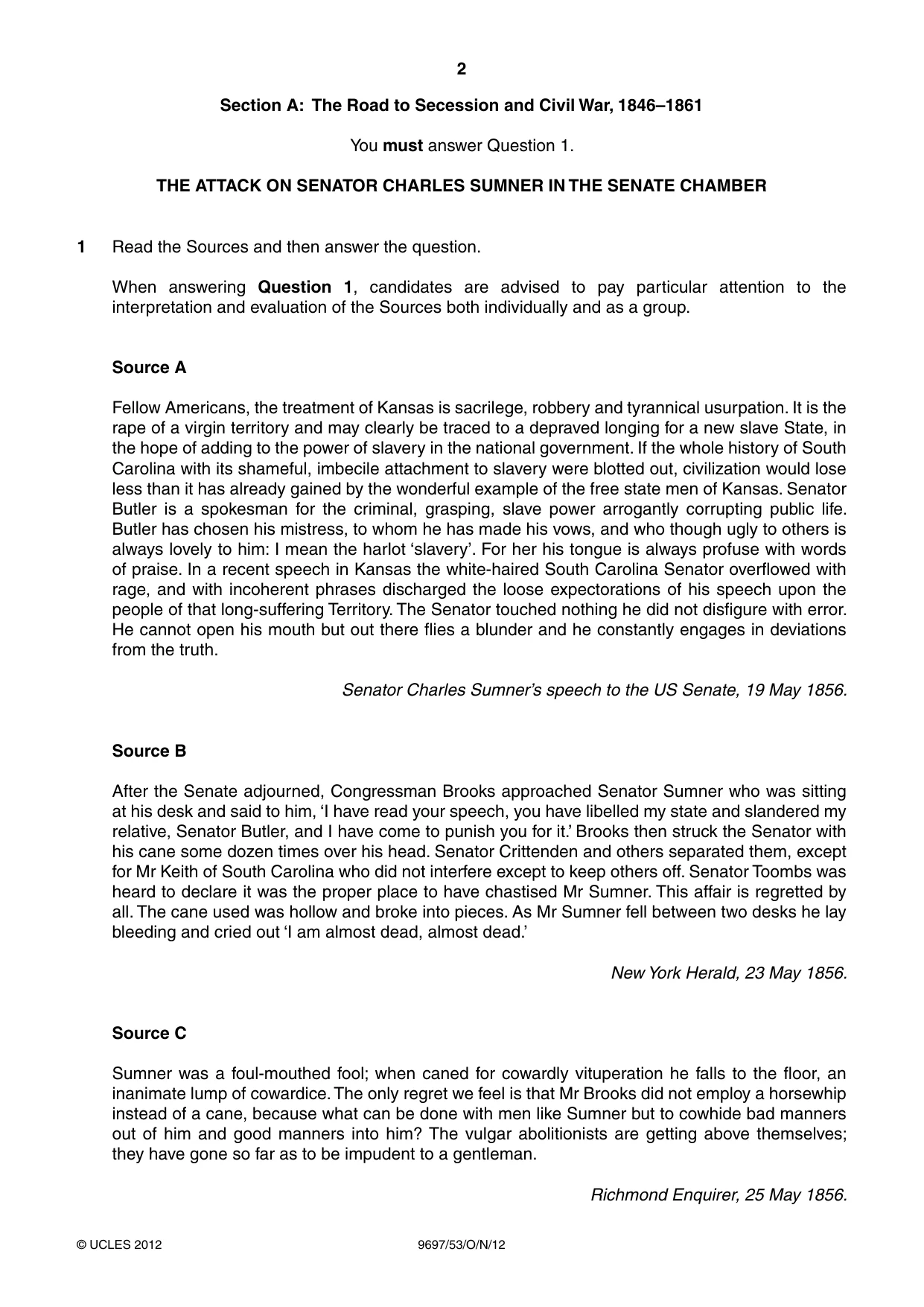
Question paper, page 2
2 9697/53/O/N/12 © UCLES 2012 Section A: The Road to Secession and Civil War, 1846–1861 You must answer Question 1. THE ATTACK ON SENATOR CHARLES SUMNER IN THE SENATE CHAMBER 1 Read the Sources and then answer the question. When answering Question 1, candidates are advised to pay particular attention to the interpretation and evaluation of the Sources both individually and as a group. Source A Fellow Americans, the treatment of Kansas is sacrilege, robbery and tyrannical usurpation. It is the rape of a virgin territory and may clearly be traced to a depraved longing for a new slave State, in the hope of adding to the power of slavery in the national government. If the whole history of South Carolina with its shameful, imbecile attachment to slavery were blotted out, civilization would lose less than it has already gained by the wonderful example of the free state men of Kansas. Senator Butler is a spokesman for the criminal, grasping, slave power arrogantly corrupting public life. Butler has chosen his mistress, to whom he has made his vows, and who though ugly to others is always lovely to him: I mean the harlot ‘slavery’. For her his tongue is always profuse with words of praise. In a recent speech in Kansas the white-haired South Carolina Senator overflowed with rage, and with incoherent phrases discharged the loose expectorations of his speech upon the people of that long-suffering Territory. The Senator touched nothing he did not disfigure with error. He cannot open his mouth but out there flies a blunder and he constantly engages in deviations from the truth. Senator Charles Sumner’s speech to the US Senate, 19 May 1856. Source B After the Senate adjourned, Congressman Brooks approached Senator Sumner who was sitting at his desk and said to him, ‘I have read your speech, you have libelled my state and slandered my relative, Senator Butler, and I have come to punish you for it.’ Brooks then struck the Senator with his cane some dozen times over his head. Senator Crittenden and others separated them, except for Mr Keith of South Carolina who did not interfere except to keep others off. Senator Toombs was heard to declare it was the proper place to have chastised Mr Sumner. This affair is regretted by all. The cane used was hollow and broke into pieces. As Mr Sumner fell between two desks he lay bleeding and cried out ‘I am almost dead, almost dead.’ New York Herald, 23 May 1856. Source C Sumner was a foul-mouthed fool; when caned for cowardly vituperation he falls to the floor, an inanimate lump of cowardice. The only regret we feel is that Mr Brooks did not employ a horsewhip instead of a cane, because what can be done with men like Sumner but to cowhide bad manners out of him and good manners into him? The vulgar abolitionists are getting above themselves; they have gone so far as to be impudent to a gentleman. Richmond Enquirer, 25 May 1856.
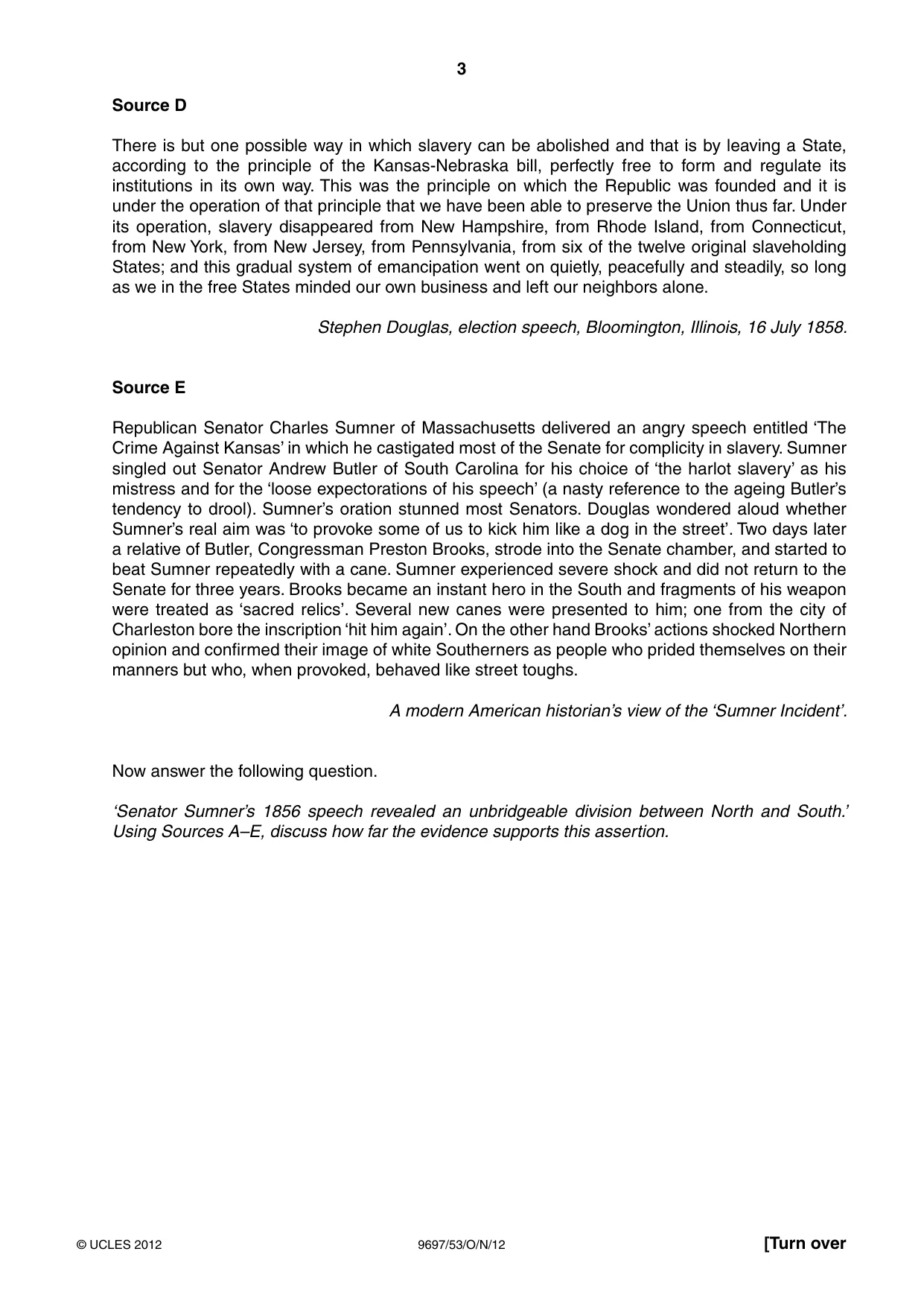
Question paper, page 3
3 9697/53/O/N/12 © UCLES 2012 [Turn over Source D There is but one possible way in which slavery can be abolished and that is by leaving a State, according to the principle of the Kansas-Nebraska bill, perfectly free to form and regulate its institutions in its own way. This was the principle on which the Republic was founded and it is under the operation of that principle that we have been able to preserve the Union thus far. Under its operation, slavery disappeared from New Hampshire, from Rhode Island, from Connecticut, from New York, from New Jersey, from Pennsylvania, from six of the twelve original slaveholding States; and this gradual system of emancipation went on quietly, peacefully and steadily, so long as we in the free States minded our own business and left our neighbors alone. Stephen Douglas, election speech, Bloomington, Illinois, 16 July 1858. Source E Republican Senator Charles Sumner of Massachusetts delivered an angry speech entitled ‘The Crime Against Kansas’ in which he castigated most of the Senate for complicity in slavery. Sumner singled out Senator Andrew Butler of South Carolina for his choice of ‘the harlot slavery’ as his mistress and for the ‘loose expectorations of his speech’ (a nasty reference to the ageing Butler’s tendency to drool). Sumner’s oration stunned most Senators. Douglas wondered aloud whether Sumner’s real aim was ‘to provoke some of us to kick him like a dog in the street’. Two days later a relative of Butler, Congressman Preston Brooks, strode into the Senate chamber, and started to beat Sumner repeatedly with a cane. Sumner experienced severe shock and did not return to the Senate for three years. Brooks became an instant hero in the South and fragments of his weapon were treated as ‘sacred relics’. Several new canes were presented to him; one from the city of Charleston bore the inscription ‘hit him again’. On the other hand Brooks’ actions shocked Northern opinion and confirmed their image of white Southerners as people who prided themselves on their manners but who, when provoked, behaved like street toughs. A modern American historian’s view of the ‘Sumner Incident’. Now answer the following question. ‘Senator Sumner’s 1856 speech revealed an unbridgeable division between North and South.’ Using Sources A–E, discuss how far the evidence supports this assertion.
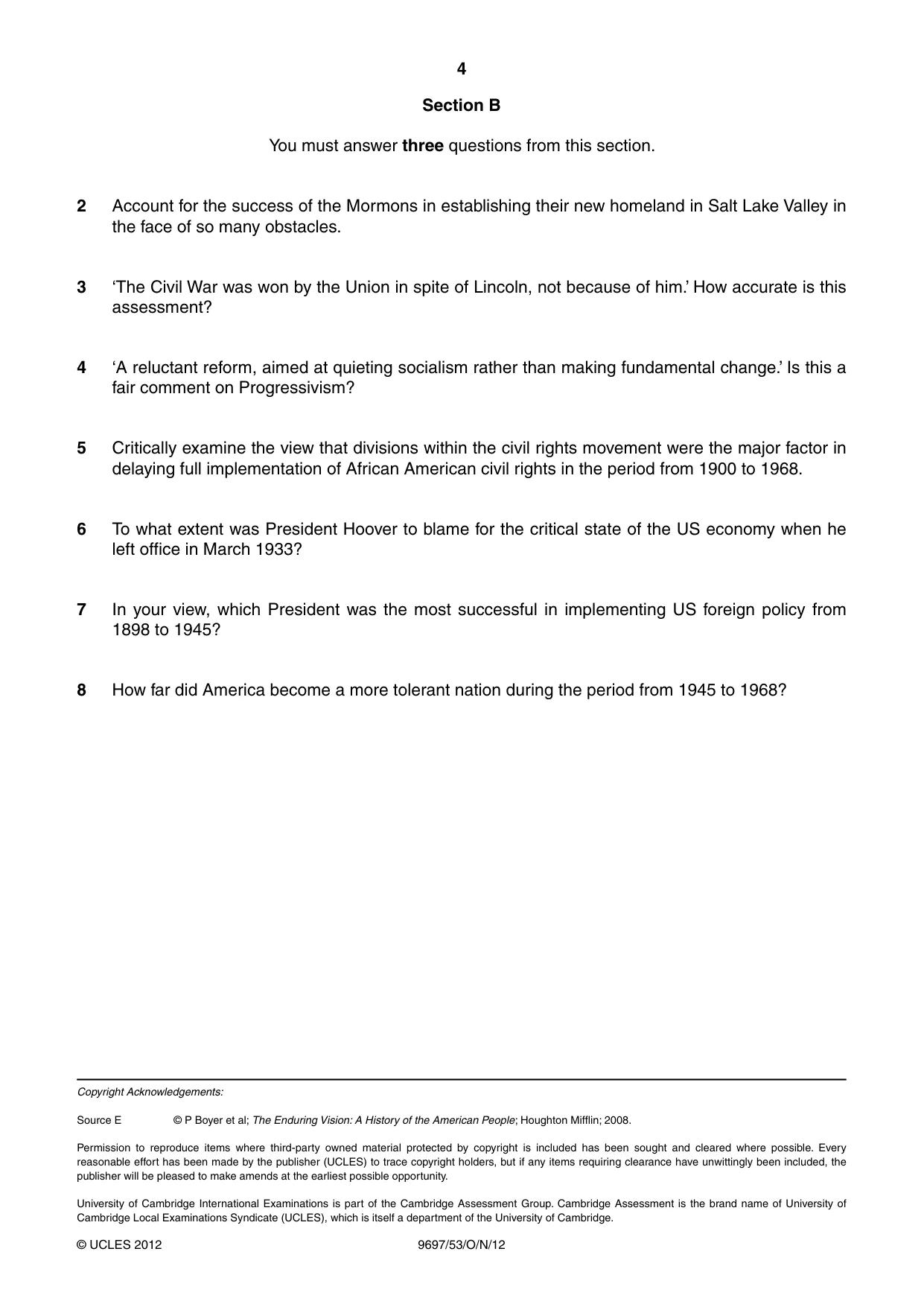
Question paper, page 4
4 9697/53/O/N/12 © UCLES 2012 Section B You must answer three questions from this section. 2 Account for the success of the Mormons in establishing their new homeland in Salt Lake Valley in the face of so many obstacles. 3 ‘The Civil War was won by the Union in spite of Lincoln, not because of him.’ How accurate is this assessment? 4 ‘A reluctant reform, aimed at quieting socialism rather than making fundamental change.’ Is this a fair comment on Progressivism? 5 Critically examine the view that divisions within the civil rights movement were the major factor in delaying full implementation of African American civil rights in the period from 1900 to 1968. 6 To what extent was President Hoover to blame for the critical state of the US economy when he left office in March 1933? 7 In your view, which President was the most successful in implementing US foreign policy from 1898 to 1945? 8 How far did America become a more tolerant nation during the period from 1945 to 1968? Copyright Acknowledgements: Source E © P Boyer et al; The Enduring Vision: A History of the American People; Houghton Mifflin; 2008. Permission to reproduce items where third-party owned material protected by copyright is included has been sought and cleared where possible. Every reasonable effort has been made by the publisher (UCLES) to trace copyright holders, but if any items requiring clearance have unwittingly been included, the publisher will be pleased to make amends at the earliest possible opportunity. University of Cambridge International Examinations is part of the Cambridge Assessment Group. Cambridge Assessment is the brand name of University of Cambridge Local Examinations Syndicate (UCLES), which is itself a department of the University of Cambridge.
Mark scheme, page 1
CAMBRIDGE INTERNATIONAL EXAMINATIONS GCE Advanced Subsidiary Level and GCE Advanced Level MARK SCHEME for the October/November 2012 series 9697 HISTORY 9697/53 Paper 5, maximum raw mark 100 This mark scheme is published as an aid to teachers and candidates, to indicate the requirements of the examination. It shows the basis on which Examiners were instructed to award marks. It does not indicate the details of the discussions that took place at an Examiners’ meeting before marking began, which would have considered the acceptability of alternative answers. Mark schemes should be read in conjunction with the question paper and the Principal Examiner Report for Teachers. Cambridge will not enter into discussions about these mark schemes. Cambridge is publishing the mark schemes for the October/November 2012 series for most IGCSE, GCE Advanced Level and Advanced Subsidiary Level components and some Ordinary Level components.
Mark scheme, page 2
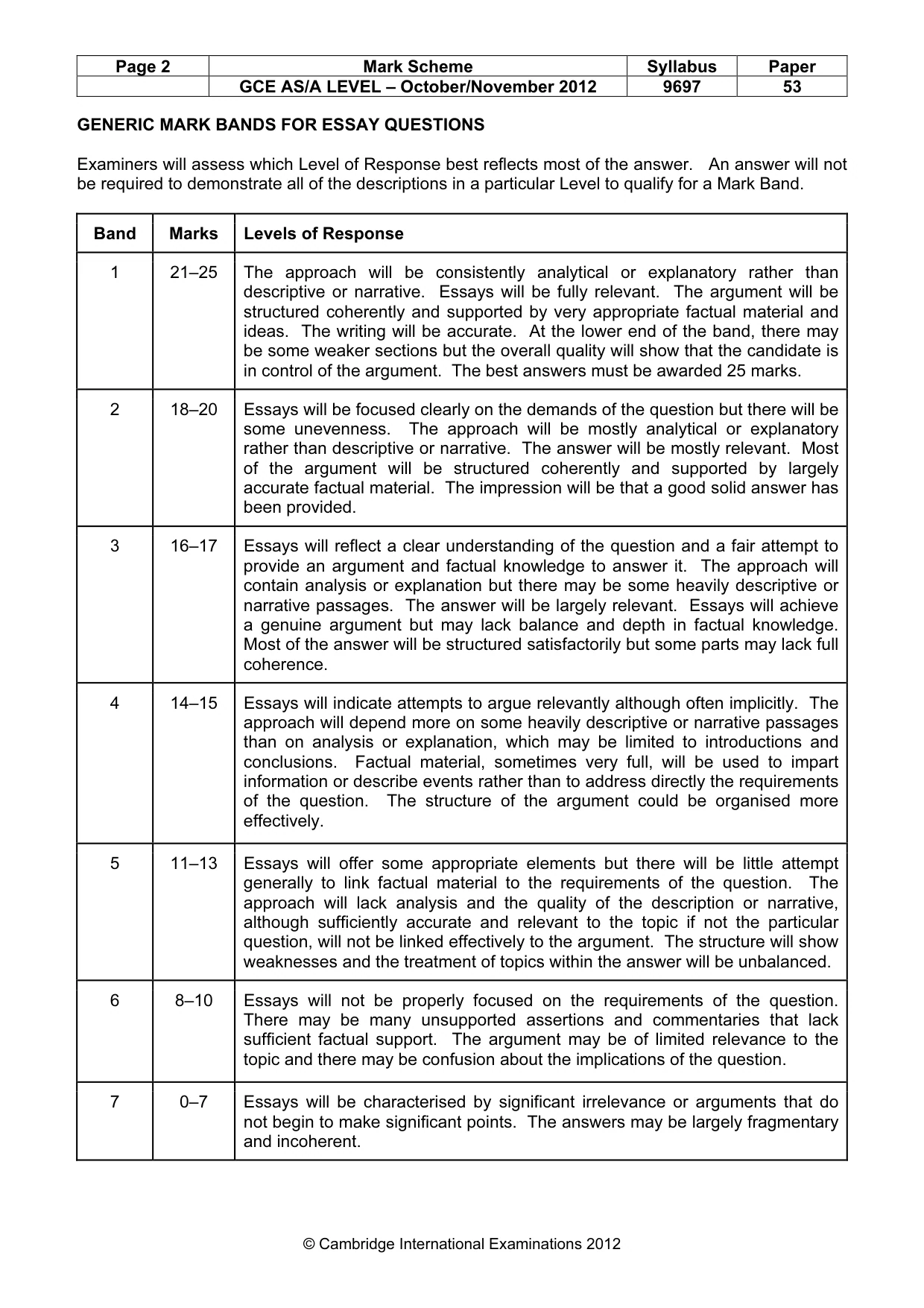
Page 2 Mark Scheme Syllabus Paper GCE AS/A LEVEL – October/November 2012 9697 53 © Cambridge International Examinations 2012 GENERIC MARK BANDS FOR ESSAY QUESTIONS Examiners will assess which Level of Response best reflects most of the answer. An answer will not be required to demonstrate all of the descriptions in a particular Level to qualify for a Mark Band. Band Marks Levels of Response 1 21–25 The approach will be consistently analytical or explanatory rather than descriptive or narrative. Essays will be fully relevant. The argument will be structured coherently and supported by very appropriate factual material and ideas. The writing will be accurate. At the lower end of the band, there may be some weaker sections but the overall quality will show that the candidate is in control of the argument. The best answers must be awarded 25 marks. 2 18–20 Essays will be focused clearly on the demands of the question but there will be some unevenness. The approach will be mostly analytical or explanatory rather than descriptive or narrative. The answer will be mostly relevant. Most of the argument will be structured coherently and supported by largely accurate factual material. The impression will be that a good solid answer has been provided. 3 16–17 Essays will reflect a clear understanding of the question and a fair attempt to provide an argument and factual knowledge to answer it. The approach will contain analysis or explanation but there may be some heavily descriptive or narrative passages. The answer will be largely relevant. Essays will achieve a genuine argument but may lack balance and depth in factual knowledge. Most of the answer will be structured satisfactorily but some parts may lack full coherence. 4 14–15 Essays will indicate attempts to argue relevantly although often implicitly. The approach will depend more on some heavily descriptive or narrative passages than on analysis or explanation, which may be limited to introductions and conclusions. Factual material, sometimes very full, will be used to impart information or describe events rather than to address directly the requirements of the question. The structure of the argument could be organised more effectively. 5 11–13 Essays will offer some appropriate elements but there will be little attempt generally to link factual material to the requirements of the question. The approach will lack analysis and the quality of the description or narrative, although sufficiently accurate and relevant to the topic if not the particular question, will not be linked effectively to the argument. The structure will show weaknesses and the treatment of topics within the answer will be unbalanced. 6 8–10 Essays will not be properly focused on the requirements of the question. There may be many unsupported assertions and commentaries that lack sufficient factual support. The argument may be of limited relevance to the topic and there may be confusion about the implications of the question. 7 0–7 Essays will be characterised by significant irrelevance or arguments that do not begin to make significant points. The answers may be largely fragmentary and incoherent.
Mark scheme, page 3
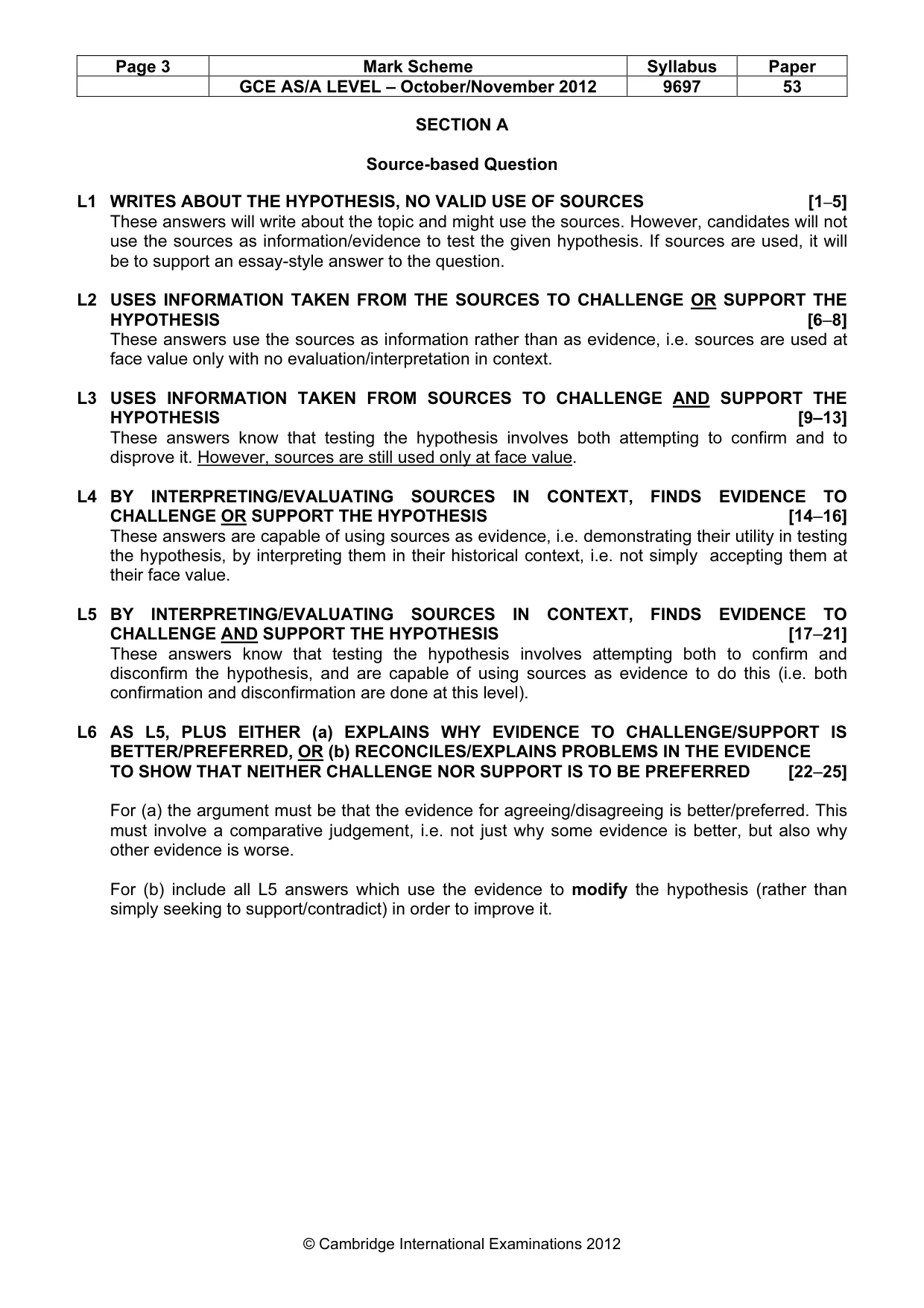
Page 3 Mark Scheme Syllabus Paper GCE AS/A LEVEL – October/November 2012 9697 53 © Cambridge International Examinations 2012 SECTION A Source-based Question L1 WRITES ABOUT THE HYPOTHESIS, NO VALID USE OF SOURCES [1–5] These answers will write about the topic and might use the sources. However, candidates will not use the sources as information/evidence to test the given hypothesis. If sources are used, it will be to support an essay-style answer to the question. L2 USES INFORMATION TAKEN FROM THE SOURCES TO CHALLENGE OR SUPPORT THE HYPOTHESIS [6–8] These answers use the sources as information rather than as evidence, i.e. sources are used at face value only with no evaluation/interpretation in context. L3 USES INFORMATION TAKEN FROM SOURCES TO CHALLENGE AND SUPPORT THE HYPOTHESIS [9–13] These answers know that testing the hypothesis involves both attempting to confirm and to disprove it. However, sources are still used only at face value. L4 BY INTERPRETING/EVALUATING SOURCES IN CONTEXT, FINDS EVIDENCE TO CHALLENGE OR SUPPORT THE HYPOTHESIS [14–16] These answers are capable of using sources as evidence, i.e. demonstrating their utility in testing the hypothesis, by interpreting them in their historical context, i.e. not simply accepting them at their face value. L5 BY INTERPRETING/EVALUATING SOURCES IN CONTEXT, FINDS EVIDENCE TO CHALLENGE AND SUPPORT THE HYPOTHESIS [17–21] These answers know that testing the hypothesis involves attempting both to confirm and disconfirm the hypothesis, and are capable of using sources as evidence to do this (i.e. both confirmation and disconfirmation are done at this level). L6 AS L5, PLUS EITHER (a) EXPLAINS WHY EVIDENCE TO CHALLENGE/SUPPORT IS BETTER/PREFERRED, OR (b) RECONCILES/EXPLAINS PROBLEMS IN THE EVIDENCE TO SHOW THAT NEITHER CHALLENGE NOR SUPPORT IS TO BE PREFERRED [22–25] For (a) the argument must be that the evidence for agreeing/disagreeing is better/preferred. This must involve a comparative judgement, i.e. not just why some evidence is better, but also why other evidence is worse. For (b) include all L5 answers which use the evidence to modify the hypothesis (rather than simply seeking to support/contradict) in order to improve it.
Mark scheme, page 4
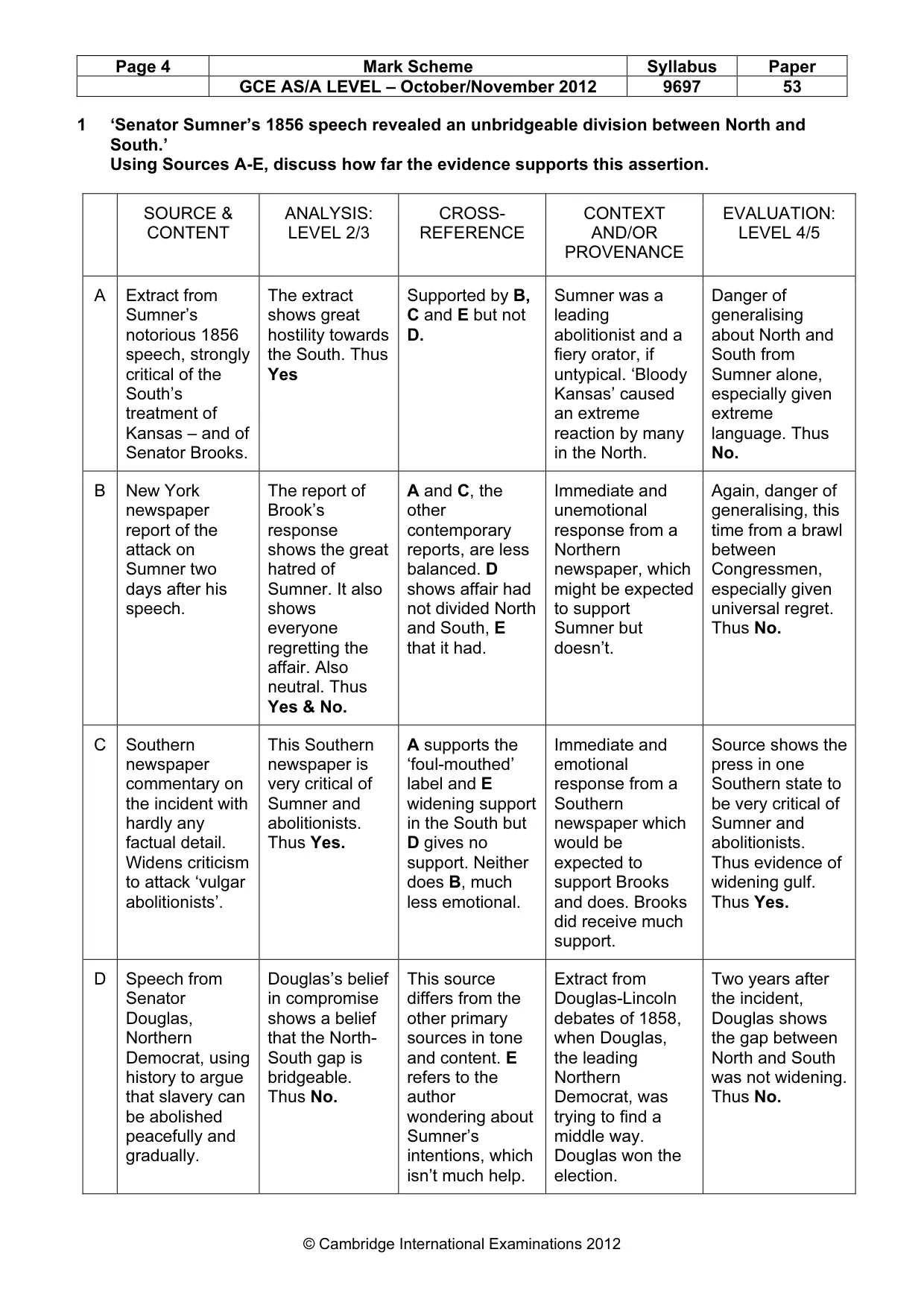
Page 4 Mark Scheme Syllabus Paper GCE AS/A LEVEL – October/November 2012 9697 53 © Cambridge International Examinations 2012 1 ‘Senator Sumner’s 1856 speech revealed an unbridgeable division between North and South.’ Using Sources A-E, discuss how far the evidence supports this assertion. SOURCE & CONTENT ANALYSIS: LEVEL 2/3 CROSS- REFERENCE CONTEXT AND/OR PROVENANCE EVALUATION: LEVEL 4/5 A Extract from Sumner’s notorious 1856 speech, strongly critical of the South’s treatment of Kansas – and of Senator Brooks. The extract shows great hostility towards the South. Thus Yes Supported by B, C and E but not D. Sumner was a leading abolitionist and a fiery orator, if untypical. ‘Bloody Kansas’ caused an extreme reaction by many in the North. Danger of generalising about North and South from Sumner alone, especially given extreme language. Thus No. B New York newspaper report of the attack on Sumner two days after his speech. The report of Brook’s response shows the great hatred of Sumner. It also shows everyone regretting the affair. Also neutral. Thus Yes & No. A and C, the other contemporary reports, are less balanced. D shows affair had not divided North and South, E that it had. Immediate and unemotional response from a Northern newspaper, which might be expected to support Sumner but doesn’t. Again, danger of generalising, this time from a brawl between Congressmen, especially given universal regret. Thus No. C Southern newspaper commentary on the incident with hardly any factual detail. Widens criticism to attack ‘vulgar abolitionists’. This Southern newspaper is very critical of Sumner and abolitionists. Thus Yes. A supports the ‘foul-mouthed’ label and E widening support in the South but D gives no support. Neither does B, much less emotional. Immediate and emotional response from a Southern newspaper which would be expected to support Brooks and does. Brooks did receive much support. Source shows the press in one Southern state to be very critical of Sumner and abolitionists. Thus evidence of widening gulf. Thus Yes. D Speech from Senator Douglas, Northern Democrat, using history to argue that slavery can be abolished peacefully and gradually. Douglas’s belief in compromise shows a belief that the North- South gap is bridgeable. Thus No. This source differs from the other primary sources in tone and content. E refers to the author wondering about Sumner’s intentions, which isn’t much help. Extract from Douglas-Lincoln debates of 1858, when Douglas, the leading Northern Democrat, was trying to find a middle way. Douglas won the election. Two years after the incident, Douglas shows the gap between North and South was not widening. Thus No.
Mark scheme, page 5
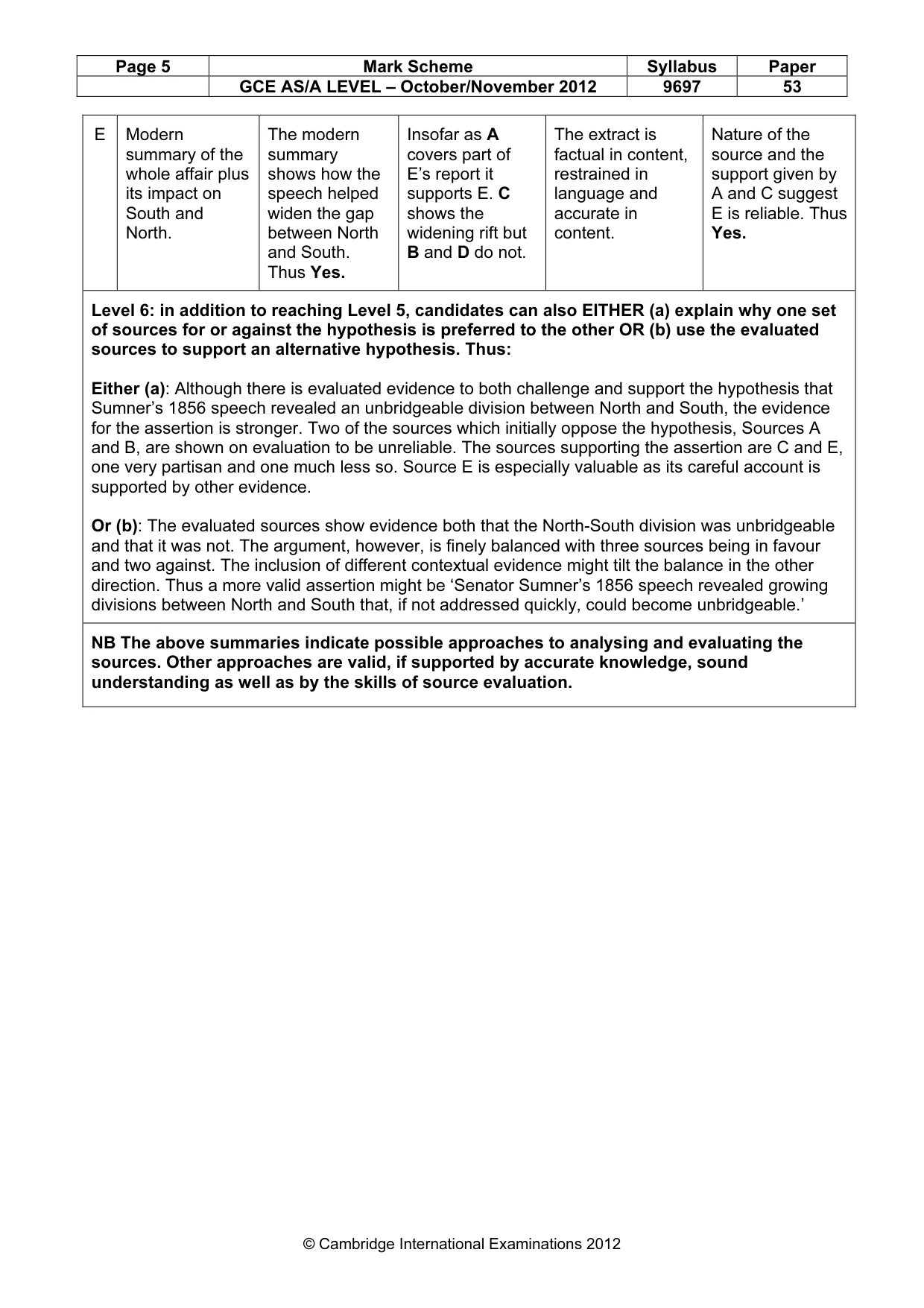
Page 5 Mark Scheme Syllabus Paper GCE AS/A LEVEL – October/November 2012 9697 53 © Cambridge International Examinations 2012 E Modern summary of the whole affair plus its impact on South and North. The modern summary shows how the speech helped widen the gap between North and South. Thus Yes. Insofar as A covers part of E’s report it supports E. C shows the widening rift but B and D do not. The extract is factual in content, restrained in language and accurate in content. Nature of the source and the support given by A and C suggest E is reliable. Thus Yes. Level 6: in addition to reaching Level 5, candidates can also EITHER (a) explain why one set of sources for or against the hypothesis is preferred to the other OR (b) use the evaluated sources to support an alternative hypothesis. Thus: Either (a): Although there is evaluated evidence to both challenge and support the hypothesis that Sumner’s 1856 speech revealed an unbridgeable division between North and South, the evidence for the assertion is stronger. Two of the sources which initially oppose the hypothesis, Sources A and B, are shown on evaluation to be unreliable. The sources supporting the assertion are C and E, one very partisan and one much less so. Source E is especially valuable as its careful account is supported by other evidence. Or (b): The evaluated sources show evidence both that the North-South division was unbridgeable and that it was not. The argument, however, is finely balanced with three sources being in favour and two against. The inclusion of different contextual evidence might tilt the balance in the other direction. Thus a more valid assertion might be ‘Senator Sumner’s 1856 speech revealed growing divisions between North and South that, if not addressed quickly, could become unbridgeable.’ NB The above summaries indicate possible approaches to analysing and evaluating the sources. Other approaches are valid, if supported by accurate knowledge, sound understanding as well as by the skills of source evaluation.
Mark scheme, page 6
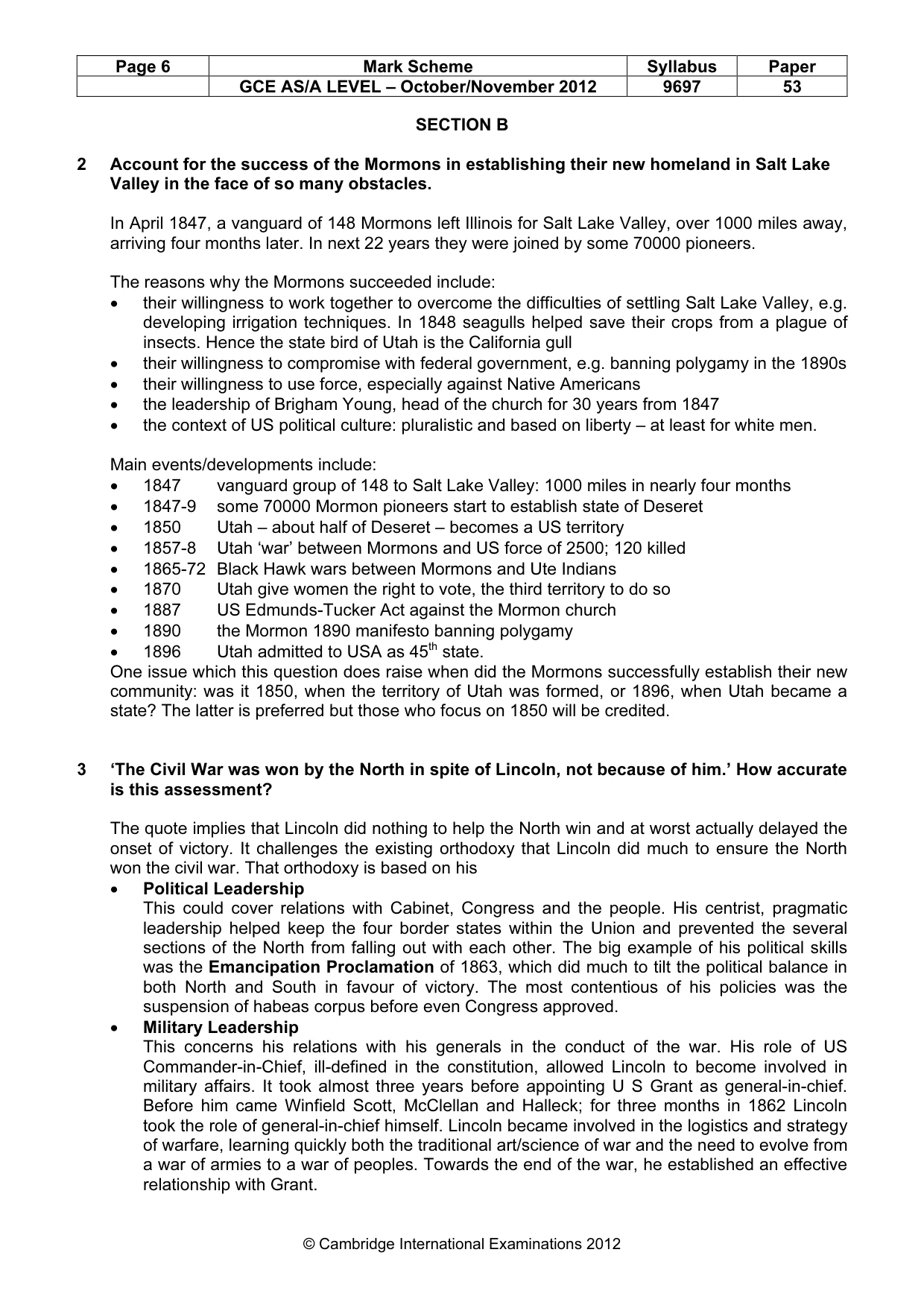
Page 6 Mark Scheme Syllabus Paper GCE AS/A LEVEL – October/November 2012 9697 53 © Cambridge International Examinations 2012 SECTION B 2 Account for the success of the Mormons in establishing their new homeland in Salt Lake Valley in the face of so many obstacles. In April 1847, a vanguard of 148 Mormons left Illinois for Salt Lake Valley, over 1000 miles away, arriving four months later. In next 22 years they were joined by some 70000 pioneers. The reasons why the Mormons succeeded include: • their willingness to work together to overcome the difficulties of settling Salt Lake Valley, e.g. developing irrigation techniques. In 1848 seagulls helped save their crops from a plague of insects. Hence the state bird of Utah is the California gull • their willingness to compromise with federal government, e.g. banning polygamy in the 1890s • their willingness to use force, especially against Native Americans • the leadership of Brigham Young, head of the church for 30 years from 1847 • the context of US political culture: pluralistic and based on liberty – at least for white men. Main events/developments include: • 1847 vanguard group of 148 to Salt Lake Valley: 1000 miles in nearly four months • 1847-9 some 70000 Mormon pioneers start to establish state of Deseret • 1850 Utah – about half of Deseret – becomes a US territory • 1857-8 Utah ‘war’ between Mormons and US force of 2500; 120 killed • 1865-72 Black Hawk wars between Mormons and Ute Indians • 1870 Utah give women the right to vote, the third territory to do so • 1887 US Edmunds-Tucker Act against the Mormon church • 1890 the Mormon 1890 manifesto banning polygamy • 1896 Utah admitted to USA as 45th state. One issue which this question does raise when did the Mormons successfully establish their new community: was it 1850, when the territory of Utah was formed, or 1896, when Utah became a state? The latter is preferred but those who focus on 1850 will be credited. 3 ‘The Civil War was won by the North in spite of Lincoln, not because of him.’ How accurate is this assessment? The quote implies that Lincoln did nothing to help the North win and at worst actually delayed the onset of victory. It challenges the existing orthodoxy that Lincoln did much to ensure the North won the civil war. That orthodoxy is based on his • Political Leadership This could cover relations with Cabinet, Congress and the people. His centrist, pragmatic leadership helped keep the four border states within the Union and prevented the several sections of the North from falling out with each other. The big example of his political skills was the Emancipation Proclamation of 1863, which did much to tilt the political balance in both North and South in favour of victory. The most contentious of his policies was the suspension of habeas corpus before even Congress approved. • Military Leadership This concerns his relations with his generals in the conduct of the war. His role of US Commander-in-Chief, ill-defined in the constitution, allowed Lincoln to become involved in military affairs. It took almost three years before appointing U S Grant as general-in-chief. Before him came Winfield Scott, McClellan and Halleck; for three months in 1862 Lincoln took the role of general-in-chief himself. Lincoln became involved in the logistics and strategy of warfare, learning quickly both the traditional art/science of war and the need to evolve from a war of armies to a war of peoples. Towards the end of the war, he established an effective relationship with Grant.
Mark scheme, page 7
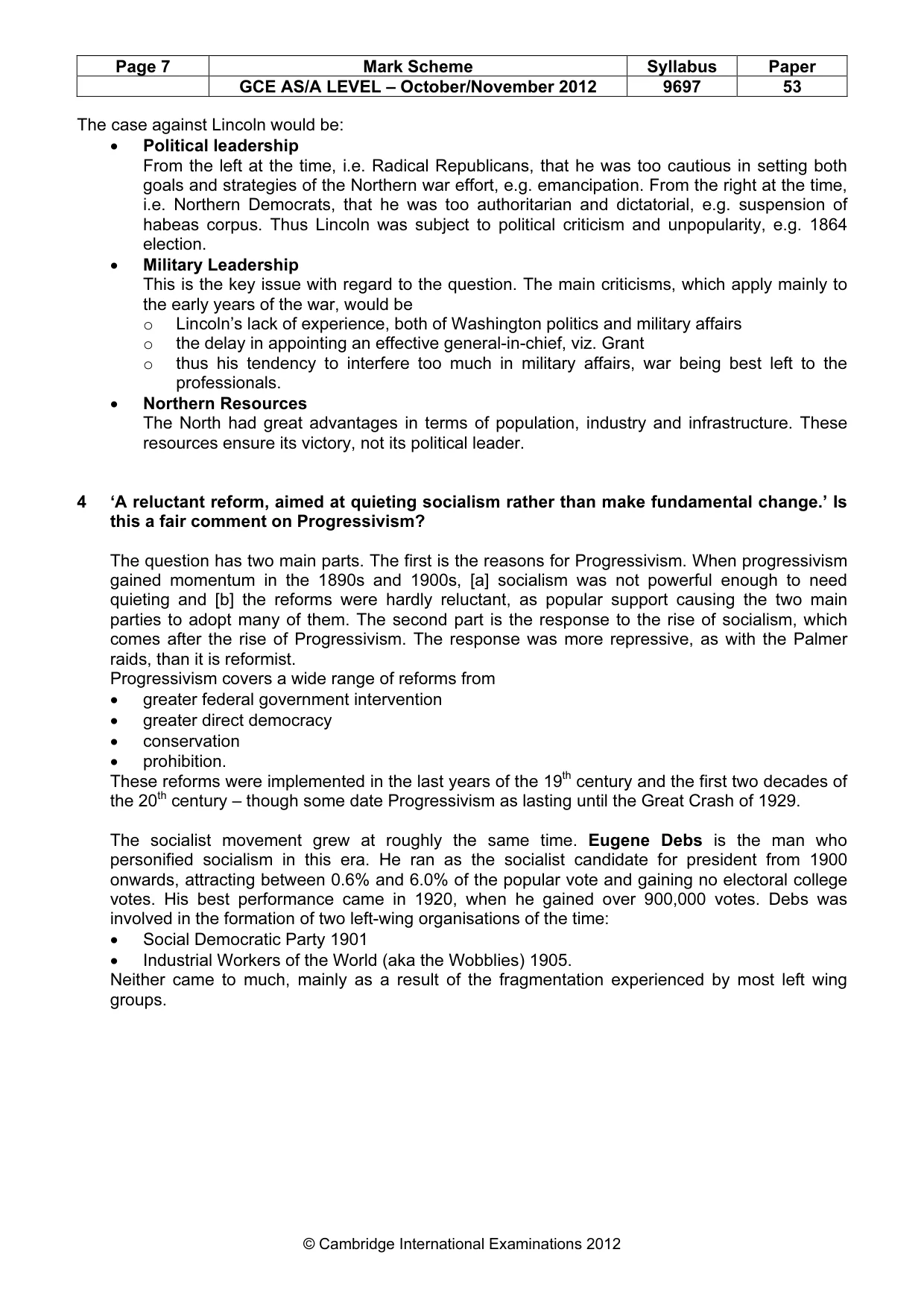
Page 7 Mark Scheme Syllabus Paper GCE AS/A LEVEL – October/November 2012 9697 53 © Cambridge International Examinations 2012 The case against Lincoln would be: • Political leadership From the left at the time, i.e. Radical Republicans, that he was too cautious in setting both goals and strategies of the Northern war effort, e.g. emancipation. From the right at the time, i.e. Northern Democrats, that he was too authoritarian and dictatorial, e.g. suspension of habeas corpus. Thus Lincoln was subject to political criticism and unpopularity, e.g. 1864 election. • Military Leadership This is the key issue with regard to the question. The main criticisms, which apply mainly to the early years of the war, would be o Lincoln’s lack of experience, both of Washington politics and military affairs o the delay in appointing an effective general-in-chief, viz. Grant o thus his tendency to interfere too much in military affairs, war being best left to the professionals. • Northern Resources The North had great advantages in terms of population, industry and infrastructure. These resources ensure its victory, not its political leader. 4 ‘A reluctant reform, aimed at quieting socialism rather than make fundamental change.’ Is this a fair comment on Progressivism? The question has two main parts. The first is the reasons for Progressivism. When progressivism gained momentum in the 1890s and 1900s, [a] socialism was not powerful enough to need quieting and [b] the reforms were hardly reluctant, as popular support causing the two main parties to adopt many of them. The second part is the response to the rise of socialism, which comes after the rise of Progressivism. The response was more repressive, as with the Palmer raids, than it is reformist. Progressivism covers a wide range of reforms from • greater federal government intervention • greater direct democracy • conservation • prohibition. These reforms were implemented in the last years of the 19th century and the first two decades of the 20th century – though some date Progressivism as lasting until the Great Crash of 1929. The socialist movement grew at roughly the same time. Eugene Debs is the man who personified socialism in this era. He ran as the socialist candidate for president from 1900 onwards, attracting between 0.6% and 6.0% of the popular vote and gaining no electoral college votes. His best performance came in 1920, when he gained over 900,000 votes. Debs was involved in the formation of two left-wing organisations of the time: • Social Democratic Party 1901 • Industrial Workers of the World (aka the Wobblies) 1905. Neither came to much, mainly as a result of the fragmentation experienced by most left wing groups.
Mark scheme, page 8
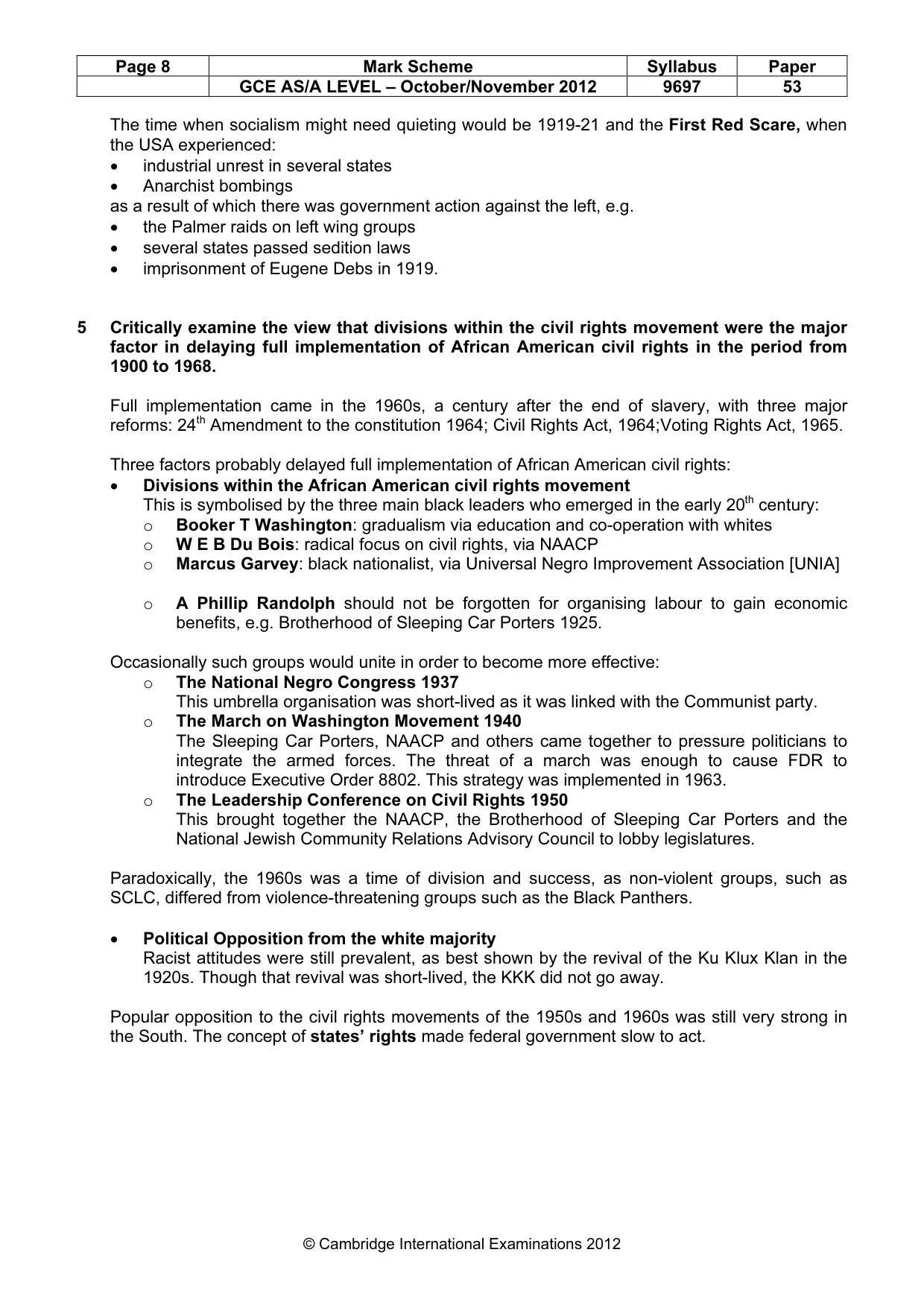
Page 8 Mark Scheme Syllabus Paper GCE AS/A LEVEL – October/November 2012 9697 53 © Cambridge International Examinations 2012 The time when socialism might need quieting would be 1919-21 and the First Red Scare, when the USA experienced: • industrial unrest in several states • Anarchist bombings as a result of which there was government action against the left, e.g. • the Palmer raids on left wing groups • several states passed sedition laws • imprisonment of Eugene Debs in 1919. 5 Critically examine the view that divisions within the civil rights movement were the major factor in delaying full implementation of African American civil rights in the period from 1900 to 1968. Full implementation came in the 1960s, a century after the end of slavery, with three major reforms: 24th Amendment to the constitution 1964; Civil Rights Act, 1964;Voting Rights Act, 1965. Three factors probably delayed full implementation of African American civil rights: • Divisions within the African American civil rights movement This is symbolised by the three main black leaders who emerged in the early 20th century: o Booker T Washington: gradualism via education and co-operation with whites o W E B Du Bois: radical focus on civil rights, via NAACP o Marcus Garvey: black nationalist, via Universal Negro Improvement Association [UNIA] o A Phillip Randolph should not be forgotten for organising labour to gain economic benefits, e.g. Brotherhood of Sleeping Car Porters 1925. Occasionally such groups would unite in order to become more effective: o The National Negro Congress 1937 This umbrella organisation was short-lived as it was linked with the Communist party. o The March on Washington Movement 1940 The Sleeping Car Porters, NAACP and others came together to pressure politicians to integrate the armed forces. The threat of a march was enough to cause FDR to introduce Executive Order 8802. This strategy was implemented in 1963. o The Leadership Conference on Civil Rights 1950 This brought together the NAACP, the Brotherhood of Sleeping Car Porters and the National Jewish Community Relations Advisory Council to lobby legislatures. Paradoxically, the 1960s was a time of division and success, as non-violent groups, such as SCLC, differed from violence-threatening groups such as the Black Panthers. • Political Opposition from the white majority Racist attitudes were still prevalent, as best shown by the revival of the Ku Klux Klan in the 1920s. Though that revival was short-lived, the KKK did not go away. Popular opposition to the civil rights movements of the 1950s and 1960s was still very strong in the South. The concept of states’ rights made federal government slow to act.
Mark scheme, page 9
Page 9 Mark Scheme Syllabus Paper GCE AS/A LEVEL – October/November 2012 9697 53 © Cambridge International Examinations 2012 • Obstacles within the federal system of government o Continued influence in Congress of the Solid South In the Senate especially, white Southerners, aka Dixiecrats, dominated the Democratic party and used the filibuster and the committee system to block many civil rights reforms. o The decisions of the Supreme Court Until the Warren Court of the 1950s and 1960s, the Supreme Court was lukewarm in its support of minority rights. o The attitude of the presidency Presidents were also lukewarm because commitment to blacks meant the loss of white votes – but note the example of FDR above. 6 To what extent was President Hoover to blame for the critical state of the US economy when he left office in March 1933? During his term in office, unemployment rose six-fold to 25% while the GNP fell by almost half and trade by 70%, making the state of the economy very critical indeed. The question asks whether Hoover repaired or worsened the economic weaknesses revealed in October 1929. The conventional verdict is that Hoover’s administration made things worse. Relevant policies included: • Persuading private sector companies to maintain employees’ wages 1929-30 Hoover persuaded some big companies not to cut wages. As prices and profits fell, the only response was to lay off workers in order to reduce the wage bill, increasing unemployment. In terms of helping the unemployed, Hoover urged the private sector to do so, e.g. PECE. • Accepting the Smoot-Hawley Tariff Bill of 1930 Increasing tariffs by up to 50%, the biggest ever, was bound to provoke retaliation and a reduction in international trade which further harmed the US economy, more by provoking retaliation than by reducing imports. Economists urged Hoover to veto the bill, about which he had reservations. He signed anyway. • Attacking the New York stockbrokers By criticising stockbrokers for short selling and thus encouraging Congress to scrutinise the stock exchange undermined willingness of stockbrokers and investors to invest. By late 1931, however, Hoover made a U-turn towards active federal government intervention: • Reconstruction Finance Corporation 1932 • Emergency Relief Construction Act 1932 While at the same time doing the opposite by trying to restore a balanced budget via the Revenue Act June 1932 which increased direct taxes for everyone. The economic crisis of 1932-33 was also caused by other factors and institutions, including: • The Federal Reserve Formed only in 1913, the Federal Reserve was too inexperienced to carry out its duties as lender of last resort and in two important respects: o Setting high rather than low rates of interests this further deflated the economy rather than inflating it o Failing to support underfunded banks as with the Bank of the United States in 1930. • Structural Defects Especially the Gold Standard, restored for most states in 1920s and then abandoned in 1930s.
Mark scheme, page 10
Page 10 Mark Scheme Syllabus Paper GCE AS/A LEVEL – October/November 2012 9697 53 © Cambridge International Examinations 2012 7 In your view, which President was the most successful in implementing US foreign policy from 1898 to 1945? Candidates have eight presidents to consider: McKinley, Theodore Roosevelt, Taft, Wilson, Harding, Coolidge, Hoover and Franklin Roosevelt. In practice, they are likely to concentrate on three, probably Woodrow Wilson and the two Roosevelts. Briefly, the foreign policies of each involve: • McKinley 1898-1901 Much happened in a few years: war with Spain over Cuba & USS Maine leading to US acquisition of Puerto Rico, Guam and Philippines as Cuba as US protectorate to 1934. Hawaii annexed. McKinley made the USA a power with a formal and informal empire. • Theodore Roosevelt 1901-9 Also active policy: building of Panama Canal, which required use of force to create Panama; Roosevelt Corollary – US intervention in American states with serious economic problems – Panama and Santa Domingo [i.e. Dominican Republic]; building of US navy, the Great White Fleet; peacemaking role in Far East and North Africa. • William Taft 1909-13 In contrast with TR, Taft focused more on trade than politics, hence dollar diplomacy. Most issues concerned Central America, sending troops to Nicaragua and almost to Mexico. • Woodrow Wilson 1913-21 Before 1914: desire for a moral policy to ensure peace via bilateral peace treaties; but military intervention in Mexico in 1914. From 1914: use of military force in Caribbean – Haiti, Dominican Republic 1915, Mexico 1916; involvement in First World War 1917; Treaty of Versailles and League of Nations. He was internationalist rather than isolationist. • Warren Harding 1921-3 Active in achieving [a] disarmament, via Washington Naval Conference, and [b] European financial reconstruction, though still no commitment to League of Nations. • Calvin Coolidge 1923-9 He maintained a strong presence, financial and military, in Central America, to the growing anger of countries in the region. In Europe – Dawes Plan and Kellogg-Briand Pact. • Herbert Hoover 1929-33 Main focus was trying to stabilise international financial system, via Young Plan, Hoover Moratorium and Lausanne Conference. In Latin America, he introduced the Good Neighbour policy, removing troops from Nicaragua and planning to do so from Haiti. In the Far East Hoover’s response to Japanese invasion of Manchuria was very cautious. • Franklin Roosevelt 1933-45 Before 1941: Good Neighbour policy in Latin America, withdrawing troops; in response to rise of dictators – Italy, Japan, Germany – FDR broadly accepted isolationism of Neutrality Acts – though more support for UK after 1939. In Second World War: USA as the arsenal of victory, ensuring defeat of Axis powers; leading the formation of the United Nations; attendance at Yalta – too generous to USSR? The question requires some assessment of how successful the various presidents had been. This might involve success both in terms of their own values and goals but also in terms of furthering US interests.
Mark scheme, page 11
Page 11 Mark Scheme Syllabus Paper GCE AS/A LEVEL – October/November 2012 9697 53 © Cambridge International Examinations 2012 8 How far did America become a more tolerant nation during the period from 1945 to 1968? Tolerant is the key word, which candidates need to define if they are to write a thoughtful answer. In social terms, it can vary from the majority’s rather negative putting-up with those with different beliefs and lifestyle to a more positive welcoming of differences, even those it might find objectionable. The main focus should be on how far the majority accepted minorities, the main ones being: • Adults towards adolescents The concept of teenagers emerged in the interwar period, the term first being used in 1941. This was mainly because more and more young people stayed on in high school until 17/18 years old. This period between childhood and adulthood allowed teenagers to develop their own identities and lifestyles. This process was helped by the increasing prosperity – and materialism – of US society in the 1950s and 1960s and the parallel expansion of college education. In addition, companies aimed to provide for this discrete market, e.g. Hollywood and the star culture, e.g. Marlon Brando, James Dean, the music industry, e.g. Elvis Presley. Thus teenagers rebelled against their parents’ in the 1950s with ‘rock n roll’ and in the 1960s to rock and pop, especially as baby boomer children reached adolescence. How far did adults tolerate the unorthodox behaviour of teenagers? There was much talk of the generation gap in the 1960s. Generalisations are difficult to make. Is it valid to say that cultural non-conformity was tolerated, political dissidence less so. • Whites towards ethnic minorities Tolerance towards the blacks in the South in the 1950s was in limited supply. Here political non-conformity was accepted so long as it was conventionally expressed. The Black Panthers were not acceptable. Other ethnic minorities could also be considered, e.g. Japanese and Chinese. • ‘Straights’ towards homosexuals The Stonewall riots against police repression in New York came in 1969, just outside our period. In general, homosexual men were persecuted in the 1950s and 1960s, often being associated with left wing groups. The first lesbian societies were formed in the 1950s but they took second place to the feminist movement of the 1960s. • Men towards women Women were tolerated only if they took second place at home and in the workplace. Hence the Equal Rights Amendment to the constitution was blocked – and still is. A feminist movement did emerge in the 1960s, stimulated by Betty Friedan’s The Feminine Mystique in 1963 and the formation of the National Organisation of Women in 1966. • Moderates towards extremists The 1950s and the 1960s were the era of the Cold War. Thus communists – or alleged communists – were not tolerated by the state and especially by J Edgar Hoover’s FBI. The John Birch Society was formed in 1958 as an anti-communist movement. On the right, the Ku Klux Klan was still active, especially in the South, but the FBI was probably more focused on communists and crypto-communists, such as civil rights leaders.