Cambridge A Level History (pre-2015) 9697 — 2012 Oct/Nov Paper 5 · Variant 2
9697/52/O/N/12
The question paper and its mark scheme, free to read here and free to download. This is Cambridge’s own paper, exactly as it was sat.
Question paper4 pages
Mark scheme10 pages
Answers below. Sit the paper first if you are practising.
Paper as text
Question paper, page 1
This document consists of 4 printed pages. DC (LEG) 63610 © UCLES 2012 [Turn over UNIVERSITY OF CAMBRIDGE INTERNATIONAL EXAMINATIONS General Certificate of Education Advanced Subsidiary Level and Advanced Level * 5 8 9 6 1 0 5 2 0 9 * HISTORY 9697/52 Paper 5 The History of the USA, c.1840–1968 October/November 2012 3 hours Additional Materials: Answer Booklet/Paper READ THESE INSTRUCTIONS FIRST Write your Centre number, candidate number and name on all the work you hand in. Write in dark blue or black pen. You may use a soft pencil for any rough working. Do not use staples, paper clips, highlighters, glue or correction fluid. Section A Answer Question 1. Section B Answer any three questions. At the end of the examination, fasten all your work securely together. All questions in this paper carry equal marks.
Question paper, page 2
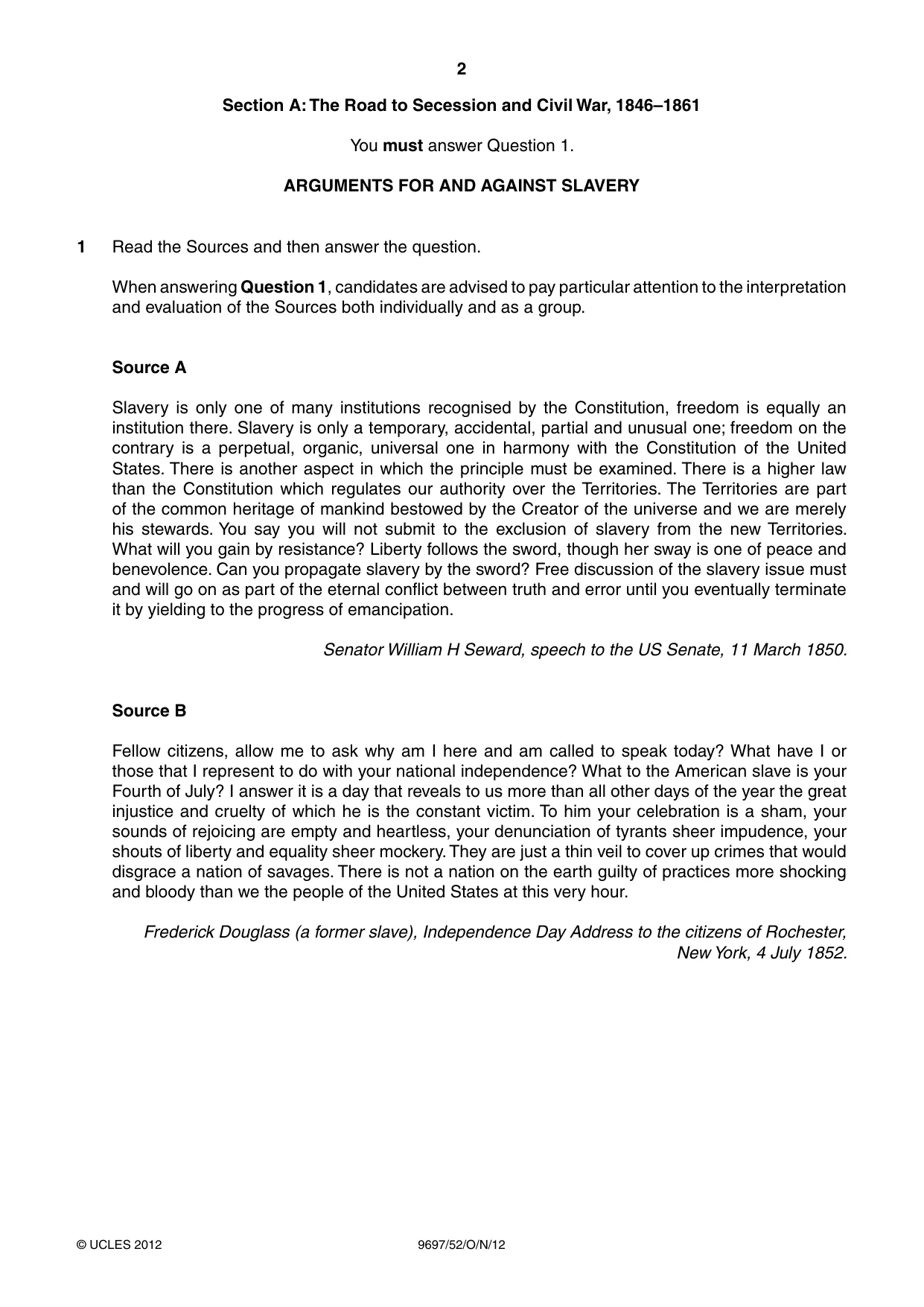
2 9697/52/O/N/12 © UCLES 2012 Section A: The Road to Secession and Civil War, 1846–1861 You must answer Question 1. ARGUMENTS FOR AND AGAINST SLAVERY 1 Read the Sources and then answer the question. When answering Question 1, candidates are advised to pay particular attention to the interpretation and evaluation of the Sources both individually and as a group. Source A Slavery is only one of many institutions recognised by the Constitution, freedom is equally an institution there. Slavery is only a temporary, accidental, partial and unusual one; freedom on the contrary is a perpetual, organic, universal one in harmony with the Constitution of the United States. There is another aspect in which the principle must be examined. There is a higher law than the Constitution which regulates our authority over the Territories. The Territories are part of the common heritage of mankind bestowed by the Creator of the universe and we are merely his stewards. You say you will not submit to the exclusion of slavery from the new Territories. What will you gain by resistance? Liberty follows the sword, though her sway is one of peace and benevolence. Can you propagate slavery by the sword? Free discussion of the slavery issue must and will go on as part of the eternal conflict between truth and error until you eventually terminate it by yielding to the progress of emancipation. Senator William H Seward, speech to the US Senate, 11 March 1850. Source B Fellow citizens, allow me to ask why am I here and am called to speak today? What have I or those that I represent to do with your national independence? What to the American slave is your Fourth of July? I answer it is a day that reveals to us more than all other days of the year the great injustice and cruelty of which he is the constant victim. To him your celebration is a sham, your sounds of rejoicing are empty and heartless, your denunciation of tyrants sheer impudence, your shouts of liberty and equality sheer mockery. They are just a thin veil to cover up crimes that would disgrace a nation of savages. There is not a nation on the earth guilty of practices more shocking and bloody than we the people of the United States at this very hour. Frederick Douglass (a former slave), Independence Day Address to the citizens of Rochester, New York, 4 July 1852.
Question paper, page 3
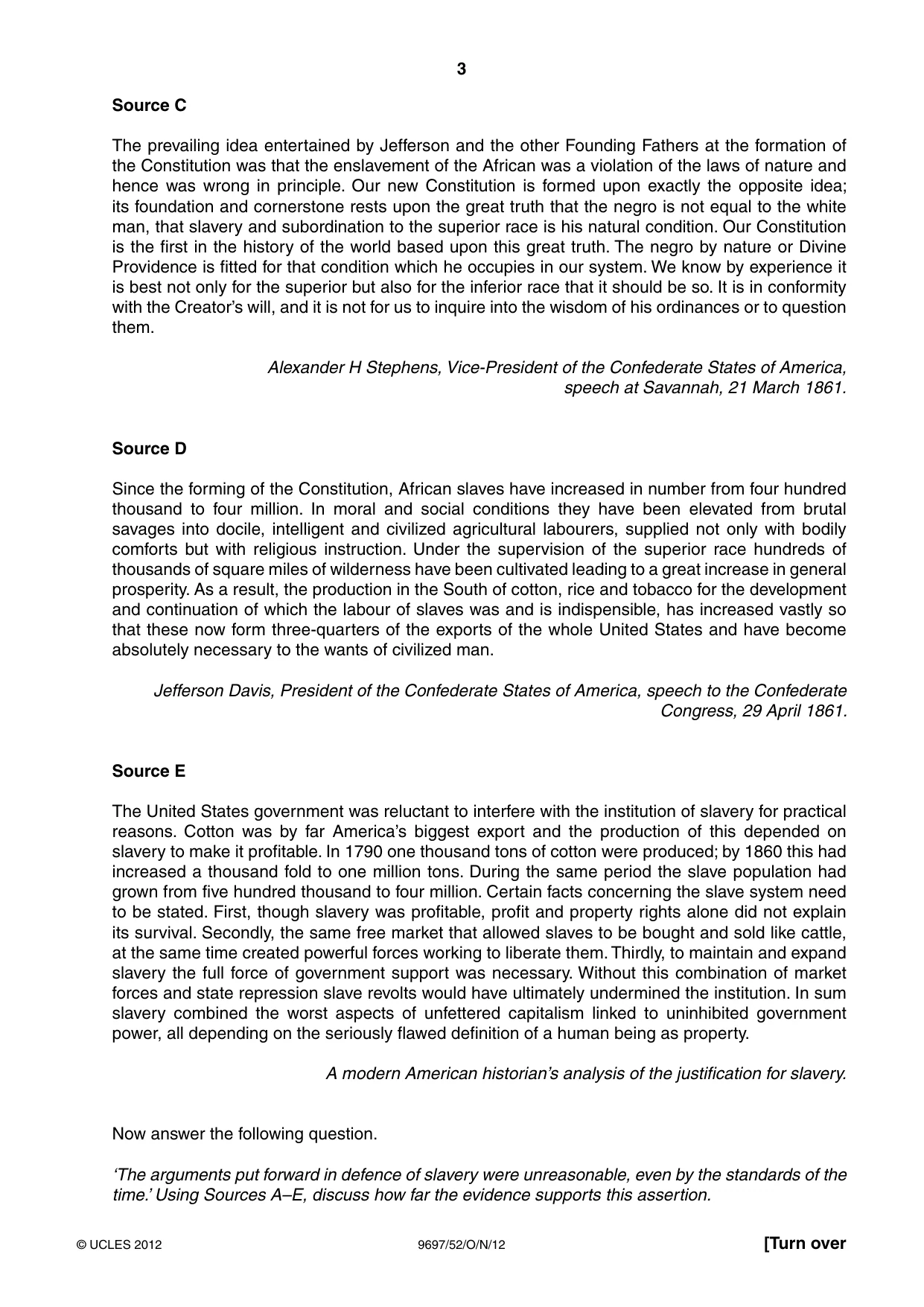
3 9697/52/O/N/12 © UCLES 2012 [Turn over Source C The prevailing idea entertained by Jefferson and the other Founding Fathers at the formation of the Constitution was that the enslavement of the African was a violation of the laws of nature and hence was wrong in principle. Our new Constitution is formed upon exactly the opposite idea; its foundation and cornerstone rests upon the great truth that the negro is not equal to the white man, that slavery and subordination to the superior race is his natural condition. Our Constitution is the first in the history of the world based upon this great truth. The negro by nature or Divine Providence is fitted for that condition which he occupies in our system. We know by experience it is best not only for the superior but also for the inferior race that it should be so. It is in conformity with the Creator’s will, and it is not for us to inquire into the wisdom of his ordinances or to question them. Alexander H Stephens, Vice-President of the Confederate States of America, speech at Savannah, 21 March 1861. Source D Since the forming of the Constitution, African slaves have increased in number from four hundred thousand to four million. In moral and social conditions they have been elevated from brutal savages into docile, intelligent and civilized agricultural labourers, supplied not only with bodily comforts but with religious instruction. Under the supervision of the superior race hundreds of thousands of square miles of wilderness have been cultivated leading to a great increase in general prosperity. As a result, the production in the South of cotton, rice and tobacco for the development and continuation of which the labour of slaves was and is indispensible, has increased vastly so that these now form three-quarters of the exports of the whole United States and have become absolutely necessary to the wants of civilized man. Jefferson Davis, President of the Confederate States of America, speech to the Confederate Congress, 29 April 1861. Source E The United States government was reluctant to interfere with the institution of slavery for practical reasons. Cotton was by far America’s biggest export and the production of this depended on slavery to make it profitable. In 1790 one thousand tons of cotton were produced; by 1860 this had increased a thousand fold to one million tons. During the same period the slave population had grown from five hundred thousand to four million. Certain facts concerning the slave system need to be stated. First, though slavery was profitable, profit and property rights alone did not explain its survival. Secondly, the same free market that allowed slaves to be bought and sold like cattle, at the same time created powerful forces working to liberate them. Thirdly, to maintain and expand slavery the full force of government support was necessary. Without this combination of market forces and state repression slave revolts would have ultimately undermined the institution. In sum slavery combined the worst aspects of unfettered capitalism linked to uninhibited government power, all depending on the seriously flawed definition of a human being as property. A modern American historian’s analysis of the justification for slavery. Now answer the following question. ‘The arguments put forward in defence of slavery were unreasonable, even by the standards of the time.’ Using Sources A–E, discuss how far the evidence supports this assertion.
Question paper, page 4
4 9697/52/O/N/12 © UCLES 2012 Section B You must answer three questions from this section. 2 Assess the significance of Turner’s frontier thesis. 3 ‘The main weakness of Radical Reconstruction was that it was not radical enough.’ How far do you agree? 4 ‘The measures taken to regulate large industrial combinations between 1865 and 1914 were completely ineffective.’ Critically discuss this assertion. 5 How great were the advances made by African Americans as a result of the two world wars? 6 Analyse the reasons why Roosevelt’s New Deal faced so much opposition in the period from 1933 to 1941. 7 Account for the United States’ return to partial isolation in the period from 1921 to 1933. 8 How far did the role and status of women change between 1945 and 1968? Copyright Acknowledgements: Source E © Howard Zinn; A People’s History of the United States; Pearson Education; 2003. Permission to reproduce items where third-party owned material protected by copyright is included has been sought and cleared where possible. Every reasonable effort has been made by the publisher (UCLES) to trace copyright holders, but if any items requiring clearance have unwittingly been included, the publisher will be pleased to make amends at the earliest possible opportunity. University of Cambridge International Examinations is part of the Cambridge Assessment Group. Cambridge Assessment is the brand name of University of Cambridge Local Examinations Syndicate (UCLES), which is itself a department of the University of Cambridge.
Mark scheme, page 1
CAMBRIDGE INTERNATIONAL EXAMINATIONS GCE Advanced Subsidiary Level and GCE Advanced Level MARK SCHEME for the October/November 2012 series 9697 HISTORY 9697/52 Paper 5, maximum raw mark 100 This mark scheme is published as an aid to teachers and candidates, to indicate the requirements of the examination. It shows the basis on which Examiners were instructed to award marks. It does not indicate the details of the discussions that took place at an Examiners’ meeting before marking began, which would have considered the acceptability of alternative answers. Mark schemes should be read in conjunction with the question paper and the Principal Examiner Report for Teachers. Cambridge will not enter into discussions about these mark schemes. Cambridge is publishing the mark schemes for the October/November 2012 series for most IGCSE, GCE Advanced Level and Advanced Subsidiary Level components and some Ordinary Level components.
Mark scheme, page 2
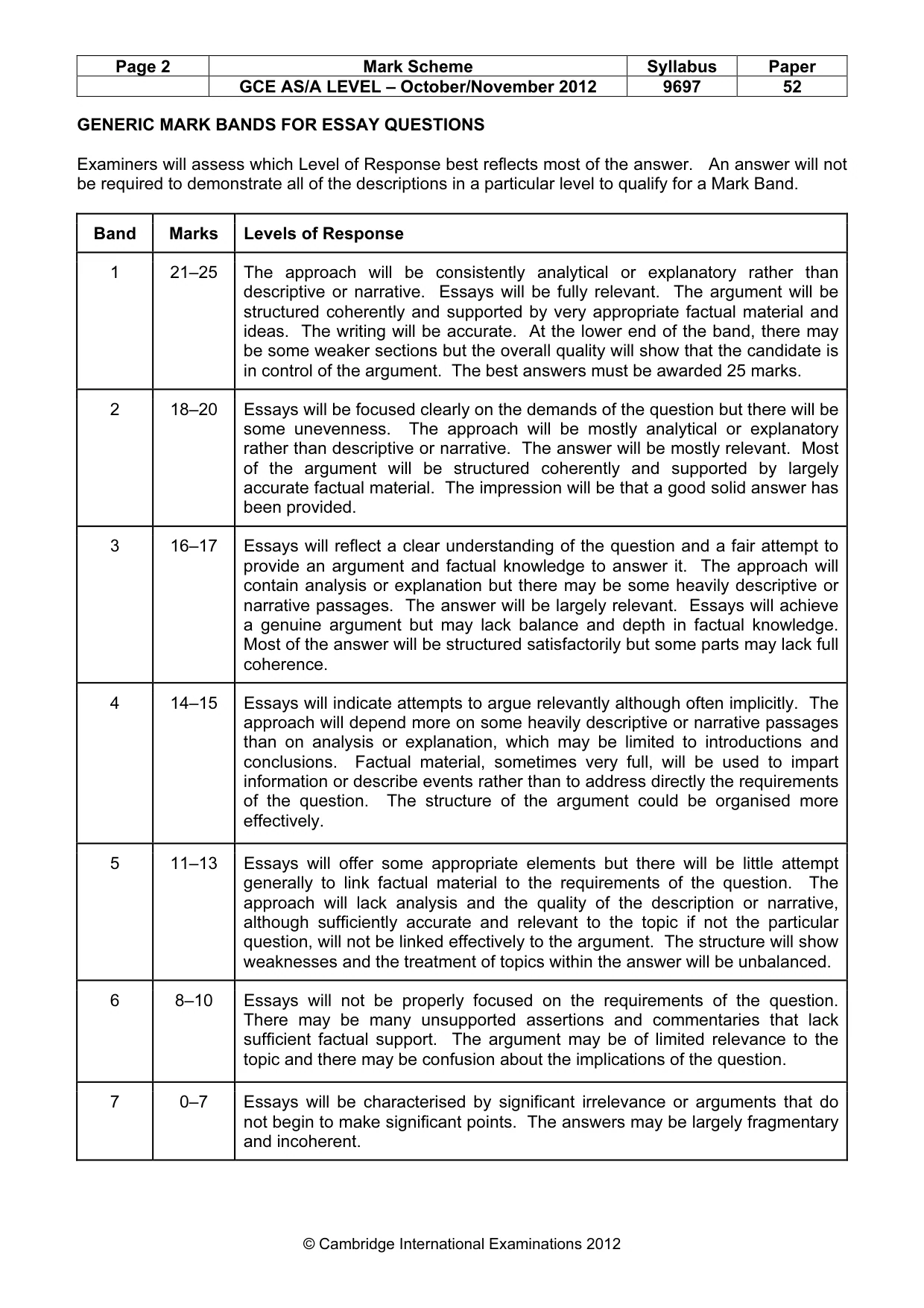
Page 2 Mark Scheme Syllabus Paper GCE AS/A LEVEL – October/November 2012 9697 52 © Cambridge International Examinations 2012 GENERIC MARK BANDS FOR ESSAY QUESTIONS Examiners will assess which Level of Response best reflects most of the answer. An answer will not be required to demonstrate all of the descriptions in a particular level to qualify for a Mark Band. Band Marks Levels of Response 1 21–25 The approach will be consistently analytical or explanatory rather than descriptive or narrative. Essays will be fully relevant. The argument will be structured coherently and supported by very appropriate factual material and ideas. The writing will be accurate. At the lower end of the band, there may be some weaker sections but the overall quality will show that the candidate is in control of the argument. The best answers must be awarded 25 marks. 2 18–20 Essays will be focused clearly on the demands of the question but there will be some unevenness. The approach will be mostly analytical or explanatory rather than descriptive or narrative. The answer will be mostly relevant. Most of the argument will be structured coherently and supported by largely accurate factual material. The impression will be that a good solid answer has been provided. 3 16–17 Essays will reflect a clear understanding of the question and a fair attempt to provide an argument and factual knowledge to answer it. The approach will contain analysis or explanation but there may be some heavily descriptive or narrative passages. The answer will be largely relevant. Essays will achieve a genuine argument but may lack balance and depth in factual knowledge. Most of the answer will be structured satisfactorily but some parts may lack full coherence. 4 14–15 Essays will indicate attempts to argue relevantly although often implicitly. The approach will depend more on some heavily descriptive or narrative passages than on analysis or explanation, which may be limited to introductions and conclusions. Factual material, sometimes very full, will be used to impart information or describe events rather than to address directly the requirements of the question. The structure of the argument could be organised more effectively. 5 11–13 Essays will offer some appropriate elements but there will be little attempt generally to link factual material to the requirements of the question. The approach will lack analysis and the quality of the description or narrative, although sufficiently accurate and relevant to the topic if not the particular question, will not be linked effectively to the argument. The structure will show weaknesses and the treatment of topics within the answer will be unbalanced. 6 8–10 Essays will not be properly focused on the requirements of the question. There may be many unsupported assertions and commentaries that lack sufficient factual support. The argument may be of limited relevance to the topic and there may be confusion about the implications of the question. 7 0–7 Essays will be characterised by significant irrelevance or arguments that do not begin to make significant points. The answers may be largely fragmentary and incoherent.
Mark scheme, page 3
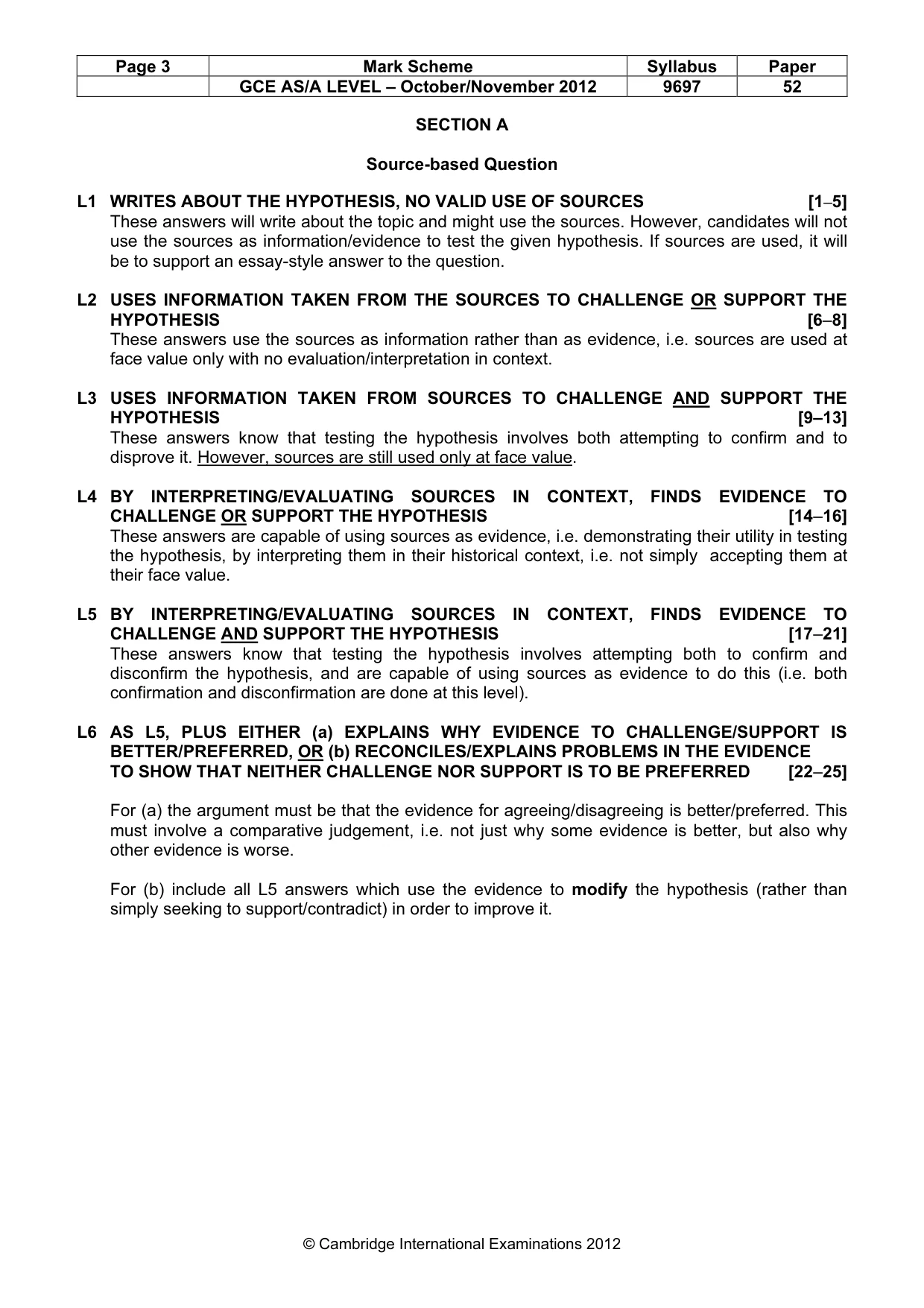
Page 3 Mark Scheme Syllabus Paper GCE AS/A LEVEL – October/November 2012 9697 52 © Cambridge International Examinations 2012 SECTION A Source-based Question L1 WRITES ABOUT THE HYPOTHESIS, NO VALID USE OF SOURCES [1–5] These answers will write about the topic and might use the sources. However, candidates will not use the sources as information/evidence to test the given hypothesis. If sources are used, it will be to support an essay-style answer to the question. L2 USES INFORMATION TAKEN FROM THE SOURCES TO CHALLENGE OR SUPPORT THE HYPOTHESIS [6–8] These answers use the sources as information rather than as evidence, i.e. sources are used at face value only with no evaluation/interpretation in context. L3 USES INFORMATION TAKEN FROM SOURCES TO CHALLENGE AND SUPPORT THE HYPOTHESIS [9–13] These answers know that testing the hypothesis involves both attempting to confirm and to disprove it. However, sources are still used only at face value. L4 BY INTERPRETING/EVALUATING SOURCES IN CONTEXT, FINDS EVIDENCE TO CHALLENGE OR SUPPORT THE HYPOTHESIS [14–16] These answers are capable of using sources as evidence, i.e. demonstrating their utility in testing the hypothesis, by interpreting them in their historical context, i.e. not simply accepting them at their face value. L5 BY INTERPRETING/EVALUATING SOURCES IN CONTEXT, FINDS EVIDENCE TO CHALLENGE AND SUPPORT THE HYPOTHESIS [17–21] These answers know that testing the hypothesis involves attempting both to confirm and disconfirm the hypothesis, and are capable of using sources as evidence to do this (i.e. both confirmation and disconfirmation are done at this level). L6 AS L5, PLUS EITHER (a) EXPLAINS WHY EVIDENCE TO CHALLENGE/SUPPORT IS BETTER/PREFERRED, OR (b) RECONCILES/EXPLAINS PROBLEMS IN THE EVIDENCE TO SHOW THAT NEITHER CHALLENGE NOR SUPPORT IS TO BE PREFERRED [22–25] For (a) the argument must be that the evidence for agreeing/disagreeing is better/preferred. This must involve a comparative judgement, i.e. not just why some evidence is better, but also why other evidence is worse. For (b) include all L5 answers which use the evidence to modify the hypothesis (rather than simply seeking to support/contradict) in order to improve it.
Mark scheme, page 4
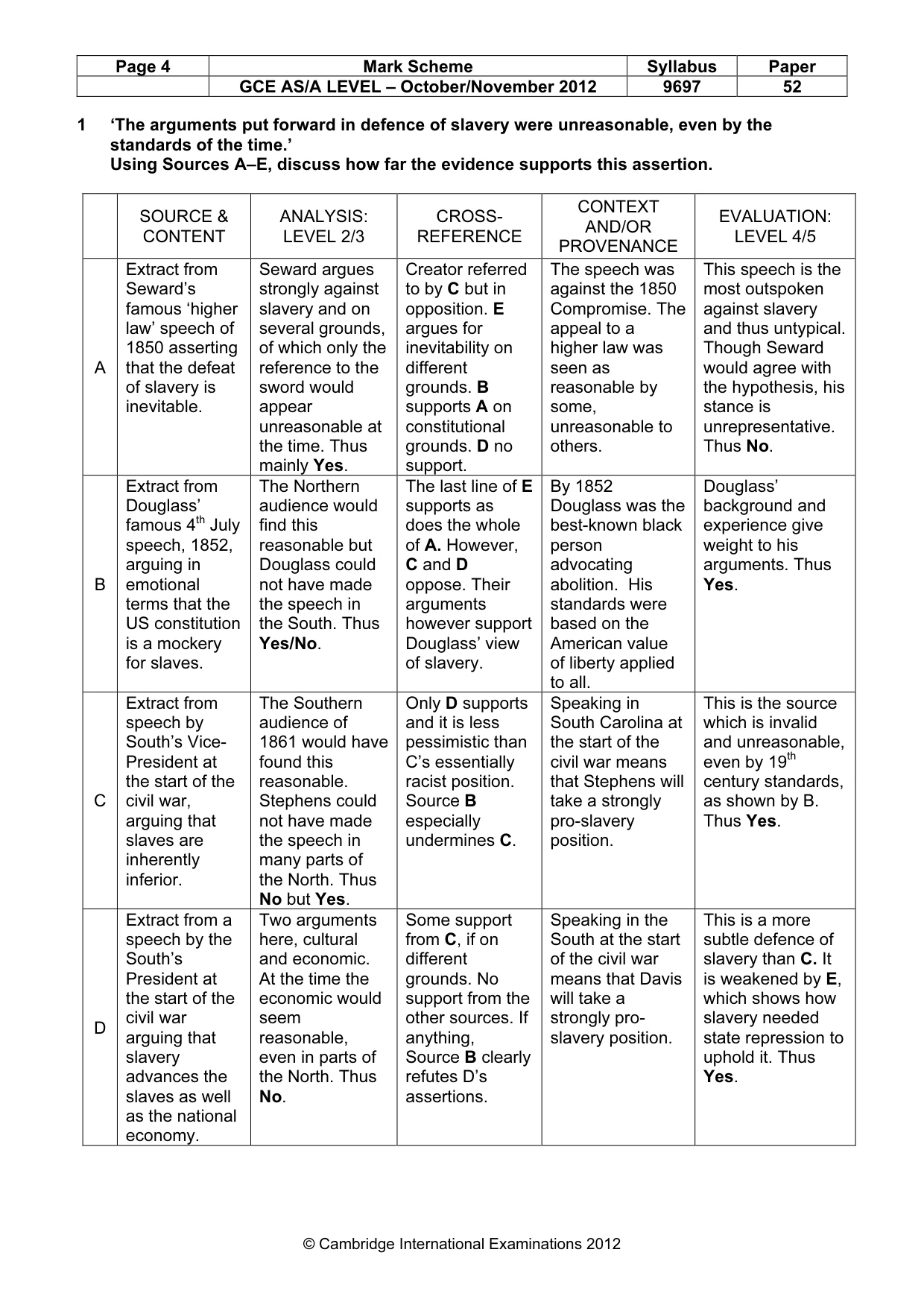
Page 4 Mark Scheme Syllabus Paper GCE AS/A LEVEL – October/November 2012 9697 52 © Cambridge International Examinations 2012 1 ‘The arguments put forward in defence of slavery were unreasonable, even by the standards of the time.’ Using Sources A–E, discuss how far the evidence supports this assertion. SOURCE & CONTENT ANALYSIS: LEVEL 2/3 CROSS- REFERENCE CONTEXT AND/OR PROVENANCE EVALUATION: LEVEL 4/5 A Extract from Seward’s famous ‘higher law’ speech of 1850 asserting that the defeat of slavery is inevitable. Seward argues strongly against slavery and on several grounds, of which only the reference to the sword would appear unreasonable at the time. Thus mainly Yes. Creator referred to by C but in opposition. E argues for inevitability on different grounds. B supports A on constitutional grounds. D no support. The speech was against the 1850 Compromise. The appeal to a higher law was seen as reasonable by some, unreasonable to others. This speech is the most outspoken against slavery and thus untypical. Though Seward would agree with the hypothesis, his stance is unrepresentative. Thus No. B Extract from Douglass’ famous 4th July speech, 1852, arguing in emotional terms that the US constitution is a mockery for slaves. The Northern audience would find this reasonable but Douglass could not have made the speech in the South. Thus Yes/No. The last line of E supports as does the whole of A. However, C and D oppose. Their arguments however support Douglass’ view of slavery. By 1852 Douglass was the best-known black person advocating abolition. His standards were based on the American value of liberty applied to all. Douglass’ background and experience give weight to his arguments. Thus Yes. C Extract from speech by South’s Vice- President at the start of the civil war, arguing that slaves are inherently inferior. The Southern audience of 1861 would have found this reasonable. Stephens could not have made the speech in many parts of the North. Thus No but Yes. Only D supports and it is less pessimistic than C’s essentially racist position. Source B especially undermines C. Speaking in South Carolina at the start of the civil war means that Stephens will take a strongly pro-slavery position. This is the source which is invalid and unreasonable, even by 19th century standards, as shown by B. Thus Yes. D Extract from a speech by the South’s President at the start of the civil war arguing that slavery advances the slaves as well as the national economy. Two arguments here, cultural and economic. At the time the economic would seem reasonable, even in parts of the North. Thus No. Some support from C, if on different grounds. No support from the other sources. If anything, Source B clearly refutes D’s assertions. Speaking in the South at the start of the civil war means that Davis will take a strongly pro- slavery position. This is a more subtle defence of slavery than C. It is weakened by E, which shows how slavery needed state repression to uphold it. Thus Yes.
Mark scheme, page 5
Page 5 Mark Scheme Syllabus Paper GCE AS/A LEVEL – October/November 2012 9697 52 © Cambridge International Examinations 2012 E Extract from a modern historian’s summary of responses to slavery, arguing that slavery was based on capitalism, state support and a flawed view of human beings. Argument is a modern one, which must see slavery as unreasonable, even by the standards of the time. Thus Yes. The short term economic argument for slavery is supported by D while its essentially critical view of slavery is backed by A and B. Writing 150 years later gives a different take on the topic. E explains why slavery existed but says little about contemporary arguments for slavery. The only relevant part of E is the final sentence but even that reflects 20th - 21st century values, not 19th century. Thus limited help in evaluating other sources. Thus still Yes. Level 6: in addition to reaching Level 5, candidates can also EITHER (a) explain why one set of sources for or against the hypothesis is preferred to the other OR (b) use the evaluated sources to support an alternative hypothesis. Thus: Either (a): Although there is evaluated evidence to both challenge and support the hypothesis that the arguments put forward in defence of slavery were unreasonable, even by the standards of the time, the evidence for the assertion is stronger. The sources which initially challenge the argument, Sources C and D, are shown on evaluation to be unreliable, if only because they were made by leading defenders of slavery at the start of the Civil War. The sources supporting the assertion, A and B, are supported by contextual knowledge. Source B is especially convincing evidence for the assertion. Or (b): The evaluated evidence shows the strength of arguments of both sides in either justifying or attacking slavery. Perhaps the most unreasonable document is Source A and yet it is arguing against slavery on moral grounds, which seems reasonable in terms of 21st century thought. All four contemporary writers, Sources A–D, would maintain their arguments were reasonable in terms of their particular values – and two of them, on opposite sides, use the Creator to support their assertions. The four contemporary sources show how divergent were the standards of the time between North and South. Thus a more appropriate hypothesis supported by the sources would be ‘the arguments put forward both in defence of and opposition to slavery show how wide was the gap between Northern and Southern values’. NB The above summaries indicate possible approaches to analysing and evaluating the sources. Other approaches are valid, if supported by accurate knowledge and sound understanding, as well as by the skills of source evaluation.
Mark scheme, page 6
Page 6 Mark Scheme Syllabus Paper GCE AS/A LEVEL – October/November 2012 9697 52 © Cambridge International Examinations 2012 SECTION B 2 Assess the significance of Turner’s frontier thesis. The obvious issue is significant for whom or what, Candidates may begin by describing the thesis, first proposed by the historian Frederick Jackson Turner in 1893: • The frontier was an area of ‘free land’ between civilisation and the wilderness. As the USA moved westward so did the frontier region before it. Tuner identified four specific frontiers: fur trading, mining, ranching and farming. • This frontier land provided challenges and opportunities for individuals and groups which helped determine how they lived their lives on the frontier. • These frontier experiences were a major influence in the development of a way of life unique to the USA: democratic, egalitarian and individualistic. • By 1890, the frontier was closed as the USA had expanded from east to west and civilised North America. The thesis is probably the single most important overview of US history. It had a great influence on both future historical studies and on US politics. Theodore Roosevelt, who in 1893 had almost completed his seven-volume The Winning of the West, applauded Turner’s ideas. The thesis gave [white] Americans a coherent and positive explanation of their unique history. Candidates are likely to focus less on Turner’s impact on American historiography and more on Turner’s retrospective view of 19th century America. They will assess the accuracy of Turner’s frontier thesis rather than its significance. The most effective responses will attempt to answer the question directly. 3 ‘The main weakness of Radical Reconstruction was that it was not radical enough.’ How far do you agree? Radical Reconstruction was the strategy of Congressional Republicans for dealing with the Confederacy following its defeat in 1865. It consisted of: • Measures to help ex-slaves e.g. Freedmen’s Bureau which provided assistance to ex-slaves, e.g. public schools. • Demands on the state governments of the Confederacy e.g. redrafting state constitutions, accepting 14th constitutional amendment giving citizenship to blacks in 1868. • Federal intervention in the government of ex-Confederate states e.g. creation of five military districts covering 10 of the 11 Confederate states. Military rule from 1867 enabled the supervision of elections for governments, overcoming the black codes passed in 1865. The new electorate first chose Republican governments composed of freedmen, carpetbaggers and scalawags. These radical policies contrasted with the more lenient policies followed by presidents Lincoln and Johnson from 1863 to 1867. The 1866 mid-term elections gave the Republicans control of Congress in number sufficient to overcome the presidential veto. Thus Radical Reconstruction is the set of federal policies imposed by the US Congress from 1867 to 1877, helped by the presidency of U S Grant. The policies might have been more radical if they had included: • Land Redistribution? Ex-slaves were given personal freedom but no land. Thus they became sharecroppers, working for white landowners. The economic position of most freedmen was little better than before the civil war. • Harsher treatment of white supremacist groups? Groups such as the Ku Klux Klan, the White League were formed in the mid-1860s. The Civil Rights Act of 1871 gave the president the power to act against the KKK and a crackdown
Mark scheme, page 7
Page 7 Mark Scheme Syllabus Paper GCE AS/A LEVEL – October/November 2012 9697 52 © Cambridge International Examinations 2012 followed. Support for the KKK declined. It’s hard to see how the federal government could have been any harsher. On the other side, however, it could be argued that Radical Reconstruction was too radical. Imposing military rule and limiting habeas corpus were drastic measures for a democratic country supposedly at peace. Also the main problem with Radical Reconstruction was that its supporters lost power in 1876, resulting in the Compromise of 1877, by which the Republicans allowed the Democrats to dominate the South. 4 ‘Measures taken to regulate large industrial combinations between 1865 and 1914 were completely ineffective.’ Critically discuss this assertion. The main measures included: • Interstate Commerce Act 1887 This introduced limited controls on the freight charges imposed by railroad companies. It also set up the Interstate Commerce Commission with monitoring powers. In 1897 the Supreme Court limited the power of the ICC. Further acts of Congress in 1893, 1906 and 1910, however, gave the ICC more and greater powers. • Sherman Anti-Trust Act 1890 Essentially a competition act, this limited the power of monopolies and cartels. In 1895 the Supreme Court limited the scope of the Act. Theodore Roosevelt’s trust busting policy was, however, supported by the Supreme Court. He broke up 44 trusts while his successor, Taft, acted against 90. • Clayton Anti-Trust Act 1914 This reinforced the Sherman Act, giving the federal executive more powers. • Federal Trade Commission 1914 Though the work of the FTC started in 1914, its introduction shows a determination to control US interstate commerce – and perhaps the ineffectiveness of previous measures? The most effective responses will analyse these and similar reforms rather than taking a descriptive approach. 5 How great were the advances made by African Americans as a result of the two world wars? This question has two aspects, the impact during the war and the impact afterwards. • During the wars • First World War 1917–18 380 000 African Americans joined the forces, 90% of whom served in labour units rather than on the frontline. There were just 8 black regiments in the army. On the home front, the needs of war led to full employment and increased job opportunities for blacks in northern industrial cities. • Second World War 1941–45 In 1940, 5 000 African Americans served in the army, 2% of the total. 900 000 African Americans served in the forces, most in separate units, though there was some integration on the frontline in 1944–45. Again, a wartime economy provided job opportunities, further stimulating the Great Migration which began in the 1910s. Racial tensions also existed, e.g. race riots in Detroit 1943. There were some political protests, e.g. A Philip Randolph’s planned March on Washington in 1940, which caused FDR to introduce Executive Order 8802 against discriminatory practices in the defence industry. The ‘Double V’ campaign – victory abroad against fascism and at home against racism – attracted broad support.
Mark scheme, page 8
Page 8 Mark Scheme Syllabus Paper GCE AS/A LEVEL – October/November 2012 9697 52 © Cambridge International Examinations 2012 • After the wars • First World War 1917–18 A brief war without clear ideological goals had little effect on the position of African Americans. The rise of communism from 1917 received much more attention, e.g. the Red Scare to 1921. • Second World War 1941–45 A longer war with distinct ideological goals had considerable impact on the place of the blacks in the USA. The best illustration of this was President Truman’s Executive Order 9981, which ordered the integration of US armed forces. The educational opportunities provided by the G I Bill did not benefit blacks greatly. They did expand the black middle class and help educate those who would lead the civil rights movement a decade later. 6 Analyse the reasons why Roosevelt’s New Deal provoked so much opposition in the period from 1933 to 1941. The opposition came from all parts of US politics and government: • Political opposition o From the Left: ‘Thunder on the Left’ Huey Long and ‘Share Our Wealth’, Father Coughlin and the National Union for Social Justice, Dr Townsend and the campaign for state pensions o From the Right: ‘Thunder on the Right’ American business interests, Herbert Hoover, The American Liberty League • Governmental Opposition o From the Supreme Court The US Supreme Court ruled many reforms of the first New Deal to be unconstitutional, e.g. the National Recovery Administration. Thus FDR planned to pack the court, soon abandoned. o From Southern states Some states, especially in the South, saw FDR’s expansion of federal government as a threat to states’ rights, especially as they saw it as a threat to their way of life as well. The reasons why so many groups and organisations opposed the New Deal include • Ideology This helps explain both left and right wing opposition, though ideological perspectives differ: liberal egalitarianism vs. conservative traditionalism. • The nature of the New Deal It was pragmatically conservative and radical at different times, thus upsetting most groups at some time or other. • The impact of the New Deal The New Deal took many years to affect the US economy. The longer the economy remained stalled, the louder the criticism grew. • The Constitution under threat The US constitution, much revered by the US people, seemed under threat from FDR and the New Deal.
Mark scheme, page 9
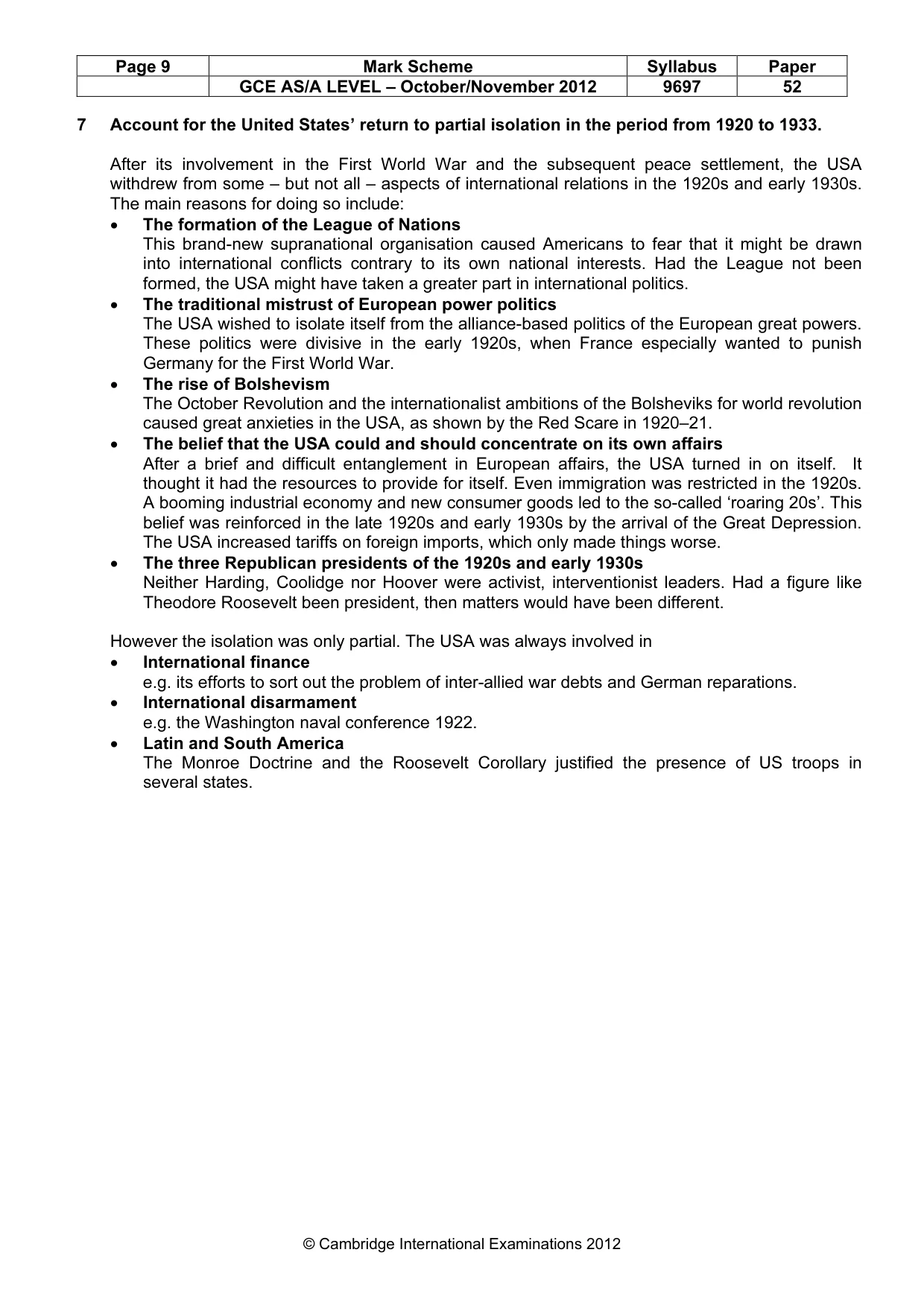
Page 9 Mark Scheme Syllabus Paper GCE AS/A LEVEL – October/November 2012 9697 52 © Cambridge International Examinations 2012 7 Account for the United States’ return to partial isolation in the period from 1920 to 1933. After its involvement in the First World War and the subsequent peace settlement, the USA withdrew from some – but not all – aspects of international relations in the 1920s and early 1930s. The main reasons for doing so include: • The formation of the League of Nations This brand-new supranational organisation caused Americans to fear that it might be drawn into international conflicts contrary to its own national interests. Had the League not been formed, the USA might have taken a greater part in international politics. • The traditional mistrust of European power politics The USA wished to isolate itself from the alliance-based politics of the European great powers. These politics were divisive in the early 1920s, when France especially wanted to punish Germany for the First World War. • The rise of Bolshevism The October Revolution and the internationalist ambitions of the Bolsheviks for world revolution caused great anxieties in the USA, as shown by the Red Scare in 1920–21. • The belief that the USA could and should concentrate on its own affairs After a brief and difficult entanglement in European affairs, the USA turned in on itself. It thought it had the resources to provide for itself. Even immigration was restricted in the 1920s. A booming industrial economy and new consumer goods led to the so-called ‘roaring 20s’. This belief was reinforced in the late 1920s and early 1930s by the arrival of the Great Depression. The USA increased tariffs on foreign imports, which only made things worse. • The three Republican presidents of the 1920s and early 1930s Neither Harding, Coolidge nor Hoover were activist, interventionist leaders. Had a figure like Theodore Roosevelt been president, then matters would have been different. However the isolation was only partial. The USA was always involved in • International finance e.g. its efforts to sort out the problem of inter-allied war debts and German reparations. • International disarmament e.g. the Washington naval conference 1922. • Latin and South America The Monroe Doctrine and the Roosevelt Corollary justified the presence of US troops in several states.
Mark scheme, page 10
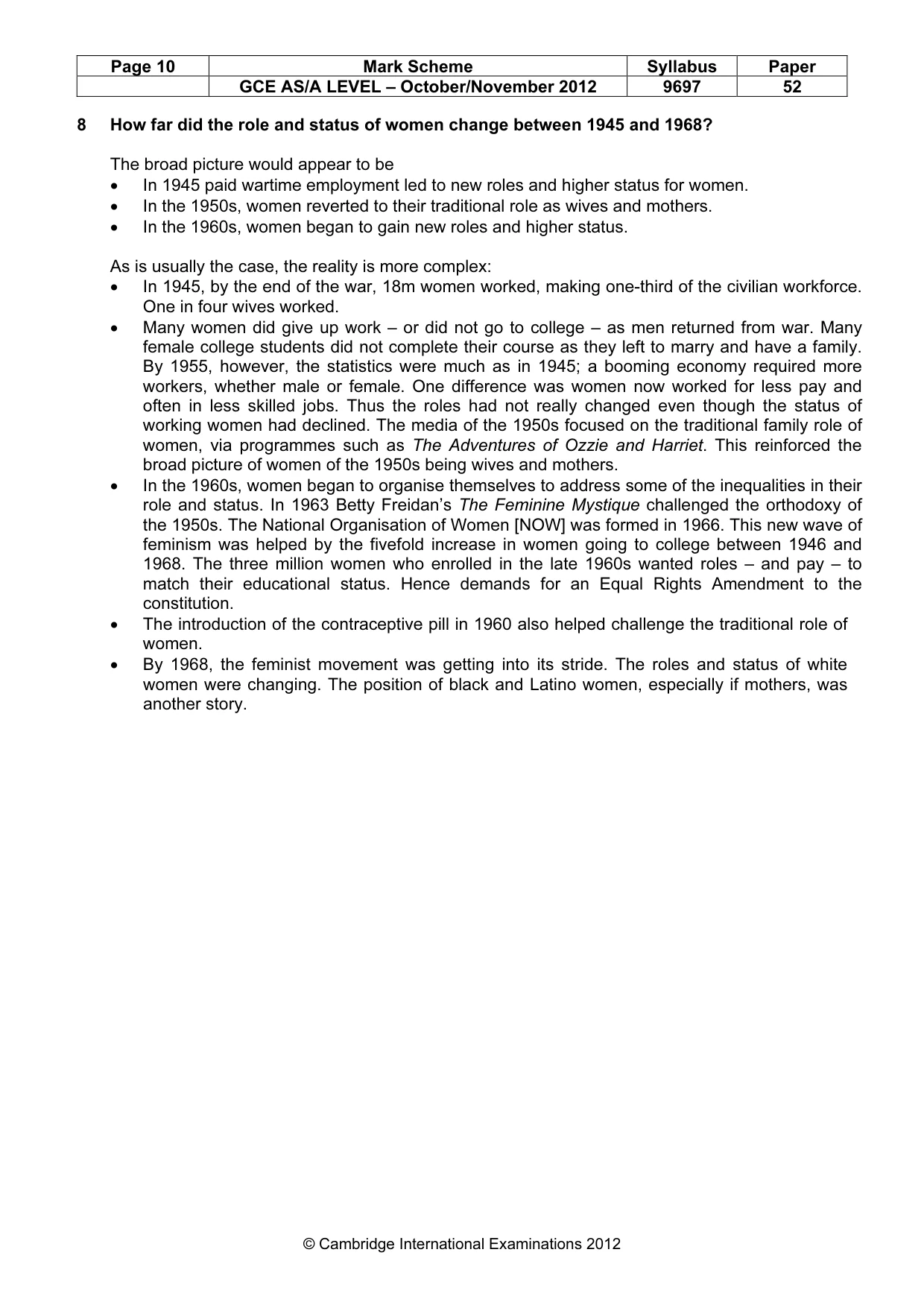
Page 10 Mark Scheme Syllabus Paper GCE AS/A LEVEL – October/November 2012 9697 52 © Cambridge International Examinations 2012 8 How far did the role and status of women change between 1945 and 1968? The broad picture would appear to be • In 1945 paid wartime employment led to new roles and higher status for women. • In the 1950s, women reverted to their traditional role as wives and mothers. • In the 1960s, women began to gain new roles and higher status. As is usually the case, the reality is more complex: • In 1945, by the end of the war, 18m women worked, making one-third of the civilian workforce. One in four wives worked. • Many women did give up work – or did not go to college – as men returned from war. Many female college students did not complete their course as they left to marry and have a family. By 1955, however, the statistics were much as in 1945; a booming economy required more workers, whether male or female. One difference was women now worked for less pay and often in less skilled jobs. Thus the roles had not really changed even though the status of working women had declined. The media of the 1950s focused on the traditional family role of women, via programmes such as The Adventures of Ozzie and Harriet. This reinforced the broad picture of women of the 1950s being wives and mothers. • In the 1960s, women began to organise themselves to address some of the inequalities in their role and status. In 1963 Betty Freidan’s The Feminine Mystique challenged the orthodoxy of the 1950s. The National Organisation of Women [NOW] was formed in 1966. This new wave of feminism was helped by the fivefold increase in women going to college between 1946 and 1968. The three million women who enrolled in the late 1960s wanted roles – and pay – to match their educational status. Hence demands for an Equal Rights Amendment to the constitution. • The introduction of the contraceptive pill in 1960 also helped challenge the traditional role of women. • By 1968, the feminist movement was getting into its stride. The roles and status of white women were changing. The position of black and Latino women, especially if mothers, was another story.