Cambridge A Level History (pre-2015) 9697 — 2014 Oct/Nov Paper 5 · Variant 3
9697/53/O/N/14 · 100 marks · ≈113 min
The question paper and its mark scheme, free to read here and free to download. This is Cambridge’s own paper, exactly as it was sat.
Question paper4 pages
Mark scheme9 pages
Answers below. Sit the paper first if you are practising.
Paper as text
Question paper, page 1
This document consists of 4 printed pages. DC (NH) 91134/3 © UCLES 2014 [Turn over Cambridge International Examinations Cambridge International Advanced Subsidiary and Advanced Level * 9 9 5 3 3 3 7 2 7 5 * HISTORY 9697/53 Paper 5 The History of the USA, c.1840–1968 October/November 2014 3 hours Additional Materials: Answer Paper READ THESE INSTRUCTIONS FIRST Write your Centre number, candidate number and name on all the work you hand in. Write in dark blue or black pen. You may use an HB pencil for any diagrams or graphs. Do not use staples, paper clips, glue or correction fluid. DO NOT WRITE IN ANY BARCODES. Section A Answer Question 1. Section B Answer any three questions. At the end of the examination, fasten all your work securely together. All questions in this paper carry equal marks.
Question paper, page 2
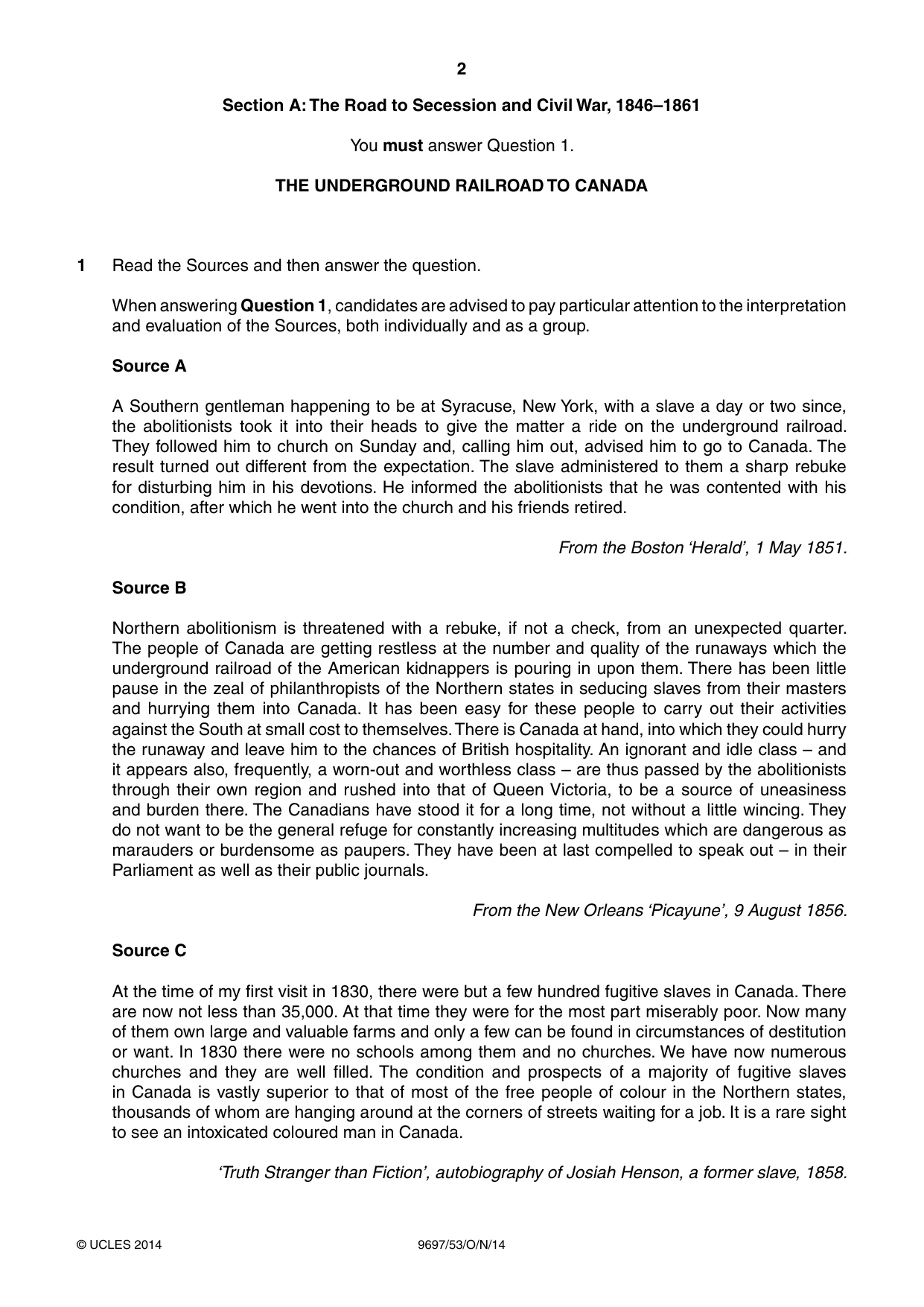
2 9697/53/O/N/14 © UCLES 2014 Section A: The Road to Secession and Civil War, 1846–1861 You must answer Question 1. THE UNDERGROUND RAILROAD TO CANADA 1 Read the Sources and then answer the question. When answering Question 1, candidates are advised to pay particular attention to the interpretation and evaluation of the Sources, both individually and as a group. Source A A Southern gentleman happening to be at Syracuse, New York, with a slave a day or two since, the abolitionists took it into their heads to give the matter a ride on the underground railroad. They followed him to church on Sunday and, calling him out, advised him to go to Canada. The result turned out different from the expectation. The slave administered to them a sharp rebuke for disturbing him in his devotions. He informed the abolitionists that he was contented with his condition, after which he went into the church and his friends retired. From the Boston ‘Herald’, 1 May 1851. Source B Northern abolitionism is threatened with a rebuke, if not a check, from an unexpected quarter. The people of Canada are getting restless at the number and quality of the runaways which the underground railroad of the American kidnappers is pouring in upon them. There has been little pause in the zeal of philanthropists of the Northern states in seducing slaves from their masters and hurrying them into Canada. It has been easy for these people to carry out their activities against the South at small cost to themselves. There is Canada at hand, into which they could hurry the runaway and leave him to the chances of British hospitality. An ignorant and idle class – and it appears also, frequently, a worn-out and worthless class – are thus passed by the abolitionists through their own region and rushed into that of Queen Victoria, to be a source of uneasiness and burden there. The Canadians have stood it for a long time, not without a little wincing. They do not want to be the general refuge for constantly increasing multitudes which are dangerous as marauders or burdensome as paupers. They have been at last compelled to speak out – in their Parliament as well as their public journals. From the New Orleans ‘Picayune’, 9 August 1856. Source C At the time of my first visit in 1830, there were but a few hundred fugitive slaves in Canada. There are now not less than 35,000. At that time they were for the most part miserably poor. Now many of them own large and valuable farms and only a few can be found in circumstances of destitution or want. In 1830 there were no schools among them and no churches. We have now numerous churches and they are well filled. The condition and prospects of a majority of fugitive slaves in Canada is vastly superior to that of most of the free people of colour in the Northern states, thousands of whom are hanging around at the corners of streets waiting for a job. It is a rare sight to see an intoxicated coloured man in Canada. ‘Truth Stranger than Fiction’, autobiography of Josiah Henson, a former slave, 1858.
Question paper, page 3
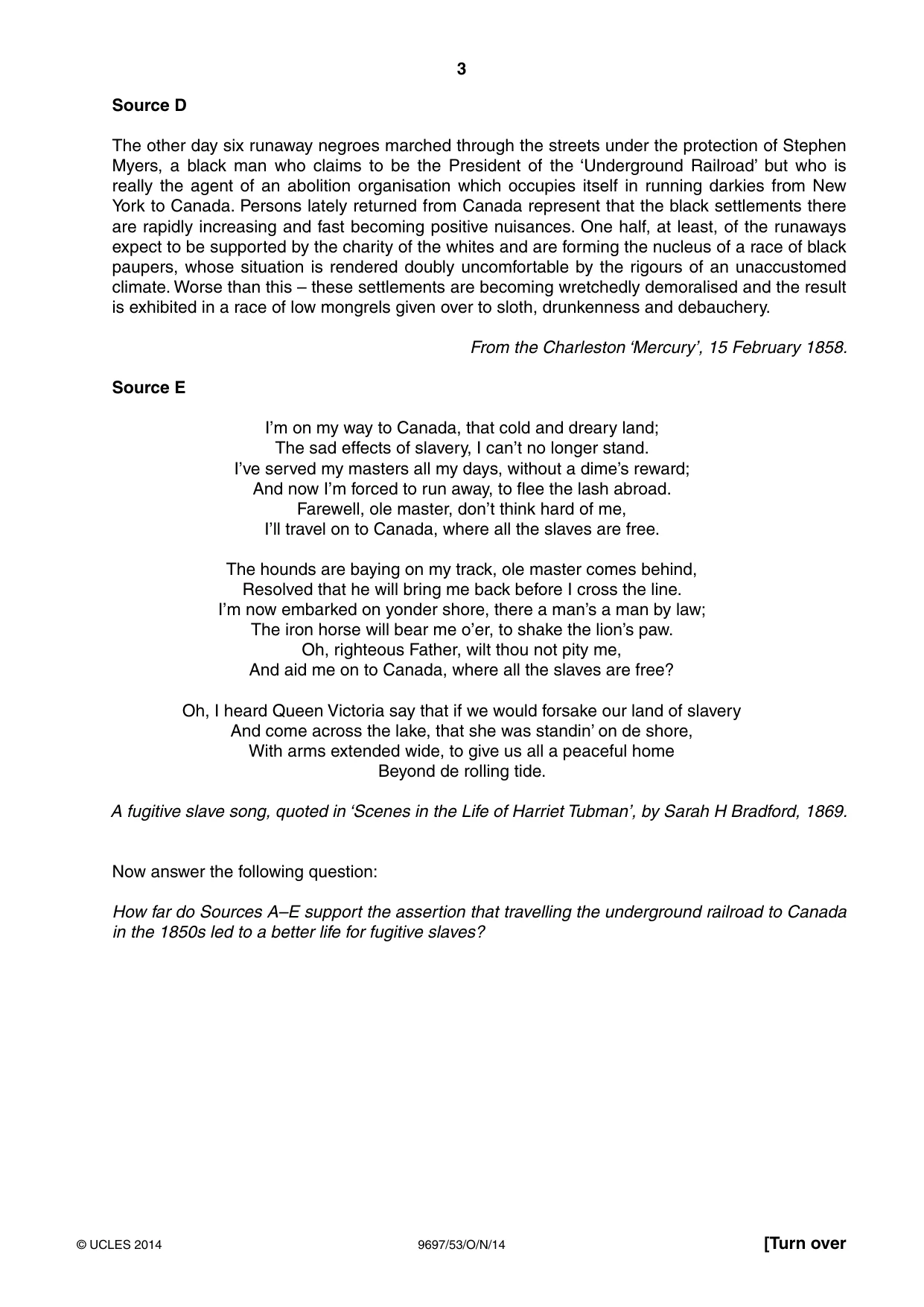
3 9697/53/O/N/14 © UCLES 2014 [Turn over Source D The other day six runaway negroes marched through the streets under the protection of Stephen Myers, a black man who claims to be the President of the ‘Underground Railroad’ but who is really the agent of an abolition organisation which occupies itself in running darkies from New York to Canada. Persons lately returned from Canada represent that the black settlements there are rapidly increasing and fast becoming positive nuisances. One half, at least, of the runaways expect to be supported by the charity of the whites and are forming the nucleus of a race of black paupers, whose situation is rendered doubly uncomfortable by the rigours of an unaccustomed climate. Worse than this – these settlements are becoming wretchedly demoralised and the result is exhibited in a race of low mongrels given over to sloth, drunkenness and debauchery. From the Charleston ‘Mercury’, 15 February 1858. Source E I’m on my way to Canada, that cold and dreary land; The sad effects of slavery, I can’t no longer stand. I’ve served my masters all my days, without a dime’s reward; And now I’m forced to run away, to flee the lash abroad. Farewell, ole master, don’t think hard of me, I’ll travel on to Canada, where all the slaves are free. The hounds are baying on my track, ole master comes behind, Resolved that he will bring me back before I cross the line. I’m now embarked on yonder shore, there a man’s a man by law; The iron horse will bear me o’er, to shake the lion’s paw. Oh, righteous Father, wilt thou not pity me, And aid me on to Canada, where all the slaves are free? Oh, I heard Queen Victoria say that if we would forsake our land of slavery And come across the lake, that she was standin’ on de shore, With arms extended wide, to give us all a peaceful home Beyond de rolling tide. A fugitive slave song, quoted in ‘Scenes in the Life of Harriet Tubman’, by Sarah H Bradford, 1869. Now answer the following question: How far do Sources A–E support the assertion that travelling the underground railroad to Canada in the 1850s led to a better life for fugitive slaves?
Question paper, page 4
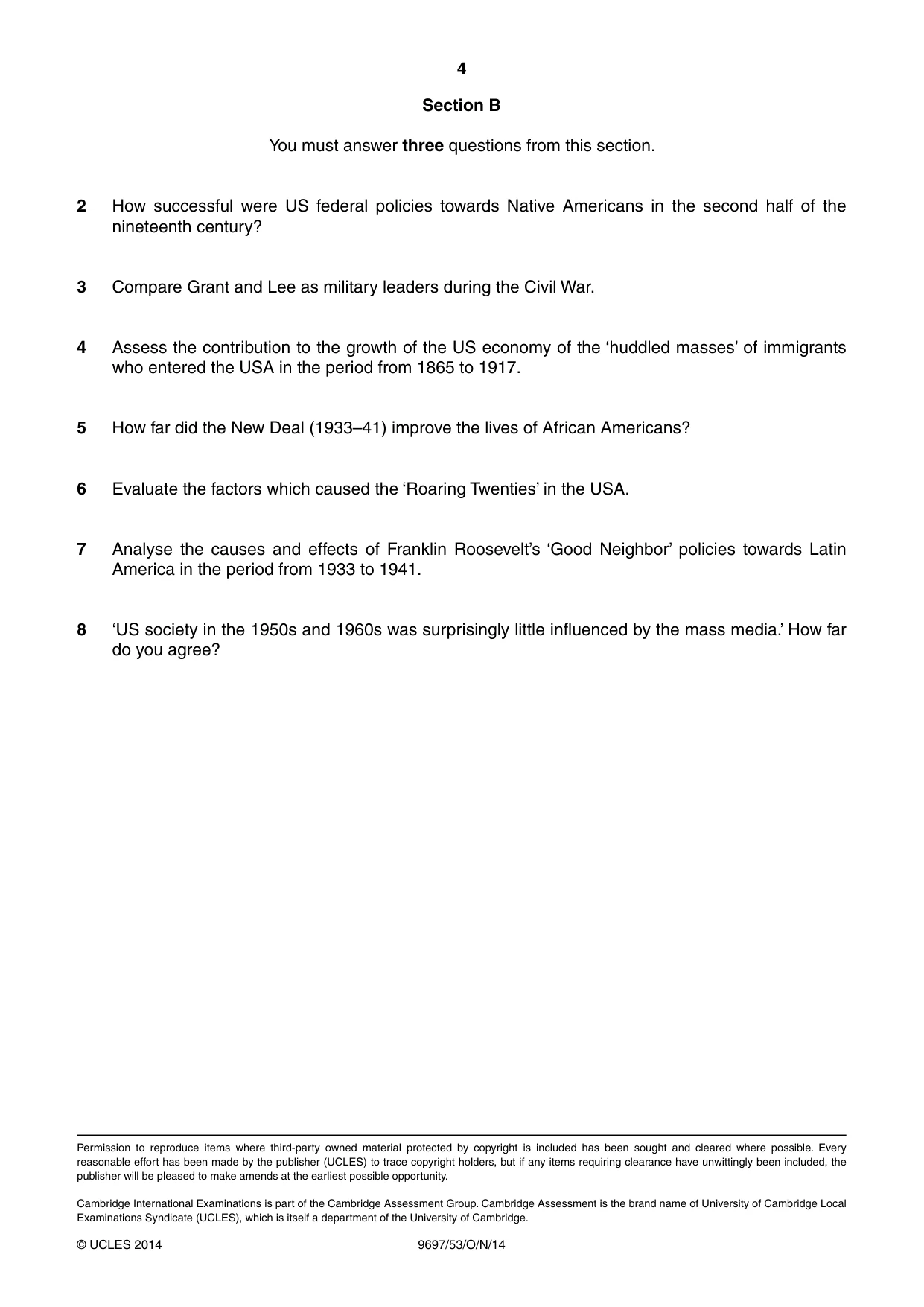
4 9697/53/O/N/14 © UCLES 2014 Permission to reproduce items where third-party owned material protected by copyright is included has been sought and cleared where possible. Every reasonable effort has been made by the publisher (UCLES) to trace copyright holders, but if any items requiring clearance have unwittingly been included, the publisher will be pleased to make amends at the earliest possible opportunity. Cambridge International Examinations is part of the Cambridge Assessment Group. Cambridge Assessment is the brand name of University of Cambridge Local Examinations Syndicate (UCLES), which is itself a department of the University of Cambridge. Section B You must answer three questions from this section. 2 How successful were US federal policies towards Native Americans in the second half of the nineteenth century? 3 Compare Grant and Lee as military leaders during the Civil War. 4 Assess the contribution to the growth of the US economy of the ‘huddled masses’ of immigrants who entered the USA in the period from 1865 to 1917. 5 How far did the New Deal (1933–41) improve the lives of African Americans? 6 Evaluate the factors which caused the ‘Roaring Twenties’ in the USA. 7 Analyse the causes and effects of Franklin Roosevelt’s ‘Good Neighbor’ policies towards Latin America in the period from 1933 to 1941. 8 ‘US society in the 1950s and 1960s was surprisingly little influenced by the mass media.’ How far do you agree?
Mark scheme, page 1
® IGCSE is the registered trademark of Cambridge International Examinations. CAMBRIDGE INTERNATIONAL EXAMINATIONS Cambridge International Advanced Subsidiary and Advanced Level MARK SCHEME for the October/November 2014 series 9697 HISTORY 9697/53 Paper 53, maximum raw mark 100 This mark scheme is published as an aid to teachers and candidates, to indicate the requirements of the examination. It shows the basis on which Examiners were instructed to award marks. It does not indicate the details of the discussions that took place at an Examiners’ meeting before marking began, which would have considered the acceptability of alternative answers. Mark schemes should be read in conjunction with the question paper and the Principal Examiner Report for Teachers. Cambridge will not enter into discussions about these mark schemes. Cambridge is publishing the mark schemes for the October/November 2014 series for most Cambridge IGCSE®, Cambridge International A and AS Level components and some Cambridge O Level components.
Mark scheme, page 2
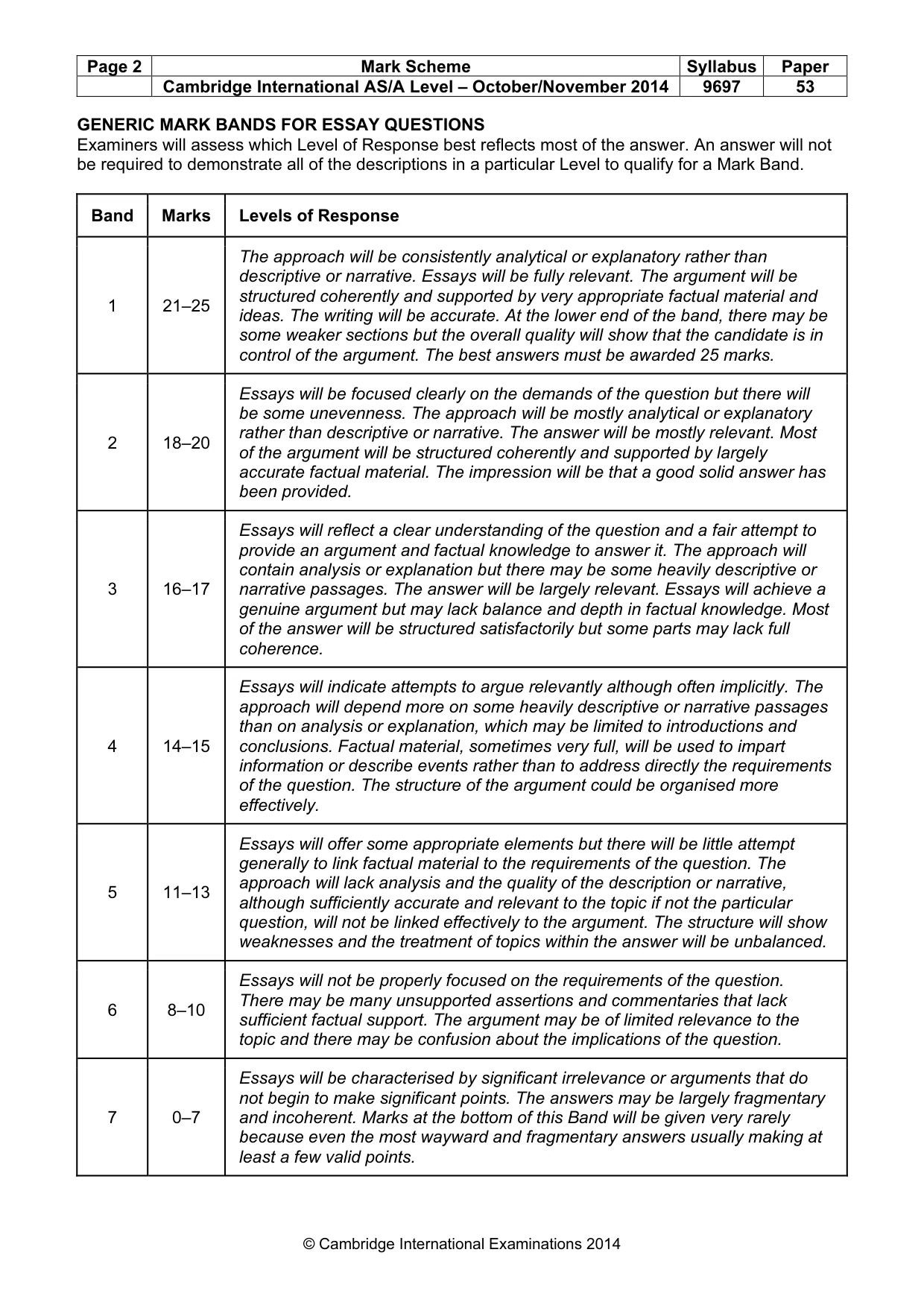
Page 2 Mark Scheme Syllabus Paper Cambridge International AS/A Level – October/November 2014 9697 53 © Cambridge International Examinations 2014 GENERIC MARK BANDS FOR ESSAY QUESTIONS Examiners will assess which Level of Response best reflects most of the answer. An answer will not be required to demonstrate all of the descriptions in a particular Level to qualify for a Mark Band. Band Marks Levels of Response 1 21–25 The approach will be consistently analytical or explanatory rather than descriptive or narrative. Essays will be fully relevant. The argument will be structured coherently and supported by very appropriate factual material and ideas. The writing will be accurate. At the lower end of the band, there may be some weaker sections but the overall quality will show that the candidate is in control of the argument. The best answers must be awarded 25 marks. 2 18–20 Essays will be focused clearly on the demands of the question but there will be some unevenness. The approach will be mostly analytical or explanatory rather than descriptive or narrative. The answer will be mostly relevant. Most of the argument will be structured coherently and supported by largely accurate factual material. The impression will be that a good solid answer has been provided. 3 16–17 Essays will reflect a clear understanding of the question and a fair attempt to provide an argument and factual knowledge to answer it. The approach will contain analysis or explanation but there may be some heavily descriptive or narrative passages. The answer will be largely relevant. Essays will achieve a genuine argument but may lack balance and depth in factual knowledge. Most of the answer will be structured satisfactorily but some parts may lack full coherence. 4 14–15 Essays will indicate attempts to argue relevantly although often implicitly. The approach will depend more on some heavily descriptive or narrative passages than on analysis or explanation, which may be limited to introductions and conclusions. Factual material, sometimes very full, will be used to impart information or describe events rather than to address directly the requirements of the question. The structure of the argument could be organised more effectively. 5 11–13 Essays will offer some appropriate elements but there will be little attempt generally to link factual material to the requirements of the question. The approach will lack analysis and the quality of the description or narrative, although sufficiently accurate and relevant to the topic if not the particular question, will not be linked effectively to the argument. The structure will show weaknesses and the treatment of topics within the answer will be unbalanced. 6 8–10 Essays will not be properly focused on the requirements of the question. There may be many unsupported assertions and commentaries that lack sufficient factual support. The argument may be of limited relevance to the topic and there may be confusion about the implications of the question. 7 0–7 Essays will be characterised by significant irrelevance or arguments that do not begin to make significant points. The answers may be largely fragmentary and incoherent. Marks at the bottom of this Band will be given very rarely because even the most wayward and fragmentary answers usually making at least a few valid points.
Mark scheme, page 3
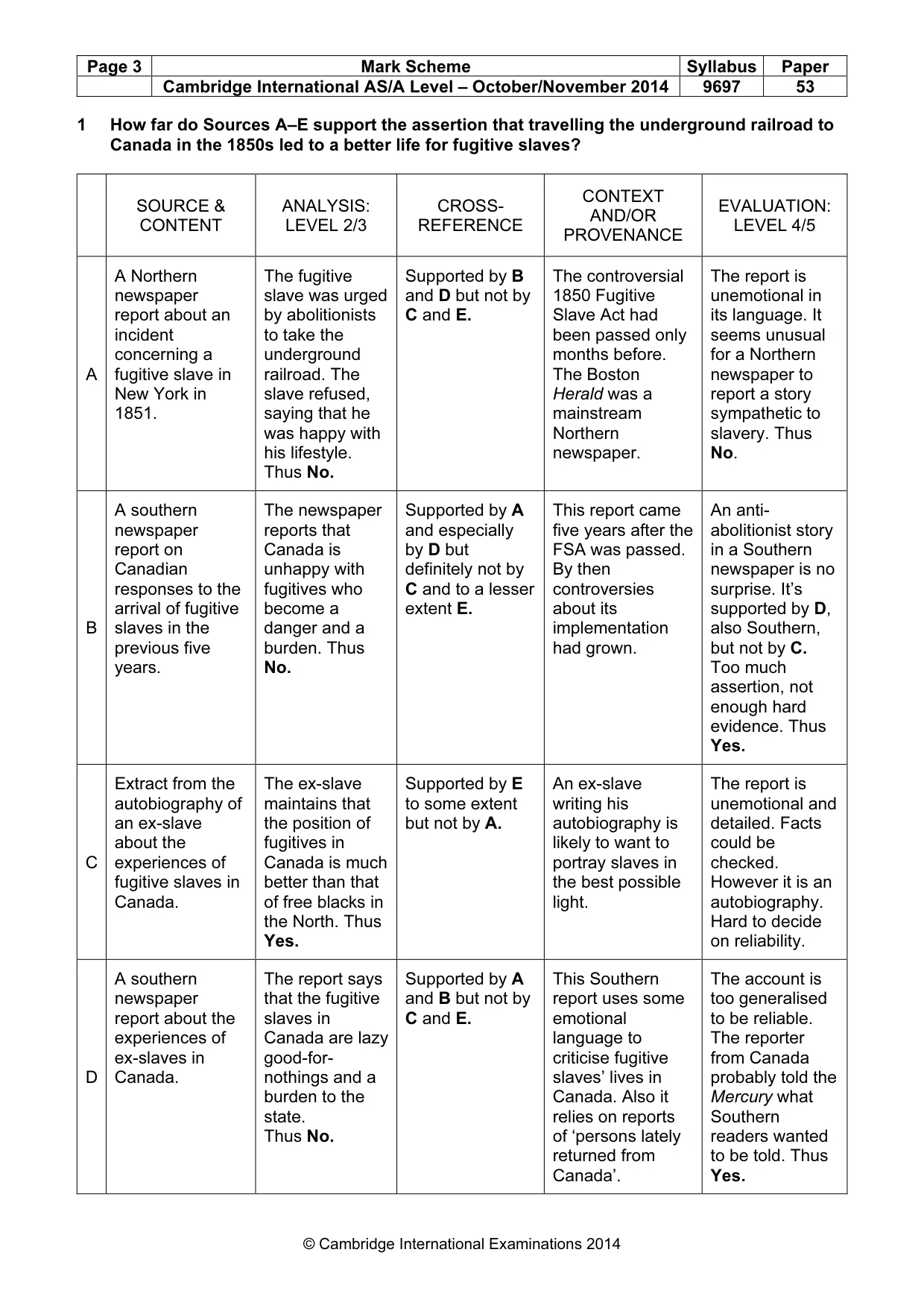
Page 3 Mark Scheme Syllabus Paper Cambridge International AS/A Level – October/November 2014 9697 53 © Cambridge International Examinations 2014 1 How far do Sources A–E support the assertion that travelling the underground railroad to Canada in the 1850s led to a better life for fugitive slaves? SOURCE & CONTENT ANALYSIS: LEVEL 2/3 CROSS- REFERENCE CONTEXT AND/OR PROVENANCE EVALUATION: LEVEL 4/5 A A Northern newspaper report about an incident concerning a fugitive slave in New York in 1851. The fugitive slave was urged by abolitionists to take the underground railroad. The slave refused, saying that he was happy with his lifestyle. Thus No. Supported by B and D but not by C and E. The controversial 1850 Fugitive Slave Act had been passed only months before. The Boston Herald was a mainstream Northern newspaper. The report is unemotional in its language. It seems unusual for a Northern newspaper to report a story sympathetic to slavery. Thus No. B A southern newspaper report on Canadian responses to the arrival of fugitive slaves in the previous five years. The newspaper reports that Canada is unhappy with fugitives who become a danger and a burden. Thus No. Supported by A and especially by D but definitely not by C and to a lesser extent E. This report came five years after the FSA was passed. By then controversies about its implementation had grown. An anti- abolitionist story in a Southern newspaper is no surprise. It’s supported by D, also Southern, but not by C. Too much assertion, not enough hard evidence. Thus Yes. C Extract from the autobiography of an ex-slave about the experiences of fugitive slaves in Canada. The ex-slave maintains that the position of fugitives in Canada is much better than that of free blacks in the North. Thus Yes. Supported by E to some extent but not by A. An ex-slave writing his autobiography is likely to want to portray slaves in the best possible light. The report is unemotional and detailed. Facts could be checked. However it is an autobiography. Hard to decide on reliability. D A southern newspaper report about the experiences of ex-slaves in Canada. The report says that the fugitive slaves in Canada are lazy good-for- nothings and a burden to the state. Thus No. Supported by A and B but not by C and E. This Southern report uses some emotional language to criticise fugitive slaves’ lives in Canada. Also it relies on reports of ‘persons lately returned from Canada’. The account is too generalised to be reliable. The reporter from Canada probably told the Mercury what Southern readers wanted to be told. Thus Yes.
Mark scheme, page 4
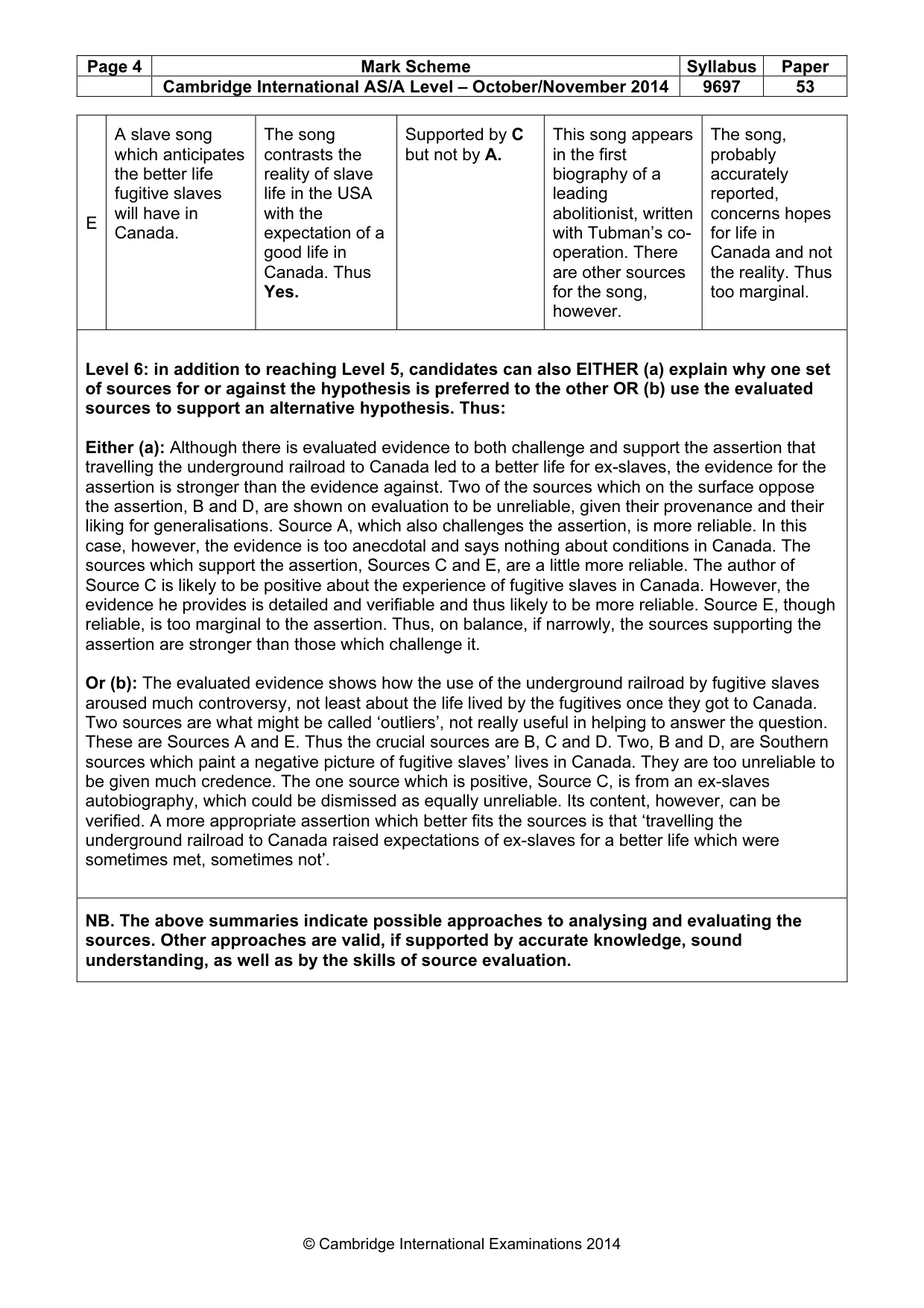
Page 4 Mark Scheme Syllabus Paper Cambridge International AS/A Level – October/November 2014 9697 53 © Cambridge International Examinations 2014 E A slave song which anticipates the better life fugitive slaves will have in Canada. The song contrasts the reality of slave life in the USA with the expectation of a good life in Canada. Thus Yes. Supported by C but not by A. This song appears in the first biography of a leading abolitionist, written with Tubman’s co- operation. There are other sources for the song, however. The song, probably accurately reported, concerns hopes for life in Canada and not the reality. Thus too marginal. Level 6: in addition to reaching Level 5, candidates can also EITHER (a) explain why one set of sources for or against the hypothesis is preferred to the other OR (b) use the evaluated sources to support an alternative hypothesis. Thus: Either (a): Although there is evaluated evidence to both challenge and support the assertion that travelling the underground railroad to Canada led to a better life for ex-slaves, the evidence for the assertion is stronger than the evidence against. Two of the sources which on the surface oppose the assertion, B and D, are shown on evaluation to be unreliable, given their provenance and their liking for generalisations. Source A, which also challenges the assertion, is more reliable. In this case, however, the evidence is too anecdotal and says nothing about conditions in Canada. The sources which support the assertion, Sources C and E, are a little more reliable. The author of Source C is likely to be positive about the experience of fugitive slaves in Canada. However, the evidence he provides is detailed and verifiable and thus likely to be more reliable. Source E, though reliable, is too marginal to the assertion. Thus, on balance, if narrowly, the sources supporting the assertion are stronger than those which challenge it. Or (b): The evaluated evidence shows how the use of the underground railroad by fugitive slaves aroused much controversy, not least about the life lived by the fugitives once they got to Canada. Two sources are what might be called ‘outliers’, not really useful in helping to answer the question. These are Sources A and E. Thus the crucial sources are B, C and D. Two, B and D, are Southern sources which paint a negative picture of fugitive slaves’ lives in Canada. They are too unreliable to be given much credence. The one source which is positive, Source C, is from an ex-slaves autobiography, which could be dismissed as equally unreliable. Its content, however, can be verified. A more appropriate assertion which better fits the sources is that ‘travelling the underground railroad to Canada raised expectations of ex-slaves for a better life which were sometimes met, sometimes not’. NB. The above summaries indicate possible approaches to analysing and evaluating the sources. Other approaches are valid, if supported by accurate knowledge, sound understanding, as well as by the skills of source evaluation.
Mark scheme, page 5
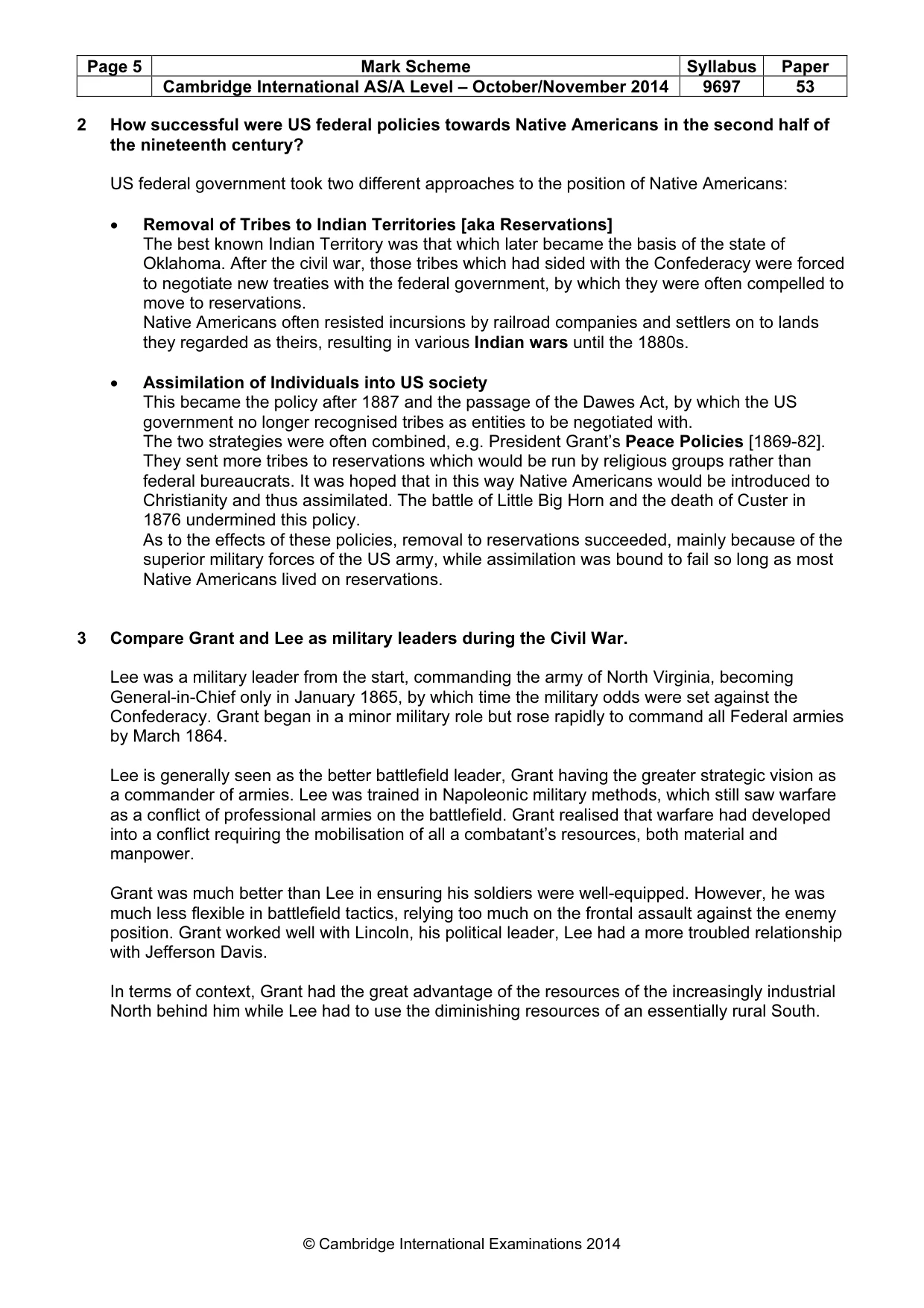
Page 5 Mark Scheme Syllabus Paper Cambridge International AS/A Level – October/November 2014 9697 53 © Cambridge International Examinations 2014 2 How successful were US federal policies towards Native Americans in the second half of the nineteenth century? US federal government took two different approaches to the position of Native Americans: • Removal of Tribes to Indian Territories [aka Reservations] The best known Indian Territory was that which later became the basis of the state of Oklahoma. After the civil war, those tribes which had sided with the Confederacy were forced to negotiate new treaties with the federal government, by which they were often compelled to move to reservations. Native Americans often resisted incursions by railroad companies and settlers on to lands they regarded as theirs, resulting in various Indian wars until the 1880s. • Assimilation of Individuals into US society This became the policy after 1887 and the passage of the Dawes Act, by which the US government no longer recognised tribes as entities to be negotiated with. The two strategies were often combined, e.g. President Grant’s Peace Policies [1869-82]. They sent more tribes to reservations which would be run by religious groups rather than federal bureaucrats. It was hoped that in this way Native Americans would be introduced to Christianity and thus assimilated. The battle of Little Big Horn and the death of Custer in 1876 undermined this policy. As to the effects of these policies, removal to reservations succeeded, mainly because of the superior military forces of the US army, while assimilation was bound to fail so long as most Native Americans lived on reservations. 3 Compare Grant and Lee as military leaders during the Civil War. Lee was a military leader from the start, commanding the army of North Virginia, becoming General-in-Chief only in January 1865, by which time the military odds were set against the Confederacy. Grant began in a minor military role but rose rapidly to command all Federal armies by March 1864. Lee is generally seen as the better battlefield leader, Grant having the greater strategic vision as a commander of armies. Lee was trained in Napoleonic military methods, which still saw warfare as a conflict of professional armies on the battlefield. Grant realised that warfare had developed into a conflict requiring the mobilisation of all a combatant’s resources, both material and manpower. Grant was much better than Lee in ensuring his soldiers were well-equipped. However, he was much less flexible in battlefield tactics, relying too much on the frontal assault against the enemy position. Grant worked well with Lincoln, his political leader, Lee had a more troubled relationship with Jefferson Davis. In terms of context, Grant had the great advantage of the resources of the increasingly industrial North behind him while Lee had to use the diminishing resources of an essentially rural South.
Mark scheme, page 6
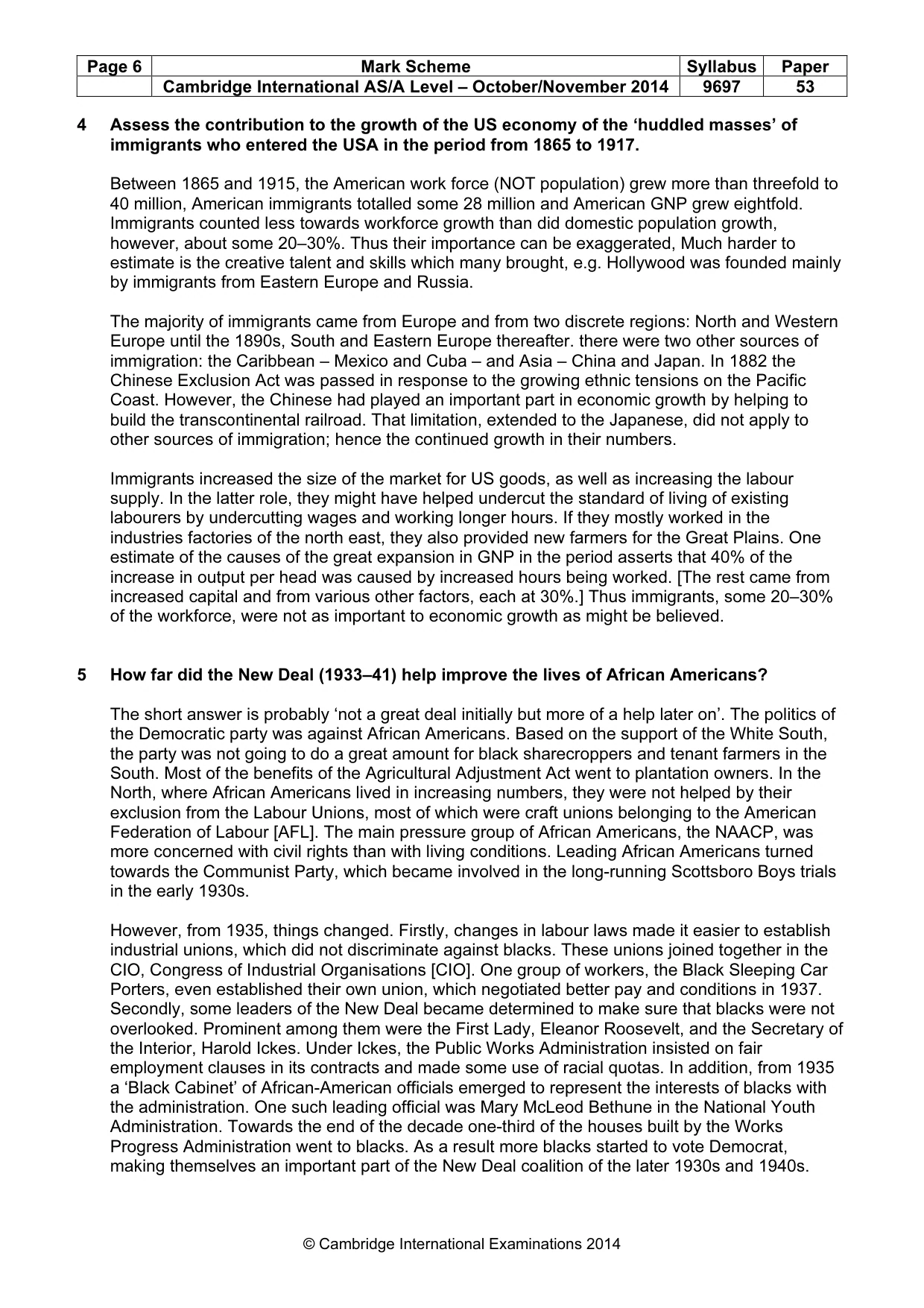
Page 6 Mark Scheme Syllabus Paper Cambridge International AS/A Level – October/November 2014 9697 53 © Cambridge International Examinations 2014 4 Assess the contribution to the growth of the US economy of the ‘huddled masses’ of immigrants who entered the USA in the period from 1865 to 1917. Between 1865 and 1915, the American work force (NOT population) grew more than threefold to 40 million, American immigrants totalled some 28 million and American GNP grew eightfold. Immigrants counted less towards workforce growth than did domestic population growth, however, about some 20–30%. Thus their importance can be exaggerated, Much harder to estimate is the creative talent and skills which many brought, e.g. Hollywood was founded mainly by immigrants from Eastern Europe and Russia. The majority of immigrants came from Europe and from two discrete regions: North and Western Europe until the 1890s, South and Eastern Europe thereafter. there were two other sources of immigration: the Caribbean – Mexico and Cuba – and Asia – China and Japan. In 1882 the Chinese Exclusion Act was passed in response to the growing ethnic tensions on the Pacific Coast. However, the Chinese had played an important part in economic growth by helping to build the transcontinental railroad. That limitation, extended to the Japanese, did not apply to other sources of immigration; hence the continued growth in their numbers. Immigrants increased the size of the market for US goods, as well as increasing the labour supply. In the latter role, they might have helped undercut the standard of living of existing labourers by undercutting wages and working longer hours. If they mostly worked in the industries factories of the north east, they also provided new farmers for the Great Plains. One estimate of the causes of the great expansion in GNP in the period asserts that 40% of the increase in output per head was caused by increased hours being worked. [The rest came from increased capital and from various other factors, each at 30%.] Thus immigrants, some 20–30% of the workforce, were not as important to economic growth as might be believed. 5 How far did the New Deal (1933–41) help improve the lives of African Americans? The short answer is probably ‘not a great deal initially but more of a help later on’. The politics of the Democratic party was against African Americans. Based on the support of the White South, the party was not going to do a great amount for black sharecroppers and tenant farmers in the South. Most of the benefits of the Agricultural Adjustment Act went to plantation owners. In the North, where African Americans lived in increasing numbers, they were not helped by their exclusion from the Labour Unions, most of which were craft unions belonging to the American Federation of Labour [AFL]. The main pressure group of African Americans, the NAACP, was more concerned with civil rights than with living conditions. Leading African Americans turned towards the Communist Party, which became involved in the long-running Scottsboro Boys trials in the early 1930s. However, from 1935, things changed. Firstly, changes in labour laws made it easier to establish industrial unions, which did not discriminate against blacks. These unions joined together in the CIO, Congress of Industrial Organisations [CIO]. One group of workers, the Black Sleeping Car Porters, even established their own union, which negotiated better pay and conditions in 1937. Secondly, some leaders of the New Deal became determined to make sure that blacks were not overlooked. Prominent among them were the First Lady, Eleanor Roosevelt, and the Secretary of the Interior, Harold Ickes. Under Ickes, the Public Works Administration insisted on fair employment clauses in its contracts and made some use of racial quotas. In addition, from 1935 a ‘Black Cabinet’ of African-American officials emerged to represent the interests of blacks with the administration. One such leading official was Mary McLeod Bethune in the National Youth Administration. Towards the end of the decade one-third of the houses built by the Works Progress Administration went to blacks. As a result more blacks started to vote Democrat, making themselves an important part of the New Deal coalition of the later 1930s and 1940s.
Mark scheme, page 7
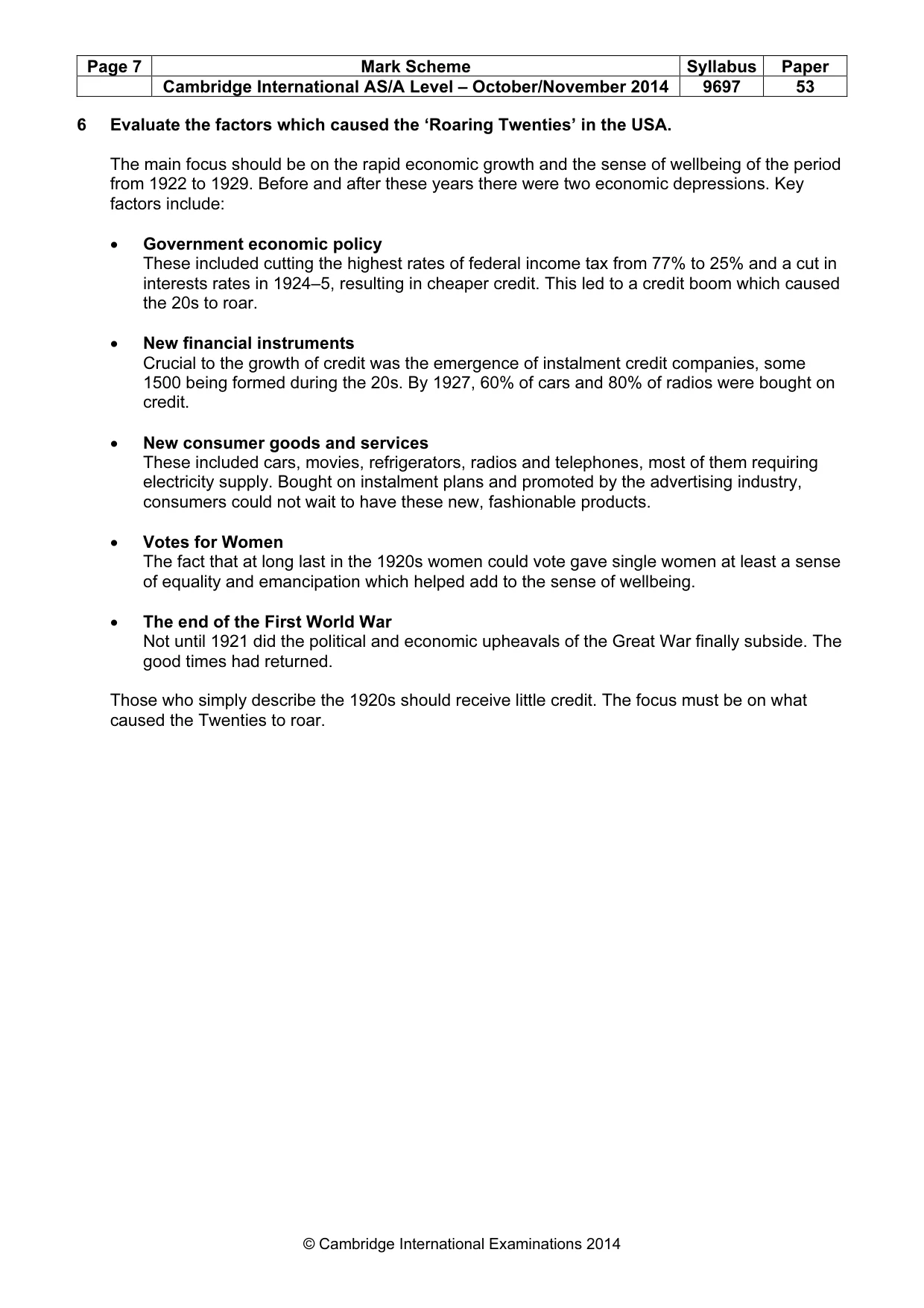
Page 7 Mark Scheme Syllabus Paper Cambridge International AS/A Level – October/November 2014 9697 53 © Cambridge International Examinations 2014 6 Evaluate the factors which caused the ‘Roaring Twenties’ in the USA. The main focus should be on the rapid economic growth and the sense of wellbeing of the period from 1922 to 1929. Before and after these years there were two economic depressions. Key factors include: • Government economic policy These included cutting the highest rates of federal income tax from 77% to 25% and a cut in interests rates in 1924–5, resulting in cheaper credit. This led to a credit boom which caused the 20s to roar. • New financial instruments Crucial to the growth of credit was the emergence of instalment credit companies, some 1500 being formed during the 20s. By 1927, 60% of cars and 80% of radios were bought on credit. • New consumer goods and services These included cars, movies, refrigerators, radios and telephones, most of them requiring electricity supply. Bought on instalment plans and promoted by the advertising industry, consumers could not wait to have these new, fashionable products. • Votes for Women The fact that at long last in the 1920s women could vote gave single women at least a sense of equality and emancipation which helped add to the sense of wellbeing. • The end of the First World War Not until 1921 did the political and economic upheavals of the Great War finally subside. The good times had returned. Those who simply describe the 1920s should receive little credit. The focus must be on what caused the Twenties to roar.
Mark scheme, page 8
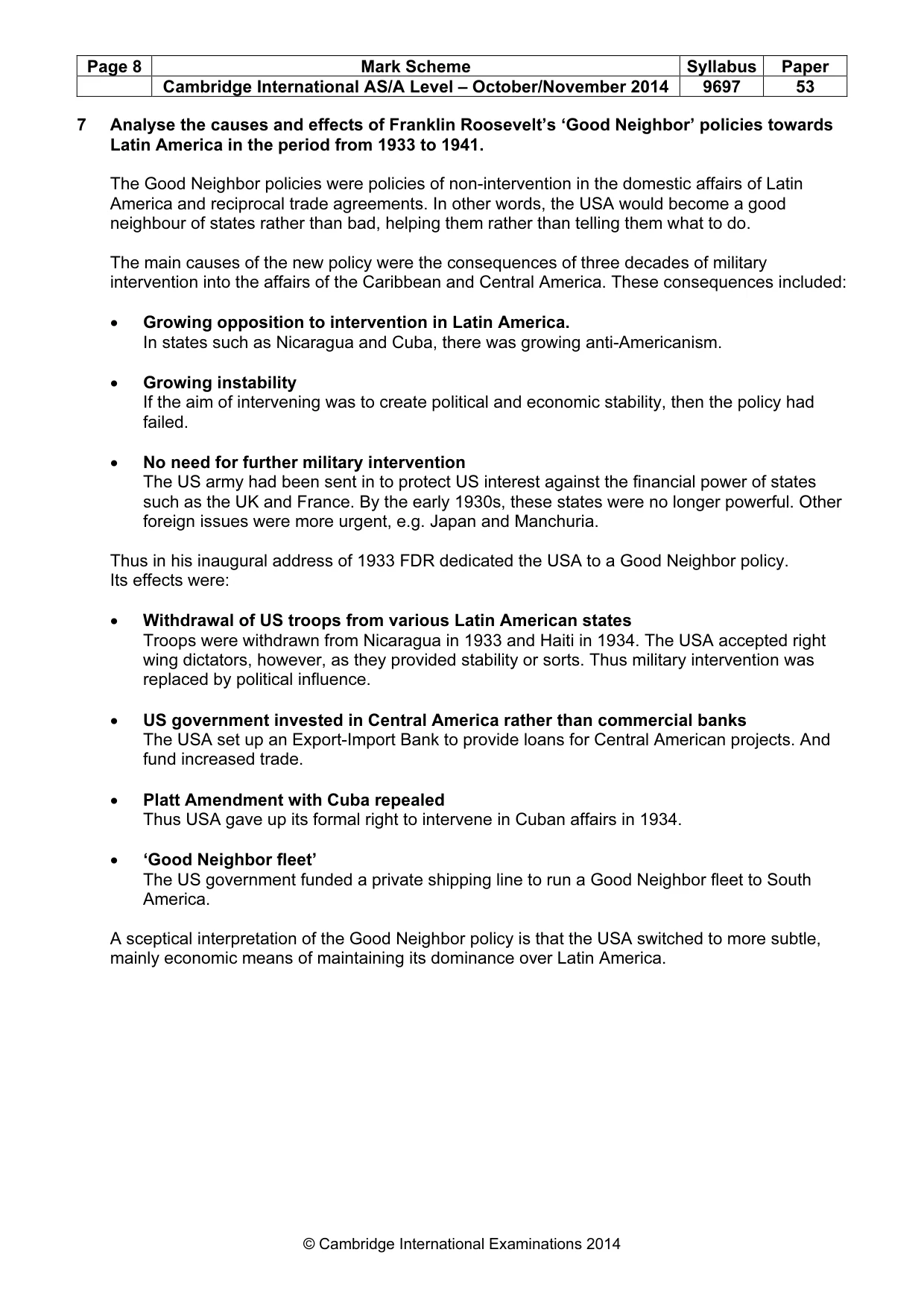
Page 8 Mark Scheme Syllabus Paper Cambridge International AS/A Level – October/November 2014 9697 53 © Cambridge International Examinations 2014 7 Analyse the causes and effects of Franklin Roosevelt’s ‘Good Neighbor’ policies towards Latin America in the period from 1933 to 1941. The Good Neighbor policies were policies of non-intervention in the domestic affairs of Latin America and reciprocal trade agreements. In other words, the USA would become a good neighbour of states rather than bad, helping them rather than telling them what to do. The main causes of the new policy were the consequences of three decades of military intervention into the affairs of the Caribbean and Central America. These consequences included: • Growing opposition to intervention in Latin America. In states such as Nicaragua and Cuba, there was growing anti-Americanism. • Growing instability If the aim of intervening was to create political and economic stability, then the policy had failed. • No need for further military intervention The US army had been sent in to protect US interest against the financial power of states such as the UK and France. By the early 1930s, these states were no longer powerful. Other foreign issues were more urgent, e.g. Japan and Manchuria. Thus in his inaugural address of 1933 FDR dedicated the USA to a Good Neighbor policy. Its effects were: • Withdrawal of US troops from various Latin American states Troops were withdrawn from Nicaragua in 1933 and Haiti in 1934. The USA accepted right wing dictators, however, as they provided stability or sorts. Thus military intervention was replaced by political influence. • US government invested in Central America rather than commercial banks The USA set up an Export-Import Bank to provide loans for Central American projects. And fund increased trade. • Platt Amendment with Cuba repealed Thus USA gave up its formal right to intervene in Cuban affairs in 1934. • ‘Good Neighbor fleet’ The US government funded a private shipping line to run a Good Neighbor fleet to South America. A sceptical interpretation of the Good Neighbor policy is that the USA switched to more subtle, mainly economic means of maintaining its dominance over Latin America.
Mark scheme, page 9
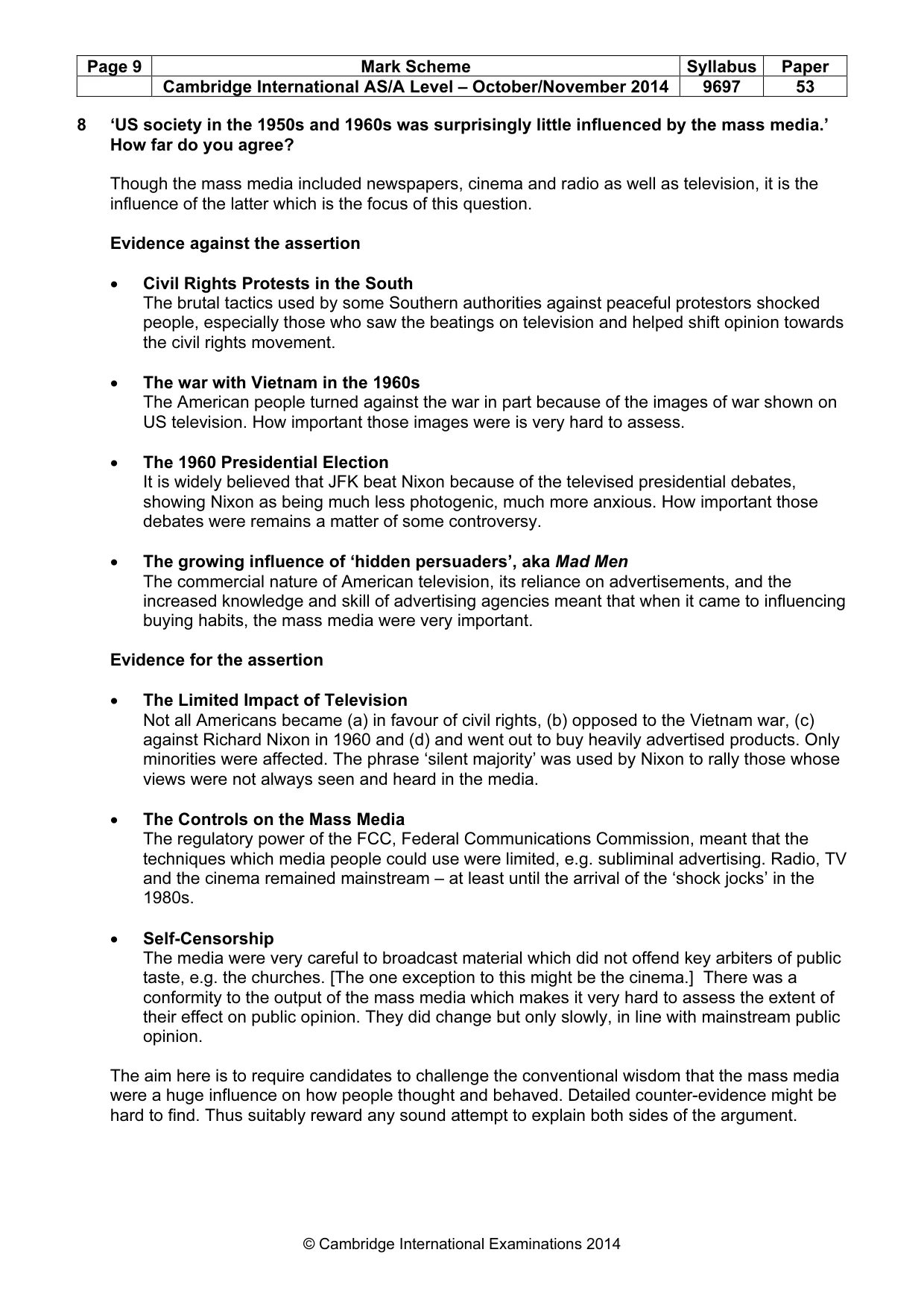
Page 9 Mark Scheme Syllabus Paper Cambridge International AS/A Level – October/November 2014 9697 53 © Cambridge International Examinations 2014 8 ‘US society in the 1950s and 1960s was surprisingly little influenced by the mass media.’ How far do you agree? Though the mass media included newspapers, cinema and radio as well as television, it is the influence of the latter which is the focus of this question. Evidence against the assertion • Civil Rights Protests in the South The brutal tactics used by some Southern authorities against peaceful protestors shocked people, especially those who saw the beatings on television and helped shift opinion towards the civil rights movement. • The war with Vietnam in the 1960s The American people turned against the war in part because of the images of war shown on US television. How important those images were is very hard to assess. • The 1960 Presidential Election It is widely believed that JFK beat Nixon because of the televised presidential debates, showing Nixon as being much less photogenic, much more anxious. How important those debates were remains a matter of some controversy. • The growing influence of ‘hidden persuaders’, aka Mad Men The commercial nature of American television, its reliance on advertisements, and the increased knowledge and skill of advertising agencies meant that when it came to influencing buying habits, the mass media were very important. Evidence for the assertion • The Limited Impact of Television Not all Americans became (a) in favour of civil rights, (b) opposed to the Vietnam war, (c) against Richard Nixon in 1960 and (d) and went out to buy heavily advertised products. Only minorities were affected. The phrase ‘silent majority’ was used by Nixon to rally those whose views were not always seen and heard in the media. • The Controls on the Mass Media The regulatory power of the FCC, Federal Communications Commission, meant that the techniques which media people could use were limited, e.g. subliminal advertising. Radio, TV and the cinema remained mainstream – at least until the arrival of the ‘shock jocks’ in the 1980s. • Self-Censorship The media were very careful to broadcast material which did not offend key arbiters of public taste, e.g. the churches. [The one exception to this might be the cinema.] There was a conformity to the output of the mass media which makes it very hard to assess the extent of their effect on public opinion. They did change but only slowly, in line with mainstream public opinion. The aim here is to require candidates to challenge the conventional wisdom that the mass media were a huge influence on how people thought and behaved. Detailed counter-evidence might be hard to find. Thus suitably reward any sound attempt to explain both sides of the argument.
What you needed in this session
Cambridge’s own grade thresholds for 2014 Oct/Nov, Paper 5 · Variant 3. A higher threshold means an easier paper — the bar moves with how the cohort did.