Cambridge A Level History (pre-2015) 9697 — 2011 Oct/Nov Paper 5 · Variant 3
9697/53/O/N/11
The question paper and its mark scheme, free to read here and free to download. This is Cambridge’s own paper, exactly as it was sat.
Question paper4 pages
Mark scheme11 pages
Answers below. Sit the paper first if you are practising.
Paper as text
Question paper, page 1
This document consists of 4 printed pages. DC (RCL (JDA)) 35190/3 © UCLES 2011 [Turn over UNIVERSITY OF CAMBRIDGE INTERNATIONAL EXAMINATIONS General Certificate of Education Advanced Subsidiary Level and Advanced Level * 9 0 0 9 8 6 9 2 9 3 * HISTORY 9697/53 Paper 5 The History of the USA, c.1840–1968 October/November 2011 3 hours Additional Materials: Answer Booklet/Paper READ THESE INSTRUCTIONS FIRST Write your Centre number, candidate number and name on all the work you hand in. Write in dark blue or black pen. You may use a soft pencil for any rough working. Do not use staples, paper clips, highlighters, glue or correction fluid. Section A Answer Question 1. Section B Answer any three questions. At the end of the examination, fasten all your work securely together. All questions in this paper carry equal marks.
Question paper, page 2
2 9697/53/O/N/11 © UCLES 2011 Section A: The Road to Secession and Civil War, 1846–1861 You must answer Question 1. THE BREAK UP OF THE UNION, 1860–1861 1 Read the Sources and then answer the question. When answering Question 1, candidates are advised to pay particular attention to the interpretation and evaluation of the Sources both individually and as a group. Source A The question is, has the Constitution delegated to Congress power to coerce a State which is attempting to withdraw or has actually withdrawn from the Union? If answered affirmatively it must be because the power has been conferred upon Congress to make war against a State. After serious reflection I have concluded that no such power has been delegated to Congress or to the Federal Government. But if we possessed this power, would it be wise to use it? The object would be to preserve the Union. War would not only present the most effective means of destroying it but would end all hopes of peaceful reconstruction. Our Union rests upon public opinion, and can never be cemented by the blood of citizens in civil war. If it cannot live in the affections of the people, it must one day perish. President Buchanan’s Annual Message to Congress, 3 December 1860. Source B The Message, in our judgement, is an incendiary document, and will tend still further to inflame the sectional differences of the day. It backs up the most extravagant demands which have been made by the South, and promises the seceding States that the power of Federal Government shall not be used for their coercion. The entire North will be made doubly indignant by this flagrant dereliction of duty on the part of the Executive of the Nation, while the Disunionists of the South will be stimulated to fresh exertions in the work of ruin upon which they have embarked. The Country has to struggle through three months more of this disgraceful imbecility and disloyalty to the Constitution. Editorial in the New York Times, 5 December 1860. Source C Does the election of Lincoln to the Presidency justify the Southern States in dissolving the Union? The constitutional rights and guarantees claimed by the Southern States are briefly: 1. That the Constitution recognises the institution of slavery as it exists in the fifteen Southern States. 2. That the citizens of the South have the right to go with their slave property into the common territories of the Union, and are entitled to protection for both their persons and property from the Federal Government.
Question paper, page 3
3 9697/53/O/N/11 © UCLES 2011 [Turn over 3. That the owner of a slave is entitled to reclaim his property in any state into which the slave may escape, and that both the Federal and State Governments are bound by the Constitution to enforce this provision. The antagonism between these recognised rights and the doctrines and principles of the Black Republican party is plain, direct and irreconcilable. One or the other must give way. On the 4th day of March 1861 the Federal Government will pass into the hands of the Abolitionists. I entertain no doubt either of your right or your duty to secede from the Union. Howell Cobb’s address to the people of Georgia, 6 December 1860. Source D You are not content with the vast millions of tribute we pay you annually under the operation of our revenue law, our navigation laws, your fishing bounties, and by making your people our manufacturers, our merchants, our shippers. You are not satisfied with the vast tribute we pay you to build up your great cities, your railroads, your canals. You are not satisfied that we of the South are almost reduced to the condition of overseers for northern capitalists. You are not satisfied with all this; but you must wage a relentless crusade against our rights and institutions. We do not intend that you shall reduce us to such a condition. But I can tell you what your folly and injustice compel us to do. It will compel us to be free from your domination, and more self-reliant than we have been. It will compel us to assert and maintain our separate independence. Texas Congressman John Reagan’s speech to Congress, 15 January 1861. Source E During the four months interval between Lincoln’s election and his inauguration, a period in which Southern states seceded and the Confederacy was formed, the timid Buchanan was President. He had the same powers to defend the federal property and collect federal taxes as President Jackson possessed in 1832 but the President did nothing. Vacillating and obstinate in turn, yet lacking firmness when the situation demanded firmness, he threw away chance after chance. His annual message to Congress on 8 December was a missed opportunity. His evasiveness on secession was cruelly paraphrased by Seward ‘it is the duty of the President to execute the laws, unless somebody opposes him, and that no state has the right to leave the Union unless it wants to.’ Yet Buchanan confronted a situation which appeared to spell defeat no matter what course he pursued. An assertive, tough stance may only have precipitated war sooner and he did put off hostilities long enough to permit attempts at compromise to emerge. Also his moderate stance possibly discouraged the Upper South and Border States from seceding from the Union. From a modern historian’s account of Buchanan’s role in the secession crisis. Now answer the following question. ‘It is unfair to blame Buchanan for his handling of the secession crisis of 1860–1861.’ Using Sources A–E, discuss how far the evidence supports this assertion.
Question paper, page 4
4 9697/53/O/N/11 © UCLES 2011 Section B You must answer three questions from this section. 2 Assess the reasons for opposition in the United States to President Polk’s aggressive expansionist policies. 3 ‘The explanation for the outcome of the Civil War lies in the weaknesses of the South rather than the strengths of the North.’ Assess the validity of this view. 4 Account for the widespread unrest amongst American farmers in the latter part of the nineteenth century. 5 Why did African-Americans find it so difficult to secure their constitutional rights between 1900 and 1965? 6 To what extent did the achievements of the New Deal outweigh its shortcomings? 7 To what extent were President Roosevelt’s policies towards Germany, Italy and Japan ineffective? 8 Account for the sustained economic boom in the United States between 1945 and 1968. Copyright Acknowledgements: Question 1 Source E © S E Morrison, The Growth of the American Republic, Oxford, 1980. Permission to reproduce items where third-party owned material protected by copyright is included has been sought and cleared where possible. Every reasonable effort has been made by the publisher (UCLES) to trace copyright holders, but if any items requiring clearance have unwittingly been included, the publisher will be pleased to make amends at the earliest possible opportunity. University of Cambridge International Examinations is part of the Cambridge Assessment Group. Cambridge Assessment is the brand name of University of Cambridge Local Examinations Syndicate (UCLES), which is itself a department of the University of Cambridge.
Mark scheme, page 1
UNIVERSITY OF CAMBRIDGE INTERNATIONAL EXAMINATIONS GCE Advanced Subsidiary Level and GCE Advanced Level MARK SCHEME for the October/November 2011 question paper for the guidance of teachers 9697 HISTORY 9697/53 Paper 5, maximum raw mark 100 This mark scheme is published as an aid to teachers and candidates, to indicate the requirements of the examination. It shows the basis on which Examiners were instructed to award marks. It does not indicate the details of the discussions that took place at an Examiners’ meeting before marking began, which would have considered the acceptability of alternative answers. Mark schemes must be read in conjunction with the question papers and the report on the examination. • Cambridge will not enter into discussions or correspondence in connection with these mark schemes. Cambridge is publishing the mark schemes for the October/November 2011 question papers for most IGCSE, GCE Advanced Level and Advanced Subsidiary Level syllabuses and some Ordinary Level syllabuses.
Mark scheme, page 2
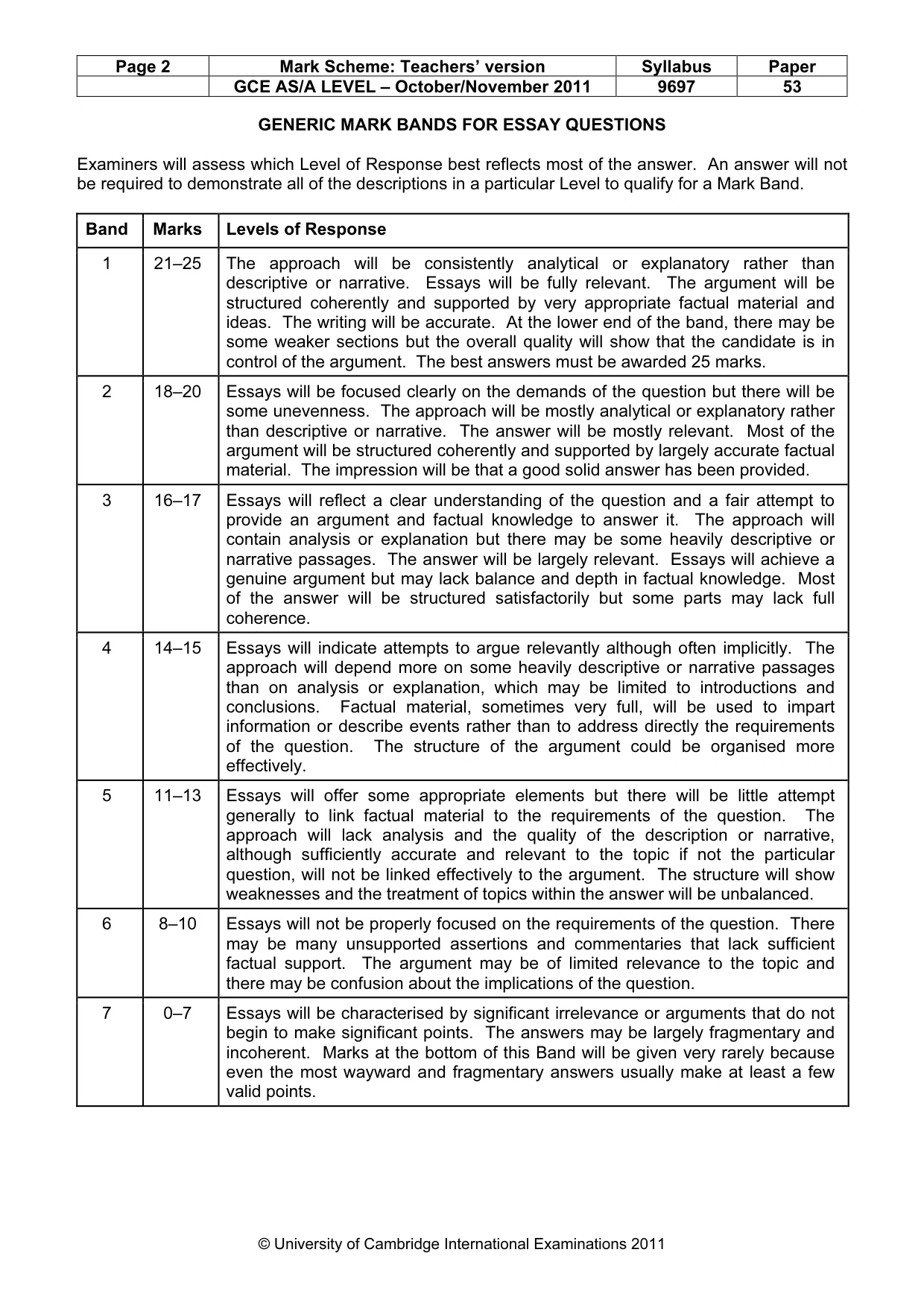
Page 2 Mark Scheme: Teachers’ version Syllabus Paper GCE AS/A LEVEL – October/November 2011 9697 53 © University of Cambridge International Examinations 2011 GENERIC MARK BANDS FOR ESSAY QUESTIONS Examiners will assess which Level of Response best reflects most of the answer. An answer will not be required to demonstrate all of the descriptions in a particular Level to qualify for a Mark Band. Band Marks Levels of Response 1 21–25 The approach will be consistently analytical or explanatory rather than descriptive or narrative. Essays will be fully relevant. The argument will be structured coherently and supported by very appropriate factual material and ideas. The writing will be accurate. At the lower end of the band, there may be some weaker sections but the overall quality will show that the candidate is in control of the argument. The best answers must be awarded 25 marks. 2 18–20 Essays will be focused clearly on the demands of the question but there will be some unevenness. The approach will be mostly analytical or explanatory rather than descriptive or narrative. The answer will be mostly relevant. Most of the argument will be structured coherently and supported by largely accurate factual material. The impression will be that a good solid answer has been provided. 3 16–17 Essays will reflect a clear understanding of the question and a fair attempt to provide an argument and factual knowledge to answer it. The approach will contain analysis or explanation but there may be some heavily descriptive or narrative passages. The answer will be largely relevant. Essays will achieve a genuine argument but may lack balance and depth in factual knowledge. Most of the answer will be structured satisfactorily but some parts may lack full coherence. 4 14–15 Essays will indicate attempts to argue relevantly although often implicitly. The approach will depend more on some heavily descriptive or narrative passages than on analysis or explanation, which may be limited to introductions and conclusions. Factual material, sometimes very full, will be used to impart information or describe events rather than to address directly the requirements of the question. The structure of the argument could be organised more effectively. 5 11–13 Essays will offer some appropriate elements but there will be little attempt generally to link factual material to the requirements of the question. The approach will lack analysis and the quality of the description or narrative, although sufficiently accurate and relevant to the topic if not the particular question, will not be linked effectively to the argument. The structure will show weaknesses and the treatment of topics within the answer will be unbalanced. 6 8–10 Essays will not be properly focused on the requirements of the question. There may be many unsupported assertions and commentaries that lack sufficient factual support. The argument may be of limited relevance to the topic and there may be confusion about the implications of the question. 7 0–7 Essays will be characterised by significant irrelevance or arguments that do not begin to make significant points. The answers may be largely fragmentary and incoherent. Marks at the bottom of this Band will be given very rarely because even the most wayward and fragmentary answers usually make at least a few valid points.
Mark scheme, page 3
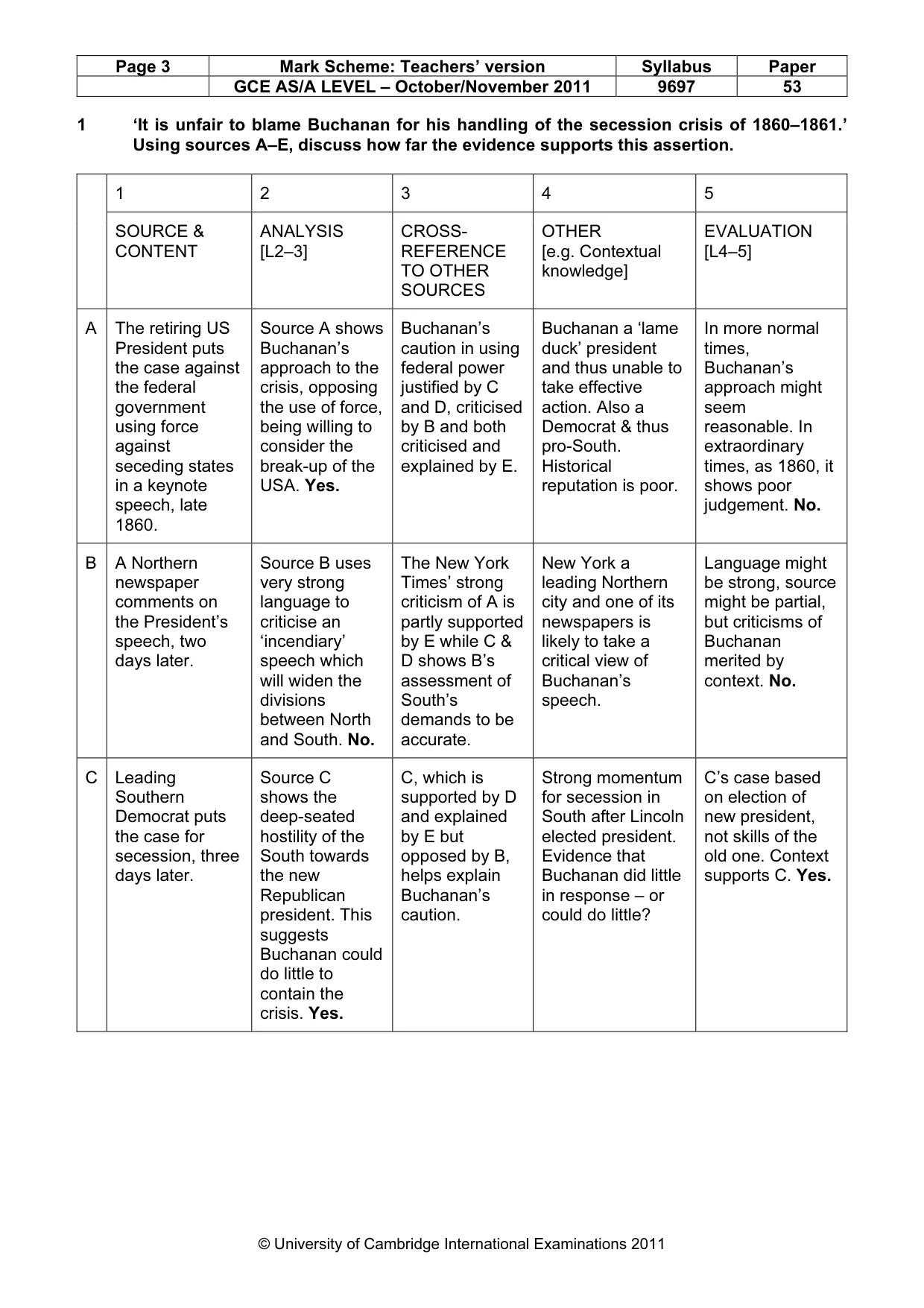
Page 3 Mark Scheme: Teachers’ version Syllabus Paper GCE AS/A LEVEL – October/November 2011 9697 53 © University of Cambridge International Examinations 2011 1 ‘It is unfair to blame Buchanan for his handling of the secession crisis of 1860–1861.’ Using sources A–E, discuss how far the evidence supports this assertion. 1 2 3 4 5 SOURCE & CONTENT ANALYSIS [L2–3] CROSS- REFERENCE TO OTHER SOURCES OTHER [e.g. Contextual knowledge] EVALUATION [L4–5] A The retiring US President puts the case against the federal government using force against seceding states in a keynote speech, late 1860. Source A shows Buchanan’s approach to the crisis, opposing the use of force, being willing to consider the break-up of the USA. Yes. Buchanan’s caution in using federal power justified by C and D, criticised by B and both criticised and explained by E. Buchanan a ‘lame duck’ president and thus unable to take effective action. Also a Democrat & thus pro-South. Historical reputation is poor. In more normal times, Buchanan’s approach might seem reasonable. In extraordinary times, as 1860, it shows poor judgement. No. B A Northern newspaper comments on the President’s speech, two days later. Source B uses very strong language to criticise an ‘incendiary’ speech which will widen the divisions between North and South. No. The New York Times’ strong criticism of A is partly supported by E while C & D shows B’s assessment of South’s demands to be accurate. New York a leading Northern city and one of its newspapers is likely to take a critical view of Buchanan’s speech. Language might be strong, source might be partial, but criticisms of Buchanan merited by context. No. C Leading Southern Democrat puts the case for secession, three days later. Source C shows the deep-seated hostility of the South towards the new Republican president. This suggests Buchanan could do little to contain the crisis. Yes. C, which is supported by D and explained by E but opposed by B, helps explain Buchanan’s caution. Strong momentum for secession in South after Lincoln elected president. Evidence that Buchanan did little in response – or could do little? C’s case based on election of new president, not skills of the old one. Context supports C. Yes.
Mark scheme, page 4
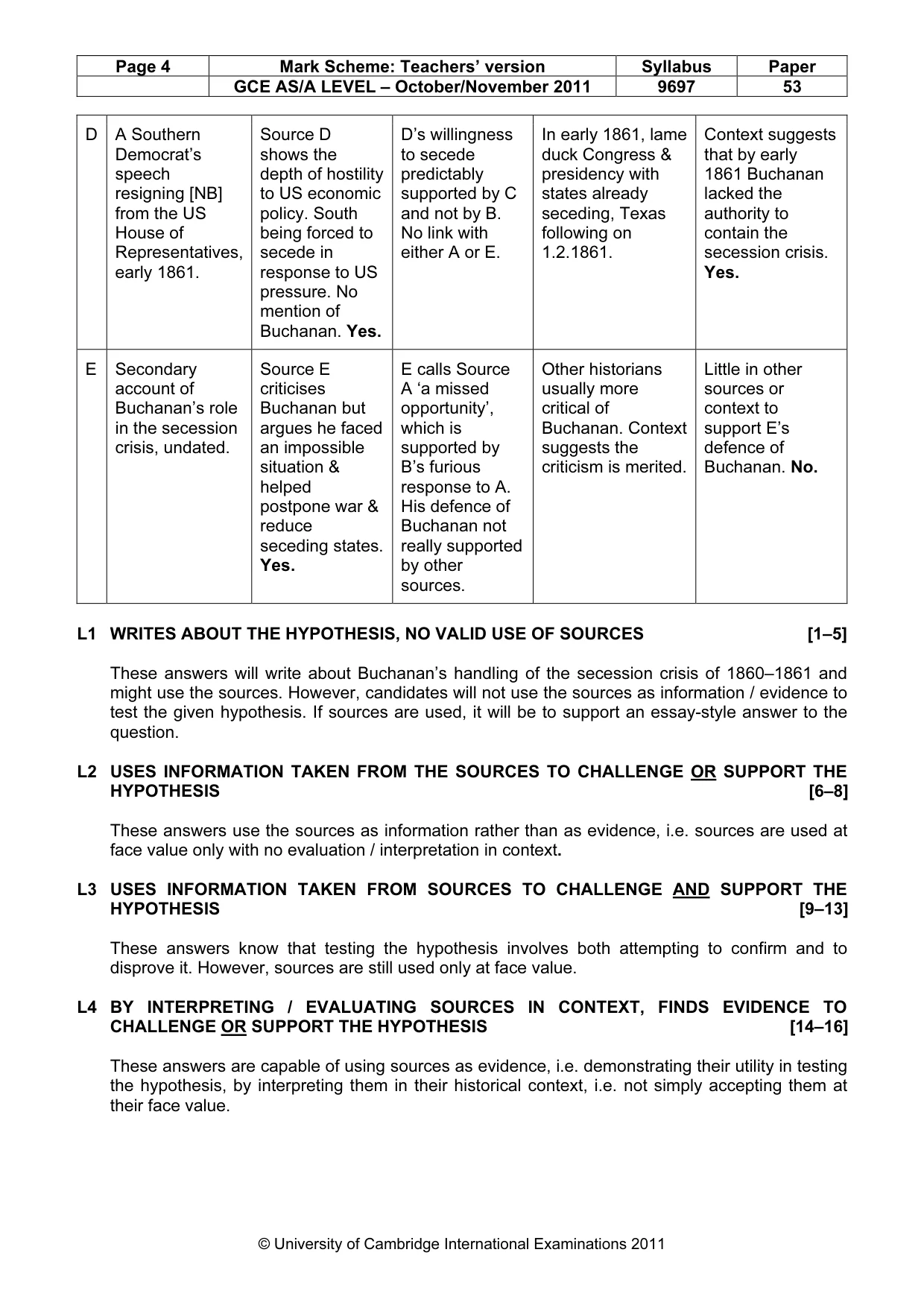
Page 4 Mark Scheme: Teachers’ version Syllabus Paper GCE AS/A LEVEL – October/November 2011 9697 53 © University of Cambridge International Examinations 2011 D A Southern Democrat’s speech resigning [NB] from the US House of Representatives, early 1861. Source D shows the depth of hostility to US economic policy. South being forced to secede in response to US pressure. No mention of Buchanan. Yes. D’s willingness to secede predictably supported by C and not by B. No link with either A or E. In early 1861, lame duck Congress & presidency with states already seceding, Texas following on 1.2.1861. Context suggests that by early 1861 Buchanan lacked the authority to contain the secession crisis. Yes. E Secondary account of Buchanan’s role in the secession crisis, undated. Source E criticises Buchanan but argues he faced an impossible situation & helped postpone war & reduce seceding states. Yes. E calls Source A ‘a missed opportunity’, which is supported by B’s furious response to A. His defence of Buchanan not really supported by other sources. Other historians usually more critical of Buchanan. Context suggests the criticism is merited. Little in other sources or context to support E’s defence of Buchanan. No. L1 WRITES ABOUT THE HYPOTHESIS, NO VALID USE OF SOURCES [1–5] These answers will write about Buchanan’s handling of the secession crisis of 1860–1861 and might use the sources. However, candidates will not use the sources as information / evidence to test the given hypothesis. If sources are used, it will be to support an essay-style answer to the question. L2 USES INFORMATION TAKEN FROM THE SOURCES TO CHALLENGE OR SUPPORT THE HYPOTHESIS [6–8] These answers use the sources as information rather than as evidence, i.e. sources are used at face value only with no evaluation / interpretation in context. L3 USES INFORMATION TAKEN FROM SOURCES TO CHALLENGE AND SUPPORT THE HYPOTHESIS [9–13] These answers know that testing the hypothesis involves both attempting to confirm and to disprove it. However, sources are still used only at face value. L4 BY INTERPRETING / EVALUATING SOURCES IN CONTEXT, FINDS EVIDENCE TO CHALLENGE OR SUPPORT THE HYPOTHESIS [14–16] These answers are capable of using sources as evidence, i.e. demonstrating their utility in testing the hypothesis, by interpreting them in their historical context, i.e. not simply accepting them at their face value.
Mark scheme, page 5
Page 5 Mark Scheme: Teachers’ version Syllabus Paper GCE AS/A LEVEL – October/November 2011 9697 53 © University of Cambridge International Examinations 2011 L5 BY INTERPRETING AND EVALUATING SOURCES IN CONTEXT, FINDS EVIDENCE TO CHALLENGE AND SUPPORT THE HYPOTHESIS [17–21] These answers know that testing the hypothesis involves attempting both to confirm and disconfirm the hypothesis, and are capable of using sources as evidence to do this (i.e. both confirmation and disconfirmation are done at this level). L6 AS L5, PLUS EITHER (a) EXPLAINS WHY EVIDENCE TO CHALLENGE / SUPPORT IS BETTER / PREFERRED, OR (b) RECONCILES / EXPLAINS PROBLEMS IN THE EVIDENCE TO SHOW THAT NEITHER CHALLENGE NOR SUPPORT IS TO BE PREFERRED [22–25] For (a) the argument must be that the evidence for agreeing / disagreeing is better / preferred. This must involve a comparative judgement, i.e. not just why some evidence is better, but also why other evidence is worse. For (b) include all L5 answers which use the evidence to modify the hypothesis (rather than simply seeking to support/contradict) in order to improve it. Level 6: as for L5 PLUS: Either (a) Although there is evaluated evidence both to support and to challenge the claim that Buchanan should not be blamed for his handling of the secession crisis, the evidence in support of the claim is stronger than the evidence against. The main source clearly against the thesis, Source B, is too partial to be relied on. Though supporting E, Source B is countered by Sources C and D, which suggest that the secession crisis was not caused by Buchanan’s handling of events. Sources C and D show how deep-rooted the secession crisis was, Source E just how little room for manoeuvre Buchanan had. Thus the evaluated sources, on balance, support the claim rather than undermine it. Or (b) While the evaluated sources give some sense of the situation facing Buchanan in early 1861, only Source C really conveys just how difficult that situation was because it is the only contemporary source to refer directly to imminent secession. No mention is made of the procession of Southern states from the Union in early 1861. Contextual knowledge is essential to understanding the gravity of the situation facing Buchanan as he entered the final weeks of his presidency. He was a lame-duck president. The Southern states feared the arrival of Lincoln, a president elected by Northern states only. As Source E mentions, Buchanan at least delayed the onset of war and helped ensure that fewer states joined the South than would have been the case, had he taken a firmer line. Thus a more valid claim would be one which asserts that Buchanan should be praised for his handling of the secession crisis in 1860–1861. NB: The above descriptions, and especially columns 2–5, indicate possible approaches to analysing and evaluating the sources. Other approaches are valid, if supported by sound knowledge and understanding of the period and/or skills of source evaluation.
Mark scheme, page 6
Page 6 Mark Scheme: Teachers’ version Syllabus Paper GCE AS/A LEVEL – October/November 2011 9697 53 © University of Cambridge International Examinations 2011 2 Assess the reasons for opposition in the United States to President Polk’s aggressive expansionist policies. The main form of Polk’s aggressive, expansionist policies was the war with Mexico, 1846–8. It provoked opposition because it was: • A war: some Whigs argued that the USA should concentrate on developing its existing economy and that expansion, if it happened, should come through trade and missionary work, not military force. • An aggressive war: most Whigs believed that Polk had deliberately provoked war. The House of Representatives decided the war was ‘unnecessarily and unconstitutionally begun’ by Polk. • An expansionist war: by the Treaty of Guadalupe Hidalgo the USA gained New Mexico and California. N.B. Texas became part of the USA just before the start of Polk’s presidency. • An expansionist war which potentially strengthened ‘slave power’ within the USA, thus upsetting the delicate balance between slave and free states. However, the annexation of Texas, a slave state, was more important in this respect. To offset its effect, the Wilmot Proviso was introduced in 1846. In addition Polk was criticised for not being expansionist enough in that: • He settled the dispute with the UK over Oregon by conceding land beyond the 49th parallel. • He did not take more Mexican lands, as some Eastern Democrats argued he should. N.B. The ‘manifest destiny’ of the USA is not relevant here. 3 ‘The explanation for the outcome of the Civil War lies in the weaknesses of the South rather than the strengths of the North.’ Assess the validity of this view. Weaknesses of the South include: • Political leadership, i.e. Jefferson Davis, but not really its military leadership. Davis could not impose his will upon the Confederacy. • An agrarian economy, which meant it lacked the manufacturing industries needed to provide war materiel – and to develop a navy to match the North’s. • A confederate system of government, which made efficient coordination of the war effort almost impossible. • A slave-based society. Externally, this made it impossible for the UK and France to support the South while within the South it caused strained relations among different sections of whites, as well as effectively excluding the slave minority from the war effort. • International isolation. Had the UK and France supported the South, as had been expected, then the balance of forces would have changed dramatically. Strengths of the North include: • Political and, eventually, military leadership, i.e. Lincoln and Grant. Lincoln was able to impose his will on the Union, e.g. suspension of habeas corpus. • More of an industrial economy with a manufacturing base and most of the railways of the USA. • Control of the US navy, which enabled the North to impose an effective economic blockade on the South. • A unifying cause, at least from September 1862 when Lincoln issued the Emancipation Proclamation. To achieve the highest bands candidates need to consider both aspects of the question and use their knowledge and understanding to focus sharply on the question.
Mark scheme, page 7
Page 7 Mark Scheme: Teachers’ version Syllabus Paper GCE AS/A LEVEL – October/November 2011 9697 53 © University of Cambridge International Examinations 2011 4 Account for the widespread unrest among American farmers in the latter part of the nineteenth century. Farming is a business which can experience over or under production simply because of changes in the weather from year to year. Thus planning for the future is hard. American farmers in the late 19th century felt that their lives were made even harder by various aspects of US life, including: • High tariffs This made the price of machinery expensive as US manufacturers were protected against foreign competition. • Transport costs Railway companies exploited their vital role in moving crops to industrial regions. • Bank credit Banks charged excessive rates of interest. • US currency In 1873 the US went on the gold standard as silver was no longer legal tender. In 1875 the Specie Payment Restoration Act made the greenbacks, paper dollars used to finance the civil war, convertible into gold from 1879, in effect reducing their supply. Farmers saw these moves as deflationary. The situation of Southern cotton farmers and mid-Western grain producers were not helped in the 1880s by international prices being depressed by cotton from Egypt and grain from Russia. Thus various attempts were made to represent farmers’ interests, including: • 1870s: the Greenback Movement • 1880s: Farmers’ Alliances • 1890s: the Populist movement ‘Account for’ means give reasons for, rather than give an account of and candidates will be best rewarded when they focus on why there was widespread unrest.
Mark scheme, page 8
Page 8 Mark Scheme: Teachers’ version Syllabus Paper GCE AS/A LEVEL – October/November 2011 9697 53 © University of Cambridge International Examinations 2011 5 Why did African Americans find it so difficult to secure their constitutional rights between 1900 and 1965? The reasons varied slightly over a period of more than 60 years but key points include: • White Opposition This opposition ranged from the brutalities of the Ku Klux Klan, which experienced a revival in the 1920s, to the racism of Southern politicians, both in Southern states and the federal government. The predominance of Southern Democrats in the US Senate was major obstacle to the passage of Civil Rights legislation. It took President Johnson (a southerner), in an era of civil rights protest to overcome this opposition. • African American differences o In terms of political strategies and tactics, African Americans had for long disagreed, most famously in the 1900s between the gradualism of Booker T Washington and the radicalism of W E B Du Bois. o The different experiences of African Americans in the rural South still using ‘Jim Crow’ laws and those in the urban North, with less obvious discrimination, caused a difference of political focus. Only in the 1950s were these several divisions minimised, with obvious effect. • Lack of Presidential leadership For electoral reasons, most Presidents were slow to help African Americans gain constitutional rights. Neither Theodore Roosevelt nor Woodrow Wilson nor FDR wanted to antagonise their white supporters any more than they had to. Even after 1945, Eisenhower and Kennedy remained cautious.
Mark scheme, page 9
Page 9 Mark Scheme: Teachers’ version Syllabus Paper GCE AS/A LEVEL – October/November 2011 9697 53 © University of Cambridge International Examinations 2011 6 To what extent did the achievements of the New Deal outweigh its shortcomings? Which aspects of the New Deal should be seen as achievements and which as shortcomings can be a matter of some dispute in itself. Achievements and shortcomings are not exact opposites. Achievements [as identified by the centre left] • Economic In the 1930s unemployment was reduced from 25% to 15%. Also the banking system was stabilised. • Political Legitimacy for the republican system of government under threat from economic failures, e.g. increased voter turnout. • Social Plenty of reforms to assist marginal and/or disadvantaged groups, e.g. new immigrants, the old, e.g. Social Security Act 1935. • Governmental Establishment of various agencies and reforms which outlasted 1930s, e.g. Glass-Steagall Act, Securities and Exchange Commission. • Cultural FDR and his reforms restored people’s faith in US capitalism and US democracy. Shortcomings [as identified by left] • Economic GNP in 1939 the same as in 1929, i.e. no economic growth, thus no real recovery. • Political New Deal too centrist, too pragmatic, too limited by the (unelected) Supreme Court, thus no effective reform. • Social Little help to ethnic minorities, e.g. African Americans, little redistribution of wealth, thus no real relief. • Governmental Federal government too hamstrung by US constitution to introduce necessary radical reform. Another perspective on the New Deal is to identify its drawbacks, which might be identified with the right, which labelled the New Deal as a form of socialism which increased the role of the state and thus undermined the best features of the US society and economy.
Mark scheme, page 10
Page 10 Mark Scheme: Teachers’ version Syllabus Paper GCE AS/A LEVEL – October/November 2011 9697 53 © University of Cambridge International Examinations 2011 7 To what extent were President Roosevelt’s policies towards Germany, Italy and Japan ineffective? Candidates may recount the story of international affairs in the 1930s and early 1940s in order to highlight American ineffectiveness in its dealings with the Fascist powers. Supporting evidence should be detailed and related to the question. Key events – with US policy highlighted in bold – include: • 1935 Events leading to the Italian invasion of Abyssinia US Neutrality Act; FDR refuses to consider oil sanctions proposed by League of Nations • 1936 German occupation of the Rhineland; start of Spanish Civil War – Italy and Germany help fascists, ignoring international efforts at non-intervention US Neutrality Act renewed • 1937 Sino-Japanese War in which Japan sinks a US destroyer, the US Panay FDR makes his quarantine speech against dictators but fails to back it up • 1938 Germany acquires Austria and dismembers Czechoslovakia, helped by UK and France USA marginal to events though FDR does try to become more interventionist • 1939 Germany invades Poland, Italy Albania: start of Second World War USA maintains neutrality policy; cash and carry • 1940 Germany defeats France; Italy into the war Destroyers-for-bases deal with UK; ‘arsenal of democracy’ speech; sanctions on Japan • 1941 German invasion of USSR; Pearl Harbour Lend-Lease; US aid to USSR; Atlantic Charter; further sanctions vs. Japan, i.e. oil If the aim of FDR’s policies towards the three fascist powers was to affect their foreign policies, then they were completely ineffective – though oil sanctions against Japan drove it to war vs. USA. If the aim of FDR’s policies was to support the anti-fascist powers within the framework of US public opinion, then his policies did have some effect: as fascist aggression increased, US support for anti-fascist powers increased.
Mark scheme, page 11
Page 11 Mark Scheme: Teachers’ version Syllabus Paper GCE AS/A LEVEL – October/November 2011 9697 53 © University of Cambridge International Examinations 2011 8 Account for the sustained economic boom in the United States between 1945 and 1968. This requires a knowledge and understanding of economic history rather than social. • Firstly, the sustained economic boom. In these 23 years America experienced an unprecedented period of continuous economic growth. Its GNP rose by 30% in the 1950s and another 40% in the 1960s. Unemployment rose above 6% only once in this period, 1958, when it reached 6.8%. The usual figure ranged from 3% to 5%. [The current level is 9.0%] • Secondly, the causes of the boom: o Federal government management of the economy either to even out the business cycle or to stimulate economic growth and ensure high employment, e.g. interstate highways 1956+ o Technological innovation e.g. transistor, computer, jet aircraft, colour television o US defence expenditure on the Korean war and the Cold War o Baby boom generation US population grew by 19% in the 1950s, creating a demand for more houses and schools and to the growth of suburbs and exurbs o Consumer society with the increasing use of credit cards and ‘hire purchase’ to buy consumer goods and services, e.g. cars and holidays o US competitive advantage in a new system of international economic cooperation (i.e. the IMF, OEEC and GATT) based on the gold-dollar standard e.g. the dollar shortage in the first decade after the war Stronger answers will focus on causes rather than features of the boom.