Cambridge A Level History (pre-2015) 9697 — 2012 May/June Paper 5 · Variant 2
9697/52/M/J/12 · 100 marks · ≈113 min
The question paper and its mark scheme, free to read here and free to download. This is Cambridge’s own paper, exactly as it was sat.
Question paper4 pages
Mark scheme12 pages
Answers below. Sit the paper first if you are practising.
Paper as text
Question paper, page 1
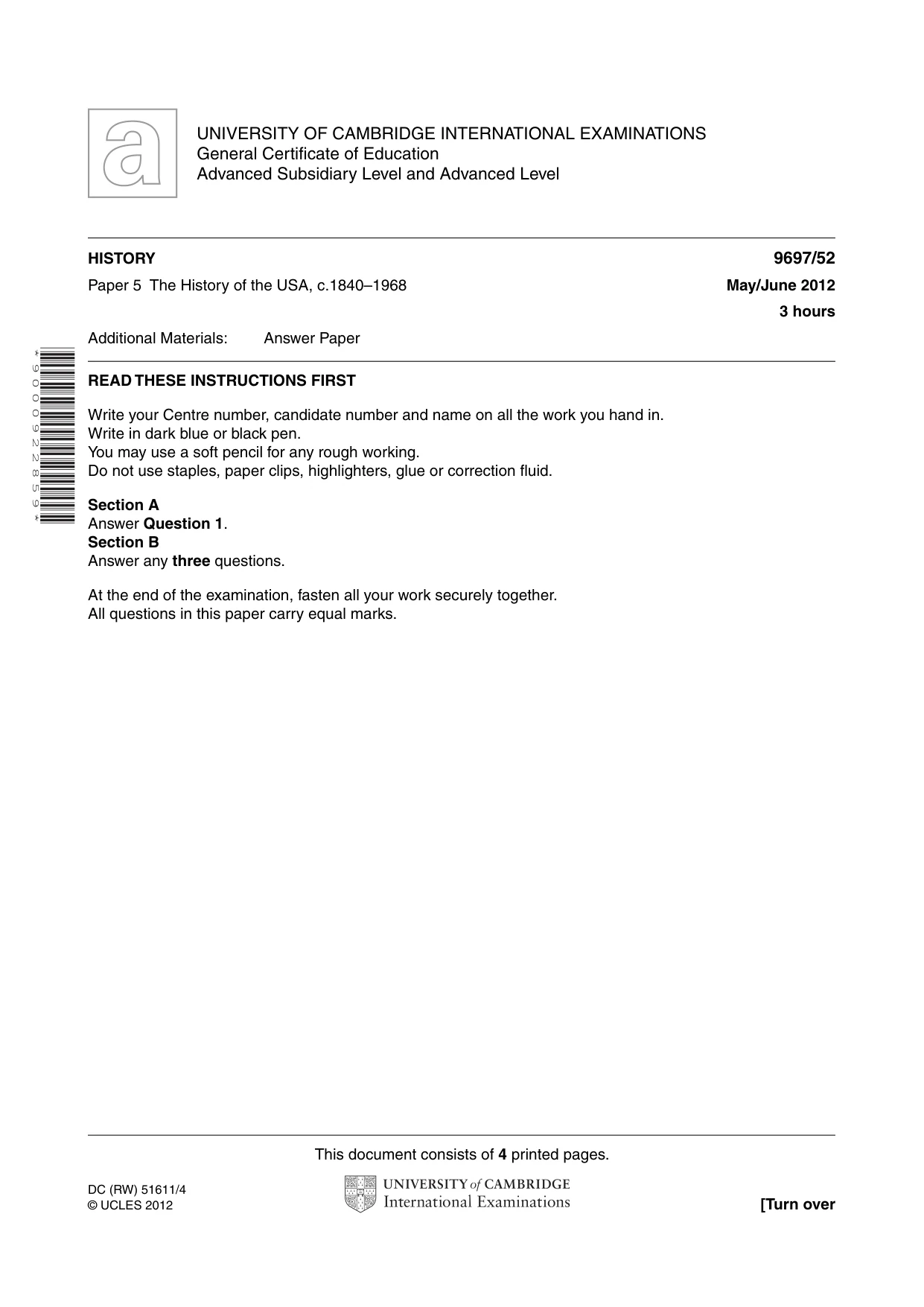
This document consists of 4 printed pages. DC (RW) 51611/4 © UCLES 2012 [Turn over UNIVERSITY OF CAMBRIDGE INTERNATIONAL EXAMINATIONS General Certificate of Education Advanced Subsidiary Level and Advanced Level * 9 0 0 0 9 2 2 8 5 9 * HISTORY 9697/52 Paper 5 The History of the USA, c.1840–1968 May/June 2012 3 hours Additional Materials: Answer Paper READ THESE INSTRUCTIONS FIRST Write your Centre number, candidate number and name on all the work you hand in. Write in dark blue or black pen. You may use a soft pencil for any rough working. Do not use staples, paper clips, highlighters, glue or correction fluid. Section A Answer Question 1. Section B Answer any three questions. At the end of the examination, fasten all your work securely together. All questions in this paper carry equal marks.
Question paper, page 2
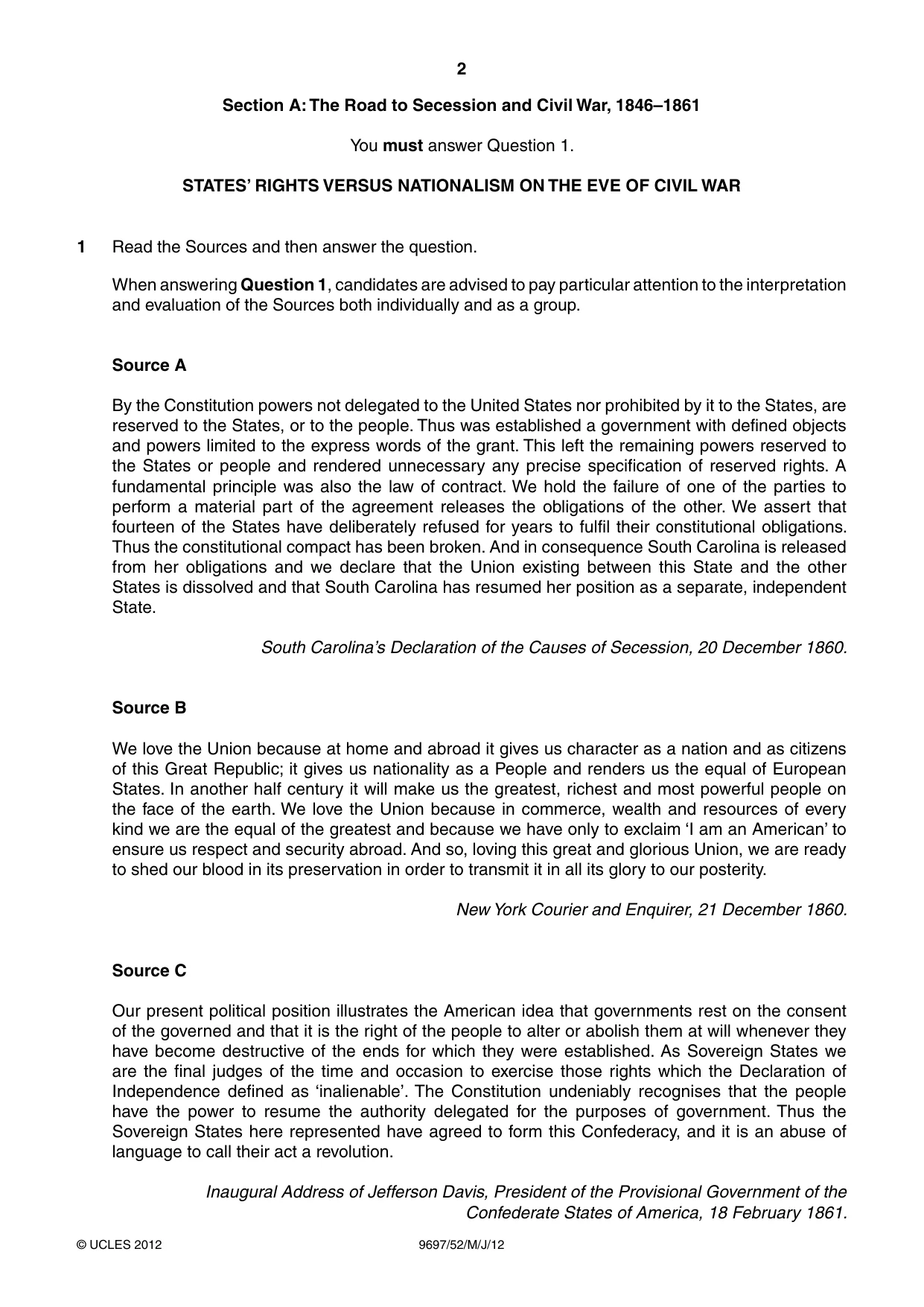
2 9697/52/M/J/12 © UCLES 2012 Section A: The Road to Secession and Civil War, 1846–1861 You must answer Question 1. STATES’ RIGHTS VERSUS NATIONALISM ON THE EVE OF CIVIL WAR 1 Read the Sources and then answer the question. When answering Question 1, candidates are advised to pay particular attention to the interpretation and evaluation of the Sources both individually and as a group. Source A By the Constitution powers not delegated to the United States nor prohibited by it to the States, are reserved to the States, or to the people. Thus was established a government with defined objects and powers limited to the express words of the grant. This left the remaining powers reserved to the States or people and rendered unnecessary any precise specification of reserved rights. A fundamental principle was also the law of contract. We hold the failure of one of the parties to perform a material part of the agreement releases the obligations of the other. We assert that fourteen of the States have deliberately refused for years to fulfil their constitutional obligations. Thus the constitutional compact has been broken. And in consequence South Carolina is released from her obligations and we declare that the Union existing between this State and the other States is dissolved and that South Carolina has resumed her position as a separate, independent State. South Carolina’s Declaration of the Causes of Secession, 20 December 1860. Source B We love the Union because at home and abroad it gives us character as a nation and as citizens of this Great Republic; it gives us nationality as a People and renders us the equal of European States. In another half century it will make us the greatest, richest and most powerful people on the face of the earth. We love the Union because in commerce, wealth and resources of every kind we are the equal of the greatest and because we have only to exclaim ‘I am an American’ to ensure us respect and security abroad. And so, loving this great and glorious Union, we are ready to shed our blood in its preservation in order to transmit it in all its glory to our posterity. New York Courier and Enquirer, 21 December 1860. Source C Our present political position illustrates the American idea that governments rest on the consent of the governed and that it is the right of the people to alter or abolish them at will whenever they have become destructive of the ends for which they were established. As Sovereign States we are the final judges of the time and occasion to exercise those rights which the Declaration of Independence defined as ‘inalienable’. The Constitution undeniably recognises that the people have the power to resume the authority delegated for the purposes of government. Thus the Sovereign States here represented have agreed to form this Confederacy, and it is an abuse of language to call their act a revolution. Inaugural Address of Jefferson Davis, President of the Provisional Government of the Confederate States of America, 18 February 1861.
Question paper, page 3
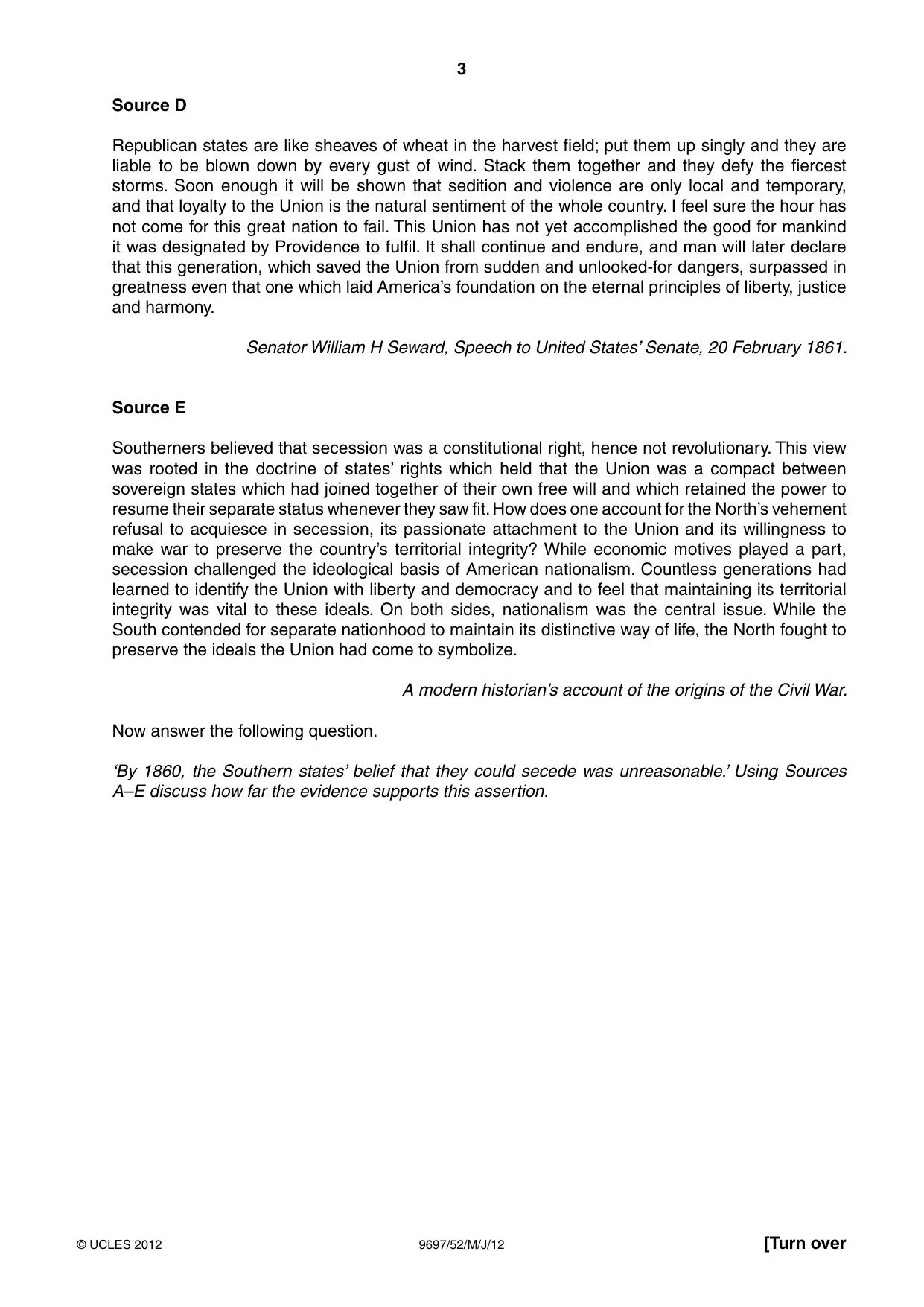
3 9697/52/M/J/12 © UCLES 2012 [Turn over Source D Republican states are like sheaves of wheat in the harvest field; put them up singly and they are liable to be blown down by every gust of wind. Stack them together and they defy the fiercest storms. Soon enough it will be shown that sedition and violence are only local and temporary, and that loyalty to the Union is the natural sentiment of the whole country. I feel sure the hour has not come for this great nation to fail. This Union has not yet accomplished the good for mankind it was designated by Providence to fulfil. It shall continue and endure, and man will later declare that this generation, which saved the Union from sudden and unlooked-for dangers, surpassed in greatness even that one which laid America’s foundation on the eternal principles of liberty, justice and harmony. Senator William H Seward, Speech to United States’ Senate, 20 February 1861. Source E Southerners believed that secession was a constitutional right, hence not revolutionary. This view was rooted in the doctrine of states’ rights which held that the Union was a compact between sovereign states which had joined together of their own free will and which retained the power to resume their separate status whenever they saw fit. How does one account for the North’s vehement refusal to acquiesce in secession, its passionate attachment to the Union and its willingness to make war to preserve the country’s territorial integrity? While economic motives played a part, secession challenged the ideological basis of American nationalism. Countless generations had learned to identify the Union with liberty and democracy and to feel that maintaining its territorial integrity was vital to these ideals. On both sides, nationalism was the central issue. While the South contended for separate nationhood to maintain its distinctive way of life, the North fought to preserve the ideals the Union had come to symbolize. A modern historian’s account of the origins of the Civil War. Now answer the following question. ‘By 1860, the Southern states’ belief that they could secede was unreasonable.’ Using Sources A–E discuss how far the evidence supports this assertion.
Question paper, page 4
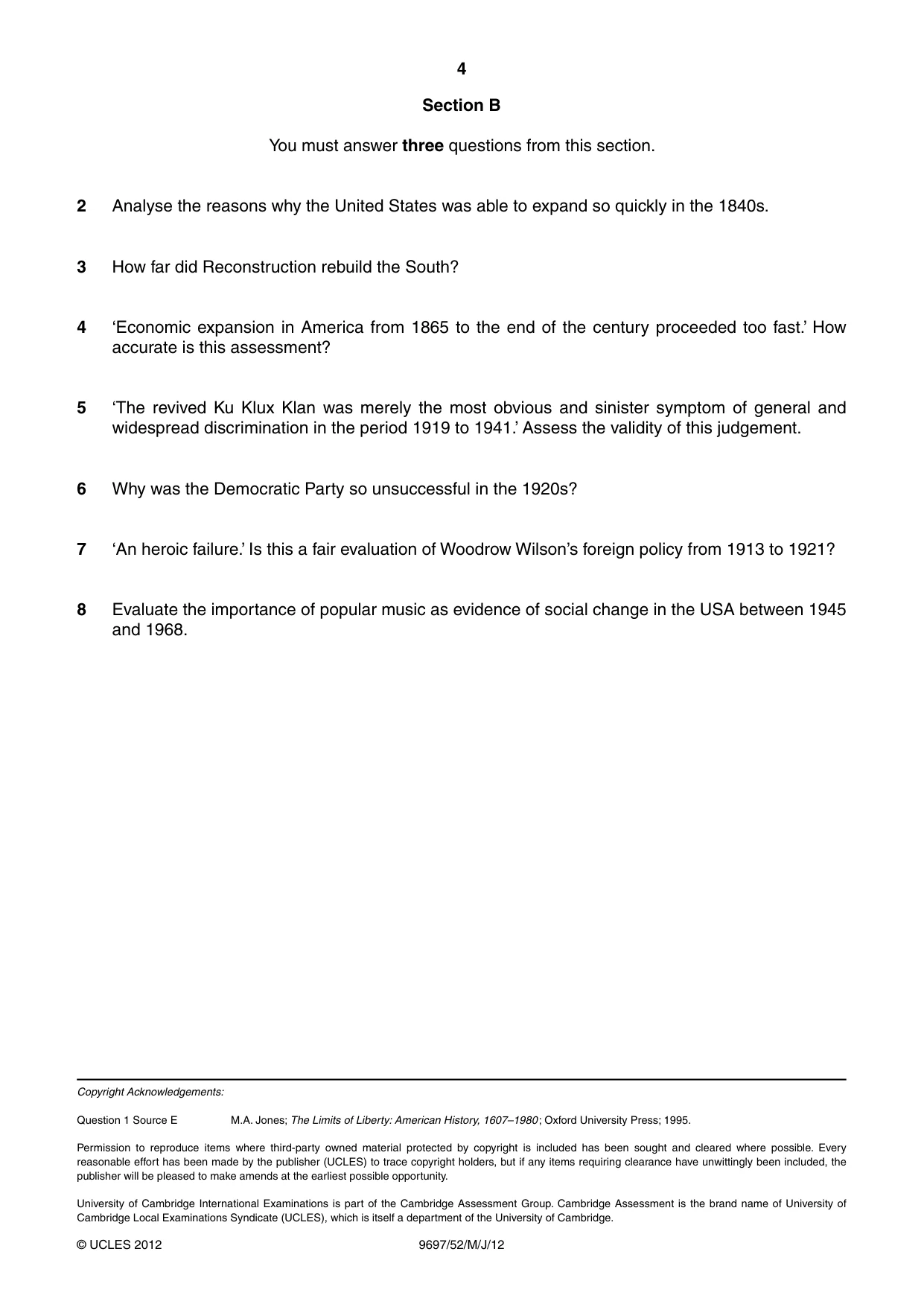
4 9697/52/M/J/12 © UCLES 2012 Section B You must answer three questions from this section. 2 Analyse the reasons why the United States was able to expand so quickly in the 1840s. 3 How far did Reconstruction rebuild the South? 4 ‘Economic expansion in America from 1865 to the end of the century proceeded too fast.’ How accurate is this assessment? 5 ‘The revived Ku Klux Klan was merely the most obvious and sinister symptom of general and widespread discrimination in the period 1919 to 1941.’ Assess the validity of this judgement. 6 Why was the Democratic Party so unsuccessful in the 1920s? 7 ‘An heroic failure.’ Is this a fair evaluation of Woodrow Wilson’s foreign policy from 1913 to 1921? 8 Evaluate the importance of popular music as evidence of social change in the USA between 1945 and 1968. Copyright Acknowledgements: Question 1 Source E M.A. Jones; The Limits of Liberty: American History, 1607–1980 ; Oxford University Press; 1995. Permission to reproduce items where third-party owned material protected by copyright is included has been sought and cleared where possible. Every reasonable effort has been made by the publisher (UCLES) to trace copyright holders, but if any items requiring clearance have unwittingly been included, the publisher will be pleased to make amends at the earliest possible opportunity. University of Cambridge International Examinations is part of the Cambridge Assessment Group. Cambridge Assessment is the brand name of University of Cambridge Local Examinations Syndicate (UCLES), which is itself a department of the University of Cambridge.
Mark scheme, page 1
UNIVERSITY OF CAMBRIDGE INTERNATIONAL EXAMINATIONS GCE Advanced Subsidiary Level and GCE Advanced Level MARK SCHEME for the May/June 2012 question paper for the guidance of teachers 9697 HISTORY 9697/52 Paper 5, maximum raw mark 100 This mark scheme is published as an aid to teachers and candidates, to indicate the requirements of the examination. It shows the basis on which Examiners were instructed to award marks. It does not indicate the details of the discussions that took place at an Examiners’ meeting before marking began, which would have considered the acceptability of alternative answers. Mark schemes must be read in conjunction with the question papers and the report on the examination. • Cambridge will not enter into discussions or correspondence in connection with these mark schemes. Cambridge is publishing the mark schemes for the May/June 2012 question papers for most IGCSE, GCE Advanced Level and Advanced Subsidiary Level syllabuses and some Ordinary Level syllabuses.
Mark scheme, page 2
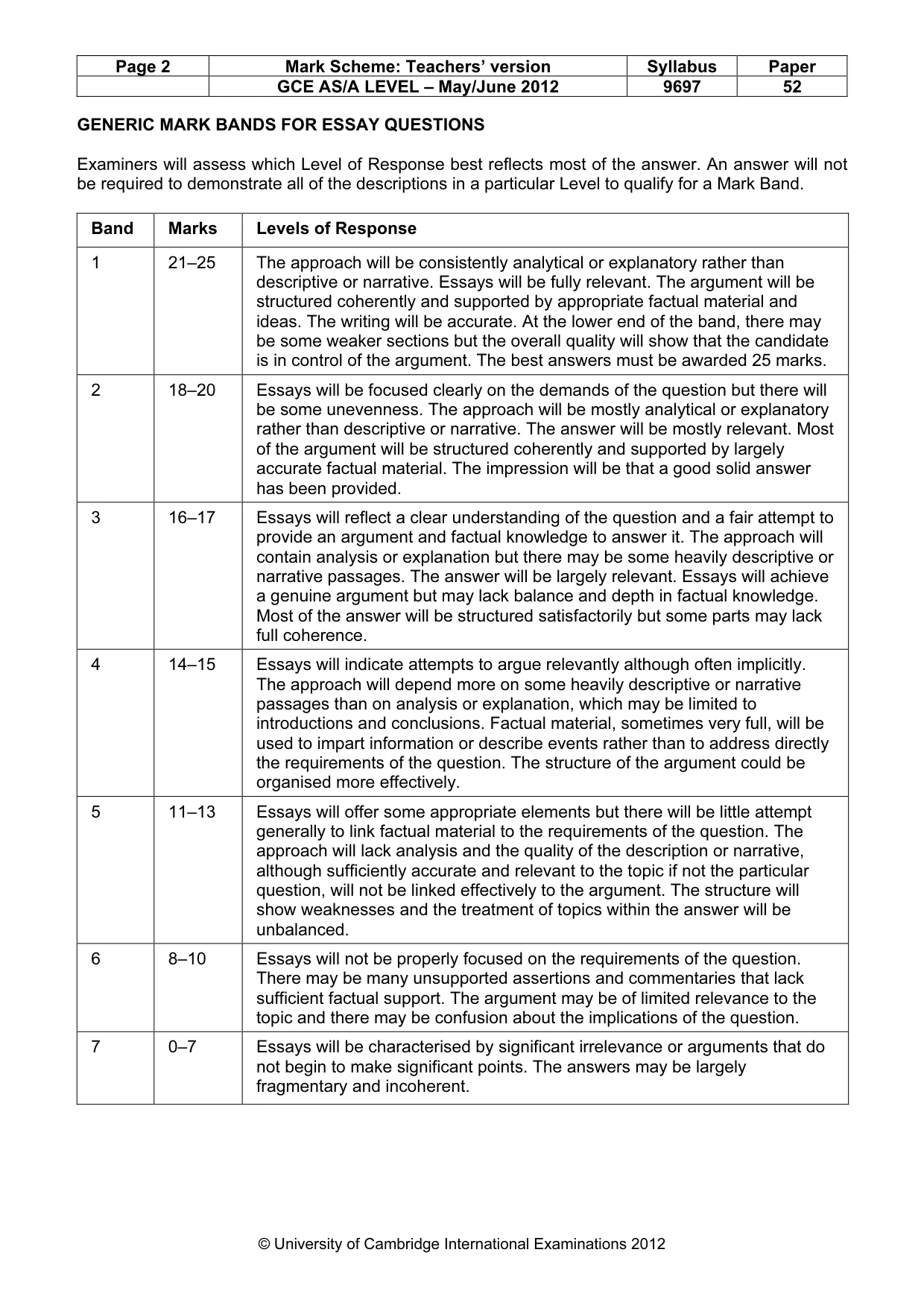
Page 2 Mark Scheme: Teachers’ version Syllabus Paper GCE AS/A LEVEL – May/June 2012 9697 52 © University of Cambridge International Examinations 2012 GENERIC MARK BANDS FOR ESSAY QUESTIONS Examiners will assess which Level of Response best reflects most of the answer. An answer will not be required to demonstrate all of the descriptions in a particular Level to qualify for a Mark Band. Band Marks Levels of Response 1 21–25 The approach will be consistently analytical or explanatory rather than descriptive or narrative. Essays will be fully relevant. The argument will be structured coherently and supported by appropriate factual material and ideas. The writing will be accurate. At the lower end of the band, there may be some weaker sections but the overall quality will show that the candidate is in control of the argument. The best answers must be awarded 25 marks. 2 18–20 Essays will be focused clearly on the demands of the question but there will be some unevenness. The approach will be mostly analytical or explanatory rather than descriptive or narrative. The answer will be mostly relevant. Most of the argument will be structured coherently and supported by largely accurate factual material. The impression will be that a good solid answer has been provided. 3 16–17 Essays will reflect a clear understanding of the question and a fair attempt to provide an argument and factual knowledge to answer it. The approach will contain analysis or explanation but there may be some heavily descriptive or narrative passages. The answer will be largely relevant. Essays will achieve a genuine argument but may lack balance and depth in factual knowledge. Most of the answer will be structured satisfactorily but some parts may lack full coherence. 4 14–15 Essays will indicate attempts to argue relevantly although often implicitly. The approach will depend more on some heavily descriptive or narrative passages than on analysis or explanation, which may be limited to introductions and conclusions. Factual material, sometimes very full, will be used to impart information or describe events rather than to address directly the requirements of the question. The structure of the argument could be organised more effectively. 5 11–13 Essays will offer some appropriate elements but there will be little attempt generally to link factual material to the requirements of the question. The approach will lack analysis and the quality of the description or narrative, although sufficiently accurate and relevant to the topic if not the particular question, will not be linked effectively to the argument. The structure will show weaknesses and the treatment of topics within the answer will be unbalanced. 6 8–10 Essays will not be properly focused on the requirements of the question. There may be many unsupported assertions and commentaries that lack sufficient factual support. The argument may be of limited relevance to the topic and there may be confusion about the implications of the question. 7 0–7 Essays will be characterised by significant irrelevance or arguments that do not begin to make significant points. The answers may be largely fragmentary and incoherent.
Mark scheme, page 3
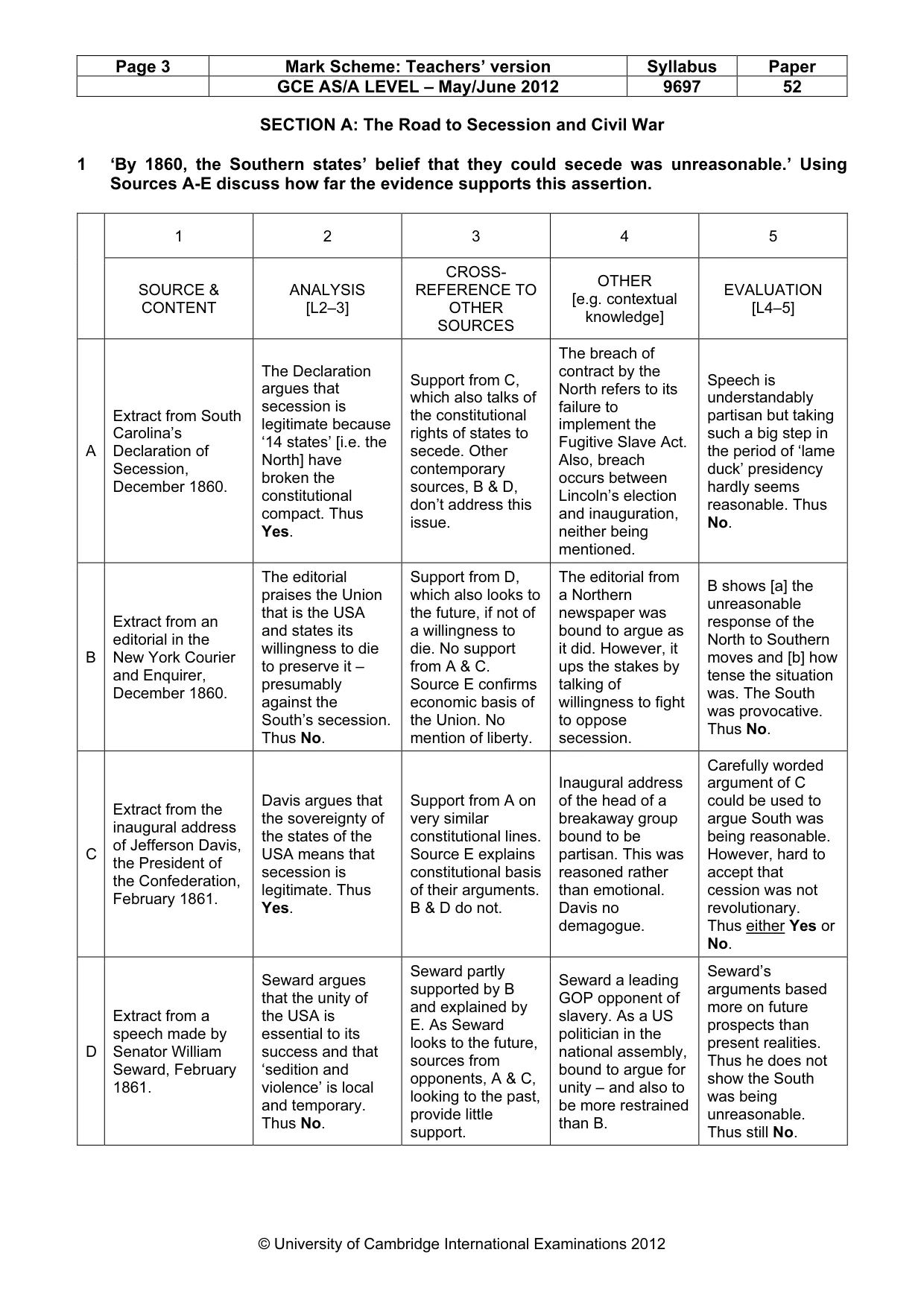
Page 3 Mark Scheme: Teachers’ version Syllabus Paper GCE AS/A LEVEL – May/June 2012 9697 52 © University of Cambridge International Examinations 2012 SECTION A: The Road to Secession and Civil War 1 ‘By 1860, the Southern states’ belief that they could secede was unreasonable.’ Using Sources A-E discuss how far the evidence supports this assertion. 1 2 3 4 5 SOURCE & CONTENT ANALYSIS [L2–3] CROSS- REFERENCE TO OTHER SOURCES OTHER [e.g. contextual knowledge] EVALUATION [L4–5] A Extract from South Carolina’s Declaration of Secession, December 1860. The Declaration argues that secession is legitimate because ‘14 states’ [i.e. the North] have broken the constitutional compact. Thus Yes. Support from C, which also talks of the constitutional rights of states to secede. Other contemporary sources, B & D, don’t address this issue. The breach of contract by the North refers to its failure to implement the Fugitive Slave Act. Also, breach occurs between Lincoln’s election and inauguration, neither being mentioned. Speech is understandably partisan but taking such a big step in the period of ‘lame duck’ presidency hardly seems reasonable. Thus No. B Extract from an editorial in the New York Courier and Enquirer, December 1860. The editorial praises the Union that is the USA and states its willingness to die to preserve it – presumably against the South’s secession. Thus No. Support from D, which also looks to the future, if not of a willingness to die. No support from A & C. Source E confirms economic basis of the Union. No mention of liberty. The editorial from a Northern newspaper was bound to argue as it did. However, it ups the stakes by talking of willingness to fight to oppose secession. B shows [a] the unreasonable response of the North to Southern moves and [b] how tense the situation was. The South was provocative. Thus No. C Extract from the inaugural address of Jefferson Davis, the President of the Confederation, February 1861. Davis argues that the sovereignty of the states of the USA means that secession is legitimate. Thus Yes. Support from A on very similar constitutional lines. Source E explains constitutional basis of their arguments. B & D do not. Inaugural address of the head of a breakaway group bound to be partisan. This was reasoned rather than emotional. Davis no demagogue. Carefully worded argument of C could be used to argue South was being reasonable. However, hard to accept that cession was not revolutionary. Thus either Yes or No. D Extract from a speech made by Senator William Seward, February 1861. Seward argues that the unity of the USA is essential to its success and that ‘sedition and violence’ is local and temporary. Thus No. Seward partly supported by B and explained by E. As Seward looks to the future, sources from opponents, A & C, looking to the past, provide little support. Seward a leading GOP opponent of slavery. As a US politician in the national assembly, bound to argue for unity – and also to be more restrained than B. Seward’s arguments based more on future prospects than present realities. Thus he does not show the South was being unreasonable. Thus still No.
Mark scheme, page 4
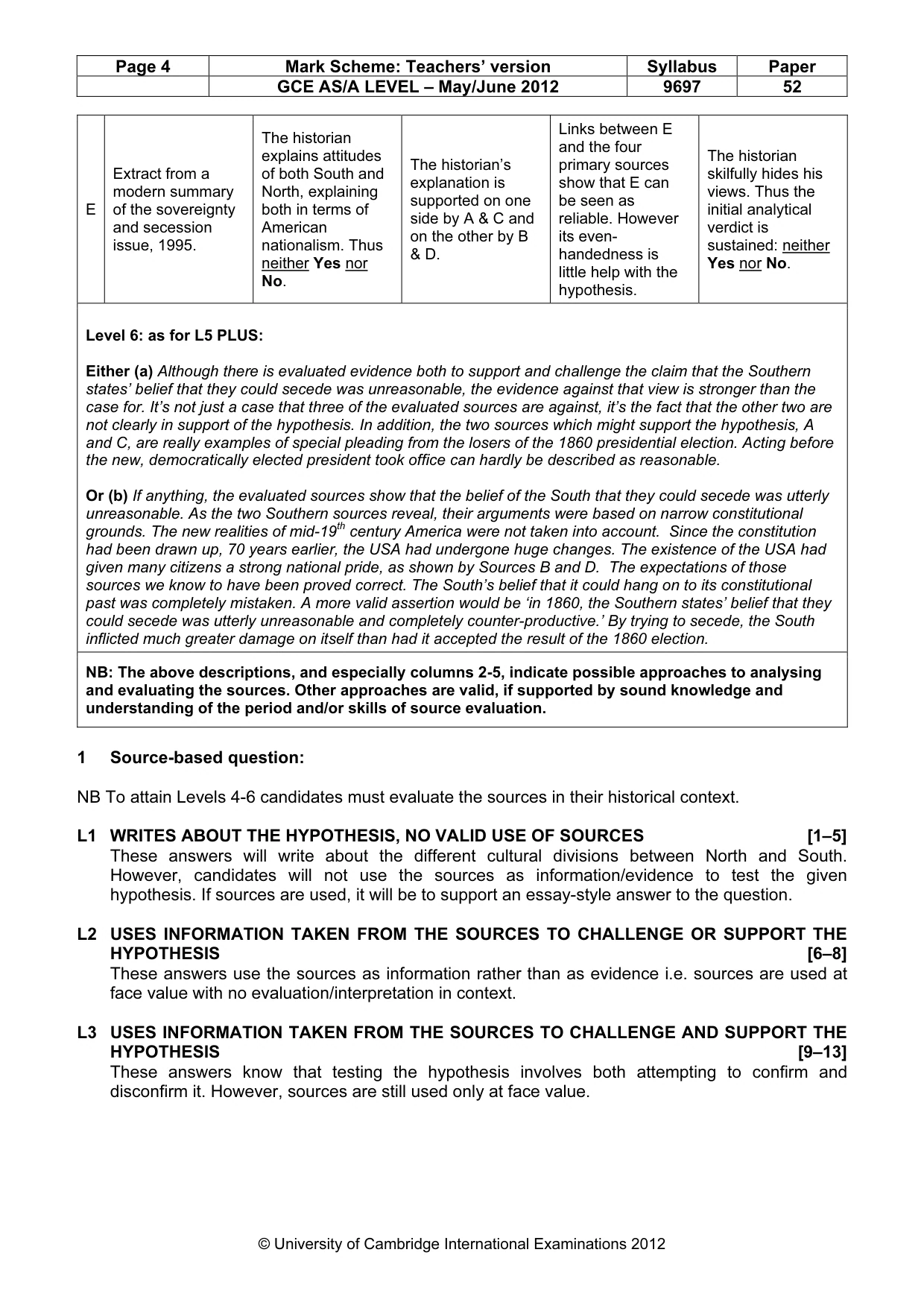
Page 4 Mark Scheme: Teachers’ version Syllabus Paper GCE AS/A LEVEL – May/June 2012 9697 52 © University of Cambridge International Examinations 2012 E Extract from a modern summary of the sovereignty and secession issue, 1995. The historian explains attitudes of both South and North, explaining both in terms of American nationalism. Thus neither Yes nor No. The historian’s explanation is supported on one side by A & C and on the other by B & D. Links between E and the four primary sources show that E can be seen as reliable. However its even- handedness is little help with the hypothesis. The historian skilfully hides his views. Thus the initial analytical verdict is sustained: neither Yes nor No. Level 6: as for L5 PLUS: Either (a) Although there is evaluated evidence both to support and challenge the claim that the Southern states’ belief that they could secede was unreasonable, the evidence against that view is stronger than the case for. It’s not just a case that three of the evaluated sources are against, it’s the fact that the other two are not clearly in support of the hypothesis. In addition, the two sources which might support the hypothesis, A and C, are really examples of special pleading from the losers of the 1860 presidential election. Acting before the new, democratically elected president took office can hardly be described as reasonable. Or (b) If anything, the evaluated sources show that the belief of the South that they could secede was utterly unreasonable. As the two Southern sources reveal, their arguments were based on narrow constitutional grounds. The new realities of mid-19th century America were not taken into account. Since the constitution had been drawn up, 70 years earlier, the USA had undergone huge changes. The existence of the USA had given many citizens a strong national pride, as shown by Sources B and D. The expectations of those sources we know to have been proved correct. The South’s belief that it could hang on to its constitutional past was completely mistaken. A more valid assertion would be ‘in 1860, the Southern states’ belief that they could secede was utterly unreasonable and completely counter-productive.’ By trying to secede, the South inflicted much greater damage on itself than had it accepted the result of the 1860 election. NB: The above descriptions, and especially columns 2-5, indicate possible approaches to analysing and evaluating the sources. Other approaches are valid, if supported by sound knowledge and understanding of the period and/or skills of source evaluation. 1 Source-based question: NB To attain Levels 4-6 candidates must evaluate the sources in their historical context. L1 WRITES ABOUT THE HYPOTHESIS, NO VALID USE OF SOURCES [1–5] These answers will write about the different cultural divisions between North and South. However, candidates will not use the sources as information/evidence to test the given hypothesis. If sources are used, it will be to support an essay-style answer to the question. L2 USES INFORMATION TAKEN FROM THE SOURCES TO CHALLENGE OR SUPPORT THE HYPOTHESIS [6–8] These answers use the sources as information rather than as evidence i.e. sources are used at face value with no evaluation/interpretation in context. L3 USES INFORMATION TAKEN FROM THE SOURCES TO CHALLENGE AND SUPPORT THE HYPOTHESIS [9–13] These answers know that testing the hypothesis involves both attempting to confirm and disconfirm it. However, sources are still used only at face value.
Mark scheme, page 5
Page 5 Mark Scheme: Teachers’ version Syllabus Paper GCE AS/A LEVEL – May/June 2012 9697 52 © University of Cambridge International Examinations 2012 L4 BY INTERPRETING/EVALUATlNG SOURCES IN CONTEXT, FINDS EVIDENCE TO CHALLENGE OR SUPPORT THE HYPOTHESIS. [14–16] These answers are capable of using sources as evidence, i.e. demonstrating their utility in testing the hypothesis, by interpreting them in their historical context, i.e. not simply accepting them at face value. L5 BY INTERPRETING/EVALUATING SOURCES IN CONTEXT, FINDS EVIDENCE TO CHALLENGE AND SUPPORT THE HYPOTHESIS. [17–21] These answers know that testing the hypothesis involves both attempting to confirm and disconfirm the hypothesis and are capable of using the sources in their historical context to do this (i.e. both confirmation and disconfirmation are done at this level). L6 AS L5 PLUS EITHER (a) EXPLAINS WHY EVIDENCE TO CHALLENGE/SUPPORT IS BETTER/PREFERRED OR (b) RECONCILES/EXPLAINS PROBLEMS IN THE EVIDENCE TO SHOW THAT NEITHER CHALLENGING OR SUPPORT IS TO BE PREFERRED. [22–25] For (a) the argument must be that the evidence for agreeing/disagreeing is better/preferred. This must include a comparative judgment – i.e. not just why some evidence is better but also why some evidence is worse. For (b) include all L5 answers which use the evidence to modify the hypothesis (rather than simply seeking to support/contradict), in order to improve it.
Mark scheme, page 6
Page 6 Mark Scheme: Teachers’ version Syllabus Paper GCE AS/A LEVEL – May/June 2012 9697 52 © University of Cambridge International Examinations 2012 SECTION B 2 Analyse the reasons why the United States was able to expand so quickly in the 1840s. The rapid expansion in the 1840s concerned three areas: Texas in 1845, Oregon in 1846 and what becomes known as the Mexican Cession in 1848. The Mormon movement arrived in Utah in 1847, exploiting the political vacuum which existed in a region still nominally Mexican. How the USA gained control differs in each area: • Texas 1845 Texas had broken away from Mexican control in 1836, wanting to join the USA. Only in 1845 did the USA agree to accept Texas as a state – not territory – of the USA. • Oregon 1846 Oregon County was a huge expanse of territory – around 850 miles from north to south – on the Pacific coast which ran from Mexico in the south, which still ruled California at the time, to Alaska, governed by Russia, in the north. In 1818 the UK and the USA, unable to agree on a boundary, had agreed to a form of joint rule of the region. In 1845 the new US president, Polk, ended the agreement. There was talk of war. In 1846 both sides agreed to compromise on the 49th parallel as the new border. NB The phrase ‘manifest destiny’ was first used by a journalist in December 1845 to justify the US claim to the whole of Oregon. The concept was never a cause of expansion. • The Mexican Cession 1848 This was a massive region covering modern-day California, Nevada, Utah, most of Arizona, half of New Mexico and parts of Colorado and Wyoming. It was gained as a result of the two- year war with Mexico, culminating in the Treaty of Guadalupe Hidalgo. In theory, the USA paid $15 million for the Cession. Why the USA was able to gain control is a different question from how. Key points include: • Military Power The US forces proved far superior in 1846-8, invading Mexico and occupying Mexico City. This superiority was based on leadership, discipline and resources. • President Polk He was prepared to settle with the UK over Oregon and to provoke war with Mexico. He resisted both those who opposed the war and those who wanted to take even more territory, both in Oregon and from Mexico. • The Opposition While the UK was prepared to settle Oregon, even if stronger than the USA, Mexico was drawn into a disastrous war, even though weaker than the USA.
Mark scheme, page 7
Page 7 Mark Scheme: Teachers’ version Syllabus Paper GCE AS/A LEVEL – May/June 2012 9697 52 © University of Cambridge International Examinations 2012 3 How far did Reconstruction rebuild the South? The question focuses on rebuilding the South after the Civil War. This rebuilding took several forms: • As most of the fighting was done in the South, it suffered great damage. This plus the emancipation of the slaves meant also: • A slave-based economy no longer existed. What was to replace it? Were plantations to be broken up and land redistributed to the landless and especially to ex-slaves? • A slave-based society no longer existed. Four million slaves had been freed. What place were they to have in society? • What conditions would the South have to fulfil in order to be readmitted to the Union? Thus Reconstruction could never be ‘reconstruction’ in the precise sense of the word. The postwar era was more accurately the construction of a new economic, social and political order. • 1863–65: Lincoln and the Republicans start to prepare for peace With the Emancipation Proclamation, plans for readmitting rebel states to the Union, the Freedmen’s Bureau and the 13th Amendment abolishing slavery. • 1865–68: Reconstruction under Johnson [or Presidential Reconstruction] Johnson was an ex-Democrat from Tennessee with an inflexible determination to control Reconstruction himself and to complete it as quickly as possible. In particular he used the eight months before the 39th Congress met in December 1865 to grant pardons to white Southerners and to restore elected government in the rebel states. The new assemblies, white-dominated, passed the Black Codes limiting the rights of ex-slaves. • 1865–6: Conflict between the President and Congress The second session of the 39th Congress, wanting more effective reconstruction policies, passed legislation and introduced constitutional amendments which Johnson tried to veto or oppose: o The 14th Amendment: due process and equal rights for all o Civil Rights Act March 1866: to overcome Black Codes o Freedmen’s Bureau: powers renewed [lasted to 1871] The 1866 midterm elections resulted in a Congress with Republican majorities sufficient to overcome presidential vetoes. • 1866–77: Radical Reconstruction [or Congressional Reconstruction] Congress introduced: o Military rule of the South 1867–76: to help restore representative government o The 15th Amendment 1869–70: no exclusion from voting on racial grounds o Civil Rights Act 1875 to provide equal access to public services and facilities Northern government of the South, helped by carpetbaggers and scalawags and ‘a massive attempt at social engineering’ [Reynolds], led to Southern resistance via the Ku Klux Klan. • 1877: The end of Reconstruction The bitterly disputed presidential election of 1876 led to the Compromise of 1877, which includes the Republicans agreeing to abandon Reconstruction – though Republican efforts had eased off from the early 1870s.
Mark scheme, page 8
Page 8 Mark Scheme: Teachers’ version Syllabus Paper GCE AS/A LEVEL – May/June 2012 9697 52 © University of Cambridge International Examinations 2012 4 ‘Economic expansion in America from 1865 to the end of the century proceeded too fast.’ How accurate is this assessment? The key issue is whether the US economy grew too fast in these 35 years. Its growth was certainly fast. In real terms [2009 dollars] the GDP per head of population grew from $4,500 in 1870 to $8,200 in 1900, a growth of 182%. In 1867 the US produced 17,000 tons of steel ingots, in 1897 7,000,000 tons. Why might this rapid growth be too rapid? Because the USA might be unable to provide • Men, money and raw materials to produce the goods Many of the men were immigrants, mainly from Europe. This in turn put pressure on [a] working class wages and [b] the infrastructures of the rapidly-growing industrial cities. The money came from private investors, government loans or overseas investors, e.g. UK. • A market large and prosperous enough to buy the goods The USA itself provided the market, the railways being the main means of national communications. That gave too much power to railway companies. Also US government provided few restraints on and often great support for initiatives undertaken by entrepreneurs as the links between business men and politicians were too close. Such rapid economic growth might be unequally distributed within the USA in several ways: • By region: the North East and Mid West gain as the South was especially hard hit. • By sector: the industrialists gain as the farmers of the South and West lost out. • By social class: the capitalists gain as the working class loose – in relative terms. And thus it might result in political activism by groups which did loose out: • Farmers in West and South: the Grange and then the People’s Party & Populism. • Working class in North East and Mid West: growth of trade unionism & industrial unrest. • Urban middle class: growing demand for regulation of railways and trusts. Thus Interstate Commerce Act 1887 & Sherman Anti-Trust Act 1890. The counter-argument, that US industrial growth was not too fast is based on the evidence of rising living standards for all Americans over the long term, despite short term setbacks, e.g. economic depression 1873–79.
Mark scheme, page 9
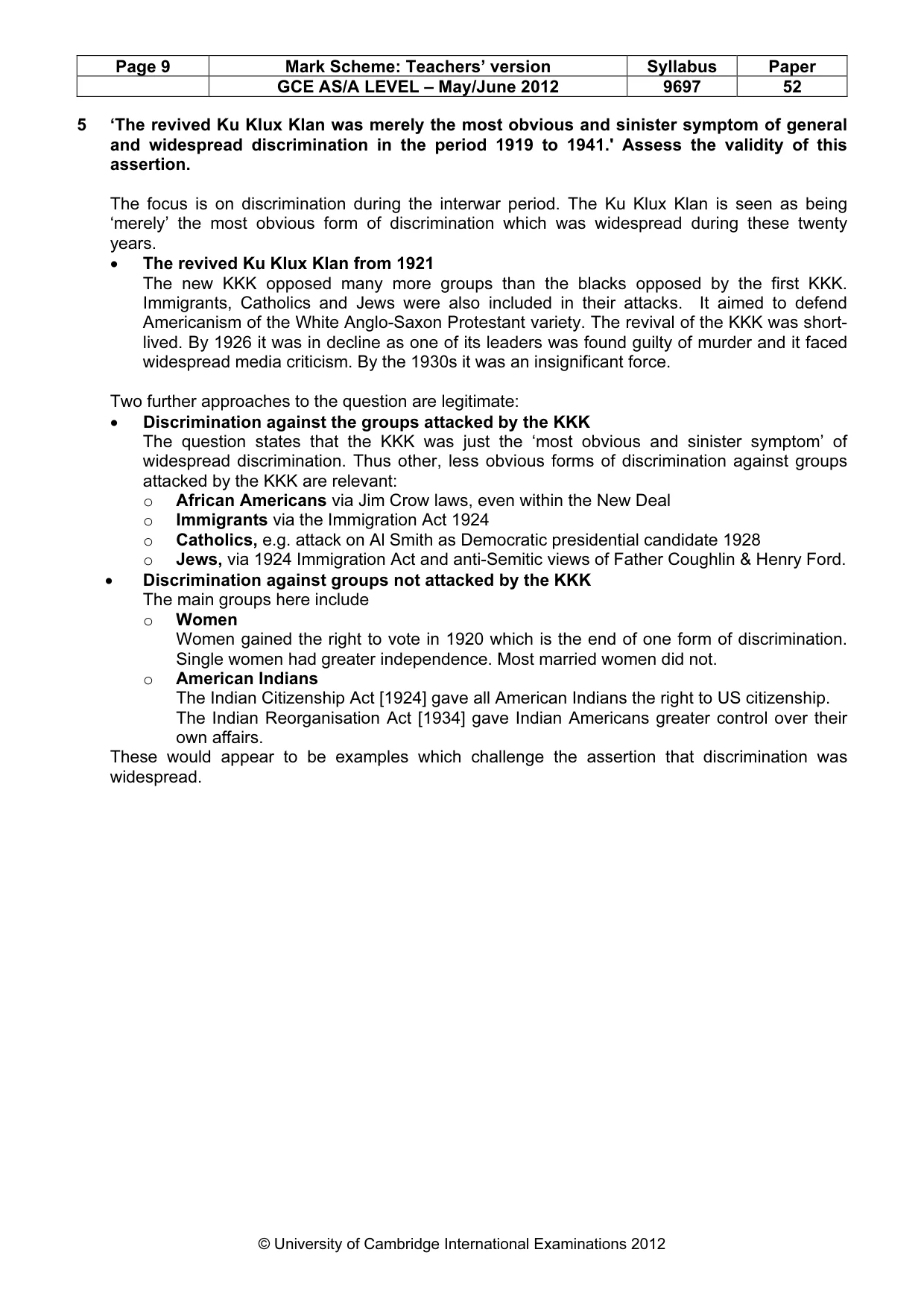
Page 9 Mark Scheme: Teachers’ version Syllabus Paper GCE AS/A LEVEL – May/June 2012 9697 52 © University of Cambridge International Examinations 2012 5 ‘The revived Ku Klux Klan was merely the most obvious and sinister symptom of general and widespread discrimination in the period 1919 to 1941.' Assess the validity of this assertion. The focus is on discrimination during the interwar period. The Ku Klux Klan is seen as being ‘merely’ the most obvious form of discrimination which was widespread during these twenty years. • The revived Ku Klux Klan from 1921 The new KKK opposed many more groups than the blacks opposed by the first KKK. Immigrants, Catholics and Jews were also included in their attacks. It aimed to defend Americanism of the White Anglo-Saxon Protestant variety. The revival of the KKK was short- lived. By 1926 it was in decline as one of its leaders was found guilty of murder and it faced widespread media criticism. By the 1930s it was an insignificant force. Two further approaches to the question are legitimate: • Discrimination against the groups attacked by the KKK The question states that the KKK was just the ‘most obvious and sinister symptom’ of widespread discrimination. Thus other, less obvious forms of discrimination against groups attacked by the KKK are relevant: o African Americans via Jim Crow laws, even within the New Deal o Immigrants via the Immigration Act 1924 o Catholics, e.g. attack on Al Smith as Democratic presidential candidate 1928 o Jews, via 1924 Immigration Act and anti-Semitic views of Father Coughlin & Henry Ford. • Discrimination against groups not attacked by the KKK The main groups here include o Women Women gained the right to vote in 1920 which is the end of one form of discrimination. Single women had greater independence. Most married women did not. o American Indians The Indian Citizenship Act [1924] gave all American Indians the right to US citizenship. The Indian Reorganisation Act [1934] gave Indian Americans greater control over their own affairs. These would appear to be examples which challenge the assertion that discrimination was widespread.
Mark scheme, page 10
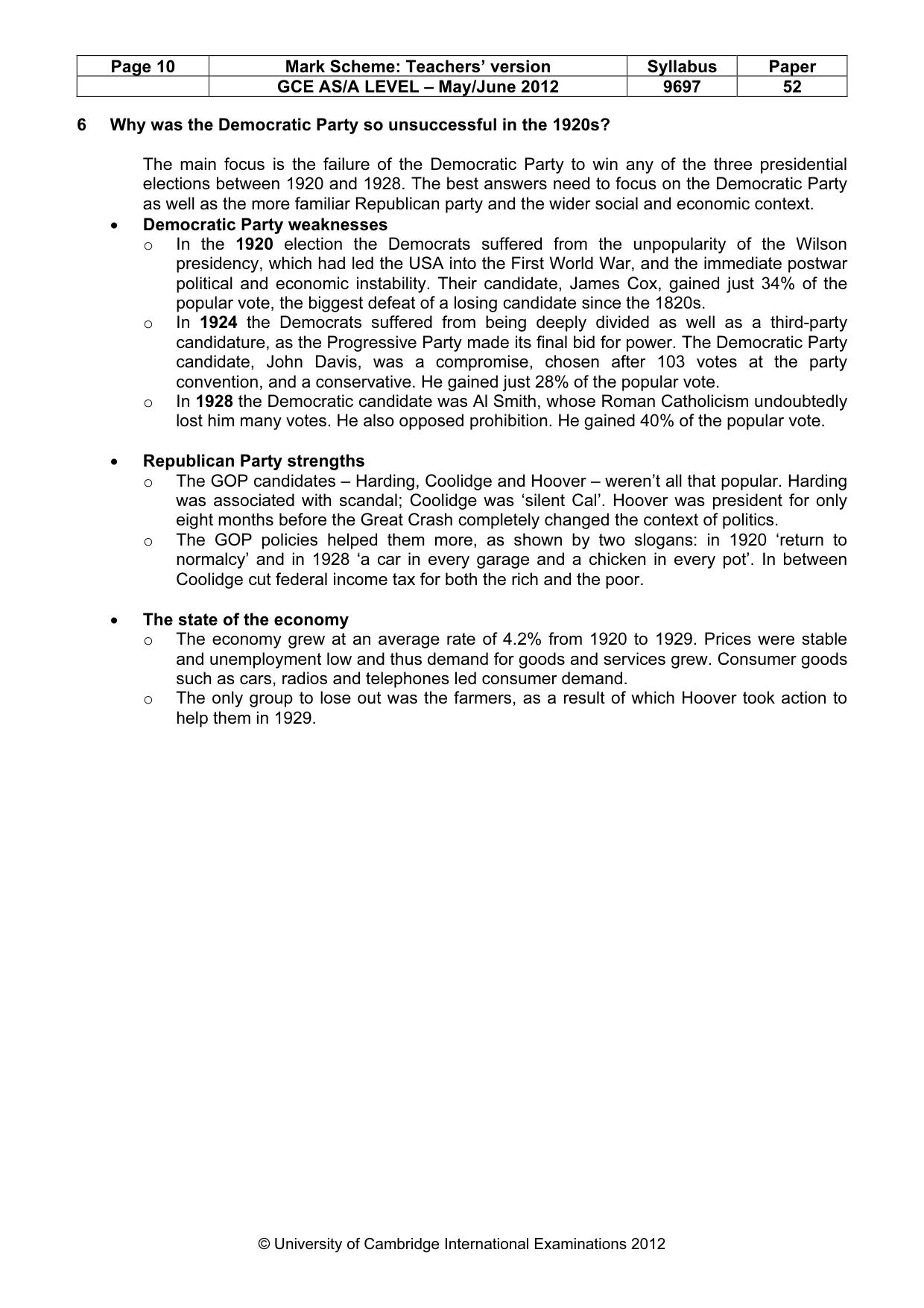
Page 10 Mark Scheme: Teachers’ version Syllabus Paper GCE AS/A LEVEL – May/June 2012 9697 52 © University of Cambridge International Examinations 2012 6 Why was the Democratic Party so unsuccessful in the 1920s? The main focus is the failure of the Democratic Party to win any of the three presidential elections between 1920 and 1928. The best answers need to focus on the Democratic Party as well as the more familiar Republican party and the wider social and economic context. • Democratic Party weaknesses o In the 1920 election the Democrats suffered from the unpopularity of the Wilson presidency, which had led the USA into the First World War, and the immediate postwar political and economic instability. Their candidate, James Cox, gained just 34% of the popular vote, the biggest defeat of a losing candidate since the 1820s. o In 1924 the Democrats suffered from being deeply divided as well as a third-party candidature, as the Progressive Party made its final bid for power. The Democratic Party candidate, John Davis, was a compromise, chosen after 103 votes at the party convention, and a conservative. He gained just 28% of the popular vote. o In 1928 the Democratic candidate was Al Smith, whose Roman Catholicism undoubtedly lost him many votes. He also opposed prohibition. He gained 40% of the popular vote. • Republican Party strengths o The GOP candidates – Harding, Coolidge and Hoover – weren’t all that popular. Harding was associated with scandal; Coolidge was ‘silent Cal’. Hoover was president for only eight months before the Great Crash completely changed the context of politics. o The GOP policies helped them more, as shown by two slogans: in 1920 ‘return to normalcy’ and in 1928 ‘a car in every garage and a chicken in every pot’. In between Coolidge cut federal income tax for both the rich and the poor. • The state of the economy o The economy grew at an average rate of 4.2% from 1920 to 1929. Prices were stable and unemployment low and thus demand for goods and services grew. Consumer goods such as cars, radios and telephones led consumer demand. o The only group to lose out was the farmers, as a result of which Hoover took action to help them in 1929.
Mark scheme, page 11
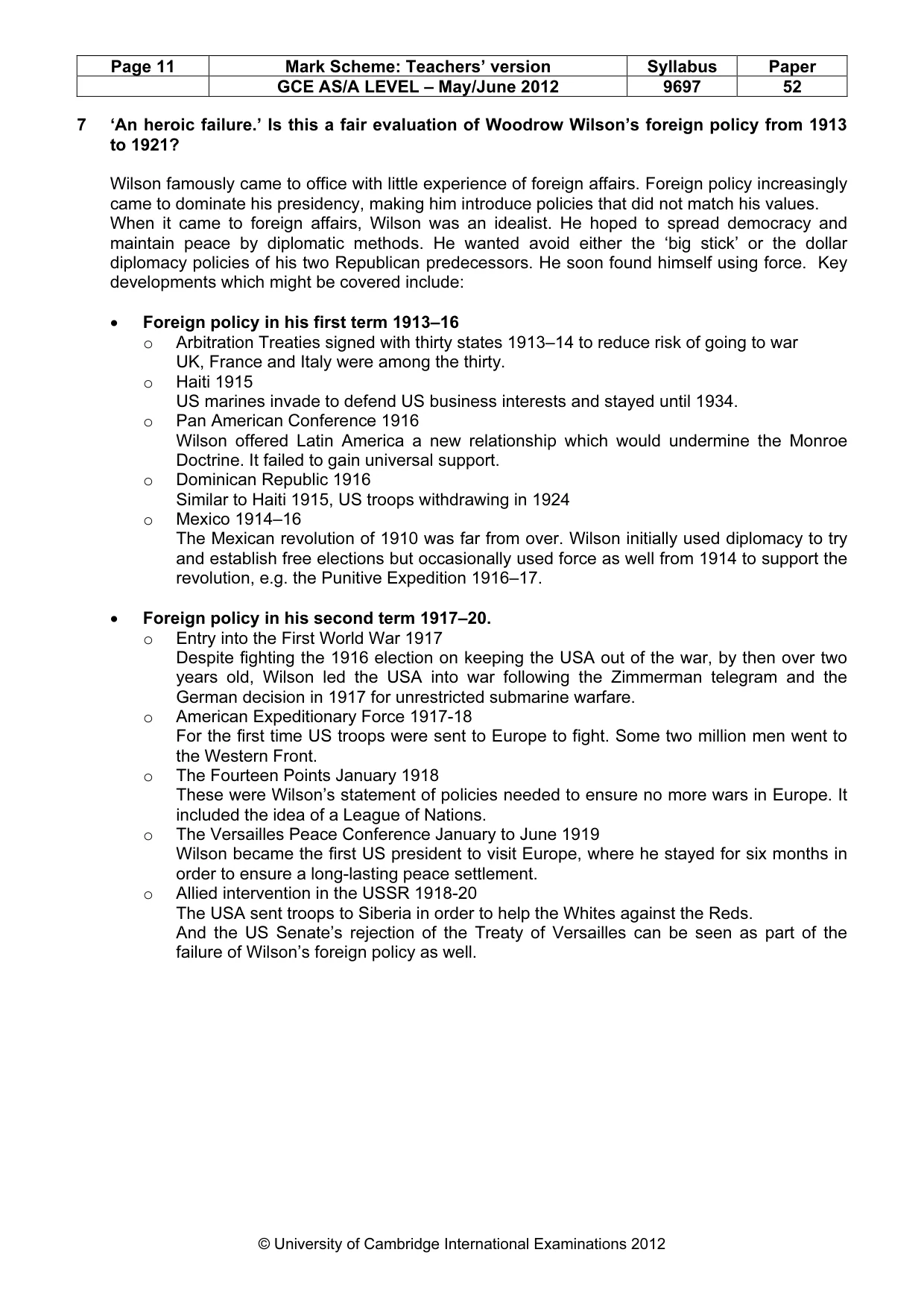
Page 11 Mark Scheme: Teachers’ version Syllabus Paper GCE AS/A LEVEL – May/June 2012 9697 52 © University of Cambridge International Examinations 2012 7 ‘An heroic failure.’ Is this a fair evaluation of Woodrow Wilson’s foreign policy from 1913 to 1921? Wilson famously came to office with little experience of foreign affairs. Foreign policy increasingly came to dominate his presidency, making him introduce policies that did not match his values. When it came to foreign affairs, Wilson was an idealist. He hoped to spread democracy and maintain peace by diplomatic methods. He wanted avoid either the ‘big stick’ or the dollar diplomacy policies of his two Republican predecessors. He soon found himself using force. Key developments which might be covered include: • Foreign policy in his first term 1913–16 o Arbitration Treaties signed with thirty states 1913–14 to reduce risk of going to war UK, France and Italy were among the thirty. o Haiti 1915 US marines invade to defend US business interests and stayed until 1934. o Pan American Conference 1916 Wilson offered Latin America a new relationship which would undermine the Monroe Doctrine. It failed to gain universal support. o Dominican Republic 1916 Similar to Haiti 1915, US troops withdrawing in 1924 o Mexico 1914–16 The Mexican revolution of 1910 was far from over. Wilson initially used diplomacy to try and establish free elections but occasionally used force as well from 1914 to support the revolution, e.g. the Punitive Expedition 1916–17. • Foreign policy in his second term 1917–20. o Entry into the First World War 1917 Despite fighting the 1916 election on keeping the USA out of the war, by then over two years old, Wilson led the USA into war following the Zimmerman telegram and the German decision in 1917 for unrestricted submarine warfare. o American Expeditionary Force 1917-18 For the first time US troops were sent to Europe to fight. Some two million men went to the Western Front. o The Fourteen Points January 1918 These were Wilson’s statement of policies needed to ensure no more wars in Europe. It included the idea of a League of Nations. o The Versailles Peace Conference January to June 1919 Wilson became the first US president to visit Europe, where he stayed for six months in order to ensure a long-lasting peace settlement. o Allied intervention in the USSR 1918-20 The USA sent troops to Siberia in order to help the Whites against the Reds. And the US Senate’s rejection of the Treaty of Versailles can be seen as part of the failure of Wilson’s foreign policy as well.
Mark scheme, page 12
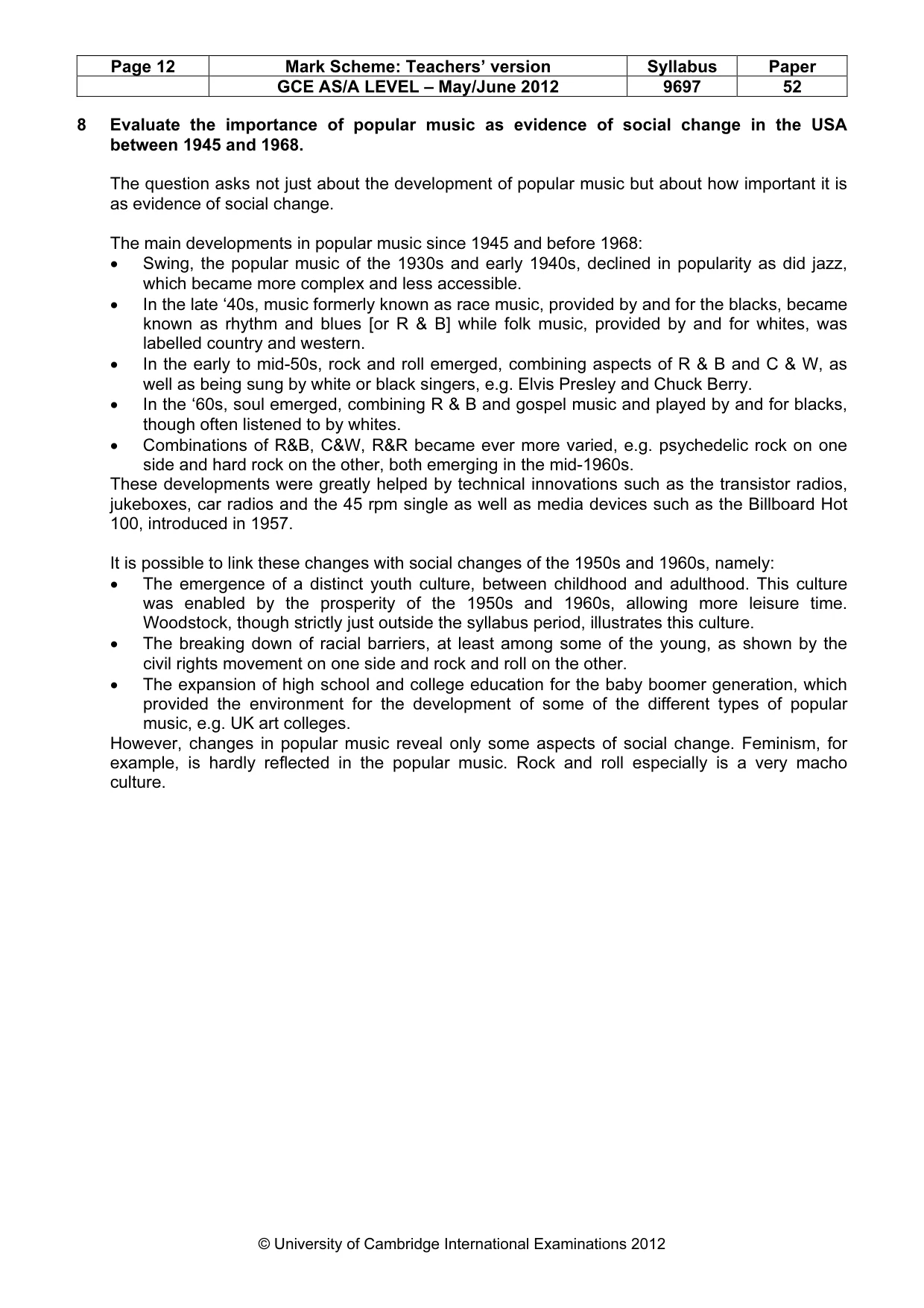
Page 12 Mark Scheme: Teachers’ version Syllabus Paper GCE AS/A LEVEL – May/June 2012 9697 52 © University of Cambridge International Examinations 2012 8 Evaluate the importance of popular music as evidence of social change in the USA between 1945 and 1968. The question asks not just about the development of popular music but about how important it is as evidence of social change. The main developments in popular music since 1945 and before 1968: • Swing, the popular music of the 1930s and early 1940s, declined in popularity as did jazz, which became more complex and less accessible. • In the late ‘40s, music formerly known as race music, provided by and for the blacks, became known as rhythm and blues [or R & B] while folk music, provided by and for whites, was labelled country and western. • In the early to mid-50s, rock and roll emerged, combining aspects of R & B and C & W, as well as being sung by white or black singers, e.g. Elvis Presley and Chuck Berry. • In the ‘60s, soul emerged, combining R & B and gospel music and played by and for blacks, though often listened to by whites. • Combinations of R&B, C&W, R&R became ever more varied, e.g. psychedelic rock on one side and hard rock on the other, both emerging in the mid-1960s. These developments were greatly helped by technical innovations such as the transistor radios, jukeboxes, car radios and the 45 rpm single as well as media devices such as the Billboard Hot 100, introduced in 1957. It is possible to link these changes with social changes of the 1950s and 1960s, namely: • The emergence of a distinct youth culture, between childhood and adulthood. This culture was enabled by the prosperity of the 1950s and 1960s, allowing more leisure time. Woodstock, though strictly just outside the syllabus period, illustrates this culture. • The breaking down of racial barriers, at least among some of the young, as shown by the civil rights movement on one side and rock and roll on the other. • The expansion of high school and college education for the baby boomer generation, which provided the environment for the development of some of the different types of popular music, e.g. UK art colleges. However, changes in popular music reveal only some aspects of social change. Feminism, for example, is hardly reflected in the popular music. Rock and roll especially is a very macho culture.
What you needed in this session
Cambridge’s own grade thresholds for 2012 May/June, Paper 5 · Variant 2. A higher threshold means an easier paper — the bar moves with how the cohort did.