Cambridge A Level History (pre-2015) 9697 — 2011 May/June Paper 5 · Variant 2
9697/52/M/J/11 · 100 marks · ≈113 min
The question paper and its mark scheme, free to read here and free to download. This is Cambridge’s own paper, exactly as it was sat.
Question paper4 pages
Mark scheme12 pages
Answers below. Sit the paper first if you are practising.
Paper as text
Question paper, page 1
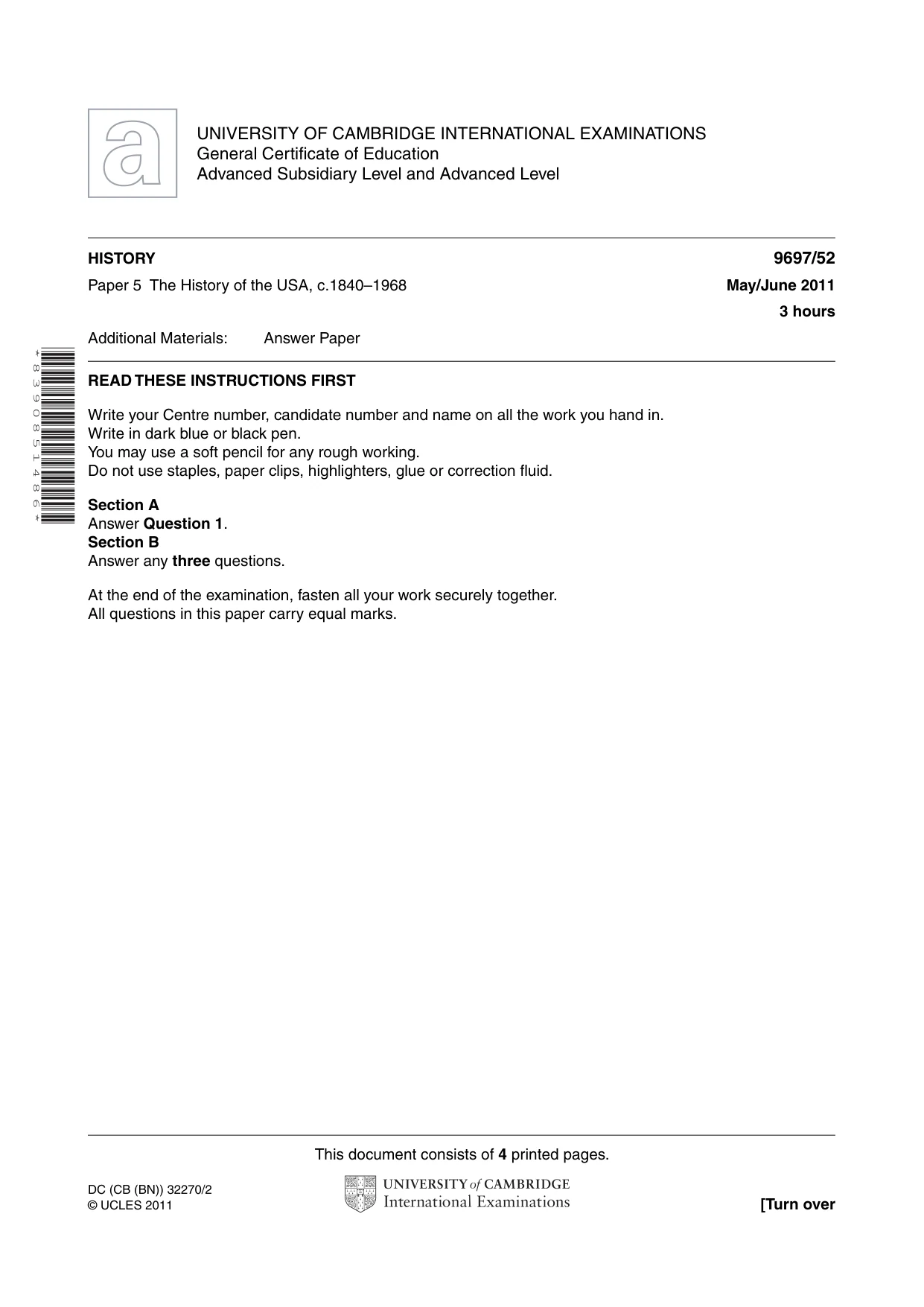
This document consists of 4 printed pages. DC (CB (BN)) 32270/2 © UCLES 2011 [Turn over UNIVERSITY OF CAMBRIDGE INTERNATIONAL EXAMINATIONS General Certificate of Education Advanced Subsidiary Level and Advanced Level * 8 3 9 0 8 5 1 4 8 6 * HISTORY 9697/52 Paper 5 The History of the USA, c.1840–1968 May/June 2011 3 hours Additional Materials: Answer Paper READ THESE INSTRUCTIONS FIRST Write your Centre number, candidate number and name on all the work you hand in. Write in dark blue or black pen. You may use a soft pencil for any rough working. Do not use staples, paper clips, highlighters, glue or correction fluid. Section A Answer Question 1. Section B Answer any three questions. At the end of the examination, fasten all your work securely together. All questions in this paper carry equal marks.
Question paper, page 2
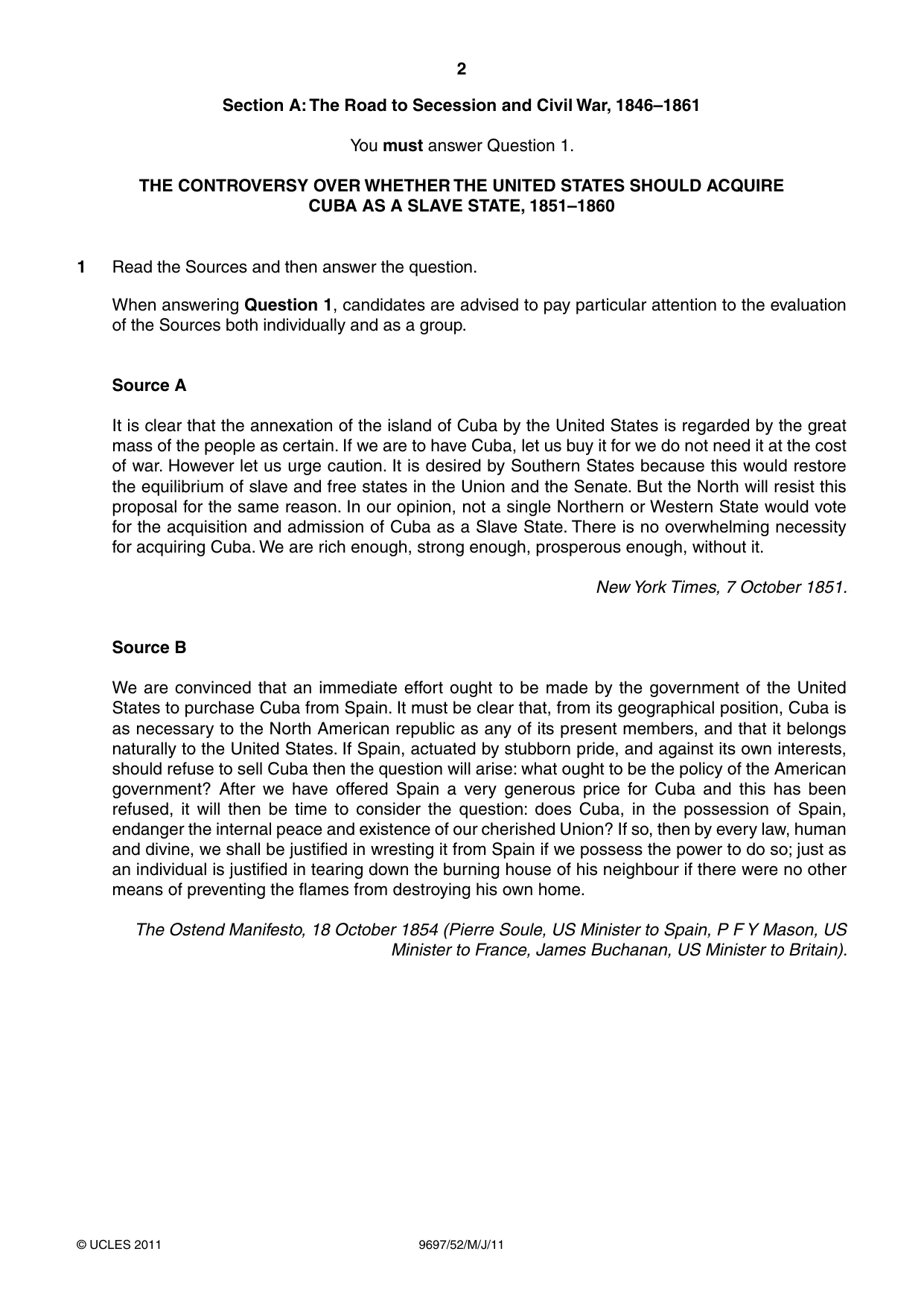
2 9697/52/M/J/11 © UCLES 2011 Section A: The Road to Secession and Civil War, 1846–1861 You must answer Question 1. THE CONTROVERSY OVER WHETHER THE UNITED STATES SHOULD ACQUIRE CUBA AS A SLAVE STATE, 1851–1860 1 Read the Sources and then answer the question. When answering Question 1, candidates are advised to pay particular attention to the evaluation of the Sources both individually and as a group. Source A It is clear that the annexation of the island of Cuba by the United States is regarded by the great mass of the people as certain. If we are to have Cuba, let us buy it for we do not need it at the cost of war. However let us urge caution. It is desired by Southern States because this would restore the equilibrium of slave and free states in the Union and the Senate. But the North will resist this proposal for the same reason. In our opinion, not a single Northern or Western State would vote for the acquisition and admission of Cuba as a Slave State. There is no overwhelming necessity for acquiring Cuba. We are rich enough, strong enough, prosperous enough, without it. New York Times, 7 October 1851. Source B We are convinced that an immediate effort ought to be made by the government of the United States to purchase Cuba from Spain. It must be clear that, from its geographical position, Cuba is as necessary to the North American republic as any of its present members, and that it belongs naturally to the United States. If Spain, actuated by stubborn pride, and against its own interests, should refuse to sell Cuba then the question will arise: what ought to be the policy of the American government? After we have offered Spain a very generous price for Cuba and this has been refused, it will then be time to consider the question: does Cuba, in the possession of Spain, endanger the internal peace and existence of our cherished Union? If so, then by every law, human and divine, we shall be justified in wresting it from Spain if we possess the power to do so; just as an individual is justified in tearing down the burning house of his neighbour if there were no other means of preventing the flames from destroying his own home. The Ostend Manifesto, 18 October 1854 (Pierre Soule, US Minister to Spain, P F Y Mason, US Minister to France, James Buchanan, US Minister to Britain).
Question paper, page 3
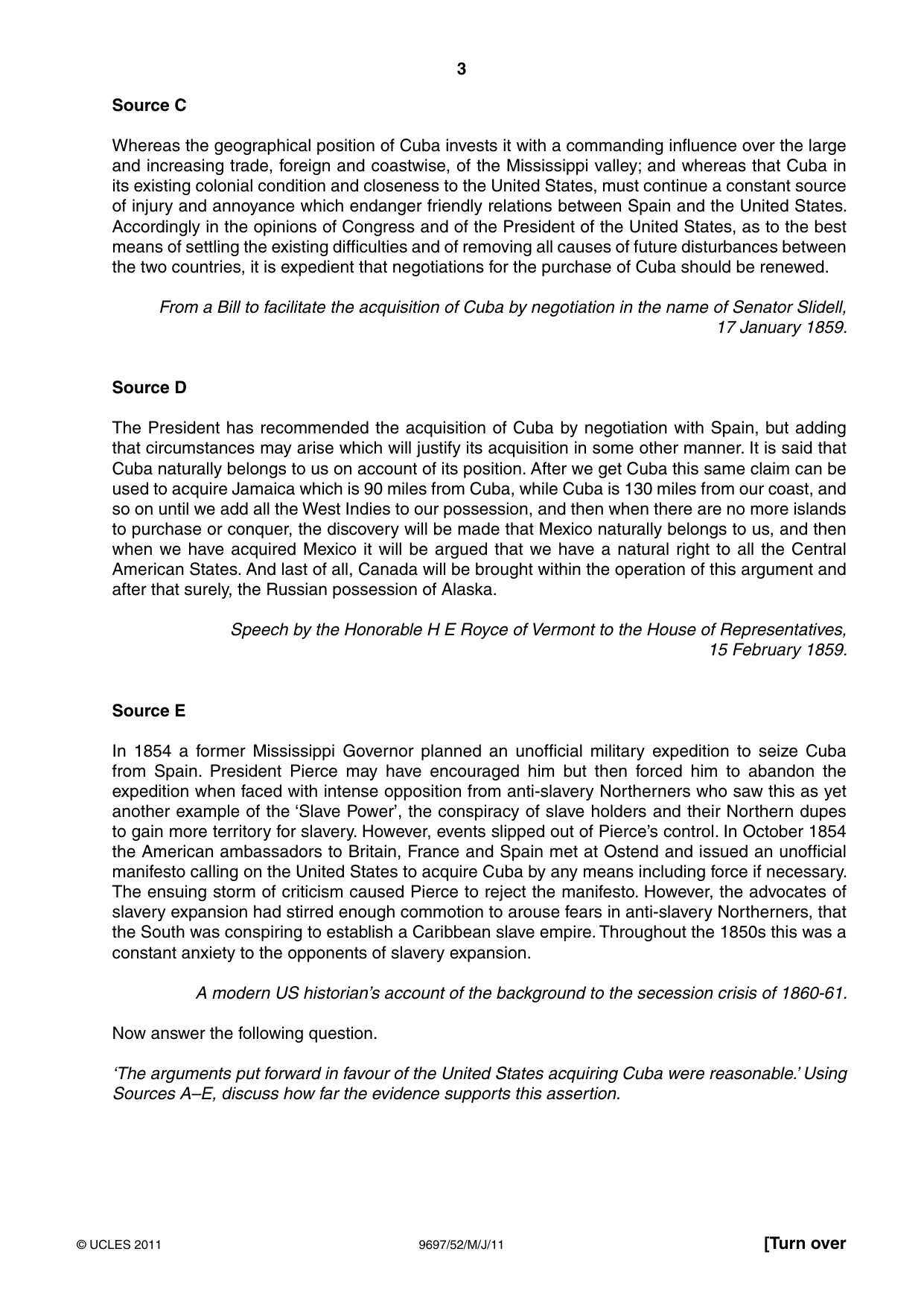
3 9697/52/M/J/11 © UCLES 2011 [Turn over Source C Whereas the geographical position of Cuba invests it with a commanding influence over the large and increasing trade, foreign and coastwise, of the Mississippi valley; and whereas that Cuba in its existing colonial condition and closeness to the United States, must continue a constant source of injury and annoyance which endanger friendly relations between Spain and the United States. Accordingly in the opinions of Congress and of the President of the United States, as to the best means of settling the existing difficulties and of removing all causes of future disturbances between the two countries, it is expedient that negotiations for the purchase of Cuba should be renewed. From a Bill to facilitate the acquisition of Cuba by negotiation in the name of Senator Slidell, 17 January 1859. Source D The President has recommended the acquisition of Cuba by negotiation with Spain, but adding that circumstances may arise which will justify its acquisition in some other manner. It is said that Cuba naturally belongs to us on account of its position. After we get Cuba this same claim can be used to acquire Jamaica which is 90 miles from Cuba, while Cuba is 130 miles from our coast, and so on until we add all the West Indies to our possession, and then when there are no more islands to purchase or conquer, the discovery will be made that Mexico naturally belongs to us, and then when we have acquired Mexico it will be argued that we have a natural right to all the Central American States. And last of all, Canada will be brought within the operation of this argument and after that surely, the Russian possession of Alaska. Speech by the Honorable H E Royce of Vermont to the House of Representatives, 15 February 1859. Source E In 1854 a former Mississippi Governor planned an unofficial military expedition to seize Cuba from Spain. President Pierce may have encouraged him but then forced him to abandon the expedition when faced with intense opposition from anti-slavery Northerners who saw this as yet another example of the ‘Slave Power’, the conspiracy of slave holders and their Northern dupes to gain more territory for slavery. However, events slipped out of Pierce’s control. In October 1854 the American ambassadors to Britain, France and Spain met at Ostend and issued an unofficial manifesto calling on the United States to acquire Cuba by any means including force if necessary. The ensuing storm of criticism caused Pierce to reject the manifesto. However, the advocates of slavery expansion had stirred enough commotion to arouse fears in anti-slavery Northerners, that the South was conspiring to establish a Caribbean slave empire. Throughout the 1850s this was a constant anxiety to the opponents of slavery expansion. A modern US historian’s account of the background to the secession crisis of 1860-61. Now answer the following question. ‘The arguments put forward in favour of the United States acquiring Cuba were reasonable.’ Using Sources A–E, discuss how far the evidence supports this assertion.
Question paper, page 4
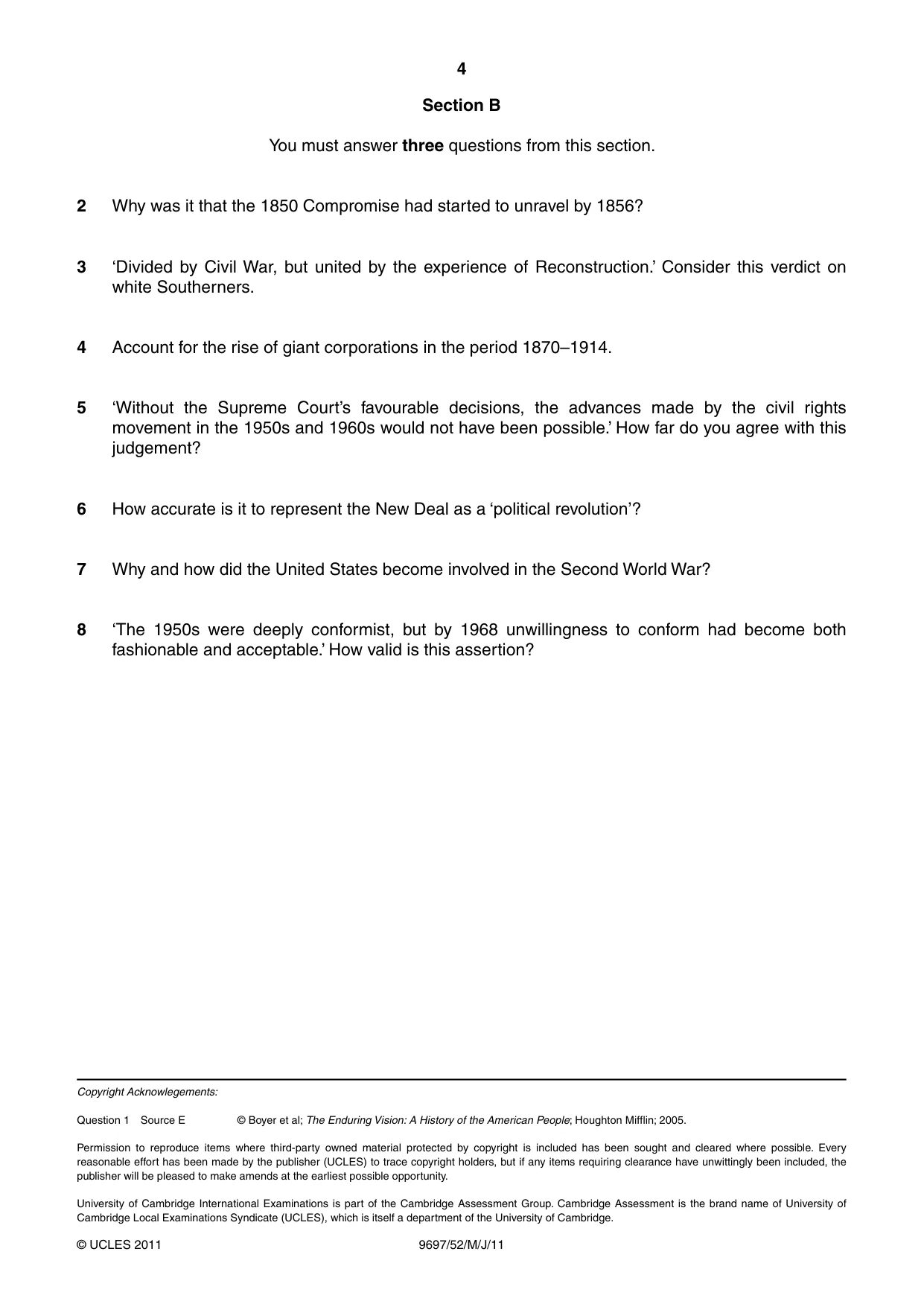
4 9697/52/M/J/11 © UCLES 2011 Copyright Acknowlegements: Question 1 Source E © Boyer et al; The Enduring Vision: A History of the American People; Houghton Mifflin; 2005. Permission to reproduce items where third-party owned material protected by copyright is included has been sought and cleared where possible. Every reasonable effort has been made by the publisher (UCLES) to trace copyright holders, but if any items requiring clearance have unwittingly been included, the publisher will be pleased to make amends at the earliest possible opportunity. University of Cambridge International Examinations is part of the Cambridge Assessment Group. Cambridge Assessment is the brand name of University of Cambridge Local Examinations Syndicate (UCLES), which is itself a department of the University of Cambridge. Section B You must answer three questions from this section. 2 Why was it that the 1850 Compromise had started to unravel by 1856? 3 ‘Divided by Civil War, but united by the experience of Reconstruction.’ Consider this verdict on white Southerners. 4 Account for the rise of giant corporations in the period 1870–1914. 5 ‘Without the Supreme Court’s favourable decisions, the advances made by the civil rights movement in the 1950s and 1960s would not have been possible.’ How far do you agree with this judgement? 6 How accurate is it to represent the New Deal as a ‘political revolution’? 7 Why and how did the United States become involved in the Second World War? 8 ‘The 1950s were deeply conformist, but by 1968 unwillingness to conform had become both fashionable and acceptable.’ How valid is this assertion?
Mark scheme, page 1
UNIVERSITY OF CAMBRIDGE INTERNATIONAL EXAMINATIONS GCE Advanced Subsidiary Level and GCE Advanced Level MARK SCHEME for the May/June 2011 question paper for the guidance of teachers 9697 HISTORY 9697/52 Paper 5, maximum raw mark 100 This mark scheme is published as an aid to teachers and candidates, to indicate the requirements of the examination. It shows the basis on which Examiners were instructed to award marks. It does not indicate the details of the discussions that took place at an Examiners’ meeting before marking began, which would have considered the acceptability of alternative answers. Mark schemes must be read in conjunction with the question papers and the report on the examination. • Cambridge will not enter into discussions or correspondence in connection with these mark schemes. Cambridge is publishing the mark schemes for the May/June 2011 question papers for most IGCSE, GCE Advanced Level and Advanced Subsidiary Level syllabuses and some Ordinary Level syllabuses.
Mark scheme, page 2
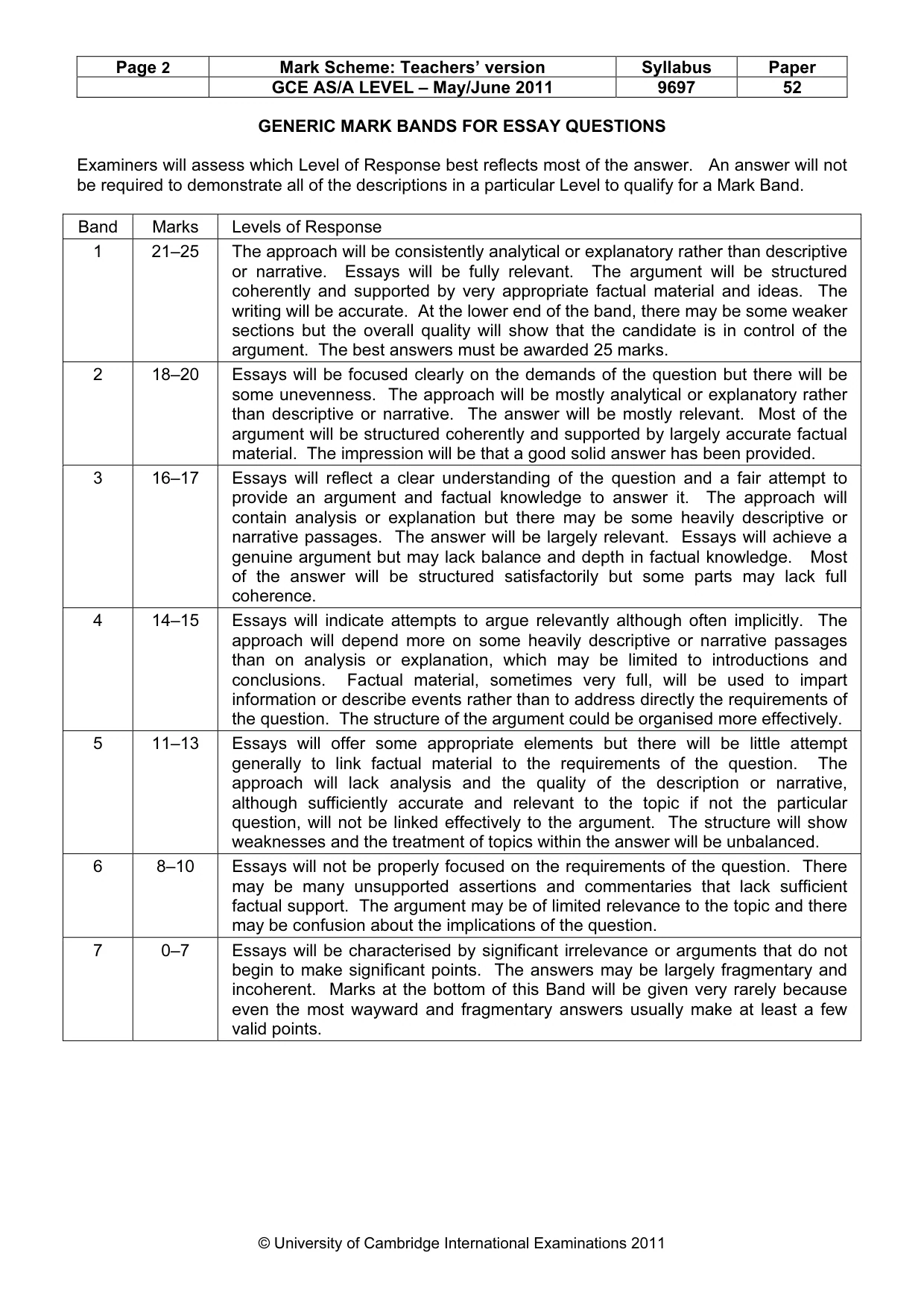
Page 2 Mark Scheme: Teachers’ version Syllabus Paper GCE AS/A LEVEL – May/June 2011 9697 52 © University of Cambridge International Examinations 2011 GENERIC MARK BANDS FOR ESSAY QUESTIONS Examiners will assess which Level of Response best reflects most of the answer. An answer will not be required to demonstrate all of the descriptions in a particular Level to qualify for a Mark Band. Band Marks Levels of Response 1 21–25 The approach will be consistently analytical or explanatory rather than descriptive or narrative. Essays will be fully relevant. The argument will be structured coherently and supported by very appropriate factual material and ideas. The writing will be accurate. At the lower end of the band, there may be some weaker sections but the overall quality will show that the candidate is in control of the argument. The best answers must be awarded 25 marks. 2 18–20 Essays will be focused clearly on the demands of the question but there will be some unevenness. The approach will be mostly analytical or explanatory rather than descriptive or narrative. The answer will be mostly relevant. Most of the argument will be structured coherently and supported by largely accurate factual material. The impression will be that a good solid answer has been provided. 3 16–17 Essays will reflect a clear understanding of the question and a fair attempt to provide an argument and factual knowledge to answer it. The approach will contain analysis or explanation but there may be some heavily descriptive or narrative passages. The answer will be largely relevant. Essays will achieve a genuine argument but may lack balance and depth in factual knowledge. Most of the answer will be structured satisfactorily but some parts may lack full coherence. 4 14–15 Essays will indicate attempts to argue relevantly although often implicitly. The approach will depend more on some heavily descriptive or narrative passages than on analysis or explanation, which may be limited to introductions and conclusions. Factual material, sometimes very full, will be used to impart information or describe events rather than to address directly the requirements of the question. The structure of the argument could be organised more effectively. 5 11–13 Essays will offer some appropriate elements but there will be little attempt generally to link factual material to the requirements of the question. The approach will lack analysis and the quality of the description or narrative, although sufficiently accurate and relevant to the topic if not the particular question, will not be linked effectively to the argument. The structure will show weaknesses and the treatment of topics within the answer will be unbalanced. 6 8–10 Essays will not be properly focused on the requirements of the question. There may be many unsupported assertions and commentaries that lack sufficient factual support. The argument may be of limited relevance to the topic and there may be confusion about the implications of the question. 7 0–7 Essays will be characterised by significant irrelevance or arguments that do not begin to make significant points. The answers may be largely fragmentary and incoherent. Marks at the bottom of this Band will be given very rarely because even the most wayward and fragmentary answers usually make at least a few valid points.
Mark scheme, page 3
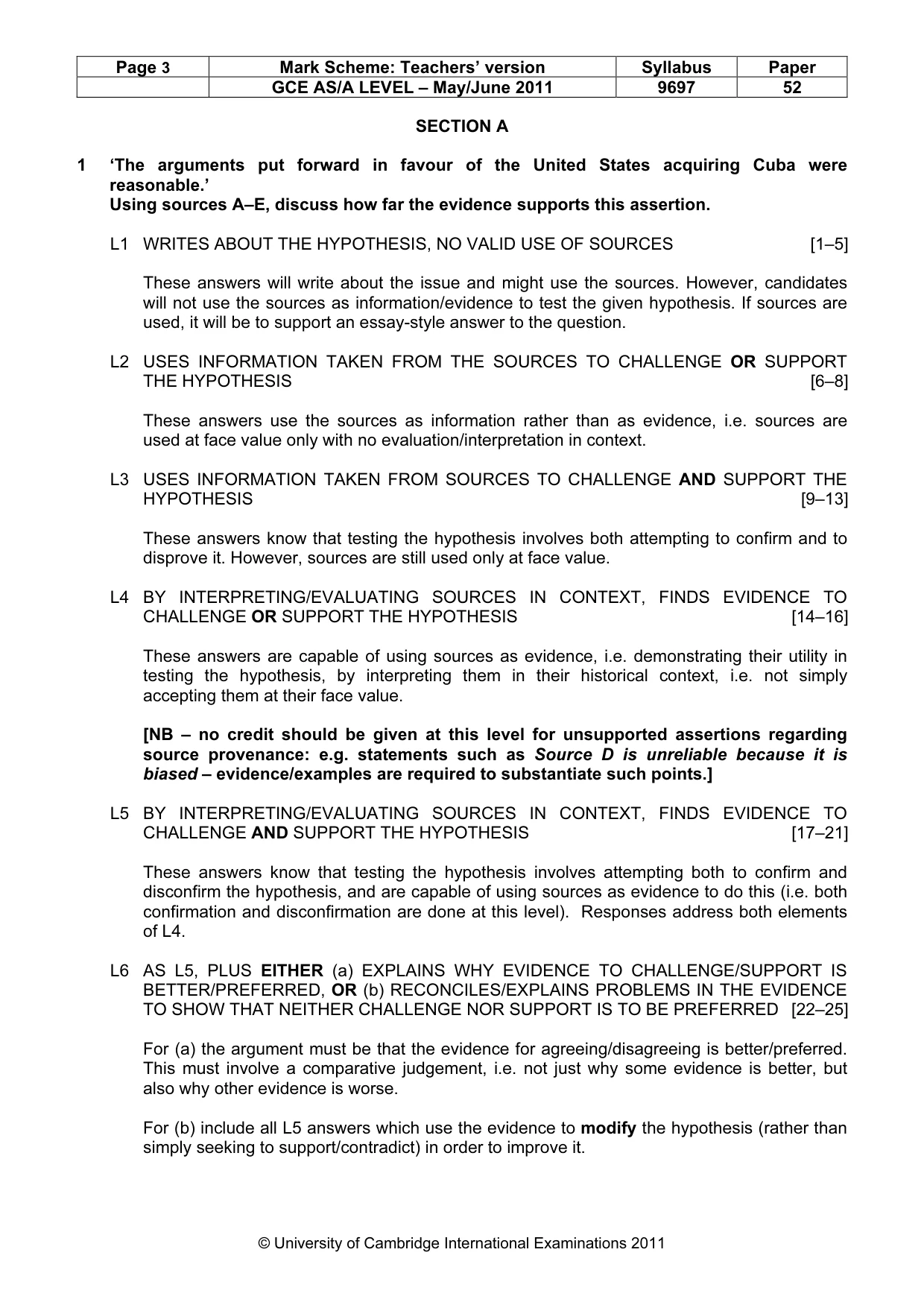
Page 3 Mark Scheme: Teachers’ version Syllabus Paper GCE AS/A LEVEL – May/June 2011 9697 52 © University of Cambridge International Examinations 2011 SECTION A 1 ‘The arguments put forward in favour of the United States acquiring Cuba were reasonable.’ Using sources A–E, discuss how far the evidence supports this assertion. L1 WRITES ABOUT THE HYPOTHESIS, NO VALID USE OF SOURCES [1–5] These answers will write about the issue and might use the sources. However, candidates will not use the sources as information/evidence to test the given hypothesis. If sources are used, it will be to support an essay-style answer to the question. L2 USES INFORMATION TAKEN FROM THE SOURCES TO CHALLENGE OR SUPPORT THE HYPOTHESIS [6–8] These answers use the sources as information rather than as evidence, i.e. sources are used at face value only with no evaluation/interpretation in context. L3 USES INFORMATION TAKEN FROM SOURCES TO CHALLENGE AND SUPPORT THE HYPOTHESIS [9–13] These answers know that testing the hypothesis involves both attempting to confirm and to disprove it. However, sources are still used only at face value. L4 BY INTERPRETING/EVALUATING SOURCES IN CONTEXT, FINDS EVIDENCE TO CHALLENGE OR SUPPORT THE HYPOTHESIS [14–16] These answers are capable of using sources as evidence, i.e. demonstrating their utility in testing the hypothesis, by interpreting them in their historical context, i.e. not simply accepting them at their face value. [NB – no credit should be given at this level for unsupported assertions regarding source provenance: e.g. statements such as Source D is unreliable because it is biased – evidence/examples are required to substantiate such points.] L5 BY INTERPRETING/EVALUATING SOURCES IN CONTEXT, FINDS EVIDENCE TO CHALLENGE AND SUPPORT THE HYPOTHESIS [17–21] These answers know that testing the hypothesis involves attempting both to confirm and disconfirm the hypothesis, and are capable of using sources as evidence to do this (i.e. both confirmation and disconfirmation are done at this level). Responses address both elements of L4. L6 AS L5, PLUS EITHER (a) EXPLAINS WHY EVIDENCE TO CHALLENGE/SUPPORT IS BETTER/PREFERRED, OR (b) RECONCILES/EXPLAINS PROBLEMS IN THE EVIDENCE TO SHOW THAT NEITHER CHALLENGE NOR SUPPORT IS TO BE PREFERRED [22–25] For (a) the argument must be that the evidence for agreeing/disagreeing is better/preferred. This must involve a comparative judgement, i.e. not just why some evidence is better, but also why other evidence is worse. For (b) include all L5 answers which use the evidence to modify the hypothesis (rather than simply seeking to support/contradict) in order to improve it.
Mark scheme, page 4
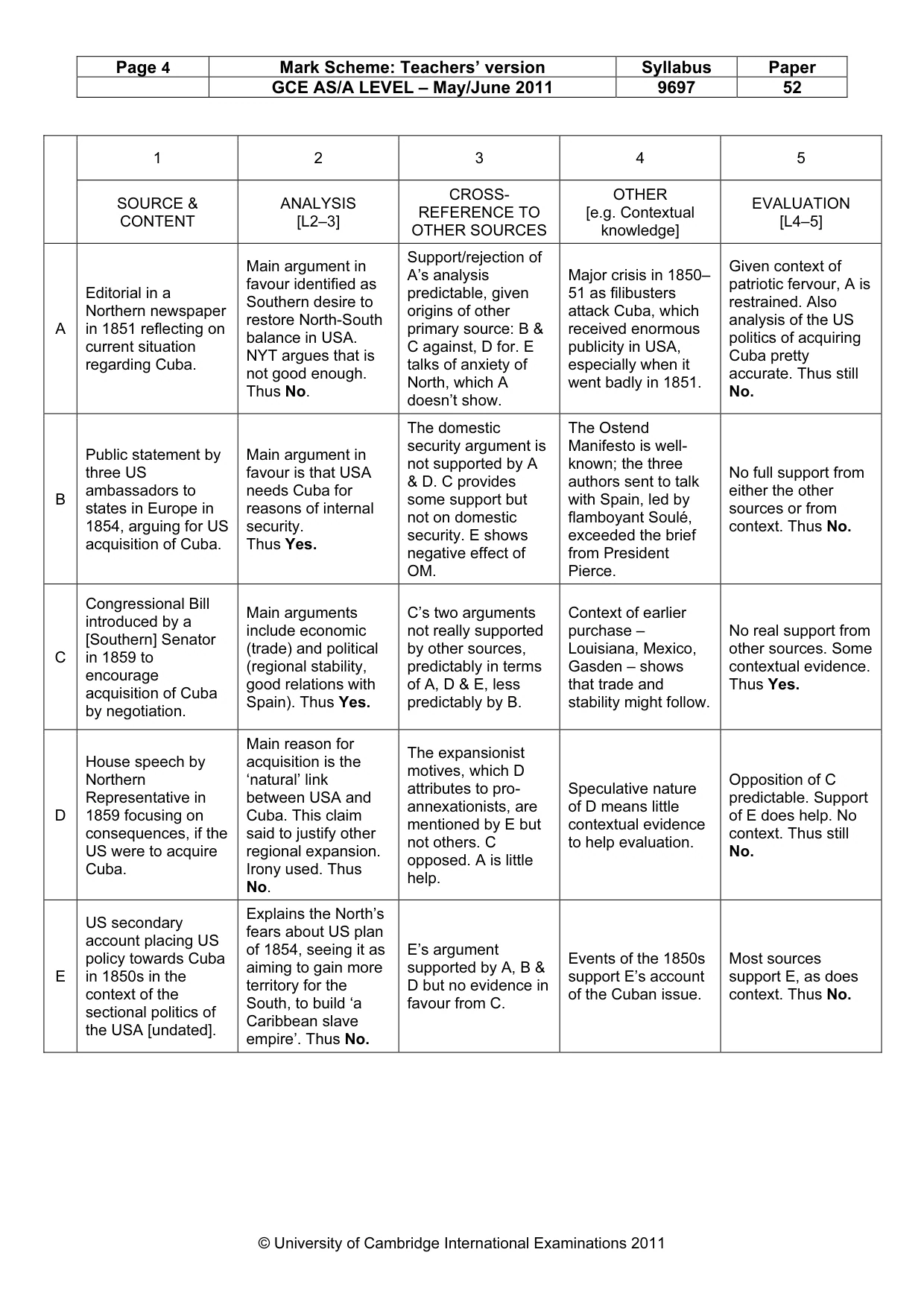
Page 4 Mark Scheme: Teachers’ version Syllabus Paper GCE AS/A LEVEL – May/June 2011 9697 52 © University of Cambridge International Examinations 2011 1 2 3 4 5 SOURCE & CONTENT ANALYSIS [L2–3] CROSS- REFERENCE TO OTHER SOURCES OTHER [e.g. Contextual knowledge] EVALUATION [L4–5] A Editorial in a Northern newspaper in 1851 reflecting on current situation regarding Cuba. Main argument in favour identified as Southern desire to restore North-South balance in USA. NYT argues that is not good enough. Thus No. Support/rejection of A’s analysis predictable, given origins of other primary source: B & C against, D for. E talks of anxiety of North, which A doesn’t show. Major crisis in 1850– 51 as filibusters attack Cuba, which received enormous publicity in USA, especially when it went badly in 1851. Given context of patriotic fervour, A is restrained. Also analysis of the US politics of acquiring Cuba pretty accurate. Thus still No. B Public statement by three US ambassadors to states in Europe in 1854, arguing for US acquisition of Cuba. Main argument in favour is that USA needs Cuba for reasons of internal security. Thus Yes. The domestic security argument is not supported by A & D. C provides some support but not on domestic security. E shows negative effect of OM. The Ostend Manifesto is well- known; the three authors sent to talk with Spain, led by flamboyant Soulé, exceeded the brief from President Pierce. No full support from either the other sources or from context. Thus No. C Congressional Bill introduced by a [Southern] Senator in 1859 to encourage acquisition of Cuba by negotiation. Main arguments include economic (trade) and political (regional stability, good relations with Spain). Thus Yes. C’s two arguments not really supported by other sources, predictably in terms of A, D & E, less predictably by B. Context of earlier purchase – Louisiana, Mexico, Gasden – shows that trade and stability might follow. No real support from other sources. Some contextual evidence. Thus Yes. D House speech by Northern Representative in 1859 focusing on consequences, if the US were to acquire Cuba. Main reason for acquisition is the ‘natural’ link between USA and Cuba. This claim said to justify other regional expansion. Irony used. Thus No. The expansionist motives, which D attributes to pro- annexationists, are mentioned by E but not others. C opposed. A is little help. Speculative nature of D means little contextual evidence to help evaluation. Opposition of C predictable. Support of E does help. No context. Thus still No. E US secondary account placing US policy towards Cuba in 1850s in the context of the sectional politics of the USA [undated]. Explains the North’s fears about US plan of 1854, seeing it as aiming to gain more territory for the South, to build ‘a Caribbean slave empire’. Thus No. E’s argument supported by A, B & D but no evidence in favour from C. Events of the 1850s support E’s account of the Cuban issue. Most sources support E, as does context. Thus No.
Mark scheme, page 5
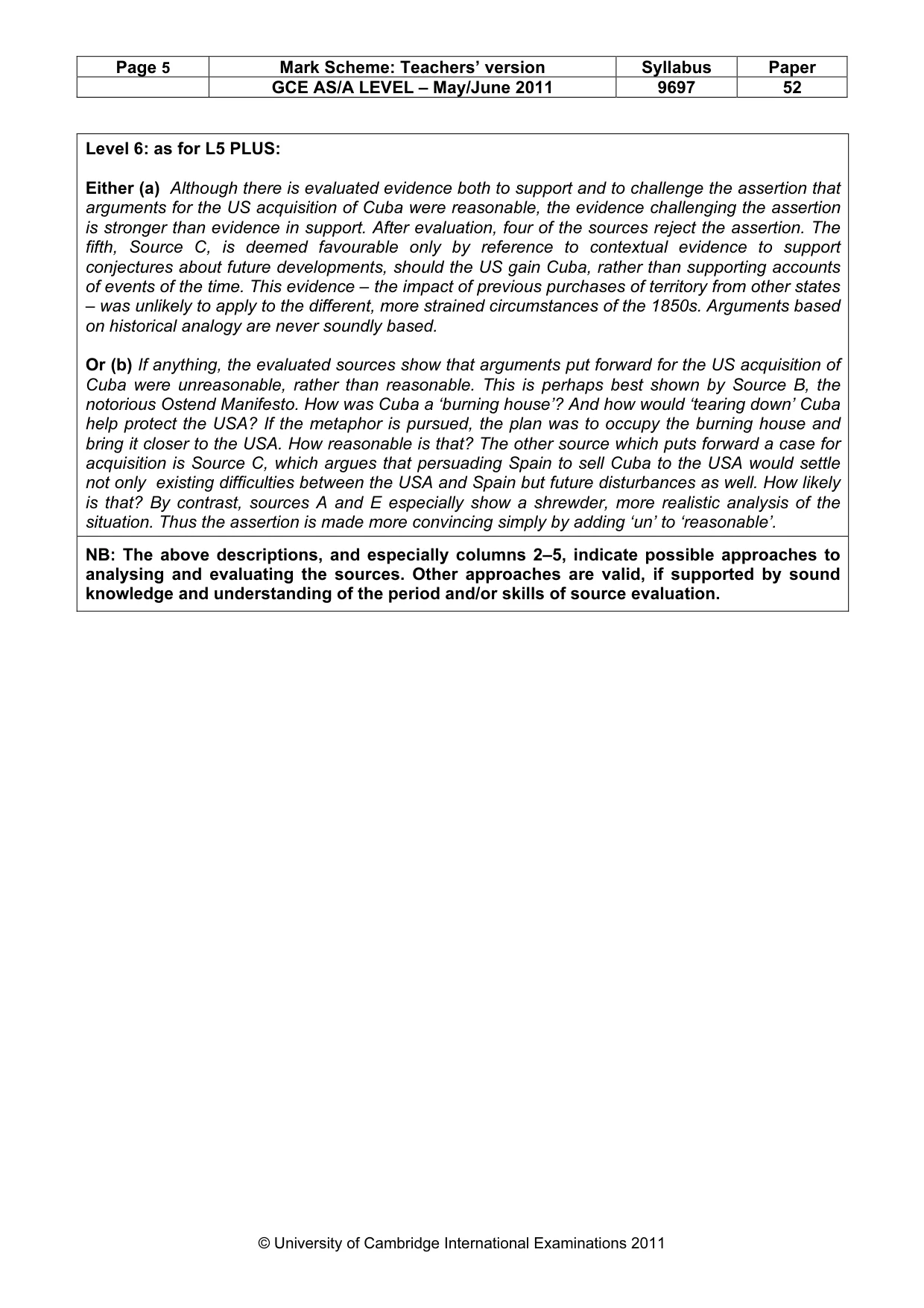
Page 5 Mark Scheme: Teachers’ version Syllabus Paper GCE AS/A LEVEL – May/June 2011 9697 52 © University of Cambridge International Examinations 2011 Level 6: as for L5 PLUS: Either (a) Although there is evaluated evidence both to support and to challenge the assertion that arguments for the US acquisition of Cuba were reasonable, the evidence challenging the assertion is stronger than evidence in support. After evaluation, four of the sources reject the assertion. The fifth, Source C, is deemed favourable only by reference to contextual evidence to support conjectures about future developments, should the US gain Cuba, rather than supporting accounts of events of the time. This evidence – the impact of previous purchases of territory from other states – was unlikely to apply to the different, more strained circumstances of the 1850s. Arguments based on historical analogy are never soundly based. Or (b) If anything, the evaluated sources show that arguments put forward for the US acquisition of Cuba were unreasonable, rather than reasonable. This is perhaps best shown by Source B, the notorious Ostend Manifesto. How was Cuba a ‘burning house’? And how would ‘tearing down’ Cuba help protect the USA? If the metaphor is pursued, the plan was to occupy the burning house and bring it closer to the USA. How reasonable is that? The other source which puts forward a case for acquisition is Source C, which argues that persuading Spain to sell Cuba to the USA would settle not only existing difficulties between the USA and Spain but future disturbances as well. How likely is that? By contrast, sources A and E especially show a shrewder, more realistic analysis of the situation. Thus the assertion is made more convincing simply by adding ‘un’ to ‘reasonable’. NB: The above descriptions, and especially columns 2–5, indicate possible approaches to analysing and evaluating the sources. Other approaches are valid, if supported by sound knowledge and understanding of the period and/or skills of source evaluation.
Mark scheme, page 6
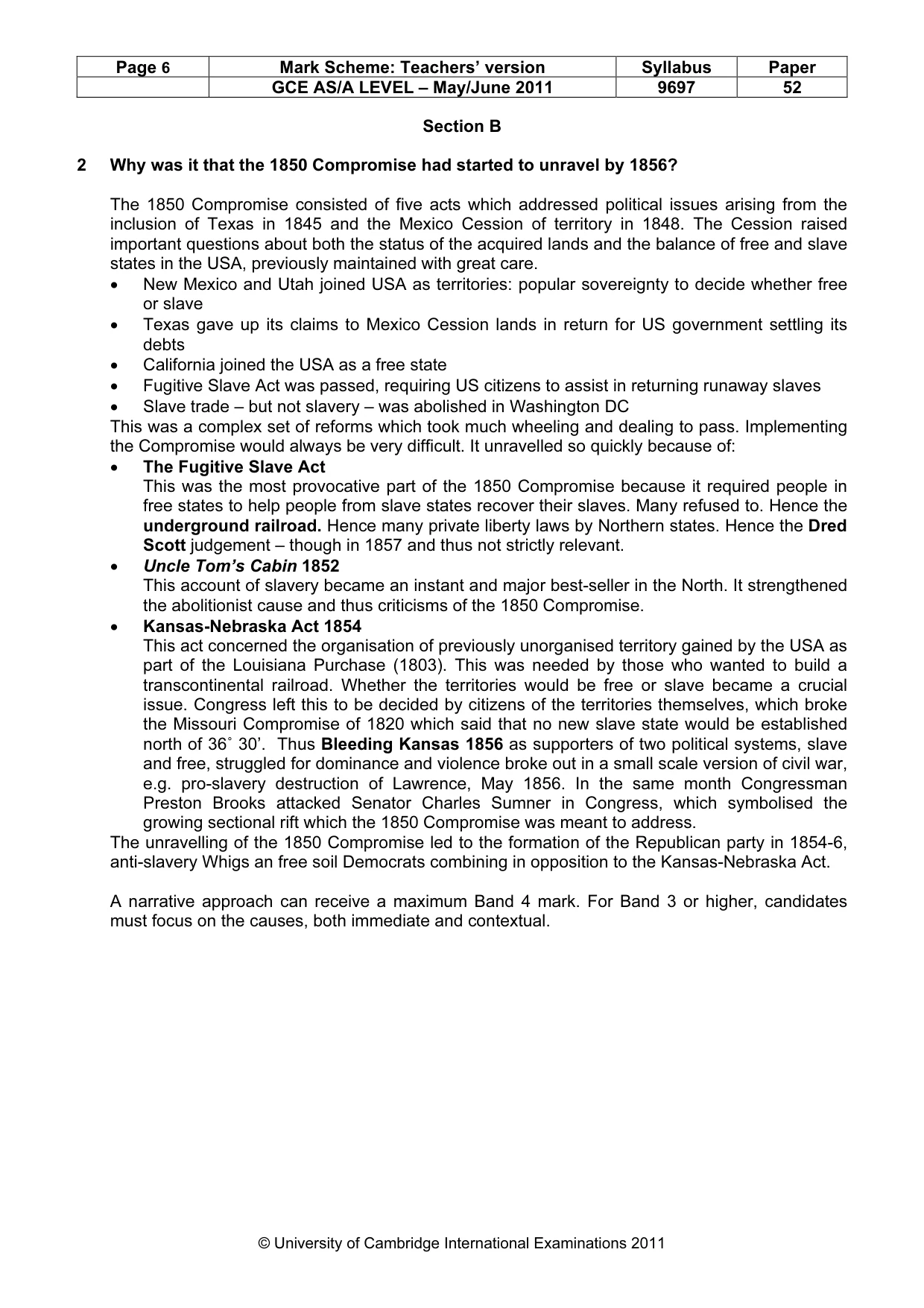
Page 6 Mark Scheme: Teachers’ version Syllabus Paper GCE AS/A LEVEL – May/June 2011 9697 52 © University of Cambridge International Examinations 2011 Section B 2 Why was it that the 1850 Compromise had started to unravel by 1856? The 1850 Compromise consisted of five acts which addressed political issues arising from the inclusion of Texas in 1845 and the Mexico Cession of territory in 1848. The Cession raised important questions about both the status of the acquired lands and the balance of free and slave states in the USA, previously maintained with great care. • New Mexico and Utah joined USA as territories: popular sovereignty to decide whether free or slave • Texas gave up its claims to Mexico Cession lands in return for US government settling its debts • California joined the USA as a free state • Fugitive Slave Act was passed, requiring US citizens to assist in returning runaway slaves • Slave trade – but not slavery – was abolished in Washington DC This was a complex set of reforms which took much wheeling and dealing to pass. Implementing the Compromise would always be very difficult. It unravelled so quickly because of: • The Fugitive Slave Act This was the most provocative part of the 1850 Compromise because it required people in free states to help people from slave states recover their slaves. Many refused to. Hence the underground railroad. Hence many private liberty laws by Northern states. Hence the Dred Scott judgement – though in 1857 and thus not strictly relevant. • Uncle Tom’s Cabin 1852 This account of slavery became an instant and major best-seller in the North. It strengthened the abolitionist cause and thus criticisms of the 1850 Compromise. • Kansas-Nebraska Act 1854 This act concerned the organisation of previously unorganised territory gained by the USA as part of the Louisiana Purchase (1803). This was needed by those who wanted to build a transcontinental railroad. Whether the territories would be free or slave became a crucial issue. Congress left this to be decided by citizens of the territories themselves, which broke the Missouri Compromise of 1820 which said that no new slave state would be established north of 36˚ 30’. Thus Bleeding Kansas 1856 as supporters of two political systems, slave and free, struggled for dominance and violence broke out in a small scale version of civil war, e.g. pro-slavery destruction of Lawrence, May 1856. In the same month Congressman Preston Brooks attacked Senator Charles Sumner in Congress, which symbolised the growing sectional rift which the 1850 Compromise was meant to address. The unravelling of the 1850 Compromise led to the formation of the Republican party in 1854-6, anti-slavery Whigs an free soil Democrats combining in opposition to the Kansas-Nebraska Act. A narrative approach can receive a maximum Band 4 mark. For Band 3 or higher, candidates must focus on the causes, both immediate and contextual.
Mark scheme, page 7
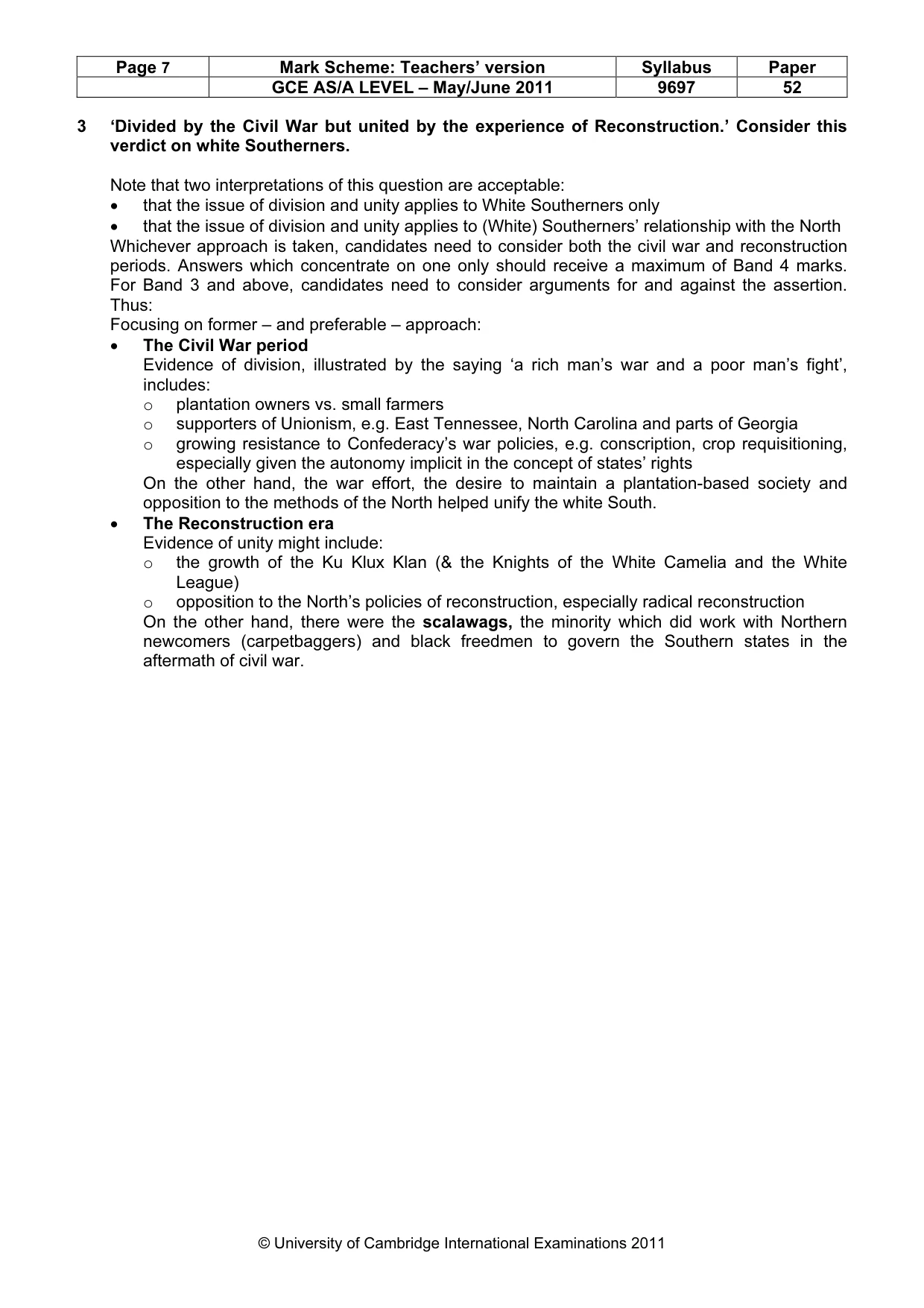
Page 7 Mark Scheme: Teachers’ version Syllabus Paper GCE AS/A LEVEL – May/June 2011 9697 52 © University of Cambridge International Examinations 2011 3 ‘Divided by the Civil War but united by the experience of Reconstruction.’ Consider this verdict on white Southerners. Note that two interpretations of this question are acceptable: • that the issue of division and unity applies to White Southerners only • that the issue of division and unity applies to (White) Southerners’ relationship with the North Whichever approach is taken, candidates need to consider both the civil war and reconstruction periods. Answers which concentrate on one only should receive a maximum of Band 4 marks. For Band 3 and above, candidates need to consider arguments for and against the assertion. Thus: Focusing on former – and preferable – approach: • The Civil War period Evidence of division, illustrated by the saying ‘a rich man’s war and a poor man’s fight’, includes: o plantation owners vs. small farmers o supporters of Unionism, e.g. East Tennessee, North Carolina and parts of Georgia o growing resistance to Confederacy’s war policies, e.g. conscription, crop requisitioning, especially given the autonomy implicit in the concept of states’ rights On the other hand, the war effort, the desire to maintain a plantation-based society and opposition to the methods of the North helped unify the white South. • The Reconstruction era Evidence of unity might include: o the growth of the Ku Klux Klan (& the Knights of the White Camelia and the White League) o opposition to the North’s policies of reconstruction, especially radical reconstruction On the other hand, there were the scalawags, the minority which did work with Northern newcomers (carpetbaggers) and black freedmen to govern the Southern states in the aftermath of civil war.
Mark scheme, page 8
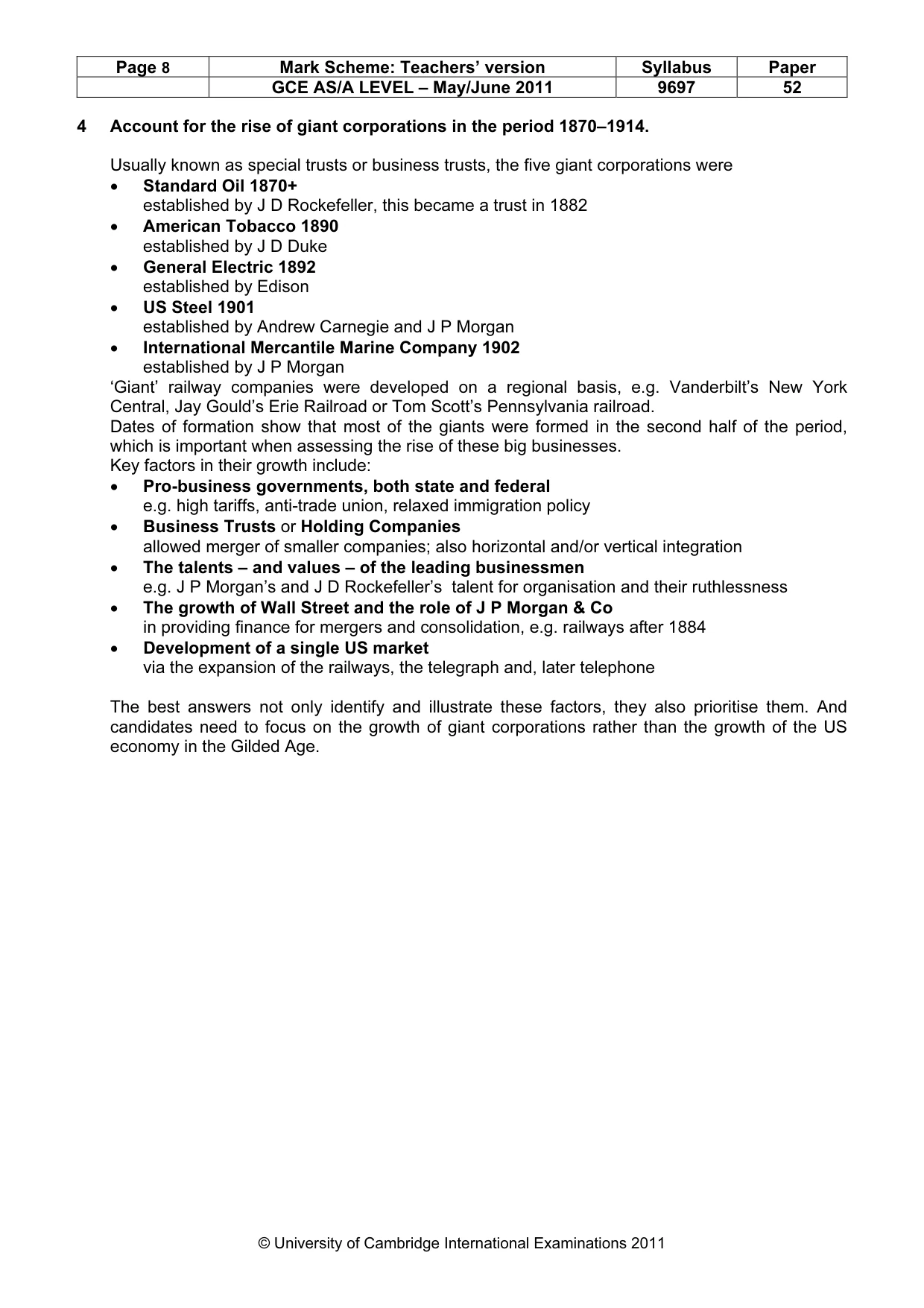
Page 8 Mark Scheme: Teachers’ version Syllabus Paper GCE AS/A LEVEL – May/June 2011 9697 52 © University of Cambridge International Examinations 2011 4 Account for the rise of giant corporations in the period 1870–1914. Usually known as special trusts or business trusts, the five giant corporations were • Standard Oil 1870+ established by J D Rockefeller, this became a trust in 1882 • American Tobacco 1890 established by J D Duke • General Electric 1892 established by Edison • US Steel 1901 established by Andrew Carnegie and J P Morgan • International Mercantile Marine Company 1902 established by J P Morgan ‘Giant’ railway companies were developed on a regional basis, e.g. Vanderbilt’s New York Central, Jay Gould’s Erie Railroad or Tom Scott’s Pennsylvania railroad. Dates of formation show that most of the giants were formed in the second half of the period, which is important when assessing the rise of these big businesses. Key factors in their growth include: • Pro-business governments, both state and federal e.g. high tariffs, anti-trade union, relaxed immigration policy • Business Trusts or Holding Companies allowed merger of smaller companies; also horizontal and/or vertical integration • The talents – and values – of the leading businessmen e.g. J P Morgan’s and J D Rockefeller’s talent for organisation and their ruthlessness • The growth of Wall Street and the role of J P Morgan & Co in providing finance for mergers and consolidation, e.g. railways after 1884 • Development of a single US market via the expansion of the railways, the telegraph and, later telephone The best answers not only identify and illustrate these factors, they also prioritise them. And candidates need to focus on the growth of giant corporations rather than the growth of the US economy in the Gilded Age.
Mark scheme, page 9
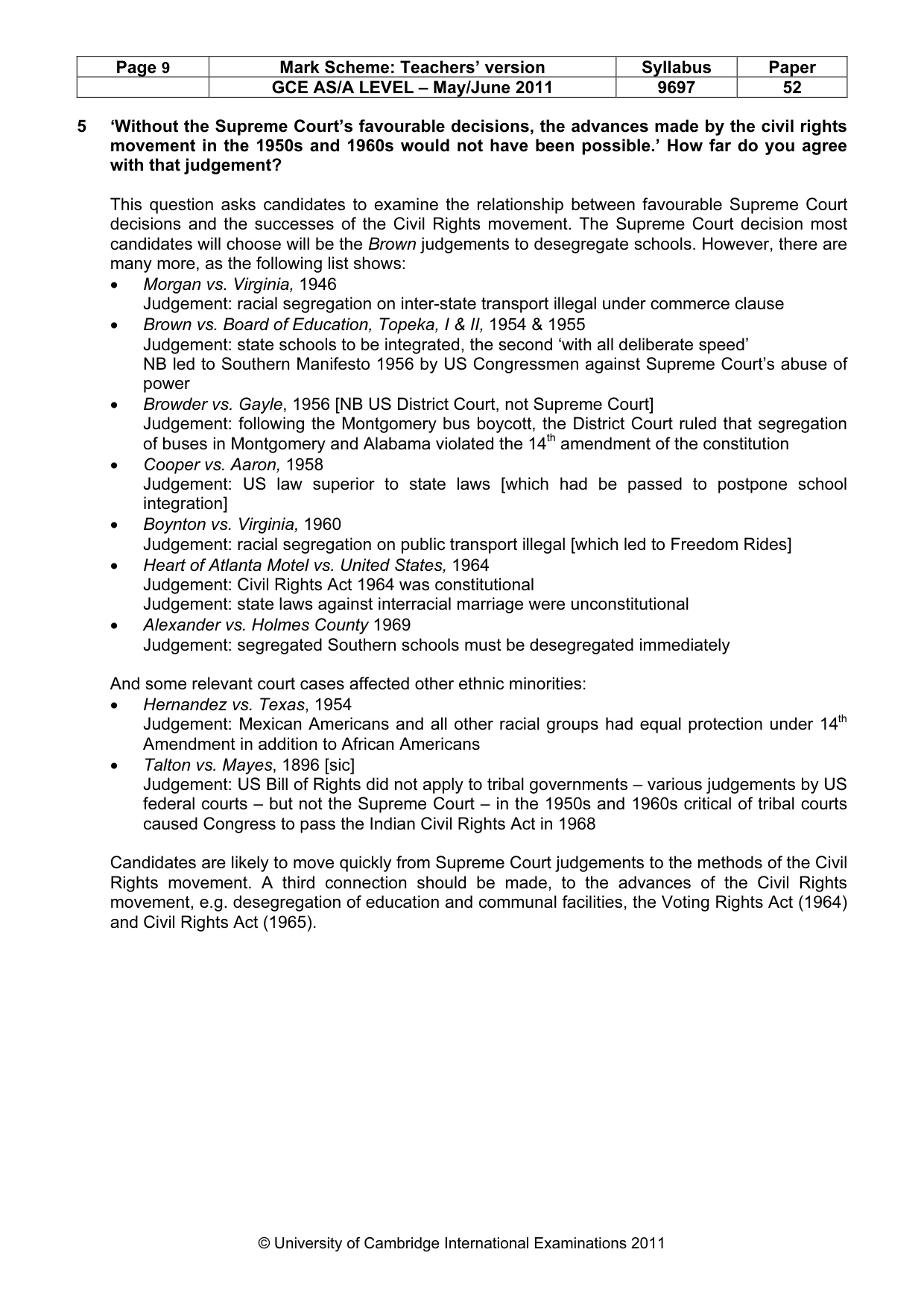
Page 9 Mark Scheme: Teachers’ version Syllabus Paper GCE AS/A LEVEL – May/June 2011 9697 52 © University of Cambridge International Examinations 2011 5 ‘Without the Supreme Court’s favourable decisions, the advances made by the civil rights movement in the 1950s and 1960s would not have been possible.’ How far do you agree with that judgement? This question asks candidates to examine the relationship between favourable Supreme Court decisions and the successes of the Civil Rights movement. The Supreme Court decision most candidates will choose will be the Brown judgements to desegregate schools. However, there are many more, as the following list shows: • Morgan vs. Virginia, 1946 Judgement: racial segregation on inter-state transport illegal under commerce clause • Brown vs. Board of Education, Topeka, I & II, 1954 & 1955 Judgement: state schools to be integrated, the second ‘with all deliberate speed’ NB led to Southern Manifesto 1956 by US Congressmen against Supreme Court’s abuse of power • Browder vs. Gayle, 1956 [NB US District Court, not Supreme Court] Judgement: following the Montgomery bus boycott, the District Court ruled that segregation of buses in Montgomery and Alabama violated the 14th amendment of the constitution • Cooper vs. Aaron, 1958 Judgement: US law superior to state laws [which had be passed to postpone school integration] • Boynton vs. Virginia, 1960 Judgement: racial segregation on public transport illegal [which led to Freedom Rides] • Heart of Atlanta Motel vs. United States, 1964 Judgement: Civil Rights Act 1964 was constitutional Judgement: state laws against interracial marriage were unconstitutional • Alexander vs. Holmes County 1969 Judgement: segregated Southern schools must be desegregated immediately And some relevant court cases affected other ethnic minorities: • Hernandez vs. Texas, 1954 Judgement: Mexican Americans and all other racial groups had equal protection under 14th Amendment in addition to African Americans • Talton vs. Mayes, 1896 [sic] Judgement: US Bill of Rights did not apply to tribal governments – various judgements by US federal courts – but not the Supreme Court – in the 1950s and 1960s critical of tribal courts caused Congress to pass the Indian Civil Rights Act in 1968 Candidates are likely to move quickly from Supreme Court judgements to the methods of the Civil Rights movement. A third connection should be made, to the advances of the Civil Rights movement, e.g. desegregation of education and communal facilities, the Voting Rights Act (1964) and Civil Rights Act (1965).
Mark scheme, page 10
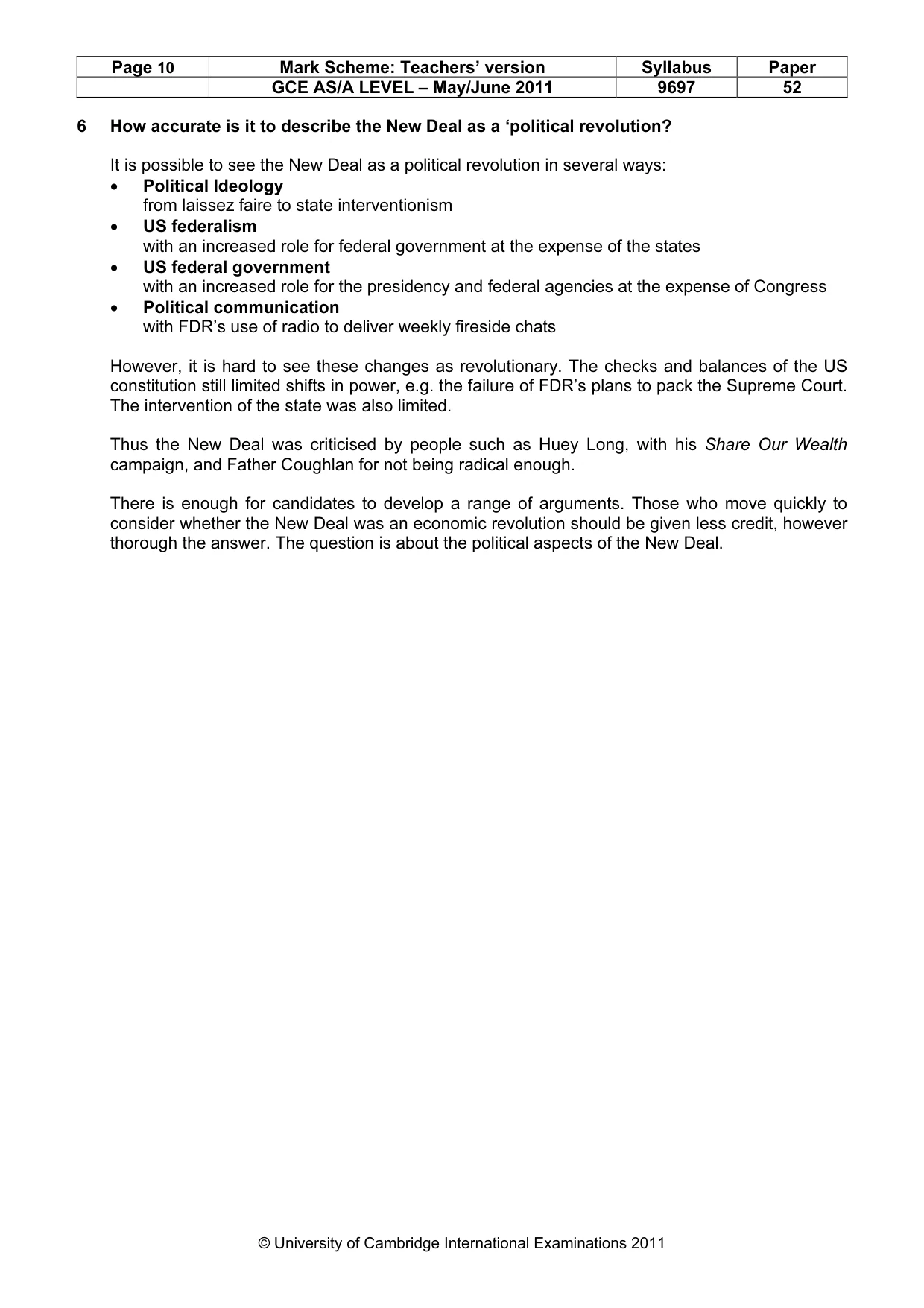
Page 10 Mark Scheme: Teachers’ version Syllabus Paper GCE AS/A LEVEL – May/June 2011 9697 52 © University of Cambridge International Examinations 2011 6 How accurate is it to describe the New Deal as a ‘political revolution? It is possible to see the New Deal as a political revolution in several ways: • Political Ideology from laissez faire to state interventionism • US federalism with an increased role for federal government at the expense of the states • US federal government with an increased role for the presidency and federal agencies at the expense of Congress • Political communication with FDR’s use of radio to deliver weekly fireside chats However, it is hard to see these changes as revolutionary. The checks and balances of the US constitution still limited shifts in power, e.g. the failure of FDR’s plans to pack the Supreme Court. The intervention of the state was also limited. Thus the New Deal was criticised by people such as Huey Long, with his Share Our Wealth campaign, and Father Coughlan for not being radical enough. There is enough for candidates to develop a range of arguments. Those who move quickly to consider whether the New Deal was an economic revolution should be given less credit, however thorough the answer. The question is about the political aspects of the New Deal.
Mark scheme, page 11
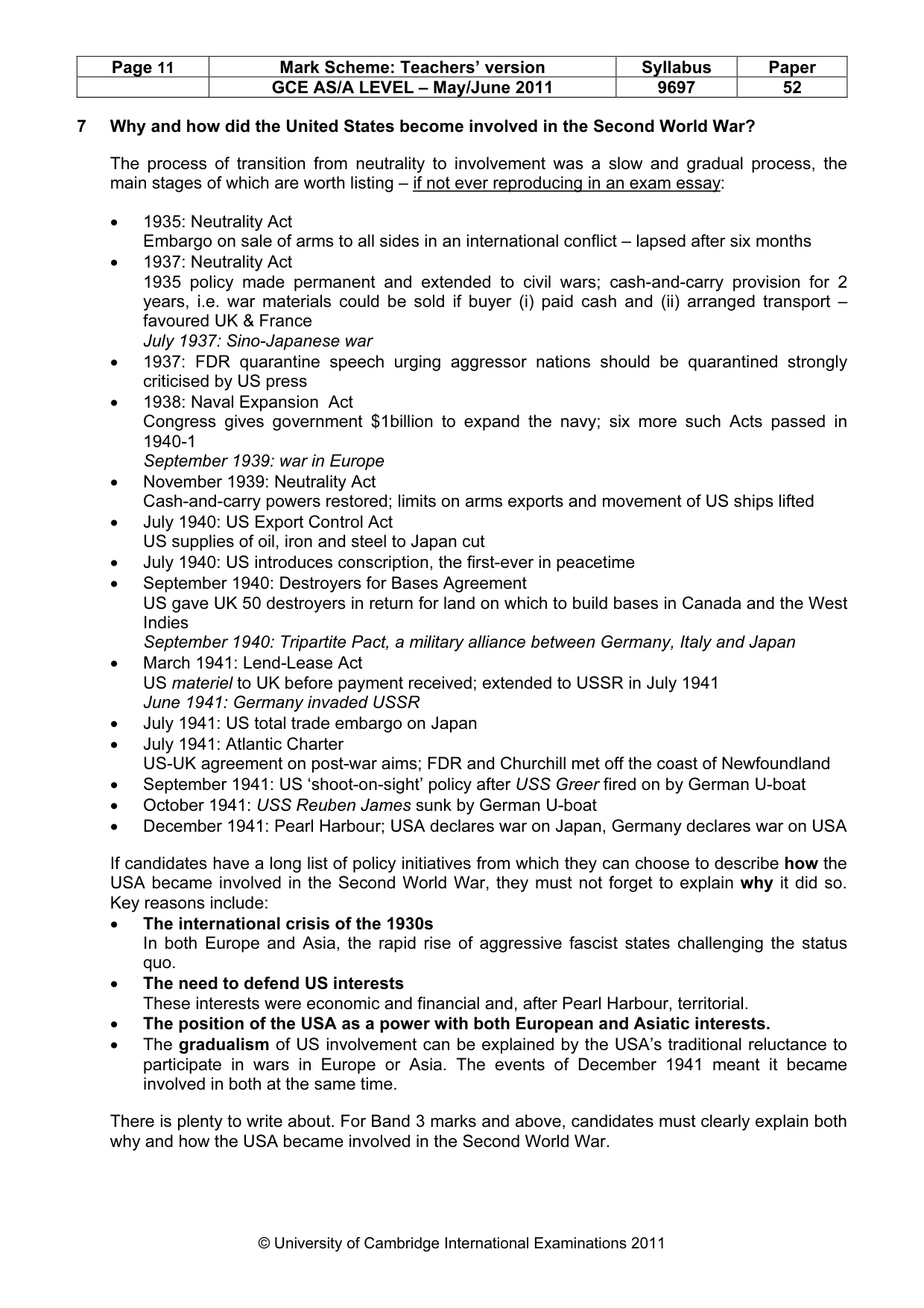
Page 11 Mark Scheme: Teachers’ version Syllabus Paper GCE AS/A LEVEL – May/June 2011 9697 52 © University of Cambridge International Examinations 2011 7 Why and how did the United States become involved in the Second World War? The process of transition from neutrality to involvement was a slow and gradual process, the main stages of which are worth listing – if not ever reproducing in an exam essay: • 1935: Neutrality Act Embargo on sale of arms to all sides in an international conflict – lapsed after six months • 1937: Neutrality Act 1935 policy made permanent and extended to civil wars; cash-and-carry provision for 2 years, i.e. war materials could be sold if buyer (i) paid cash and (ii) arranged transport – favoured UK & France July 1937: Sino-Japanese war • 1937: FDR quarantine speech urging aggressor nations should be quarantined strongly criticised by US press • 1938: Naval Expansion Act Congress gives government $1billion to expand the navy; six more such Acts passed in 1940-1 September 1939: war in Europe • November 1939: Neutrality Act Cash-and-carry powers restored; limits on arms exports and movement of US ships lifted • July 1940: US Export Control Act US supplies of oil, iron and steel to Japan cut • July 1940: US introduces conscription, the first-ever in peacetime • September 1940: Destroyers for Bases Agreement US gave UK 50 destroyers in return for land on which to build bases in Canada and the West Indies September 1940: Tripartite Pact, a military alliance between Germany, Italy and Japan • March 1941: Lend-Lease Act US materiel to UK before payment received; extended to USSR in July 1941 June 1941: Germany invaded USSR • July 1941: US total trade embargo on Japan • July 1941: Atlantic Charter US-UK agreement on post-war aims; FDR and Churchill met off the coast of Newfoundland • September 1941: US ‘shoot-on-sight’ policy after USS Greer fired on by German U-boat • October 1941: USS Reuben James sunk by German U-boat • December 1941: Pearl Harbour; USA declares war on Japan, Germany declares war on USA If candidates have a long list of policy initiatives from which they can choose to describe how the USA became involved in the Second World War, they must not forget to explain why it did so. Key reasons include: • The international crisis of the 1930s In both Europe and Asia, the rapid rise of aggressive fascist states challenging the status quo. • The need to defend US interests These interests were economic and financial and, after Pearl Harbour, territorial. • The position of the USA as a power with both European and Asiatic interests. • The gradualism of US involvement can be explained by the USA’s traditional reluctance to participate in wars in Europe or Asia. The events of December 1941 meant it became involved in both at the same time. There is plenty to write about. For Band 3 marks and above, candidates must clearly explain both why and how the USA became involved in the Second World War.
Mark scheme, page 12
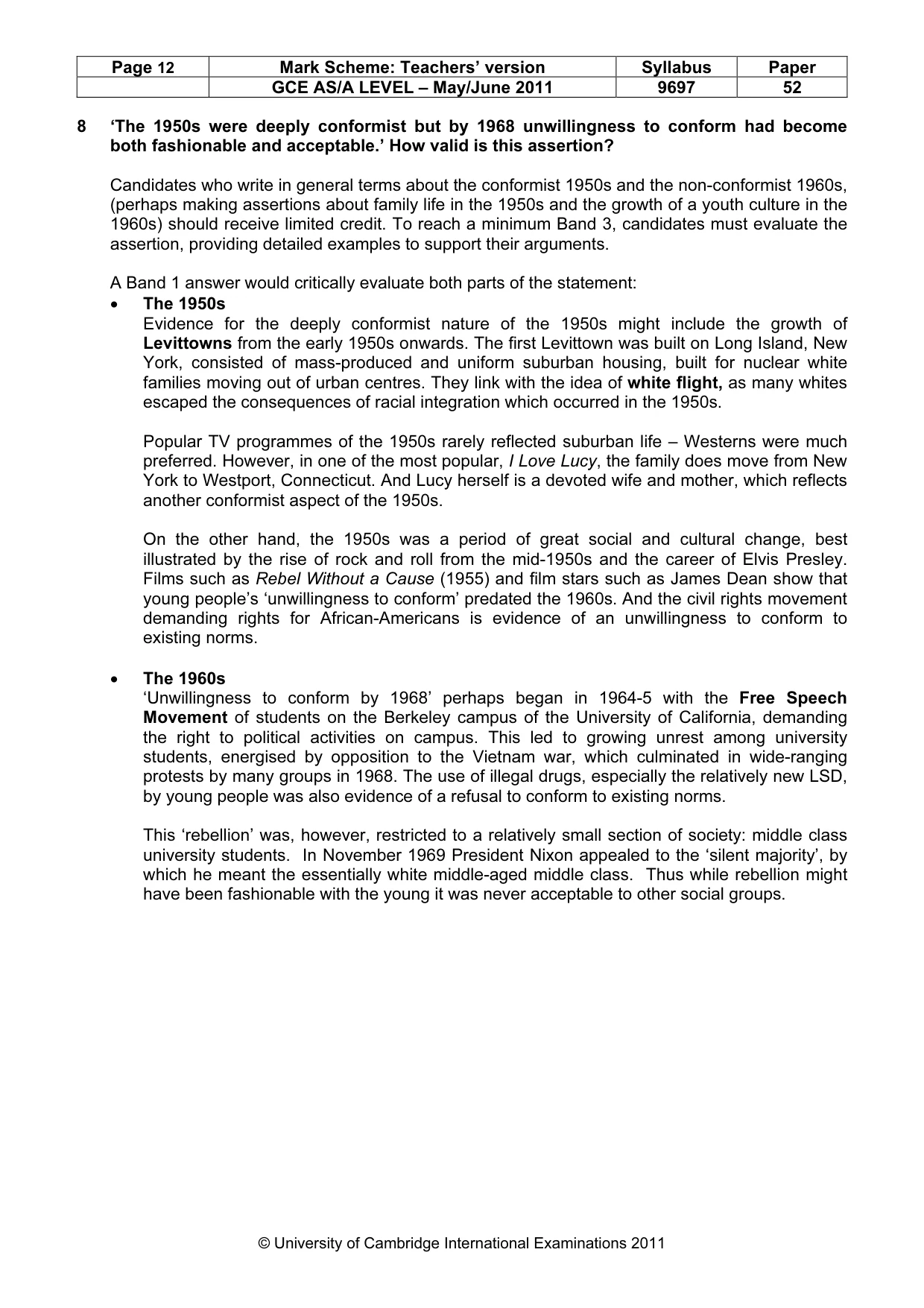
Page 12 Mark Scheme: Teachers’ version Syllabus Paper GCE AS/A LEVEL – May/June 2011 9697 52 © University of Cambridge International Examinations 2011 8 ‘The 1950s were deeply conformist but by 1968 unwillingness to conform had become both fashionable and acceptable.’ How valid is this assertion? Candidates who write in general terms about the conformist 1950s and the non-conformist 1960s, (perhaps making assertions about family life in the 1950s and the growth of a youth culture in the 1960s) should receive limited credit. To reach a minimum Band 3, candidates must evaluate the assertion, providing detailed examples to support their arguments. A Band 1 answer would critically evaluate both parts of the statement: • The 1950s Evidence for the deeply conformist nature of the 1950s might include the growth of Levittowns from the early 1950s onwards. The first Levittown was built on Long Island, New York, consisted of mass-produced and uniform suburban housing, built for nuclear white families moving out of urban centres. They link with the idea of white flight, as many whites escaped the consequences of racial integration which occurred in the 1950s. Popular TV programmes of the 1950s rarely reflected suburban life – Westerns were much preferred. However, in one of the most popular, I Love Lucy, the family does move from New York to Westport, Connecticut. And Lucy herself is a devoted wife and mother, which reflects another conformist aspect of the 1950s. On the other hand, the 1950s was a period of great social and cultural change, best illustrated by the rise of rock and roll from the mid-1950s and the career of Elvis Presley. Films such as Rebel Without a Cause (1955) and film stars such as James Dean show that young people’s ‘unwillingness to conform’ predated the 1960s. And the civil rights movement demanding rights for African-Americans is evidence of an unwillingness to conform to existing norms. • The 1960s ‘Unwillingness to conform by 1968’ perhaps began in 1964-5 with the Free Speech Movement of students on the Berkeley campus of the University of California, demanding the right to political activities on campus. This led to growing unrest among university students, energised by opposition to the Vietnam war, which culminated in wide-ranging protests by many groups in 1968. The use of illegal drugs, especially the relatively new LSD, by young people was also evidence of a refusal to conform to existing norms. This ‘rebellion’ was, however, restricted to a relatively small section of society: middle class university students. In November 1969 President Nixon appealed to the ‘silent majority’, by which he meant the essentially white middle-aged middle class. Thus while rebellion might have been fashionable with the young it was never acceptable to other social groups.
What you needed in this session
Cambridge’s own grade thresholds for 2011 May/June, Paper 5 · Variant 2. A higher threshold means an easier paper — the bar moves with how the cohort did.