Cambridge A Level History (pre-2015) 9697 — 2012 May/June Paper 5 · Variant 1
9697/51/M/J/12 · 100 marks · ≈113 min
The question paper and its mark scheme, free to read here and free to download. This is Cambridge’s own paper, exactly as it was sat.
Question paper4 pages
Mark scheme11 pages
Answers below. Sit the paper first if you are practising.
Paper as text
Question paper, page 1
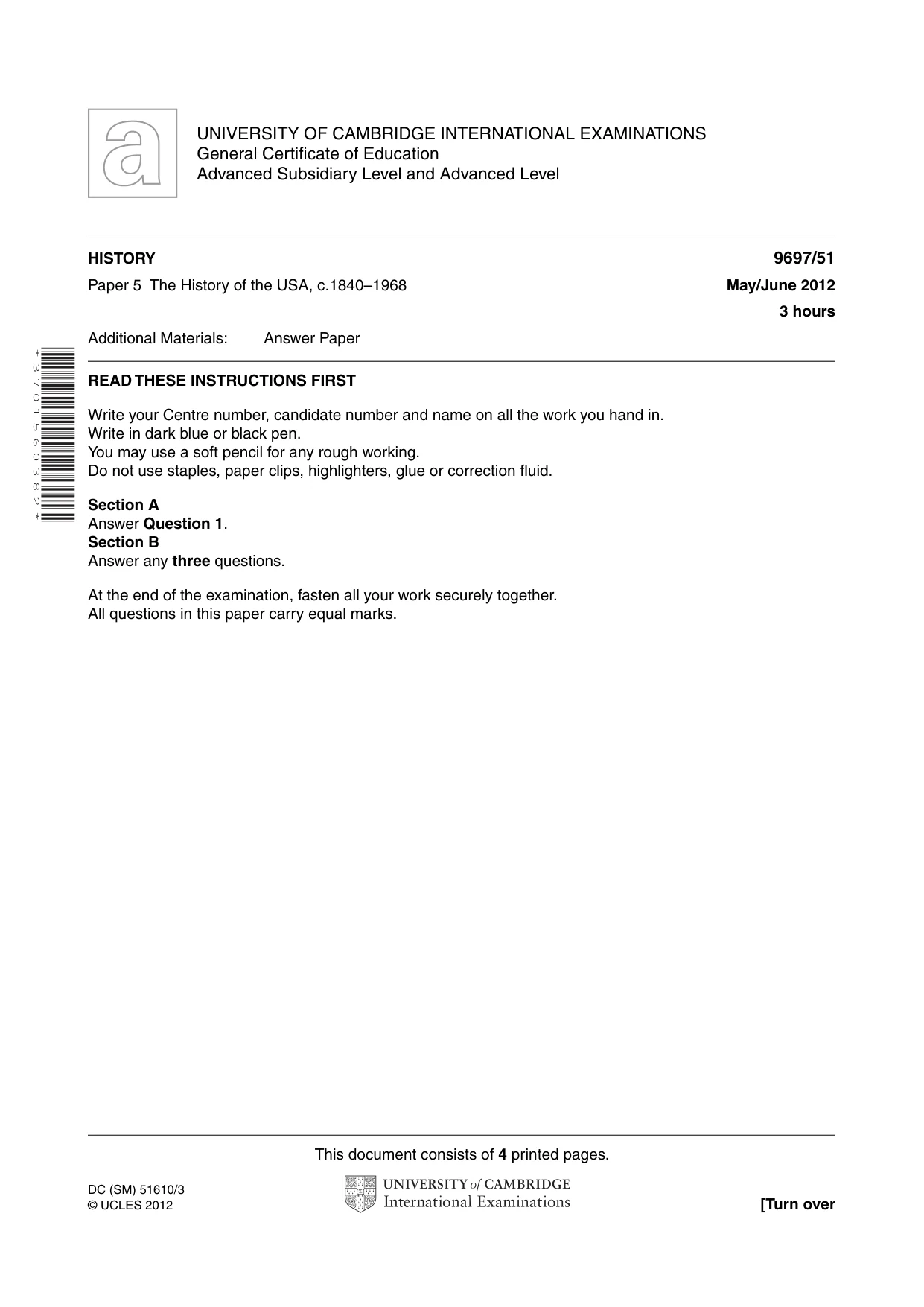
This document consists of 4 printed pages. DC (SM) 51610/3 © UCLES 2012 [Turn over UNIVERSITY OF CAMBRIDGE INTERNATIONAL EXAMINATIONS General Certificate of Education Advanced Subsidiary Level and Advanced Level * 3 7 0 1 5 6 0 3 8 2 * HISTORY 9697/51 Paper 5 The History of the USA, c.1840–1968 May/June 2012 3 hours Additional Materials: Answer Paper READ THESE INSTRUCTIONS FIRST Write your Centre number, candidate number and name on all the work you hand in. Write in dark blue or black pen. You may use a soft pencil for any rough working. Do not use staples, paper clips, highlighters, glue or correction fluid. Section A Answer Question 1. Section B Answer any three questions. At the end of the examination, fasten all your work securely together. All questions in this paper carry equal marks.
Question paper, page 2
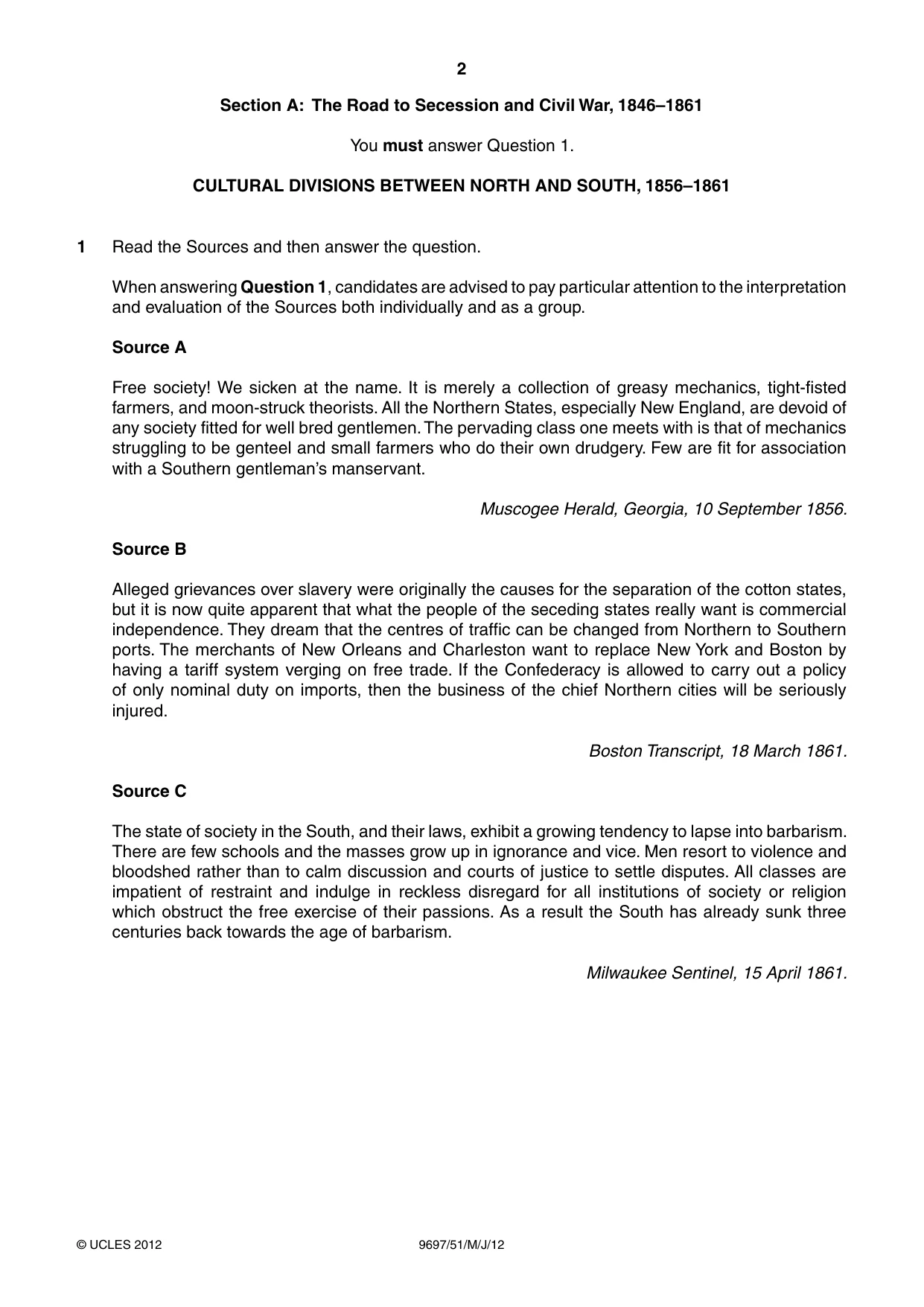
2 9697/51/M/J/12 © UCLES 2012 Section A: The Road to Secession and Civil War, 1846–1861 You must answer Question 1. CULTURAL DIVISIONS BETWEEN NORTH AND SOUTH, 1856–1861 1 Read the Sources and then answer the question. When answering Question 1, candidates are advised to pay particular attention to the interpretation and evaluation of the Sources both individually and as a group. Source A Free society! We sicken at the name. It is merely a collection of greasy mechanics, tight-fisted farmers, and moon-struck theorists. All the Northern States, especially New England, are devoid of any society fitted for well bred gentlemen. The pervading class one meets with is that of mechanics struggling to be genteel and small farmers who do their own drudgery. Few are fit for association with a Southern gentleman’s manservant. Muscogee Herald, Georgia, 10 September 1856. Source B Alleged grievances over slavery were originally the causes for the separation of the cotton states, but it is now quite apparent that what the people of the seceding states really want is commercial independence. They dream that the centres of traffic can be changed from Northern to Southern ports. The merchants of New Orleans and Charleston want to replace New York and Boston by having a tariff system verging on free trade. If the Confederacy is allowed to carry out a policy of only nominal duty on imports, then the business of the chief Northern cities will be seriously injured. Boston Transcript, 18 March 1861. Source C The state of society in the South, and their laws, exhibit a growing tendency to lapse into barbarism. There are few schools and the masses grow up in ignorance and vice. Men resort to violence and bloodshed rather than to calm discussion and courts of justice to settle disputes. All classes are impatient of restraint and indulge in reckless disregard for all institutions of society or religion which obstruct the free exercise of their passions. As a result the South has already sunk three centuries back towards the age of barbarism. Milwaukee Sentinel, 15 April 1861.
Question paper, page 3
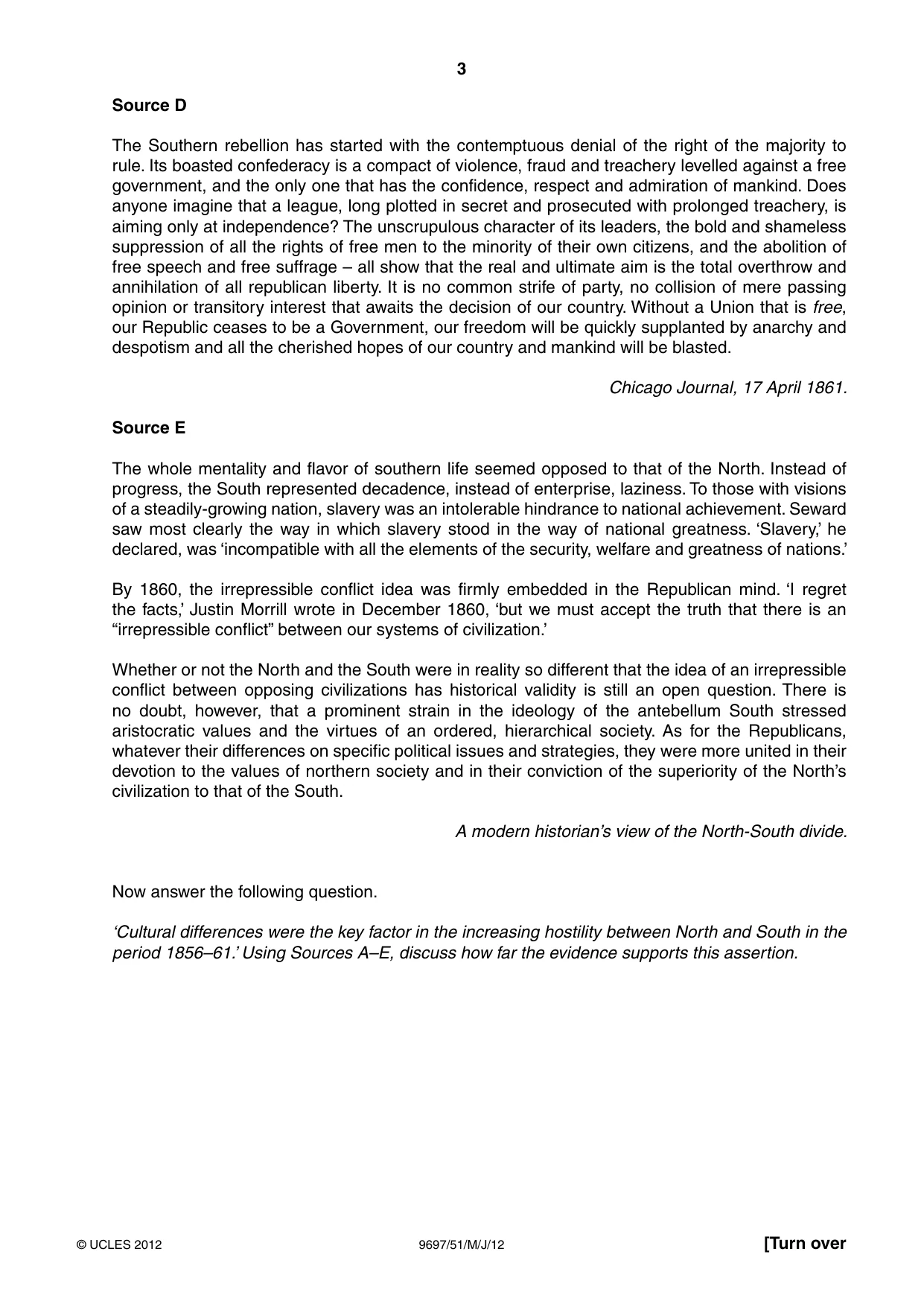
3 9697/51/M/J/12 © UCLES 2012 [Turn over Source D The Southern rebellion has started with the contemptuous denial of the right of the majority to rule. Its boasted confederacy is a compact of violence, fraud and treachery levelled against a free government, and the only one that has the confidence, respect and admiration of mankind. Does anyone imagine that a league, long plotted in secret and prosecuted with prolonged treachery, is aiming only at independence? The unscrupulous character of its leaders, the bold and shameless suppression of all the rights of free men to the minority of their own citizens, and the abolition of free speech and free suffrage – all show that the real and ultimate aim is the total overthrow and annihilation of all republican liberty. It is no common strife of party, no collision of mere passing opinion or transitory interest that awaits the decision of our country. Without a Union that is free, our Republic ceases to be a Government, our freedom will be quickly supplanted by anarchy and despotism and all the cherished hopes of our country and mankind will be blasted. Chicago Journal, 17 April 1861. Source E The whole mentality and flavor of southern life seemed opposed to that of the North. Instead of progress, the South represented decadence, instead of enterprise, laziness. To those with visions of a steadily-growing nation, slavery was an intolerable hindrance to national achievement. Seward saw most clearly the way in which slavery stood in the way of national greatness. ‘Slavery,’ he declared, was ‘incompatible with all the elements of the security, welfare and greatness of nations.’ By 1860, the irrepressible conflict idea was firmly embedded in the Republican mind. ‘I regret the facts,’ Justin Morrill wrote in December 1860, ‘but we must accept the truth that there is an “irrepressible conflict” between our systems of civilization.’ Whether or not the North and the South were in reality so different that the idea of an irrepressible conflict between opposing civilizations has historical validity is still an open question. There is no doubt, however, that a prominent strain in the ideology of the antebellum South stressed aristocratic values and the virtues of an ordered, hierarchical society. As for the Republicans, whatever their differences on specific political issues and strategies, they were more united in their devotion to the values of northern society and in their conviction of the superiority of the North’s civilization to that of the South. A modern historian’s view of the North-South divide. Now answer the following question. ‘Cultural differences were the key factor in the increasing hostility between North and South in the period 1856–61.’ Using Sources A–E, discuss how far the evidence supports this assertion.
Question paper, page 4
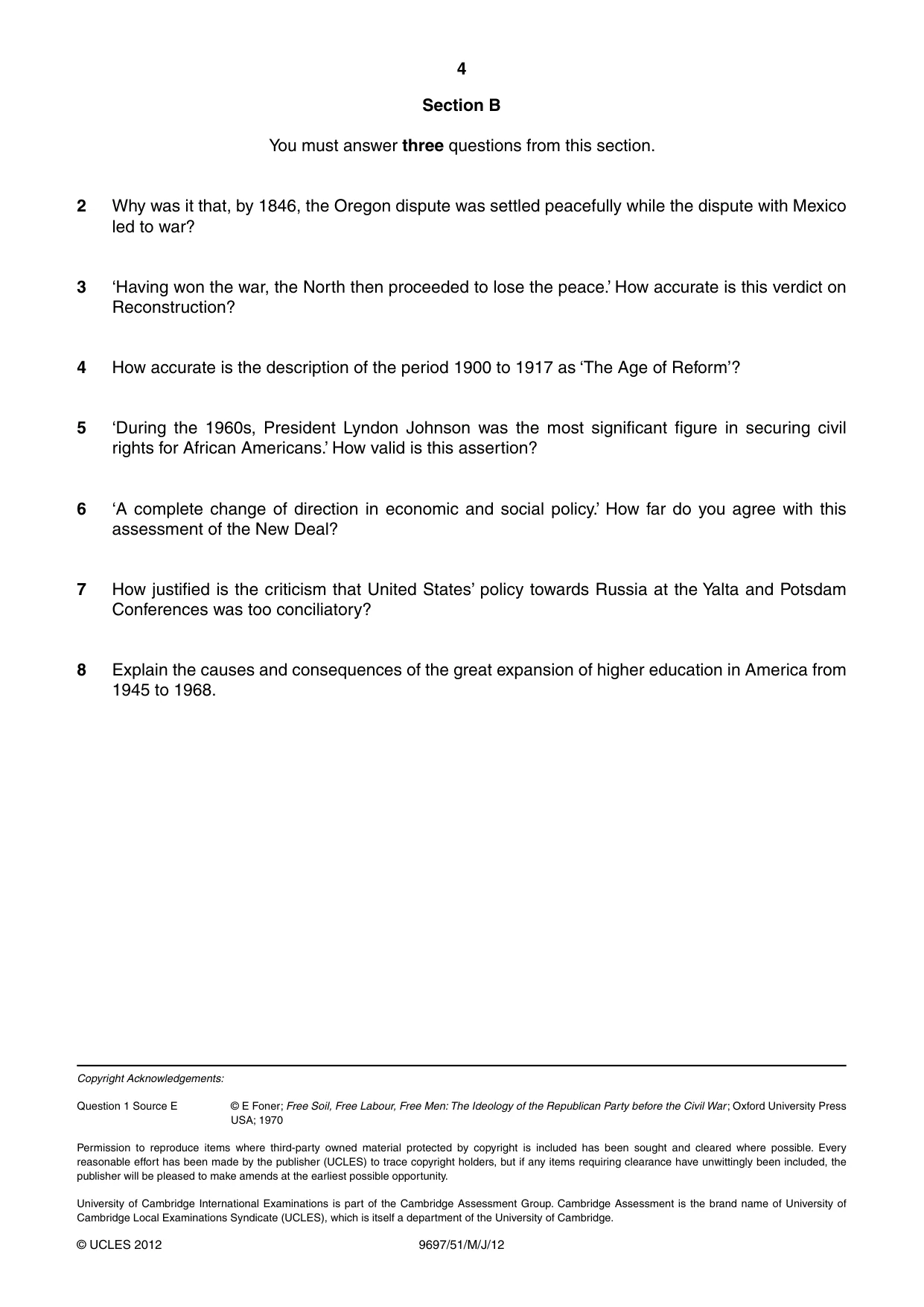
4 9697/51/M/J/12 © UCLES 2012 Copyright Acknowledgements: Question 1 Source E © E Foner; Free Soil, Free Labour, Free Men: The Ideology of the Republican Party before the Civil War ; Oxford University Press USA; 1970 Permission to reproduce items where third-party owned material protected by copyright is included has been sought and cleared where possible. Every reasonable effort has been made by the publisher (UCLES) to trace copyright holders, but if any items requiring clearance have unwittingly been included, the publisher will be pleased to make amends at the earliest possible opportunity. University of Cambridge International Examinations is part of the Cambridge Assessment Group. Cambridge Assessment is the brand name of University of Cambridge Local Examinations Syndicate (UCLES), which is itself a department of the University of Cambridge. Section B You must answer three questions from this section. 2 Why was it that, by 1846, the Oregon dispute was settled peacefully while the dispute with Mexico led to war? 3 ‘Having won the war, the North then proceeded to lose the peace.’ How accurate is this verdict on Reconstruction? 4 How accurate is the description of the period 1900 to 1917 as ‘The Age of Reform’? 5 ‘During the 1960s, President Lyndon Johnson was the most significant figure in securing civil rights for African Americans.’ How valid is this assertion? 6 ‘A complete change of direction in economic and social policy.’ How far do you agree with this assessment of the New Deal? 7 How justified is the criticism that United States’ policy towards Russia at the Yalta and Potsdam Conferences was too conciliatory? 8 Explain the causes and consequences of the great expansion of higher education in America from 1945 to 1968.
Mark scheme, page 1
UNIVERSITY OF CAMBRIDGE INTERNATIONAL EXAMINATIONS GCE Advanced Subsidiary Level and GCE Advanced Level MARK SCHEME for the May/June 2012 question paper for the guidance of teachers 9697 HISTORY 9697/51 Paper 5, maximum raw mark 100 This mark scheme is published as an aid to teachers and candidates, to indicate the requirements of the examination. It shows the basis on which Examiners were instructed to award marks. It does not indicate the details of the discussions that took place at an Examiners’ meeting before marking began, which would have considered the acceptability of alternative answers. Mark schemes must be read in conjunction with the question papers and the report on the examination. • Cambridge will not enter into discussions or correspondence in connection with these mark schemes. Cambridge is publishing the mark schemes for the May/June 2012 question papers for most IGCSE, GCE Advanced Level and Advanced Subsidiary Level syllabuses and some Ordinary Level syllabuses.
Mark scheme, page 2
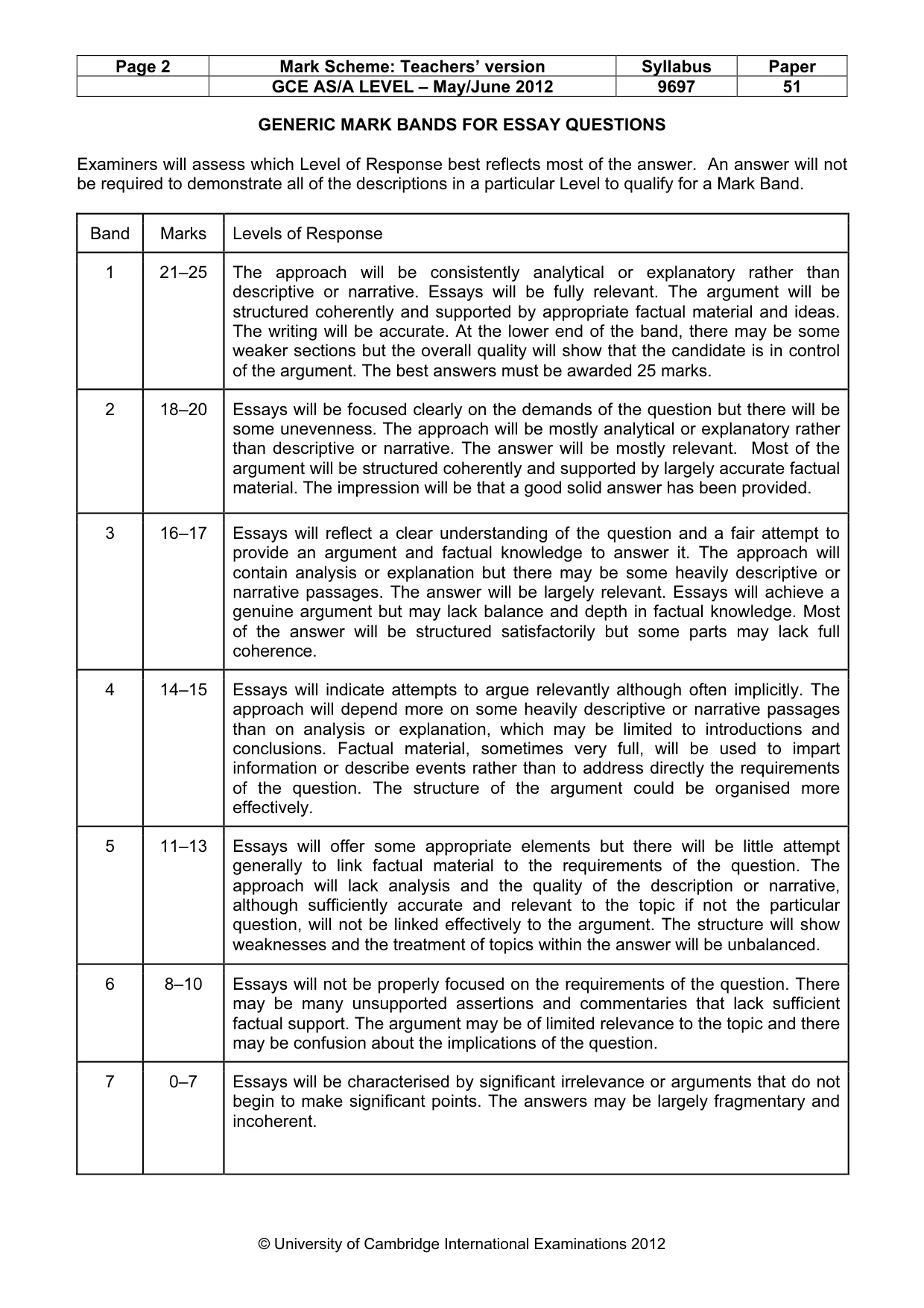
Page 2 Mark Scheme: Teachers’ version Syllabus Paper GCE AS/A LEVEL – May/June 2012 9697 51 © University of Cambridge International Examinations 2012 GENERIC MARK BANDS FOR ESSAY QUESTIONS Examiners will assess which Level of Response best reflects most of the answer. An answer will not be required to demonstrate all of the descriptions in a particular Level to qualify for a Mark Band. Band Marks Levels of Response 1 21–25 The approach will be consistently analytical or explanatory rather than descriptive or narrative. Essays will be fully relevant. The argument will be structured coherently and supported by appropriate factual material and ideas. The writing will be accurate. At the lower end of the band, there may be some weaker sections but the overall quality will show that the candidate is in control of the argument. The best answers must be awarded 25 marks. 2 18–20 Essays will be focused clearly on the demands of the question but there will be some unevenness. The approach will be mostly analytical or explanatory rather than descriptive or narrative. The answer will be mostly relevant. Most of the argument will be structured coherently and supported by largely accurate factual material. The impression will be that a good solid answer has been provided. 3 16–17 Essays will reflect a clear understanding of the question and a fair attempt to provide an argument and factual knowledge to answer it. The approach will contain analysis or explanation but there may be some heavily descriptive or narrative passages. The answer will be largely relevant. Essays will achieve a genuine argument but may lack balance and depth in factual knowledge. Most of the answer will be structured satisfactorily but some parts may lack full coherence. 4 14–15 Essays will indicate attempts to argue relevantly although often implicitly. The approach will depend more on some heavily descriptive or narrative passages than on analysis or explanation, which may be limited to introductions and conclusions. Factual material, sometimes very full, will be used to impart information or describe events rather than to address directly the requirements of the question. The structure of the argument could be organised more effectively. 5 11–13 Essays will offer some appropriate elements but there will be little attempt generally to link factual material to the requirements of the question. The approach will lack analysis and the quality of the description or narrative, although sufficiently accurate and relevant to the topic if not the particular question, will not be linked effectively to the argument. The structure will show weaknesses and the treatment of topics within the answer will be unbalanced. 6 8–10 Essays will not be properly focused on the requirements of the question. There may be many unsupported assertions and commentaries that lack sufficient factual support. The argument may be of limited relevance to the topic and there may be confusion about the implications of the question. 7 0–7 Essays will be characterised by significant irrelevance or arguments that do not begin to make significant points. The answers may be largely fragmentary and incoherent.
Mark scheme, page 3
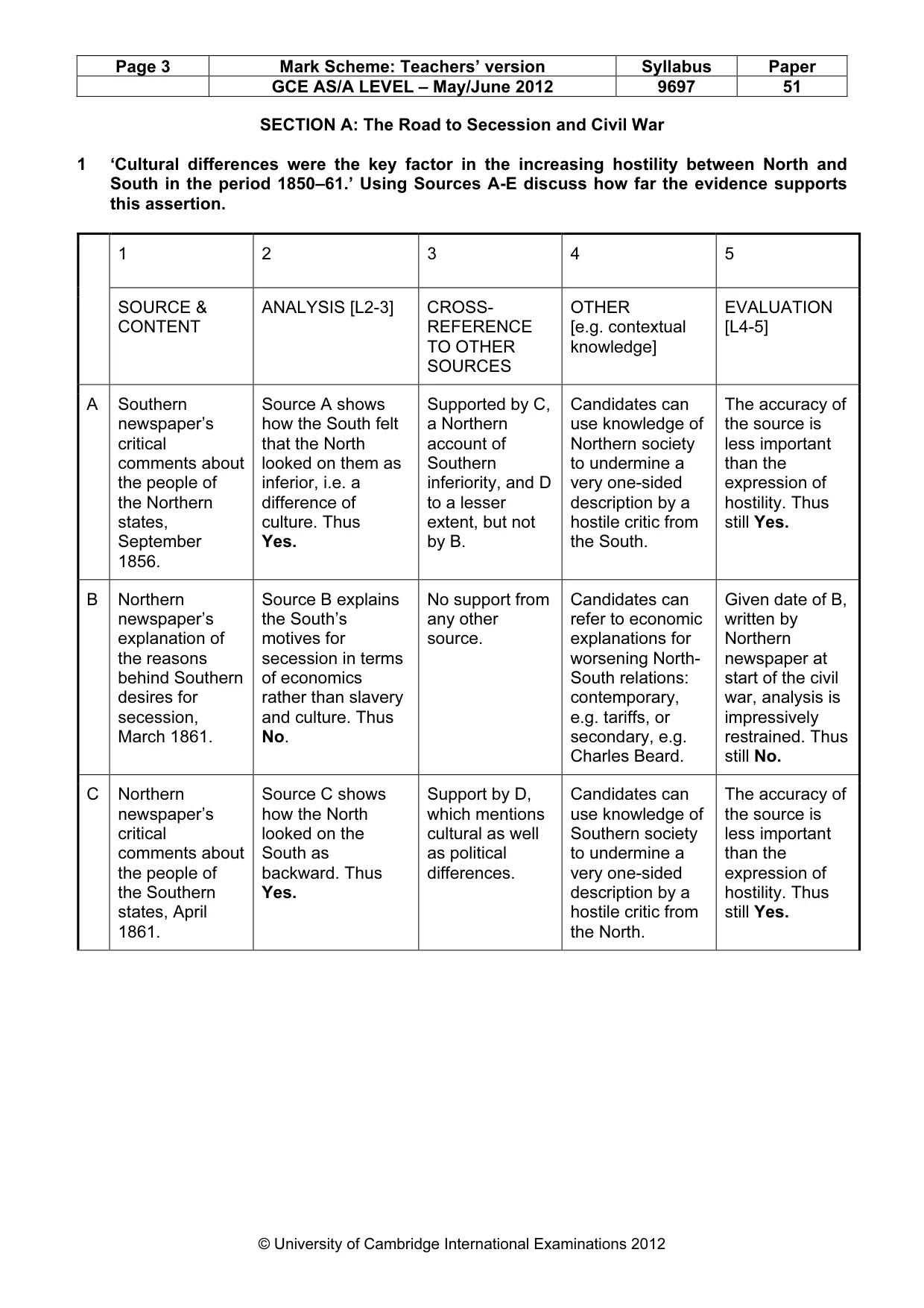
Page 3 Mark Scheme: Teachers’ version Syllabus Paper GCE AS/A LEVEL – May/June 2012 9697 51 © University of Cambridge International Examinations 2012 SECTION A: The Road to Secession and Civil War 1 ‘Cultural differences were the key factor in the increasing hostility between North and South in the period 1850–61.’ Using Sources A-E discuss how far the evidence supports this assertion. 1 2 3 4 5 SOURCE & CONTENT ANALYSIS [L2-3] CROSS- REFERENCE TO OTHER SOURCES OTHER [e.g. contextual knowledge] EVALUATION [L4-5] A Southern newspaper’s critical comments about the people of the Northern states, September 1856. Source A shows how the South felt that the North looked on them as inferior, i.e. a difference of culture. Thus Yes. Supported by C, a Northern account of Southern inferiority, and D to a lesser extent, but not by B. Candidates can use knowledge of Northern society to undermine a very one-sided description by a hostile critic from the South. The accuracy of the source is less important than the expression of hostility. Thus still Yes. B Northern newspaper’s explanation of the reasons behind Southern desires for secession, March 1861. Source B explains the South’s motives for secession in terms of economics rather than slavery and culture. Thus No. No support from any other source. Candidates can refer to economic explanations for worsening North- South relations: contemporary, e.g. tariffs, or secondary, e.g. Charles Beard. Given date of B, written by Northern newspaper at start of the civil war, analysis is impressively restrained. Thus still No. C Northern newspaper’s critical comments about the people of the Southern states, April 1861. Source C shows how the North looked on the South as backward. Thus Yes. Support by D, which mentions cultural as well as political differences. Candidates can use knowledge of Southern society to undermine a very one-sided description by a hostile critic from the North. The accuracy of the source is less important than the expression of hostility. Thus still Yes.
Mark scheme, page 4
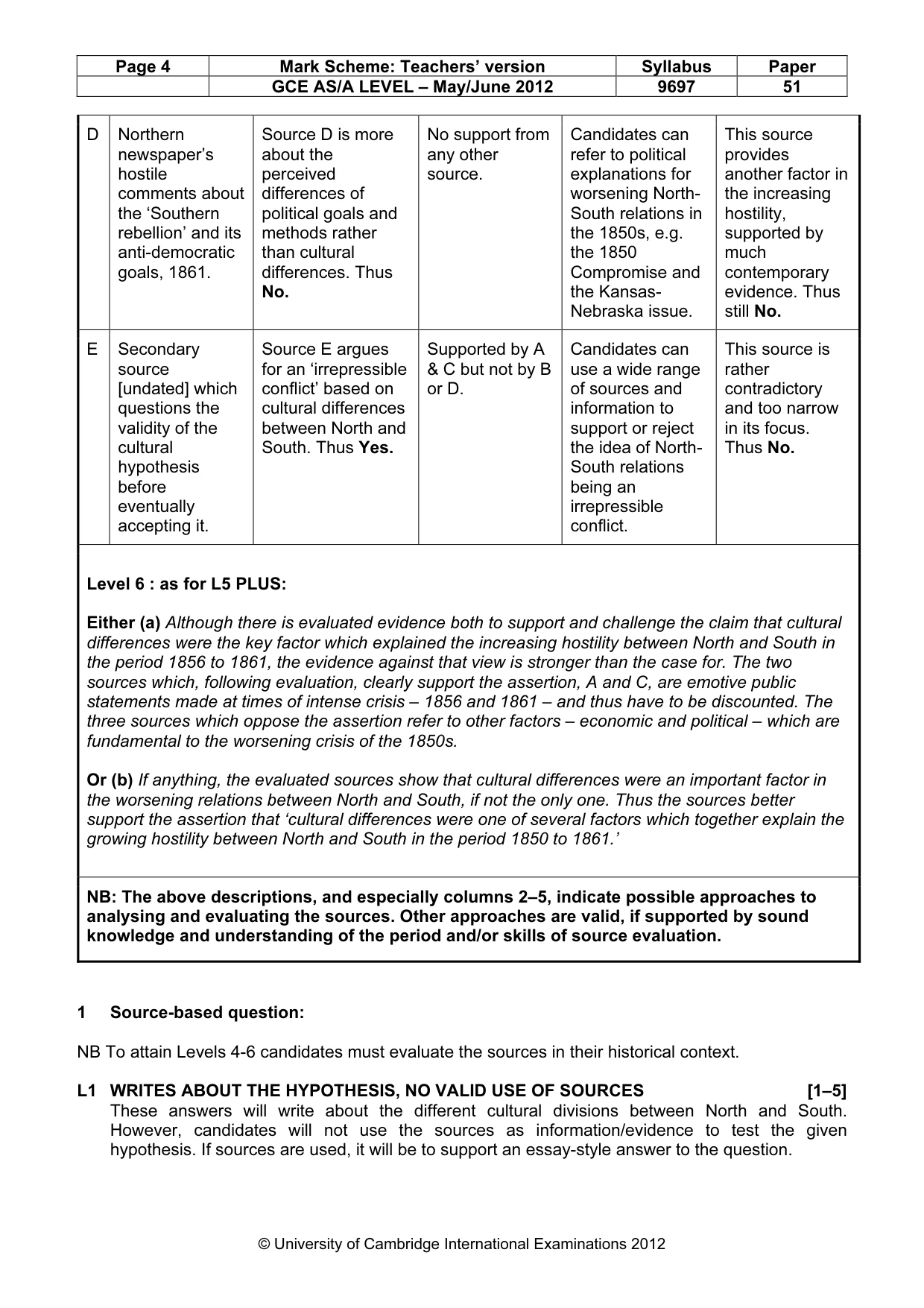
Page 4 Mark Scheme: Teachers’ version Syllabus Paper GCE AS/A LEVEL – May/June 2012 9697 51 © University of Cambridge International Examinations 2012 D Northern newspaper’s hostile comments about the ‘Southern rebellion’ and its anti-democratic goals, 1861. Source D is more about the perceived differences of political goals and methods rather than cultural differences. Thus No. No support from any other source. Candidates can refer to political explanations for worsening North- South relations in the 1850s, e.g. the 1850 Compromise and the Kansas- Nebraska issue. This source provides another factor in the increasing hostility, supported by much contemporary evidence. Thus still No. E Secondary source [undated] which questions the validity of the cultural hypothesis before eventually accepting it. Source E argues for an ‘irrepressible conflict’ based on cultural differences between North and South. Thus Yes. Supported by A & C but not by B or D. Candidates can use a wide range of sources and information to support or reject the idea of North- South relations being an irrepressible conflict. This source is rather contradictory and too narrow in its focus. Thus No. Level 6 : as for L5 PLUS: Either (a) Although there is evaluated evidence both to support and challenge the claim that cultural differences were the key factor which explained the increasing hostility between North and South in the period 1856 to 1861, the evidence against that view is stronger than the case for. The two sources which, following evaluation, clearly support the assertion, A and C, are emotive public statements made at times of intense crisis – 1856 and 1861 – and thus have to be discounted. The three sources which oppose the assertion refer to other factors – economic and political – which are fundamental to the worsening crisis of the 1850s. Or (b) If anything, the evaluated sources show that cultural differences were an important factor in the worsening relations between North and South, if not the only one. Thus the sources better support the assertion that ‘cultural differences were one of several factors which together explain the growing hostility between North and South in the period 1850 to 1861.’ NB: The above descriptions, and especially columns 2–5, indicate possible approaches to analysing and evaluating the sources. Other approaches are valid, if supported by sound knowledge and understanding of the period and/or skills of source evaluation. 1 Source-based question: NB To attain Levels 4-6 candidates must evaluate the sources in their historical context. L1 WRITES ABOUT THE HYPOTHESIS, NO VALID USE OF SOURCES [1–5] These answers will write about the different cultural divisions between North and South. However, candidates will not use the sources as information/evidence to test the given hypothesis. If sources are used, it will be to support an essay-style answer to the question.
Mark scheme, page 5
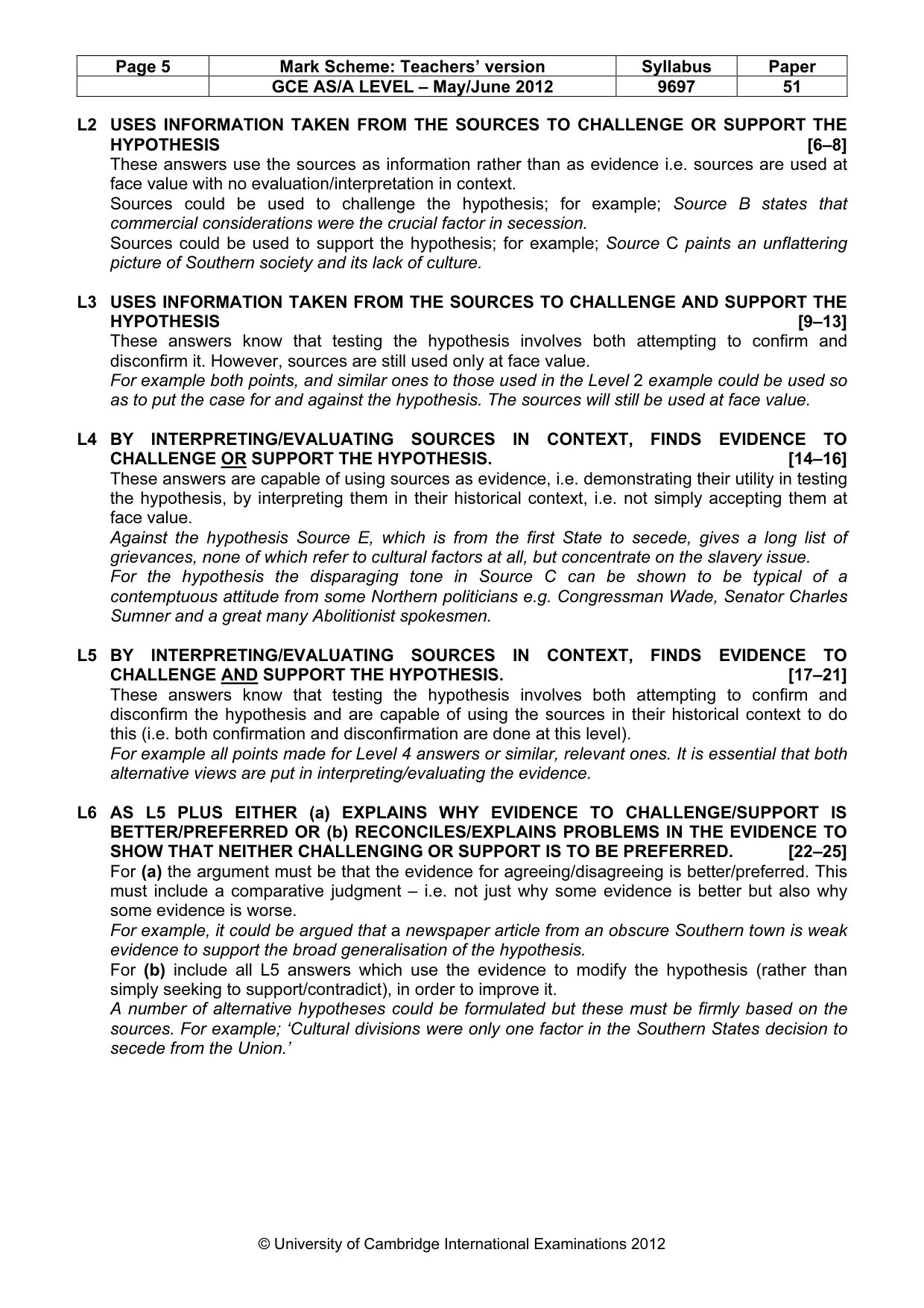
Page 5 Mark Scheme: Teachers’ version Syllabus Paper GCE AS/A LEVEL – May/June 2012 9697 51 © University of Cambridge International Examinations 2012 L2 USES INFORMATION TAKEN FROM THE SOURCES TO CHALLENGE OR SUPPORT THE HYPOTHESIS [6–8] These answers use the sources as information rather than as evidence i.e. sources are used at face value with no evaluation/interpretation in context. Sources could be used to challenge the hypothesis; for example; Source B states that commercial considerations were the crucial factor in secession. Sources could be used to support the hypothesis; for example; Source C paints an unflattering picture of Southern society and its lack of culture. L3 USES INFORMATION TAKEN FROM THE SOURCES TO CHALLENGE AND SUPPORT THE HYPOTHESIS [9–13] These answers know that testing the hypothesis involves both attempting to confirm and disconfirm it. However, sources are still used only at face value. For example both points, and similar ones to those used in the Level 2 example could be used so as to put the case for and against the hypothesis. The sources will still be used at face value. L4 BY INTERPRETING/EVALUATlNG SOURCES IN CONTEXT, FINDS EVIDENCE TO CHALLENGE OR SUPPORT THE HYPOTHESIS. [14–16] These answers are capable of using sources as evidence, i.e. demonstrating their utility in testing the hypothesis, by interpreting them in their historical context, i.e. not simply accepting them at face value. Against the hypothesis Source E, which is from the first State to secede, gives a long list of grievances, none of which refer to cultural factors at all, but concentrate on the slavery issue. For the hypothesis the disparaging tone in Source C can be shown to be typical of a contemptuous attitude from some Northern politicians e.g. Congressman Wade, Senator Charles Sumner and a great many Abolitionist spokesmen. L5 BY INTERPRETING/EVALUATING SOURCES IN CONTEXT, FINDS EVIDENCE TO CHALLENGE AND SUPPORT THE HYPOTHESIS. [17–21] These answers know that testing the hypothesis involves both attempting to confirm and disconfirm the hypothesis and are capable of using the sources in their historical context to do this (i.e. both confirmation and disconfirmation are done at this level). For example all points made for Level 4 answers or similar, relevant ones. It is essential that both alternative views are put in interpreting/evaluating the evidence. L6 AS L5 PLUS EITHER (a) EXPLAINS WHY EVIDENCE TO CHALLENGE/SUPPORT IS BETTER/PREFERRED OR (b) RECONCILES/EXPLAINS PROBLEMS IN THE EVIDENCE TO SHOW THAT NEITHER CHALLENGING OR SUPPORT IS TO BE PREFERRED. [22–25] For (a) the argument must be that the evidence for agreeing/disagreeing is better/preferred. This must include a comparative judgment – i.e. not just why some evidence is better but also why some evidence is worse. For example, it could be argued that a newspaper article from an obscure Southern town is weak evidence to support the broad generalisation of the hypothesis. For (b) include all L5 answers which use the evidence to modify the hypothesis (rather than simply seeking to support/contradict), in order to improve it. A number of alternative hypotheses could be formulated but these must be firmly based on the sources. For example; ‘Cultural divisions were only one factor in the Southern States decision to secede from the Union.’
Mark scheme, page 6
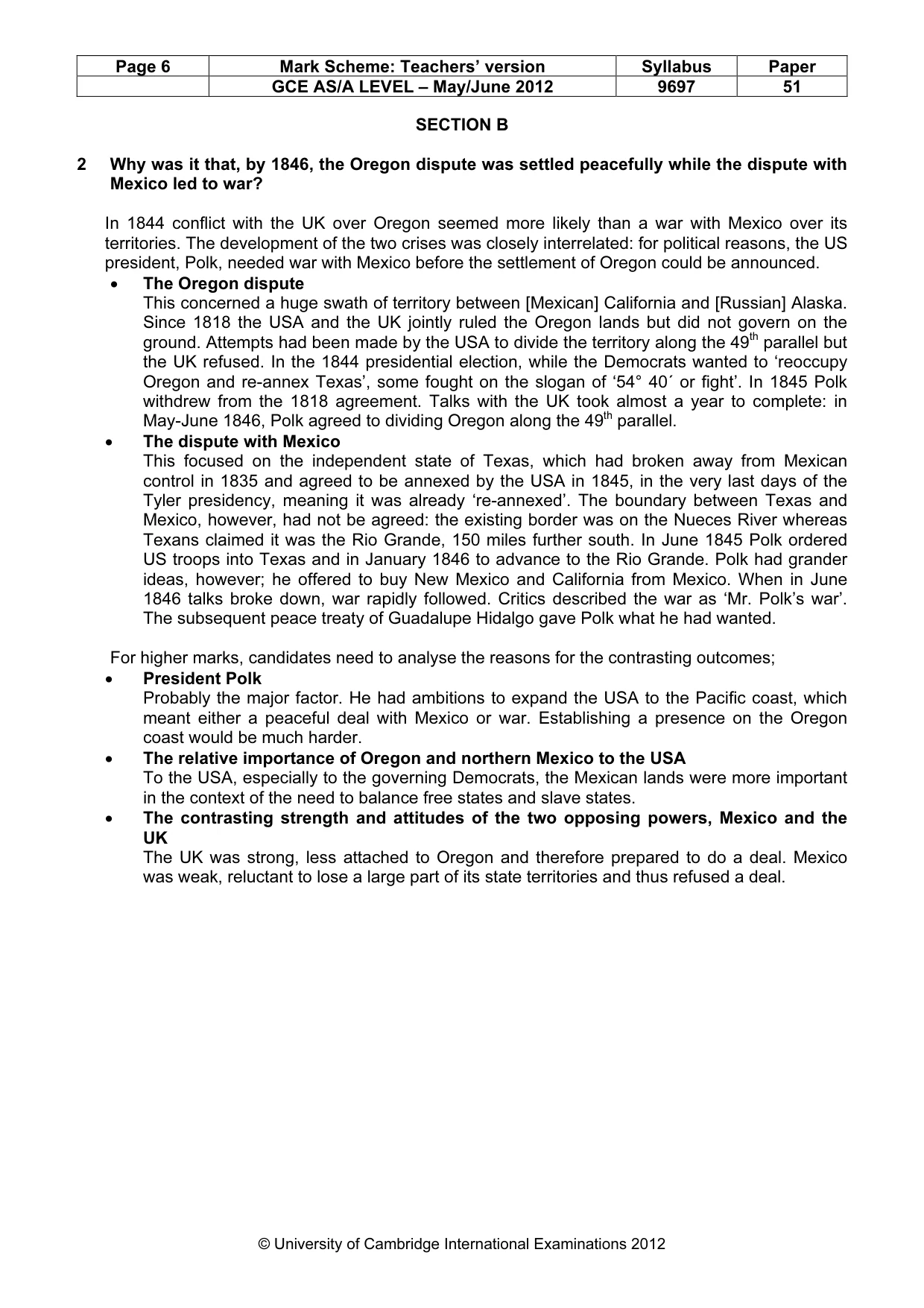
Page 6 Mark Scheme: Teachers’ version Syllabus Paper GCE AS/A LEVEL – May/June 2012 9697 51 © University of Cambridge International Examinations 2012 SECTION B 2 Why was it that, by 1846, the Oregon dispute was settled peacefully while the dispute with Mexico led to war? In 1844 conflict with the UK over Oregon seemed more likely than a war with Mexico over its territories. The development of the two crises was closely interrelated: for political reasons, the US president, Polk, needed war with Mexico before the settlement of Oregon could be announced. • The Oregon dispute This concerned a huge swath of territory between [Mexican] California and [Russian] Alaska. Since 1818 the USA and the UK jointly ruled the Oregon lands but did not govern on the ground. Attempts had been made by the USA to divide the territory along the 49th parallel but the UK refused. In the 1844 presidential election, while the Democrats wanted to ‘reoccupy Oregon and re-annex Texas’, some fought on the slogan of ‘54° 40´ or fight’. In 1845 Polk withdrew from the 1818 agreement. Talks with the UK took almost a year to complete: in May-June 1846, Polk agreed to dividing Oregon along the 49th parallel. • The dispute with Mexico This focused on the independent state of Texas, which had broken away from Mexican control in 1835 and agreed to be annexed by the USA in 1845, in the very last days of the Tyler presidency, meaning it was already ‘re-annexed’. The boundary between Texas and Mexico, however, had not be agreed: the existing border was on the Nueces River whereas Texans claimed it was the Rio Grande, 150 miles further south. In June 1845 Polk ordered US troops into Texas and in January 1846 to advance to the Rio Grande. Polk had grander ideas, however; he offered to buy New Mexico and California from Mexico. When in June 1846 talks broke down, war rapidly followed. Critics described the war as ‘Mr. Polk’s war’. The subsequent peace treaty of Guadalupe Hidalgo gave Polk what he had wanted. For higher marks, candidates need to analyse the reasons for the contrasting outcomes; • President Polk Probably the major factor. He had ambitions to expand the USA to the Pacific coast, which meant either a peaceful deal with Mexico or war. Establishing a presence on the Oregon coast would be much harder. • The relative importance of Oregon and northern Mexico to the USA To the USA, especially to the governing Democrats, the Mexican lands were more important in the context of the need to balance free states and slave states. • The contrasting strength and attitudes of the two opposing powers, Mexico and the UK The UK was strong, less attached to Oregon and therefore prepared to do a deal. Mexico was weak, reluctant to lose a large part of its state territories and thus refused a deal.
Mark scheme, page 7
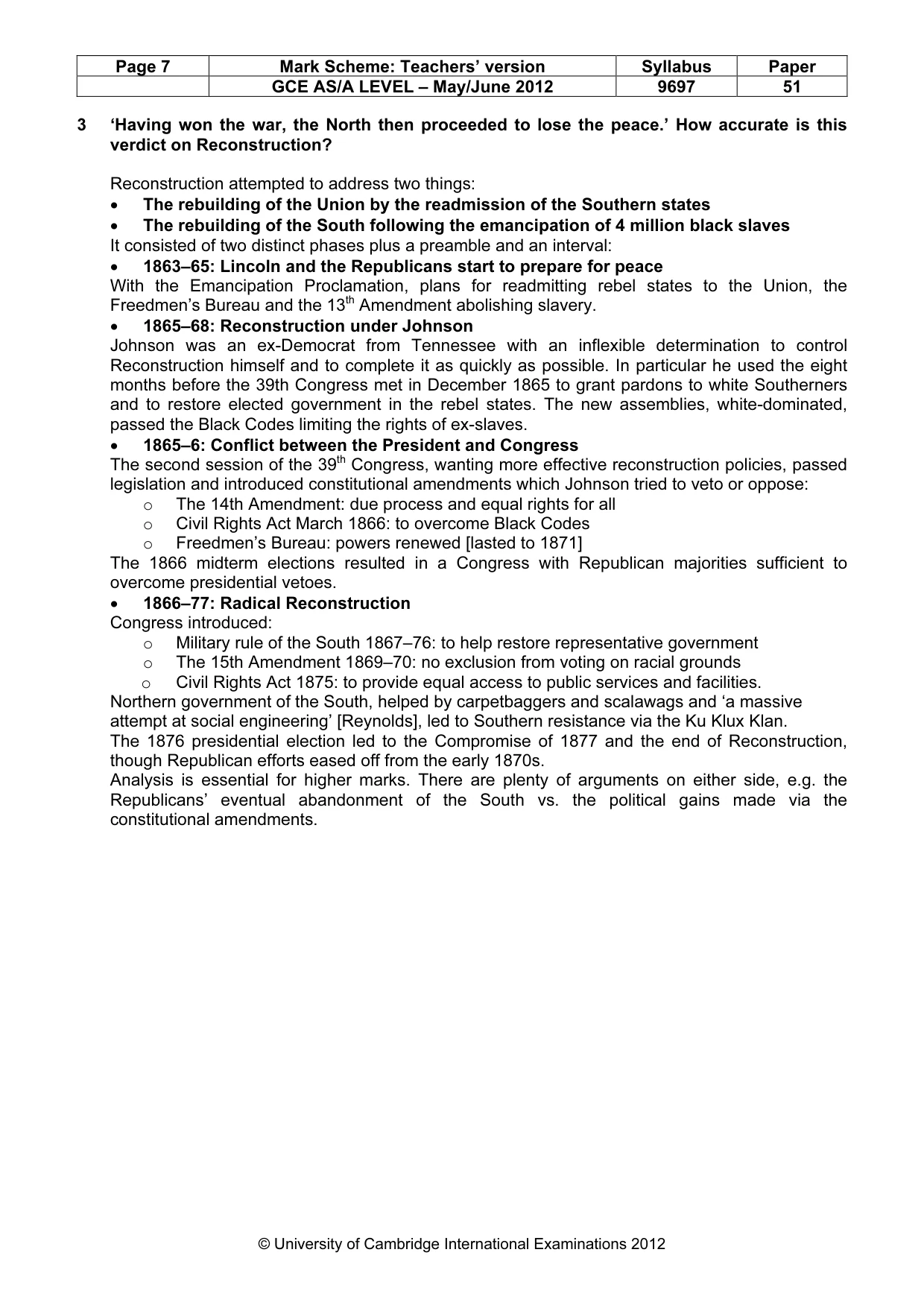
Page 7 Mark Scheme: Teachers’ version Syllabus Paper GCE AS/A LEVEL – May/June 2012 9697 51 © University of Cambridge International Examinations 2012 3 ‘Having won the war, the North then proceeded to lose the peace.’ How accurate is this verdict on Reconstruction? Reconstruction attempted to address two things: • The rebuilding of the Union by the readmission of the Southern states • The rebuilding of the South following the emancipation of 4 million black slaves It consisted of two distinct phases plus a preamble and an interval: • 1863–65: Lincoln and the Republicans start to prepare for peace With the Emancipation Proclamation, plans for readmitting rebel states to the Union, the Freedmen’s Bureau and the 13th Amendment abolishing slavery. • 1865–68: Reconstruction under Johnson Johnson was an ex-Democrat from Tennessee with an inflexible determination to control Reconstruction himself and to complete it as quickly as possible. In particular he used the eight months before the 39th Congress met in December 1865 to grant pardons to white Southerners and to restore elected government in the rebel states. The new assemblies, white-dominated, passed the Black Codes limiting the rights of ex-slaves. • 1865–6: Conflict between the President and Congress The second session of the 39th Congress, wanting more effective reconstruction policies, passed legislation and introduced constitutional amendments which Johnson tried to veto or oppose: o The 14th Amendment: due process and equal rights for all o Civil Rights Act March 1866: to overcome Black Codes o Freedmen’s Bureau: powers renewed [lasted to 1871] The 1866 midterm elections resulted in a Congress with Republican majorities sufficient to overcome presidential vetoes. • 1866–77: Radical Reconstruction Congress introduced: o Military rule of the South 1867–76: to help restore representative government o The 15th Amendment 1869–70: no exclusion from voting on racial grounds o Civil Rights Act 1875: to provide equal access to public services and facilities. Northern government of the South, helped by carpetbaggers and scalawags and ‘a massive attempt at social engineering’ [Reynolds], led to Southern resistance via the Ku Klux Klan. The 1876 presidential election led to the Compromise of 1877 and the end of Reconstruction, though Republican efforts eased off from the early 1870s. Analysis is essential for higher marks. There are plenty of arguments on either side, e.g. the Republicans’ eventual abandonment of the South vs. the political gains made via the constitutional amendments.
Mark scheme, page 8
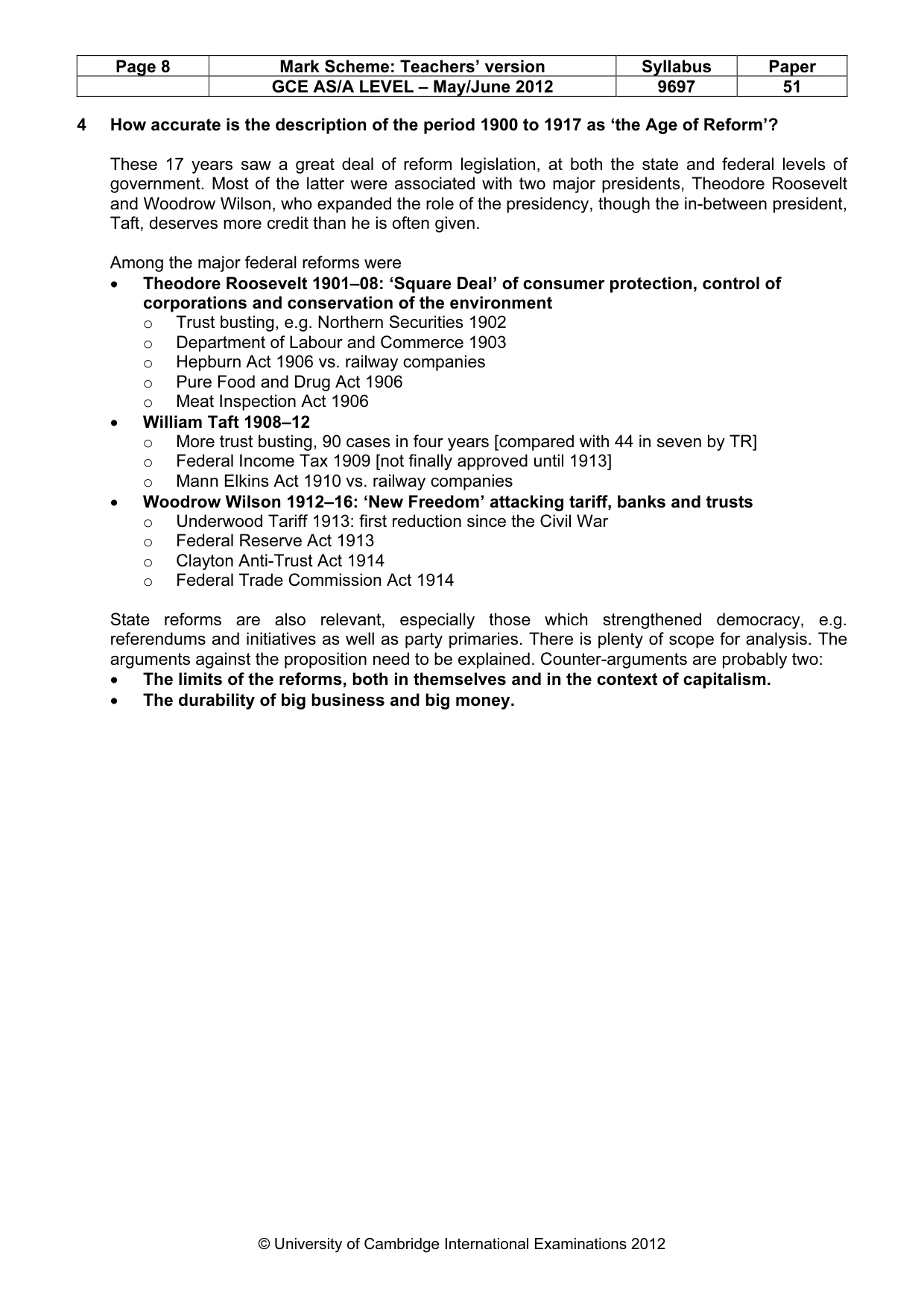
Page 8 Mark Scheme: Teachers’ version Syllabus Paper GCE AS/A LEVEL – May/June 2012 9697 51 © University of Cambridge International Examinations 2012 4 How accurate is the description of the period 1900 to 1917 as ‘the Age of Reform’? These 17 years saw a great deal of reform legislation, at both the state and federal levels of government. Most of the latter were associated with two major presidents, Theodore Roosevelt and Woodrow Wilson, who expanded the role of the presidency, though the in-between president, Taft, deserves more credit than he is often given. Among the major federal reforms were • Theodore Roosevelt 1901–08: ‘Square Deal’ of consumer protection, control of corporations and conservation of the environment o Trust busting, e.g. Northern Securities 1902 o Department of Labour and Commerce 1903 o Hepburn Act 1906 vs. railway companies o Pure Food and Drug Act 1906 o Meat Inspection Act 1906 • William Taft 1908–12 o More trust busting, 90 cases in four years [compared with 44 in seven by TR] o Federal Income Tax 1909 [not finally approved until 1913] o Mann Elkins Act 1910 vs. railway companies • Woodrow Wilson 1912–16: ‘New Freedom’ attacking tariff, banks and trusts o Underwood Tariff 1913: first reduction since the Civil War o Federal Reserve Act 1913 o Clayton Anti-Trust Act 1914 o Federal Trade Commission Act 1914 State reforms are also relevant, especially those which strengthened democracy, e.g. referendums and initiatives as well as party primaries. There is plenty of scope for analysis. The arguments against the proposition need to be explained. Counter-arguments are probably two: • The limits of the reforms, both in themselves and in the context of capitalism. • The durability of big business and big money.
Mark scheme, page 9
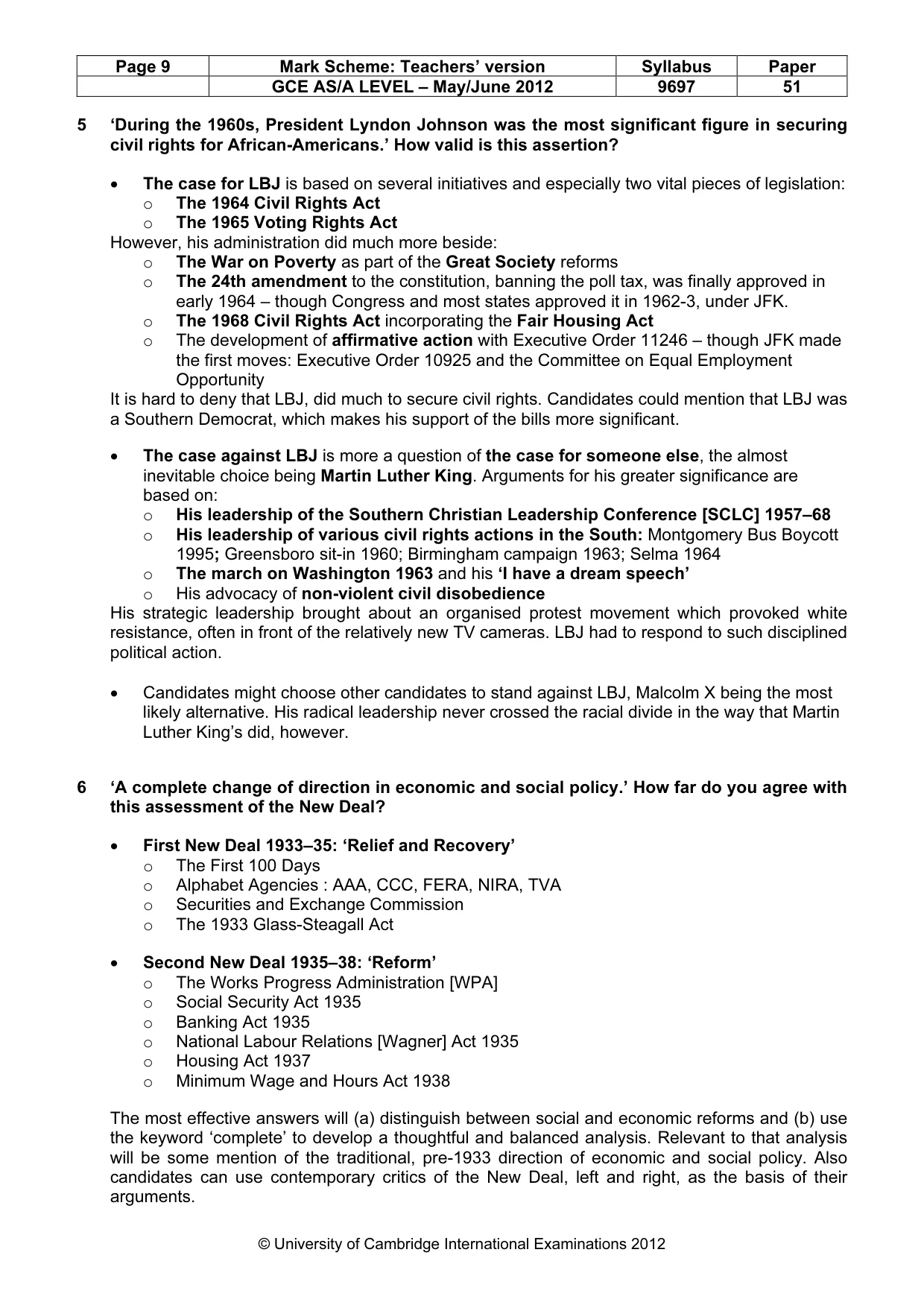
Page 9 Mark Scheme: Teachers’ version Syllabus Paper GCE AS/A LEVEL – May/June 2012 9697 51 © University of Cambridge International Examinations 2012 5 ‘During the 1960s, President Lyndon Johnson was the most significant figure in securing civil rights for African-Americans.’ How valid is this assertion? • The case for LBJ is based on several initiatives and especially two vital pieces of legislation: o The 1964 Civil Rights Act o The 1965 Voting Rights Act However, his administration did much more beside: o The War on Poverty as part of the Great Society reforms o The 24th amendment to the constitution, banning the poll tax, was finally approved in early 1964 – though Congress and most states approved it in 1962-3, under JFK. o The 1968 Civil Rights Act incorporating the Fair Housing Act o The development of affirmative action with Executive Order 11246 – though JFK made the first moves: Executive Order 10925 and the Committee on Equal Employment Opportunity It is hard to deny that LBJ, did much to secure civil rights. Candidates could mention that LBJ was a Southern Democrat, which makes his support of the bills more significant. • The case against LBJ is more a question of the case for someone else, the almost inevitable choice being Martin Luther King. Arguments for his greater significance are based on: o His leadership of the Southern Christian Leadership Conference [SCLC] 1957–68 o His leadership of various civil rights actions in the South: Montgomery Bus Boycott 1995; Greensboro sit-in 1960; Birmingham campaign 1963; Selma 1964 o The march on Washington 1963 and his ‘I have a dream speech’ o His advocacy of non-violent civil disobedience His strategic leadership brought about an organised protest movement which provoked white resistance, often in front of the relatively new TV cameras. LBJ had to respond to such disciplined political action. • Candidates might choose other candidates to stand against LBJ, Malcolm X being the most likely alternative. His radical leadership never crossed the racial divide in the way that Martin Luther King’s did, however. 6 ‘A complete change of direction in economic and social policy.’ How far do you agree with this assessment of the New Deal? • First New Deal 1933–35: ‘Relief and Recovery’ o The First 100 Days o Alphabet Agencies : AAA, CCC, FERA, NIRA, TVA o Securities and Exchange Commission o The 1933 Glass-Steagall Act • Second New Deal 1935–38: ‘Reform’ o The Works Progress Administration [WPA] o Social Security Act 1935 o Banking Act 1935 o National Labour Relations [Wagner] Act 1935 o Housing Act 1937 o Minimum Wage and Hours Act 1938 The most effective answers will (a) distinguish between social and economic reforms and (b) use the keyword ‘complete’ to develop a thoughtful and balanced analysis. Relevant to that analysis will be some mention of the traditional, pre-1933 direction of economic and social policy. Also candidates can use contemporary critics of the New Deal, left and right, as the basis of their arguments.
Mark scheme, page 10
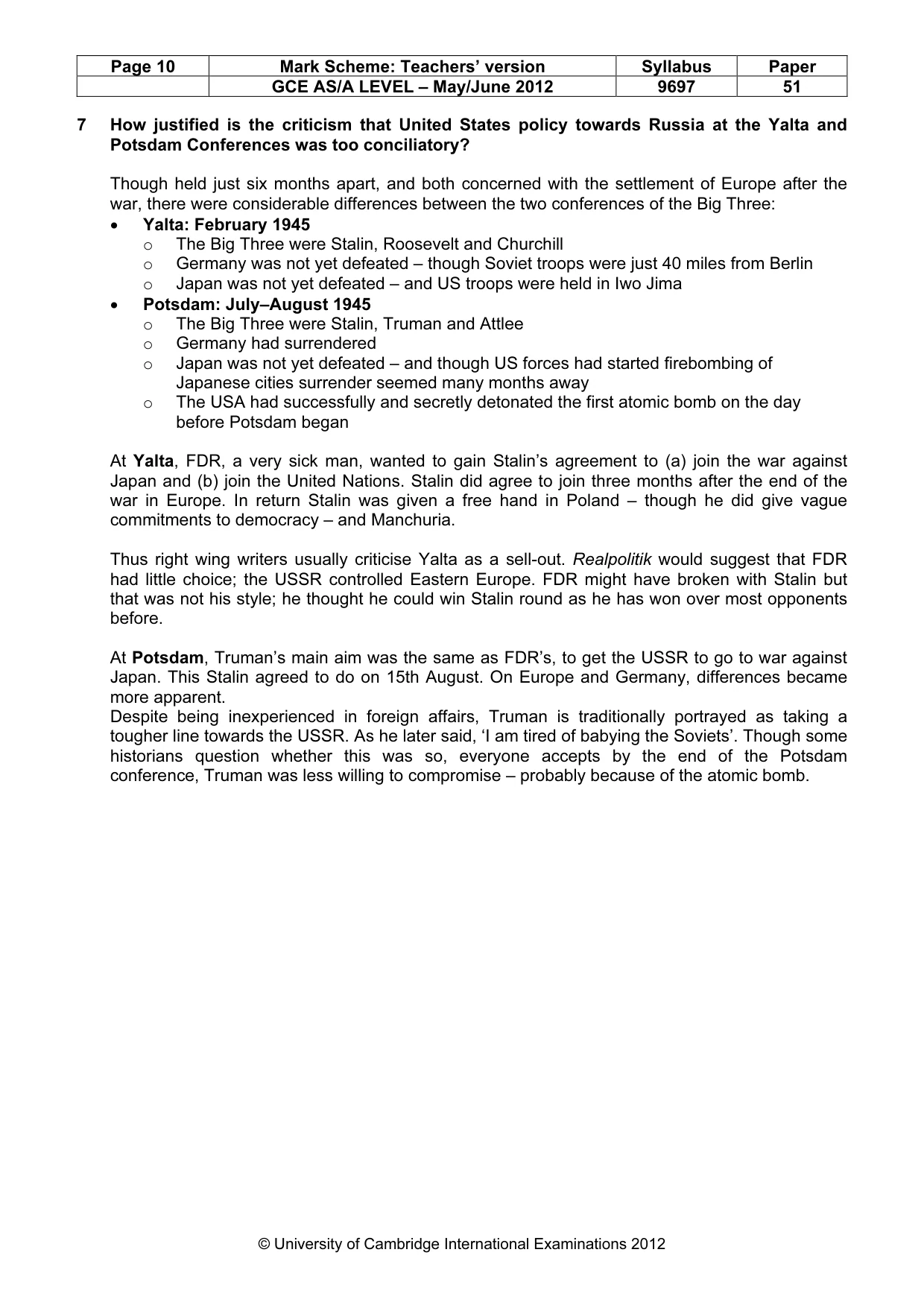
Page 10 Mark Scheme: Teachers’ version Syllabus Paper GCE AS/A LEVEL – May/June 2012 9697 51 © University of Cambridge International Examinations 2012 7 How justified is the criticism that United States policy towards Russia at the Yalta and Potsdam Conferences was too conciliatory? Though held just six months apart, and both concerned with the settlement of Europe after the war, there were considerable differences between the two conferences of the Big Three: • Yalta: February 1945 o The Big Three were Stalin, Roosevelt and Churchill o Germany was not yet defeated – though Soviet troops were just 40 miles from Berlin o Japan was not yet defeated – and US troops were held in Iwo Jima • Potsdam: July–August 1945 o The Big Three were Stalin, Truman and Attlee o Germany had surrendered o Japan was not yet defeated – and though US forces had started firebombing of Japanese cities surrender seemed many months away o The USA had successfully and secretly detonated the first atomic bomb on the day before Potsdam began At Yalta, FDR, a very sick man, wanted to gain Stalin’s agreement to (a) join the war against Japan and (b) join the United Nations. Stalin did agree to join three months after the end of the war in Europe. In return Stalin was given a free hand in Poland – though he did give vague commitments to democracy – and Manchuria. Thus right wing writers usually criticise Yalta as a sell-out. Realpolitik would suggest that FDR had little choice; the USSR controlled Eastern Europe. FDR might have broken with Stalin but that was not his style; he thought he could win Stalin round as he has won over most opponents before. At Potsdam, Truman’s main aim was the same as FDR’s, to get the USSR to go to war against Japan. This Stalin agreed to do on 15th August. On Europe and Germany, differences became more apparent. Despite being inexperienced in foreign affairs, Truman is traditionally portrayed as taking a tougher line towards the USSR. As he later said, ‘I am tired of babying the Soviets’. Though some historians question whether this was so, everyone accepts by the end of the Potsdam conference, Truman was less willing to compromise – probably because of the atomic bomb.
Mark scheme, page 11
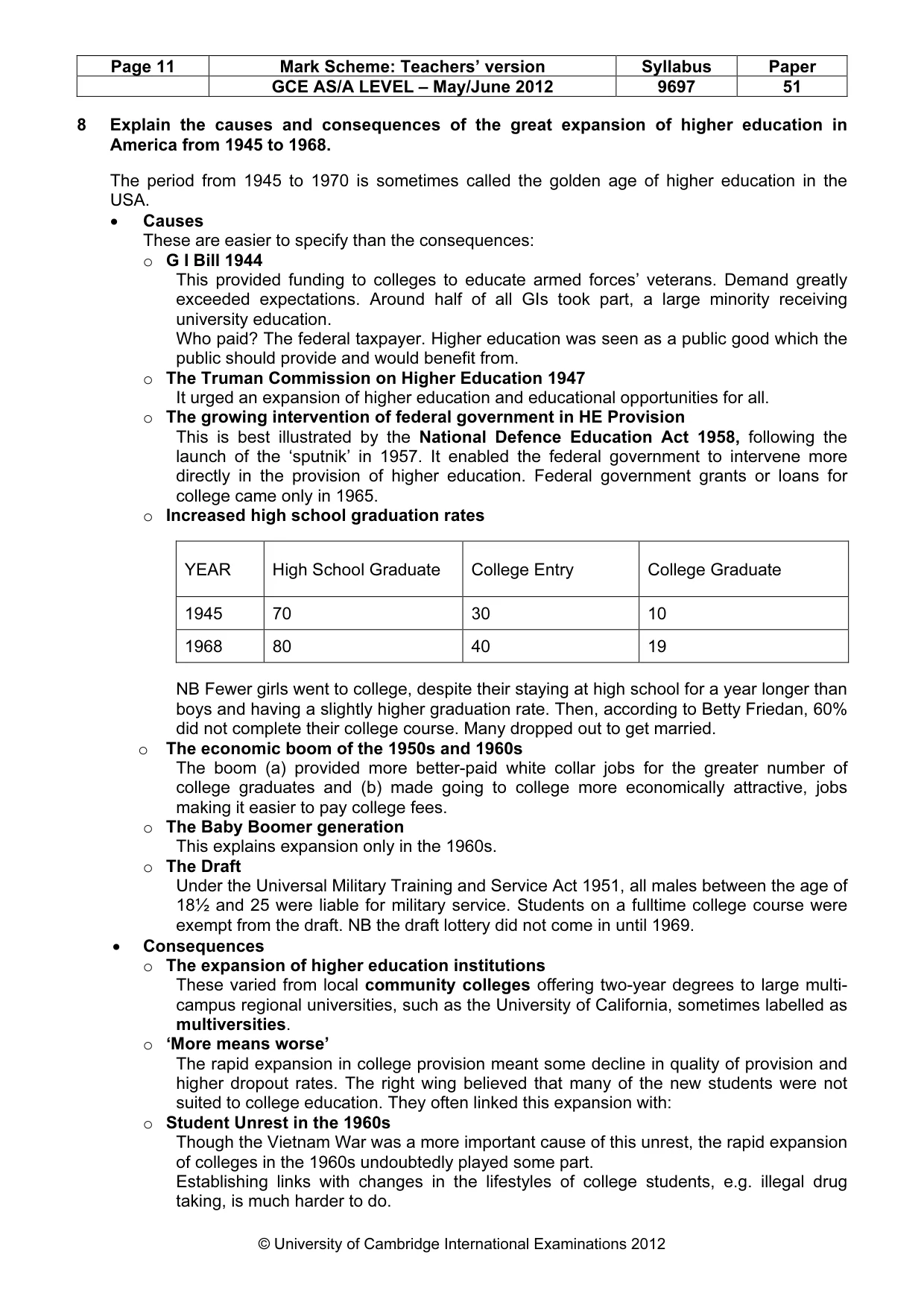
Page 11 Mark Scheme: Teachers’ version Syllabus Paper GCE AS/A LEVEL – May/June 2012 9697 51 © University of Cambridge International Examinations 2012 8 Explain the causes and consequences of the great expansion of higher education in America from 1945 to 1968. The period from 1945 to 1970 is sometimes called the golden age of higher education in the USA. • Causes These are easier to specify than the consequences: o G I Bill 1944 This provided funding to colleges to educate armed forces’ veterans. Demand greatly exceeded expectations. Around half of all GIs took part, a large minority receiving university education. Who paid? The federal taxpayer. Higher education was seen as a public good which the public should provide and would benefit from. o The Truman Commission on Higher Education 1947 It urged an expansion of higher education and educational opportunities for all. o The growing intervention of federal government in HE Provision This is best illustrated by the National Defence Education Act 1958, following the launch of the ‘sputnik’ in 1957. It enabled the federal government to intervene more directly in the provision of higher education. Federal government grants or loans for college came only in 1965. o Increased high school graduation rates YEAR High School Graduate College Entry College Graduate 1945 70 30 10 1968 80 40 19 NB Fewer girls went to college, despite their staying at high school for a year longer than boys and having a slightly higher graduation rate. Then, according to Betty Friedan, 60% did not complete their college course. Many dropped out to get married. o The economic boom of the 1950s and 1960s The boom (a) provided more better-paid white collar jobs for the greater number of college graduates and (b) made going to college more economically attractive, jobs making it easier to pay college fees. o The Baby Boomer generation This explains expansion only in the 1960s. o The Draft Under the Universal Military Training and Service Act 1951, all males between the age of 18½ and 25 were liable for military service. Students on a fulltime college course were exempt from the draft. NB the draft lottery did not come in until 1969. • Consequences o The expansion of higher education institutions These varied from local community colleges offering two-year degrees to large multi- campus regional universities, such as the University of California, sometimes labelled as multiversities. o ‘More means worse’ The rapid expansion in college provision meant some decline in quality of provision and higher dropout rates. The right wing believed that many of the new students were not suited to college education. They often linked this expansion with: o Student Unrest in the 1960s Though the Vietnam War was a more important cause of this unrest, the rapid expansion of colleges in the 1960s undoubtedly played some part. Establishing links with changes in the lifestyles of college students, e.g. illegal drug taking, is much harder to do.
What you needed in this session
Cambridge’s own grade thresholds for 2012 May/June, Paper 5 · Variant 1. A higher threshold means an easier paper — the bar moves with how the cohort did.