Cambridge A Level History (pre-2015) 9697 — 2011 May/June Paper 5 · Variant 1
9697/51/M/J/11 · 100 marks · ≈113 min
The question paper and its mark scheme, free to read here and free to download. This is Cambridge’s own paper, exactly as it was sat.
Question paper4 pages
Mark scheme12 pages
Answers below. Sit the paper first if you are practising.
Paper as text
Question paper, page 1
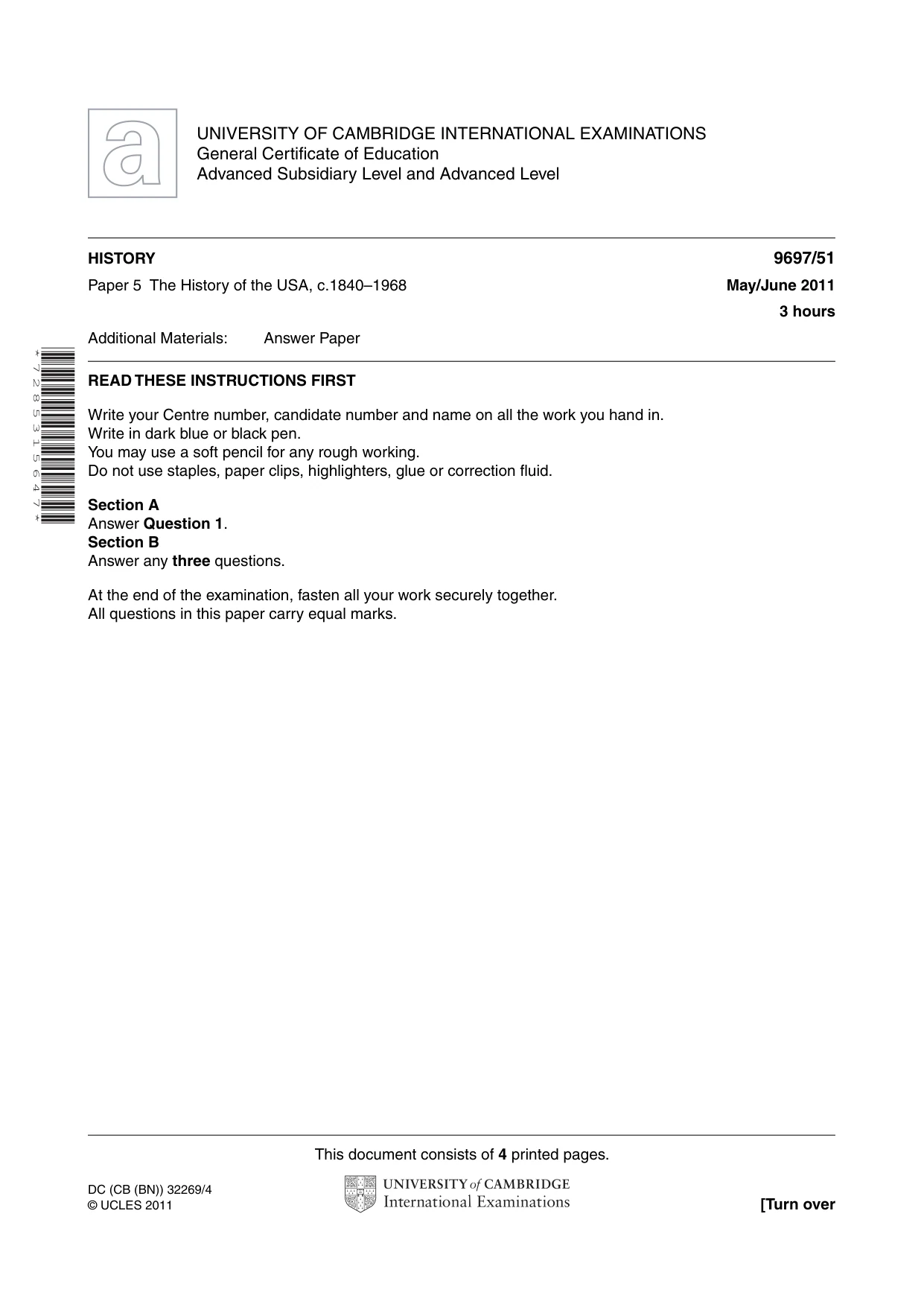
This document consists of 4 printed pages. DC (CB (BN)) 32269/4 © UCLES 2011 [Turn over UNIVERSITY OF CAMBRIDGE INTERNATIONAL EXAMINATIONS General Certificate of Education Advanced Subsidiary Level and Advanced Level * 7 2 8 5 3 1 5 6 4 7 * HISTORY 9697/51 Paper 5 The History of the USA, c.1840–1968 May/June 2011 3 hours Additional Materials: Answer Paper READ THESE INSTRUCTIONS FIRST Write your Centre number, candidate number and name on all the work you hand in. Write in dark blue or black pen. You may use a soft pencil for any rough working. Do not use staples, paper clips, highlighters, glue or correction fluid. Section A Answer Question 1. Section B Answer any three questions. At the end of the examination, fasten all your work securely together. All questions in this paper carry equal marks.
Question paper, page 2
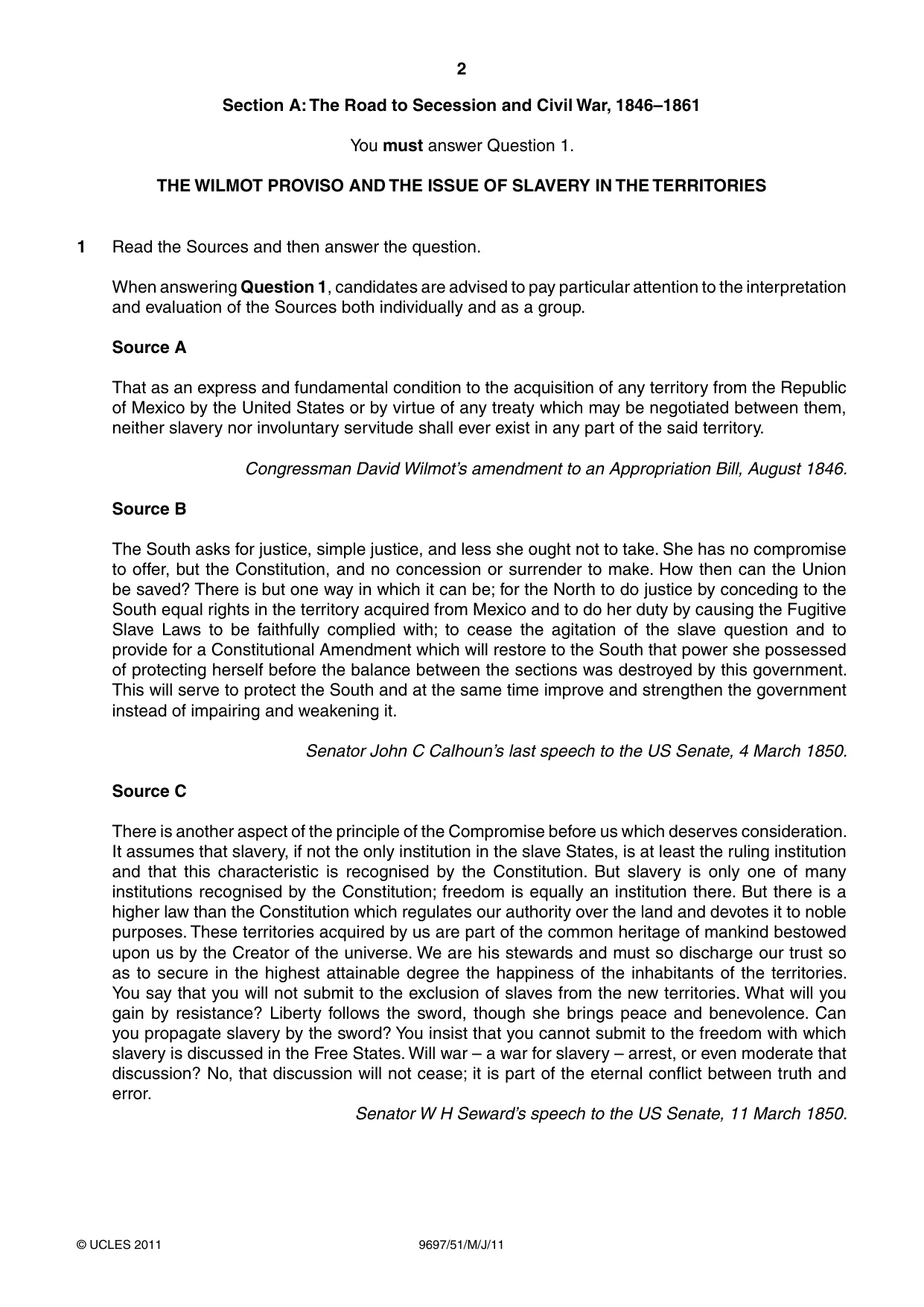
2 9697/51/M/J/11 © UCLES 2011 Section A: The Road to Secession and Civil War, 1846–1861 You must answer Question 1. THE WILMOT PROVISO AND THE ISSUE OF SLAVERY IN THE TERRITORIES 1 Read the Sources and then answer the question. When answering Question 1, candidates are advised to pay particular attention to the interpretation and evaluation of the Sources both individually and as a group. Source A That as an express and fundamental condition to the acquisition of any territory from the Republic of Mexico by the United States or by virtue of any treaty which may be negotiated between them, neither slavery nor involuntary servitude shall ever exist in any part of the said territory. Congressman David Wilmot’s amendment to an Appropriation Bill, August 1846. Source B The South asks for justice, simple justice, and less she ought not to take. She has no compromise to offer, but the Constitution, and no concession or surrender to make. How then can the Union be saved? There is but one way in which it can be; for the North to do justice by conceding to the South equal rights in the territory acquired from Mexico and to do her duty by causing the Fugitive Slave Laws to be faithfully complied with; to cease the agitation of the slave question and to provide for a Constitutional Amendment which will restore to the South that power she possessed of protecting herself before the balance between the sections was destroyed by this government. This will serve to protect the South and at the same time improve and strengthen the government instead of impairing and weakening it. Senator John C Calhoun’s last speech to the US Senate, 4 March 1850. Source C There is another aspect of the principle of the Compromise before us which deserves consideration. It assumes that slavery, if not the only institution in the slave States, is at least the ruling institution and that this characteristic is recognised by the Constitution. But slavery is only one of many institutions recognised by the Constitution; freedom is equally an institution there. But there is a higher law than the Constitution which regulates our authority over the land and devotes it to noble purposes. These territories acquired by us are part of the common heritage of mankind bestowed upon us by the Creator of the universe. We are his stewards and must so discharge our trust so as to secure in the highest attainable degree the happiness of the inhabitants of the territories. You say that you will not submit to the exclusion of slaves from the new territories. What will you gain by resistance? Liberty follows the sword, though she brings peace and benevolence. Can you propagate slavery by the sword? You insist that you cannot submit to the freedom with which slavery is discussed in the Free States. Will war – a war for slavery – arrest, or even moderate that discussion? No, that discussion will not cease; it is part of the eternal conflict between truth and error. Senator W H Seward’s speech to the US Senate, 11 March 1850.
Question paper, page 3
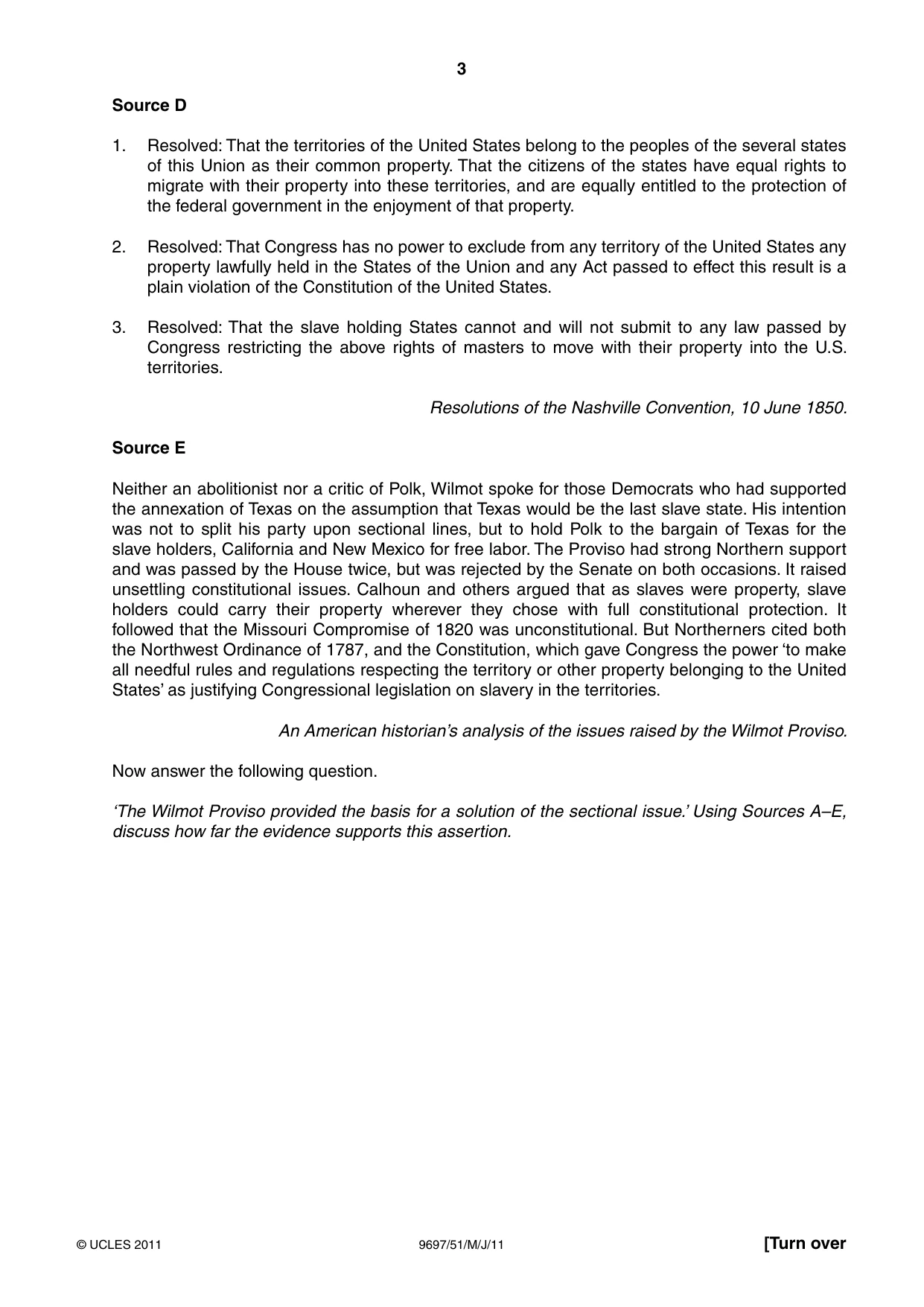
3 9697/51/M/J/11 © UCLES 2011 [Turn over Source D 1. Resolved: That the territories of the United States belong to the peoples of the several states of this Union as their common property. That the citizens of the states have equal rights to migrate with their property into these territories, and are equally entitled to the protection of the federal government in the enjoyment of that property. 2. Resolved: That Congress has no power to exclude from any territory of the United States any property lawfully held in the States of the Union and any Act passed to effect this result is a plain violation of the Constitution of the United States. 3. Resolved: That the slave holding States cannot and will not submit to any law passed by Congress restricting the above rights of masters to move with their property into the U.S. territories. Resolutions of the Nashville Convention, 10 June 1850. Source E Neither an abolitionist nor a critic of Polk, Wilmot spoke for those Democrats who had supported the annexation of Texas on the assumption that Texas would be the last slave state. His intention was not to split his party upon sectional lines, but to hold Polk to the bargain of Texas for the slave holders, California and New Mexico for free labor. The Proviso had strong Northern support and was passed by the House twice, but was rejected by the Senate on both occasions. It raised unsettling constitutional issues. Calhoun and others argued that as slaves were property, slave holders could carry their property wherever they chose with full constitutional protection. It followed that the Missouri Compromise of 1820 was unconstitutional. But Northerners cited both the Northwest Ordinance of 1787, and the Constitution, which gave Congress the power ‘to make all needful rules and regulations respecting the territory or other property belonging to the United States’ as justifying Congressional legislation on slavery in the territories. An American historian’s analysis of the issues raised by the Wilmot Proviso. Now answer the following question. ‘The Wilmot Proviso provided the basis for a solution of the sectional issue.’ Using Sources A–E, discuss how far the evidence supports this assertion.
Question paper, page 4
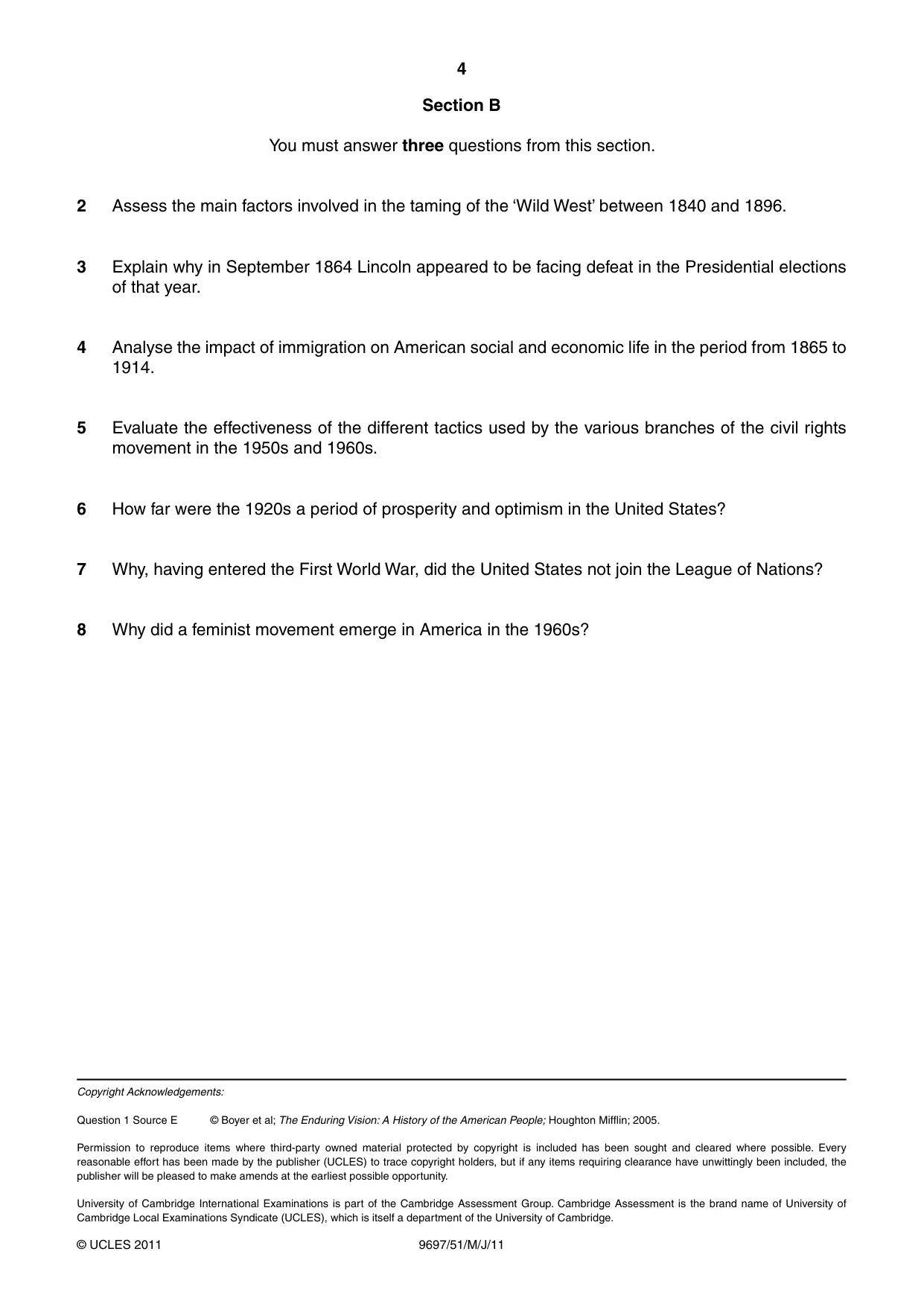
4 9697/51/M/J/11 © UCLES 2011 Copyright Acknowledgements: Question 1 Source E © Boyer et al; The Enduring Vision: A History of the American People; Houghton Mifflin; 2005. Permission to reproduce items where third-party owned material protected by copyright is included has been sought and cleared where possible. Every reasonable effort has been made by the publisher (UCLES) to trace copyright holders, but if any items requiring clearance have unwittingly been included, the publisher will be pleased to make amends at the earliest possible opportunity. University of Cambridge International Examinations is part of the Cambridge Assessment Group. Cambridge Assessment is the brand name of University of Cambridge Local Examinations Syndicate (UCLES), which is itself a department of the University of Cambridge. Section B You must answer three questions from this section. 2 Assess the main factors involved in the taming of the ‘Wild West’ between 1840 and 1896. 3 Explain why in September 1864 Lincoln appeared to be facing defeat in the Presidential elections of that year. 4 Analyse the impact of immigration on American social and economic life in the period from 1865 to 1914. 5 Evaluate the effectiveness of the different tactics used by the various branches of the civil rights movement in the 1950s and 1960s. 6 How far were the 1920s a period of prosperity and optimism in the United States? 7 Why, having entered the First World War, did the United States not join the League of Nations? 8 Why did a feminist movement emerge in America in the 1960s?
Mark scheme, page 1
UNIVERSITY OF CAMBRIDGE INTERNATIONAL EXAMINATIONS GCE Advanced Subsidiary Level and GCE Advanced Level MARK SCHEME for the May/June 2011 question paper for the guidance of teachers 9697 HISTORY 9697/51 Paper 5, maximum raw mark 100 This mark scheme is published as an aid to teachers and candidates, to indicate the requirements of the examination. It shows the basis on which Examiners were instructed to award marks. It does not indicate the details of the discussions that took place at an Examiners’ meeting before marking began, which would have considered the acceptability of alternative answers. Mark schemes must be read in conjunction with the question papers and the report on the examination. • Cambridge will not enter into discussions or correspondence in connection with these mark schemes. Cambridge is publishing the mark schemes for the May/June 2011 question papers for most IGCSE, GCE Advanced Level and Advanced Subsidiary Level syllabuses and some Ordinary Level syllabuses.
Mark scheme, page 2
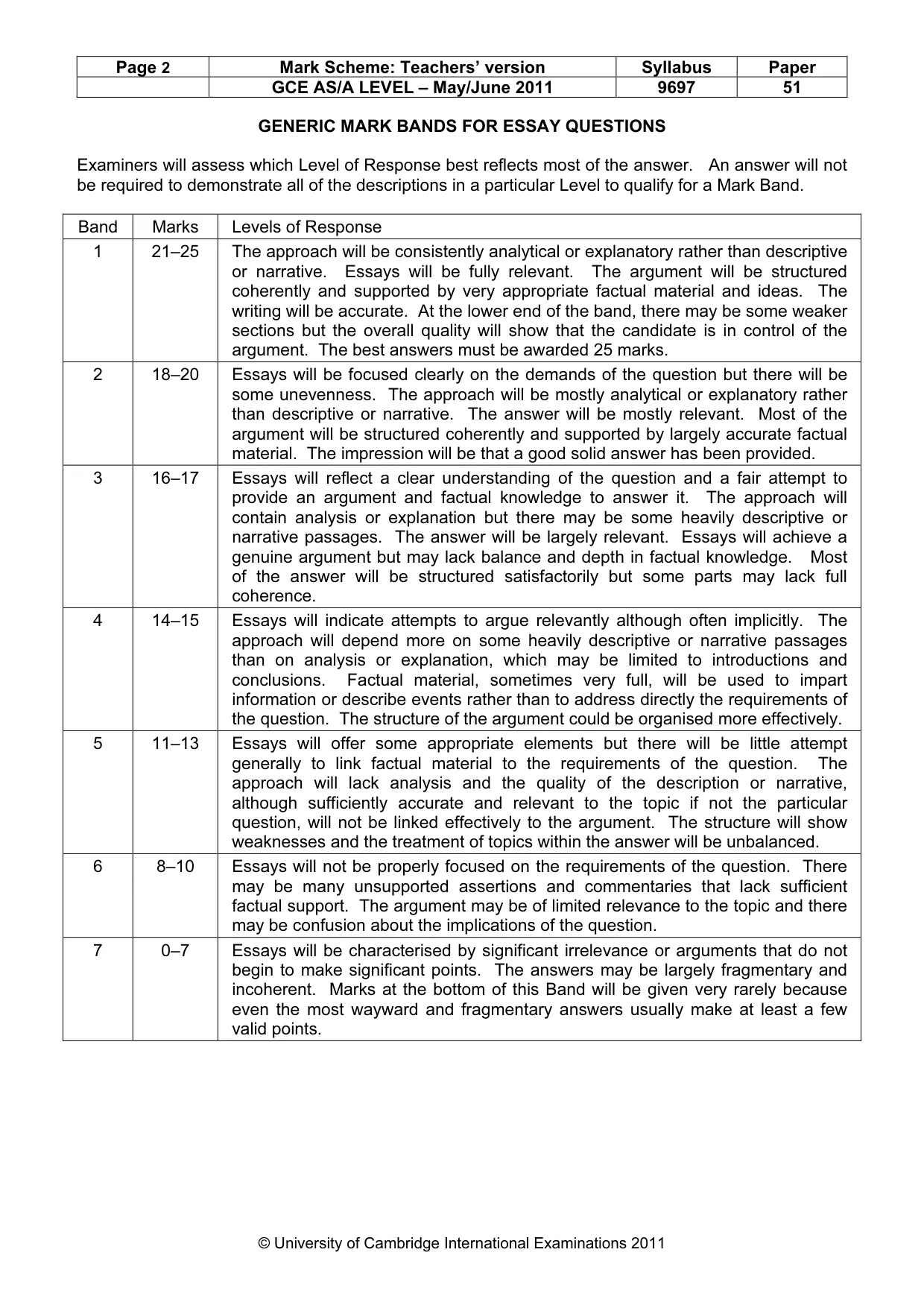
Page 2 Mark Scheme: Teachers’ version Syllabus Paper GCE AS/A LEVEL – May/June 2011 9697 51 © University of Cambridge International Examinations 2011 GENERIC MARK BANDS FOR ESSAY QUESTIONS Examiners will assess which Level of Response best reflects most of the answer. An answer will not be required to demonstrate all of the descriptions in a particular Level to qualify for a Mark Band. Band Marks Levels of Response 1 21–25 The approach will be consistently analytical or explanatory rather than descriptive or narrative. Essays will be fully relevant. The argument will be structured coherently and supported by very appropriate factual material and ideas. The writing will be accurate. At the lower end of the band, there may be some weaker sections but the overall quality will show that the candidate is in control of the argument. The best answers must be awarded 25 marks. 2 18–20 Essays will be focused clearly on the demands of the question but there will be some unevenness. The approach will be mostly analytical or explanatory rather than descriptive or narrative. The answer will be mostly relevant. Most of the argument will be structured coherently and supported by largely accurate factual material. The impression will be that a good solid answer has been provided. 3 16–17 Essays will reflect a clear understanding of the question and a fair attempt to provide an argument and factual knowledge to answer it. The approach will contain analysis or explanation but there may be some heavily descriptive or narrative passages. The answer will be largely relevant. Essays will achieve a genuine argument but may lack balance and depth in factual knowledge. Most of the answer will be structured satisfactorily but some parts may lack full coherence. 4 14–15 Essays will indicate attempts to argue relevantly although often implicitly. The approach will depend more on some heavily descriptive or narrative passages than on analysis or explanation, which may be limited to introductions and conclusions. Factual material, sometimes very full, will be used to impart information or describe events rather than to address directly the requirements of the question. The structure of the argument could be organised more effectively. 5 11–13 Essays will offer some appropriate elements but there will be little attempt generally to link factual material to the requirements of the question. The approach will lack analysis and the quality of the description or narrative, although sufficiently accurate and relevant to the topic if not the particular question, will not be linked effectively to the argument. The structure will show weaknesses and the treatment of topics within the answer will be unbalanced. 6 8–10 Essays will not be properly focused on the requirements of the question. There may be many unsupported assertions and commentaries that lack sufficient factual support. The argument may be of limited relevance to the topic and there may be confusion about the implications of the question. 7 0–7 Essays will be characterised by significant irrelevance or arguments that do not begin to make significant points. The answers may be largely fragmentary and incoherent. Marks at the bottom of this Band will be given very rarely because even the most wayward and fragmentary answers usually make at least a few valid points.
Mark scheme, page 3
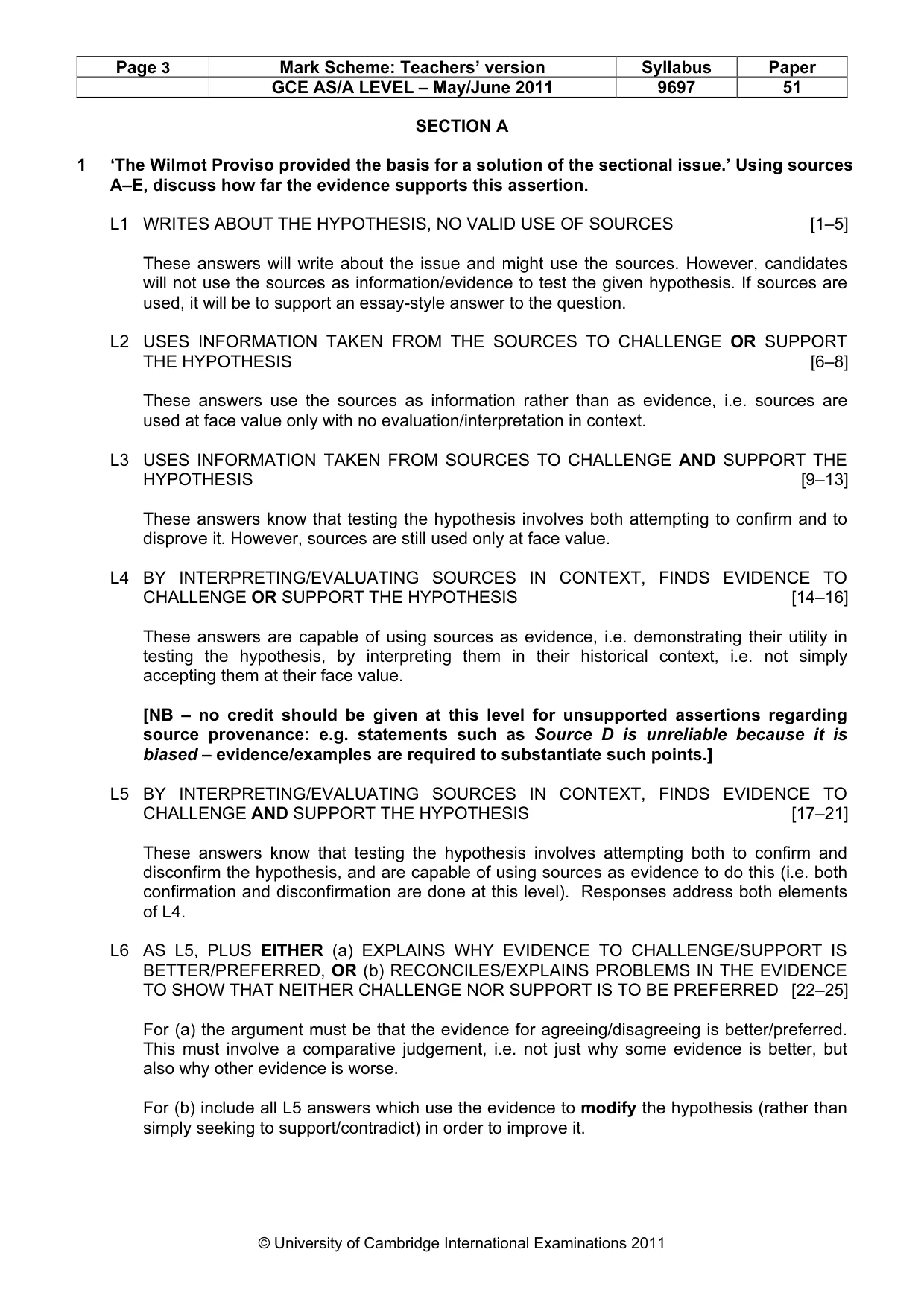
Page 3 Mark Scheme: Teachers’ version Syllabus Paper GCE AS/A LEVEL – May/June 2011 9697 51 © University of Cambridge International Examinations 2011 SECTION A 1 ‘The Wilmot Proviso provided the basis for a solution of the sectional issue.’ Using sources A–E, discuss how far the evidence supports this assertion. L1 WRITES ABOUT THE HYPOTHESIS, NO VALID USE OF SOURCES [1–5] These answers will write about the issue and might use the sources. However, candidates will not use the sources as information/evidence to test the given hypothesis. If sources are used, it will be to support an essay-style answer to the question. L2 USES INFORMATION TAKEN FROM THE SOURCES TO CHALLENGE OR SUPPORT THE HYPOTHESIS [6–8] These answers use the sources as information rather than as evidence, i.e. sources are used at face value only with no evaluation/interpretation in context. L3 USES INFORMATION TAKEN FROM SOURCES TO CHALLENGE AND SUPPORT THE HYPOTHESIS [9–13] These answers know that testing the hypothesis involves both attempting to confirm and to disprove it. However, sources are still used only at face value. L4 BY INTERPRETING/EVALUATING SOURCES IN CONTEXT, FINDS EVIDENCE TO CHALLENGE OR SUPPORT THE HYPOTHESIS [14–16] These answers are capable of using sources as evidence, i.e. demonstrating their utility in testing the hypothesis, by interpreting them in their historical context, i.e. not simply accepting them at their face value. [NB – no credit should be given at this level for unsupported assertions regarding source provenance: e.g. statements such as Source D is unreliable because it is biased – evidence/examples are required to substantiate such points.] L5 BY INTERPRETING/EVALUATING SOURCES IN CONTEXT, FINDS EVIDENCE TO CHALLENGE AND SUPPORT THE HYPOTHESIS [17–21] These answers know that testing the hypothesis involves attempting both to confirm and disconfirm the hypothesis, and are capable of using sources as evidence to do this (i.e. both confirmation and disconfirmation are done at this level). Responses address both elements of L4. L6 AS L5, PLUS EITHER (a) EXPLAINS WHY EVIDENCE TO CHALLENGE/SUPPORT IS BETTER/PREFERRED, OR (b) RECONCILES/EXPLAINS PROBLEMS IN THE EVIDENCE TO SHOW THAT NEITHER CHALLENGE NOR SUPPORT IS TO BE PREFERRED [22–25] For (a) the argument must be that the evidence for agreeing/disagreeing is better/preferred. This must involve a comparative judgement, i.e. not just why some evidence is better, but also why other evidence is worse. For (b) include all L5 answers which use the evidence to modify the hypothesis (rather than simply seeking to support/contradict) in order to improve it.
Mark scheme, page 4
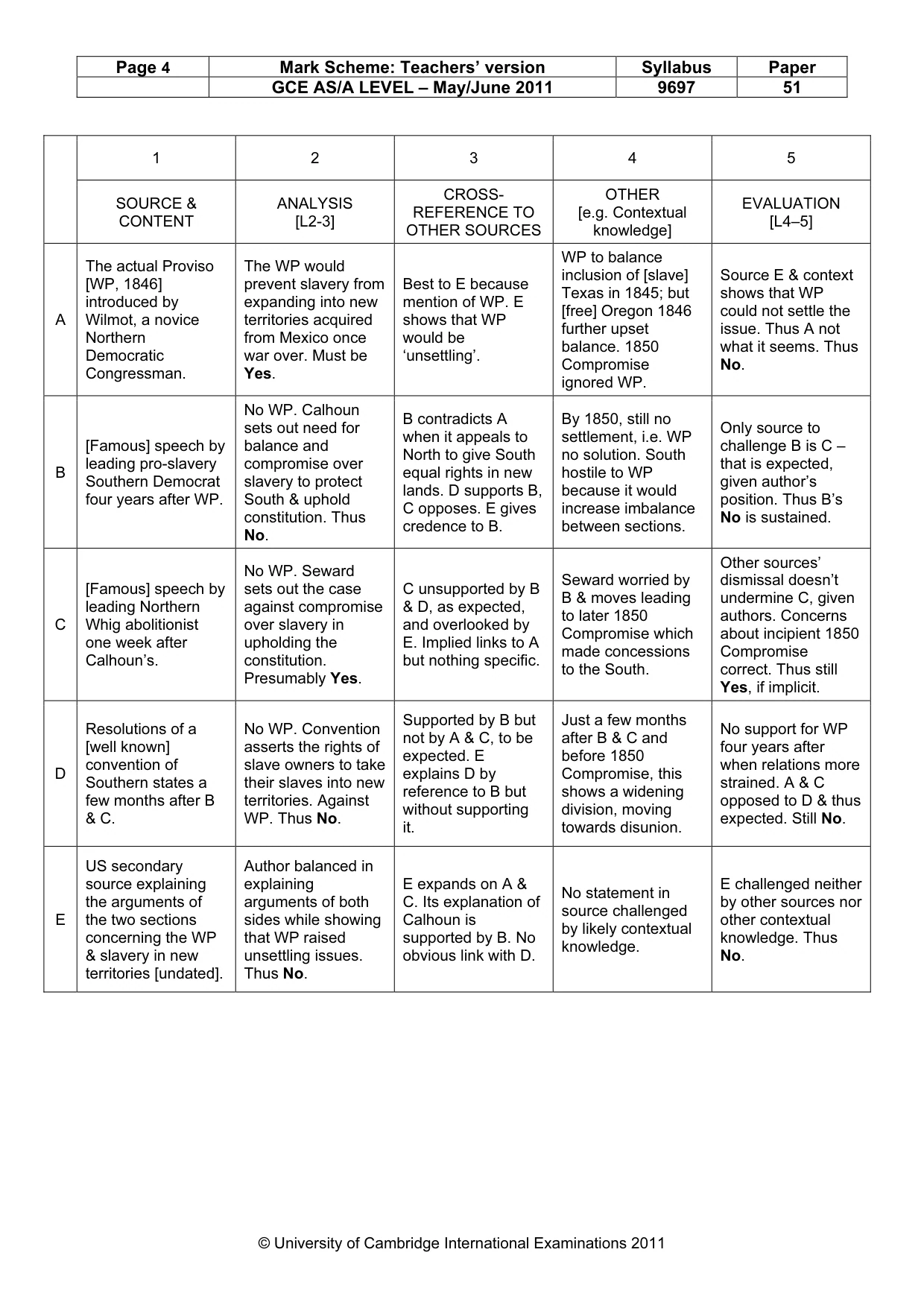
Page 4 Mark Scheme: Teachers’ version Syllabus Paper GCE AS/A LEVEL – May/June 2011 9697 51 © University of Cambridge International Examinations 2011 1 2 3 4 5 SOURCE & CONTENT ANALYSIS [L2-3] CROSS- REFERENCE TO OTHER SOURCES OTHER [e.g. Contextual knowledge] EVALUATION [L4–5] A The actual Proviso [WP, 1846] introduced by Wilmot, a novice Northern Democratic Congressman. The WP would prevent slavery from expanding into new territories acquired from Mexico once war over. Must be Yes. Best to E because mention of WP. E shows that WP would be ‘unsettling’. WP to balance inclusion of [slave] Texas in 1845; but [free] Oregon 1846 further upset balance. 1850 Compromise ignored WP. Source E & context shows that WP could not settle the issue. Thus A not what it seems. Thus No. B [Famous] speech by leading pro-slavery Southern Democrat four years after WP. No WP. Calhoun sets out need for balance and compromise over slavery to protect South & uphold constitution. Thus No. B contradicts A when it appeals to North to give South equal rights in new lands. D supports B, C opposes. E gives credence to B. By 1850, still no settlement, i.e. WP no solution. South hostile to WP because it would increase imbalance between sections. Only source to challenge B is C – that is expected, given author’s position. Thus B’s No is sustained. C [Famous] speech by leading Northern Whig abolitionist one week after Calhoun’s. No WP. Seward sets out the case against compromise over slavery in upholding the constitution. Presumably Yes. C unsupported by B & D, as expected, and overlooked by E. Implied links to A but nothing specific. Seward worried by B & moves leading to later 1850 Compromise which made concessions to the South. Other sources’ dismissal doesn’t undermine C, given authors. Concerns about incipient 1850 Compromise correct. Thus still Yes, if implicit. D Resolutions of a [well known] convention of Southern states a few months after B & C. No WP. Convention asserts the rights of slave owners to take their slaves into new territories. Against WP. Thus No. Supported by B but not by A & C, to be expected. E explains D by reference to B but without supporting it. Just a few months after B & C and before 1850 Compromise, this shows a widening division, moving towards disunion. No support for WP four years after when relations more strained. A & C opposed to D & thus expected. Still No. E US secondary source explaining the arguments of the two sections concerning the WP & slavery in new territories [undated]. Author balanced in explaining arguments of both sides while showing that WP raised unsettling issues. Thus No. E expands on A & C. Its explanation of Calhoun is supported by B. No obvious link with D. No statement in source challenged by likely contextual knowledge. E challenged neither by other sources nor other contextual knowledge. Thus No.
Mark scheme, page 5
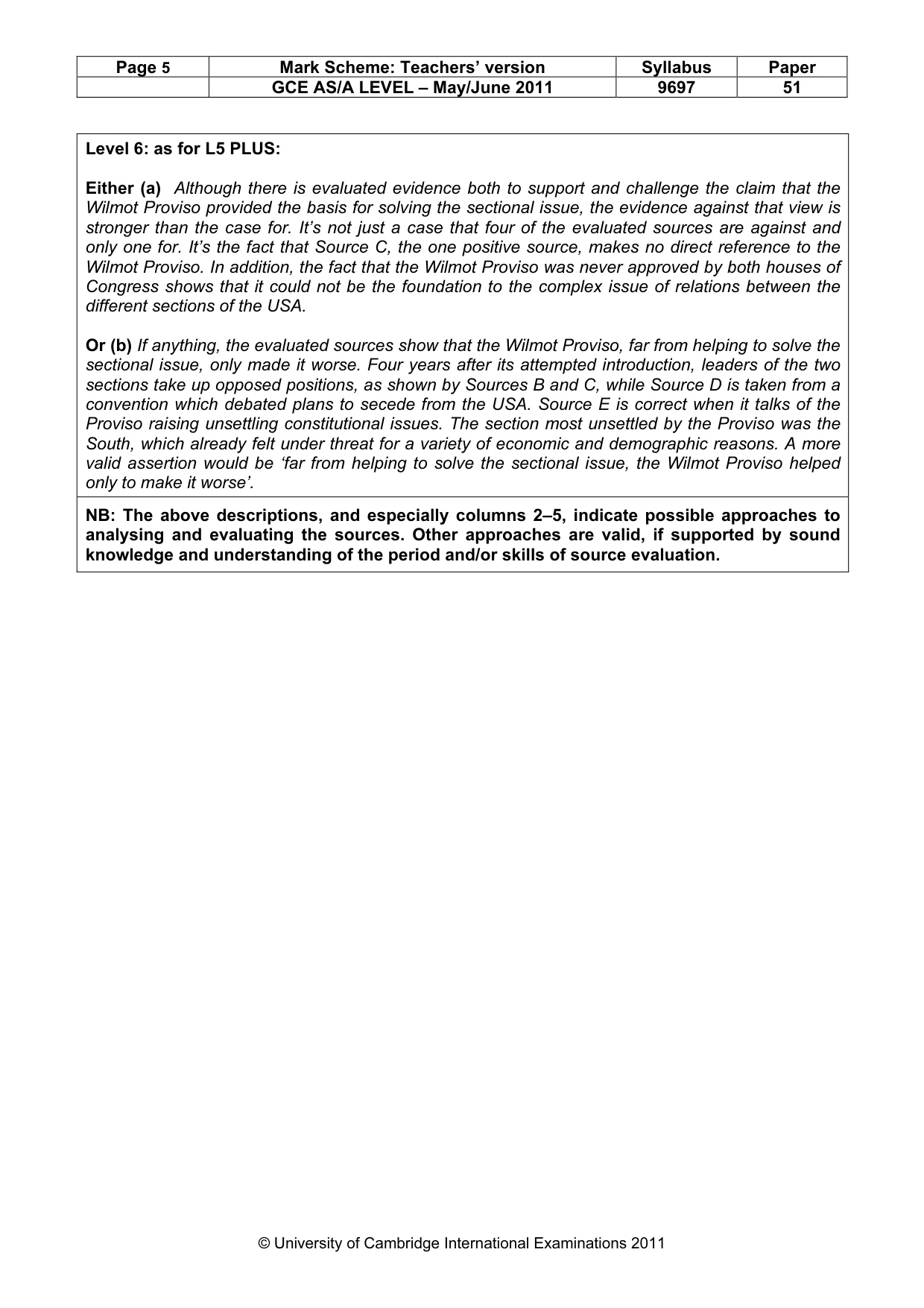
Page 5 Mark Scheme: Teachers’ version Syllabus Paper GCE AS/A LEVEL – May/June 2011 9697 51 © University of Cambridge International Examinations 2011 Level 6: as for L5 PLUS: Either (a) Although there is evaluated evidence both to support and challenge the claim that the Wilmot Proviso provided the basis for solving the sectional issue, the evidence against that view is stronger than the case for. It’s not just a case that four of the evaluated sources are against and only one for. It’s the fact that Source C, the one positive source, makes no direct reference to the Wilmot Proviso. In addition, the fact that the Wilmot Proviso was never approved by both houses of Congress shows that it could not be the foundation to the complex issue of relations between the different sections of the USA. Or (b) If anything, the evaluated sources show that the Wilmot Proviso, far from helping to solve the sectional issue, only made it worse. Four years after its attempted introduction, leaders of the two sections take up opposed positions, as shown by Sources B and C, while Source D is taken from a convention which debated plans to secede from the USA. Source E is correct when it talks of the Proviso raising unsettling constitutional issues. The section most unsettled by the Proviso was the South, which already felt under threat for a variety of economic and demographic reasons. A more valid assertion would be ‘far from helping to solve the sectional issue, the Wilmot Proviso helped only to make it worse’. NB: The above descriptions, and especially columns 2–5, indicate possible approaches to analysing and evaluating the sources. Other approaches are valid, if supported by sound knowledge and understanding of the period and/or skills of source evaluation.
Mark scheme, page 6
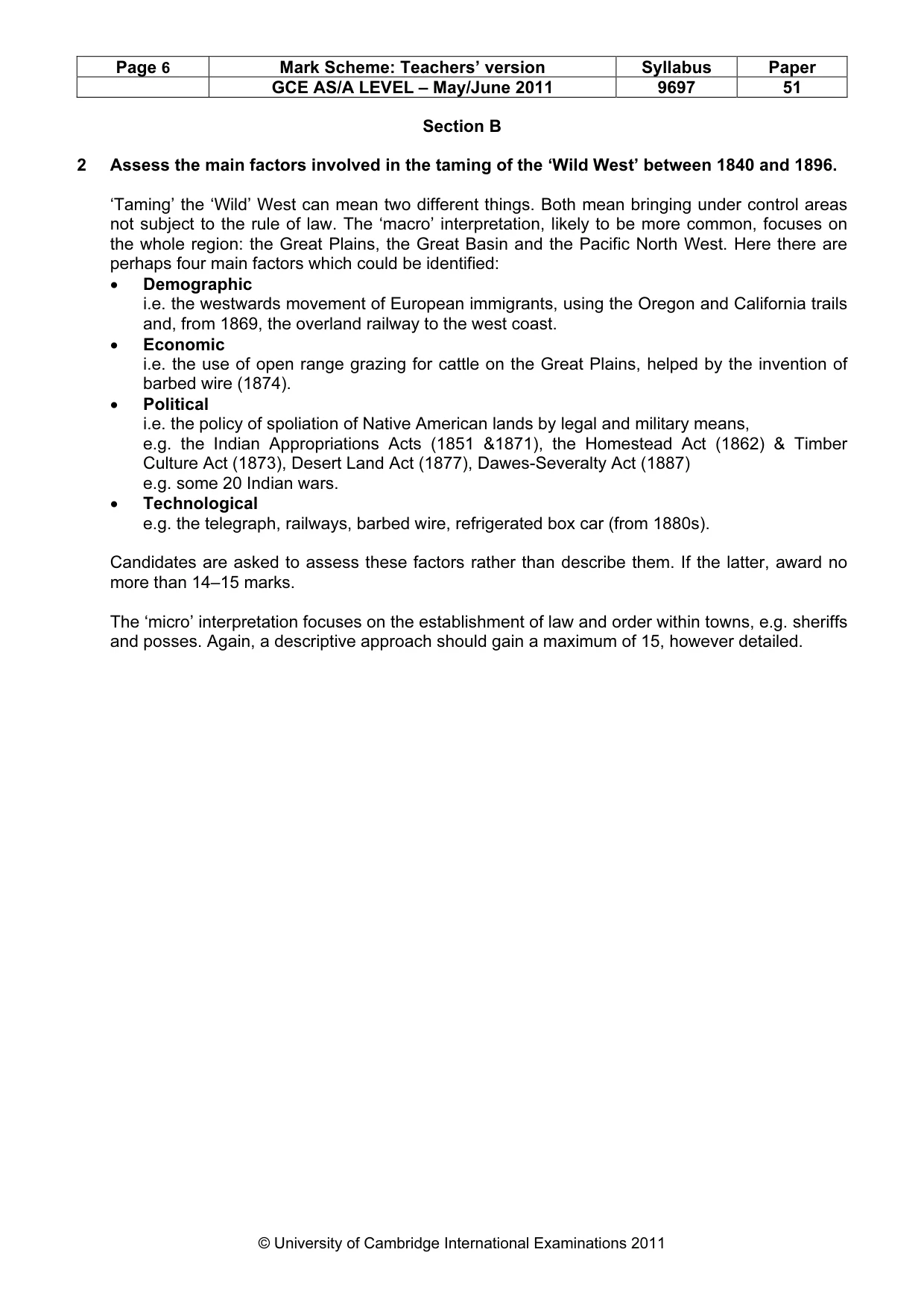
Page 6 Mark Scheme: Teachers’ version Syllabus Paper GCE AS/A LEVEL – May/June 2011 9697 51 © University of Cambridge International Examinations 2011 Section B 2 Assess the main factors involved in the taming of the ‘Wild West’ between 1840 and 1896. ‘Taming’ the ‘Wild’ West can mean two different things. Both mean bringing under control areas not subject to the rule of law. The ‘macro’ interpretation, likely to be more common, focuses on the whole region: the Great Plains, the Great Basin and the Pacific North West. Here there are perhaps four main factors which could be identified: • Demographic i.e. the westwards movement of European immigrants, using the Oregon and California trails and, from 1869, the overland railway to the west coast. • Economic i.e. the use of open range grazing for cattle on the Great Plains, helped by the invention of barbed wire (1874). • Political i.e. the policy of spoliation of Native American lands by legal and military means, e.g. the Indian Appropriations Acts (1851 &1871), the Homestead Act (1862) & Timber Culture Act (1873), Desert Land Act (1877), Dawes-Severalty Act (1887) e.g. some 20 Indian wars. • Technological e.g. the telegraph, railways, barbed wire, refrigerated box car (from 1880s). Candidates are asked to assess these factors rather than describe them. If the latter, award no more than 14–15 marks. The ‘micro’ interpretation focuses on the establishment of law and order within towns, e.g. sheriffs and posses. Again, a descriptive approach should gain a maximum of 15, however detailed.
Mark scheme, page 7
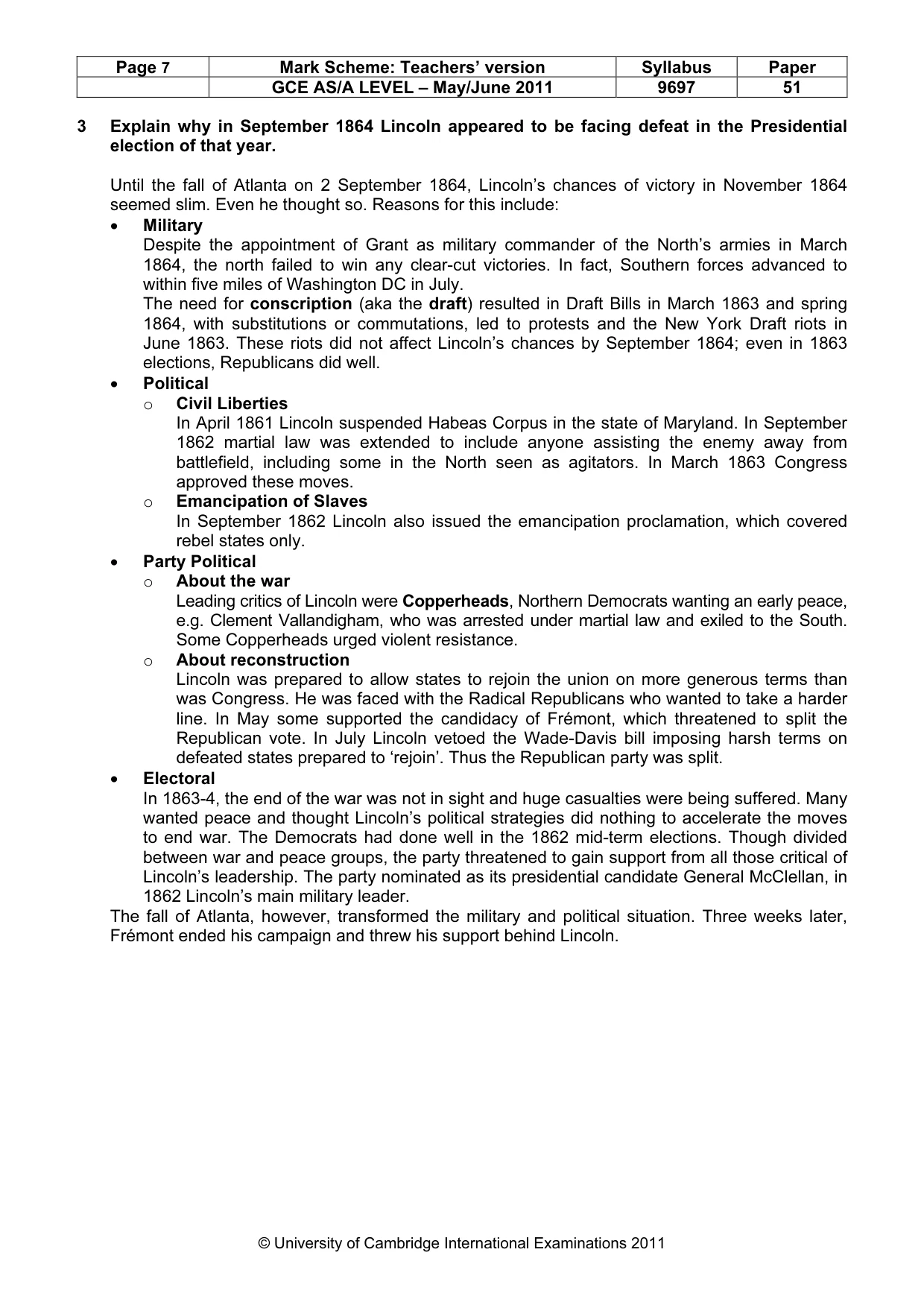
Page 7 Mark Scheme: Teachers’ version Syllabus Paper GCE AS/A LEVEL – May/June 2011 9697 51 © University of Cambridge International Examinations 2011 3 Explain why in September 1864 Lincoln appeared to be facing defeat in the Presidential election of that year. Until the fall of Atlanta on 2 September 1864, Lincoln’s chances of victory in November 1864 seemed slim. Even he thought so. Reasons for this include: • Military Despite the appointment of Grant as military commander of the North’s armies in March 1864, the north failed to win any clear-cut victories. In fact, Southern forces advanced to within five miles of Washington DC in July. The need for conscription (aka the draft) resulted in Draft Bills in March 1863 and spring 1864, with substitutions or commutations, led to protests and the New York Draft riots in June 1863. These riots did not affect Lincoln’s chances by September 1864; even in 1863 elections, Republicans did well. • Political o Civil Liberties In April 1861 Lincoln suspended Habeas Corpus in the state of Maryland. In September 1862 martial law was extended to include anyone assisting the enemy away from battlefield, including some in the North seen as agitators. In March 1863 Congress approved these moves. o Emancipation of Slaves In September 1862 Lincoln also issued the emancipation proclamation, which covered rebel states only. • Party Political o About the war Leading critics of Lincoln were Copperheads, Northern Democrats wanting an early peace, e.g. Clement Vallandigham, who was arrested under martial law and exiled to the South. Some Copperheads urged violent resistance. o About reconstruction Lincoln was prepared to allow states to rejoin the union on more generous terms than was Congress. He was faced with the Radical Republicans who wanted to take a harder line. In May some supported the candidacy of Frémont, which threatened to split the Republican vote. In July Lincoln vetoed the Wade-Davis bill imposing harsh terms on defeated states prepared to ‘rejoin’. Thus the Republican party was split. • Electoral In 1863-4, the end of the war was not in sight and huge casualties were being suffered. Many wanted peace and thought Lincoln’s political strategies did nothing to accelerate the moves to end war. The Democrats had done well in the 1862 mid-term elections. Though divided between war and peace groups, the party threatened to gain support from all those critical of Lincoln’s leadership. The party nominated as its presidential candidate General McClellan, in 1862 Lincoln’s main military leader. The fall of Atlanta, however, transformed the military and political situation. Three weeks later, Frémont ended his campaign and threw his support behind Lincoln.
Mark scheme, page 8
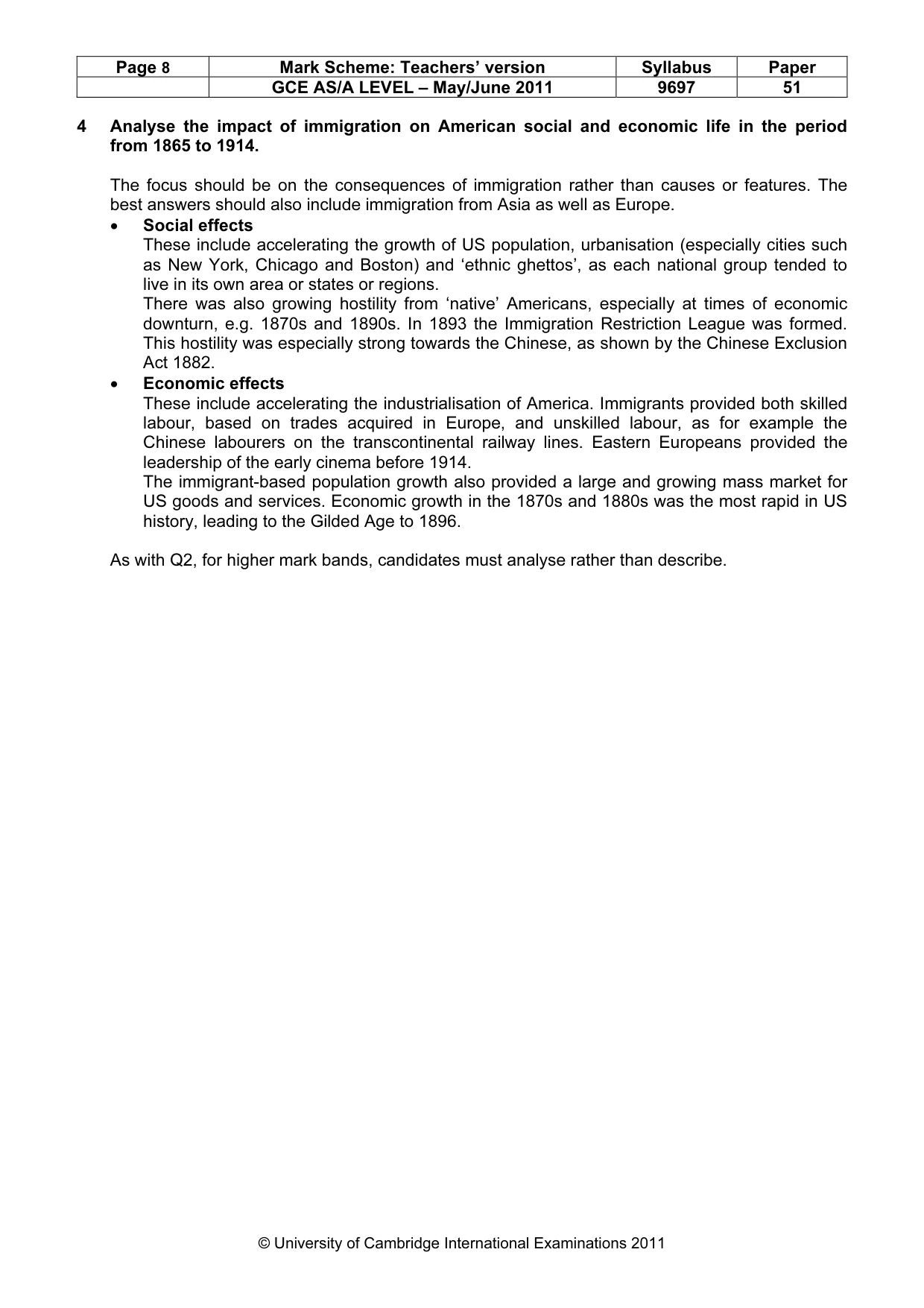
Page 8 Mark Scheme: Teachers’ version Syllabus Paper GCE AS/A LEVEL – May/June 2011 9697 51 © University of Cambridge International Examinations 2011 4 Analyse the impact of immigration on American social and economic life in the period from 1865 to 1914. The focus should be on the consequences of immigration rather than causes or features. The best answers should also include immigration from Asia as well as Europe. • Social effects These include accelerating the growth of US population, urbanisation (especially cities such as New York, Chicago and Boston) and ‘ethnic ghettos’, as each national group tended to live in its own area or states or regions. There was also growing hostility from ‘native’ Americans, especially at times of economic downturn, e.g. 1870s and 1890s. In 1893 the Immigration Restriction League was formed. This hostility was especially strong towards the Chinese, as shown by the Chinese Exclusion Act 1882. • Economic effects These include accelerating the industrialisation of America. Immigrants provided both skilled labour, based on trades acquired in Europe, and unskilled labour, as for example the Chinese labourers on the transcontinental railway lines. Eastern Europeans provided the leadership of the early cinema before 1914. The immigrant-based population growth also provided a large and growing mass market for US goods and services. Economic growth in the 1870s and 1880s was the most rapid in US history, leading to the Gilded Age to 1896. As with Q2, for higher mark bands, candidates must analyse rather than describe.
Mark scheme, page 9
Page 9 Mark Scheme: Teachers’ version Syllabus Paper GCE AS/A LEVEL – May/June 2011 9697 51 © University of Cambridge International Examinations 2011 5 Evaluate the effectiveness of the different tactics used by the various branches of the civil rights movement in the 1950s and 1960s. The civil rights movement includes groups such as NAACP and CORE and should strictly exclude black nationalist groups such as the Black Panthers and Nation of Islam. In practice, however, these groups can be considered. Note that effectiveness requires some consideration of the impact of the different tactics in terms of effect upon US Congress, the presidency and public opinion. If the tactics only are assessed, award a maximum of 14–15 marks. Tactics include: • Legal e.g. Brown vs. the Board of Education, Topeka, 1954 in which the NAACP won the case for the desegregation of schools in Arkansas • Direct Action i.e. non violent civil disobedience : breaking the law and accepting the punishments e.g. Montgomery bus boycotts 1955-6, sit-ins (Greensboro 1960), freedom rides 1961 • Peaceful protest e.g. March on Washington 1963 • Political e.g. voter registration and lobbying Black nationalist groups argued for more radical goals than just civil rights and advocated more extreme methods. The Black Panther party’s activities in 1967-70 are the best-known examples. Also credit other minority groups fighting for their civil rights in the 1960s: • Latino farm workers in California Led by Cesar Chavez, they used the more traditional method of going on strike. The Delano grape strike lasted for five years, 1965-70, eventually achieving some collective bargaining rights for workers. • American Indians The Indians of All Tribes group (IAT) occupied Alcatraz in 1964 and again from 1969 to 1971. The occupation did result in concessions from the US government, e.g. Indian Self- Determination and Educational Assistance Act (1975).
Mark scheme, page 10
Page 10 Mark Scheme: Teachers’ version Syllabus Paper GCE AS/A LEVEL – May/June 2011 9697 51 © University of Cambridge International Examinations 2011 6 How far were the 1920s a period of prosperity and optimism in the United States? The image of the Roaring Twenties and the Jazz Age would suggest the 1920s were a time of great optimism and rising prosperity, even if the latter proved to be built on sand. For many, however, they weren’t. Those for whom the 1920s were a source of prosperity and optimism included: • The urban middle class – and especially bankers and financiers • The urban working class – including northern blacks, though all less secure than middle class • Women – especially single women in their 20s Those who were left out of the prosperity of the 1920s included: • Farmers, who over-borrowed and then suffered from over-production in the 1920s • Farm Labourers – especially southern blacks, who also suffered from a revived Ku Klux Klan • Immigrants, who lived on the margins of US life and experienced a revival of nativism, e.g. KKK Also, the impact of prohibition needs to be considered, even if its place on the balance sheet of optimism and pessimism is a matter of debate. There was a veneer of common prosperity, conveyed by the Hollywood studios and radio broadcasting and encouraged by the growth of consumer credit. In general, however, the cities were prosperous, the countryside poor. Thus there is plenty of evidence and arguments for candidates to consider. Award marks according to breadth, depth and structure of the analysis.
Mark scheme, page 11
Page 11 Mark Scheme: Teachers’ version Syllabus Paper GCE AS/A LEVEL – May/June 2011 9697 51 © University of Cambridge International Examinations 2011 7 Why, having entered the First World War, did the United States not join the League of Nations? The first part of the question should not be overlooked. The question is not just about the USA’s refusal to join the League of Nations. The contrast is that entering the war marks the end of isolationism (from Europe) whereas rejecting the League marks the return of isolationism (at least in part: the USA played a greater role in international diplomacy in the 1920s). Relevant reasons include: • The nature of the League of Nations This brand-new supranational organisation raised US fears about loss of sovereignty, especially Article 10. • The strategy and tactics of Woodrow Wilson The President refused to make any concessions to US opponents of the League. Also he took no Republican politicians to Versailles. And his six-month absence from the USA in 1919 was too long. Some argue that the stroke he suffered in October 1919 affected his judgement. • The composition of the US Senate The 1918 mid-term elections gave the Republicans a small majority, 49-47. Two-thirds majority was needed to approve the Treaty of Versailles and the League of Nations. Only 13 Senators were against the League in any form. Even Henry Cabot Lodge, the leading critic of the League, was prepared for the US to join if certain compromises were made. Wilson was having none of it. • The US constitution But for the two-thirds majority required by Article 2 for approving foreign treaties, the Senate would have approved the Treaty of Versailles and the USA would have joined the League of Nations. The best answers need to have a detailed knowledge of US politics in 1919-20. The greater commitment to internationalism shown in 1917 was not sustained in 1920 mainly because of the tactics of the US president and the demands of the US constitution. The rejection of the League was not really the return of isolationism.
Mark scheme, page 12
Page 12 Mark Scheme: Teachers’ version Syllabus Paper GCE AS/A LEVEL – May/June 2011 9697 51 © University of Cambridge International Examinations 2011 8 Why did a feminist movement emerge in America in the 1960s? Key factors include: • The restoration of a patriarchal society post-1945 – at least in terms of popular culture Women who did men’s work in World War Two were expected to return to the traditional home-making role. Also (male) politicians did little or nothing to advance the Equal Rights Amendment. And yet ... • More women in work Helped by the long-term economic boom of the 1950s and 1960s, more women were working – 29% of the work force in 1950, 42% in 1970 – with an increasing proportion being married (from one-third of women to two-thirds in the same period). These women experienced economic and social discrimination as they were expected to maintain their home-making role was well. These inequalities were highlighted by the Presidential Commission on the Status of Women (1963), set up by President Kennedy. • The rights-based culture of the 1960s The focus on the civil rights of African-Americans caused links to be made with the rights of women. Thus in 1967 affirmative action extended to women as well as to ethnic minorities. • The Feminine Mystique by Betty Friedan (1963) This book which provided a critical portrayal of the position of women in the USA had a great influence on many American women. Betty Friedan helped form the National Organisation of Women (NOW) in 1966. Other factors might be mentioned such as the introduction of the contraceptive pill in the 1960s and the counter-culture of the 1960s, though how significant both were to the rise of feminism is hard to say. Candidates who have studied the social history of mid-20th century America should find plenty to write about. Reward only specific historical analysis; beware of vague and generalised answers.
What you needed in this session
Cambridge’s own grade thresholds for 2011 May/June, Paper 5 · Variant 1. A higher threshold means an easier paper — the bar moves with how the cohort did.