Cambridge A Level History (pre-2015) 9697 — 2010 May/June Paper 3 · Variant 3
9697/33/M/J/10 · 100 marks · ≈113 min
The question paper and its mark scheme, free to read here and free to download. This is Cambridge’s own paper, exactly as it was sat.
Question paper4 pages
Mark scheme6 pages
Answers below. Sit the paper first if you are practising.
Paper as text
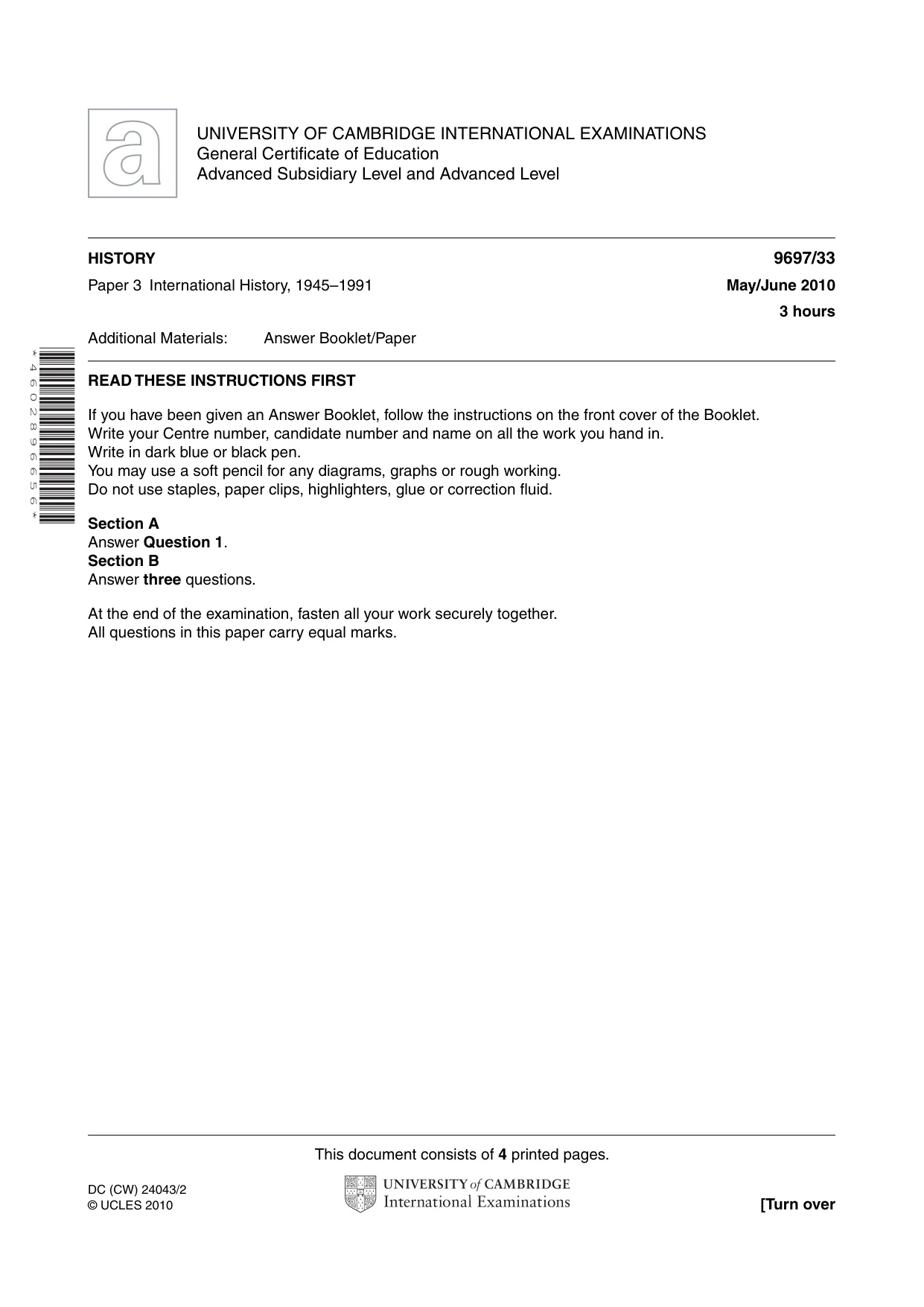
Question paper, page 1
This document consists of 4 printed pages. DC (CW) 24043/2 © UCLES 2010 [Turn over UNIVERSITY OF CAMBRIDGE INTERNATIONAL EXAMINATIONS General Certificate of Education Advanced Subsidiary Level and Advanced Level READ THESE INSTRUCTIONS FIRST If you have been given an Answer Booklet, follow the instructions on the front cover of the Booklet. Write your Centre number, candidate number and name on all the work you hand in. Write in dark blue or black pen. You may use a soft pencil for any diagrams, graphs or rough working. Do not use staples, paper clips, highlighters, glue or correction fluid. Section A Answer Question 1. Section B Answer three questions. At the end of the examination, fasten all your work securely together. All questions in this paper carry equal marks. * 4 6 0 2 8 9 6 6 5 6 * HISTORY 9697/33 Paper 3 International History, 1945–1991 May/June 2010 3 hours Additional Materials: Answer Booklet/Paper
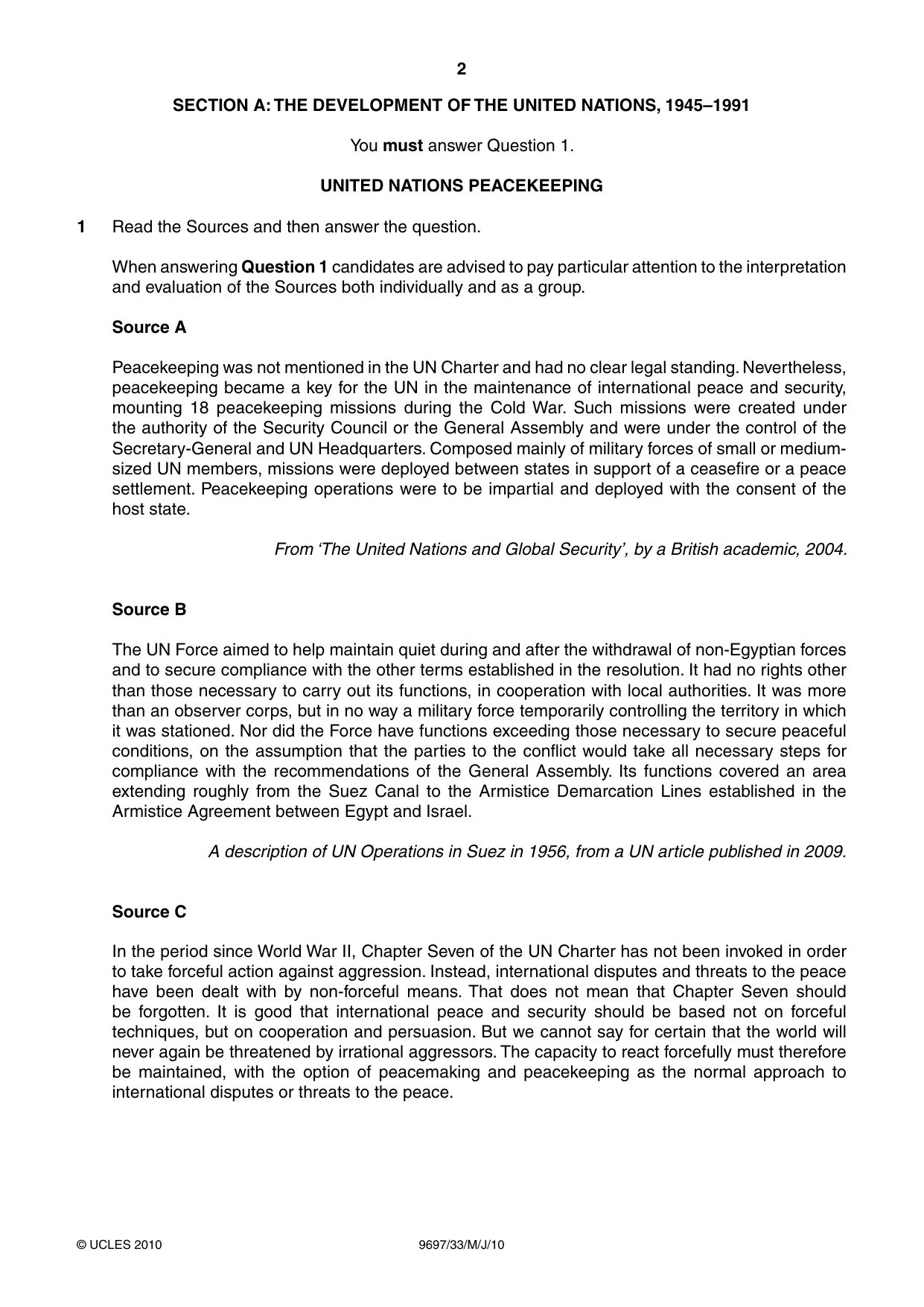
Question paper, page 2
2 9697/33/M/J/10 © UCLES 2010 SECTION A: THE DEVELOPMENT OF THE UNITED NATIONS, 1945–1991 You must answer Question 1. UNITED NATIONS PEACEKEEPING 1 Read the Sources and then answer the question. When answering Question 1 candidates are advised to pay particular attention to the interpretation and evaluation of the Sources both individually and as a group. Source A Peacekeeping was not mentioned in the UN Charter and had no clear legal standing. Nevertheless, peacekeeping became a key for the UN in the maintenance of international peace and security, mounting 18 peacekeeping missions during the Cold War. Such missions were created under the authority of the Security Council or the General Assembly and were under the control of the Secretary-General and UN Headquarters. Composed mainly of military forces of small or medium- sized UN members, missions were deployed between states in support of a ceasefire or a peace settlement. Peacekeeping operations were to be impartial and deployed with the consent of the host state. From ‘The United Nations and Global Security’, by a British academic, 2004. Source B The UN Force aimed to help maintain quiet during and after the withdrawal of non-Egyptian forces and to secure compliance with the other terms established in the resolution. It had no rights other than those necessary to carry out its functions, in cooperation with local authorities. It was more than an observer corps, but in no way a military force temporarily controlling the territory in which it was stationed. Nor did the Force have functions exceeding those necessary to secure peaceful conditions, on the assumption that the parties to the conflict would take all necessary steps for compliance with the recommendations of the General Assembly. Its functions covered an area extending roughly from the Suez Canal to the Armistice Demarcation Lines established in the Armistice Agreement between Egypt and Israel. A description of UN Operations in Suez in 1956, from a UN article published in 2009. Source C In the period since World War II, Chapter Seven of the UN Charter has not been invoked in order to take forceful action against aggression. Instead, international disputes and threats to the peace have been dealt with by non-forceful means. That does not mean that Chapter Seven should be forgotten. It is good that international peace and security should be based not on forceful techniques, but on cooperation and persuasion. But we cannot say for certain that the world will never again be threatened by irrational aggressors. The capacity to react forcefully must therefore be maintained, with the option of peacemaking and peacekeeping as the normal approach to international disputes or threats to the peace.
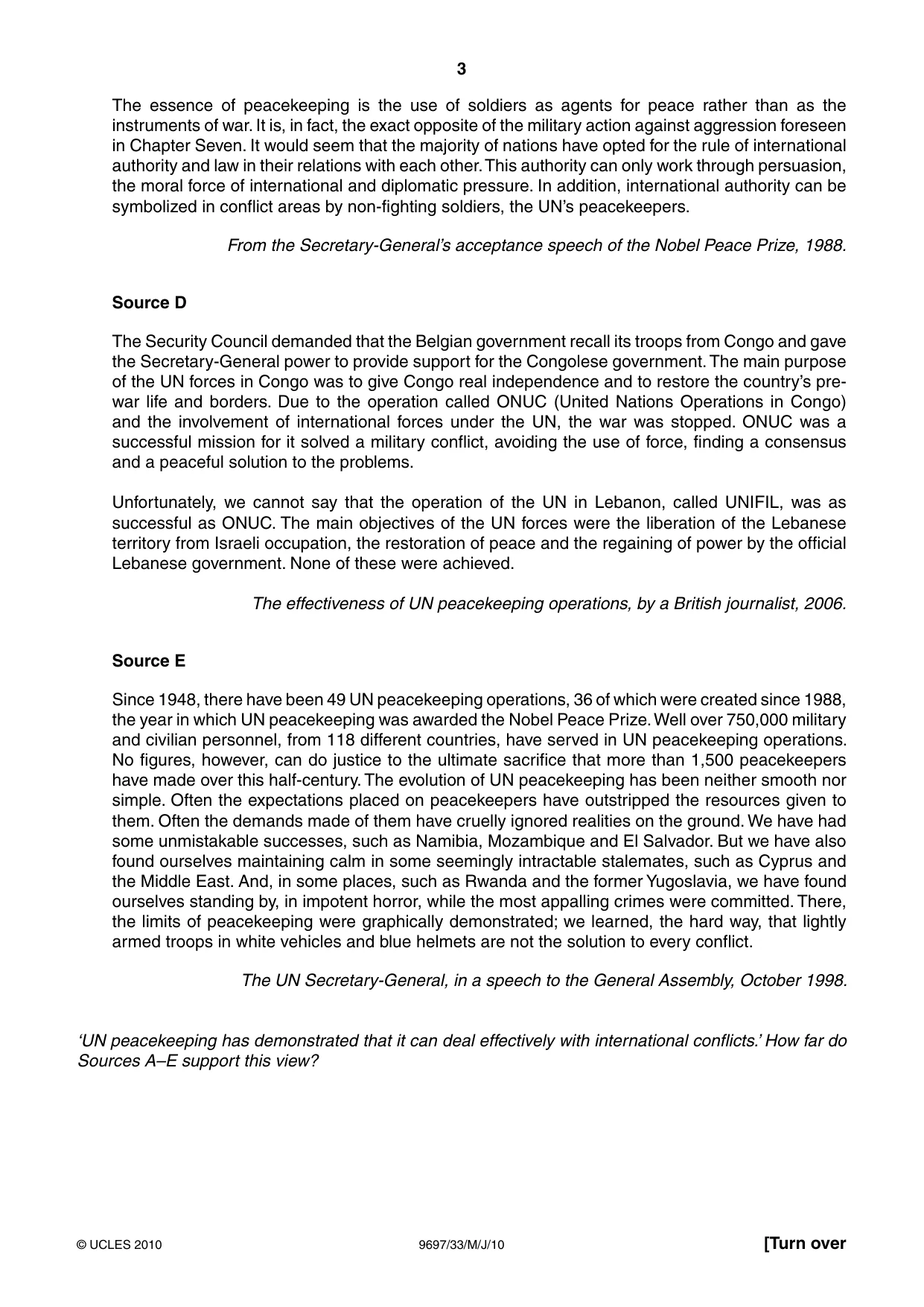
Question paper, page 3
3 9697/33/M/J/10 © UCLES 2010 [Turn over The essence of peacekeeping is the use of soldiers as agents for peace rather than as the instruments of war. It is, in fact, the exact opposite of the military action against aggression foreseen in Chapter Seven. It would seem that the majority of nations have opted for the rule of international authority and law in their relations with each other. This authority can only work through persuasion, the moral force of international and diplomatic pressure. In addition, international authority can be symbolized in conflict areas by non-fighting soldiers, the UN’s peacekeepers. From the Secretary-General’s acceptance speech of the Nobel Peace Prize, 1988. Source D The Security Council demanded that the Belgian government recall its troops from Congo and gave the Secretary-General power to provide support for the Congolese government. The main purpose of the UN forces in Congo was to give Congo real independence and to restore the country’s pre- war life and borders. Due to the operation called ONUC (United Nations Operations in Congo) and the involvement of international forces under the UN, the war was stopped. ONUC was a successful mission for it solved a military conflict, avoiding the use of force, finding a consensus and a peaceful solution to the problems. Unfortunately, we cannot say that the operation of the UN in Lebanon, called UNIFIL, was as successful as ONUC. The main objectives of the UN forces were the liberation of the Lebanese territory from Israeli occupation, the restoration of peace and the regaining of power by the official Lebanese government. None of these were achieved. The effectiveness of UN peacekeeping operations, by a British journalist, 2006. Source E Since 1948, there have been 49 UN peacekeeping operations, 36 of which were created since 1988, the year in which UN peacekeeping was awarded the Nobel Peace Prize. Well over 750,000 military and civilian personnel, from 118 different countries, have served in UN peacekeeping operations. No figures, however, can do justice to the ultimate sacrifice that more than 1,500 peacekeepers have made over this half-century. The evolution of UN peacekeeping has been neither smooth nor simple. Often the expectations placed on peacekeepers have outstripped the resources given to them. Often the demands made of them have cruelly ignored realities on the ground. We have had some unmistakable successes, such as Namibia, Mozambique and El Salvador. But we have also found ourselves maintaining calm in some seemingly intractable stalemates, such as Cyprus and the Middle East. And, in some places, such as Rwanda and the former Yugoslavia, we have found ourselves standing by, in impotent horror, while the most appalling crimes were committed. There, the limits of peacekeeping were graphically demonstrated; we learned, the hard way, that lightly armed troops in white vehicles and blue helmets are not the solution to every conflict. The UN Secretary-General, in a speech to the General Assembly, October 1998. ‘UN peacekeeping has demonstrated that it can deal effectively with international conflicts.’ How far do Sources A–E support this view?
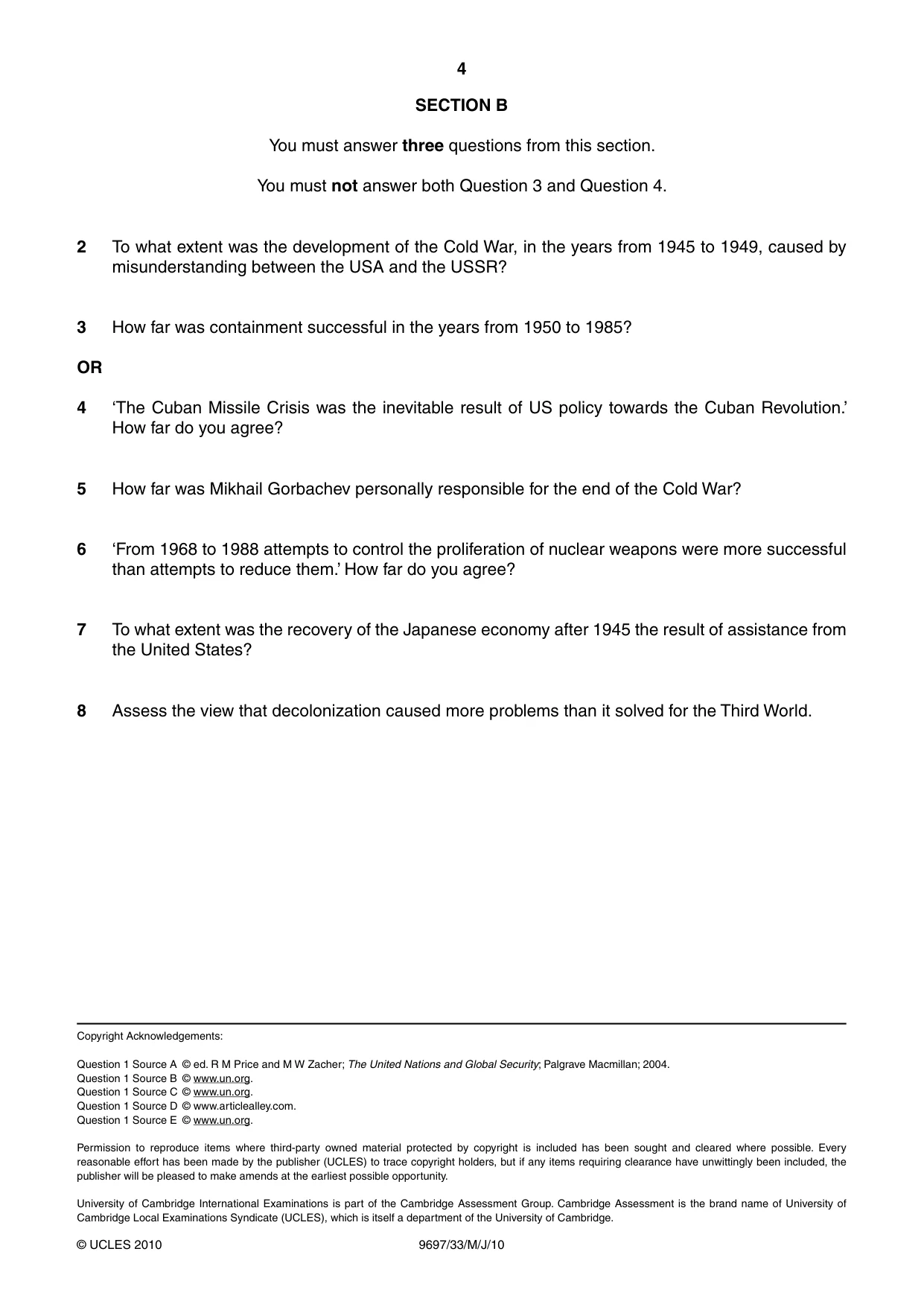
Question paper, page 4
4 9697/33/M/J/10 © UCLES 2010 SECTION B You must answer three questions from this section. You must not answer both Question 3 and Question 4. 2 To what extent was the development of the Cold War, in the years from 1945 to 1949, caused by misunderstanding between the USA and the USSR? 3 How far was containment successful in the years from 1950 to 1985? OR 4 ‘The Cuban Missile Crisis was the inevitable result of US policy towards the Cuban Revolution.’ How far do you agree? 5 How far was Mikhail Gorbachev personally responsible for the end of the Cold War? 6 ‘From 1968 to 1988 attempts to control the proliferation of nuclear weapons were more successful than attempts to reduce them.’ How far do you agree? 7 To what extent was the recovery of the Japanese economy after 1945 the result of assistance from the United States? 8 Assess the view that decolonization caused more problems than it solved for the Third World. Copyright Acknowledgements: Question 1 Source A © ed. R M Price and M W Zacher; The United Nations and Global Security; Palgrave Macmillan; 2004. Question 1 Source B © www.un.org. Question 1 Source C © www.un.org. Question 1 Source D © www.articlealley.com. Question 1 Source E © www.un.org. Permission to reproduce items where third-party owned material protected by copyright is included has been sought and cleared where possible. Every reasonable effort has been made by the publisher (UCLES) to trace copyright holders, but if any items requiring clearance have unwittingly been included, the publisher will be pleased to make amends at the earliest possible opportunity. University of Cambridge International Examinations is part of the Cambridge Assessment Group. Cambridge Assessment is the brand name of University of Cambridge Local Examinations Syndicate (UCLES), which is itself a department of the University of Cambridge.
Mark scheme, page 1
UNIVERSITY OF CAMBRIDGE INTERNATIONAL EXAMINATIONS GCE Advanced Subsidiary Level and GCE Advanced Level MARK SCHEME for the May/June 2010 question paper for the guidance of teachers 9697 HISTORY 9697/33 Paper 33, maximum raw mark 100 This mark scheme is published as an aid to teachers and candidates, to indicate the requirements of the examination. It shows the basis on which Examiners were instructed to award marks. It does not indicate the details of the discussions that took place at an Examiners’ meeting before marking began, which would have considered the acceptability of alternative answers. Mark schemes must be read in conjunction with the question papers and the report on the examination. • CIE will not enter into discussions or correspondence in connection with these mark schemes. CIE is publishing the mark schemes for the May/June 2010 question papers for most IGCSE, GCE Advanced Level and Advanced Subsidiary Level syllabuses and some Ordinary Level syllabuses.
Mark scheme, page 2
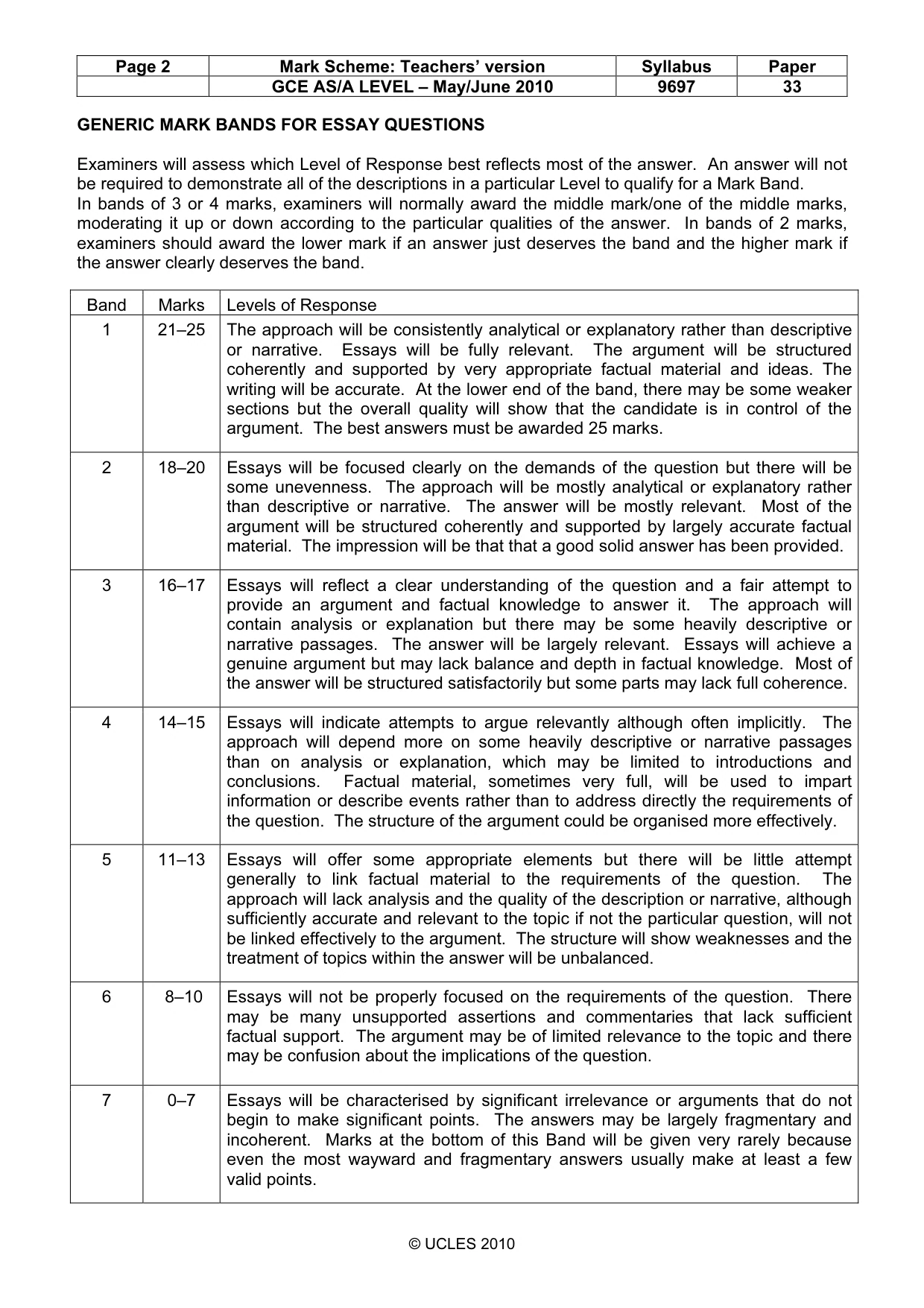
Page 2 Mark Scheme: Teachers’ version Syllabus Paper GCE AS/A LEVEL – May/June 2010 9697 33 © UCLES 2010 GENERIC MARK BANDS FOR ESSAY QUESTIONS Examiners will assess which Level of Response best reflects most of the answer. An answer will not be required to demonstrate all of the descriptions in a particular Level to qualify for a Mark Band. In bands of 3 or 4 marks, examiners will normally award the middle mark/one of the middle marks, moderating it up or down according to the particular qualities of the answer. In bands of 2 marks, examiners should award the lower mark if an answer just deserves the band and the higher mark if the answer clearly deserves the band. Band Marks Levels of Response 1 21–25 The approach will be consistently analytical or explanatory rather than descriptive or narrative. Essays will be fully relevant. The argument will be structured coherently and supported by very appropriate factual material and ideas. The writing will be accurate. At the lower end of the band, there may be some weaker sections but the overall quality will show that the candidate is in control of the argument. The best answers must be awarded 25 marks. 2 18–20 Essays will be focused clearly on the demands of the question but there will be some unevenness. The approach will be mostly analytical or explanatory rather than descriptive or narrative. The answer will be mostly relevant. Most of the argument will be structured coherently and supported by largely accurate factual material. The impression will be that that a good solid answer has been provided. 3 16–17 Essays will reflect a clear understanding of the question and a fair attempt to provide an argument and factual knowledge to answer it. The approach will contain analysis or explanation but there may be some heavily descriptive or narrative passages. The answer will be largely relevant. Essays will achieve a genuine argument but may lack balance and depth in factual knowledge. Most of the answer will be structured satisfactorily but some parts may lack full coherence. 4 14–15 Essays will indicate attempts to argue relevantly although often implicitly. The approach will depend more on some heavily descriptive or narrative passages than on analysis or explanation, which may be limited to introductions and conclusions. Factual material, sometimes very full, will be used to impart information or describe events rather than to address directly the requirements of the question. The structure of the argument could be organised more effectively. 5 11–13 Essays will offer some appropriate elements but there will be little attempt generally to link factual material to the requirements of the question. The approach will lack analysis and the quality of the description or narrative, although sufficiently accurate and relevant to the topic if not the particular question, will not be linked effectively to the argument. The structure will show weaknesses and the treatment of topics within the answer will be unbalanced. 6 8–10 Essays will not be properly focused on the requirements of the question. There may be many unsupported assertions and commentaries that lack sufficient factual support. The argument may be of limited relevance to the topic and there may be confusion about the implications of the question. 7 0–7 Essays will be characterised by significant irrelevance or arguments that do not begin to make significant points. The answers may be largely fragmentary and incoherent. Marks at the bottom of this Band will be given very rarely because even the most wayward and fragmentary answers usually make at least a few valid points.
Mark scheme, page 3
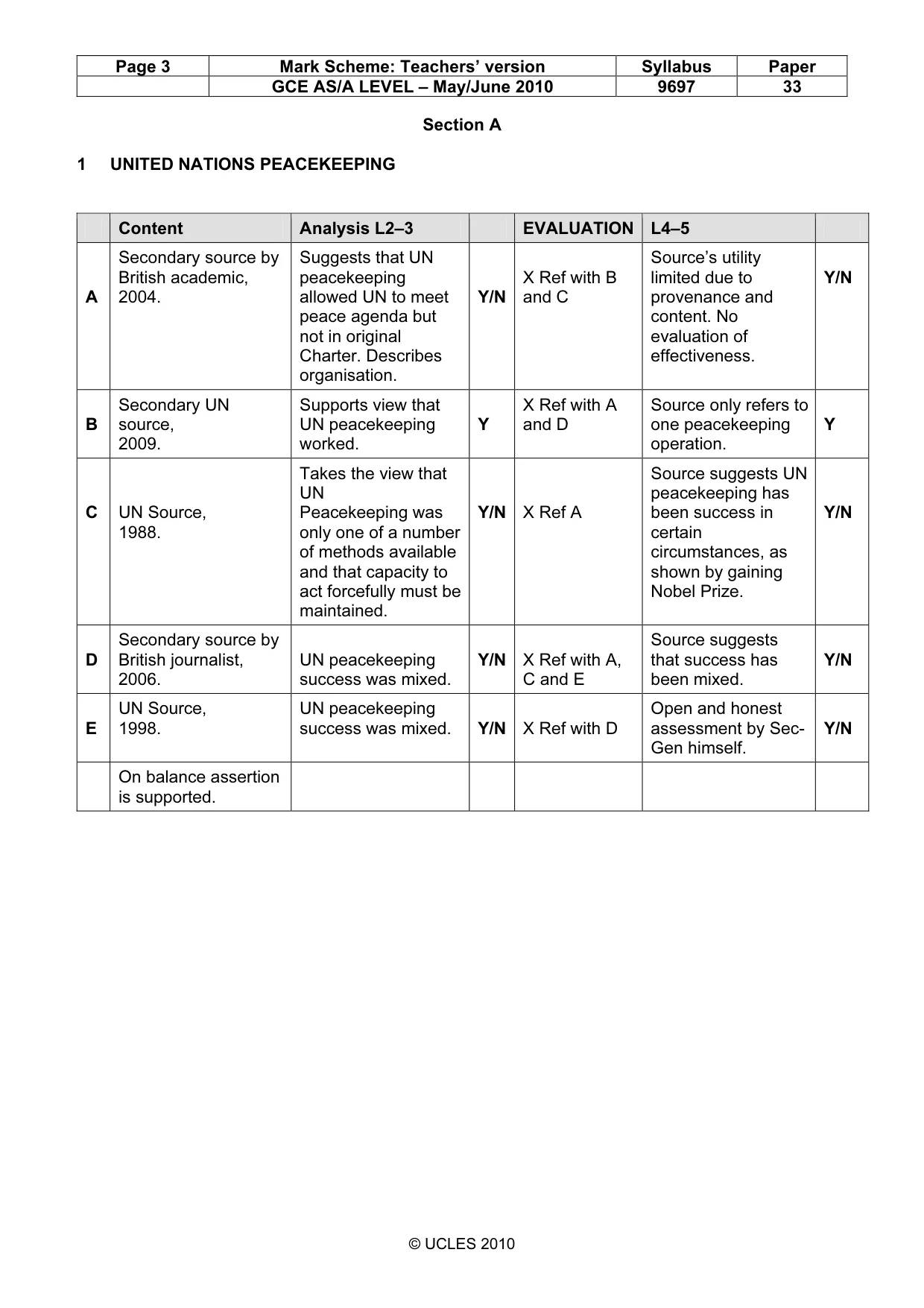
Page 3 Mark Scheme: Teachers’ version Syllabus Paper GCE AS/A LEVEL – May/June 2010 9697 33 © UCLES 2010 Section A 1 UNITED NATIONS PEACEKEEPING Content Analysis L2–3 EVALUATION L4–5 A Secondary source by British academic, 2004. Suggests that UN peacekeeping allowed UN to meet peace agenda but not in original Charter. Describes organisation. Y/N X Ref with B and C Source’s utility limited due to provenance and content. No evaluation of effectiveness. Y/N B Secondary UN source, 2009. Supports view that UN peacekeeping worked. Y X Ref with A and D Source only refers to one peacekeeping operation. Y C UN Source, 1988. Takes the view that UN Peacekeeping was only one of a number of methods available and that capacity to act forcefully must be maintained. Y/N X Ref A Source suggests UN peacekeeping has been success in certain circumstances, as shown by gaining Nobel Prize. Y/N D Secondary source by British journalist, 2006. UN peacekeeping success was mixed. Y/N X Ref with A, C and E Source suggests that success has been mixed. Y/N E UN Source, 1998. UN peacekeeping success was mixed. Y/N X Ref with D Open and honest assessment by Sec- Gen himself. Y/N On balance assertion is supported.
Mark scheme, page 4
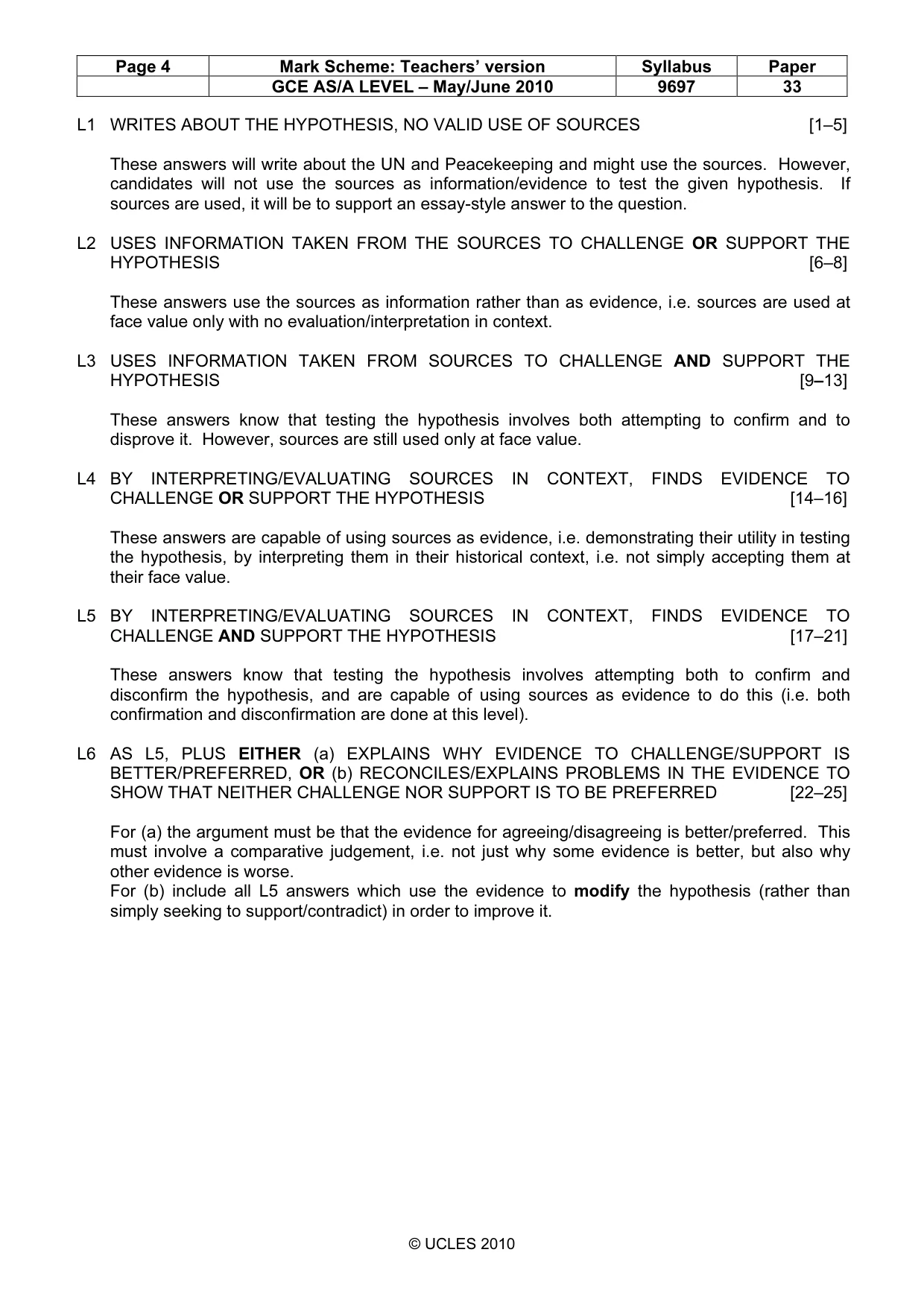
Page 4 Mark Scheme: Teachers’ version Syllabus Paper GCE AS/A LEVEL – May/June 2010 9697 33 © UCLES 2010 L1 WRITES ABOUT THE HYPOTHESIS, NO VALID USE OF SOURCES [1–5] These answers will write about the UN and Peacekeeping and might use the sources. However, candidates will not use the sources as information/evidence to test the given hypothesis. If sources are used, it will be to support an essay-style answer to the question. L2 USES INFORMATION TAKEN FROM THE SOURCES TO CHALLENGE OR SUPPORT THE HYPOTHESIS [6–8] These answers use the sources as information rather than as evidence, i.e. sources are used at face value only with no evaluation/interpretation in context. L3 USES INFORMATION TAKEN FROM SOURCES TO CHALLENGE AND SUPPORT THE HYPOTHESIS [9–13] These answers know that testing the hypothesis involves both attempting to confirm and to disprove it. However, sources are still used only at face value. L4 BY INTERPRETING/EVALUATING SOURCES IN CONTEXT, FINDS EVIDENCE TO CHALLENGE OR SUPPORT THE HYPOTHESIS [14–16] These answers are capable of using sources as evidence, i.e. demonstrating their utility in testing the hypothesis, by interpreting them in their historical context, i.e. not simply accepting them at their face value. L5 BY INTERPRETING/EVALUATING SOURCES IN CONTEXT, FINDS EVIDENCE TO CHALLENGE AND SUPPORT THE HYPOTHESIS [17–21] These answers know that testing the hypothesis involves attempting both to confirm and disconfirm the hypothesis, and are capable of using sources as evidence to do this (i.e. both confirmation and disconfirmation are done at this level). L6 AS L5, PLUS EITHER (a) EXPLAINS WHY EVIDENCE TO CHALLENGE/SUPPORT IS BETTER/PREFERRED, OR (b) RECONCILES/EXPLAINS PROBLEMS IN THE EVIDENCE TO SHOW THAT NEITHER CHALLENGE NOR SUPPORT IS TO BE PREFERRED [22–25] For (a) the argument must be that the evidence for agreeing/disagreeing is better/preferred. This must involve a comparative judgement, i.e. not just why some evidence is better, but also why other evidence is worse. For (b) include all L5 answers which use the evidence to modify the hypothesis (rather than simply seeking to support/contradict) in order to improve it.
Mark scheme, page 5
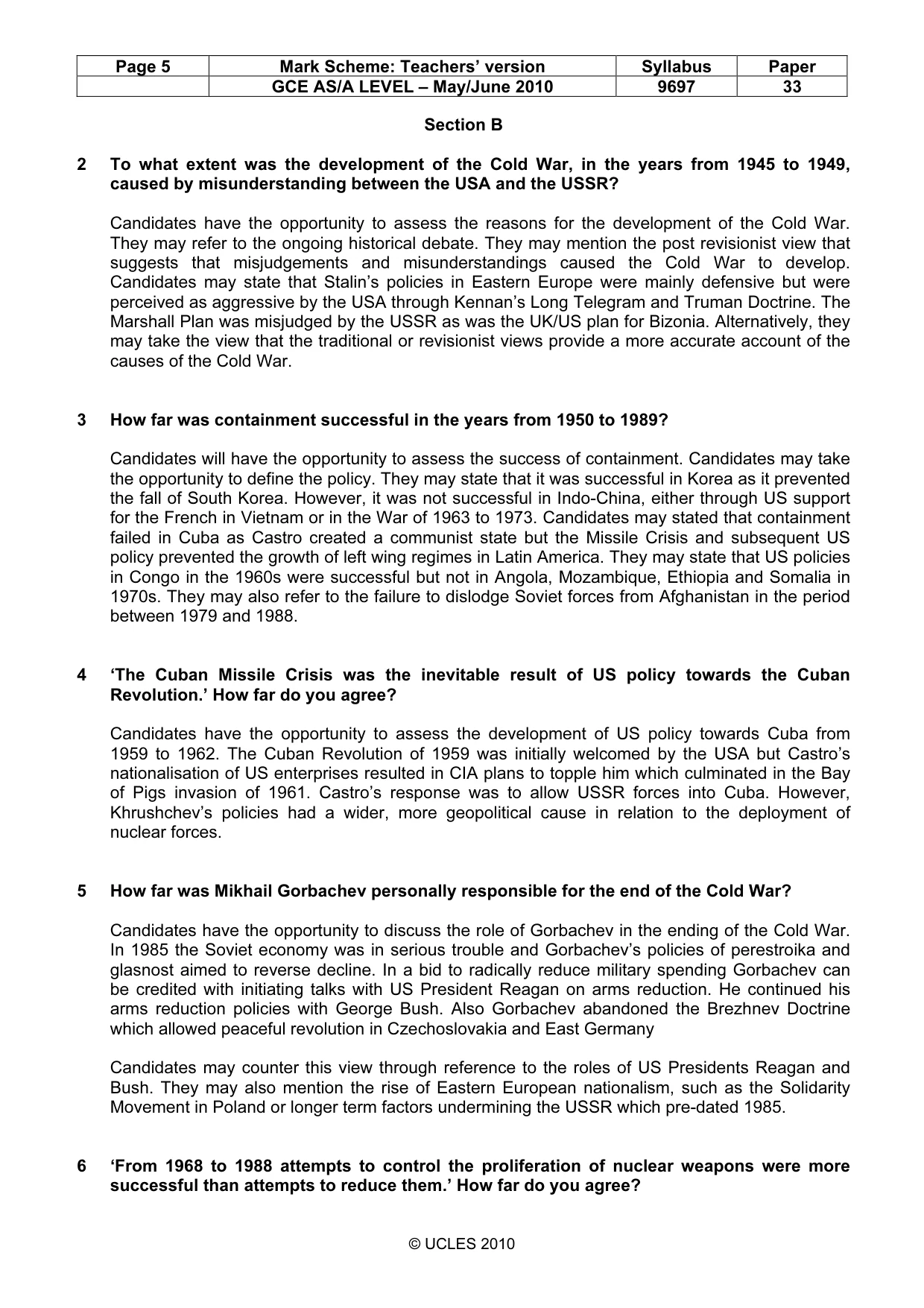
Page 5 Mark Scheme: Teachers’ version Syllabus Paper GCE AS/A LEVEL – May/June 2010 9697 33 © UCLES 2010 Section B 2 To what extent was the development of the Cold War, in the years from 1945 to 1949, caused by misunderstanding between the USA and the USSR? Candidates have the opportunity to assess the reasons for the development of the Cold War. They may refer to the ongoing historical debate. They may mention the post revisionist view that suggests that misjudgements and misunderstandings caused the Cold War to develop. Candidates may state that Stalin’s policies in Eastern Europe were mainly defensive but were perceived as aggressive by the USA through Kennan’s Long Telegram and Truman Doctrine. The Marshall Plan was misjudged by the USSR as was the UK/US plan for Bizonia. Alternatively, they may take the view that the traditional or revisionist views provide a more accurate account of the causes of the Cold War. 3 How far was containment successful in the years from 1950 to 1989? Candidates will have the opportunity to assess the success of containment. Candidates may take the opportunity to define the policy. They may state that it was successful in Korea as it prevented the fall of South Korea. However, it was not successful in Indo-China, either through US support for the French in Vietnam or in the War of 1963 to 1973. Candidates may stated that containment failed in Cuba as Castro created a communist state but the Missile Crisis and subsequent US policy prevented the growth of left wing regimes in Latin America. They may state that US policies in Congo in the 1960s were successful but not in Angola, Mozambique, Ethiopia and Somalia in 1970s. They may also refer to the failure to dislodge Soviet forces from Afghanistan in the period between 1979 and 1988. 4 ‘The Cuban Missile Crisis was the inevitable result of US policy towards the Cuban Revolution.’ How far do you agree? Candidates have the opportunity to assess the development of US policy towards Cuba from 1959 to 1962. The Cuban Revolution of 1959 was initially welcomed by the USA but Castro’s nationalisation of US enterprises resulted in CIA plans to topple him which culminated in the Bay of Pigs invasion of 1961. Castro’s response was to allow USSR forces into Cuba. However, Khrushchev’s policies had a wider, more geopolitical cause in relation to the deployment of nuclear forces. 5 How far was Mikhail Gorbachev personally responsible for the end of the Cold War? Candidates have the opportunity to discuss the role of Gorbachev in the ending of the Cold War. In 1985 the Soviet economy was in serious trouble and Gorbachev’s policies of perestroika and glasnost aimed to reverse decline. In a bid to radically reduce military spending Gorbachev can be credited with initiating talks with US President Reagan on arms reduction. He continued his arms reduction policies with George Bush. Also Gorbachev abandoned the Brezhnev Doctrine which allowed peaceful revolution in Czechoslovakia and East Germany Candidates may counter this view through reference to the roles of US Presidents Reagan and Bush. They may also mention the rise of Eastern European nationalism, such as the Solidarity Movement in Poland or longer term factors undermining the USSR which pre-dated 1985. 6 ‘From 1968 to 1988 attempts to control the proliferation of nuclear weapons were more successful than attempts to reduce them.’ How far do you agree?
Mark scheme, page 6
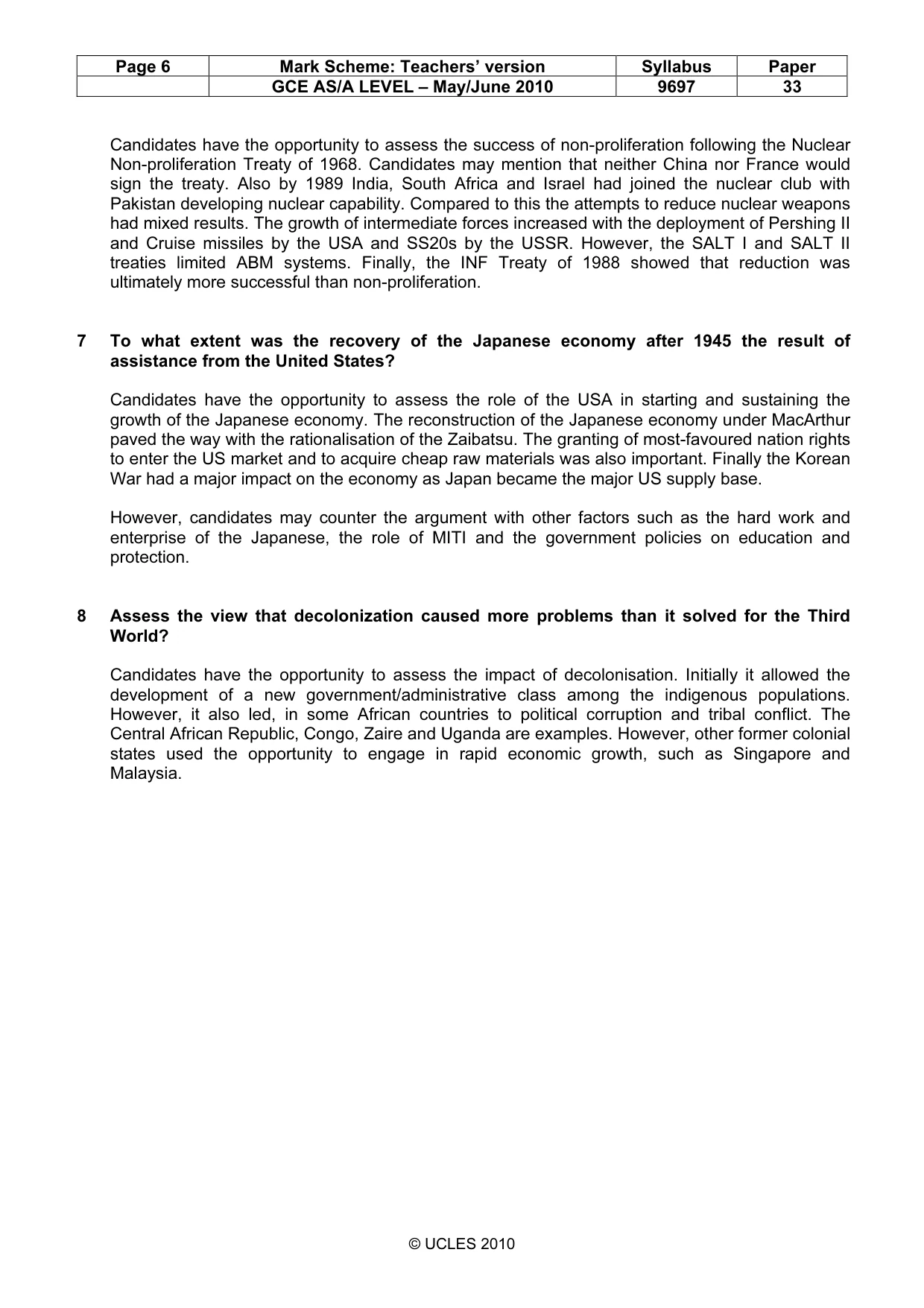
Page 6 Mark Scheme: Teachers’ version Syllabus Paper GCE AS/A LEVEL – May/June 2010 9697 33 © UCLES 2010 Candidates have the opportunity to assess the success of non-proliferation following the Nuclear Non-proliferation Treaty of 1968. Candidates may mention that neither China nor France would sign the treaty. Also by 1989 India, South Africa and Israel had joined the nuclear club with Pakistan developing nuclear capability. Compared to this the attempts to reduce nuclear weapons had mixed results. The growth of intermediate forces increased with the deployment of Pershing II and Cruise missiles by the USA and SS20s by the USSR. However, the SALT I and SALT II treaties limited ABM systems. Finally, the INF Treaty of 1988 showed that reduction was ultimately more successful than non-proliferation. 7 To what extent was the recovery of the Japanese economy after 1945 the result of assistance from the United States? Candidates have the opportunity to assess the role of the USA in starting and sustaining the growth of the Japanese economy. The reconstruction of the Japanese economy under MacArthur paved the way with the rationalisation of the Zaibatsu. The granting of most-favoured nation rights to enter the US market and to acquire cheap raw materials was also important. Finally the Korean War had a major impact on the economy as Japan became the major US supply base. However, candidates may counter the argument with other factors such as the hard work and enterprise of the Japanese, the role of MITI and the government policies on education and protection. 8 Assess the view that decolonization caused more problems than it solved for the Third World? Candidates have the opportunity to assess the impact of decolonisation. Initially it allowed the development of a new government/administrative class among the indigenous populations. However, it also led, in some African countries to political corruption and tribal conflict. The Central African Republic, Congo, Zaire and Uganda are examples. However, other former colonial states used the opportunity to engage in rapid economic growth, such as Singapore and Malaysia.
What you needed in this session
Cambridge’s own grade thresholds for 2010 May/June, Paper 3 · Variant 3. A higher threshold means an easier paper — the bar moves with how the cohort did.