Cambridge A Level History 9389 — 2017 Oct/Nov Paper 2 · Variant 3
9389/23/O/N/17 · 12 questions · 60 marks · ≈68 min
The question paper and its mark scheme, free to read here and free to download. This is Cambridge’s own paper, exactly as it was sat.
Question paper4 pages
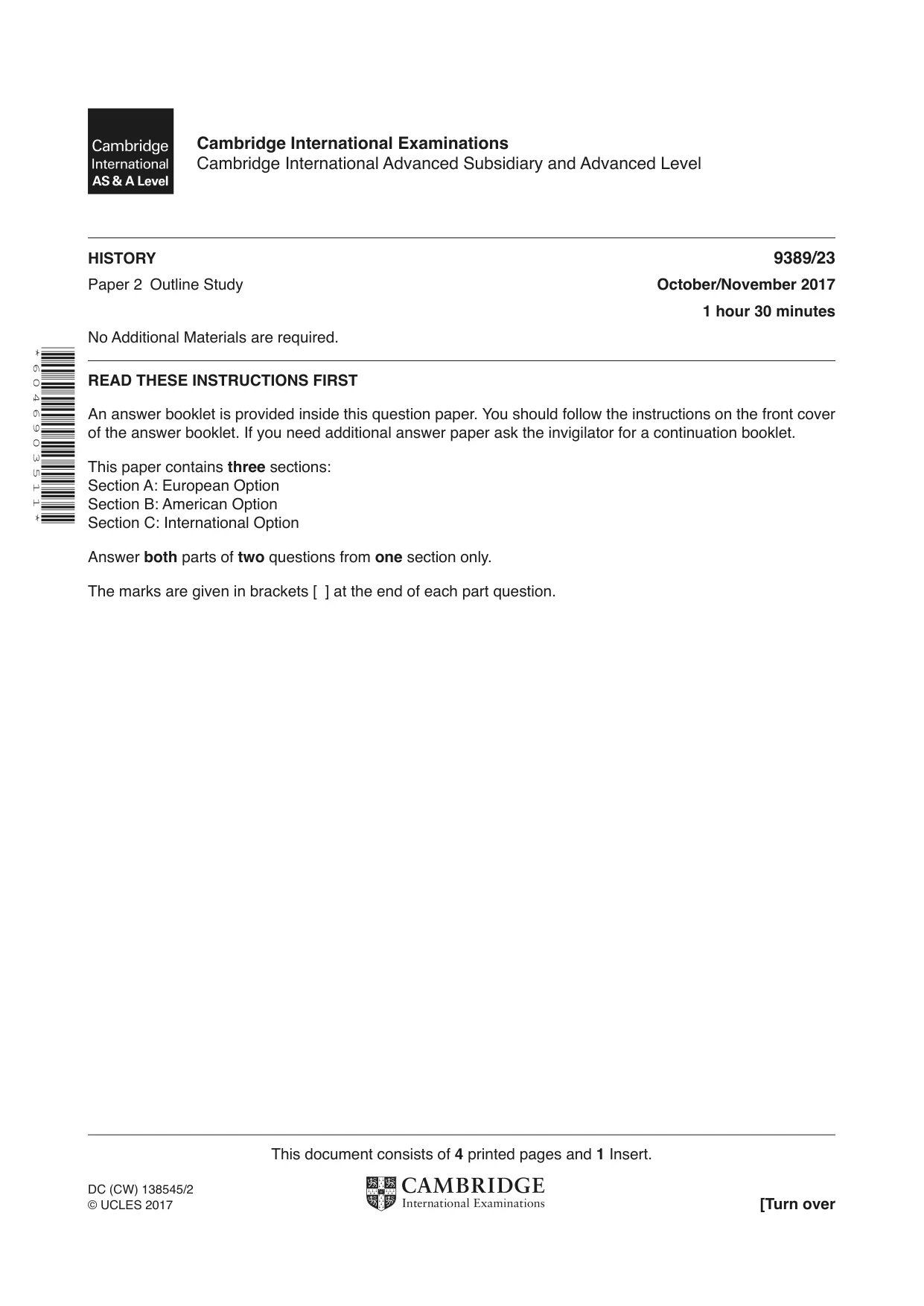
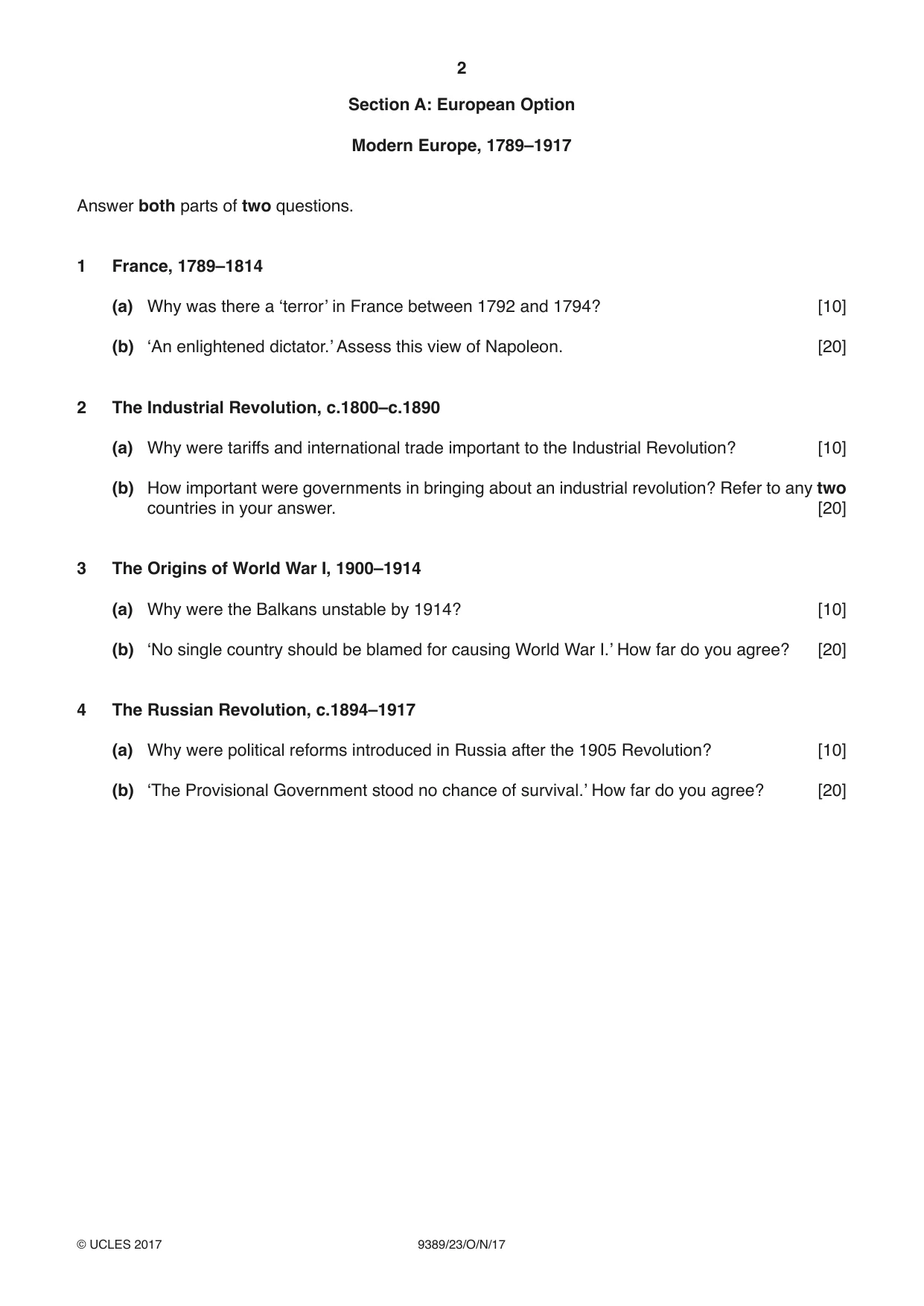
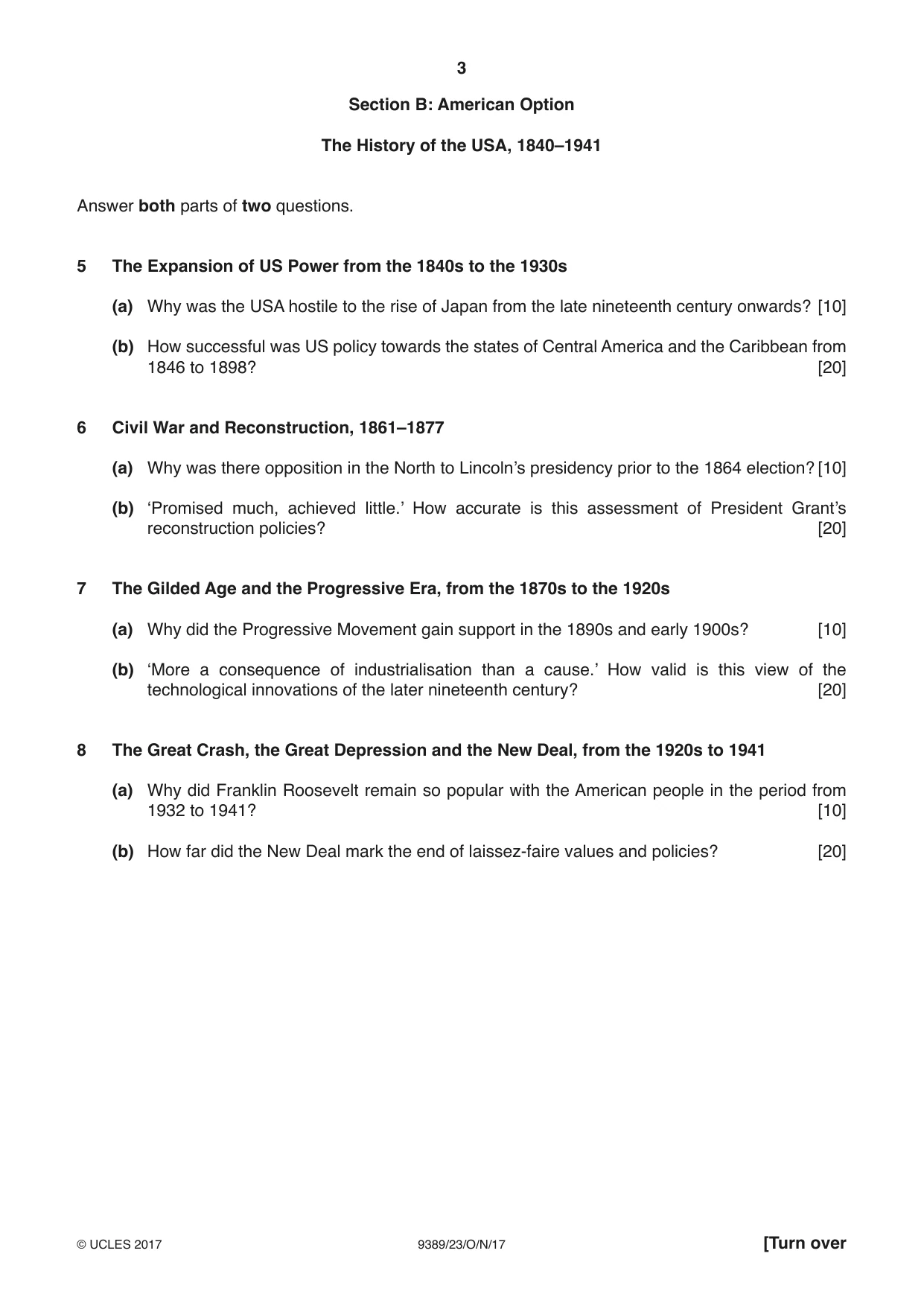
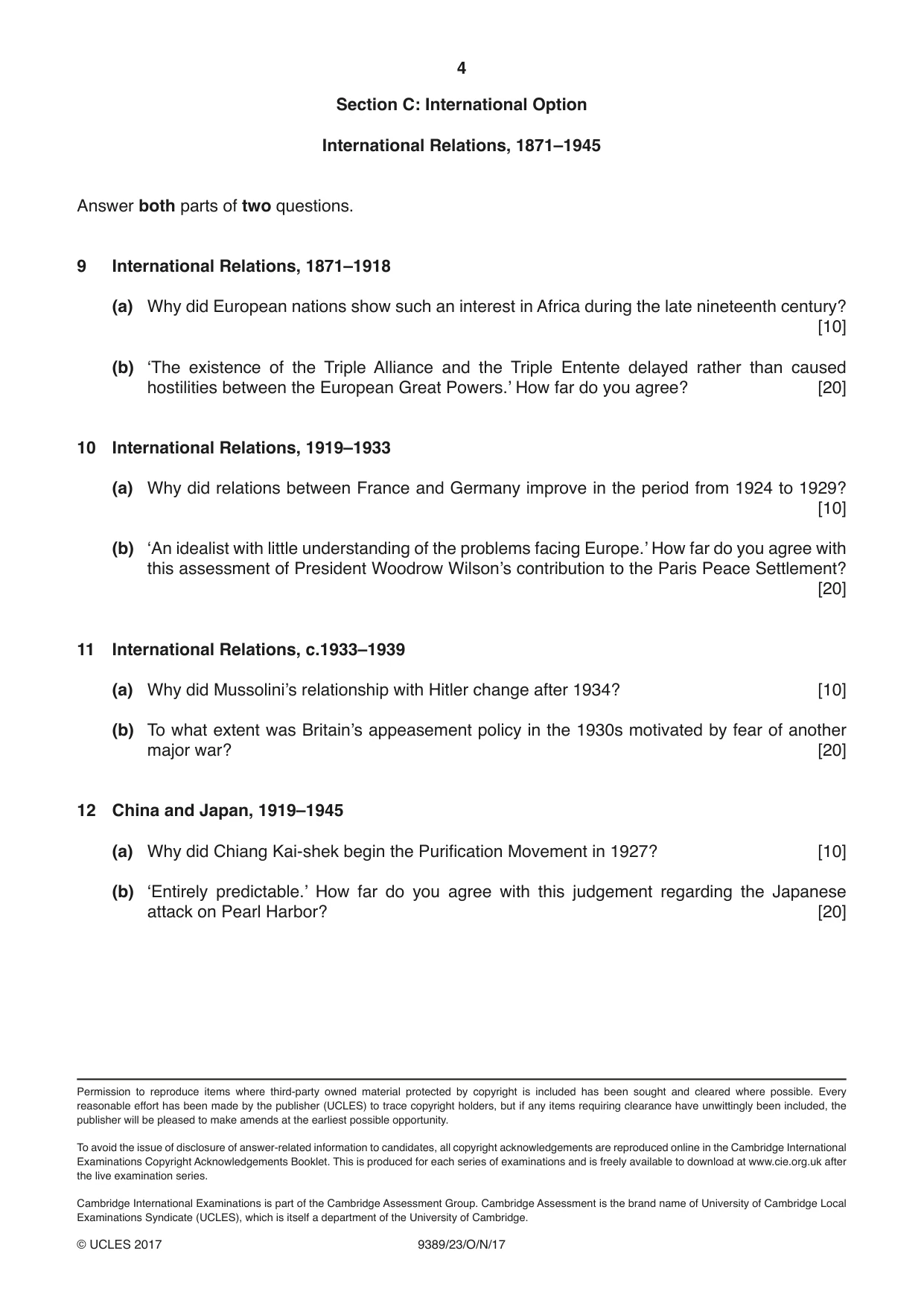
Mark scheme21 pages
Answers below. Sit the paper first if you are practising.
Questions as text
Q1 · France, 1789–1814 (a) Why was there a ‘terror’ in France between 1792 and 1794?
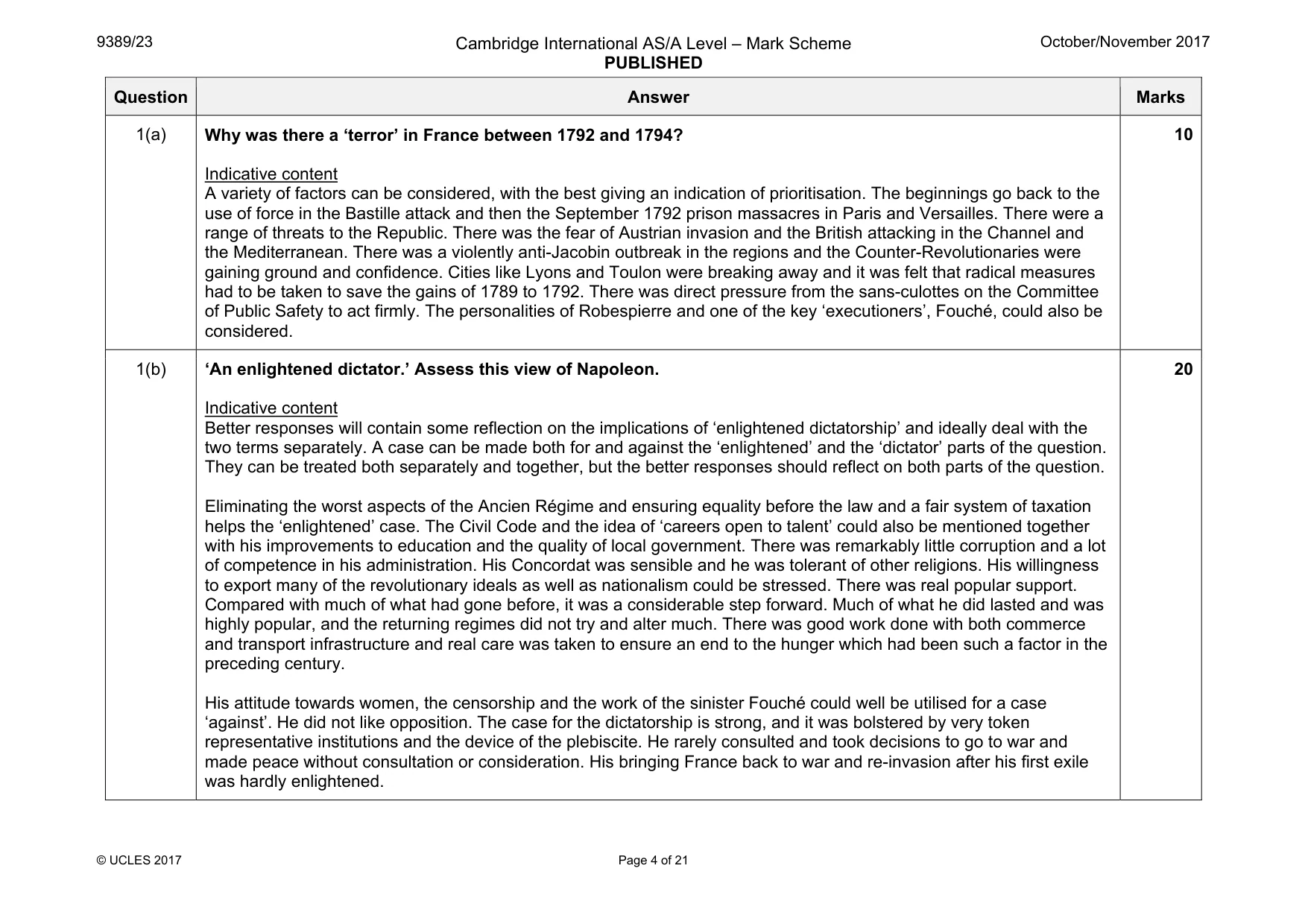
1 France, 1789–1814 (a) Why was there a ‘terror’ in France between 1792 and 1794? [10] (b) ‘An enlightened dictator.’ Assess this view of Napoleon. [20]
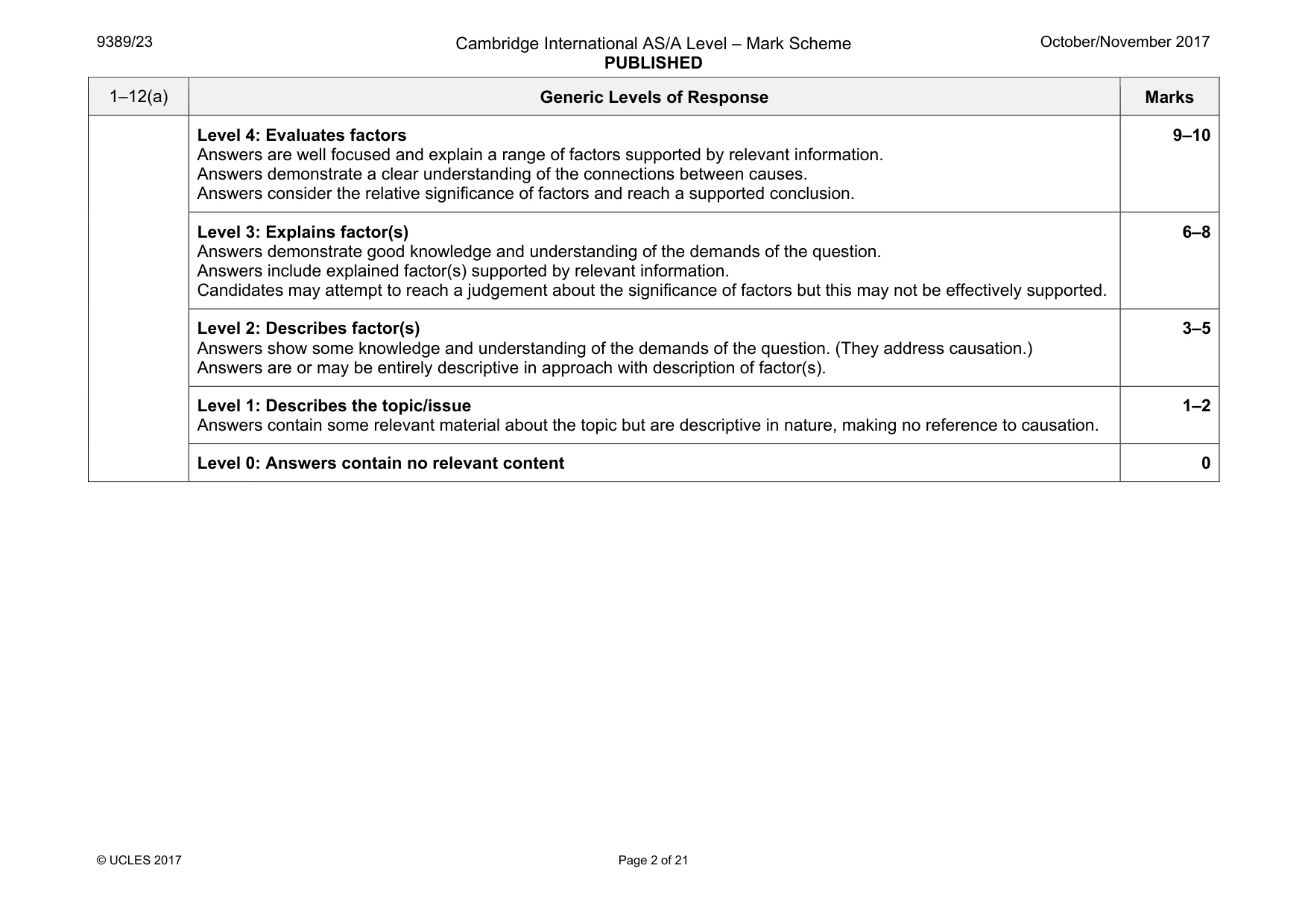
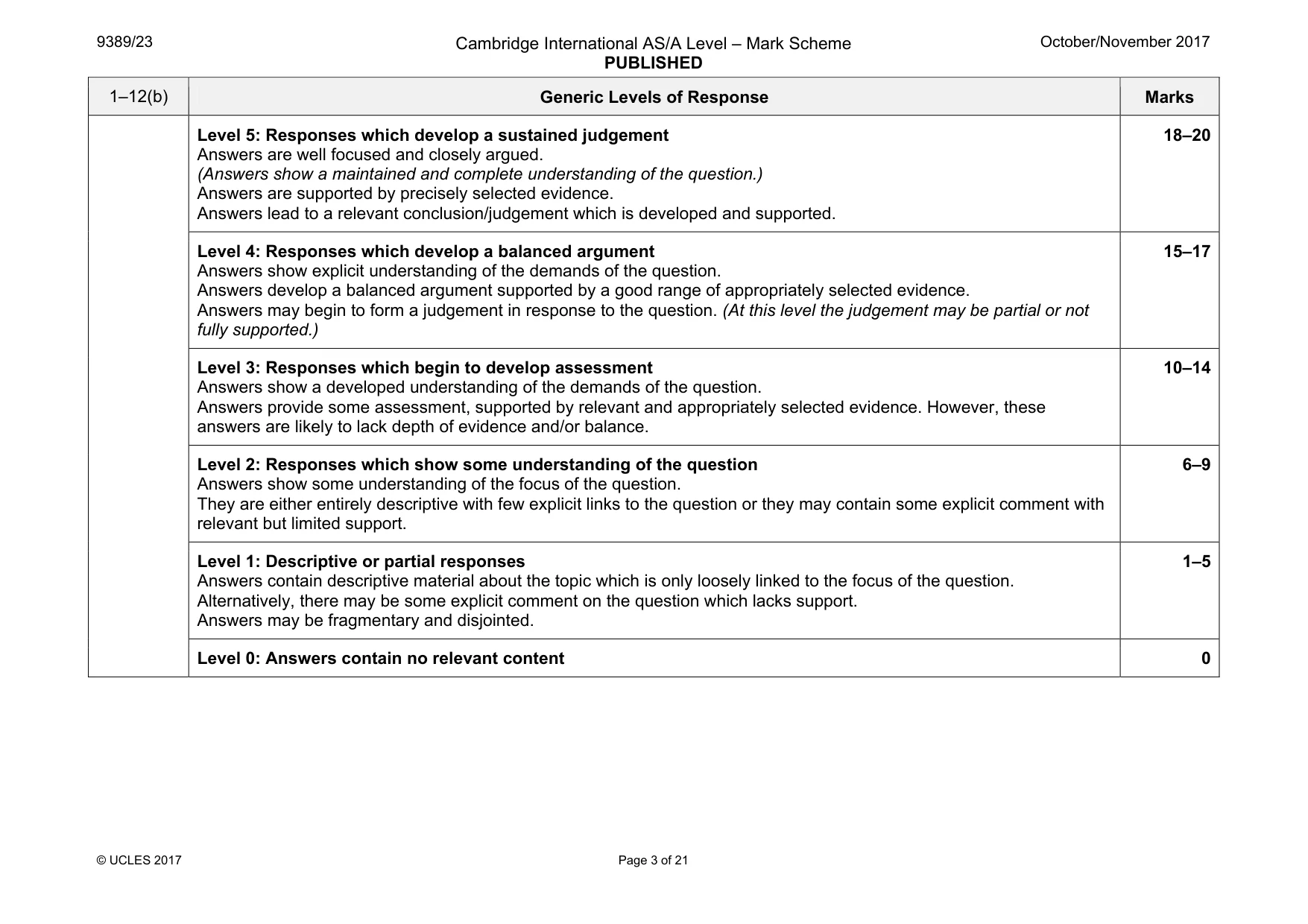
Mark scheme: 1(a) Why was there a ‘terror’ in France between 1792 and 1794? Indicative content A variety of factors can be considered, with the best giving an indication of prioritisation. The beginnings go back to the use of force in the Bastille attack and then the September 1792 prison massacres in Paris and Versailles. There were a range of threats to the Republic. There was the fear of Austrian invasion and the British attacking in the Channel and the Mediterranean. There was a violently anti-Jacobin outbreak in the regions and the Counter-Revolutionaries were gaining ground and confidence. Cities like Lyons and Toulon were breaking away and it was felt that radical measures had to be taken to save the gains of 1789 to 1792. There was direct pressure from the sans-culottes on the Committee of Public Safety to act firmly. The personalities of Robespierre and one of the key ‘executioners’, Fouché, could also be considered. 10 1(b) ‘An enlightened dictator.’ Assess this view of Napoleon. Indicative content Better responses will contain some reflection on the implications of ‘enlightened dictatorship’ and ideally deal with the two terms separately. A case can be made both for and against the ‘enlightened’ and the ‘dictator’ parts of the question. They can be treated both separately and together, but the better responses should reflect on both parts of the question. Eliminating the worst aspects of the Ancien Régime and ensuring equality before the law and a fair system of taxation helps the ‘enlightened’ case. The Civil Code and the idea of ‘careers open to talent’ could also be mentioned together with his improvements to education and the quality of local government. There was remarkably little corruption and a lot of competence in his administration. His Concordat was sensible and he was tolerant of other religions. His willingness to export many of the revolutionary ideals as well as nationalism could be stressed. There was real popular support. Compared with much of what had gone before, it was a considerable step forward. Much of what he did lasted and was highly popular, and the returning regimes did not try and alter much. There was good work done with both commerce and transport infrastructure and real care was taken to ensure an end to the hunger which had been such a factor in the preceding century. His attitude towards women, the censorship and the work of the sinister Fouché could well be utilised for a case ‘against’. He did not like opposition. The case for the dictatorship is strong, and it was bolstered by very token representative institutions and the device of the plebiscite. He rarely consulted and took decisions to go to war and made peace without consultation or consideration. His bringing France back to war and re-invasion after his first exile was hardly enlightened. 20
Q2 · The Industrial Revolution, c.1800–c.1890 (a) Why were tariffs and international trade…
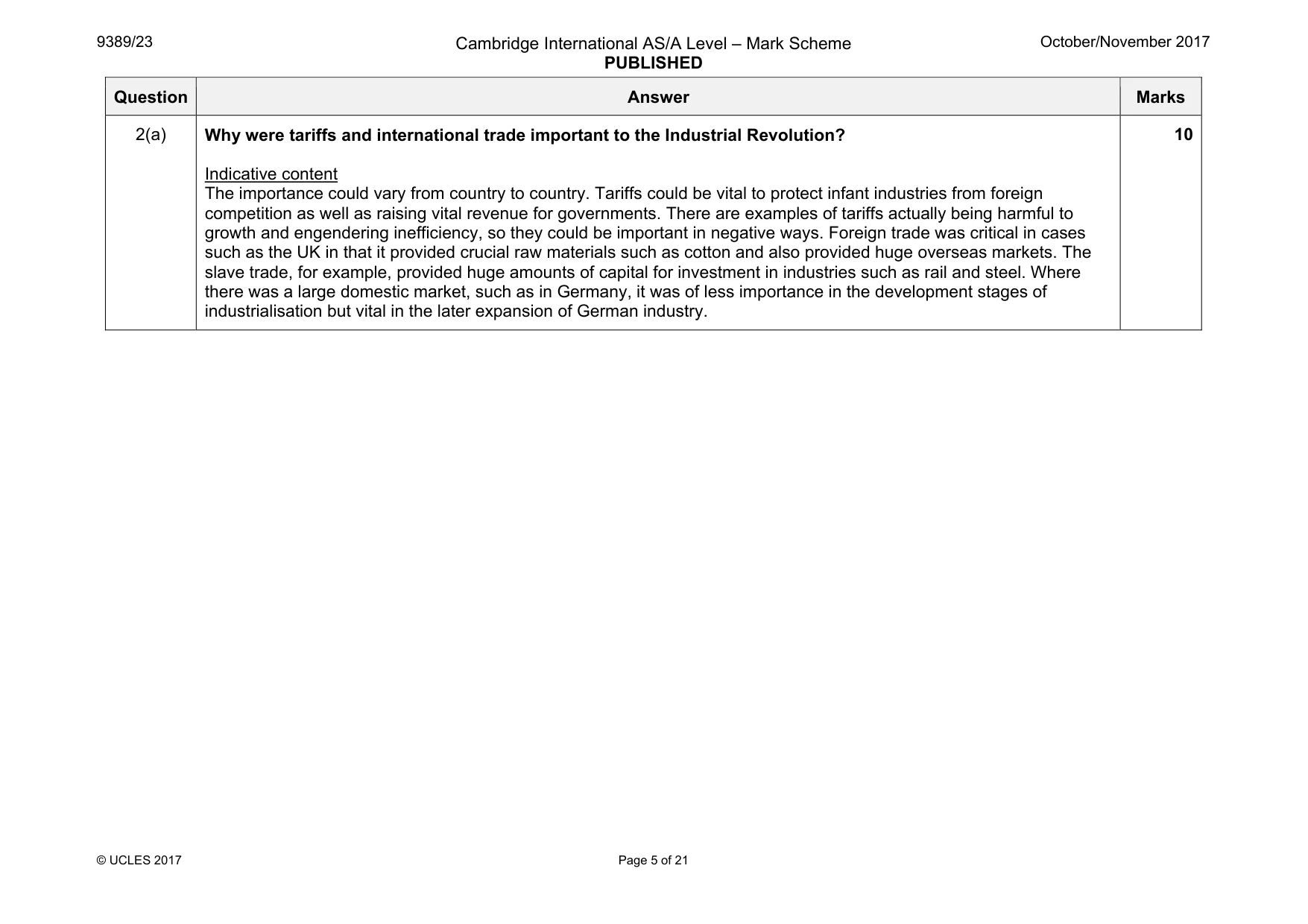
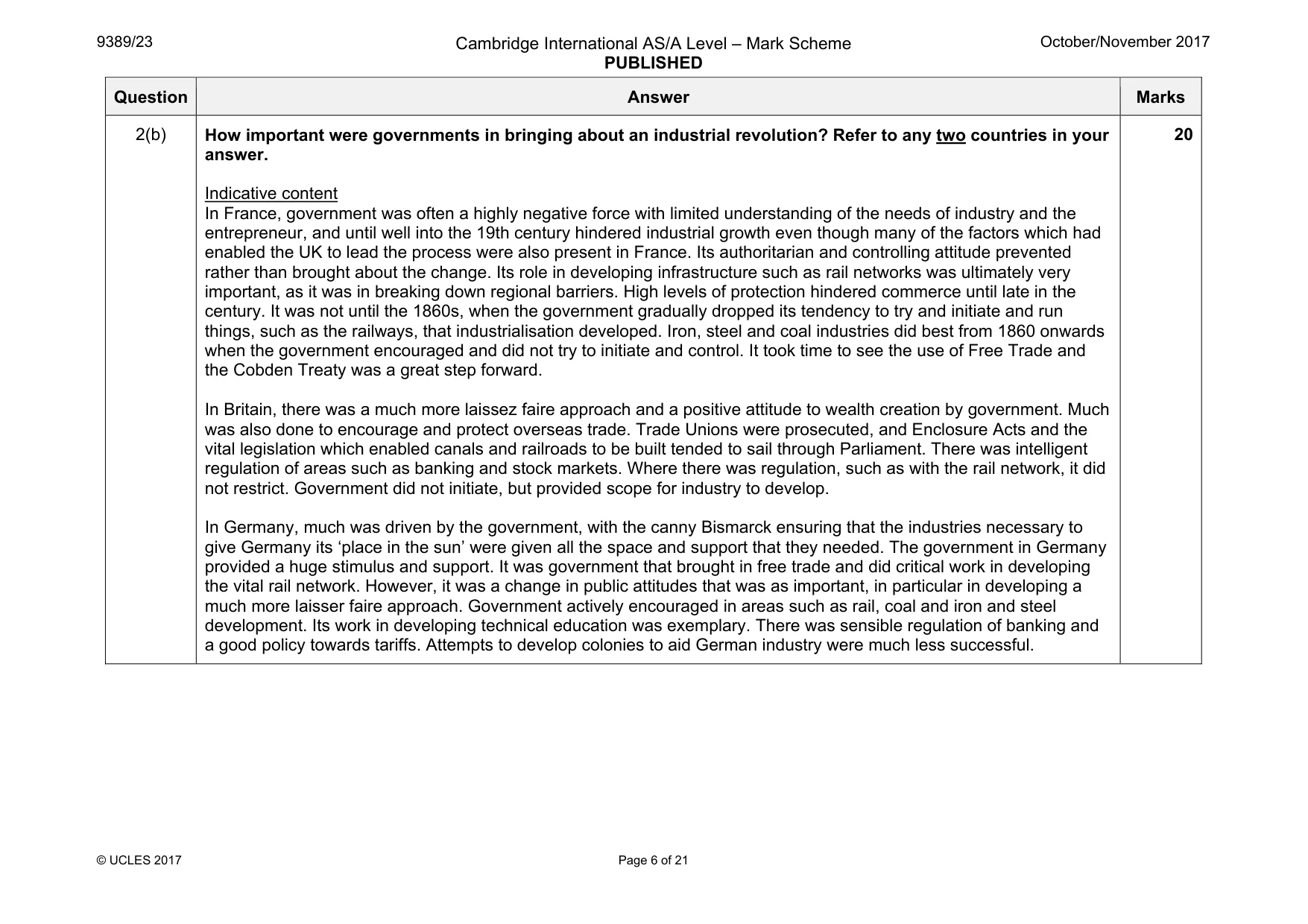
2 The Industrial Revolution, c.1800–c.1890 (a) Why were tariffs and international trade important to the Industrial Revolution? [10] (b) How important were governments in bringing about an industrial revolution? Refer to any two countries in your answer. [20]
Mark scheme: 2(a) Why were tariffs and international trade important to the Industrial Revolution? Indicative content The importance could vary from country to country. Tariffs could be vital to protect infant industries from foreign competition as well as raising vital revenue for governments. There are examples of tariffs actually being harmful to growth and engendering inefficiency, so they could be important in negative ways. Foreign trade was critical in cases such as the UK in that it provided crucial raw materials such as cotton and also provided huge overseas markets. The slave trade, for example, provided huge amounts of capital for investment in industries such as rail and steel. Where there was a large domestic market, such as in Germany, it was of less importance in the development stages of industrialisation but vital in the later expansion of German industry. 10 Question Answer Marks 2(b) How important were governments in bringing about an industrial revolution? Refer to any two countries in your answer. Indicative content In France, government was often a highly negative force with limited understanding of the needs of industry and the entrepreneur, and until well into the 19th century hindered industrial growth even though many of the factors which had enabled the UK to lead the process were also present in France. Its authoritarian and controlling attitude prevented rather than brought about the change. Its role in developing infrastructure such as rail networks was ultimately very important, as it was in breaking down regional barriers. High levels of protection hindered commerce until late in the century. It was not until the 1860s, when the government gradually dropped its tendency to try and initiate and run things, such as the railways, that industrialisation developed. Iron, steel and coal industries did best from 1860 onwards when the government encouraged and did not try to initiate and control. It took time to see the use of Free Trade and the Cobden Treaty was a great step forward. In Britain, there was a much more laissez faire approach and a positive attitude to wealth creation by government. Much was also done to encourage and protect overseas trade. Trade Unions were prosecuted, and Enclosure Acts and the vital legislation which enabled canals and railroads to be built tended to sail through Parliament. There was intelligent regulation of areas such as banking and stock markets. Where there was regulation, such as with the rail network, it did not restrict. Government did not initiate, but provided scope for industry to develop. In Germany, much was driven by the government, with the canny Bismarck ensuring that the industries necessary to give Germany its ‘place in the sun’ were given all the space and support that they needed. The government in Germany provided a huge stimulus and support. It was government that brought in free trade and did critical work in developing the vital rail network. However, it was a change in public attitudes that was as important, in particular in developing a much more laisser faire approach. Government actively encouraged in areas such as rail, coal and iron and steel development. Its work in developing technical education was exemplary. There was sensible regulation of banking and a good policy towards tariffs. Attempts to develop colonies to aid German industry were much less successful. 20
Q3 · The Origins of World War I, 1900–1914 (a) Why were the Balkans unstable by 1914?
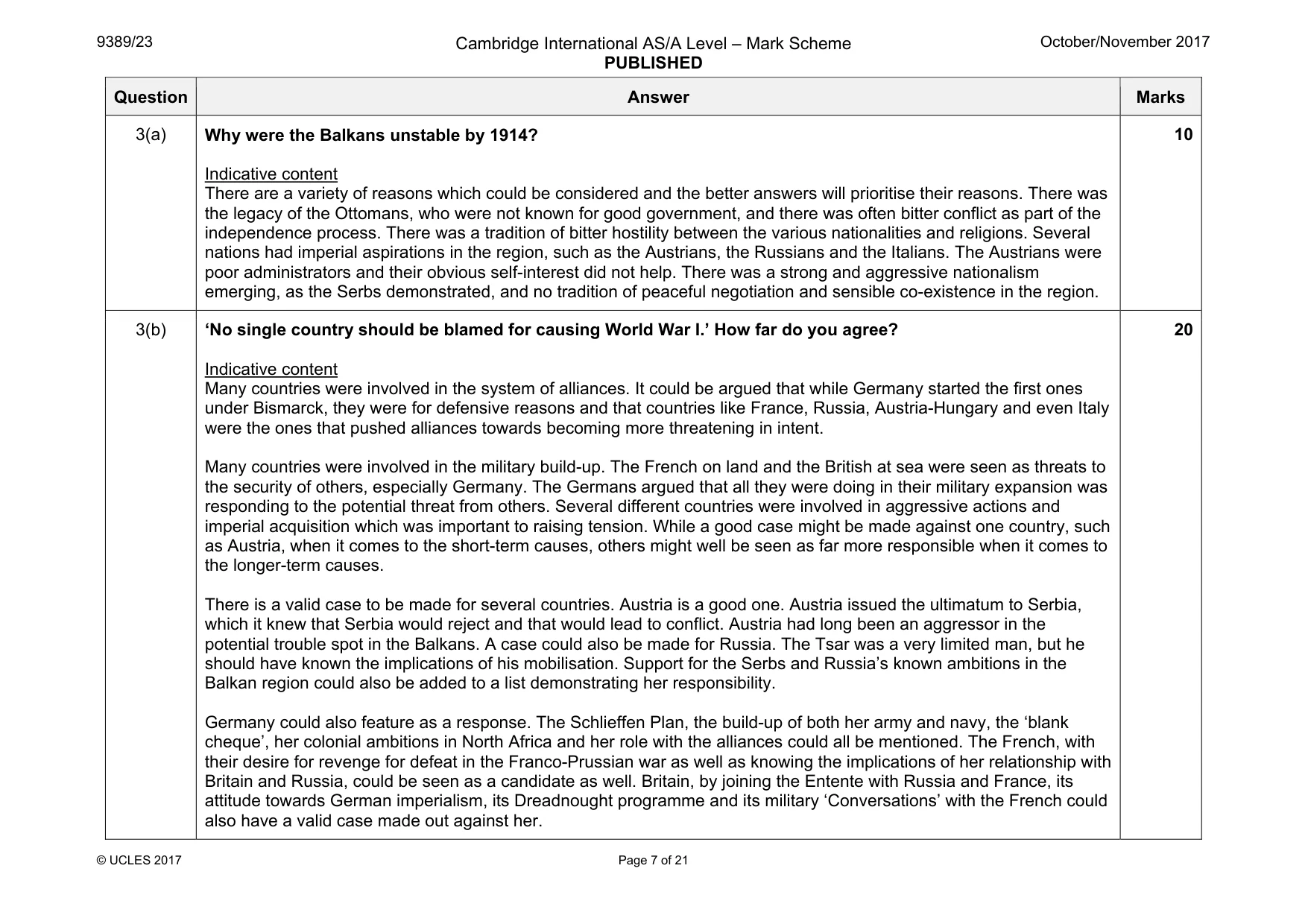
3 The Origins of World War I, 1900–1914 (a) Why were the Balkans unstable by 1914? [10] (b) ‘No single country should be blamed for causing World War I.’ How far do you agree? [20]
Mark scheme: 3(a) Why were the Balkans unstable by 1914? Indicative content There are a variety of reasons which could be considered and the better answers will prioritise their reasons. There was the legacy of the Ottomans, who were not known for good government, and there was often bitter conflict as part of the independence process. There was a tradition of bitter hostility between the various nationalities and religions. Several nations had imperial aspirations in the region, such as the Austrians, the Russians and the Italians. The Austrians were poor administrators and their obvious self-interest did not help. There was a strong and aggressive nationalism emerging, as the Serbs demonstrated, and no tradition of peaceful negotiation and sensible co-existence in the region. 10 3(b) ‘No single country should be blamed for causing World War I.’ How far do you agree? Indicative content Many countries were involved in the system of alliances. It could be argued that while Germany started the first ones under Bismarck, they were for defensive reasons and that countries like France, Russia, Austria-Hungary and even Italy were the ones that pushed alliances towards becoming more threatening in intent. Many countries were involved in the military build-up. The French on land and the British at sea were seen as threats to the security of others, especially Germany. The Germans argued that all they were doing in their military expansion was responding to the potential threat from others. Several different countries were involved in aggressive actions and imperial acquisition which was important to raising tension. While a good case might be made against one country, such as Austria, when it comes to the short-term causes, others might well be seen as far more responsible when it comes to the longer-term causes. There is a valid case to be made for several countries. Austria is a good one. Austria issued the ultimatum to Serbia, which it knew that Serbia would reject and that would lead to conflict. Austria had long been an aggressor in the potential trouble spot in the Balkans. A case could also be made for Russia. The Tsar was a very limited man, but he should have known the implications of his mobilisation. Support for the Serbs and Russia’s known ambitions in the Balkan region could also be added to a list demonstrating her responsibility. Germany could also feature as a response. The Schlieffen Plan, the build-up of both her army and navy, the ‘blank cheque’, her colonial ambitions in North Africa and her role with the alliances could all be mentioned. The French, with their desire for revenge for defeat in the Franco-Prussian war as well as knowing the implications of her relationship with Britain and Russia, could be seen as a candidate as well. Britain, by joining the Entente with Russia and France, its attitude towards German imperialism, its Dreadnought programme and its military ‘Conversations’ with the French could also have a valid case made out against her. 20
Q4 · The Russian Revolution, c.1894–1917 (a) Why were political reforms introduced in Russia…
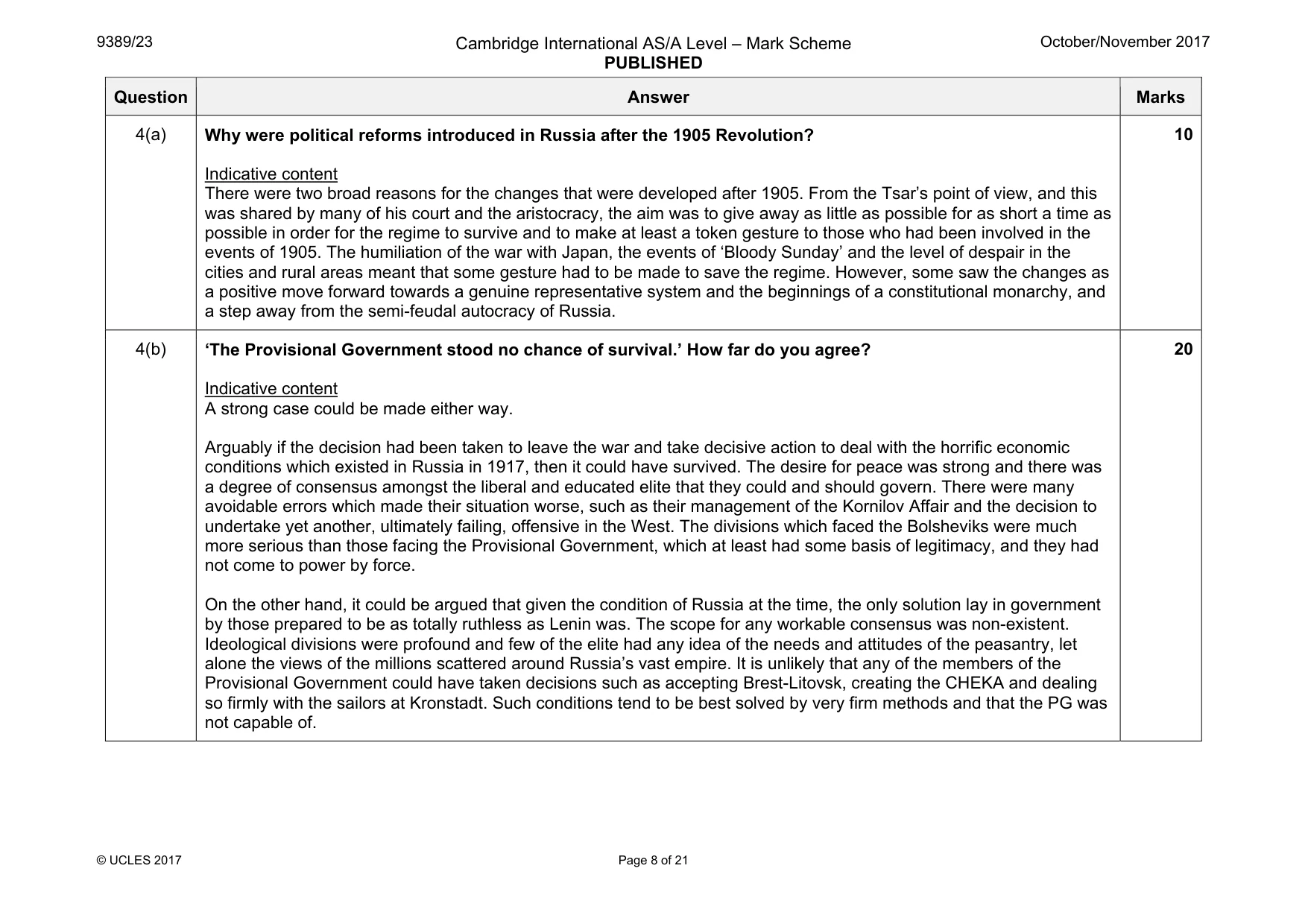
4 The Russian Revolution, c.1894–1917 (a) Why were political reforms introduced in Russia after the 1905 Revolution? [10] (b) ‘The Provisional Government stood no chance of survival.’ How far do you agree? [20]
Mark scheme: 4(a) Why were political reforms introduced in Russia after the 1905 Revolution? Indicative content There were two broad reasons for the changes that were developed after 1905. From the Tsar’s point of view, and this was shared by many of his court and the aristocracy, the aim was to give away as little as possible for as short a time as possible in order for the regime to survive and to make at least a token gesture to those who had been involved in the events of 1905. The humiliation of the war with Japan, the events of ‘Bloody Sunday’ and the level of despair in the cities and rural areas meant that some gesture had to be made to save the regime. However, some saw the changes as a positive move forward towards a genuine representative system and the beginnings of a constitutional monarchy, and a step away from the semi-feudal autocracy of Russia. 10 4(b) ‘The Provisional Government stood no chance of survival.’ How far do you agree? Indicative content A strong case could be made either way. Arguably if the decision had been taken to leave the war and take decisive action to deal with the horrific economic conditions which existed in Russia in 1917, then it could have survived. The desire for peace was strong and there was a degree of consensus amongst the liberal and educated elite that they could and should govern. There were many avoidable errors which made their situation worse, such as their management of the Kornilov Affair and the decision to undertake yet another, ultimately failing, offensive in the West. The divisions which faced the Bolsheviks were much more serious than those facing the Provisional Government, which at least had some basis of legitimacy, and they had not come to power by force. On the other hand, it could be argued that given the condition of Russia at the time, the only solution lay in government by those prepared to be as totally ruthless as Lenin was. The scope for any workable consensus was non-existent. Ideological divisions were profound and few of the elite had any idea of the needs and attitudes of the peasantry, let alone the views of the millions scattered around Russia’s vast empire. It is unlikely that any of the members of the Provisional Government could have taken decisions such as accepting Brest-Litovsk, creating the CHEKA and dealing so firmly with the sailors at Kronstadt. Such conditions tend to be best solved by very firm methods and that the PG was not capable of. 20
Q5 · The Expansion of US Power from the 1840s to the 1930s (a) Why was the USA hostile to the…
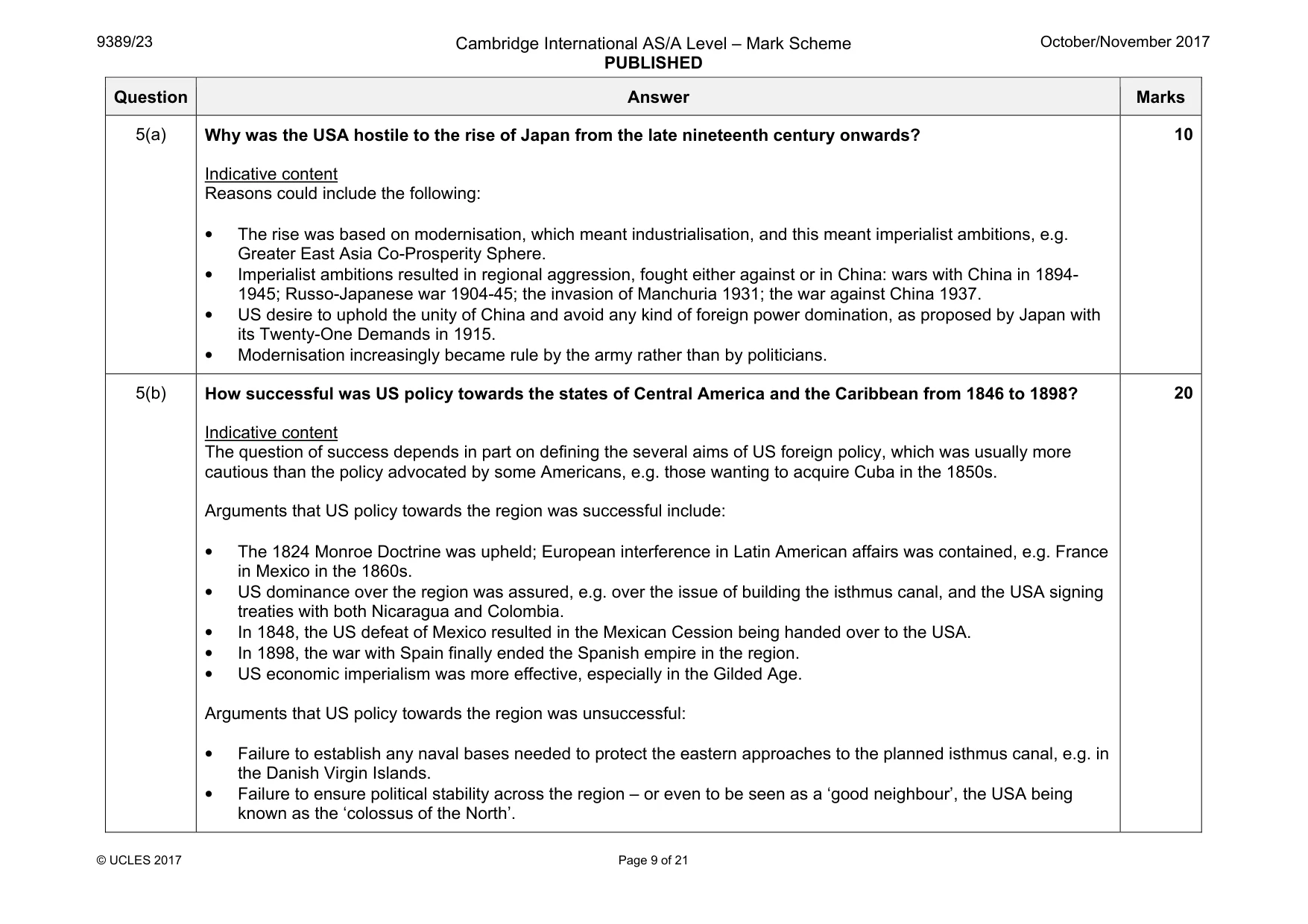
5 The Expansion of US Power from the 1840s to the 1930s (a) Why was the USA hostile to the rise of Japan from the late nineteenth century onwards? [10] (b) How successful was US policy towards the states of Central America and the Caribbean from 1846 to 1898? [20]
Mark scheme: 5(a) Why was the USA hostile to the rise of Japan from the late nineteenth century onwards? Indicative content Reasons could include the following: • The rise was based on modernisation, which meant industrialisation, and this meant imperialist ambitions, e.g. Greater East Asia Co-Prosperity Sphere. • Imperialist ambitions resulted in regional aggression, fought either against or in China: wars with China in 1894- 1945; Russo-Japanese war 1904-45; the invasion of Manchuria 1931; the war against China 1937. • US desire to uphold the unity of China and avoid any kind of foreign power domination, as proposed by Japan with its Twenty-One Demands in 1915. • Modernisation increasingly became rule by the army rather than by politicians. 10 5(b) How successful was US policy towards the states of Central America and the Caribbean from 1846 to 1898? Indicative content The question of success depends in part on defining the several aims of US foreign policy, which was usually more cautious than the policy advocated by some Americans, e.g. those wanting to acquire Cuba in the 1850s. Arguments that US policy towards the region was successful include: • The 1824 Monroe Doctrine was upheld; European interference in Latin American affairs was contained, e.g. France in Mexico in the 1860s. • US dominance over the region was assured, e.g. over the issue of building the isthmus canal, and the USA signing treaties with both Nicaragua and Colombia. • In 1848, the US defeat of Mexico resulted in the Mexican Cession being handed over to the USA. • In 1898, the war with Spain finally ended the Spanish empire in the region. • US economic imperialism was more effective, especially in the Gilded Age. Arguments that US policy towards the region was unsuccessful: • Failure to establish any naval bases needed to protect the eastern approaches to the planned isthmus canal, e.g. in the Danish Virgin Islands. • Failure to ensure political stability across the region – or even to be seen as a ‘good neighbour’, the USA being known as the ‘colossus of the North’. 20
Q6 · Civil War and Reconstruction, 1861–1877 (a) Why was there opposition in the North to…
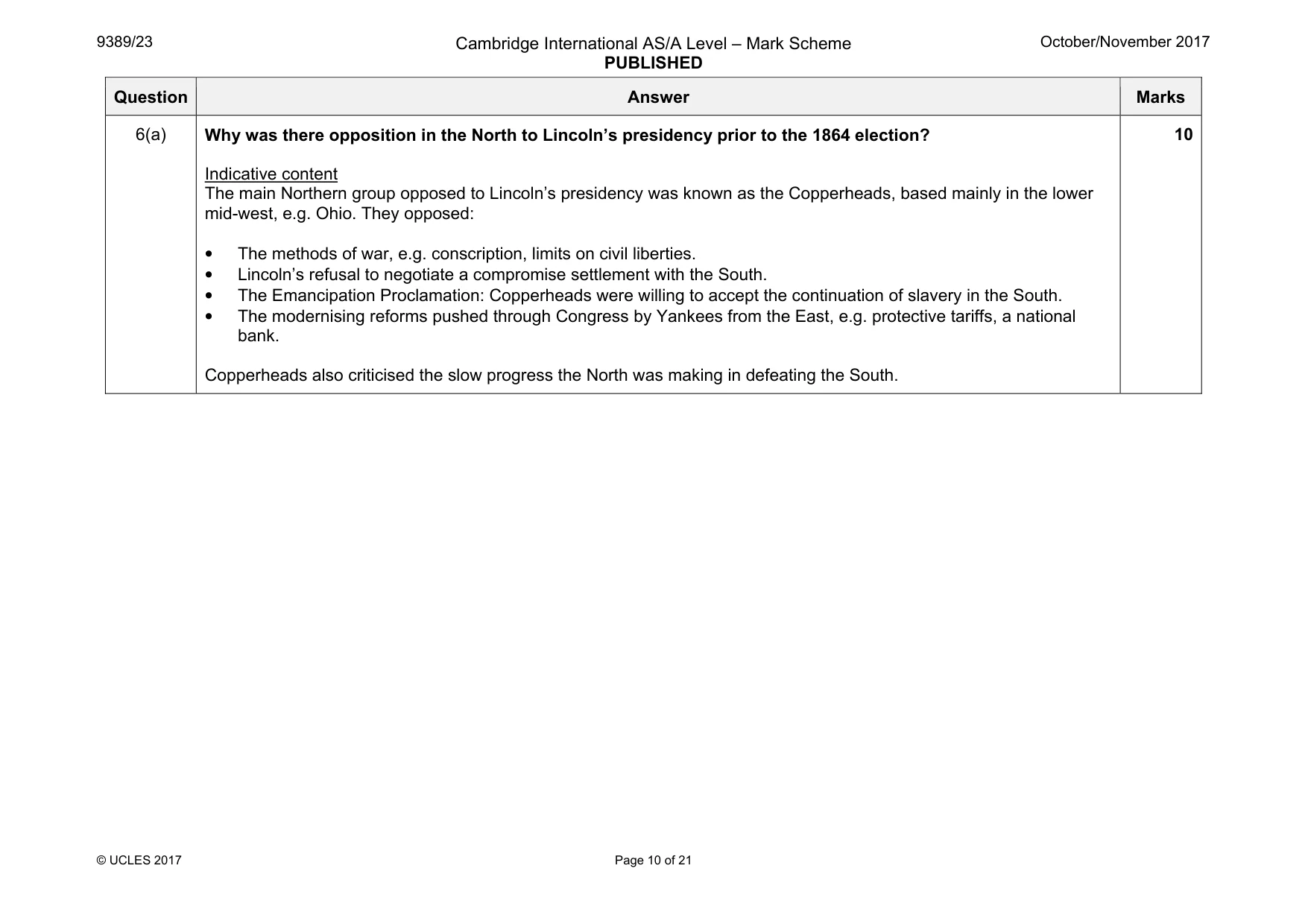
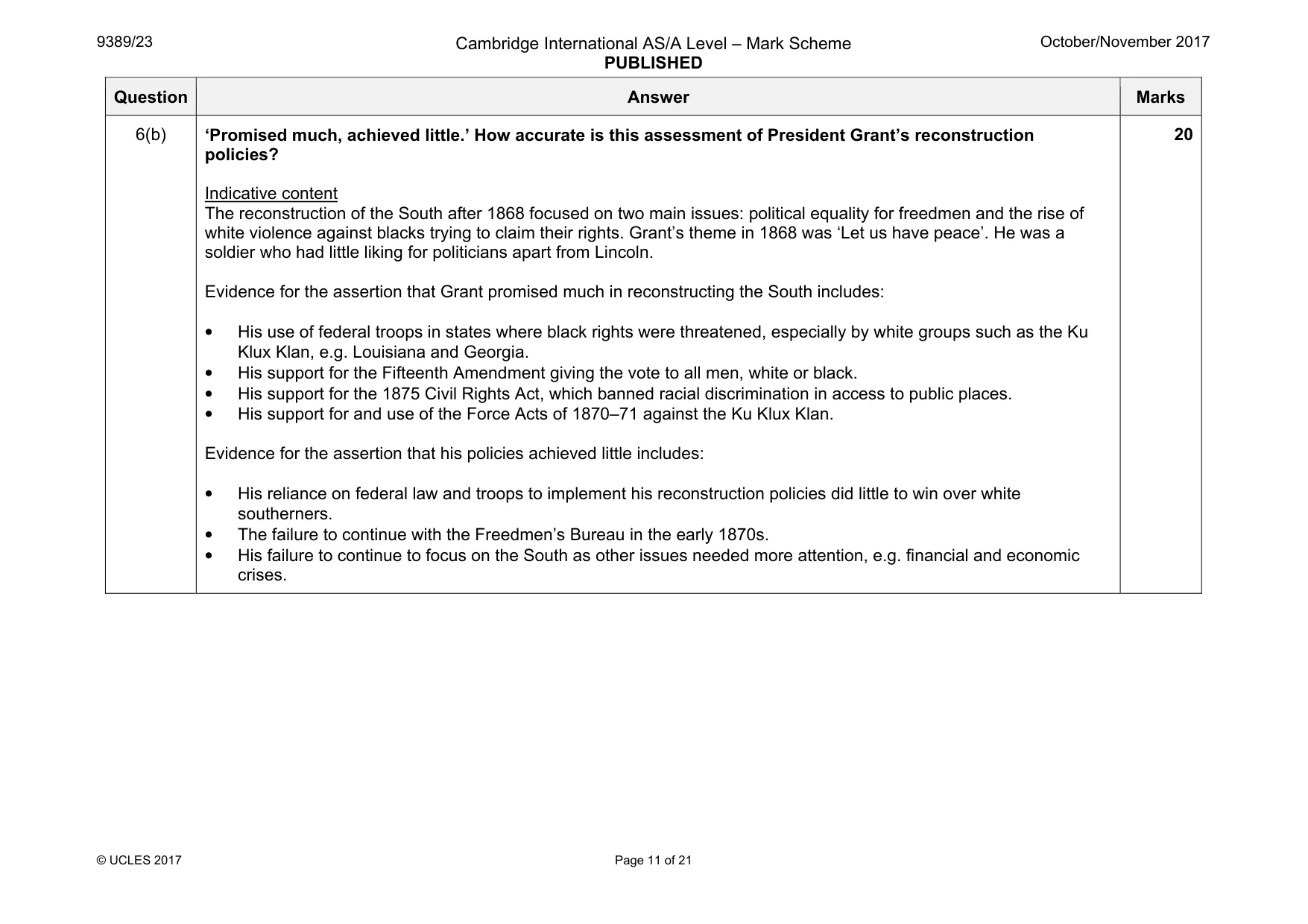
6 Civil War and Reconstruction, 1861–1877 (a) Why was there opposition in the North to Lincoln’s presidency prior to the 1864 election? [10] (b) ‘Promised much, achieved little.’ How accurate is this assessment of President Grant’s reconstruction policies? [20]
Mark scheme: 6(a) Why was there opposition in the North to Lincoln’s presidency prior to the 1864 election? Indicative content The main Northern group opposed to Lincoln’s presidency was known as the Copperheads, based mainly in the lower mid-west, e.g. Ohio. They opposed: • The methods of war, e.g. conscription, limits on civil liberties. • Lincoln’s refusal to negotiate a compromise settlement with the South. • The Emancipation Proclamation: Copperheads were willing to accept the continuation of slavery in the South. • The modernising reforms pushed through Congress by Yankees from the East, e.g. protective tariffs, a national bank. Copperheads also criticised the slow progress the North was making in defeating the South. 10 Question Answer Marks 6(b) ‘Promised much, achieved little.’ How accurate is this assessment of President Grant’s reconstruction policies? Indicative content The reconstruction of the South after 1868 focused on two main issues: political equality for freedmen and the rise of white violence against blacks trying to claim their rights. Grant’s theme in 1868 was ‘Let us have peace’. He was a soldier who had little liking for politicians apart from Lincoln. Evidence for the assertion that Grant promised much in reconstructing the South includes: • His use of federal troops in states where black rights were threatened, especially by white groups such as the Ku Klux Klan, e.g. Louisiana and Georgia. • His support for the Fifteenth Amendment giving the vote to all men, white or black. • His support for the 1875 Civil Rights Act, which banned racial discrimination in access to public places. • His support for and use of the Force Acts of 1870–71 against the Ku Klux Klan. Evidence for the assertion that his policies achieved little includes: • His reliance on federal law and troops to implement his reconstruction policies did little to win over white southerners. • The failure to continue with the Freedmen’s Bureau in the early 1870s. • His failure to continue to focus on the South as other issues needed more attention, e.g. financial and economic crises. 20
Q7 · The Gilded Age and the Progressive Era, from the 1870s to the 1920s (a) Why did the…
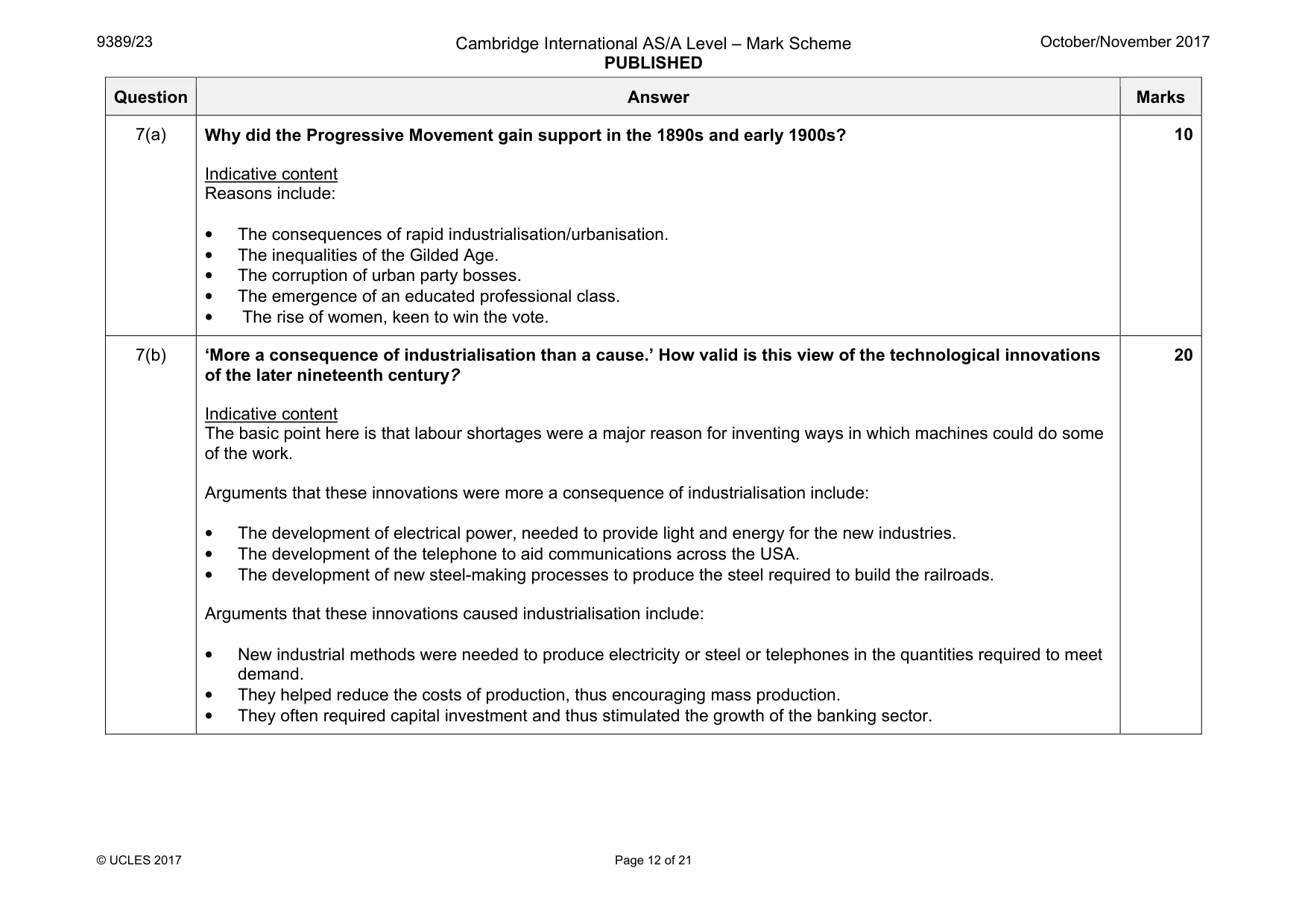
7 The Gilded Age and the Progressive Era, from the 1870s to the 1920s (a) Why did the Progressive Movement gain support in the 1890s and early 1900s? [10] (b) ‘More a consequence of industrialisation than a cause.’ How valid is this view of the technological innovations of the later nineteenth century? [20]
Mark scheme: 7(a) Why did the Progressive Movement gain support in the 1890s and early 1900s? Indicative content Reasons include: • The consequences of rapid industrialisation/urbanisation. • The inequalities of the Gilded Age. • The corruption of urban party bosses. • The emergence of an educated professional class. • The rise of women, keen to win the vote. 10 7(b) ‘More a consequence of industrialisation than a cause.’ How valid is this view of the technological innovations of the later nineteenth century? Indicative content The basic point here is that labour shortages were a major reason for inventing ways in which machines could do some of the work. Arguments that these innovations were more a consequence of industrialisation include: • The development of electrical power, needed to provide light and energy for the new industries. • The development of the telephone to aid communications across the USA. • The development of new steel-making processes to produce the steel required to build the railroads. Arguments that these innovations caused industrialisation include: • New industrial methods were needed to produce electricity or steel or telephones in the quantities required to meet demand. • They helped reduce the costs of production, thus encouraging mass production. • They often required capital investment and thus stimulated the growth of the banking sector. 20
Q8 · The Great Crash, the Great Depression and the New Deal, from the 1920s to 1941 (a) Why…
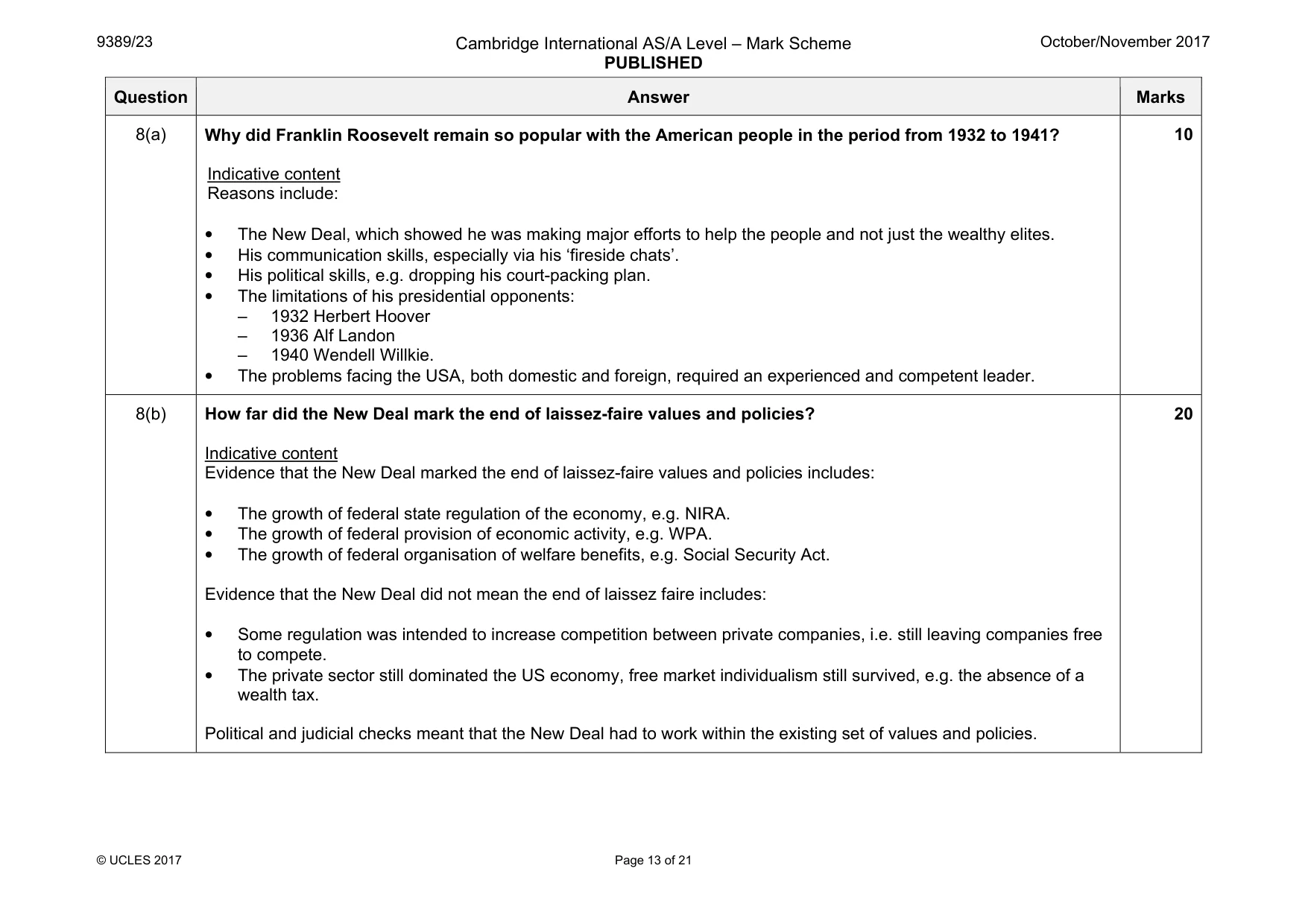
8 The Great Crash, the Great Depression and the New Deal, from the 1920s to 1941 (a) Why did Franklin Roosevelt remain so popular with the American people in the period from 1932 to 1941? [10] (b) How far did the New Deal mark the end of laissez-faire values and policies? [20] Section C: International Option International Relations, 1871–1945 Answer both parts of two questions.
Mark scheme: 8(a) Why did Franklin Roosevelt remain so popular with the American people in the period from 1932 to 1941? Indicative content Reasons include: • The New Deal, which showed he was making major efforts to help the people and not just the wealthy elites. • His communication skills, especially via his ‘fireside chats’. • His political skills, e.g. dropping his court-packing plan. • The limitations of his presidential opponents: – 1932 Herbert Hoover – 1936 Alf Landon – 1940 Wendell Willkie. • The problems facing the USA, both domestic and foreign, required an experienced and competent leader. 10 8(b) How far did the New Deal mark the end of laissez-faire values and policies? Indicative content Evidence that the New Deal marked the end of laissez-faire values and policies includes: • The growth of federal state regulation of the economy, e.g. NIRA. • The growth of federal provision of economic activity, e.g. WPA. • The growth of federal organisation of welfare benefits, e.g. Social Security Act. Evidence that the New Deal did not mean the end of laissez faire includes: • Some regulation was intended to increase competition between private companies, i.e. still leaving companies free to compete. • The private sector still dominated the US economy, free market individualism still survived, e.g. the absence of a wealth tax. Political and judicial checks meant that the New Deal had to work within the existing set of values and policies. 20
Q9 · International Relations, 1871–1918 (a) Why did European nations show such an interest in…
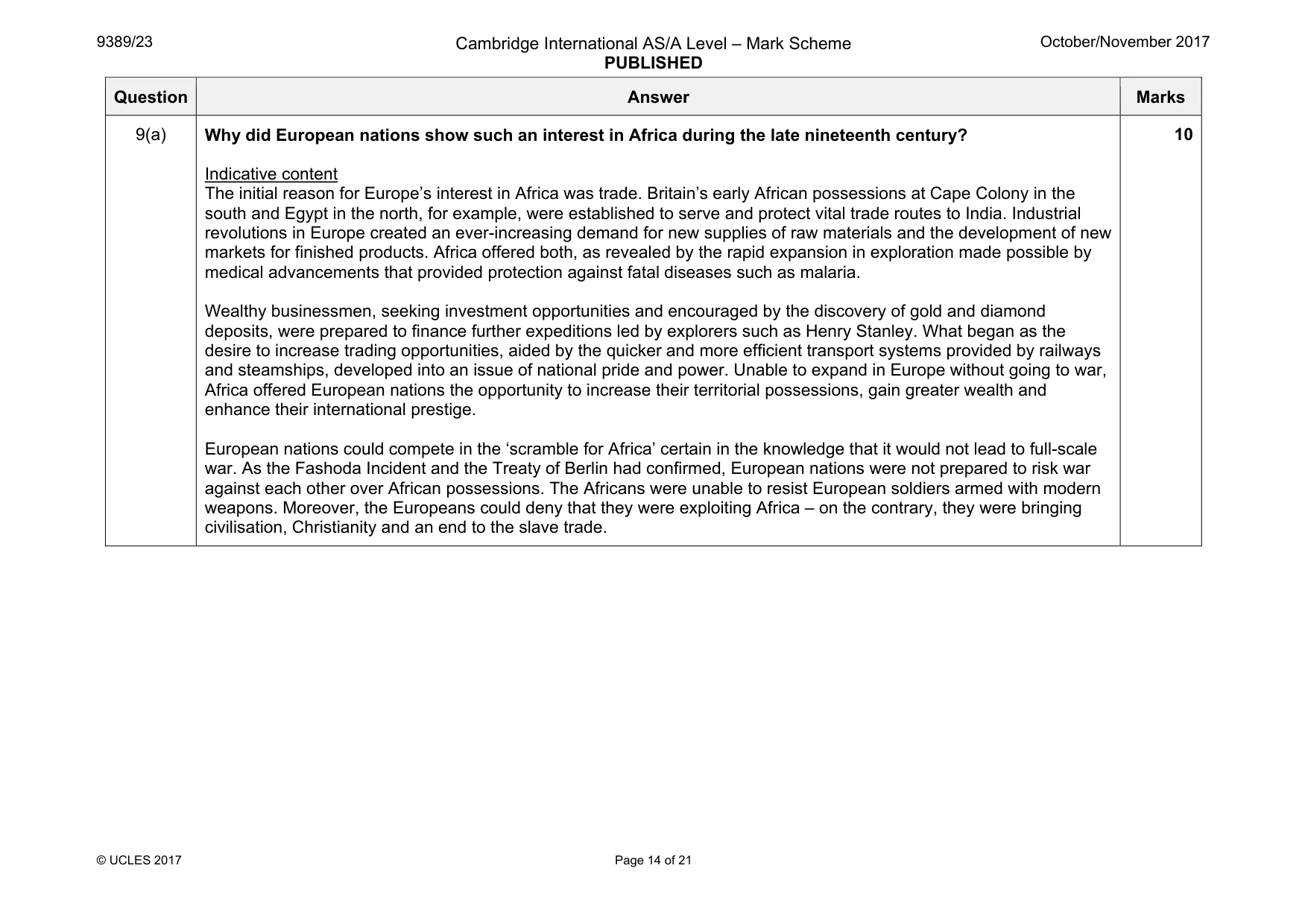
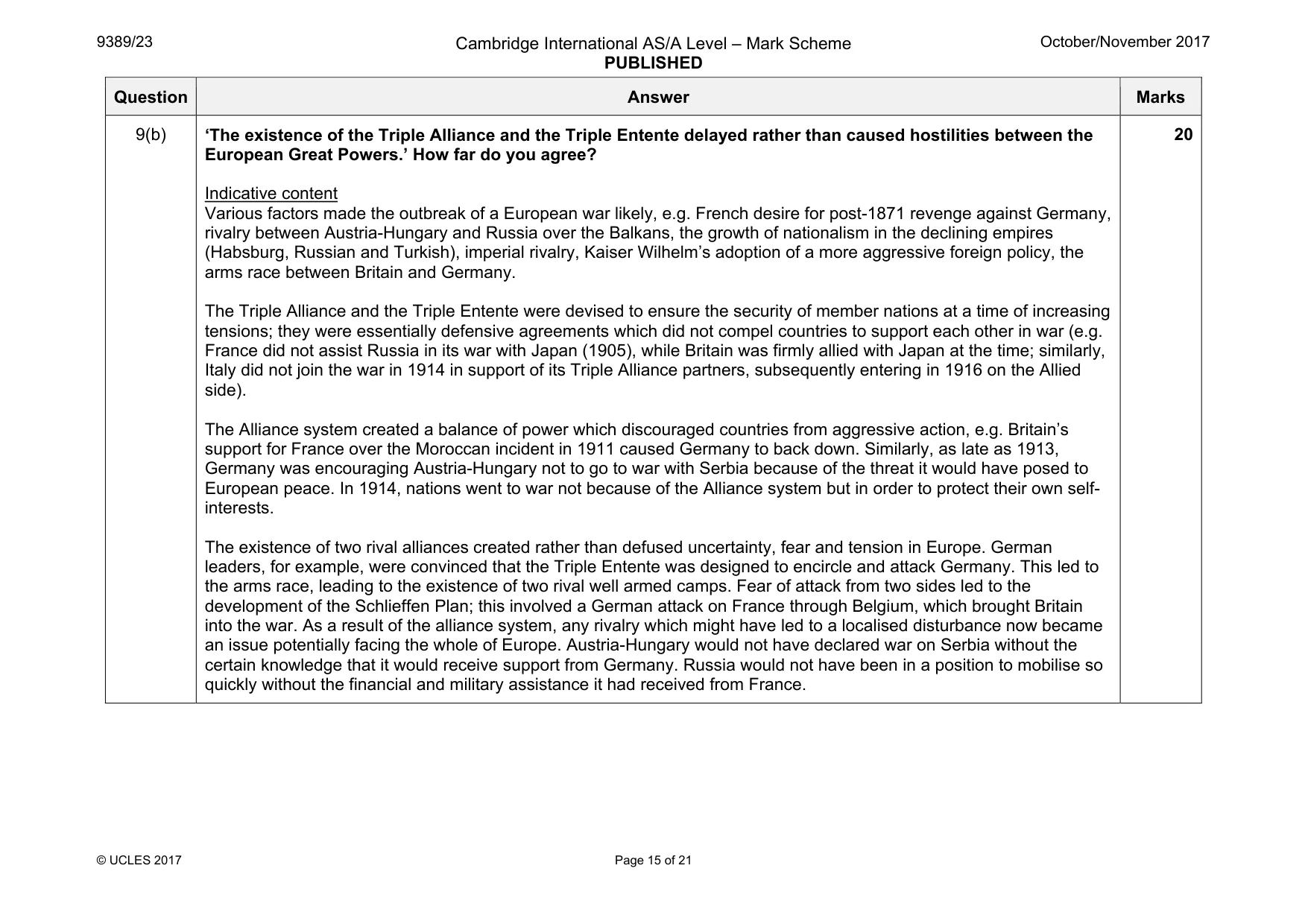
9 International Relations, 1871–1918 (a) Why did European nations show such an interest in Africa during the late nineteenth century? [10] (b) ‘The existence of the Triple Alliance and the Triple Entente delayed rather than caused hostilities between the European Great Powers.’ How far do you agree? [20]
Mark scheme: 9(a) Why did European nations show such an interest in Africa during the late nineteenth century? Indicative content The initial reason for Europe’s interest in Africa was trade. Britain’s early African possessions at Cape Colony in the south and Egypt in the north, for example, were established to serve and protect vital trade routes to India. Industrial revolutions in Europe created an ever-increasing demand for new supplies of raw materials and the development of new markets for finished products. Africa offered both, as revealed by the rapid expansion in exploration made possible by medical advancements that provided protection against fatal diseases such as malaria. Wealthy businessmen, seeking investment opportunities and encouraged by the discovery of gold and diamond deposits, were prepared to finance further expeditions led by explorers such as Henry Stanley. What began as the desire to increase trading opportunities, aided by the quicker and more efficient transport systems provided by railways and steamships, developed into an issue of national pride and power. Unable to expand in Europe without going to war, Africa offered European nations the opportunity to increase their territorial possessions, gain greater wealth and enhance their international prestige. European nations could compete in the ‘scramble for Africa’ certain in the knowledge that it would not lead to full-scale war. As the Fashoda Incident and the Treaty of Berlin had confirmed, European nations were not prepared to risk war against each other over African possessions. The Africans were unable to resist European soldiers armed with modern weapons. Moreover, the Europeans could deny that they were exploiting Africa – on the contrary, they were bringing civilisation, Christianity and an end to the slave trade. 10 Question Answer Marks 9(b) ‘The existence of the Triple Alliance and the Triple Entente delayed rather than caused hostilities between the European Great Powers.’ How far do you agree? Indicative content Various factors made the outbreak of a European war likely, e.g. French desire for post-1871 revenge against Germany, rivalry between Austria-Hungary and Russia over the Balkans, the growth of nationalism in the declining empires (Habsburg, Russian and Turkish), imperial rivalry, Kaiser Wilhelm’s adoption of a more aggressive foreign policy, the arms race between Britain and Germany. The Triple Alliance and the Triple Entente were devised to ensure the security of member nations at a time of increasing tensions; they were essentially defensive agreements which did not compel countries to support each other in war (e.g. France did not assist Russia in its war with Japan (1905), while Britain was firmly allied with Japan at the time; similarly, Italy did not join the war in 1914 in support of its Triple Alliance partners, subsequently entering in 1916 on the Allied side). The Alliance system created a balance of power which discouraged countries from aggressive action, e.g. Britain’s support for France over the Moroccan incident in 1911 caused Germany to back down. Similarly, as late as 1913, Germany was encouraging Austria-Hungary not to go to war with Serbia because of the threat it would have posed to European peace. In 1914, nations went to war not because of the Alliance system but in order to protect their own self- interests. The existence of two rival alliances created rather than defused uncertainty, fear and tension in Europe. German leaders, for example, were convinced that the Triple Entente was designed to encircle and attack Germany. This led to the arms race, leading to the existence of two rival well armed camps. Fear of attack from two sides led to the development of the Schlieffen Plan; this involved a German attack on France through Belgium, which brought Britain into the war. As a result of the alliance system, any rivalry which might have led to a localised disturbance now became an issue potentially facing the whole of Europe. Austria-Hungary would not have declared war on Serbia without the certain knowledge that it would receive support from Germany. Russia would not have been in a position to mobilise so quickly without the financial and military assistance it had received from France. 20
Q10 · International Relations, 1919–1933 (a) Why did relations between France and Germany…
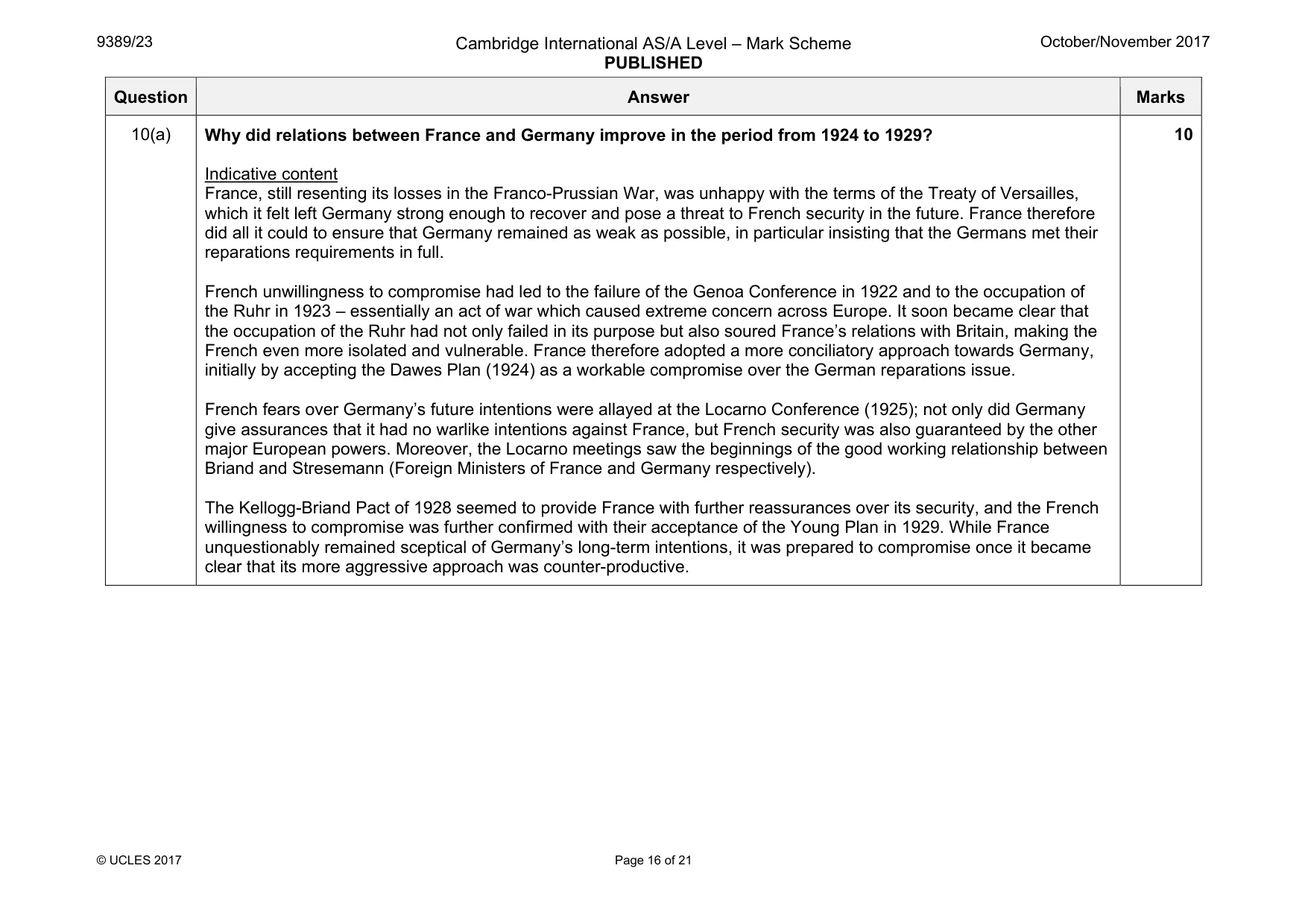
10 International Relations, 1919–1933 (a) Why did relations between France and Germany improve in the period from 1924 to 1929? [10] (b) ‘An idealist with little understanding of the problems facing Europe.’ How far do you agree with this assessment of President Woodrow Wilson’s contribution to the Paris Peace Settlement? [20]
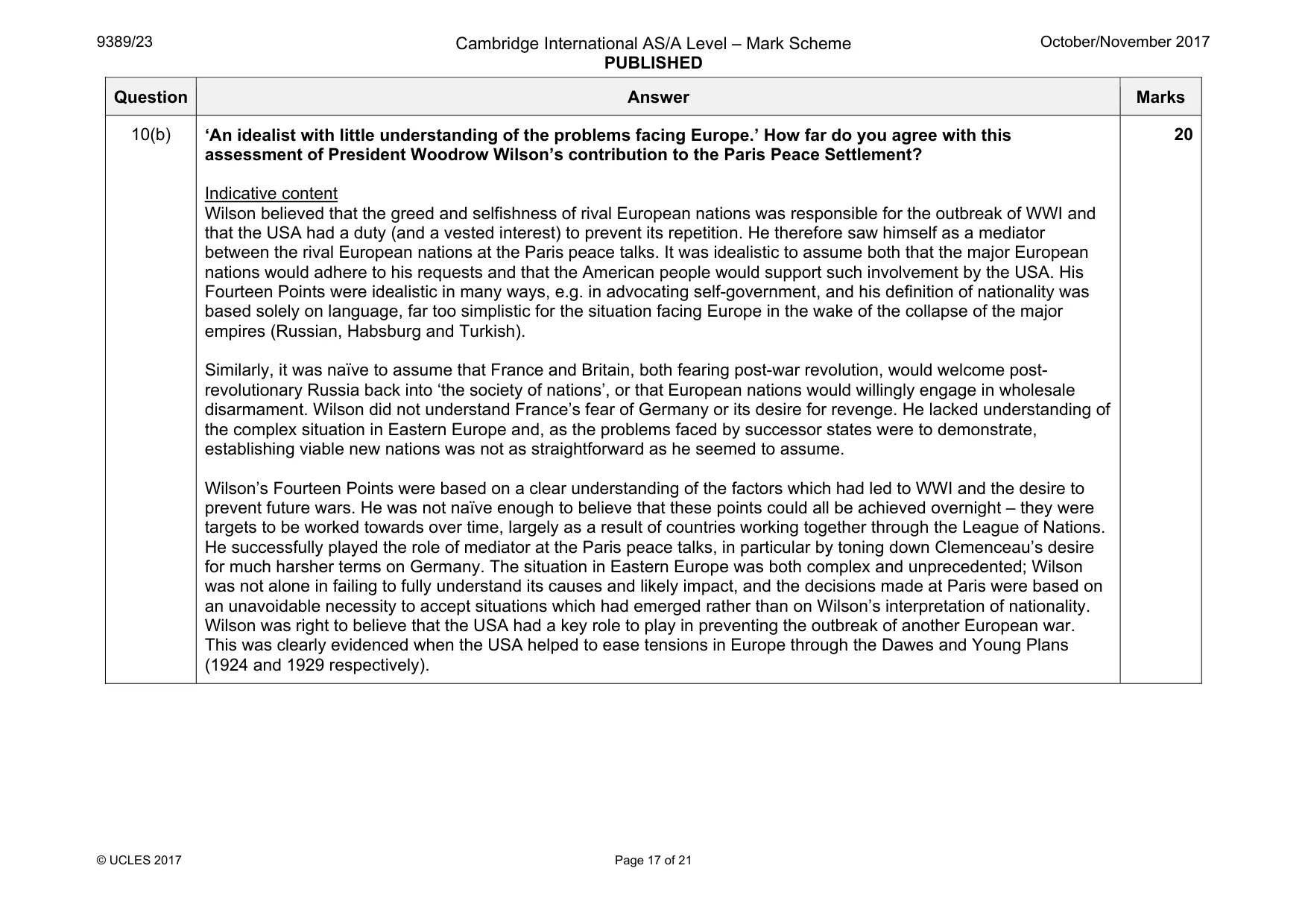
Mark scheme: 10(a) Why did relations between France and Germany improve in the period from 1924 to 1929? Indicative content France, still resenting its losses in the Franco-Prussian War, was unhappy with the terms of the Treaty of Versailles, which it felt left Germany strong enough to recover and pose a threat to French security in the future. France therefore did all it could to ensure that Germany remained as weak as possible, in particular insisting that the Germans met their reparations requirements in full. French unwillingness to compromise had led to the failure of the Genoa Conference in 1922 and to the occupation of the Ruhr in 1923 – essentially an act of war which caused extreme concern across Europe. It soon became clear that the occupation of the Ruhr had not only failed in its purpose but also soured France’s relations with Britain, making the French even more isolated and vulnerable. France therefore adopted a more conciliatory approach towards Germany, initially by accepting the Dawes Plan (1924) as a workable compromise over the German reparations issue. French fears over Germany’s future intentions were allayed at the Locarno Conference (1925); not only did Germany give assurances that it had no warlike intentions against France, but French security was also guaranteed by the other major European powers. Moreover, the Locarno meetings saw the beginnings of the good working relationship between Briand and Stresemann (Foreign Ministers of France and Germany respectively). The Kellogg-Briand Pact of 1928 seemed to provide France with further reassurances over its security, and the French willingness to compromise was further confirmed with their acceptance of the Young Plan in 1929. While France unquestionably remained sceptical of Germany’s long-term intentions, it was prepared to compromise once it became clear that its more aggressive approach was counter-productive. 10 Question Answer Marks 10(b) ‘An idealist with little understanding of the problems facing Europe.’ How far do you agree with this assessment of President Woodrow Wilson’s contribution to the Paris Peace Settlement? Indicative content Wilson believed that the greed and selfishness of rival European nations was responsible for the outbreak of WWI and that the USA had a duty (and a vested interest) to prevent its repetition. He therefore saw himself as a mediator between the rival European nations at the Paris peace talks. It was idealistic to assume both that the major European nations would adhere to his requests and that the American people would support such involvement by the USA. His Fourteen Points were idealistic in many ways, e.g. in advocating self-government, and his definition of nationality was based solely on language, far too simplistic for the situation facing Europe in the wake of the collapse of the major empires (Russian, Habsburg and Turkish). Similarly, it was naïve to assume that France and Britain, both fearing post-war revolution, would welcome post- revolutionary Russia back into ‘the society of nations’, or that European nations would willingly engage in wholesale disarmament. Wilson did not understand France’s fear of Germany or its desire for revenge. He lacked understanding of the complex situation in Eastern Europe and, as the problems faced by successor states were to demonstrate, establishing viable new nations was not as straightforward as he seemed to assume. Wilson’s Fourteen Points were based on a clear understanding of the factors which had led to WWI and the desire to prevent future wars. He was not naïve enough to believe that these points could all be achieved overnight – they were targets to be worked towards over time, largely as a result of countries working together through the League of Nations. He successfully played the role of mediator at the Paris peace talks, in particular by toning down Clemenceau’s desire for much harsher terms on Germany. The situation in Eastern Europe was both complex and unprecedented; Wilson was not alone in failing to fully understand its causes and likely impact, and the decisions made at Paris were based on an unavoidable necessity to accept situations which had emerged rather than on Wilson’s interpretation of nationality. Wilson was right to believe that the USA had a key role to play in preventing the outbreak of another European war. This was clearly evidenced when the USA helped to ease tensions in Europe through the Dawes and Young Plans (1924 and 1929 respectively). 20
Q11 · International Relations, c.1933–1939 (a) Why did Mussolini’s relationship with Hitler…
11 International Relations, c.1933–1939 (a) Why did Mussolini’s relationship with Hitler change after 1934? [10] (b) To what extent was Britain’s appeasement policy in the 1930s motivated by fear of another major war? [20]
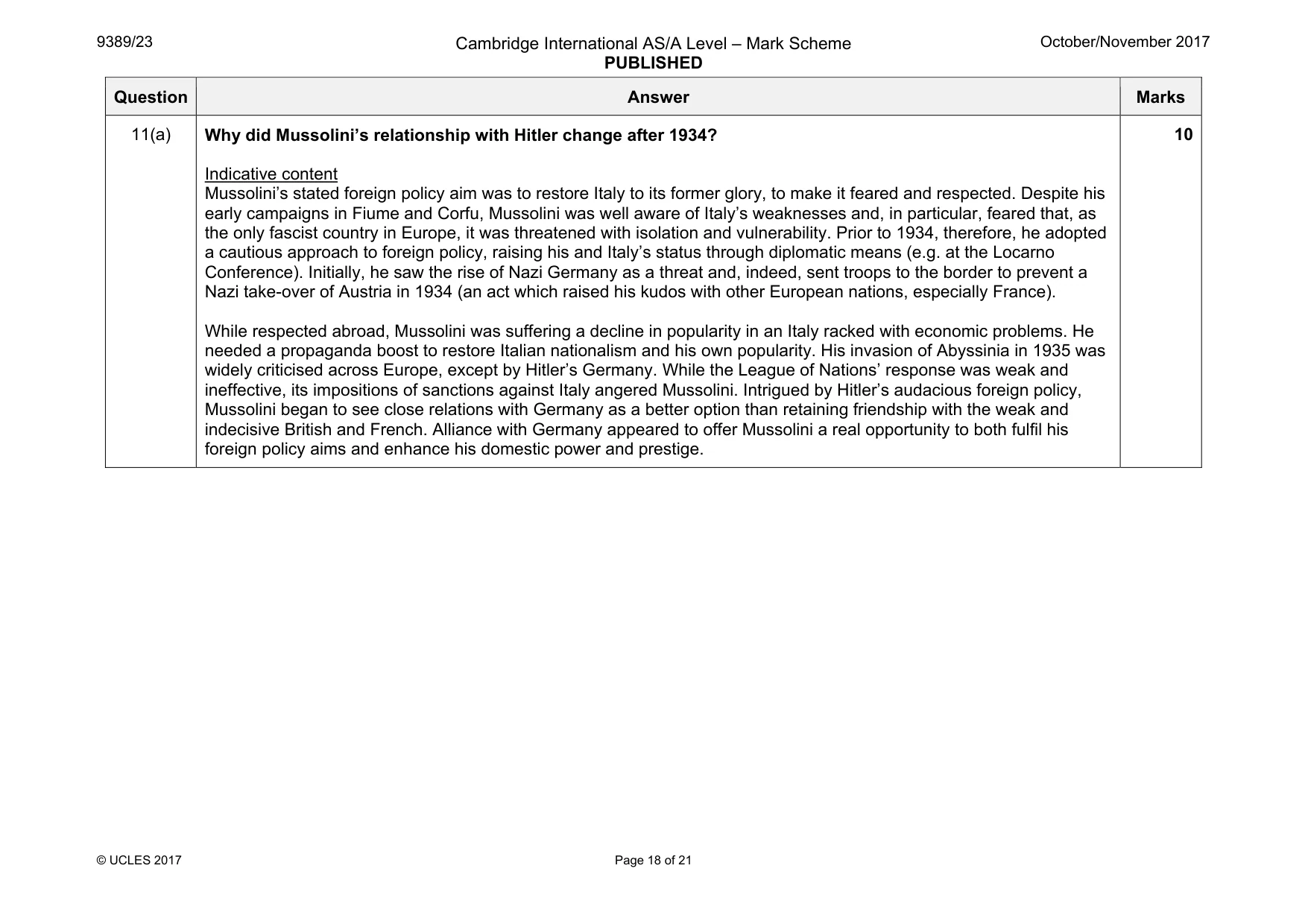
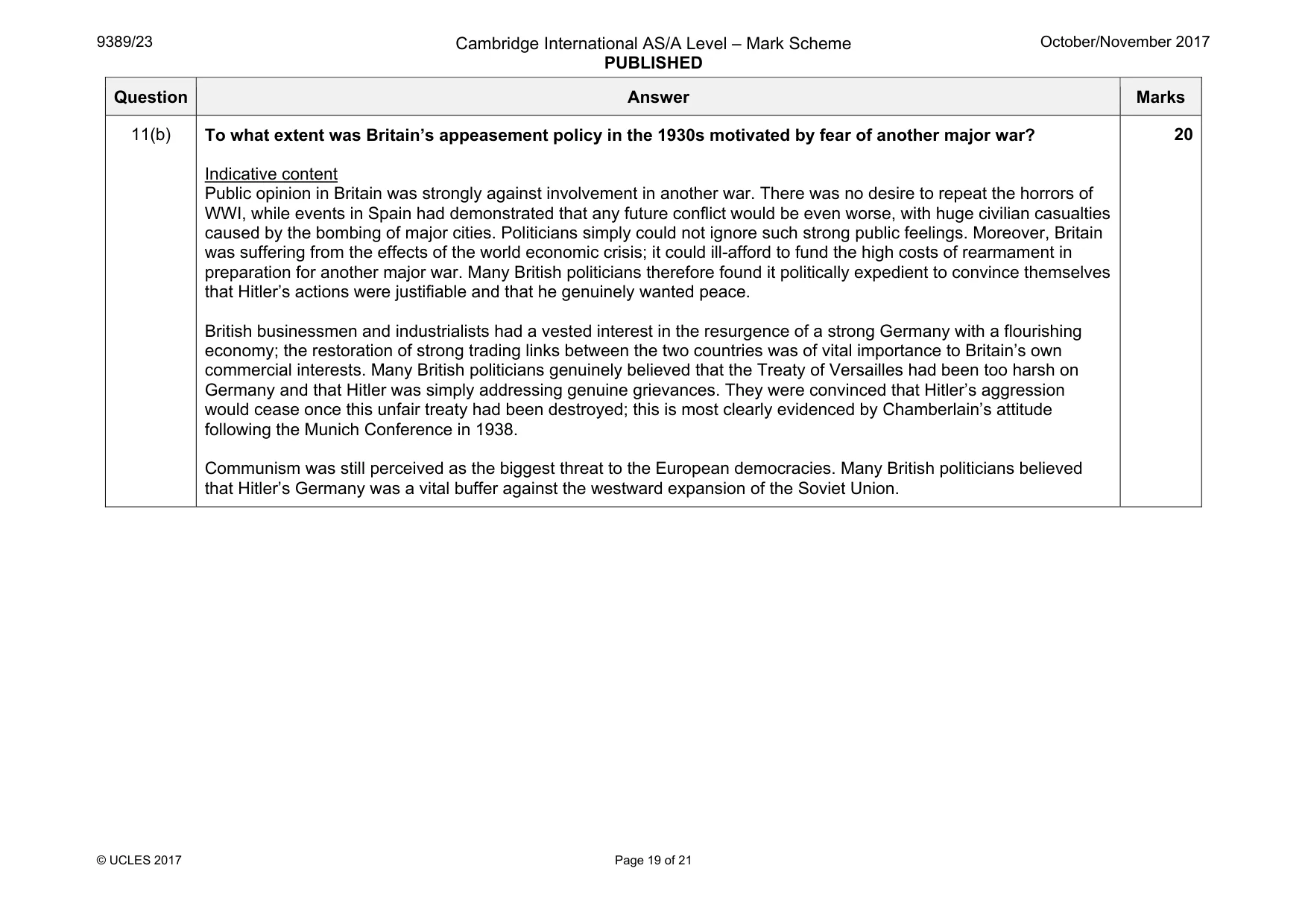
Mark scheme: 11(a) Why did Mussolini’s relationship with Hitler change after 1934? Indicative content Mussolini’s stated foreign policy aim was to restore Italy to its former glory, to make it feared and respected. Despite his early campaigns in Fiume and Corfu, Mussolini was well aware of Italy’s weaknesses and, in particular, feared that, as the only fascist country in Europe, it was threatened with isolation and vulnerability. Prior to 1934, therefore, he adopted a cautious approach to foreign policy, raising his and Italy’s status through diplomatic means (e.g. at the Locarno Conference). Initially, he saw the rise of Nazi Germany as a threat and, indeed, sent troops to the border to prevent a Nazi take-over of Austria in 1934 (an act which raised his kudos with other European nations, especially France). While respected abroad, Mussolini was suffering a decline in popularity in an Italy racked with economic problems. He needed a propaganda boost to restore Italian nationalism and his own popularity. His invasion of Abyssinia in 1935 was widely criticised across Europe, except by Hitler’s Germany. While the League of Nations’ response was weak and ineffective, its impositions of sanctions against Italy angered Mussolini. Intrigued by Hitler’s audacious foreign policy, Mussolini began to see close relations with Germany as a better option than retaining friendship with the weak and indecisive British and French. Alliance with Germany appeared to offer Mussolini a real opportunity to both fulfil his foreign policy aims and enhance his domestic power and prestige. 10 Question Answer Marks 11(b) To what extent was Britain’s appeasement policy in the 1930s motivated by fear of another major war? Indicative content Public opinion in Britain was strongly against involvement in another war. There was no desire to repeat the horrors of WWI, while events in Spain had demonstrated that any future conflict would be even worse, with huge civilian casualties caused by the bombing of major cities. Politicians simply could not ignore such strong public feelings. Moreover, Britain was suffering from the effects of the world economic crisis; it could ill-afford to fund the high costs of rearmament in preparation for another major war. Many British politicians therefore found it politically expedient to convince themselves that Hitler’s actions were justifiable and that he genuinely wanted peace. British businessmen and industrialists had a vested interest in the resurgence of a strong Germany with a flourishing economy; the restoration of strong trading links between the two countries was of vital importance to Britain’s own commercial interests. Many British politicians genuinely believed that the Treaty of Versailles had been too harsh on Germany and that Hitler was simply addressing genuine grievances. They were convinced that Hitler’s aggression would cease once this unfair treaty had been destroyed; this is most clearly evidenced by Chamberlain’s attitude following the Munich Conference in 1938. Communism was still perceived as the biggest threat to the European democracies. Many British politicians believed that Hitler’s Germany was a vital buffer against the westward expansion of the Soviet Union. 20
Q12 · China and Japan, 1919–1945 (a) Why did Chiang Kai-shek begin the Purification Movement in…
12 China and Japan, 1919–1945 (a) Why did Chiang Kai-shek begin the Purification Movement in 1927? [10] (b) ‘Entirely predictable.’ How far do you agree with this judgement regarding the Japanese attack on Pearl Harbor? [20]
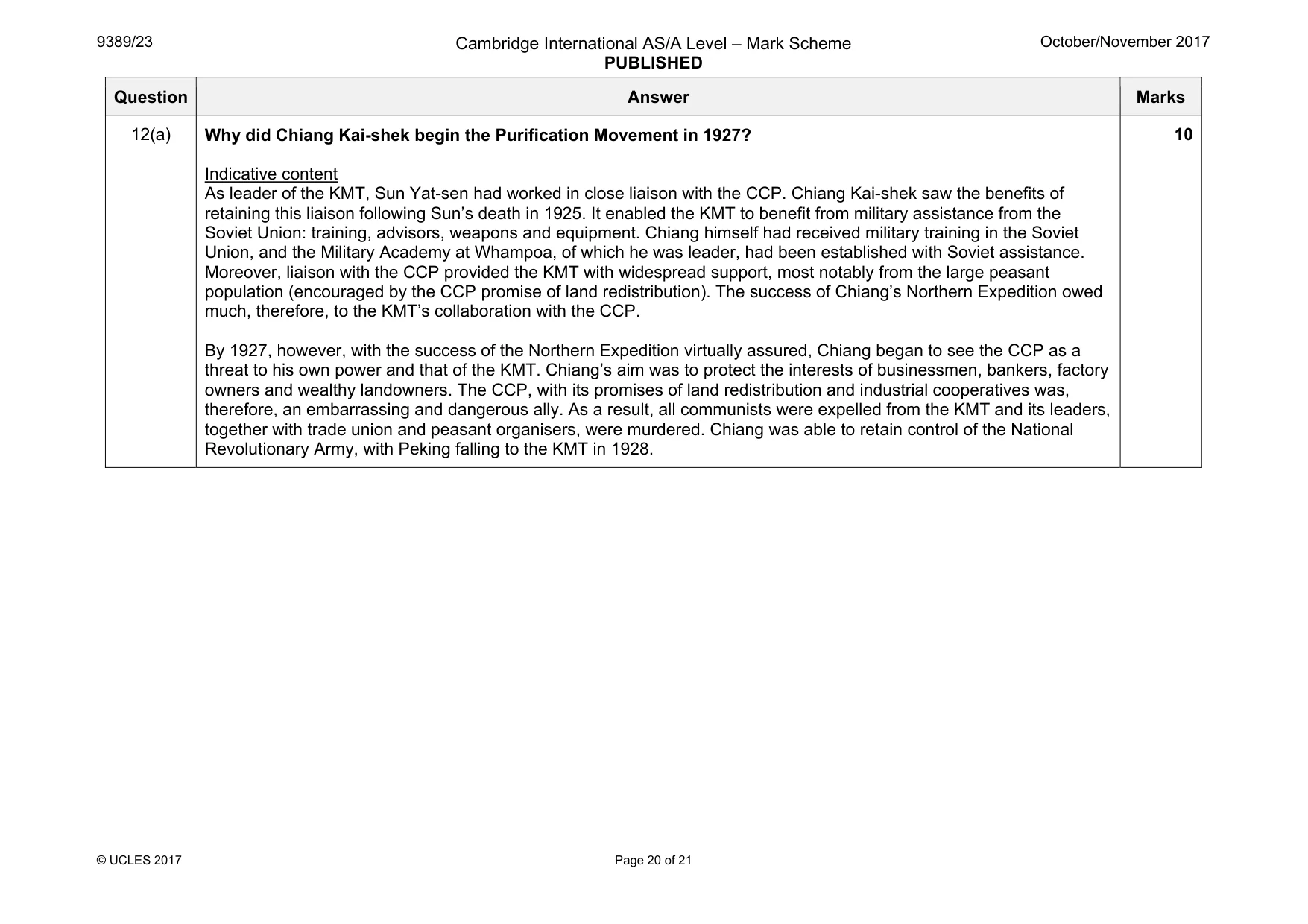
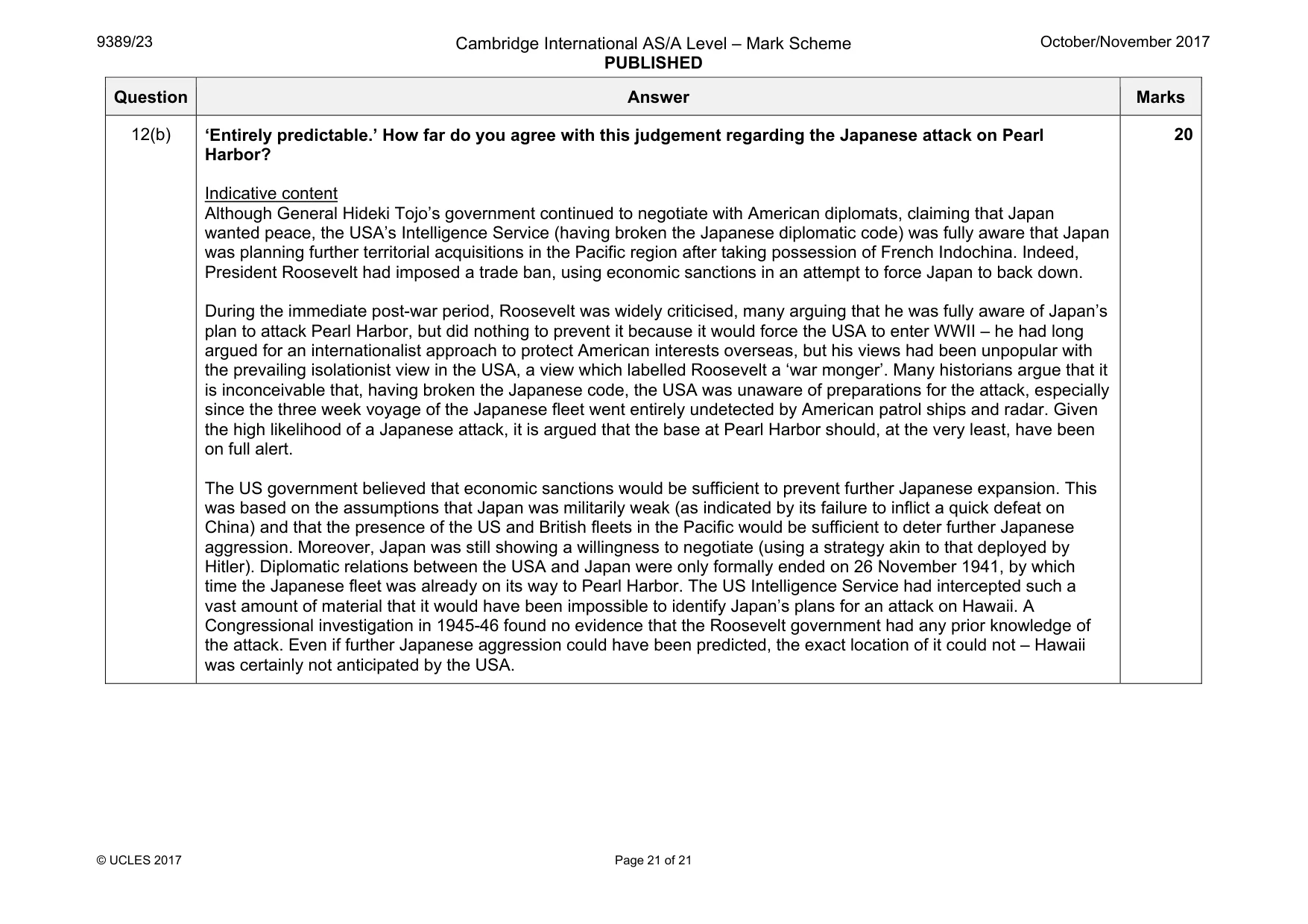
Mark scheme: 12(a) Why did Chiang Kai-shek begin the Purification Movement in 1927? Indicative content As leader of the KMT, Sun Yat-sen had worked in close liaison with the CCP. Chiang Kai-shek saw the benefits of retaining this liaison following Sun’s death in 1925. It enabled the KMT to benefit from military assistance from the Soviet Union: training, advisors, weapons and equipment. Chiang himself had received military training in the Soviet Union, and the Military Academy at Whampoa, of which he was leader, had been established with Soviet assistance. Moreover, liaison with the CCP provided the KMT with widespread support, most notably from the large peasant population (encouraged by the CCP promise of land redistribution). The success of Chiang’s Northern Expedition owed much, therefore, to the KMT’s collaboration with the CCP. By 1927, however, with the success of the Northern Expedition virtually assured, Chiang began to see the CCP as a threat to his own power and that of the KMT. Chiang’s aim was to protect the interests of businessmen, bankers, factory owners and wealthy landowners. The CCP, with its promises of land redistribution and industrial cooperatives was, therefore, an embarrassing and dangerous ally. As a result, all communists were expelled from the KMT and its leaders, together with trade union and peasant organisers, were murdered. Chiang was able to retain control of the National Revolutionary Army, with Peking falling to the KMT in 1928. 10 Question Answer Marks 12(b) ‘Entirely predictable.’ How far do you agree with this judgement regarding the Japanese attack on Pearl Harbor? Indicative content Although General Hideki Tojo’s government continued to negotiate with American diplomats, claiming that Japan wanted peace, the USA’s Intelligence Service (having broken the Japanese diplomatic code) was fully aware that Japan was planning further territorial acquisitions in the Pacific region after taking possession of French Indochina. Indeed, President Roosevelt had imposed a trade ban, using economic sanctions in an attempt to force Japan to back down. During the immediate post-war period, Roosevelt was widely criticised, many arguing that he was fully aware of Japan’s plan to attack Pearl Harbor, but did nothing to prevent it because it would force the USA to enter WWII – he had long argued for an internationalist approach to protect American interests overseas, but his views had been unpopular with the prevailing isolationist view in the USA, a view which labelled Roosevelt a ‘war monger’. Many historians argue that it is inconceivable that, having broken the Japanese code, the USA was unaware of preparations for the attack, especially since the three week voyage of the Japanese fleet went entirely undetected by American patrol ships and radar. Given the high likelihood of a Japanese attack, it is argued that the base at Pearl Harbor should, at the very least, have been on full alert. The US government believed that economic sanctions would be sufficient to prevent further Japanese expansion. This was based on the assumptions that Japan was militarily weak (as indicated by its failure to inflict a quick defeat on China) and that the presence of the US and British fleets in the Pacific would be sufficient to deter further Japanese aggression. Moreover, Japan was still showing a willingness to negotiate (using a strategy akin to that deployed by Hitler). Diplomatic relations between the USA and Japan were only formally ended on 26 November 1941, by which time the Japanese fleet was already on its way to Pearl Harbor. The US Intelligence Service had intercepted such a vast amount of material that it would have been impossible to identify Japan’s plans for an attack on Hawaii. A Congressional investigation in 1945-46 found no evidence that the Roosevelt government had any prior knowledge of the attack. Even if further Japanese aggression could have been predicted, the exact location of it could not – Hawaii was certainly not anticipated by the USA. 20
What you needed in this session
Cambridge’s own grade thresholds for 2017 Oct/Nov, Paper 2 · Variant 3. A higher threshold means an easier paper — the bar moves with how the cohort did.