Cambridge A Level Hinduism 9487 — 2025 May/June Paper 2 · Variant 0
9487/20/M/J/25 · 60 marks · ≈68 min
The question paper and its mark scheme, free to read here and free to download. This is Cambridge’s own paper, exactly as it was sat.
Question paper4 pages
Mark scheme
No mark scheme is in the library for this paper.
Paper as text
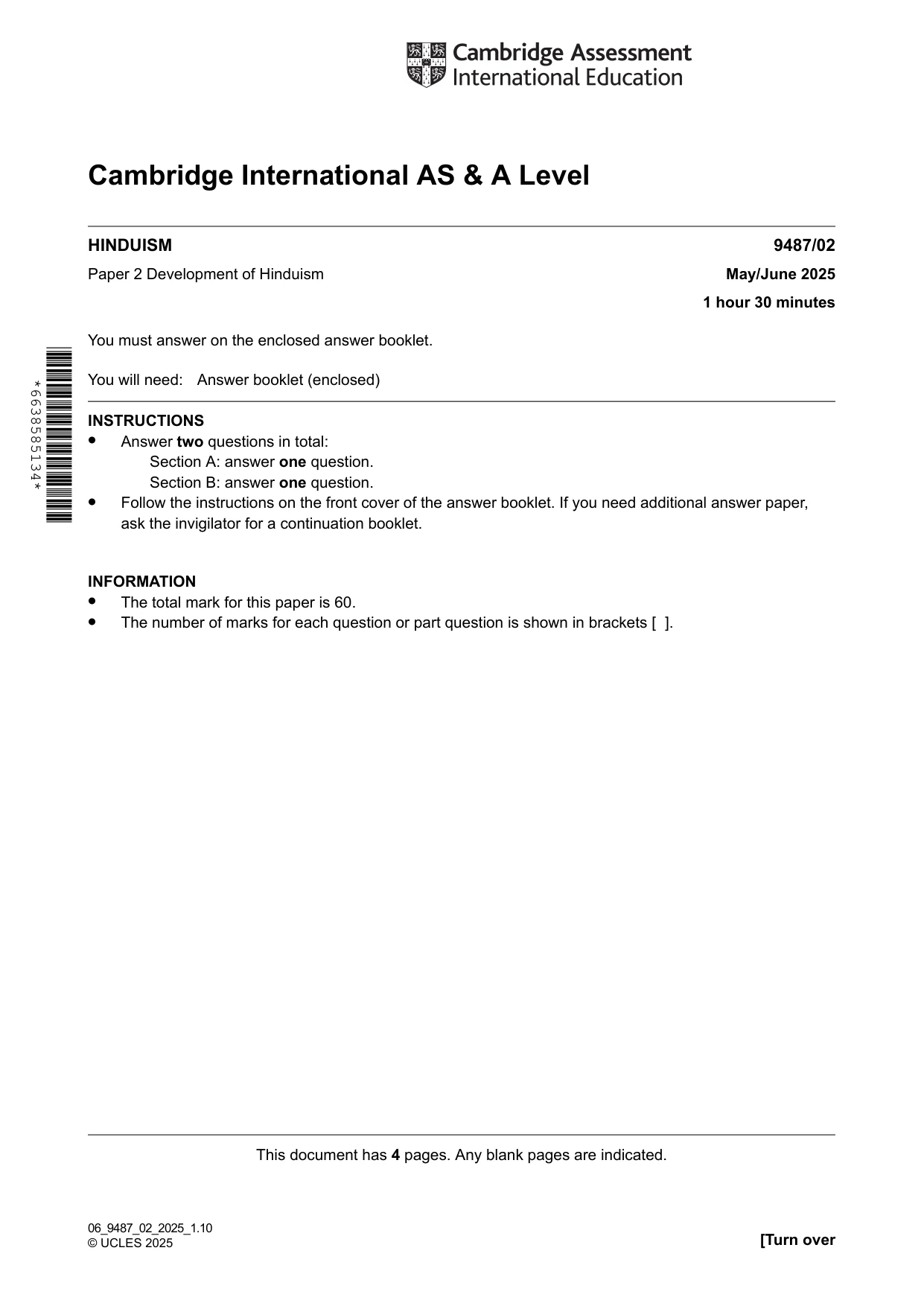
Question paper, page 1
Cambridge International AS & A Level 9487/02 May/June 2025 1 hour 30 minutes HINDUISM Paper 2 Development of Hinduism You must answer on the enclosed answer booklet. You will need: Answer booklet (enclosed) INSTRUCTIONS • Answer two questions in total: Section A: answer one question. Section B: answer one question. • Follow the instructions on the front cover of the answer booklet. If you need additional answer paper, ask the invigilator for a continuation booklet. INFORMATION • The total mark for this paper is 60. • The number of marks for each question or part question is shown in brackets [ ]. This document has 4 pages. Any blank pages are indicated. [Turn over 06_9487_02_2025_1.10 © UCLES 2025 *6638585134*
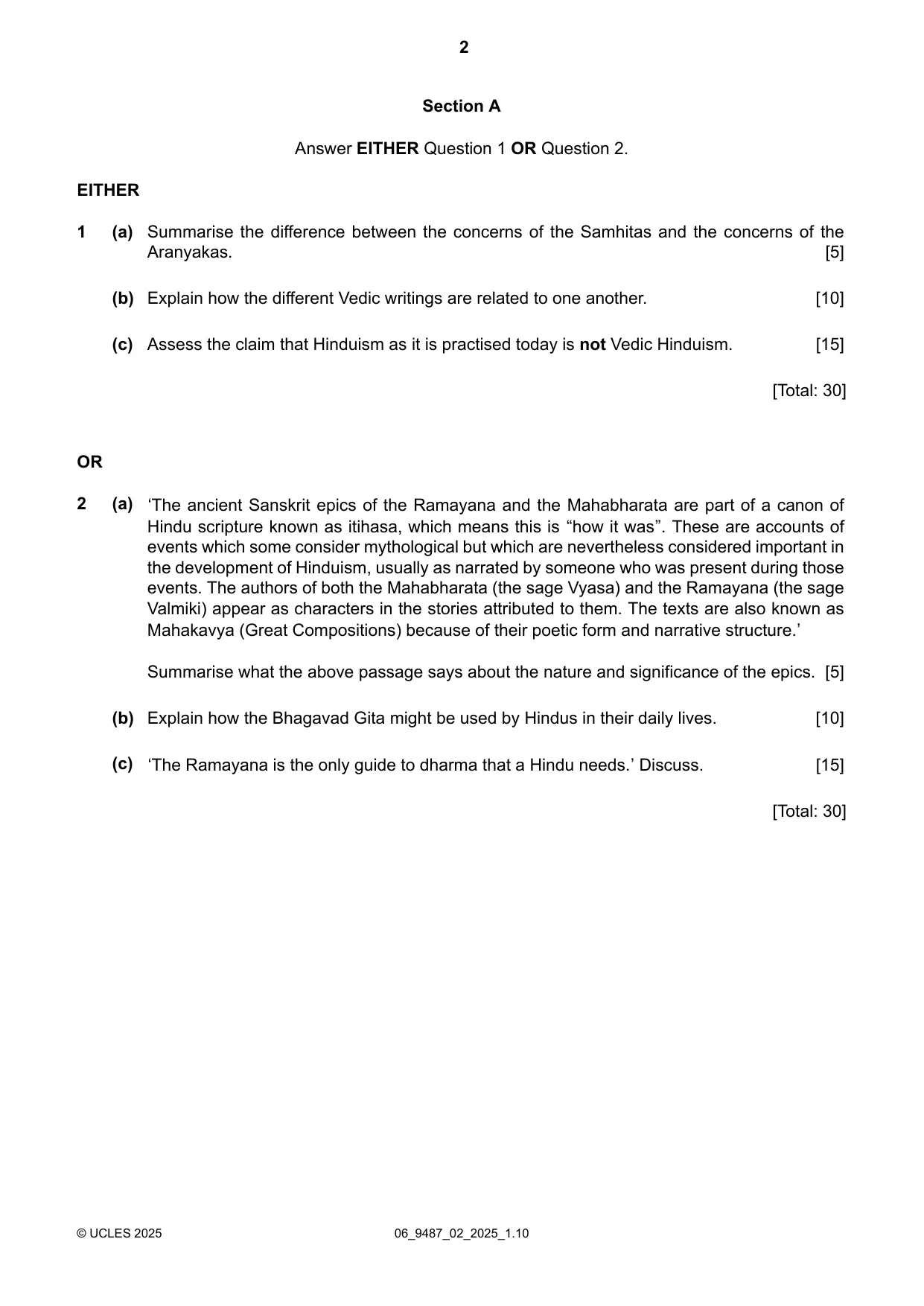
Question paper, page 2
Section A Answer EITHER Question 1 OR Question 2. EITHER Summarise the difference between the concerns of the Samhitas and the concerns of the Aranyakas. [5] (a) 1 Explain how the different Vedic writings are related to one another. [10] (b) Assess the claim that Hinduism as it is practised today is not Vedic Hinduism. [15] (c) [Total: 30] OR ‘The ancient Sanskrit epics of the Ramayana and the Mahabharata are part of a canon of Hindu scripture known as itihasa, which means this is “how it was”. These are accounts of events which some consider mythological but which are nevertheless considered important in the development of Hinduism, usually as narrated by someone who was present during those events. The authors of both the Mahabharata (the sage Vyasa) and the Ramayana (the sage Valmiki) appear as characters in the stories attributed to them. The texts are also known as Mahakavya (Great Compositions) because of their poetic form and narrative structure.’ Summarise what the above passage says about the nature and significance of the epics. [5] (a) 2 Explain how the Bhagavad Gita might be used by Hindus in their daily lives. [10] (b) ‘The Ramayana is the only guide to dharma that a Hindu needs.’ Discuss. [15] (c) [Total: 30] 06_9487_02_2025_1.10 © UCLES 2025 2
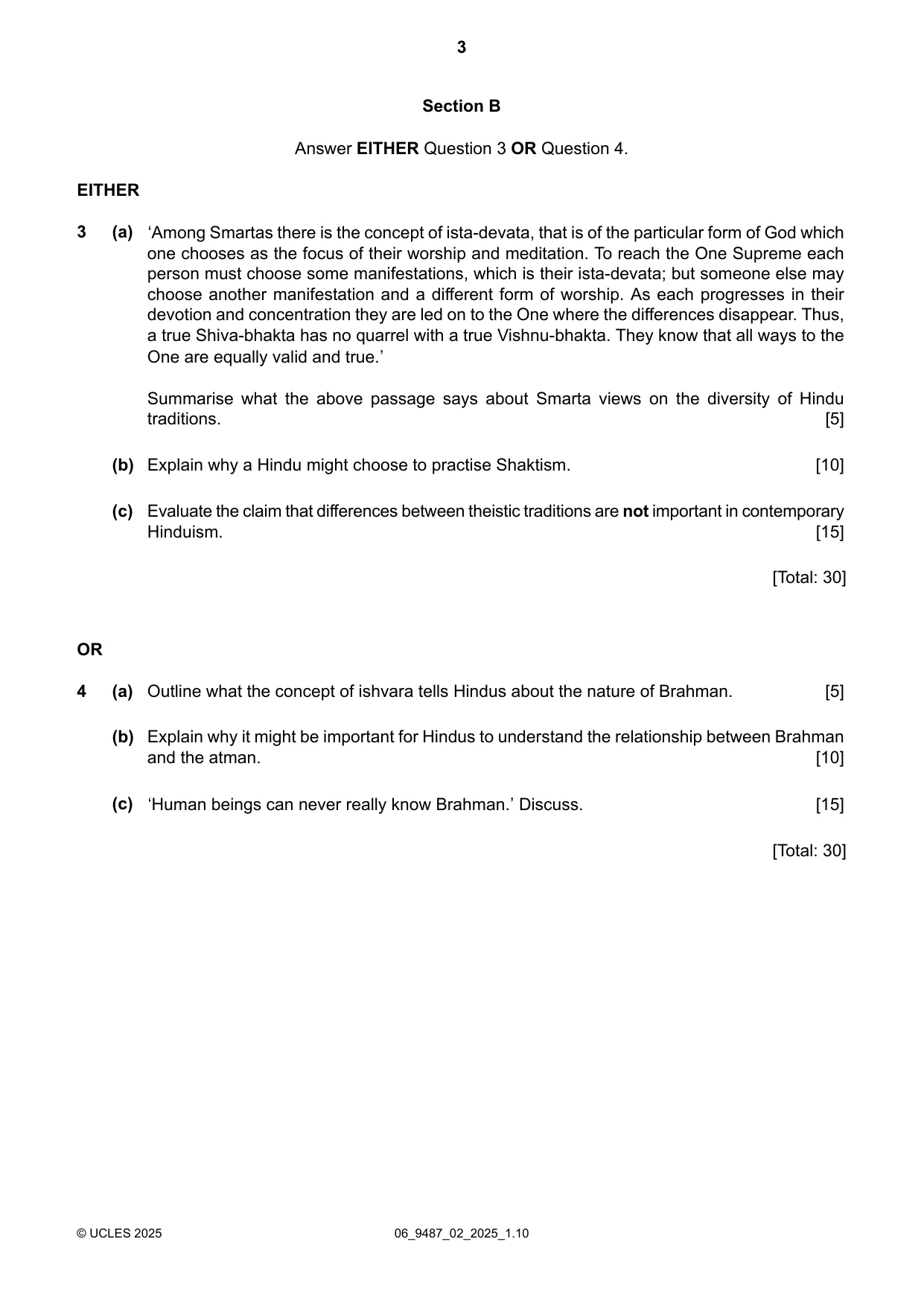
Question paper, page 3
Section B Answer EITHER Question 3 OR Question 4. EITHER ‘Among Smartas there is the concept of ista-devata, that is of the particular form of God which one chooses as the focus of their worship and meditation. To reach the One Supreme each person must choose some manifestations, which is their ista-devata; but someone else may choose another manifestation and a different form of worship. As each progresses in their devotion and concentration they are led on to the One where the differences disappear. Thus, a true Shiva-bhakta has no quarrel with a true Vishnu-bhakta. They know that all ways to the One are equally valid and true.’ Summarise what the above passage says about Smarta views on the diversity of Hindu traditions. [5] (a) 3 Explain why a Hindu might choose to practise Shaktism. [10] (b) Evaluate the claim that differences between theistic traditions are not important in contemporary Hinduism. [15] (c) [Total: 30] OR Outline what the concept of ishvara tells Hindus about the nature of Brahman. [5] (a) 4 Explain why it might be important for Hindus to understand the relationship between Brahman and the atman. [10] (b) ‘Human beings can never really know Brahman.’ Discuss. [15] (c) [Total: 30] 06_9487_02_2025_1.10 © UCLES 2025 3
Question paper, page 4
BLANK PAGE Permission to reproduce items where third-party owned material protected by copyright is included has been sought and cleared where possible. Every reasonable effort has been made by the publisher (UCLES) to trace copyright holders, but if any items requiring clearance have unwittingly been included, the publisher will be pleased to make amends at the earliest possible opportunity. To avoid the issue of disclosure of answer-related information to candidates, all copyright acknowledgements are reproduced online in the Cambridge Assessment International Education Copyright Acknowledgements Booklet. This is produced for each series of examinations and is freely available to download at www.cambridgeinternational.org after the live examination series. Cambridge Assessment International Education is part of Cambridge Assessment. Cambridge Assessment is the brand name of the University of Cambridge Local Examinations Syndicate (UCLES), which is a department of the University of Cambridge. 06_9487_02_2025_1.10 © UCLES 2025 4
What you needed in this session
Cambridge’s own grade thresholds for 2025 May/June, Paper 2 · Variant 0. A higher threshold means an easier paper — the bar moves with how the cohort did.