Cambridge A Level Hinduism 9487 — 2023 Oct/Nov Paper 2 · Variant 0
9487/20/O/N/23 · 60 marks · ≈68 min
The question paper and its mark scheme, free to read here and free to download. This is Cambridge’s own paper, exactly as it was sat.
Question paper4 pages
Mark scheme
No mark scheme is in the library for this paper.
Paper as text
Question paper, page 1
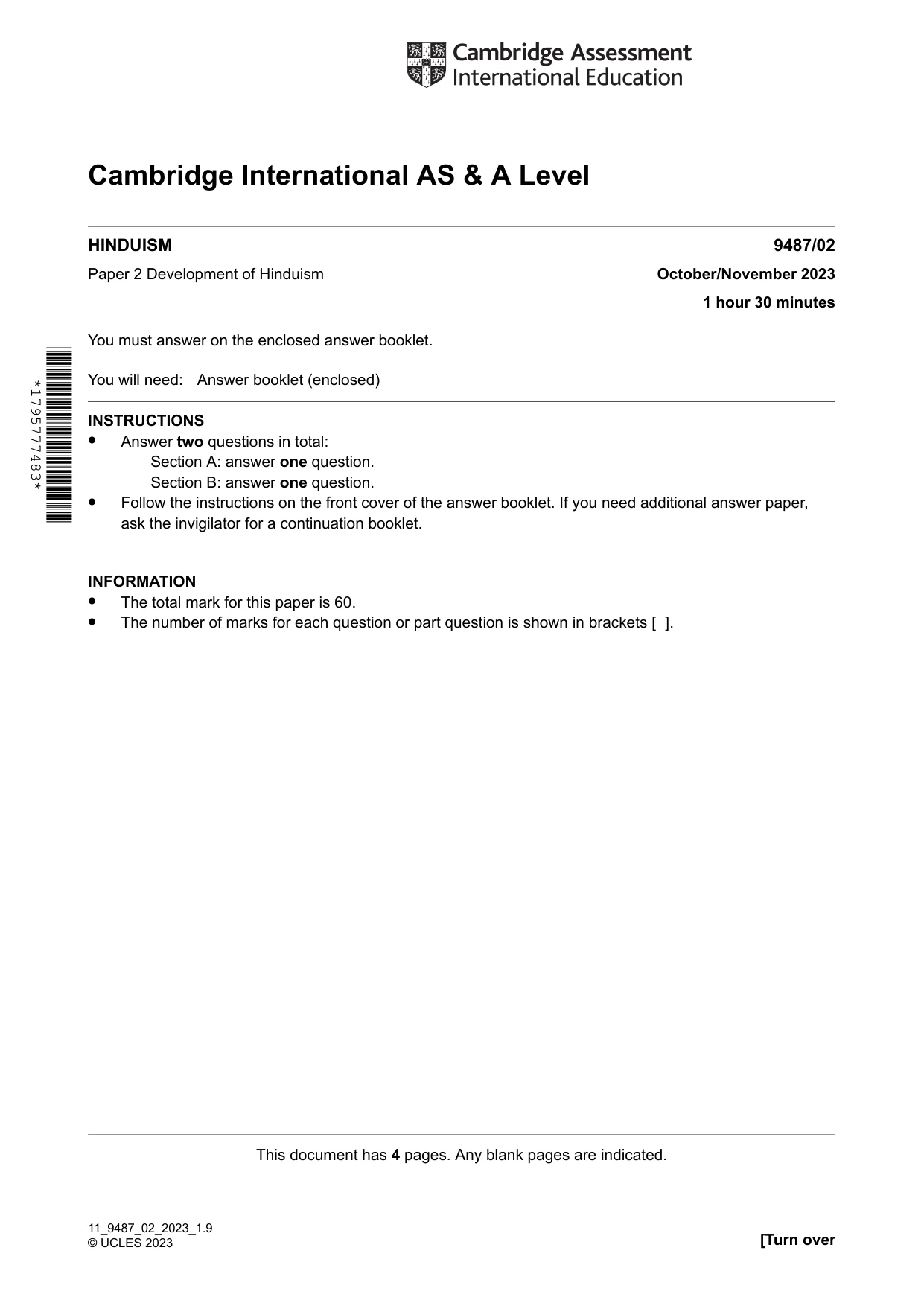
Cambridge International AS & A Level 9487/02 October/November 2023 1 hour 30 minutes HINDUISM Paper 2 Development of Hinduism You must answer on the enclosed answer booklet. You will need: Answer booklet (enclosed) INSTRUCTIONS • Answer two questions in total: Section A: answer one question. Section B: answer one question. • Follow the instructions on the front cover of the answer booklet. If you need additional answer paper, ask the invigilator for a continuation booklet. INFORMATION • The total mark for this paper is 60. • The number of marks for each question or part question is shown in brackets [ ]. This document has 4 pages. Any blank pages are indicated. [Turn over 11_9487_02_2023_1.9 © UCLES 2023 *1795777483*
Question paper, page 2
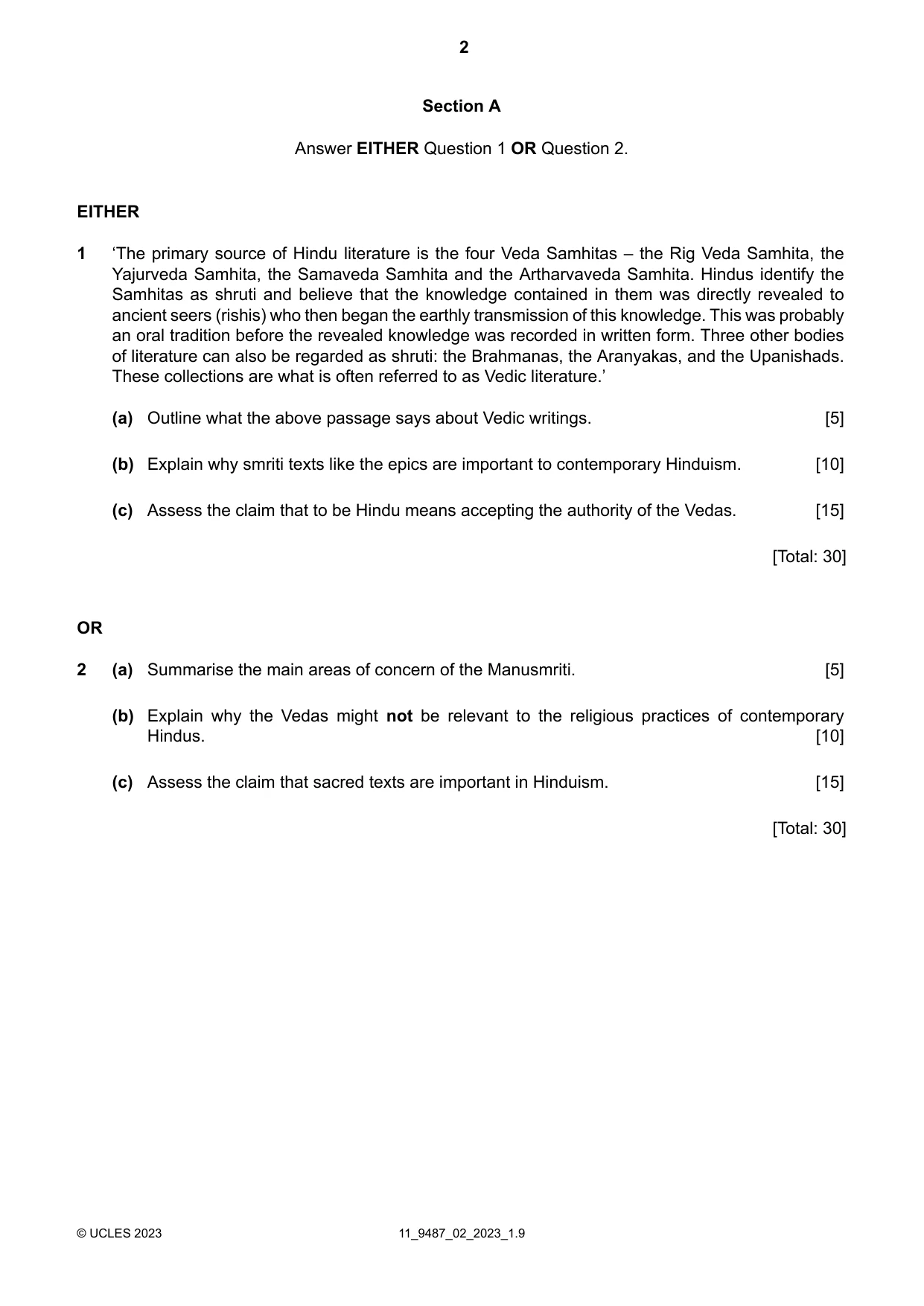
Section A Answer EITHER Question 1 OR Question 2. EITHER ‘The primary source of Hindu literature is the four Veda Samhitas – the Rig Veda Samhita, the Yajurveda Samhita, the Samaveda Samhita and the Artharvaveda Samhita. Hindus identify the 1 Samhitas as shruti and believe that the knowledge contained in them was directly revealed to ancient seers (rishis) who then began the earthly transmission of this knowledge. This was probably an oral tradition before the revealed knowledge was recorded in written form. Three other bodies of literature can also be regarded as shruti: the Brahmanas, the Aranyakas, and the Upanishads. These collections are what is often referred to as Vedic literature.’ Outline what the above passage says about Vedic writings. [5] (a) Explain why smriti texts like the epics are important to contemporary Hinduism. [10] (b) Assess the claim that to be Hindu means accepting the authority of the Vedas. [15] (c) [Total: 30] OR Summarise the main areas of concern of the Manusmriti. [5] (a) 2 Explain why the Vedas might not be relevant to the religious practices of contemporary Hindus. [10] (b) Assess the claim that sacred texts are important in Hinduism. [15] (c) [Total: 30] 11_9487_02_2023_1.9 © UCLES 2023 2
Question paper, page 3
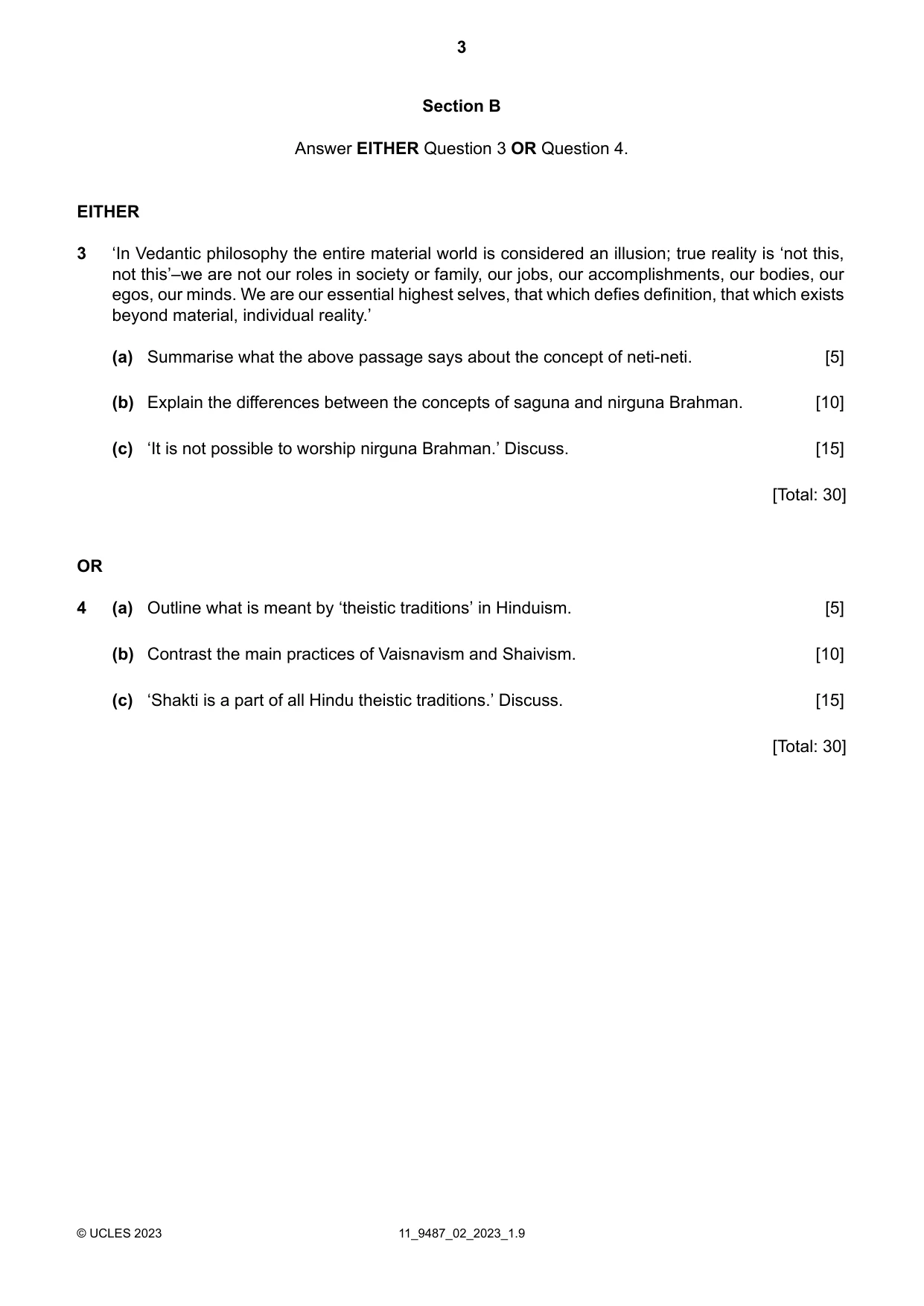
Section B Answer EITHER Question 3 OR Question 4. EITHER ‘In Vedantic philosophy the entire material world is considered an illusion; true reality is ‘not this, not this’–we are not our roles in society or family, our jobs, our accomplishments, our bodies, our 3 egos, our minds. We are our essential highest selves, that which defies definition, that which exists beyond material, individual reality.’ Summarise what the above passage says about the concept of neti-neti. [5] (a) Explain the differences between the concepts of saguna and nirguna Brahman. [10] (b) ‘It is not possible to worship nirguna Brahman.’ Discuss. [15] (c) [Total: 30] OR Outline what is meant by ‘theistic traditions’ in Hinduism. [5] (a) 4 Contrast the main practices of Vaisnavism and Shaivism. [10] (b) ‘Shakti is a part of all Hindu theistic traditions.’ Discuss. [15] (c) [Total: 30] 11_9487_02_2023_1.9 © UCLES 2023 3
Question paper, page 4
BLANK PAGE Permission to reproduce items where third-party owned material protected by copyright is included has been sought and cleared where possible. Every reasonable effort has been made by the publisher (UCLES) to trace copyright holders, but if any items requiring clearance have unwittingly been included, the publisher will be pleased to make amends at the earliest possible opportunity. To avoid the issue of disclosure of answer-related information to candidates, all copyright acknowledgements are reproduced online in the Cambridge Assessment International Education Copyright Acknowledgements Booklet. This is produced for each series of examinations and is freely available to download at www.cambridgeinternational.org after the live examination series. Cambridge Assessment International Education is part of Cambridge Assessment. Cambridge Assessment is the brand name of the University of Cambridge Local Examinations Syndicate (UCLES), which is a department of the University of Cambridge. 11_9487_02_2023_1.9 © UCLES 2023 4
What you needed in this session
Cambridge’s own grade thresholds for 2023 Oct/Nov, Paper 2 · Variant 0. A higher threshold means an easier paper — the bar moves with how the cohort did.