Cambridge A Level Hinduism 9487 — 2024 May/June Paper 2 · Variant 0
9487/20/M/J/24 · 60 marks · ≈68 min
The question paper and its mark scheme, free to read here and free to download. This is Cambridge’s own paper, exactly as it was sat.
Question paper4 pages
Mark scheme
No mark scheme is in the library for this paper.
Paper as text
Question paper, page 1
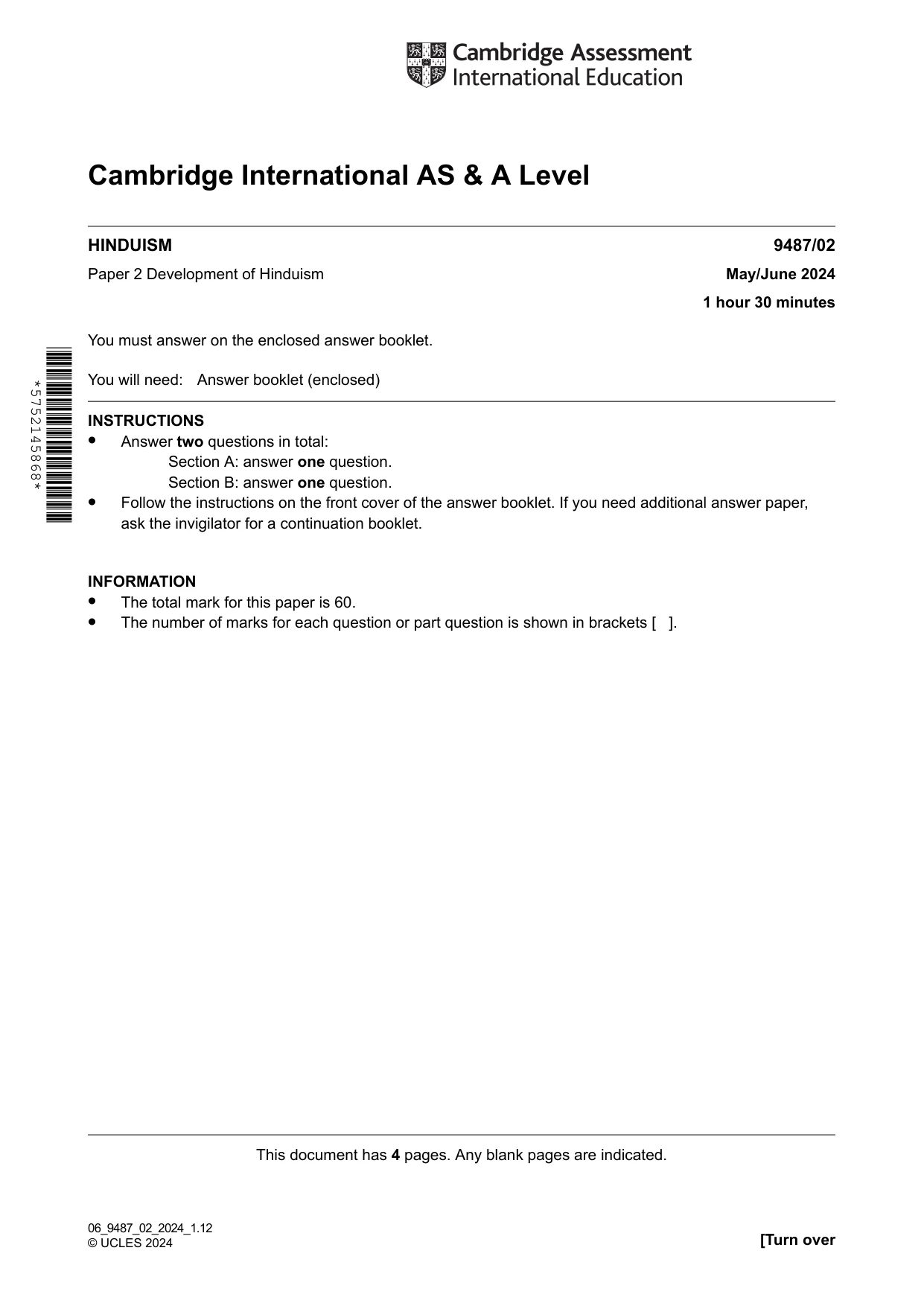
Cambridge International AS & A Level 9487/02 May/June 2024 1 hour 30 minutes HINDUISM Paper 2 Development of Hinduism You must answer on the enclosed answer booklet. You will need: Answer booklet (enclosed) INSTRUCTIONS • Answer two questions in total: Section A: answer one question. Section B: answer one question. • Follow the instructions on the front cover of the answer booklet. If you need additional answer paper, ask the invigilator for a continuation booklet. INFORMATION • The total mark for this paper is 60. • The number of marks for each question or part question is shown in brackets [ ]. This document has 4 pages. Any blank pages are indicated. [Turn over 06_9487_02_2024_1.12 © UCLES 2024 *5752145868*
Question paper, page 2
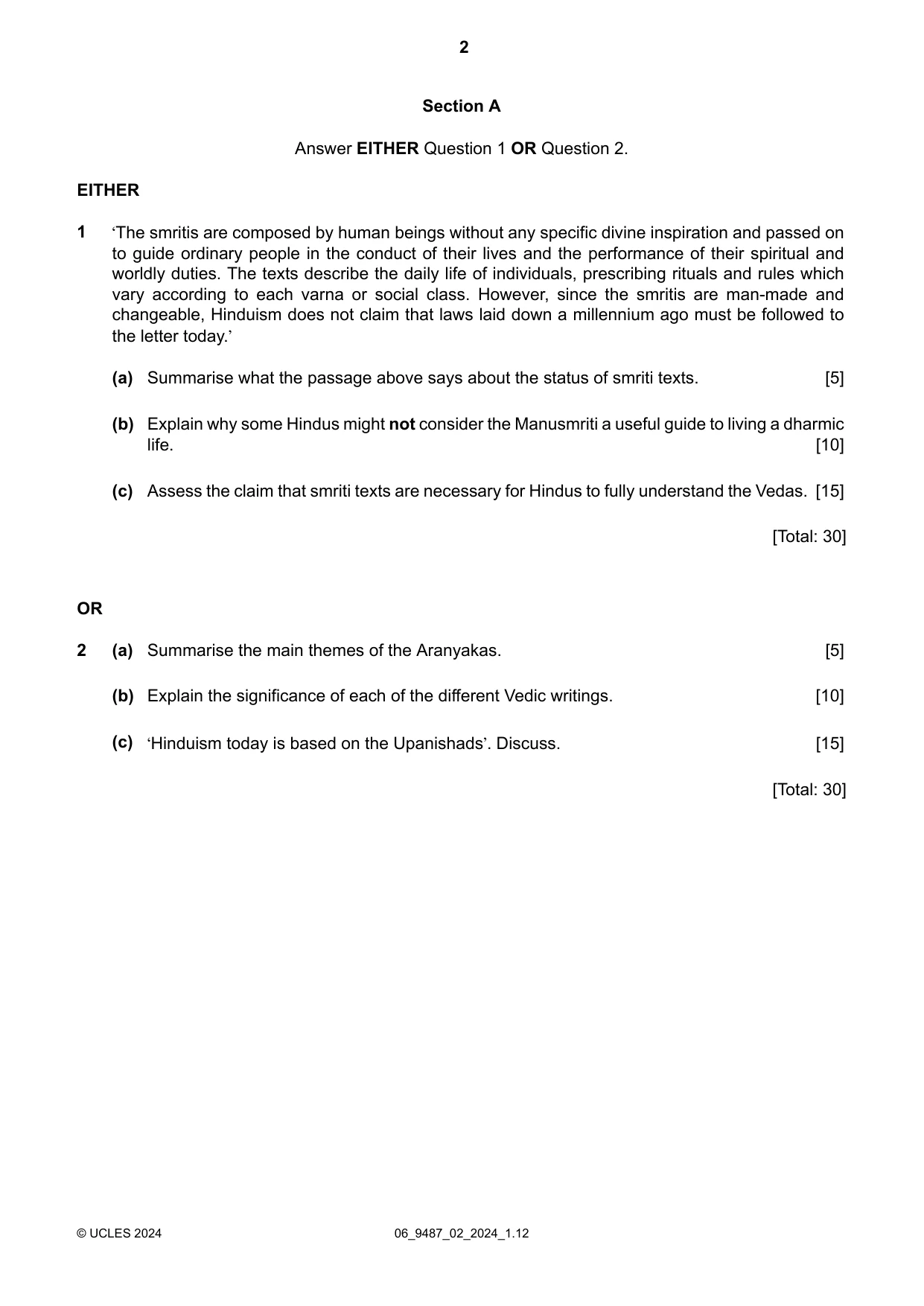
Section A Answer EITHER Question 1 OR Question 2. EITHER ‘The smritis are composed by human beings without any specific divine inspiration and passed on to guide ordinary people in the conduct of their lives and the performance of their spiritual and 1 worldly duties. The texts describe the daily life of individuals, prescribing rituals and rules which vary according to each varna or social class. However, since the smritis are man-made and changeable, Hinduism does not claim that laws laid down a millennium ago must be followed to the letter today.’ Summarise what the passage above says about the status of smriti texts. [5] (a) Explain why some Hindus might not consider the Manusmriti a useful guide to living a dharmic life. [10] (b) Assess the claim that smriti texts are necessary for Hindus to fully understand the Vedas. [15] (c) [Total: 30] OR Summarise the main themes of the Aranyakas. [5] (a) 2 Explain the significance of each of the different Vedic writings. [10] (b) ‘Hinduism today is based on the Upanishads’. Discuss. [15] (c) [Total: 30] 06_9487_02_2024_1.12 © UCLES 2024 2
Question paper, page 3
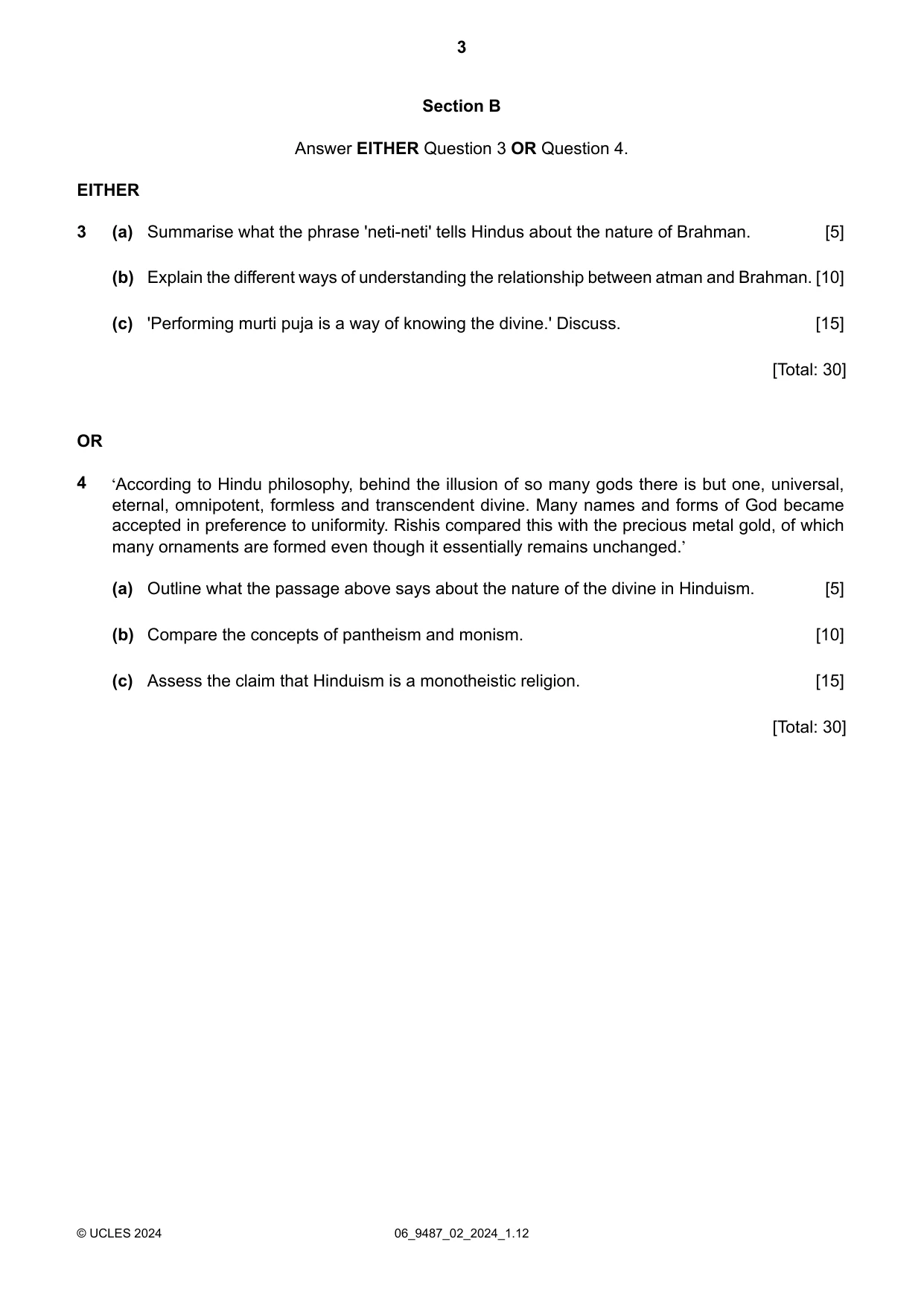
Section B Answer EITHER Question 3 OR Question 4. EITHER Summarise what the phrase 'neti-neti' tells Hindus about the nature of Brahman. [5] (a) 3 Explain the different ways of understanding the relationship between atman and Brahman. [10] (b) 'Performing murti puja is a way of knowing the divine.' Discuss. [15] (c) [Total: 30] OR ‘According to Hindu philosophy, behind the illusion of so many gods there is but one, universal, eternal, omnipotent, formless and transcendent divine. Many names and forms of God became 4 accepted in preference to uniformity. Rishis compared this with the precious metal gold, of which many ornaments are formed even though it essentially remains unchanged.’ Outline what the passage above says about the nature of the divine in Hinduism. [5] (a) Compare the concepts of pantheism and monism. [10] (b) Assess the claim that Hinduism is a monotheistic religion. [15] (c) [Total: 30] 06_9487_02_2024_1.12 © UCLES 2024 3
Question paper, page 4
BLANK PAGE Permission to reproduce items where third-party owned material protected by copyright is included has been sought and cleared where possible. Every reasonable effort has been made by the publisher (UCLES) to trace copyright holders, but if any items requiring clearance have unwittingly been included, the publisher will be pleased to make amends at the earliest possible opportunity. To avoid the issue of disclosure of answer-related information to candidates, all copyright acknowledgements are reproduced online in the Cambridge Assessment International Education Copyright Acknowledgements Booklet. This is produced for each series of examinations and is freely available to download at www.cambridgeinternational.org after the live examination series. Cambridge Assessment International Education is part of Cambridge Assessment. Cambridge Assessment is the brand name of the University of Cambridge Local Examinations Syndicate (UCLES), which is a department of the University of Cambridge. 06_9487_02_2024_1.12 © UCLES 2024 4
What you needed in this session
Cambridge’s own grade thresholds for 2024 May/June, Paper 2 · Variant 0. A higher threshold means an easier paper — the bar moves with how the cohort did.