Cambridge A Level German (A Level only) 9717 — 2019 May/June Paper 2 · Variant 1
9717/21/M/J/19 · 70 marks · ≈79 min
The question paper and its mark scheme, free to read here and free to download. This is Cambridge’s own paper, exactly as it was sat.
Question paper12 pages



Mark scheme9 pages
Answers below. Sit the paper first if you are practising.

Paper as text
Question paper, page 1
This document consists of 9 printed pages, 3 blank pages and 1 Insert. DC (RW) 168819/2 © UCLES 2019 [Turn over * 9 0 7 2 6 0 4 8 2 5 * GERMAN 9717/02 Paper 2 Reading and Writing May/June 2019 1 hour 45 minutes Candidates answer on the Question Paper. No Additional Materials are required. READ THESE INSTRUCTIONS FIRST Write your centre number, candidate number and name in the spaces at the top of this page. Write in dark blue or black pen. Do not use staples, paper clips, glue or correction fluid. DO NOT WRITE IN ANY BARCODES. Answer all questions in German in the spaces provided. Dictionaries are not permitted. You should keep to any word limits given in the questions. The number of marks is given in brackets [ ] at the end of each question or part question. LESEN SIE ZUERST DIESE ANWEISUNGEN Schreiben Sie Ihre Center-Nummer, Kandidaten-Nummer und Ihren Namen in die vorgegebenen Kästchen oben auf dieser Seite. Schreiben Sie mit dunkelblauem oder schwarzem Füller/Kugelschreiber. Benutzen Sie keine Heftklammern, Büroklammern, Korrekturflüssigkeit und keinen Klebstoff. SCHREIBEN SIE NICHT ÜBER DIE STRICHCODES. Beantworten Sie alle Fragen auf Deutsch in dem dafür vorgesehenen Bereich. Der Gebrauch von Wörterbüchern ist nicht erlaubt. Sie müssen sich an die Wortzahl halten, die für jede Frage angegeben ist. Die erreichbare Punktzahl finden Sie in Klammern [ ] am Ende jeder Frage oder Teilfrage. Cambridge Assessment International Education Cambridge International Advanced Level
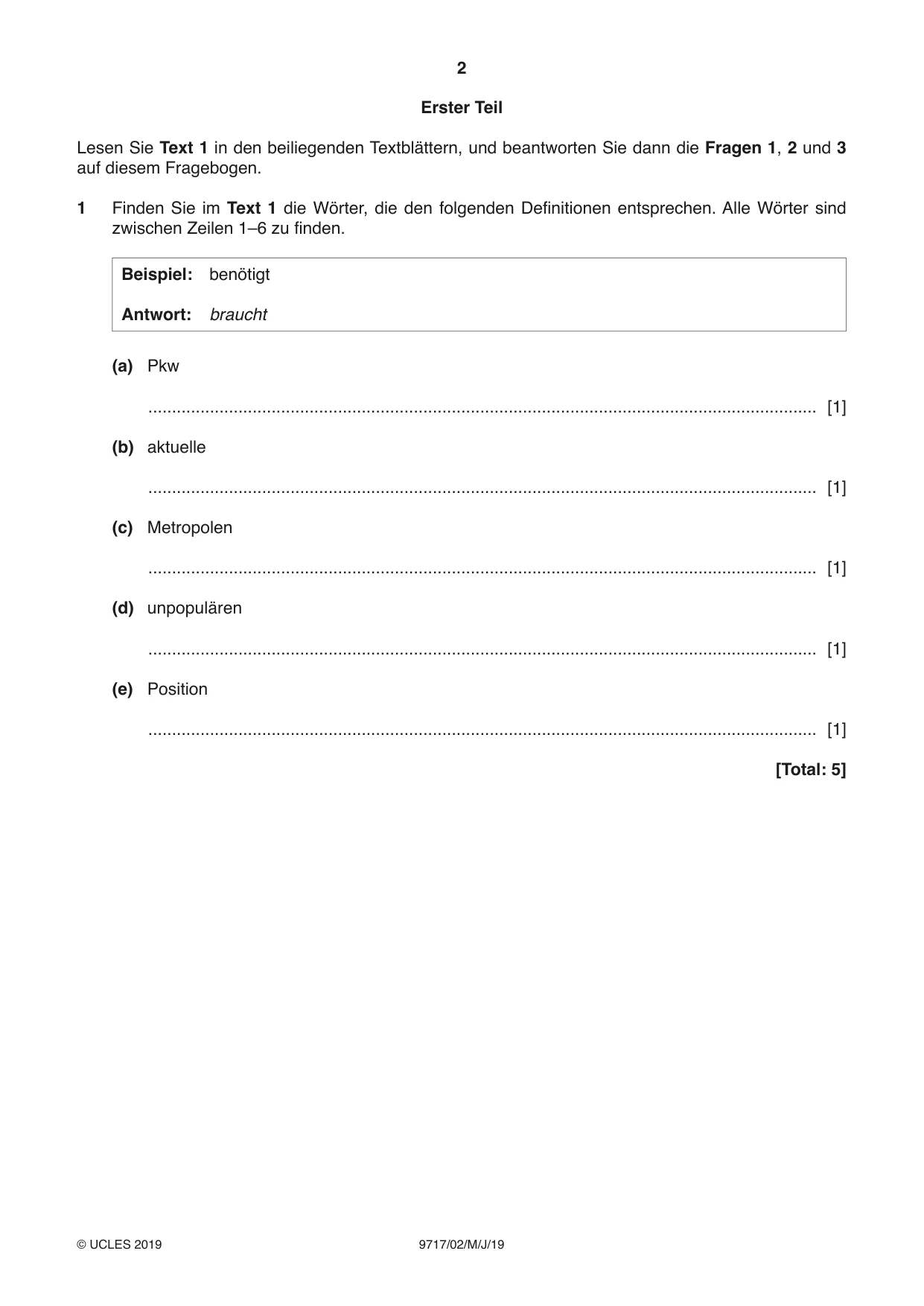
Question paper, page 2
2 9717/02/M/J/19 © UCLES 2019 Erster Teil Lesen Sie Text 1 in den beiliegenden Textblättern, und beantworten Sie dann die Fragen 1, 2 und 3 auf diesem Fragebogen. 1 Finden Sie im Text 1 die Wörter, die den folgenden Definitionen entsprechen. Alle Wörter sind zwischen Zeilen 1–6 zu finden. Beispiel: benötigt Antwort: braucht (a) Pkw … [1] (b) aktuelle … [1] (c) Metropolen … [1] (d) unpopulären … [1] (e) Position … [1] [Total: 5]
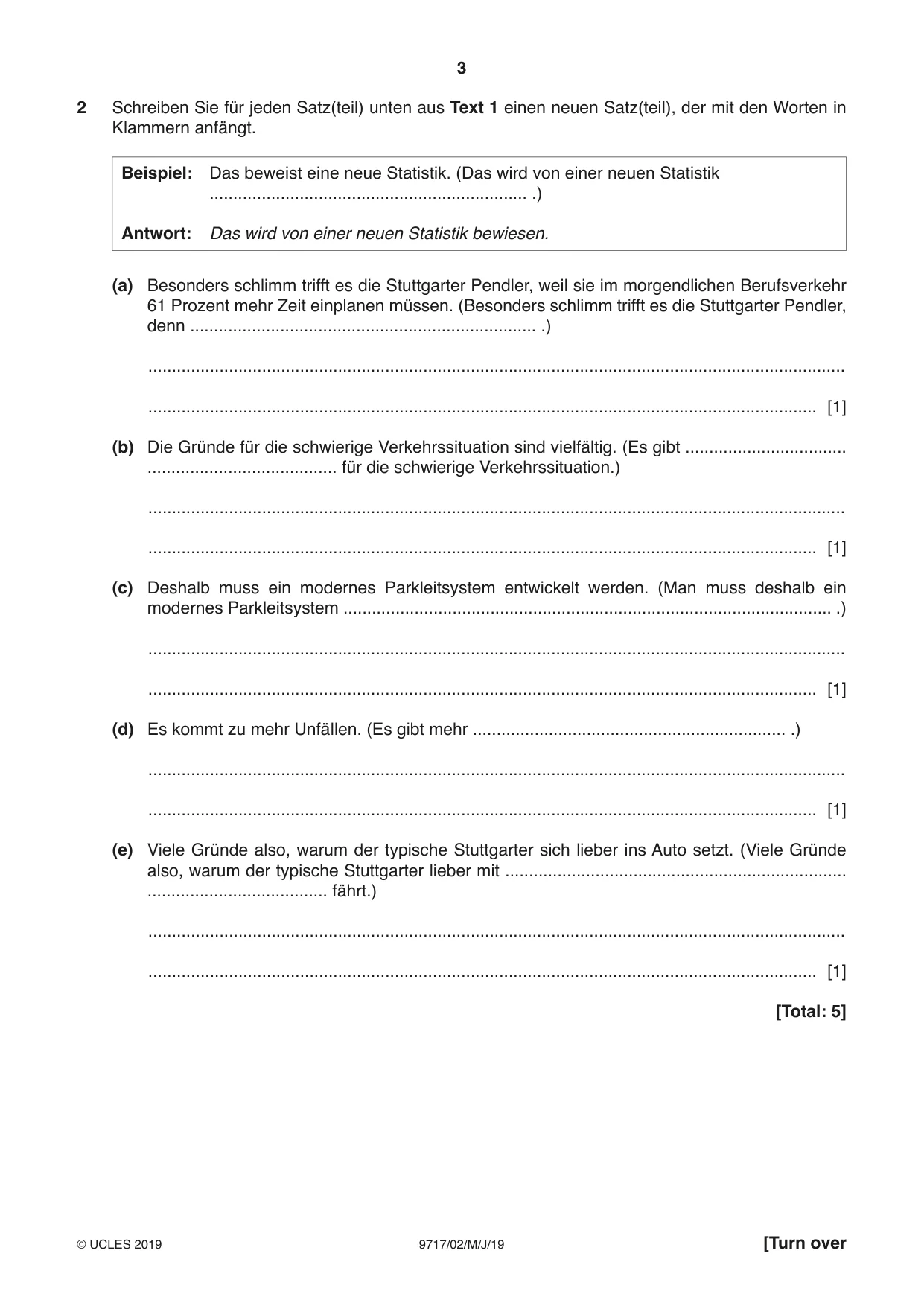
Question paper, page 3
3 9717/02/M/J/19 © UCLES 2019 [Turn over 2 Schreiben Sie für jeden Satz(teil) unten aus Text 1 einen neuen Satz(teil), der mit den Worten in Klammern anfängt. Beispiel: Das beweist eine neue Statistik. (Das wird von einer neuen Statistik … .) Antwort: Das wird von einer neuen Statistik bewiesen. (a) Besonders schlimm trifft es die Stuttgarter Pendler, weil sie im morgendlichen Berufsverkehr 61 Prozent mehr Zeit einplanen müssen. (Besonders schlimm trifft es die Stuttgarter Pendler, denn … .) … … [1] (b) Die Gründe für die schwierige Verkehrssituation sind vielfältig. (Es gibt … … für die schwierige Verkehrssituation.) … … [1] (c) Deshalb muss ein modernes Parkleitsystem entwickelt werden. (Man muss deshalb ein modernes Parkleitsystem … .) … … [1] (d) Es kommt zu mehr Unfӓllen. (Es gibt mehr … .) … … [1] (e) Viele Gründe also, warum der typische Stuttgarter sich lieber ins Auto setzt. (Viele Gründe also, warum der typische Stuttgarter lieber mit … … fährt.) … … [1] [Total: 5]
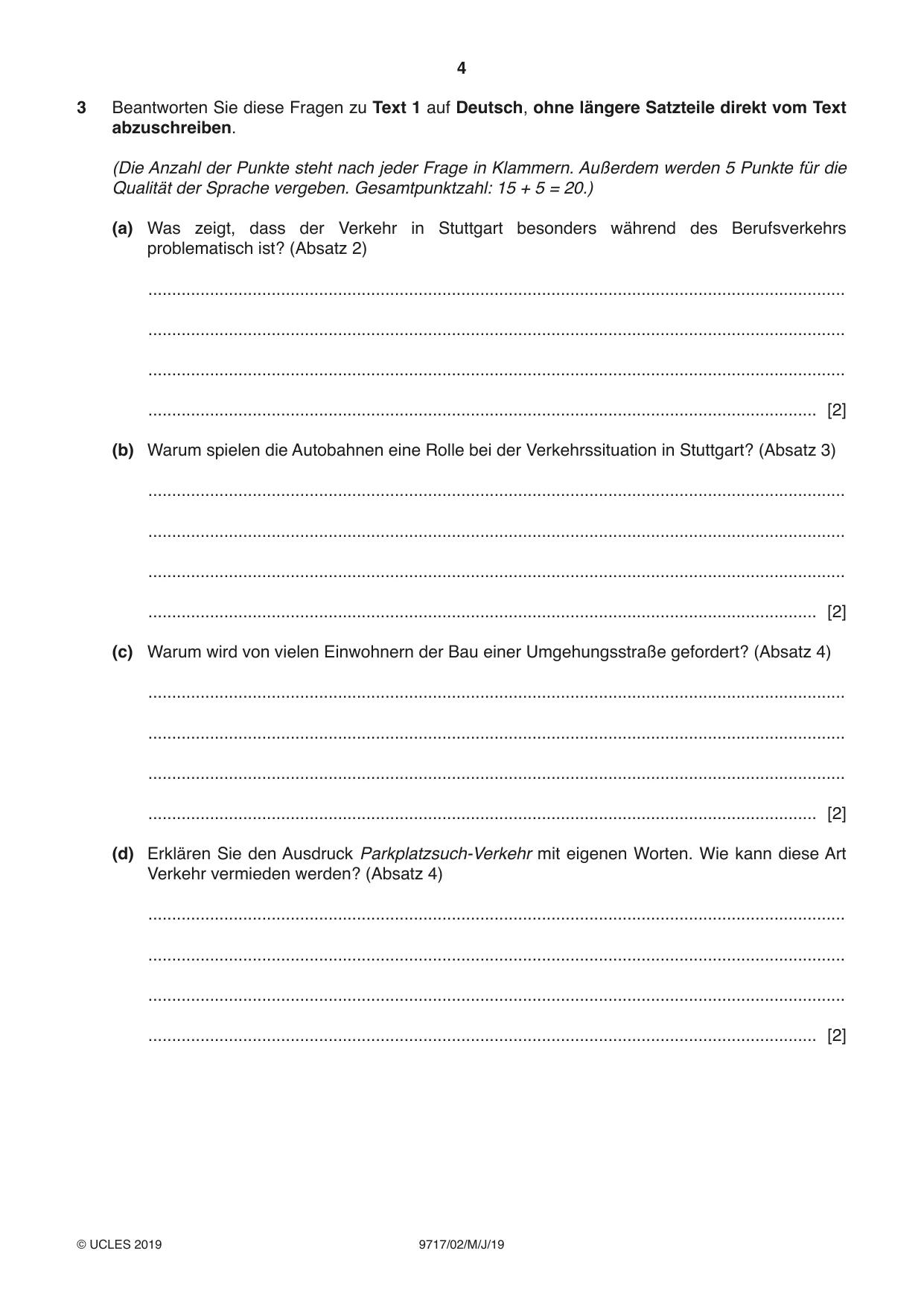
Question paper, page 4
4 9717/02/M/J/19 © UCLES 2019 3 Beantworten Sie diese Fragen zu Text 1 auf Deutsch, ohne längere Satzteile direkt vom Text abzuschreiben. (Die Anzahl der Punkte steht nach jeder Frage in Klammern. Außerdem werden 5 Punkte für die Qualität der Sprache vergeben. Gesamtpunktzahl: 15 + 5 = 20.) (a) Was zeigt, dass der Verkehr in Stuttgart besonders während des Berufsverkehrs problematisch ist? (Absatz 2) … … … … [2] (b) Warum spielen die Autobahnen eine Rolle bei der Verkehrssituation in Stuttgart? (Absatz 3) … … … … [2] (c) Warum wird von vielen Einwohnern der Bau einer Umgehungsstraße gefordert? (Absatz 4) … … … … [2] (d) Erklären Sie den Ausdruck Parkplatzsuch-Verkehr mit eigenen Worten. Wie kann diese Art Verkehr vermieden werden? (Absatz 4) … … … … [2]
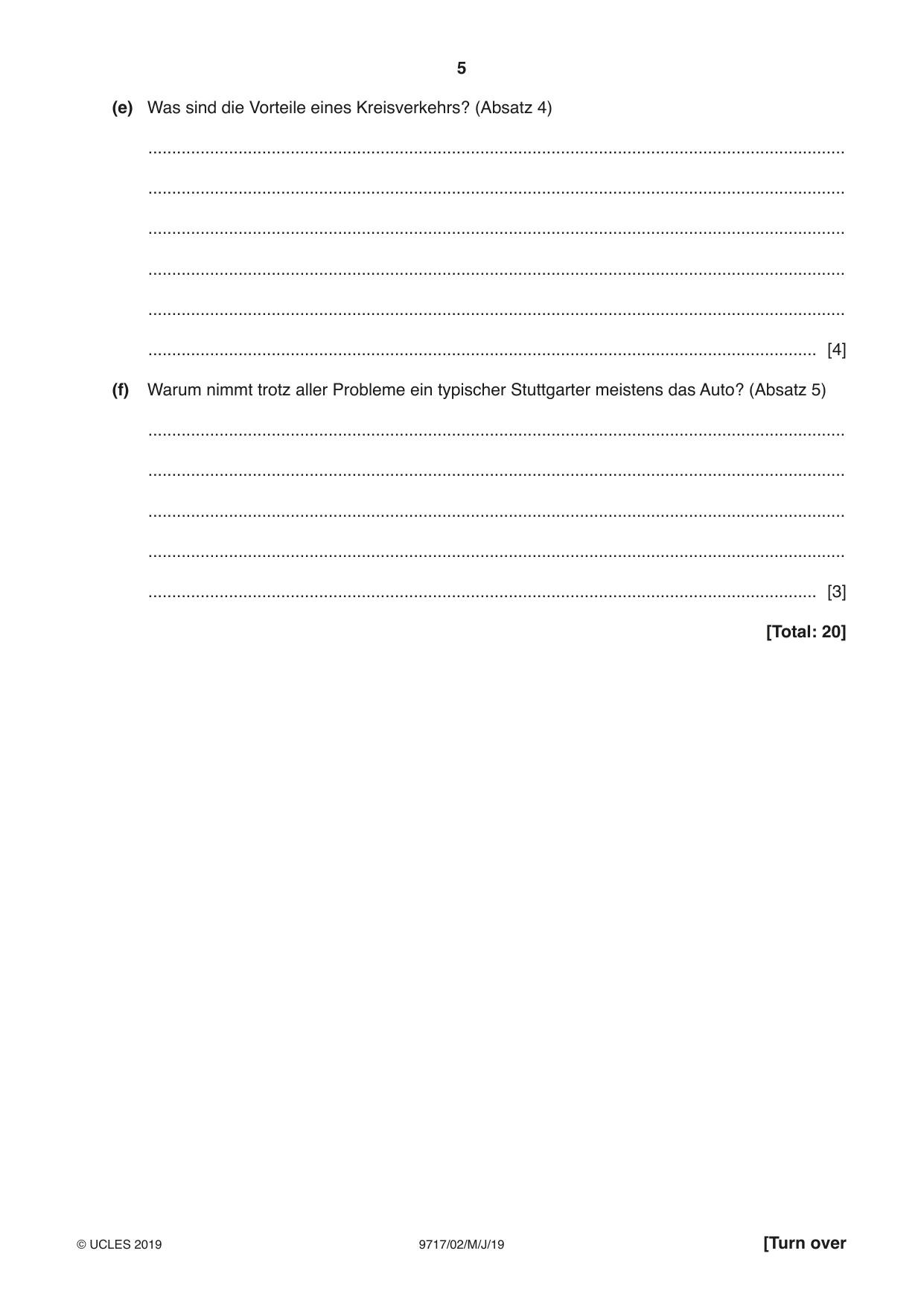
Question paper, page 5
5 9717/02/M/J/19 © UCLES 2019 [Turn over (e) Was sind die Vorteile eines Kreisverkehrs? (Absatz 4) … … … … … … [4] (f) Warum nimmt trotz aller Probleme ein typischer Stuttgarter meistens das Auto? (Absatz 5) … … … … … [3] [Total: 20]
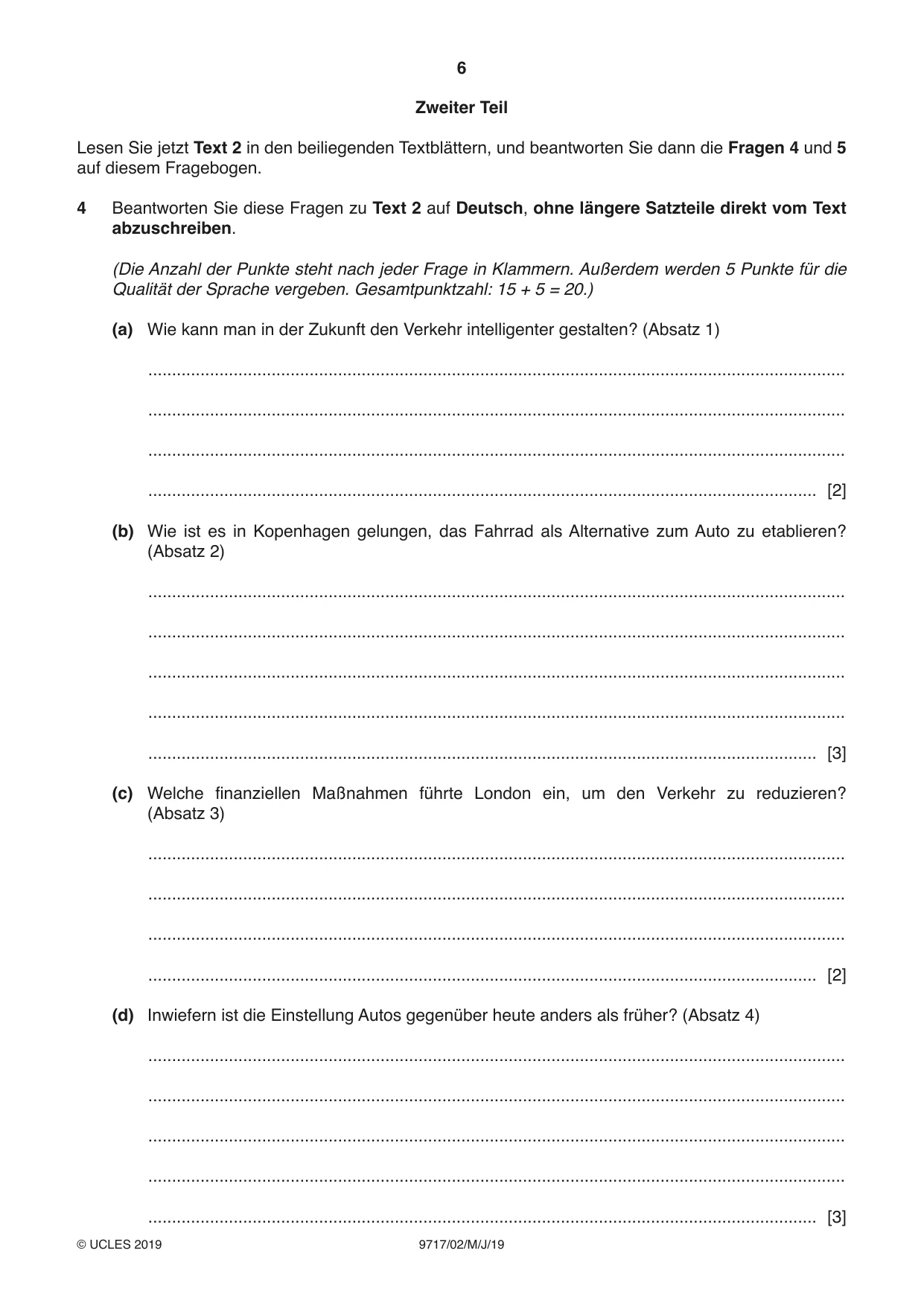
Question paper, page 6
6 9717/02/M/J/19 © UCLES 2019 Zweiter Teil Lesen Sie jetzt Text 2 in den beiliegenden Textblättern, und beantworten Sie dann die Fragen 4 und 5 auf diesem Fragebogen. 4 Beantworten Sie diese Fragen zu Text 2 auf Deutsch, ohne längere Satzteile direkt vom Text abzuschreiben. (Die Anzahl der Punkte steht nach jeder Frage in Klammern. Außerdem werden 5 Punkte für die Qualität der Sprache vergeben. Gesamtpunktzahl: 15 + 5 = 20.) (a) Wie kann man in der Zukunft den Verkehr intelligenter gestalten? (Absatz 1) … … … … [2] (b) Wie ist es in Kopenhagen gelungen, das Fahrrad als Alternative zum Auto zu etablieren? (Absatz 2) … … … … … [3] (c) Welche finanziellen Maßnahmen führte London ein, um den Verkehr zu reduzieren? (Absatz 3) … … … … [2] (d) Inwiefern ist die Einstellung Autos gegenüber heute anders als früher? (Absatz 4) … … … … … [3]
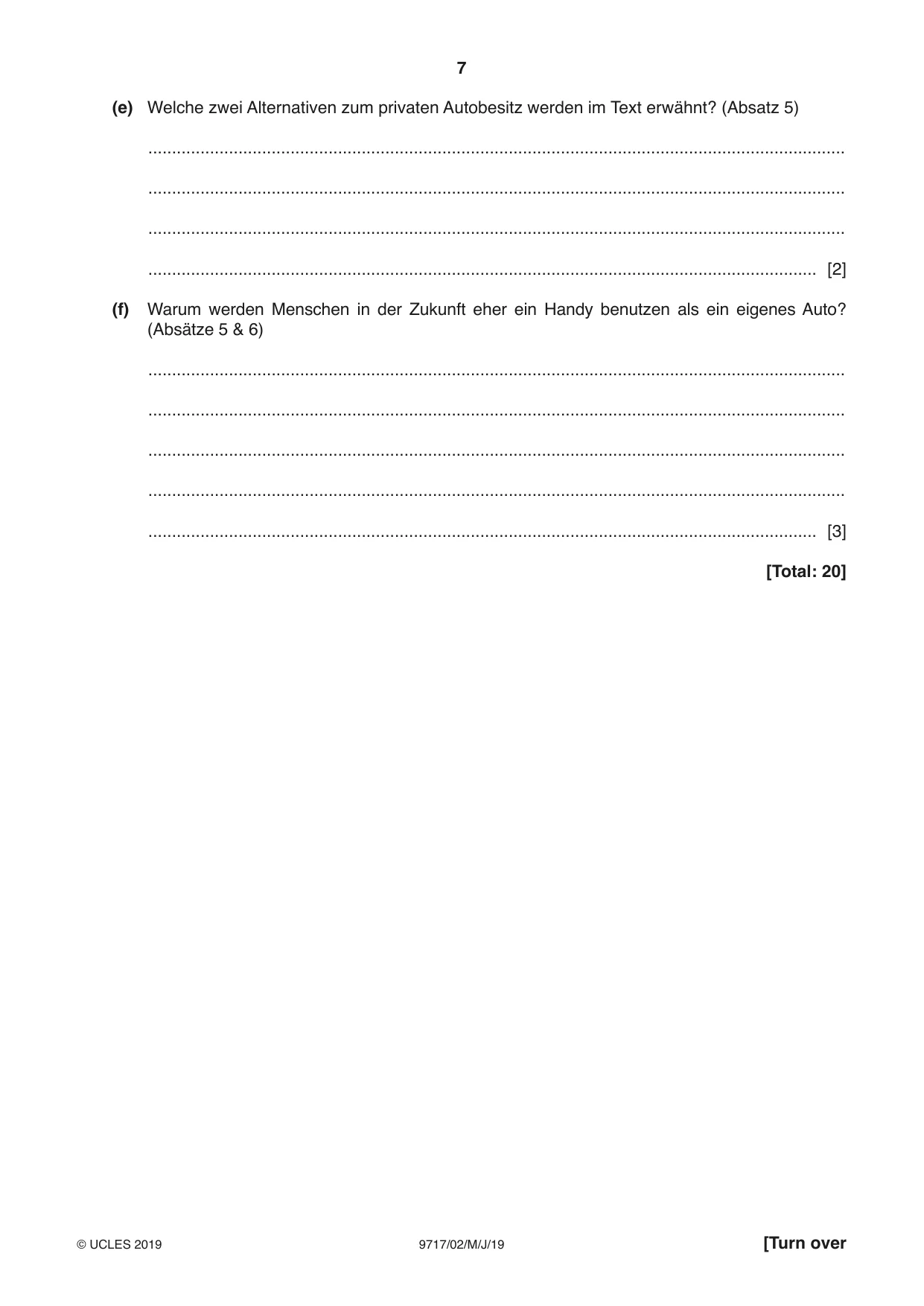
Question paper, page 7
7 9717/02/M/J/19 © UCLES 2019 [Turn over (e) Welche zwei Alternativen zum privaten Autobesitz werden im Text erwähnt? (Absatz 5) … … … … [2] (f) Warum werden Menschen in der Zukunft eher ein Handy benutzen als ein eigenes Auto? (Absätze 5 & 6) … … … … … [3] [Total: 20]
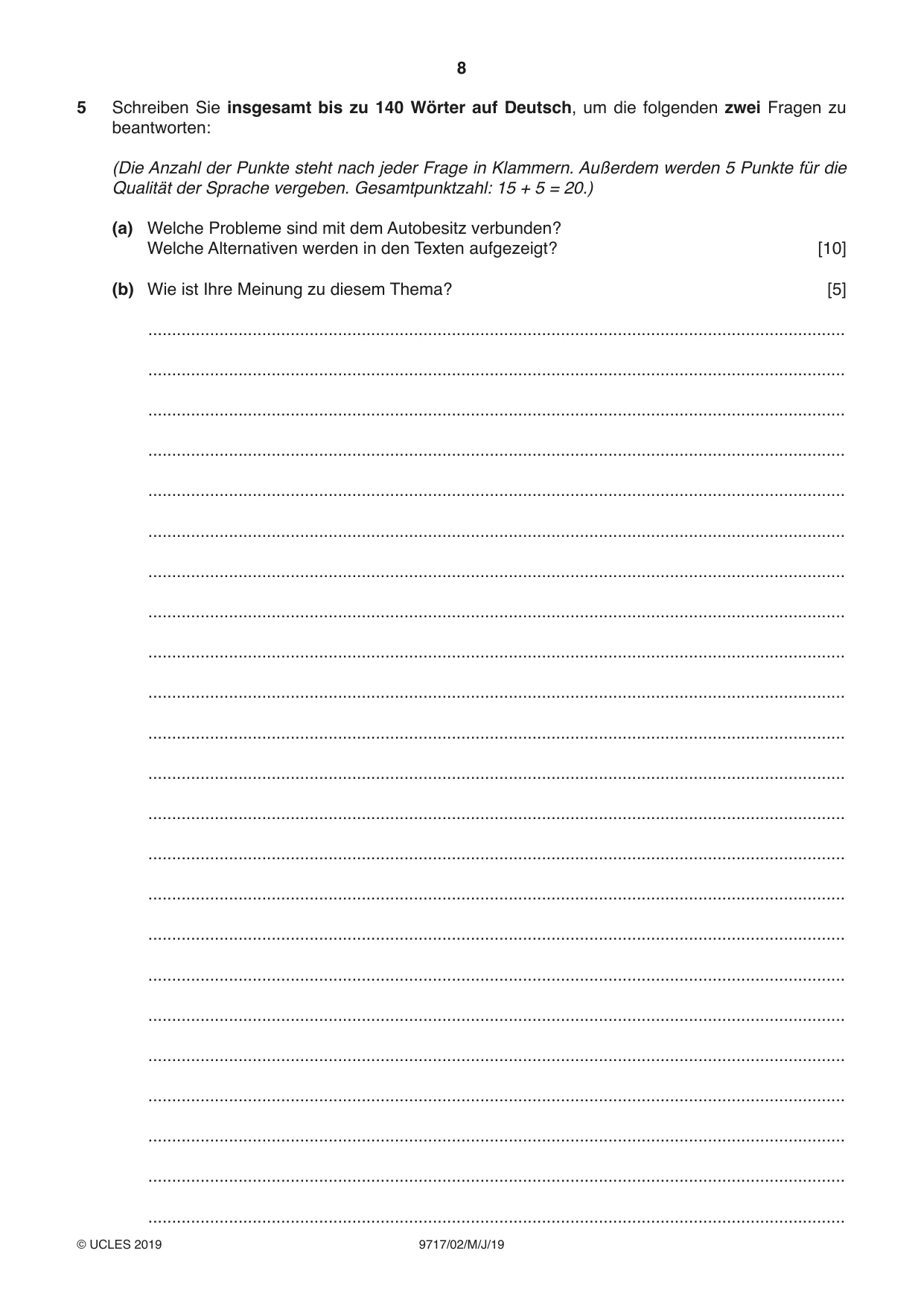
Question paper, page 8
8 9717/02/M/J/19 © UCLES 2019 5 Schreiben Sie insgesamt bis zu 140 Wörter auf Deutsch, um die folgenden zwei Fragen zu beantworten: (Die Anzahl der Punkte steht nach jeder Frage in Klammern. Außerdem werden 5 Punkte für die Qualität der Sprache vergeben. Gesamtpunktzahl: 15 + 5 = 20.) (a) Welche Probleme sind mit dem Autobesitz verbunden? Welche Alternativen werden in den Texten aufgezeigt? [10] (b) Wie ist Ihre Meinung zu diesem Thema? [5] … … … … … … … … … … … … … … … … … … … … … … …
Question paper, page 9
9 9717/02/M/J/19 © UCLES 2019 … … … … … … … … … … … … … … … [Total: 20]
Question paper, page 10
10 9717/02/M/J/19 © UCLES 2019 BLANK PAGE
Question paper, page 11
11 9717/02/M/J/19 © UCLES 2019 BLANK PAGE
Question paper, page 12
12 9717/02/M/J/19 © UCLES 2019 Permission to reproduce items where third-party owned material protected by copyright is included has been sought and cleared where possible. Every reasonable effort has been made by the publisher (UCLES) to trace copyright holders, but if any items requiring clearance have unwittingly been included, the publisher will be pleased to make amends at the earliest possible opportunity. To avoid the issue of disclosure of answer-related information to candidates, all copyright acknowledgements are reproduced online in the Cambridge Assessment International Education Copyright Acknowledgements Booklet. This is produced for each series of examinations and is freely available to download at www.cambridgeinternational.org after the live examination series. Cambridge Assessment International Education is part of the Cambridge Assessment Group. Cambridge Assessment is the brand name of the University of Cambridge Local Examinations Syndicate (UCLES), which itself is a department of the University of Cambridge. BLANK PAGE
Mark scheme, page 1
This document consists of 9 printed pages. © UCLES 2019 [Turn over Cambridge Assessment International Education Cambridge International Advanced Level GERMAN 9717/02 Paper 2 Reading and Writing May/June 2019 MARK SCHEME Maximum Mark: 70 Published This mark scheme is published as an aid to teachers and candidates, to indicate the requirements of the examination. It shows the basis on which Examiners were instructed to award marks. It does not indicate the details of the discussions that took place at an Examiners’ meeting before marking began, which would have considered the acceptability of alternative answers. Mark schemes should be read in conjunction with the question paper and the Principal Examiner Report for Teachers. Cambridge International will not enter into discussions about these mark schemes. Cambridge International is publishing the mark schemes for the May/June 2019 series for most Cambridge IGCSE™, Cambridge International A and AS Level and Cambridge Pre-U components, and some Cambridge O Level components.
Mark scheme, page 2
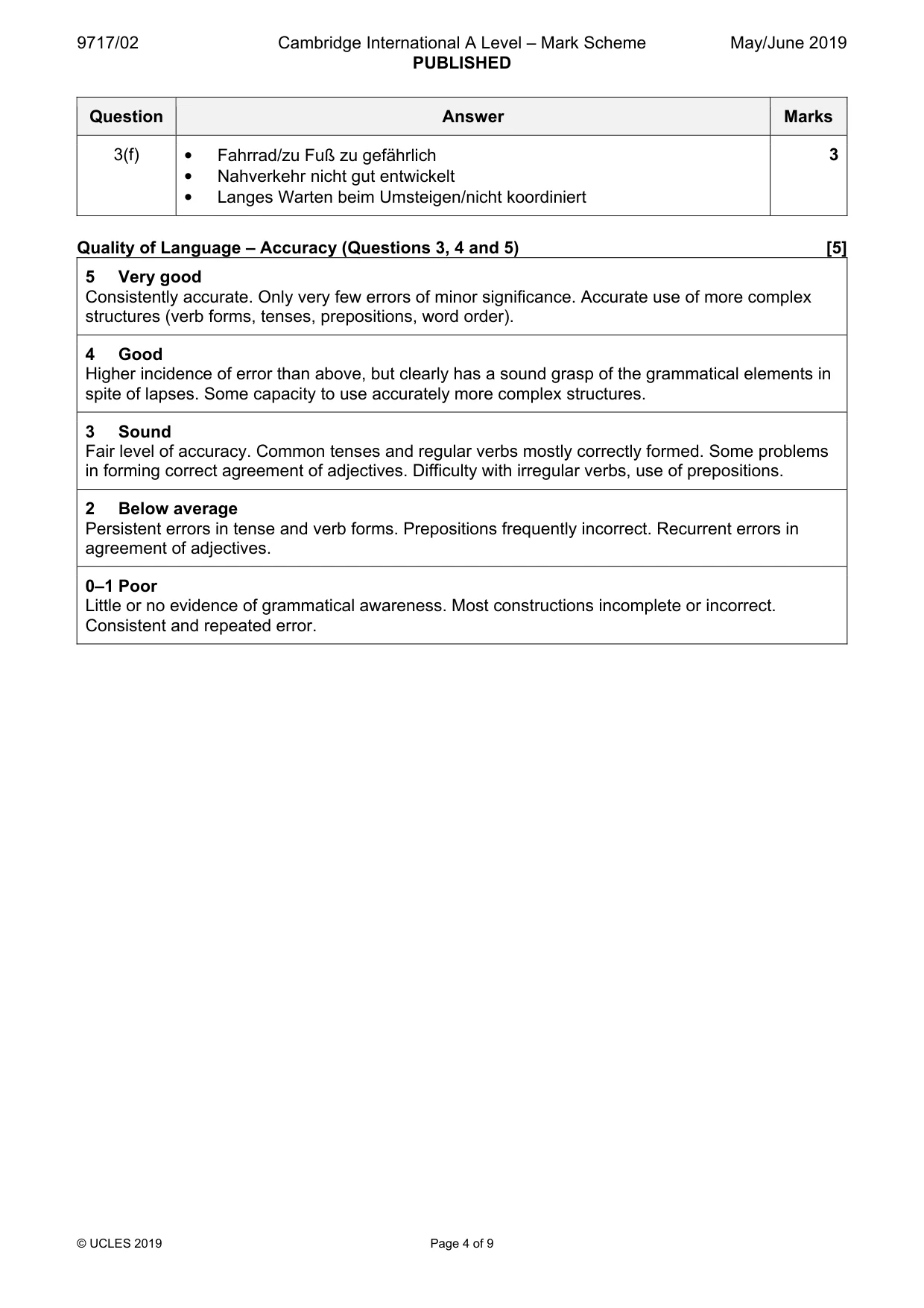
9717/02 Cambridge International A Level – Mark Scheme PUBLISHED May/June 2019 © UCLES 2019 Page 2 of 9 1 Generic Marking Principles These general marking principles must be applied by all examiners when marking candidate answers. They should be applied alongside the specific content of the mark scheme or generic level descriptors for a question. Each question paper and mark scheme will also comply with these marking principles. GENERIC MARKING PRINCIPLE 1: Marks must be awarded in line with: • the specific content of the mark scheme or the generic level descriptors for the question • the specific skills defined in the mark scheme or in the generic level descriptors for the question • the standard of response required by a candidate as exemplified by the standardisation scripts. GENERIC MARKING PRINCIPLE 2: Marks awarded are always whole marks (not half marks, or other fractions). GENERIC MARKING PRINCIPLE 3: Marks must be awarded positively: • marks are awarded for correct/valid answers, as defined in the mark scheme. However, credit is given for valid answers which go beyond the scope of the syllabus and mark scheme, referring to your Team Leader as appropriate • marks are awarded when candidates clearly demonstrate what they know and can do • marks are not deducted for errors • marks are not deducted for omissions • answers should only be judged on the quality of spelling, punctuation and grammar when these features are specifically assessed by the question as indicated by the mark scheme. The meaning, however, should be unambiguous. GENERIC MARKING PRINCIPLE 4: Rules must be applied consistently e.g. in situations where candidates have not followed instructions or in the application of generic level descriptors. GENERIC MARKING PRINCIPLE 5: Marks should be awarded using the full range of marks defined in the mark scheme for the question (however; the use of the full mark range may be limited according to the quality of the candidate responses seen). GENERIC MARKING PRINCIPLE 6: Marks awarded are based solely on the requirements as defined in the mark scheme. Marks should not be awarded with grade thresholds or grade descriptors in mind.
Mark scheme, page 3
9717/02 Cambridge International A Level – Mark Scheme PUBLISHED May/June 2019 © UCLES 2019 Page 3 of 9 2 Detailed Mark Scheme Section 1 Question Answer Marks 1(a) Auto 1 1(b) neue 1 1(c) Großstӓdten 1 1(d) unbeliebten 1 1(e) Platz 1 Question Answer Marks 2(a) – sie müssen…einplanen 1 2(b) – viele / vielfӓltige Gründe 1 2(c) – entwickeln 1 2(d) – Unfӓlle 1 2(e) – dem Auto 1 Question Answer Marks 3(a) • Es dauert morgens 61% länger • Abends sogar 70% 2 3(b) • 2 Autobahnen führen direkt an der Stadt vorbei • Stadt ist im Zentrum der internationalenTransitverkehre / Treffpunkt Ost- und Westeuropa 2 3(c) • Hohe Luftverschmutzung • Gesamter Verkehr geht durch die Innenstadt 2 3(d) • Autofahrer suchen einen Parkplatz und verursachen zusӓtzlichen Verkehr • Modernes Parkleitsystem 2 3(e) • Geschwindigkeit wird natürlich reguliert • Weniger Wartezeiten • Billiger • Weniger Unfälle • Keine starren Ampelphasen (Any 4 of 5) 4
Mark scheme, page 4
9717/02 Cambridge International A Level – Mark Scheme PUBLISHED May/June 2019 © UCLES 2019 Page 4 of 9 Question Answer Marks 3(f) • Fahrrad/zu Fuß zu gefährlich • Nahverkehr nicht gut entwickelt • Langes Warten beim Umsteigen/nicht koordiniert 3 Quality of Language – Accuracy (Questions 3, 4 and 5) [5] 5 Very good Consistently accurate. Only very few errors of minor significance. Accurate use of more complex structures (verb forms, tenses, prepositions, word order). 4 Good Higher incidence of error than above, but clearly has a sound grasp of the grammatical elements in spite of lapses. Some capacity to use accurately more complex structures. 3 Sound Fair level of accuracy. Common tenses and regular verbs mostly correctly formed. Some problems in forming correct agreement of adjectives. Difficulty with irregular verbs, use of prepositions. 2 Below average Persistent errors in tense and verb forms. Prepositions frequently incorrect. Recurrent errors in agreement of adjectives. 0–1 Poor Little or no evidence of grammatical awareness. Most constructions incomplete or incorrect. Consistent and repeated error.
Mark scheme, page 5
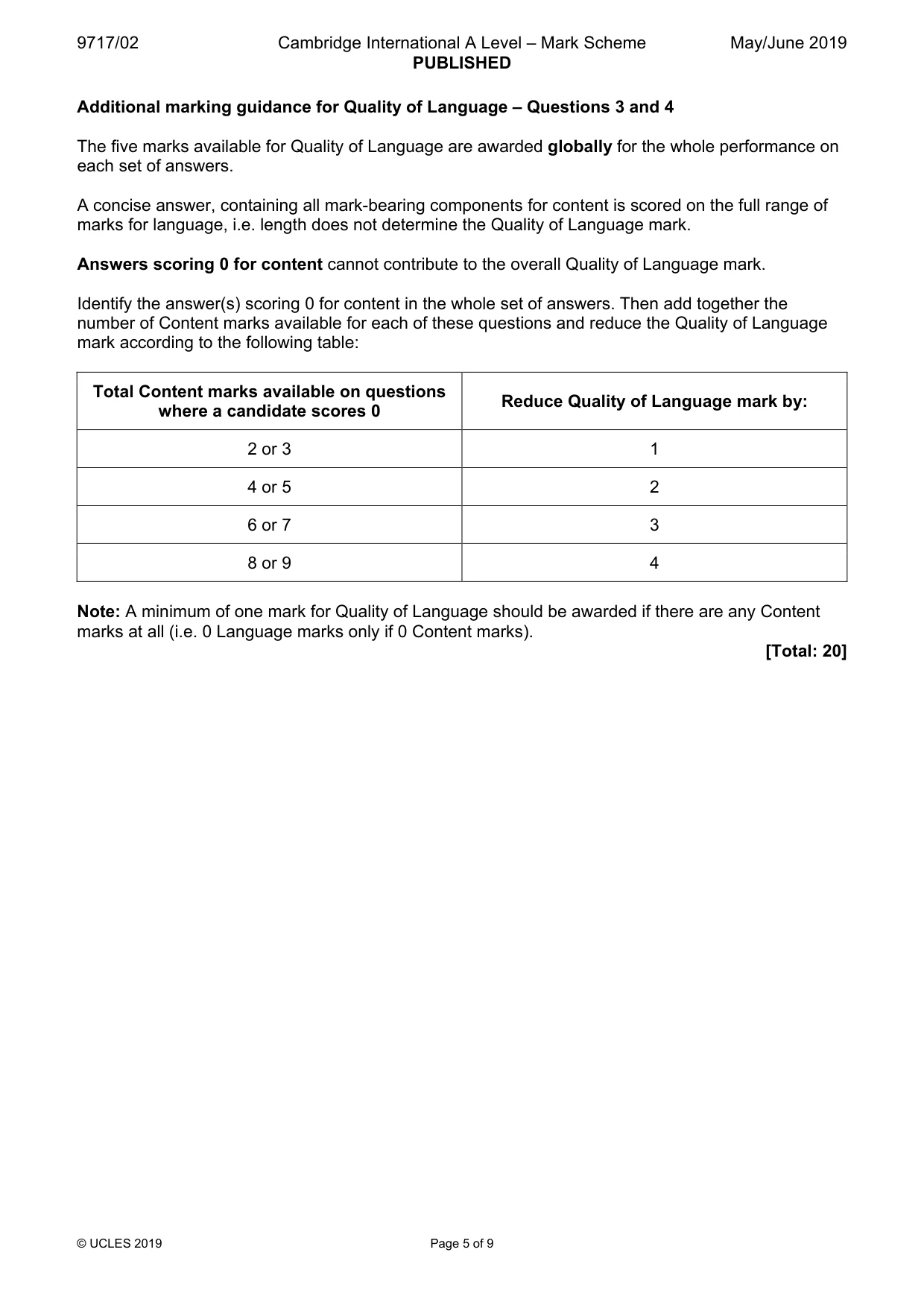
9717/02 Cambridge International A Level – Mark Scheme PUBLISHED May/June 2019 © UCLES 2019 Page 5 of 9 Additional marking guidance for Quality of Language – Questions 3 and 4 The five marks available for Quality of Language are awarded globally for the whole performance on each set of answers. A concise answer, containing all mark-bearing components for content is scored on the full range of marks for language, i.e. length does not determine the Quality of Language mark. Answers scoring 0 for content cannot contribute to the overall Quality of Language mark. Identify the answer(s) scoring 0 for content in the whole set of answers. Then add together the number of Content marks available for each of these questions and reduce the Quality of Language mark according to the following table: Total Content marks available on questions where a candidate scores 0 Reduce Quality of Language mark by: 2 or 3 1 4 or 5 2 6 or 7 3 8 or 9 4 Note: A minimum of one mark for Quality of Language should be awarded if there are any Content marks at all (i.e. 0 Language marks only if 0 Content marks). [Total: 20]
Mark scheme, page 6
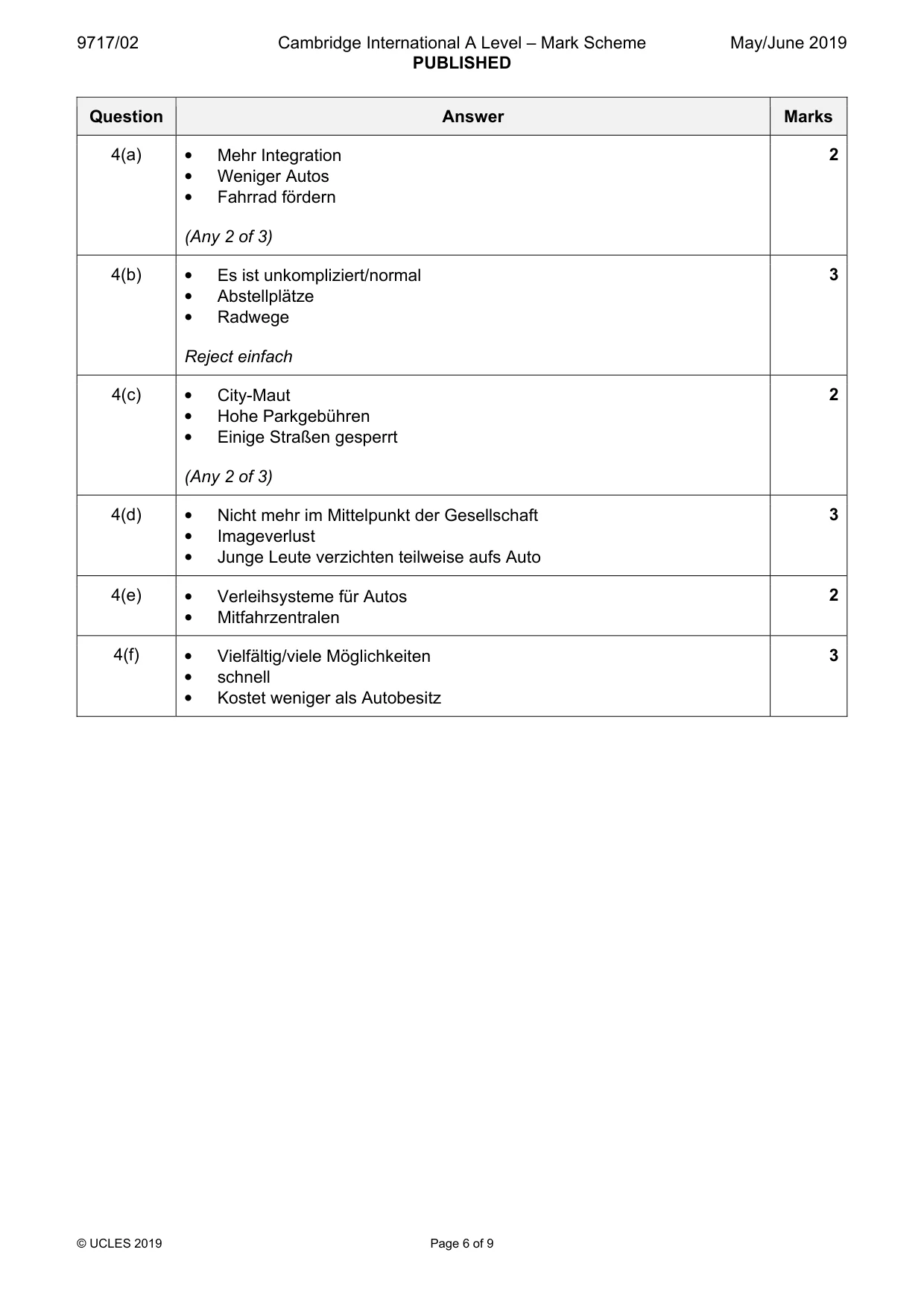
9717/02 Cambridge International A Level – Mark Scheme PUBLISHED May/June 2019 © UCLES 2019 Page 6 of 9 Question Answer Marks 4(a) • Mehr Integration • Weniger Autos • Fahrrad fӧrdern (Any 2 of 3) 2 4(b) • Es ist unkompliziert/normal • Abstellplӓtze • Radwege Reject einfach 3 4(c) • City-Maut • Hohe Parkgebühren • Einige Straßen gesperrt (Any 2 of 3) 2 4(d) • Nicht mehr im Mittelpunkt der Gesellschaft • Imageverlust • Junge Leute verzichten teilweise aufs Auto 3 4(e) • Verleihsysteme für Autos • Mitfahrzentralen 2 4(f) • Vielfältig/viele Mӧglichkeiten • schnell • Kostet weniger als Autobesitz 3
Mark scheme, page 7
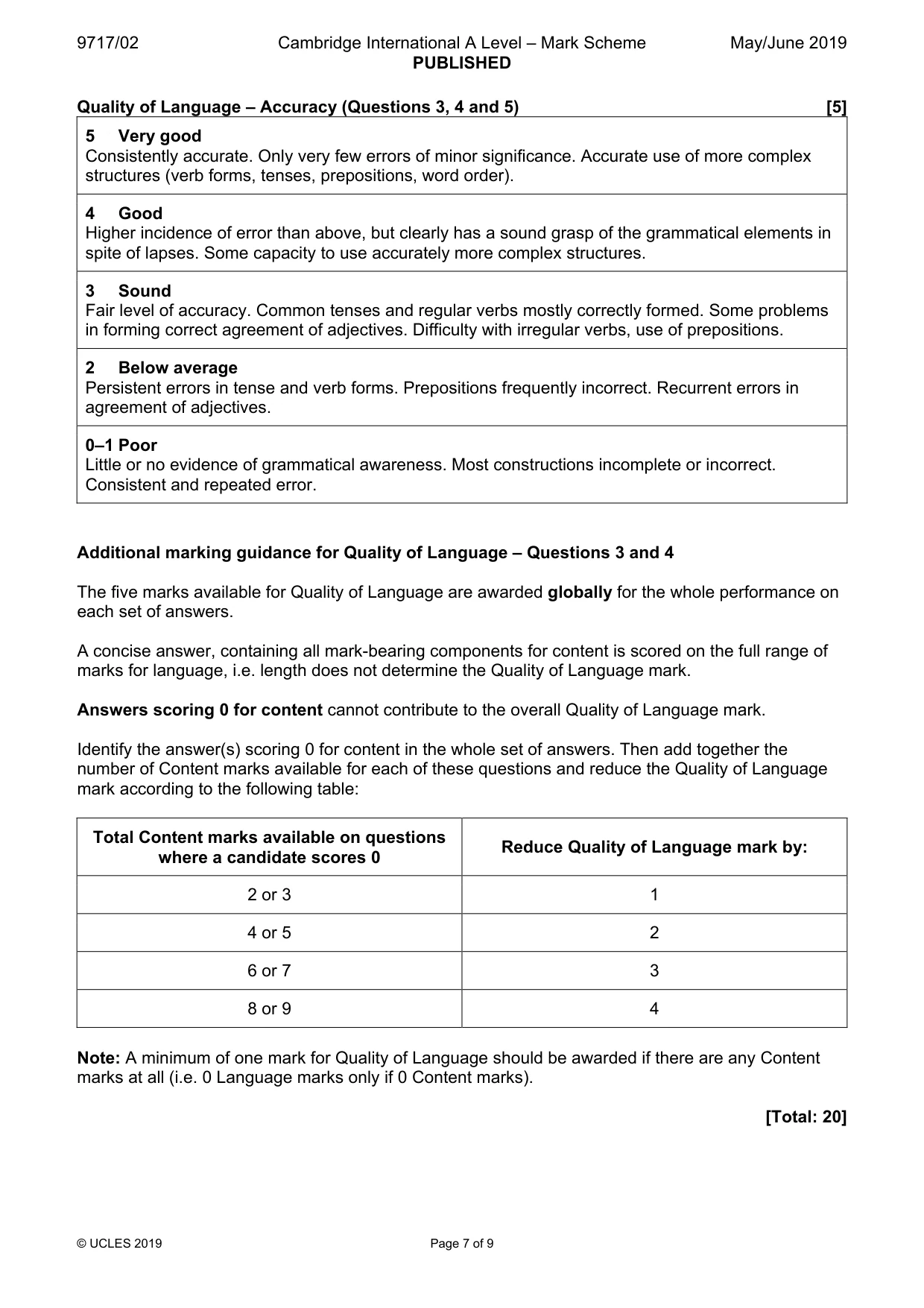
9717/02 Cambridge International A Level – Mark Scheme PUBLISHED May/June 2019 © UCLES 2019 Page 7 of 9 Quality of Language – Accuracy (Questions 3, 4 and 5) [5] 5 Very good Consistently accurate. Only very few errors of minor significance. Accurate use of more complex structures (verb forms, tenses, prepositions, word order). 4 Good Higher incidence of error than above, but clearly has a sound grasp of the grammatical elements in spite of lapses. Some capacity to use accurately more complex structures. 3 Sound Fair level of accuracy. Common tenses and regular verbs mostly correctly formed. Some problems in forming correct agreement of adjectives. Difficulty with irregular verbs, use of prepositions. 2 Below average Persistent errors in tense and verb forms. Prepositions frequently incorrect. Recurrent errors in agreement of adjectives. 0–1 Poor Little or no evidence of grammatical awareness. Most constructions incomplete or incorrect. Consistent and repeated error. Additional marking guidance for Quality of Language – Questions 3 and 4 The five marks available for Quality of Language are awarded globally for the whole performance on each set of answers. A concise answer, containing all mark-bearing components for content is scored on the full range of marks for language, i.e. length does not determine the Quality of Language mark. Answers scoring 0 for content cannot contribute to the overall Quality of Language mark. Identify the answer(s) scoring 0 for content in the whole set of answers. Then add together the number of Content marks available for each of these questions and reduce the Quality of Language mark according to the following table: Total Content marks available on questions where a candidate scores 0 Reduce Quality of Language mark by: 2 or 3 1 4 or 5 2 6 or 7 3 8 or 9 4 Note: A minimum of one mark for Quality of Language should be awarded if there are any Content marks at all (i.e. 0 Language marks only if 0 Content marks). [Total: 20]
Mark scheme, page 8
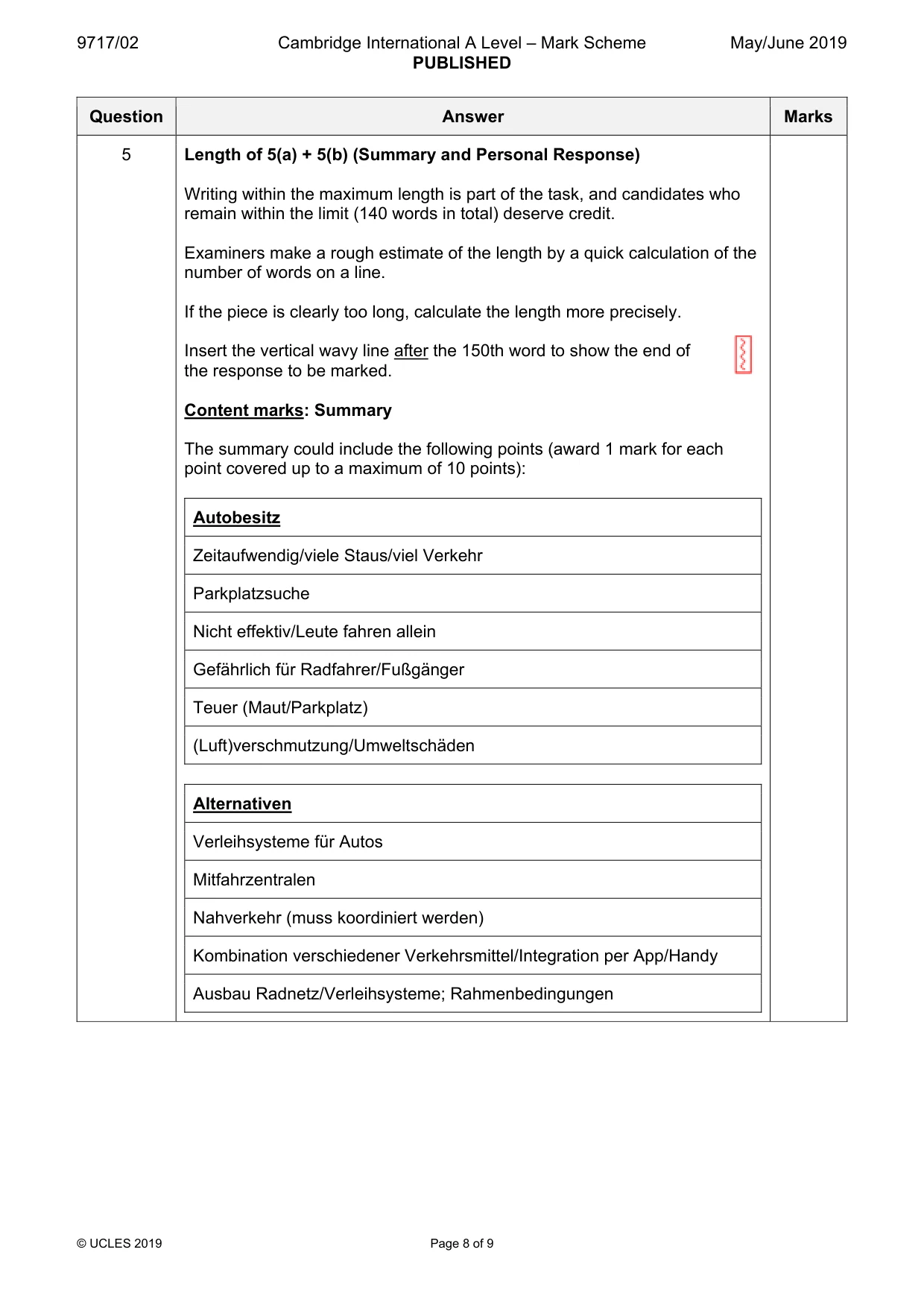
9717/02 Cambridge International A Level – Mark Scheme PUBLISHED May/June 2019 © UCLES 2019 Page 8 of 9 Question Answer Marks 5 Length of 5(a) + 5(b) (Summary and Personal Response) Writing within the maximum length is part of the task, and candidates who remain within the limit (140 words in total) deserve credit. Examiners make a rough estimate of the length by a quick calculation of the number of words on a line. If the piece is clearly too long, calculate the length more precisely. Insert the vertical wavy line after the 150th word to show the end of the response to be marked. Content marks: Summary The summary could include the following points (award 1 mark for each point covered up to a maximum of 10 points): Autobesitz Zeitaufwendig/viele Staus/viel Verkehr Parkplatzsuche Nicht effektiv/Leute fahren allein Gefährlich für Radfahrer/Fußgänger Teuer (Maut/Parkplatz) (Luft)verschmutzung/Umweltschäden Alternativen Verleihsysteme für Autos Mitfahrzentralen Nahverkehr (muss koordiniert werden) Kombination verschiedener Verkehrsmittel/Integration per App/Handy Ausbau Radnetz/Verleihsysteme; Rahmenbedingungen
Mark scheme, page 9
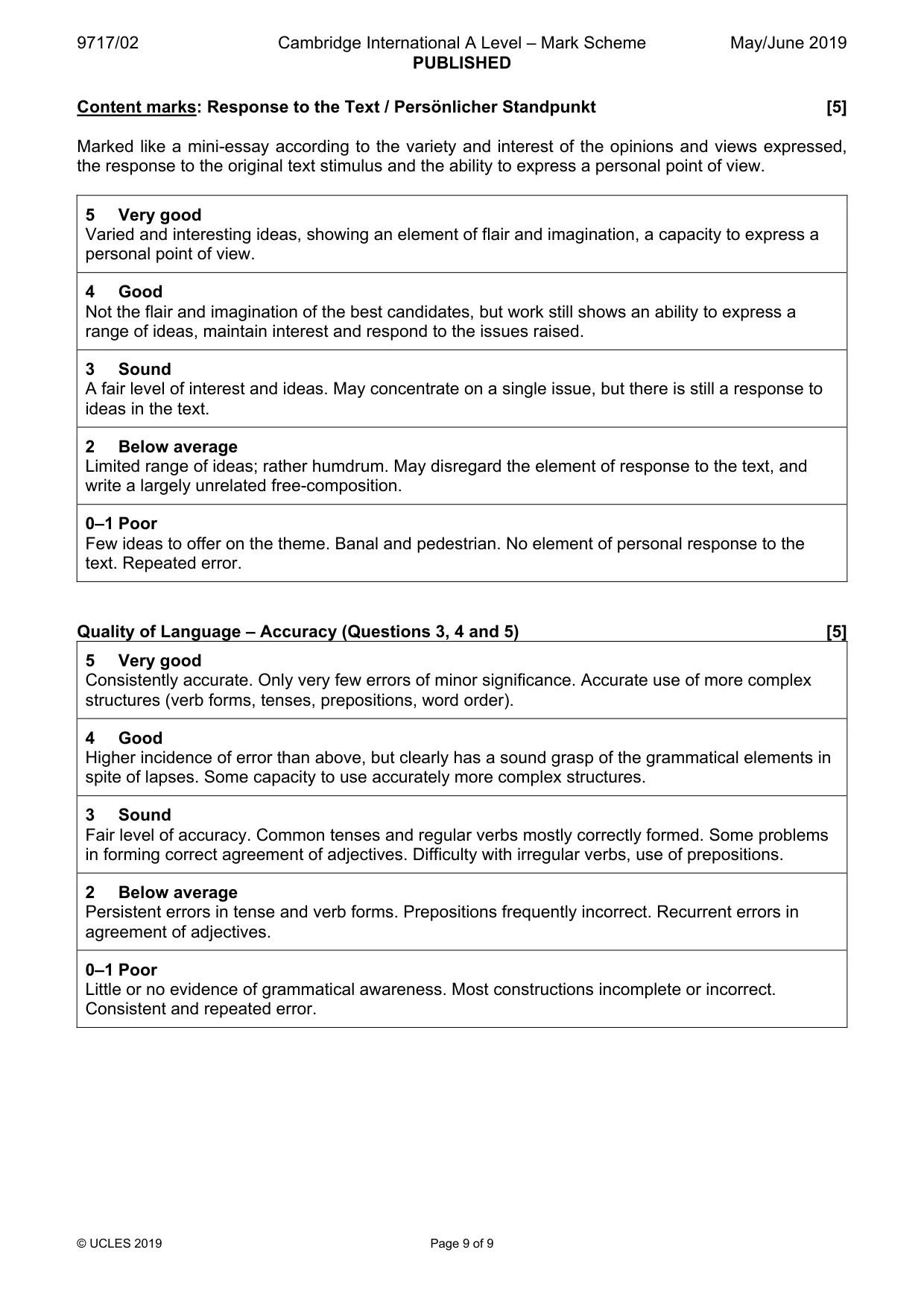
9717/02 Cambridge International A Level – Mark Scheme PUBLISHED May/June 2019 © UCLES 2019 Page 9 of 9 Content marks: Response to the Text / Persönlicher Standpunkt [5] Marked like a mini-essay according to the variety and interest of the opinions and views expressed, the response to the original text stimulus and the ability to express a personal point of view. 5 Very good Varied and interesting ideas, showing an element of flair and imagination, a capacity to express a personal point of view. 4 Good Not the flair and imagination of the best candidates, but work still shows an ability to express a range of ideas, maintain interest and respond to the issues raised. 3 Sound A fair level of interest and ideas. May concentrate on a single issue, but there is still a response to ideas in the text. 2 Below average Limited range of ideas; rather humdrum. May disregard the element of response to the text, and write a largely unrelated free-composition. 0–1 Poor Few ideas to offer on the theme. Banal and pedestrian. No element of personal response to the text. Repeated error. Quality of Language – Accuracy (Questions 3, 4 and 5) [5] 5 Very good Consistently accurate. Only very few errors of minor significance. Accurate use of more complex structures (verb forms, tenses, prepositions, word order). 4 Good Higher incidence of error than above, but clearly has a sound grasp of the grammatical elements in spite of lapses. Some capacity to use accurately more complex structures. 3 Sound Fair level of accuracy. Common tenses and regular verbs mostly correctly formed. Some problems in forming correct agreement of adjectives. Difficulty with irregular verbs, use of prepositions. 2 Below average Persistent errors in tense and verb forms. Prepositions frequently incorrect. Recurrent errors in agreement of adjectives. 0–1 Poor Little or no evidence of grammatical awareness. Most constructions incomplete or incorrect. Consistent and repeated error.
What you needed in this session
Cambridge’s own grade thresholds for 2019 May/June, Paper 2 · Variant 1. A higher threshold means an easier paper — the bar moves with how the cohort did.