Cambridge A Level German (A Level only) 9717 — 2015 Oct/Nov Paper 2 · Variant 1
9717/21/O/N/15
The question paper and its mark scheme, free to read here and free to download. This is Cambridge’s own paper, exactly as it was sat.
Question paper8 pages

Mark scheme5 pages
Answers below. Sit the paper first if you are practising.
Paper as text
Question paper, page 1
This document consists of 8 printed pages and 1 Insert. DC (ST) 102487/6 © UCLES 2015 [Turn over Cambridge International Examinations Cambridge International Advanced Level * 4 2 3 2 4 2 6 3 0 1 * GERMAN 9717/21 Paper 2 Reading and Writing October/November 2015 1 hour 45 minutes Candidates answer on the Question Paper. No Additional Materials are required. READ THESE INSTRUCTIONS FIRST Write your Centre number, candidate number and name in the spaces at the top of this page. Write in dark blue or black pen. Do not use staples, paper clips, glue or correction fluid. DO NOT WRITE IN ANY BARCODES. Answer all questions in German in the spaces provided. Dictionaries are not permitted. You should keep to any word limits given in the questions. The number of marks is given in brackets [ ] at the end of each question or part question. LESEN SIE ZUERST DIESE ANWEISUNGEN Schreiben Sie Ihre Center-Nummer, Kandidaten-Nummer und Ihren Namen in die vorgegebenen Kästchen oben auf dieser Seite. Schreiben Sie mit dunkelblauem oder schwarzem Füller/Kugelschreiber. Benutzen Sie keine Heftklammern, Büroklammern, Korrekturflüssigkeit und keinen Klebstoff. SCHREIBEN SIE NICHT ÜBER DIE STRICHCODES. Beantworten Sie alle Fragen auf Deutsch in dem dafür vorgesehenen Bereich. Der Gebrauch von Wörterbüchern ist nicht erlaubt. Sie müssen sich an die Wortzahl halten, die für jede Frage angegeben ist. Die erreichbare Punktzahl finden Sie in Klammern [ ] am Ende jeder Frage oder Teilfrage.
Question paper, page 2
2 9717/21/O/N/15 © UCLES 2015 Erster Teil Lesen Sie Text 1, Psychologen untersuchen den Trend zur flexiblen Arbeitszeit, in den beiliegenden Textblättern und beantworten Sie dann die Fragen 1, 2 und 3 auf diesem Fragebogen. 1 Finden Sie im Text 1 die Wörter, die den folgenden Definitionen entsprechen. Alle Wörter sind zwischen Zeilen 1–7 zu finden. Beispiel: wach Antwort: munter (a) bedeutet …[1] (b) inzwischen …[1] (c) die Lage …[1] (d) angenehmer …[1] (e) die Ansicht …[1] [5]
Question paper, page 3
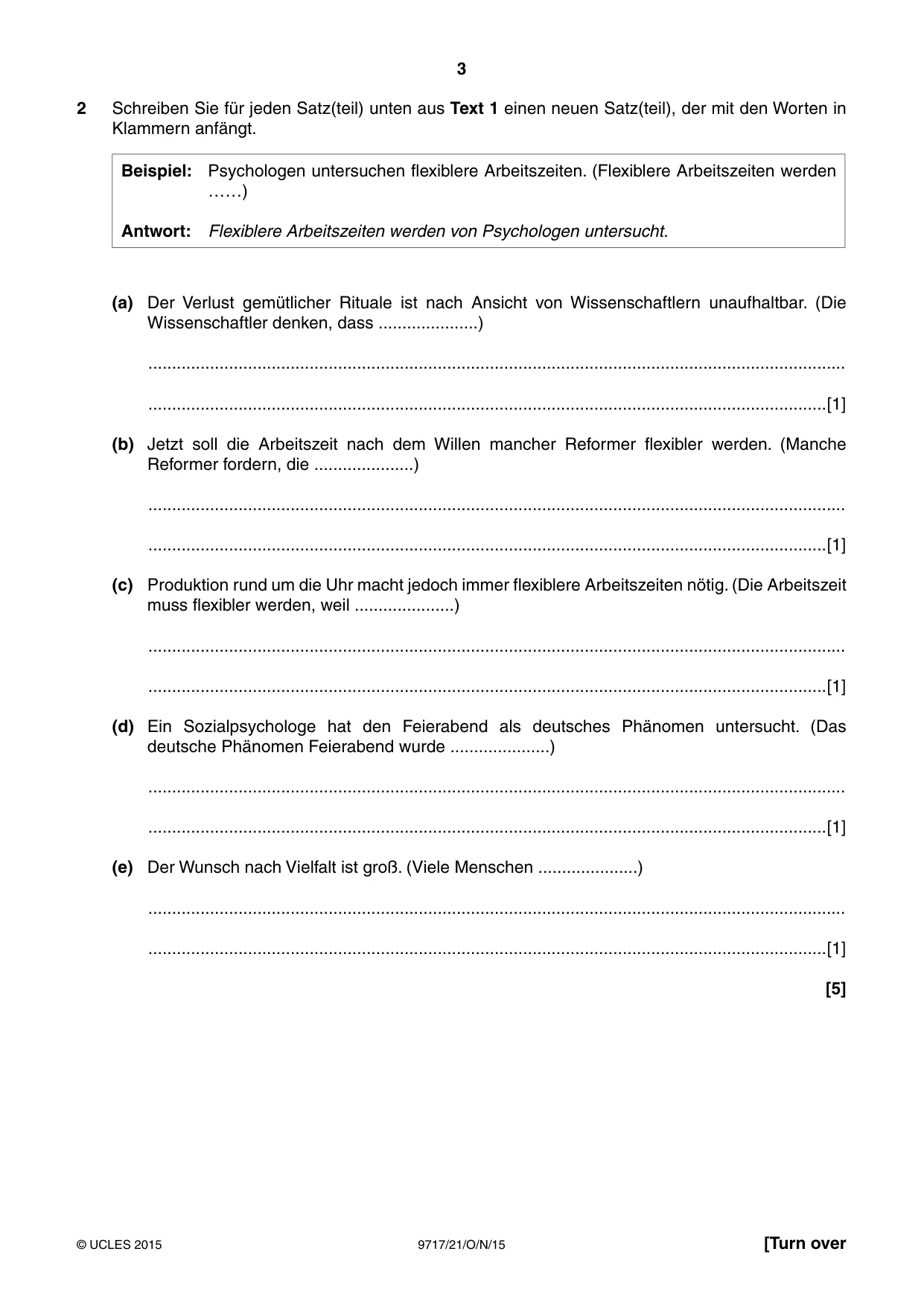
3 9717/21/O/N/15 © UCLES 2015 [Turn over 2 Schreiben Sie für jeden Satz(teil) unten aus Text 1 einen neuen Satz(teil), der mit den Worten in Klammern anfängt. Beispiel: Psychologen untersuchen flexiblere Arbeitszeiten. (Flexiblere Arbeitszeiten werden ……) Antwort: Flexiblere Arbeitszeiten werden von Psychologen untersucht. (a) Der Verlust gemütlicher Rituale ist nach Ansicht von Wissenschaftlern unaufhaltbar. (Die Wissenschaftler denken, dass …) … …[1] (b) Jetzt soll die Arbeitszeit nach dem Willen mancher Reformer flexibler werden. (Manche Reformer fordern, die …) … …[1] (c) Produktion rund um die Uhr macht jedoch immer flexiblere Arbeitszeiten nötig. (Die Arbeitszeit muss flexibler werden, weil …) … …[1] (d) Ein Sozialpsychologe hat den Feierabend als deutsches Phänomen untersucht. (Das deutsche Phänomen Feierabend wurde …) … …[1] (e) Der Wunsch nach Vielfalt ist groß. (Viele Menschen …) … …[1] [5]
Question paper, page 4
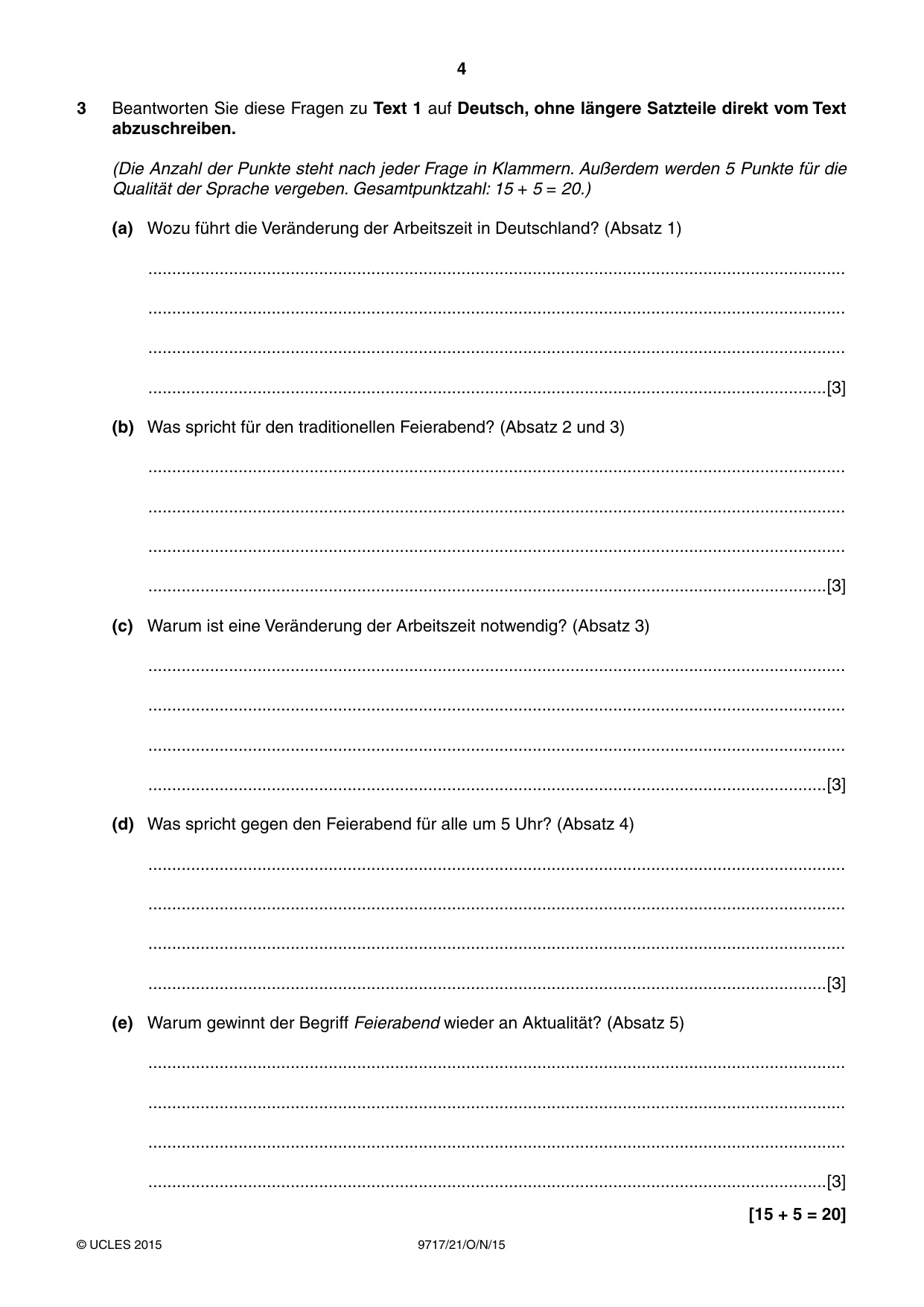
4 9717/21/O/N/15 © UCLES 2015 3 Beantworten Sie diese Fragen zu Text 1 auf Deutsch, ohne längere Satzteile direkt vom Text abzuschreiben. (Die Anzahl der Punkte steht nach jeder Frage in Klammern. Außerdem werden 5 Punkte für die Qualität der Sprache vergeben. Gesamtpunktzahl: 15 + 5 = 20.) (a) Wozu führt die Veränderung der Arbeitszeit in Deutschland? (Absatz 1) … … … …[3] (b) Was spricht für den traditionellen Feierabend? (Absatz 2 und 3) … … … …[3] (c) Warum ist eine Veränderung der Arbeitszeit notwendig? (Absatz 3) … … … …[3] (d) Was spricht gegen den Feierabend für alle um 5 Uhr? (Absatz 4) … … … …[3] (e) Warum gewinnt der Begriff Feierabend wieder an Aktualität? (Absatz 5) … … … …[3] [15 + 5 = 20]
Question paper, page 5
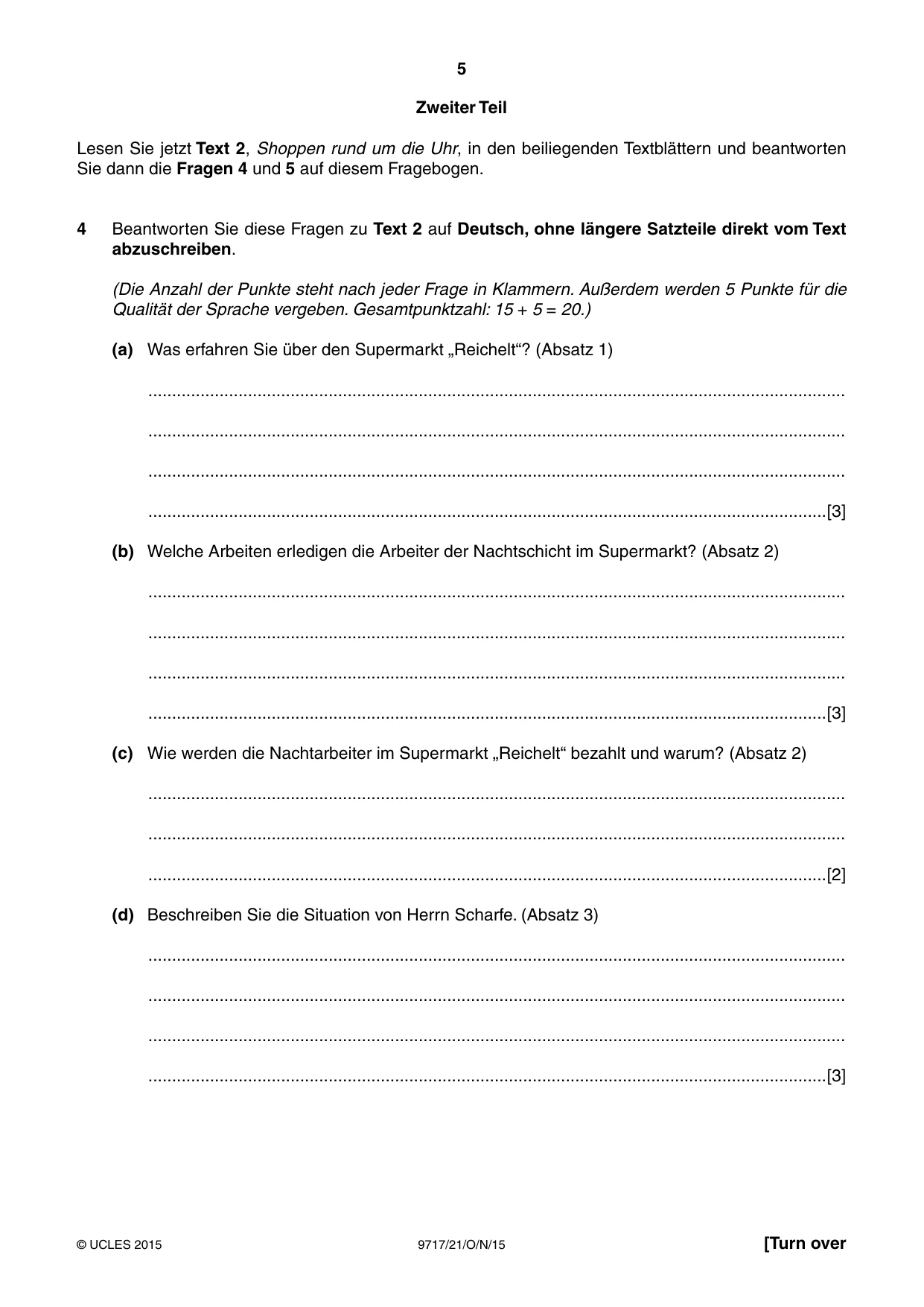
5 9717/21/O/N/15 © UCLES 2015 [Turn over Zweiter Teil Lesen Sie jetzt Text 2, Shoppen rund um die Uhr, in den beiliegenden Textblättern und beantworten Sie dann die Fragen 4 und 5 auf diesem Fragebogen. 4 Beantworten Sie diese Fragen zu Text 2 auf Deutsch, ohne längere Satzteile direkt vom Text abzuschreiben. (Die Anzahl der Punkte steht nach jeder Frage in Klammern. Außerdem werden 5 Punkte für die Qualität der Sprache vergeben. Gesamtpunktzahl: 15 + 5 = 20.) (a) Was erfahren Sie über den Supermarkt „Reichelt“? (Absatz 1) … … … …[3] (b) Welche Arbeiten erledigen die Arbeiter der Nachtschicht im Supermarkt? (Absatz 2) … … … …[3] (c) Wie werden die Nachtarbeiter im Supermarkt „Reichelt“ bezahlt und warum? (Absatz 2) … … …[2] (d) Beschreiben Sie die Situation von Herrn Scharfe. (Absatz 3) … … … …[3]
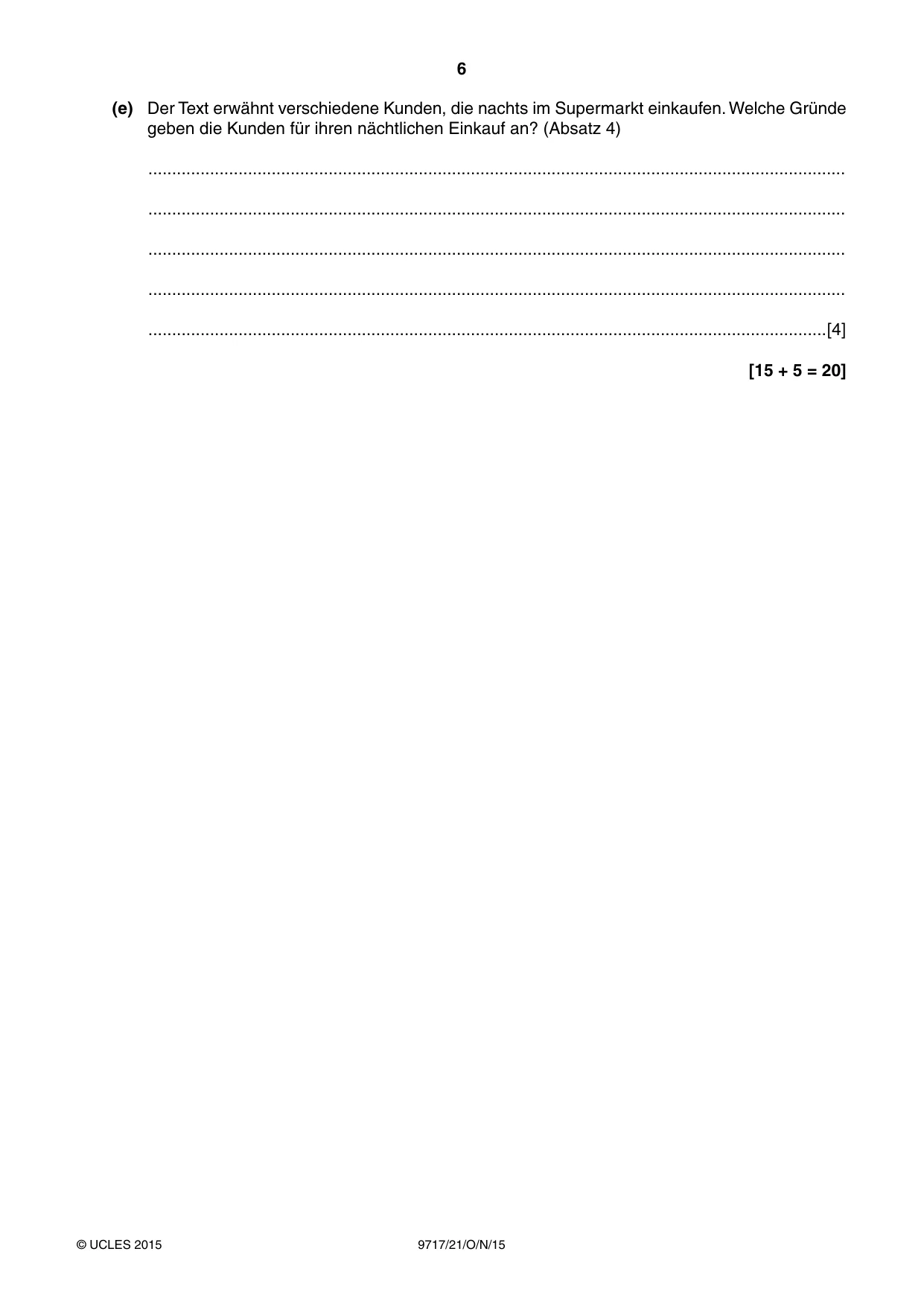
Question paper, page 6
6 9717/21/O/N/15 © UCLES 2015 (e) Der Text erwähnt verschiedene Kunden, die nachts im Supermarkt einkaufen. Welche Gründe geben die Kunden für ihren nächtlichen Einkauf an? (Absatz 4) … … … … …[4] [15 + 5 = 20]
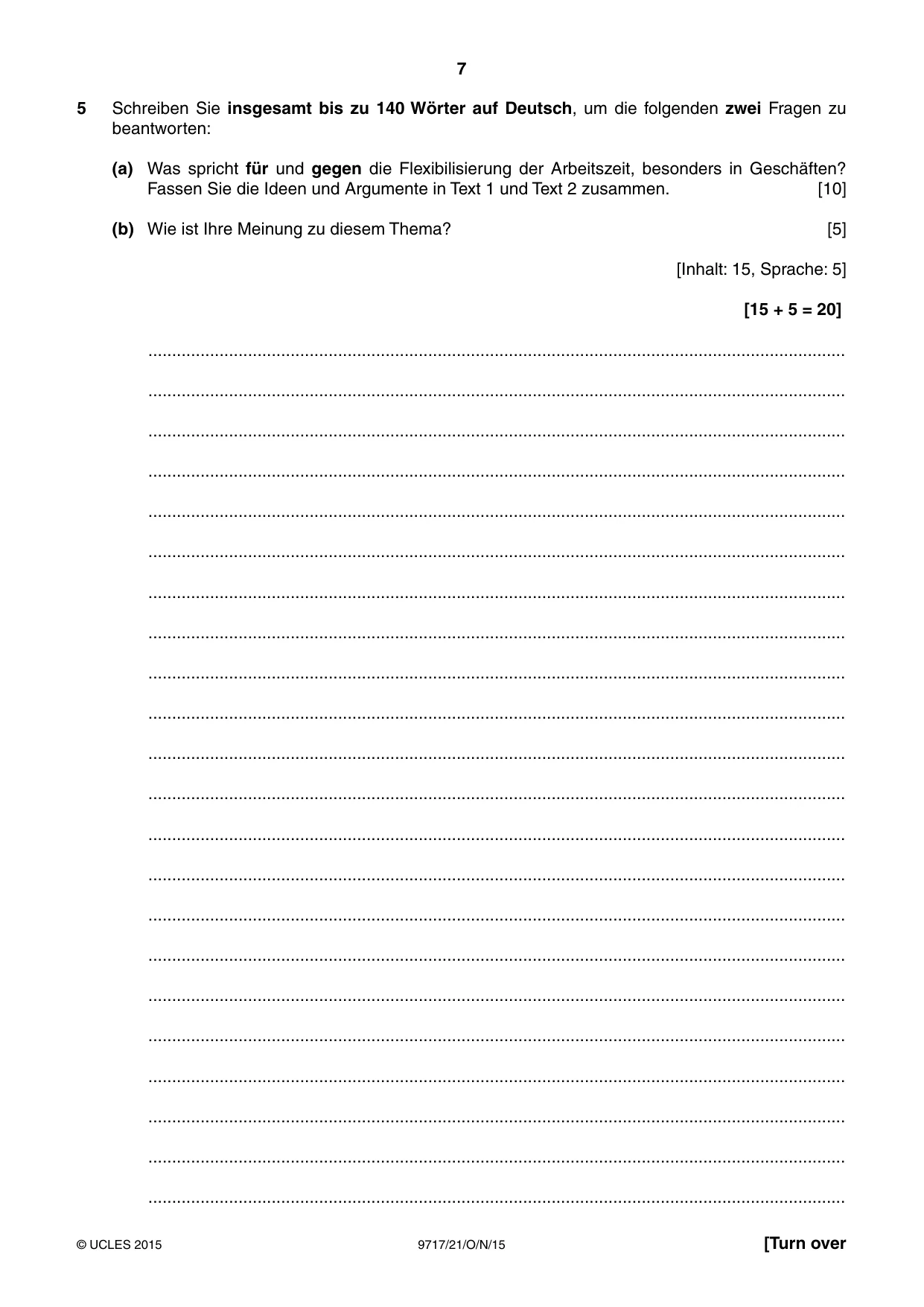
Question paper, page 7
7 9717/21/O/N/15 © UCLES 2015 [Turn over 5 Schreiben Sie insgesamt bis zu 140 Wörter auf Deutsch, um die folgenden zwei Fragen zu beantworten: (a) Was spricht für und gegen die Flexibilisierung der Arbeitszeit, besonders in Geschäften? Fassen Sie die Ideen und Argumente in Text 1 und Text 2 zusammen. [10] (b) Wie ist Ihre Meinung zu diesem Thema? [5] [Inhalt: 15, Sprache: 5] [15 + 5 = 20] … … … … … … … … … … … … … … … … … … … … … …
Question paper, page 8
8 9717/21/O/N/15 © UCLES 2015 Permission to reproduce items where third-party owned material protected by copyright is included has been sought and cleared where possible. Every reasonable effort has been made by the publisher (UCLES) to trace copyright holders, but if any items requiring clearance have unwittingly been included, the publisher will be pleased to make amends at the earliest possible opportunity. To avoid the issue of disclosure of answer-related information to candidates, all copyright acknowledgements are reproduced online in the Cambridge International Examinations Copyright Acknowledgements Booklet. This is produced for each series of examinations and is freely available to download at www.cie.org.uk after the live examination series. Cambridge International Examinations is part of the Cambridge Assessment Group. Cambridge Assessment is the brand name of University of Cambridge Local Examinations Syndicate (UCLES), which is itself a department of the University of Cambridge. … … … … … … … … … … … … …
Mark scheme, page 1
® IGCSE is the registered trademark of Cambridge International Examinations. CAMBRIDGE INTERNATIONAL EXAMINATIONS Cambridge International Advanced Level MARK SCHEME for the October/November 2015 series 9717 GERMAN 9717/21 Paper 2 (Reading and Writing), maximum raw mark 70 This mark scheme is published as an aid to teachers and candidates, to indicate the requirements of the examination. It shows the basis on which Examiners were instructed to award marks. It does not indicate the details of the discussions that took place at an Examiners’ meeting before marking began, which would have considered the acceptability of alternative answers. Mark schemes should be read in conjunction with the question paper and the Principal Examiner Report for Teachers. Cambridge will not enter into discussions about these mark schemes. Cambridge is publishing the mark schemes for the October/November 2015 series for most Cambridge IGCSE®, Cambridge International A and AS Level components and some Cambridge O Level components.
Mark scheme, page 2
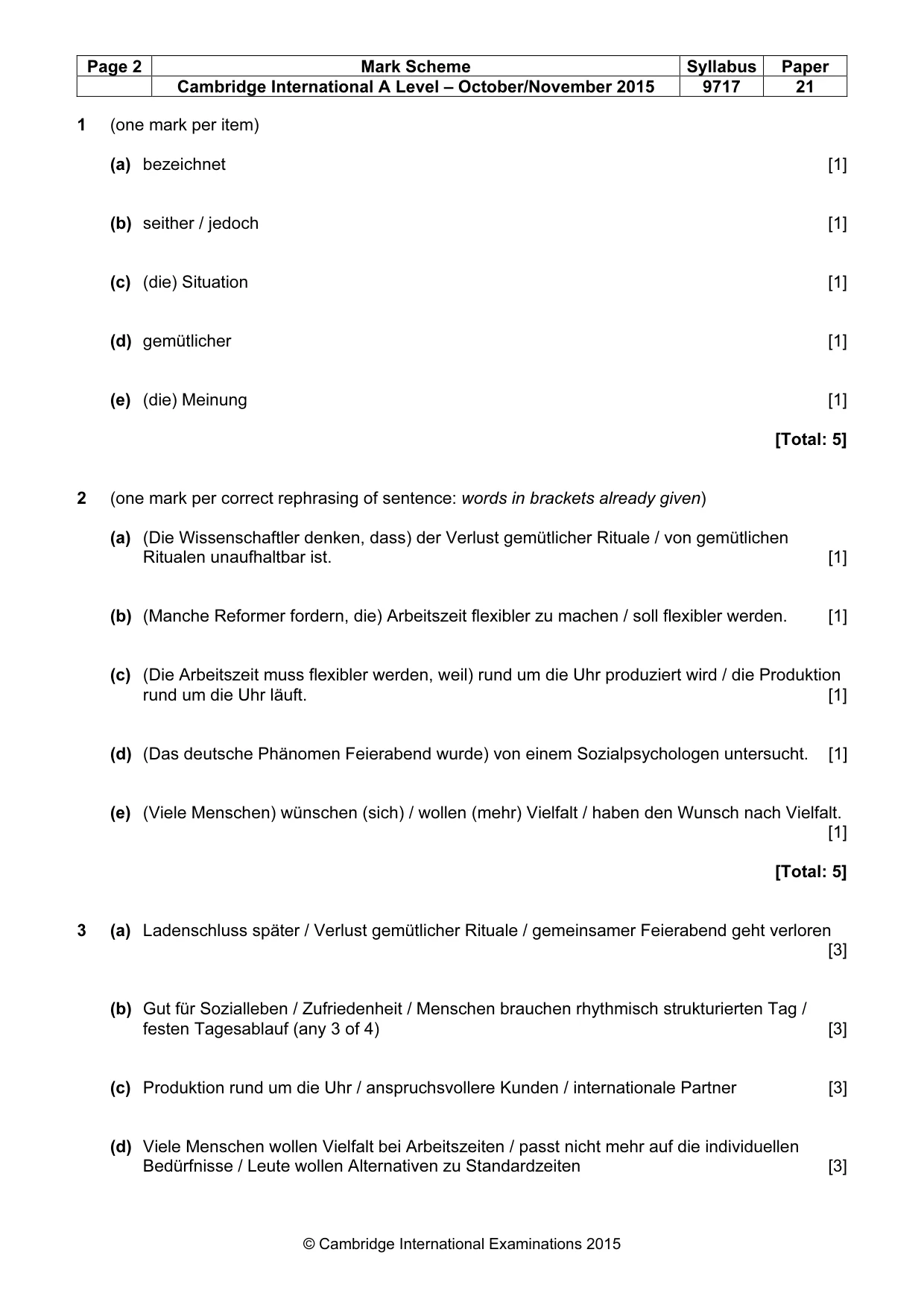
Page 2 Mark Scheme Syllabus Paper Cambridge International A Level – October/November 2015 9717 21 © Cambridge International Examinations 2015 1 (one mark per item) (a) bezeichnet [1] (b) seither / jedoch [1] (c) (die) Situation [1] (d) gemütlicher [1] (e) (die) Meinung [1] [Total: 5] 2 (one mark per correct rephrasing of sentence: words in brackets already given) (a) (Die Wissenschaftler denken, dass) der Verlust gemütlicher Rituale / von gemütlichen Ritualen unaufhaltbar ist. [1] (b) (Manche Reformer fordern, die) Arbeitszeit flexibler zu machen / soll flexibler werden. [1] (c) (Die Arbeitszeit muss flexibler werden, weil) rund um die Uhr produziert wird / die Produktion rund um die Uhr läuft. [1] (d) (Das deutsche Phänomen Feierabend wurde) von einem Sozialpsychologen untersucht. [1] (e) (Viele Menschen) wünschen (sich) / wollen (mehr) Vielfalt / haben den Wunsch nach Vielfalt. [1] [Total: 5] 3 (a) Ladenschluss später / Verlust gemütlicher Rituale / gemeinsamer Feierabend geht verloren [3] (b) Gut für Sozialleben / Zufriedenheit / Menschen brauchen rhythmisch strukturierten Tag / festen Tagesablauf (any 3 of 4) [3] (c) Produktion rund um die Uhr / anspruchsvollere Kunden / internationale Partner [3] (d) Viele Menschen wollen Vielfalt bei Arbeitszeiten / passt nicht mehr auf die individuellen Bedürfnisse / Leute wollen Alternativen zu Standardzeiten [3]
Mark scheme, page 3
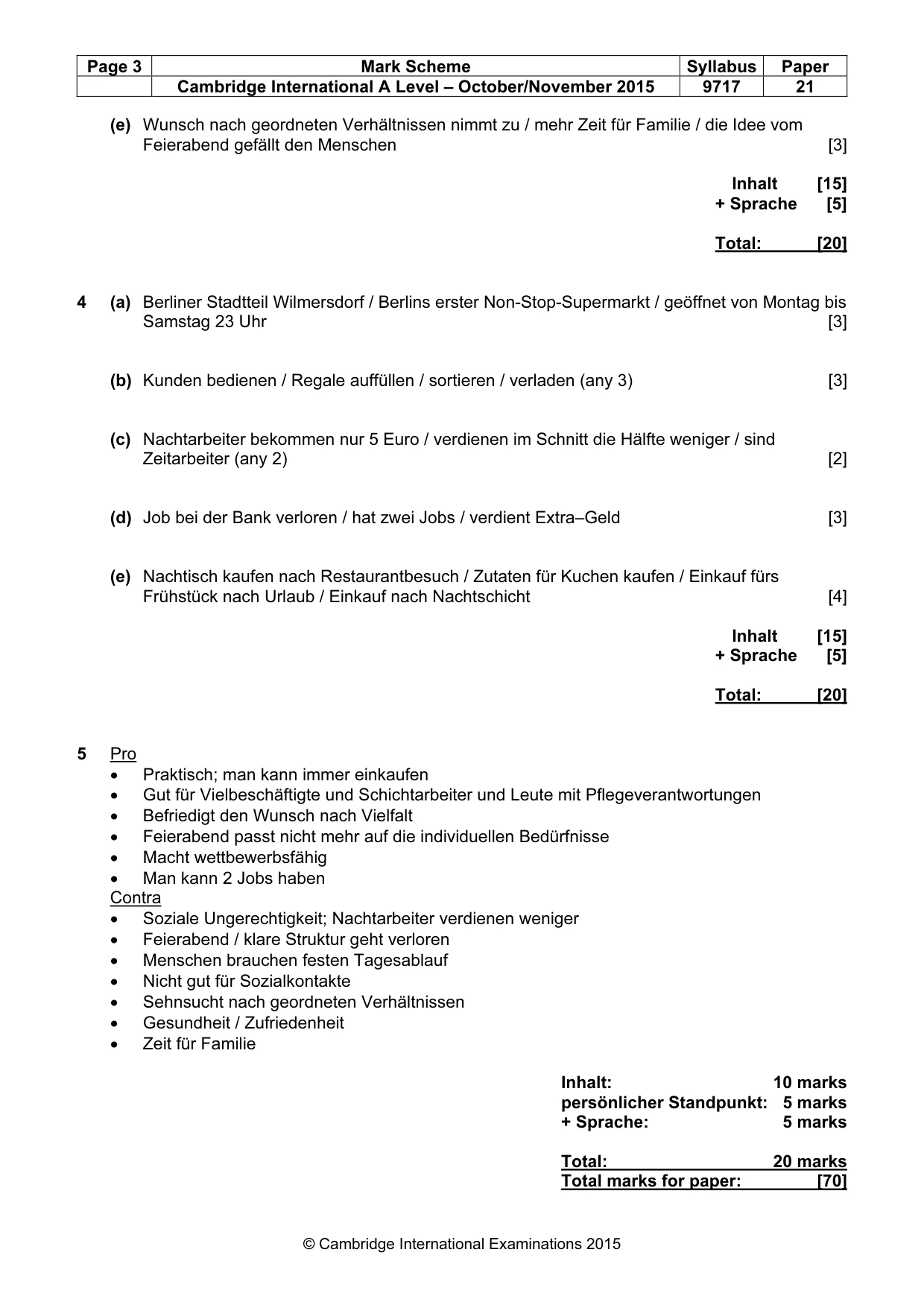
Page 3 Mark Scheme Syllabus Paper Cambridge International A Level – October/November 2015 9717 21 © Cambridge International Examinations 2015 (e) Wunsch nach geordneten Verhältnissen nimmt zu / mehr Zeit für Familie / die Idee vom Feierabend gefällt den Menschen [3] Inhalt [15] + Sprache [5] Total: [20] 4 (a) Berliner Stadtteil Wilmersdorf / Berlins erster Non-Stop-Supermarkt / geöffnet von Montag bis Samstag 23 Uhr [3] (b) Kunden bedienen / Regale auffüllen / sortieren / verladen (any 3) [3] (c) Nachtarbeiter bekommen nur 5 Euro / verdienen im Schnitt die Hälfte weniger / sind Zeitarbeiter (any 2) [2] (d) Job bei der Bank verloren / hat zwei Jobs / verdient Extra–Geld [3] (e) Nachtisch kaufen nach Restaurantbesuch / Zutaten für Kuchen kaufen / Einkauf fürs Frühstück nach Urlaub / Einkauf nach Nachtschicht [4] Inhalt [15] + Sprache [5] Total: [20] 5 Pro • Praktisch; man kann immer einkaufen • Gut für Vielbeschäftigte und Schichtarbeiter und Leute mit Pflegeverantwortungen • Befriedigt den Wunsch nach Vielfalt • Feierabend passt nicht mehr auf die individuellen Bedürfnisse • Macht wettbewerbsfähig • Man kann 2 Jobs haben Contra • Soziale Ungerechtigkeit; Nachtarbeiter verdienen weniger • Feierabend / klare Struktur geht verloren • Menschen brauchen festen Tagesablauf • Nicht gut für Sozialkontakte • Sehnsucht nach geordneten Verhältnissen • Gesundheit / Zufriedenheit • Zeit für Familie Inhalt: 10 marks persönlicher Standpunkt: 5 marks + Sprache: 5 marks Total: 20 marks Total marks for paper: [70]
Mark scheme, page 4
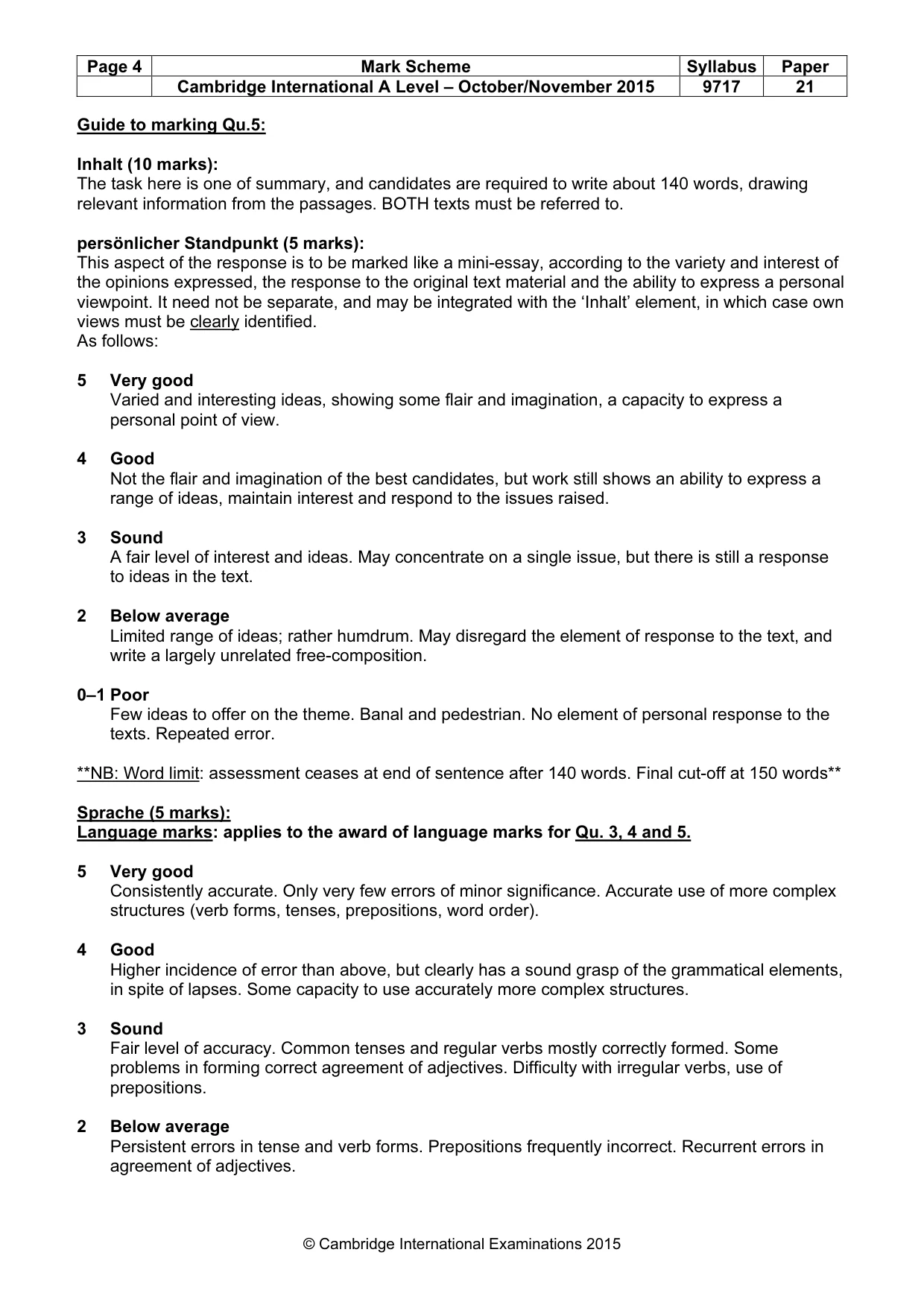
Page 4 Mark Scheme Syllabus Paper Cambridge International A Level – October/November 2015 9717 21 © Cambridge International Examinations 2015 Guide to marking Qu.5: Inhalt (10 marks): The task here is one of summary, and candidates are required to write about 140 words, drawing relevant information from the passages. BOTH texts must be referred to. persönlicher Standpunkt (5 marks): This aspect of the response is to be marked like a mini-essay, according to the variety and interest of the opinions expressed, the response to the original text material and the ability to express a personal viewpoint. It need not be separate, and may be integrated with the ‘Inhalt’ element, in which case own views must be clearly identified. As follows: 5 Very good Varied and interesting ideas, showing some flair and imagination, a capacity to express a personal point of view. 4 Good Not the flair and imagination of the best candidates, but work still shows an ability to express a range of ideas, maintain interest and respond to the issues raised. 3 Sound A fair level of interest and ideas. May concentrate on a single issue, but there is still a response to ideas in the text. 2 Below average Limited range of ideas; rather humdrum. May disregard the element of response to the text, and write a largely unrelated free-composition. 0–1 Poor Few ideas to offer on the theme. Banal and pedestrian. No element of personal response to the texts. Repeated error. **NB: Word limit: assessment ceases at end of sentence after 140 words. Final cut-off at 150 words** Sprache (5 marks): Language marks: applies to the award of language marks for Qu. 3, 4 and 5. 5 Very good Consistently accurate. Only very few errors of minor significance. Accurate use of more complex structures (verb forms, tenses, prepositions, word order). 4 Good Higher incidence of error than above, but clearly has a sound grasp of the grammatical elements, in spite of lapses. Some capacity to use accurately more complex structures. 3 Sound Fair level of accuracy. Common tenses and regular verbs mostly correctly formed. Some problems in forming correct agreement of adjectives. Difficulty with irregular verbs, use of prepositions. 2 Below average Persistent errors in tense and verb forms. Prepositions frequently incorrect. Recurrent errors in agreement of adjectives.
Mark scheme, page 5
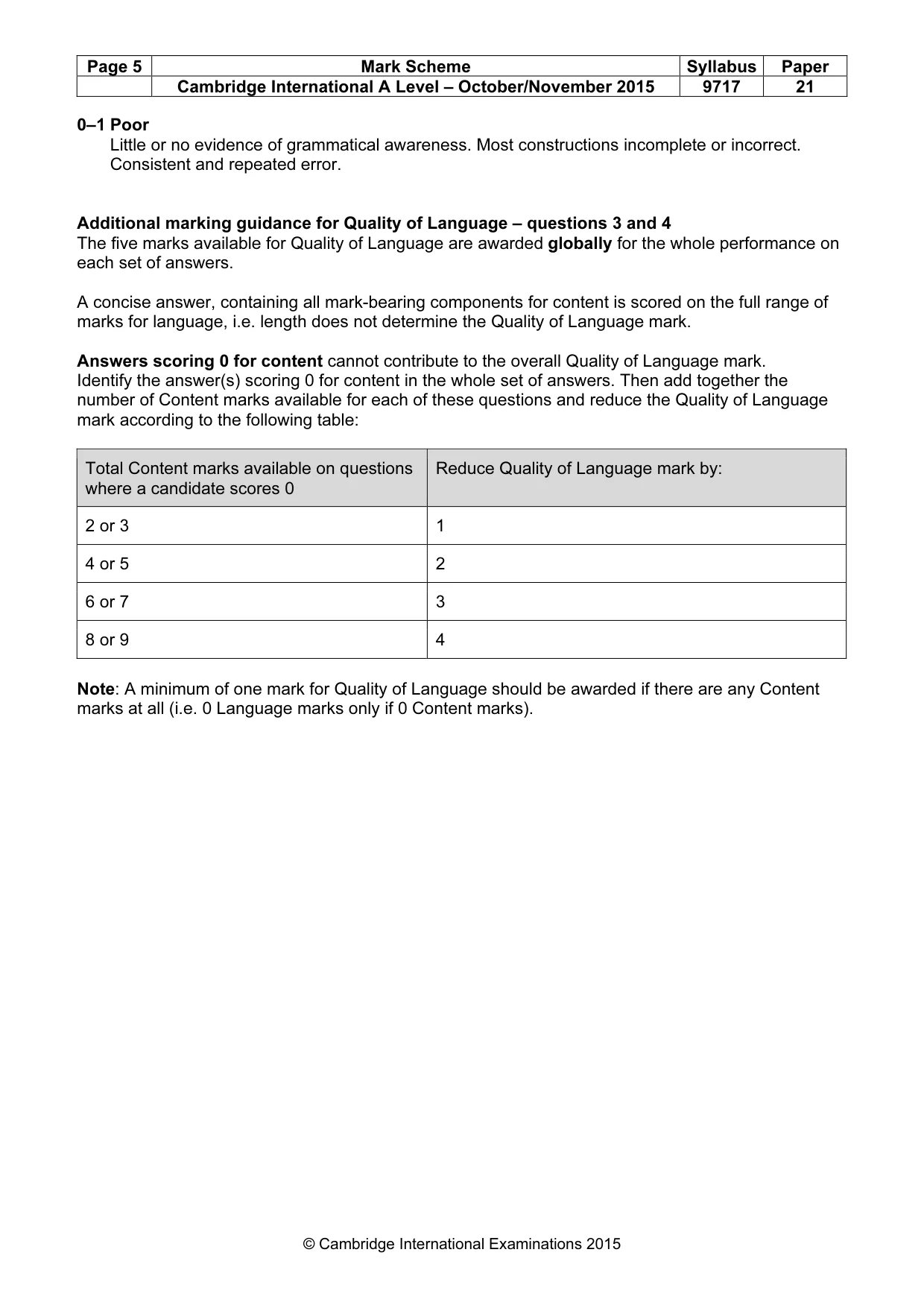
Page 5 Mark Scheme Syllabus Paper Cambridge International A Level – October/November 2015 9717 21 © Cambridge International Examinations 2015 0–1 Poor Little or no evidence of grammatical awareness. Most constructions incomplete or incorrect. Consistent and repeated error. Additional marking guidance for Quality of Language – questions 3 and 4 The five marks available for Quality of Language are awarded globally for the whole performance on each set of answers. A concise answer, containing all mark-bearing components for content is scored on the full range of marks for language, i.e. length does not determine the Quality of Language mark. Answers scoring 0 for content cannot contribute to the overall Quality of Language mark. Identify the answer(s) scoring 0 for content in the whole set of answers. Then add together the number of Content marks available for each of these questions and reduce the Quality of Language mark according to the following table: Total Content marks available on questions where a candidate scores 0 Reduce Quality of Language mark by: 2 or 3 1 4 or 5 2 6 or 7 3 8 or 9 4 Note: A minimum of one mark for Quality of Language should be awarded if there are any Content marks at all (i.e. 0 Language marks only if 0 Content marks).