Cambridge A Level Geography 9696 — 2017 May/June Paper 3 · Variant 3
9696/33/M/J/17 · 8 questions · 50 marks · ≈56 min
The question paper and its mark scheme, free to read here and free to download. This is Cambridge’s own paper, exactly as it was sat.
Question paper4 pages



Mark scheme17 pages
Answers below. Sit the paper first if you are practising.


Questions as text
Q1 · With reference to examples, describe and explain how climate affects agricultural…
1 (a) With reference to examples, describe and explain how climate affects agricultural land-use and practices on farms. [10] (b) For one country, assess the extent to which the success of attempts to manage agricultural change is determined by political factors. [15]
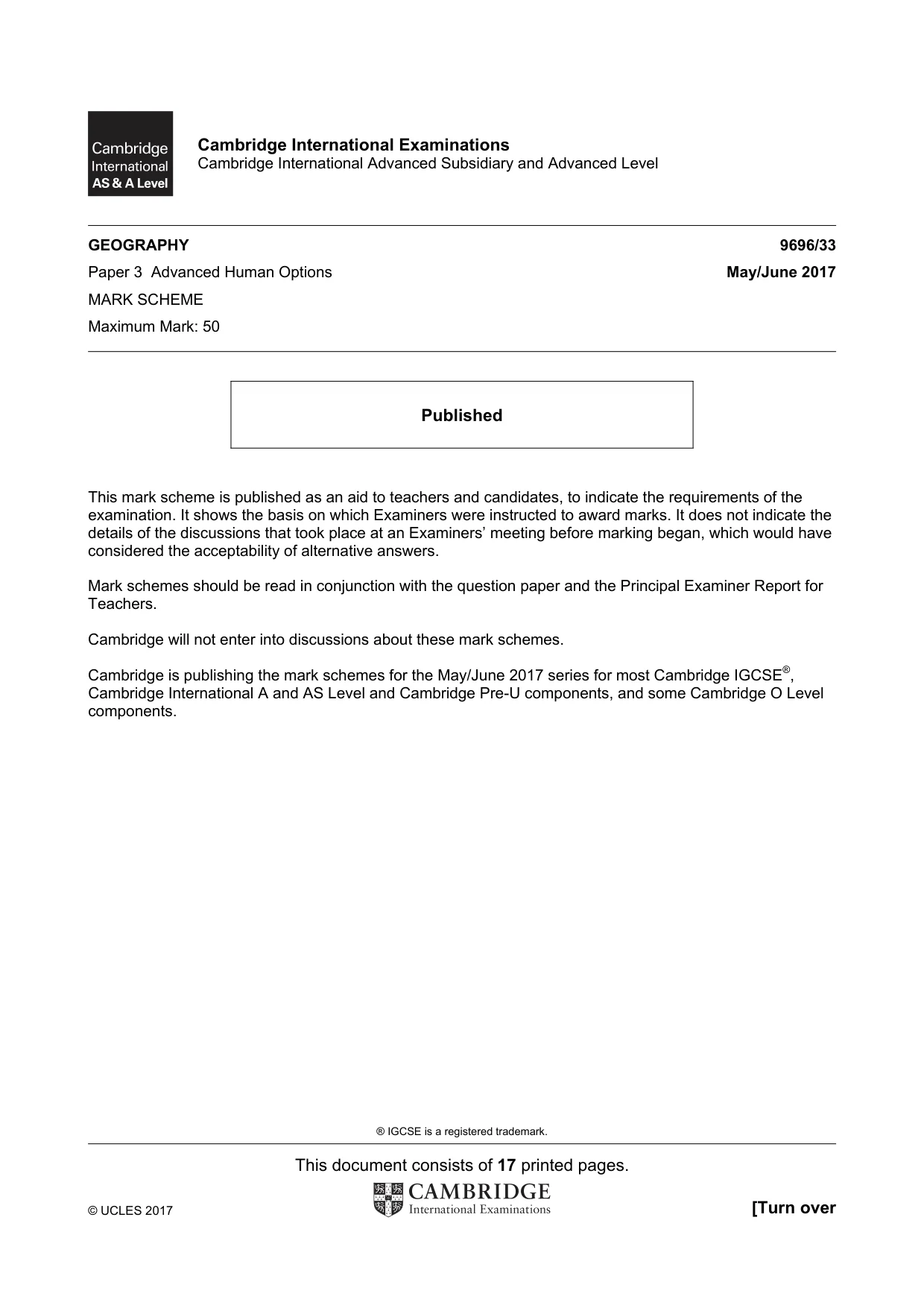
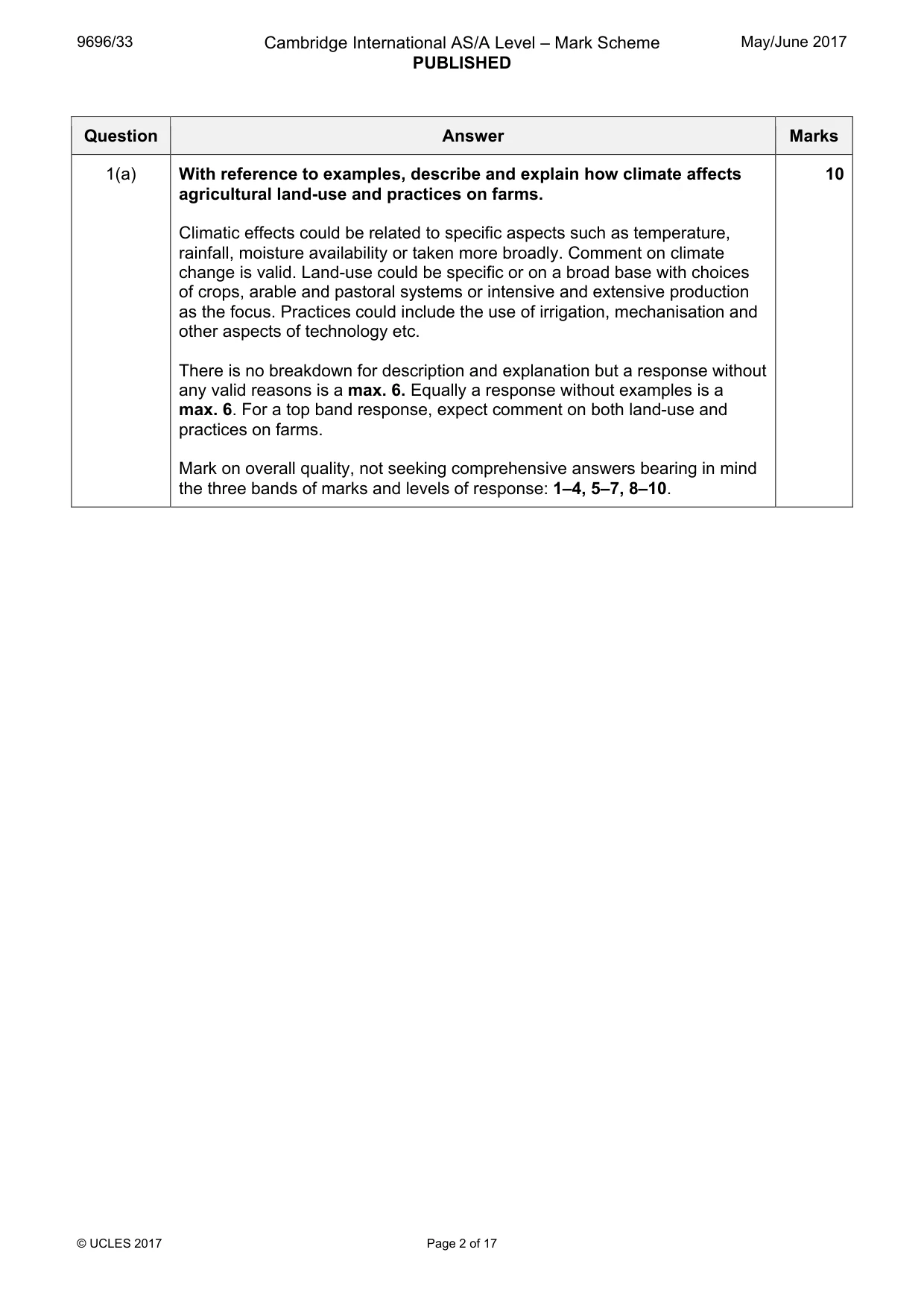
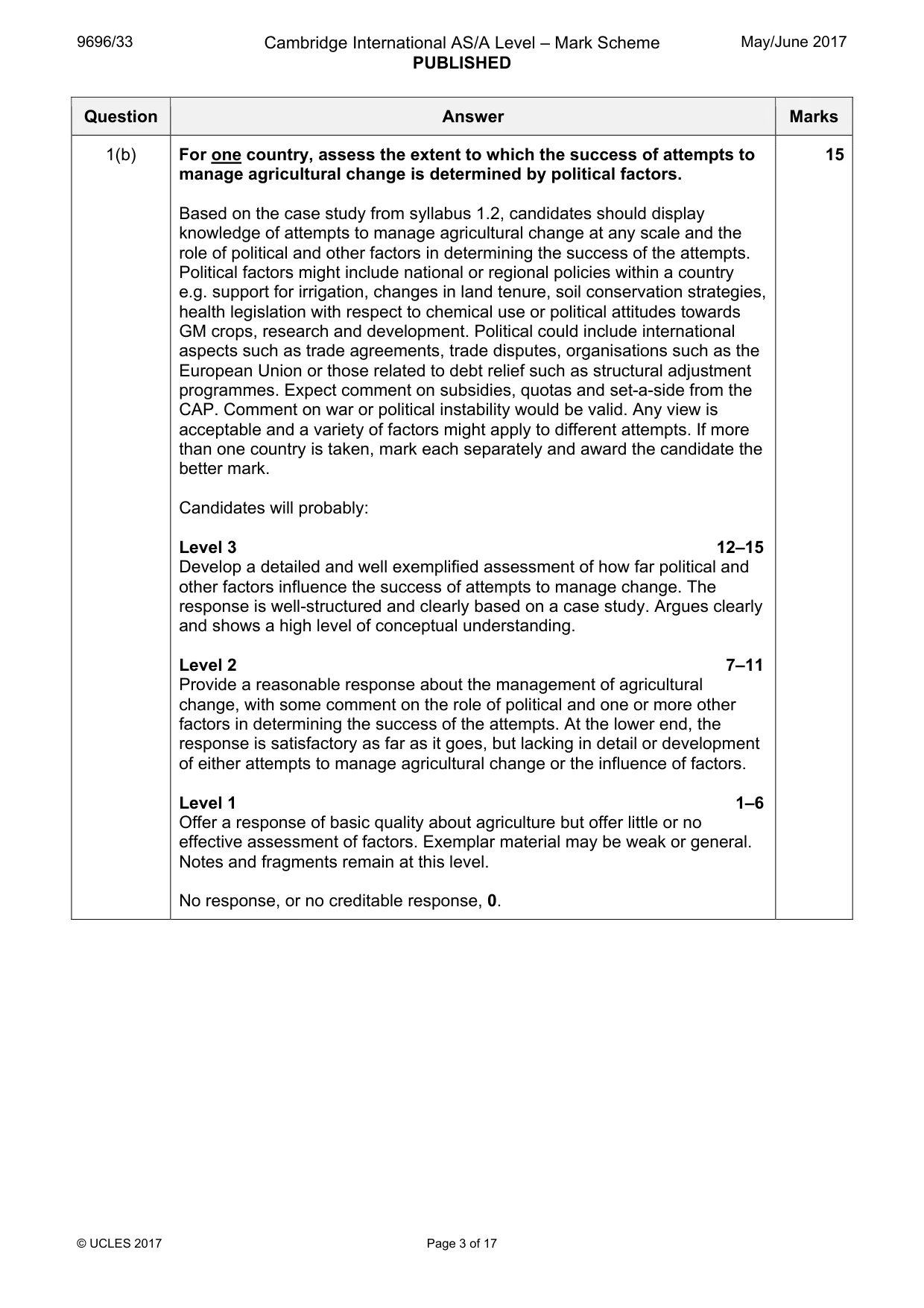
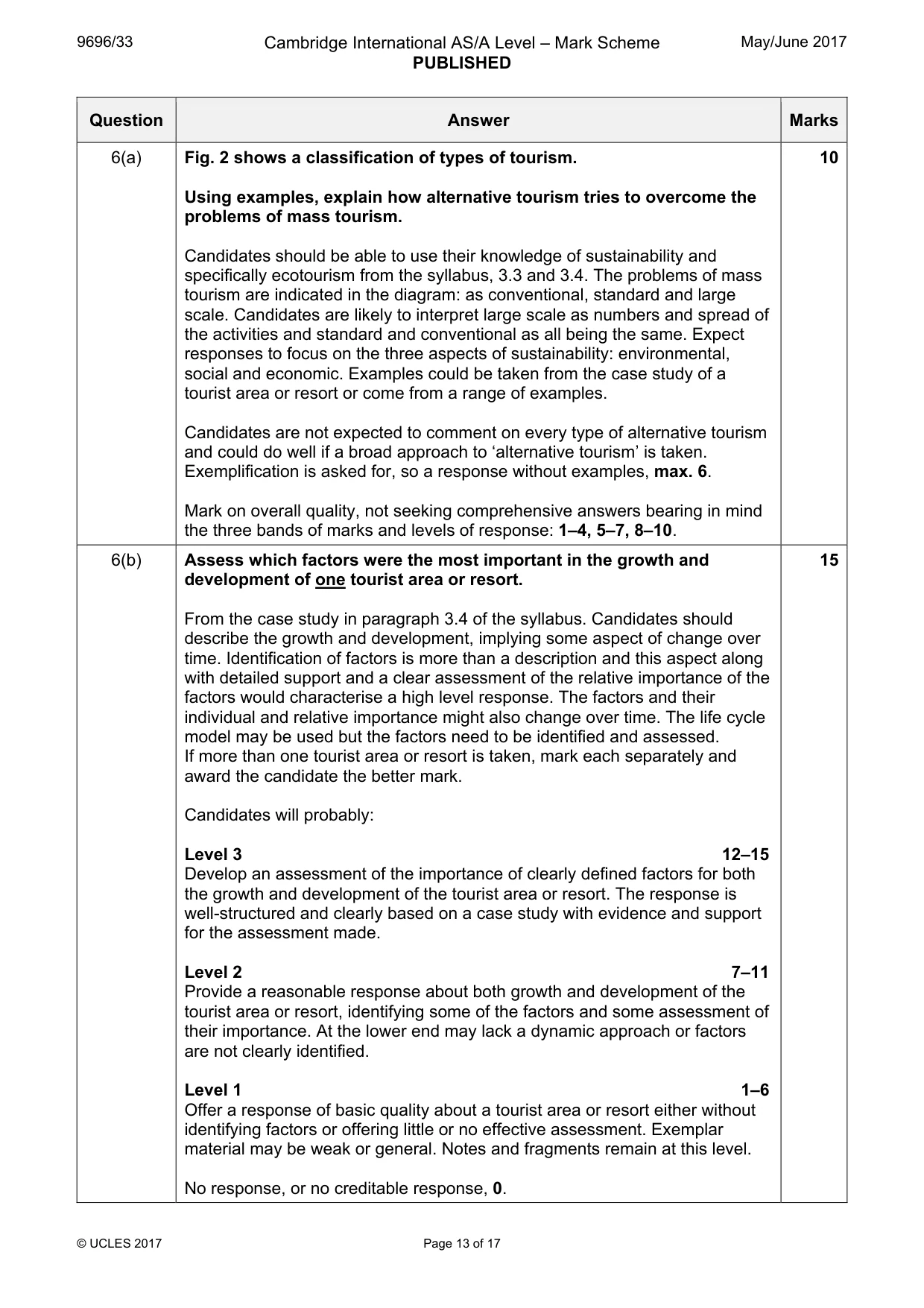
Mark scheme: Question Answer Marks 1(a) With reference to examples, describe and explain how climate affects 10 agricultural land-use and practices on farms. Climatic effects could be related to specific aspects such as temperature, rainfall, moisture availability or taken more broadly. Comment on climate change is valid. Land-use could be specific or on a broad base with choices of crops, arable and pastoral systems or intensive and extensive production as the focus. Practices could include the use of irrigation, mechanisation and other aspects of technology etc. There is no breakdown for description and explanation but a response without any valid reasons is a max. 6. Equally a response without examples is a max. 6. For a top band response, expect comment on both land-use and practices on farms. Mark on overall quality, not seeking comprehensive answers bearing in mind the three bands of marks and levels of response: 1–4, 5–7, 8–10. 1(b) For one country, assess the extent to which the success of attempts to 15 manage agricultural change is determined by political factors. Based on the case study from syllabus 1.2, candidates should display knowledge of attempts to manage agricultural change at any scale and the role of political and other factors in determining the success of the attempts. Political factors might include national or regional policies within a country e.g. support for irrigation, changes in land tenure, soil conservation strategies, health legislation with respect to chemical use or political attitudes towards GM crops, research and development. Political could include international aspects such as trade agreements, trade disputes, organisations such as the European Union or those related to debt relief such as structural adjustment programmes. Expect comment on subsidies, quotas and set-a-side from the CAP. Comment on war or political instability would be valid. Any view is acceptable and a variety of factors might apply to different attempts. If more than one country is taken, mark each separately and award the candidate the better mark. Candidates will probably: Level 3 12–15 Develop a detailed and well exemplified assessment of how far political and other factors influence the success of attempts to manage change. The response is well-structured and clearly based on a case study. Argues clearly and shows a high level of conceptual understanding. Level 2 7–11 Provide a reasonable response about the management of agricultural change, with some comment on the role of political and one or more other factors in determining the success of the attempts. At the lower end, the response is satisfactory as far as it goes, but lacking in detail or development of either attempts to manage agricultural change or the influence of factors. Level 1 1–6 Offer a response of basic quality about agriculture but offer little or no effective assessment of factors. Exemplar material may be weak or general. Notes and fragments remain at this level. No response, or no creditable response, 0.
Q2 · The localisation (specialisation) of clothes manufacturing in the UK, an MEDC in Europe…
2 (a) Fig. 1 shows the localisation (specialisation) of clothes manufacturing in the UK, an MEDC in Europe, in 2010. (i) Describe the pattern of localisation (specialisation) of the clothing industry shown in Fig. 1. [5] (ii) Explain the advantages of agglomeration for manufacturing industry. [5] (b) With reference to one country you have studied, describe the causes of change in manufacturing and related service industry and assess the effects of these changes. [15] Environmental management Only one question may be answered from this topic.
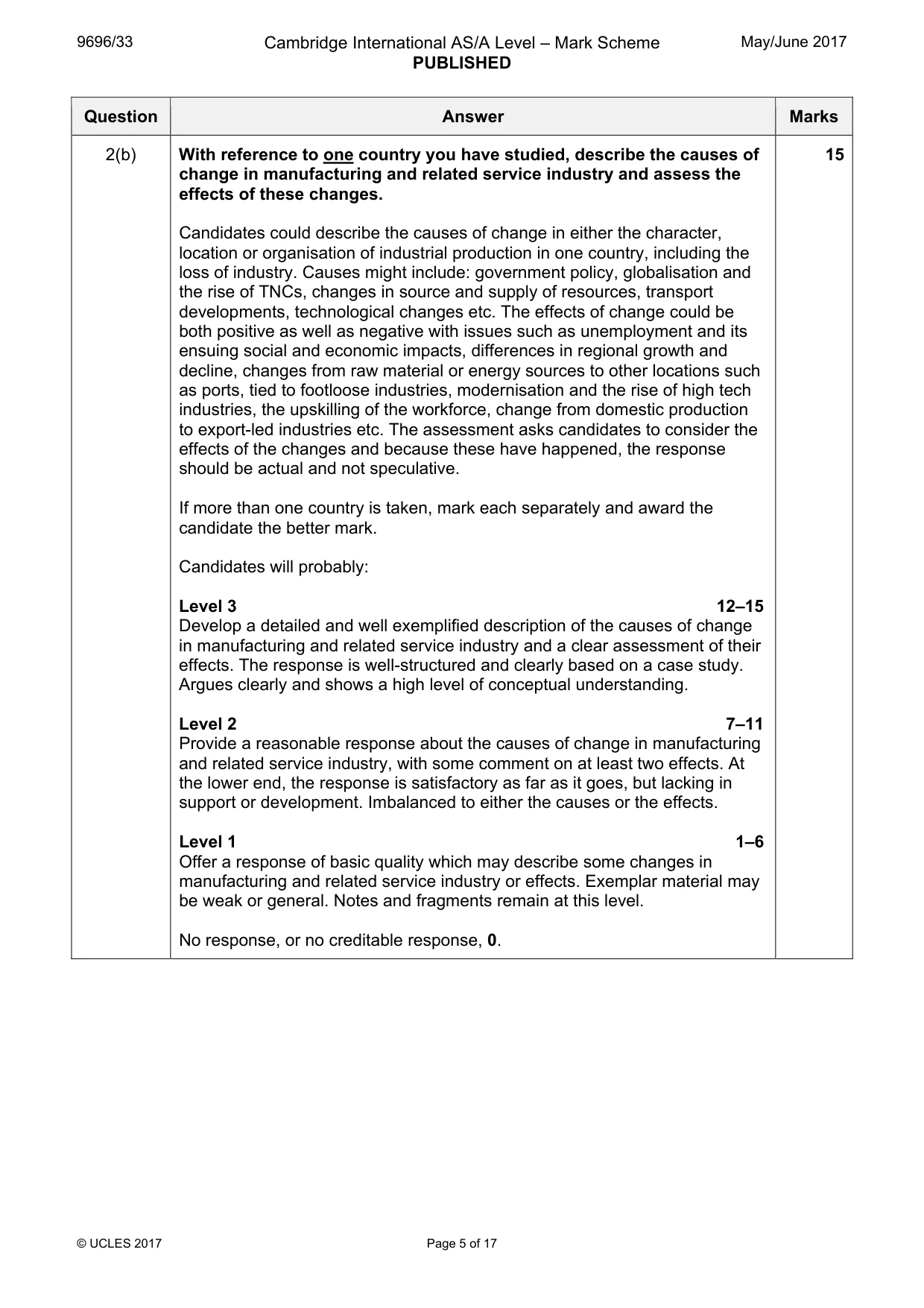
Mark scheme: 2(a)(i) Fig. 1 shows the localisation (specialisation) of clothes manufacturing 5 in the UK, an MEDC in Europe, in 2010. Describe the pattern of localisation (specialisation) of the clothing industry shown in Fig. 1. The pattern displays both aspects of localisation or specialisation-highly specialised or localised in some areas, meaning that other areas are under- represented i.e. No localisation. The most localised-specialised- area is in the centre of England and forms part of a larger area where 5 regions altogether have at least strong localisation. There is a larger area in the North, covering most of Scotland, with a strong localisation but nothing higher. There is some localisation in Northern Ireland but only weak localisation. Most of England, all of Wales and a large part of Southern Scotland along with the NE corner have ‘No localisation’. There is one small area in the South East of England, with a higher level-1.00-1.49- than the rest of this generally low area. Mark on overall quality, bearing in mind the three mark bands: 1-2, 3-4 and 5. 2(a)(ii) Explain the advantages of agglomeration for manufacturing industry. 5 This is for any country and any industry and not related to (a)(i) Reasons might include factors such as raw materials and energy sources (possibly elaborated to weight losing raw materials), labour, sources of capital, markets, economies of scale (elaborated to functional linkages), inertia, other aspects of transport, government policy, security etc. Reference to a specific example might enhance a response, but this is not a requirement. Mark on overall quality, bearing in mind the three mark bands: 1–2, 3–4 and 5. 2(b) With reference to one country you have studied, describe the causes of 15 change in manufacturing and related service industry and assess the effects of these changes. Candidates could describe the causes of change in either the character, location or organisation of industrial production in one country, including the loss of industry. Causes might include: government policy, globalisation and the rise of TNCs, changes in source and supply of resources, transport developments, technological changes etc. The effects of change could be both positive as well as negative with issues such as unemployment and its ensuing social and economic impacts, differences in regional growth and decline, changes from raw material or energy sources to other locations such as ports, tied to footloose industries, modernisation and the rise of high tech industries, the upskilling of the workforce, change from domestic production to export-led industries etc. The assessment asks candidates to consider the effects of the changes and because these have happened, the response should be actual and not speculative. If more than one country is taken, mark each separately and award the candidate the better mark. Candidates will probably: Level 3 12–15 Develop a detailed and well exemplified description of the causes of change in manufacturing and related service industry and a clear assessment of their effects. The response is well-structured and clearly based on a case study. Argues clearly and shows a high level of conceptual understanding. Level 2 7–11 Provide a reasonable response about the causes of change in manufacturing and related service industry, with some comment on at least two effects. At the lower end, the response is satisfactory as far as it goes, but lacking in support or development. Imbalanced to either the causes or the effects. Level 1 1–6 Offer a response of basic quality which may describe some changes in manufacturing and related service industry or effects. Exemplar material may be weak or general. Notes and fragments remain at this level. No response, or no creditable response, 0.
Q3 · With reference to one country: (a) explain some of the issues in supplying electricity…
3 With reference to one country: (a) explain some of the issues in supplying electricity; [10] (b) assess the extent to which renewable energy sources are meeting the demand for electricity. [15]
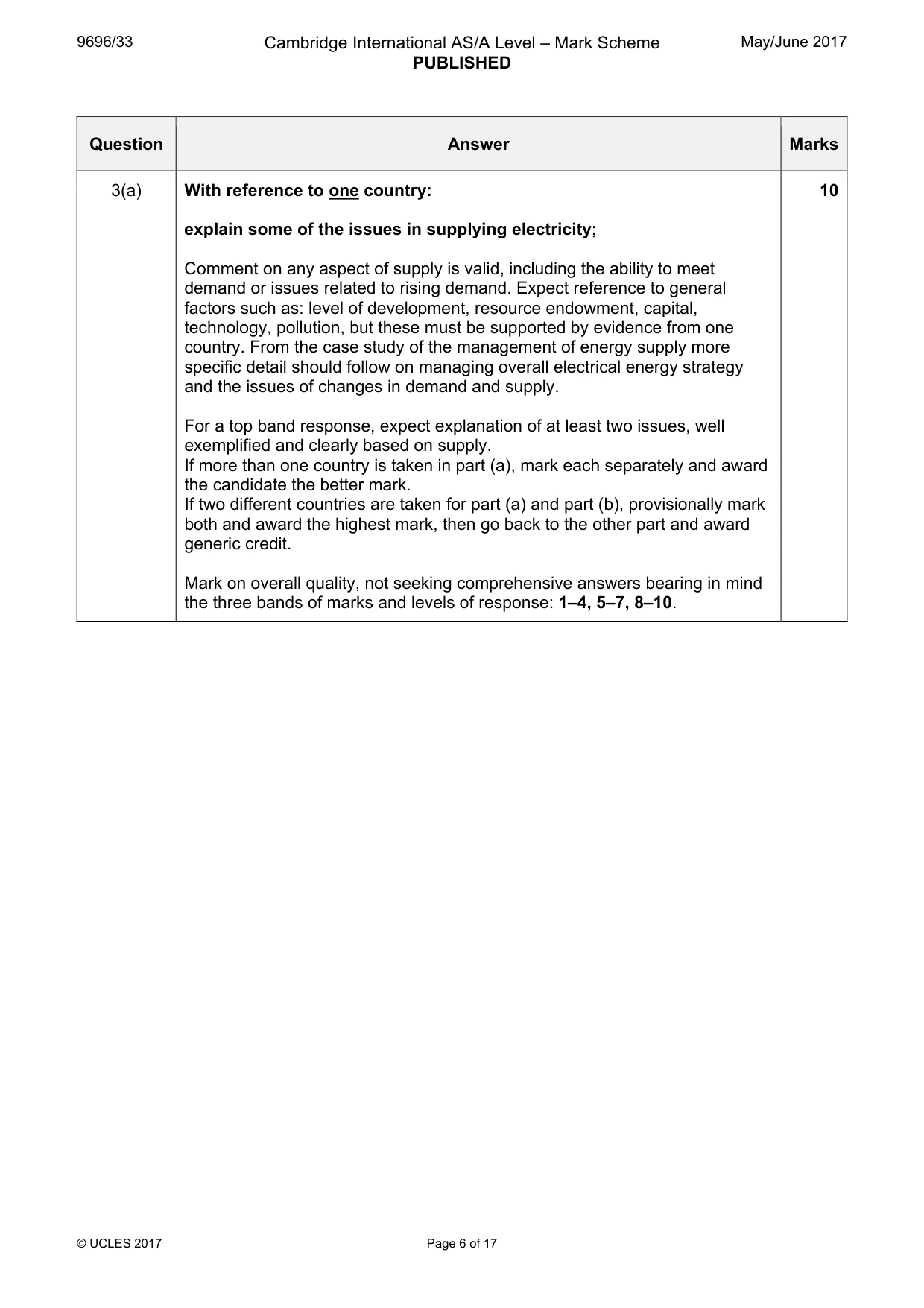
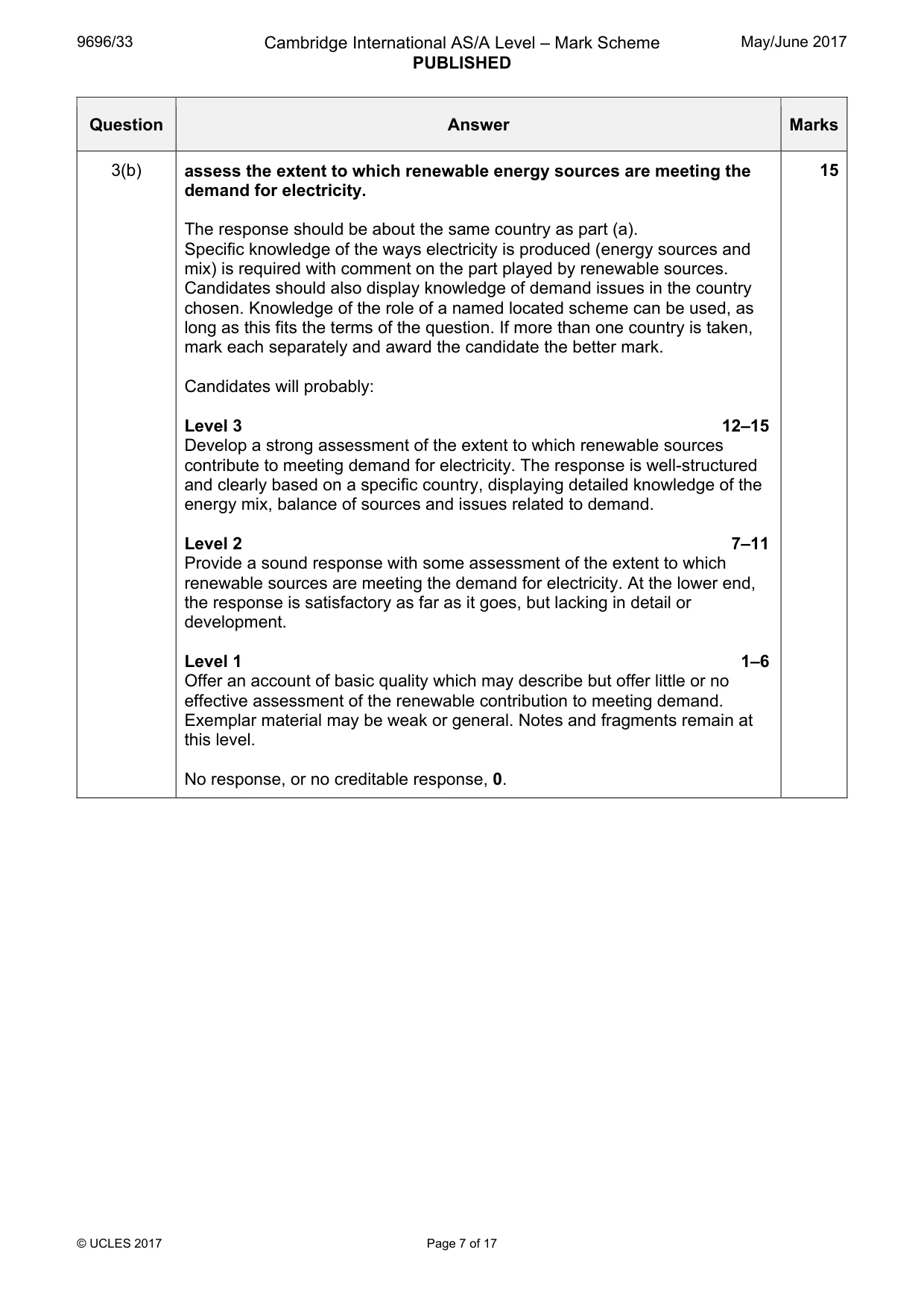
Mark scheme: 3(a) With reference to one country: 10 explain some of the issues in supplying electricity; Comment on any aspect of supply is valid, including the ability to meet demand or issues related to rising demand. Expect reference to general factors such as: level of development, resource endowment, capital, technology, pollution, but these must be supported by evidence from one country. From the case study of the management of energy supply more specific detail should follow on managing overall electrical energy strategy and the issues of changes in demand and supply. For a top band response, expect explanation of at least two issues, well exemplified and clearly based on supply. If more than one country is taken in part (a), mark each separately and award the candidate the better mark. If two different countries are taken for part (a) and part (b), provisionally mark both and award the highest mark, then go back to the other part and award generic credit. Mark on overall quality, not seeking comprehensive answers bearing in mind the three bands of marks and levels of response: 1–4, 5–7, 8–10. 3(b) assess the extent to which renewable energy sources are meeting the 15 demand for electricity. The response should be about the same country as part (a). Specific knowledge of the ways electricity is produced (energy sources and mix) is required with comment on the part played by renewable sources. Candidates should also display knowledge of demand issues in the country chosen. Knowledge of the role of a named located scheme can be used, as long as this fits the terms of the question. If more than one country is taken, mark each separately and award the candidate the better mark. Candidates will probably: Level 3 12–15 Develop a strong assessment of the extent to which renewable sources contribute to meeting demand for electricity. The response is well-structured and clearly based on a specific country, displaying detailed knowledge of the energy mix, balance of sources and issues related to demand. Level 2 7–11 Provide a sound response with some assessment of the extent to which renewable sources are meeting the demand for electricity. At the lower end, the response is satisfactory as far as it goes, but lacking in detail or development. Level 1 1–6 Offer an account of basic quality which may describe but offer little or no effective assessment of the renewable contribution to meeting demand. Exemplar material may be weak or general. Notes and fragments remain at this level. No response, or no creditable response, 0.
Q4 · Photograph A shows a new well in a village in Cameroon, an LEDC in Africa
4 (a) Photograph A shows a new well in a village in Cameroon, an LEDC in Africa. Explain how constructing a well helps overcome issues of water supply and water quality for local people. [10] (b) Assess the success of attempts to improve one named degraded environment. [15] Global interdependence Only one question may be answered from this topic.
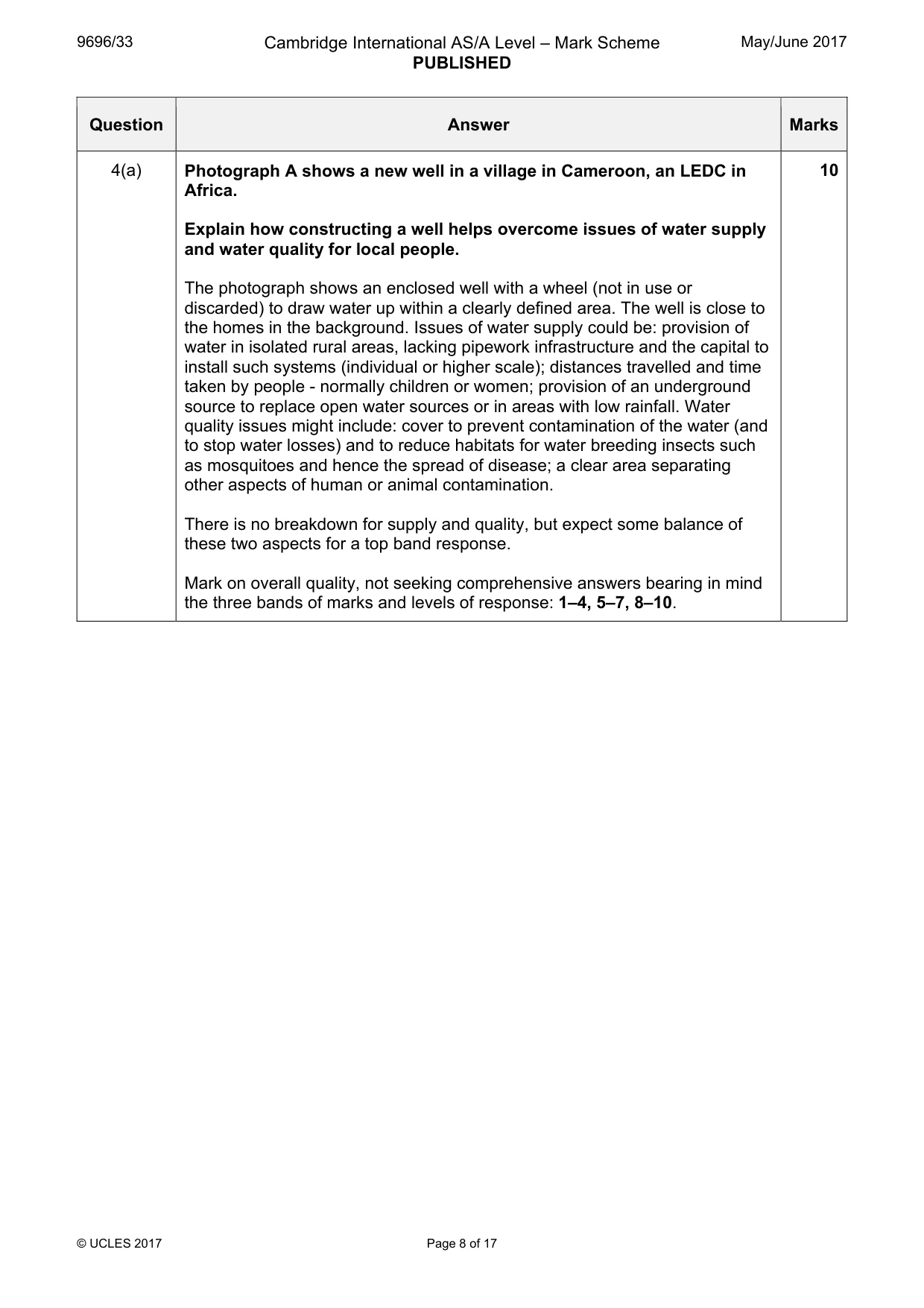
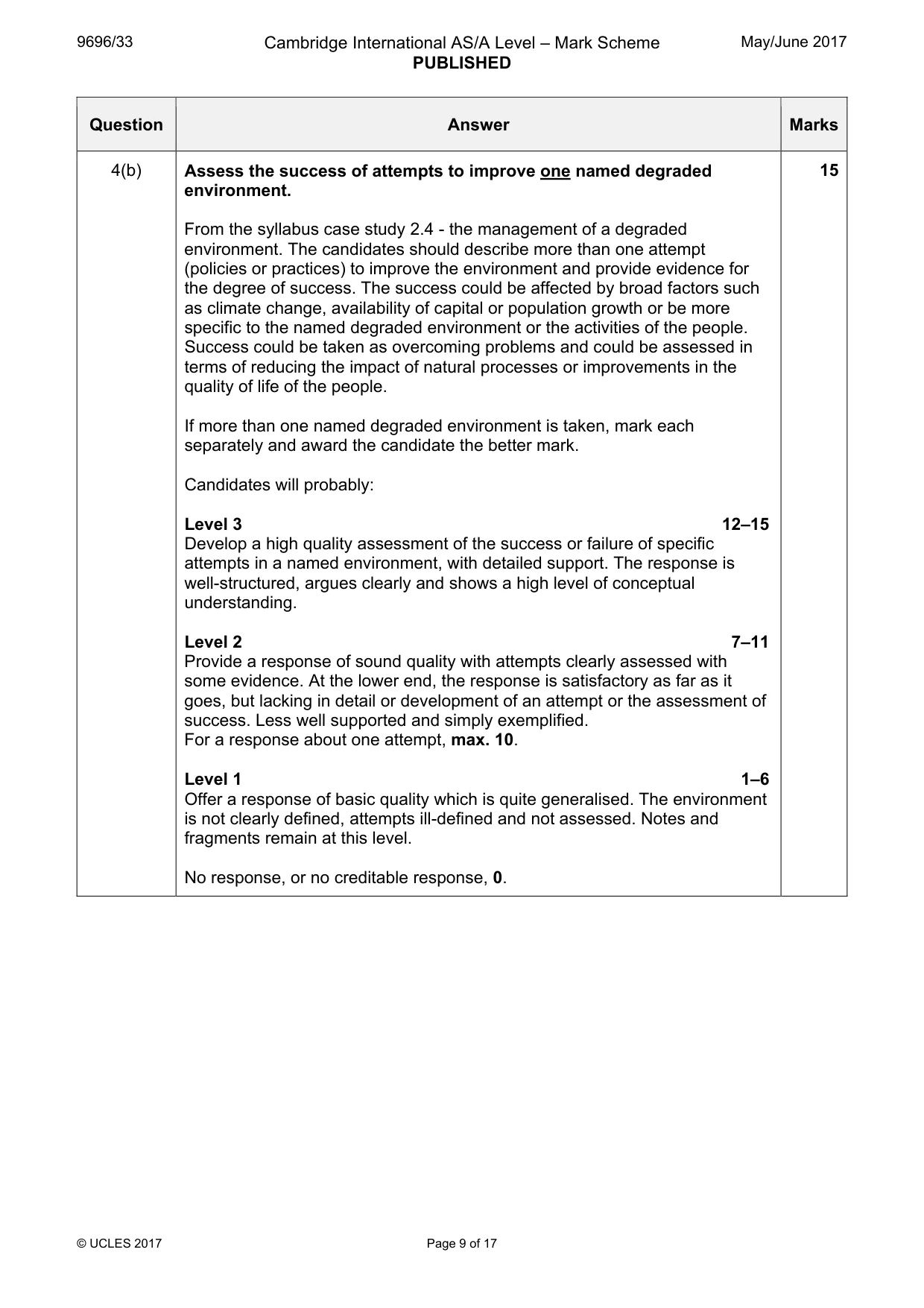
Mark scheme: 4(a) Photograph A shows a new well in a village in Cameroon, an LEDC in 10 Africa. Explain how constructing a well helps overcome issues of water supply and water quality for local people. The photograph shows an enclosed well with a wheel (not in use or discarded) to draw water up within a clearly defined area. The well is close to the homes in the background. Issues of water supply could be: provision of water in isolated rural areas, lacking pipework infrastructure and the capital to install such systems (individual or higher scale); distances travelled and time taken by people - normally children or women; provision of an underground source to replace open water sources or in areas with low rainfall. Water quality issues might include: cover to prevent contamination of the water (and to stop water losses) and to reduce habitats for water breeding insects such as mosquitoes and hence the spread of disease; a clear area separating other aspects of human or animal contamination. There is no breakdown for supply and quality, but expect some balance of these two aspects for a top band response. Mark on overall quality, not seeking comprehensive answers bearing in mind the three bands of marks and levels of response: 1–4, 5–7, 8–10. 4(b) Assess the success of attempts to improve one named degraded 15 environment. From the syllabus case study 2.4 - the management of a degraded environment. The candidates should describe more than one attempt (policies or practices) to improve the environment and provide evidence for the degree of success. The success could be affected by broad factors such as climate change, availability of capital or population growth or be more specific to the named degraded environment or the activities of the people. Success could be taken as overcoming problems and could be assessed in terms of reducing the impact of natural processes or improvements in the quality of life of the people. If more than one named degraded environment is taken, mark each separately and award the candidate the better mark. Candidates will probably: Level 3 12–15 Develop a high quality assessment of the success or failure of specific attempts in a named environment, with detailed support. The response is well-structured, argues clearly and shows a high level of conceptual understanding. Level 2 7–11 Provide a response of sound quality with attempts clearly assessed with some evidence. At the lower end, the response is satisfactory as far as it goes, but lacking in detail or development of an attempt or the assessment of success. Less well supported and simply exemplified. For a response about one attempt, max. 10. Level 1 1–6 Offer a response of basic quality which is quite generalised. The environment is not clearly defined, attempts ill-defined and not assessed. Notes and fragments remain at this level. No response, or no creditable response, 0.
Q5 · Give the meaning of the terms relief aid and development aid
5 (a) (i) Give the meaning of the terms relief aid and development aid. [4] (ii) Using one or more examples, explain the disadvantages for countries of receiving tied aid. [6] (b) Explain the causes of national debt in one or more countries and assess the problems which national debt creates. [15]
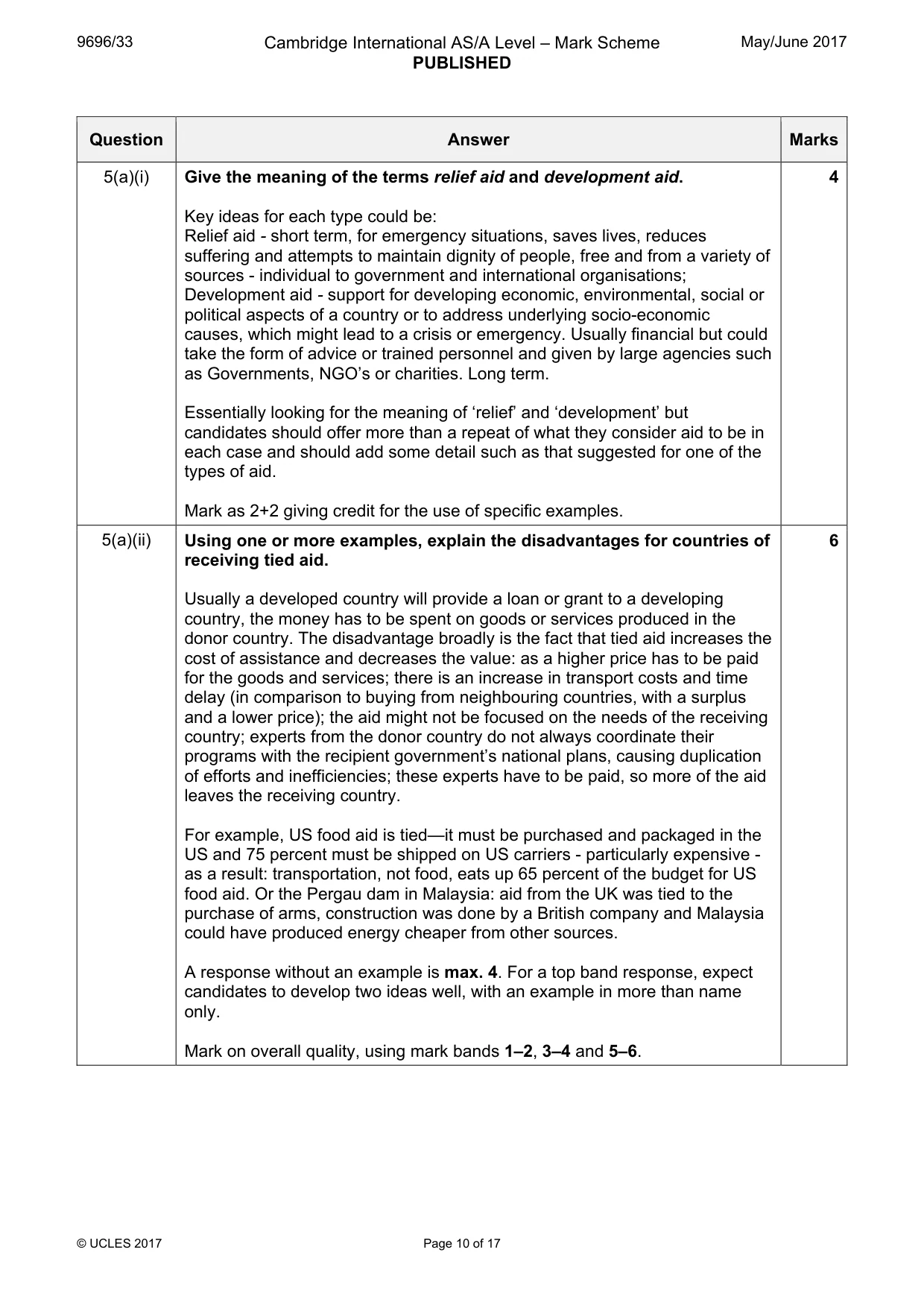
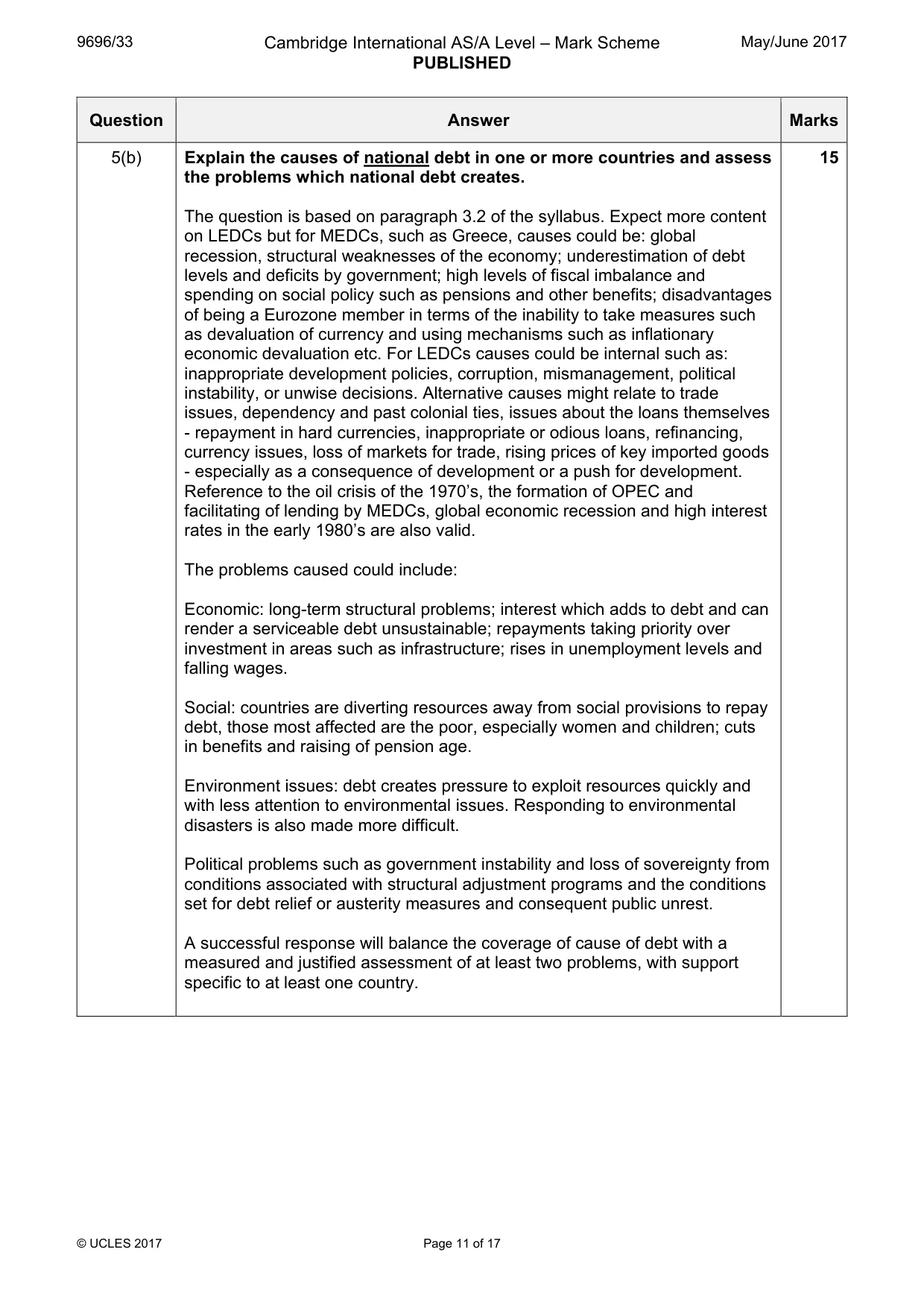
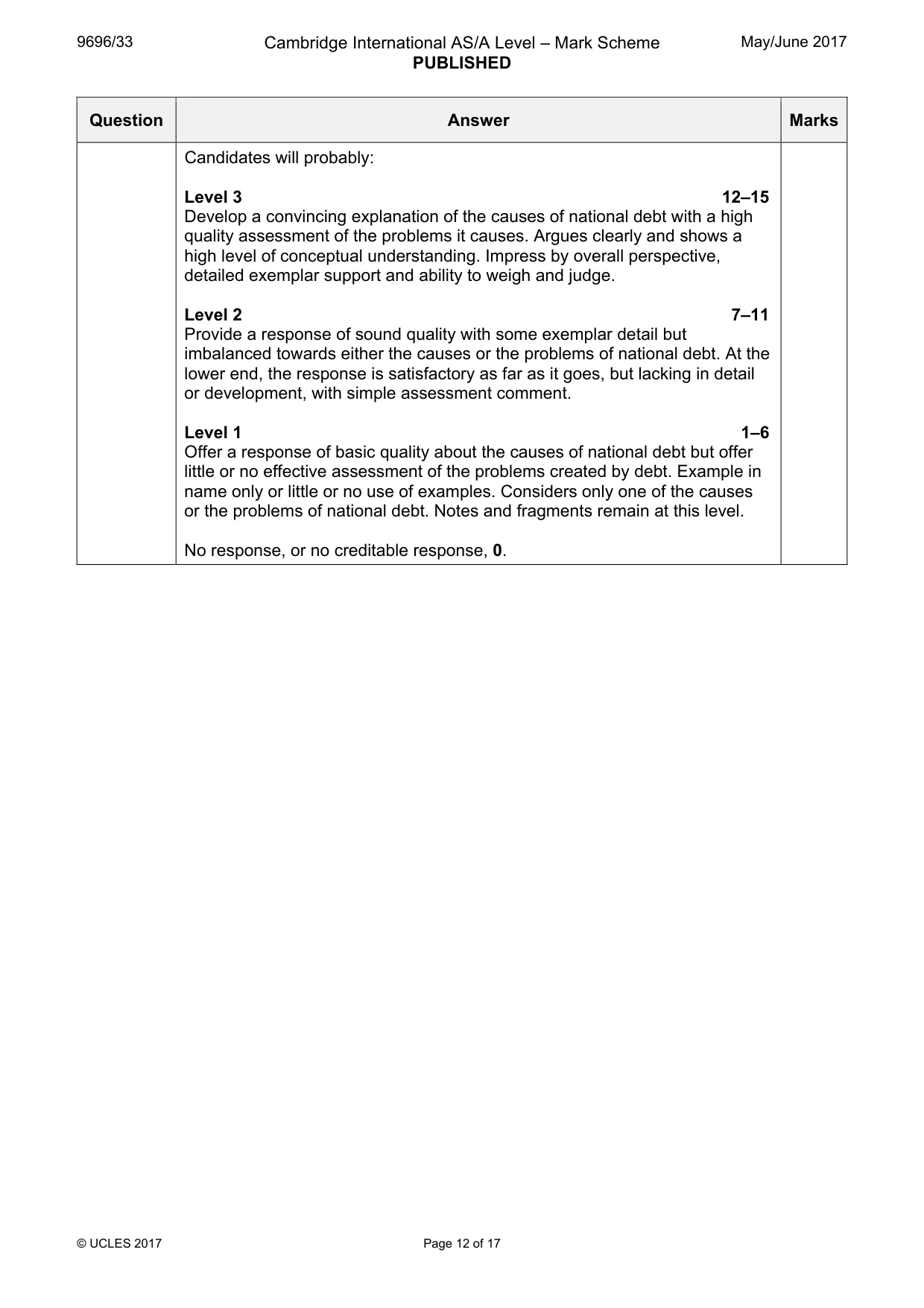
Mark scheme: 5(a)(i) Give the meaning of the terms relief aid and development aid. 4 Key ideas for each type could be: Relief aid - short term, for emergency situations, saves lives, reduces suffering and attempts to maintain dignity of people, free and from a variety of sources - individual to government and international organisations; Development aid - support for developing economic, environmental, social or political aspects of a country or to address underlying socio-economic causes, which might lead to a crisis or emergency. Usually financial but could take the form of advice or trained personnel and given by large agencies such as Governments, NGO’s or charities. Long term. Essentially looking for the meaning of ‘relief’ and ‘development’ but candidates should offer more than a repeat of what they consider aid to be in each case and should add some detail such as that suggested for one of the types of aid. Mark as 2+2 giving credit for the use of specific examples. 5(a)(ii) Using one or more examples, explain the disadvantages for countries of 6 receiving tied aid. Usually a developed country will provide a loan or grant to a developing country, the money has to be spent on goods or services produced in the donor country. The disadvantage broadly is the fact that tied aid increases the cost of assistance and decreases the value: as a higher price has to be paid for the goods and services; there is an increase in transport costs and time delay (in comparison to buying from neighbouring countries, with a surplus and a lower price); the aid might not be focused on the needs of the receiving country; experts from the donor country do not always coordinate their programs with the recipient government’s national plans, causing duplication of efforts and inefficiencies; these experts have to be paid, so more of the aid leaves the receiving country. For example, US food aid is tied—it must be purchased and packaged in the US and 75 percent must be shipped on US carriers - particularly expensive - as a result: transportation, not food, eats up 65 percent of the budget for US food aid. Or the Pergau dam in Malaysia: aid from the UK was tied to the purchase of arms, construction was done by a British company and Malaysia could have produced energy cheaper from other sources. A response without an example is max. 4. For a top band response, expect candidates to develop two ideas well, with an example in more than name only. Mark on overall quality, using mark bands 1–2, 3–4 and 5–6. 5(b) Explain the causes of national debt in one or more countries and assess 15 the problems which national debt creates. The question is based on paragraph 3.2 of the syllabus. Expect more content on LEDCs but for MEDCs, such as Greece, causes could be: global recession, structural weaknesses of the economy; underestimation of debt levels and deficits by government; high levels of fiscal imbalance and spending on social policy such as pensions and other benefits; disadvantages of being a Eurozone member in terms of the inability to take measures such as devaluation of currency and using mechanisms such as inflationary economic devaluation etc. For LEDCs causes could be internal such as: inappropriate development policies, corruption, mismanagement, political instability, or unwise decisions. Alternative causes might relate to trade issues, dependency and past colonial ties, issues about the loans themselves - repayment in hard currencies, inappropriate or odious loans, refinancing, currency issues, loss of markets for trade, rising prices of key imported goods - especially as a consequence of development or a push for development. Reference to the oil crisis of the 1970’s, the formation of OPEC and facilitating of lending by MEDCs, global economic recession and high interest rates in the early 1980’s are also valid. The problems caused could include: Economic: long-term structural problems; interest which adds to debt and can render a serviceable debt unsustainable; repayments taking priority over investment in areas such as infrastructure; rises in unemployment levels and falling wages. Social: countries are diverting resources away from social provisions to repay debt, those most affected are the poor, especially women and children; cuts in benefits and raising of pension age. Environment issues: debt creates pressure to exploit resources quickly and with less attention to environmental issues. Responding to environmental disasters is also made more difficult. Political problems such as government instability and loss of sovereignty from conditions associated with structural adjustment programs and the conditions set for debt relief or austerity measures and consequent public unrest. A successful response will balance the coverage of cause of debt with a measured and justified assessment of at least two problems, with support specific to at least one country. Candidates will probably: Level 3 12–15 Develop a convincing explanation of the causes of national debt with a high quality assessment of the problems it causes. Argues clearly and shows a high level of conceptual understanding. Impress by overall perspective, detailed exemplar support and ability to weigh and judge. Level 2 7–11 Provide a response of sound quality with some exemplar detail but imbalanced towards either the causes or the problems of national debt. At the lower end, the response is satisfactory as far as it goes, but lacking in detail or development, with simple assessment comment. Level 1 1–6 Offer a response of basic quality about the causes of national debt but offer little or no effective assessment of the problems created by debt. Example in name only or little or no use of examples. Considers only one of the causes or the problems of national debt. Notes and fragments remain at this level. No response, or no creditable response, 0.
Q6 · A classification of types of tourism
6 (a) Fig. 2 shows a classification of types of tourism. Using examples, explain how alternative tourism tries to overcome the problems of mass tourism. [10] (b) Assess which factors were the most important in the growth and development of one tourist area or resort. [15] Economic transition Only one question may be answered from this topic.
Mark scheme: 6(a) Fig. 2 shows a classification of types of tourism. 10 Using examples, explain how alternative tourism tries to overcome the problems of mass tourism. Candidates should be able to use their knowledge of sustainability and specifically ecotourism from the syllabus, 3.3 and 3.4. The problems of mass tourism are indicated in the diagram: as conventional, standard and large scale. Candidates are likely to interpret large scale as numbers and spread of the activities and standard and conventional as all being the same. Expect responses to focus on the three aspects of sustainability: environmental, social and economic. Examples could be taken from the case study of a tourist area or resort or come from a range of examples. Candidates are not expected to comment on every type of alternative tourism and could do well if a broad approach to ‘alternative tourism’ is taken. Exemplification is asked for, so a response without examples, max. 6. Mark on overall quality, not seeking comprehensive answers bearing in mind the three bands of marks and levels of response: 1–4, 5–7, 8–10. 6(b) Assess which factors were the most important in the growth and 15 development of one tourist area or resort. From the case study in paragraph 3.4 of the syllabus. Candidates should describe the growth and development, implying some aspect of change over time. Identification of factors is more than a description and this aspect along with detailed support and a clear assessment of the relative importance of the factors would characterise a high level response. The factors and their individual and relative importance might also change over time. The life cycle model may be used but the factors need to be identified and assessed. If more than one tourist area or resort is taken, mark each separately and award the candidate the better mark. Candidates will probably: Level 3 12–15 Develop an assessment of the importance of clearly defined factors for both the growth and development of the tourist area or resort. The response is well-structured and clearly based on a case study with evidence and support for the assessment made. Level 2 7–11 Provide a reasonable response about both growth and development of the tourist area or resort, identifying some of the factors and some assessment of their importance. At the lower end may lack a dynamic approach or factors are not clearly identified. Level 1 1–6 Offer a response of basic quality about a tourist area or resort either without identifying factors or offering little or no effective assessment. Exemplar material may be weak or general. Notes and fragments remain at this level. No response, or no creditable response, 0.
Q7 · Describe how the nature and role of the primary, secondary, tertiary and quaternary…
7 (a) Describe how the nature and role of the primary, secondary, tertiary and quaternary sectors change with economic development. [10] (b) How far do you agree that the growth of transnational corporations (TNCs) is the main cause of globalisation of industrial activity? [15]
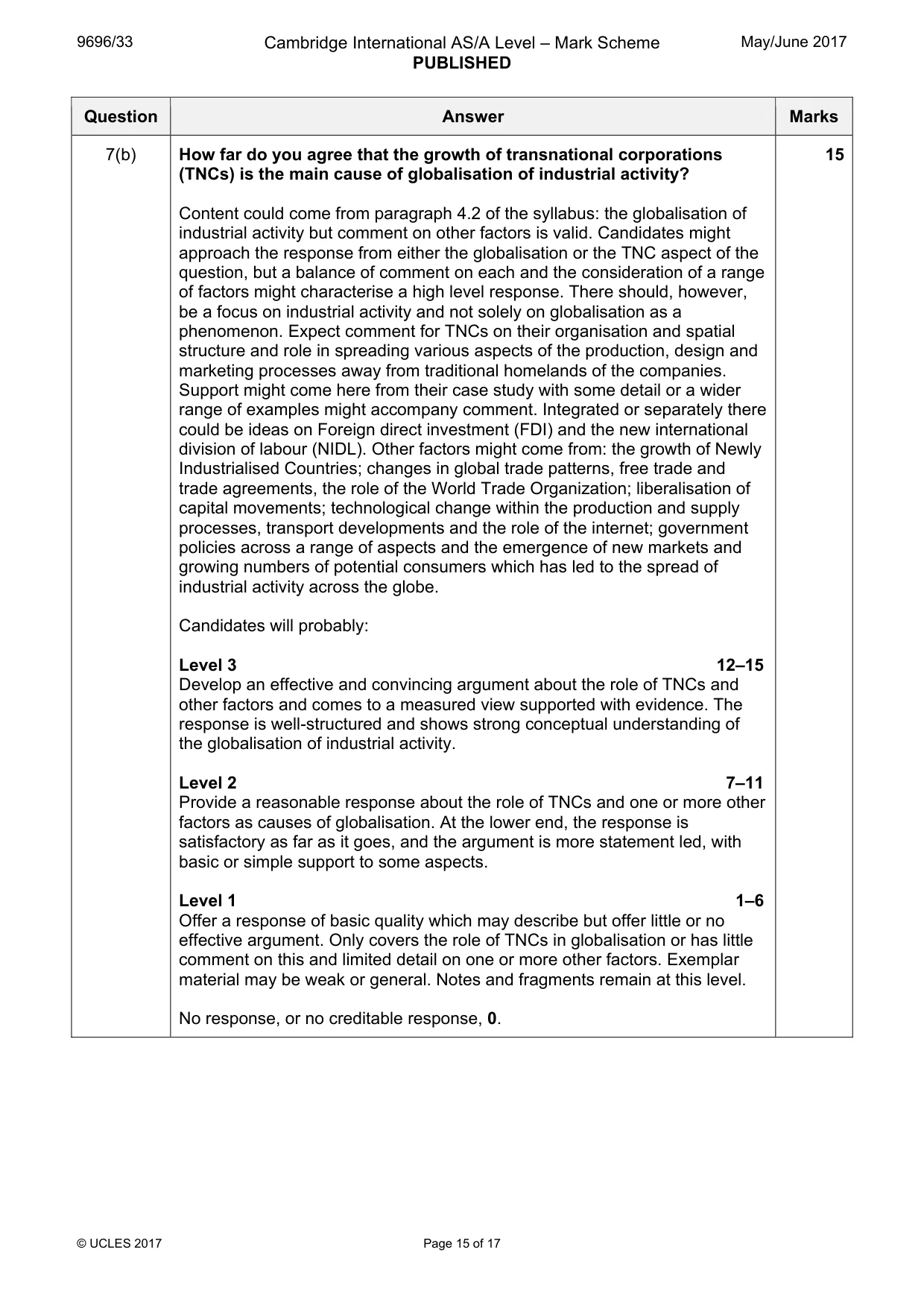
Mark scheme: 7(a) Describe how the nature and role of the primary, secondary, tertiary and 10 quaternary sectors change with economic development. Candidates may take a simple approach and describe the nature of each sector recognising that there is some change, especially the later emergence of the quaternary sector as economic development takes place. In these more basic responses, nature and role aspects might merge. A comparison of countries at different levels of development such as MEDCS, LEDCs and NICs would be valid - indeed is most likely. The use of a model, such as Clark Fisher and presented as a labelled diagram could be taken as a starting point. A higher band response will comment on the dynamic aspect of the nature of each sector and will clearly link the role to the part played by the sector as economic development takes place. The use of examples and support which are more than simple country names would enhance a response and might be another characteristic of a higher band response. Mark on overall quality, not seeking comprehensive answers bearing in mind the three bands of marks and levels of response: 1–4, 5–7, 8–10. 7(b) How far do you agree that the growth of transnational corporations 15 (TNCs) is the main cause of globalisation of industrial activity? Content could come from paragraph 4.2 of the syllabus: the globalisation of industrial activity but comment on other factors is valid. Candidates might approach the response from either the globalisation or the TNC aspect of the question, but a balance of comment on each and the consideration of a range of factors might characterise a high level response. There should, however, be a focus on industrial activity and not solely on globalisation as a phenomenon. Expect comment for TNCs on their organisation and spatial structure and role in spreading various aspects of the production, design and marketing processes away from traditional homelands of the companies. Support might come here from their case study with some detail or a wider range of examples might accompany comment. Integrated or separately there could be ideas on Foreign direct investment (FDI) and the new international division of labour (NIDL). Other factors might come from: the growth of Newly Industrialised Countries; changes in global trade patterns, free trade and trade agreements, the role of the World Trade Organization; liberalisation of capital movements; technological change within the production and supply processes, transport developments and the role of the internet; government policies across a range of aspects and the emergence of new markets and growing numbers of potential consumers which has led to the spread of industrial activity across the globe. Candidates will probably: Level 3 12–15 Develop an effective and convincing argument about the role of TNCs and other factors and comes to a measured view supported with evidence. The response is well-structured and shows strong conceptual understanding of the globalisation of industrial activity. Level 2 7–11 Provide a reasonable response about the role of TNCs and one or more other factors as causes of globalisation. At the lower end, the response is satisfactory as far as it goes, and the argument is more statement led, with basic or simple support to some aspects. Level 1 1–6 Offer a response of basic quality which may describe but offer little or no effective argument. Only covers the role of TNCs in globalisation or has little comment on this and limited detail on one or more other factors. Exemplar material may be weak or general. Notes and fragments remain at this level. No response, or no creditable response, 0.
Q8 · Percentage growth in gross domestic product (GDP) for two regions in China, an NIC in…
8 (a) Fig. 3 shows percentage growth in gross domestic product (GDP) for two regions in China, an NIC in Asia, 1979–2013. (i) Compare the trends of growth in GDP for the inland region and the coastal region shown in Fig. 3. [5] (ii) Explain the advantages of using one measure other than GDP to show differences between regions within a country. [5] (b) ‘Cumulative causation is responsible for the development of regional disparities within countries.’ How far do you agree? [15]
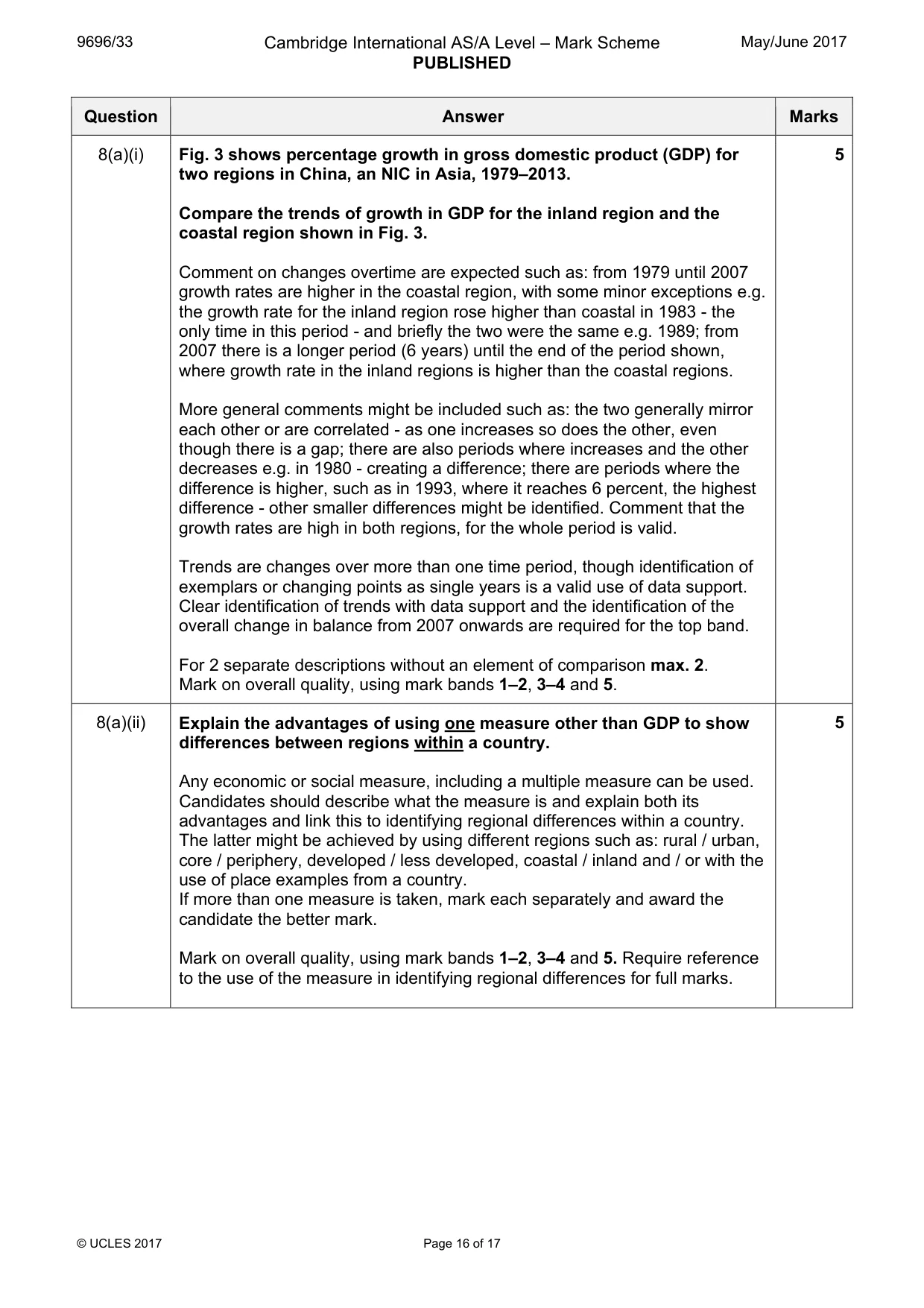
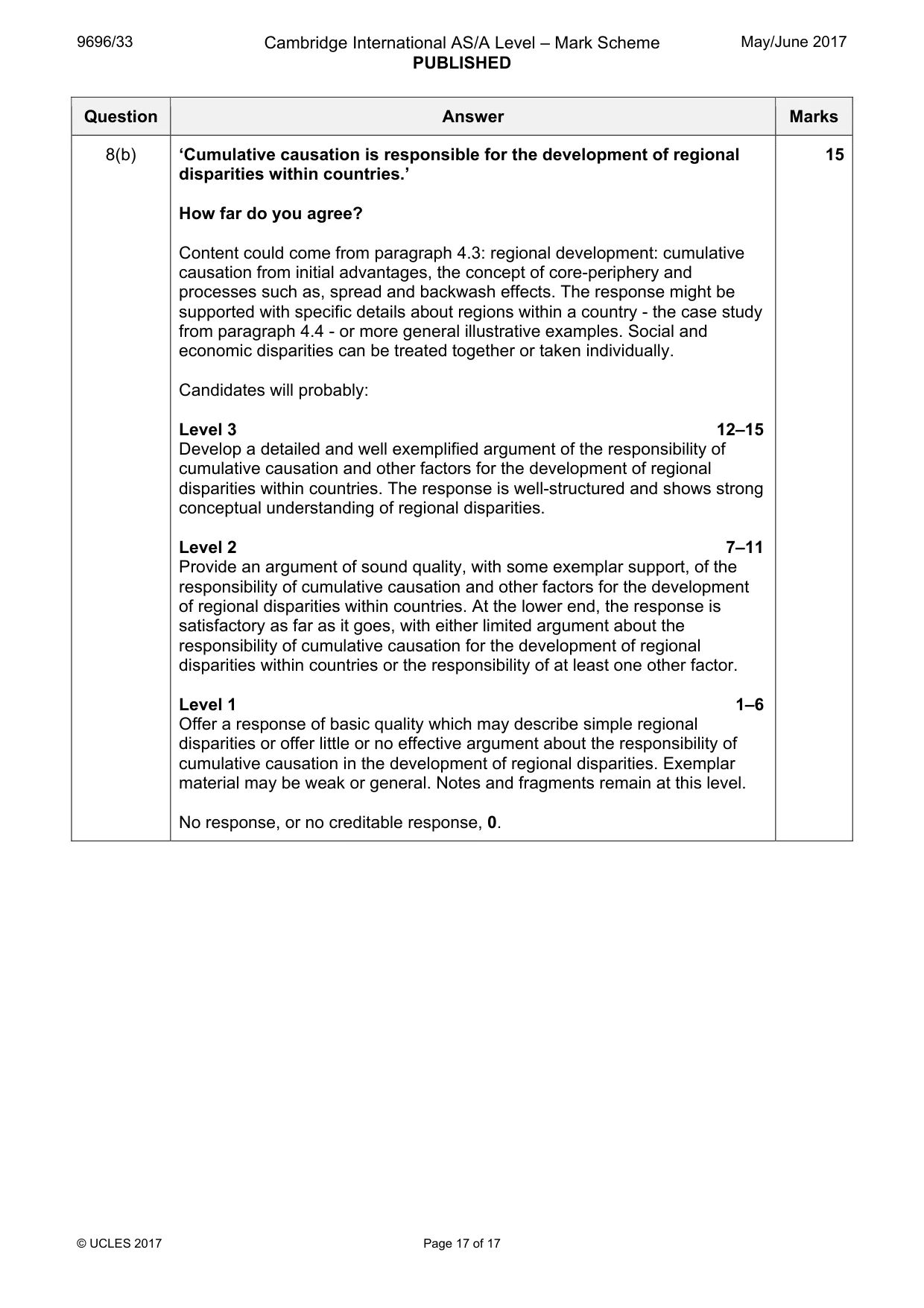
Mark scheme: 8(a)(i) Fig. 3 shows percentage growth in gross domestic product (GDP) for 5 two regions in China, an NIC in Asia, 1979–2013. Compare the trends of growth in GDP for the inland region and the coastal region shown in Fig. 3. Comment on changes overtime are expected such as: from 1979 until 2007 growth rates are higher in the coastal region, with some minor exceptions e.g. the growth rate for the inland region rose higher than coastal in 1983 - the only time in this period - and briefly the two were the same e.g. 1989; from 2007 there is a longer period (6 years) until the end of the period shown, where growth rate in the inland regions is higher than the coastal regions. More general comments might be included such as: the two generally mirror each other or are correlated - as one increases so does the other, even though there is a gap; there are also periods where increases and the other decreases e.g. in 1980 - creating a difference; there are periods where the difference is higher, such as in 1993, where it reaches 6 percent, the highest difference - other smaller differences might be identified. Comment that the growth rates are high in both regions, for the whole period is valid. Trends are changes over more than one time period, though identification of exemplars or changing points as single years is a valid use of data support. Clear identification of trends with data support and the identification of the overall change in balance from 2007 onwards are required for the top band. For 2 separate descriptions without an element of comparison max. 2. Mark on overall quality, using mark bands 1–2, 3–4 and 5. 8(a)(ii) Explain the advantages of using one measure other than GDP to show 5 differences between regions within a country. Any economic or social measure, including a multiple measure can be used. Candidates should describe what the measure is and explain both its advantages and link this to identifying regional differences within a country. The latter might be achieved by using different regions such as: rural / urban, core / periphery, developed / less developed, coastal / inland and / or with the use of place examples from a country. If more than one measure is taken, mark each separately and award the candidate the better mark. Mark on overall quality, using mark bands 1–2, 3–4 and 5. Require reference to the use of the measure in identifying regional differences for full marks. 8(b) ‘Cumulative causation is responsible for the development of regional 15 disparities within countries.’ How far do you agree? Content could come from paragraph 4.3: regional development: cumulative causation from initial advantages, the concept of core-periphery and processes such as, spread and backwash effects. The response might be supported with specific details about regions within a country - the case study from paragraph 4.4 - or more general illustrative examples. Social and economic disparities can be treated together or taken individually. Candidates will probably: Level 3 12–15 Develop a detailed and well exemplified argument of the responsibility of cumulative causation and other factors for the development of regional disparities within countries. The response is well-structured and shows strong conceptual understanding of regional disparities. Level 2 7–11 Provide an argument of sound quality, with some exemplar support, of the responsibility of cumulative causation and other factors for the development of regional disparities within countries. At the lower end, the response is satisfactory as far as it goes, with either limited argument about the responsibility of cumulative causation for the development of regional disparities within countries or the responsibility of at least one other factor. Level 1 1–6 Offer a response of basic quality which may describe simple regional disparities or offer little or no effective argument about the responsibility of cumulative causation in the development of regional disparities. Exemplar material may be weak or general. Notes and fragments remain at this level. No response, or no creditable response, 0.
What was in this paper
The subtopics covered by these 8 questions, and how many questions each got. Open one in a new tab to see every Cambridge question on it.
1Regional development within countries1Sustainable energy supplies1The development of international tourism1The globalisation of economic activity1The management of a degraded environment1The management of agricultural change1The management of change in manufacturing industry1What you needed in this session
Cambridge’s own grade thresholds for 2017 May/June, Paper 3 · Variant 3. A higher threshold means an easier paper — the bar moves with how the cohort did.