Cambridge A Level General Paper (AS Level only) 8001 — 2010 Oct/Nov Paper 1 · Variant 2
8001/12/O/N/10 · 50 marks · ≈56 min
The question paper and its mark scheme, free to read here and free to download. This is Cambridge’s own paper, exactly as it was sat.
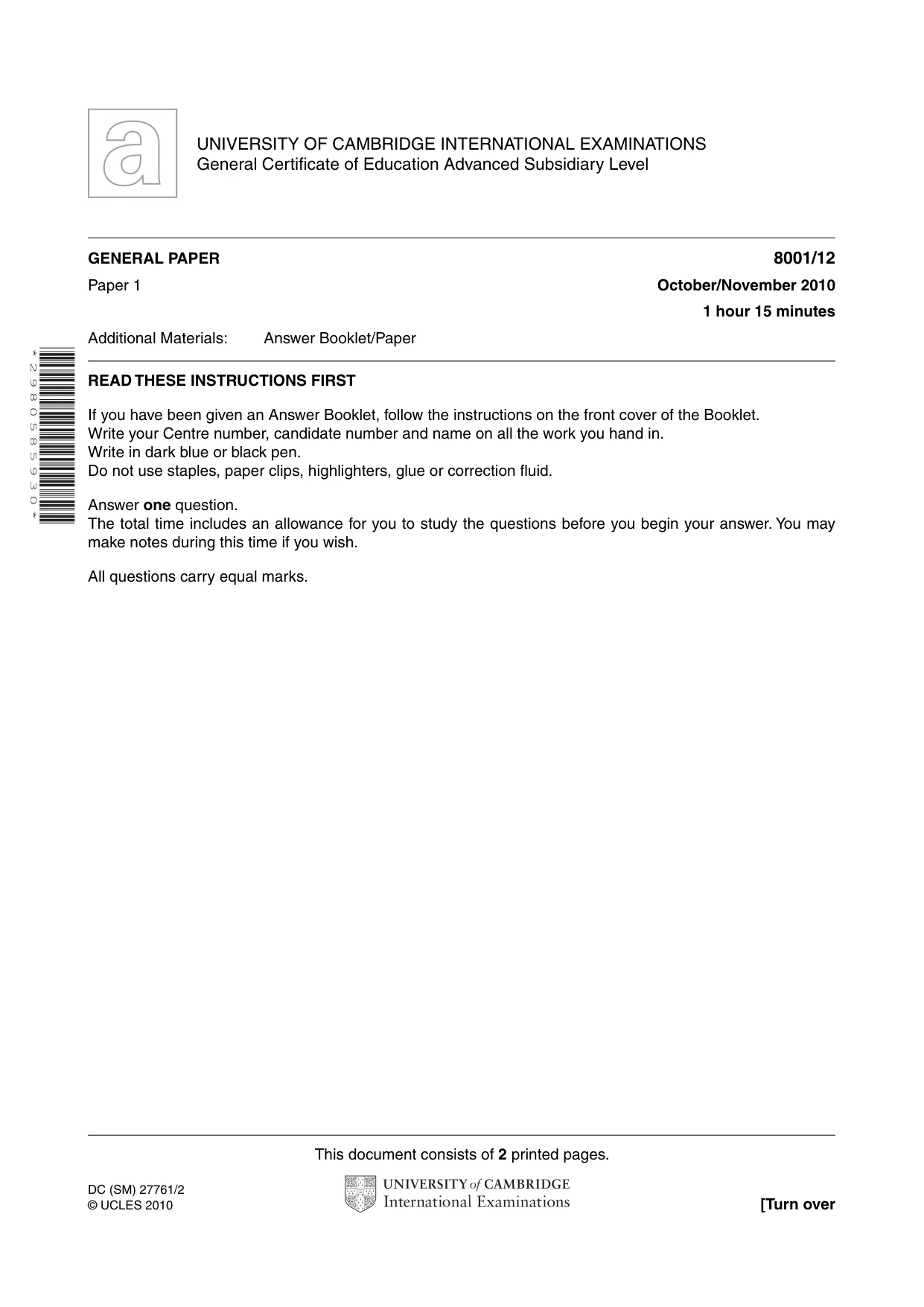
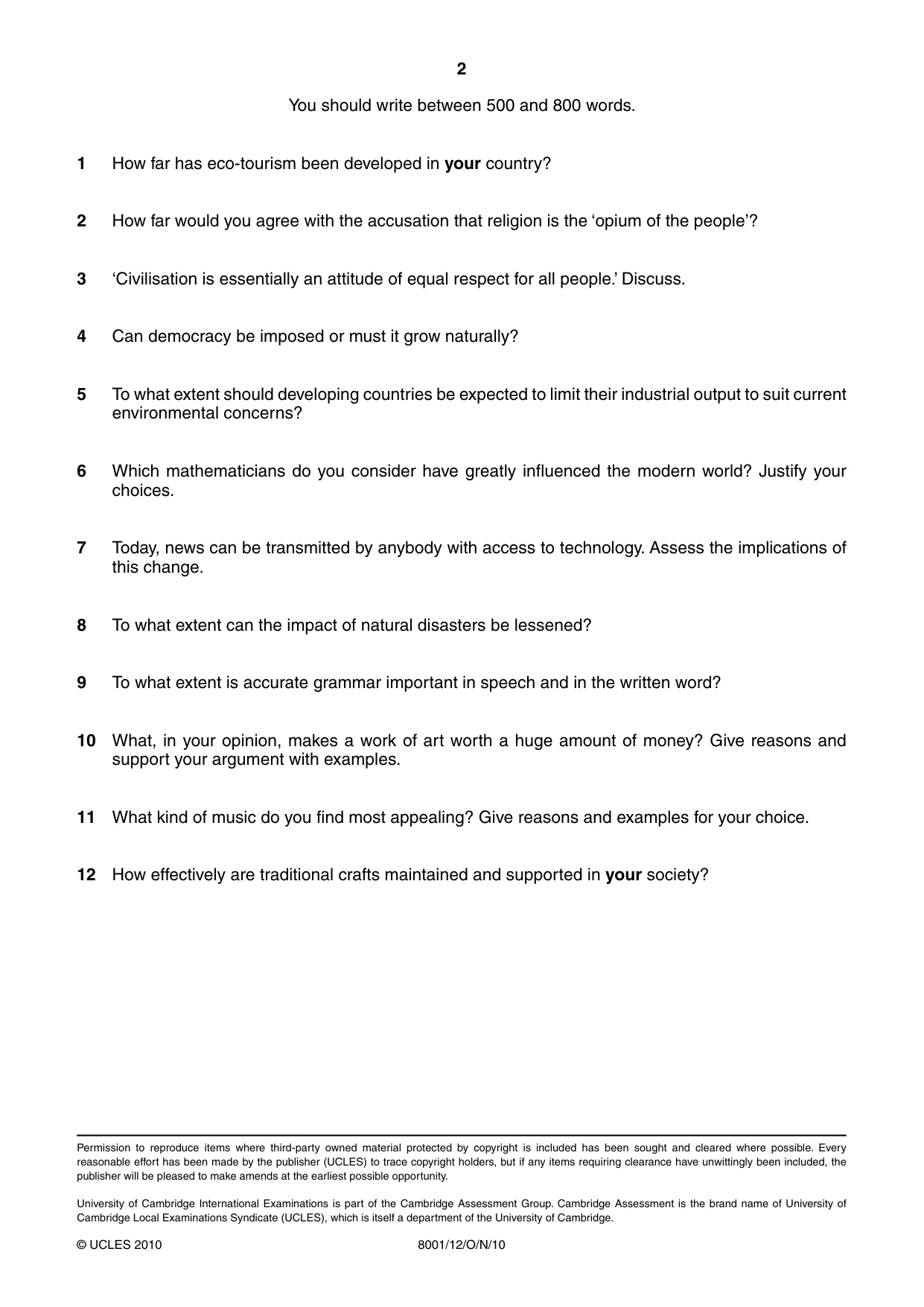
Question paper2 pages
Mark scheme7 pages
Answers below. Sit the paper first if you are practising.
Paper as text
Question paper, page 1
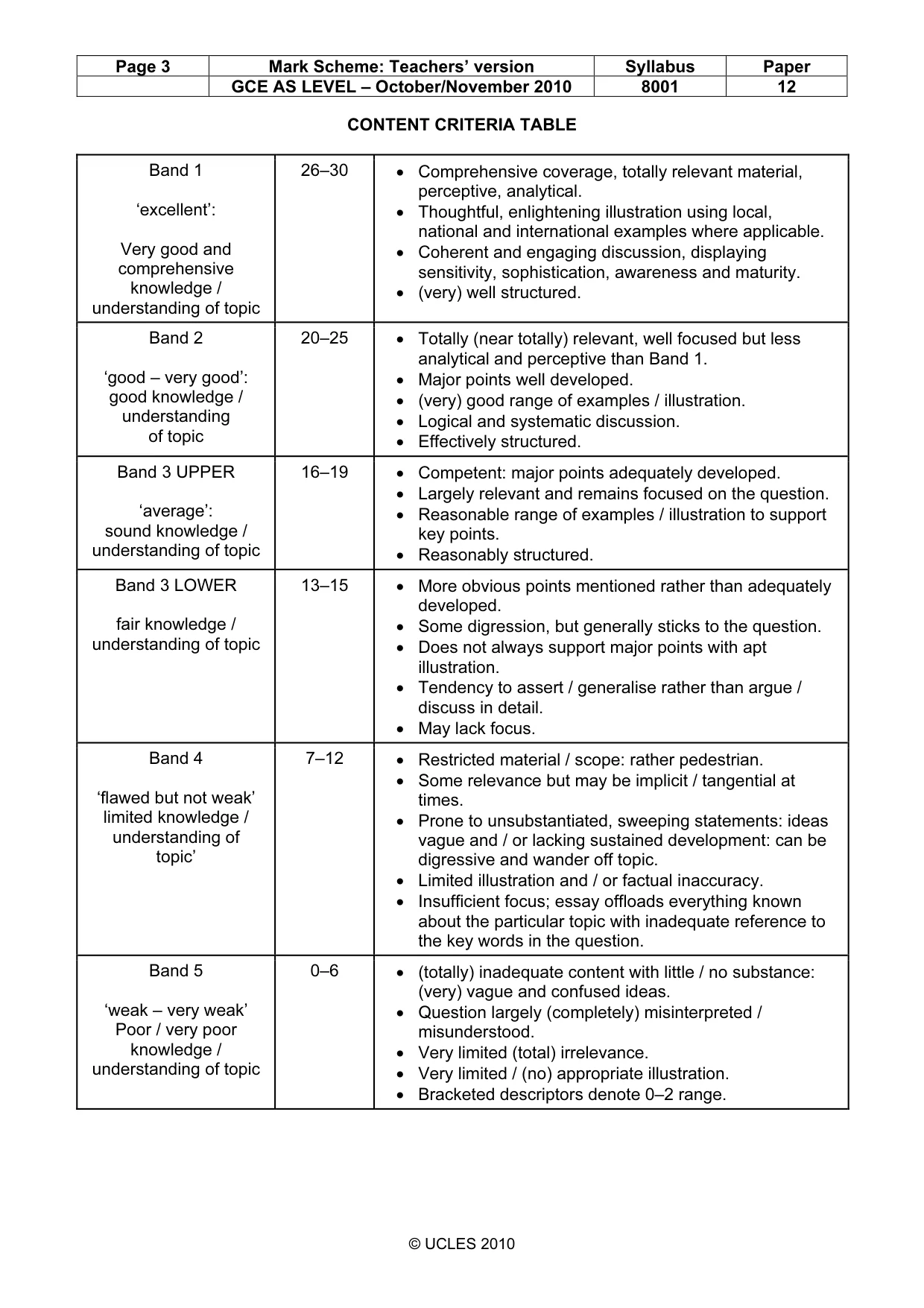
This document consists of 2 printed pages. DC (SM) 27761/2 © UCLES 2010 [Turn over UNIVERSITY OF CAMBRIDGE INTERNATIONAL EXAMINATIONS General Certificate of Education Advanced Subsidiary Level READ THESE INSTRUCTIONS FIRST If you have been given an Answer Booklet, follow the instructions on the front cover of the Booklet. Write your Centre number, candidate number and name on all the work you hand in. Write in dark blue or black pen. Do not use staples, paper clips, highlighters, glue or correction fluid. Answer one question. The total time includes an allowance for you to study the questions before you begin your answer. You may make notes during this time if you wish. All questions carry equal marks. * 2 9 8 0 5 8 5 9 3 0 * GENERAL PAPER 8001/12 Paper 1 October/November 2010 1 hour 15 minutes Additional Materials: Answer Booklet/Paper
Question paper, page 2
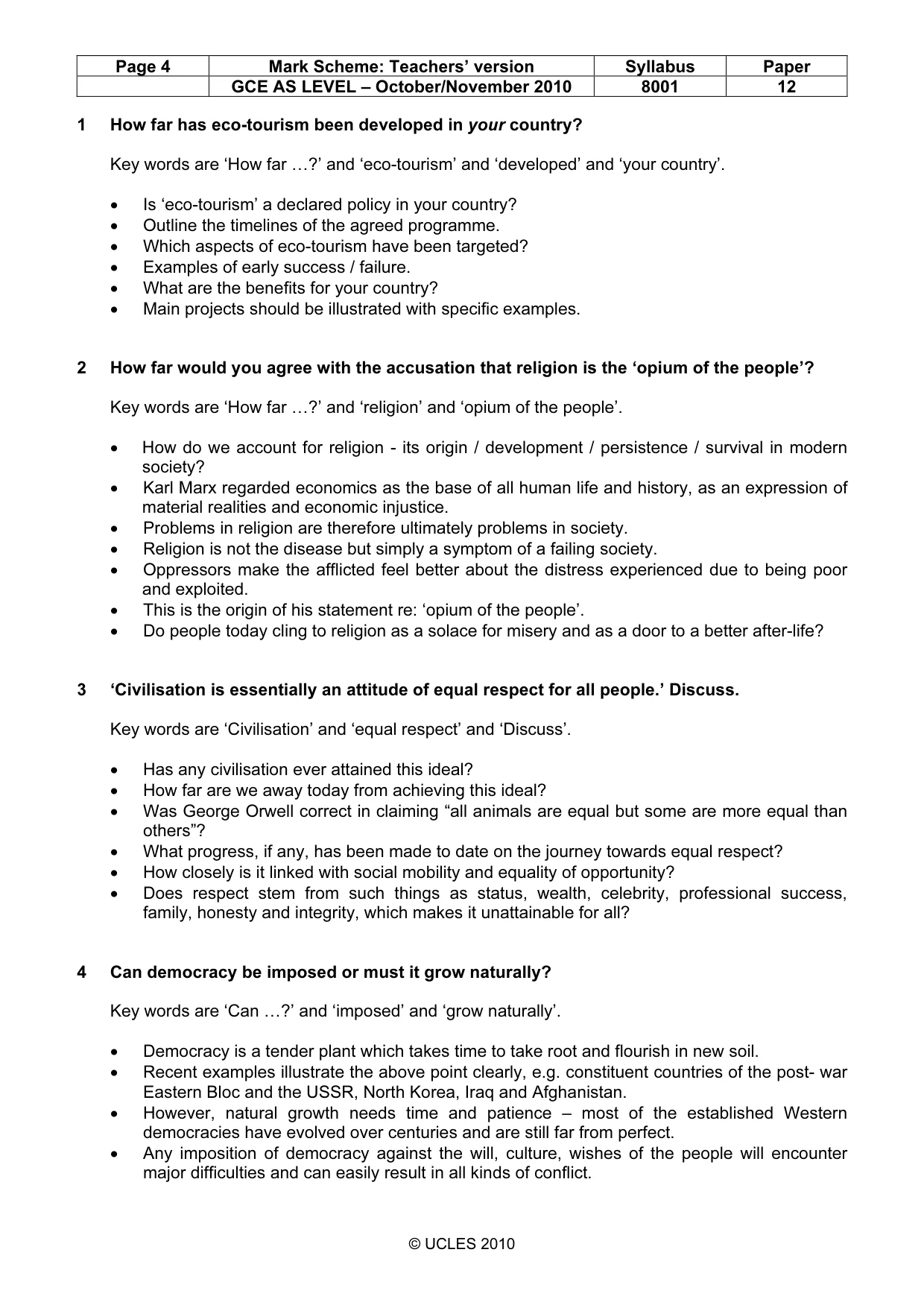
2 © UCLES 2010 8001/12/O/N/10 You should write between 500 and 800 words. 1 How far has eco-tourism been developed in your country? 2 How far would you agree with the accusation that religion is the ‘opium of the people’? 3 ‘Civilisation is essentially an attitude of equal respect for all people.’ Discuss. 4 Can democracy be imposed or must it grow naturally? 5 To what extent should developing countries be expected to limit their industrial output to suit current environmental concerns? 6 Which mathematicians do you consider have greatly influenced the modern world? Justify your choices. 7 Today, news can be transmitted by anybody with access to technology. Assess the implications of this change. 8 To what extent can the impact of natural disasters be lessened? 9 To what extent is accurate grammar important in speech and in the written word? 10 What, in your opinion, makes a work of art worth a huge amount of money? Give reasons and support your argument with examples. 11 What kind of music do you find most appealing? Give reasons and examples for your choice. 12 How effectively are traditional crafts maintained and supported in your society? Permission to reproduce items where third-party owned material protected by copyright is included has been sought and cleared where possible. Every reasonable effort has been made by the publisher (UCLES) to trace copyright holders, but if any items requiring clearance have unwittingly been included, the publisher will be pleased to make amends at the earliest possible opportunity. University of Cambridge International Examinations is part of the Cambridge Assessment Group. Cambridge Assessment is the brand name of University of Cambridge Local Examinations Syndicate (UCLES), which is itself a department of the University of Cambridge.
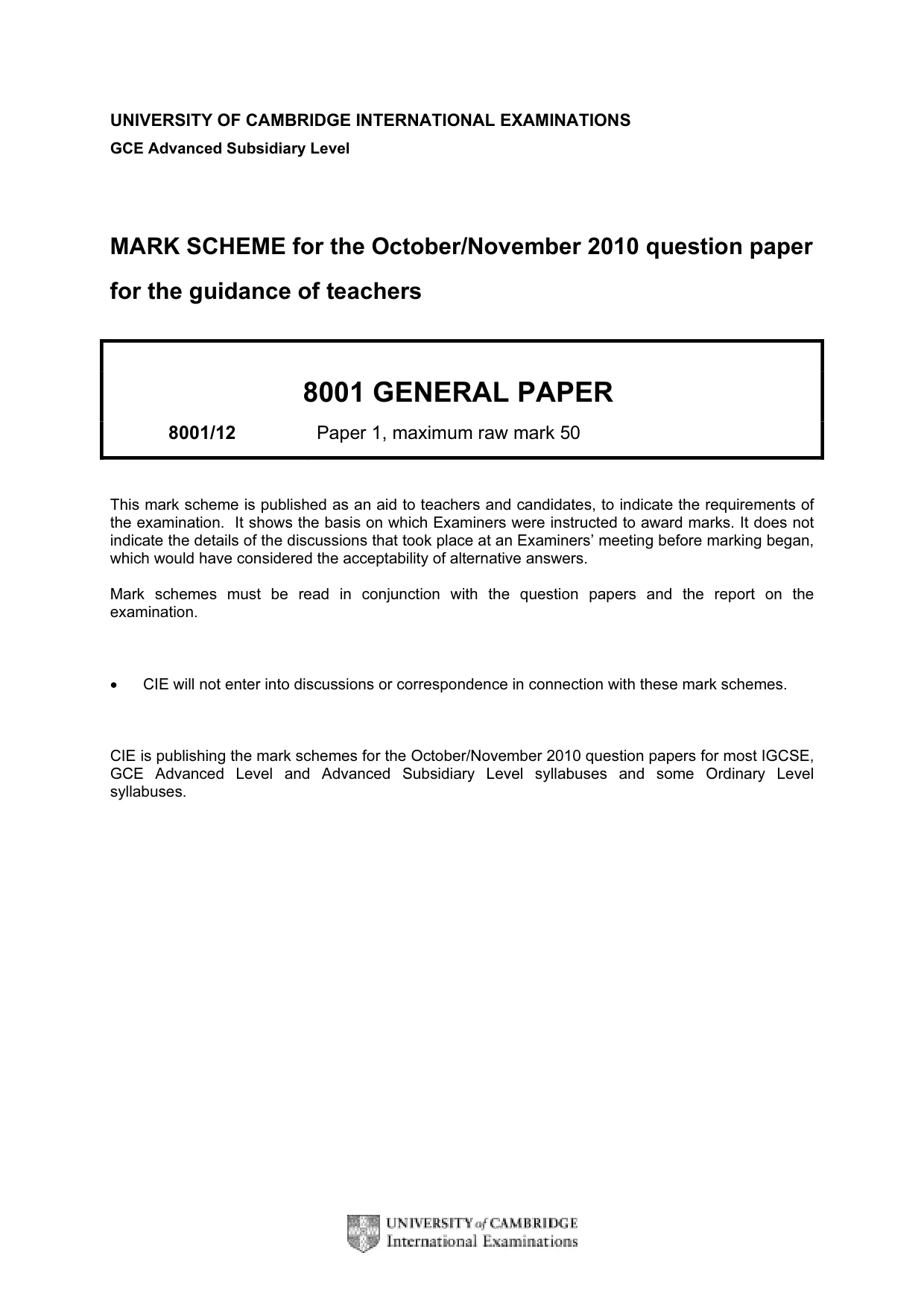
Mark scheme, page 1
UNIVERSITY OF CAMBRIDGE INTERNATIONAL EXAMINATIONS GCE Advanced Subsidiary Level MARK SCHEME for the October/November 2010 question paper for the guidance of teachers 8001 GENERAL PAPER 8001/12 Paper 1, maximum raw mark 50 This mark scheme is published as an aid to teachers and candidates, to indicate the requirements of the examination. It shows the basis on which Examiners were instructed to award marks. It does not indicate the details of the discussions that took place at an Examiners’ meeting before marking began, which would have considered the acceptability of alternative answers. Mark schemes must be read in conjunction with the question papers and the report on the examination. • CIE will not enter into discussions or correspondence in connection with these mark schemes. CIE is publishing the mark schemes for the October/November 2010 question papers for most IGCSE, GCE Advanced Level and Advanced Subsidiary Level syllabuses and some Ordinary Level syllabuses.
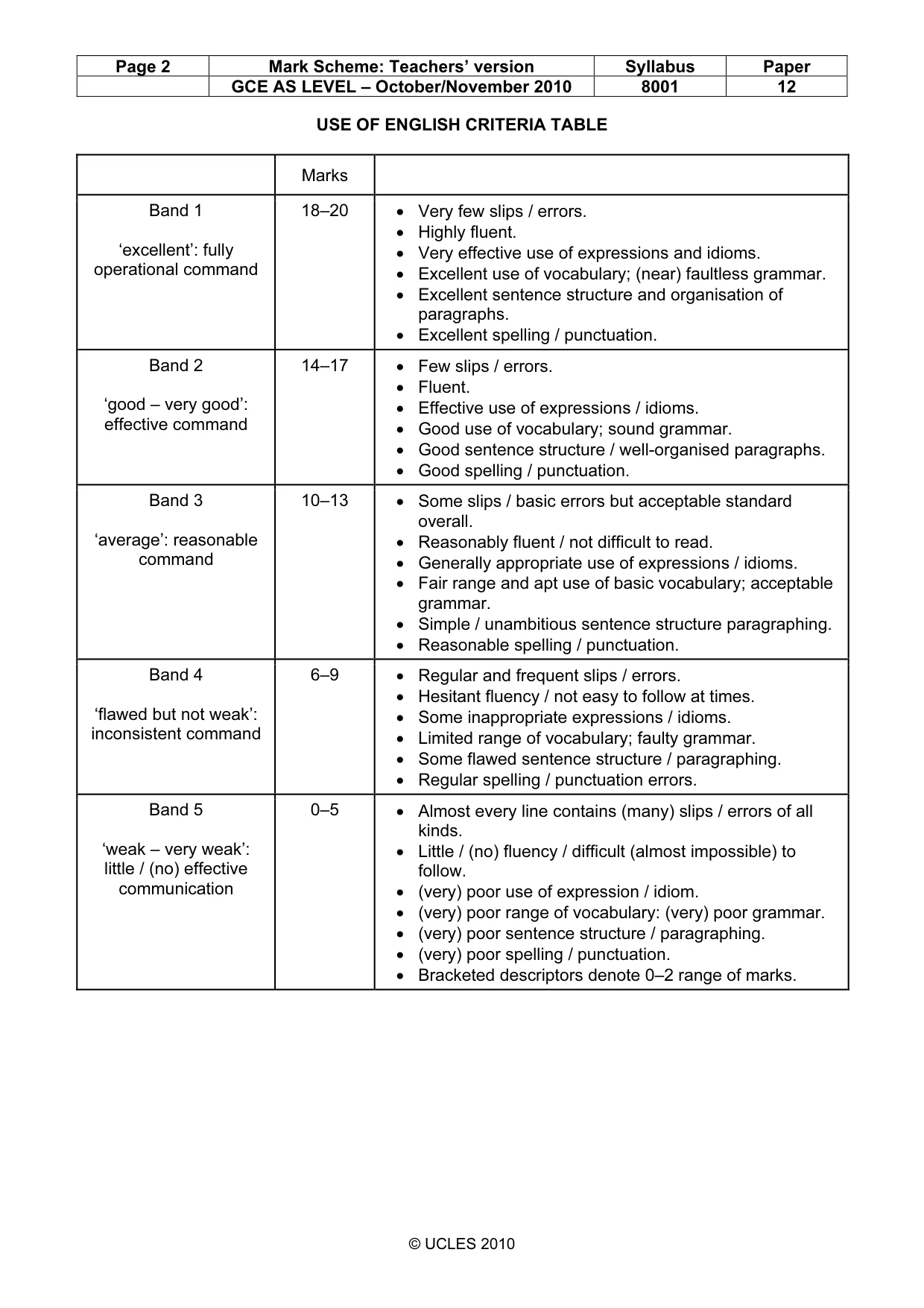
Mark scheme, page 2
Page 2 Mark Scheme: Teachers’ version Syllabus Paper GCE AS LEVEL – October/November 2010 8001 12 © UCLES 2010 USE OF ENGLISH CRITERIA TABLE Marks Band 1 ‘excellent’: fully operational command 18–20 • Very few slips / errors. • Highly fluent. • Very effective use of expressions and idioms. • Excellent use of vocabulary; (near) faultless grammar. • Excellent sentence structure and organisation of paragraphs. • Excellent spelling / punctuation. Band 2 ‘good – very good’: effective command 14–17 • Few slips / errors. • Fluent. • Effective use of expressions / idioms. • Good use of vocabulary; sound grammar. • Good sentence structure / well-organised paragraphs. • Good spelling / punctuation. Band 3 ‘average’: reasonable command 10–13 • Some slips / basic errors but acceptable standard overall. • Reasonably fluent / not difficult to read. • Generally appropriate use of expressions / idioms. • Fair range and apt use of basic vocabulary; acceptable grammar. • Simple / unambitious sentence structure paragraphing. • Reasonable spelling / punctuation. Band 4 ‘flawed but not weak’: inconsistent command 6–9 • Regular and frequent slips / errors. • Hesitant fluency / not easy to follow at times. • Some inappropriate expressions / idioms. • Limited range of vocabulary; faulty grammar. • Some flawed sentence structure / paragraphing. • Regular spelling / punctuation errors. Band 5 ‘weak – very weak’: little / (no) effective communication 0–5 • Almost every line contains (many) slips / errors of all kinds. • Little / (no) fluency / difficult (almost impossible) to follow. • (very) poor use of expression / idiom. • (very) poor range of vocabulary: (very) poor grammar. • (very) poor sentence structure / paragraphing. • (very) poor spelling / punctuation. • Bracketed descriptors denote 0–2 range of marks.
Mark scheme, page 3
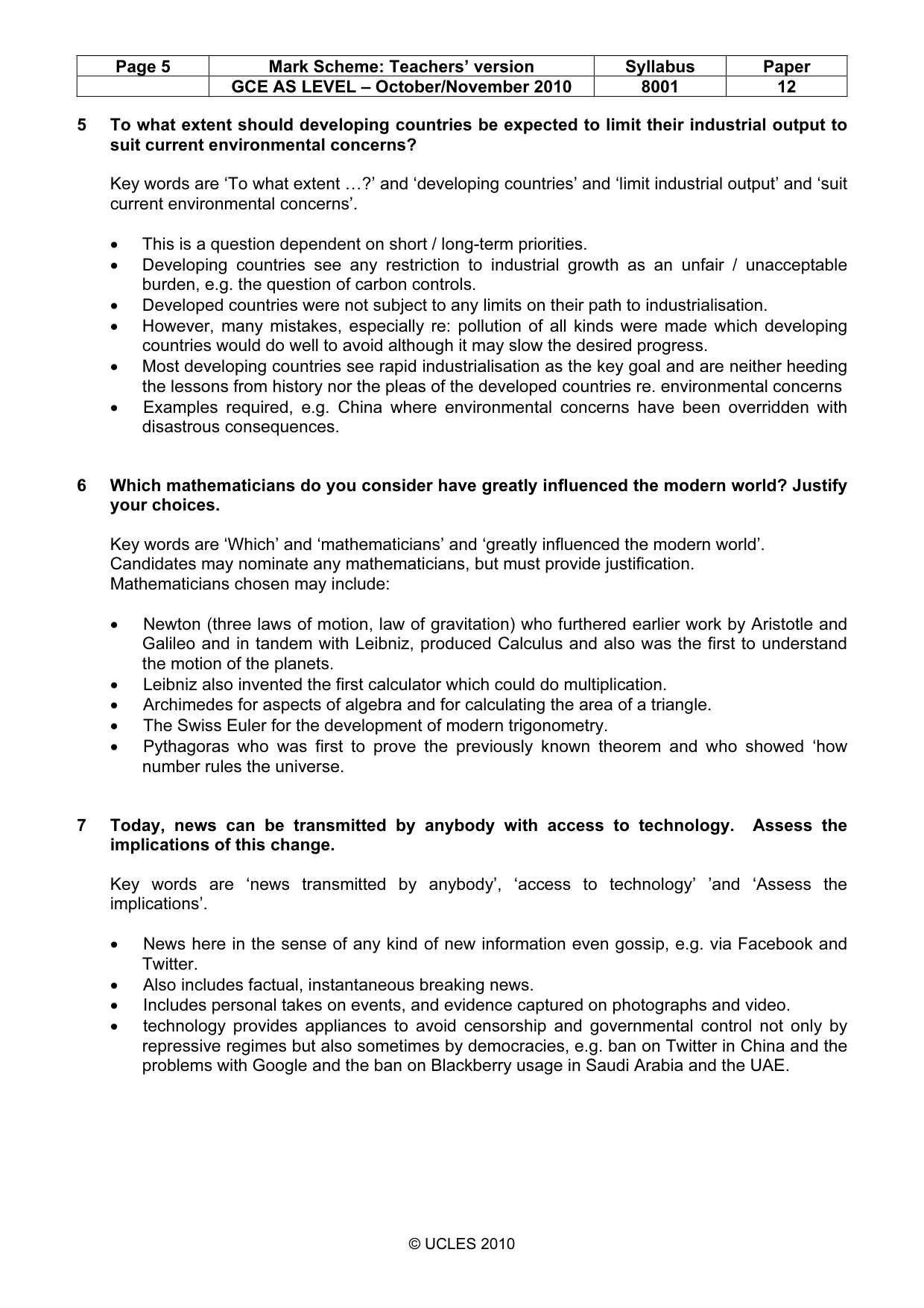
Page 3 Mark Scheme: Teachers’ version Syllabus Paper GCE AS LEVEL – October/November 2010 8001 12 © UCLES 2010 CONTENT CRITERIA TABLE Band 1 ‘excellent’: Very good and comprehensive knowledge / understanding of topic 26–30 • Comprehensive coverage, totally relevant material, perceptive, analytical. • Thoughtful, enlightening illustration using local, national and international examples where applicable. • Coherent and engaging discussion, displaying sensitivity, sophistication, awareness and maturity. • (very) well structured. Band 2 ‘good – very good’: good knowledge / understanding of topic 20–25 • Totally (near totally) relevant, well focused but less analytical and perceptive than Band 1. • Major points well developed. • (very) good range of examples / illustration. • Logical and systematic discussion. • Effectively structured. Band 3 UPPER ‘average’: sound knowledge / understanding of topic 16–19 • Competent: major points adequately developed. • Largely relevant and remains focused on the question. • Reasonable range of examples / illustration to support key points. • Reasonably structured. Band 3 LOWER fair knowledge / understanding of topic 13–15 • More obvious points mentioned rather than adequately developed. • Some digression, but generally sticks to the question. • Does not always support major points with apt illustration. • Tendency to assert / generalise rather than argue / discuss in detail. • May lack focus. Band 4 ‘flawed but not weak’ limited knowledge / understanding of topic’ 7–12 • Restricted material / scope: rather pedestrian. • Some relevance but may be implicit / tangential at times. • Prone to unsubstantiated, sweeping statements: ideas vague and / or lacking sustained development: can be digressive and wander off topic. • Limited illustration and / or factual inaccuracy. • Insufficient focus; essay offloads everything known about the particular topic with inadequate reference to the key words in the question. Band 5 ‘weak – very weak’ Poor / very poor knowledge / understanding of topic 0–6 • (totally) inadequate content with little / no substance: (very) vague and confused ideas. • Question largely (completely) misinterpreted / misunderstood. • Very limited (total) irrelevance. • Very limited / (no) appropriate illustration. • Bracketed descriptors denote 0–2 range.
Mark scheme, page 4
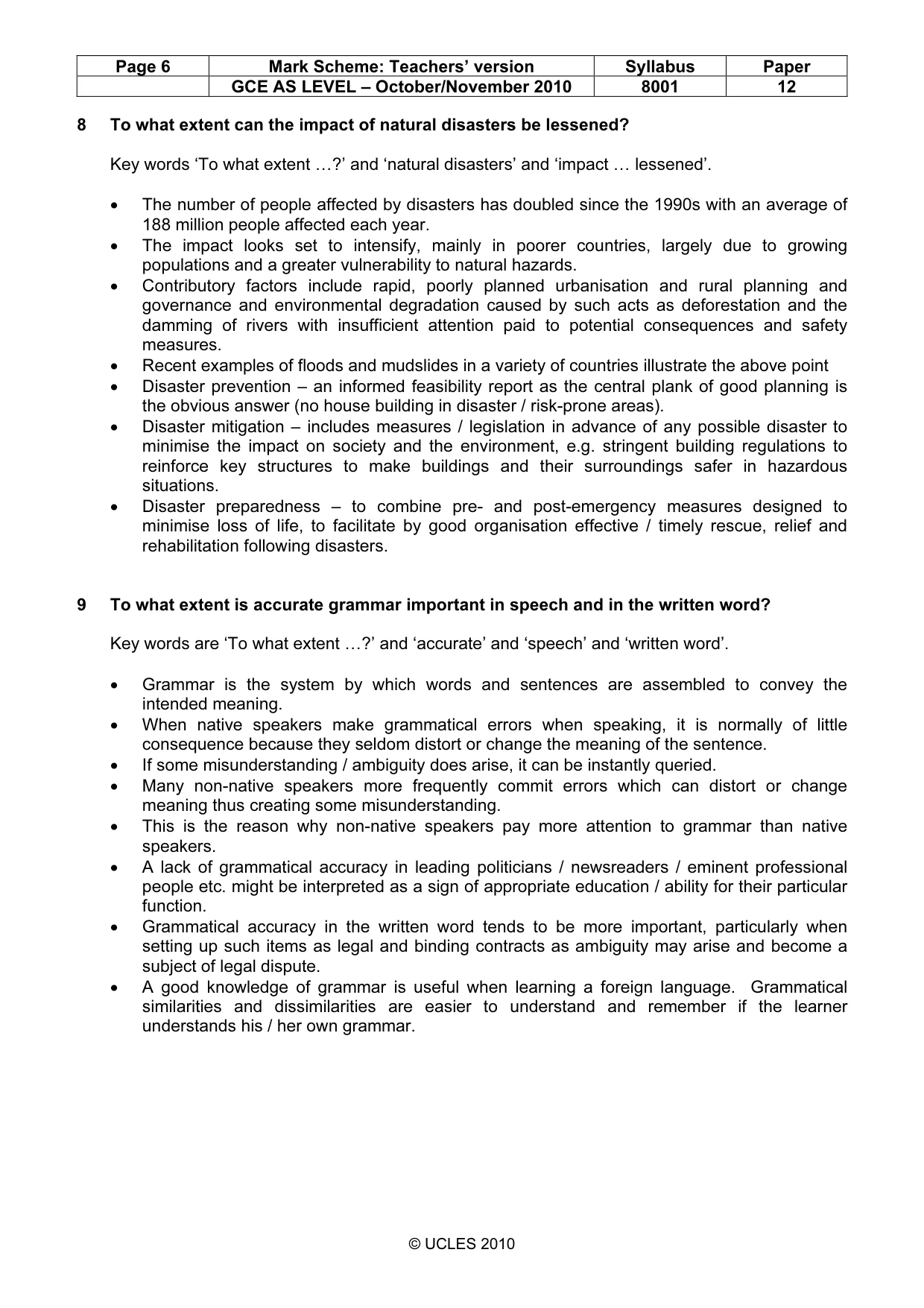
Page 4 Mark Scheme: Teachers’ version Syllabus Paper GCE AS LEVEL – October/November 2010 8001 12 © UCLES 2010 1 How far has eco-tourism been developed in your country? Key words are ‘How far …?’ and ‘eco-tourism’ and ‘developed’ and ‘your country’. • Is ‘eco-tourism’ a declared policy in your country? • Outline the timelines of the agreed programme. • Which aspects of eco-tourism have been targeted? • Examples of early success / failure. • What are the benefits for your country? • Main projects should be illustrated with specific examples. 2 How far would you agree with the accusation that religion is the ‘opium of the people’? Key words are ‘How far …?’ and ‘religion’ and ‘opium of the people’. • How do we account for religion - its origin / development / persistence / survival in modern society? • Karl Marx regarded economics as the base of all human life and history, as an expression of material realities and economic injustice. • Problems in religion are therefore ultimately problems in society. • Religion is not the disease but simply a symptom of a failing society. • Oppressors make the afflicted feel better about the distress experienced due to being poor and exploited. • This is the origin of his statement re: ‘opium of the people’. • Do people today cling to religion as a solace for misery and as a door to a better after-life? 3 ‘Civilisation is essentially an attitude of equal respect for all people.’ Discuss. Key words are ‘Civilisation’ and ‘equal respect’ and ‘Discuss’. • Has any civilisation ever attained this ideal? • How far are we away today from achieving this ideal? • Was George Orwell correct in claiming “all animals are equal but some are more equal than others”? • What progress, if any, has been made to date on the journey towards equal respect? • How closely is it linked with social mobility and equality of opportunity? • Does respect stem from such things as status, wealth, celebrity, professional success, family, honesty and integrity, which makes it unattainable for all? 4 Can democracy be imposed or must it grow naturally? Key words are ‘Can …?’ and ‘imposed’ and ‘grow naturally’. • Democracy is a tender plant which takes time to take root and flourish in new soil. • Recent examples illustrate the above point clearly, e.g. constituent countries of the post- war Eastern Bloc and the USSR, North Korea, Iraq and Afghanistan. • However, natural growth needs time and patience – most of the established Western democracies have evolved over centuries and are still far from perfect. • Any imposition of democracy against the will, culture, wishes of the people will encounter major difficulties and can easily result in all kinds of conflict.
Mark scheme, page 5
Page 5 Mark Scheme: Teachers’ version Syllabus Paper GCE AS LEVEL – October/November 2010 8001 12 © UCLES 2010 5 To what extent should developing countries be expected to limit their industrial output to suit current environmental concerns? Key words are ‘To what extent …?’ and ‘developing countries’ and ‘limit industrial output’ and ‘suit current environmental concerns’. • This is a question dependent on short / long-term priorities. • Developing countries see any restriction to industrial growth as an unfair / unacceptable burden, e.g. the question of carbon controls. • Developed countries were not subject to any limits on their path to industrialisation. • However, many mistakes, especially re: pollution of all kinds were made which developing countries would do well to avoid although it may slow the desired progress. • Most developing countries see rapid industrialisation as the key goal and are neither heeding the lessons from history nor the pleas of the developed countries re. environmental concerns • Examples required, e.g. China where environmental concerns have been overridden with disastrous consequences. 6 Which mathematicians do you consider have greatly influenced the modern world? Justify your choices. Key words are ‘Which’ and ‘mathematicians’ and ‘greatly influenced the modern world’. Candidates may nominate any mathematicians, but must provide justification. Mathematicians chosen may include: • Newton (three laws of motion, law of gravitation) who furthered earlier work by Aristotle and Galileo and in tandem with Leibniz, produced Calculus and also was the first to understand the motion of the planets. • Leibniz also invented the first calculator which could do multiplication. • Archimedes for aspects of algebra and for calculating the area of a triangle. • The Swiss Euler for the development of modern trigonometry. • Pythagoras who was first to prove the previously known theorem and who showed ‘how number rules the universe. 7 Today, news can be transmitted by anybody with access to technology. Assess the implications of this change. Key words are ‘news transmitted by anybody’, ‘access to technology’ ’and ‘Assess the implications’. • News here in the sense of any kind of new information even gossip, e.g. via Facebook and Twitter. • Also includes factual, instantaneous breaking news. • Includes personal takes on events, and evidence captured on photographs and video. • technology provides appliances to avoid censorship and governmental control not only by repressive regimes but also sometimes by democracies, e.g. ban on Twitter in China and the problems with Google and the ban on Blackberry usage in Saudi Arabia and the UAE.
Mark scheme, page 6
Page 6 Mark Scheme: Teachers’ version Syllabus Paper GCE AS LEVEL – October/November 2010 8001 12 © UCLES 2010 8 To what extent can the impact of natural disasters be lessened? Key words ‘To what extent …?’ and ‘natural disasters’ and ‘impact … lessened’. • The number of people affected by disasters has doubled since the 1990s with an average of 188 million people affected each year. • The impact looks set to intensify, mainly in poorer countries, largely due to growing populations and a greater vulnerability to natural hazards. • Contributory factors include rapid, poorly planned urbanisation and rural planning and governance and environmental degradation caused by such acts as deforestation and the damming of rivers with insufficient attention paid to potential consequences and safety measures. • Recent examples of floods and mudslides in a variety of countries illustrate the above point • Disaster prevention – an informed feasibility report as the central plank of good planning is the obvious answer (no house building in disaster / risk-prone areas). • Disaster mitigation – includes measures / legislation in advance of any possible disaster to minimise the impact on society and the environment, e.g. stringent building regulations to reinforce key structures to make buildings and their surroundings safer in hazardous situations. • Disaster preparedness – to combine pre- and post-emergency measures designed to minimise loss of life, to facilitate by good organisation effective / timely rescue, relief and rehabilitation following disasters. 9 To what extent is accurate grammar important in speech and in the written word? Key words are ‘To what extent …?’ and ‘accurate’ and ‘speech’ and ‘written word’. • Grammar is the system by which words and sentences are assembled to convey the intended meaning. • When native speakers make grammatical errors when speaking, it is normally of little consequence because they seldom distort or change the meaning of the sentence. • If some misunderstanding / ambiguity does arise, it can be instantly queried. • Many non-native speakers more frequently commit errors which can distort or change meaning thus creating some misunderstanding. • This is the reason why non-native speakers pay more attention to grammar than native speakers. • A lack of grammatical accuracy in leading politicians / newsreaders / eminent professional people etc. might be interpreted as a sign of appropriate education / ability for their particular function. • Grammatical accuracy in the written word tends to be more important, particularly when setting up such items as legal and binding contracts as ambiguity may arise and become a subject of legal dispute. • A good knowledge of grammar is useful when learning a foreign language. Grammatical similarities and dissimilarities are easier to understand and remember if the learner understands his / her own grammar.
Mark scheme, page 7
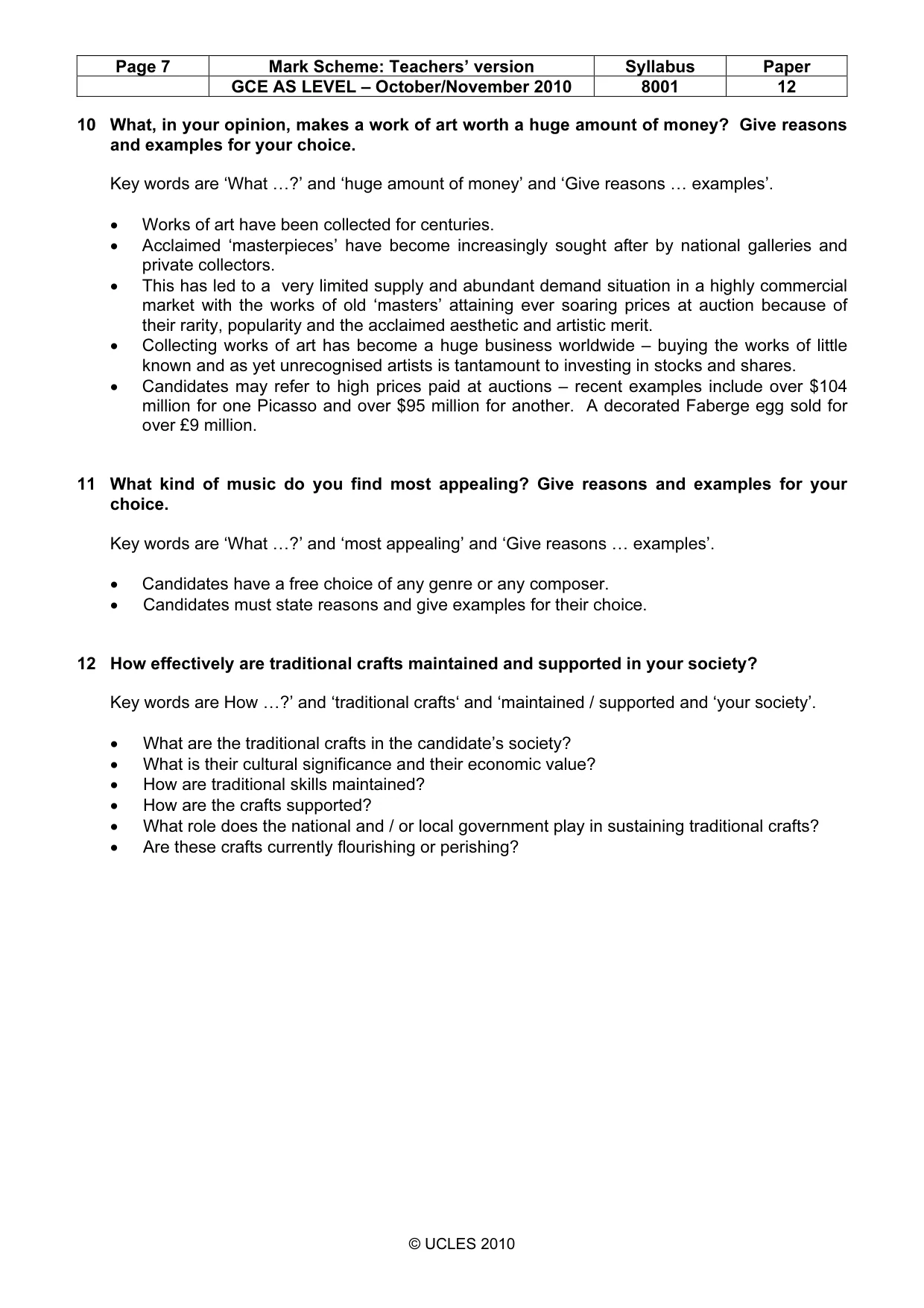
Page 7 Mark Scheme: Teachers’ version Syllabus Paper GCE AS LEVEL – October/November 2010 8001 12 © UCLES 2010 10 What, in your opinion, makes a work of art worth a huge amount of money? Give reasons and examples for your choice. Key words are ‘What …?’ and ‘huge amount of money’ and ‘Give reasons … examples’. • Works of art have been collected for centuries. • Acclaimed ‘masterpieces’ have become increasingly sought after by national galleries and private collectors. • This has led to a very limited supply and abundant demand situation in a highly commercial market with the works of old ‘masters’ attaining ever soaring prices at auction because of their rarity, popularity and the acclaimed aesthetic and artistic merit. • Collecting works of art has become a huge business worldwide – buying the works of little known and as yet unrecognised artists is tantamount to investing in stocks and shares. • Candidates may refer to high prices paid at auctions – recent examples include over $104 million for one Picasso and over $95 million for another. A decorated Faberge egg sold for over £9 million. 11 What kind of music do you find most appealing? Give reasons and examples for your choice. Key words are ‘What …?’ and ‘most appealing’ and ‘Give reasons … examples’. • Candidates have a free choice of any genre or any composer. • Candidates must state reasons and give examples for their choice. 12 How effectively are traditional crafts maintained and supported in your society? Key words are How …?’ and ‘traditional crafts‘ and ‘maintained / supported and ‘your society’. • What are the traditional crafts in the candidate’s society? • What is their cultural significance and their economic value? • How are traditional skills maintained? • How are the crafts supported? • What role does the national and / or local government play in sustaining traditional crafts? • Are these crafts currently flourishing or perishing?
What you needed in this session
Cambridge’s own grade thresholds for 2010 Oct/Nov, Paper 1 · Variant 2. A higher threshold means an easier paper — the bar moves with how the cohort did.