Cambridge A Level French - Literature (AS Level only) 8670 — 2018 May/June Paper 4 · Variant 2
8670/42/M/J/18 · 75 marks · ≈84 min
The question paper and its mark scheme, free to read here and free to download. This is Cambridge’s own paper, exactly as it was sat.
Question paper12 pages



Mark scheme4 pages
Answers below. Sit the paper first if you are practising.
Paper as text
Question paper, page 1
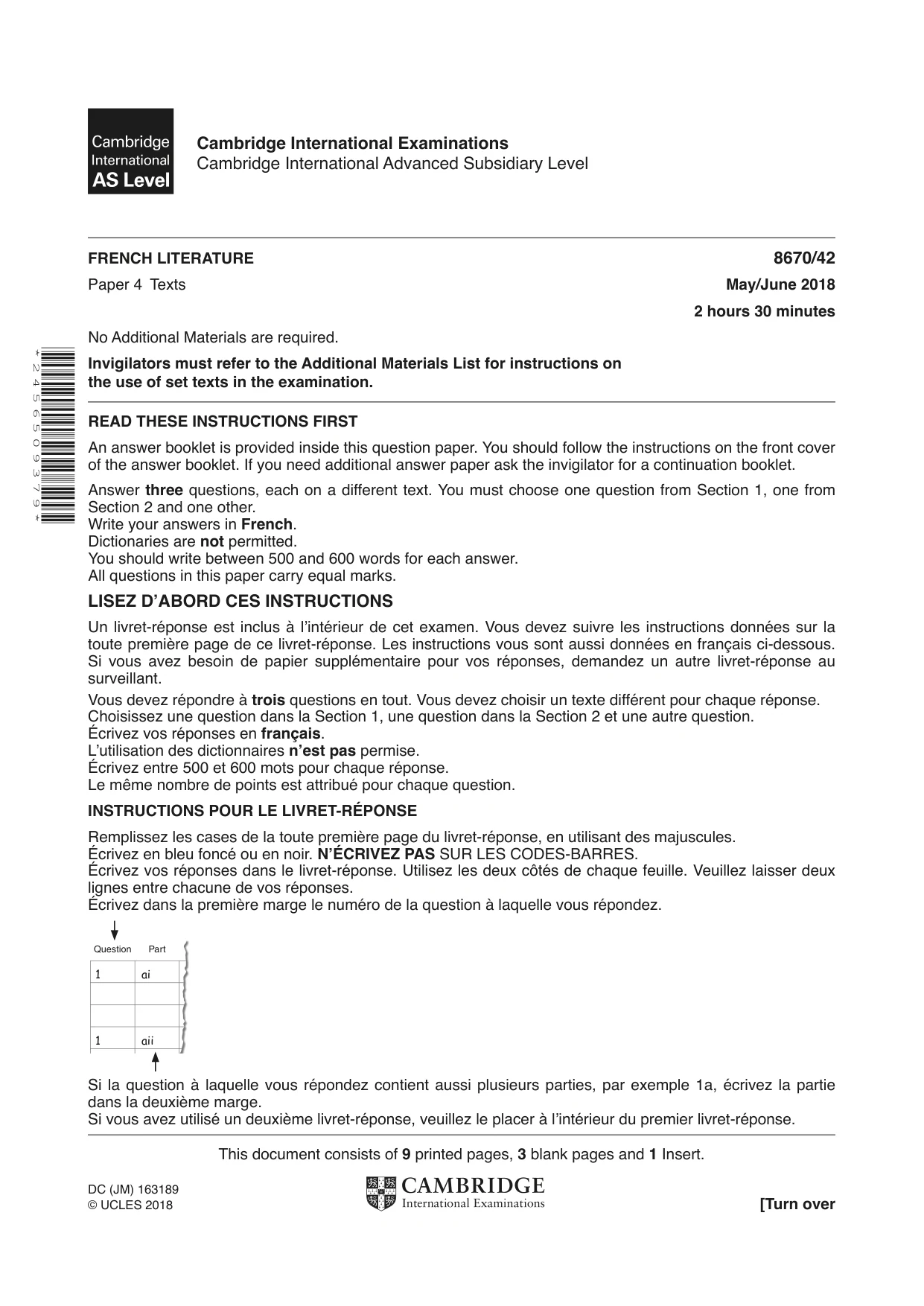
This document consists of 9 printed pages, 3 blank pages and 1 Insert. DC (JM) 163189 © UCLES 2018 [Turn over Cambridge International Examinations Cambridge International Advanced Subsidiary Level FRENCH LITERATURE 8670/42 Paper 4 Texts May/June 2018 2 hours 30 minutes No Additional Materials are required. Invigilators must refer to the Additional Materials List for instructions on the use of set texts in the examination. READ THESE INSTRUCTIONS FIRST An answer booklet is provided inside this question paper. You should follow the instructions on the front cover of the answer booklet. If you need additional answer paper ask the invigilator for a continuation booklet. Answer three questions, each on a different text. You must choose one question from Section 1, one from Section 2 and one other. Write your answers in French. Dictionaries are not permitted. You should write between 500 and 600 words for each answer. All questions in this paper carry equal marks. LISEZ D’ABORD CES INSTRUCTIONS Un livret-réponse est inclus à l’intérieur de cet examen. Vous devez suivre les instructions données sur la toute première page de ce livret-réponse. Les instructions vous sont aussi données en français ci-dessous. Si vous avez besoin de papier supplémentaire pour vos réponses, demandez un autre livret-réponse au surveillant. Vous devez répondre à trois questions en tout. Vous devez choisir un texte différent pour chaque réponse. Choisissez une question dans la Section 1, une question dans la Section 2 et une autre question. Écrivez vos réponses en français. L’utilisation des dictionnaires n’est pas permise. Écrivez entre 500 et 600 mots pour chaque réponse. Le même nombre de points est attribué pour chaque question. INSTRUCTIONS POUR LE LIVRET-RÉPONSE Remplissez les cases de la toute première page du livret-réponse, en utilisant des majuscules. Écrivez en bleu foncé ou en noir. N’ÉCRIVEZ PAS SUR LES CODES-BARRES. Écrivez vos réponses dans le livret-réponse. Utilisez les deux côtés de chaque feuille. Veuillez laisser deux lignes entre chacune de vos réponses. Écrivez dans la première marge le numéro de la question à laquelle vous répondez. Question Part 1 1 ai aii Si la question à laquelle vous répondez contient aussi plusieurs parties, par exemple 1a, écrivez la partie dans la deuxième marge. Si vous avez utilisé un deuxième livret-réponse, veuillez le placer à l’intérieur du premier livret-réponse. * 2 4 5 6 5 0 9 3 7 9 *
Question paper, page 2
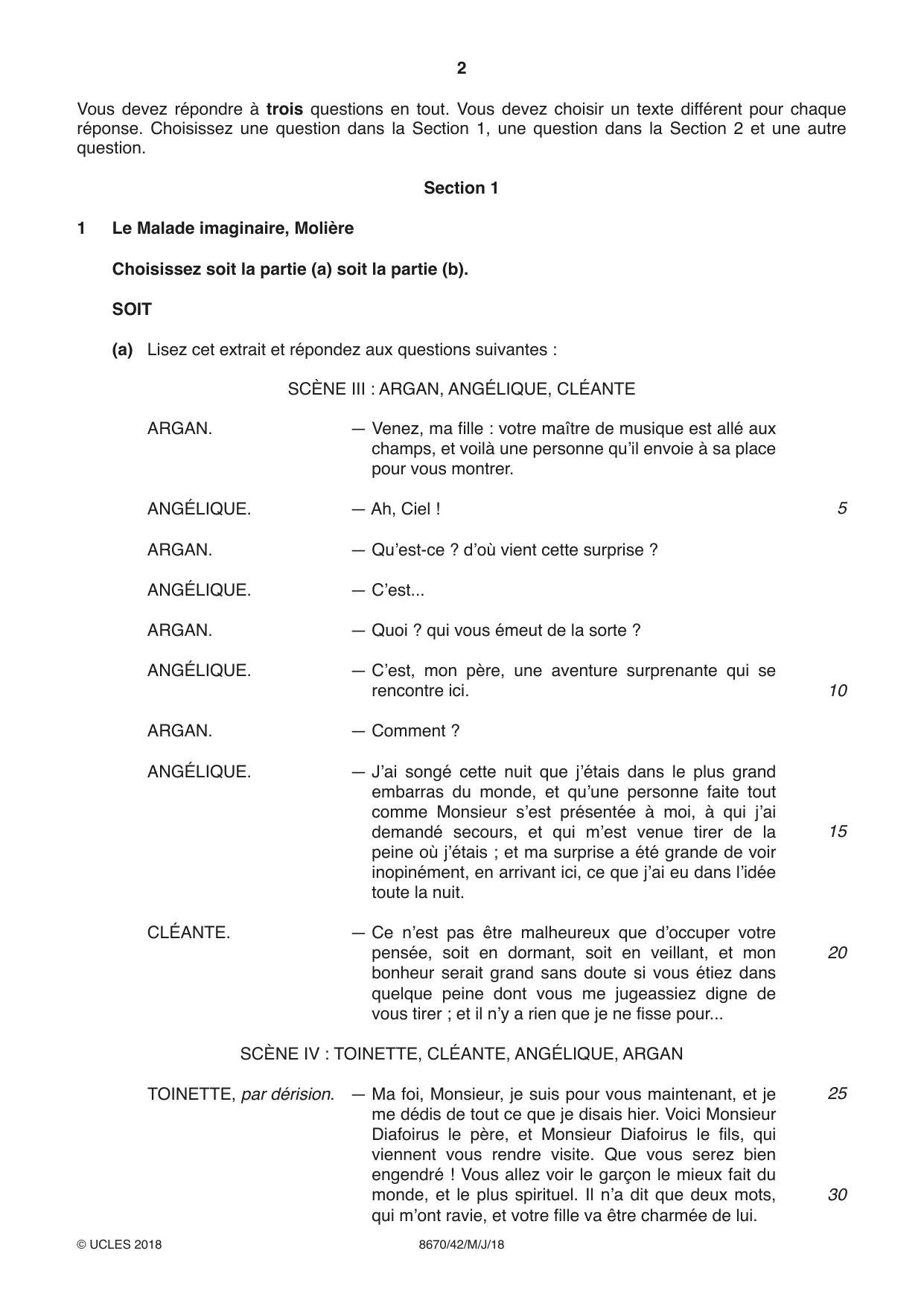
2 8670/42/M/J/18 © UCLES 2018 Vous devez répondre à trois questions en tout. Vous devez choisir un texte différent pour chaque réponse. Choisissez une question dans la Section 1, une question dans la Section 2 et une autre question. Section 1 1 Le Malade imaginaire, Molière Choisissez soit la partie (a) soit la partie (b). SOIT (a) Lisez cet extrait et répondez aux questions suivantes : SCÈNE III : ARGAN, ANGÉLIQUE, CLÉANTE ARGAN. — Venez, ma fille : votre maître de musique est allé aux champs, et voilà une personne qu’il envoie à sa place pour vous montrer. ANGÉLIQUE. — Ah, Ciel ! ARGAN. — Qu’est-ce ? d’où vient cette surprise ? ANGÉLIQUE. — C’est... ARGAN. — Quoi ? qui vous émeut de la sorte ? ANGÉLIQUE. — C’est, mon père, une aventure surprenante qui se rencontre ici. ARGAN. — Comment ? ANGÉLIQUE. — J’ai songé cette nuit que j’étais dans le plus grand embarras du monde, et qu’une personne faite tout comme Monsieur s’est présentée à moi, à qui j’ai demandé secours, et qui m’est venue tirer de la peine où j’étais ; et ma surprise a été grande de voir inopinément, en arrivant ici, ce que j’ai eu dans l’idée toute la nuit. CLÉANTE. — Ce n’est pas être malheureux que d’occuper votre pensée, soit en dormant, soit en veillant, et mon bonheur serait grand sans doute si vous étiez dans quelque peine dont vous me jugeassiez digne de vous tirer ; et il n’y a rien que je ne fisse pour... SCÈNE IV : TOINETTE, CLÉANTE, ANGÉLIQUE, ARGAN TOINETTE, par dérision. — Ma foi, Monsieur, je suis pour vous maintenant, et je me dédis de tout ce que je disais hier. Voici Monsieur Diafoirus le père, et Monsieur Diafoirus le fils, qui viennent vous rendre visite. Que vous serez bien engendré ! Vous allez voir le garçon le mieux fait du monde, et le plus spirituel. Il n’a dit que deux mots, qui m’ont ravie, et votre fille va être charmée de lui. 5 10 15 20 25 30
Question paper, page 3
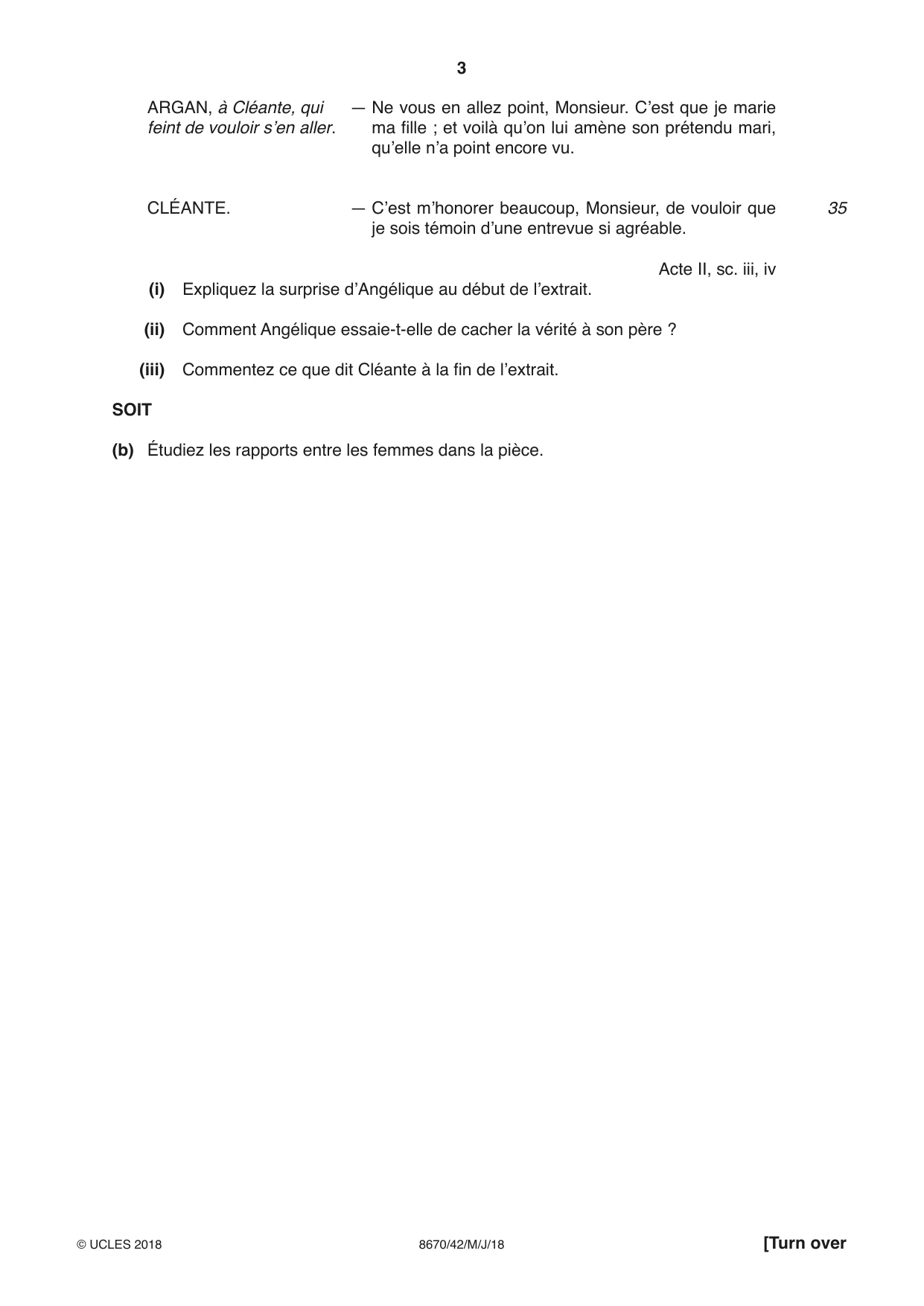
3 8670/42/M/J/18 © UCLES 2018 [Turn over ARGAN, à Cléante, qui feint de vouloir s’en aller. — Ne vous en allez point, Monsieur. C’est que je marie ma fille ; et voilà qu’on lui amène son prétendu mari, qu’elle n’a point encore vu. CLÉANTE. — C’est m’honorer beaucoup, Monsieur, de vouloir que je sois témoin d’une entrevue si agréable. Acte II, sc. iii, iv (i) Expliquez la surprise d’Angélique au début de l’extrait. (ii) Comment Angélique essaie-t-elle de cacher la vérité à son père ? (iii) Commentez ce que dit Cléante à la fin de l’extrait. SOIT (b) Étudiez les rapports entre les femmes dans la pièce. 35
Question paper, page 4
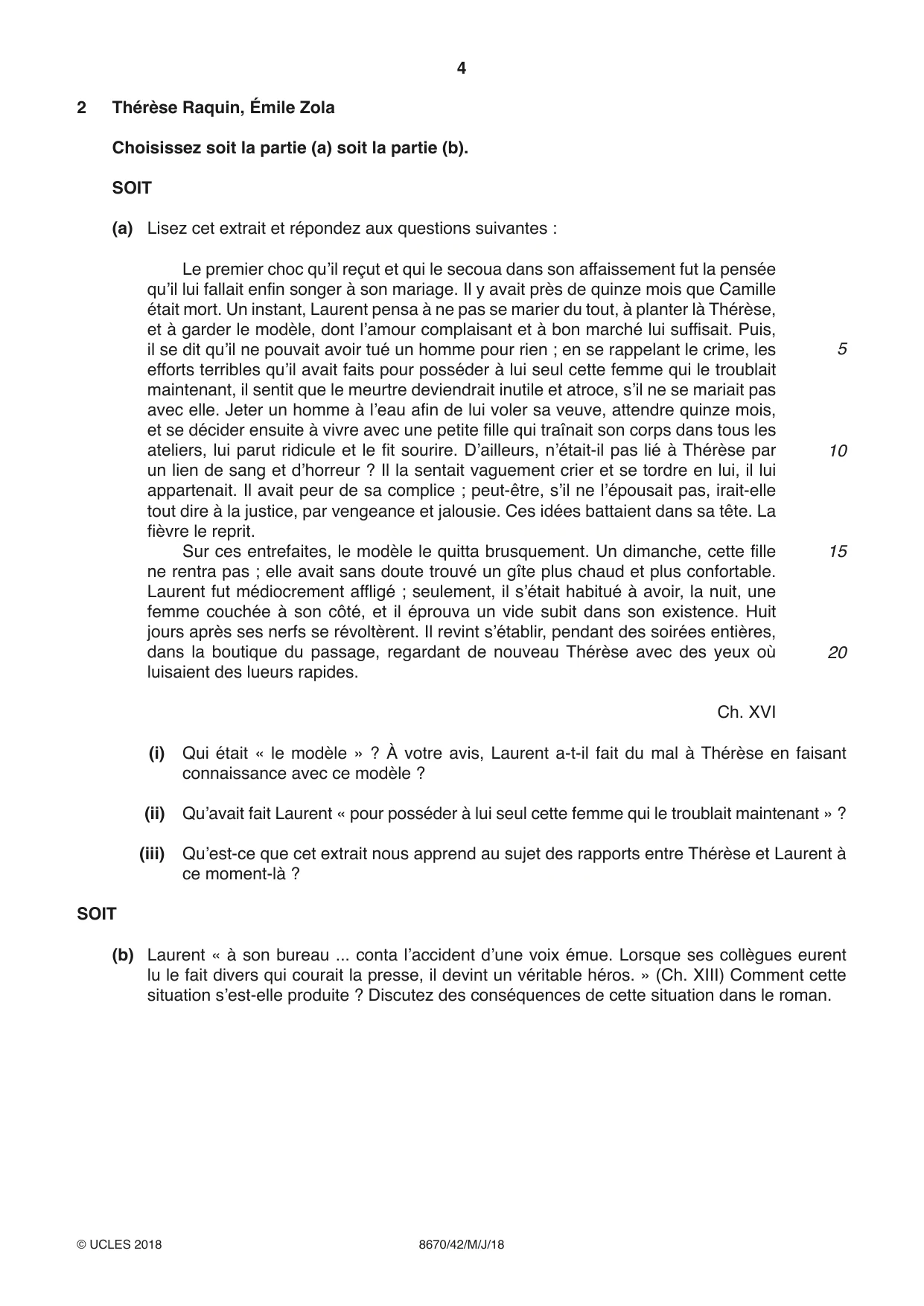
4 8670/42/M/J/18 © UCLES 2018 2 Thérèse Raquin, Émile Zola Choisissez soit la partie (a) soit la partie (b). SOIT (a) Lisez cet extrait et répondez aux questions suivantes : Le premier choc qu’il reçut et qui le secoua dans son affaissement fut la pensée qu’il lui fallait enfin songer à son mariage. Il y avait près de quinze mois que Camille était mort. Un instant, Laurent pensa à ne pas se marier du tout, à planter là Thérèse, et à garder le modèle, dont l’amour complaisant et à bon marché lui suffisait. Puis, il se dit qu’il ne pouvait avoir tué un homme pour rien ; en se rappelant le crime, les efforts terribles qu’il avait faits pour posséder à lui seul cette femme qui le troublait maintenant, il sentit que le meurtre deviendrait inutile et atroce, s’il ne se mariait pas avec elle. Jeter un homme à l’eau afin de lui voler sa veuve, attendre quinze mois, et se décider ensuite à vivre avec une petite fille qui traînait son corps dans tous les ateliers, lui parut ridicule et le fit sourire. D’ailleurs, n’était-il pas lié à Thérèse par un lien de sang et d’horreur ? Il la sentait vaguement crier et se tordre en lui, il lui appartenait. Il avait peur de sa complice ; peut-être, s’il ne l’épousait pas, irait-elle tout dire à la justice, par vengeance et jalousie. Ces idées battaient dans sa tête. La fièvre le reprit. Sur ces entrefaites, le modèle le quitta brusquement. Un dimanche, cette fille ne rentra pas ; elle avait sans doute trouvé un gîte plus chaud et plus confortable. Laurent fut médiocrement affligé ; seulement, il s’était habitué à avoir, la nuit, une femme couchée à son côté, et il éprouva un vide subit dans son existence. Huit jours après ses nerfs se révoltèrent. Il revint s’établir, pendant des soirées entières, dans la boutique du passage, regardant de nouveau Thérèse avec des yeux où luisaient des lueurs rapides. Ch. XVI (i) Qui était « le modèle » ? À votre avis, Laurent a-t-il fait du mal à Thérèse en faisant connaissance avec ce modèle ? (ii) Qu’avait fait Laurent « pour posséder à lui seul cette femme qui le troublait maintenant » ? (iii) Qu’est-ce que cet extrait nous apprend au sujet des rapports entre Thérèse et Laurent à ce moment-là ? SOIT (b) Laurent « à son bureau ... conta l’accident d’une voix émue. Lorsque ses collègues eurent lu le fait divers qui courait la presse, il devint un véritable héros. » (Ch. XIII) Comment cette situation s’est-elle produite ? Discutez des conséquences de cette situation dans le roman. 5 10 15 20
Question paper, page 5
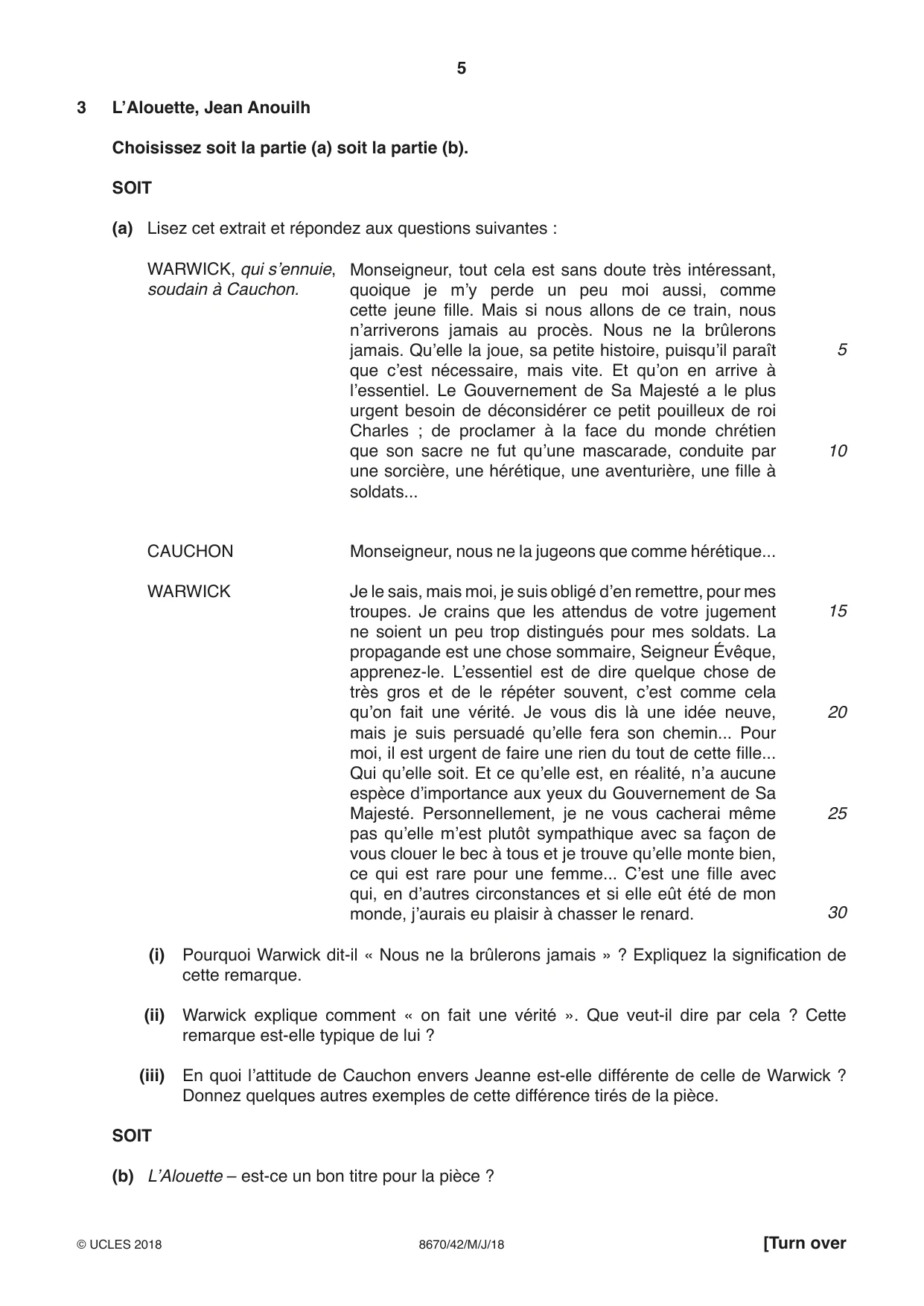
5 8670/42/M/J/18 © UCLES 2018 [Turn over 3 L’Alouette, Jean Anouilh Choisissez soit la partie (a) soit la partie (b). SOIT (a) Lisez cet extrait et répondez aux questions suivantes : WARWICK, qui s’ennuie, soudain à Cauchon. Monseigneur, tout cela est sans doute très intéressant, quoique je m’y perde un peu moi aussi, comme cette jeune fille. Mais si nous allons de ce train, nous n’arriverons jamais au procès. Nous ne la brûlerons jamais. Qu’elle la joue, sa petite histoire, puisqu’il paraît que c’est nécessaire, mais vite. Et qu’on en arrive à l’essentiel. Le Gouvernement de Sa Majesté a le plus urgent besoin de déconsidérer ce petit pouilleux de roi Charles ; de proclamer à la face du monde chrétien que son sacre ne fut qu’une mascarade, conduite par une sorcière, une hérétique, une aventurière, une fille à soldats... CAUCHON Monseigneur, nous ne la jugeons que comme hérétique... WARWICK Je le sais, mais moi, je suis obligé d’en remettre, pour mes troupes. Je crains que les attendus de votre jugement ne soient un peu trop distingués pour mes soldats. La propagande est une chose sommaire, Seigneur Évêque, apprenez-le. L’essentiel est de dire quelque chose de très gros et de le répéter souvent, c’est comme cela qu’on fait une vérité. Je vous dis là une idée neuve, mais je suis persuadé qu’elle fera son chemin... Pour moi, il est urgent de faire une rien du tout de cette fille... Qui qu’elle soit. Et ce qu’elle est, en réalité, n’a aucune espèce d’importance aux yeux du Gouvernement de Sa Majesté. Personnellement, je ne vous cacherai même pas qu’elle m’est plutôt sympathique avec sa façon de vous clouer le bec à tous et je trouve qu’elle monte bien, ce qui est rare pour une femme... C’est une fille avec qui, en d’autres circonstances et si elle eût été de mon monde, j’aurais eu plaisir à chasser le renard. (i) Pourquoi Warwick dit-il « Nous ne la brûlerons jamais » ? Expliquez la signification de cette remarque. (ii) Warwick explique comment « on fait une vérité ». Que veut-il dire par cela ? Cette remarque est-elle typique de lui ? (iii) En quoi l’attitude de Cauchon envers Jeanne est-elle différente de celle de Warwick ? Donnez quelques autres exemples de cette différence tirés de la pièce. SOIT (b) L’Alouette – est-ce un bon titre pour la pièce ? 5 10 15 20 25 30
Question paper, page 6
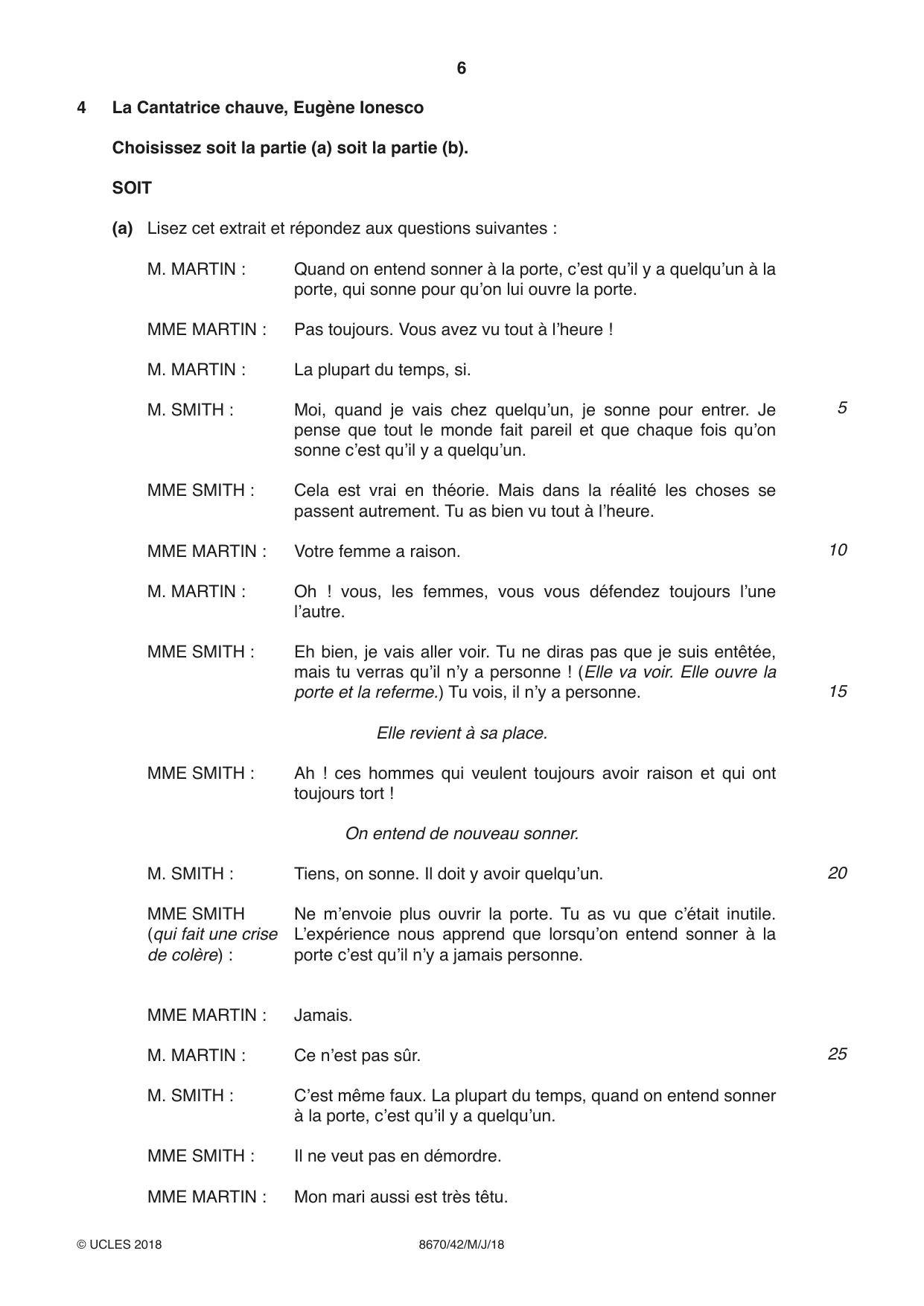
6 8670/42/M/J/18 © UCLES 2018 4 La Cantatrice chauve, Eugène Ionesco Choisissez soit la partie (a) soit la partie (b). SOIT (a) Lisez cet extrait et répondez aux questions suivantes : M. MARTIN : Quand on entend sonner à la porte, c’est qu’il y a quelqu’un à la porte, qui sonne pour qu’on lui ouvre la porte. MME MARTIN : Pas toujours. Vous avez vu tout à l’heure ! M. MARTIN : La plupart du temps, si. M. SMITH : Moi, quand je vais chez quelqu’un, je sonne pour entrer. Je pense que tout le monde fait pareil et que chaque fois qu’on sonne c’est qu’il y a quelqu’un. MME SMITH : Cela est vrai en théorie. Mais dans la réalité les choses se passent autrement. Tu as bien vu tout à l’heure. MME MARTIN : Votre femme a raison. M. MARTIN : Oh ! vous, les femmes, vous vous défendez toujours l’une l’autre. MME SMITH : Eh bien, je vais aller voir. Tu ne diras pas que je suis entêtée, mais tu verras qu’il n’y a personne ! (Elle va voir. Elle ouvre la porte et la referme.) Tu vois, il n’y a personne. Elle revient à sa place. MME SMITH : Ah ! ces hommes qui veulent toujours avoir raison et qui ont toujours tort ! On entend de nouveau sonner. M. SMITH : Tiens, on sonne. Il doit y avoir quelqu’un. MME SMITH (qui fait une crise de colère) : Ne m’envoie plus ouvrir la porte. Tu as vu que c’était inutile. L’expérience nous apprend que lorsqu’on entend sonner à la porte c’est qu’il n’y a jamais personne. MME MARTIN : Jamais. M. MARTIN : Ce n’est pas sûr. M. SMITH : C’est même faux. La plupart du temps, quand on entend sonner à la porte, c’est qu’il y a quelqu’un. MME SMITH : Il ne veut pas en démordre. MME MARTIN : Mon mari aussi est très têtu. 5 10 15 20 25
Question paper, page 7
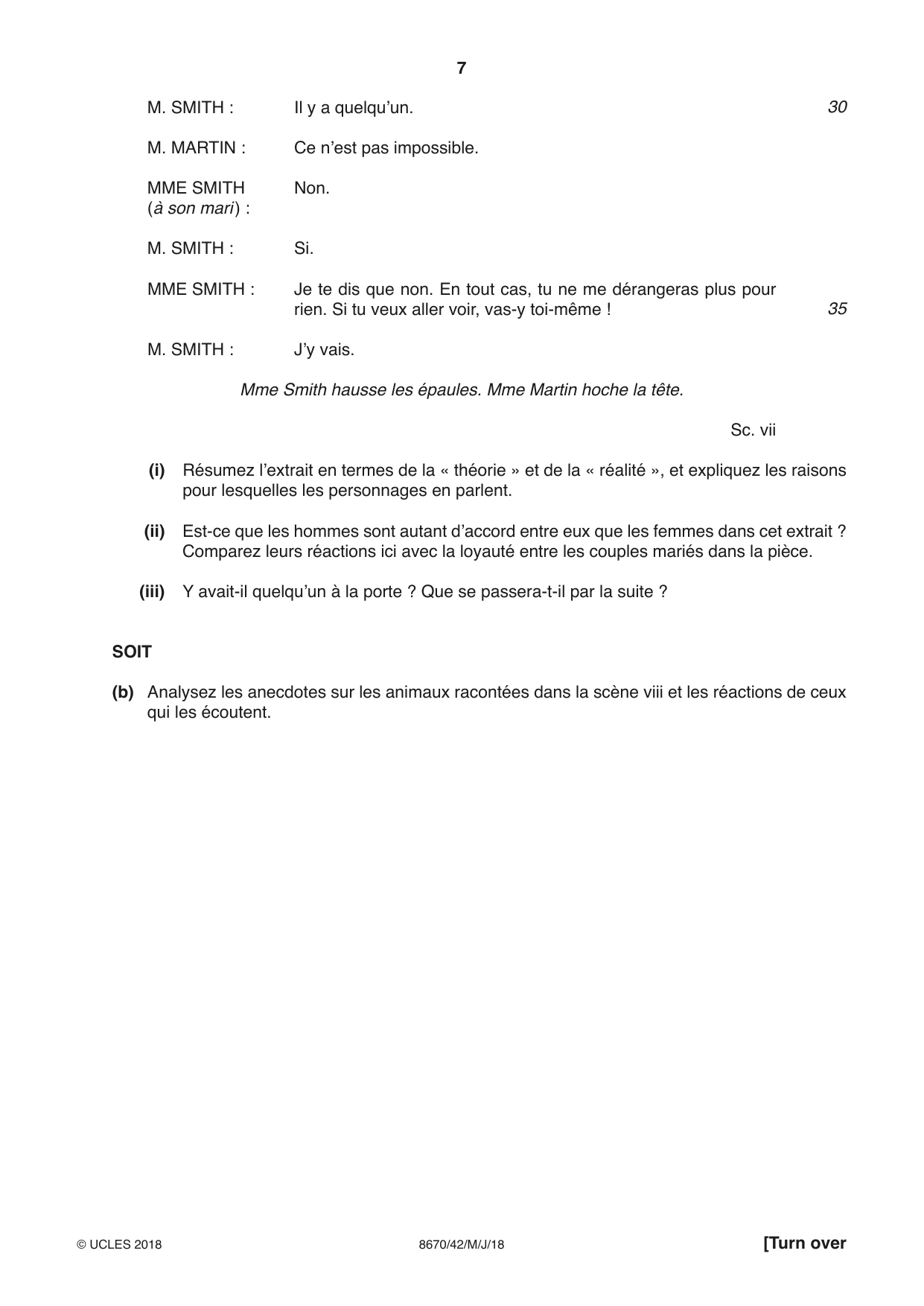
7 8670/42/M/J/18 © UCLES 2018 [Turn over M. SMITH : Il y a quelqu’un. M. MARTIN : Ce n’est pas impossible. MME SMITH (à son mari ) : Non. M. SMITH : Si. MME SMITH : Je te dis que non. En tout cas, tu ne me dérangeras plus pour rien. Si tu veux aller voir, vas-y toi-même ! M. SMITH : J’y vais. Mme Smith hausse les épaules. Mme Martin hoche la tête. Sc. vii (i) Résumez l’extrait en termes de la « théorie » et de la « réalité », et expliquez les raisons pour lesquelles les personnages en parlent. (ii) Est-ce que les hommes sont autant d’accord entre eux que les femmes dans cet extrait ? Comparez leurs réactions ici avec la loyauté entre les couples mariés dans la pièce. (iii) Y avait-il quelqu’un à la porte ? Que se passera-t-il par la suite ? SOIT (b) Analysez les anecdotes sur les animaux racontées dans la scène viii et les réactions de ceux qui les écoutent. 30 35
Question paper, page 8
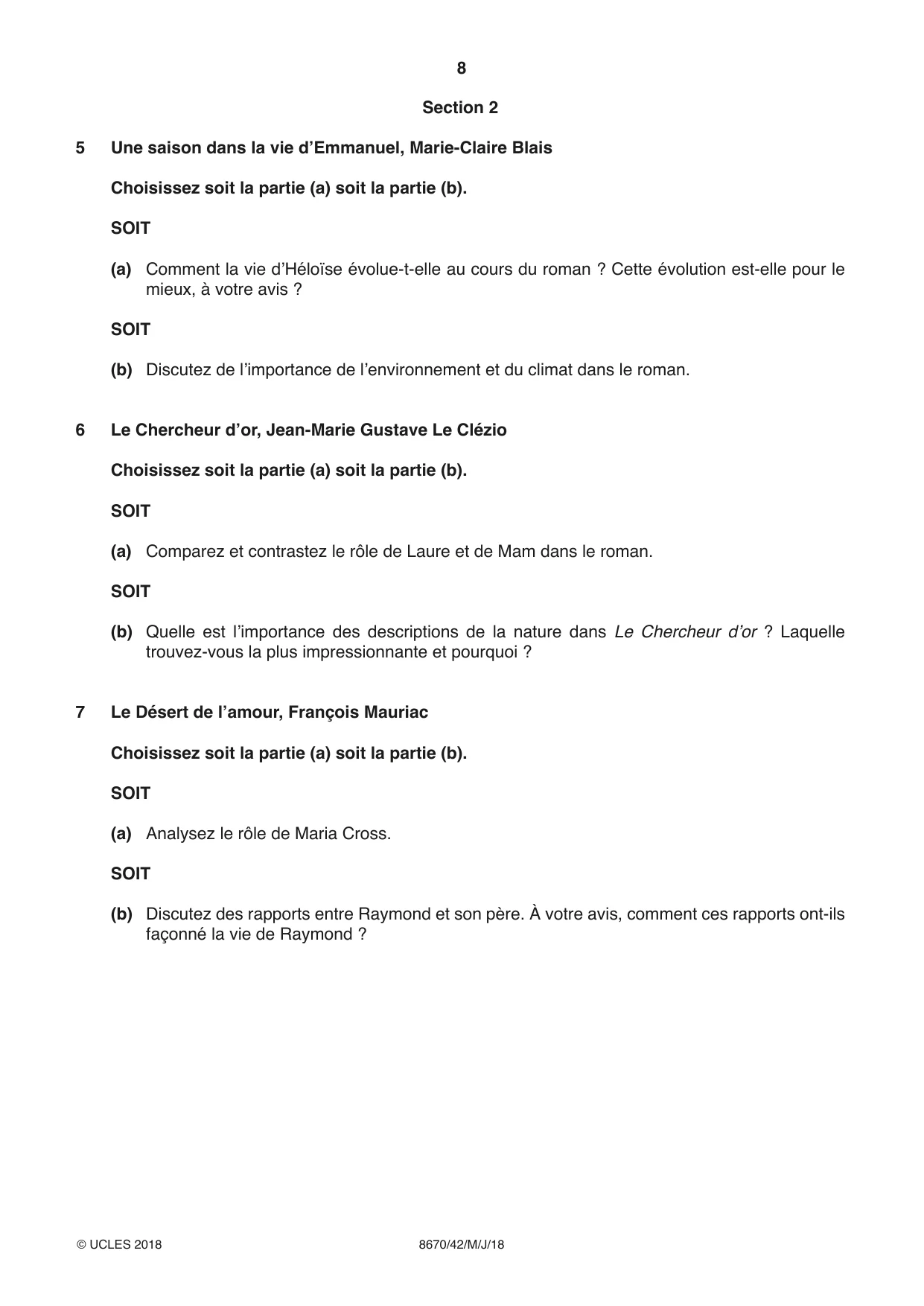
8 8670/42/M/J/18 © UCLES 2018 Section 2 5 Une saison dans la vie d’Emmanuel, Marie-Claire Blais Choisissez soit la partie (a) soit la partie (b). SOIT (a) Comment la vie d’Héloïse évolue-t-elle au cours du roman ? Cette évolution est-elle pour le mieux, à votre avis ? SOIT (b) Discutez de l’importance de l’environnement et du climat dans le roman. 6 Le Chercheur d’or, Jean-Marie Gustave Le Clézio Choisissez soit la partie (a) soit la partie (b). SOIT (a) Comparez et contrastez le rôle de Laure et de Mam dans le roman. SOIT (b) Quelle est l’importance des descriptions de la nature dans Le Chercheur d’or ? Laquelle trouvez-vous la plus impressionnante et pourquoi ? 7 Le Désert de l’amour, François Mauriac Choisissez soit la partie (a) soit la partie (b). SOIT (a) Analysez le rôle de Maria Cross. SOIT (b) Discutez des rapports entre Raymond et son père. À votre avis, comment ces rapports ont-ils façonné la vie de Raymond ?
Question paper, page 9
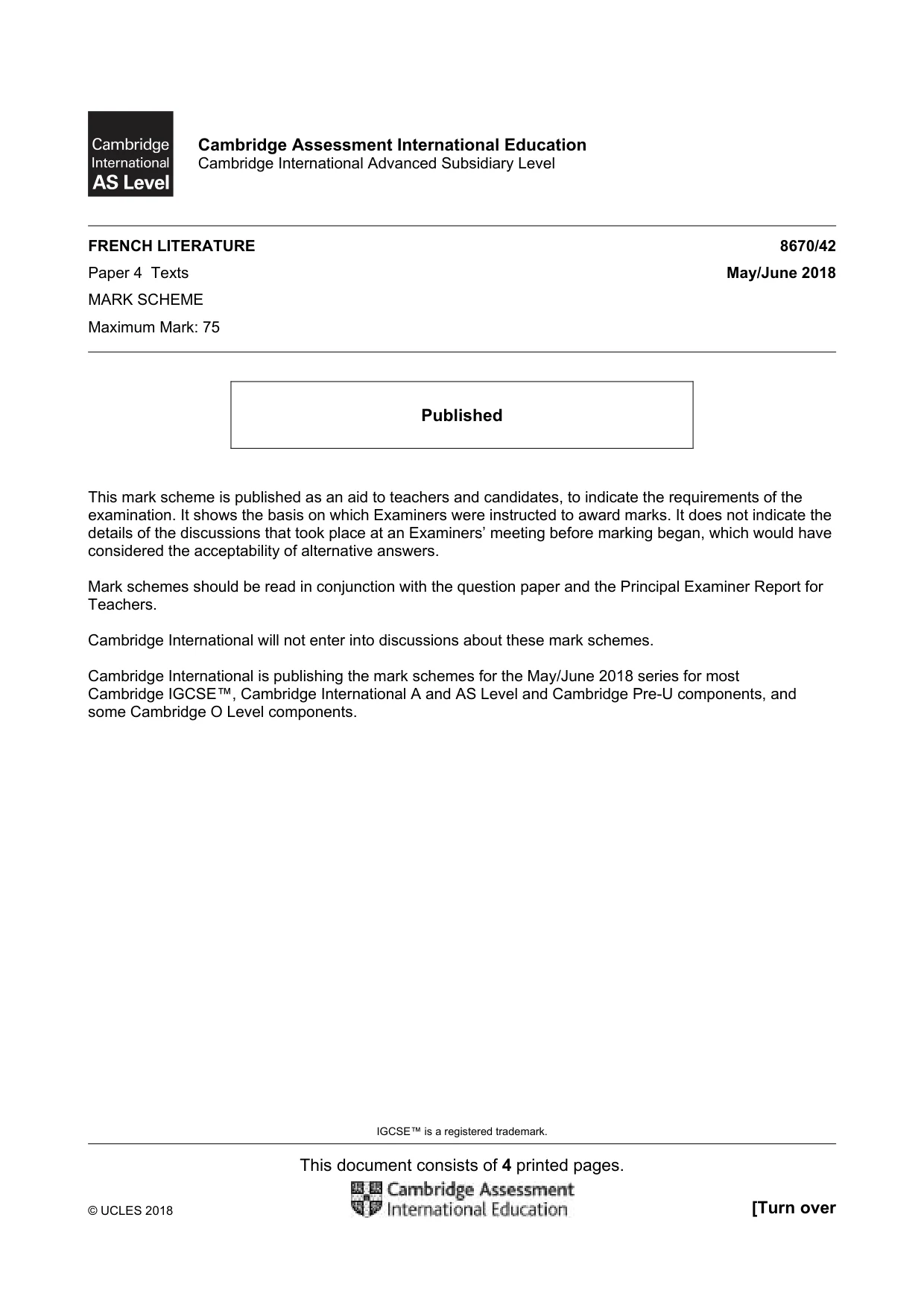
9 8670/42/M/J/18 © UCLES 2018 8 Tempête en juin (from Suite Française), Irène Némirovsky Choisissez soit la partie (a) soit la partie (b). SOIT (a) « L’évasion d’Hubert ... était un acte irréfléchi, indiscipliné, mais digne d’un homme ». Commentez la réflexion de Mme Péricand. Partagez-vous son point de vue ? SOIT (b) Dans quelle mesure les personnages sont-ils isolés au cours de leur fuite de Paris ?
Question paper, page 10
10 8670/42/M/J/18 © UCLES 2018 BLANK PAGE
Question paper, page 11
11 8670/42/M/J/18 © UCLES 2018 BLANK PAGE
Question paper, page 12
12 8670/42/M/J/18 © UCLES 2018 Permission to reproduce items where third-party owned material protected by copyright is included has been sought and cleared where possible. Every reasonable effort has been made by the publisher (UCLES) to trace copyright holders, but if any items requiring clearance have unwittingly been included, the publisher will be pleased to make amends at the earliest possible opportunity. To avoid the issue of disclosure of answer-related information to candidates, all copyright acknowledgements are reproduced online in the Cambridge International Examinations Copyright Acknowledgements Booklet. This is produced for each series of examinations and is freely available to download at www.cie.org.uk after the live examination series. Cambridge International Examinations is part of the Cambridge Assessment Group. Cambridge Assessment is the brand name of University of Cambridge Local Examinations Syndicate (UCLES), which is itself a department of the University of Cambridge. BLANK PAGE
Mark scheme, page 1
IGCSE™ is a registered trademark. This document consists of 4 printed pages. © UCLES 2018 [Turn over Cambridge Assessment International Education Cambridge International Advanced Subsidiary Level FRENCH LITERATURE 8670/42 Paper 4 Texts May/June 2018 MARK SCHEME Maximum Mark: 75 Published This mark scheme is published as an aid to teachers and candidates, to indicate the requirements of the examination. It shows the basis on which Examiners were instructed to award marks. It does not indicate the details of the discussions that took place at an Examiners’ meeting before marking began, which would have considered the acceptability of alternative answers. Mark schemes should be read in conjunction with the question paper and the Principal Examiner Report for Teachers. Cambridge International will not enter into discussions about these mark schemes. Cambridge International is publishing the mark schemes for the May/June 2018 series for most Cambridge IGCSE™, Cambridge International A and AS Level and Cambridge Pre-U components, and some Cambridge O Level components.
Mark scheme, page 2
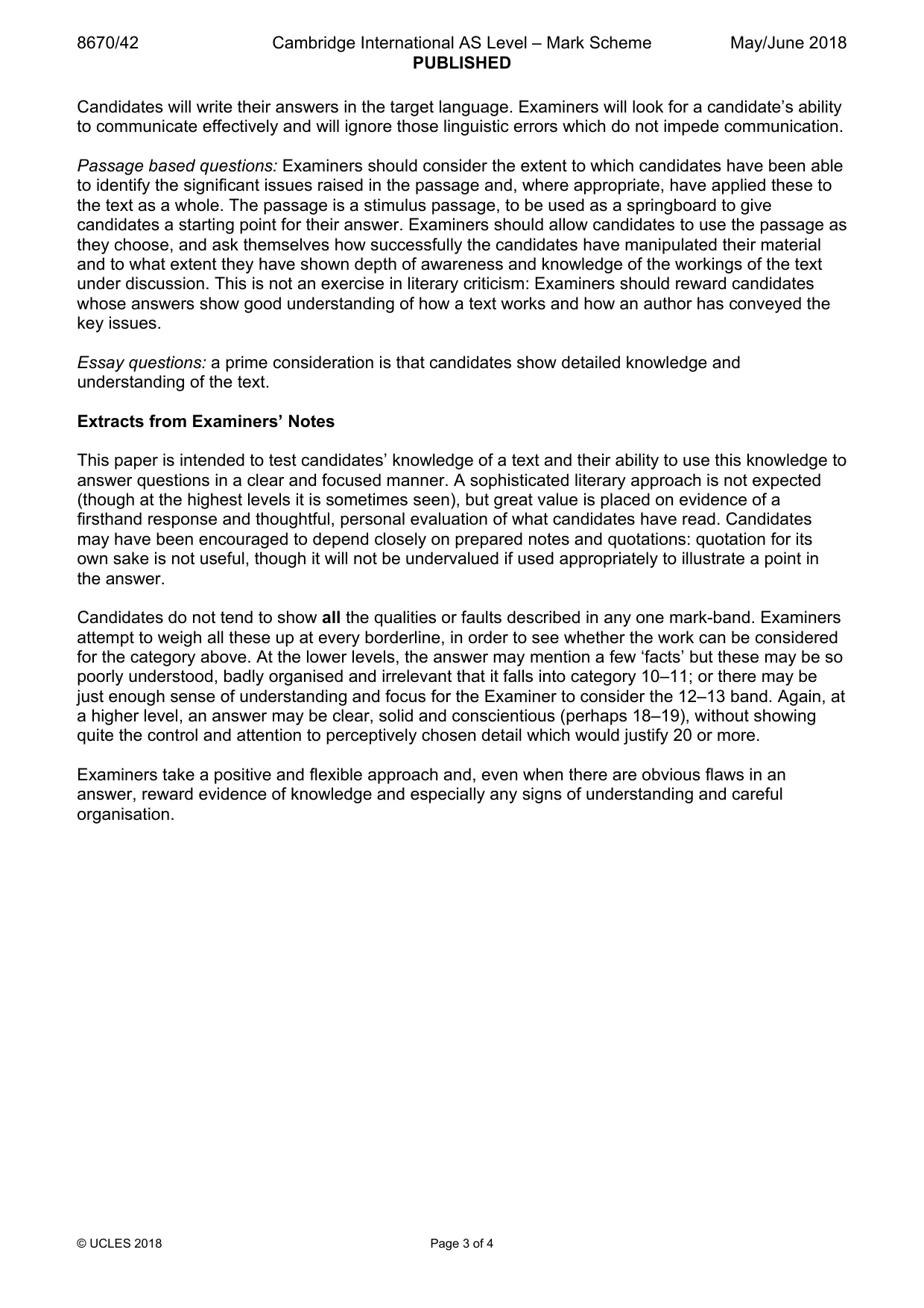
8670/42 Cambridge International AS Level – Mark Scheme PUBLISHED May/June 2018 © UCLES 2018 Page 2 of 4 Generic Marking Principles These general marking principles must be applied by all examiners when marking candidate answers. They should be applied alongside the specific content of the mark scheme or generic level descriptors for a question. Each question paper and mark scheme will also comply with these marking principles. GENERIC MARKING PRINCIPLE 1: Marks must be awarded in line with: • the specific content of the mark scheme or the generic level descriptors for the question • the specific skills defined in the mark scheme or in the generic level descriptors for the question • the standard of response required by a candidate as exemplified by the standardisation scripts. GENERIC MARKING PRINCIPLE 2: Marks awarded are always whole marks (not half marks, or other fractions). GENERIC MARKING PRINCIPLE 3: Marks must be awarded positively: • marks are awarded for correct/valid answers, as defined in the mark scheme. However, credit is given for valid answers which go beyond the scope of the syllabus and mark scheme, referring to your Team Leader as appropriate • marks are awarded when candidates clearly demonstrate what they know and can do • marks are not deducted for errors • marks are not deducted for omissions • answers should only be judged on the quality of spelling, punctuation and grammar when these features are specifically assessed by the question as indicated by the mark scheme. The meaning, however, should be unambiguous. GENERIC MARKING PRINCIPLE 4: Rules must be applied consistently e.g. in situations where candidates have not followed instructions or in the application of generic level descriptors. GENERIC MARKING PRINCIPLE 5: Marks should be awarded using the full range of marks defined in the mark scheme for the question (however; the use of the full mark range may be limited according to the quality of the candidate responses seen). GENERIC MARKING PRINCIPLE 6: Marks awarded are based solely on the requirements as defined in the mark scheme. Marks should not be awarded with grade thresholds or grade descriptors in mind.
Mark scheme, page 3
8670/42 Cambridge International AS Level – Mark Scheme PUBLISHED May/June 2018 © UCLES 2018 Page 3 of 4 Candidates will write their answers in the target language. Examiners will look for a candidate’s ability to communicate effectively and will ignore those linguistic errors which do not impede communication. Passage based questions: Examiners should consider the extent to which candidates have been able to identify the significant issues raised in the passage and, where appropriate, have applied these to the text as a whole. The passage is a stimulus passage, to be used as a springboard to give candidates a starting point for their answer. Examiners should allow candidates to use the passage as they choose, and ask themselves how successfully the candidates have manipulated their material and to what extent they have shown depth of awareness and knowledge of the workings of the text under discussion. This is not an exercise in literary criticism: Examiners should reward candidates whose answers show good understanding of how a text works and how an author has conveyed the key issues. Essay questions: a prime consideration is that candidates show detailed knowledge and understanding of the text. Extracts from Examiners’ Notes This paper is intended to test candidates’ knowledge of a text and their ability to use this knowledge to answer questions in a clear and focused manner. A sophisticated literary approach is not expected (though at the highest levels it is sometimes seen), but great value is placed on evidence of a firsthand response and thoughtful, personal evaluation of what candidates have read. Candidates may have been encouraged to depend closely on prepared notes and quotations: quotation for its own sake is not useful, though it will not be undervalued if used appropriately to illustrate a point in the answer. Candidates do not tend to show all the qualities or faults described in any one mark-band. Examiners attempt to weigh all these up at every borderline, in order to see whether the work can be considered for the category above. At the lower levels, the answer may mention a few ‘facts’ but these may be so poorly understood, badly organised and irrelevant that it falls into category 10–11; or there may be just enough sense of understanding and focus for the Examiner to consider the 12–13 band. Again, at a higher level, an answer may be clear, solid and conscientious (perhaps 18–19), without showing quite the control and attention to perceptively chosen detail which would justify 20 or more. Examiners take a positive and flexible approach and, even when there are obvious flaws in an answer, reward evidence of knowledge and especially any signs of understanding and careful organisation.
Mark scheme, page 4
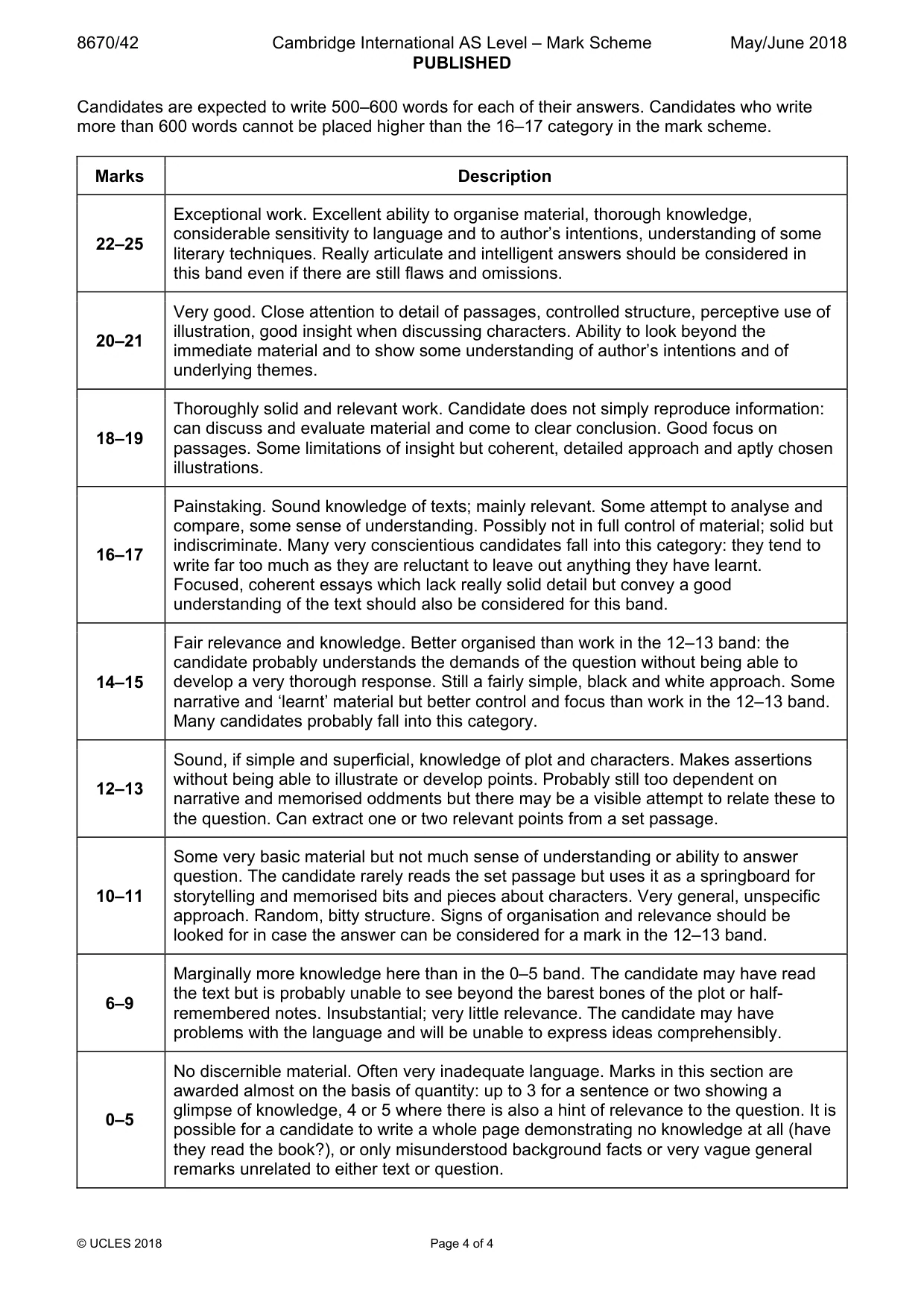
8670/42 Cambridge International AS Level – Mark Scheme PUBLISHED May/June 2018 © UCLES 2018 Page 4 of 4 Candidates are expected to write 500–600 words for each of their answers. Candidates who write more than 600 words cannot be placed higher than the 16–17 category in the mark scheme. Marks Description 22–25 Exceptional work. Excellent ability to organise material, thorough knowledge, considerable sensitivity to language and to author’s intentions, understanding of some literary techniques. Really articulate and intelligent answers should be considered in this band even if there are still flaws and omissions. 20–21 Very good. Close attention to detail of passages, controlled structure, perceptive use of illustration, good insight when discussing characters. Ability to look beyond the immediate material and to show some understanding of author’s intentions and of underlying themes. 18–19 Thoroughly solid and relevant work. Candidate does not simply reproduce information: can discuss and evaluate material and come to clear conclusion. Good focus on passages. Some limitations of insight but coherent, detailed approach and aptly chosen illustrations. 16–17 Painstaking. Sound knowledge of texts; mainly relevant. Some attempt to analyse and compare, some sense of understanding. Possibly not in full control of material; solid but indiscriminate. Many very conscientious candidates fall into this category: they tend to write far too much as they are reluctant to leave out anything they have learnt. Focused, coherent essays which lack really solid detail but convey a good understanding of the text should also be considered for this band. 14–15 Fair relevance and knowledge. Better organised than work in the 12–13 band: the candidate probably understands the demands of the question without being able to develop a very thorough response. Still a fairly simple, black and white approach. Some narrative and ‘learnt’ material but better control and focus than work in the 12–13 band. Many candidates probably fall into this category. 12–13 Sound, if simple and superficial, knowledge of plot and characters. Makes assertions without being able to illustrate or develop points. Probably still too dependent on narrative and memorised oddments but there may be a visible attempt to relate these to the question. Can extract one or two relevant points from a set passage. 10–11 Some very basic material but not much sense of understanding or ability to answer question. The candidate rarely reads the set passage but uses it as a springboard for storytelling and memorised bits and pieces about characters. Very general, unspecific approach. Random, bitty structure. Signs of organisation and relevance should be looked for in case the answer can be considered for a mark in the 12–13 band. 6–9 Marginally more knowledge here than in the 0–5 band. The candidate may have read the text but is probably unable to see beyond the barest bones of the plot or half- remembered notes. Insubstantial; very little relevance. The candidate may have problems with the language and will be unable to express ideas comprehensibly. 0–5 No discernible material. Often very inadequate language. Marks in this section are awarded almost on the basis of quantity: up to 3 for a sentence or two showing a glimpse of knowledge, 4 or 5 where there is also a hint of relevance to the question. It is possible for a candidate to write a whole page demonstrating no knowledge at all (have they read the book?), or only misunderstood background facts or very vague general remarks unrelated to either text or question.
What you needed in this session
Cambridge’s own grade thresholds for 2018 May/June, Paper 4 · Variant 2. A higher threshold means an easier paper — the bar moves with how the cohort did.