Cambridge A Level French - Literature (AS Level only) 8670 — 2014 Oct/Nov Paper 4 · Variant 2
8670/42/O/N/14 · 75 marks · ≈84 min
The question paper and its mark scheme, free to read here and free to download. This is Cambridge’s own paper, exactly as it was sat.
Question paper8 pages

Mark scheme3 pages
Answers below. Sit the paper first if you are practising.
Paper as text
Question paper, page 1
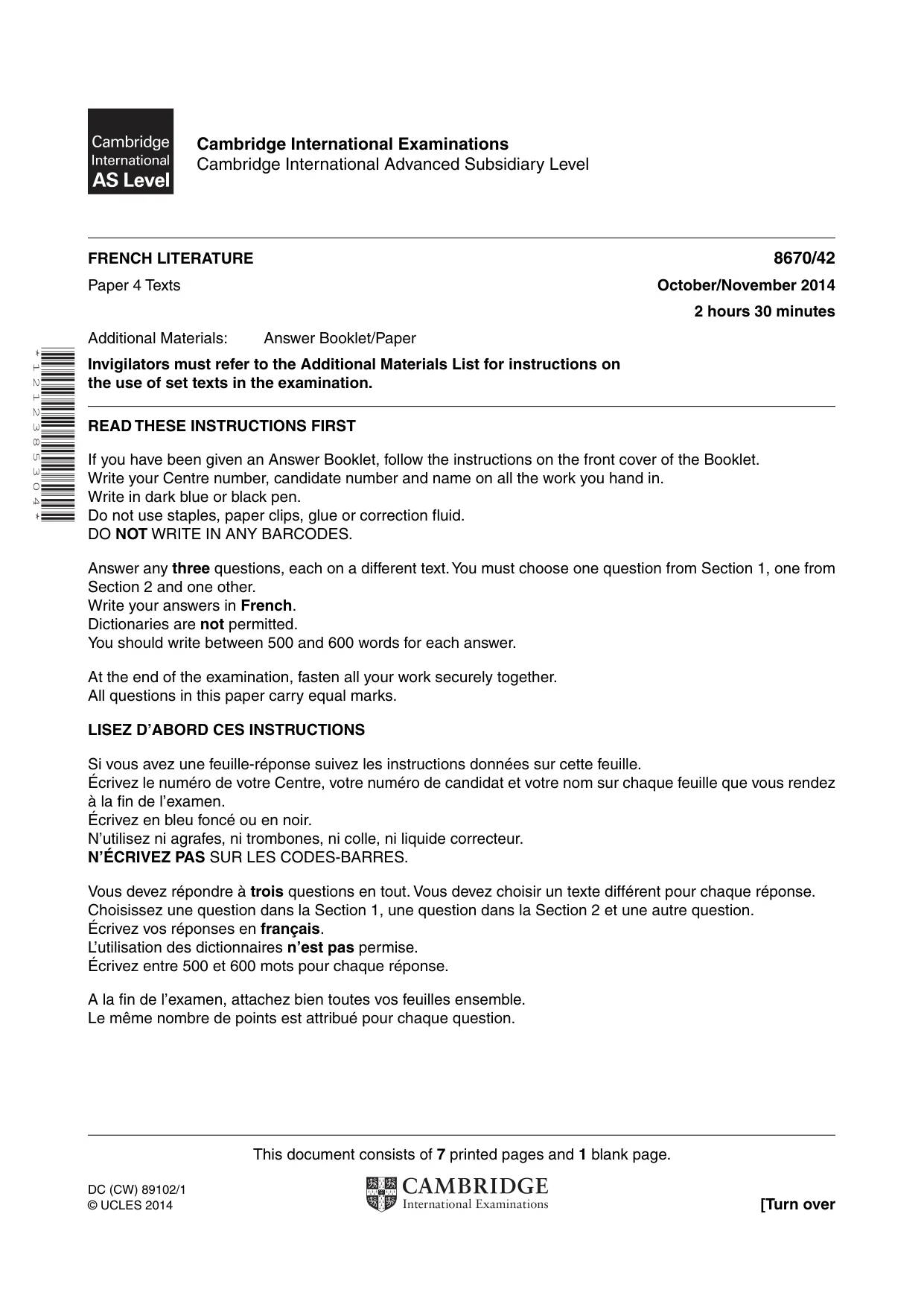
This document consists of 7 printed pages and 1 blank page. DC (CW) 89102/1 © UCLES 2014 [Turn over Cambridge International Examinations Cambridge International Advanced Subsidiary Level * 1 2 1 2 3 8 5 3 0 4 * FRENCH LITERATURE 8670/42 Paper 4 Texts October/November 2014 2 hours 30 minutes Additional Materials: Answer Booklet/Paper Invigilators must refer to the Additional Materials List for instructions on the use of set texts in the examination. READ THESE INSTRUCTIONS FIRST If you have been given an Answer Booklet, follow the instructions on the front cover of the Booklet. Write your Centre number, candidate number and name on all the work you hand in. Write in dark blue or black pen. Do not use staples, paper clips, glue or correction fluid. DO NOT WRITE IN ANY BARCODES. Answer any three questions, each on a different text. You must choose one question from Section 1, one from Section 2 and one other. Write your answers in French. Dictionaries are not permitted. You should write between 500 and 600 words for each answer. At the end of the examination, fasten all your work securely together. All questions in this paper carry equal marks. LISEZ D’ABORD CES INSTRUCTIONS Si vous avez une feuille-réponse suivez les instructions données sur cette feuille. Écrivez le numéro de votre Centre, votre numéro de candidat et votre nom sur chaque feuille que vous rendez à la fin de l’examen. Écrivez en bleu foncé ou en noir. N’utilisez ni agrafes, ni trombones, ni colle, ni liquide correcteur. N’ÉCRIVEZ PAS SUR LES CODES-BARRES. Vous devez répondre à trois questions en tout. Vous devez choisir un texte différent pour chaque réponse. Choisissez une question dans la Section 1, une question dans la Section 2 et une autre question. Écrivez vos réponses en français. L’utilisation des dictionnaires n’est pas permise. Écrivez entre 500 et 600 mots pour chaque réponse. A la fin de l’examen, attachez bien toutes vos feuilles ensemble. Le même nombre de points est attribué pour chaque question.
Question paper, page 2
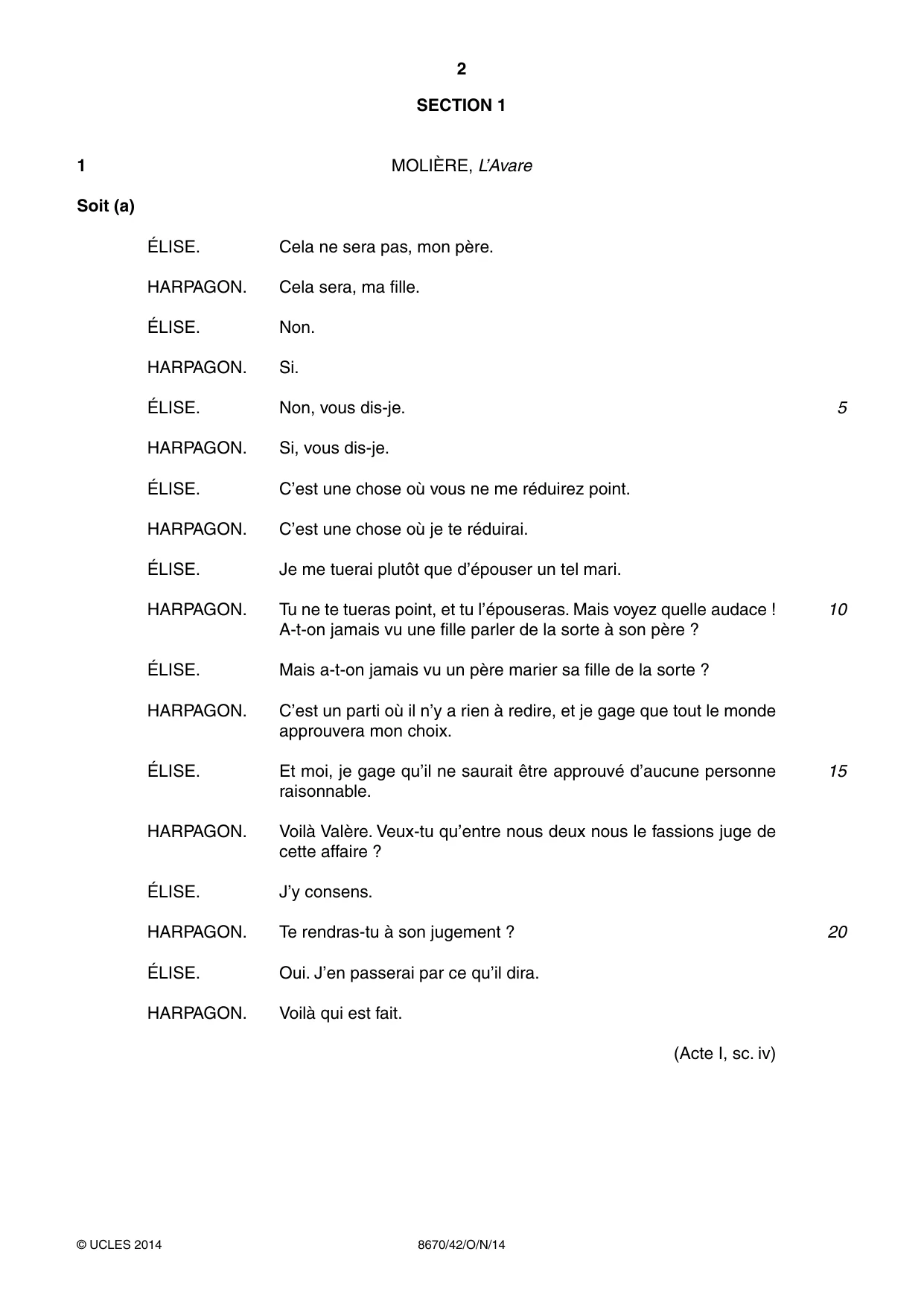
2 8670/42/O/N/14 © UCLES 2014 SECTION 1 1 MOLIÈRE, L’Avare Soit (a) ÉLISE. Cela ne sera pas, mon père. HARPAGON. Cela sera, ma fille. ÉLISE. Non. HARPAGON. Si. ÉLISE. Non, vous dis-je. HARPAGON. Si, vous dis-je. ÉLISE. C’est une chose où vous ne me réduirez point. HARPAGON. C’est une chose où je te réduirai. ÉLISE. Je me tuerai plutôt que d’épouser un tel mari. HARPAGON. Tu ne te tueras point, et tu l’épouseras. Mais voyez quelle audace ! A-t-on jamais vu une fille parler de la sorte à son père ? ÉLISE. Mais a-t-on jamais vu un père marier sa fille de la sorte ? HARPAGON. C’est un parti où il n’y a rien à redire, et je gage que tout le monde approuvera mon choix. ÉLISE. Et moi, je gage qu’il ne saurait être approuvé d’aucune personne raisonnable. HARPAGON. Voilà Valère. Veux-tu qu’entre nous deux nous le fassions juge de cette affaire ? ÉLISE. J’y consens. HARPAGON. Te rendras-tu à son jugement ? ÉLISE. Oui. J’en passerai par ce qu’il dira. HARPAGON. Voilà qui est fait. (Acte I, sc. iv) 5 10 15 20
Question paper, page 3
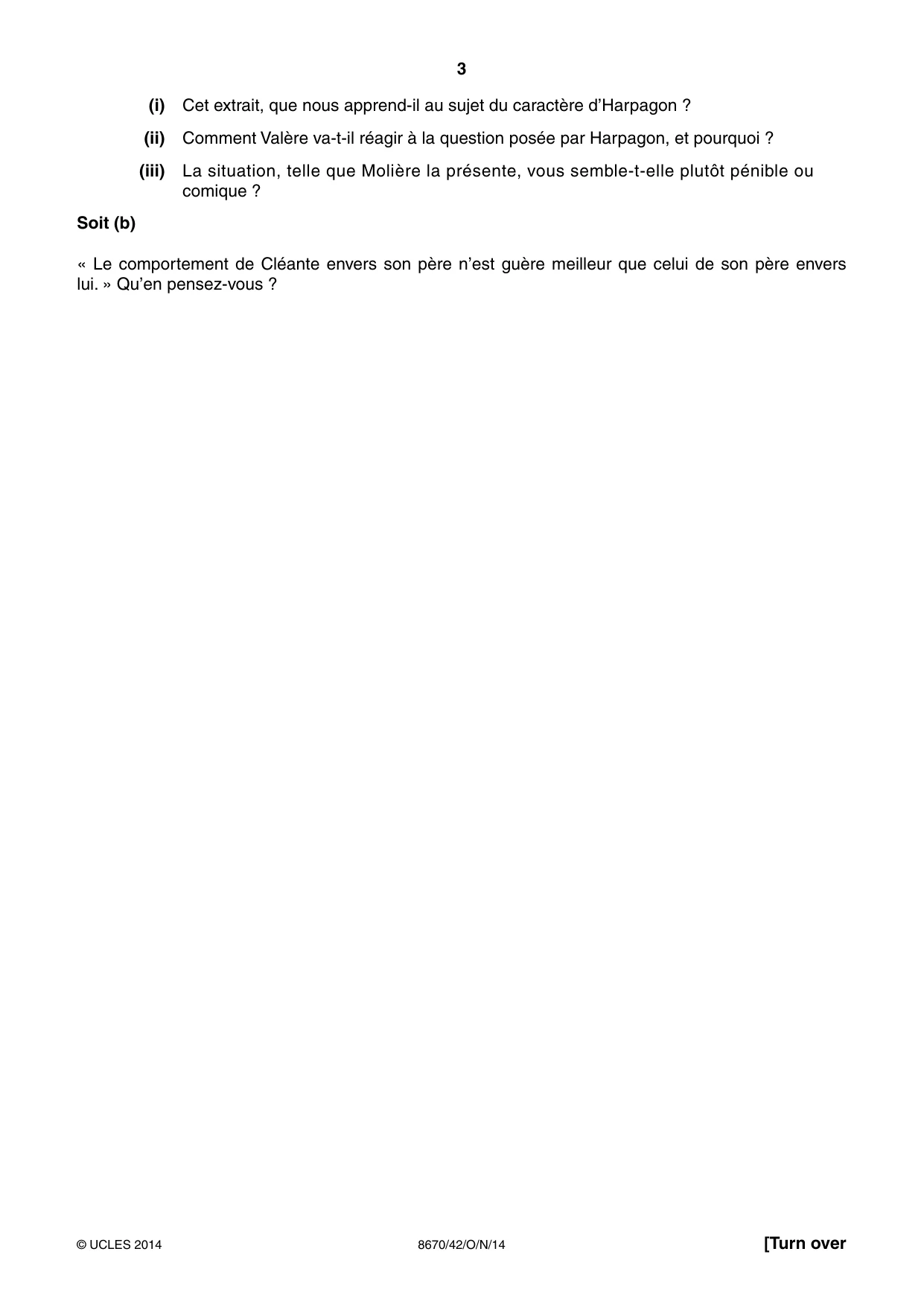
3 8670/42/O/N/14 © UCLES 2014 [Turn over (i) Cet extrait, que nous apprend-il au sujet du caractère d’Harpagon ? (ii) Comment Valère va-t-il réagir à la question posée par Harpagon, et pourquoi ? (iii) La situation, telle que Molière la présente, vous semble-t-elle plutôt pénible ou comique ? Soit (b) « Le comportement de Cléante envers son père n’est guère meilleur que celui de son père envers lui. » Qu’en pensez-vous ?
Question paper, page 4
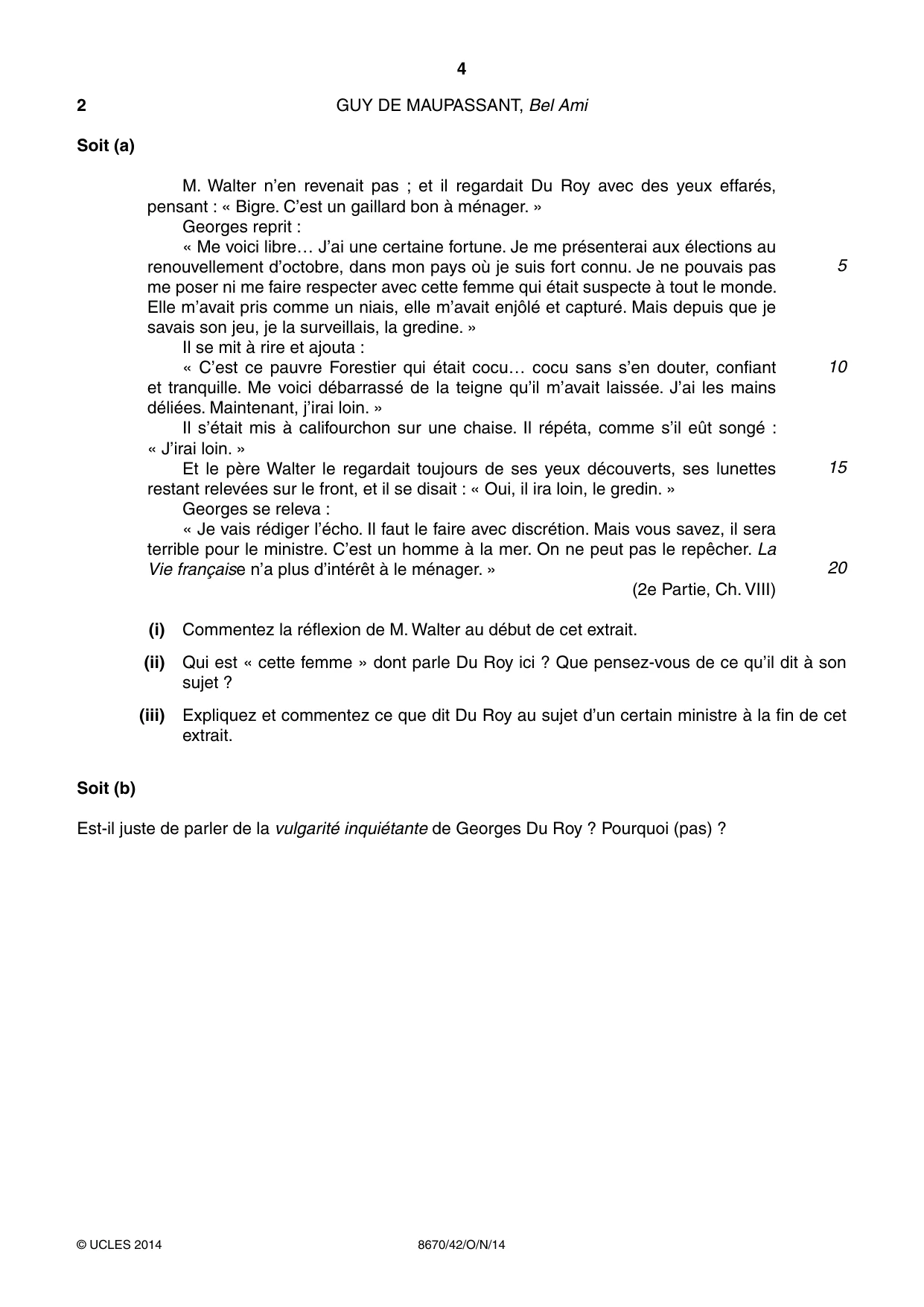
4 8670/42/O/N/14 © UCLES 2014 2 GUY DE MAUPASSANT, Bel Ami Soit (a) M. Walter n’en revenait pas ; et il regardait Du Roy avec des yeux effarés, pensant : « Bigre. C’est un gaillard bon à ménager. » Georges reprit : « Me voici libre… J’ai une certaine fortune. Je me présenterai aux élections au renouvellement d’octobre, dans mon pays où je suis fort connu. Je ne pouvais pas me poser ni me faire respecter avec cette femme qui était suspecte à tout le monde. Elle m’avait pris comme un niais, elle m’avait enjôlé et capturé. Mais depuis que je savais son jeu, je la surveillais, la gredine. » Il se mit à rire et ajouta : « C’est ce pauvre Forestier qui était cocu… cocu sans s’en douter, confiant et tranquille. Me voici débarrassé de la teigne qu’il m’avait laissée. J’ai les mains déliées. Maintenant, j’irai loin. » Il s’était mis à califourchon sur une chaise. Il répéta, comme s’il eût songé : « J’irai loin. » Et le père Walter le regardait toujours de ses yeux découverts, ses lunettes restant relevées sur le front, et il se disait : « Oui, il ira loin, le gredin. » Georges se releva : « Je vais rédiger l’écho. Il faut le faire avec discrétion. Mais vous savez, il sera terrible pour le ministre. C’est un homme à la mer. On ne peut pas le repêcher. La Vie française n’a plus d’intérêt à le ménager. » (2e Partie, Ch. VIII) (i) Commentez la réflexion de M. Walter au début de cet extrait. (ii) Qui est « cette femme » dont parle Du Roy ici ? Que pensez-vous de ce qu’il dit à son sujet ? (iii) Expliquez et commentez ce que dit Du Roy au sujet d’un certain ministre à la fin de cet extrait. Soit (b) Est-il juste de parler de la vulgarité inquiétante de Georges Du Roy ? Pourquoi (pas) ? 5 10 15 20
Question paper, page 5
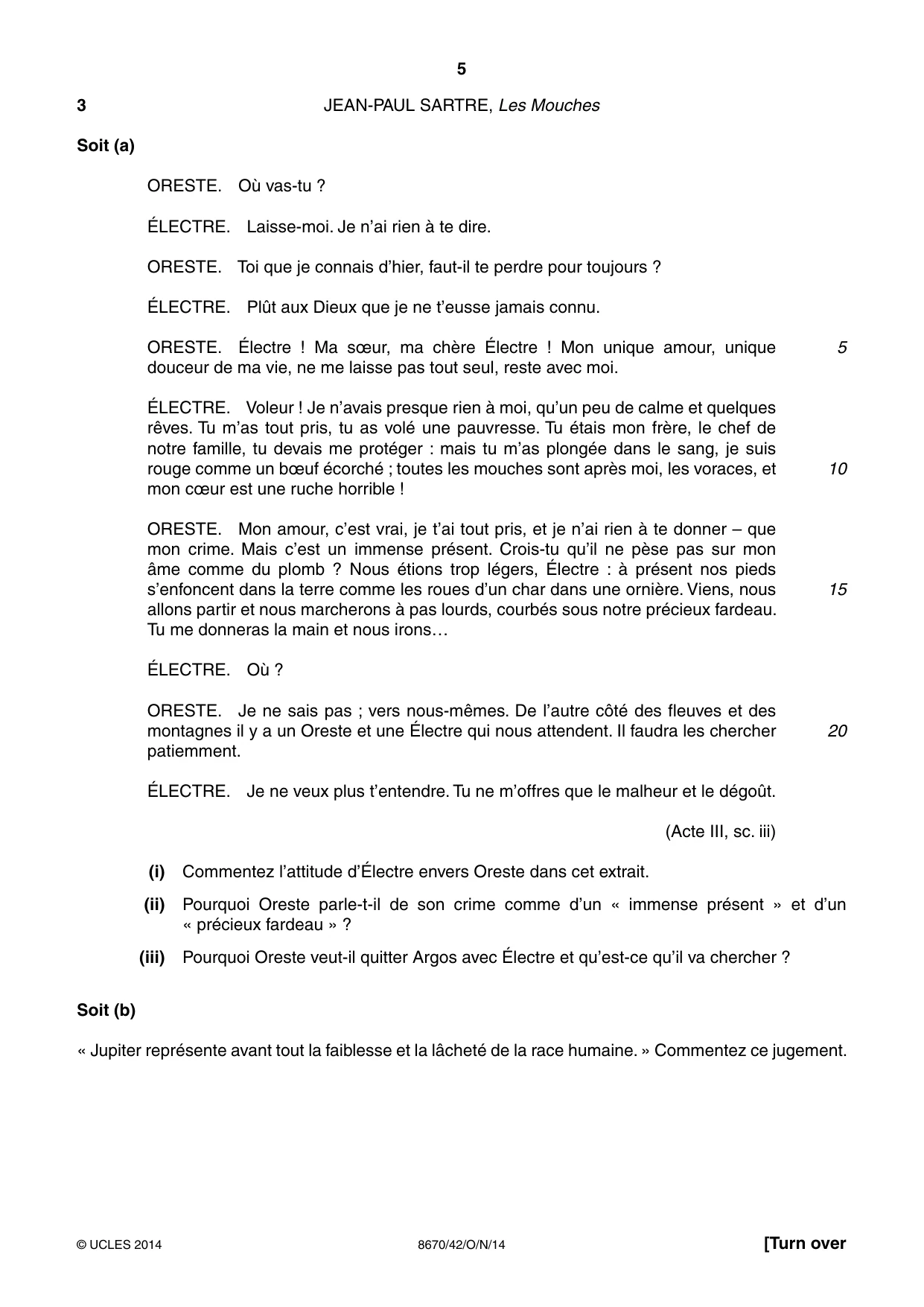
5 8670/42/O/N/14 © UCLES 2014 [Turn over 3 JEAN-PAUL SARTRE, Les Mouches Soit (a) ORESTE. Où vas-tu ? ÉLECTRE. Laisse-moi. Je n’ai rien à te dire. ORESTE. Toi que je connais d’hier, faut-il te perdre pour toujours ? ÉLECTRE. Plût aux Dieux que je ne t’eusse jamais connu. ORESTE. Électre ! Ma sœur, ma chère Électre ! Mon unique amour, unique douceur de ma vie, ne me laisse pas tout seul, reste avec moi. ÉLECTRE. Voleur ! Je n’avais presque rien à moi, qu’un peu de calme et quelques rêves. Tu m’as tout pris, tu as volé une pauvresse. Tu étais mon frère, le chef de notre famille, tu devais me protéger : mais tu m’as plongée dans le sang, je suis rouge comme un bœuf écorché ; toutes les mouches sont après moi, les voraces, et mon cœur est une ruche horrible ! ORESTE. Mon amour, c’est vrai, je t’ai tout pris, et je n’ai rien à te donner – que mon crime. Mais c’est un immense présent. Crois-tu qu’il ne pèse pas sur mon âme comme du plomb ? Nous étions trop légers, Électre : à présent nos pieds s’enfoncent dans la terre comme les roues d’un char dans une ornière. Viens, nous allons partir et nous marcherons à pas lourds, courbés sous notre précieux fardeau. Tu me donneras la main et nous irons… ÉLECTRE. Où ? ORESTE. Je ne sais pas ; vers nous-mêmes. De l’autre côté des fleuves et des montagnes il y a un Oreste et une Électre qui nous attendent. Il faudra les chercher patiemment. ÉLECTRE. Je ne veux plus t’entendre. Tu ne m’offres que le malheur et le dégoût. (Acte III, sc. iii) (i) Commentez l’attitude d’Électre envers Oreste dans cet extrait. (ii) Pourquoi Oreste parle-t-il de son crime comme d’un « immense présent » et d’un « précieux fardeau » ? (iii) Pourquoi Oreste veut-il quitter Argos avec Électre et qu’est-ce qu’il va chercher ? Soit (b) « Jupiter représente avant tout la faiblesse et la lâcheté de la race humaine. » Commentez ce jugement. 5 10 15 20
Question paper, page 6
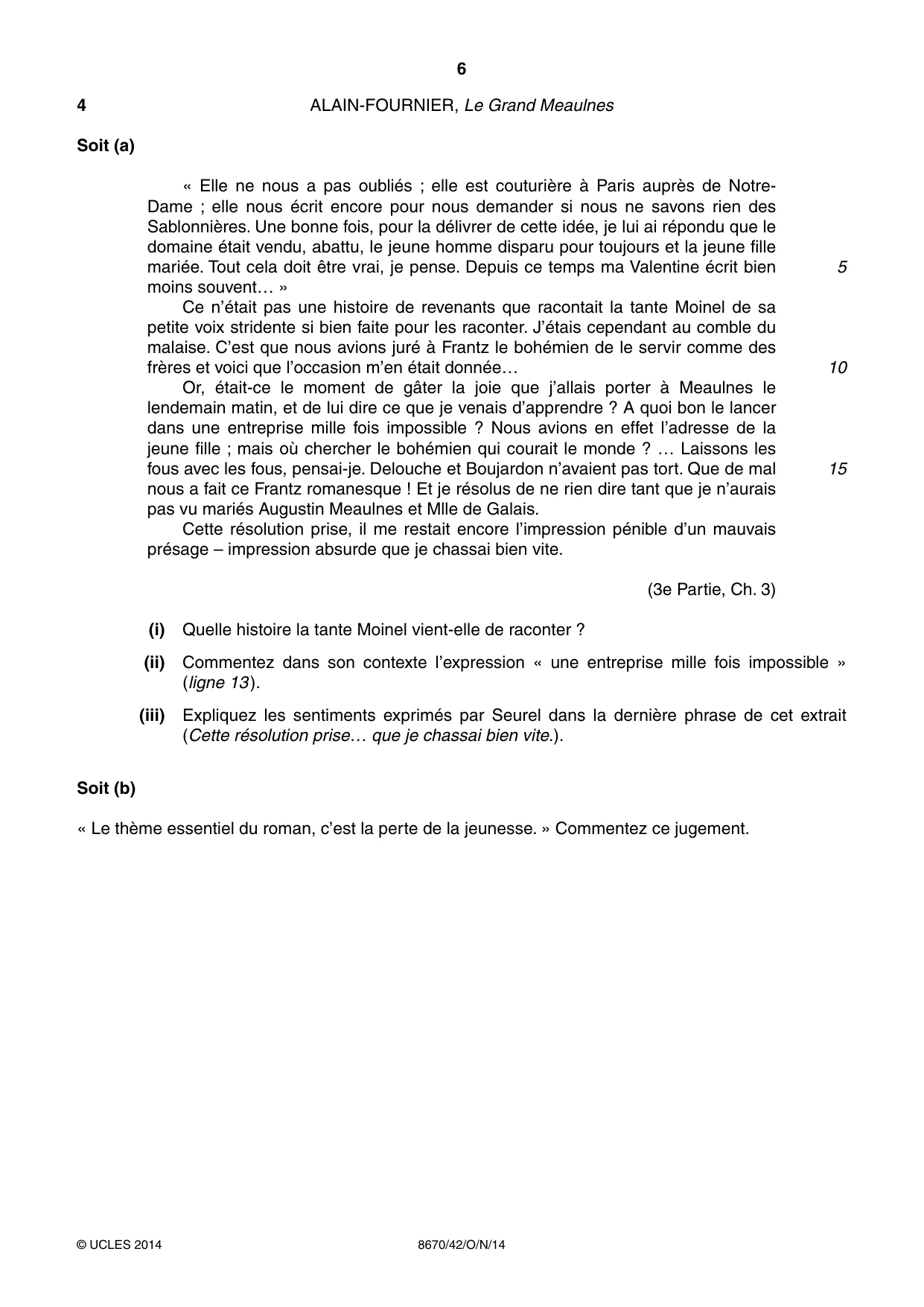
6 8670/42/O/N/14 © UCLES 2014 4 ALAIN-FOURNIER, Le Grand Meaulnes Soit (a) « Elle ne nous a pas oubliés ; elle est couturière à Paris auprès de Notre- Dame ; elle nous écrit encore pour nous demander si nous ne savons rien des Sablonnières. Une bonne fois, pour la délivrer de cette idée, je lui ai répondu que le domaine était vendu, abattu, le jeune homme disparu pour toujours et la jeune fille mariée. Tout cela doit être vrai, je pense. Depuis ce temps ma Valentine écrit bien moins souvent… » Ce n’était pas une histoire de revenants que racontait la tante Moinel de sa petite voix stridente si bien faite pour les raconter. J’étais cependant au comble du malaise. C’est que nous avions juré à Frantz le bohémien de le servir comme des frères et voici que l’occasion m’en était donnée… Or, était-ce le moment de gâter la joie que j’allais porter à Meaulnes le lendemain matin, et de lui dire ce que je venais d’apprendre ? A quoi bon le lancer dans une entreprise mille fois impossible ? Nous avions en effet l’adresse de la jeune fille ; mais où chercher le bohémien qui courait le monde ? … Laissons les fous avec les fous, pensai-je. Delouche et Boujardon n’avaient pas tort. Que de mal nous a fait ce Frantz romanesque ! Et je résolus de ne rien dire tant que je n’aurais pas vu mariés Augustin Meaulnes et Mlle de Galais. Cette résolution prise, il me restait encore l’impression pénible d’un mauvais présage – impression absurde que je chassai bien vite. (3e Partie, Ch. 3) (i) Quelle histoire la tante Moinel vient-elle de raconter ? (ii) Commentez dans son contexte l’expression « une entreprise mille fois impossible » (ligne 13 ). (iii) Expliquez les sentiments exprimés par Seurel dans la dernière phrase de cet extrait (Cette résolution prise… que je chassai bien vite.). Soit (b) « Le thème essentiel du roman, c’est la perte de la jeunesse. » Commentez ce jugement. 5 10 15
Question paper, page 7
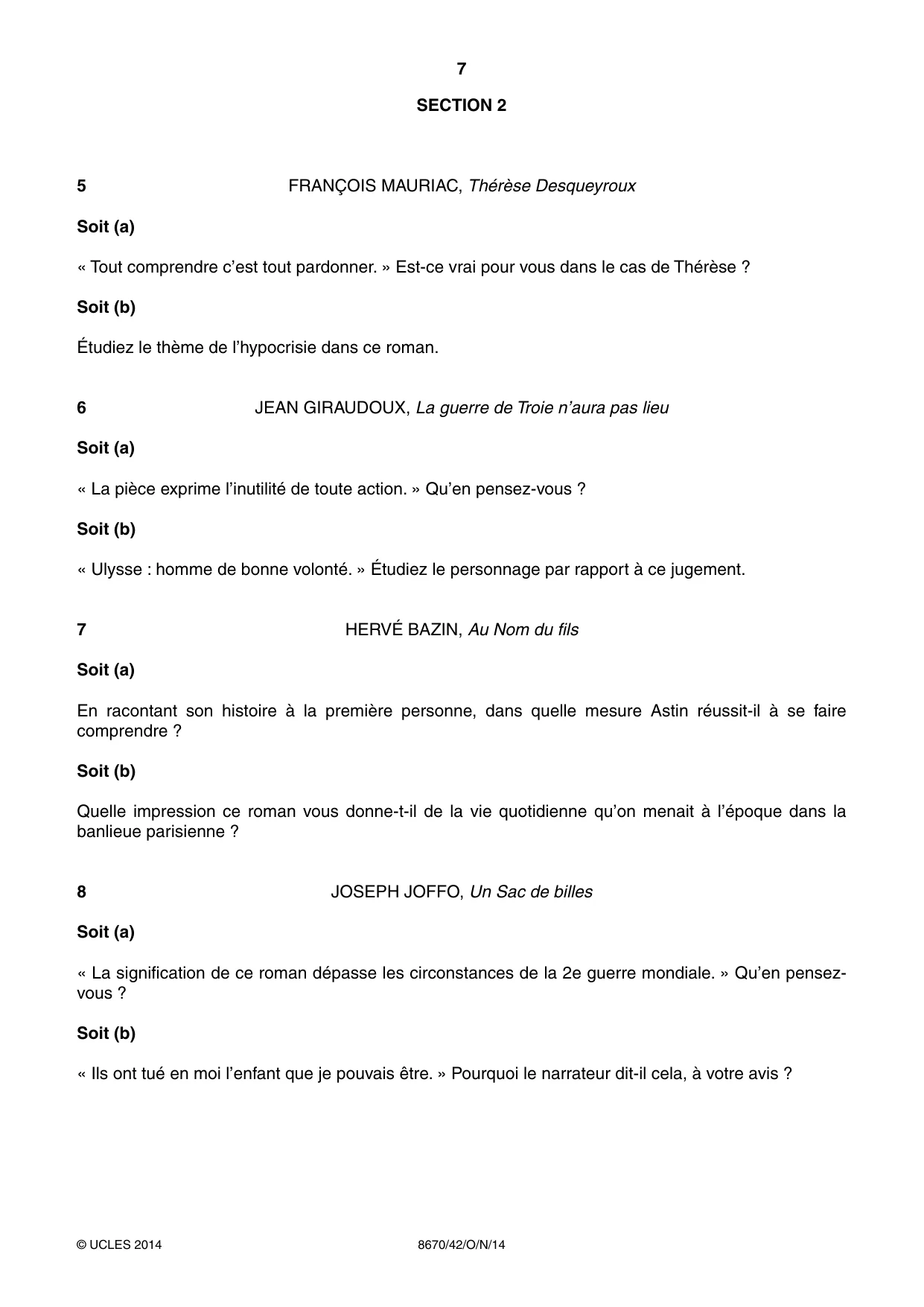
7 8670/42/O/N/14 © UCLES 2014 SECTION 2 5 FRANÇOIS MAURIAC, Thérèse Desqueyroux Soit (a) « Tout comprendre c’est tout pardonner. » Est-ce vrai pour vous dans le cas de Thérèse ? Soit (b) Étudiez le thème de l’hypocrisie dans ce roman. 6 JEAN GIRAUDOUX, La guerre de Troie n’aura pas lieu Soit (a) « La pièce exprime l’inutilité de toute action. » Qu’en pensez-vous ? Soit (b) « Ulysse : homme de bonne volonté. » Étudiez le personnage par rapport à ce jugement. 7 HERVÉ BAZIN, Au Nom du fils Soit (a) En racontant son histoire à la première personne, dans quelle mesure Astin réussit-il à se faire comprendre ? Soit (b) Quelle impression ce roman vous donne-t-il de la vie quotidienne qu’on menait à l’époque dans la banlieue parisienne ? 8 JOSEPH JOFFO, Un Sac de billes Soit (a) « La signification de ce roman dépasse les circonstances de la 2e guerre mondiale. » Qu’en pensez- vous ? Soit (b) « Ils ont tué en moi l’enfant que je pouvais être. » Pourquoi le narrateur dit-il cela, à votre avis ?
Question paper, page 8
8 8670/42/O/N/14 © UCLES 2014 Copyright Acknowledgements: Question 3 © Jean-Paul Sartre; Les Mouches; Editions Gallimard; 1947. Permission to reproduce items where third-party owned material protected by copyright is included has been sought and cleared where possible. Every reasonable effort has been made by the publisher (UCLES) to trace copyright holders, but if any items requiring clearance have unwittingly been included, the publisher will be pleased to make amends at the earliest possible opportunity. Cambridge International Examinations is part of the Cambridge Assessment Group. Cambridge Assessment is the brand name of University of Cambridge Local Examinations Syndicate (UCLES), which is itself a department of the University of Cambridge. BLANK PAGE
Mark scheme, page 1
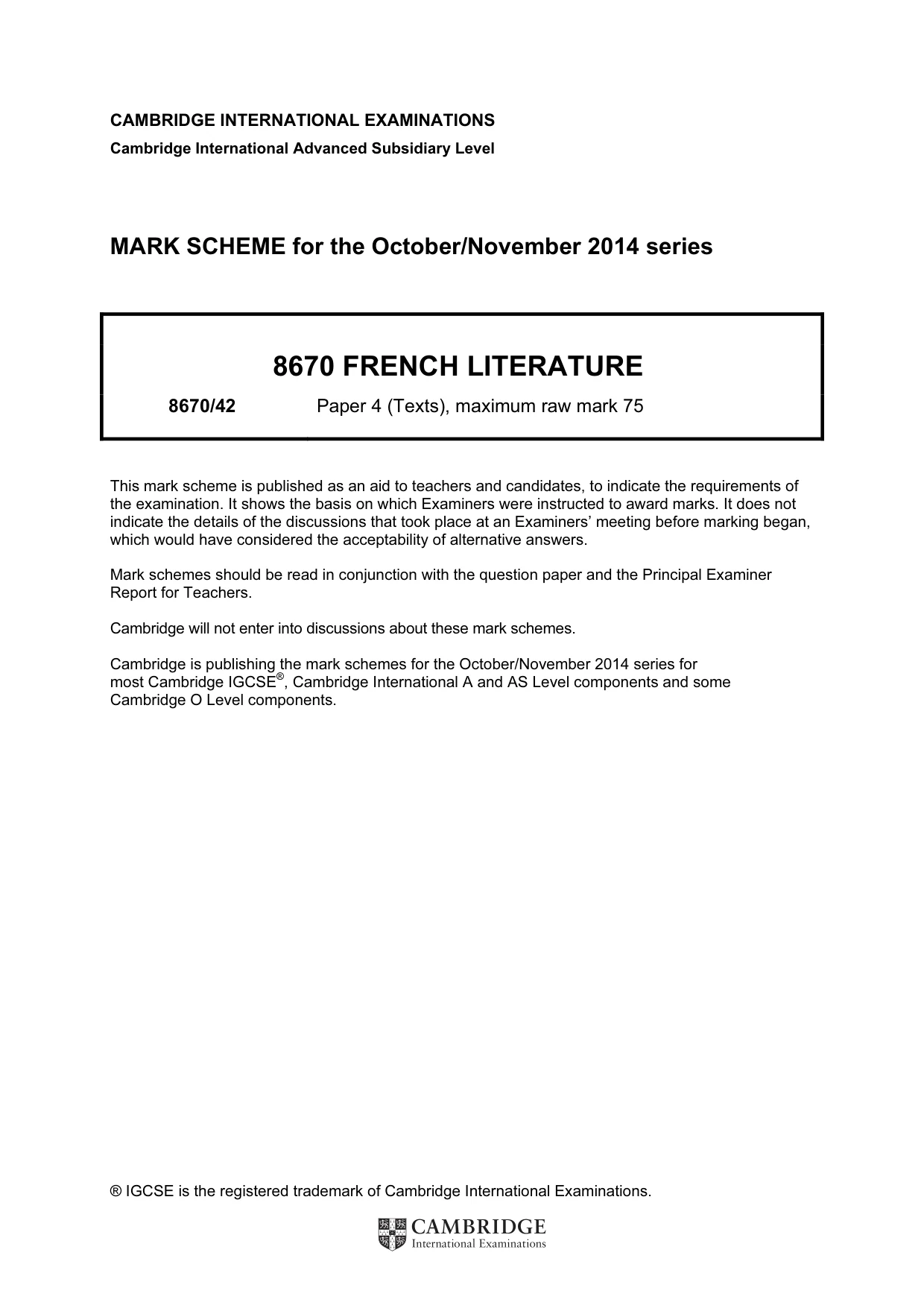
® IGCSE is the registered trademark of Cambridge International Examinations. CAMBRIDGE INTERNATIONAL EXAMINATIONS Cambridge International Advanced Subsidiary Level MARK SCHEME for the October/November 2014 series 8670 FRENCH LITERATURE 8670/42 Paper 4 (Texts), maximum raw mark 75 This mark scheme is published as an aid to teachers and candidates, to indicate the requirements of the examination. It shows the basis on which Examiners were instructed to award marks. It does not indicate the details of the discussions that took place at an Examiners’ meeting before marking began, which would have considered the acceptability of alternative answers. Mark schemes should be read in conjunction with the question paper and the Principal Examiner Report for Teachers. Cambridge will not enter into discussions about these mark schemes. Cambridge is publishing the mark schemes for the October/November 2014 series for most Cambridge IGCSE®, Cambridge International A and AS Level components and some Cambridge O Level components.
Mark scheme, page 2
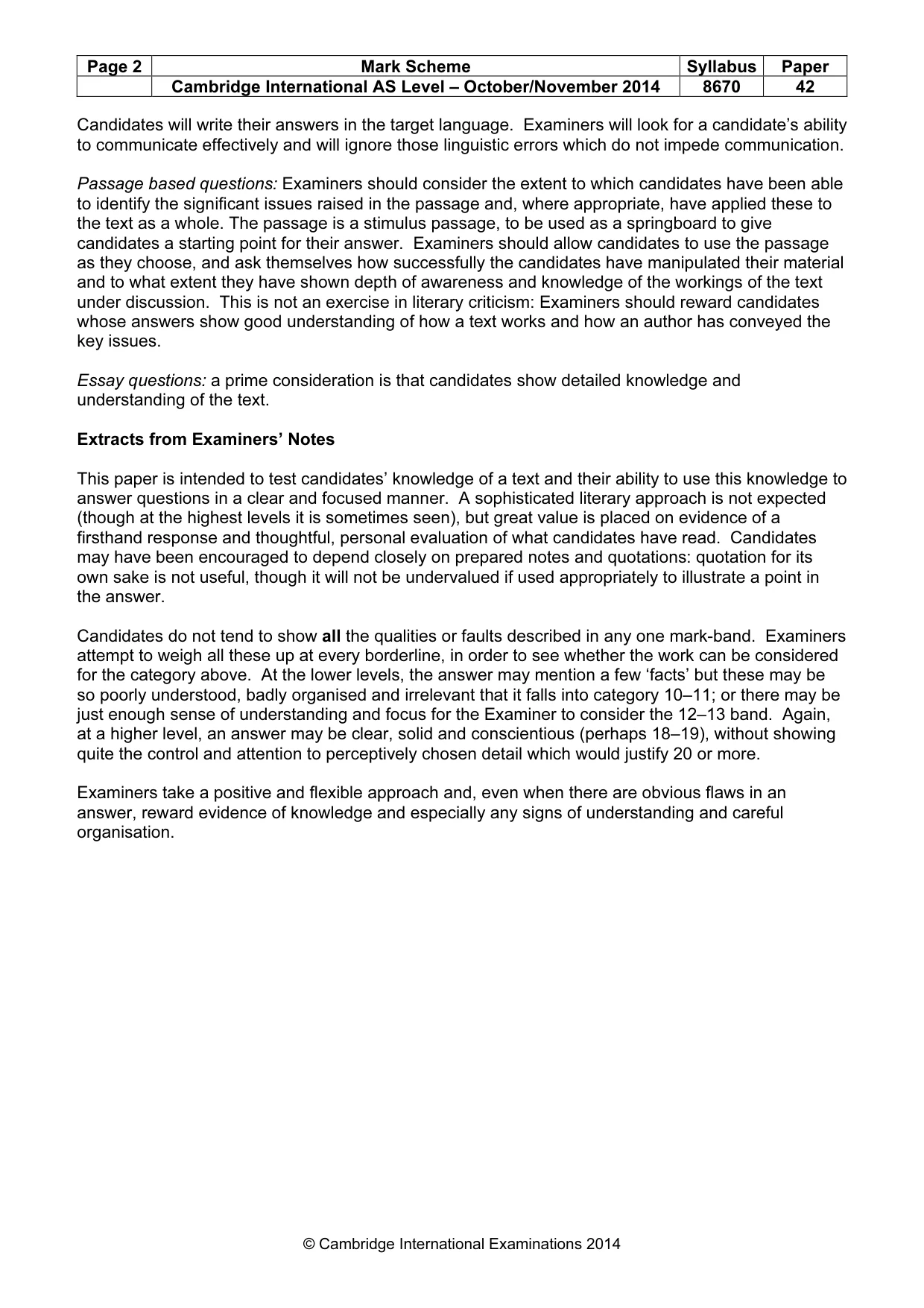
Page 2 Mark Scheme Syllabus Paper Cambridge International AS Level – October/November 2014 8670 42 © Cambridge International Examinations 2014 Candidates will write their answers in the target language. Examiners will look for a candidate’s ability to communicate effectively and will ignore those linguistic errors which do not impede communication. Passage based questions: Examiners should consider the extent to which candidates have been able to identify the significant issues raised in the passage and, where appropriate, have applied these to the text as a whole. The passage is a stimulus passage, to be used as a springboard to give candidates a starting point for their answer. Examiners should allow candidates to use the passage as they choose, and ask themselves how successfully the candidates have manipulated their material and to what extent they have shown depth of awareness and knowledge of the workings of the text under discussion. This is not an exercise in literary criticism: Examiners should reward candidates whose answers show good understanding of how a text works and how an author has conveyed the key issues. Essay questions: a prime consideration is that candidates show detailed knowledge and understanding of the text. Extracts from Examiners’ Notes This paper is intended to test candidates’ knowledge of a text and their ability to use this knowledge to answer questions in a clear and focused manner. A sophisticated literary approach is not expected (though at the highest levels it is sometimes seen), but great value is placed on evidence of a firsthand response and thoughtful, personal evaluation of what candidates have read. Candidates may have been encouraged to depend closely on prepared notes and quotations: quotation for its own sake is not useful, though it will not be undervalued if used appropriately to illustrate a point in the answer. Candidates do not tend to show all the qualities or faults described in any one mark-band. Examiners attempt to weigh all these up at every borderline, in order to see whether the work can be considered for the category above. At the lower levels, the answer may mention a few ‘facts’ but these may be so poorly understood, badly organised and irrelevant that it falls into category 10–11; or there may be just enough sense of understanding and focus for the Examiner to consider the 12–13 band. Again, at a higher level, an answer may be clear, solid and conscientious (perhaps 18–19), without showing quite the control and attention to perceptively chosen detail which would justify 20 or more. Examiners take a positive and flexible approach and, even when there are obvious flaws in an answer, reward evidence of knowledge and especially any signs of understanding and careful organisation.
Mark scheme, page 3
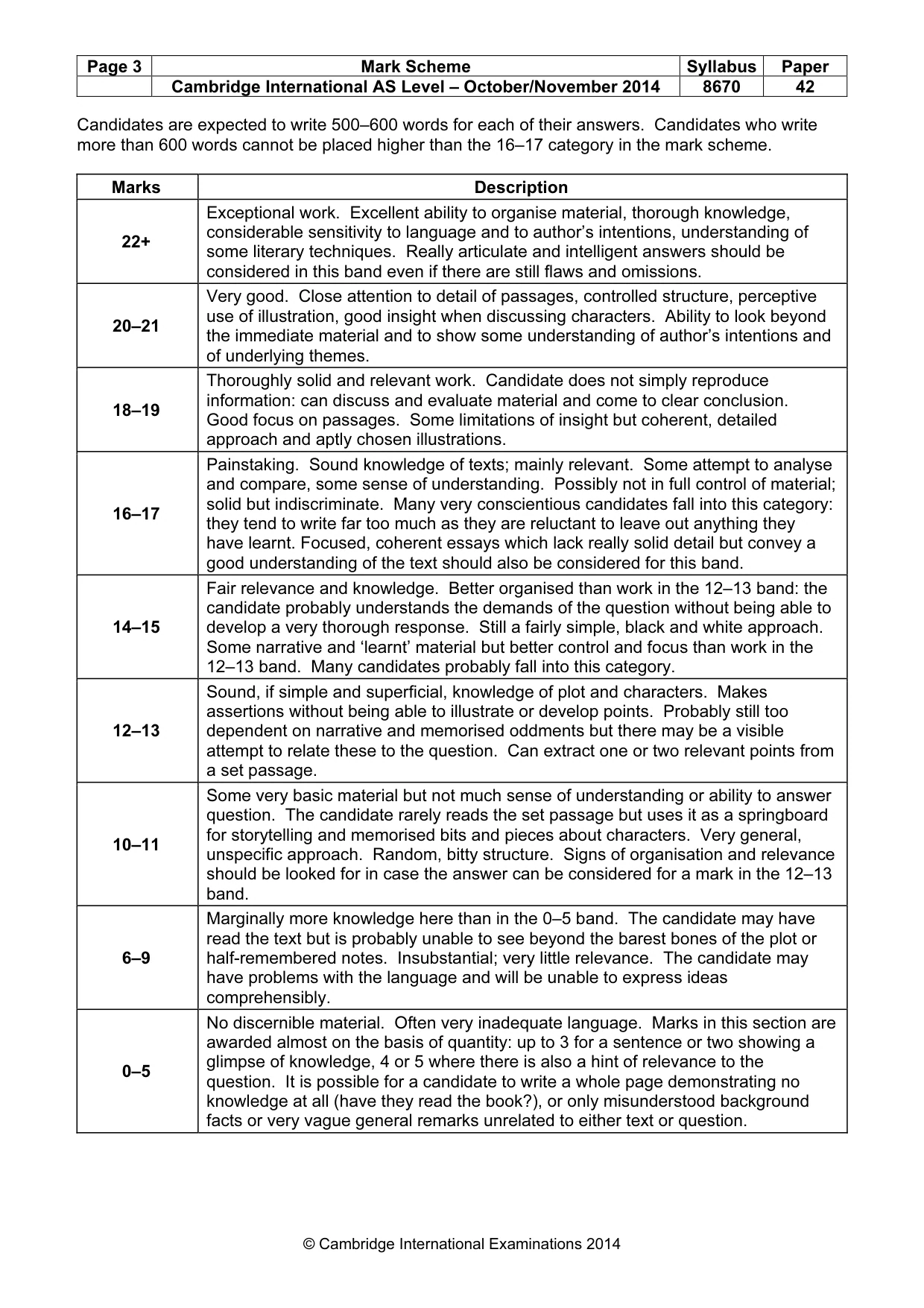
Page 3 Mark Scheme Syllabus Paper Cambridge International AS Level – October/November 2014 8670 42 © Cambridge International Examinations 2014 Candidates are expected to write 500–600 words for each of their answers. Candidates who write more than 600 words cannot be placed higher than the 16–17 category in the mark scheme. Marks Description 22+ Exceptional work. Excellent ability to organise material, thorough knowledge, considerable sensitivity to language and to author’s intentions, understanding of some literary techniques. Really articulate and intelligent answers should be considered in this band even if there are still flaws and omissions. 20–21 Very good. Close attention to detail of passages, controlled structure, perceptive use of illustration, good insight when discussing characters. Ability to look beyond the immediate material and to show some understanding of author’s intentions and of underlying themes. 18–19 Thoroughly solid and relevant work. Candidate does not simply reproduce information: can discuss and evaluate material and come to clear conclusion. Good focus on passages. Some limitations of insight but coherent, detailed approach and aptly chosen illustrations. 16–17 Painstaking. Sound knowledge of texts; mainly relevant. Some attempt to analyse and compare, some sense of understanding. Possibly not in full control of material; solid but indiscriminate. Many very conscientious candidates fall into this category: they tend to write far too much as they are reluctant to leave out anything they have learnt. Focused, coherent essays which lack really solid detail but convey a good understanding of the text should also be considered for this band. 14–15 Fair relevance and knowledge. Better organised than work in the 12–13 band: the candidate probably understands the demands of the question without being able to develop a very thorough response. Still a fairly simple, black and white approach. Some narrative and ‘learnt’ material but better control and focus than work in the 12–13 band. Many candidates probably fall into this category. 12–13 Sound, if simple and superficial, knowledge of plot and characters. Makes assertions without being able to illustrate or develop points. Probably still too dependent on narrative and memorised oddments but there may be a visible attempt to relate these to the question. Can extract one or two relevant points from a set passage. 10–11 Some very basic material but not much sense of understanding or ability to answer question. The candidate rarely reads the set passage but uses it as a springboard for storytelling and memorised bits and pieces about characters. Very general, unspecific approach. Random, bitty structure. Signs of organisation and relevance should be looked for in case the answer can be considered for a mark in the 12–13 band. 6–9 Marginally more knowledge here than in the 0–5 band. The candidate may have read the text but is probably unable to see beyond the barest bones of the plot or half-remembered notes. Insubstantial; very little relevance. The candidate may have problems with the language and will be unable to express ideas comprehensibly. 0–5 No discernible material. Often very inadequate language. Marks in this section are awarded almost on the basis of quantity: up to 3 for a sentence or two showing a glimpse of knowledge, 4 or 5 where there is also a hint of relevance to the question. It is possible for a candidate to write a whole page demonstrating no knowledge at all (have they read the book?), or only misunderstood background facts or very vague general remarks unrelated to either text or question.
What you needed in this session
Cambridge’s own grade thresholds for 2014 Oct/Nov, Paper 4 · Variant 2. A higher threshold means an easier paper — the bar moves with how the cohort did.