Cambridge A Level French (A Level only) 9716 — 2015 Oct/Nov Paper 4 · Variant 2
9716/42/O/N/15 · 75 marks · ≈84 min
The question paper and its mark scheme, free to read here and free to download. This is Cambridge’s own paper, exactly as it was sat.
Question paper8 pages

Mark scheme3 pages
Answers below. Sit the paper first if you are practising.
Paper as text
Question paper, page 1
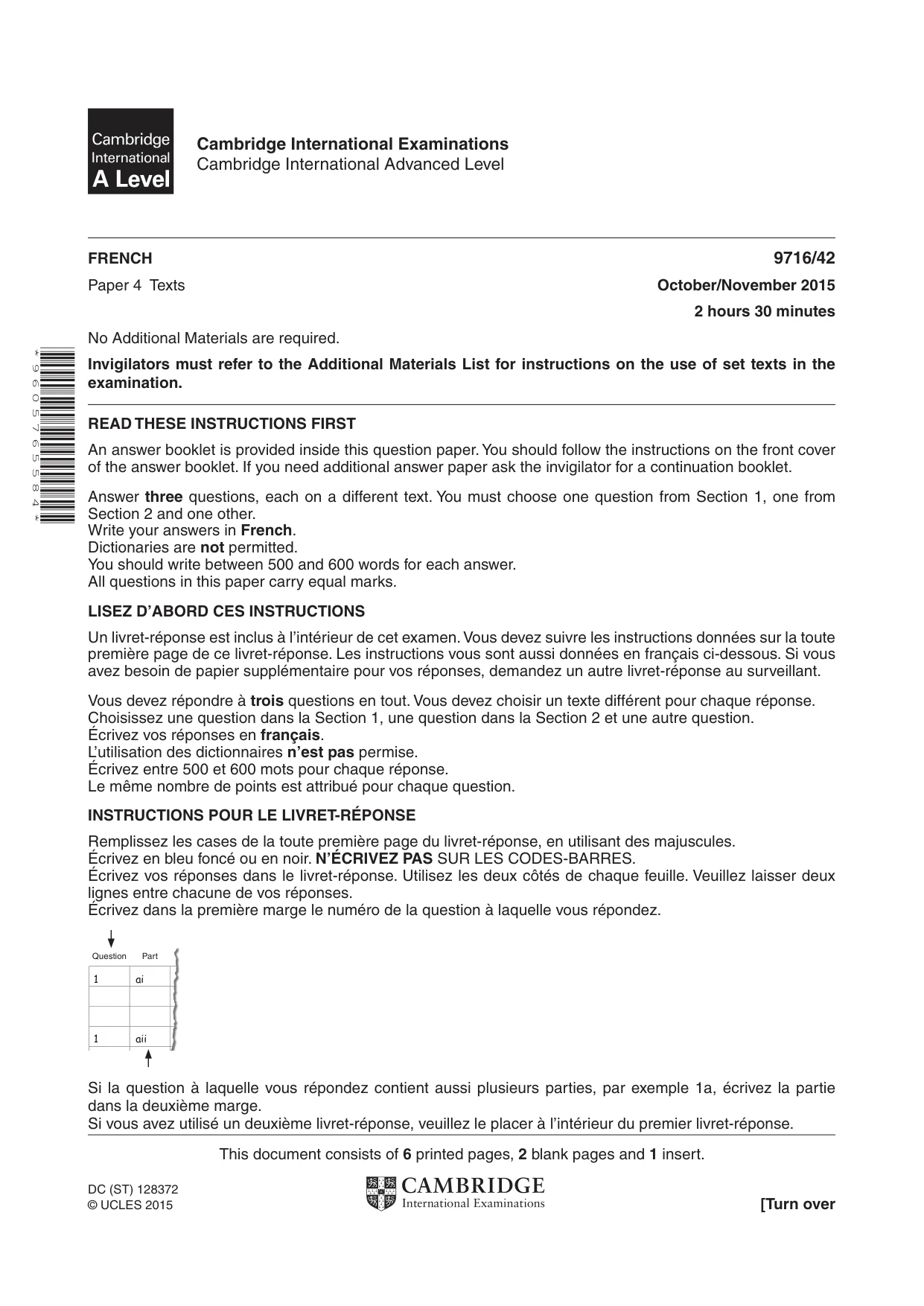
This document consists of 6 printed pages, 2 blank pages and 1 insert. DC (ST) 128372 © UCLES 2015 [Turn over Cambridge International Examinations Cambridge International Advanced Level * 9 6 0 5 7 6 5 5 8 4 * FRENCH 9716/42 Paper 4 Texts October/November 2015 2 hours 30 minutes No Additional Materials are required. Invigilators must refer to the Additional Materials List for instructions on the use of set texts in the examination. READ THESE INSTRUCTIONS FIRST An answer booklet is provided inside this question paper. You should follow the instructions on the front cover of the answer booklet. If you need additional answer paper ask the invigilator for a continuation booklet. Answer three questions, each on a different text. You must choose one question from Section 1, one from Section 2 and one other. Write your answers in French. Dictionaries are not permitted. You should write between 500 and 600 words for each answer. All questions in this paper carry equal marks. LISEZ D’ABORD CES INSTRUCTIONS Un livret-réponse est inclus à l’intérieur de cet examen. Vous devez suivre les instructions données sur la toute première page de ce livret-réponse. Les instructions vous sont aussi données en français ci-dessous. Si vous avez besoin de papier supplémentaire pour vos réponses, demandez un autre livret-réponse au surveillant. Vous devez répondre à trois questions en tout. Vous devez choisir un texte différent pour chaque réponse. Choisissez une question dans la Section 1, une question dans la Section 2 et une autre question. Écrivez vos réponses en français. L’utilisation des dictionnaires n’est pas permise. Écrivez entre 500 et 600 mots pour chaque réponse. Le même nombre de points est attribué pour chaque question. INSTRUCTIONS POUR LE LIVRET-RÉPONSE Remplissez les cases de la toute première page du livret-réponse, en utilisant des majuscules. Écrivez en bleu foncé ou en noir. N’ÉCRIVEZ PAS SUR LES CODES-BARRES. Écrivez vos réponses dans le livret-réponse. Utilisez les deux côtés de chaque feuille. Veuillez laisser deux lignes entre chacune de vos réponses. Écrivez dans la première marge le numéro de la question à laquelle vous répondez. Si la question à laquelle vous répondez contient aussi plusieurs parties, par exemple 1a, écrivez la partie dans la deuxième marge. Si vous avez utilisé un deuxième livret-réponse, veuillez le placer à l’intérieur du premier livret-réponse. Question Part 1 1 ai aii
Question paper, page 2
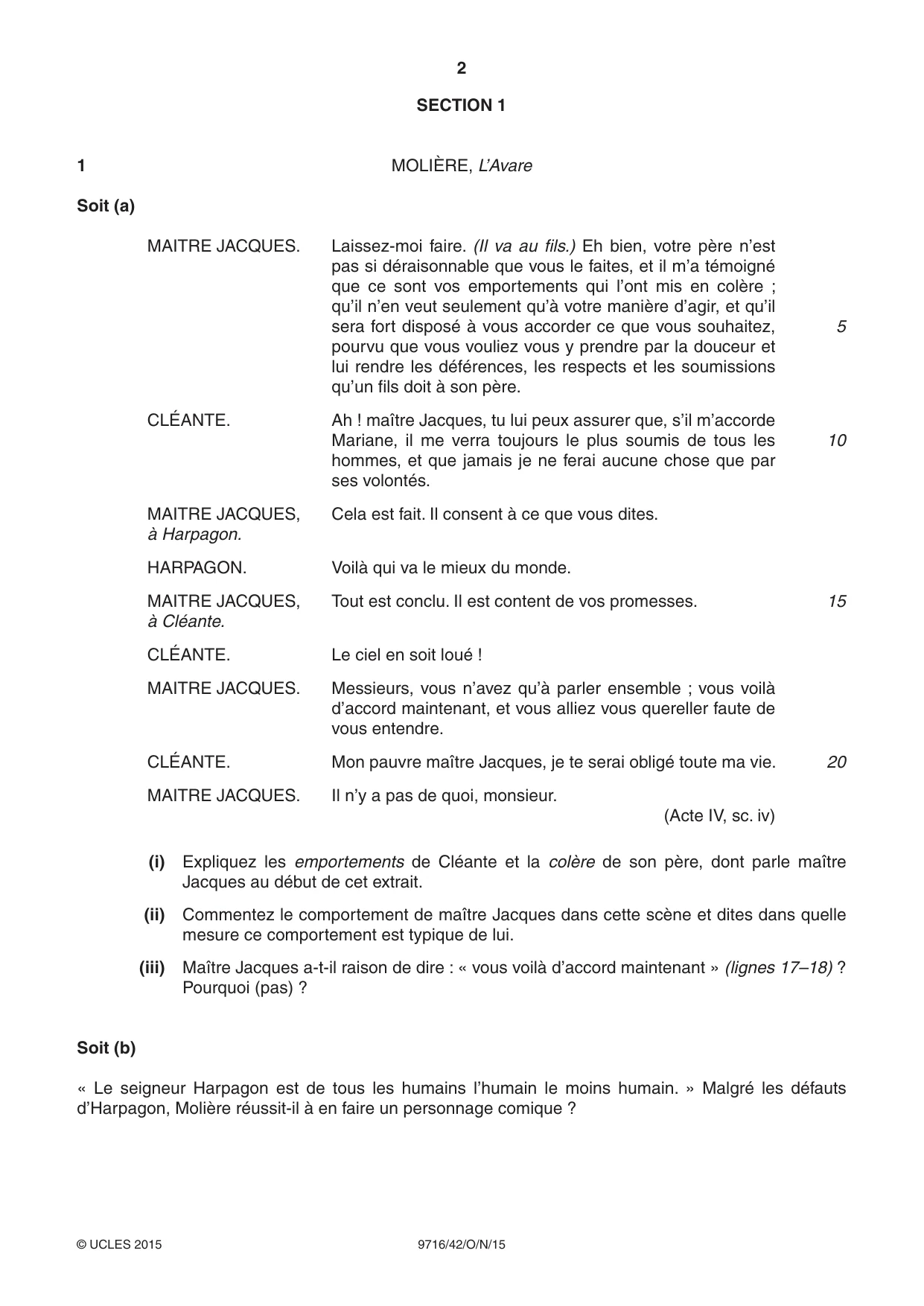
2 9716/42/O/N/15 © UCLES 2015 SECTION 1 1 MOLIÈRE, L’Avare Soit (a) MAITRE JACQUES. Laissez-moi faire. (Il va au fils.) Eh bien, votre père n’est pas si déraisonnable que vous le faites, et il m’a témoigné que ce sont vos emportements qui l’ont mis en colère ; qu’il n’en veut seulement qu’à votre manière d’agir, et qu’il sera fort disposé à vous accorder ce que vous souhaitez, pourvu que vous vouliez vous y prendre par la douceur et lui rendre les déférences, les respects et les soumissions qu’un fils doit à son père. 5 CLÉANTE. Ah ! maître Jacques, tu lui peux assurer que, s’il m’accorde Mariane, il me verra toujours le plus soumis de tous les hommes, et que jamais je ne ferai aucune chose que par ses volontés. 10 MAITRE JACQUES, à Harpagon. Cela est fait. Il consent à ce que vous dites. HARPAGON. Voilà qui va le mieux du monde. MAITRE JACQUES, à Cléante. Tout est conclu. Il est content de vos promesses. 15 CLÉANTE. Le ciel en soit loué ! MAITRE JACQUES. Messieurs, vous n’avez qu’à parler ensemble ; vous voilà d’accord maintenant, et vous alliez vous quereller faute de vous entendre. CLÉANTE. Mon pauvre maître Jacques, je te serai obligé toute ma vie. 20 MAITRE JACQUES. Il n’y a pas de quoi, monsieur. (Acte IV, sc. iv) (i) Expliquez les emportements de Cléante et la colère de son père, dont parle maître Jacques au début de cet extrait. (ii) Commentez le comportement de maître Jacques dans cette scène et dites dans quelle mesure ce comportement est typique de lui. (iii) Maître Jacques a-t-il raison de dire : « vous voilà d’accord maintenant » (lignes 17–18) ? Pourquoi (pas) ? Soit (b) « Le seigneur Harpagon est de tous les humains l’humain le moins humain. » Malgré les défauts d’Harpagon, Molière réussit-il à en faire un personnage comique ?
Question paper, page 3
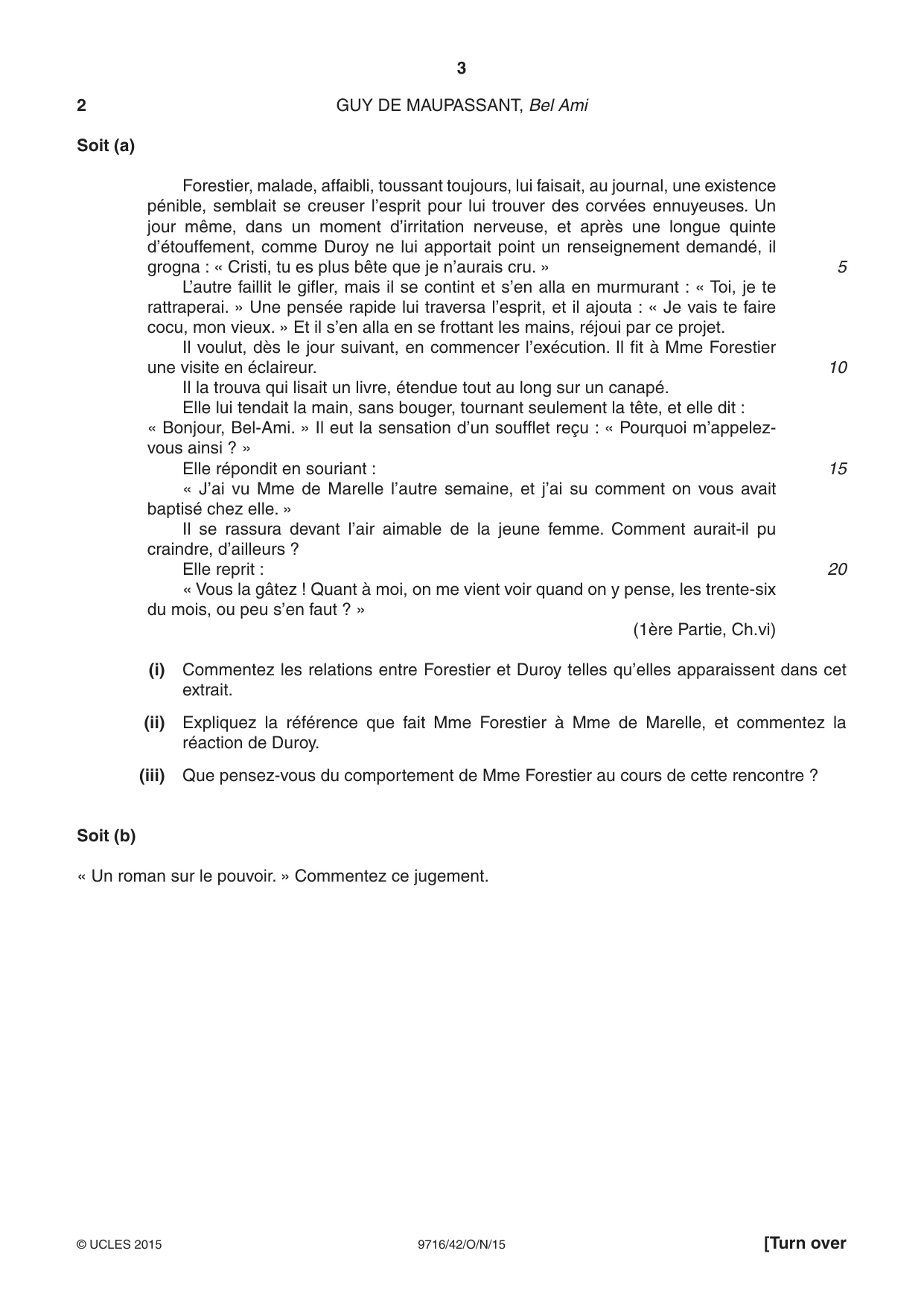
3 9716/42/O/N/15 © UCLES 2015 [Turn over 2 GUY DE MAUPASSANT, Bel Ami Soit (a) Forestier, malade, affaibli, toussant toujours, lui faisait, au journal, une existence pénible, semblait se creuser l’esprit pour lui trouver des corvées ennuyeuses. Un jour même, dans un moment d’irritation nerveuse, et après une longue quinte d’étouffement, comme Duroy ne lui apportait point un renseignement demandé, il grogna : « Cristi, tu es plus bête que je n’aurais cru. » L’autre faillit le gifler, mais il se contint et s’en alla en murmurant : « Toi, je te rattraperai. » Une pensée rapide lui traversa l’esprit, et il ajouta : « Je vais te faire cocu, mon vieux. » Et il s’en alla en se frottant les mains, réjoui par ce projet. Il voulut, dès le jour suivant, en commencer l’exécution. Il fit à Mme Forestier une visite en éclaireur. Il la trouva qui lisait un livre, étendue tout au long sur un canapé. Elle lui tendait la main, sans bouger, tournant seulement la tête, et elle dit : « Bonjour, Bel-Ami. » Il eut la sensation d’un soufflet reçu : « Pourquoi m’appelez- vous ainsi ? » Elle répondit en souriant : « J’ai vu Mme de Marelle l’autre semaine, et j’ai su comment on vous avait baptisé chez elle. » Il se rassura devant l’air aimable de la jeune femme. Comment aurait-il pu craindre, d’ailleurs ? Elle reprit : « Vous la gâtez ! Quant à moi, on me vient voir quand on y pense, les trente-six du mois, ou peu s’en faut ? » (1ère Partie, Ch.vi) (i) Commentez les relations entre Forestier et Duroy telles qu’elles apparaissent dans cet extrait. (ii) Expliquez la référence que fait Mme Forestier à Mme de Marelle, et commentez la réaction de Duroy. (iii) Que pensez-vous du comportement de Mme Forestier au cours de cette rencontre ? Soit (b) « Un roman sur le pouvoir. » Commentez ce jugement. 5 10 15 20
Question paper, page 4
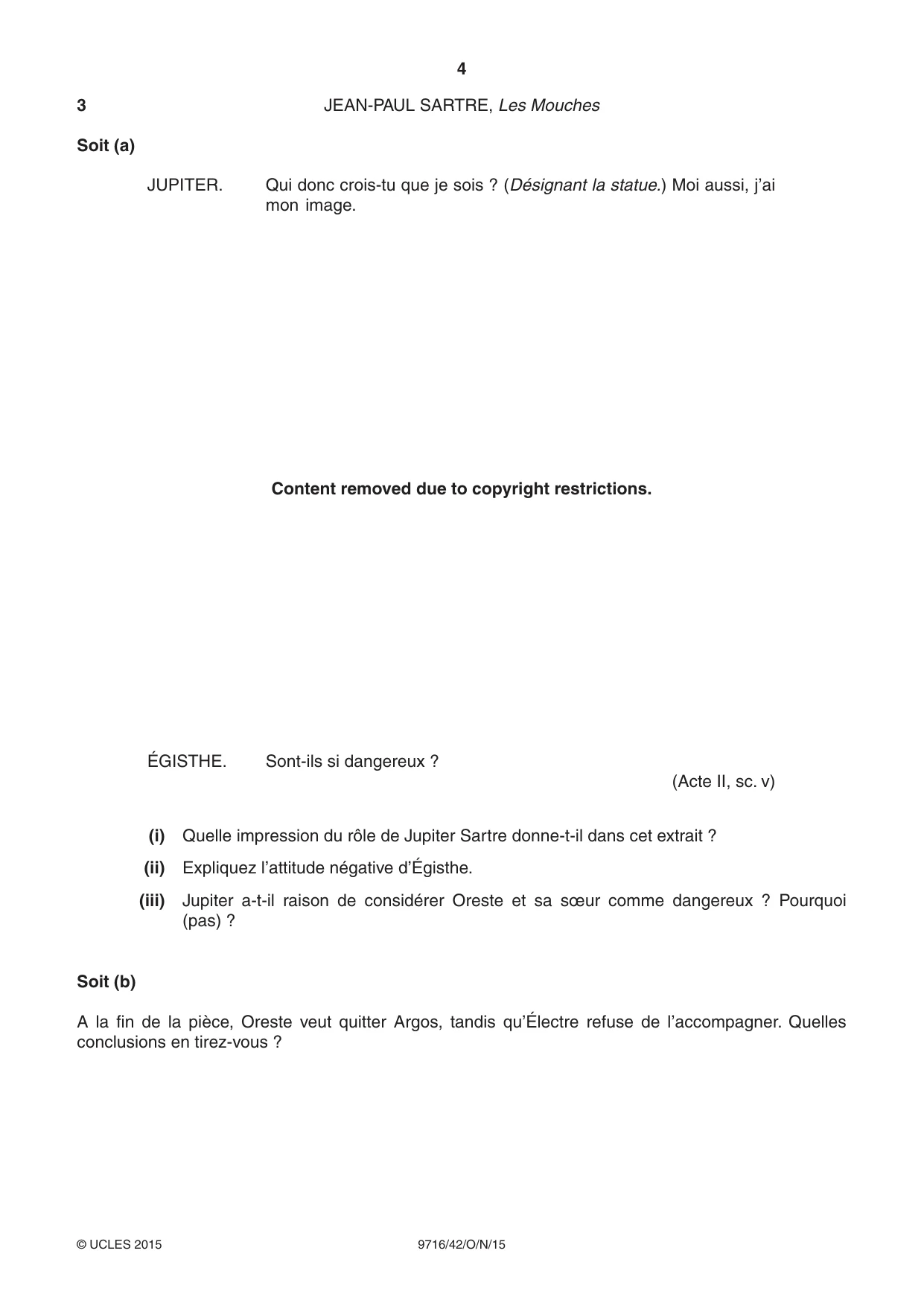
4 9716/42/O/N/15 © UCLES 2015 3 JEAN-PAUL SARTRE, Les Mouches Soit (a) JUPITER. Qui donc crois-tu que je sois ? (Désignant la statue.) Moi aussi, j’ai mon image. ÉGISTHE. Sont-ils si dangereux ? (Acte II, sc. v) (i) Quelle impression du rôle de Jupiter Sartre donne-t-il dans cet extrait ? (ii) Expliquez l’attitude négative d’Égisthe. (iii) Jupiter a-t-il raison de considérer Oreste et sa sœur comme dangereux ? Pourquoi (pas) ? Soit (b) A la fin de la pièce, Oreste veut quitter Argos, tandis qu’Électre refuse de l’accompagner. Quelles conclusions en tirez-vous ? Content removed due to copyright restrictions.
Question paper, page 5
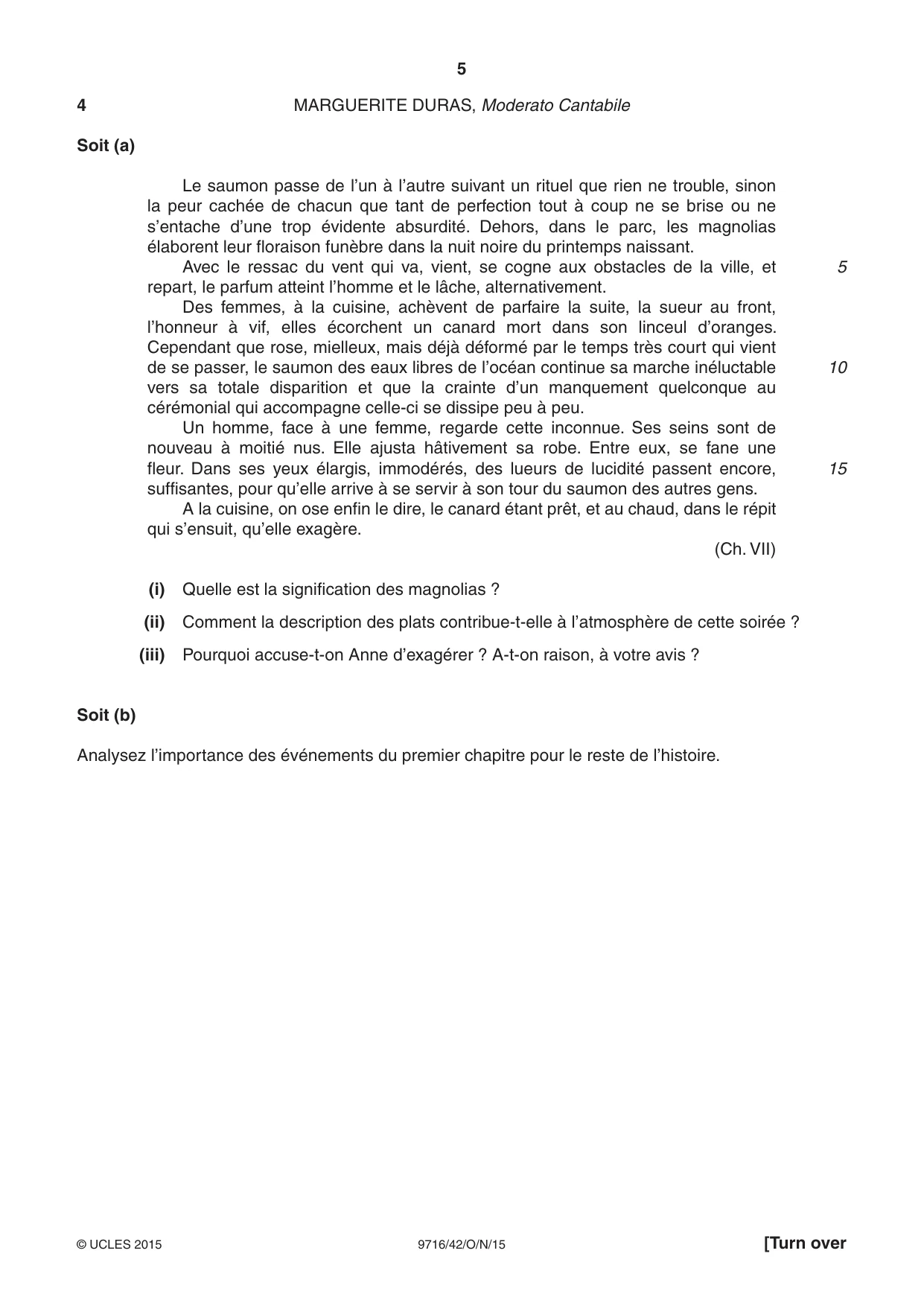
5 9716/42/O/N/15 © UCLES 2015 [Turn over 4 MARGUERITE DURAS, Moderato Cantabile Soit (a) Le saumon passe de l’un à l’autre suivant un rituel que rien ne trouble, sinon la peur cachée de chacun que tant de perfection tout à coup ne se brise ou ne s’entache d’une trop évidente absurdité. Dehors, dans le parc, les magnolias élaborent leur floraison funèbre dans la nuit noire du printemps naissant. Avec le ressac du vent qui va, vient, se cogne aux obstacles de la ville, et repart, le parfum atteint l’homme et le lâche, alternativement. Des femmes, à la cuisine, achèvent de parfaire la suite, la sueur au front, l’honneur à vif, elles écorchent un canard mort dans son linceul d’oranges. Cependant que rose, mielleux, mais déjà déformé par le temps très court qui vient de se passer, le saumon des eaux libres de l’océan continue sa marche inéluctable vers sa totale disparition et que la crainte d’un manquement quelconque au cérémonial qui accompagne celle-ci se dissipe peu à peu. Un homme, face à une femme, regarde cette inconnue. Ses seins sont de nouveau à moitié nus. Elle ajusta hâtivement sa robe. Entre eux, se fane une fleur. Dans ses yeux élargis, immodérés, des lueurs de lucidité passent encore, suffisantes, pour qu’elle arrive à se servir à son tour du saumon des autres gens. A la cuisine, on ose enfin le dire, le canard étant prêt, et au chaud, dans le répit qui s’ensuit, qu’elle exagère. (Ch. VII) (i) Quelle est la signification des magnolias ? (ii) Comment la description des plats contribue-t-elle à l’atmosphère de cette soirée ? (iii) Pourquoi accuse-t-on Anne d’exagérer ? A-t-on raison, à votre avis ? Soit (b) Analysez l’importance des événements du premier chapitre pour le reste de l’histoire. 5 10 15
Question paper, page 6
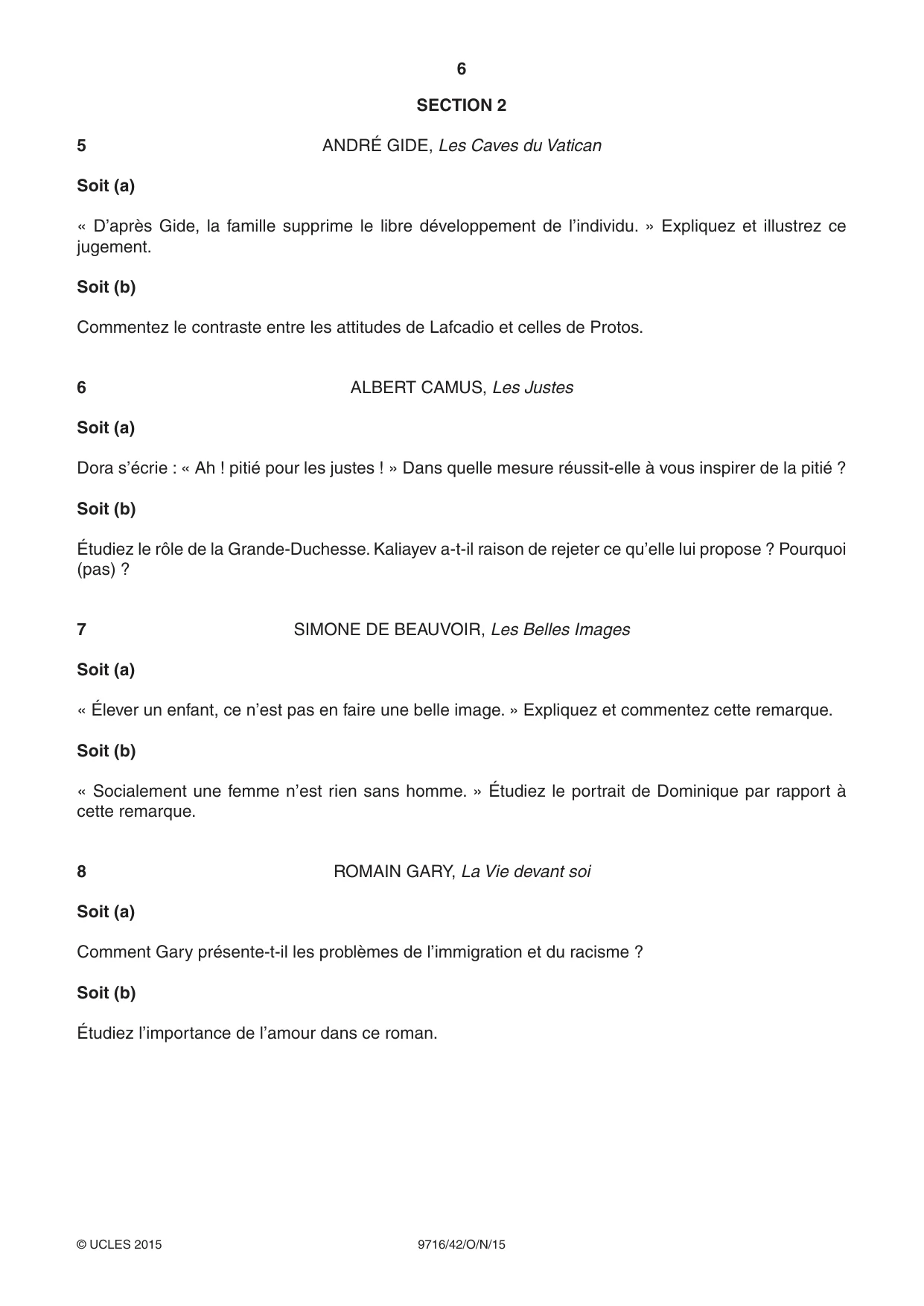
6 9716/42/O/N/15 © UCLES 2015 SECTION 2 5 ANDRÉ GIDE, Les Caves du Vatican Soit (a) « D’après Gide, la famille supprime le libre développement de l’individu. » Expliquez et illustrez ce jugement. Soit (b) Commentez le contraste entre les attitudes de Lafcadio et celles de Protos. 6 ALBERT CAMUS, Les Justes Soit (a) Dora s’écrie : « Ah ! pitié pour les justes ! » Dans quelle mesure réussit-elle à vous inspirer de la pitié ? Soit (b) Étudiez le rôle de la Grande-Duchesse. Kaliayev a-t-il raison de rejeter ce qu’elle lui propose ? Pourquoi (pas) ? 7 SIMONE DE BEAUVOIR, Les Belles Images Soit (a) « Élever un enfant, ce n’est pas en faire une belle image. » Expliquez et commentez cette remarque. Soit (b) « Socialement une femme n’est rien sans homme. » Étudiez le portrait de Dominique par rapport à cette remarque. 8 ROMAIN GARY, La Vie devant soi Soit (a) Comment Gary présente-t-il les problèmes de l’immigration et du racisme ? Soit (b) Étudiez l’importance de l’amour dans ce roman.
Question paper, page 7
7 9716/42/O/N/15 © UCLES 2015 BLANK PAGE
Question paper, page 8
8 9716/42/O/N/15 © UCLES 2015 BLANK PAGE Permission to reproduce items where third-party owned material protected by copyright is included has been sought and cleared where possible. Every reasonable effort has been made by the publisher (UCLES) to trace copyright holders, but if any items requiring clearance have unwittingly been included, the publisher will be pleased to make amends at the earliest possible opportunity. To avoid the issue of disclosure of answer-related information to candidates, all copyright acknowledgements are reproduced online in the Cambridge International Examinations Copyright Acknowledgements Booklet. This is produced for each series of examinations and is freely available to download at www.cie.org.uk after the live examination series. Cambridge International Examinations is part of the Cambridge Assessment Group. Cambridge Assessment is the brand name of University of Cambridge Local Examinations Syndicate (UCLES), which is itself a department of the University of Cambridge.
Mark scheme, page 1
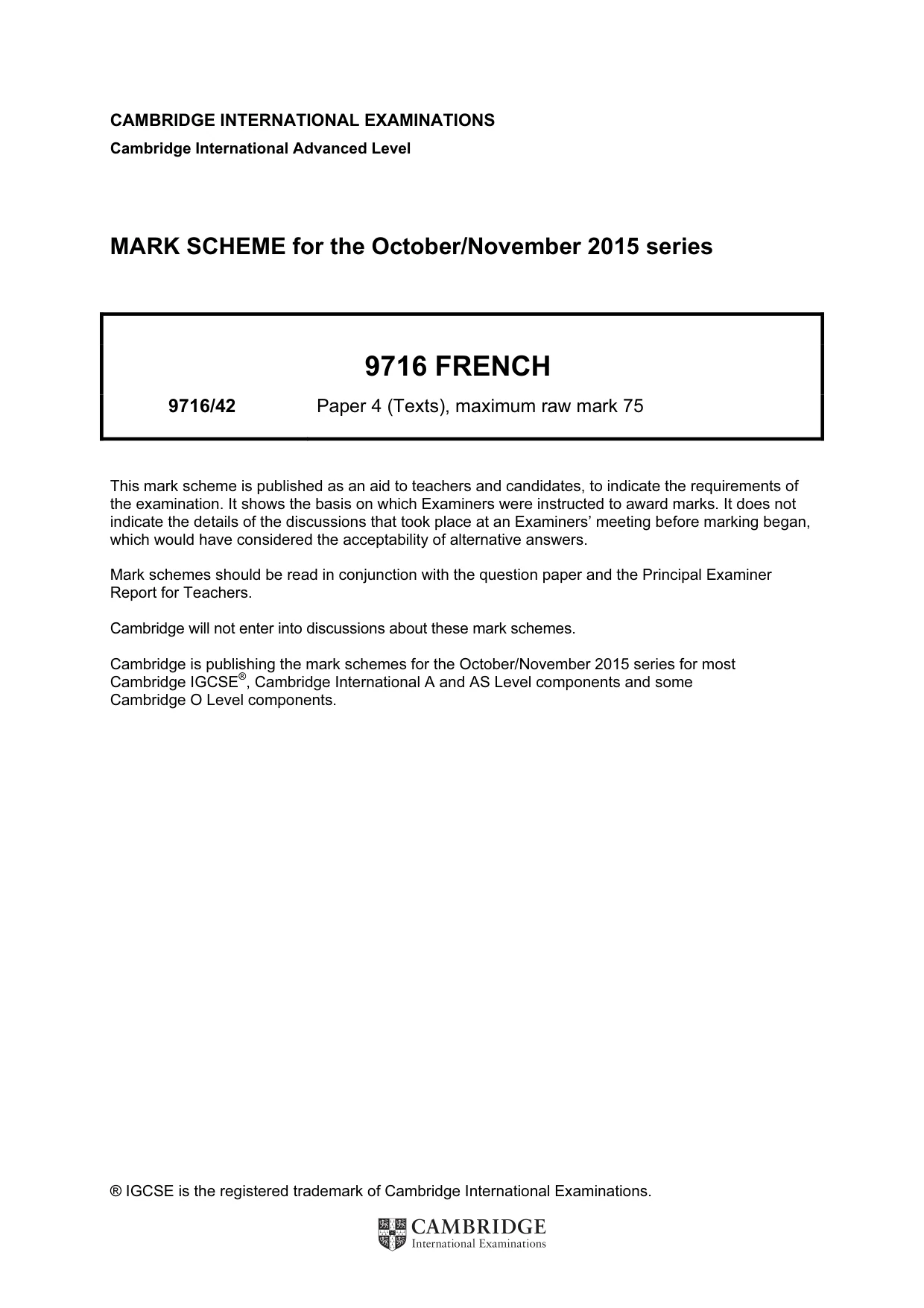
® IGCSE is the registered trademark of Cambridge International Examinations. CAMBRIDGE INTERNATIONAL EXAMINATIONS Cambridge International Advanced Level MARK SCHEME for the October/November 2015 series 9716 FRENCH 9716/42 Paper 4 (Texts), maximum raw mark 75 This mark scheme is published as an aid to teachers and candidates, to indicate the requirements of the examination. It shows the basis on which Examiners were instructed to award marks. It does not indicate the details of the discussions that took place at an Examiners’ meeting before marking began, which would have considered the acceptability of alternative answers. Mark schemes should be read in conjunction with the question paper and the Principal Examiner Report for Teachers. Cambridge will not enter into discussions about these mark schemes. Cambridge is publishing the mark schemes for the October/November 2015 series for most Cambridge IGCSE®, Cambridge International A and AS Level components and some Cambridge O Level components.
Mark scheme, page 2
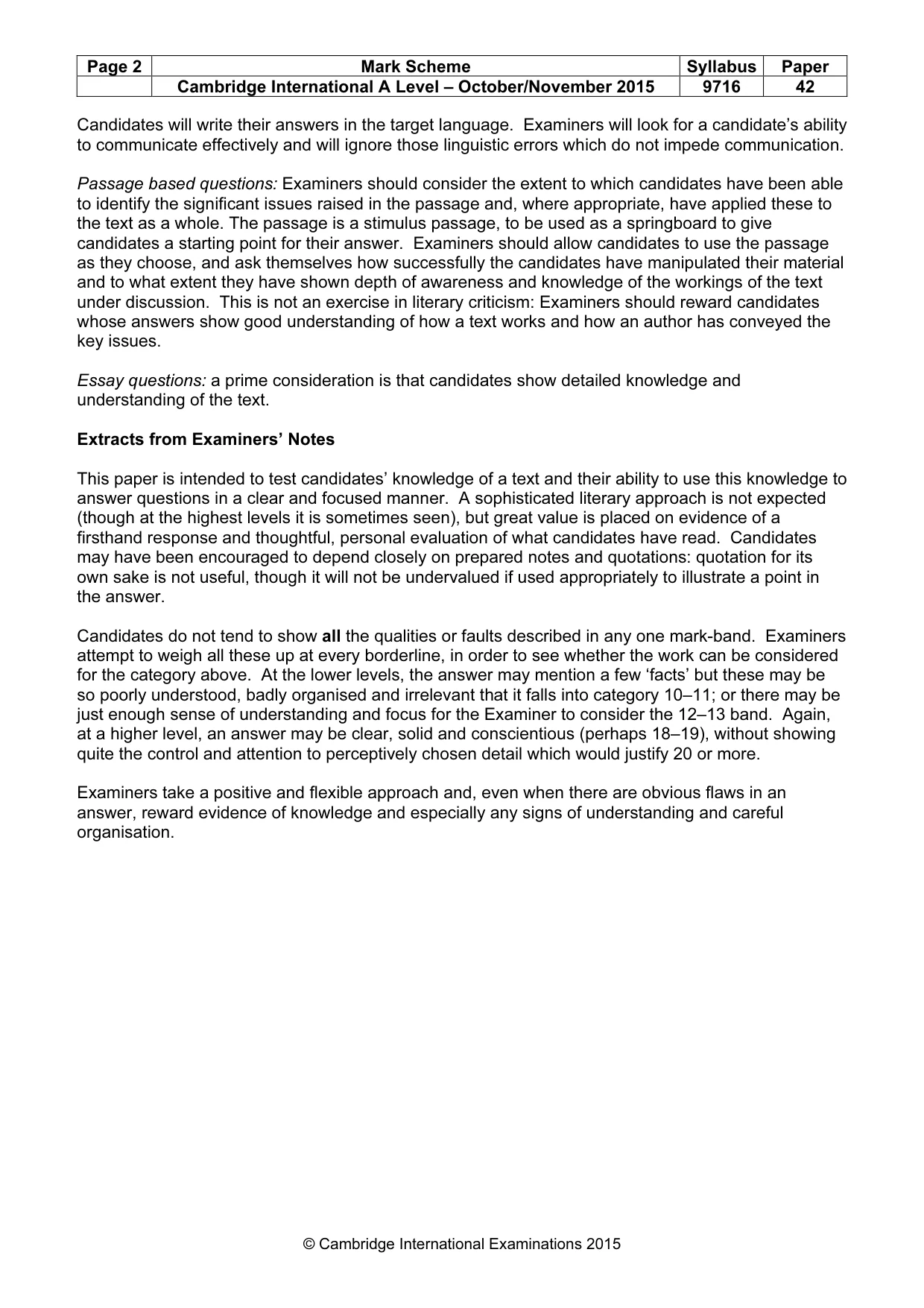
Page 2 Mark Scheme Syllabus Paper Cambridge International A Level – October/November 2015 9716 42 © Cambridge International Examinations 2015 Candidates will write their answers in the target language. Examiners will look for a candidate’s ability to communicate effectively and will ignore those linguistic errors which do not impede communication. Passage based questions: Examiners should consider the extent to which candidates have been able to identify the significant issues raised in the passage and, where appropriate, have applied these to the text as a whole. The passage is a stimulus passage, to be used as a springboard to give candidates a starting point for their answer. Examiners should allow candidates to use the passage as they choose, and ask themselves how successfully the candidates have manipulated their material and to what extent they have shown depth of awareness and knowledge of the workings of the text under discussion. This is not an exercise in literary criticism: Examiners should reward candidates whose answers show good understanding of how a text works and how an author has conveyed the key issues. Essay questions: a prime consideration is that candidates show detailed knowledge and understanding of the text. Extracts from Examiners’ Notes This paper is intended to test candidates’ knowledge of a text and their ability to use this knowledge to answer questions in a clear and focused manner. A sophisticated literary approach is not expected (though at the highest levels it is sometimes seen), but great value is placed on evidence of a firsthand response and thoughtful, personal evaluation of what candidates have read. Candidates may have been encouraged to depend closely on prepared notes and quotations: quotation for its own sake is not useful, though it will not be undervalued if used appropriately to illustrate a point in the answer. Candidates do not tend to show all the qualities or faults described in any one mark-band. Examiners attempt to weigh all these up at every borderline, in order to see whether the work can be considered for the category above. At the lower levels, the answer may mention a few ‘facts’ but these may be so poorly understood, badly organised and irrelevant that it falls into category 10–11; or there may be just enough sense of understanding and focus for the Examiner to consider the 12–13 band. Again, at a higher level, an answer may be clear, solid and conscientious (perhaps 18–19), without showing quite the control and attention to perceptively chosen detail which would justify 20 or more. Examiners take a positive and flexible approach and, even when there are obvious flaws in an answer, reward evidence of knowledge and especially any signs of understanding and careful organisation.
Mark scheme, page 3
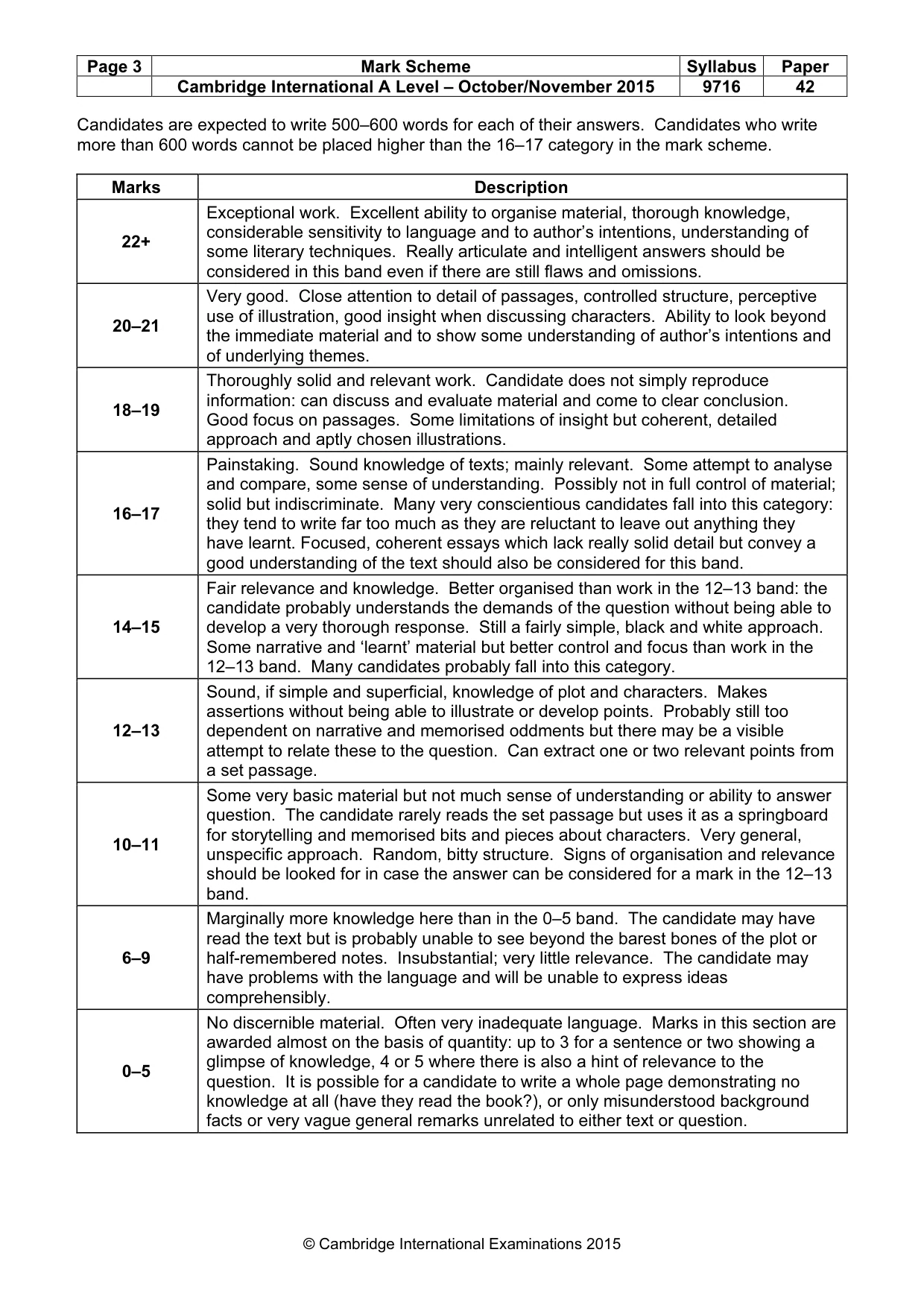
Page 3 Mark Scheme Syllabus Paper Cambridge International A Level – October/November 2015 9716 42 © Cambridge International Examinations 2015 Candidates are expected to write 500–600 words for each of their answers. Candidates who write more than 600 words cannot be placed higher than the 16–17 category in the mark scheme. Marks Description 22+ Exceptional work. Excellent ability to organise material, thorough knowledge, considerable sensitivity to language and to author’s intentions, understanding of some literary techniques. Really articulate and intelligent answers should be considered in this band even if there are still flaws and omissions. 20–21 Very good. Close attention to detail of passages, controlled structure, perceptive use of illustration, good insight when discussing characters. Ability to look beyond the immediate material and to show some understanding of author’s intentions and of underlying themes. 18–19 Thoroughly solid and relevant work. Candidate does not simply reproduce information: can discuss and evaluate material and come to clear conclusion. Good focus on passages. Some limitations of insight but coherent, detailed approach and aptly chosen illustrations. 16–17 Painstaking. Sound knowledge of texts; mainly relevant. Some attempt to analyse and compare, some sense of understanding. Possibly not in full control of material; solid but indiscriminate. Many very conscientious candidates fall into this category: they tend to write far too much as they are reluctant to leave out anything they have learnt. Focused, coherent essays which lack really solid detail but convey a good understanding of the text should also be considered for this band. 14–15 Fair relevance and knowledge. Better organised than work in the 12–13 band: the candidate probably understands the demands of the question without being able to develop a very thorough response. Still a fairly simple, black and white approach. Some narrative and ‘learnt’ material but better control and focus than work in the 12–13 band. Many candidates probably fall into this category. 12–13 Sound, if simple and superficial, knowledge of plot and characters. Makes assertions without being able to illustrate or develop points. Probably still too dependent on narrative and memorised oddments but there may be a visible attempt to relate these to the question. Can extract one or two relevant points from a set passage. 10–11 Some very basic material but not much sense of understanding or ability to answer question. The candidate rarely reads the set passage but uses it as a springboard for storytelling and memorised bits and pieces about characters. Very general, unspecific approach. Random, bitty structure. Signs of organisation and relevance should be looked for in case the answer can be considered for a mark in the 12–13 band. 6–9 Marginally more knowledge here than in the 0–5 band. The candidate may have read the text but is probably unable to see beyond the barest bones of the plot or half-remembered notes. Insubstantial; very little relevance. The candidate may have problems with the language and will be unable to express ideas comprehensibly. 0–5 No discernible material. Often very inadequate language. Marks in this section are awarded almost on the basis of quantity: up to 3 for a sentence or two showing a glimpse of knowledge, 4 or 5 where there is also a hint of relevance to the question. It is possible for a candidate to write a whole page demonstrating no knowledge at all (have they read the book?), or only misunderstood background facts or very vague general remarks unrelated to either text or question.
What you needed in this session
Cambridge’s own grade thresholds for 2015 Oct/Nov, Paper 4 · Variant 2. A higher threshold means an easier paper — the bar moves with how the cohort did.