Cambridge A Level French (A Level only) 9716 — 2013 May/June Paper 4 · Variant 2
9716/42/M/J/13 · 75 marks · ≈84 min
The question paper and its mark scheme, free to read here and free to download. This is Cambridge’s own paper, exactly as it was sat.
Question paper8 pages

Mark scheme3 pages
Answers below. Sit the paper first if you are practising.
Paper as text
Question paper, page 1
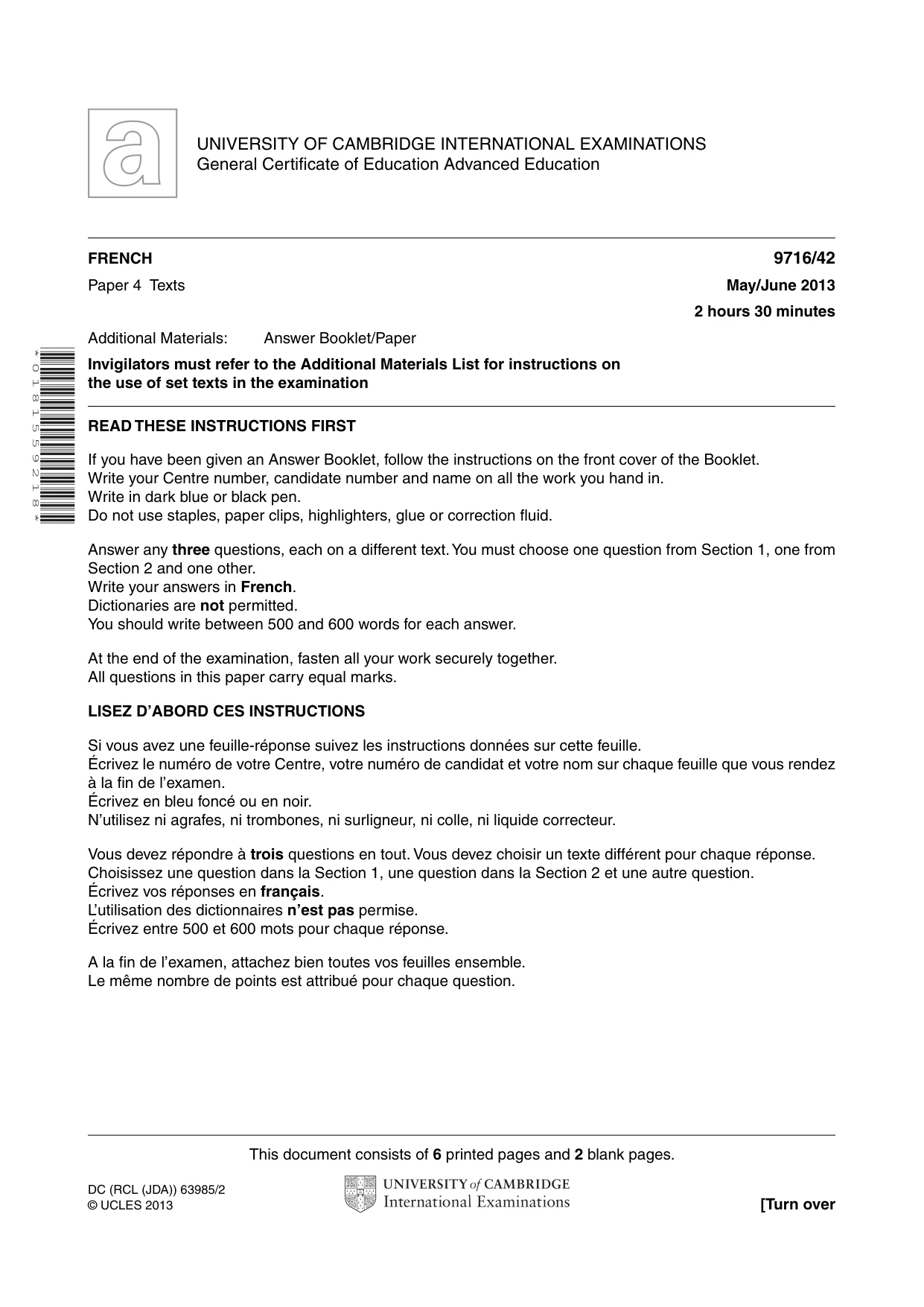
This document consists of 6 printed pages and 2 blank pages. DC (RCL (JDA)) 63985/2 © UCLES 2013 [Turn over UNIVERSITY OF CAMBRIDGE INTERNATIONAL EXAMINATIONS General Certificate of Education Advanced Education * 0 1 8 1 5 5 9 2 1 8 * FRENCH 9716/42 Paper 4 Texts May/June 2013 2 hours 30 minutes Additional Materials: Answer Booklet/Paper Invigilators must refer to the Additional Materials List for instructions on the use of set texts in the examination READ THESE INSTRUCTIONS FIRST If you have been given an Answer Booklet, follow the instructions on the front cover of the Booklet. Write your Centre number, candidate number and name on all the work you hand in. Write in dark blue or black pen. Do not use staples, paper clips, highlighters, glue or correction fluid. Answer any three questions, each on a different text. You must choose one question from Section 1, one from Section 2 and one other. Write your answers in French. Dictionaries are not permitted. You should write between 500 and 600 words for each answer. At the end of the examination, fasten all your work securely together. All questions in this paper carry equal marks. LISEZ D’ABORD CES INSTRUCTIONS Si vous avez une feuille-réponse suivez les instructions données sur cette feuille. Écrivez le numéro de votre Centre, votre numéro de candidat et votre nom sur chaque feuille que vous rendez à la fin de l’examen. Écrivez en bleu foncé ou en noir. N’utilisez ni agrafes, ni trombones, ni surligneur, ni colle, ni liquide correcteur. Vous devez répondre à trois questions en tout. Vous devez choisir un texte différent pour chaque réponse. Choisissez une question dans la Section 1, une question dans la Section 2 et une autre question. Écrivez vos réponses en français. L’utilisation des dictionnaires n’est pas permise. Écrivez entre 500 et 600 mots pour chaque réponse. A la fin de l’examen, attachez bien toutes vos feuilles ensemble. Le même nombre de points est attribué pour chaque question.
Question paper, page 2
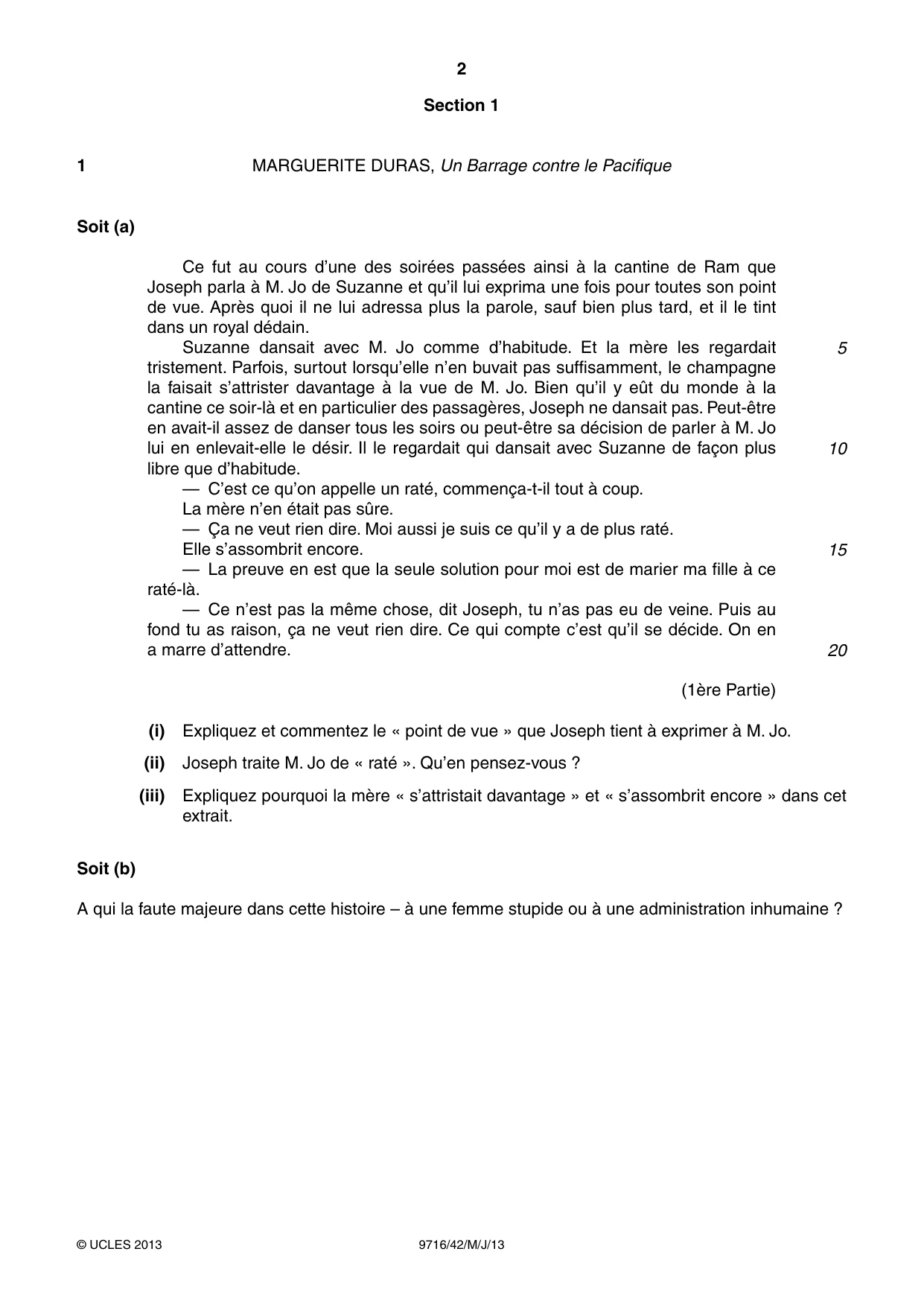
2 9716/42/M/J/13 © UCLES 2013 Section 1 1 MARGUERITE DURAS, Un Barrage contre le Pacifique Soit (a) Ce fut au cours d’une des soirées passées ainsi à la cantine de Ram que Joseph parla à M. Jo de Suzanne et qu’il lui exprima une fois pour toutes son point de vue. Après quoi il ne lui adressa plus la parole, sauf bien plus tard, et il le tint dans un royal dédain. Suzanne dansait avec M. Jo comme d’habitude. Et la mère les regardait tristement. Parfois, surtout lorsqu’elle n’en buvait pas suffisamment, le champagne la faisait s’attrister davantage à la vue de M. Jo. Bien qu’il y eût du monde à la cantine ce soir-là et en particulier des passagères, Joseph ne dansait pas. Peut-être en avait-il assez de danser tous les soirs ou peut-être sa décision de parler à M. Jo lui en enlevait-elle le désir. Il le regardait qui dansait avec Suzanne de façon plus libre que d’habitude. — C’est ce qu’on appelle un raté, commença-t-il tout à coup. La mère n’en était pas sûre. — Ça ne veut rien dire. Moi aussi je suis ce qu’il y a de plus raté. Elle s’assombrit encore. — La preuve en est que la seule solution pour moi est de marier ma fille à ce raté-là. — Ce n’est pas la même chose, dit Joseph, tu n’as pas eu de veine. Puis au fond tu as raison, ça ne veut rien dire. Ce qui compte c’est qu’il se décide. On en a marre d’attendre. (1ère Partie) (i) Expliquez et commentez le « point de vue » que Joseph tient à exprimer à M. Jo. (ii) Joseph traite M. Jo de « raté ». Qu’en pensez-vous ? (iii) Expliquez pourquoi la mère « s’attristait davantage » et « s’assombrit encore » dans cet extrait. Soit (b) A qui la faute majeure dans cette histoire – à une femme stupide ou à une administration inhumaine ? 5 10 15 20
Question paper, page 3
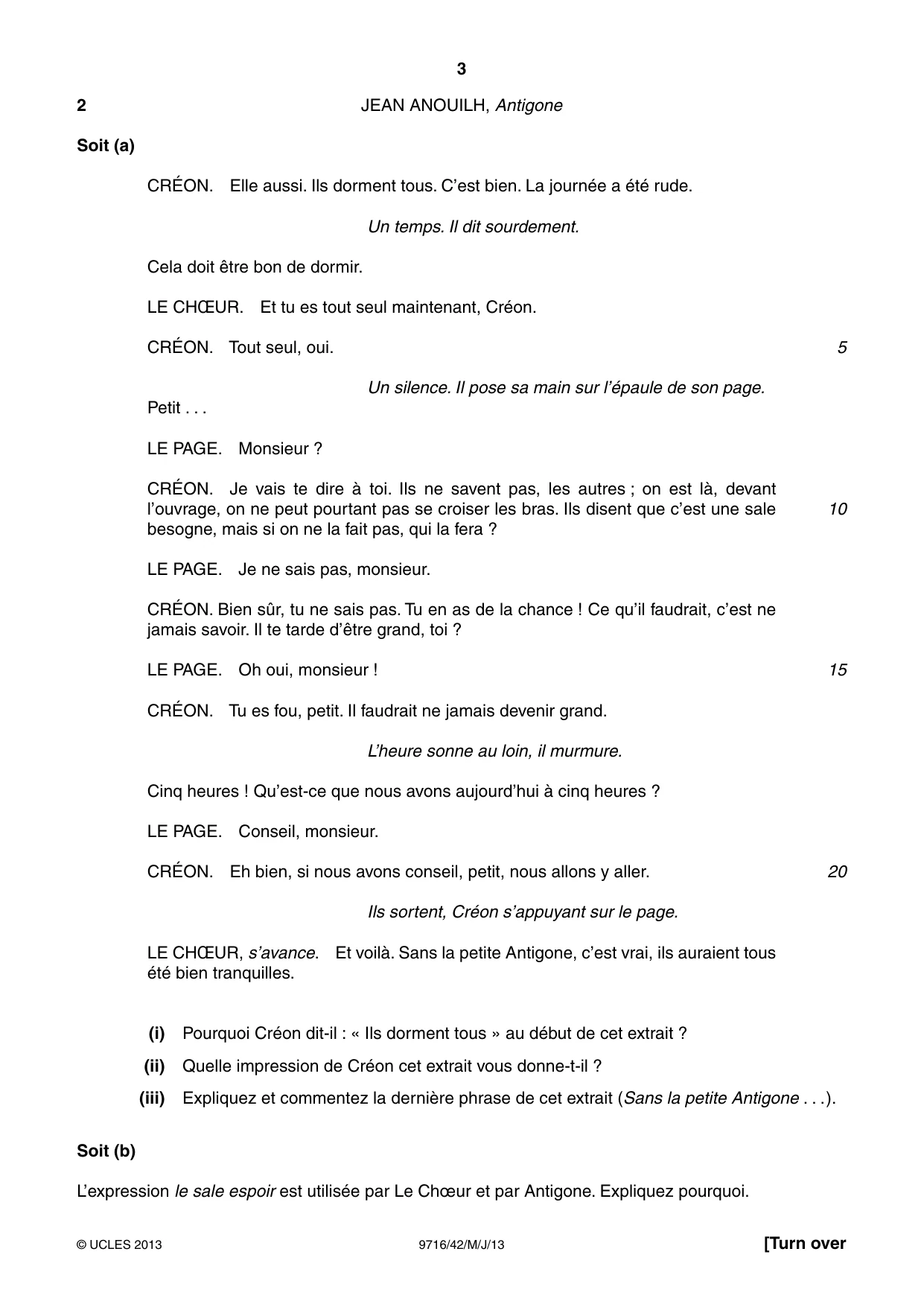
3 9716/42/M/J/13 © UCLES 2013 [Turn over 2 JEAN ANOUILH, Antigone Soit (a) CRÉON. Elle aussi. Ils dorment tous. C’est bien. La journée a été rude. Un temps. Il dit sourdement. Cela doit être bon de dormir. LE CHŒUR. Et tu es tout seul maintenant, Créon. CRÉON. Tout seul, oui. Un silence. Il pose sa main sur l’épaule de son page. Petit . . . LE PAGE. Monsieur ? CRÉON. Je vais te dire à toi. Ils ne savent pas, les autres ; on est là, devant l’ouvrage, on ne peut pourtant pas se croiser les bras. Ils disent que c’est une sale besogne, mais si on ne la fait pas, qui la fera ? LE PAGE. Je ne sais pas, monsieur. CRÉON. Bien sûr, tu ne sais pas. Tu en as de la chance ! Ce qu’il faudrait, c’est ne jamais savoir. Il te tarde d’être grand, toi ? LE PAGE. Oh oui, monsieur ! CRÉON. Tu es fou, petit. Il faudrait ne jamais devenir grand. L’heure sonne au loin, il murmure. Cinq heures ! Qu’est-ce que nous avons aujourd’hui à cinq heures ? LE PAGE. Conseil, monsieur. CRÉON. Eh bien, si nous avons conseil, petit, nous allons y aller. Ils sortent, Créon s’appuyant sur le page. LE CHŒUR, s’avance. Et voilà. Sans la petite Antigone, c’est vrai, ils auraient tous été bien tranquilles. (i) Pourquoi Créon dit-il : « Ils dorment tous » au début de cet extrait ? (ii) Quelle impression de Créon cet extrait vous donne-t-il ? (iii) Expliquez et commentez la dernière phrase de cet extrait (Sans la petite Antigone . . . ). Soit (b) L’expression le sale espoir est utilisée par Le Chœur et par Antigone. Expliquez pourquoi. 5 10 15 20
Question paper, page 4
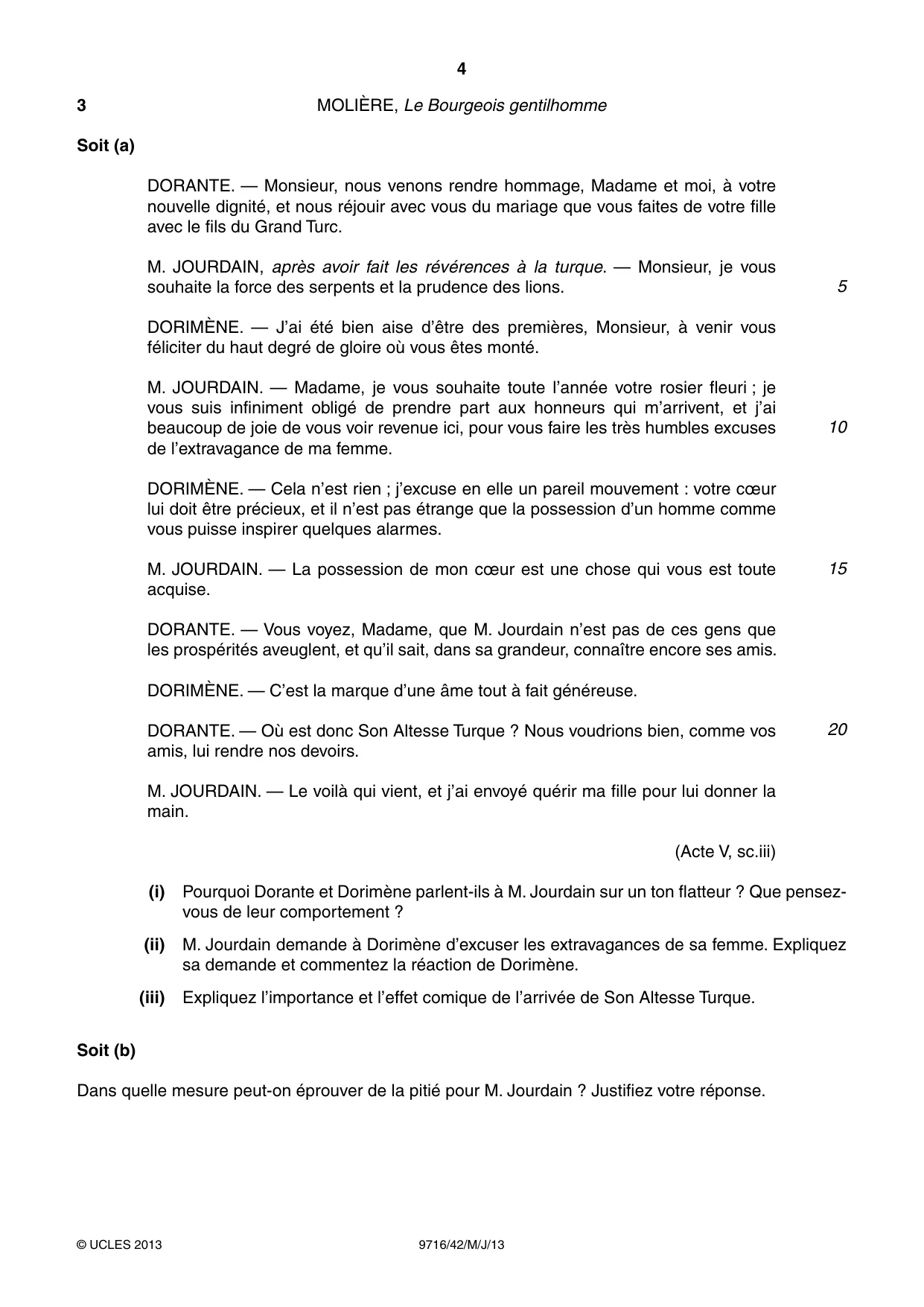
4 9716/42/M/J/13 © UCLES 2013 3 MOLIÈRE, Le Bourgeois gentilhomme Soit (a) DORANTE. — Monsieur, nous venons rendre hommage, Madame et moi, à votre nouvelle dignité, et nous réjouir avec vous du mariage que vous faites de votre fille avec le fils du Grand Turc. M. JOURDAIN, après avoir fait les révérences à la turque. — Monsieur, je vous souhaite la force des serpents et la prudence des lions. DORIMÈNE. — J’ai été bien aise d’être des premières, Monsieur, à venir vous féliciter du haut degré de gloire où vous êtes monté. M. JOURDAIN. — Madame, je vous souhaite toute l’année votre rosier fleuri ; je vous suis infiniment obligé de prendre part aux honneurs qui m’arrivent, et j’ai beaucoup de joie de vous voir revenue ici, pour vous faire les très humbles excuses de l’extravagance de ma femme. DORIMÈNE. — Cela n’est rien ; j’excuse en elle un pareil mouvement : votre cœur lui doit être précieux, et il n’est pas étrange que la possession d’un homme comme vous puisse inspirer quelques alarmes. M. JOURDAIN. — La possession de mon cœur est une chose qui vous est toute acquise. DORANTE. — Vous voyez, Madame, que M. Jourdain n’est pas de ces gens que les prospérités aveuglent, et qu’il sait, dans sa grandeur, connaître encore ses amis. DORIMÈNE. — C’est la marque d’une âme tout à fait généreuse. DORANTE. — Où est donc Son Altesse Turque ? Nous voudrions bien, comme vos amis, lui rendre nos devoirs. M. JOURDAIN. — Le voilà qui vient, et j’ai envoyé quérir ma fille pour lui donner la main. (Acte V, sc.iii) (i) Pourquoi Dorante et Dorimène parlent-ils à M. Jourdain sur un ton flatteur ? Que pensez- vous de leur comportement ? (ii) M. Jourdain demande à Dorimène d’excuser les extravagances de sa femme. Expliquez sa demande et commentez la réaction de Dorimène. (iii) Expliquez l’importance et l’effet comique de l’arrivée de Son Altesse Turque. Soit (b) Dans quelle mesure peut-on éprouver de la pitié pour M. Jourdain ? Justifiez votre réponse. 5 10 15 20
Question paper, page 5
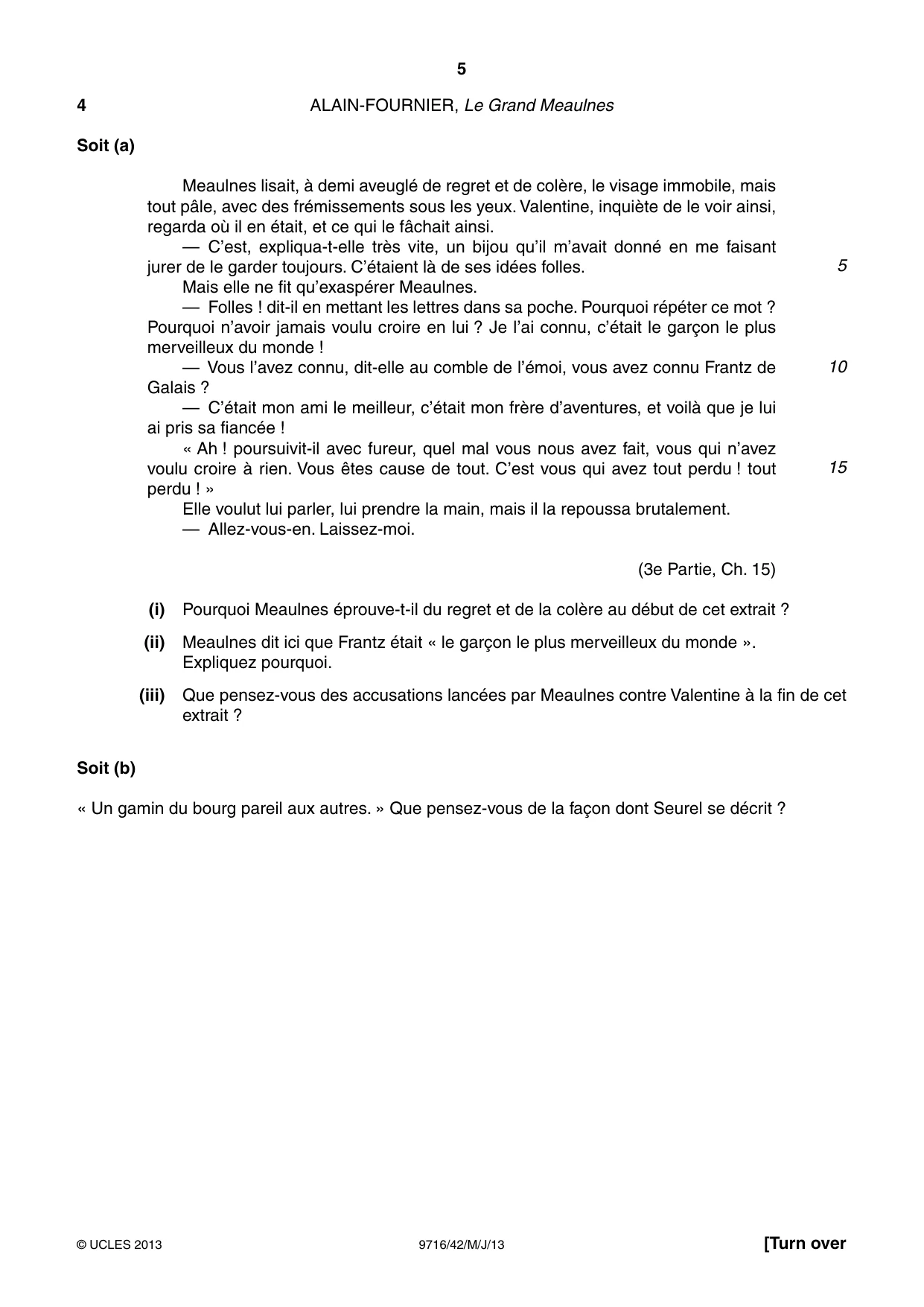
5 9716/42/M/J/13 © UCLES 2013 [Turn over 4 ALAIN-FOURNIER, Le Grand Meaulnes Soit (a) Meaulnes lisait, à demi aveuglé de regret et de colère, le visage immobile, mais tout pâle, avec des frémissements sous les yeux. Valentine, inquiète de le voir ainsi, regarda où il en était, et ce qui le fâchait ainsi. — C’est, expliqua-t-elle très vite, un bijou qu’il m’avait donné en me faisant jurer de le garder toujours. C’étaient là de ses idées folles. Mais elle ne fit qu’exaspérer Meaulnes. — Folles ! dit-il en mettant les lettres dans sa poche. Pourquoi répéter ce mot ? Pourquoi n’avoir jamais voulu croire en lui ? Je l’ai connu, c’était le garçon le plus merveilleux du monde ! — Vous l’avez connu, dit-elle au comble de l’émoi, vous avez connu Frantz de Galais ? — C’était mon ami le meilleur, c’était mon frère d’aventures, et voilà que je lui ai pris sa fiancée ! « Ah ! poursuivit-il avec fureur, quel mal vous nous avez fait, vous qui n’avez voulu croire à rien. Vous êtes cause de tout. C’est vous qui avez tout perdu ! tout perdu ! » Elle voulut lui parler, lui prendre la main, mais il la repoussa brutalement. — Allez-vous-en. Laissez-moi. (3e Partie, Ch. 15) (i) Pourquoi Meaulnes éprouve-t-il du regret et de la colère au début de cet extrait ? (ii) Meaulnes dit ici que Frantz était « le garçon le plus merveilleux du monde ». Expliquez pourquoi. (iii) Que pensez-vous des accusations lancées par Meaulnes contre Valentine à la fin de cet extrait ? Soit (b) « Un gamin du bourg pareil aux autres. » Que pensez-vous de la façon dont Seurel se décrit ? 5 10 15
Question paper, page 6
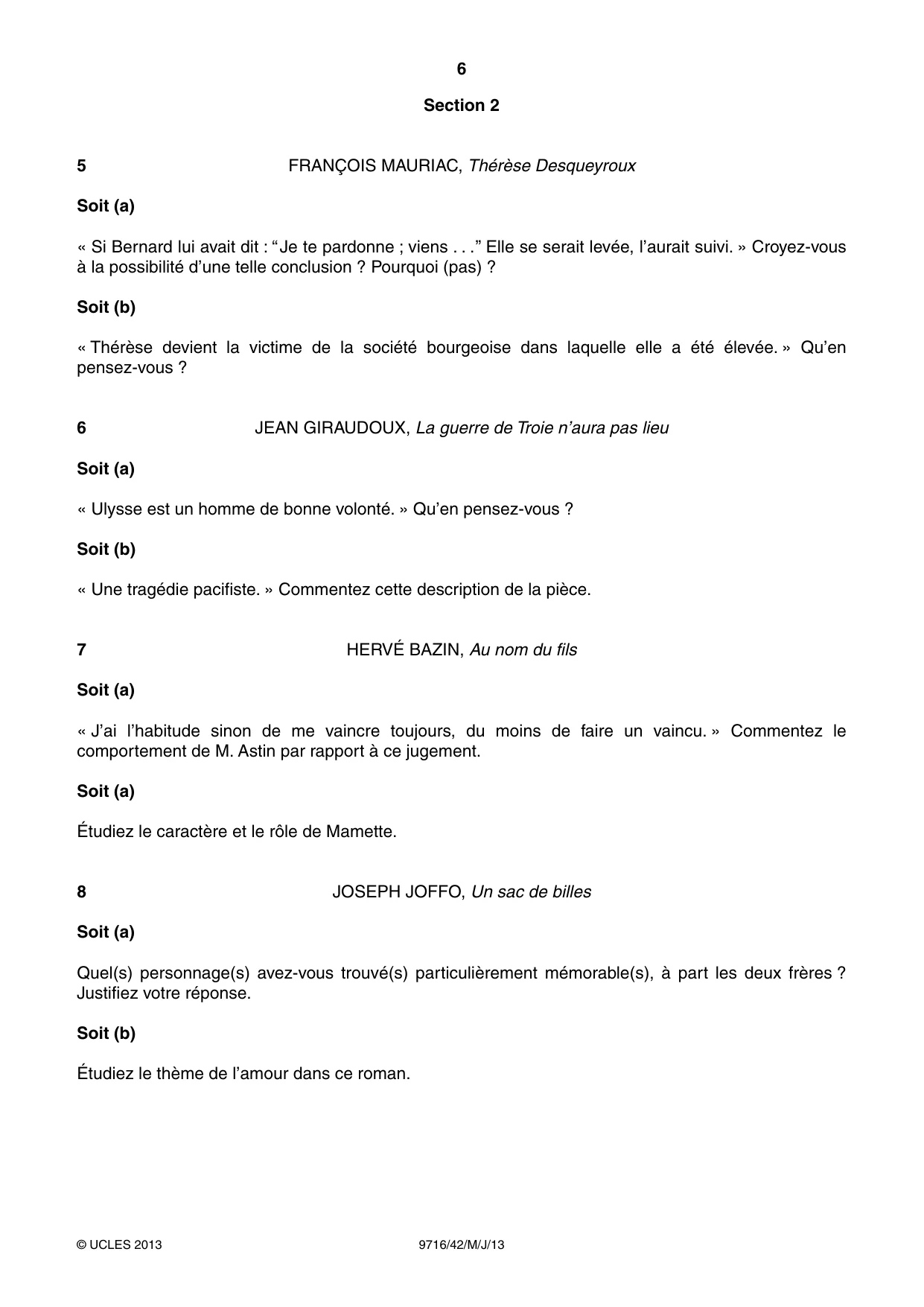
6 9716/42/M/J/13 © UCLES 2013 Section 2 5 FRANÇOIS MAURIAC, Thérèse Desqueyroux Soit (a) « Si Bernard lui avait dit : “ Je te pardonne ; viens . . . ” Elle se serait levée, l’aurait suivi. » Croyez-vous à la possibilité d’une telle conclusion ? Pourquoi (pas) ? Soit (b) « Thérèse devient la victime de la société bourgeoise dans laquelle elle a été élevée. » Qu’en pensez-vous ? 6 JEAN GIRAUDOUX, La guerre de Troie n’aura pas lieu Soit (a) « Ulysse est un homme de bonne volonté. » Qu’en pensez-vous ? Soit (b) « Une tragédie pacifiste. » Commentez cette description de la pièce. 7 HERVÉ BAZIN, Au nom du fils Soit (a) « J’ai l’habitude sinon de me vaincre toujours, du moins de faire un vaincu. » Commentez le comportement de M. Astin par rapport à ce jugement. Soit (a) Étudiez le caractère et le rôle de Mamette. 8 JOSEPH JOFFO, Un sac de billes Soit (a) Quel(s) personnage(s) avez-vous trouvé(s) particulièrement mémorable(s), à part les deux frères ? Justifiez votre réponse. Soit (b) Étudiez le thème de l’amour dans ce roman.
Question paper, page 7
7 9716/42/M/J/13 © UCLES 2013 BLANK PAGE
Question paper, page 8
8 9716/42/M/J/13 © UCLES 2013 BLANK PAGE Copyright Acknowledgements: Question 1 © Marguerite Duras; Un barrage contre le Pacifique; Gallimard; 1950. Question 2 © Jean Anouilh; Antigone; Harrap; 1954. Permission to reproduce items where third-party owned material protected by copyright is included has been sought and cleared where possible. Every reasonable effort has been made by the publisher (UCLES) to trace copyright holders, but if any items requiring clearance have unwittingly been included, the publisher will be pleased to make amends at the earliest possible opportunity. University of Cambridge International Examinations is part of the Cambridge Assessment Group. Cambridge Assessment is the brand name of University of Cambridge Local Examinations Syndicate (UCLES), which is itself a department of the University of Cambridge.
Mark scheme, page 1
CAMBRIDGE INTERNATIONAL EXAMINATIONS GCE Advanced Level MARK SCHEME for the May/June 2013 series 9716 FRENCH 9716/42 Paper 4 (Texts), maximum raw mark 75 This mark scheme is published as an aid to teachers and candidates, to indicate the requirements of the examination. It shows the basis on which Examiners were instructed to award marks. It does not indicate the details of the discussions that took place at an Examiners’ meeting before marking began, which would have considered the acceptability of alternative answers. Mark schemes should be read in conjunction with the question paper and the Principal Examiner Report for Teachers. Cambridge will not enter into discussions about these mark schemes. Cambridge is publishing the mark schemes for the May/June 2013 series for most IGCSE, GCE Advanced Level and Advanced Subsidiary Level components and some Ordinary Level components.
Mark scheme, page 2
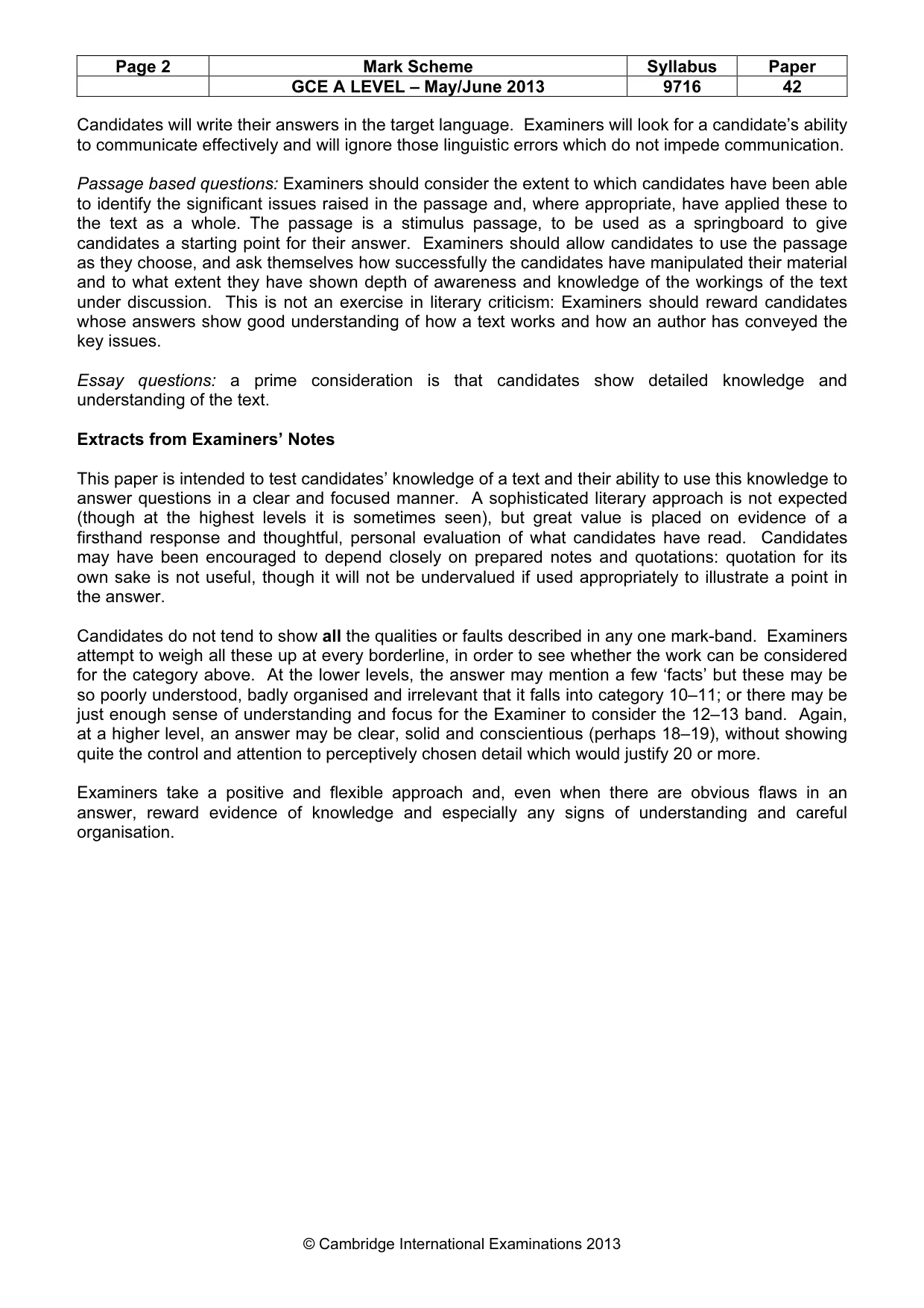
Page 2 Mark Scheme Syllabus Paper GCE A LEVEL – May/June 2013 9716 42 © Cambridge International Examinations 2013 Candidates will write their answers in the target language. Examiners will look for a candidate’s ability to communicate effectively and will ignore those linguistic errors which do not impede communication. Passage based questions: Examiners should consider the extent to which candidates have been able to identify the significant issues raised in the passage and, where appropriate, have applied these to the text as a whole. The passage is a stimulus passage, to be used as a springboard to give candidates a starting point for their answer. Examiners should allow candidates to use the passage as they choose, and ask themselves how successfully the candidates have manipulated their material and to what extent they have shown depth of awareness and knowledge of the workings of the text under discussion. This is not an exercise in literary criticism: Examiners should reward candidates whose answers show good understanding of how a text works and how an author has conveyed the key issues. Essay questions: a prime consideration is that candidates show detailed knowledge and understanding of the text. Extracts from Examiners’ Notes This paper is intended to test candidates’ knowledge of a text and their ability to use this knowledge to answer questions in a clear and focused manner. A sophisticated literary approach is not expected (though at the highest levels it is sometimes seen), but great value is placed on evidence of a firsthand response and thoughtful, personal evaluation of what candidates have read. Candidates may have been encouraged to depend closely on prepared notes and quotations: quotation for its own sake is not useful, though it will not be undervalued if used appropriately to illustrate a point in the answer. Candidates do not tend to show all the qualities or faults described in any one mark-band. Examiners attempt to weigh all these up at every borderline, in order to see whether the work can be considered for the category above. At the lower levels, the answer may mention a few ‘facts’ but these may be so poorly understood, badly organised and irrelevant that it falls into category 10–11; or there may be just enough sense of understanding and focus for the Examiner to consider the 12–13 band. Again, at a higher level, an answer may be clear, solid and conscientious (perhaps 18–19), without showing quite the control and attention to perceptively chosen detail which would justify 20 or more. Examiners take a positive and flexible approach and, even when there are obvious flaws in an answer, reward evidence of knowledge and especially any signs of understanding and careful organisation.
Mark scheme, page 3
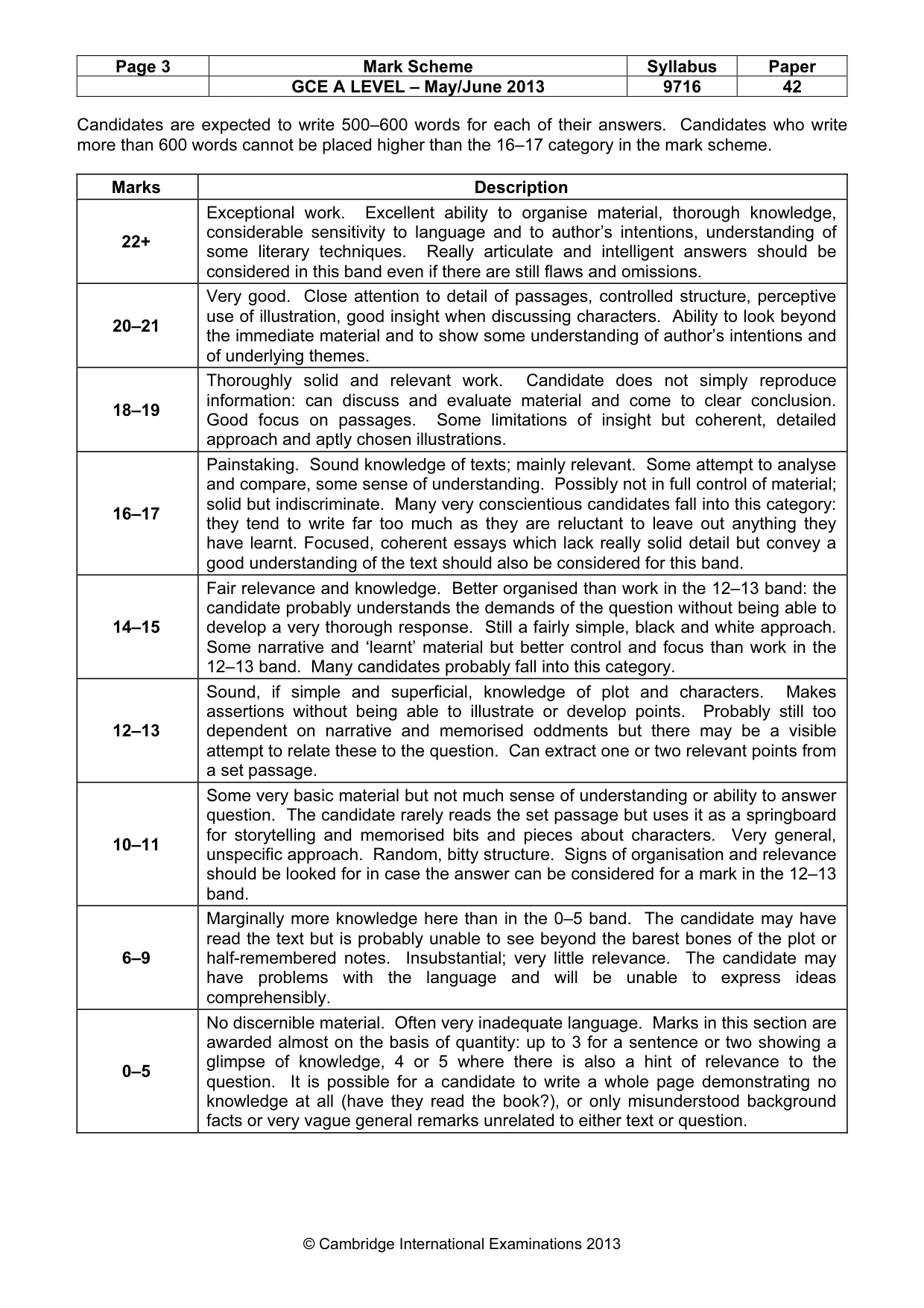
Page 3 Mark Scheme Syllabus Paper GCE A LEVEL – May/June 2013 9716 42 © Cambridge International Examinations 2013 Candidates are expected to write 500–600 words for each of their answers. Candidates who write more than 600 words cannot be placed higher than the 16–17 category in the mark scheme. Marks Description 22+ Exceptional work. Excellent ability to organise material, thorough knowledge, considerable sensitivity to language and to author’s intentions, understanding of some literary techniques. Really articulate and intelligent answers should be considered in this band even if there are still flaws and omissions. 20–21 Very good. Close attention to detail of passages, controlled structure, perceptive use of illustration, good insight when discussing characters. Ability to look beyond the immediate material and to show some understanding of author’s intentions and of underlying themes. 18–19 Thoroughly solid and relevant work. Candidate does not simply reproduce information: can discuss and evaluate material and come to clear conclusion. Good focus on passages. Some limitations of insight but coherent, detailed approach and aptly chosen illustrations. 16–17 Painstaking. Sound knowledge of texts; mainly relevant. Some attempt to analyse and compare, some sense of understanding. Possibly not in full control of material; solid but indiscriminate. Many very conscientious candidates fall into this category: they tend to write far too much as they are reluctant to leave out anything they have learnt. Focused, coherent essays which lack really solid detail but convey a good understanding of the text should also be considered for this band. 14–15 Fair relevance and knowledge. Better organised than work in the 12–13 band: the candidate probably understands the demands of the question without being able to develop a very thorough response. Still a fairly simple, black and white approach. Some narrative and ‘learnt’ material but better control and focus than work in the 12–13 band. Many candidates probably fall into this category. 12–13 Sound, if simple and superficial, knowledge of plot and characters. Makes assertions without being able to illustrate or develop points. Probably still too dependent on narrative and memorised oddments but there may be a visible attempt to relate these to the question. Can extract one or two relevant points from a set passage. 10–11 Some very basic material but not much sense of understanding or ability to answer question. The candidate rarely reads the set passage but uses it as a springboard for storytelling and memorised bits and pieces about characters. Very general, unspecific approach. Random, bitty structure. Signs of organisation and relevance should be looked for in case the answer can be considered for a mark in the 12–13 band. 6–9 Marginally more knowledge here than in the 0–5 band. The candidate may have read the text but is probably unable to see beyond the barest bones of the plot or half-remembered notes. Insubstantial; very little relevance. The candidate may have problems with the language and will be unable to express ideas comprehensibly. 0–5 No discernible material. Often very inadequate language. Marks in this section are awarded almost on the basis of quantity: up to 3 for a sentence or two showing a glimpse of knowledge, 4 or 5 where there is also a hint of relevance to the question. It is possible for a candidate to write a whole page demonstrating no knowledge at all (have they read the book?), or only misunderstood background facts or very vague general remarks unrelated to either text or question.
What you needed in this session
Cambridge’s own grade thresholds for 2013 May/June, Paper 4 · Variant 2. A higher threshold means an easier paper — the bar moves with how the cohort did.