Cambridge A Level French (A Level only) 9716 — 2010 May/June Paper 4 · Variant 2
9716/42/M/J/10
The question paper and its mark scheme, free to read here and free to download. This is Cambridge’s own paper, exactly as it was sat.
Question paper8 pages
Mark scheme3 pages
Answers below. Sit the paper first if you are practising.
Paper as text
Question paper, page 1
This document consists of 7 printed pages and 1 blank page. DC (SM) 26307 © UCLES 2010 [Turn over UNIVERSITY OF CAMBRIDGE INTERNATIONAL EXAMINATIONS General Certificate of Education Advanced Level READ THESE INSTRUCTIONS FIRST If you have been given an Answer Booklet, follow the instructions on the front cover of the Booklet. Write your Centre number, candidate number and name on all the work you hand in. Write in dark blue or black pen. Do not use staples, paper clips, highlighters, glue or correction fluid. Answer any three questions, each on a different text. You must choose one question from Section 1, one from Section 2 and one other. Write your answers in French. Dictionaries are not permitted. You should write between 500 and 600 words for each answer. At the end of the examination, fasten all your work securely together. All questions in this paper carry equal marks. LISEZ D’ABORD CES INSTRUCTIONS Si vous avez une feuille-réponse suivez les instructions données sur cette feuille. Écrivez le numéro de votre Centre, votre numéro de candidat et votre nom sur chaque feuille que vous rendez à la fin de l’examen. Écrivez en bleu foncé ou en noir. N’utilisez ni agrafes, ni trombones, ni surligneur, ni colle, ni liquide correcteur. Vous devez répondre à trois questions en tout. Vous devez choisir un texte différent pour chaque réponse. Choisissez une question dans la Section 1, une question dans la Section 2 et une autre question. Écrivez vos réponses en français. L’utilisation des dictionnaires n’est pas permise. Écrivez entre 500 et 600 mots pour chaque réponse. A la fin de l’examen, attachez bien toutes vos feuilles ensemble. Le même nombre de points est attribué pour chaque question. * 5 8 4 6 6 4 7 9 4 8 * FRENCH 9716/42 Paper 4 Texts May/June 2010 2 hours 30 minutes Additional Materials: Answer Booklet/Paper Invigilators must refer to the Additional Materials List for instructions on the use of set texts in the examination.
Question paper, page 2
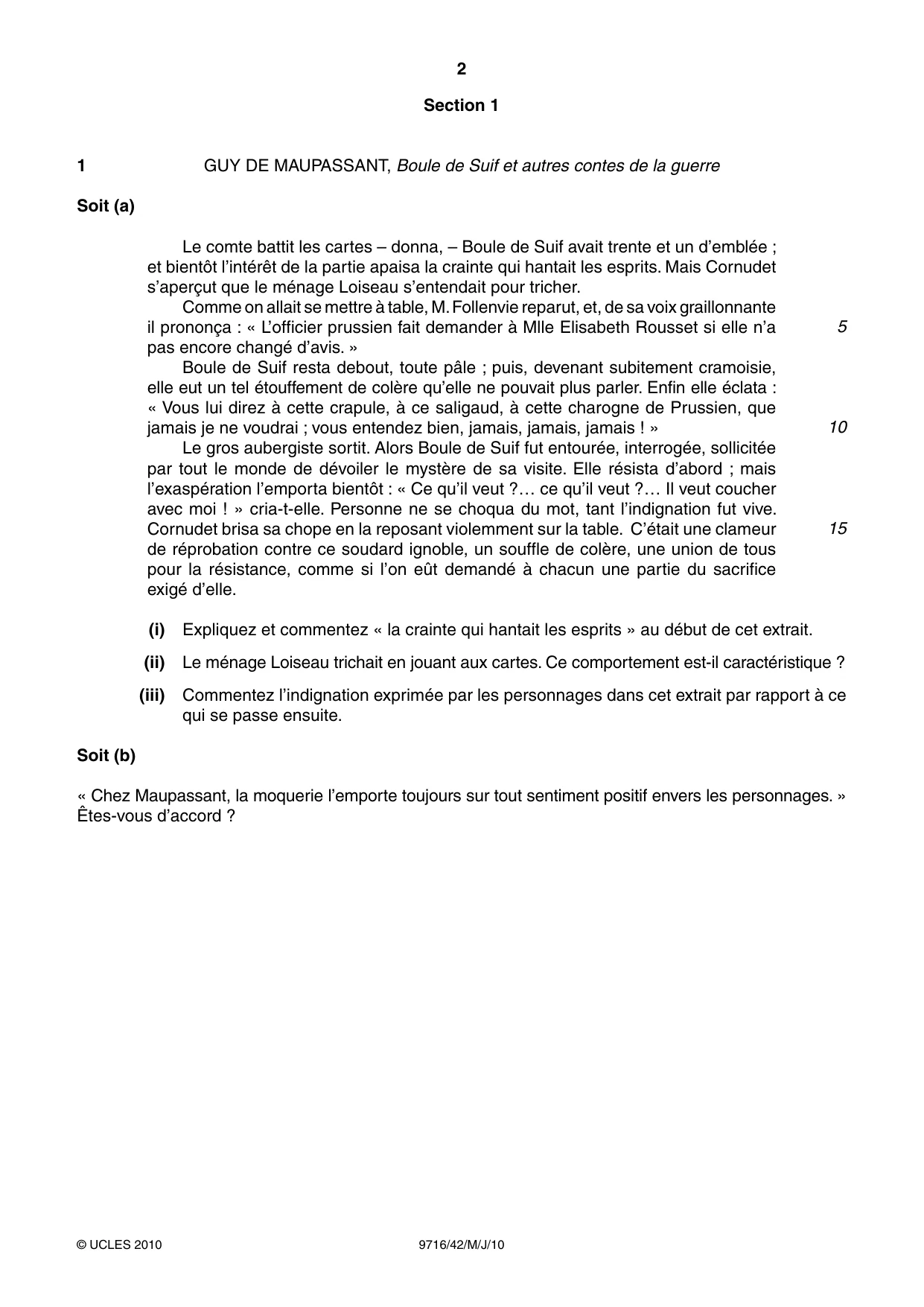
2 9716/42/M/J/10 © UCLES 2010 Section 1 1 GUY DE MAUPASSANT, Boule de Suif et autres contes de la guerre Soit (a) Le comte battit les cartes – donna, – Boule de Suif avait trente et un d’emblée ; et bientôt l’intérêt de la partie apaisa la crainte qui hantait les esprits. Mais Cornudet s’aperçut que le ménage Loiseau s’entendait pour tricher. Comme on allait se mettre à table, M. Follenvie reparut, et, de sa voix graillonnante il prononça : « L’officier prussien fait demander à Mlle Elisabeth Rousset si elle n’a pas encore changé d’avis. » Boule de Suif resta debout, toute pâle ; puis, devenant subitement cramoisie, elle eut un tel étouffement de colère qu’elle ne pouvait plus parler. Enfin elle éclata : « Vous lui direz à cette crapule, à ce saligaud, à cette charogne de Prussien, que jamais je ne voudrai ; vous entendez bien, jamais, jamais, jamais ! » Le gros aubergiste sortit. Alors Boule de Suif fut entourée, interrogée, sollicitée par tout le monde de dévoiler le mystère de sa visite. Elle résista d’abord ; mais l’exaspération l’emporta bientôt : « Ce qu’il veut ?… ce qu’il veut ?… Il veut coucher avec moi ! » cria-t-elle. Personne ne se choqua du mot, tant l’indignation fut vive. Cornudet brisa sa chope en la reposant violemment sur la table. C’était une clameur de réprobation contre ce soudard ignoble, un souffle de colère, une union de tous pour la résistance, comme si l’on eût demandé à chacun une partie du sacrifice exigé d’elle. (i) Expliquez et commentez « la crainte qui hantait les esprits » au début de cet extrait. (ii) Le ménage Loiseau trichait en jouant aux cartes. Ce comportement est-il caractéristique ? (iii) Commentez l’indignation exprimée par les personnages dans cet extrait par rapport à ce qui se passe ensuite. Soit (b) « Chez Maupassant, la moquerie l’emporte toujours sur tout sentiment positif envers les personnages. » Êtes-vous d’accord ? 5 10 15
Question paper, page 3
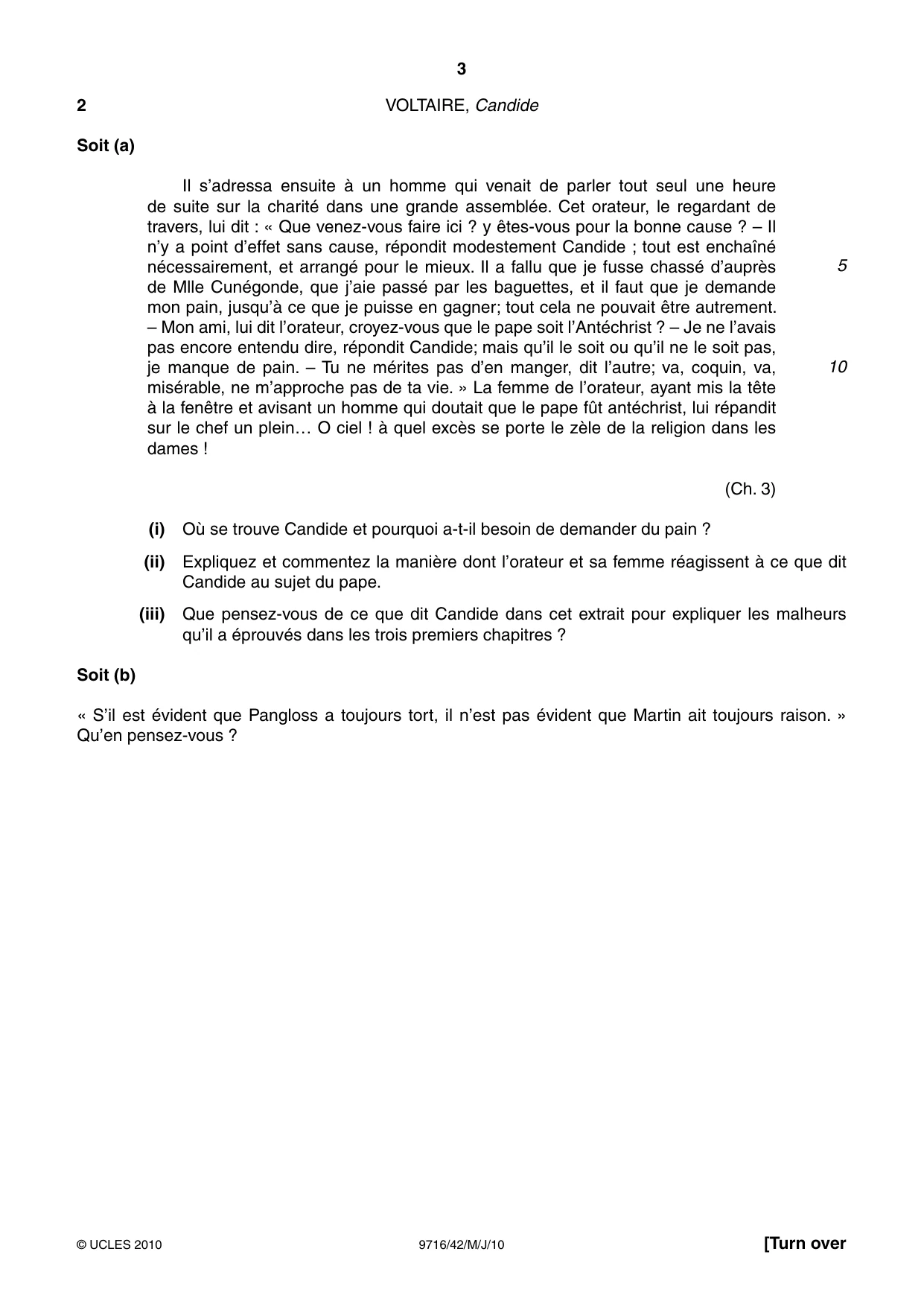
3 9716/42/M/J/10 © UCLES 2010 [Turn over 2 VOLTAIRE, Candide Soit (a) Il s’adressa ensuite à un homme qui venait de parler tout seul une heure de suite sur la charité dans une grande assemblée. Cet orateur, le regardant de travers, lui dit : « Que venez-vous faire ici ? y êtes-vous pour la bonne cause ? – Il n’y a point d’effet sans cause, répondit modestement Candide ; tout est enchaîné nécessairement, et arrangé pour le mieux. Il a fallu que je fusse chassé d’auprès de Mlle Cunégonde, que j’aie passé par les baguettes, et il faut que je demande mon pain, jusqu’à ce que je puisse en gagner; tout cela ne pouvait être autrement. – Mon ami, lui dit l’orateur, croyez-vous que le pape soit l’Antéchrist ? – Je ne l’avais pas encore entendu dire, répondit Candide; mais qu’il le soit ou qu’il ne le soit pas, je manque de pain. – Tu ne mérites pas d’en manger, dit l’autre; va, coquin, va, misérable, ne m’approche pas de ta vie. » La femme de l’orateur, ayant mis la tête à la fenêtre et avisant un homme qui doutait que le pape fût antéchrist, lui répandit sur le chef un plein… O ciel ! à quel excès se porte le zèle de la religion dans les dames ! (Ch. 3) (i) Où se trouve Candide et pourquoi a-t-il besoin de demander du pain ? (ii) Expliquez et commentez la manière dont l’orateur et sa femme réagissent à ce que dit Candide au sujet du pape. (iii) Que pensez-vous de ce que dit Candide dans cet extrait pour expliquer les malheurs qu’il a éprouvés dans les trois premiers chapitres ? Soit (b) « S’il est évident que Pangloss a toujours tort, il n’est pas évident que Martin ait toujours raison. » Qu’en pensez-vous ? 5 10
Question paper, page 4
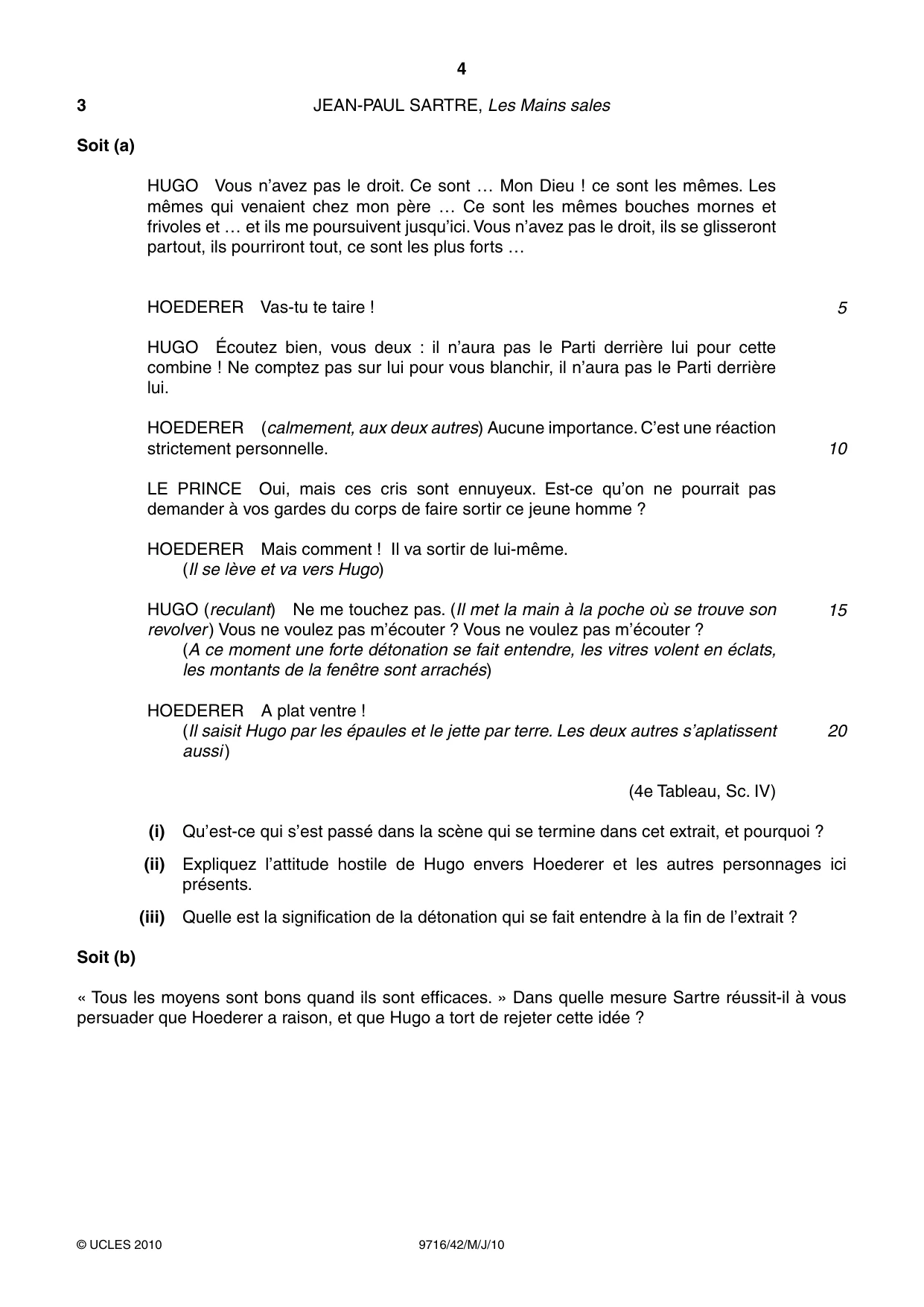
4 9716/42/M/J/10 © UCLES 2010 3 JEAN-PAUL SARTRE, Les Mains sales Soit (a) HUGO Vous n’avez pas le droit. Ce sont … Mon Dieu ! ce sont les mêmes. Les mêmes qui venaient chez mon père … Ce sont les mêmes bouches mornes et frivoles et … et ils me poursuivent jusqu’ici. Vous n’avez pas le droit, ils se glisseront partout, ils pourriront tout, ce sont les plus forts … HOEDERER Vas-tu te taire ! HUGO Écoutez bien, vous deux : il n’aura pas le Parti derrière lui pour cette combine ! Ne comptez pas sur lui pour vous blanchir, il n’aura pas le Parti derrière lui. HOEDERER (calmement, aux deux autres) Aucune importance. C’est une réaction strictement personnelle. LE PRINCE Oui, mais ces cris sont ennuyeux. Est-ce qu’on ne pourrait pas demander à vos gardes du corps de faire sortir ce jeune homme ? HOEDERER Mais comment ! Il va sortir de lui-même. (Il se lève et va vers Hugo) HUGO (reculant) Ne me touchez pas. (Il met la main à la poche où se trouve son revolver ) Vous ne voulez pas m’écouter ? Vous ne voulez pas m’écouter ? (A ce moment une forte détonation se fait entendre, les vitres volent en éclats, les montants de la fenêtre sont arrachés) HOEDERER A plat ventre ! (Il saisit Hugo par les épaules et le jette par terre. Les deux autres s’aplatissent aussi ) (4e Tableau, Sc. IV) (i) Qu’est-ce qui s’est passé dans la scène qui se termine dans cet extrait, et pourquoi ? (ii) Expliquez l’attitude hostile de Hugo envers Hoederer et les autres personnages ici présents. (iii) Quelle est la signification de la détonation qui se fait entendre à la fin de l’extrait ? Soit (b) « Tous les moyens sont bons quand ils sont efficaces. » Dans quelle mesure Sartre réussit-il à vous persuader que Hoederer a raison, et que Hugo a tort de rejeter cette idée ? 5 10 15 20
Question paper, page 5
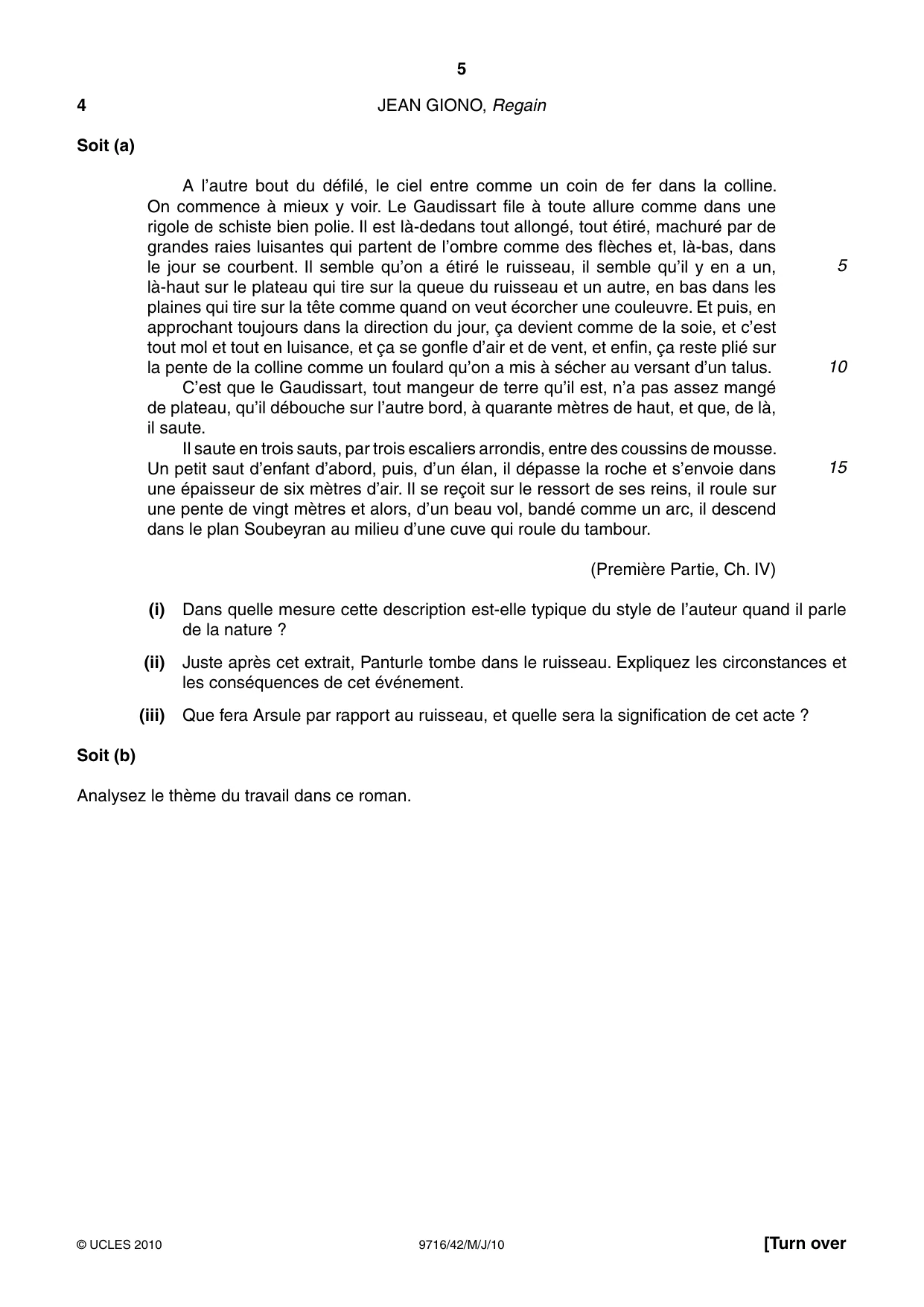
5 9716/42/M/J/10 © UCLES 2010 [Turn over 4 JEAN GIONO, Regain Soit (a) A l’autre bout du défilé, le ciel entre comme un coin de fer dans la colline. On commence à mieux y voir. Le Gaudissart file à toute allure comme dans une rigole de schiste bien polie. Il est là-dedans tout allongé, tout étiré, machuré par de grandes raies luisantes qui partent de l’ombre comme des flèches et, là-bas, dans le jour se courbent. Il semble qu’on a étiré le ruisseau, il semble qu’il y en a un, là-haut sur le plateau qui tire sur la queue du ruisseau et un autre, en bas dans les plaines qui tire sur la tête comme quand on veut écorcher une couleuvre. Et puis, en approchant toujours dans la direction du jour, ça devient comme de la soie, et c’est tout mol et tout en luisance, et ça se gonfle d’air et de vent, et enfin, ça reste plié sur la pente de la colline comme un foulard qu’on a mis à sécher au versant d’un talus. C’est que le Gaudissart, tout mangeur de terre qu’il est, n’a pas assez mangé de plateau, qu’il débouche sur l’autre bord, à quarante mètres de haut, et que, de là, il saute. Il saute en trois sauts, par trois escaliers arrondis, entre des coussins de mousse. Un petit saut d’enfant d’abord, puis, d’un élan, il dépasse la roche et s’envoie dans une épaisseur de six mètres d’air. Il se reçoit sur le ressort de ses reins, il roule sur une pente de vingt mètres et alors, d’un beau vol, bandé comme un arc, il descend dans le plan Soubeyran au milieu d’une cuve qui roule du tambour. (Première Partie, Ch. IV) (i) Dans quelle mesure cette description est-elle typique du style de l’auteur quand il parle de la nature ? (ii) Juste après cet extrait, Panturle tombe dans le ruisseau. Expliquez les circonstances et les conséquences de cet événement. (iii) Que fera Arsule par rapport au ruisseau, et quelle sera la signification de cet acte ? Soit (b) Analysez le thème du travail dans ce roman. 5 10 15
Question paper, page 6
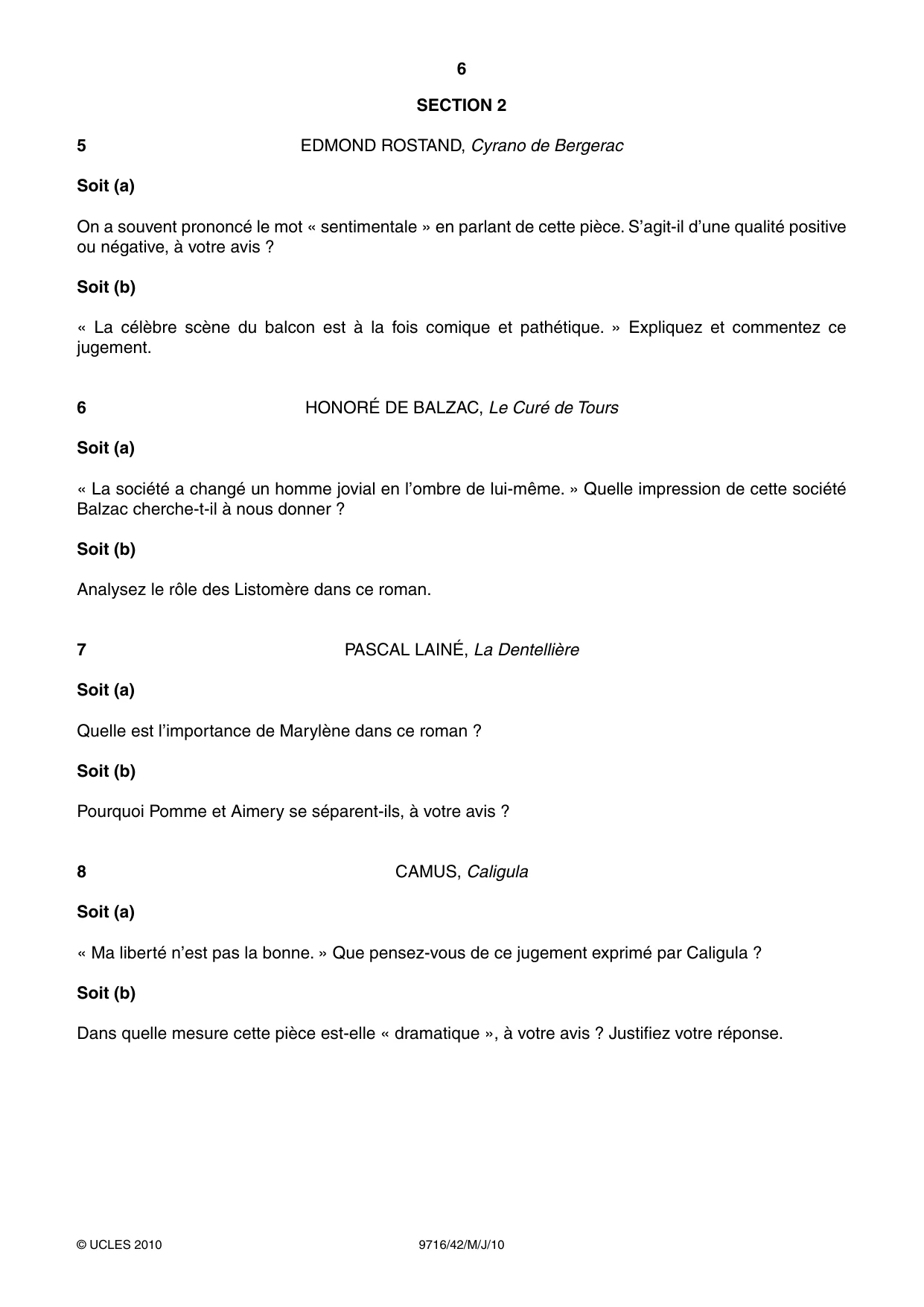
6 9716/42/M/J/10 © UCLES 2010 SECTION 2 5 EDMOND ROSTAND, Cyrano de Bergerac Soit (a) On a souvent prononcé le mot « sentimentale » en parlant de cette pièce. S’agit-il d’une qualité positive ou négative, à votre avis ? Soit (b) « La célèbre scène du balcon est à la fois comique et pathétique. » Expliquez et commentez ce jugement. 6 HONORÉ DE BALZAC, Le Curé de Tours Soit (a) « La société a changé un homme jovial en l’ombre de lui-même. » Quelle impression de cette société Balzac cherche-t-il à nous donner ? Soit (b) Analysez le rôle des Listomère dans ce roman. 7 PASCAL LAINÉ, La Dentellière Soit (a) Quelle est l’importance de Marylène dans ce roman ? Soit (b) Pourquoi Pomme et Aimery se séparent-ils, à votre avis ? 8 CAMUS, Caligula Soit (a) « Ma liberté n’est pas la bonne. » Que pensez-vous de ce jugement exprimé par Caligula ? Soit (b) Dans quelle mesure cette pièce est-elle « dramatique », à votre avis ? Justifiez votre réponse.
Question paper, page 7
7 9716/42/M/J/10 © UCLES 2010 9 COLETTE, Le Blé en herbe Soit (a) « Colette ne voit rien de positif dans le passage de l’adolescence à l’âge adulte. » Est-ce vrai, à votre avis ? Soit (b) « Pour Colette, l’homme est essentiellement inférieur à la femme. » Dans quelle mesure Colette communique-t-elle cette opinion dans Le Blé en herbe ?
Question paper, page 8
8 9716/42/M/J/10 © UCLES 2010 BLANK PAGE Copyright Acknowledgements: Question 3 © Sartre; Les Mains sales; Editions Gallimard; 1963. Question 4 © Giono; Regain; Editions Bernard Grasset; 1967. Permission to reproduce items where third-party owned material protected by copyright is included has been sought and cleared where possible. Every reasonable effort has been made by the publisher (UCLES) to trace copyright holders, but if any items requiring clearance have unwittingly been included, the publisher will be pleased to make amends at the earliest possible opportunity. University of Cambridge International Examinations is part of the Cambridge Assessment Group. Cambridge Assessment is the brand name of University of Cambridge Local Examinations Syndicate (UCLES), which is itself a department of the University of Cambridge.
Mark scheme, page 1
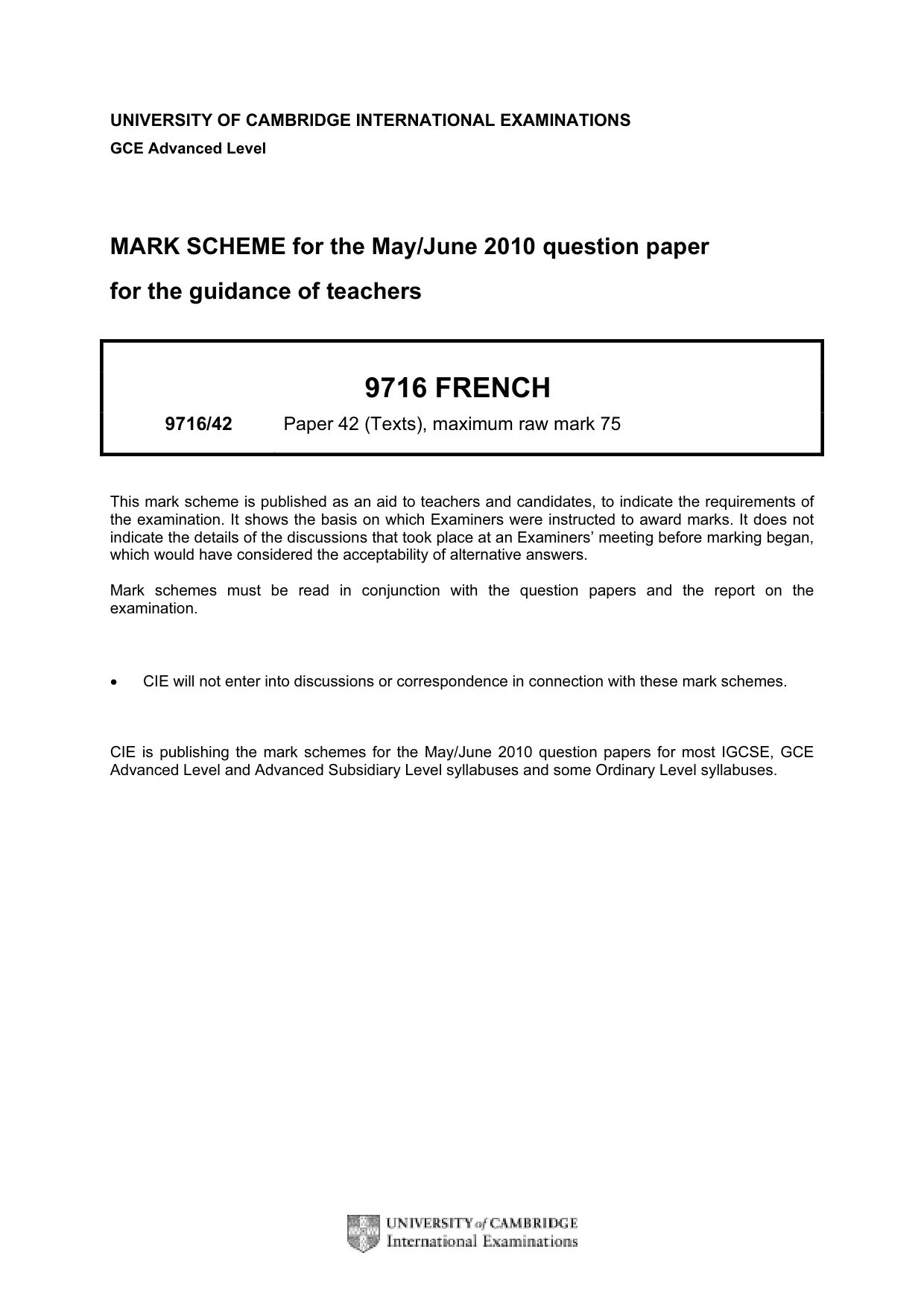
UNIVERSITY OF CAMBRIDGE INTERNATIONAL EXAMINATIONS GCE Advanced Level MARK SCHEME for the May/June 2010 question paper for the guidance of teachers 9716 FRENCH 9716/42 Paper 42 (Texts), maximum raw mark 75 This mark scheme is published as an aid to teachers and candidates, to indicate the requirements of the examination. It shows the basis on which Examiners were instructed to award marks. It does not indicate the details of the discussions that took place at an Examiners’ meeting before marking began, which would have considered the acceptability of alternative answers. Mark schemes must be read in conjunction with the question papers and the report on the examination. • CIE will not enter into discussions or correspondence in connection with these mark schemes. CIE is publishing the mark schemes for the May/June 2010 question papers for most IGCSE, GCE Advanced Level and Advanced Subsidiary Level syllabuses and some Ordinary Level syllabuses.
Mark scheme, page 2
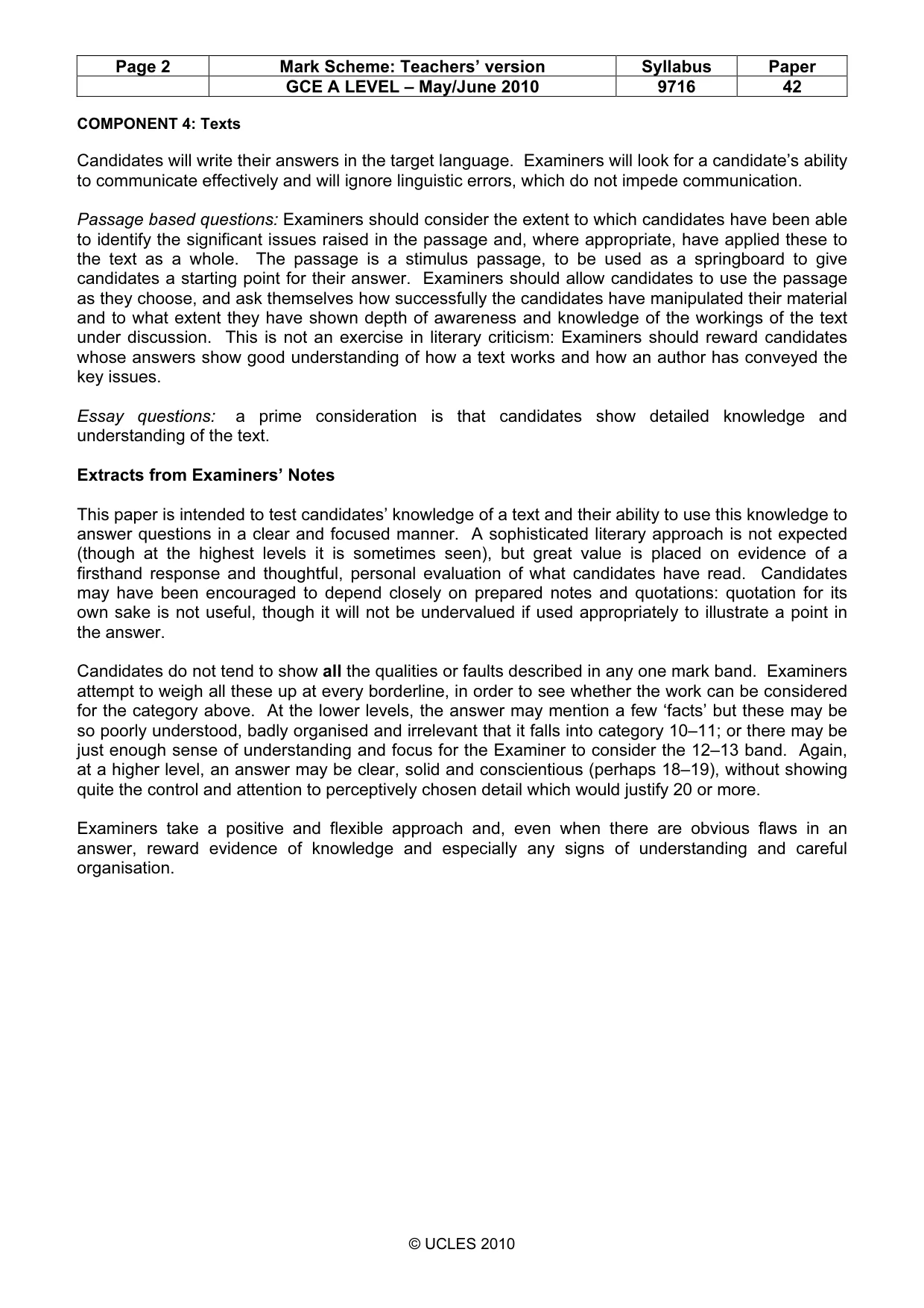
Page 2 Mark Scheme: Teachers’ version Syllabus Paper GCE A LEVEL – May/June 2010 9716 42 © UCLES 2010 COMPONENT 4: Texts Candidates will write their answers in the target language. Examiners will look for a candidate’s ability to communicate effectively and will ignore linguistic errors, which do not impede communication. Passage based questions: Examiners should consider the extent to which candidates have been able to identify the significant issues raised in the passage and, where appropriate, have applied these to the text as a whole. The passage is a stimulus passage, to be used as a springboard to give candidates a starting point for their answer. Examiners should allow candidates to use the passage as they choose, and ask themselves how successfully the candidates have manipulated their material and to what extent they have shown depth of awareness and knowledge of the workings of the text under discussion. This is not an exercise in literary criticism: Examiners should reward candidates whose answers show good understanding of how a text works and how an author has conveyed the key issues. Essay questions: a prime consideration is that candidates show detailed knowledge and understanding of the text. Extracts from Examiners’ Notes This paper is intended to test candidates’ knowledge of a text and their ability to use this knowledge to answer questions in a clear and focused manner. A sophisticated literary approach is not expected (though at the highest levels it is sometimes seen), but great value is placed on evidence of a firsthand response and thoughtful, personal evaluation of what candidates have read. Candidates may have been encouraged to depend closely on prepared notes and quotations: quotation for its own sake is not useful, though it will not be undervalued if used appropriately to illustrate a point in the answer. Candidates do not tend to show all the qualities or faults described in any one mark band. Examiners attempt to weigh all these up at every borderline, in order to see whether the work can be considered for the category above. At the lower levels, the answer may mention a few ‘facts’ but these may be so poorly understood, badly organised and irrelevant that it falls into category 10–11; or there may be just enough sense of understanding and focus for the Examiner to consider the 12–13 band. Again, at a higher level, an answer may be clear, solid and conscientious (perhaps 18–19), without showing quite the control and attention to perceptively chosen detail which would justify 20 or more. Examiners take a positive and flexible approach and, even when there are obvious flaws in an answer, reward evidence of knowledge and especially any signs of understanding and careful organisation.
Mark scheme, page 3
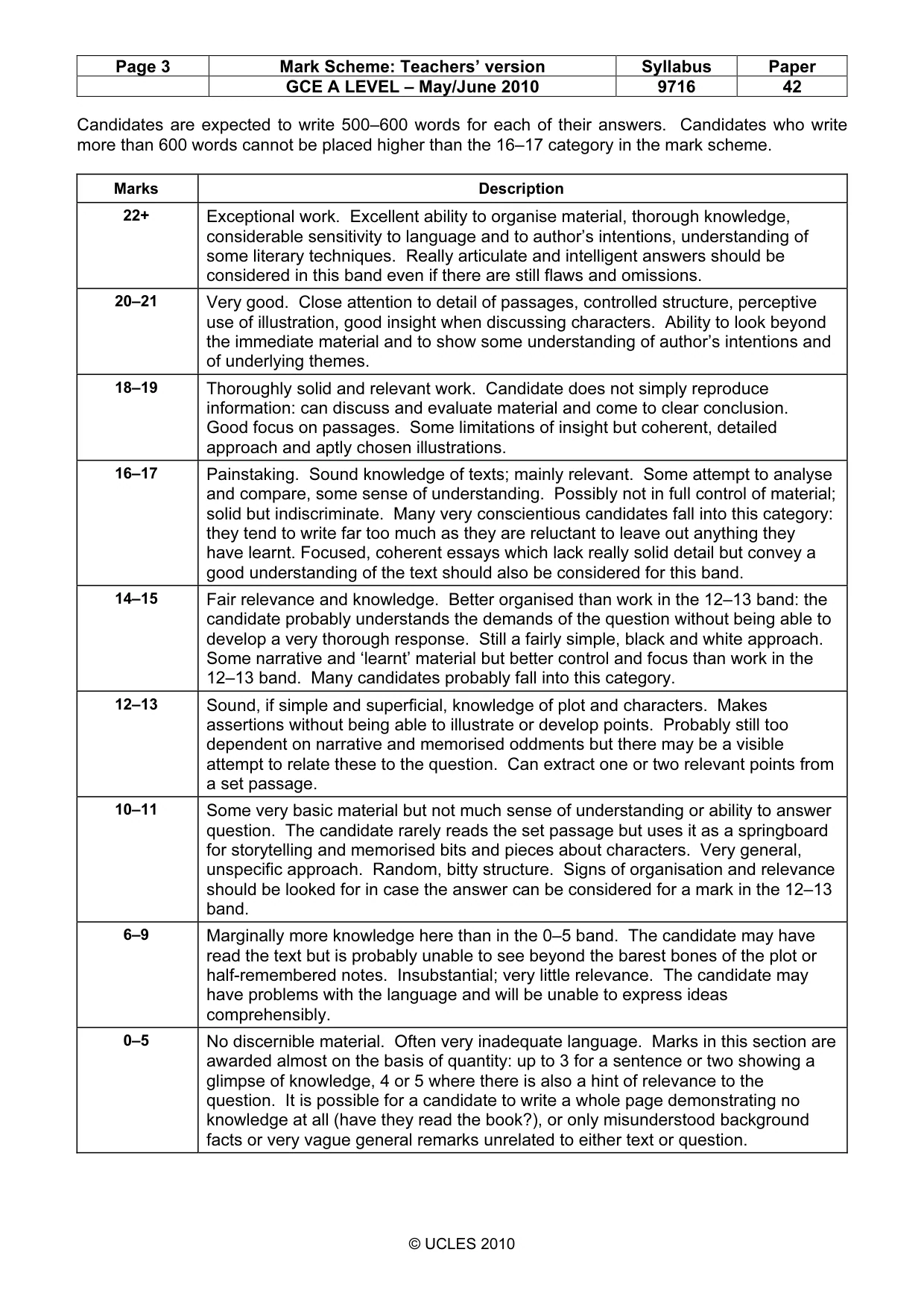
Page 3 Mark Scheme: Teachers’ version Syllabus Paper GCE A LEVEL – May/June 2010 9716 42 © UCLES 2010 Candidates are expected to write 500–600 words for each of their answers. Candidates who write more than 600 words cannot be placed higher than the 16–17 category in the mark scheme. Marks Description 22+ Exceptional work. Excellent ability to organise material, thorough knowledge, considerable sensitivity to language and to author’s intentions, understanding of some literary techniques. Really articulate and intelligent answers should be considered in this band even if there are still flaws and omissions. 20–21 Very good. Close attention to detail of passages, controlled structure, perceptive use of illustration, good insight when discussing characters. Ability to look beyond the immediate material and to show some understanding of author’s intentions and of underlying themes. 18–19 Thoroughly solid and relevant work. Candidate does not simply reproduce information: can discuss and evaluate material and come to clear conclusion. Good focus on passages. Some limitations of insight but coherent, detailed approach and aptly chosen illustrations. 16–17 Painstaking. Sound knowledge of texts; mainly relevant. Some attempt to analyse and compare, some sense of understanding. Possibly not in full control of material; solid but indiscriminate. Many very conscientious candidates fall into this category: they tend to write far too much as they are reluctant to leave out anything they have learnt. Focused, coherent essays which lack really solid detail but convey a good understanding of the text should also be considered for this band. 14–15 Fair relevance and knowledge. Better organised than work in the 12–13 band: the candidate probably understands the demands of the question without being able to develop a very thorough response. Still a fairly simple, black and white approach. Some narrative and ‘learnt’ material but better control and focus than work in the 12–13 band. Many candidates probably fall into this category. 12–13 Sound, if simple and superficial, knowledge of plot and characters. Makes assertions without being able to illustrate or develop points. Probably still too dependent on narrative and memorised oddments but there may be a visible attempt to relate these to the question. Can extract one or two relevant points from a set passage. 10–11 Some very basic material but not much sense of understanding or ability to answer question. The candidate rarely reads the set passage but uses it as a springboard for storytelling and memorised bits and pieces about characters. Very general, unspecific approach. Random, bitty structure. Signs of organisation and relevance should be looked for in case the answer can be considered for a mark in the 12–13 band. 6–9 Marginally more knowledge here than in the 0–5 band. The candidate may have read the text but is probably unable to see beyond the barest bones of the plot or half-remembered notes. Insubstantial; very little relevance. The candidate may have problems with the language and will be unable to express ideas comprehensibly. 0–5 No discernible material. Often very inadequate language. Marks in this section are awarded almost on the basis of quantity: up to 3 for a sentence or two showing a glimpse of knowledge, 4 or 5 where there is also a hint of relevance to the question. It is possible for a candidate to write a whole page demonstrating no knowledge at all (have they read the book?), or only misunderstood background facts or very vague general remarks unrelated to either text or question.