Cambridge A Level Food Studies 9336 — 2015 Oct/Nov Paper 2 · Variant 1
9336/21/O/N/15 · 1 question · 100 marks · ≈113 min
The question paper and its mark scheme, free to read here and free to download. This is Cambridge’s own paper, exactly as it was sat.
Question paper4 pages
Mark scheme4 pages
Answers below. Sit the paper first if you are practising.
Questions as text
Q1 · Sauces can be made by several methods and used in many ways in the preparation of dishes
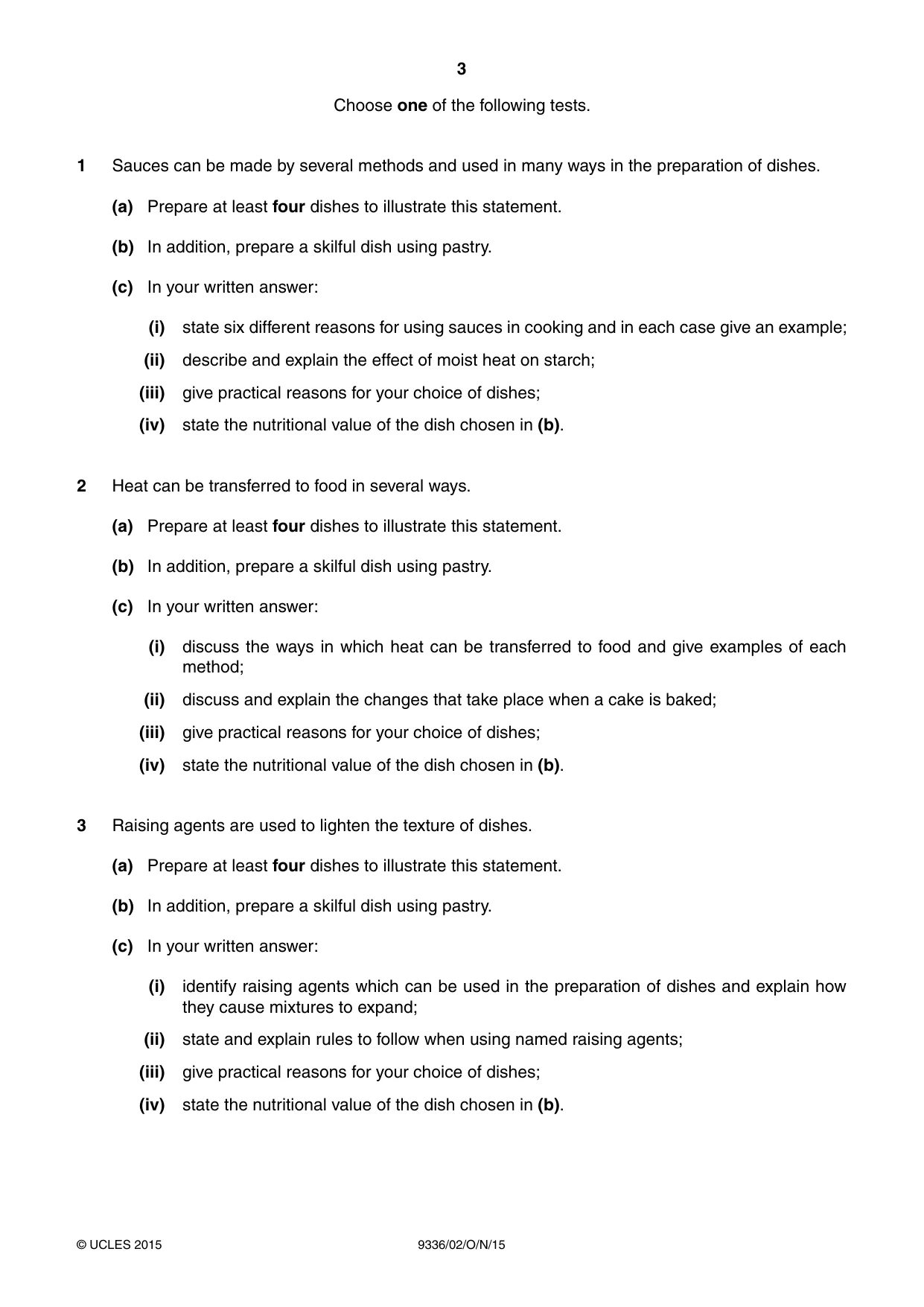
1 Sauces can be made by several methods and used in many ways in the preparation of dishes. (a) Prepare at least four dishes to illustrate this statement. (b) In addition, prepare a skilful dish using pastry. (c) In your written answer: (i) state six different reasons for using sauces in cooking and in each case give an example; (ii) describe and explain the effect of moist heat on starch; (iii) give practical reasons for your choice of dishes; (iv) state the nutritional value of the dish chosen in (b). 2 Heat can be transferred to food in several ways. (a) Prepare at least four dishes to illustrate this statement. (b) In addition, prepare a skilful dish using pastry. (c) In your written answer: (i) discuss the ways in which heat can be transferred to food and give examples of each method; (ii) discuss and explain the changes that take place when a cake is baked; (iii) give practical reasons for your choice of dishes; (iv) state the nutritional value of the dish chosen in (b). 3 Raising agents are used to lighten the texture of dishes. (a) Prepare at least four dishes to illustrate this statement. (b) In addition, prepare a skilful dish using pastry. (c) In your written answer: (i) identify raising agents which can be used in the preparation of dishes and explain how they cause mixtures to expand; (ii) state and explain rules to follow when using named raising agents; (iii) give practical reasons for your choice of dishes; (iv) state the nutritional value of the dish chosen in (b).
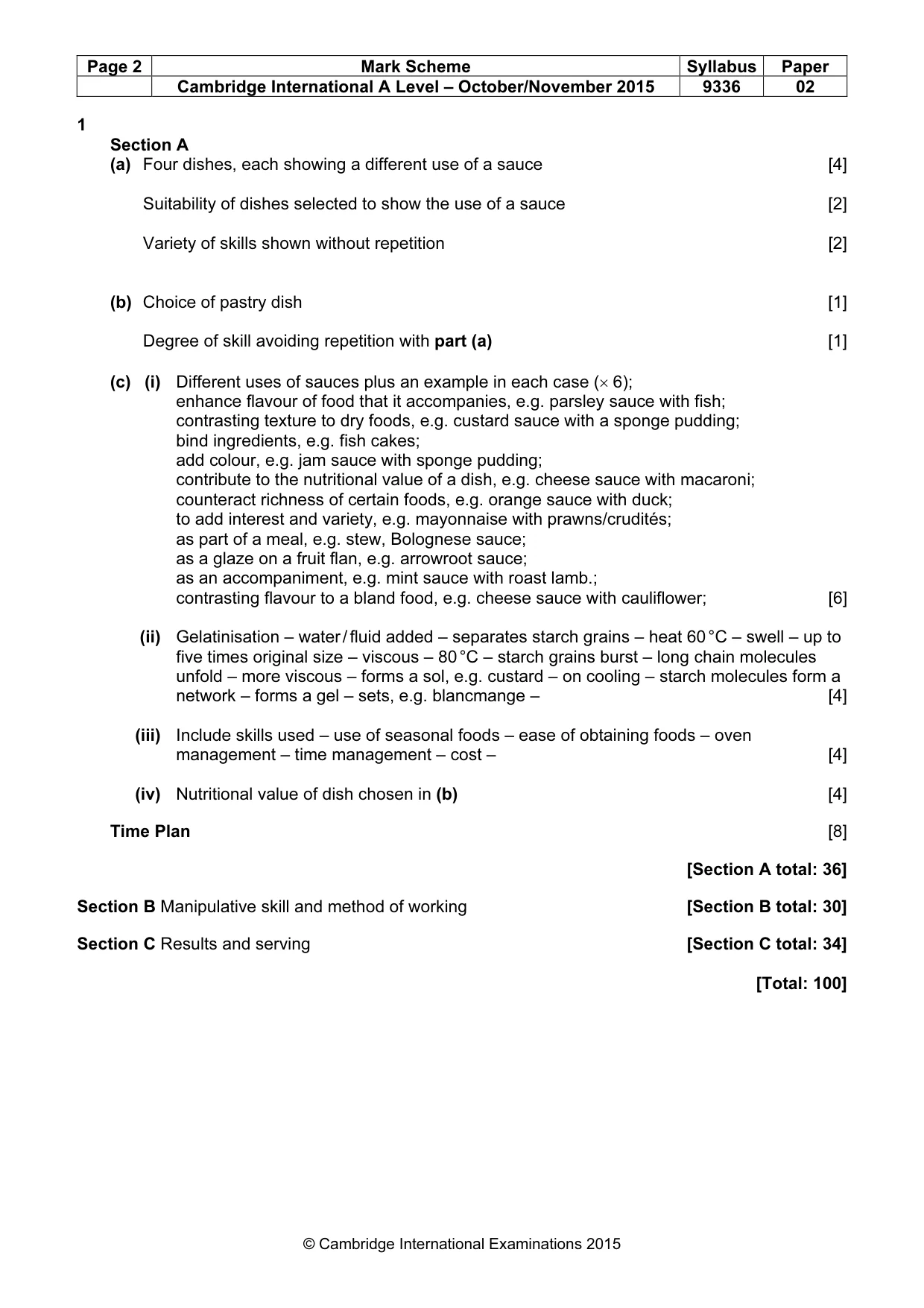
Mark scheme: 1 Section A (a) Four dishes, each showing a different use of a sauce [4] Suitability of dishes selected to show the use of a sauce [2] Variety of skills shown without repetition [2] (b) Choice of pastry dish [1] Degree of skill avoiding repetition with part (a) [1] (c) (i) Different uses of sauces plus an example in each case (× 6); enhance flavour of food that it accompanies, e.g. parsley sauce with fish; contrasting texture to dry foods, e.g. custard sauce with a sponge pudding; bind ingredients, e.g. fish cakes; add colour, e.g. jam sauce with sponge pudding; contribute to the nutritional value of a dish, e.g. cheese sauce with macaroni; counteract richness of certain foods, e.g. orange sauce with duck; to add interest and variety, e.g. mayonnaise with prawns/crudités; as part of a meal, e.g. stew, Bolognese sauce; as a glaze on a fruit flan, e.g. arrowroot sauce; as an accompaniment, e.g. mint sauce with roast lamb.; contrasting flavour to a bland food, e.g. cheese sauce with cauliflower; [6] (ii) Gelatinisation – water / fluid added – separates starch grains – heat 60 °C – swell – up to five times original size – viscous – 80 °C – starch grains burst – long chain molecules unfold – more viscous – forms a sol, e.g. custard – on cooling – starch molecules form a network – forms a gel – sets, e.g. blancmange – [4] (iii) Include skills used – use of seasonal foods – ease of obtaining foods – oven management – time management – cost – [4] (iv) Nutritional value of dish chosen in (b) [4] Time Plan [8] [Section A total: 36] Section B Manipulative skill and method of working [Section B total: 30] Section C Results and serving [Section C total: 34] [Total: 100]
What you needed in this session
Cambridge’s own grade thresholds for 2015 Oct/Nov, Paper 2 · Variant 1. A higher threshold means an easier paper — the bar moves with how the cohort did.