Cambridge A Level Environmental Management (AS only) 8291 — 2022 Oct/Nov Paper 1 · Variant 2
8291/12/O/N/22 · 80 marks · ≈90 min
The question paper and its mark scheme, free to read here and free to download. This is Cambridge’s own paper, exactly as it was sat.
Question paper20 pages









Mark scheme17 pages
Answers below. Sit the paper first if you are practising.
Paper as text
Question paper, page 1
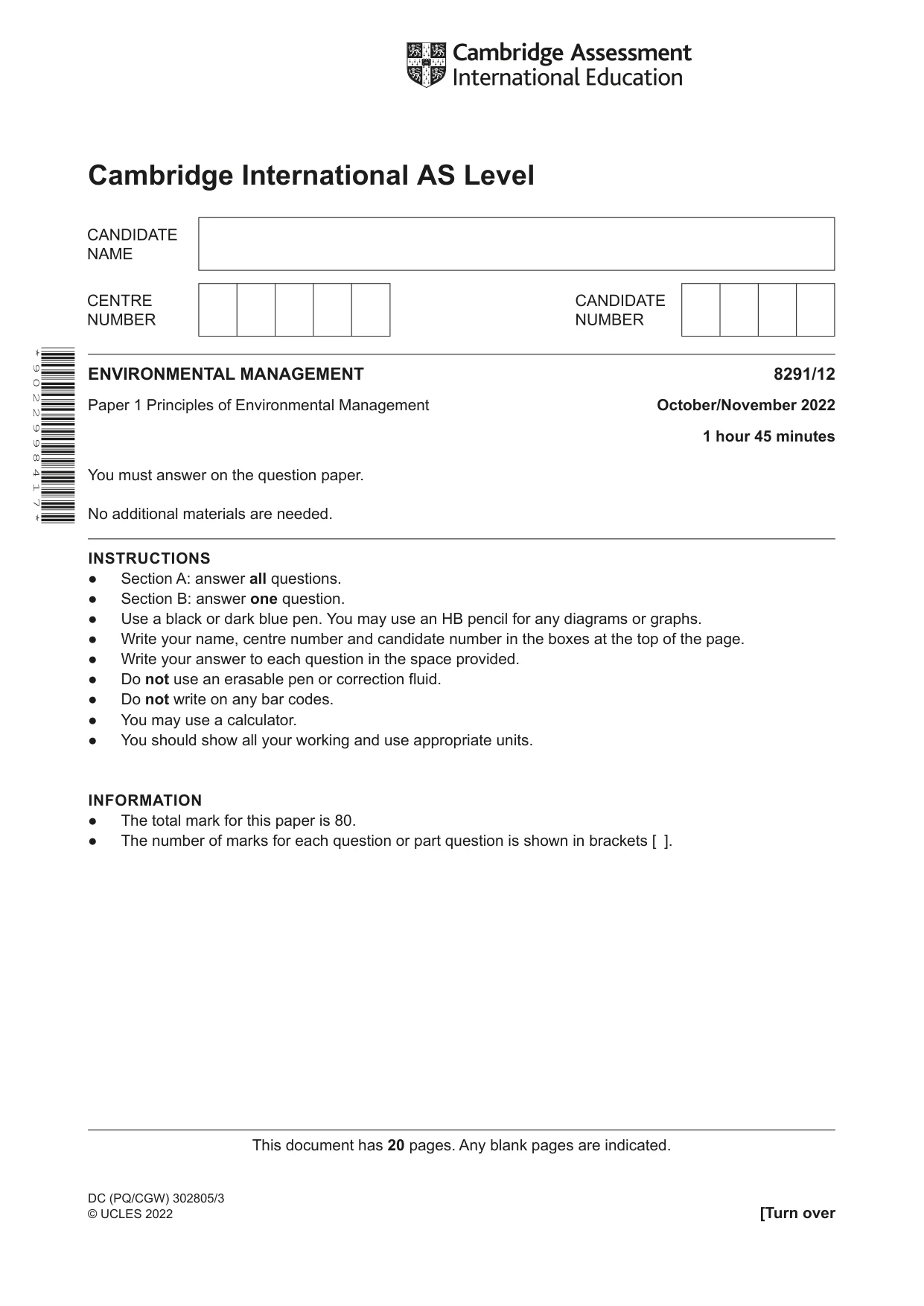
This document has 20 pages. Any blank pages are indicated. [Turn over Cambridge International AS Level DC (PQ/CGW) 302805/3 © UCLES 2022 * 9 0 2 2 9 9 8 4 1 7 * ENVIRONMENTAL MANAGEMENT 8291/12 Paper 1 Principles of Environmental Management October/November 2022 1 hour 45 minutes You must answer on the question paper. No additional materials are needed. INSTRUCTIONS ● Section A: answer all questions. ● Section B: answer one question. ● Use a black or dark blue pen. You may use an HB pencil for any diagrams or graphs. ● Write your name, centre number and candidate number in the boxes at the top of the page. ● Write your answer to each question in the space provided. ● Do not use an erasable pen or correction fluid. ● Do not write on any bar codes. ● You may use a calculator. ● You should show all your working and use appropriate units. INFORMATION ● The total mark for this paper is 80. ● The number of marks for each question or part question is shown in brackets [ ].
Question paper, page 2
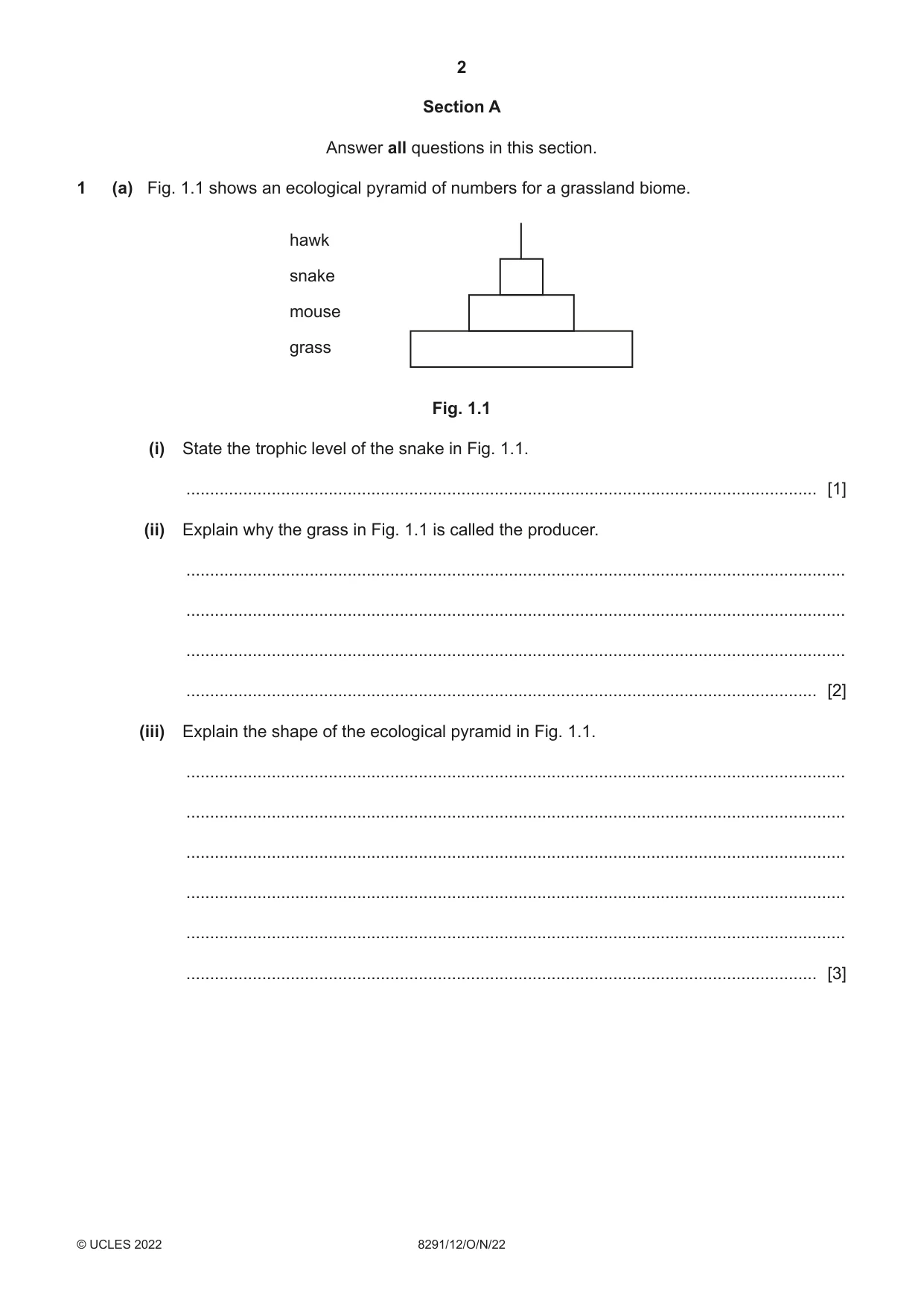
2 8291/12/O/N/22 © UCLES 2022 Section A Answer all questions in this section. 1 (a) Fig. 1.1 shows an ecological pyramid of numbers for a grassland biome. hawk snake mouse grass Fig. 1.1 (i) State the trophic level of the snake in Fig. 1.1. … [1] (ii) Explain why the grass in Fig. 1.1 is called the producer. … … … … [2] (iii) Explain the shape of the ecological pyramid in Fig. 1.1. … … … … … … [3]
Question paper, page 3
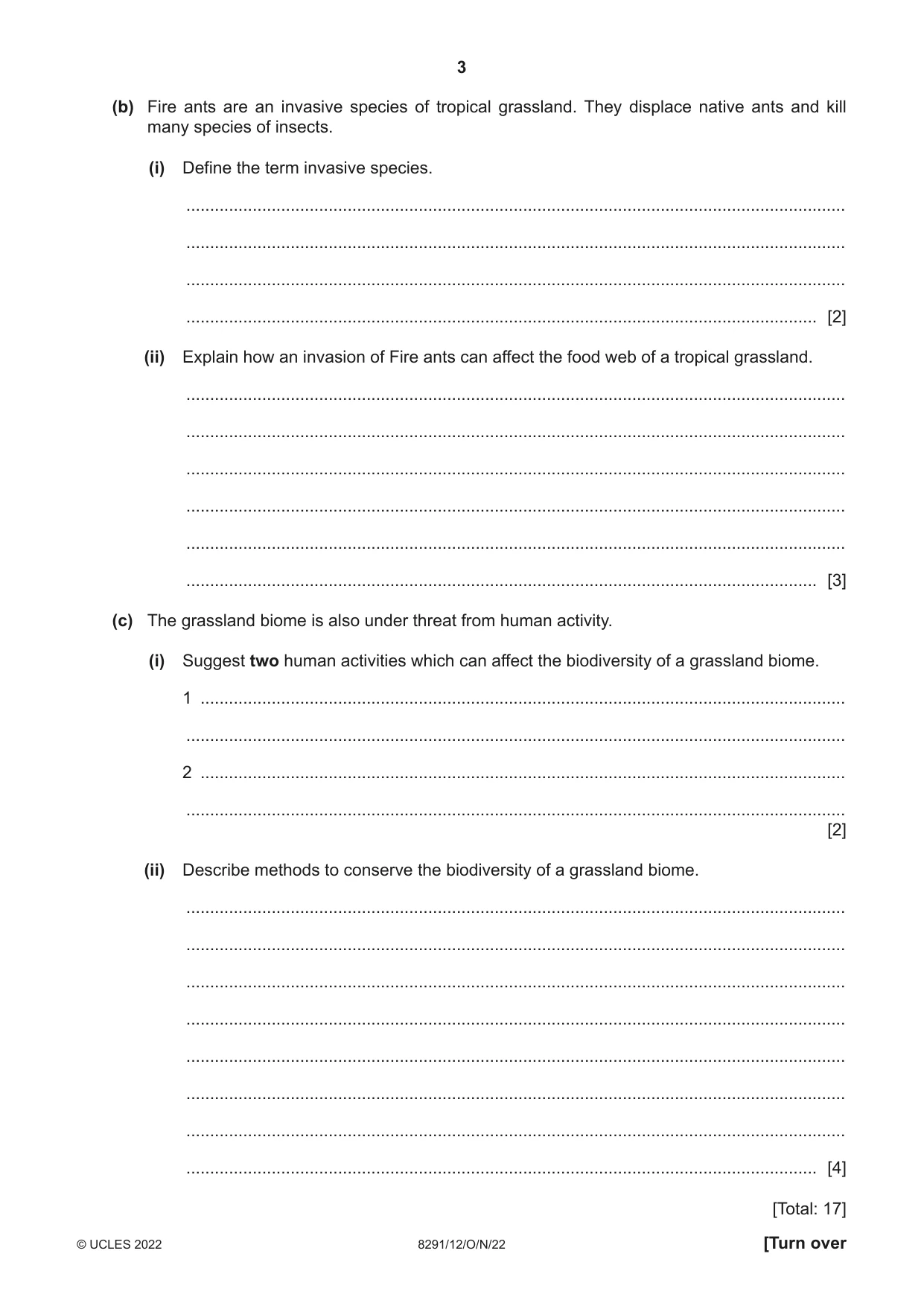
3 8291/12/O/N/22 © UCLES 2022 [Turn over (b) Fire ants are an invasive species of tropical grassland. They displace native ants and kill many species of insects. (i) Define the term invasive species. … … … … [2] (ii) Explain how an invasion of Fire ants can affect the food web of a tropical grassland. … … … … … … [3] (c) The grassland biome is also under threat from human activity. (i) Suggest two human activities which can affect the biodiversity of a grassland biome. 1 … … 2 … … [2] (ii) Describe methods to conserve the biodiversity of a grassland biome. … … … … … … … … [4] [Total: 17]
Question paper, page 4
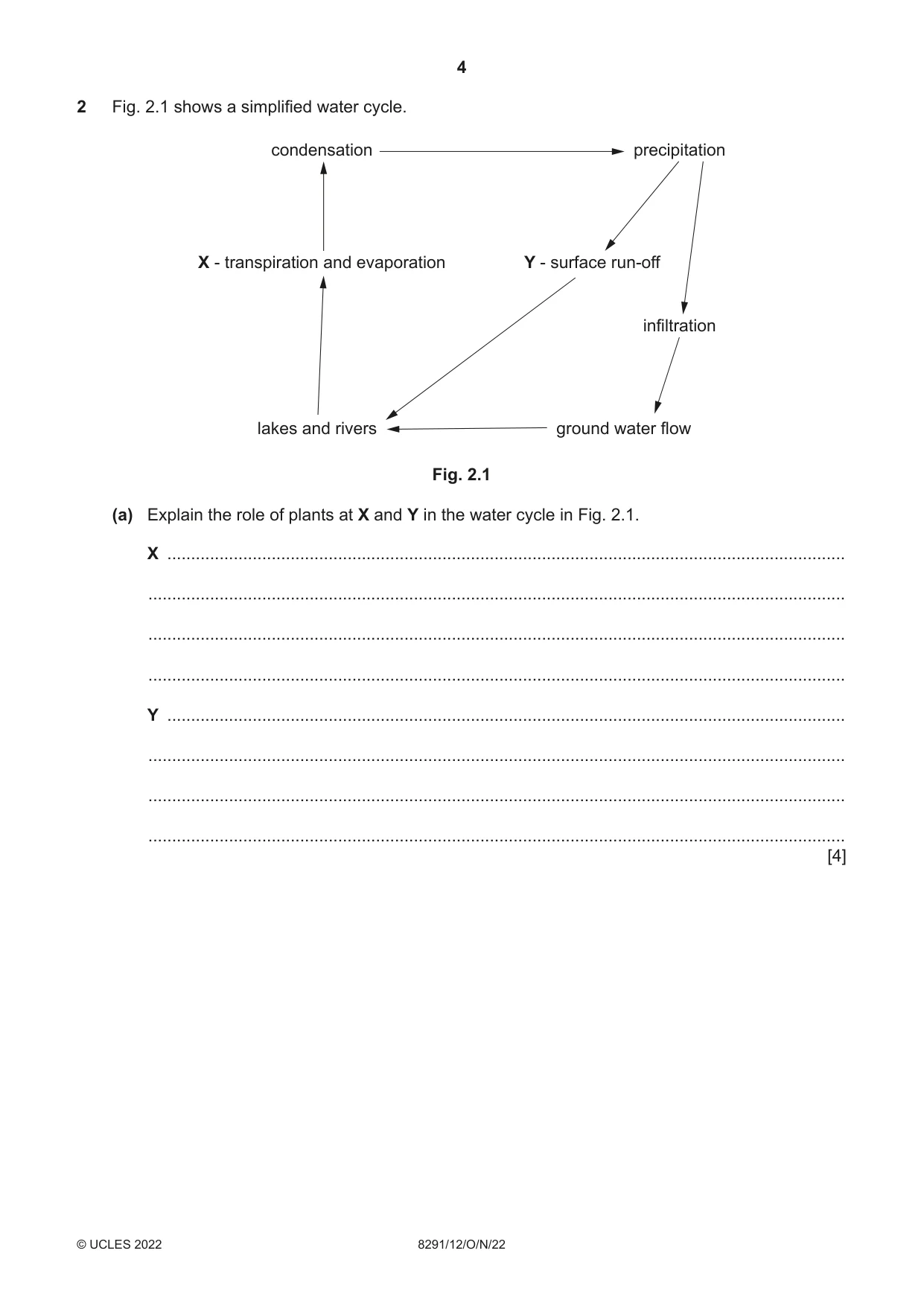
4 8291/12/O/N/22 © UCLES 2022 2 Fig. 2.1 shows a simplified water cycle. condensation precipitation infiltration X - transpiration and evaporation Y - surface run-off lakes and rivers ground water flow Fig. 2.1 (a) Explain the role of plants at X and Y in the water cycle in Fig. 2.1. X … … … … Y … … … … [4]
Question paper, page 5
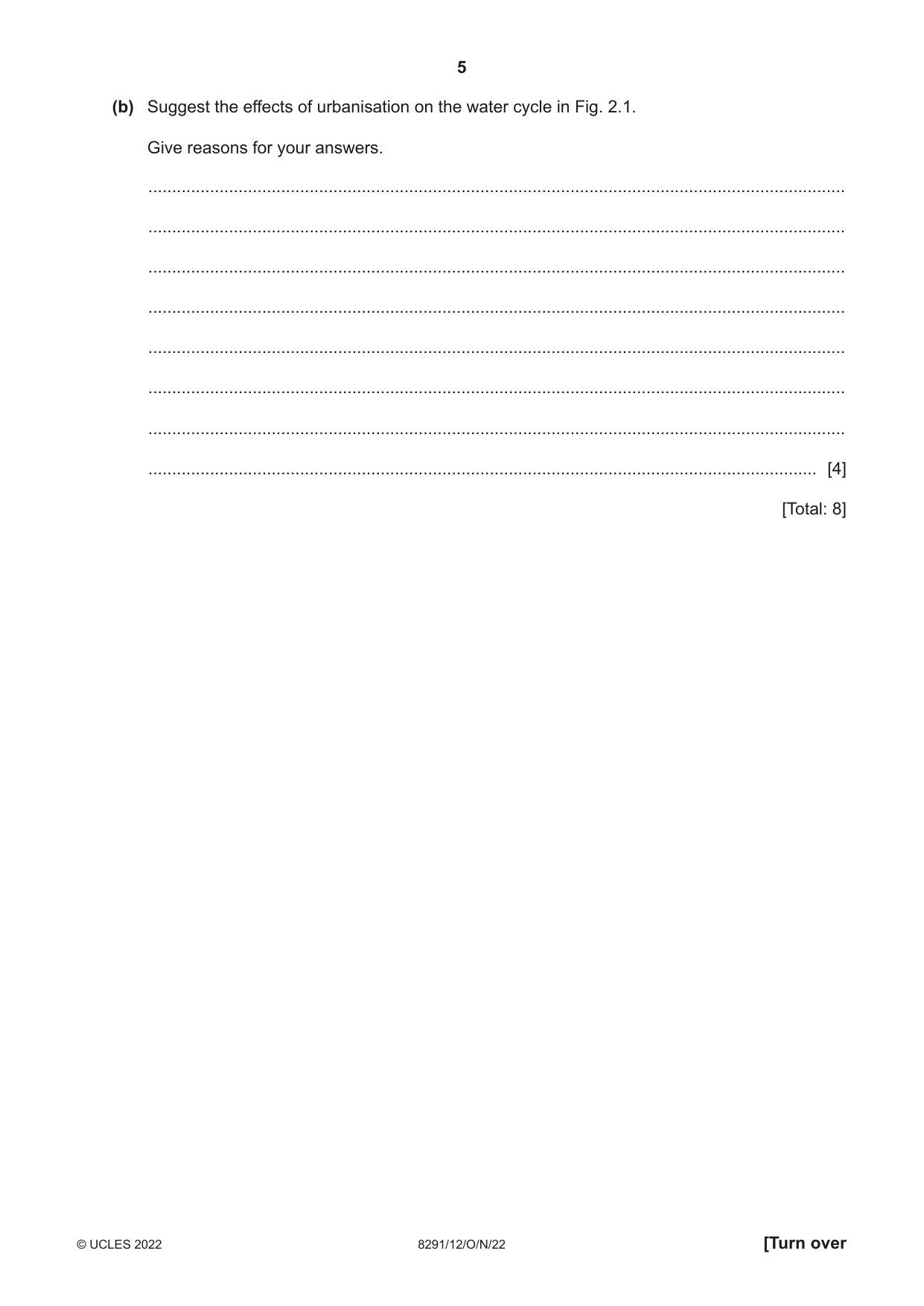
5 8291/12/O/N/22 © UCLES 2022 [Turn over (b) Suggest the effects of urbanisation on the water cycle in Fig. 2.1. Give reasons for your answers. … … … … … … … … [4] [Total: 8]
Question paper, page 6
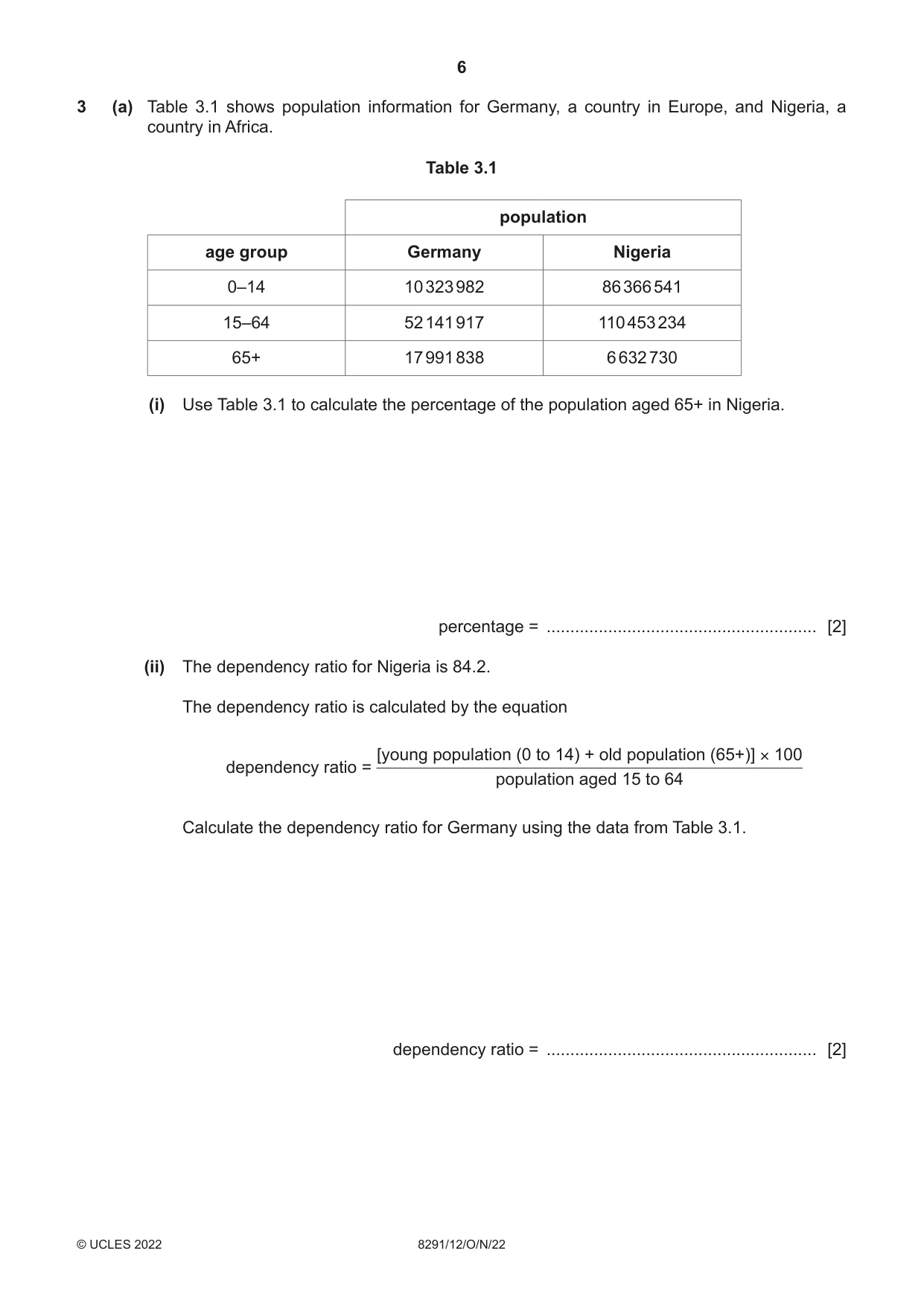
6 8291/12/O/N/22 © UCLES 2022 3 (a) Table 3.1 shows population information for Germany, a country in Europe, and Nigeria, a country in Africa. Table 3.1 population age group Germany Nigeria 0–14 10 323 982 86 366 541 15–64 52 141 917 110 453 234 65+ 17 991 838 6 632 730 (i) Use Table 3.1 to calculate the percentage of the population aged 65+ in Nigeria. percentage = … [2] (ii) The dependency ratio for Nigeria is 84.2. The dependency ratio is calculated by the equation dependency ratio = [young population (0 to 14) + old population (65+)] × 100 population aged 15 to 64 Calculate the dependency ratio for Germany using the data from Table 3.1. dependency ratio = … [2]
Question paper, page 7
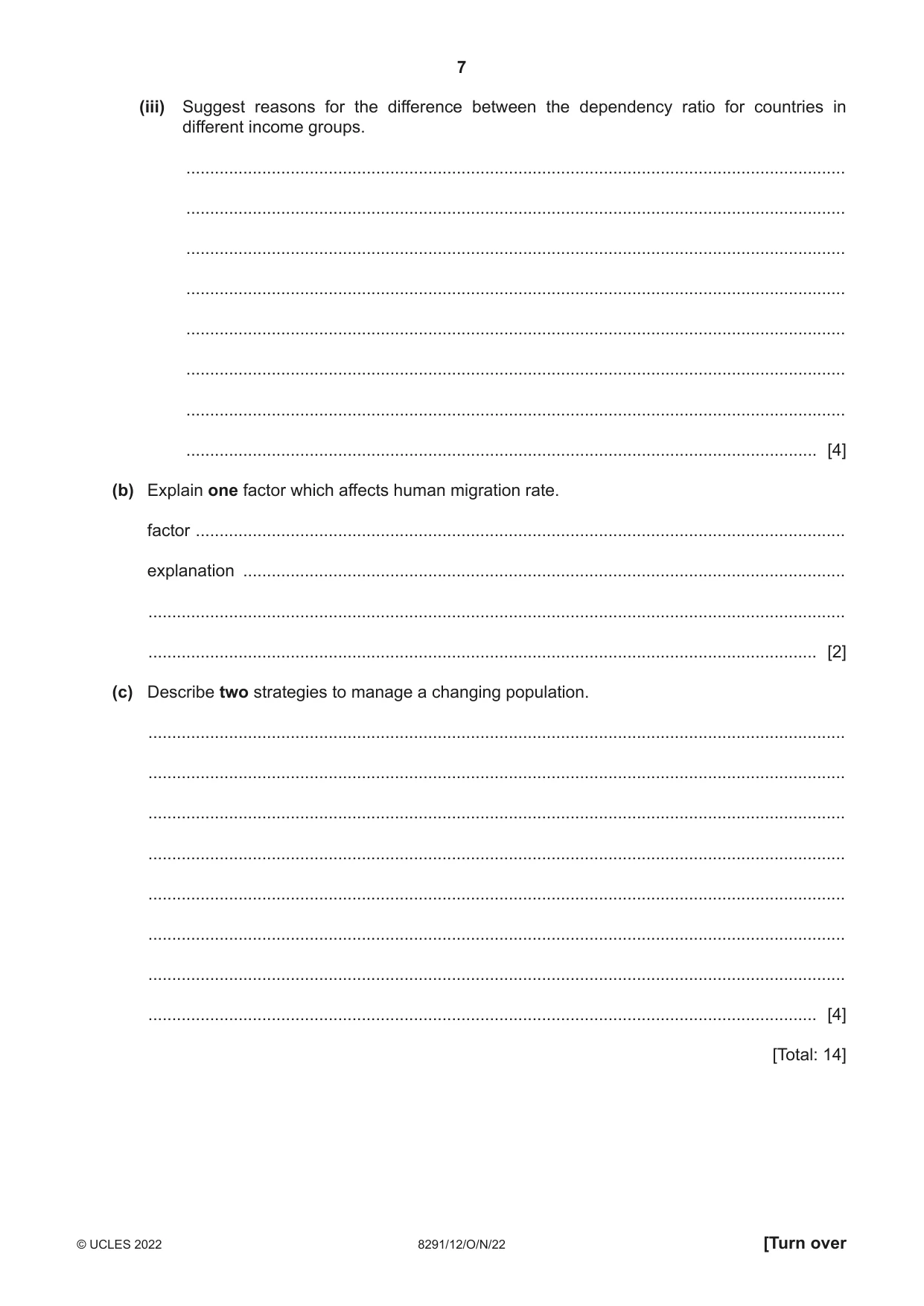
7 8291/12/O/N/22 © UCLES 2022 [Turn over (iii) Suggest reasons for the difference between the dependency ratio for countries in different income groups. … … … … … … … … [4] (b) Explain one factor which affects human migration rate. factor … explanation … … … [2] (c) Describe two strategies to manage a changing population. … … … … … … … … [4] [Total: 14]
Question paper, page 8
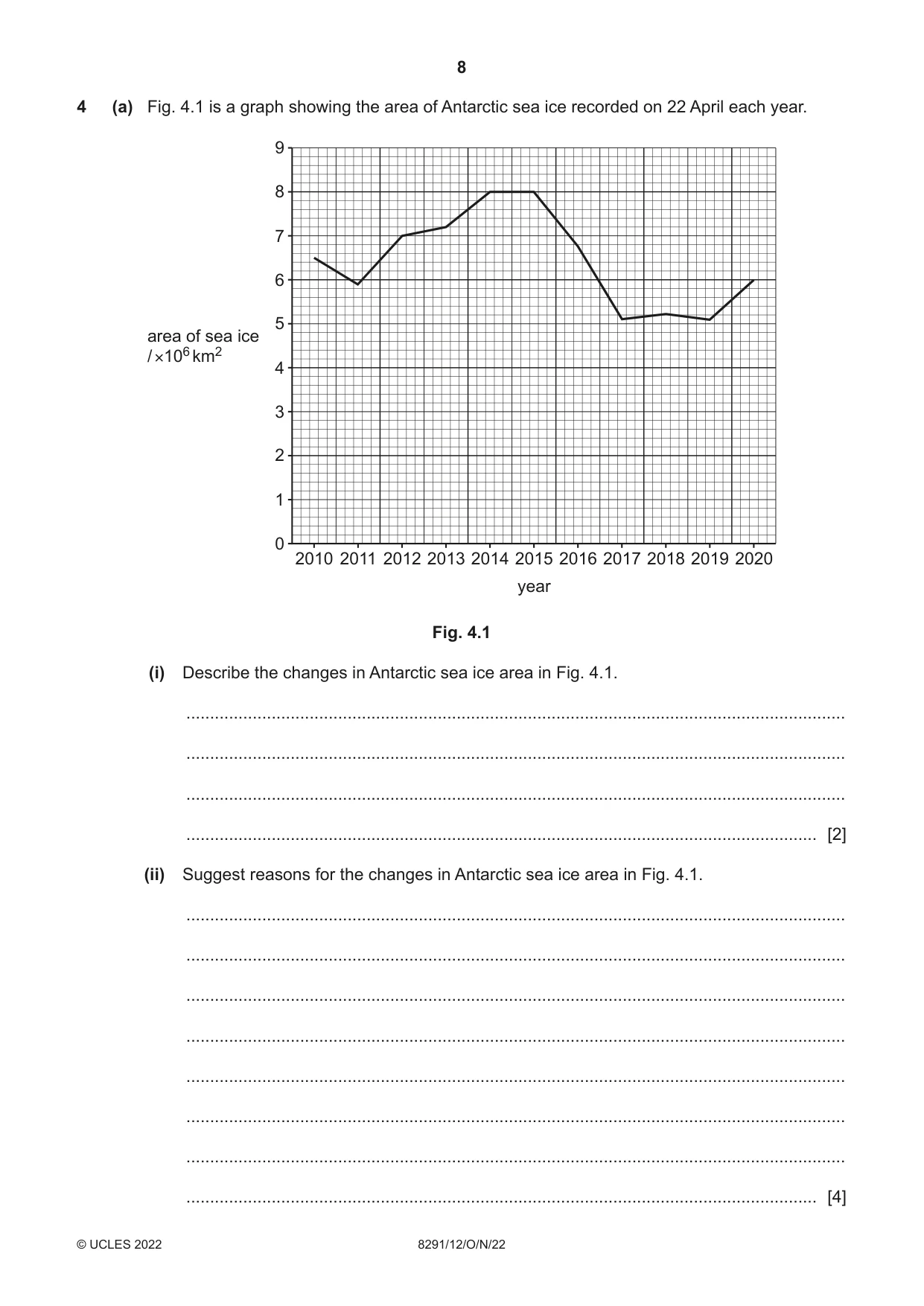
8 8291/12/O/N/22 © UCLES 2022 4 (a) Fig. 4.1 is a graph showing the area of Antarctic sea ice recorded on 22 April each year. 9 8 7 6 5 4 area of sea ice / ×106 km2 3 2 1 2010 2011 2012 2013 2014 2015 year 2016 2017 2018 2019 2020 0 Fig. 4.1 (i) Describe the changes in Antarctic sea ice area in Fig. 4.1. … … … … [2] (ii) Suggest reasons for the changes in Antarctic sea ice area in Fig. 4.1. … … … … … … … … [4]
Question paper, page 9
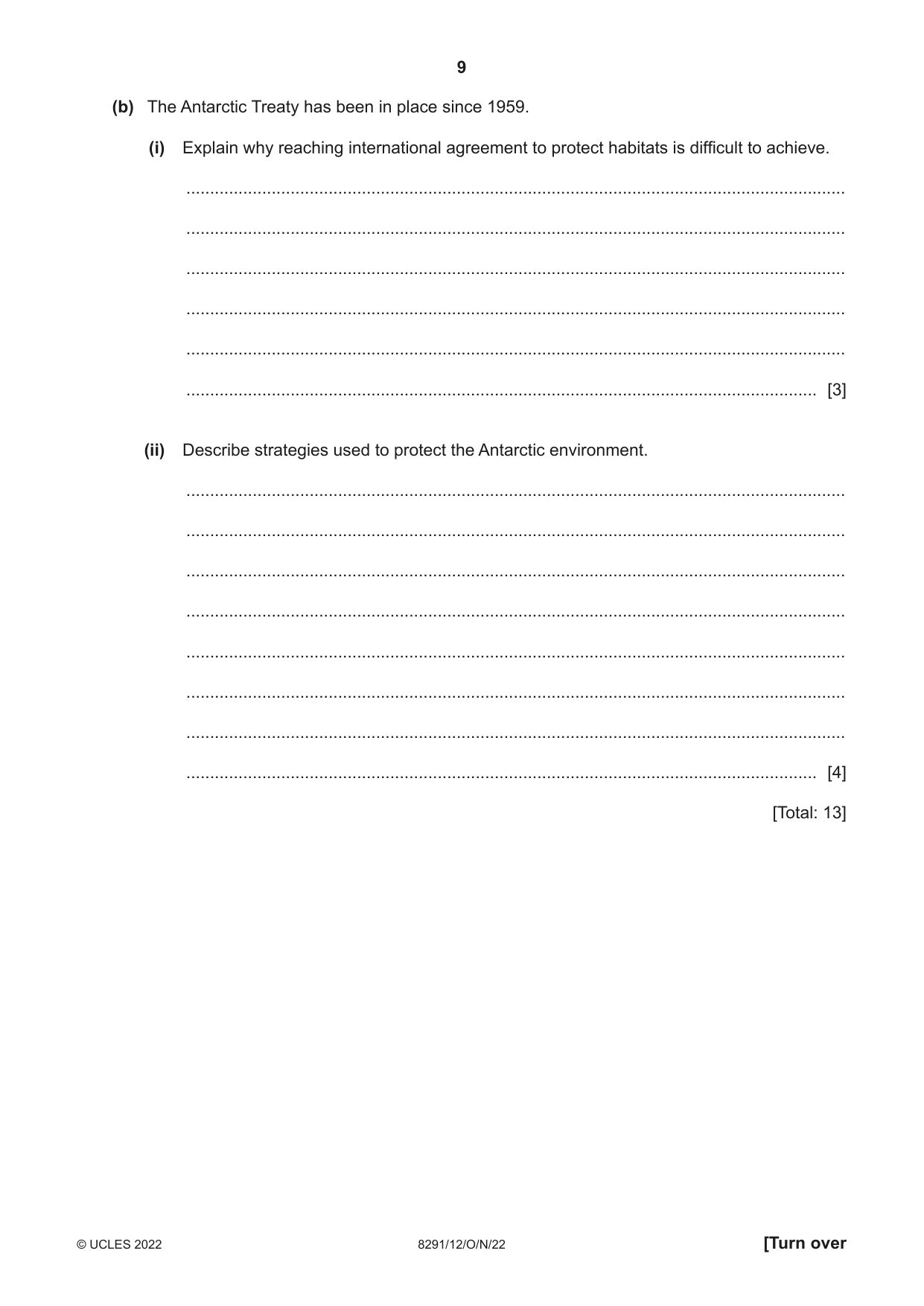
9 8291/12/O/N/22 © UCLES 2022 [Turn over (b) The Antarctic Treaty has been in place since 1959. (i) Explain why reaching international agreement to protect habitats is difficult to achieve. … … … … … … [3] (ii) Describe strategies used to protect the Antarctic environment. … … … … … … … … [4] [Total: 13]
Question paper, page 10
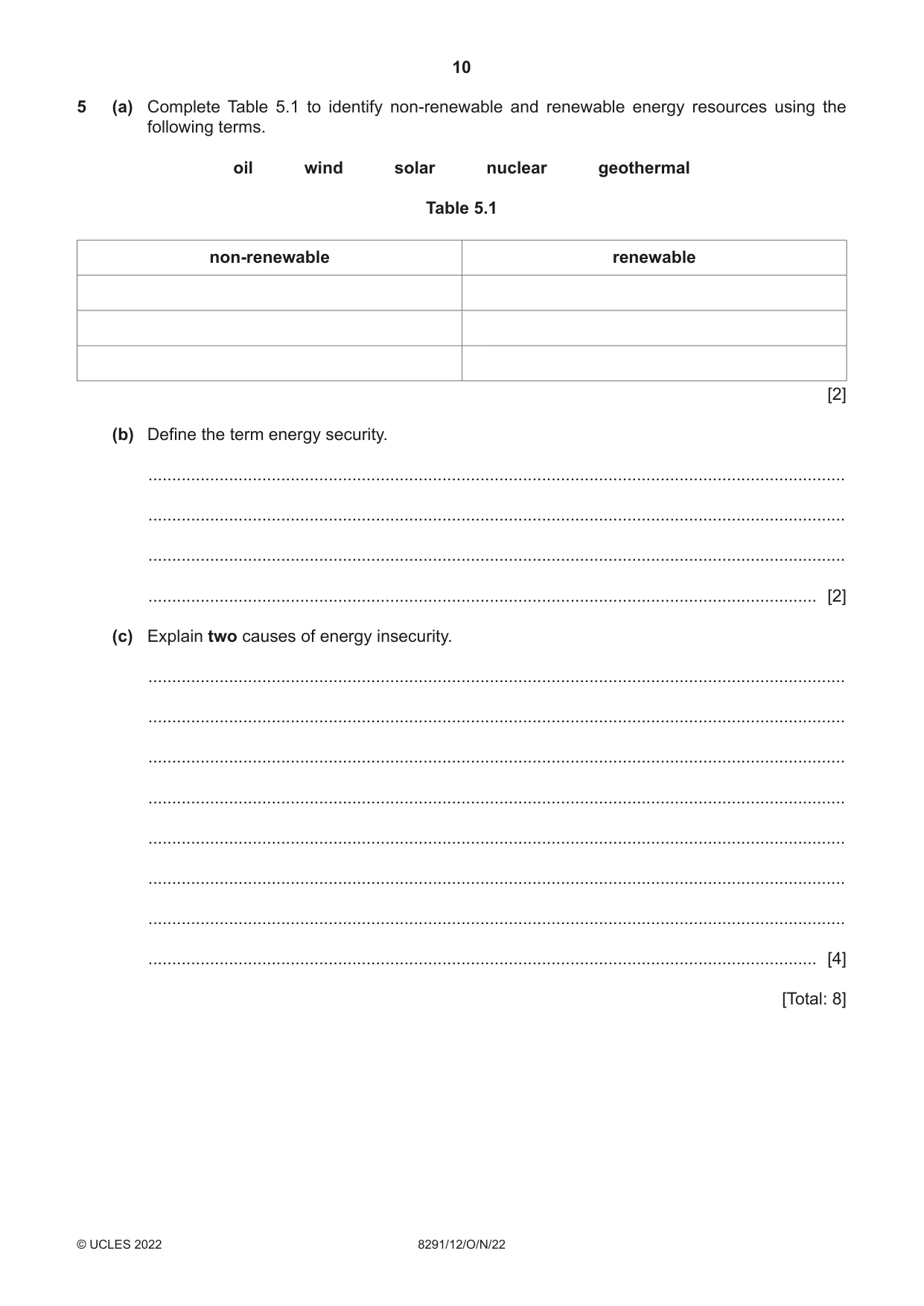
10 8291/12/O/N/22 © UCLES 2022 5 (a) Complete Table 5.1 to identify non-renewable and renewable energy resources using the following terms. oil wind solar nuclear geothermal Table 5.1 non-renewable renewable [2] (b) Define the term energy security. … … … … [2] (c) Explain two causes of energy insecurity. … … … … … … … … [4] [Total: 8]
Question paper, page 11
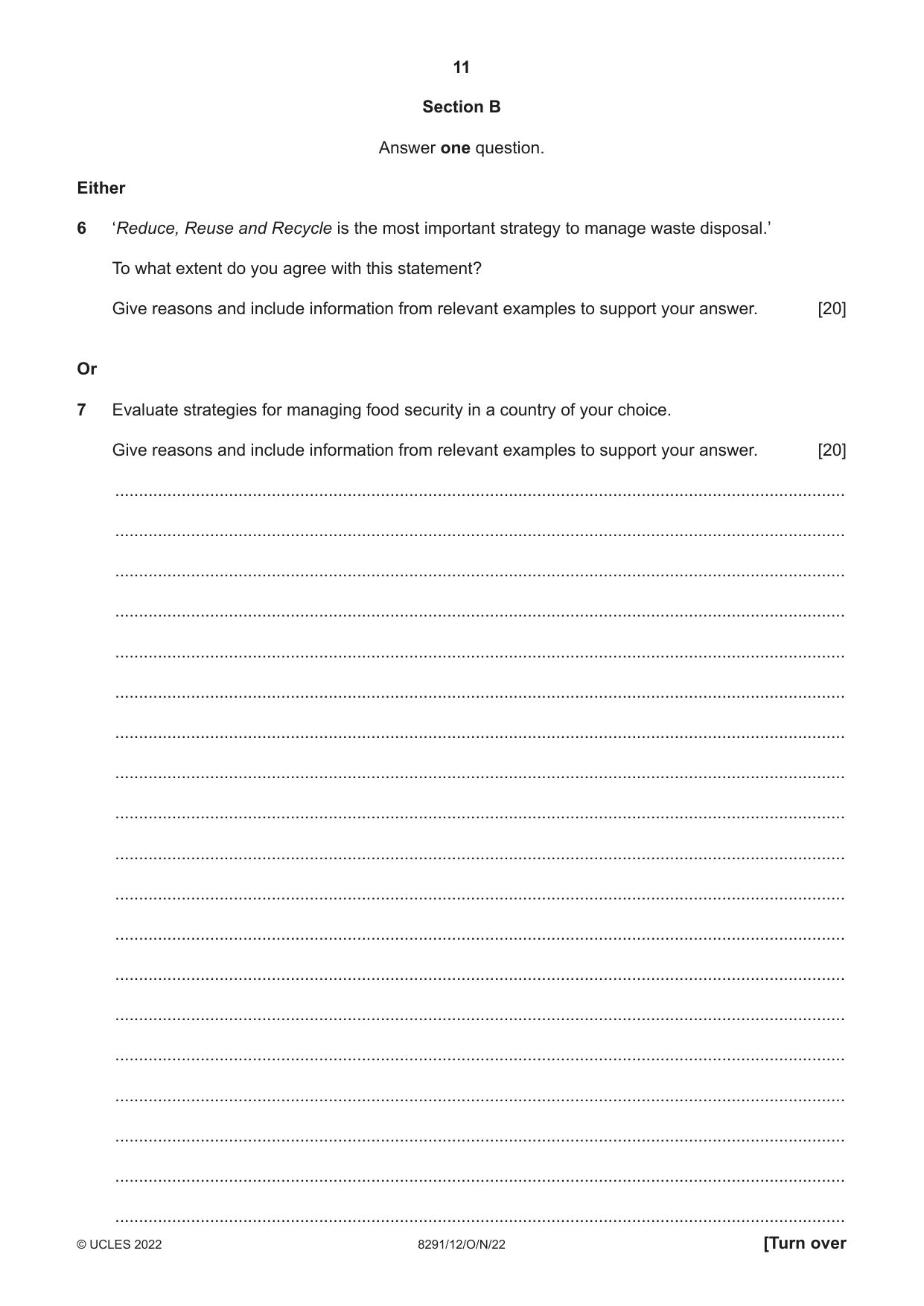
11 8291/12/O/N/22 © UCLES 2022 Section B Answer one question. Either 6 ‘Reduce, Reuse and Recycle is the most important strategy to manage waste disposal.’ To what extent do you agree with this statement? Give reasons and include information from relevant examples to support your answer. [20] Or 7 Evaluate strategies for managing food security in a country of your choice. Give reasons and include information from relevant examples to support your answer. [20] … … … … … … … … … … … … … … … … … … … [Turn over
Question paper, page 12
12 8291/12/O/N/22 © UCLES 2022 … … … … … … … … … … … … … … … … … … … … … … … … … … … …
Question paper, page 13
13 8291/12/O/N/22 © UCLES 2022 [Turn over … … … … … … … … … … … … … … … … … … … … … … … … … … … …
Question paper, page 14
14 8291/12/O/N/22 © UCLES 2022 … … … … … … … … … … … … … … … … … … … … … … … … … … … …
Question paper, page 15
15 8291/12/O/N/22 © UCLES 2022 [Turn over … … … … … … … … … … … … … … … … … … … … … … … … … … … …
Question paper, page 16
16 8291/12/O/N/22 © UCLES 2022 … … … … … … … … … … … … … … … … … … … … … … … … … … … …
Question paper, page 17
17 8291/12/O/N/22 © UCLES 2022 … … … … … … … … … … … … … … … … … … … … … … … … … … … …
Question paper, page 18
18 8291/12/O/N/22 © UCLES 2022 BLANK PAGE
Question paper, page 19
19 8291/12/O/N/22 © UCLES 2022 BLANK PAGE
Question paper, page 20
20 8291/12/O/N/22 © UCLES 2022 BLANK PAGE The boundaries and names shown, the designations used and the presentation of material on any maps contained in this question paper/insert do not imply official endorsement or acceptance by Cambridge Assessment International Education concerning the legal status of any country, territory, or area or any of its authorities, or of the delimitation of its frontiers or boundaries. Permission to reproduce items where third-party owned material protected by copyright is included has been sought and cleared where possible. Every reasonable effort has been made by the publisher (UCLES) to trace copyright holders, but if any items requiring clearance have unwittingly been included, the publisher will be pleased to make amends at the earliest possible opportunity. To avoid the issue of disclosure of answer-related information to candidates, all copyright acknowledgements are reproduced online in the Cambridge Assessment International Education Copyright Acknowledgements Booklet. This is produced for each series of examinations and is freely available to download at www.cambridgeinternational.org after the live examination series. Cambridge Assessment International Education is part of Cambridge Assessment. Cambridge Assessment is the brand name of the University of Cambridge Local Examinations Syndicate (UCLES), which is a department of the University of Cambridge.
Mark scheme, page 1
This document consists of 17 printed pages. © UCLES 2022 [Turn over Cambridge International AS Level ENVIRONMENTAL MANAGEMENT 8291/12 Paper 1 Principles of Environmental Management October/November 2022 MARK SCHEME Maximum Mark: 80 Published This mark scheme is published as an aid to teachers and candidates, to indicate the requirements of the examination. It shows the basis on which Examiners were instructed to award marks. It does not indicate the details of the discussions that took place at an Examiners’ meeting before marking began, which would have considered the acceptability of alternative answers. Mark schemes should be read in conjunction with the question paper and the Principal Examiner Report for Teachers. Cambridge International will not enter into discussions about these mark schemes. Cambridge International is publishing the mark schemes for the October/November 2022 series for most Cambridge IGCSE™, Cambridge International A and AS Level components and some Cambridge O Level components.
Mark scheme, page 2
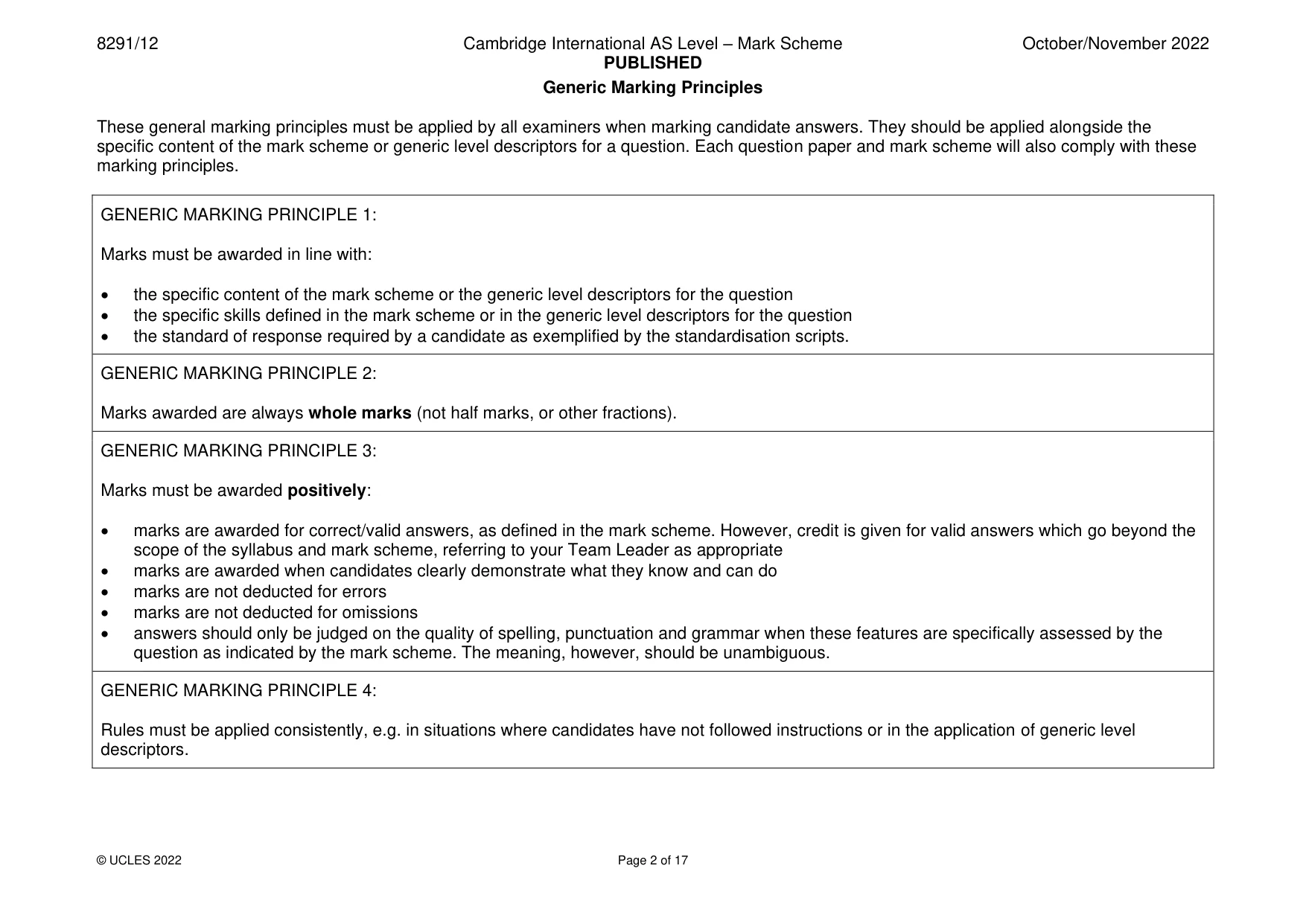
8291/12 Cambridge International AS Level – Mark Scheme PUBLISHED October/November 2022 © UCLES 2022 Page 2 of 17 Generic Marking Principles These general marking principles must be applied by all examiners when marking candidate answers. They should be applied alongside the specific content of the mark scheme or generic level descriptors for a question. Each question paper and mark scheme will also comply with these marking principles. GENERIC MARKING PRINCIPLE 1: Marks must be awarded in line with: • the specific content of the mark scheme or the generic level descriptors for the question • the specific skills defined in the mark scheme or in the generic level descriptors for the question • the standard of response required by a candidate as exemplified by the standardisation scripts. GENERIC MARKING PRINCIPLE 2: Marks awarded are always whole marks (not half marks, or other fractions). GENERIC MARKING PRINCIPLE 3: Marks must be awarded positively: • marks are awarded for correct/valid answers, as defined in the mark scheme. However, credit is given for valid answers which go beyond the scope of the syllabus and mark scheme, referring to your Team Leader as appropriate • marks are awarded when candidates clearly demonstrate what they know and can do • marks are not deducted for errors • marks are not deducted for omissions • answers should only be judged on the quality of spelling, punctuation and grammar when these features are specifically assessed by the question as indicated by the mark scheme. The meaning, however, should be unambiguous. GENERIC MARKING PRINCIPLE 4: Rules must be applied consistently, e.g. in situations where candidates have not followed instructions or in the application of generic level descriptors.
Mark scheme, page 3
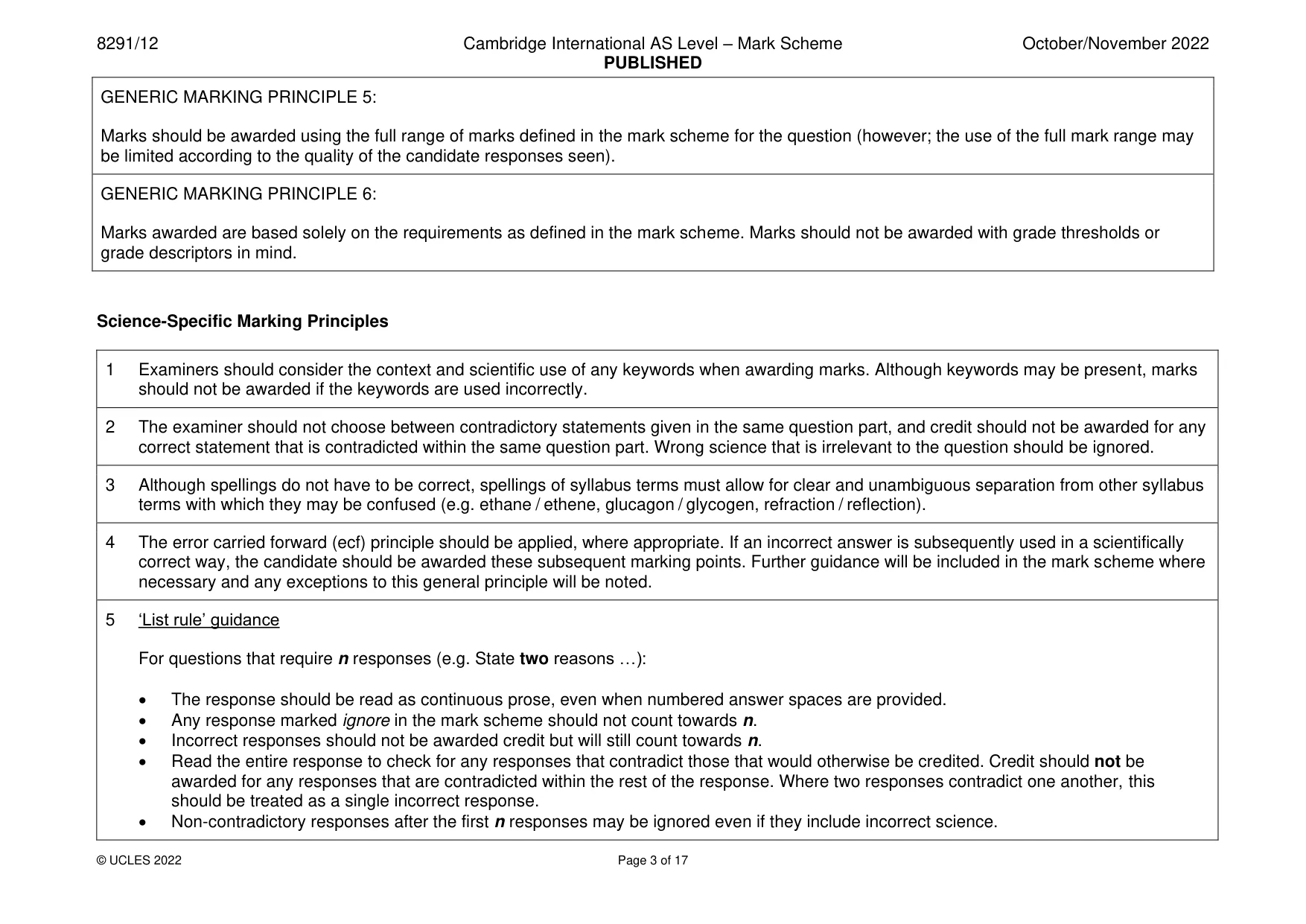
8291/12 Cambridge International AS Level – Mark Scheme PUBLISHED October/November 2022 © UCLES 2022 Page 3 of 17 GENERIC MARKING PRINCIPLE 5: Marks should be awarded using the full range of marks defined in the mark scheme for the question (however; the use of the full mark range may be limited according to the quality of the candidate responses seen). GENERIC MARKING PRINCIPLE 6: Marks awarded are based solely on the requirements as defined in the mark scheme. Marks should not be awarded with grade thresholds or grade descriptors in mind. Science-Specific Marking Principles 1 Examiners should consider the context and scientific use of any keywords when awarding marks. Although keywords may be present, marks should not be awarded if the keywords are used incorrectly. 2 The examiner should not choose between contradictory statements given in the same question part, and credit should not be awarded for any correct statement that is contradicted within the same question part. Wrong science that is irrelevant to the question should be ignored. 3 Although spellings do not have to be correct, spellings of syllabus terms must allow for clear and unambiguous separation from other syllabus terms with which they may be confused (e.g. ethane / ethene, glucagon / glycogen, refraction / reflection). 4 The error carried forward (ecf) principle should be applied, where appropriate. If an incorrect answer is subsequently used in a scientifically correct way, the candidate should be awarded these subsequent marking points. Further guidance will be included in the mark scheme where necessary and any exceptions to this general principle will be noted. 5 ‘List rule’ guidance For questions that require n responses (e.g. State two reasons …): • The response should be read as continuous prose, even when numbered answer spaces are provided. • Any response marked ignore in the mark scheme should not count towards n. • Incorrect responses should not be awarded credit but will still count towards n. • Read the entire response to check for any responses that contradict those that would otherwise be credited. Credit should not be awarded for any responses that are contradicted within the rest of the response. Where two responses contradict one another, this should be treated as a single incorrect response. • Non-contradictory responses after the first n responses may be ignored even if they include incorrect science.
Mark scheme, page 4
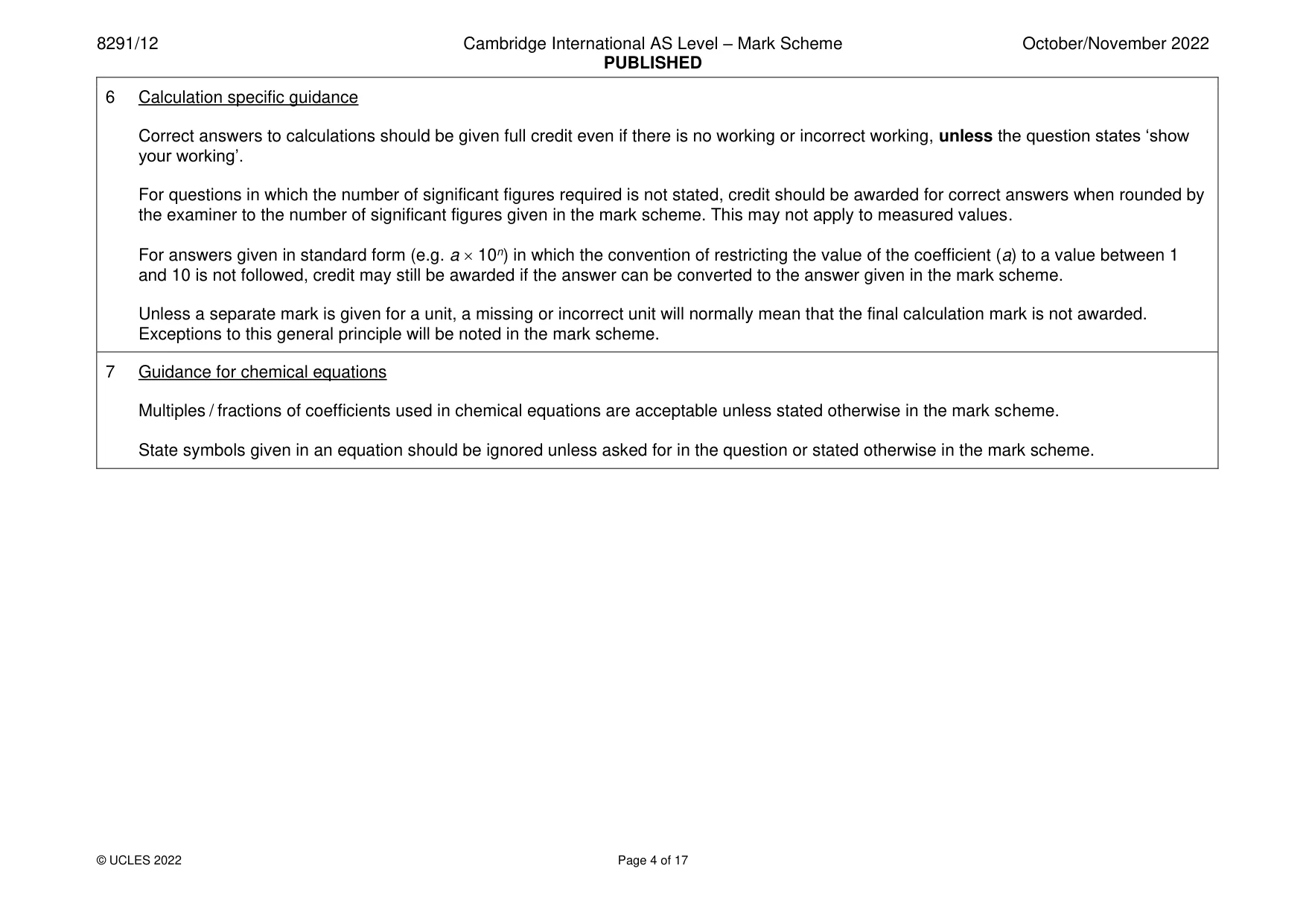
8291/12 Cambridge International AS Level – Mark Scheme PUBLISHED October/November 2022 © UCLES 2022 Page 4 of 17 6 Calculation specific guidance Correct answers to calculations should be given full credit even if there is no working or incorrect working, unless the question states ‘show your working’. For questions in which the number of significant figures required is not stated, credit should be awarded for correct answers when rounded by the examiner to the number of significant figures given in the mark scheme. This may not apply to measured values. For answers given in standard form (e.g. a 10n) in which the convention of restricting the value of the coefficient (a) to a value between 1 and 10 is not followed, credit may still be awarded if the answer can be converted to the answer given in the mark scheme. Unless a separate mark is given for a unit, a missing or incorrect unit will normally mean that the final calculation mark is not awarded. Exceptions to this general principle will be noted in the mark scheme. 7 Guidance for chemical equations Multiples / fractions of coefficients used in chemical equations are acceptable unless stated otherwise in the mark scheme. State symbols given in an equation should be ignored unless asked for in the question or stated otherwise in the mark scheme.
Mark scheme, page 5
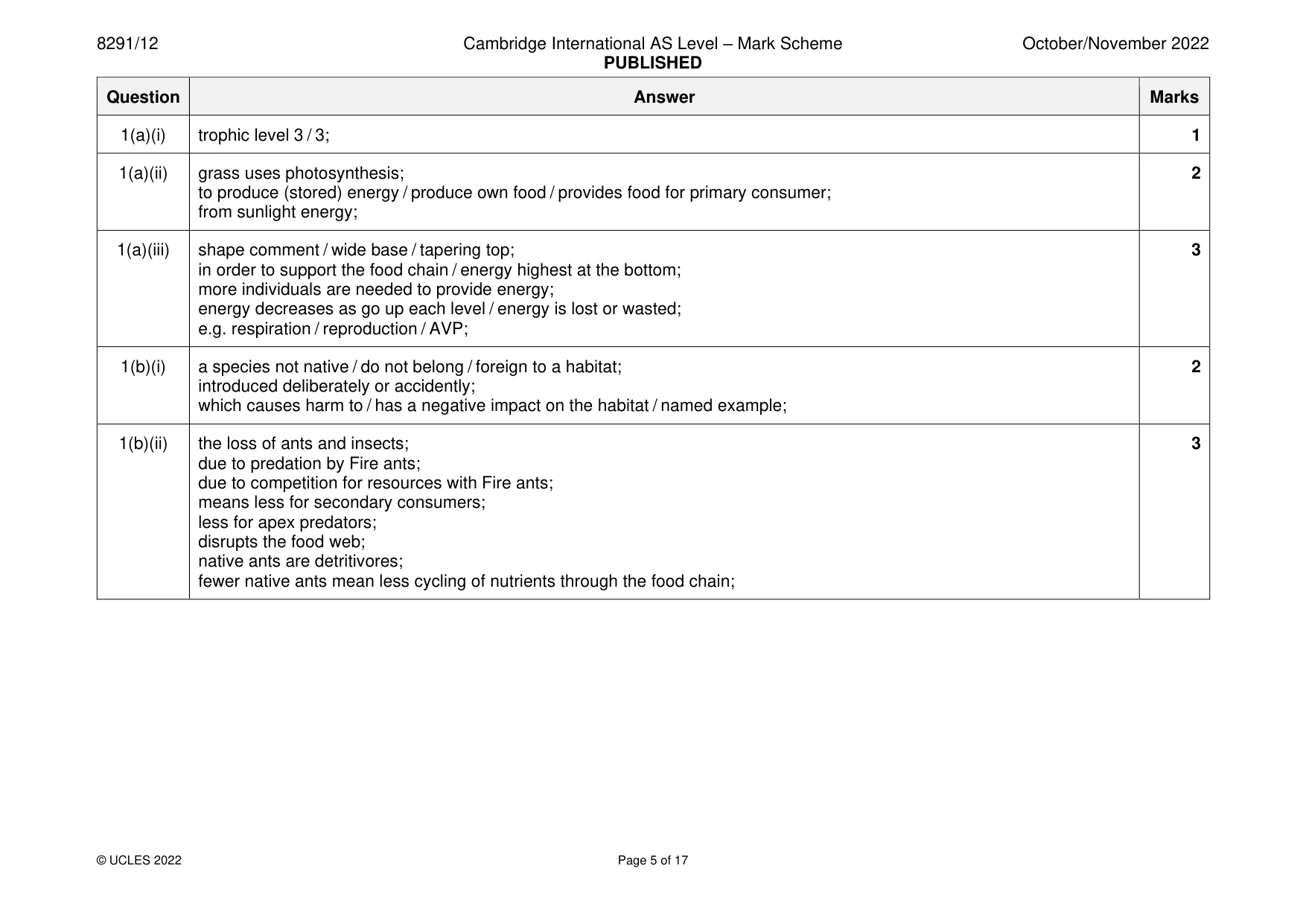
8291/12 Cambridge International AS Level – Mark Scheme PUBLISHED October/November 2022 © UCLES 2022 Page 5 of 17 Question Answer Marks 1(a)(i) trophic level 3 / 3; 1 1(a)(ii) grass uses photosynthesis; to produce (stored) energy / produce own food / provides food for primary consumer; from sunlight energy; 2 1(a)(iii) shape comment / wide base / tapering top; in order to support the food chain / energy highest at the bottom; more individuals are needed to provide energy; energy decreases as go up each level / energy is lost or wasted; e.g. respiration / reproduction / AVP; 3 1(b)(i) a species not native / do not belong / foreign to a habitat; introduced deliberately or accidently; which causes harm to / has a negative impact on the habitat / named example; 2 1(b)(ii) the loss of ants and insects; due to predation by Fire ants; due to competition for resources with Fire ants; means less for secondary consumers; less for apex predators; disrupts the food web; native ants are detritivores; fewer native ants mean less cycling of nutrients through the food chain; 3
Mark scheme, page 6
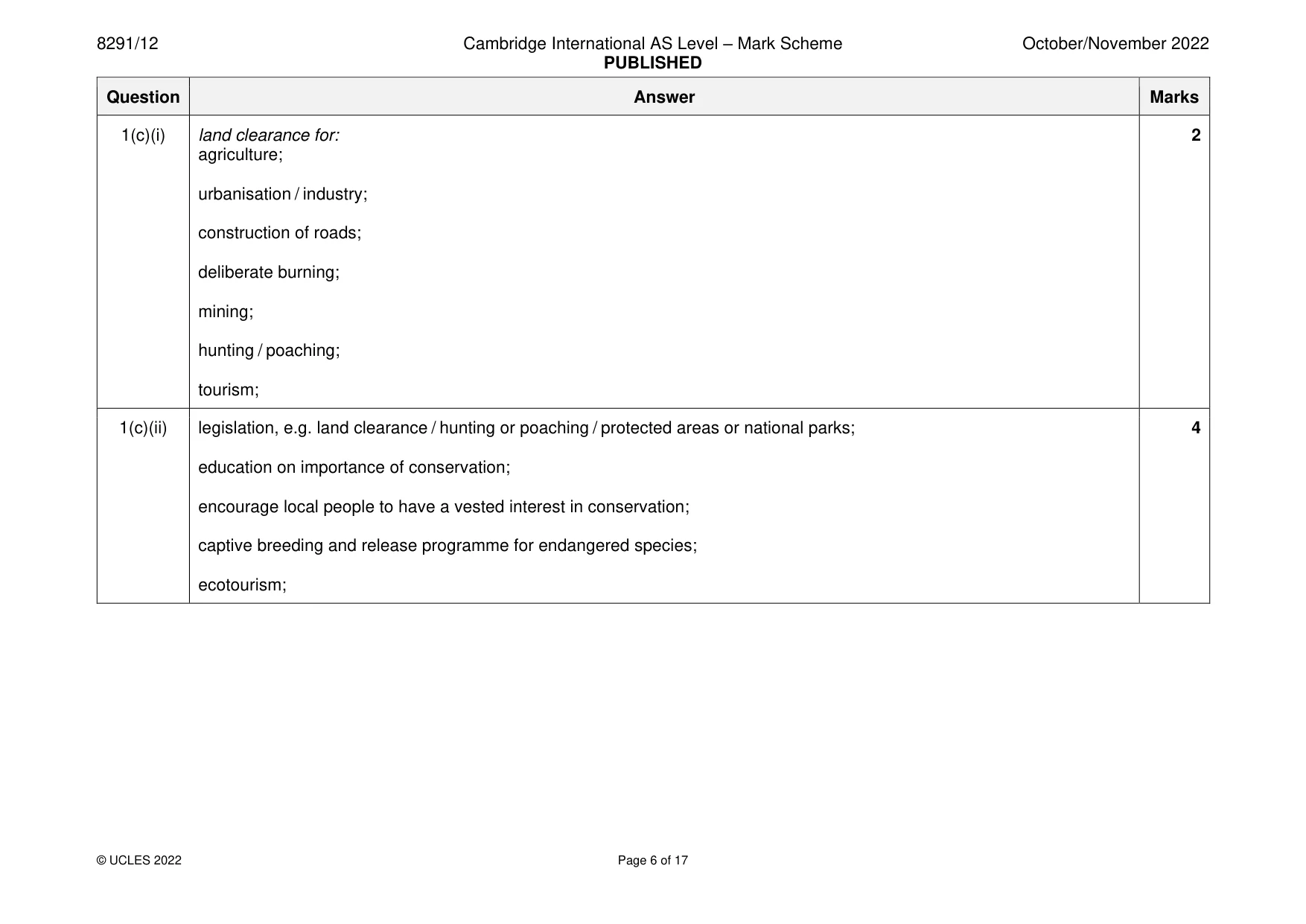
8291/12 Cambridge International AS Level – Mark Scheme PUBLISHED October/November 2022 © UCLES 2022 Page 6 of 17 Question Answer Marks 1(c)(i) land clearance for: agriculture; urbanisation / industry; construction of roads; deliberate burning; mining; hunting / poaching; tourism; 2 1(c)(ii) legislation, e.g. land clearance / hunting or poaching / protected areas or national parks; education on importance of conservation; encourage local people to have a vested interest in conservation; captive breeding and release programme for endangered species; ecotourism; 4
Mark scheme, page 7
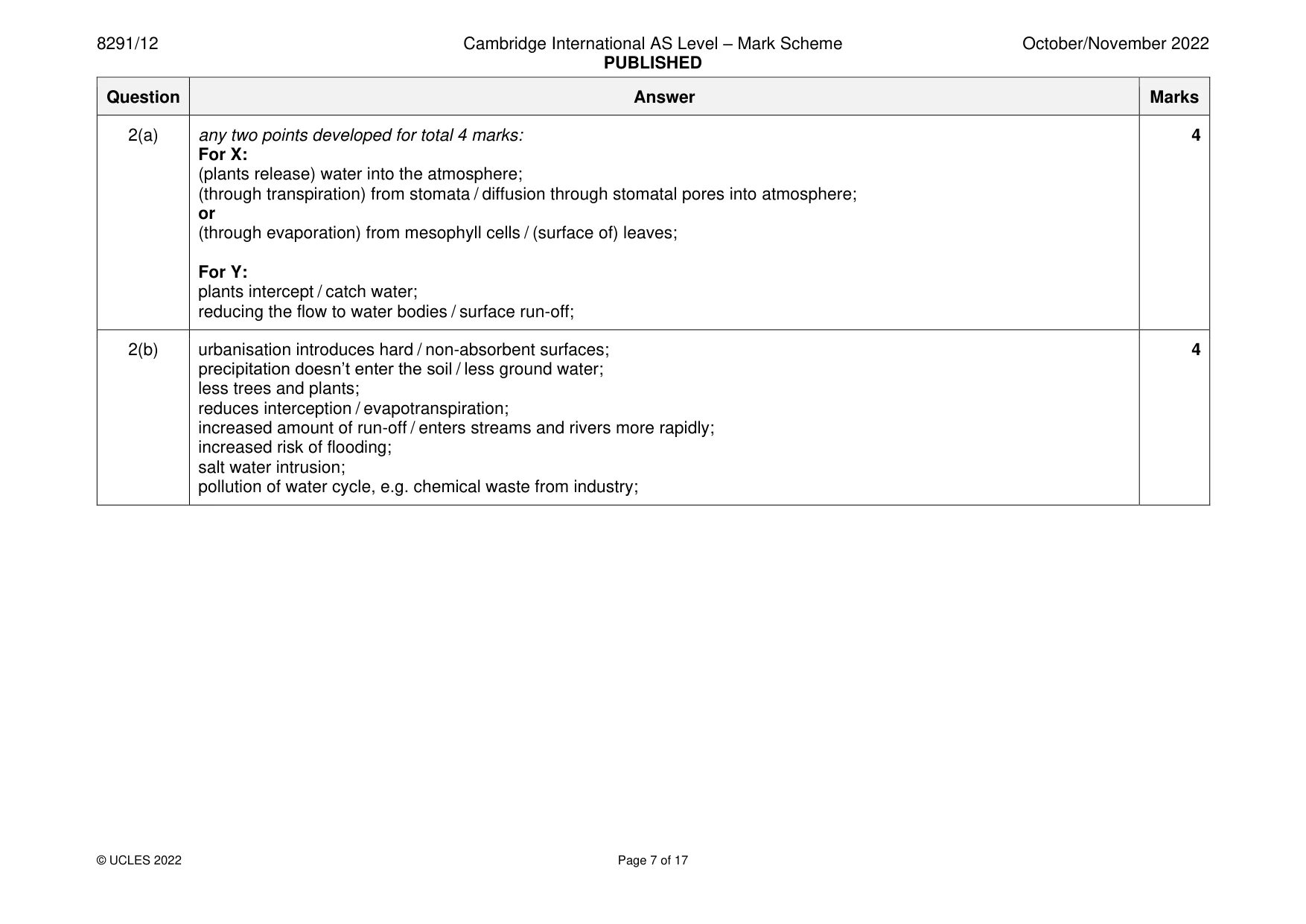
8291/12 Cambridge International AS Level – Mark Scheme PUBLISHED October/November 2022 © UCLES 2022 Page 7 of 17 Question Answer Marks 2(a) any two points developed for total 4 marks: For X: (plants release) water into the atmosphere; (through transpiration) from stomata / diffusion through stomatal pores into atmosphere; or (through evaporation) from mesophyll cells / (surface of) leaves; For Y: plants intercept / catch water; reducing the flow to water bodies / surface run-off; 4 2(b) urbanisation introduces hard / non-absorbent surfaces; precipitation doesn’t enter the soil / less ground water; less trees and plants; reduces interception / evapotranspiration; increased amount of run-off / enters streams and rivers more rapidly; increased risk of flooding; salt water intrusion; pollution of water cycle, e.g. chemical waste from industry; 4
Mark scheme, page 8
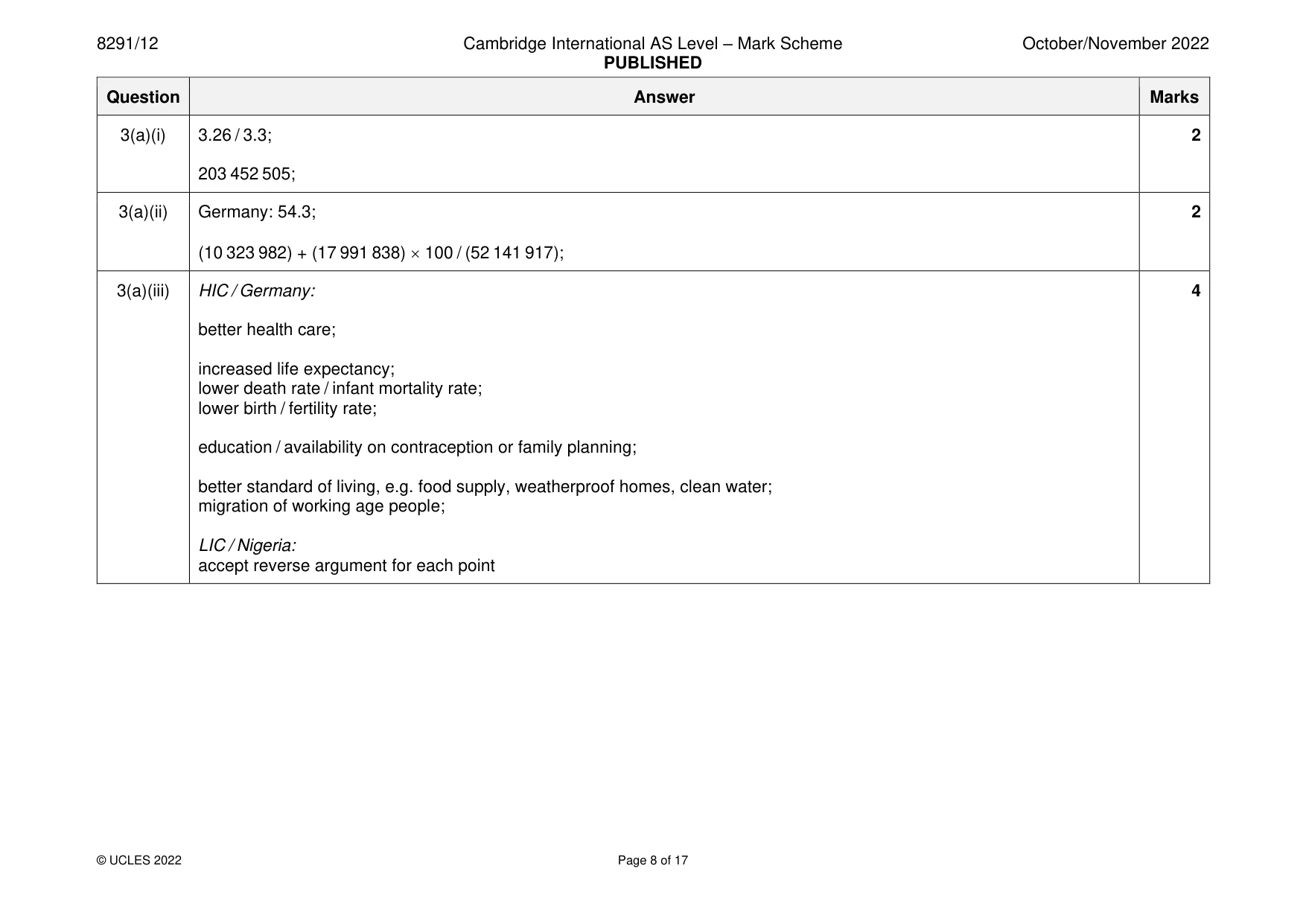
8291/12 Cambridge International AS Level – Mark Scheme PUBLISHED October/November 2022 © UCLES 2022 Page 8 of 17 Question Answer Marks 3(a)(i) 3.26 / 3.3; 203 452 505; 2 3(a)(ii) Germany: 54.3; (10 323 982) + (17 991 838) 100 / (52 141 917); 2 3(a)(iii) HIC / Germany: better health care; increased life expectancy; lower death rate / infant mortality rate; lower birth / fertility rate; education / availability on contraception or family planning; better standard of living, e.g. food supply, weatherproof homes, clean water; migration of working age people; LIC / Nigeria: accept reverse argument for each point 4
Mark scheme, page 9
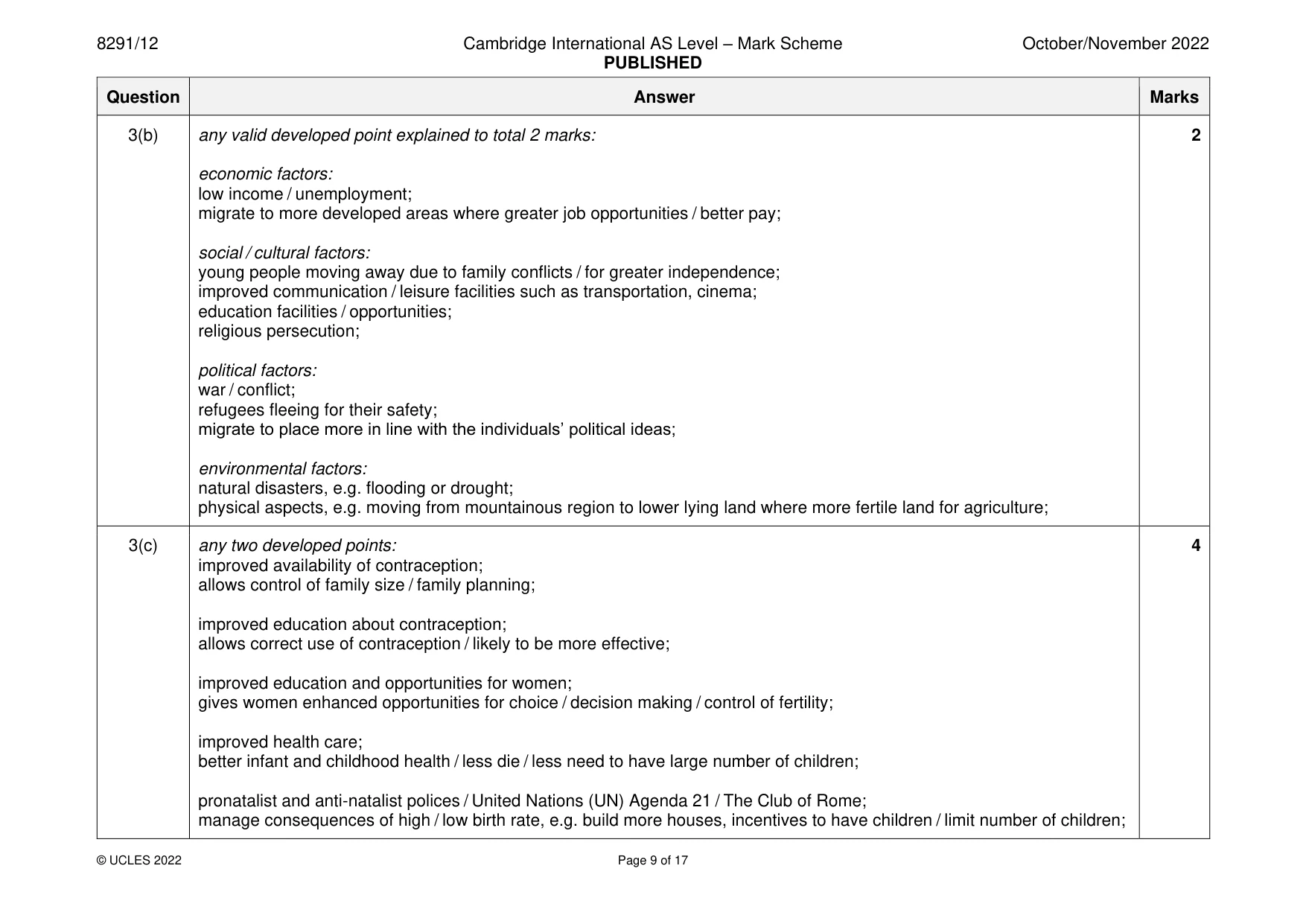
8291/12 Cambridge International AS Level – Mark Scheme PUBLISHED October/November 2022 © UCLES 2022 Page 9 of 17 Question Answer Marks 3(b) any valid developed point explained to total 2 marks: economic factors: low income / unemployment; migrate to more developed areas where greater job opportunities / better pay; social / cultural factors: young people moving away due to family conflicts / for greater independence; improved communication / leisure facilities such as transportation, cinema; education facilities / opportunities; religious persecution; political factors: war / conflict; refugees fleeing for their safety; migrate to place more in line with the individuals’ political ideas; environmental factors: natural disasters, e.g. flooding or drought; physical aspects, e.g. moving from mountainous region to lower lying land where more fertile land for agriculture; 2 3(c) any two developed points: improved availability of contraception; allows control of family size / family planning; improved education about contraception; allows correct use of contraception / likely to be more effective; improved education and opportunities for women; gives women enhanced opportunities for choice / decision making / control of fertility; improved health care; better infant and childhood health / less die / less need to have large number of children; pronatalist and anti-natalist polices / United Nations (UN) Agenda 21 / The Club of Rome; manage consequences of high / low birth rate, e.g. build more houses, incentives to have children / limit number of children; 4
Mark scheme, page 10
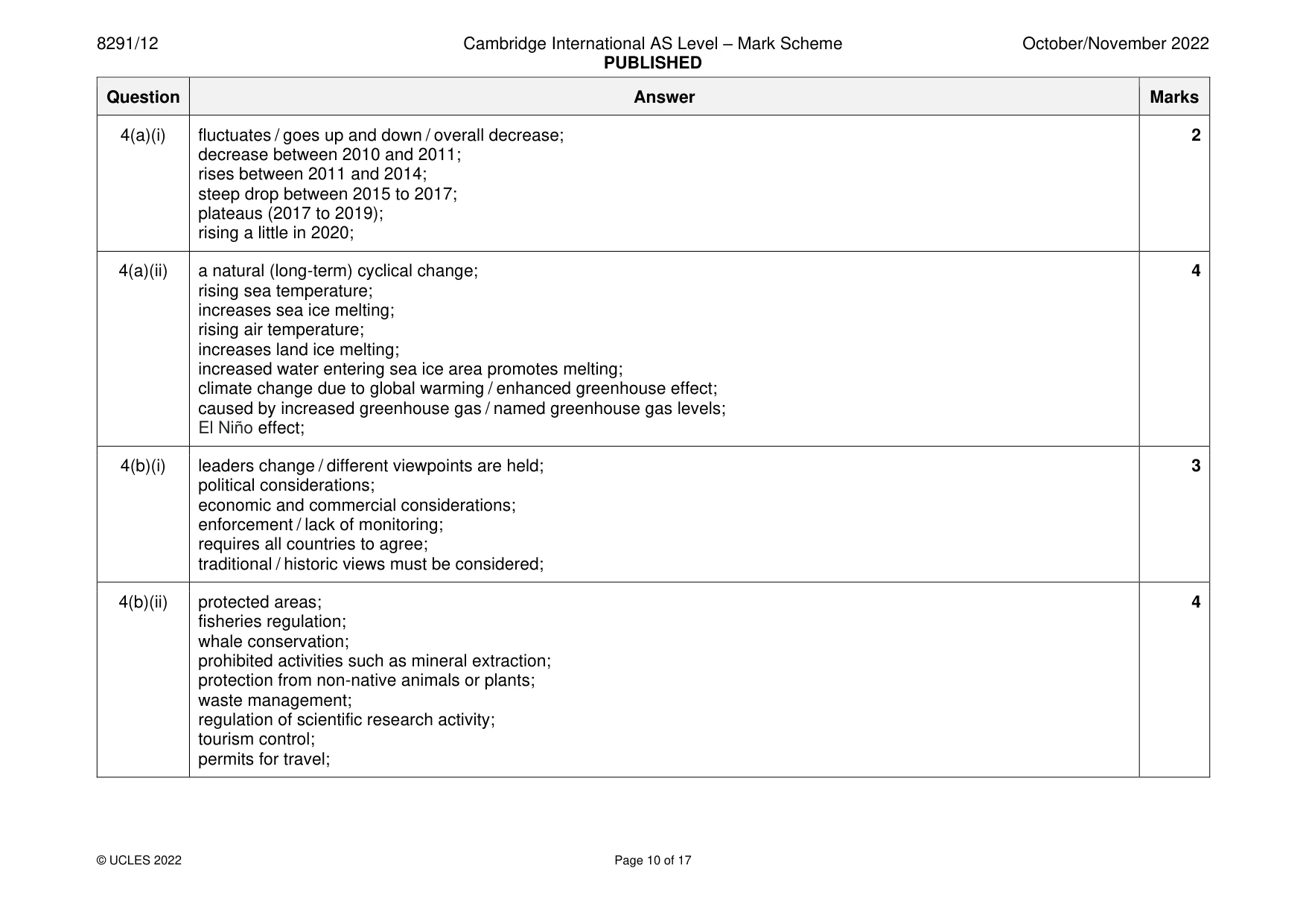
8291/12 Cambridge International AS Level – Mark Scheme PUBLISHED October/November 2022 © UCLES 2022 Page 10 of 17 Question Answer Marks 4(a)(i) fluctuates / goes up and down / overall decrease; decrease between 2010 and 2011; rises between 2011 and 2014; steep drop between 2015 to 2017; plateaus (2017 to 2019); rising a little in 2020; 2 4(a)(ii) a natural (long-term) cyclical change; rising sea temperature; increases sea ice melting; rising air temperature; increases land ice melting; increased water entering sea ice area promotes melting; climate change due to global warming / enhanced greenhouse effect; caused by increased greenhouse gas / named greenhouse gas levels; El Niño effect; 4 4(b)(i) leaders change / different viewpoints are held; political considerations; economic and commercial considerations; enforcement / lack of monitoring; requires all countries to agree; traditional / historic views must be considered; 3 4(b)(ii) protected areas; fisheries regulation; whale conservation; prohibited activities such as mineral extraction; protection from non-native animals or plants; waste management; regulation of scientific research activity; tourism control; permits for travel; 4
Mark scheme, page 11
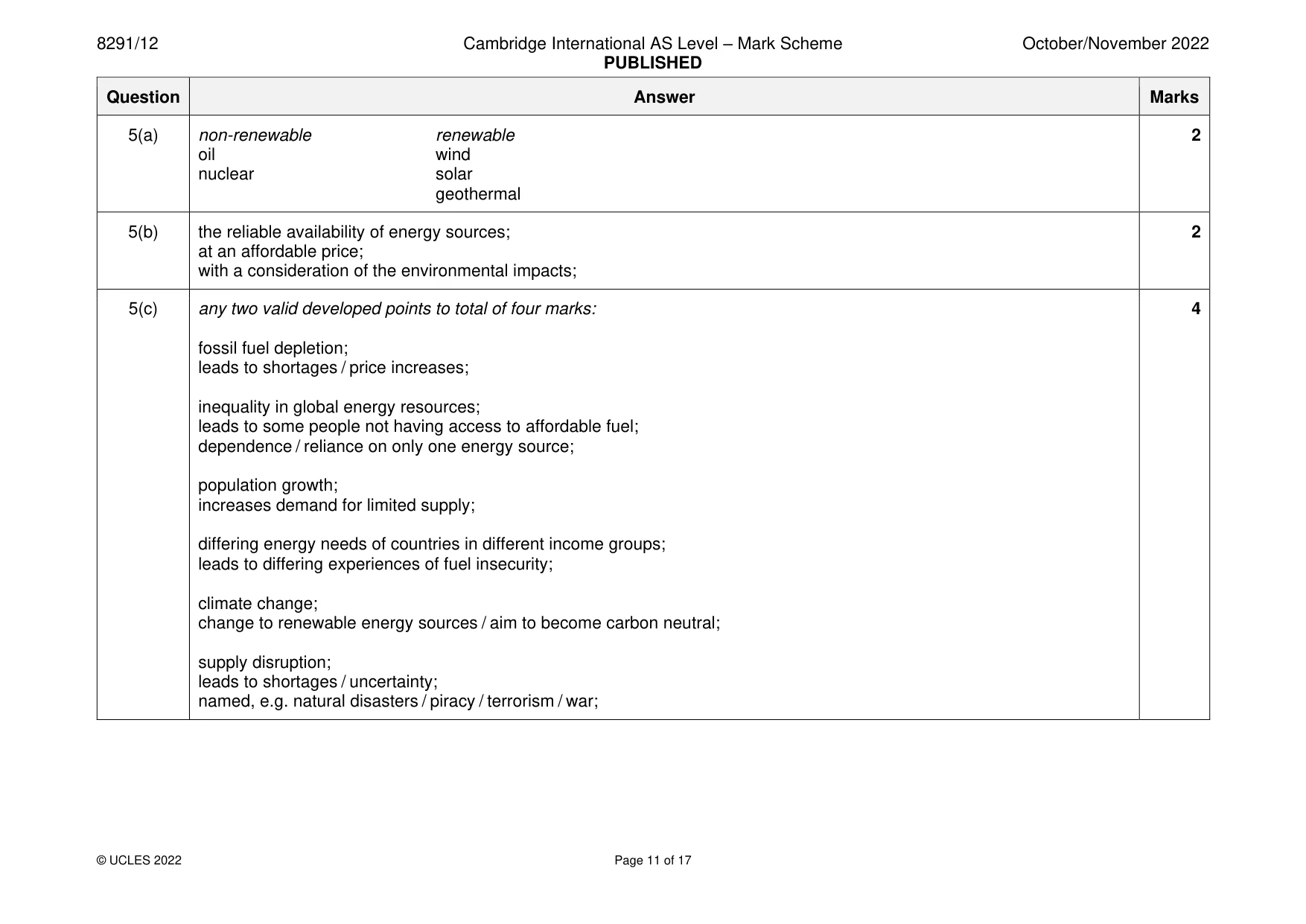
8291/12 Cambridge International AS Level – Mark Scheme PUBLISHED October/November 2022 © UCLES 2022 Page 11 of 17 Question Answer Marks 5(a) non-renewable renewable oil wind nuclear solar geothermal 2 5(b) the reliable availability of energy sources; at an affordable price; with a consideration of the environmental impacts; 2 5(c) any two valid developed points to total of four marks: fossil fuel depletion; leads to shortages / price increases; inequality in global energy resources; leads to some people not having access to affordable fuel; dependence / reliance on only one energy source; population growth; increases demand for limited supply; differing energy needs of countries in different income groups; leads to differing experiences of fuel insecurity; climate change; change to renewable energy sources / aim to become carbon neutral; supply disruption; leads to shortages / uncertainty; named, e.g. natural disasters / piracy / terrorism / war; 4
Mark scheme, page 12
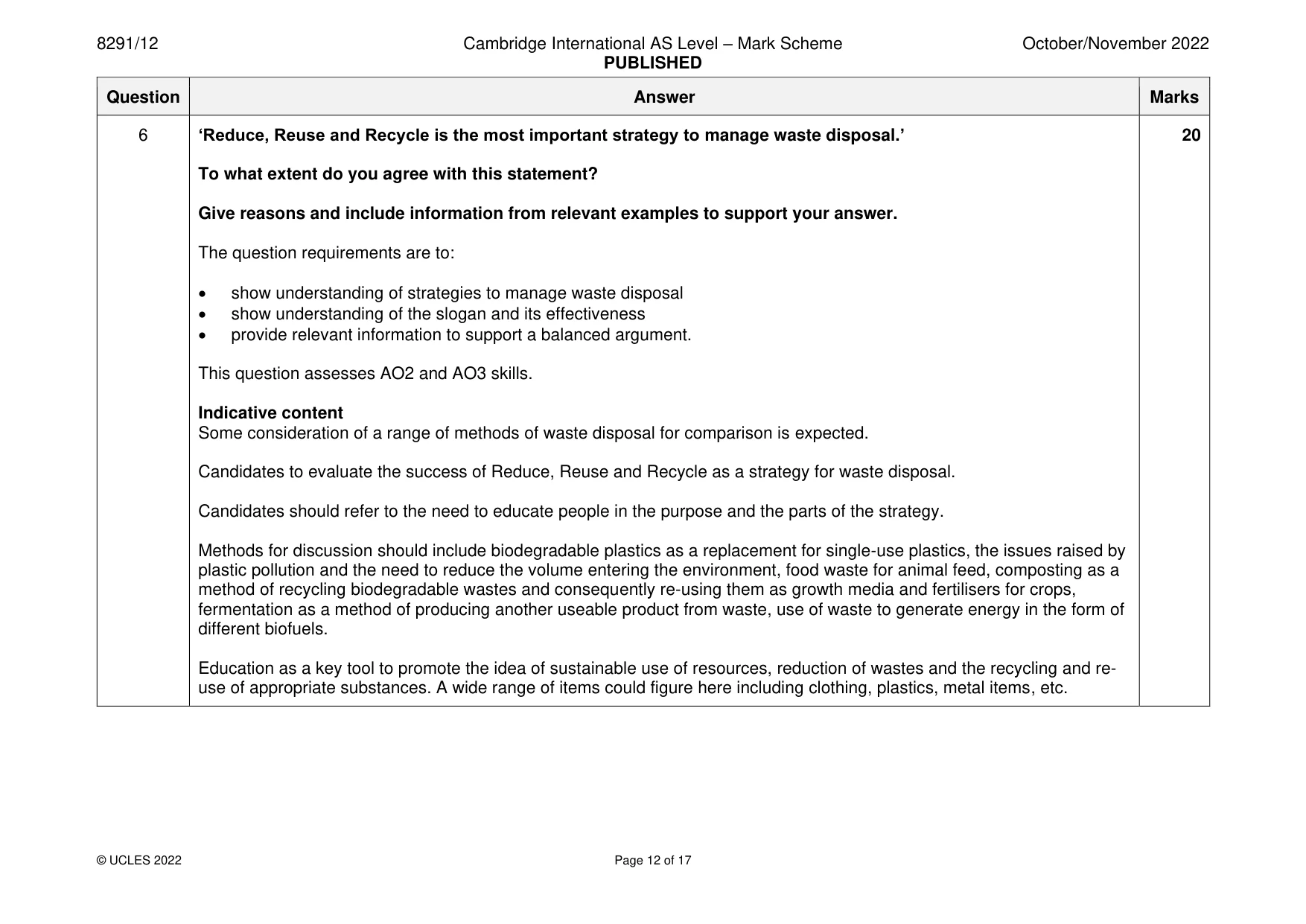
8291/12 Cambridge International AS Level – Mark Scheme PUBLISHED October/November 2022 © UCLES 2022 Page 12 of 17 Question Answer Marks 6 ‘Reduce, Reuse and Recycle is the most important strategy to manage waste disposal.’ To what extent do you agree with this statement? Give reasons and include information from relevant examples to support your answer. The question requirements are to: • show understanding of strategies to manage waste disposal • show understanding of the slogan and its effectiveness • provide relevant information to support a balanced argument. This question assesses AO2 and AO3 skills. Indicative content Some consideration of a range of methods of waste disposal for comparison is expected. Candidates to evaluate the success of Reduce, Reuse and Recycle as a strategy for waste disposal. Candidates should refer to the need to educate people in the purpose and the parts of the strategy. Methods for discussion should include biodegradable plastics as a replacement for single-use plastics, the issues raised by plastic pollution and the need to reduce the volume entering the environment, food waste for animal feed, composting as a method of recycling biodegradable wastes and consequently re-using them as growth media and fertilisers for crops, fermentation as a method of producing another useable product from waste, use of waste to generate energy in the form of different biofuels. Education as a key tool to promote the idea of sustainable use of resources, reduction of wastes and the recycling and re- use of appropriate substances. A wide range of items could figure here including clothing, plastics, metal items, etc. 20
Mark scheme, page 13
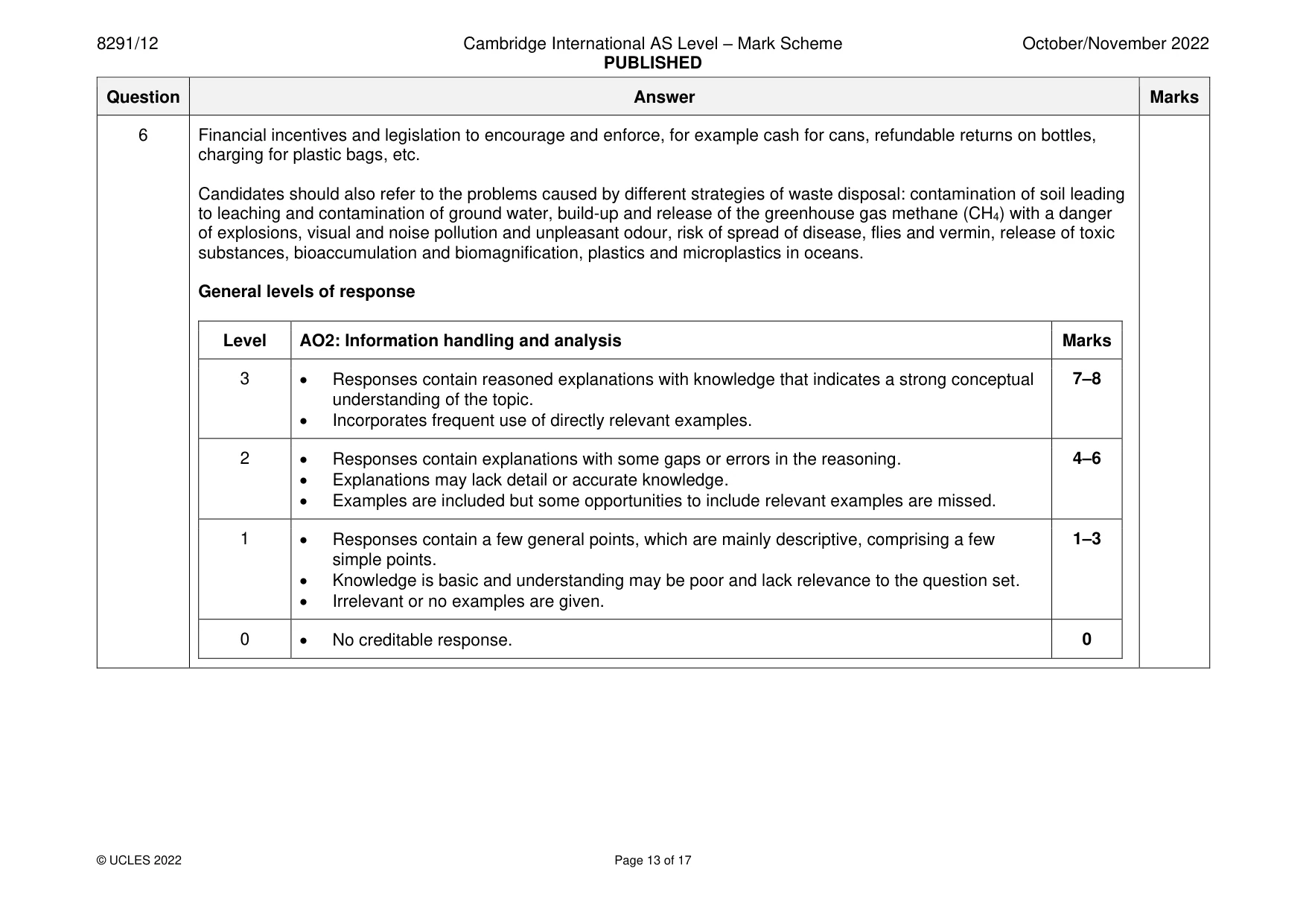
8291/12 Cambridge International AS Level – Mark Scheme PUBLISHED October/November 2022 © UCLES 2022 Page 13 of 17 Question Answer Marks 6 Financial incentives and legislation to encourage and enforce, for example cash for cans, refundable returns on bottles, charging for plastic bags, etc. Candidates should also refer to the problems caused by different strategies of waste disposal: contamination of soil leading to leaching and contamination of ground water, build-up and release of the greenhouse gas methane (CH4) with a danger of explosions, visual and noise pollution and unpleasant odour, risk of spread of disease, flies and vermin, release of toxic substances, bioaccumulation and biomagnification, plastics and microplastics in oceans. General levels of response Level AO2: Information handling and analysis Marks 3 • Responses contain reasoned explanations with knowledge that indicates a strong conceptual understanding of the topic. • Incorporates frequent use of directly relevant examples. 7–8 2 • Responses contain explanations with some gaps or errors in the reasoning. • Explanations may lack detail or accurate knowledge. • Examples are included but some opportunities to include relevant examples are missed. 4–6 1 • Responses contain a few general points, which are mainly descriptive, comprising a few simple points. • Knowledge is basic and understanding may be poor and lack relevance to the question set. • Irrelevant or no examples are given. 1–3 0 • No creditable response. 0
Mark scheme, page 14
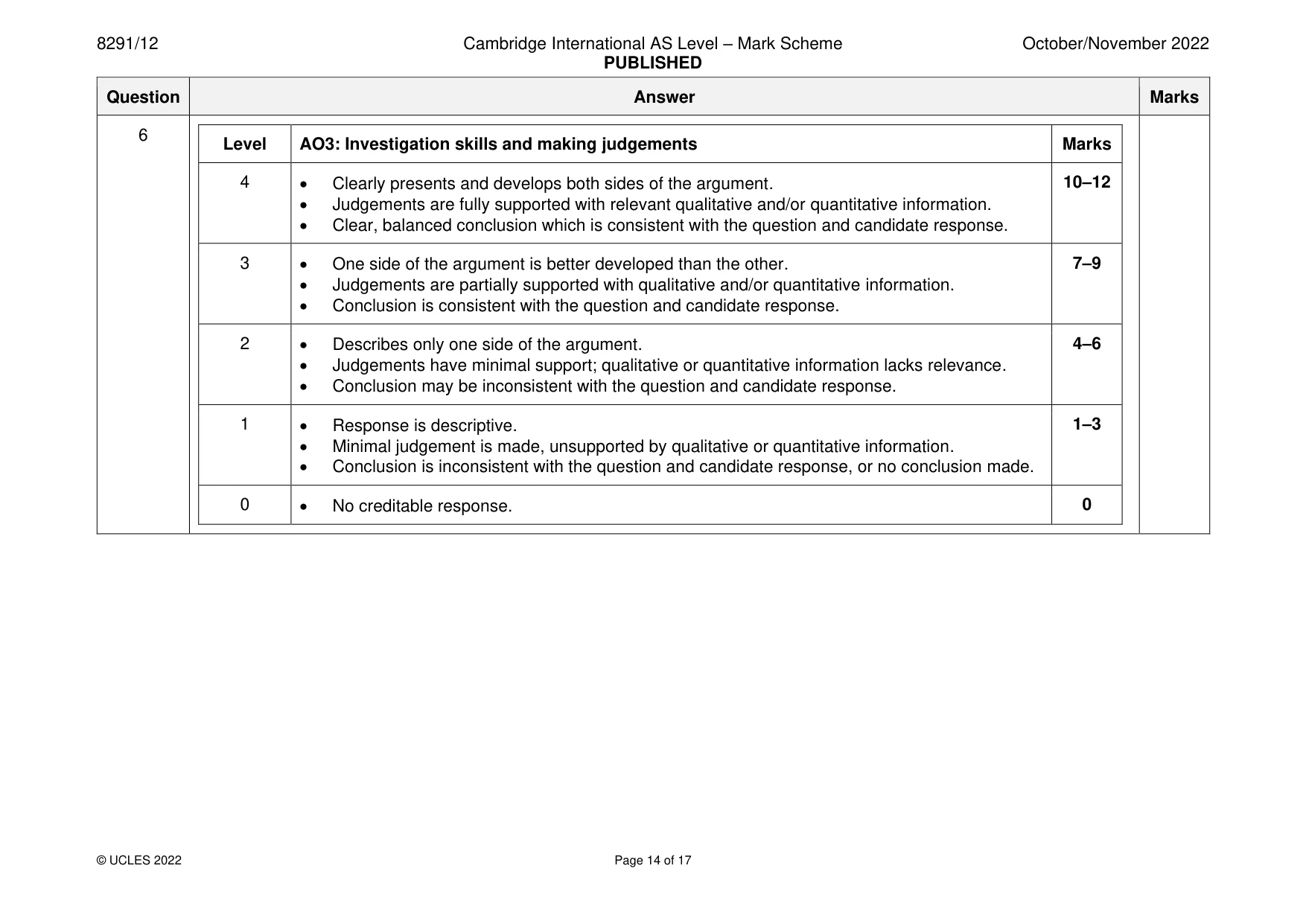
8291/12 Cambridge International AS Level – Mark Scheme PUBLISHED October/November 2022 © UCLES 2022 Page 14 of 17 Question Answer Marks 6 Level AO3: Investigation skills and making judgements Marks 4 • Clearly presents and develops both sides of the argument. • Judgements are fully supported with relevant qualitative and/or quantitative information. • Clear, balanced conclusion which is consistent with the question and candidate response. 10–12 3 • One side of the argument is better developed than the other. • Judgements are partially supported with qualitative and/or quantitative information. • Conclusion is consistent with the question and candidate response. 7–9 2 • Describes only one side of the argument. • Judgements have minimal support; qualitative or quantitative information lacks relevance. • Conclusion may be inconsistent with the question and candidate response. 4–6 1 • Response is descriptive. • Minimal judgement is made, unsupported by qualitative or quantitative information. • Conclusion is inconsistent with the question and candidate response, or no conclusion made. 1–3 0 • No creditable response. 0
Mark scheme, page 15
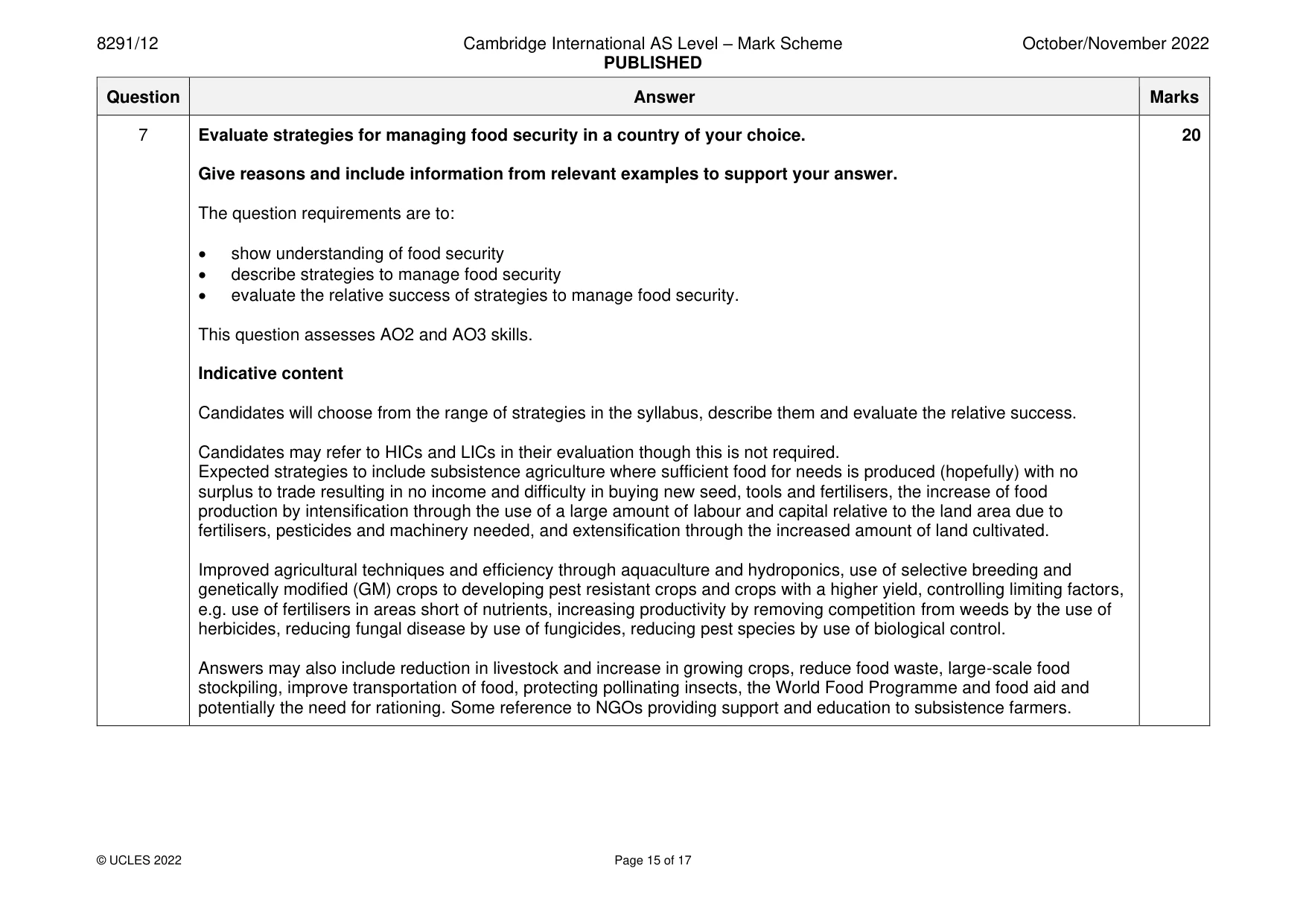
8291/12 Cambridge International AS Level – Mark Scheme PUBLISHED October/November 2022 © UCLES 2022 Page 15 of 17 Question Answer Marks 7 Evaluate strategies for managing food security in a country of your choice. Give reasons and include information from relevant examples to support your answer. The question requirements are to: • show understanding of food security • describe strategies to manage food security • evaluate the relative success of strategies to manage food security. This question assesses AO2 and AO3 skills. Indicative content Candidates will choose from the range of strategies in the syllabus, describe them and evaluate the relative success. Candidates may refer to HICs and LICs in their evaluation though this is not required. Expected strategies to include subsistence agriculture where sufficient food for needs is produced (hopefully) with no surplus to trade resulting in no income and difficulty in buying new seed, tools and fertilisers, the increase of food production by intensification through the use of a large amount of labour and capital relative to the land area due to fertilisers, pesticides and machinery needed, and extensification through the increased amount of land cultivated. Improved agricultural techniques and efficiency through aquaculture and hydroponics, use of selective breeding and genetically modified (GM) crops to developing pest resistant crops and crops with a higher yield, controlling limiting factors, e.g. use of fertilisers in areas short of nutrients, increasing productivity by removing competition from weeds by the use of herbicides, reducing fungal disease by use of fungicides, reducing pest species by use of biological control. Answers may also include reduction in livestock and increase in growing crops, reduce food waste, large-scale food stockpiling, improve transportation of food, protecting pollinating insects, the World Food Programme and food aid and potentially the need for rationing. Some reference to NGOs providing support and education to subsistence farmers. 20
Mark scheme, page 16
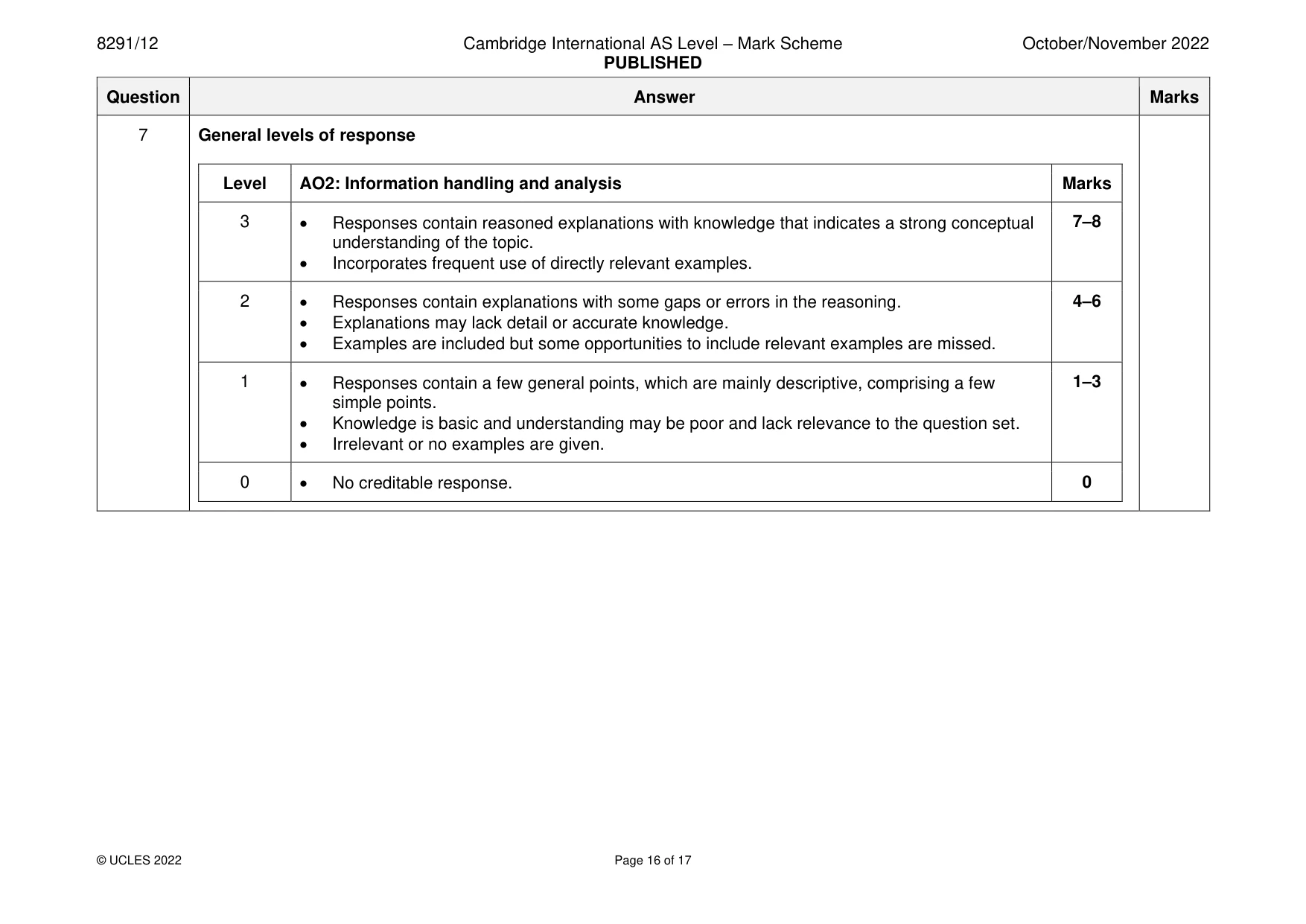
8291/12 Cambridge International AS Level – Mark Scheme PUBLISHED October/November 2022 © UCLES 2022 Page 16 of 17 Question Answer Marks 7 General levels of response Level AO2: Information handling and analysis Marks 3 • Responses contain reasoned explanations with knowledge that indicates a strong conceptual understanding of the topic. • Incorporates frequent use of directly relevant examples. 7–8 2 • Responses contain explanations with some gaps or errors in the reasoning. • Explanations may lack detail or accurate knowledge. • Examples are included but some opportunities to include relevant examples are missed. 4–6 1 • Responses contain a few general points, which are mainly descriptive, comprising a few simple points. • Knowledge is basic and understanding may be poor and lack relevance to the question set. • Irrelevant or no examples are given. 1–3 0 • No creditable response. 0
Mark scheme, page 17
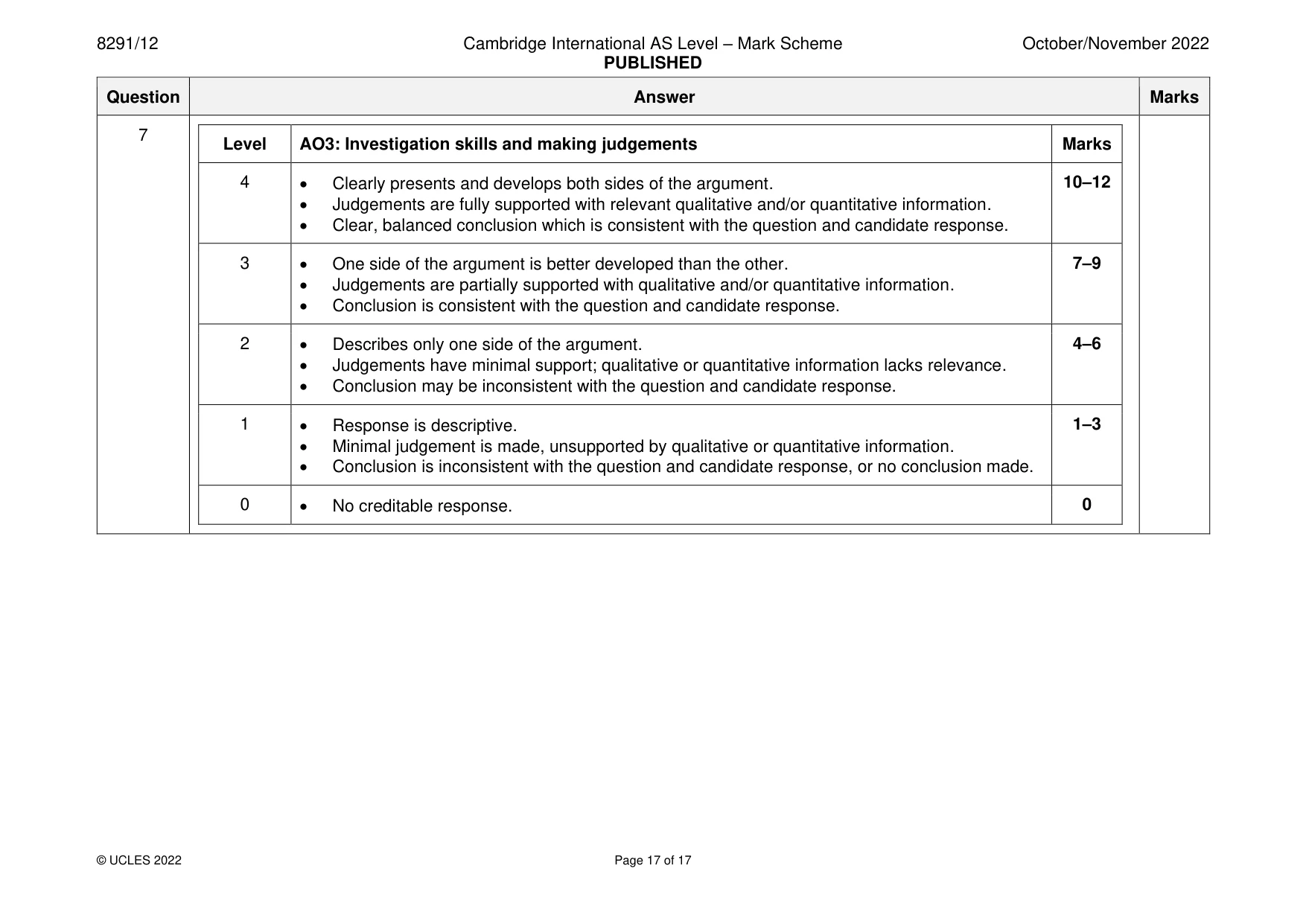
8291/12 Cambridge International AS Level – Mark Scheme PUBLISHED October/November 2022 © UCLES 2022 Page 17 of 17 Question Answer Marks 7 Level AO3: Investigation skills and making judgements Marks 4 • Clearly presents and develops both sides of the argument. • Judgements are fully supported with relevant qualitative and/or quantitative information. • Clear, balanced conclusion which is consistent with the question and candidate response. 10–12 3 • One side of the argument is better developed than the other. • Judgements are partially supported with qualitative and/or quantitative information. • Conclusion is consistent with the question and candidate response. 7–9 2 • Describes only one side of the argument. • Judgements have minimal support; qualitative or quantitative information lacks relevance. • Conclusion may be inconsistent with the question and candidate response. 4–6 1 • Response is descriptive. • Minimal judgement is made, unsupported by qualitative or quantitative information. • Conclusion is inconsistent with the question and candidate response, or no conclusion made. 1–3 0 • No creditable response. 0
What you needed in this session
Cambridge’s own grade thresholds for 2022 Oct/Nov, Paper 1 · Variant 2. A higher threshold means an easier paper — the bar moves with how the cohort did.