Cambridge A Level Environmental Management (AS only) 8291 — 2022 Oct/Nov Paper 1 · Variant 3
8291/13/O/N/22 · 80 marks · ≈90 min
The question paper and its mark scheme, free to read here and free to download. This is Cambridge’s own paper, exactly as it was sat.
Question paper20 pages










Mark scheme18 pages
Answers below. Sit the paper first if you are practising.
Paper as text
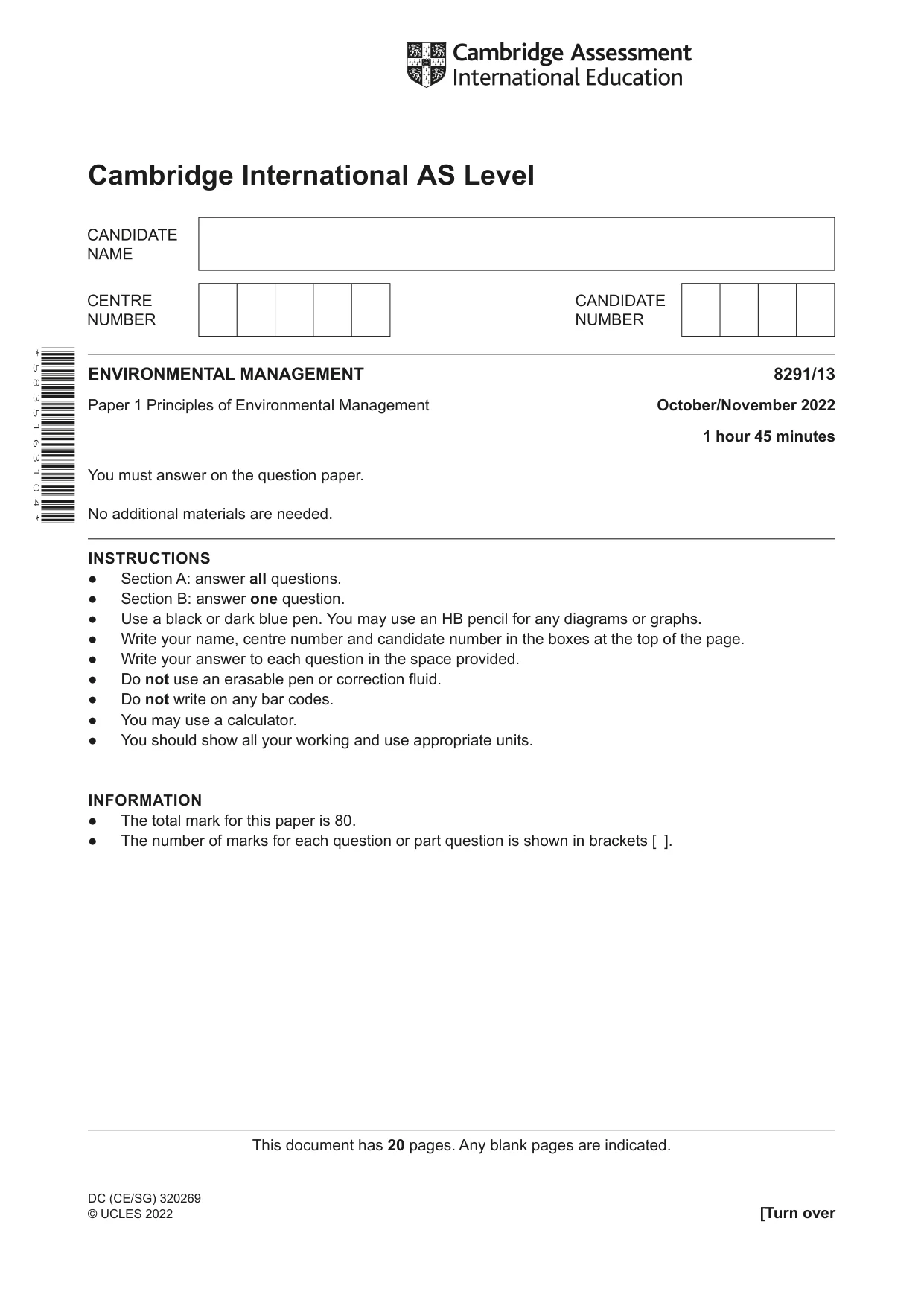
Question paper, page 1
This document has 20 pages. Any blank pages are indicated. [Turn over Cambridge International AS Level * 5 8 3 5 1 6 3 1 0 4 * DC (CE/SG) 320269 © UCLES 2022 ENVIRONMENTAL MANAGEMENT 8291/13 Paper 1 Principles of Environmental Management October/November 2022 1 hour 45 minutes You must answer on the question paper. No additional materials are needed. INSTRUCTIONS ● Section A: answer all questions. ● Section B: answer one question. ● Use a black or dark blue pen. You may use an HB pencil for any diagrams or graphs. ● Write your name, centre number and candidate number in the boxes at the top of the page. ● Write your answer to each question in the space provided. ● Do not use an erasable pen or correction fluid. ● Do not write on any bar codes. ● You may use a calculator. ● You should show all your working and use appropriate units. INFORMATION ● The total mark for this paper is 80. ● The number of marks for each question or part question is shown in brackets [ ].
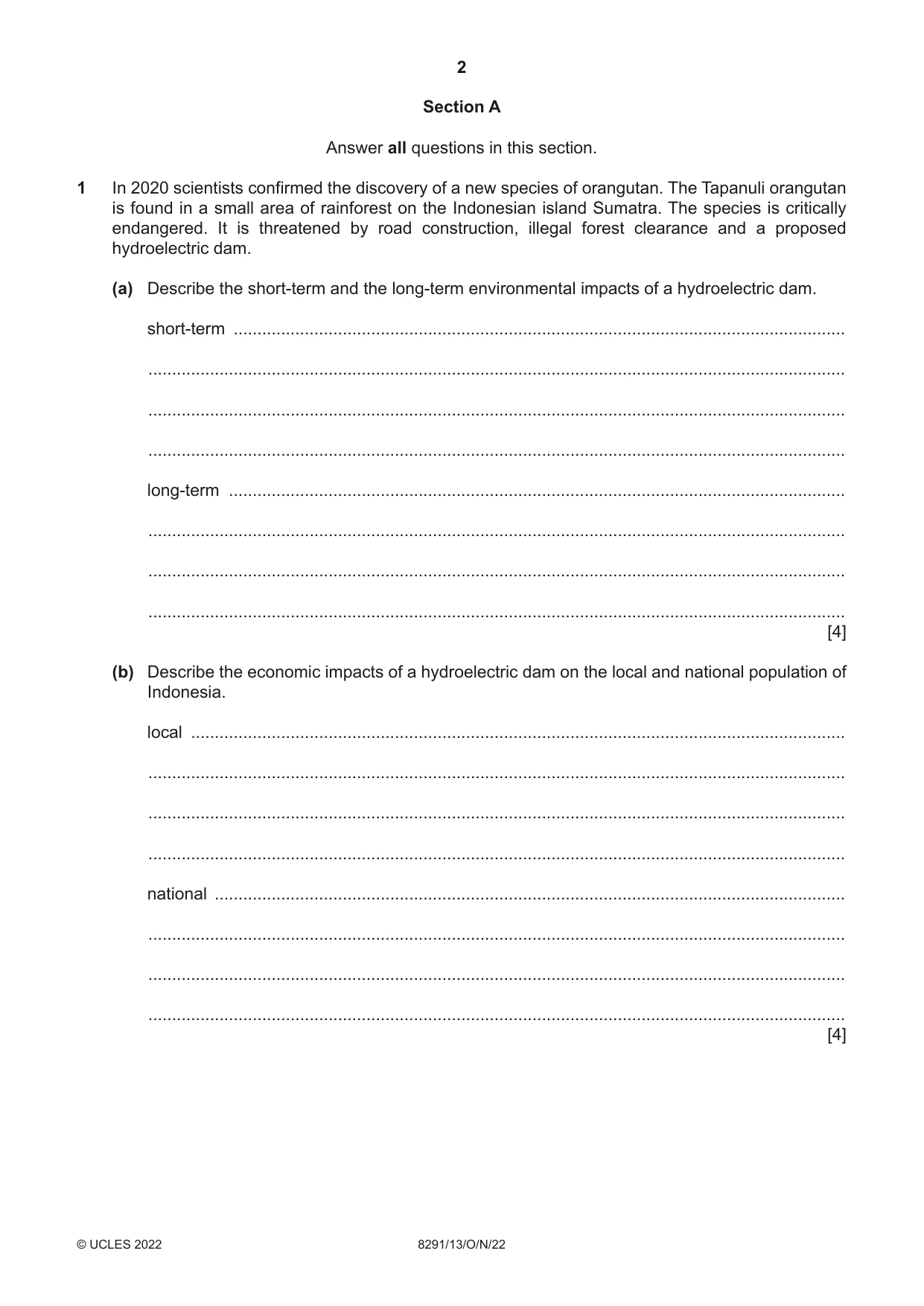
Question paper, page 2
2 8291/13/O/N/22 © UCLES 2022 Section A Answer all questions in this section. 1 In 2020 scientists confirmed the discovery of a new species of orangutan. The Tapanuli orangutan is found in a small area of rainforest on the Indonesian island Sumatra. The species is critically endangered. It is threatened by road construction, illegal forest clearance and a proposed hydroelectric dam. (a) Describe the short-term and the long-term environmental impacts of a hydroelectric dam. short-term … … … … long-term … … … … [4] (b) Describe the economic impacts of a hydroelectric dam on the local and national population of Indonesia. local … … … … national … … … … [4]
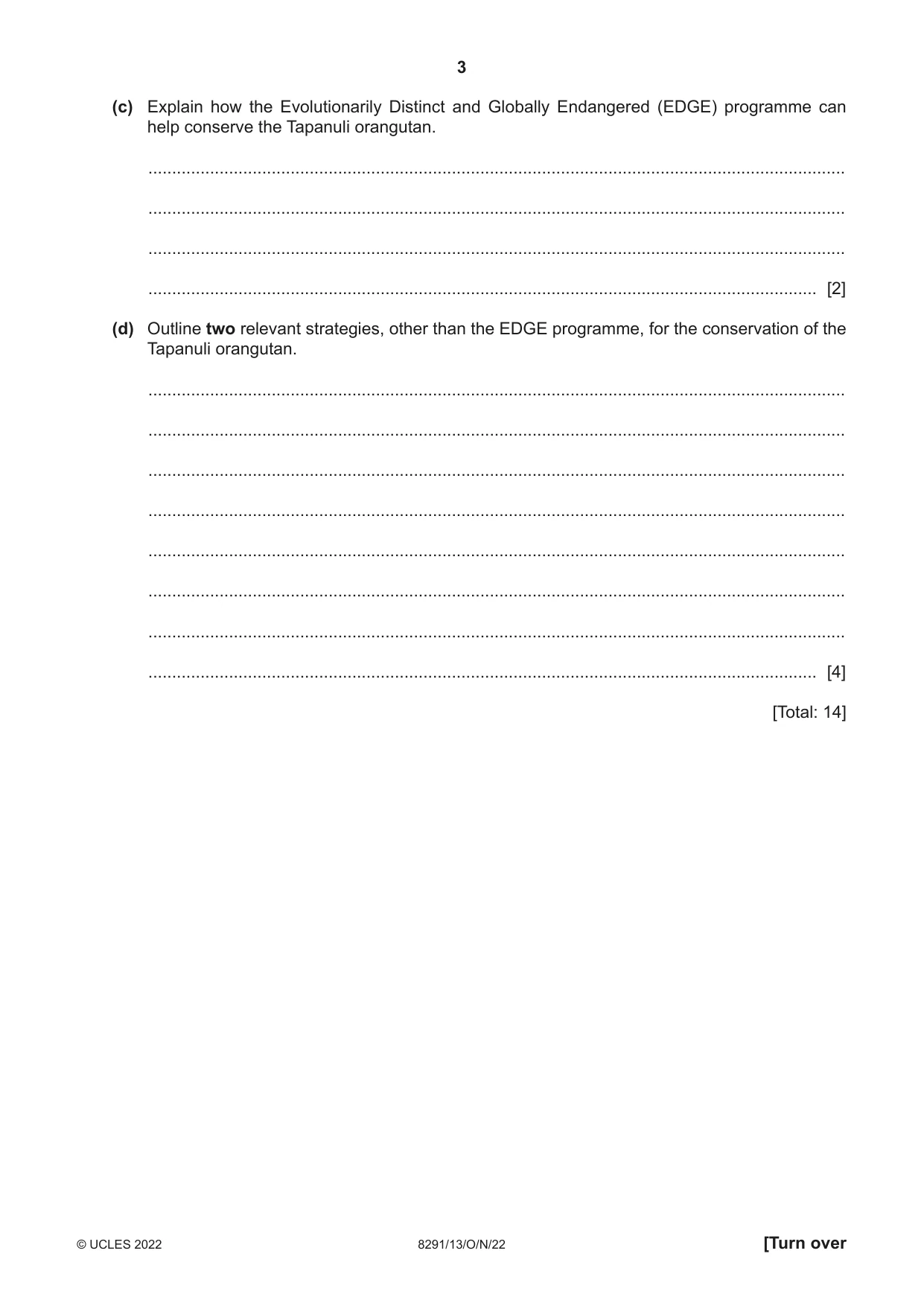
Question paper, page 3
3 8291/13/O/N/22 © UCLES 2022 [Turn over (c) Explain how the Evolutionarily Distinct and Globally Endangered (EDGE) programme can help conserve the Tapanuli orangutan. … … … … [2] (d) Outline two relevant strategies, other than the EDGE programme, for the conservation of the Tapanuli orangutan. … … … … … … … … [4] [Total: 14]
Question paper, page 4
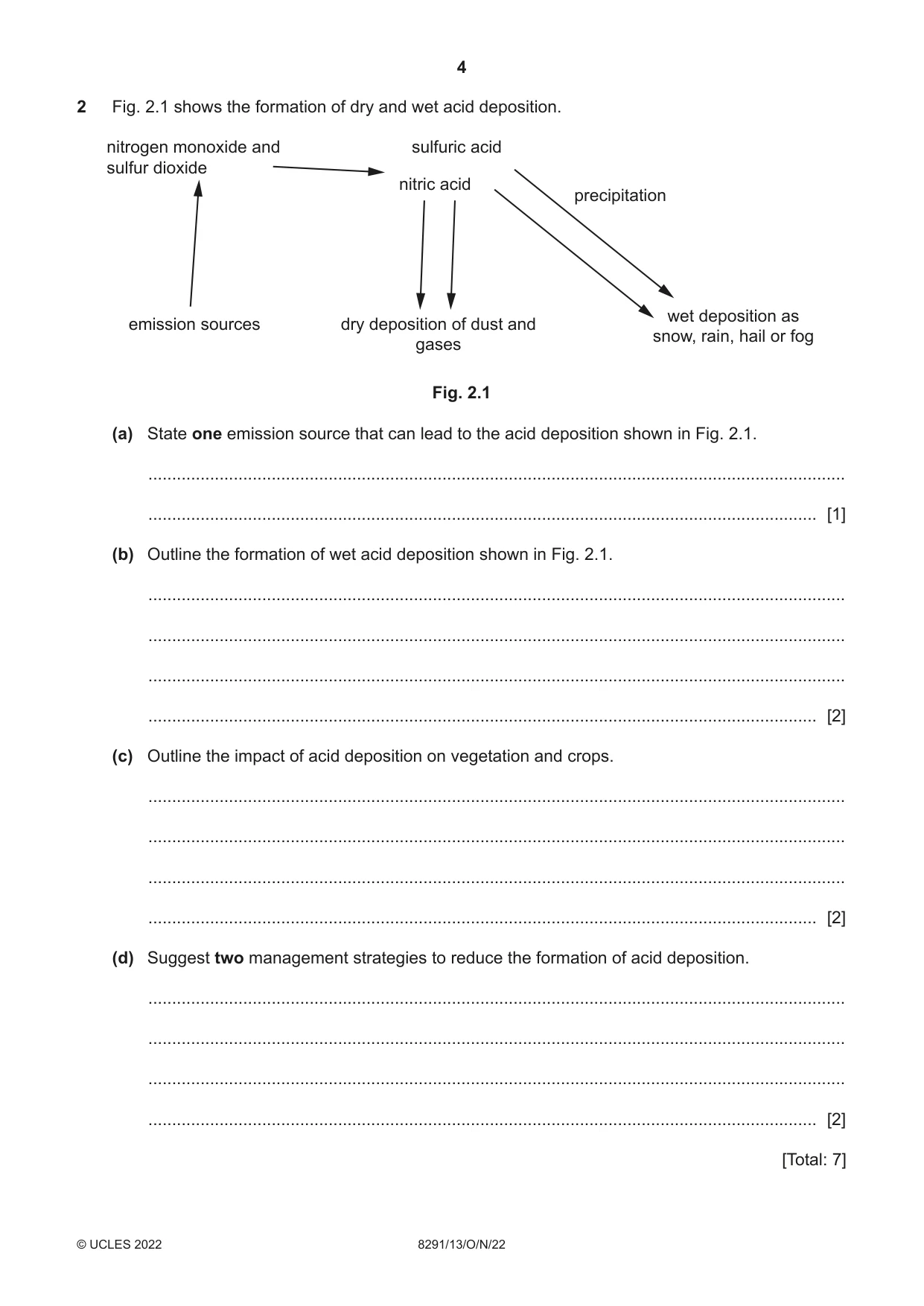
4 8291/13/O/N/22 © UCLES 2022 2 Fig. 2.1 shows the formation of dry and wet acid deposition. nitrogen monoxide and sulfur dioxide sulfuric acid nitric acid precipitation wet deposition as snow, rain, hail or fog dry deposition of dust and gases emission sources Fig. 2.1 (a) State one emission source that can lead to the acid deposition shown in Fig. 2.1. … … [1] (b) Outline the formation of wet acid deposition shown in Fig. 2.1. … … … … [2] (c) Outline the impact of acid deposition on vegetation and crops. … … … … [2] (d) Suggest two management strategies to reduce the formation of acid deposition. … … … … [2] [Total: 7]
Question paper, page 5
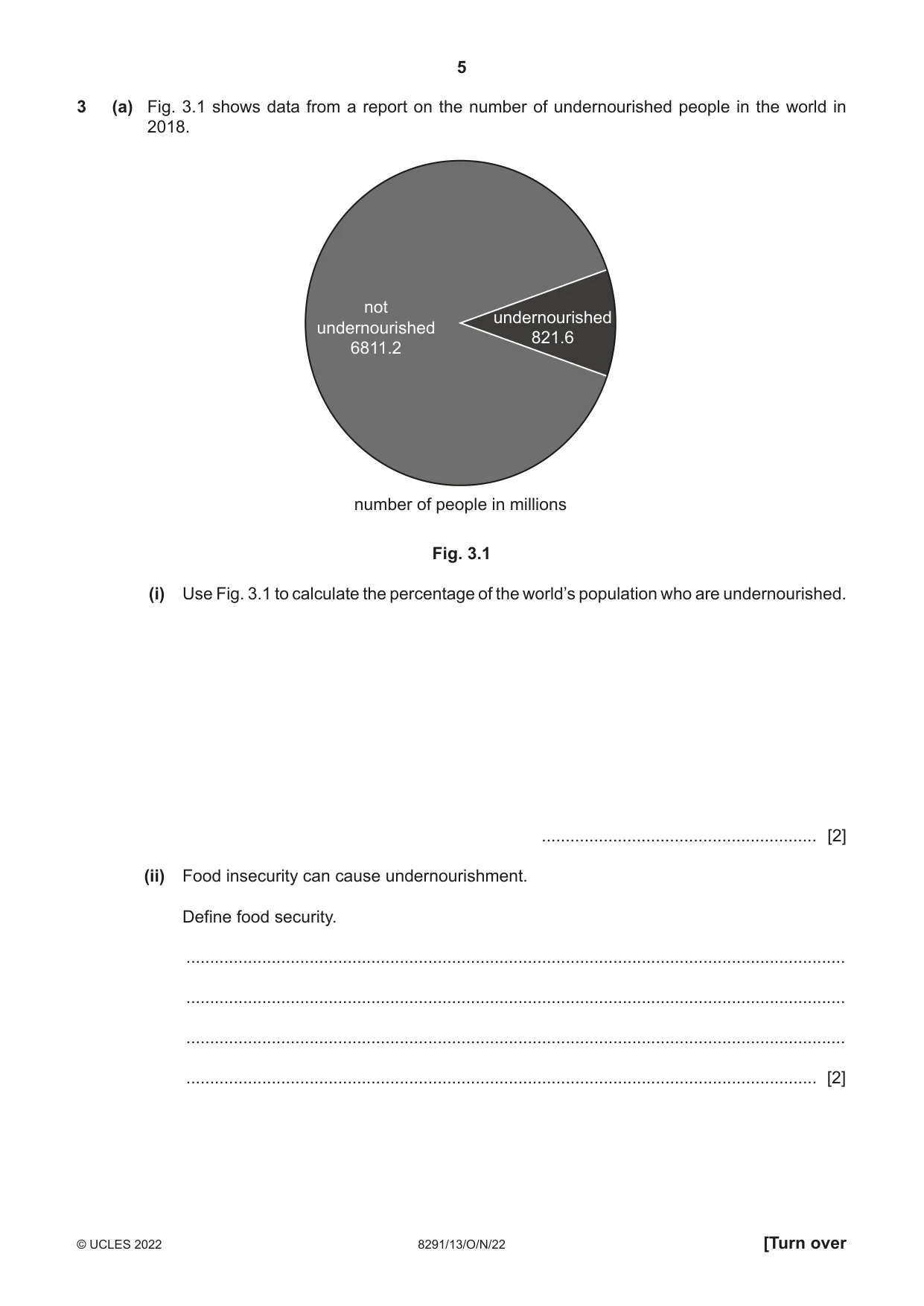
5 8291/13/O/N/22 © UCLES 2022 [Turn over 3 (a) Fig. 3.1 shows data from a report on the number of undernourished people in the world in 2018. number of people in millions not undernourished 6811.2 undernourished 821.6 Fig. 3.1 (i) Use Fig. 3.1 to calculate the percentage of the world’s population who are undernourished. … [2] (ii) Food insecurity can cause undernourishment. Define food security. … … … … [2]
Question paper, page 6
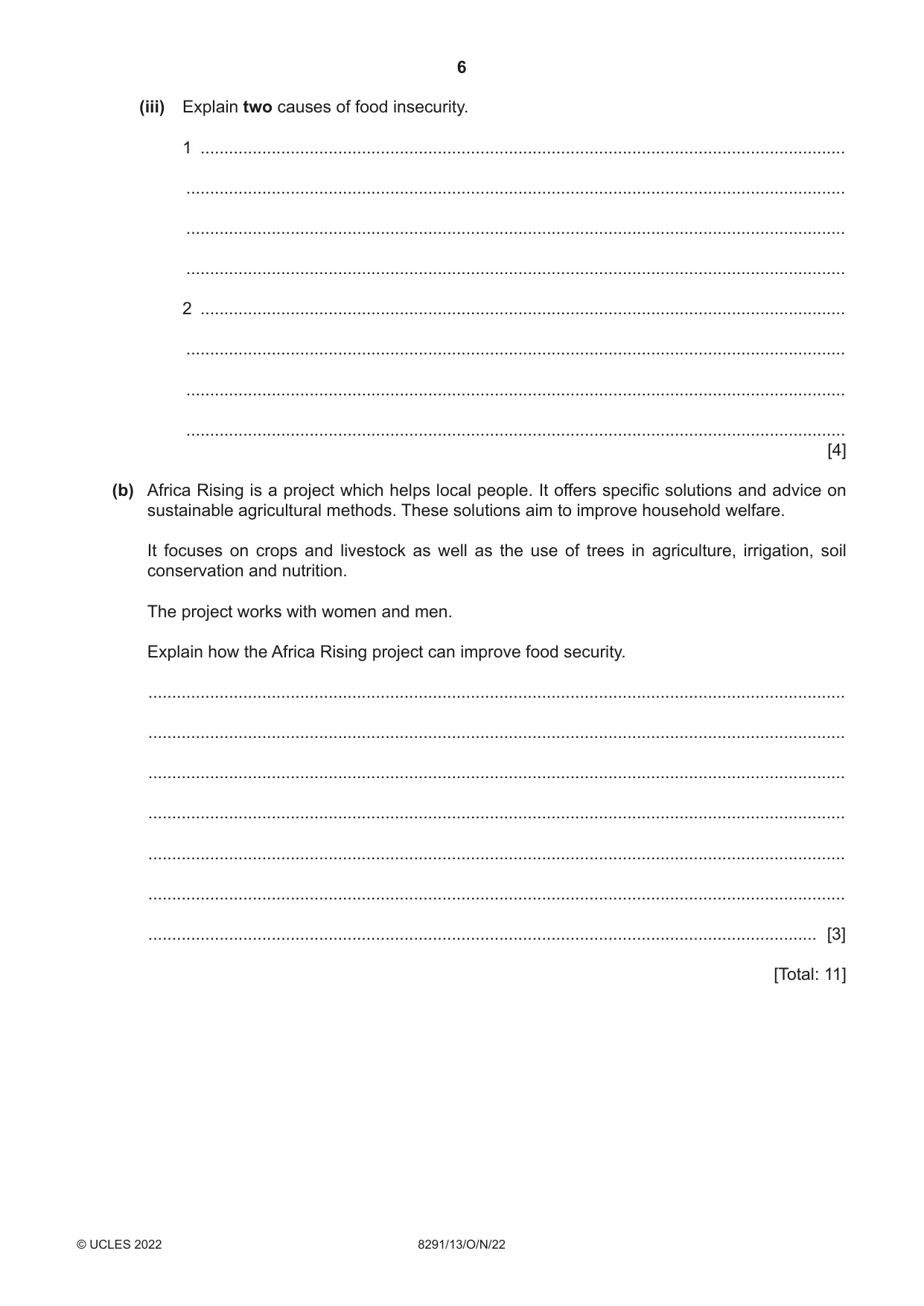
6 8291/13/O/N/22 © UCLES 2022 (iii) Explain two causes of food insecurity. 1 … … … … 2 … … … … [4] (b) Africa Rising is a project which helps local people. It offers specific solutions and advice on sustainable agricultural methods. These solutions aim to improve household welfare. It focuses on crops and livestock as well as the use of trees in agriculture, irrigation, soil conservation and nutrition. The project works with women and men. Explain how the Africa Rising project can improve food security. … … … … … … … [3] [Total: 11]
Question paper, page 7
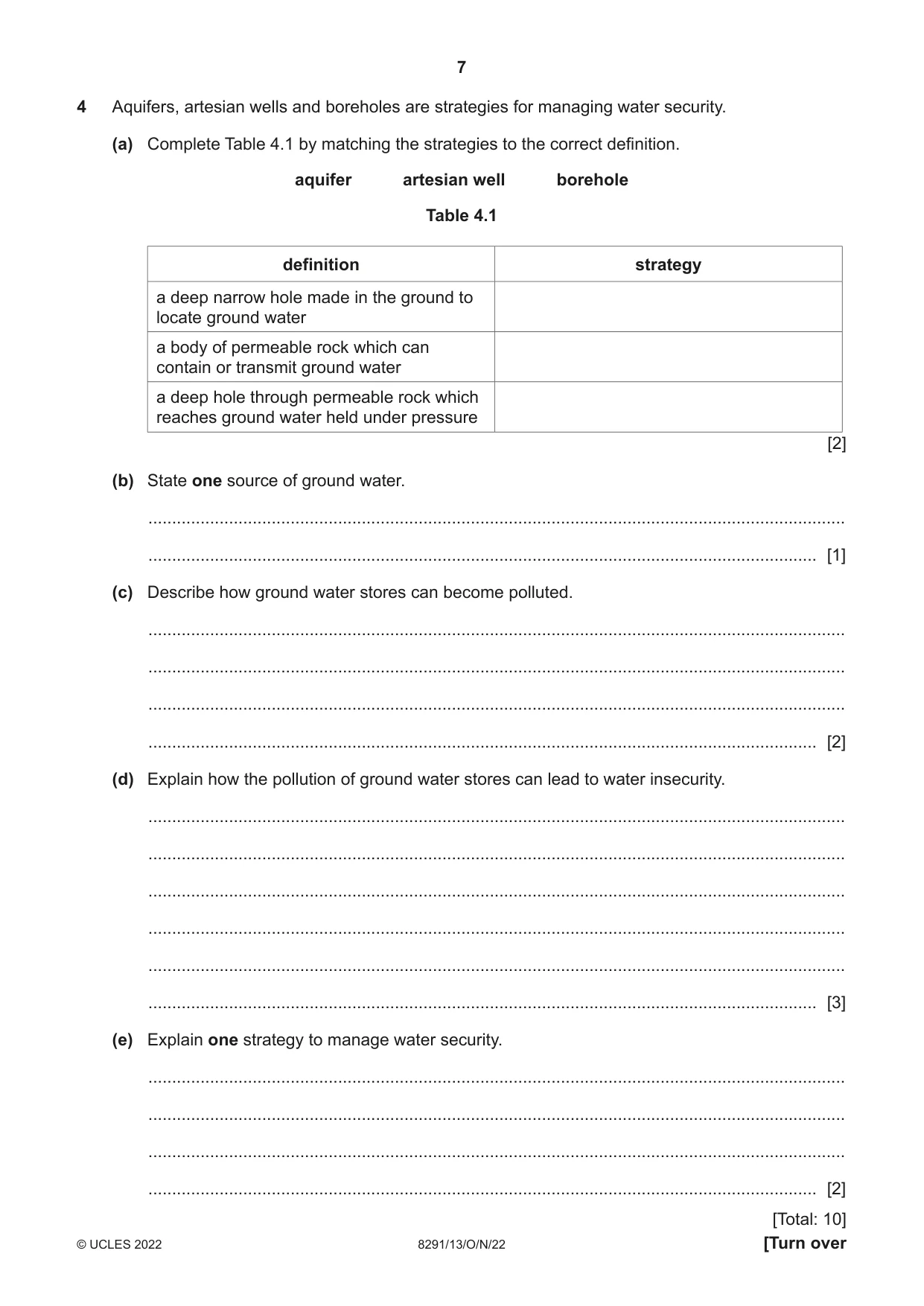
7 8291/13/O/N/22 © UCLES 2022 [Turn over 4 Aquifers, artesian wells and boreholes are strategies for managing water security. (a) Complete Table 4.1 by matching the strategies to the correct definition. aquifer artesian well borehole Table 4.1 definition strategy a deep narrow hole made in the ground to locate ground water a body of permeable rock which can contain or transmit ground water a deep hole through permeable rock which reaches ground water held under pressure [2] (b) State one source of ground water. … … [1] (c) Describe how ground water stores can become polluted. … … … … [2] (d) Explain how the pollution of ground water stores can lead to water insecurity. … … … … … … [3] (e) Explain one strategy to manage water security. … … … … [2] [Total: 10]
Question paper, page 8
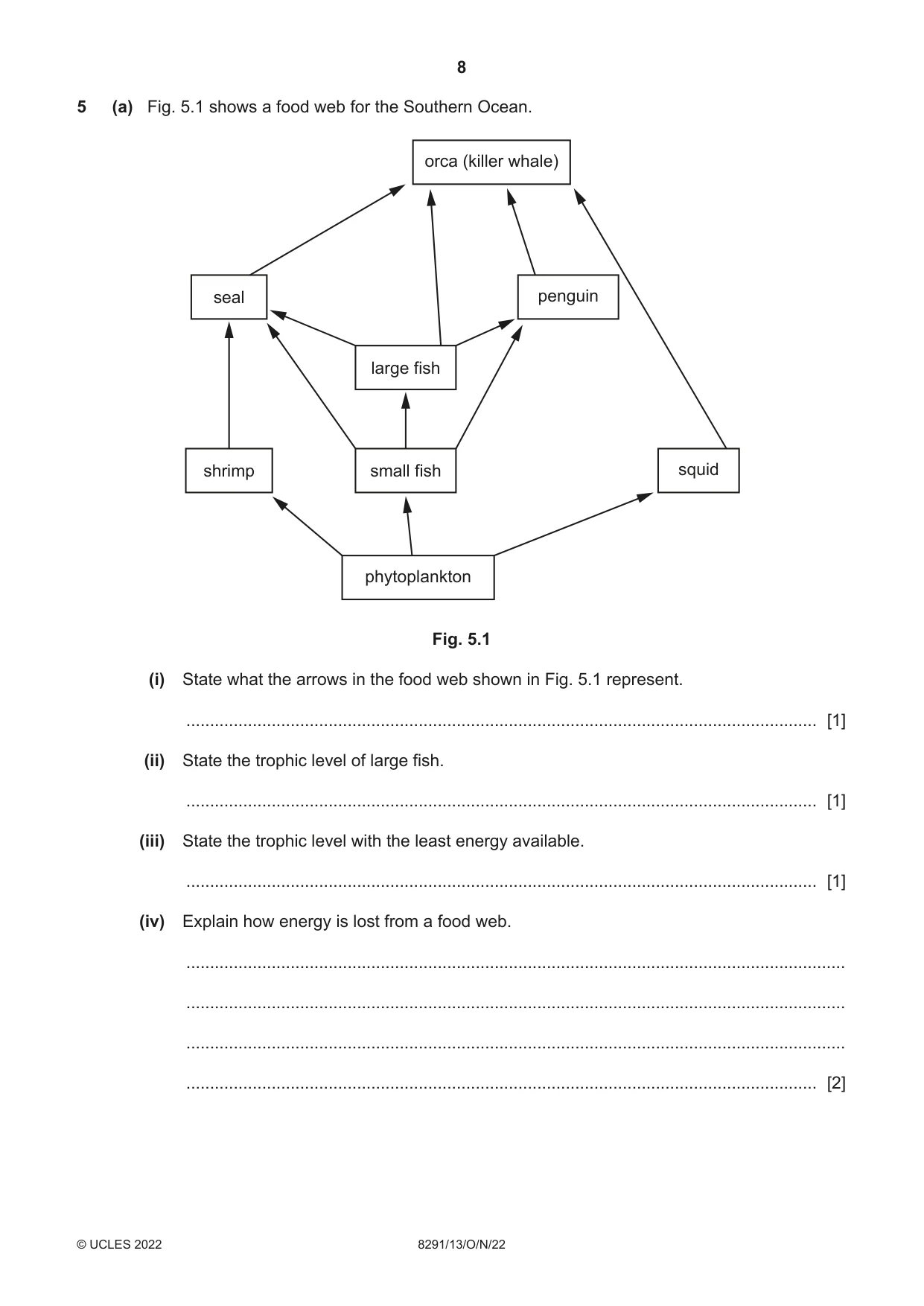
8 8291/13/O/N/22 © UCLES 2022 5 (a) Fig. 5.1 shows a food web for the Southern Ocean. orca (killer whale) penguin squid phytoplankton large fish small fish shrimp seal Fig. 5.1 (i) State what the arrows in the food web shown in Fig. 5.1 represent. … [1] (ii) State the trophic level of large fish. … [1] (iii) State the trophic level with the least energy available. … [1] (iv) Explain how energy is lost from a food web. … … … … [2]
Question paper, page 9
9 8291/13/O/N/22 © UCLES 2022 [Turn over (v) Explain the effects a decrease in the squid population would have on this Southern Ocean food web. … … … … … … … … [4]
Question paper, page 10
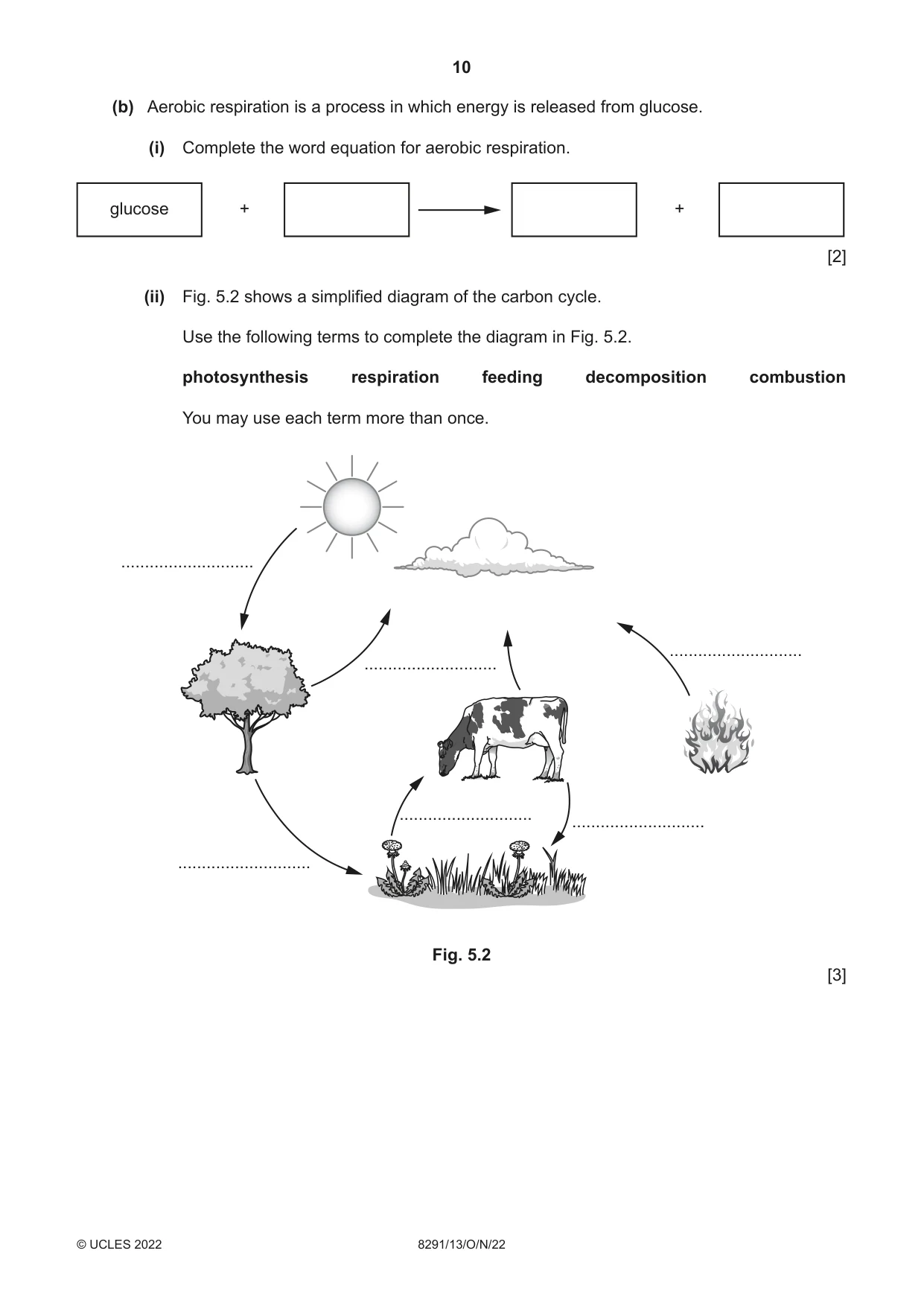
10 8291/13/O/N/22 © UCLES 2022 (b) Aerobic respiration is a process in which energy is released from glucose. (i) Complete the word equation for aerobic respiration. glucose + + [2] (ii) Fig. 5.2 shows a simplified diagram of the carbon cycle. Use the following terms to complete the diagram in Fig. 5.2. photosynthesis respiration feeding decomposition combustion You may use each term more than once. … … … … … … Fig. 5.2 [3]
Question paper, page 11
11 8291/13/O/N/22 © UCLES 2022 [Turn over (iii) Explain how the combustion of fossil fuels leads to climate change. … … … … … … … … [4] [Total: 18]
Question paper, page 12
12 8291/13/O/N/22 © UCLES 2022 Section B Answer one question. Either 6 ‘International agreements are the main reason why the populations of humpback, grey and blue whale species have increased over the past 50 years.’ To what extent do you agree with this statement? Give reasons and include relevant information to support your answer. [20] Or 7 Evaluate the success of strategies to manage energy security in a location of your choice. Give reasons and include relevant information to support your answer. [20] … … … … … … … … … … … … … … … … … …
Question paper, page 13
13 8291/13/O/N/22 © UCLES 2022 [Turn over … … … … … … … … … … … … … … … … … … … … … … … … … … … …
Question paper, page 14
14 8291/13/O/N/22 © UCLES 2022 … … … … … … … … … … … … … … … … … … … … … … … … … … … …
Question paper, page 15
15 8291/13/O/N/22 © UCLES 2022 [Turn over … … … … … … … … … … … … … … … … … … … … … … … … … … … …
Question paper, page 16
16 8291/13/O/N/22 © UCLES 2022 … … … … … … … … … … … … … … … … … … … … … … … … … … … …
Question paper, page 17
17 8291/13/O/N/22 © UCLES 2022 [Turn over … … … … … … … … … … … … … … … … … … … … … … … … … … … …
Question paper, page 18
18 8291/13/O/N/22 © UCLES 2022 … … … … … … … … … … … … … … … … … … … … … … … … … … … …
Question paper, page 19
19 8291/13/O/N/22 © UCLES 2022 BLANK PAGE
Question paper, page 20
20 8291/13/O/N/22 © UCLES 2022 The boundaries and names shown, the designations used and the presentation of material on any maps contained in this question paper/insert do not imply official endorsement or acceptance by Cambridge Assessment International Education concerning the legal status of any country, territory, or area or any of its authorities, or of the delimitation of its frontiers or boundaries. Permission to reproduce items where third-party owned material protected by copyright is included has been sought and cleared where possible. Every reasonable effort has been made by the publisher (UCLES) to trace copyright holders, but if any items requiring clearance have unwittingly been included, the publisher will be pleased to make amends at the earliest possible opportunity. To avoid the issue of disclosure of answer-related information to candidates, all copyright acknowledgements are reproduced online in the Cambridge Assessment International Education Copyright Acknowledgements Booklet. This is produced for each series of examinations and is freely available to download at www.cambridgeinternational.org after the live examination series. Cambridge Assessment International Education is part of Cambridge Assessment. Cambridge Assessment is the brand name of the University of Cambridge Local Examinations Syndicate (UCLES), which is a department of the University of Cambridge. BLANK PAGE
Mark scheme, page 1
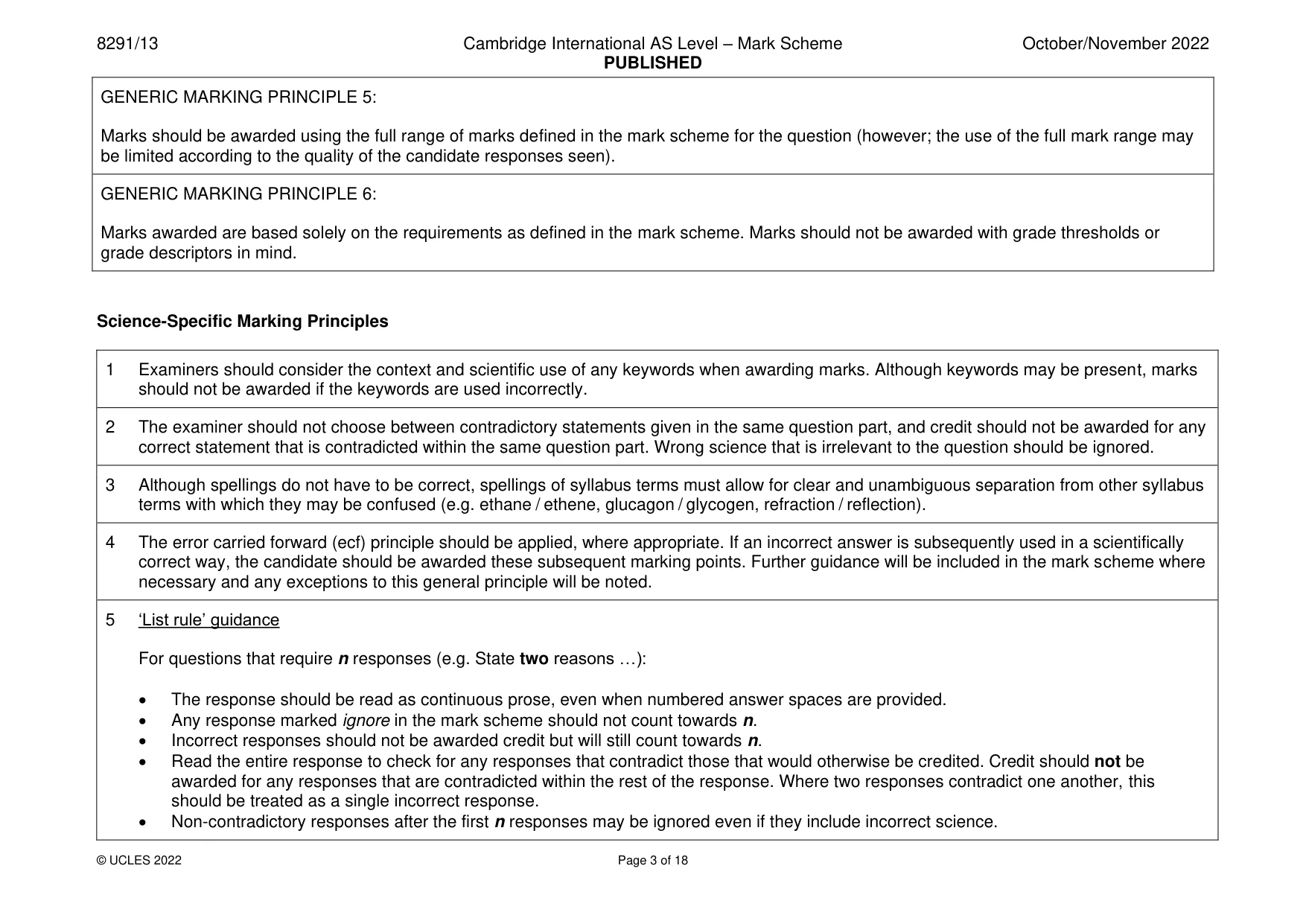
This document consists of 18 printed pages. © UCLES 2022 [Turn over Cambridge International AS Level ENVIRONMENTAL MANAGEMENT 8291/13 Paper 1 Principles of Environmental Management October/November 2022 MARK SCHEME Maximum Mark: 80 Published This mark scheme is published as an aid to teachers and candidates, to indicate the requirements of the examination. It shows the basis on which Examiners were instructed to award marks. It does not indicate the details of the discussions that took place at an Examiners’ meeting before marking began, which would have considered the acceptability of alternative answers. Mark schemes should be read in conjunction with the question paper and the Principal Examiner Report for Teachers. Cambridge International will not enter into discussions about these mark schemes. Cambridge International is publishing the mark schemes for the October/November 2022 series for most Cambridge IGCSE™, Cambridge International A and AS Level components and some Cambridge O Level components.
Mark scheme, page 2
8291/13 Cambridge International AS Level – Mark Scheme PUBLISHED October/November 2022 © UCLES 2022 Page 2 of 18 Generic Marking Principles These general marking principles must be applied by all examiners when marking candidate answers. They should be applied alongside the specific content of the mark scheme or generic level descriptors for a question. Each question paper and mark scheme will also comply with these marking principles. GENERIC MARKING PRINCIPLE 1: Marks must be awarded in line with: • the specific content of the mark scheme or the generic level descriptors for the question • the specific skills defined in the mark scheme or in the generic level descriptors for the question • the standard of response required by a candidate as exemplified by the standardisation scripts. GENERIC MARKING PRINCIPLE 2: Marks awarded are always whole marks (not half marks, or other fractions). GENERIC MARKING PRINCIPLE 3: Marks must be awarded positively: • marks are awarded for correct/valid answers, as defined in the mark scheme. However, credit is given for valid answers which go beyond the scope of the syllabus and mark scheme, referring to your Team Leader as appropriate • marks are awarded when candidates clearly demonstrate what they know and can do • marks are not deducted for errors • marks are not deducted for omissions • answers should only be judged on the quality of spelling, punctuation and grammar when these features are specifically assessed by the question as indicated by the mark scheme. The meaning, however, should be unambiguous. GENERIC MARKING PRINCIPLE 4: Rules must be applied consistently, e.g. in situations where candidates have not followed instructions or in the application of generic level descriptors.
Mark scheme, page 3
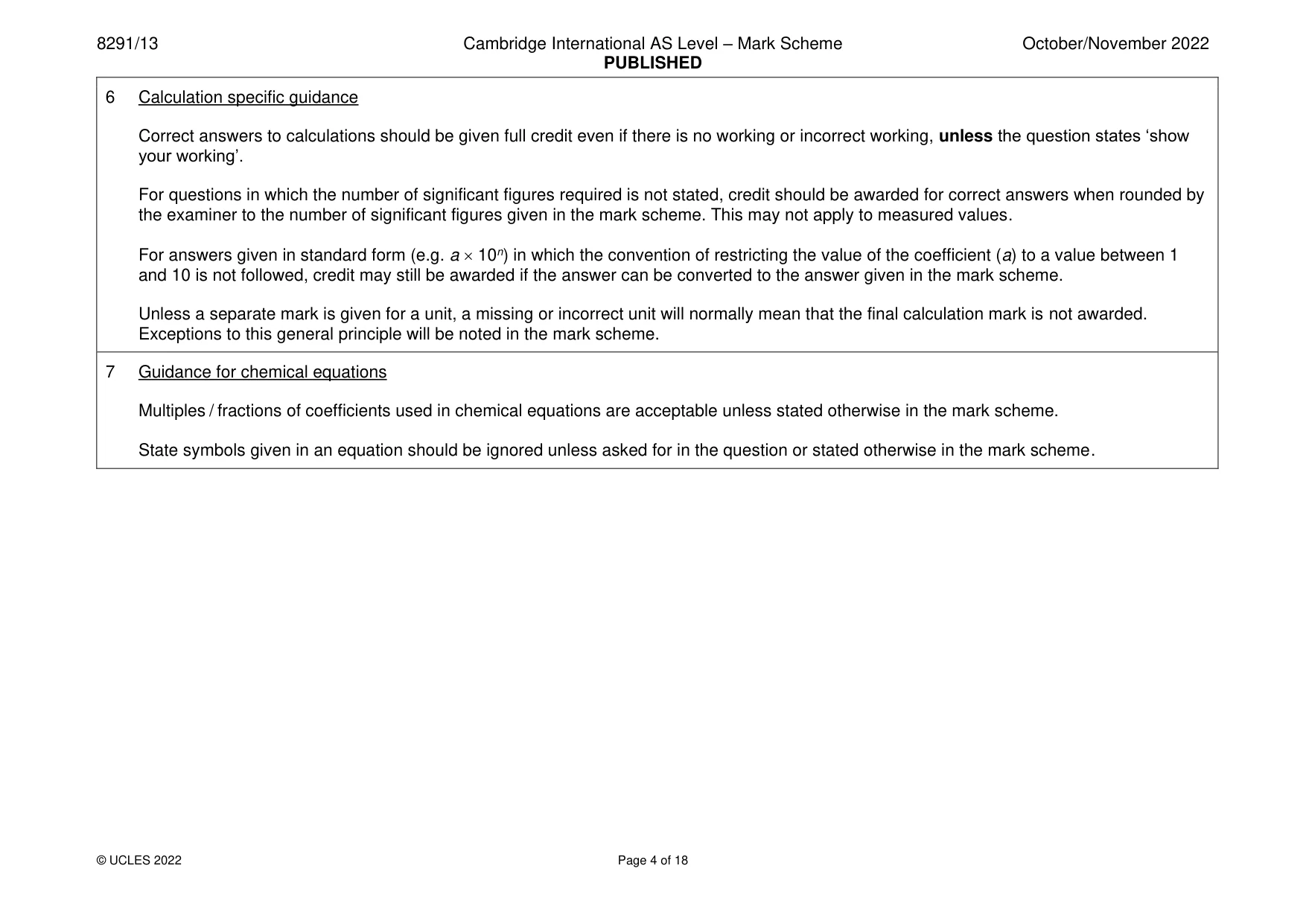
8291/13 Cambridge International AS Level – Mark Scheme PUBLISHED October/November 2022 © UCLES 2022 Page 3 of 18 GENERIC MARKING PRINCIPLE 5: Marks should be awarded using the full range of marks defined in the mark scheme for the question (however; the use of the full mark range may be limited according to the quality of the candidate responses seen). GENERIC MARKING PRINCIPLE 6: Marks awarded are based solely on the requirements as defined in the mark scheme. Marks should not be awarded with grade thresholds or grade descriptors in mind. Science-Specific Marking Principles 1 Examiners should consider the context and scientific use of any keywords when awarding marks. Although keywords may be present, marks should not be awarded if the keywords are used incorrectly. 2 The examiner should not choose between contradictory statements given in the same question part, and credit should not be awarded for any correct statement that is contradicted within the same question part. Wrong science that is irrelevant to the question should be ignored. 3 Although spellings do not have to be correct, spellings of syllabus terms must allow for clear and unambiguous separation from other syllabus terms with which they may be confused (e.g. ethane / ethene, glucagon / glycogen, refraction / reflection). 4 The error carried forward (ecf) principle should be applied, where appropriate. If an incorrect answer is subsequently used in a scientifically correct way, the candidate should be awarded these subsequent marking points. Further guidance will be included in the mark scheme where necessary and any exceptions to this general principle will be noted. 5 ‘List rule’ guidance For questions that require n responses (e.g. State two reasons …): • The response should be read as continuous prose, even when numbered answer spaces are provided. • Any response marked ignore in the mark scheme should not count towards n. • Incorrect responses should not be awarded credit but will still count towards n. • Read the entire response to check for any responses that contradict those that would otherwise be credited. Credit should not be awarded for any responses that are contradicted within the rest of the response. Where two responses contradict one another, this should be treated as a single incorrect response. • Non-contradictory responses after the first n responses may be ignored even if they include incorrect science.
Mark scheme, page 4
8291/13 Cambridge International AS Level – Mark Scheme PUBLISHED October/November 2022 © UCLES 2022 Page 4 of 18 6 Calculation specific guidance Correct answers to calculations should be given full credit even if there is no working or incorrect working, unless the question states ‘show your working’. For questions in which the number of significant figures required is not stated, credit should be awarded for correct answers when rounded by the examiner to the number of significant figures given in the mark scheme. This may not apply to measured values. For answers given in standard form (e.g. a 10n) in which the convention of restricting the value of the coefficient (a) to a value between 1 and 10 is not followed, credit may still be awarded if the answer can be converted to the answer given in the mark scheme. Unless a separate mark is given for a unit, a missing or incorrect unit will normally mean that the final calculation mark is not awarded. Exceptions to this general principle will be noted in the mark scheme. 7 Guidance for chemical equations Multiples / fractions of coefficients used in chemical equations are acceptable unless stated otherwise in the mark scheme. State symbols given in an equation should be ignored unless asked for in the question or stated otherwise in the mark scheme.
Mark scheme, page 5
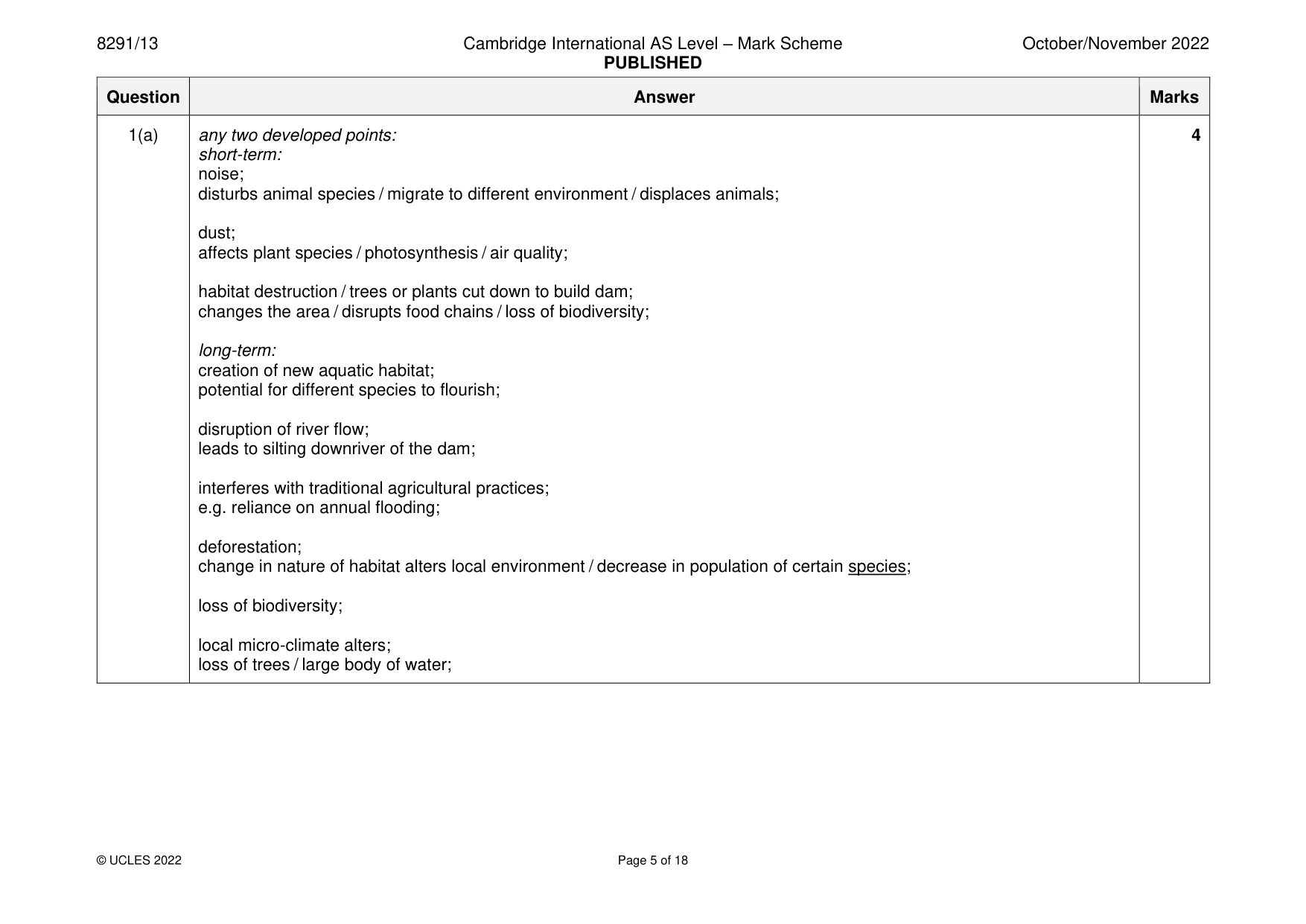
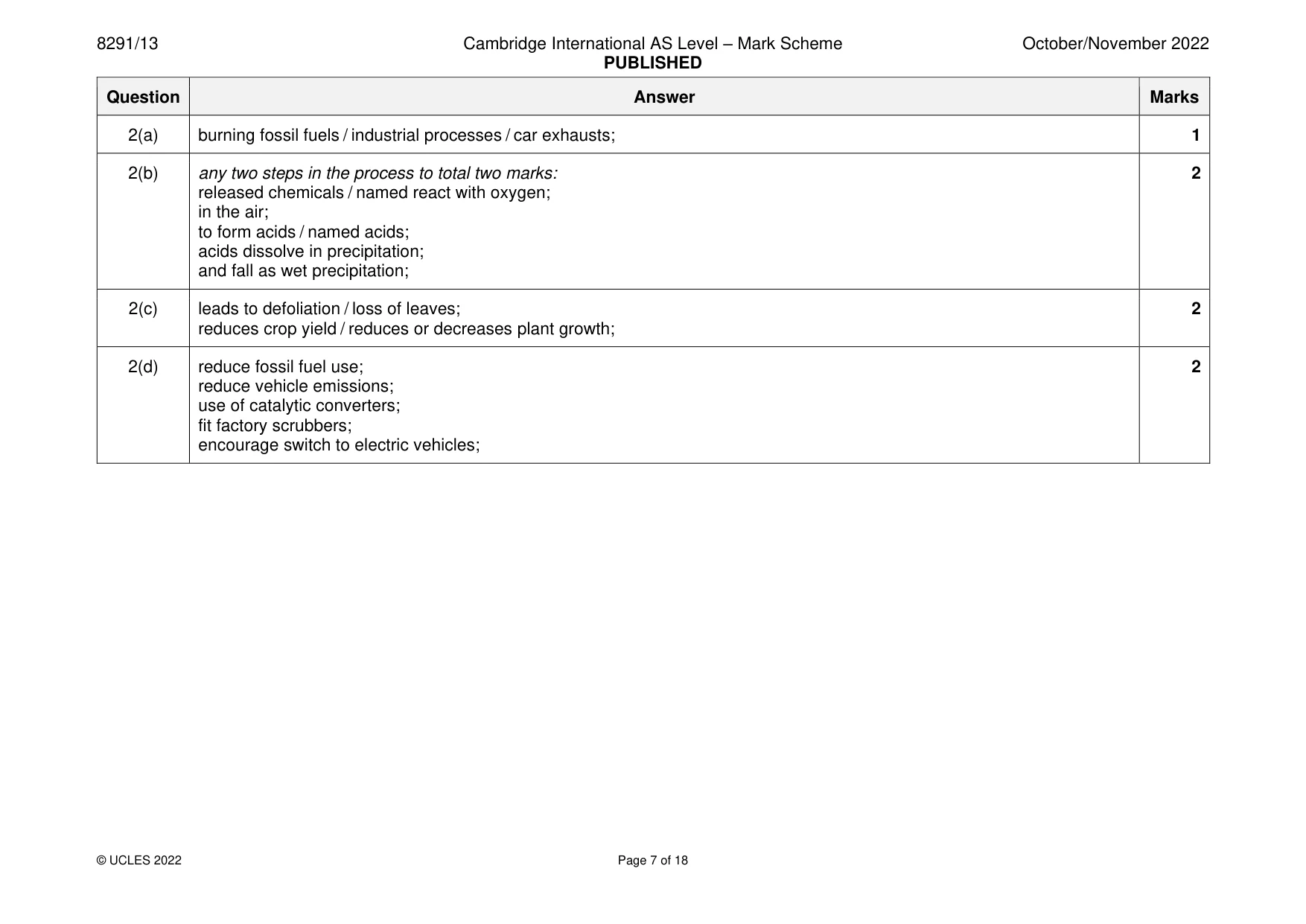
8291/13 Cambridge International AS Level – Mark Scheme PUBLISHED October/November 2022 © UCLES 2022 Page 5 of 18 Question Answer Marks 1(a) any two developed points: short-term: noise; disturbs animal species / migrate to different environment / displaces animals; dust; affects plant species / photosynthesis / air quality; habitat destruction / trees or plants cut down to build dam; changes the area / disrupts food chains / loss of biodiversity; long-term: creation of new aquatic habitat; potential for different species to flourish; disruption of river flow; leads to silting downriver of the dam; interferes with traditional agricultural practices; e.g. reliance on annual flooding; deforestation; change in nature of habitat alters local environment / decrease in population of certain species; loss of biodiversity; local micro-climate alters; loss of trees / large body of water; 4
Mark scheme, page 6
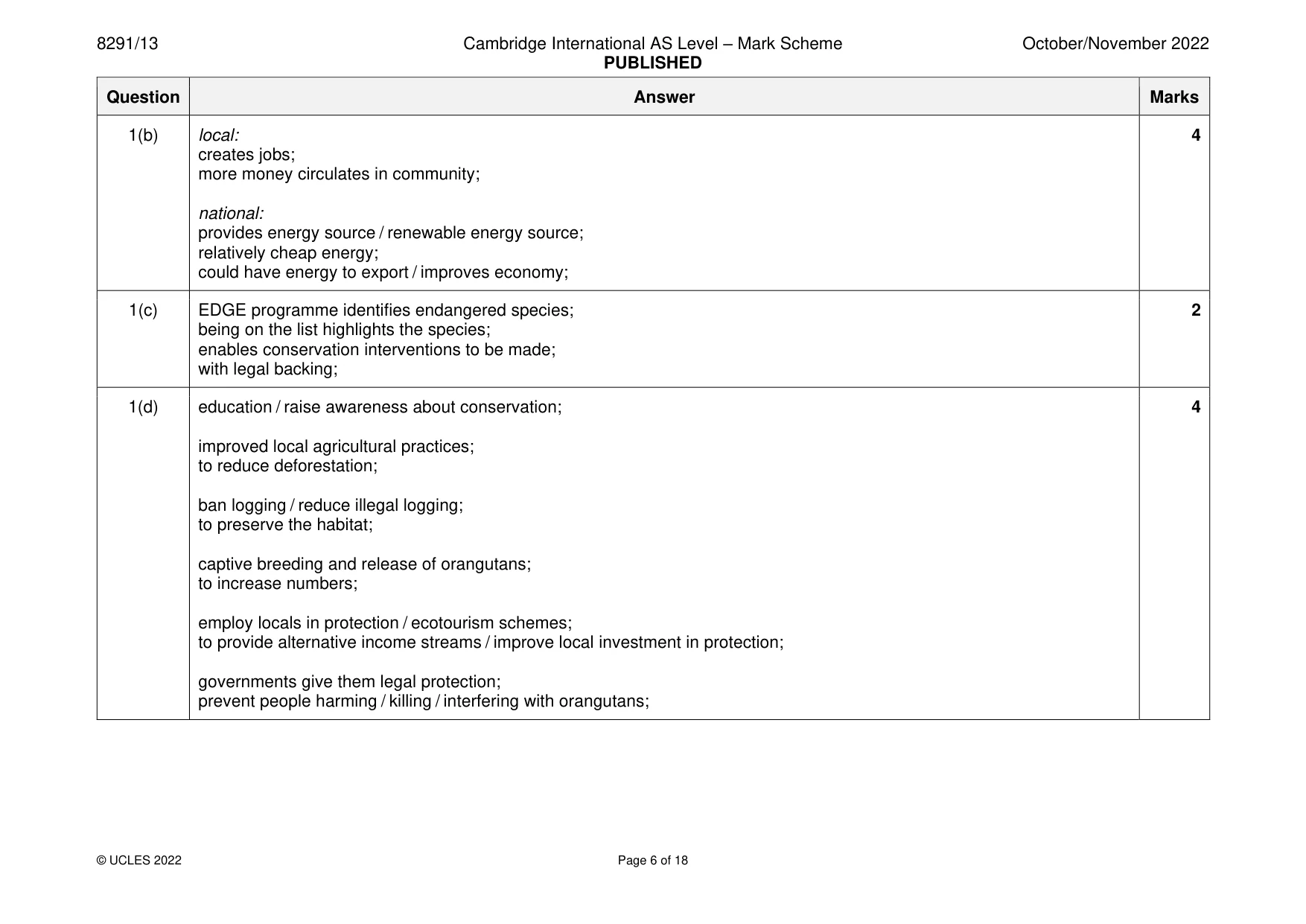
8291/13 Cambridge International AS Level – Mark Scheme PUBLISHED October/November 2022 © UCLES 2022 Page 6 of 18 Question Answer Marks 1(b) local: creates jobs; more money circulates in community; national: provides energy source / renewable energy source; relatively cheap energy; could have energy to export / improves economy; 4 1(c) EDGE programme identifies endangered species; being on the list highlights the species; enables conservation interventions to be made; with legal backing; 2 1(d) education / raise awareness about conservation; improved local agricultural practices; to reduce deforestation; ban logging / reduce illegal logging; to preserve the habitat; captive breeding and release of orangutans; to increase numbers; employ locals in protection / ecotourism schemes; to provide alternative income streams / improve local investment in protection; governments give them legal protection; prevent people harming / killing / interfering with orangutans; 4
Mark scheme, page 7
8291/13 Cambridge International AS Level – Mark Scheme PUBLISHED October/November 2022 © UCLES 2022 Page 7 of 18 Question Answer Marks 2(a) burning fossil fuels / industrial processes / car exhausts; 1 2(b) any two steps in the process to total two marks: released chemicals / named react with oxygen; in the air; to form acids / named acids; acids dissolve in precipitation; and fall as wet precipitation; 2 2(c) leads to defoliation / loss of leaves; reduces crop yield / reduces or decreases plant growth; 2 2(d) reduce fossil fuel use; reduce vehicle emissions; use of catalytic converters; fit factory scrubbers; encourage switch to electric vehicles; 2
Mark scheme, page 8
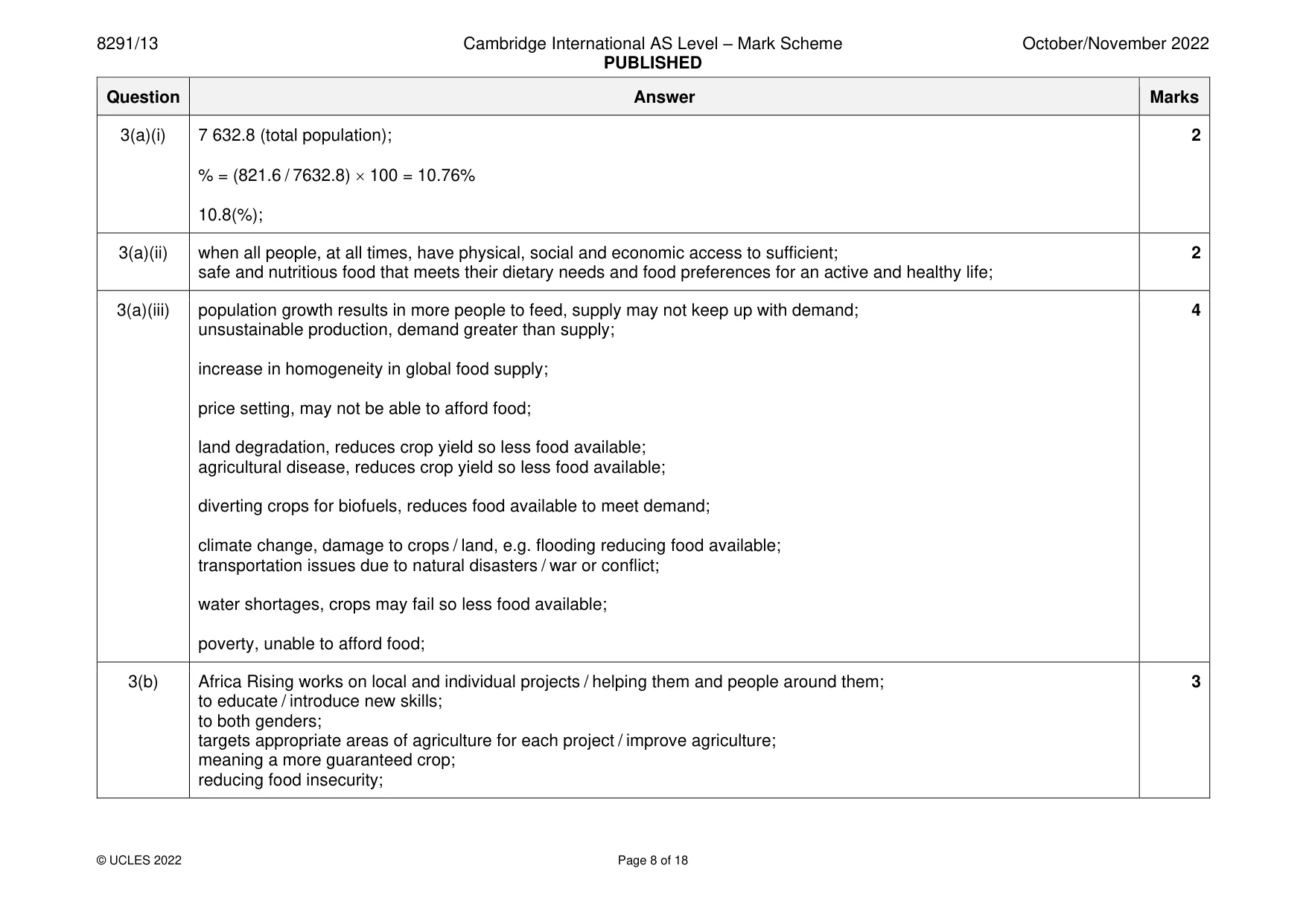
8291/13 Cambridge International AS Level – Mark Scheme PUBLISHED October/November 2022 © UCLES 2022 Page 8 of 18 Question Answer Marks 3(a)(i) 7 632.8 (total population); % = (821.6 / 7632.8) 100 = 10.76% 10.8(%); 2 3(a)(ii) when all people, at all times, have physical, social and economic access to sufficient; safe and nutritious food that meets their dietary needs and food preferences for an active and healthy life; 2 3(a)(iii) population growth results in more people to feed, supply may not keep up with demand; unsustainable production, demand greater than supply; increase in homogeneity in global food supply; price setting, may not be able to afford food; land degradation, reduces crop yield so less food available; agricultural disease, reduces crop yield so less food available; diverting crops for biofuels, reduces food available to meet demand; climate change, damage to crops / land, e.g. flooding reducing food available; transportation issues due to natural disasters / war or conflict; water shortages, crops may fail so less food available; poverty, unable to afford food; 4 3(b) Africa Rising works on local and individual projects / helping them and people around them; to educate / introduce new skills; to both genders; targets appropriate areas of agriculture for each project / improve agriculture; meaning a more guaranteed crop; reducing food insecurity; 3
Mark scheme, page 9
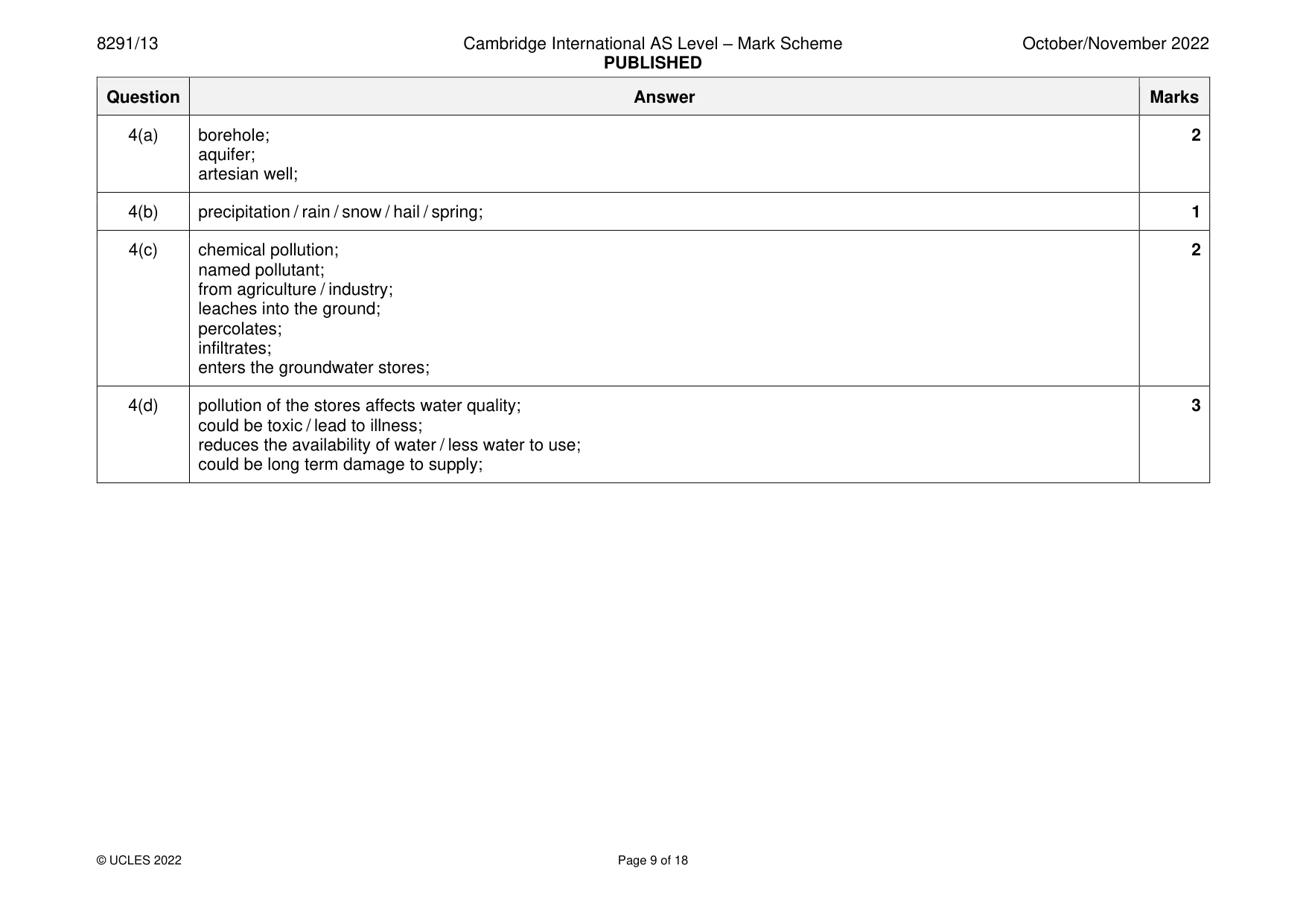
8291/13 Cambridge International AS Level – Mark Scheme PUBLISHED October/November 2022 © UCLES 2022 Page 9 of 18 Question Answer Marks 4(a) borehole; aquifer; artesian well; 2 4(b) precipitation / rain / snow / hail / spring; 1 4(c) chemical pollution; named pollutant; from agriculture / industry; leaches into the ground; percolates; infiltrates; enters the groundwater stores; 2 4(d) pollution of the stores affects water quality; could be toxic / lead to illness; reduces the availability of water / less water to use; could be long term damage to supply; 3
Mark scheme, page 10
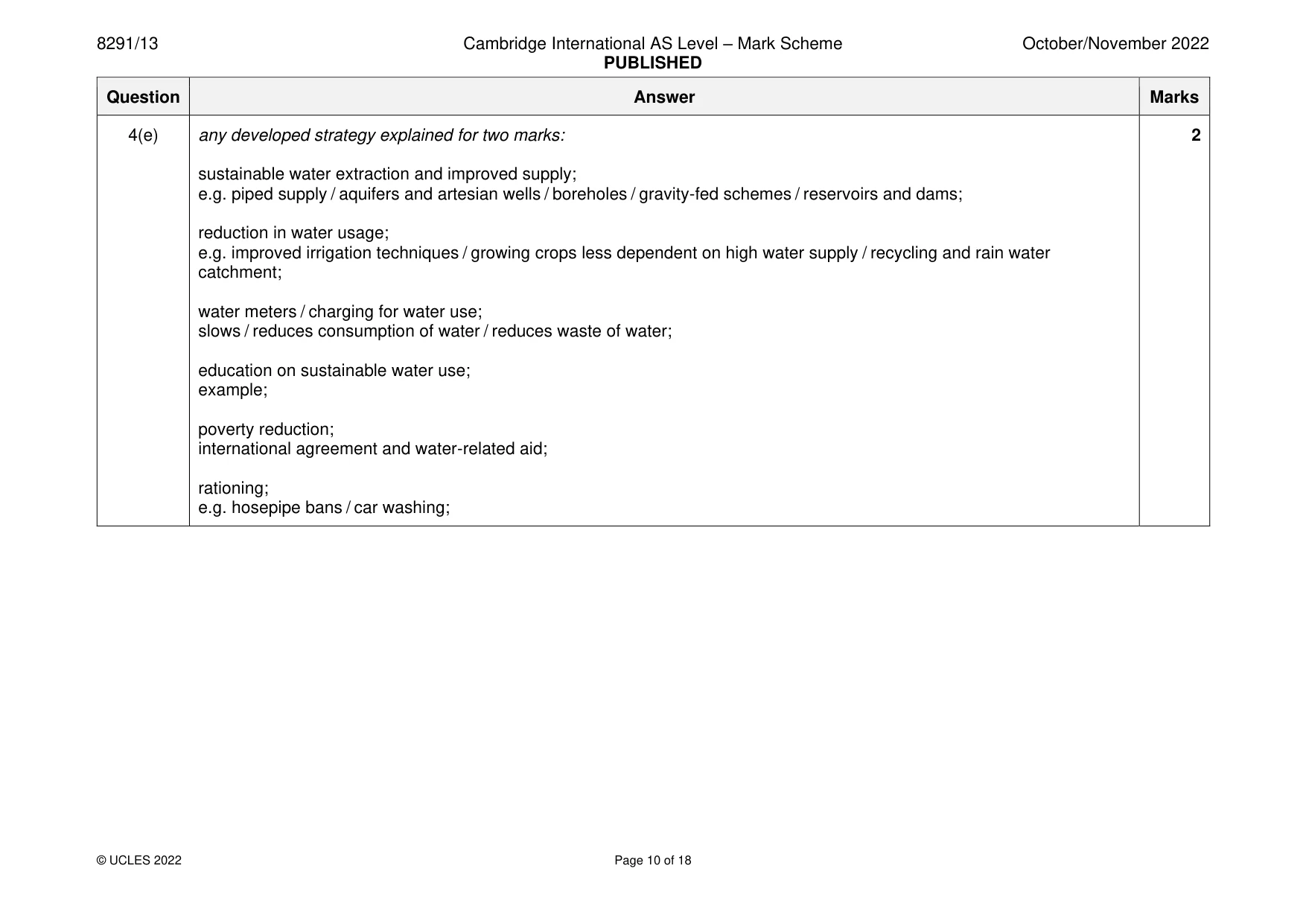
8291/13 Cambridge International AS Level – Mark Scheme PUBLISHED October/November 2022 © UCLES 2022 Page 10 of 18 Question Answer Marks 4(e) any developed strategy explained for two marks: sustainable water extraction and improved supply; e.g. piped supply / aquifers and artesian wells / boreholes / gravity-fed schemes / reservoirs and dams; reduction in water usage; e.g. improved irrigation techniques / growing crops less dependent on high water supply / recycling and rain water catchment; water meters / charging for water use; slows / reduces consumption of water / reduces waste of water; education on sustainable water use; example; poverty reduction; international agreement and water-related aid; rationing; e.g. hosepipe bans / car washing; 2
Mark scheme, page 11
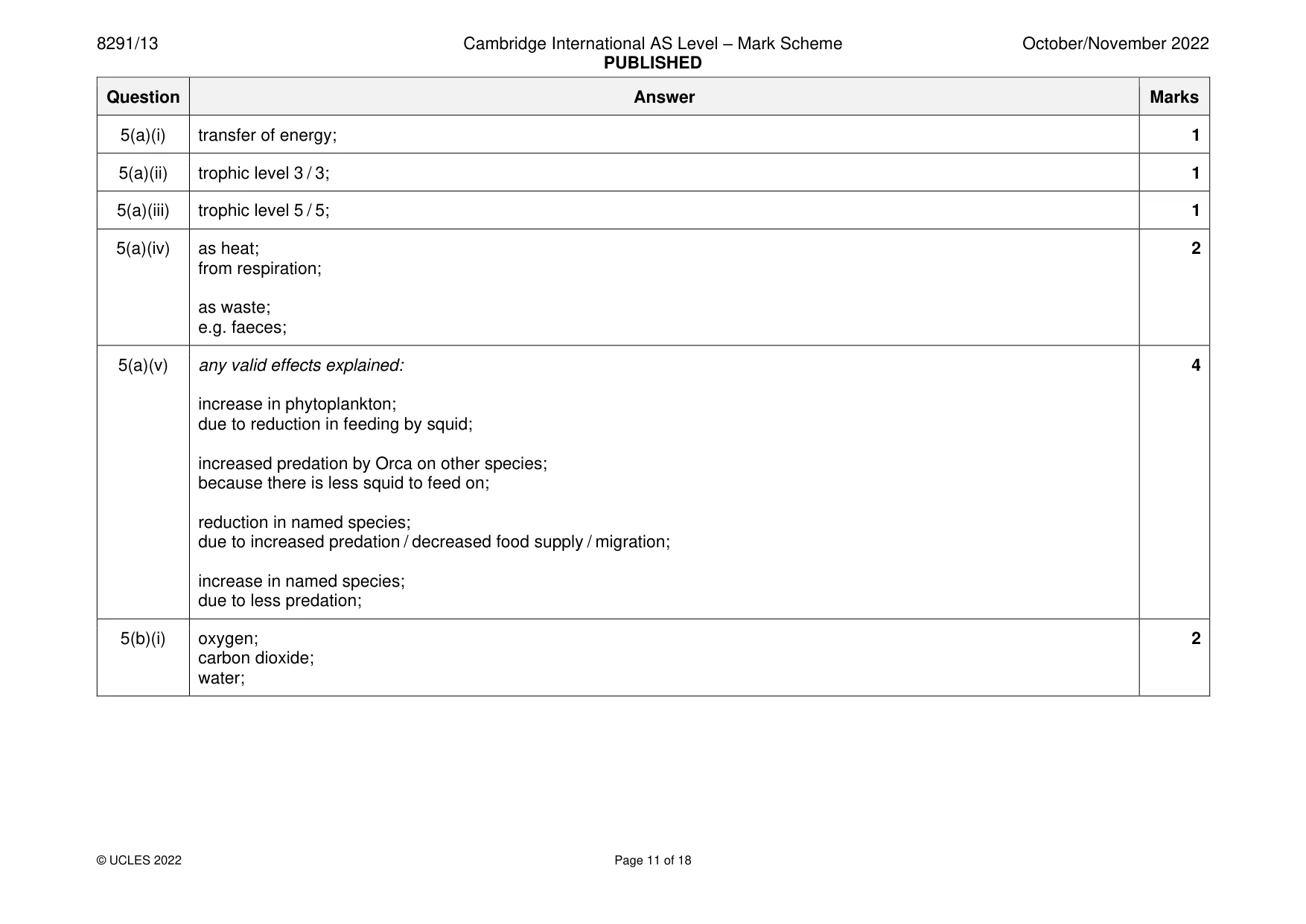
8291/13 Cambridge International AS Level – Mark Scheme PUBLISHED October/November 2022 © UCLES 2022 Page 11 of 18 Question Answer Marks 5(a)(i) transfer of energy; 1 5(a)(ii) trophic level 3 / 3; 1 5(a)(iii) trophic level 5 / 5; 1 5(a)(iv) as heat; from respiration; as waste; e.g. faeces; 2 5(a)(v) any valid effects explained: increase in phytoplankton; due to reduction in feeding by squid; increased predation by Orca on other species; because there is less squid to feed on; reduction in named species; due to increased predation / decreased food supply / migration; increase in named species; due to less predation; 4 5(b)(i) oxygen; carbon dioxide; water; 2
Mark scheme, page 12
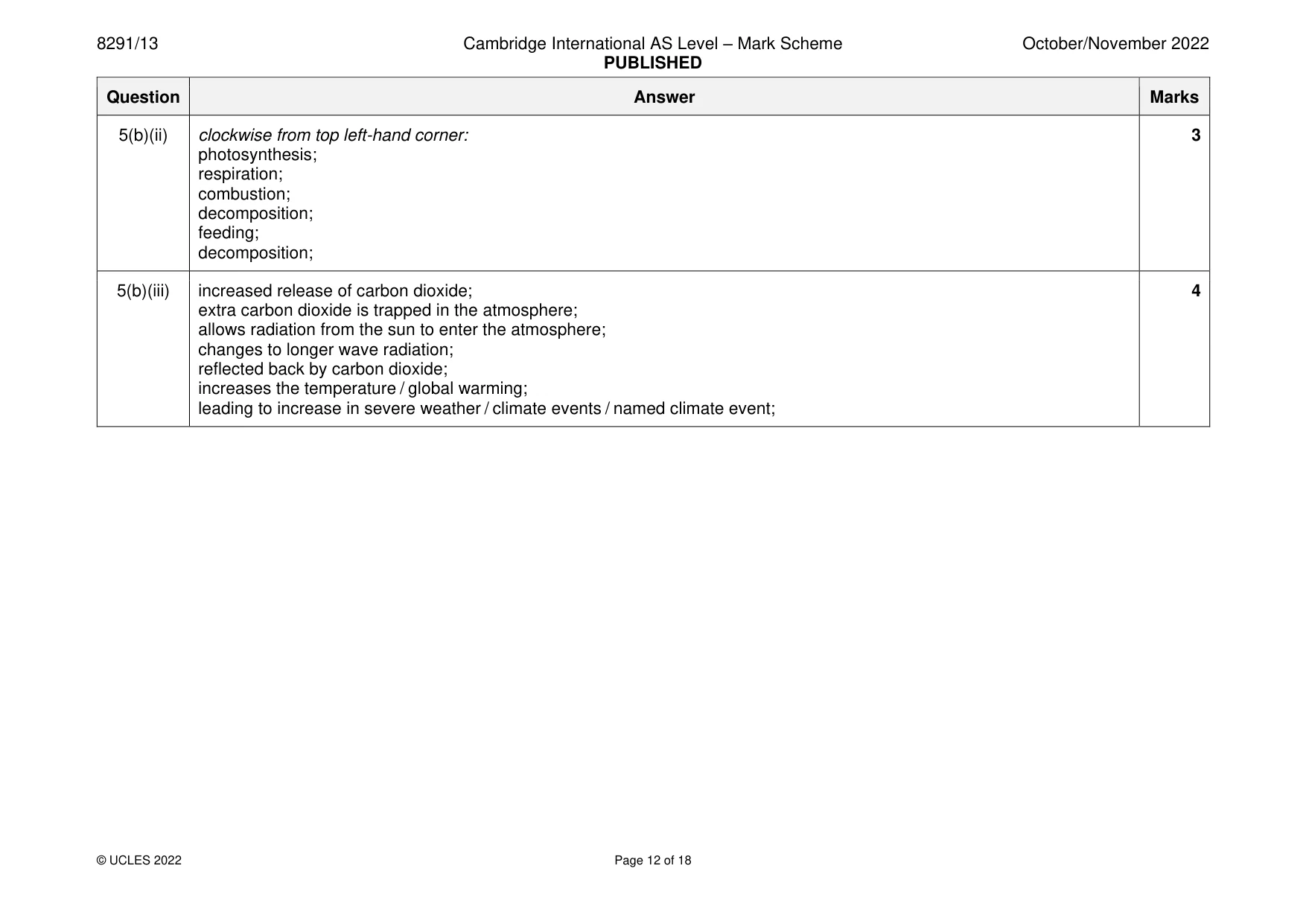
8291/13 Cambridge International AS Level – Mark Scheme PUBLISHED October/November 2022 © UCLES 2022 Page 12 of 18 Question Answer Marks 5(b)(ii) clockwise from top left-hand corner: photosynthesis; respiration; combustion; decomposition; feeding; decomposition; 3 5(b)(iii) increased release of carbon dioxide; extra carbon dioxide is trapped in the atmosphere; allows radiation from the sun to enter the atmosphere; changes to longer wave radiation; reflected back by carbon dioxide; increases the temperature / global warming; leading to increase in severe weather / climate events / named climate event; 4
Mark scheme, page 13
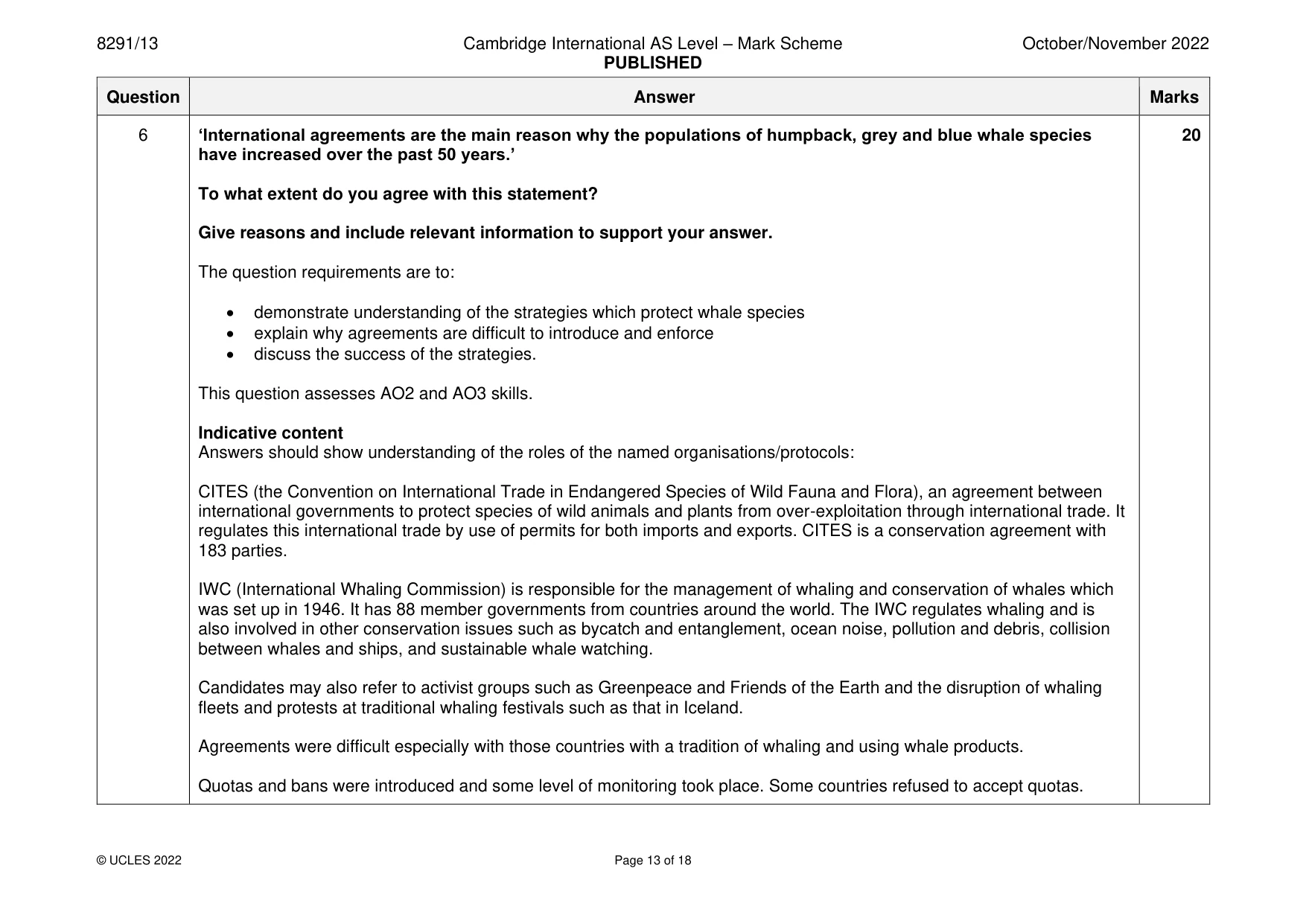
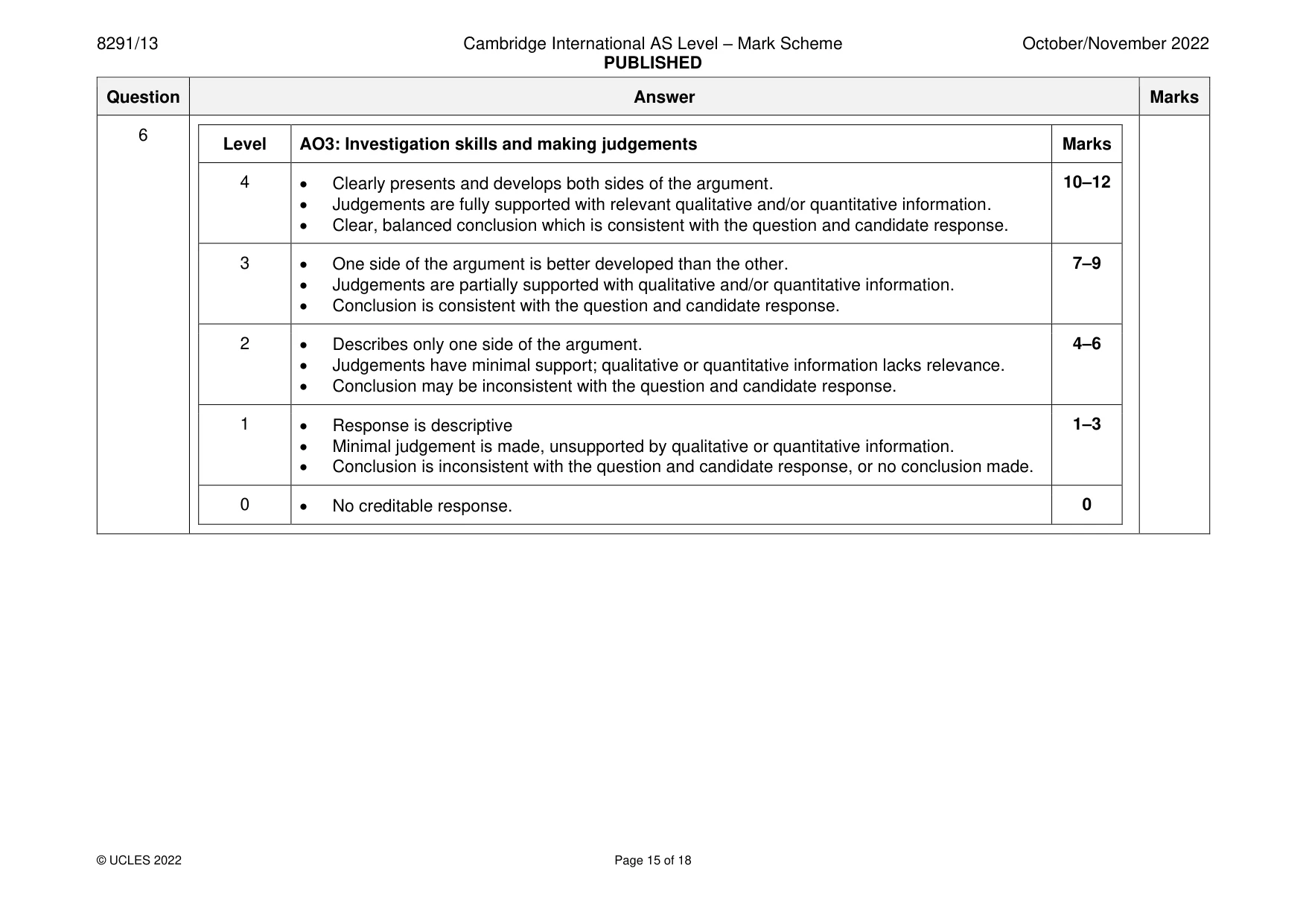
8291/13 Cambridge International AS Level – Mark Scheme PUBLISHED October/November 2022 © UCLES 2022 Page 13 of 18 Question Answer Marks 6 ‘International agreements are the main reason why the populations of humpback, grey and blue whale species have increased over the past 50 years.’ To what extent do you agree with this statement? Give reasons and include relevant information to support your answer. The question requirements are to: • demonstrate understanding of the strategies which protect whale species • explain why agreements are difficult to introduce and enforce • discuss the success of the strategies. This question assesses AO2 and AO3 skills. Indicative content Answers should show understanding of the roles of the named organisations/protocols: CITES (the Convention on International Trade in Endangered Species of Wild Fauna and Flora), an agreement between international governments to protect species of wild animals and plants from over-exploitation through international trade. It regulates this international trade by use of permits for both imports and exports. CITES is a conservation agreement with 183 parties. IWC (International Whaling Commission) is responsible for the management of whaling and conservation of whales which was set up in 1946. It has 88 member governments from countries around the world. The IWC regulates whaling and is also involved in other conservation issues such as bycatch and entanglement, ocean noise, pollution and debris, collision between whales and ships, and sustainable whale watching. Candidates may also refer to activist groups such as Greenpeace and Friends of the Earth and the disruption of whaling fleets and protests at traditional whaling festivals such as that in Iceland. Agreements were difficult especially with those countries with a tradition of whaling and using whale products. Quotas and bans were introduced and some level of monitoring took place. Some countries refused to accept quotas. 20
Mark scheme, page 14
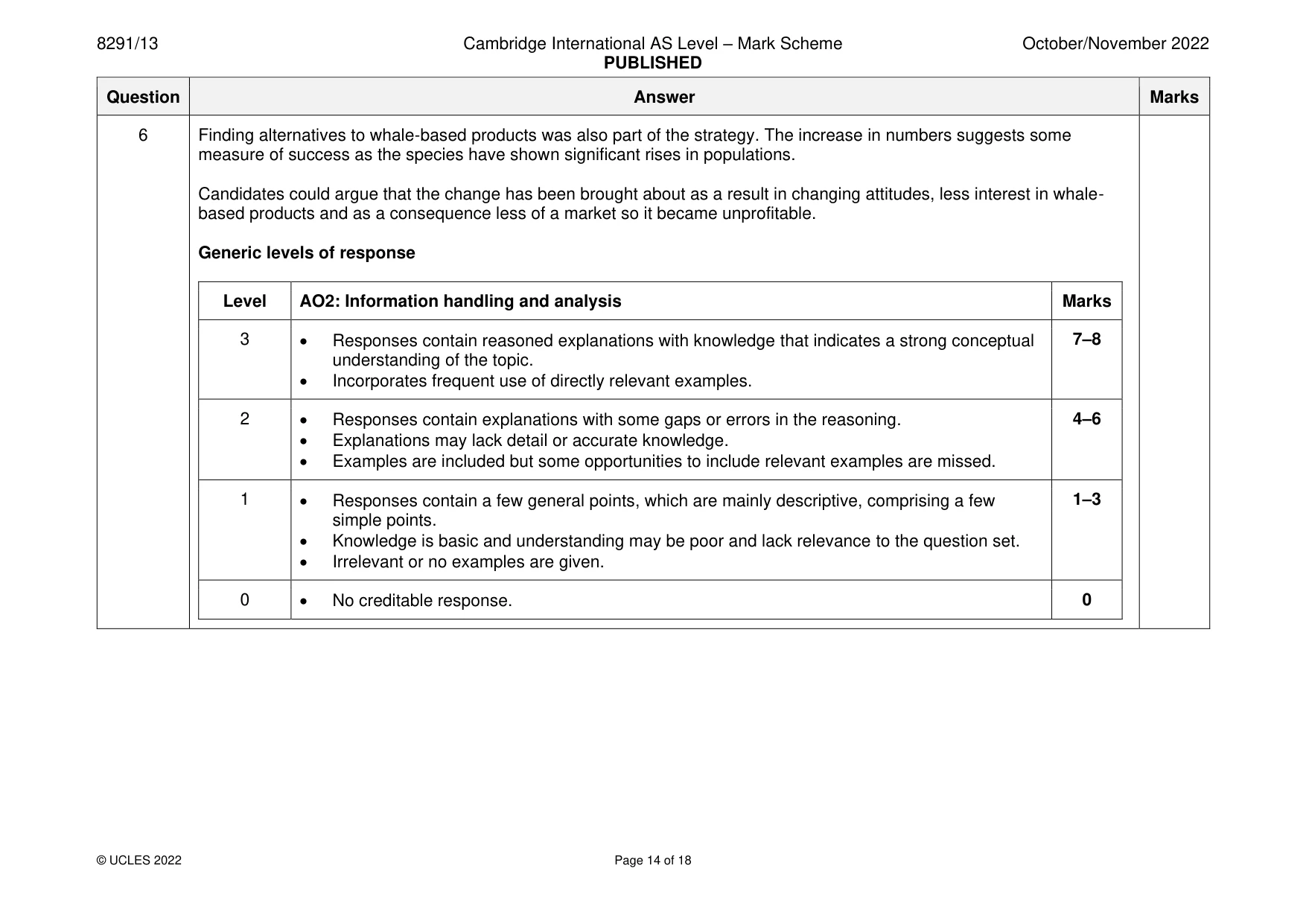
8291/13 Cambridge International AS Level – Mark Scheme PUBLISHED October/November 2022 © UCLES 2022 Page 14 of 18 Question Answer Marks 6 Finding alternatives to whale-based products was also part of the strategy. The increase in numbers suggests some measure of success as the species have shown significant rises in populations. Candidates could argue that the change has been brought about as a result in changing attitudes, less interest in whale- based products and as a consequence less of a market so it became unprofitable. Generic levels of response Level AO2: Information handling and analysis Marks 3 • Responses contain reasoned explanations with knowledge that indicates a strong conceptual understanding of the topic. • Incorporates frequent use of directly relevant examples. 7–8 2 • Responses contain explanations with some gaps or errors in the reasoning. • Explanations may lack detail or accurate knowledge. • Examples are included but some opportunities to include relevant examples are missed. 4–6 1 • Responses contain a few general points, which are mainly descriptive, comprising a few simple points. • Knowledge is basic and understanding may be poor and lack relevance to the question set. • Irrelevant or no examples are given. 1–3 0 • No creditable response. 0
Mark scheme, page 15
8291/13 Cambridge International AS Level – Mark Scheme PUBLISHED October/November 2022 © UCLES 2022 Page 15 of 18 Question Answer Marks 6 Level AO3: Investigation skills and making judgements Marks 4 • Clearly presents and develops both sides of the argument. • Judgements are fully supported with relevant qualitative and/or quantitative information. • Clear, balanced conclusion which is consistent with the question and candidate response. 10–12 3 • One side of the argument is better developed than the other. • Judgements are partially supported with qualitative and/or quantitative information. • Conclusion is consistent with the question and candidate response. 7–9 2 • Describes only one side of the argument. • Judgements have minimal support; qualitative or quantitative information lacks relevance. • Conclusion may be inconsistent with the question and candidate response. 4–6 1 • Response is descriptive • Minimal judgement is made, unsupported by qualitative or quantitative information. • Conclusion is inconsistent with the question and candidate response, or no conclusion made. 1–3 0 • No creditable response. 0
Mark scheme, page 16
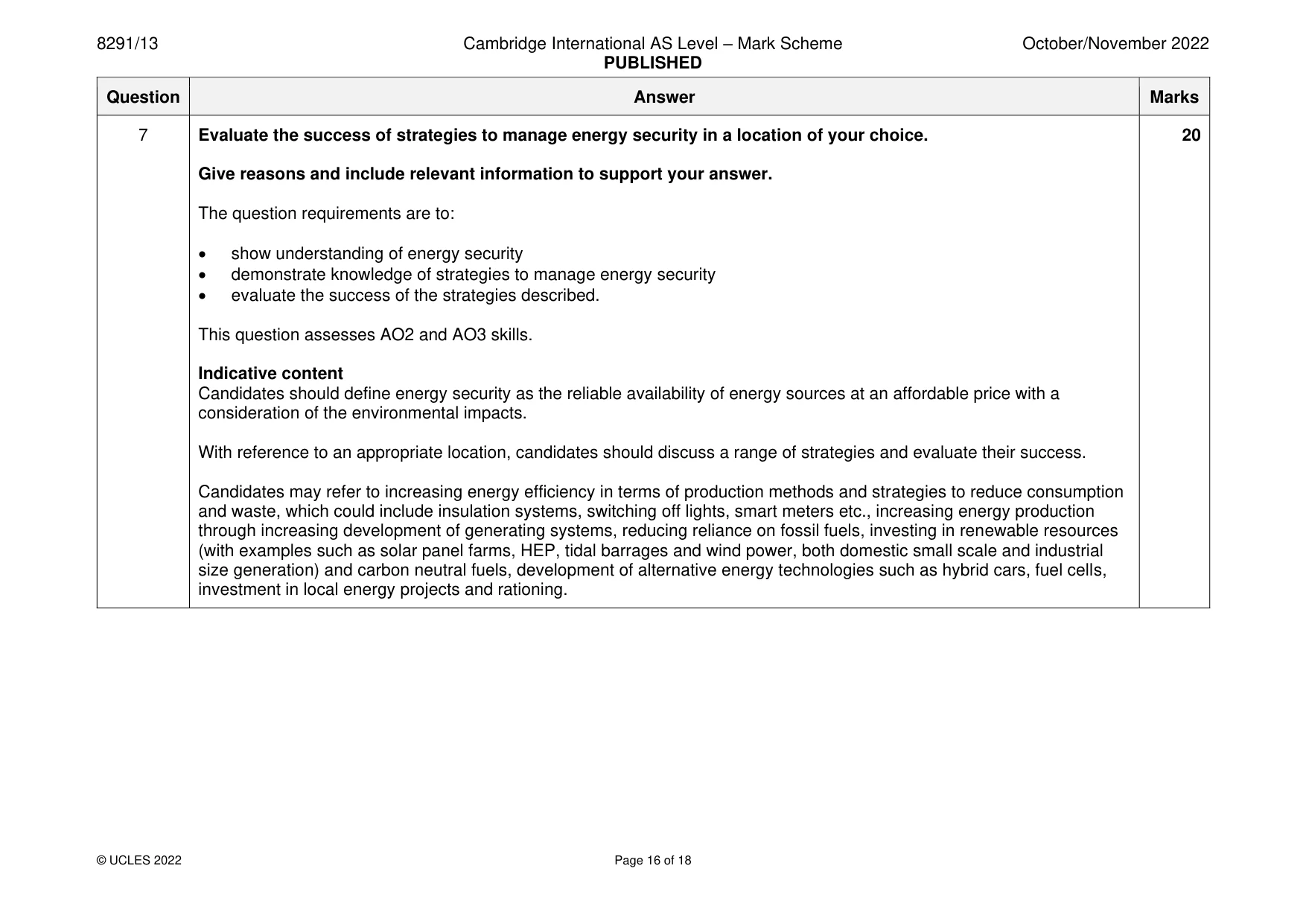
8291/13 Cambridge International AS Level – Mark Scheme PUBLISHED October/November 2022 © UCLES 2022 Page 16 of 18 Question Answer Marks 7 Evaluate the success of strategies to manage energy security in a location of your choice. Give reasons and include relevant information to support your answer. The question requirements are to: • show understanding of energy security • demonstrate knowledge of strategies to manage energy security • evaluate the success of the strategies described. This question assesses AO2 and AO3 skills. Indicative content Candidates should define energy security as the reliable availability of energy sources at an affordable price with a consideration of the environmental impacts. With reference to an appropriate location, candidates should discuss a range of strategies and evaluate their success. Candidates may refer to increasing energy efficiency in terms of production methods and strategies to reduce consumption and waste, which could include insulation systems, switching off lights, smart meters etc., increasing energy production through increasing development of generating systems, reducing reliance on fossil fuels, investing in renewable resources (with examples such as solar panel farms, HEP, tidal barrages and wind power, both domestic small scale and industrial size generation) and carbon neutral fuels, development of alternative energy technologies such as hybrid cars, fuel cells, investment in local energy projects and rationing. 20
Mark scheme, page 17
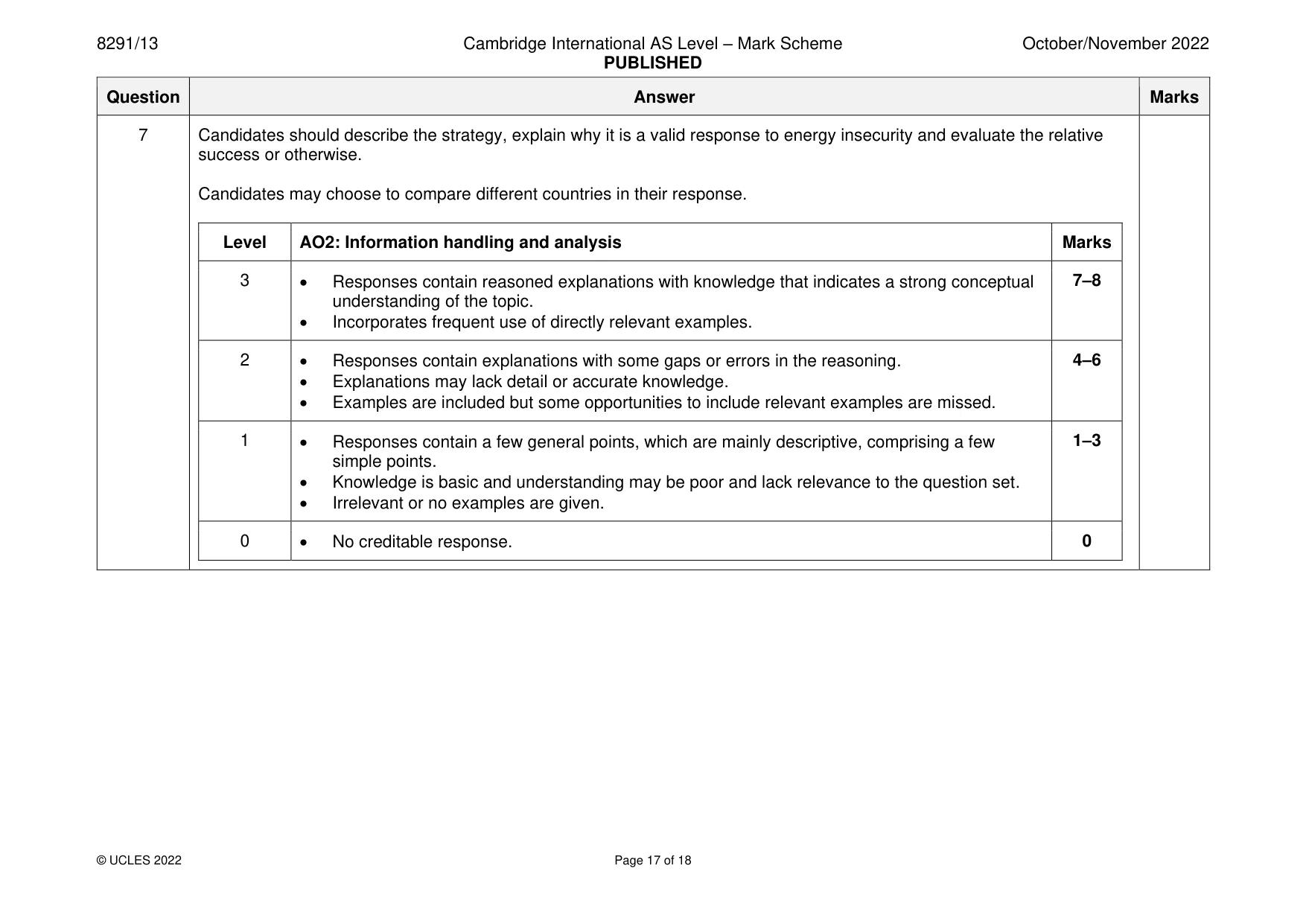
8291/13 Cambridge International AS Level – Mark Scheme PUBLISHED October/November 2022 © UCLES 2022 Page 17 of 18 Question Answer Marks 7 Candidates should describe the strategy, explain why it is a valid response to energy insecurity and evaluate the relative success or otherwise. Candidates may choose to compare different countries in their response. Level AO2: Information handling and analysis Marks 3 • Responses contain reasoned explanations with knowledge that indicates a strong conceptual understanding of the topic. • Incorporates frequent use of directly relevant examples. 7–8 2 • Responses contain explanations with some gaps or errors in the reasoning. • Explanations may lack detail or accurate knowledge. • Examples are included but some opportunities to include relevant examples are missed. 4–6 1 • Responses contain a few general points, which are mainly descriptive, comprising a few simple points. • Knowledge is basic and understanding may be poor and lack relevance to the question set. • Irrelevant or no examples are given. 1–3 0 • No creditable response. 0
Mark scheme, page 18
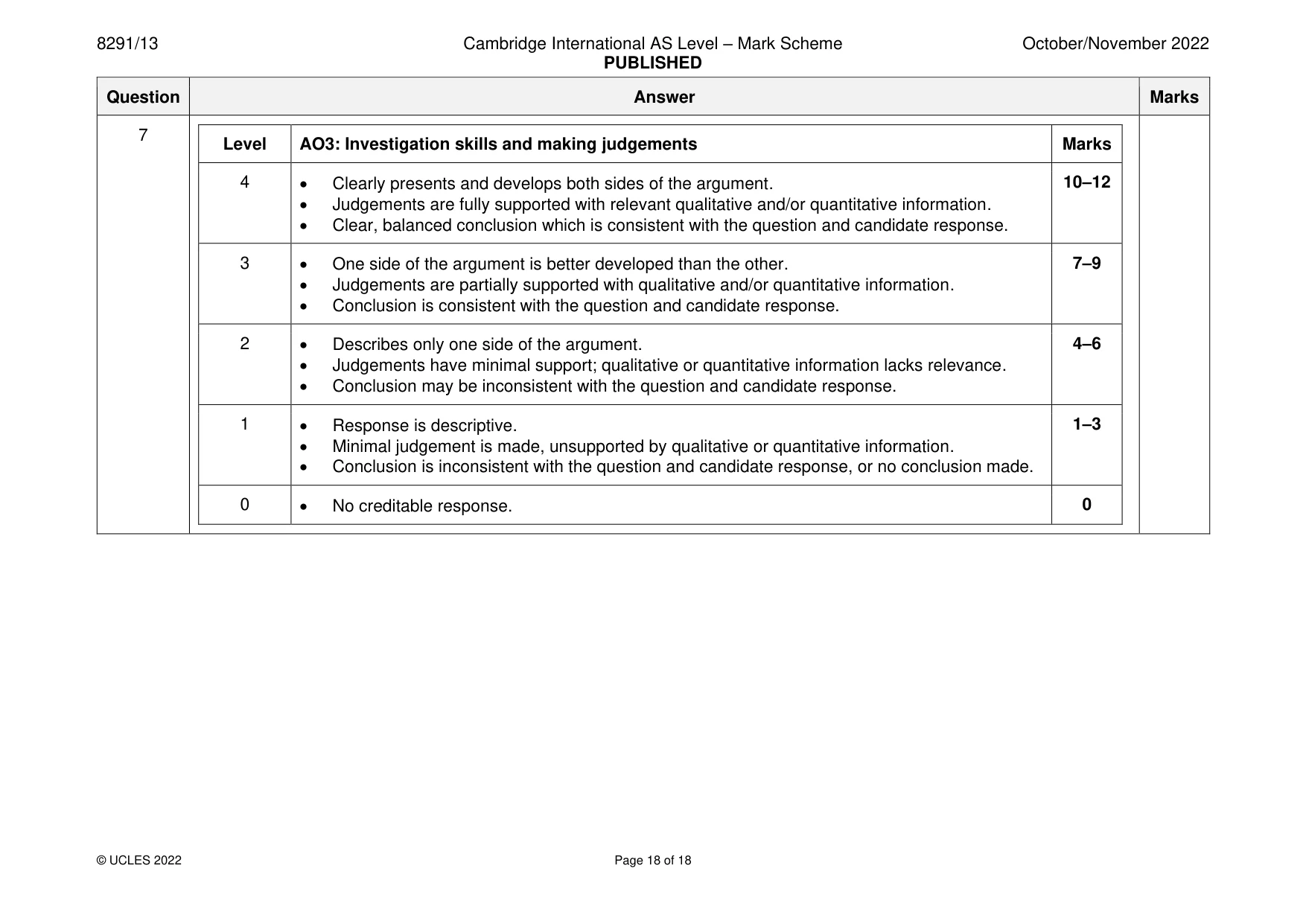
8291/13 Cambridge International AS Level – Mark Scheme PUBLISHED October/November 2022 © UCLES 2022 Page 18 of 18 Question Answer Marks 7 Level AO3: Investigation skills and making judgements Marks 4 • Clearly presents and develops both sides of the argument. • Judgements are fully supported with relevant qualitative and/or quantitative information. • Clear, balanced conclusion which is consistent with the question and candidate response. 10–12 3 • One side of the argument is better developed than the other. • Judgements are partially supported with qualitative and/or quantitative information. • Conclusion is consistent with the question and candidate response. 7–9 2 • Describes only one side of the argument. • Judgements have minimal support; qualitative or quantitative information lacks relevance. • Conclusion may be inconsistent with the question and candidate response. 4–6 1 • Response is descriptive. • Minimal judgement is made, unsupported by qualitative or quantitative information. • Conclusion is inconsistent with the question and candidate response, or no conclusion made. 1–3 0 • No creditable response. 0
What you needed in this session
Cambridge’s own grade thresholds for 2022 Oct/Nov, Paper 1 · Variant 3. A higher threshold means an easier paper — the bar moves with how the cohort did.