Cambridge A Level Environmental Management (AS only) 8291 — 2020 May/June Paper 1 · Variant 2
8291/12/M/J/20
The question paper and its mark scheme, free to read here and free to download. This is Cambridge’s own paper, exactly as it was sat.
Question paper12 pages




Mark scheme16 pages
Answers below. Sit the paper first if you are practising.
Paper as text
Question paper, page 1
Cambridge International AS Level DC (JC/JG) 184667/5 © UCLES 2020 [Turn over This document has 12 pages. Blank pages are indicated. * 4 2 7 2 2 3 1 2 1 1 * ENVIRONMENTAL MANAGEMENT 8291/12 Paper 1 Lithosphere and Atmosphere May/June 2020 1 hour 30 minutes You must answer Section A on the question paper and Section B on the answer booklet/paper you have been given. You will need: Answer booklet/paper INSTRUCTIONS ● Section A: answer all questions. Write your answer to each question in the space provided on the question paper. ● Section B: answer one question. Write your answer on the separate answer booklet/paper provided. ● Use a black or dark blue pen. You may use an HB pencil for any diagrams or graphs. ● Write your name, centre number and candidate number in the boxes at the top of the page. ● Do not use an erasable pen or correction fluid. ● Do not write on any bar codes. ● You may use a calculator. ● You should show all your working and use appropriate units. ● At the end of the examination, fasten all your work together. Do not use staples, paper clips or glue. INFORMATION ● The total mark for this paper is 80. ● The number of marks for each question or part question is shown in brackets [ ]. For Examiner’s use Section A 1 2 Section B Total
Question paper, page 2
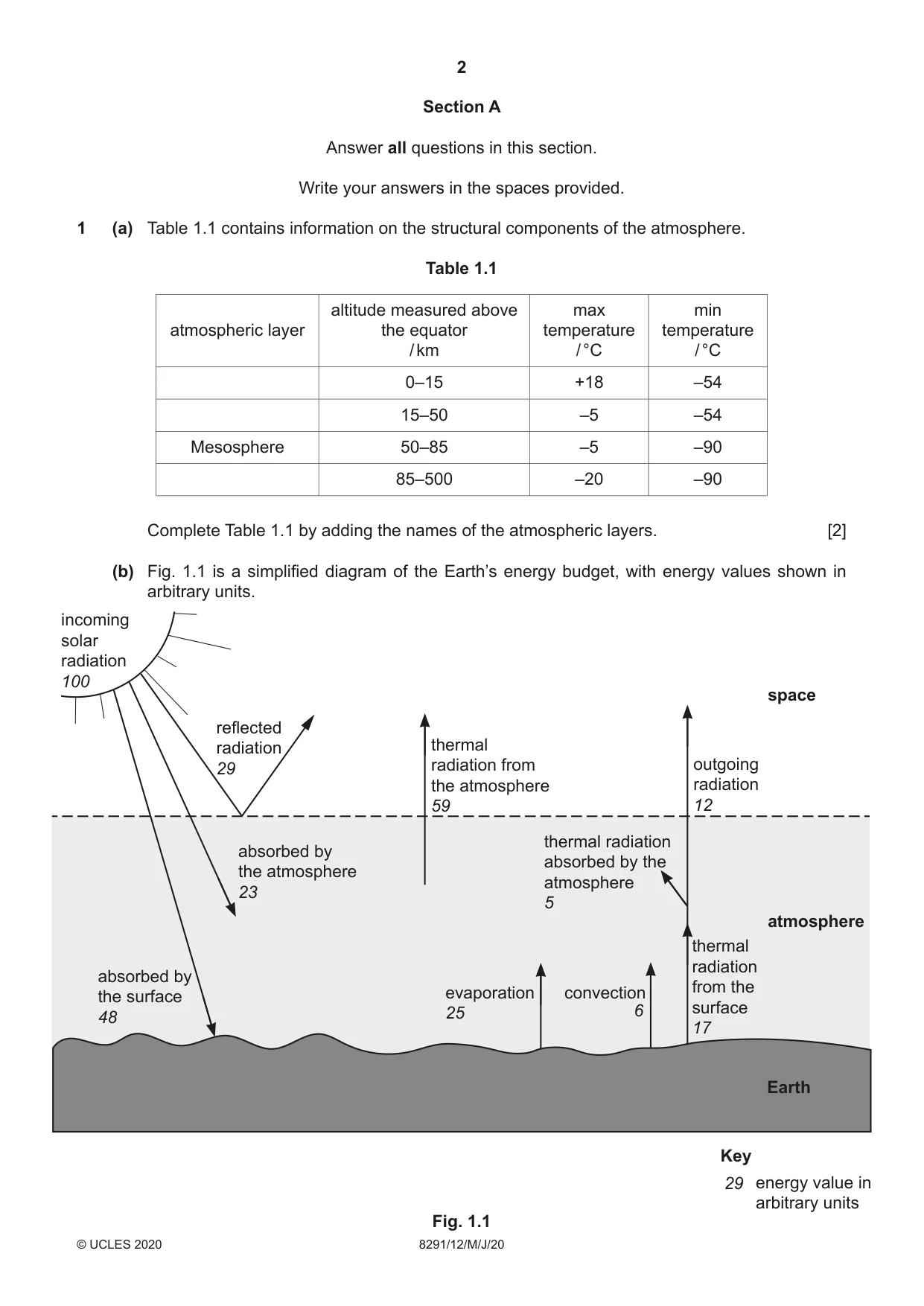
2 8291/12/M/J/20 © UCLES 2020 Section A Answer all questions in this section. Write your answers in the spaces provided. 1 (a) Table 1.1 contains information on the structural components of the atmosphere. Table 1.1 atmospheric layer altitude measured above the equator / km max temperature / °C min temperature / °C 0–15 +18 –54 15–50 –5 –54 Mesosphere 50–85 –5 –90 85–500 –20 –90 Complete Table 1.1 by adding the names of the atmospheric layers. [2] (b) Fig. 1.1 is a simplified diagram of the Earth’s energy budget, with energy values shown in arbitrary units. incoming solar radiation 100 reflected radiation 29 thermal radiation from the atmosphere 59 outgoing radiation 12 atmosphere space Earth Key energy value in arbitrary units 29 absorbed by the atmosphere absorbed by the surface 48 thermal radiation absorbed by the atmosphere 5 thermal radiation from the surface 17 evaporation 25 convection 23 6 Fig. 1.1
Question paper, page 3
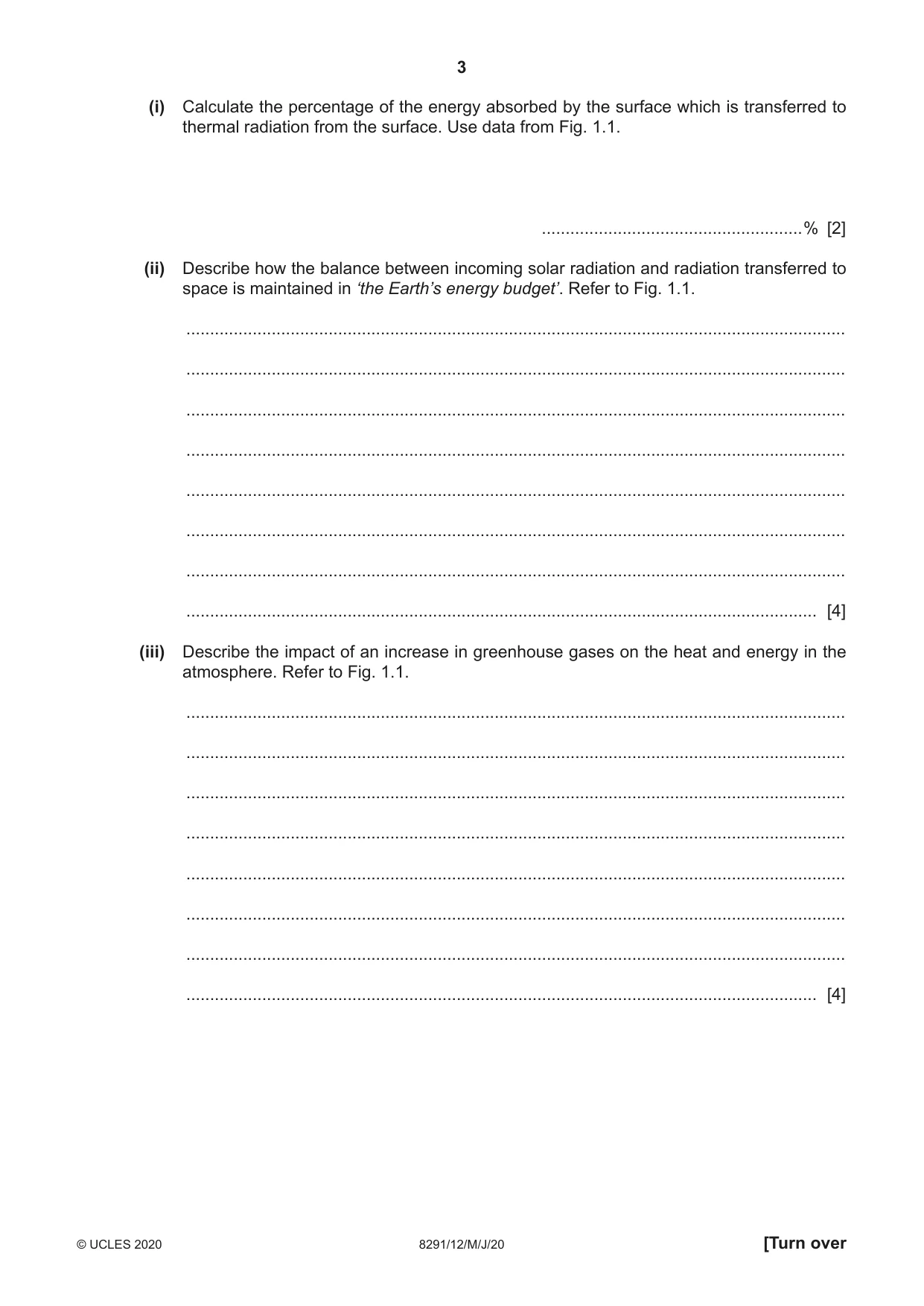
3 8291/12/M/J/20 © UCLES 2020 [Turn over (i) Calculate the percentage of the energy absorbed by the surface which is transferred to thermal radiation from the surface. Use data from Fig. 1.1. …% [2] (ii) Describe how the balance between incoming solar radiation and radiation transferred to space is maintained in ‘the Earth’s energy budget’. Refer to Fig. 1.1. … … … … … … … … [4] (iii) Describe the impact of an increase in greenhouse gases on the heat and energy in the atmosphere. Refer to Fig. 1.1. … … … … … … … … [4]
Question paper, page 4
4 8291/12/M/J/20 © UCLES 2020 (iv) Name two scientific methods used to provide evidence that ‘the Earth’s energy budget’ is changing. State how each method is used to provide this evidence. method 1 … how method provides the evidence … … method 2 … how method provides the evidence … … [4] (v) Outline ways in which humans are responsible for changes in ‘the Earth’s energy budget’. … … … … … … … … [4] [Total: 20]
Question paper, page 5
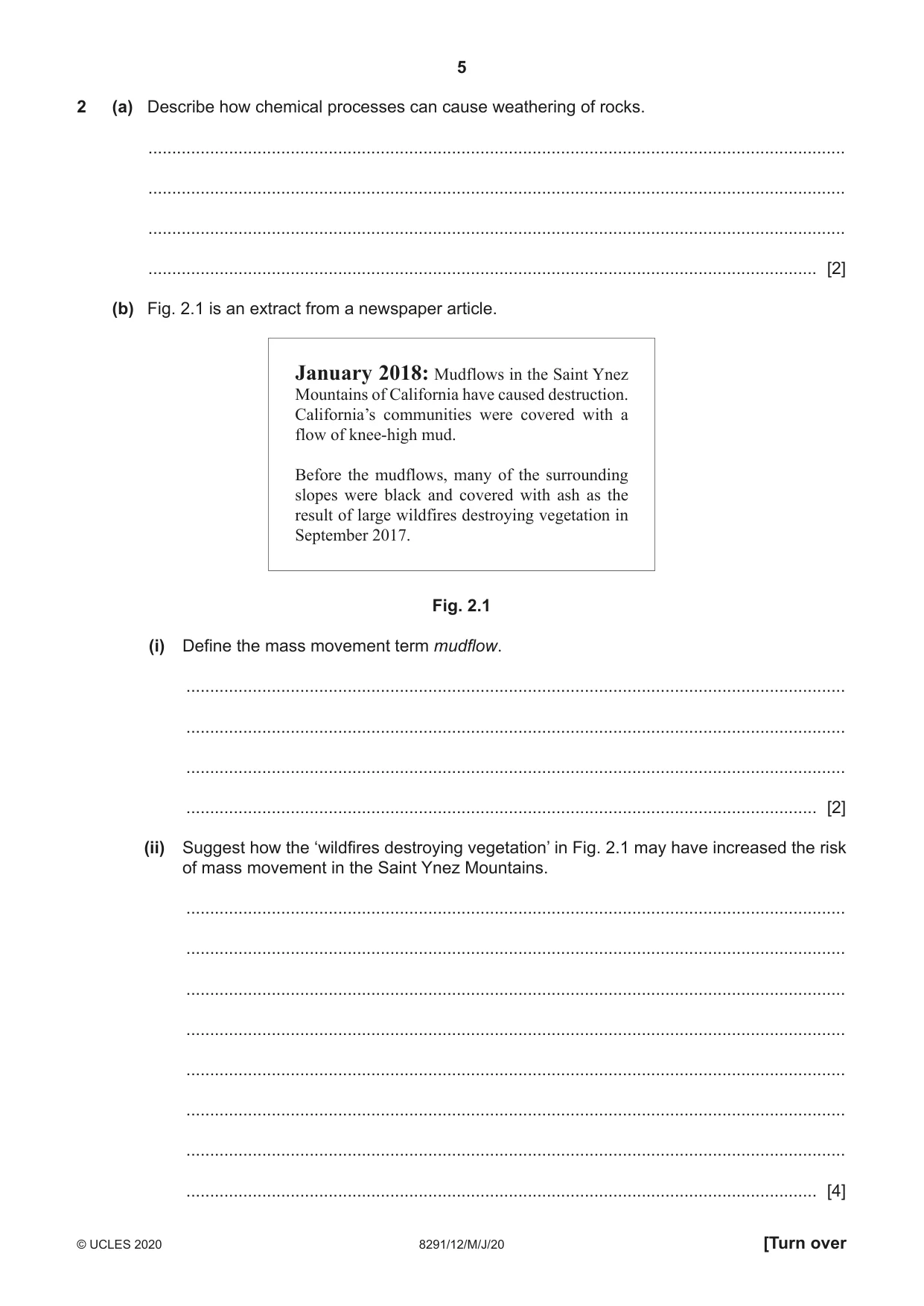
5 8291/12/M/J/20 © UCLES 2020 [Turn over 2 (a) Describe how chemical processes can cause weathering of rocks. … … … … [2] (b) Fig. 2.1 is an extract from a newspaper article. January 2018: Mudflows in the Saint Ynez Mountains of California have caused destruction. California’s communities were covered with a flow of knee-high mud. Before the mudflows, many of the surrounding slopes were black and covered with ash as the result of large wildfires destroying vegetation in September 2017. Fig. 2.1 (i) Define the mass movement term mudflow. … … … … [2] (ii) Suggest how the ‘wildfires destroying vegetation’ in Fig. 2.1 may have increased the risk of mass movement in the Saint Ynez Mountains. … … … … … … … … [4]
Question paper, page 6
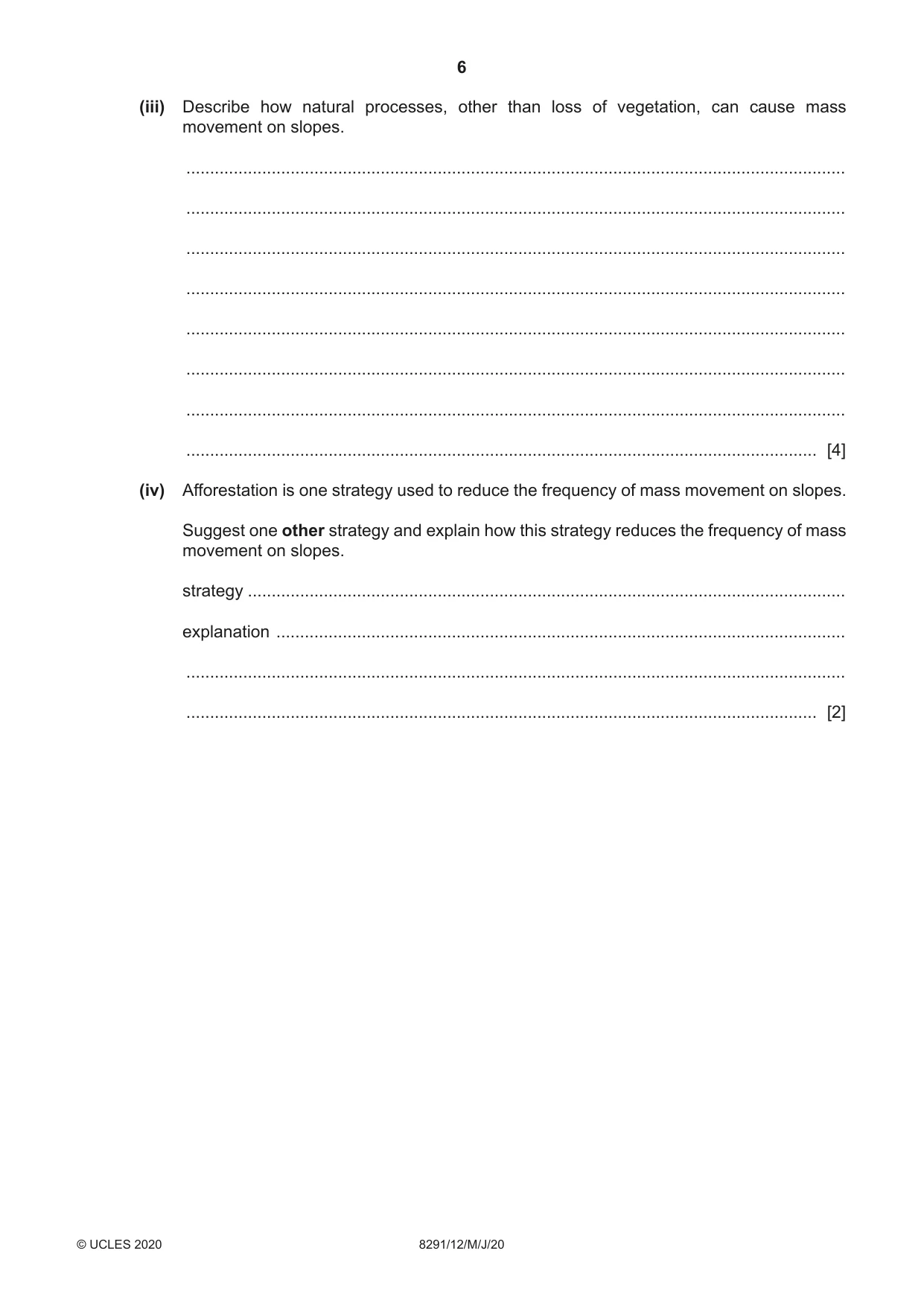
6 8291/12/M/J/20 © UCLES 2020 (iii) Describe how natural processes, other than loss of vegetation, can cause mass movement on slopes. … … … … … … … … [4] (iv) Afforestation is one strategy used to reduce the frequency of mass movement on slopes. Suggest one other strategy and explain how this strategy reduces the frequency of mass movement on slopes. strategy … explanation … … … [2]
Question paper, page 7
7 8291/12/M/J/20 © UCLES 2020 [Turn over BLANK PAGE
Question paper, page 8
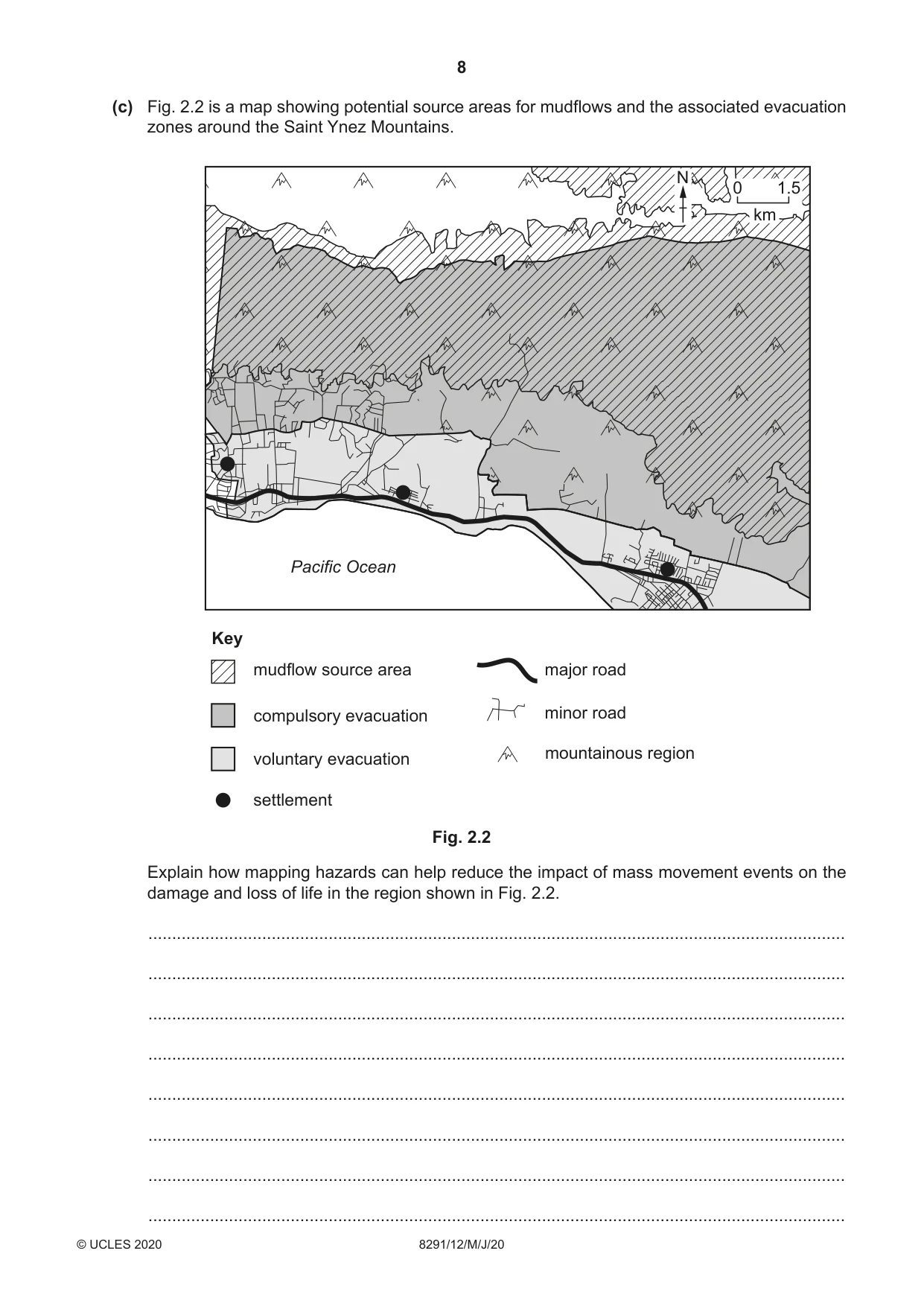
8 8291/12/M/J/20 © UCLES 2020 (c) Fig. 2.2 is a map showing potential source areas for mudflows and the associated evacuation zones around the Saint Ynez Mountains. mudflow source area compulsory evacuation voluntary evacuation mountainous region settlement Key N 0 1.5 km N 0 1.5 km major road minor road Pacific Ocean Fig. 2.2 Explain how mapping hazards can help reduce the impact of mass movement events on the damage and loss of life in the region shown in Fig. 2.2. … … … … … … … …
Question paper, page 9
9 8291/12/M/J/20 © UCLES 2020 [Turn over … … … … [6] [Total: 20]
Question paper, page 10
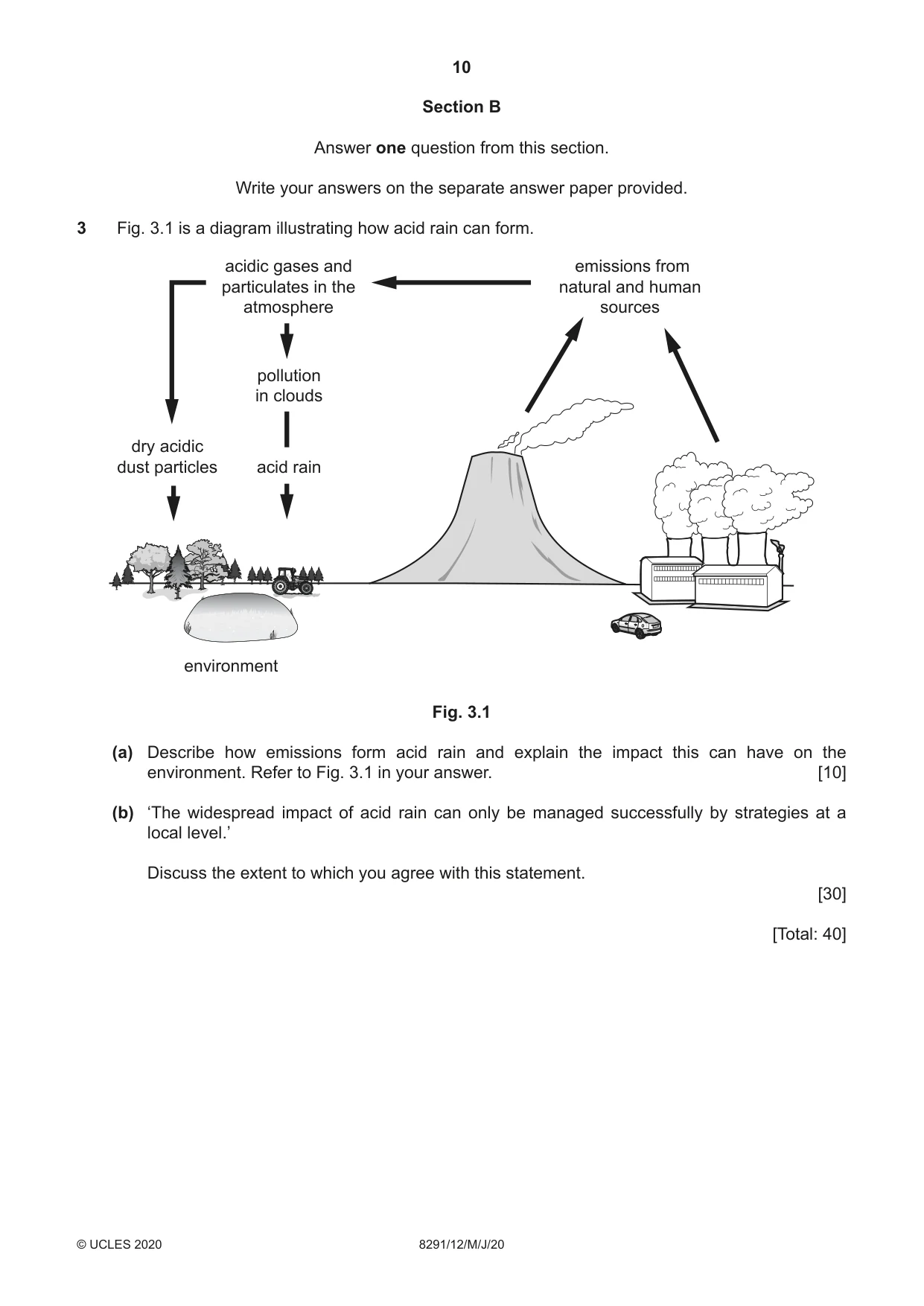
10 8291/12/M/J/20 © UCLES 2020 Section B Answer one question from this section. Write your answers on the separate answer paper provided. 3 Fig. 3.1 is a diagram illustrating how acid rain can form. emissions from natural and human sources acidic gases and particulates in the atmosphere pollution in clouds acid rain environment dry acidic dust particles Fig. 3.1 (a) Describe how emissions form acid rain and explain the impact this can have on the environment. Refer to Fig. 3.1 in your answer. [10] (b) ‘The widespread impact of acid rain can only be managed successfully by strategies at a local level.’ Discuss the extent to which you agree with this statement. [30] [Total: 40]
Question paper, page 11
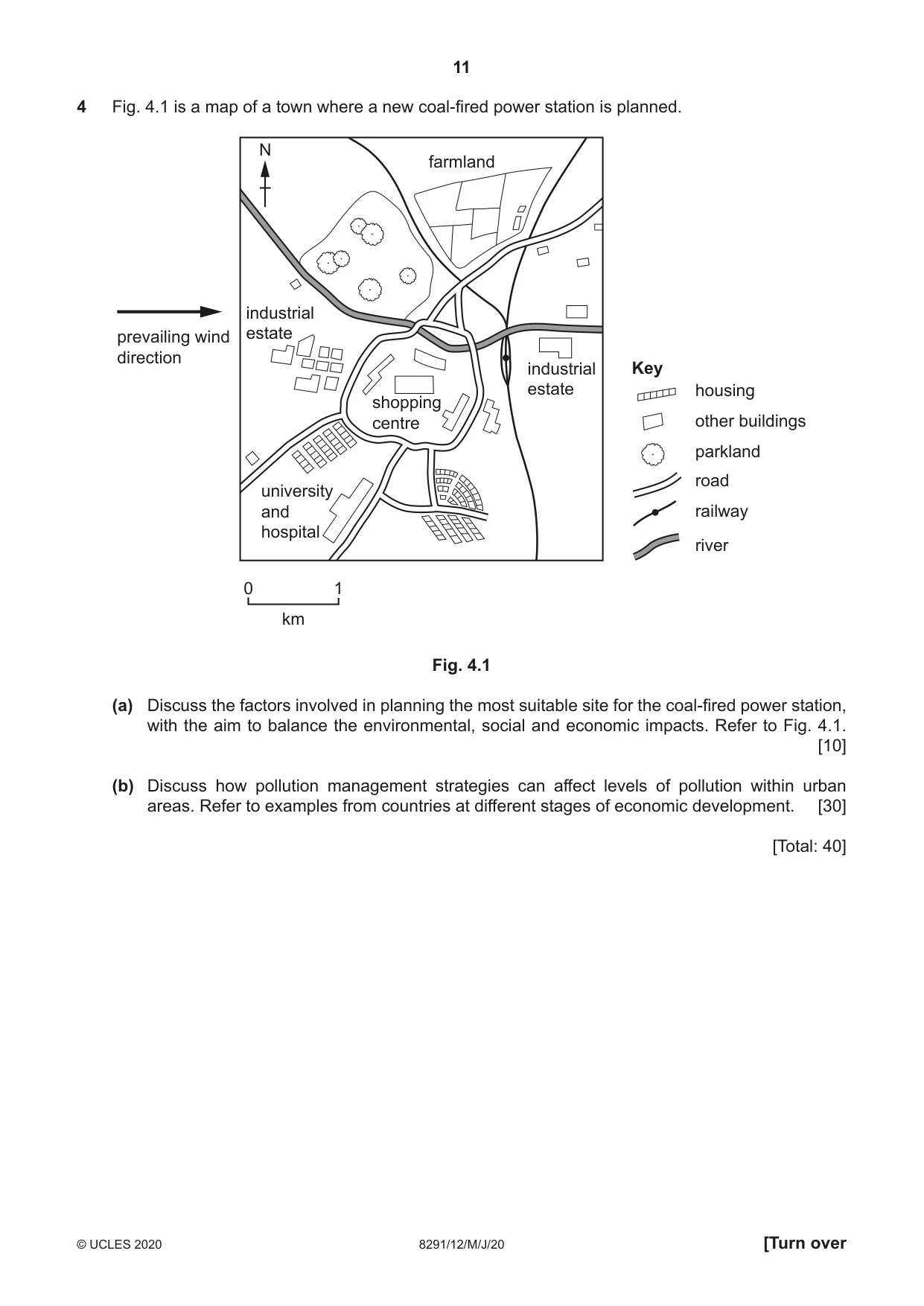
11 8291/12/M/J/20 © UCLES 2020 [Turn over 4 Fig. 4.1 is a map of a town where a new coal-fired power station is planned. prevailing wind direction farmland industrial estate shopping centre industrial estate university and hospital N Key housing other buildings parkland road railway river 0 1 km Fig. 4.1 (a) Discuss the factors involved in planning the most suitable site for the coal-fired power station, with the aim to balance the environmental, social and economic impacts. Refer to Fig. 4.1. [10] (b) Discuss how pollution management strategies can affect levels of pollution within urban areas. Refer to examples from countries at different stages of economic development. [30] [Total: 40]
Question paper, page 12
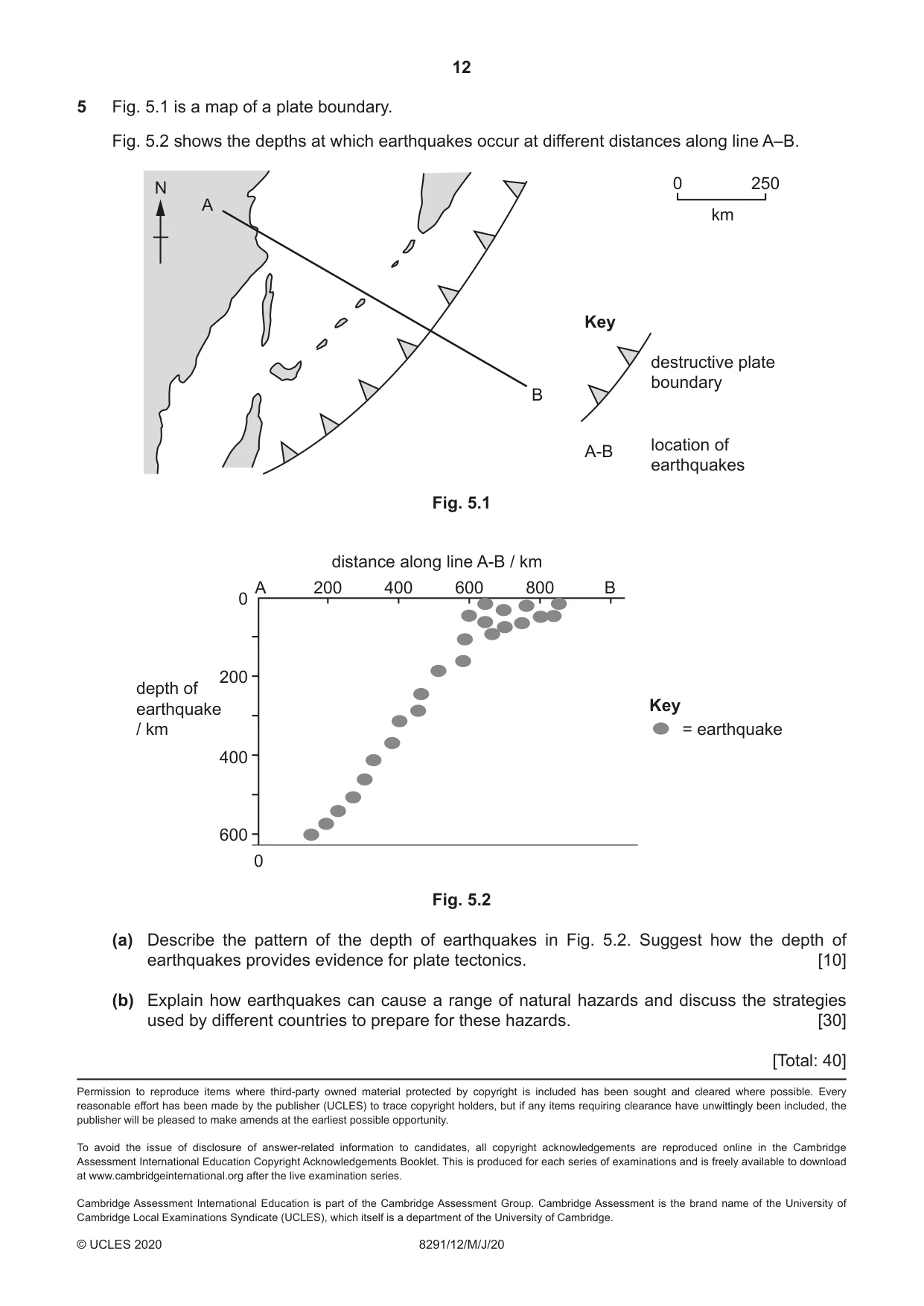
12 8291/12/M/J/20 © UCLES 2020 Permission to reproduce items where third-party owned material protected by copyright is included has been sought and cleared where possible. Every reasonable effort has been made by the publisher (UCLES) to trace copyright holders, but if any items requiring clearance have unwittingly been included, the publisher will be pleased to make amends at the earliest possible opportunity. To avoid the issue of disclosure of answer-related information to candidates, all copyright acknowledgements are reproduced online in the Cambridge Assessment International Education Copyright Acknowledgements Booklet. This is produced for each series of examinations and is freely available to download at www.cambridgeinternational.org after the live examination series. Cambridge Assessment International Education is part of the Cambridge Assessment Group. Cambridge Assessment is the brand name of the University of Cambridge Local Examinations Syndicate (UCLES), which itself is a department of the University of Cambridge. 5 Fig. 5.1 is a map of a plate boundary. Fig. 5.2 shows the depths at which earthquakes occur at different distances along line A–B. A B Key destructive plate boundary N location of earthquakes A-B 0 250 km Fig. 5.1 depth of earthquake / km 0 0 200 400 600 A 200 distance along line A-B / km 400 600 800 B Key = earthquake Fig. 5.2 (a) Describe the pattern of the depth of earthquakes in Fig. 5.2. Suggest how the depth of earthquakes provides evidence for plate tectonics. [10] (b) Explain how earthquakes can cause a range of natural hazards and discuss the strategies used by different countries to prepare for these hazards. [30] [Total: 40]
Mark scheme, page 1
This document consists of 16 printed pages. © UCLES 2020 [Turn over Cambridge International AS Level ENVIRONMENTAL MANAGEMENT 8291/12 Paper 1 May/June 2020 MARK SCHEME Maximum Mark: 80 Published Students did not sit exam papers in the June 2020 series due to the Covid-19 global pandemic. This mark scheme is published to support teachers and students and should be read together with the question paper. It shows the requirements of the exam. The answer column of the mark scheme shows the proposed basis on which Examiners would award marks for this exam. Where appropriate, this column also provides the most likely acceptable alternative responses expected from students. Examiners usually review the mark scheme after they have seen student responses and update the mark scheme if appropriate. In the June series, Examiners were unable to consider the acceptability of alternative responses, as there were no student responses to consider. Mark schemes should usually be read together with the Principal Examiner Report for Teachers. However, because students did not sit exam papers, there is no Principal Examiner Report for Teachers for the June 2020 series. Cambridge International will not enter into discussions about these mark schemes. Cambridge International is publishing the mark schemes for the June 2020 series for most Cambridge IGCSE™ and Cambridge International A & AS Level components, and some Cambridge O Level components.
Mark scheme, page 2
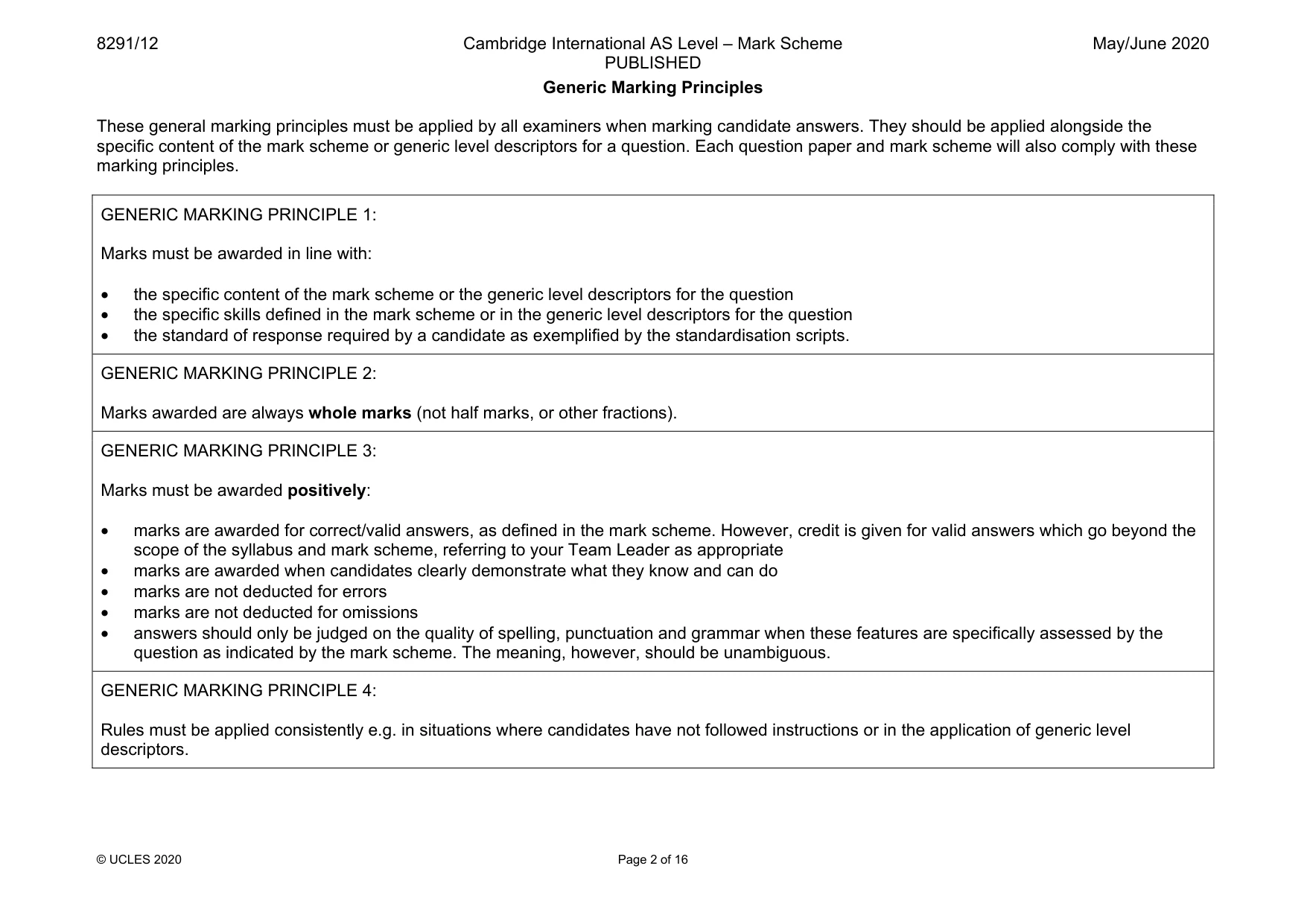
8291/12 Cambridge International AS Level – Mark Scheme PUBLISHED May/June 2020 © UCLES 2020 Page 2 of 16 Generic Marking Principles These general marking principles must be applied by all examiners when marking candidate answers. They should be applied alongside the specific content of the mark scheme or generic level descriptors for a question. Each question paper and mark scheme will also comply with these marking principles. GENERIC MARKING PRINCIPLE 1: Marks must be awarded in line with: • the specific content of the mark scheme or the generic level descriptors for the question • the specific skills defined in the mark scheme or in the generic level descriptors for the question • the standard of response required by a candidate as exemplified by the standardisation scripts. GENERIC MARKING PRINCIPLE 2: Marks awarded are always whole marks (not half marks, or other fractions). GENERIC MARKING PRINCIPLE 3: Marks must be awarded positively: • marks are awarded for correct/valid answers, as defined in the mark scheme. However, credit is given for valid answers which go beyond the scope of the syllabus and mark scheme, referring to your Team Leader as appropriate • marks are awarded when candidates clearly demonstrate what they know and can do • marks are not deducted for errors • marks are not deducted for omissions • answers should only be judged on the quality of spelling, punctuation and grammar when these features are specifically assessed by the question as indicated by the mark scheme. The meaning, however, should be unambiguous. GENERIC MARKING PRINCIPLE 4: Rules must be applied consistently e.g. in situations where candidates have not followed instructions or in the application of generic level descriptors.
Mark scheme, page 3
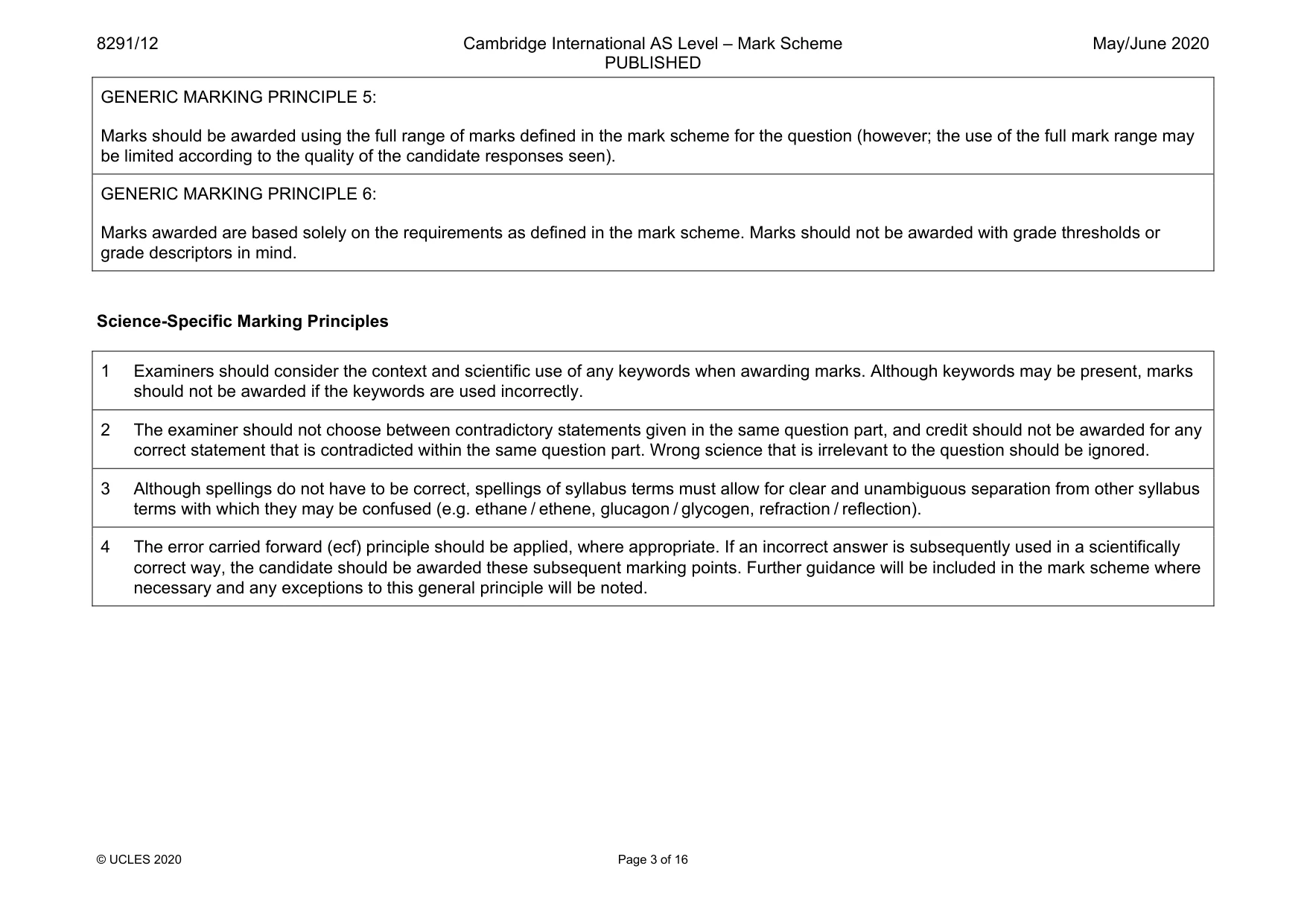
8291/12 Cambridge International AS Level – Mark Scheme PUBLISHED May/June 2020 © UCLES 2020 Page 3 of 16 GENERIC MARKING PRINCIPLE 5: Marks should be awarded using the full range of marks defined in the mark scheme for the question (however; the use of the full mark range may be limited according to the quality of the candidate responses seen). GENERIC MARKING PRINCIPLE 6: Marks awarded are based solely on the requirements as defined in the mark scheme. Marks should not be awarded with grade thresholds or grade descriptors in mind. Science-Specific Marking Principles 1 Examiners should consider the context and scientific use of any keywords when awarding marks. Although keywords may be present, marks should not be awarded if the keywords are used incorrectly. 2 The examiner should not choose between contradictory statements given in the same question part, and credit should not be awarded for any correct statement that is contradicted within the same question part. Wrong science that is irrelevant to the question should be ignored. 3 Although spellings do not have to be correct, spellings of syllabus terms must allow for clear and unambiguous separation from other syllabus terms with which they may be confused (e.g. ethane / ethene, glucagon / glycogen, refraction / reflection). 4 The error carried forward (ecf) principle should be applied, where appropriate. If an incorrect answer is subsequently used in a scientifically correct way, the candidate should be awarded these subsequent marking points. Further guidance will be included in the mark scheme where necessary and any exceptions to this general principle will be noted.
Mark scheme, page 4
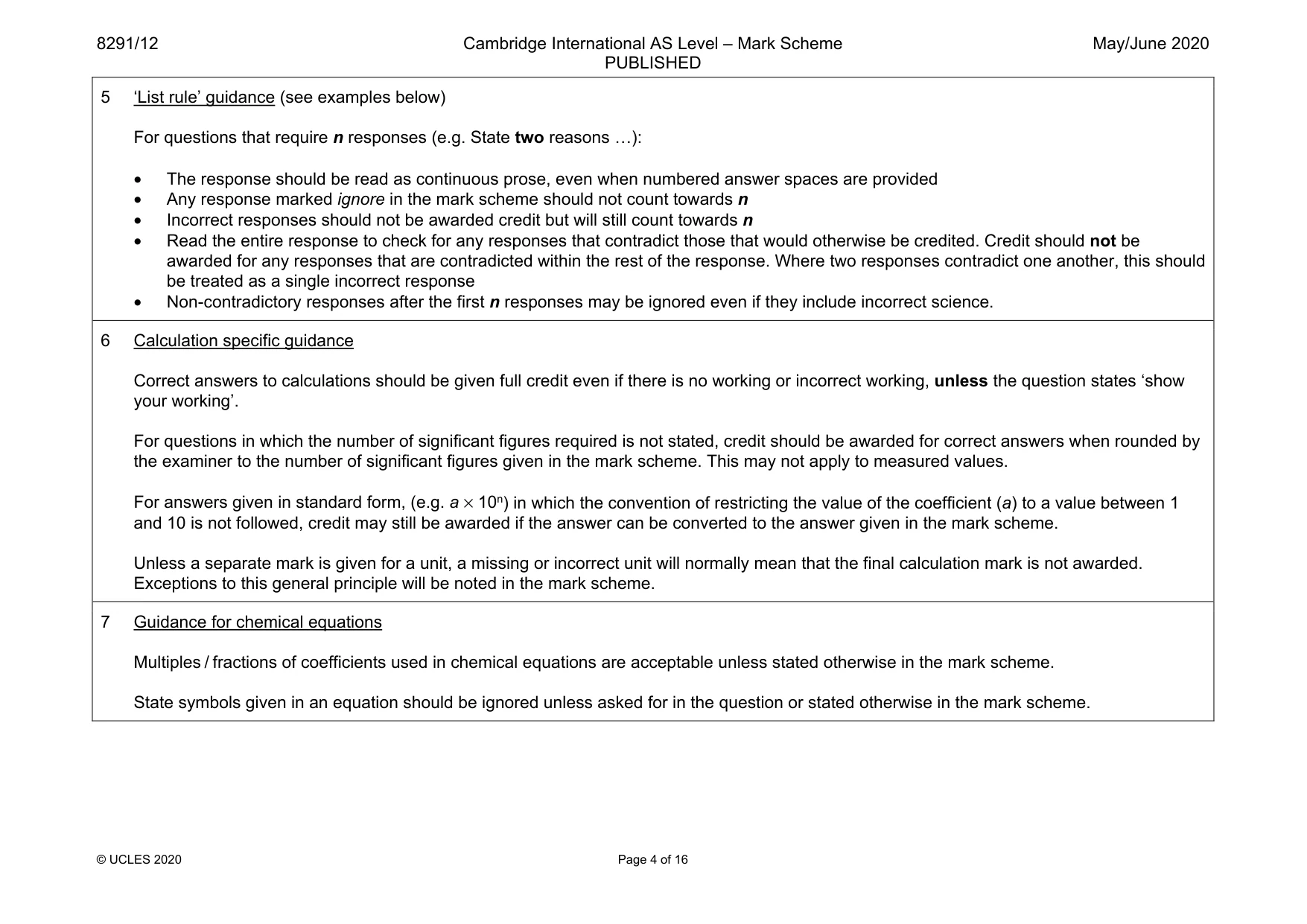
8291/12 Cambridge International AS Level – Mark Scheme PUBLISHED May/June 2020 © UCLES 2020 Page 4 of 16 5 ‘List rule’ guidance (see examples below) For questions that require n responses (e.g. State two reasons …): • The response should be read as continuous prose, even when numbered answer spaces are provided • Any response marked ignore in the mark scheme should not count towards n • Incorrect responses should not be awarded credit but will still count towards n • Read the entire response to check for any responses that contradict those that would otherwise be credited. Credit should not be awarded for any responses that are contradicted within the rest of the response. Where two responses contradict one another, this should be treated as a single incorrect response • Non-contradictory responses after the first n responses may be ignored even if they include incorrect science. 6 Calculation specific guidance Correct answers to calculations should be given full credit even if there is no working or incorrect working, unless the question states ‘show your working’. For questions in which the number of significant figures required is not stated, credit should be awarded for correct answers when rounded by the examiner to the number of significant figures given in the mark scheme. This may not apply to measured values. For answers given in standard form, (e.g. a × 10n) in which the convention of restricting the value of the coefficient (a) to a value between 1 and 10 is not followed, credit may still be awarded if the answer can be converted to the answer given in the mark scheme. Unless a separate mark is given for a unit, a missing or incorrect unit will normally mean that the final calculation mark is not awarded. Exceptions to this general principle will be noted in the mark scheme. 7 Guidance for chemical equations Multiples / fractions of coefficients used in chemical equations are acceptable unless stated otherwise in the mark scheme. State symbols given in an equation should be ignored unless asked for in the question or stated otherwise in the mark scheme.
Mark scheme, page 5
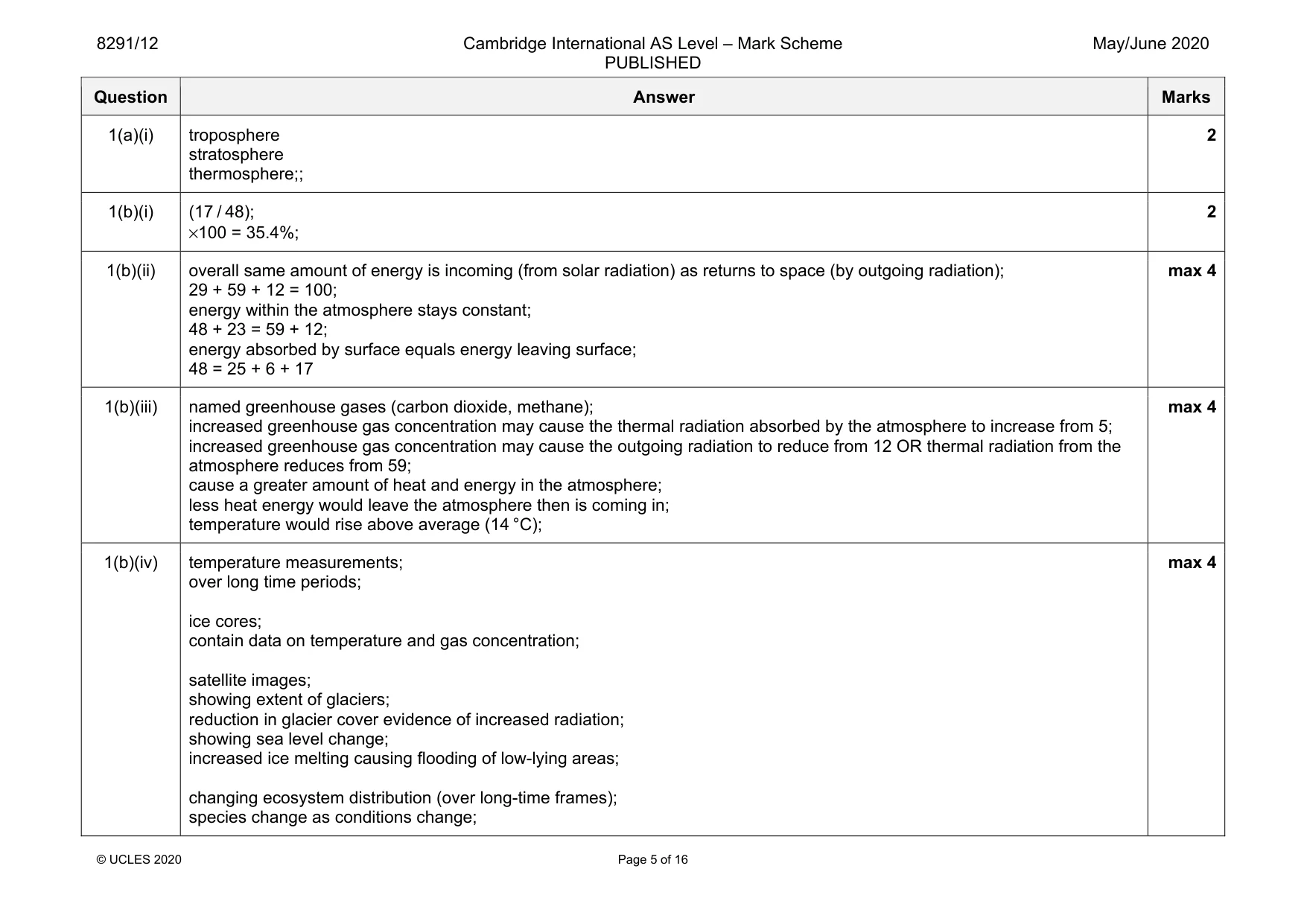
8291/12 Cambridge International AS Level – Mark Scheme PUBLISHED May/June 2020 © UCLES 2020 Page 5 of 16 Question Answer Marks 1(a)(i) troposphere stratosphere thermosphere;; 2 1(b)(i) (17 / 48); ×100 = 35.4%; 2 1(b)(ii) overall same amount of energy is incoming (from solar radiation) as returns to space (by outgoing radiation); 29 + 59 + 12 = 100; energy within the atmosphere stays constant; 48 + 23 = 59 + 12; energy absorbed by surface equals energy leaving surface; 48 = 25 + 6 + 17 max 4 1(b)(iii) named greenhouse gases (carbon dioxide, methane); increased greenhouse gas concentration may cause the thermal radiation absorbed by the atmosphere to increase from 5; increased greenhouse gas concentration may cause the outgoing radiation to reduce from 12 OR thermal radiation from the atmosphere reduces from 59; cause a greater amount of heat and energy in the atmosphere; less heat energy would leave the atmosphere then is coming in; temperature would rise above average (14 °C); max 4 1(b)(iv) temperature measurements; over long time periods; ice cores; contain data on temperature and gas concentration; satellite images; showing extent of glaciers; reduction in glacier cover evidence of increased radiation; showing sea level change; increased ice melting causing flooding of low-lying areas; changing ecosystem distribution (over long-time frames); species change as conditions change; max 4
Mark scheme, page 6
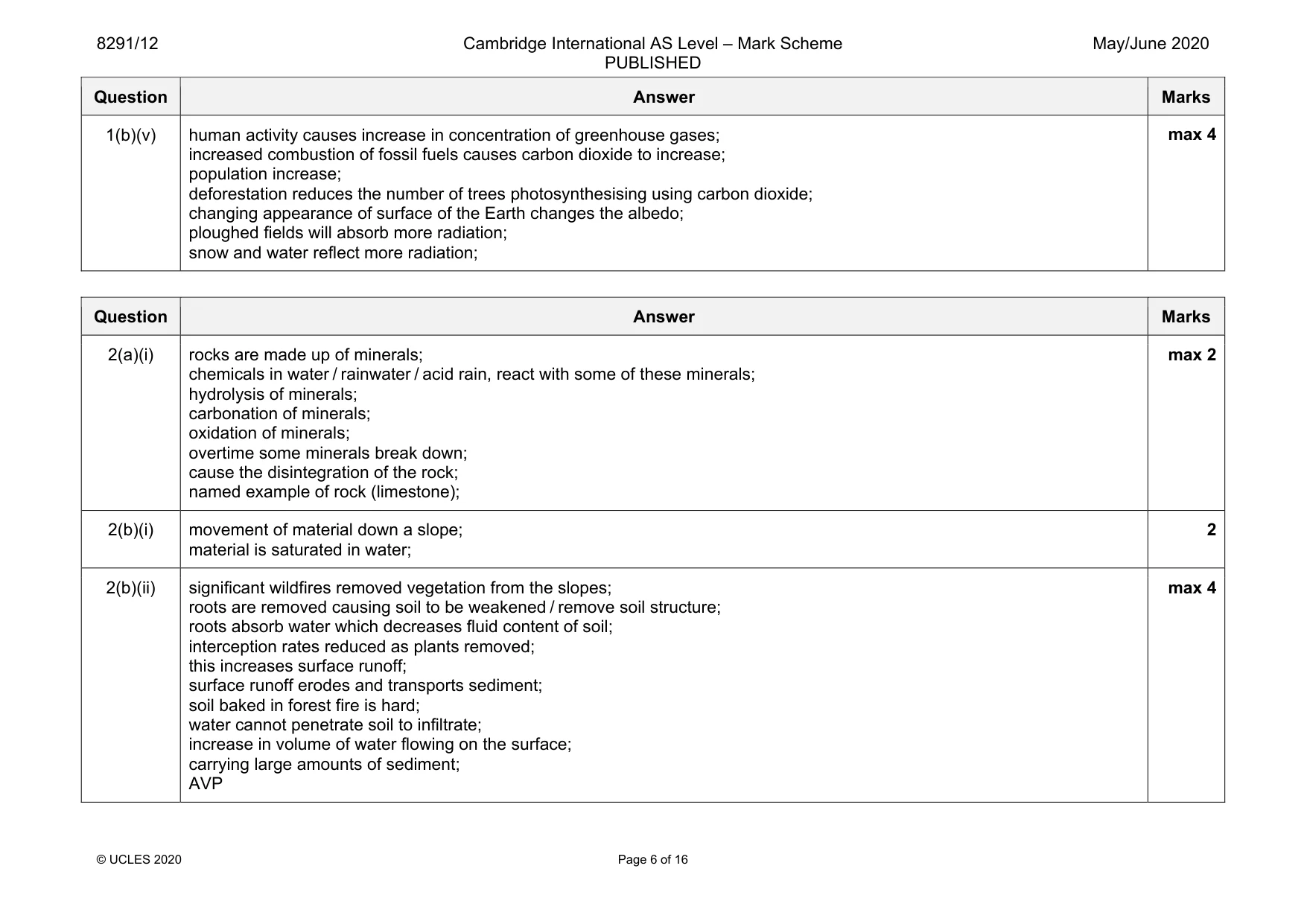
8291/12 Cambridge International AS Level – Mark Scheme PUBLISHED May/June 2020 © UCLES 2020 Page 6 of 16 Question Answer Marks 1(b)(v) human activity causes increase in concentration of greenhouse gases; increased combustion of fossil fuels causes carbon dioxide to increase; population increase; deforestation reduces the number of trees photosynthesising using carbon dioxide; changing appearance of surface of the Earth changes the albedo; ploughed fields will absorb more radiation; snow and water reflect more radiation; max 4 Question Answer Marks 2(a)(i) rocks are made up of minerals; chemicals in water / rainwater / acid rain, react with some of these minerals; hydrolysis of minerals; carbonation of minerals; oxidation of minerals; overtime some minerals break down; cause the disintegration of the rock; named example of rock (limestone); max 2 2(b)(i) movement of material down a slope; material is saturated in water; 2 2(b)(ii) significant wildfires removed vegetation from the slopes; roots are removed causing soil to be weakened / remove soil structure; roots absorb water which decreases fluid content of soil; interception rates reduced as plants removed; this increases surface runoff; surface runoff erodes and transports sediment; soil baked in forest fire is hard; water cannot penetrate soil to infiltrate; increase in volume of water flowing on the surface; carrying large amounts of sediment; AVP max 4
Mark scheme, page 7
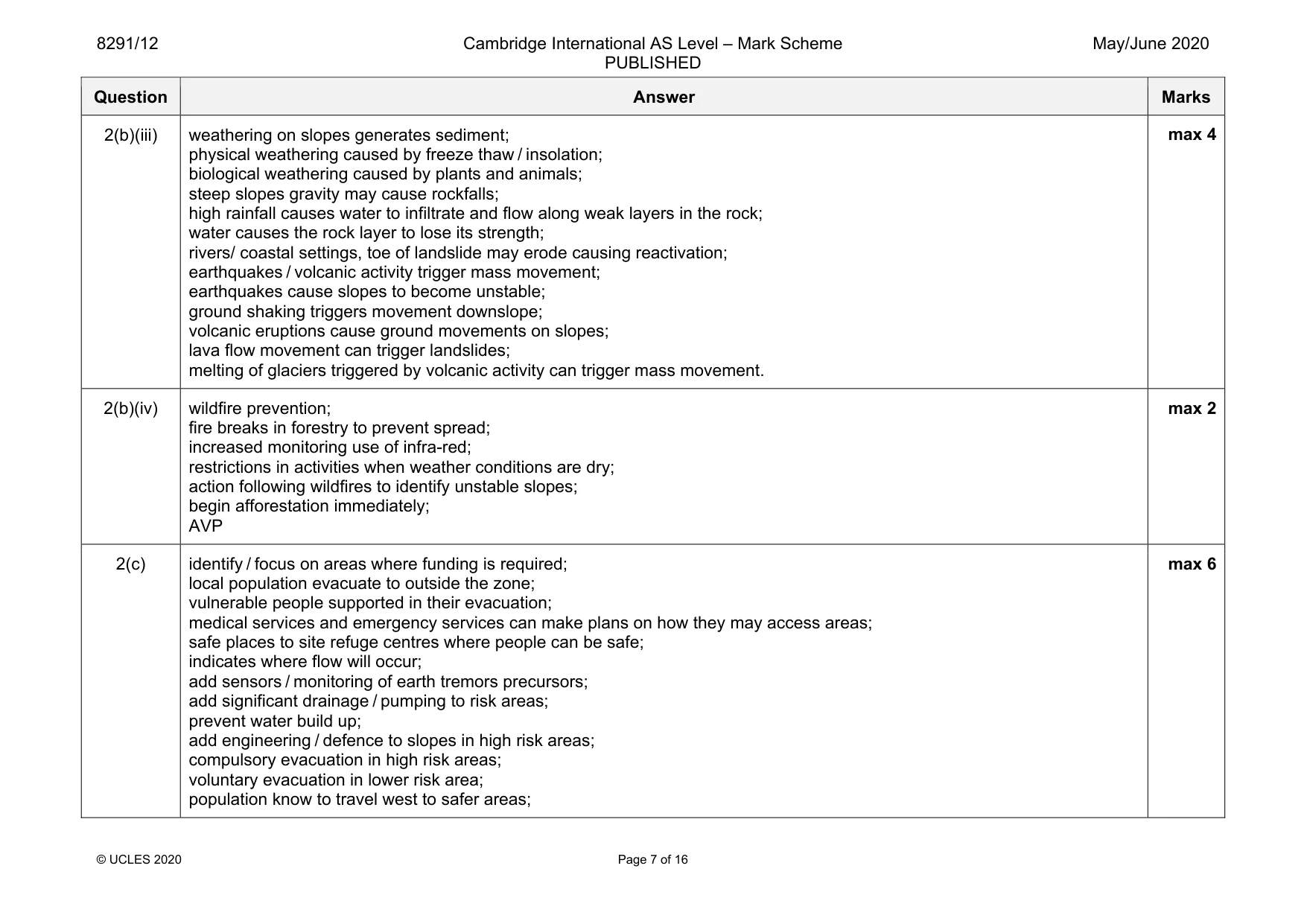
8291/12 Cambridge International AS Level – Mark Scheme PUBLISHED May/June 2020 © UCLES 2020 Page 7 of 16 Question Answer Marks 2(b)(iii) weathering on slopes generates sediment; physical weathering caused by freeze thaw / insolation; biological weathering caused by plants and animals; steep slopes gravity may cause rockfalls; high rainfall causes water to infiltrate and flow along weak layers in the rock; water causes the rock layer to lose its strength; rivers/ coastal settings, toe of landslide may erode causing reactivation; earthquakes / volcanic activity trigger mass movement; earthquakes cause slopes to become unstable; ground shaking triggers movement downslope; volcanic eruptions cause ground movements on slopes; lava flow movement can trigger landslides; melting of glaciers triggered by volcanic activity can trigger mass movement. max 4 2(b)(iv) wildfire prevention; fire breaks in forestry to prevent spread; increased monitoring use of infra-red; restrictions in activities when weather conditions are dry; action following wildfires to identify unstable slopes; begin afforestation immediately; AVP max 2 2(c) identify / focus on areas where funding is required; local population evacuate to outside the zone; vulnerable people supported in their evacuation; medical services and emergency services can make plans on how they may access areas; safe places to site refuge centres where people can be safe; indicates where flow will occur; add sensors / monitoring of earth tremors precursors; add significant drainage / pumping to risk areas; prevent water build up; add engineering / defence to slopes in high risk areas; compulsory evacuation in high risk areas; voluntary evacuation in lower risk area; population know to travel west to safer areas; max 6
Mark scheme, page 8
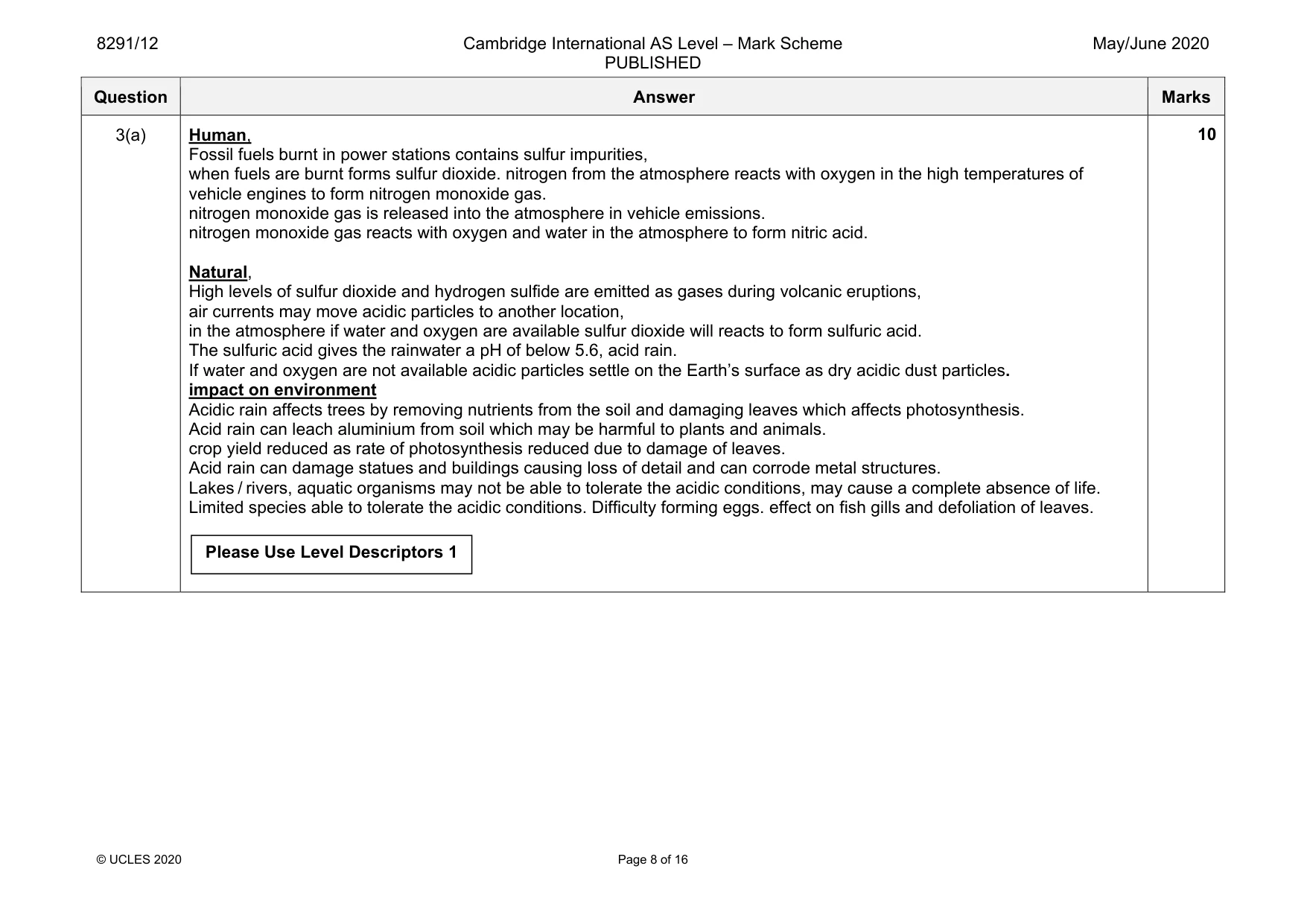
8291/12 Cambridge International AS Level – Mark Scheme PUBLISHED May/June 2020 © UCLES 2020 Page 8 of 16 Question Answer Marks 3(a) Human, Fossil fuels burnt in power stations contains sulfur impurities, when fuels are burnt forms sulfur dioxide. nitrogen from the atmosphere reacts with oxygen in the high temperatures of vehicle engines to form nitrogen monoxide gas. nitrogen monoxide gas is released into the atmosphere in vehicle emissions. nitrogen monoxide gas reacts with oxygen and water in the atmosphere to form nitric acid. Natural, High levels of sulfur dioxide and hydrogen sulfide are emitted as gases during volcanic eruptions, air currents may move acidic particles to another location, in the atmosphere if water and oxygen are available sulfur dioxide will reacts to form sulfuric acid. The sulfuric acid gives the rainwater a pH of below 5.6, acid rain. If water and oxygen are not available acidic particles settle on the Earth’s surface as dry acidic dust particles. impact on environment Acidic rain affects trees by removing nutrients from the soil and damaging leaves which affects photosynthesis. Acid rain can leach aluminium from soil which may be harmful to plants and animals. crop yield reduced as rate of photosynthesis reduced due to damage of leaves. Acid rain can damage statues and buildings causing loss of detail and can corrode metal structures. Lakes / rivers, aquatic organisms may not be able to tolerate the acidic conditions, may cause a complete absence of life. Limited species able to tolerate the acidic conditions. Difficulty forming eggs. effect on fish gills and defoliation of leaves. 10 Please Use Level Descriptors 1
Mark scheme, page 9
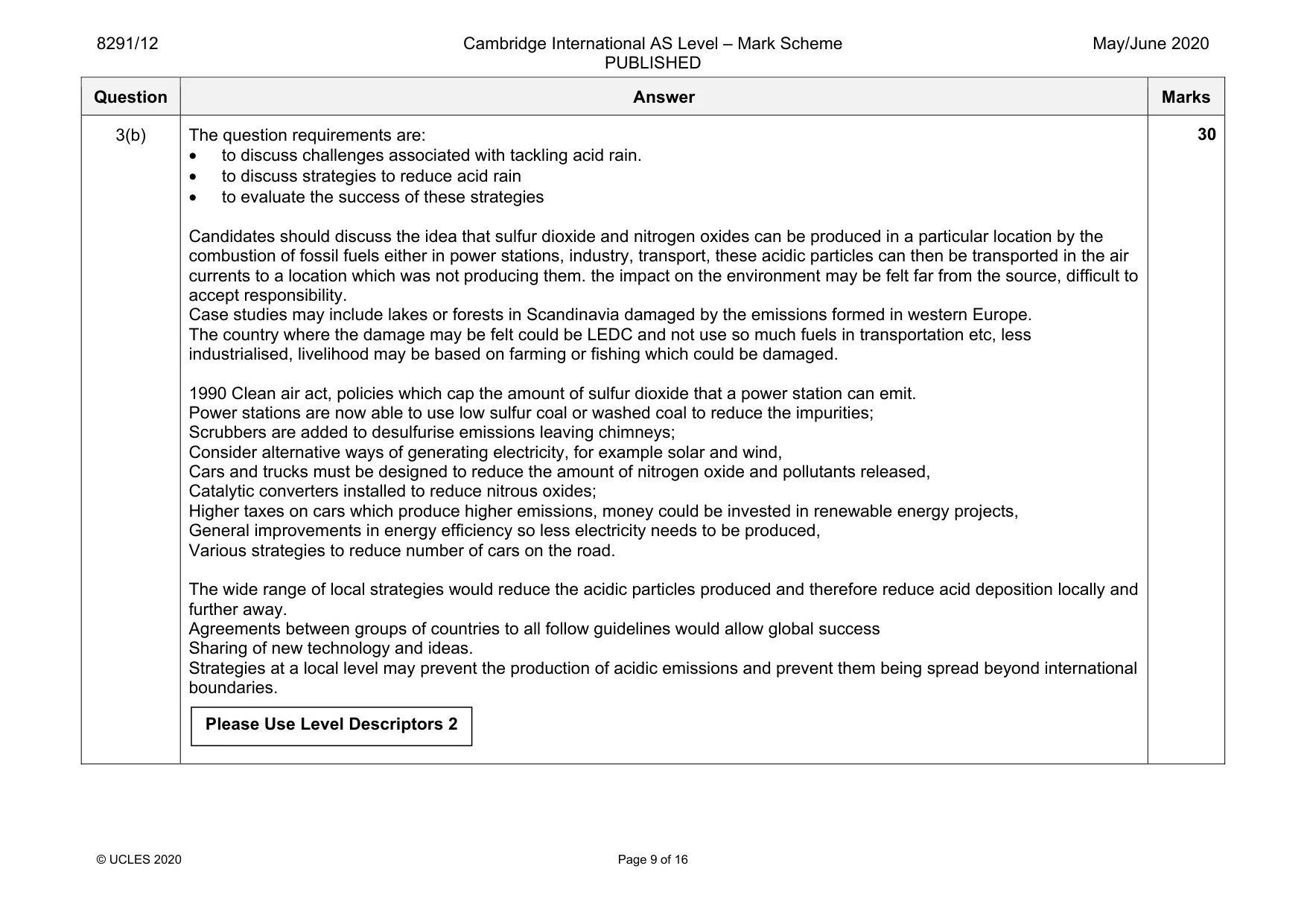
8291/12 Cambridge International AS Level – Mark Scheme PUBLISHED May/June 2020 © UCLES 2020 Page 9 of 16 Question Answer Marks 3(b) The question requirements are: • to discuss challenges associated with tackling acid rain. • to discuss strategies to reduce acid rain • to evaluate the success of these strategies Candidates should discuss the idea that sulfur dioxide and nitrogen oxides can be produced in a particular location by the combustion of fossil fuels either in power stations, industry, transport, these acidic particles can then be transported in the air currents to a location which was not producing them. the impact on the environment may be felt far from the source, difficult to accept responsibility. Case studies may include lakes or forests in Scandinavia damaged by the emissions formed in western Europe. The country where the damage may be felt could be LEDC and not use so much fuels in transportation etc, less industrialised, livelihood may be based on farming or fishing which could be damaged. 1990 Clean air act, policies which cap the amount of sulfur dioxide that a power station can emit. Power stations are now able to use low sulfur coal or washed coal to reduce the impurities; Scrubbers are added to desulfurise emissions leaving chimneys; Consider alternative ways of generating electricity, for example solar and wind, Cars and trucks must be designed to reduce the amount of nitrogen oxide and pollutants released, Catalytic converters installed to reduce nitrous oxides; Higher taxes on cars which produce higher emissions, money could be invested in renewable energy projects, General improvements in energy efficiency so less electricity needs to be produced, Various strategies to reduce number of cars on the road. The wide range of local strategies would reduce the acidic particles produced and therefore reduce acid deposition locally and further away. Agreements between groups of countries to all follow guidelines would allow global success Sharing of new technology and ideas. Strategies at a local level may prevent the production of acidic emissions and prevent them being spread beyond international boundaries. 30 Please Use Level Descriptors 2
Mark scheme, page 10
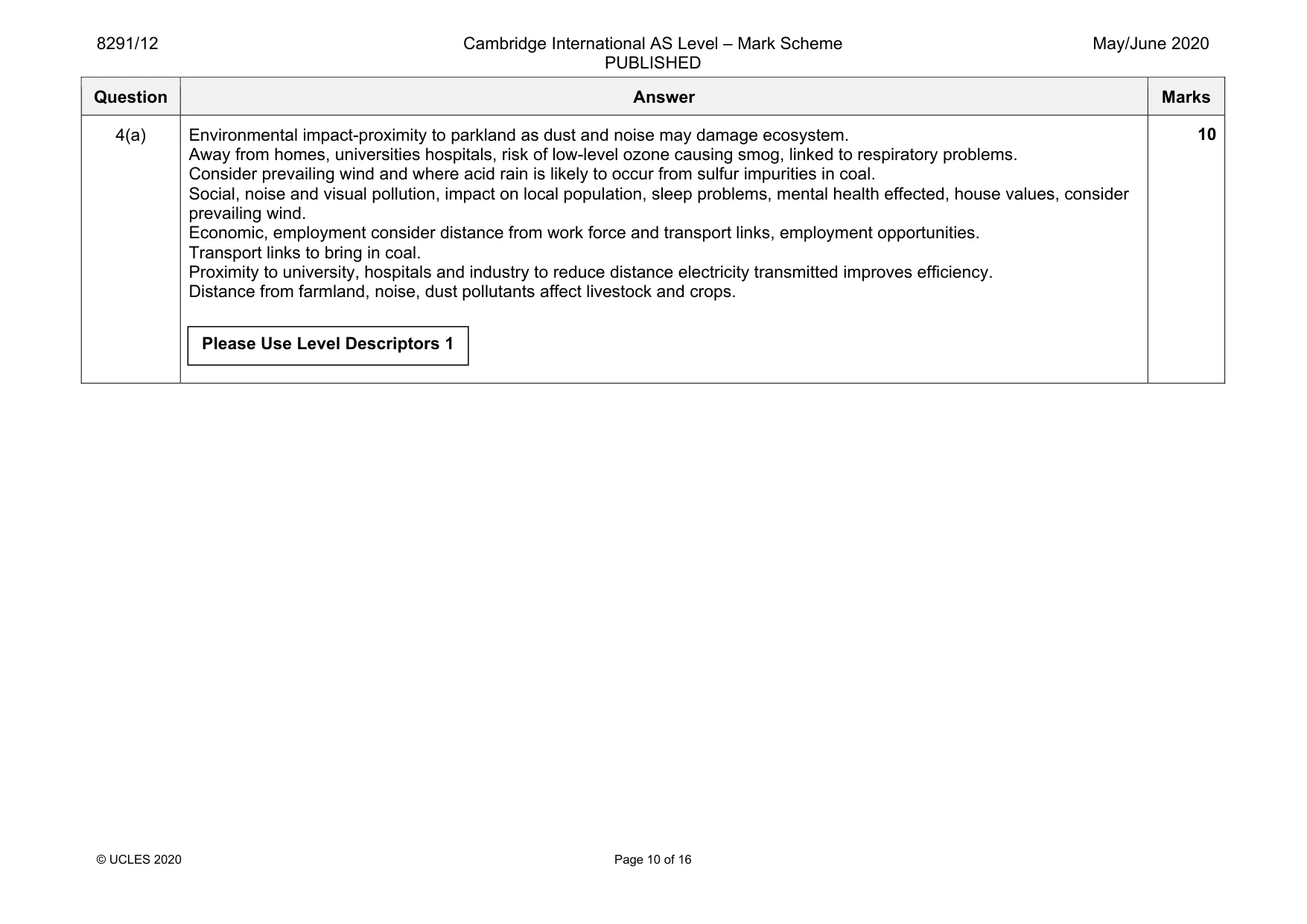
8291/12 Cambridge International AS Level – Mark Scheme PUBLISHED May/June 2020 © UCLES 2020 Page 10 of 16 Question Answer Marks 4(a) Environmental impact-proximity to parkland as dust and noise may damage ecosystem. Away from homes, universities hospitals, risk of low-level ozone causing smog, linked to respiratory problems. Consider prevailing wind and where acid rain is likely to occur from sulfur impurities in coal. Social, noise and visual pollution, impact on local population, sleep problems, mental health effected, house values, consider prevailing wind. Economic, employment consider distance from work force and transport links, employment opportunities. Transport links to bring in coal. Proximity to university, hospitals and industry to reduce distance electricity transmitted improves efficiency. Distance from farmland, noise, dust pollutants affect livestock and crops. 10 Please Use Level Descriptors 1
Mark scheme, page 11
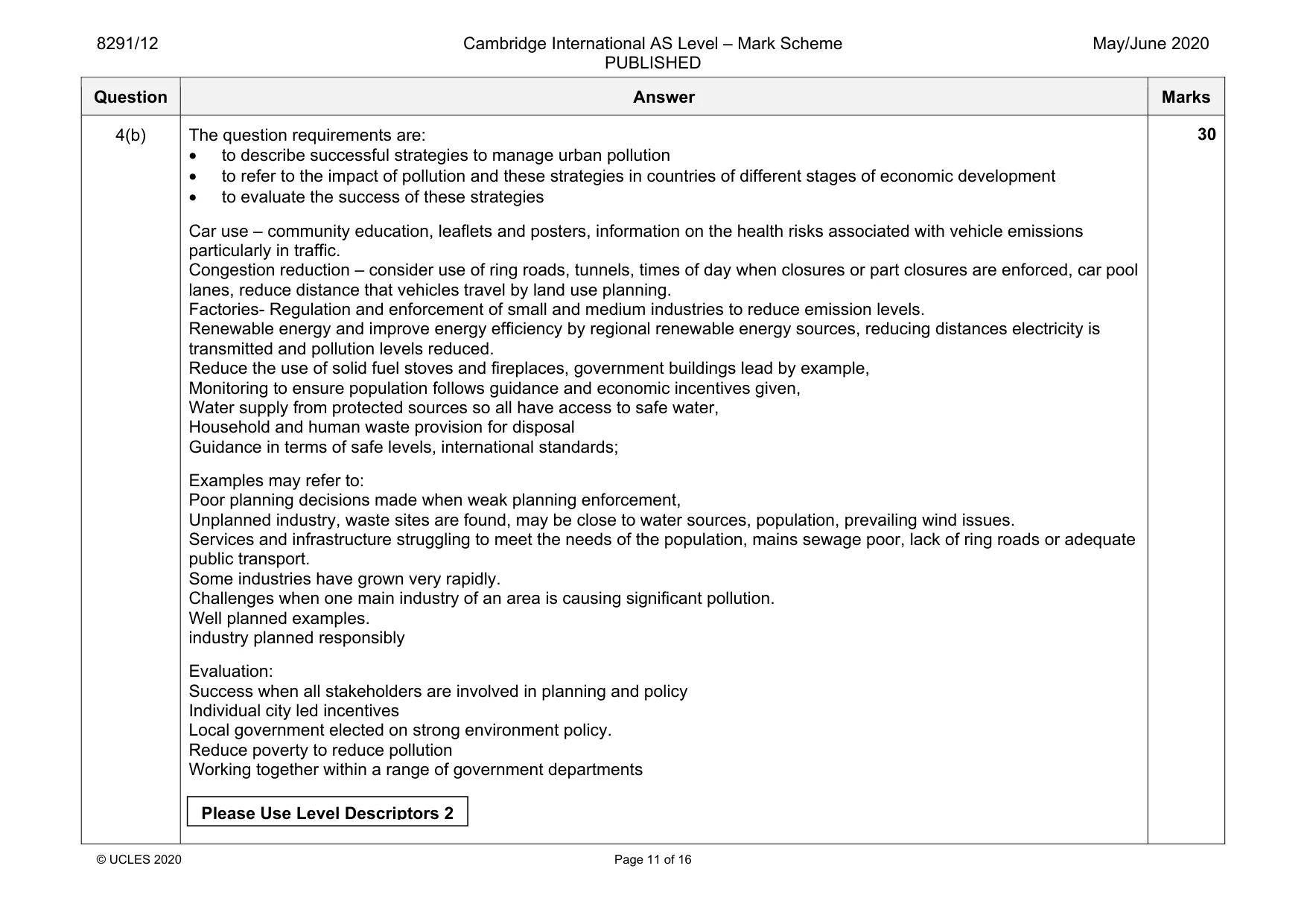
8291/12 Cambridge International AS Level – Mark Scheme PUBLISHED May/June 2020 © UCLES 2020 Page 11 of 16 Question Answer Marks 4(b) The question requirements are: • to describe successful strategies to manage urban pollution • to refer to the impact of pollution and these strategies in countries of different stages of economic development • to evaluate the success of these strategies Car use – community education, leaflets and posters, information on the health risks associated with vehicle emissions particularly in traffic. Congestion reduction – consider use of ring roads, tunnels, times of day when closures or part closures are enforced, car pool lanes, reduce distance that vehicles travel by land use planning. Factories- Regulation and enforcement of small and medium industries to reduce emission levels. Renewable energy and improve energy efficiency by regional renewable energy sources, reducing distances electricity is transmitted and pollution levels reduced. Reduce the use of solid fuel stoves and fireplaces, government buildings lead by example, Monitoring to ensure population follows guidance and economic incentives given, Water supply from protected sources so all have access to safe water, Household and human waste provision for disposal Guidance in terms of safe levels, international standards; Examples may refer to: Poor planning decisions made when weak planning enforcement, Unplanned industry, waste sites are found, may be close to water sources, population, prevailing wind issues. Services and infrastructure struggling to meet the needs of the population, mains sewage poor, lack of ring roads or adequate public transport. Some industries have grown very rapidly. Challenges when one main industry of an area is causing significant pollution. Well planned examples. industry planned responsibly Evaluation: Success when all stakeholders are involved in planning and policy Individual city led incentives Local government elected on strong environment policy. Reduce poverty to reduce pollution Working together within a range of government departments 30 Please Use Level Descriptors 2
Mark scheme, page 12
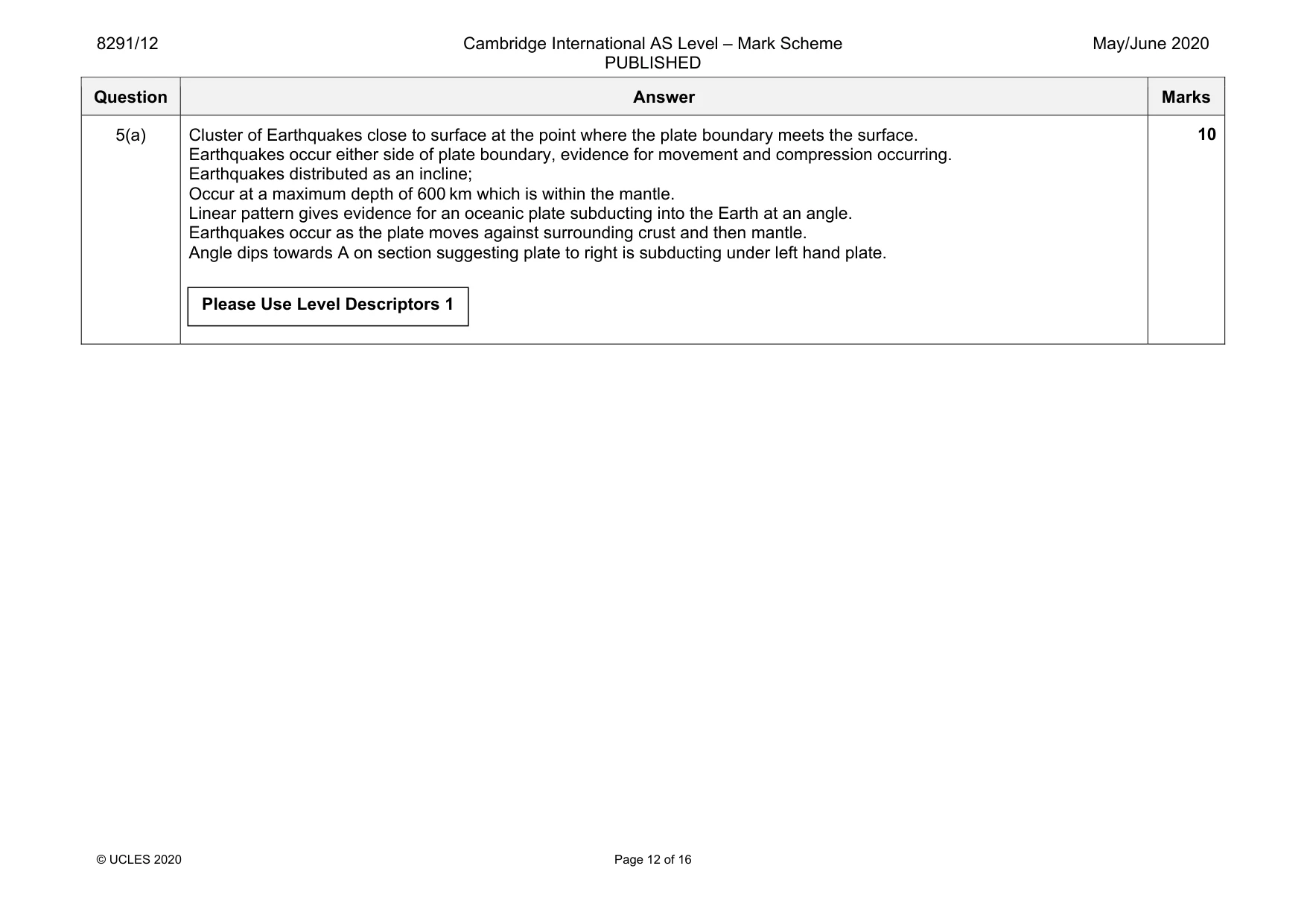
8291/12 Cambridge International AS Level – Mark Scheme PUBLISHED May/June 2020 © UCLES 2020 Page 12 of 16 Question Answer Marks 5(a) Cluster of Earthquakes close to surface at the point where the plate boundary meets the surface. Earthquakes occur either side of plate boundary, evidence for movement and compression occurring. Earthquakes distributed as an incline; Occur at a maximum depth of 600 km which is within the mantle. Linear pattern gives evidence for an oceanic plate subducting into the Earth at an angle. Earthquakes occur as the plate moves against surrounding crust and then mantle. Angle dips towards A on section suggesting plate to right is subducting under left hand plate. 10 Please Use Level Descriptors 1
Mark scheme, page 13
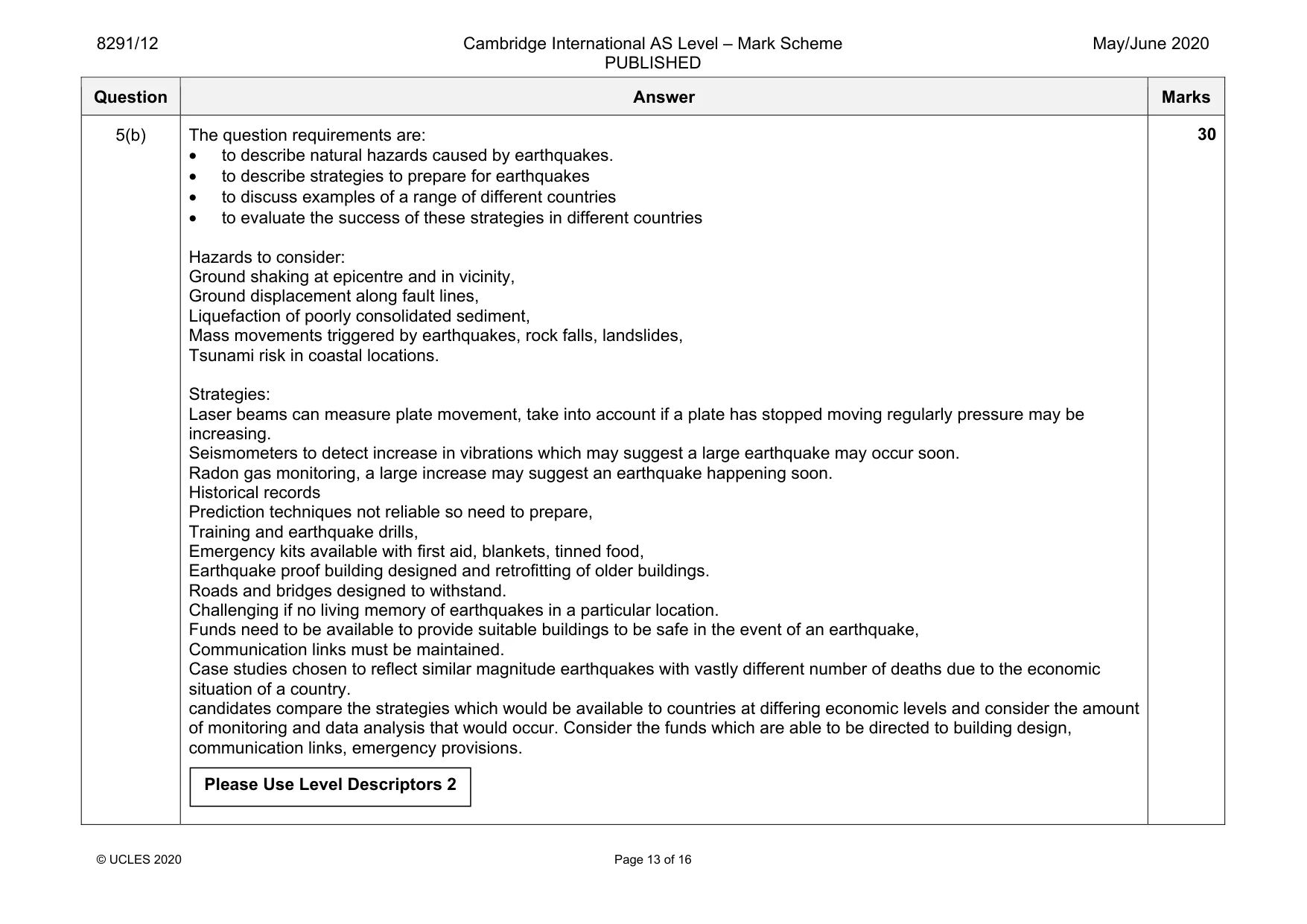
8291/12 Cambridge International AS Level – Mark Scheme PUBLISHED May/June 2020 © UCLES 2020 Page 13 of 16 Question Answer Marks 5(b) The question requirements are: • to describe natural hazards caused by earthquakes. • to describe strategies to prepare for earthquakes • to discuss examples of a range of different countries • to evaluate the success of these strategies in different countries Hazards to consider: Ground shaking at epicentre and in vicinity, Ground displacement along fault lines, Liquefaction of poorly consolidated sediment, Mass movements triggered by earthquakes, rock falls, landslides, Tsunami risk in coastal locations. Strategies: Laser beams can measure plate movement, take into account if a plate has stopped moving regularly pressure may be increasing. Seismometers to detect increase in vibrations which may suggest a large earthquake may occur soon. Radon gas monitoring, a large increase may suggest an earthquake happening soon. Historical records Prediction techniques not reliable so need to prepare, Training and earthquake drills, Emergency kits available with first aid, blankets, tinned food, Earthquake proof building designed and retrofitting of older buildings. Roads and bridges designed to withstand. Challenging if no living memory of earthquakes in a particular location. Funds need to be available to provide suitable buildings to be safe in the event of an earthquake, Communication links must be maintained. Case studies chosen to reflect similar magnitude earthquakes with vastly different number of deaths due to the economic situation of a country. candidates compare the strategies which would be available to countries at differing economic levels and consider the amount of monitoring and data analysis that would occur. Consider the funds which are able to be directed to building design, communication links, emergency provisions. 30 Please Use Level Descriptors 2
Mark scheme, page 14
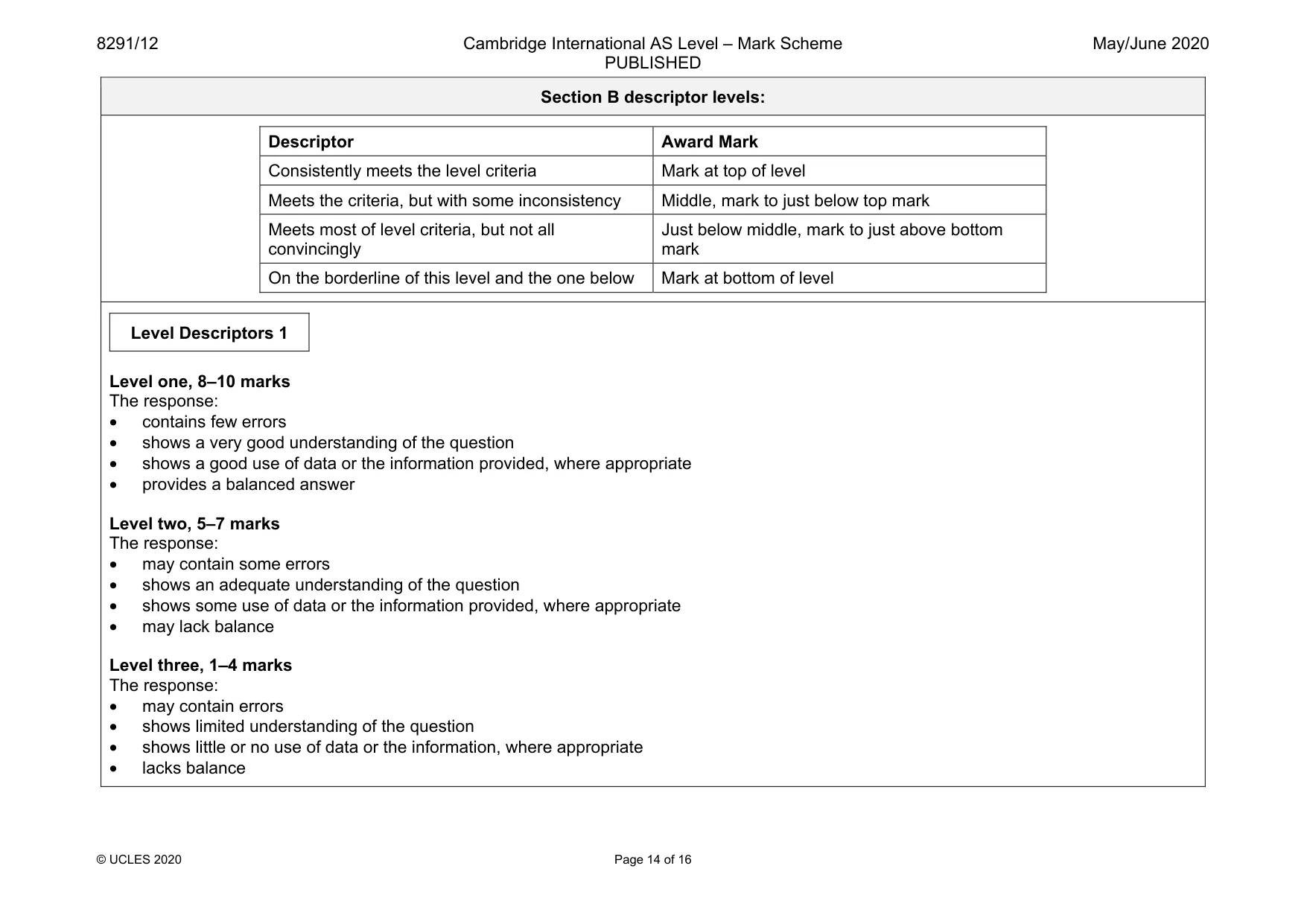
8291/12 Cambridge International AS Level – Mark Scheme PUBLISHED May/June 2020 © UCLES 2020 Page 14 of 16 Section B descriptor levels: Descriptor Award Mark Consistently meets the level criteria Mark at top of level Meets the criteria, but with some inconsistency Middle, mark to just below top mark Meets most of level criteria, but not all convincingly Just below middle, mark to just above bottom mark On the borderline of this level and the one below Mark at bottom of level Level Descriptors 1 Level one, 8–10 marks The response: • contains few errors • shows a very good understanding of the question • shows a good use of data or the information provided, where appropriate • provides a balanced answer Level two, 5–7 marks The response: • may contain some errors • shows an adequate understanding of the question • shows some use of data or the information provided, where appropriate • may lack balance Level three, 1–4 marks The response: • may contain errors • shows limited understanding of the question • shows little or no use of data or the information, where appropriate • lacks balance
Mark scheme, page 15
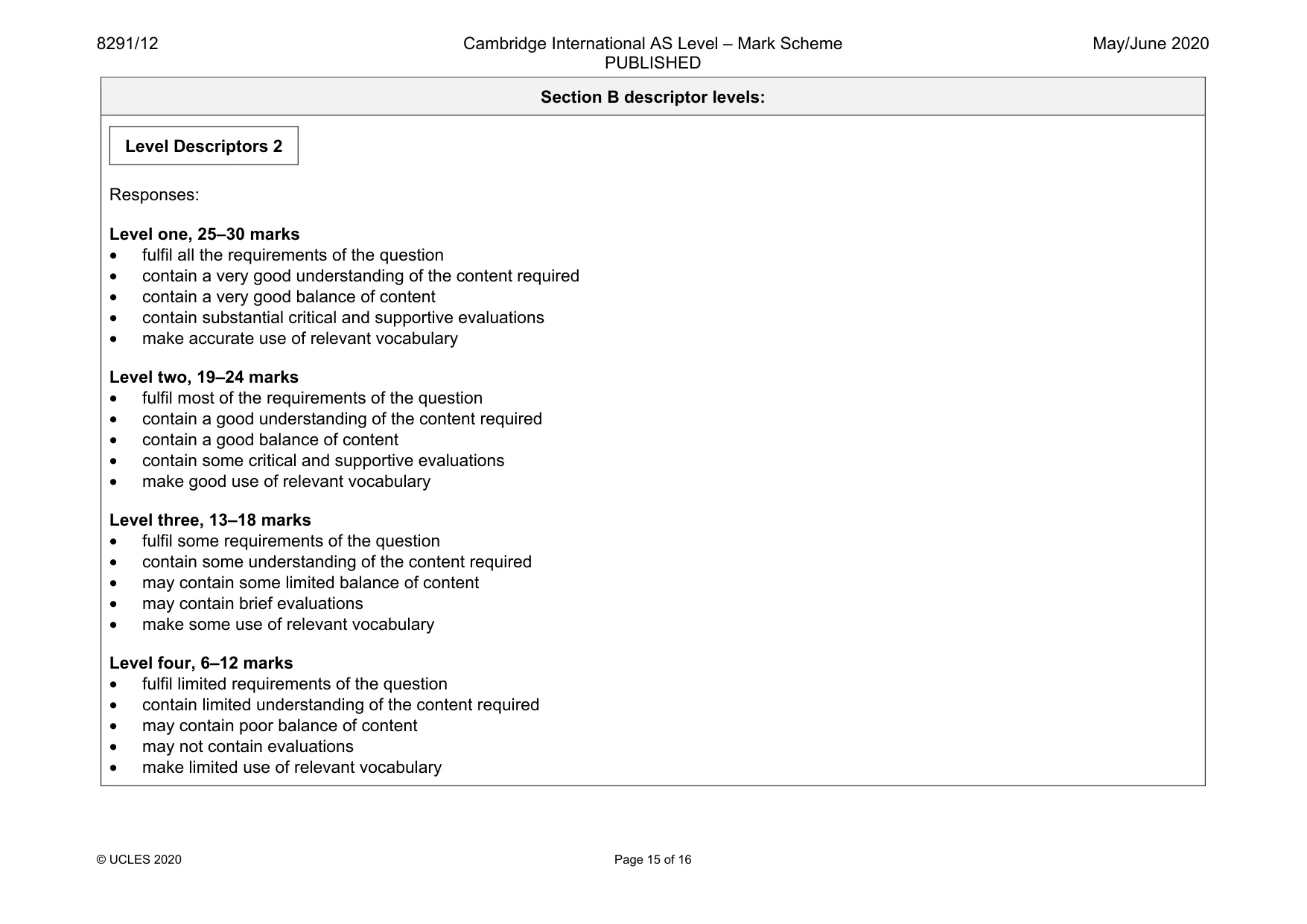
8291/12 Cambridge International AS Level – Mark Scheme PUBLISHED May/June 2020 © UCLES 2020 Page 15 of 16 Section B descriptor levels: Level Descriptors 2 Responses: Level one, 25–30 marks • fulfil all the requirements of the question • contain a very good understanding of the content required • contain a very good balance of content • contain substantial critical and supportive evaluations • make accurate use of relevant vocabulary Level two, 19–24 marks • fulfil most of the requirements of the question • contain a good understanding of the content required • contain a good balance of content • contain some critical and supportive evaluations • make good use of relevant vocabulary Level three, 13–18 marks • fulfil some requirements of the question • contain some understanding of the content required • may contain some limited balance of content • may contain brief evaluations • make some use of relevant vocabulary Level four, 6–12 marks • fulfil limited requirements of the question • contain limited understanding of the content required • may contain poor balance of content • may not contain evaluations • make limited use of relevant vocabulary
Mark scheme, page 16
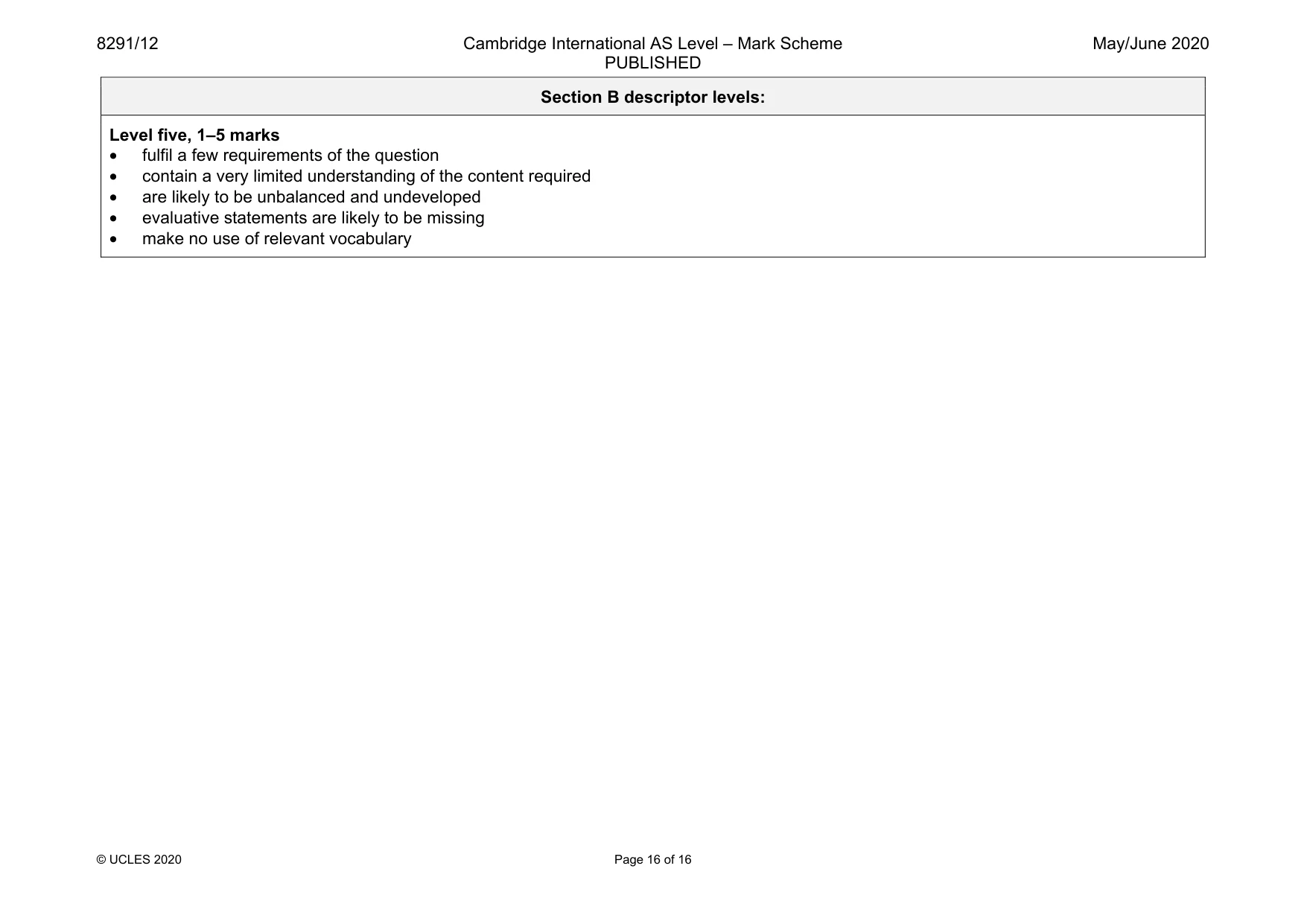
8291/12 Cambridge International AS Level – Mark Scheme PUBLISHED May/June 2020 © UCLES 2020 Page 16 of 16 Section B descriptor levels: Level five, 1–5 marks • fulfil a few requirements of the question • contain a very limited understanding of the content required • are likely to be unbalanced and undeveloped • evaluative statements are likely to be missing • make no use of relevant vocabulary