Cambridge A Level Environmental Management (AS only) 8291 — 2015 Oct/Nov Paper 1 · Variant 1
8291/11/O/N/15 · 80 marks · ≈90 min
The question paper and its mark scheme, free to read here and free to download. This is Cambridge’s own paper, exactly as it was sat.
Question paper12 pages


Mark scheme9 pages
Answers below. Sit the paper first if you are practising.
Paper as text
Question paper, page 1
This document consists of 10 printed pages and 2 blank pages. DC (LEG/SG) 97987/5 © UCLES 2015 [Turn over Cambridge International Examinations Cambridge International Advanced Subsidiary Level * 0 8 8 7 0 0 3 9 2 7 * ENVIRONMENTAL MANAGEMENT 8291/11 Paper 1 Lithosphere and Atmosphere October/November 2015 1 hour 30 minutes Additional Materials: Answer Booklet/Paper READ THESE INSTRUCTIONS FIRST Write your Centre number, candidate number and name on all the work you hand in. Write in dark blue or black pen. You may use an HB pencil for any diagrams or graphs. Do not use staples, paper clips, glue or correction fluid. DO NOT WRITE IN ANY BARCODES. Electronic calculators may be used. You may lose marks if you do not show your working or if you do not use appropriate units. Section A Answer all questions. Write your answers in the spaces provided on the question paper. Section B Answer one question from this section. Answer the question on the separate answer paper provided. At the end of the examination, 1. fasten all separate answer paper securely to the question paper; 2. enter the question number from Section B in the grid opposite. For Examiner’s Use Section A 1 2 Section B Total
Question paper, page 2
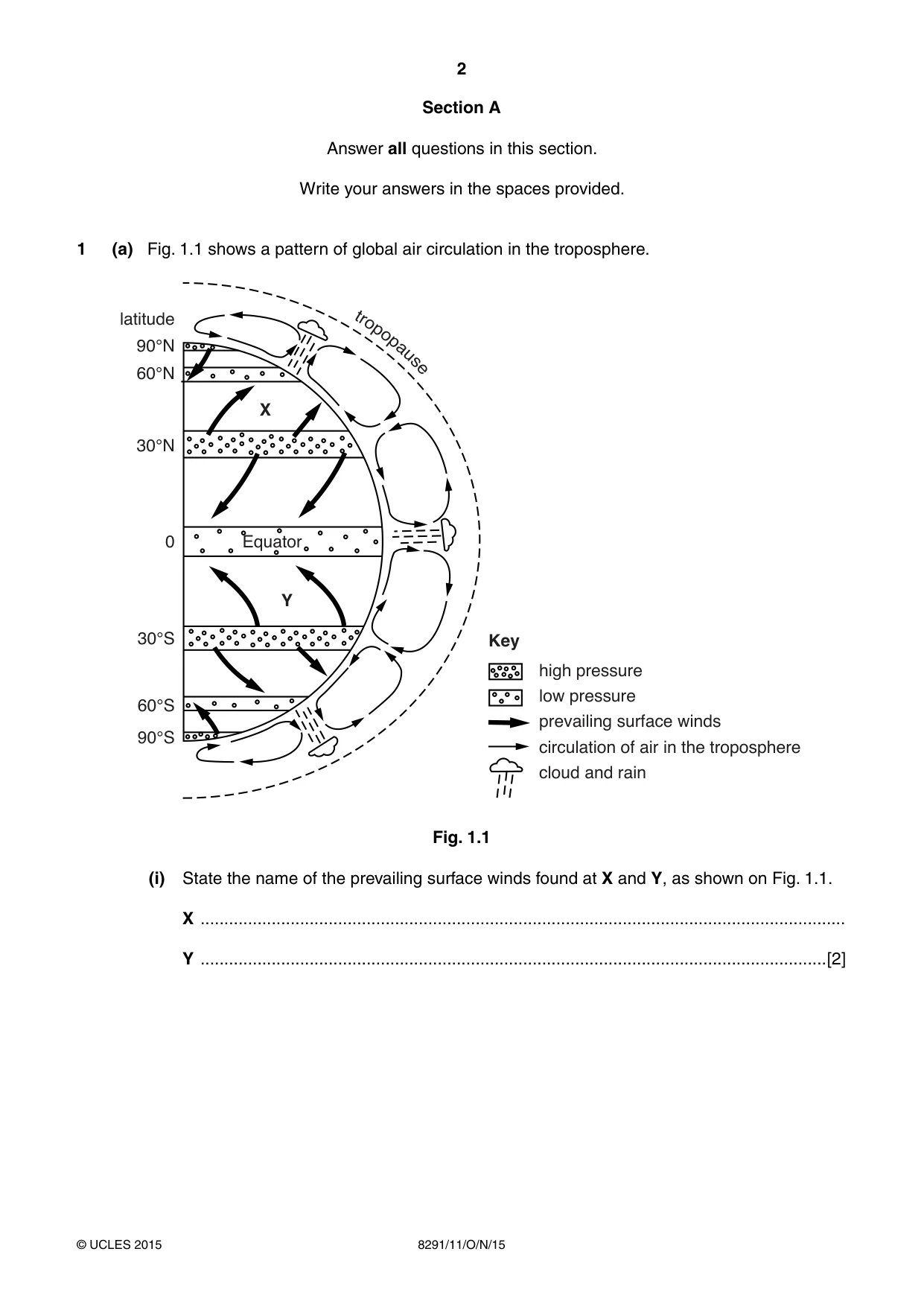
2 8291/11/O/N/15 © UCLES 2015 Section A Answer all questions in this section. Write your answers in the spaces provided. 1 (a) Fig. 1.1 shows a pattern of global air circulation in the troposphere. tro po pa us e latitude 90°N 60°N 30°N 0 30°S 60°S 90°S Equator Key high pressure low pressure prevailing surface winds circulation of air in the troposphere cloud and rain X Y Fig. 1.1 (i) State the name of the prevailing surface winds found at X and Y, as shown on Fig. 1.1. X … Y …[2]
Question paper, page 3
3 8291/11/O/N/15 © UCLES 2015 [Turn over (ii) Describe two factors that influence the direction of prevailing surface winds as shown in Fig. 1.1. … … … … … … … …[4] (iii) With reference to Fig. 1.1, explain why cloud and rain often occur at the Equator. … … … … … …[3] (iv) With reference to Fig. 1.1, explain why the areas around 30 °N and 30 °S are prone to drought. … … … … … … … …[4]
Question paper, page 4
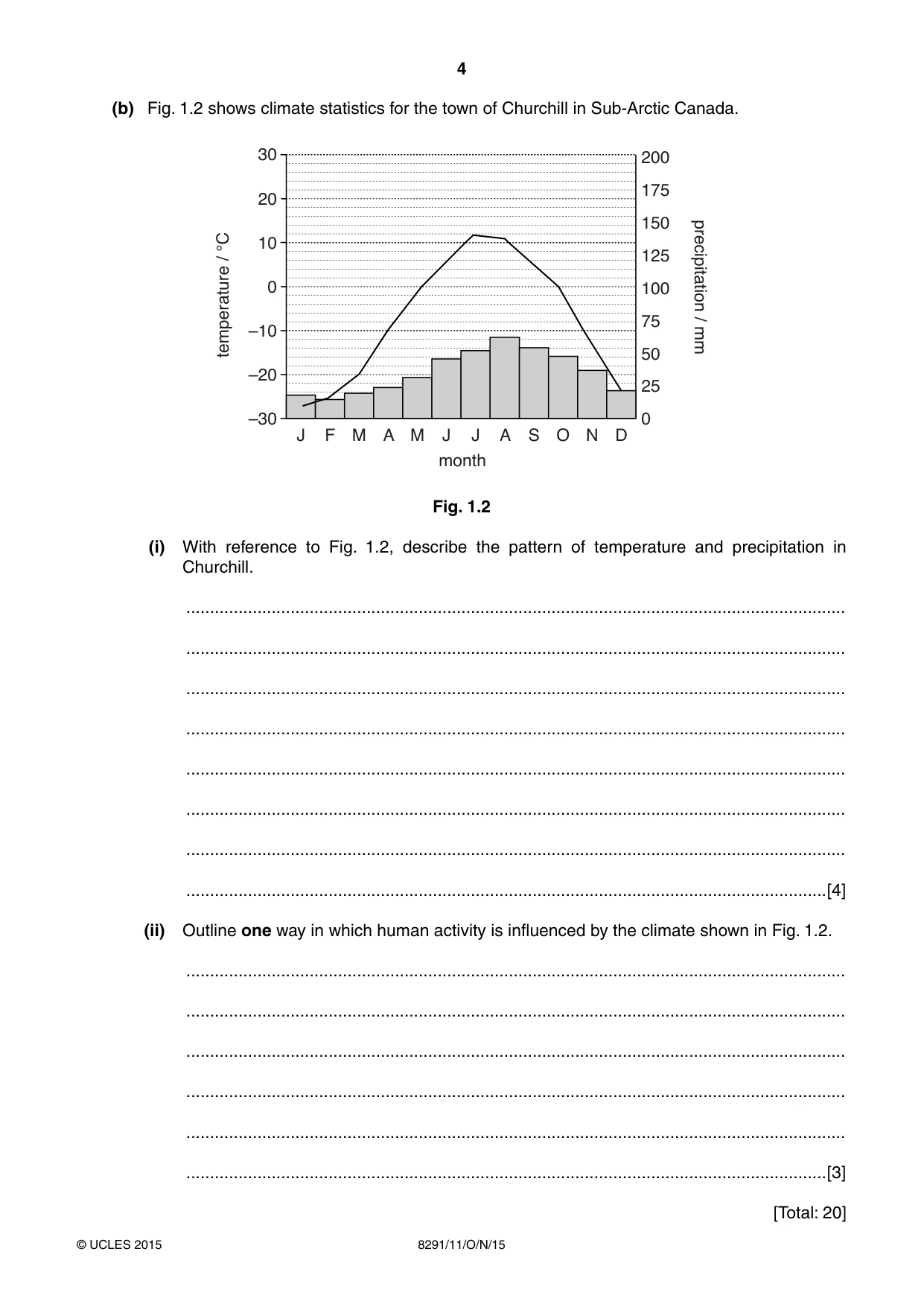
4 8291/11/O/N/15 © UCLES 2015 (b) Fig. 1.2 shows climate statistics for the town of Churchill in Sub-Arctic Canada. J F M A M J J A S O N D month 30 200 175 150 125 100 75 50 25 0 20 10 0 –10 –20 –30 temperature / °C precipitation / mm Fig. 1.2 (i) With reference to Fig. 1.2, describe the pattern of temperature and precipitation in Churchill. … … … … … … … …[4] (ii) Outline one way in which human activity is influenced by the climate shown in Fig. 1.2. … … … … … …[3] [Total: 20]
Question paper, page 5
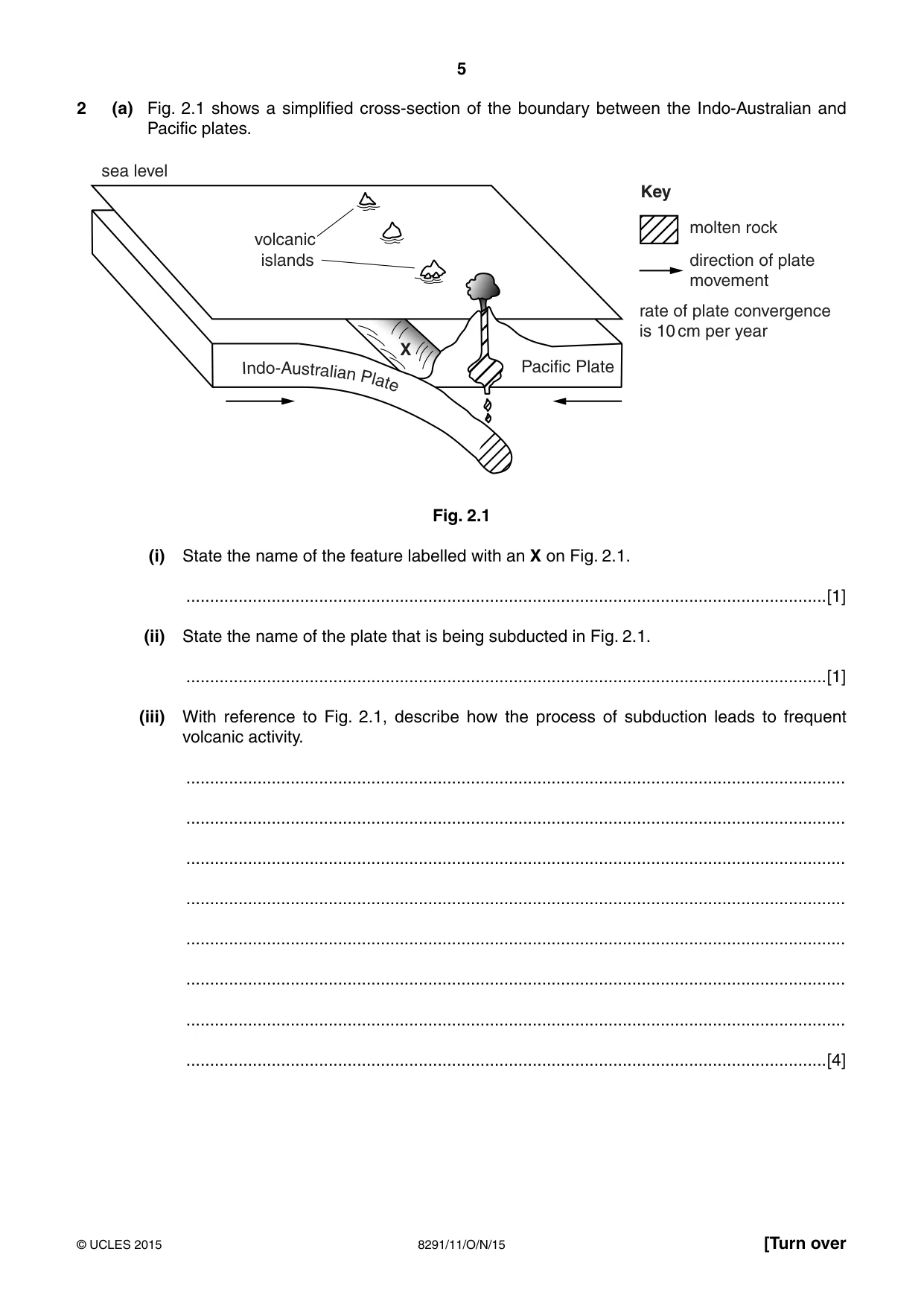
5 8291/11/O/N/15 © UCLES 2015 [Turn over 2 (a) Fig. 2.1 shows a simplified cross-section of the boundary between the Indo-Australian and Pacific plates. Indo -Aus tral ian P la t e sea level volcanic islands Pacific Plate X Key molten rock direction of plate movement rate of plate convergence is 10 cm per year Fig. 2.1 (i) State the name of the feature labelled with an X on Fig. 2.1. …[1] (ii) State the name of the plate that is being subducted in Fig. 2.1. …[1] (iii) With reference to Fig. 2.1, describe how the process of subduction leads to frequent volcanic activity. … … … … … … … …[4]
Question paper, page 6
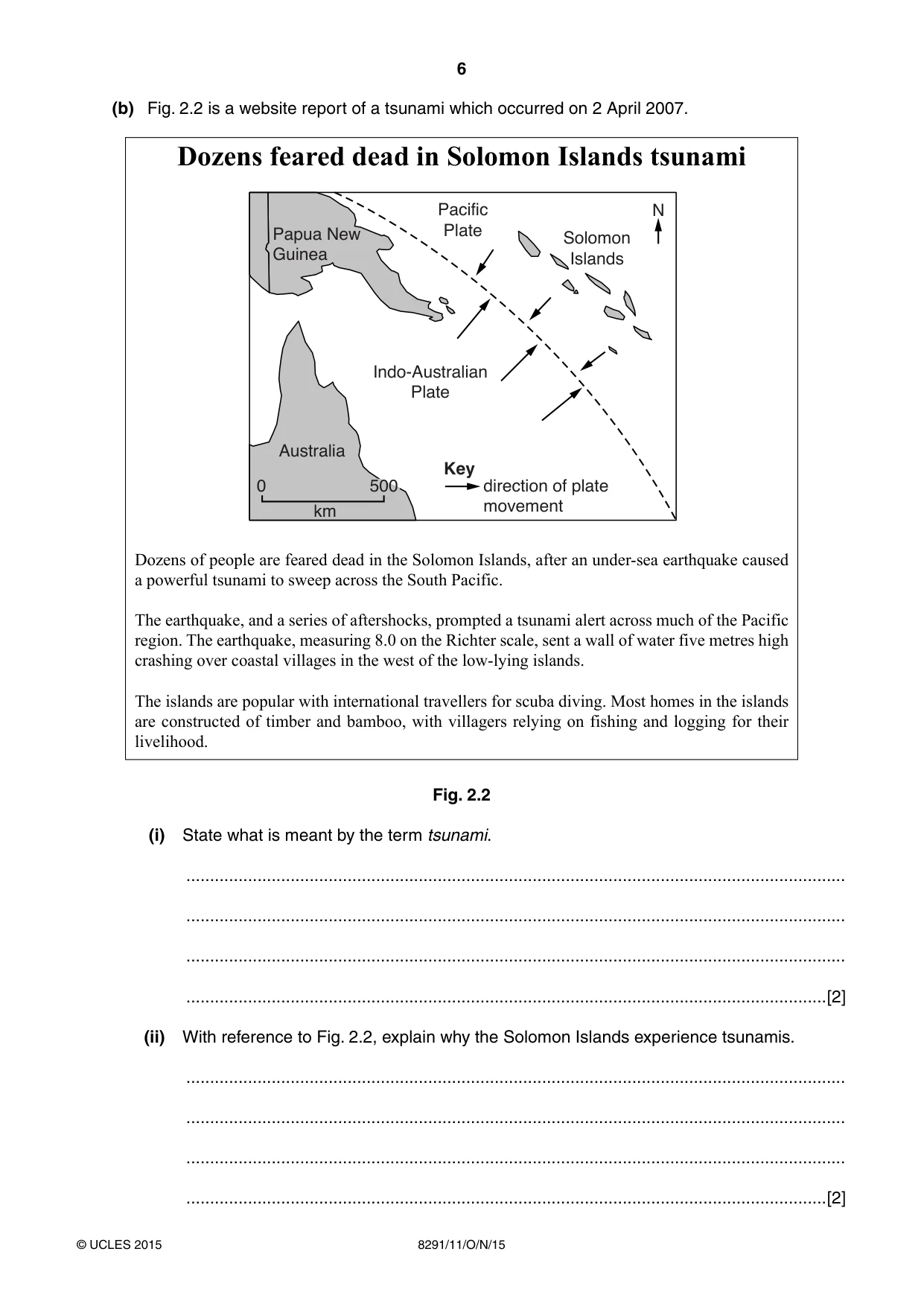
6 8291/11/O/N/15 © UCLES 2015 (b) Fig. 2.2 is a website report of a tsunami which occurred on 2 April 2007. Dozens feared dead in Solomon Islands tsunami Papua New Guinea Australia Indo-Australian Plate Pacific Plate Solomon Islands 0 km N Key direction of plate movement 500 Dozens of people are feared dead in the Solomon Islands, after an under-sea earthquake caused a powerful tsunami to sweep across the South Pacific. The earthquake, and a series of aftershocks, prompted a tsunami alert across much of the Pacific region. The earthquake, measuring 8.0 on the Richter scale, sent a wall of water five metres high crashing over coastal villages in the west of the low-lying islands. The islands are popular with international travellers for scuba diving. Most homes in the islands are constructed of timber and bamboo, with villagers relying on fishing and logging for their livelihood. Fig. 2.2 (i) State what is meant by the term tsunami. … … … …[2] (ii) With reference to Fig. 2.2, explain why the Solomon Islands experience tsunamis. … … … …[2]
Question paper, page 7
7 8291/11/O/N/15 © UCLES 2015 [Turn over (iii) With reference to Fig. 2.2, describe the possible short and long term effects of the tsunami on the Solomon islanders. … … … … … … … … … … … …[6] (iv) With reference to Fig. 2.2, assess the extent to which the Solomon Islands can be protected against the threat of tsunami. … … … … … … … …[4] [Total: 20]
Question paper, page 8
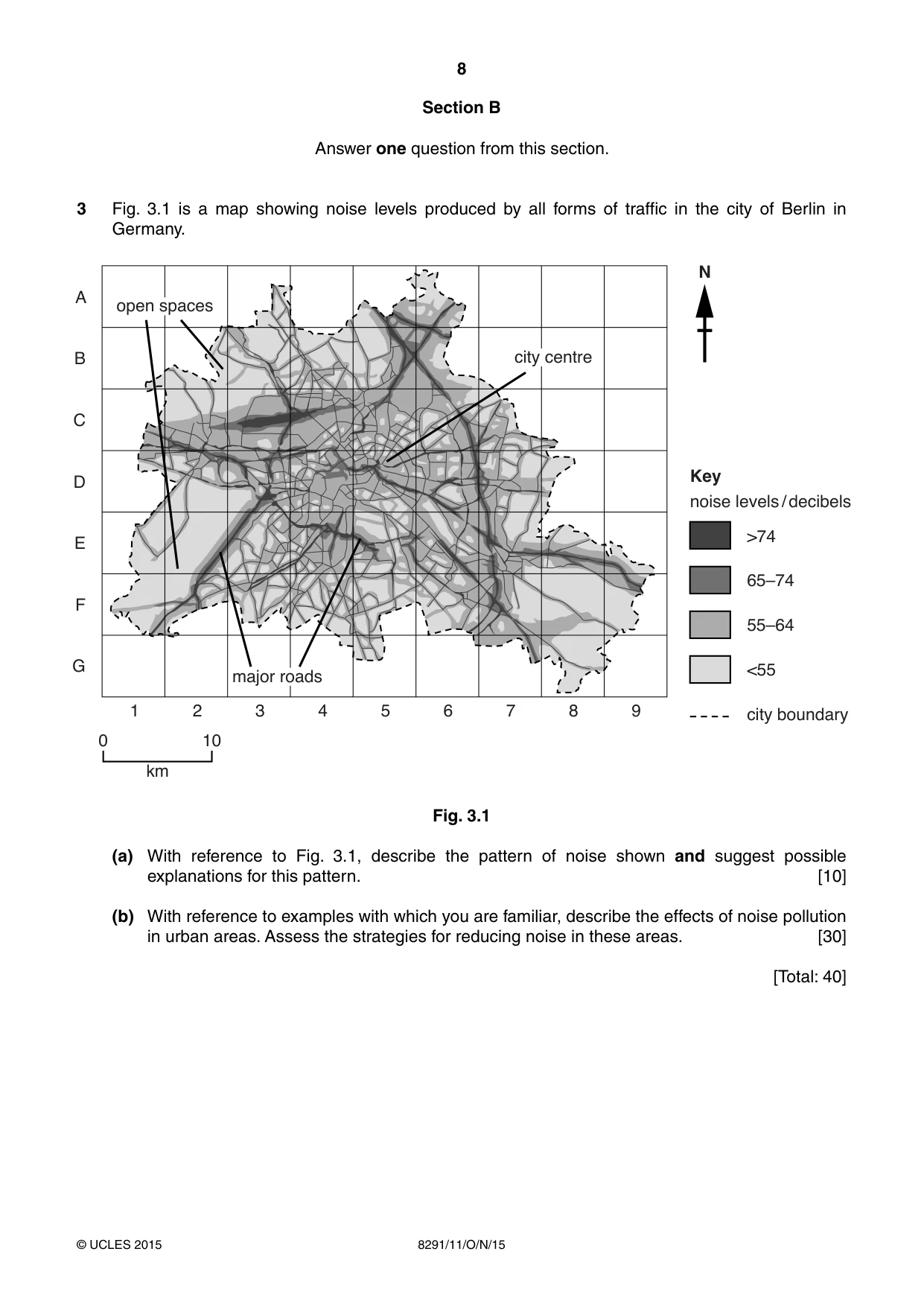
8 8291/11/O/N/15 © UCLES 2015 Section B Answer one question from this section. 3 Fig. 3.1 is a map showing noise levels produced by all forms of traffic in the city of Berlin in Germany. 1 2 3 4 5 6 7 8 9 A B C D E F G 0 10 km N Key noise levels / decibels >74 65–74 55–64 <55 city boundary open spaces major roads city centre Fig. 3.1 (a) With reference to Fig. 3.1, describe the pattern of noise shown and suggest possible explanations for this pattern. [10] (b) With reference to examples with which you are familiar, describe the effects of noise pollution in urban areas. Assess the strategies for reducing noise in these areas. [30] [Total: 40]
Question paper, page 9
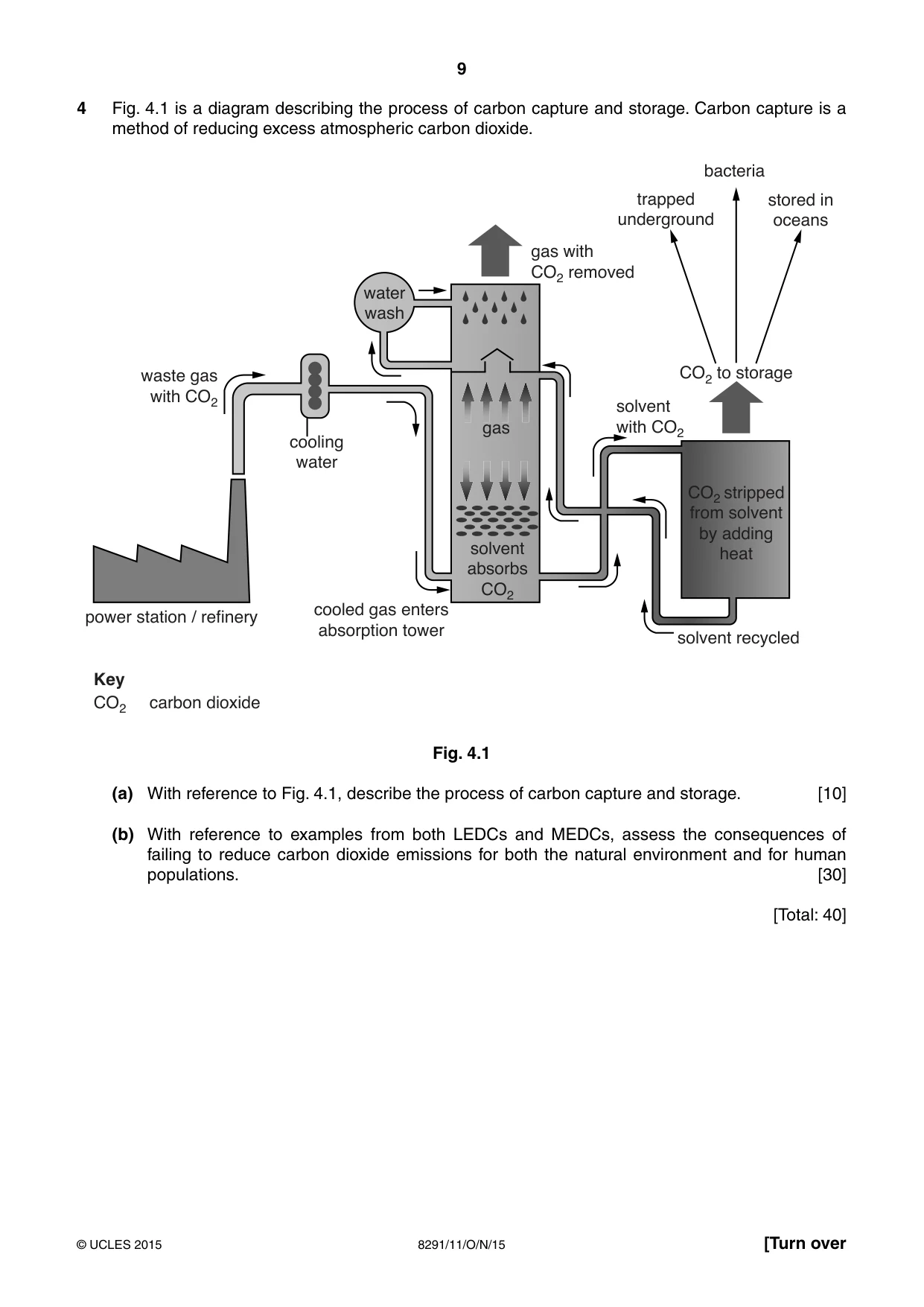
9 8291/11/O/N/15 © UCLES 2015 [Turn over 4 Fig. 4.1 is a diagram describing the process of carbon capture and storage. Carbon capture is a method of reducing excess atmospheric carbon dioxide. bacteria stored in oceans trapped underground CO2 to storage gas with CO2 removed solvent with CO2 solvent recycled solvent absorbs CO2 CO2 stripped from solvent by adding heat gas water wash cooled gas enters absorption tower cooling water waste gas with CO2 power station / refinery Key CO2 carbon dioxide Fig. 4.1 (a) With reference to Fig. 4.1, describe the process of carbon capture and storage. [10] (b) With reference to examples from both LEDCs and MEDCs, assess the consequences of failing to reduce carbon dioxide emissions for both the natural environment and for human populations. [30] [Total: 40]
Question paper, page 10
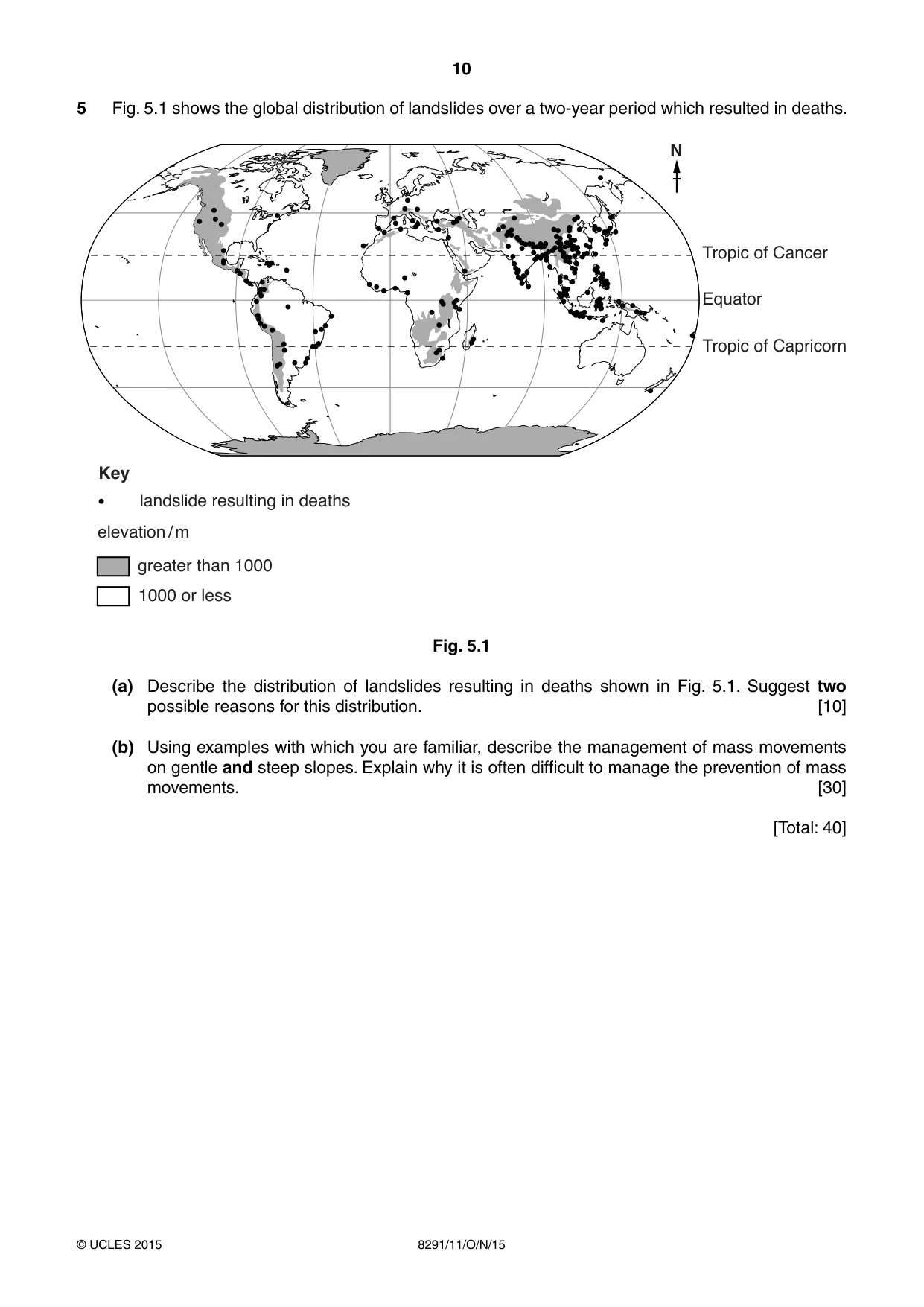
10 8291/11/O/N/15 © UCLES 2015 5 Fig. 5.1 shows the global distribution of landslides over a two-year period which resulted in deaths. Tropic of Cancer Tropic of Capricorn Equator N Key landslide resulting in deaths greater than 1000 1000 or less elevation / m Fig. 5.1 (a) Describe the distribution of landslides resulting in deaths shown in Fig. 5.1. Suggest two possible reasons for this distribution. [10] (b) Using examples with which you are familiar, describe the management of mass movements on gentle and steep slopes. Explain why it is often difficult to manage the prevention of mass movements. [30] [Total: 40]
Question paper, page 11
11 8291/11/O/N/15 © UCLES 2015 BLANK PAGE
Question paper, page 12
12 8291/11/O/N/15 © UCLES 2015 Permission to reproduce items where third-party owned material protected by copyright is included has been sought and cleared where possible. Every reasonable effort has been made by the publisher (UCLES) to trace copyright holders, but if any items requiring clearance have unwittingly been included, the publisher will be pleased to make amends at the earliest possible opportunity. To avoid the issue of disclosure of answer-related information to candidates, all copyright acknowledgements are reproduced online in the Cambridge International Examinations Copyright Acknowledgements Booklet. This is produced for each series of examinations and is freely available to download at www.cie.org.uk after the live examination series. Cambridge International Examinations is part of the Cambridge Assessment Group. Cambridge Assessment is the brand name of University of Cambridge Local Examinations Syndicate (UCLES), which is itself a department of the University of Cambridge. BLANK PAGE
Mark scheme, page 1
® IGCSE is the registered trademark of Cambridge International Examinations. CAMBRIDGE INTERNATIONAL EXAMINATIONS Cambridge International Advanced Subsidiary Level MARK SCHEME for the October/November 2015 series 8291 ENVIRONMENTAL MANAGEMENT 8291/11 Paper 1, maximum raw mark 80 This mark scheme is published as an aid to teachers and candidates, to indicate the requirements of the examination. It shows the basis on which Examiners were instructed to award marks. It does not indicate the details of the discussions that took place at an Examiners’ meeting before marking began, which would have considered the acceptability of alternative answers. Mark schemes should be read in conjunction with the question paper and the Principal Examiner Report for Teachers. Cambridge will not enter into discussions about these mark schemes. Cambridge is publishing the mark schemes for the October/November 2015 series for most Cambridge IGCSE®, Cambridge International A and AS Level components and some Cambridge O Level components.
Mark scheme, page 2
Page 2 Mark Scheme Syllabus Paper Cambridge International AS Level – October/November 2015 8291 11 © Cambridge International Examinations 2015 General notes Symbols used in Environmental Management mark schemes. / separates alternatives for a marking point – other valid ways of expressing the same idea are also credited ; separates points for the award of a mark [3] indicates the number of marks available italic indicates that this is information about the marking points and is not required to gain credit italic text is also used for comments about alternatives that should be accepted, ignored or rejected ora or reverse argument – shows that an argument from an alternative viewpoint will be credited AW alternative wording, sometimes called ‘or words to that effect’ – AW is used when there are many different ways of expressing the same idea ( ) the word / phrase in brackets is not required to gain marks but sets the context of the response for credit e.g. (nuclear) waste – nuclear is not needed but if it was described as a domestic waste then no mark is awarded volcanic underlined words – the answer must contain exactly this word ecf error carried forward – if an incorrect answer is given to part of a question, and this answer is subsequently used by a candidate in later parts of the question, this indicates that the candidate’s incorrect answer will be used as a starting point for marking the later parts of the question
Mark scheme, page 3
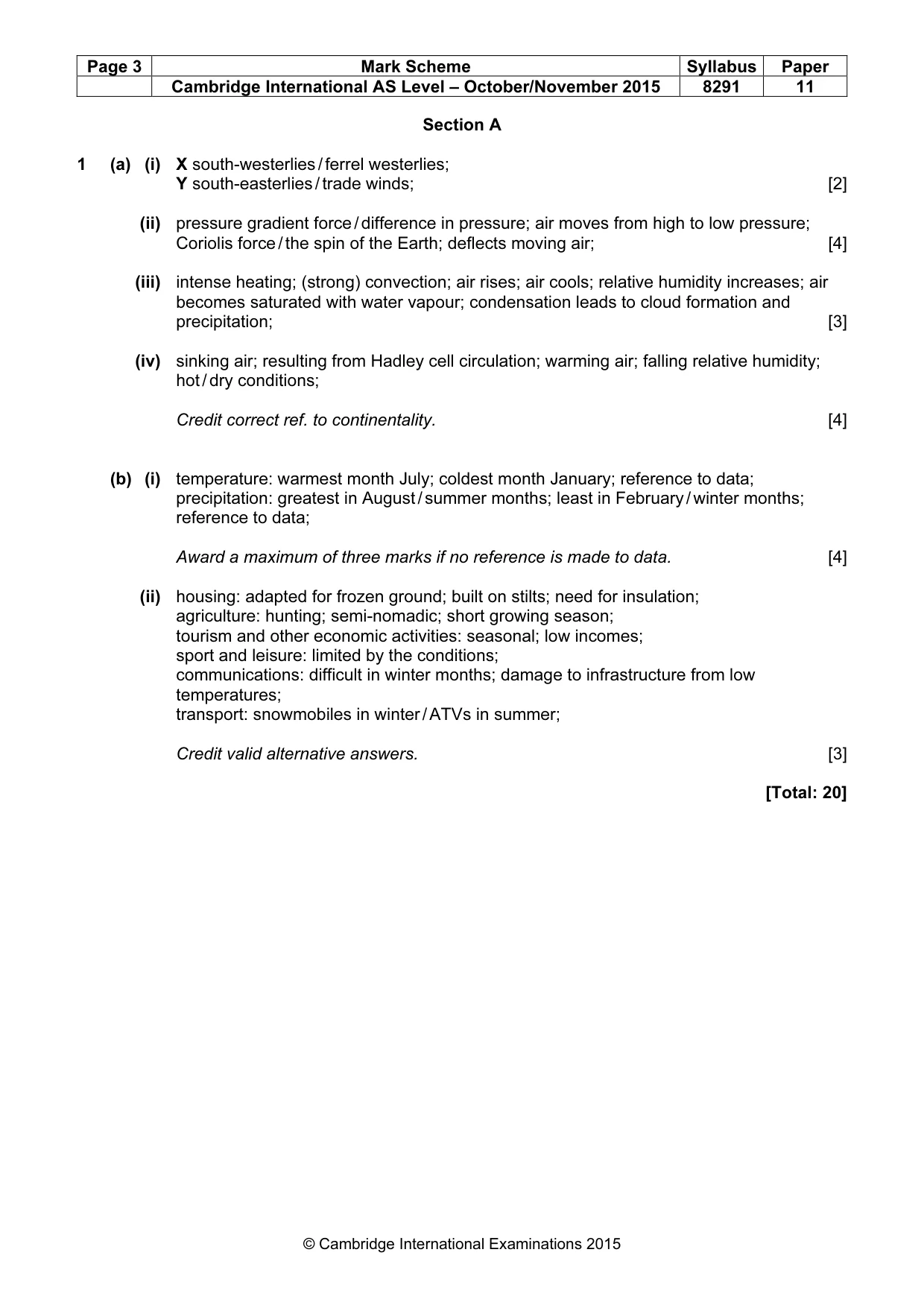
Page 3 Mark Scheme Syllabus Paper Cambridge International AS Level – October/November 2015 8291 11 © Cambridge International Examinations 2015 Section A 1 (a) (i) X south-westerlies / ferrel westerlies; Y south-easterlies / trade winds; [2] (ii) pressure gradient force / difference in pressure; air moves from high to low pressure; Coriolis force / the spin of the Earth; deflects moving air; [4] (iii) intense heating; (strong) convection; air rises; air cools; relative humidity increases; air becomes saturated with water vapour; condensation leads to cloud formation and precipitation; [3] (iv) sinking air; resulting from Hadley cell circulation; warming air; falling relative humidity; hot / dry conditions; Credit correct ref. to continentality. [4] (b) (i) temperature: warmest month July; coldest month January; reference to data; precipitation: greatest in August / summer months; least in February / winter months; reference to data; Award a maximum of three marks if no reference is made to data. [4] (ii) housing: adapted for frozen ground; built on stilts; need for insulation; agriculture: hunting; semi-nomadic; short growing season; tourism and other economic activities: seasonal; low incomes; sport and leisure: limited by the conditions; communications: difficult in winter months; damage to infrastructure from low temperatures; transport: snowmobiles in winter / ATVs in summer; Credit valid alternative answers. [3] [Total: 20]
Mark scheme, page 4
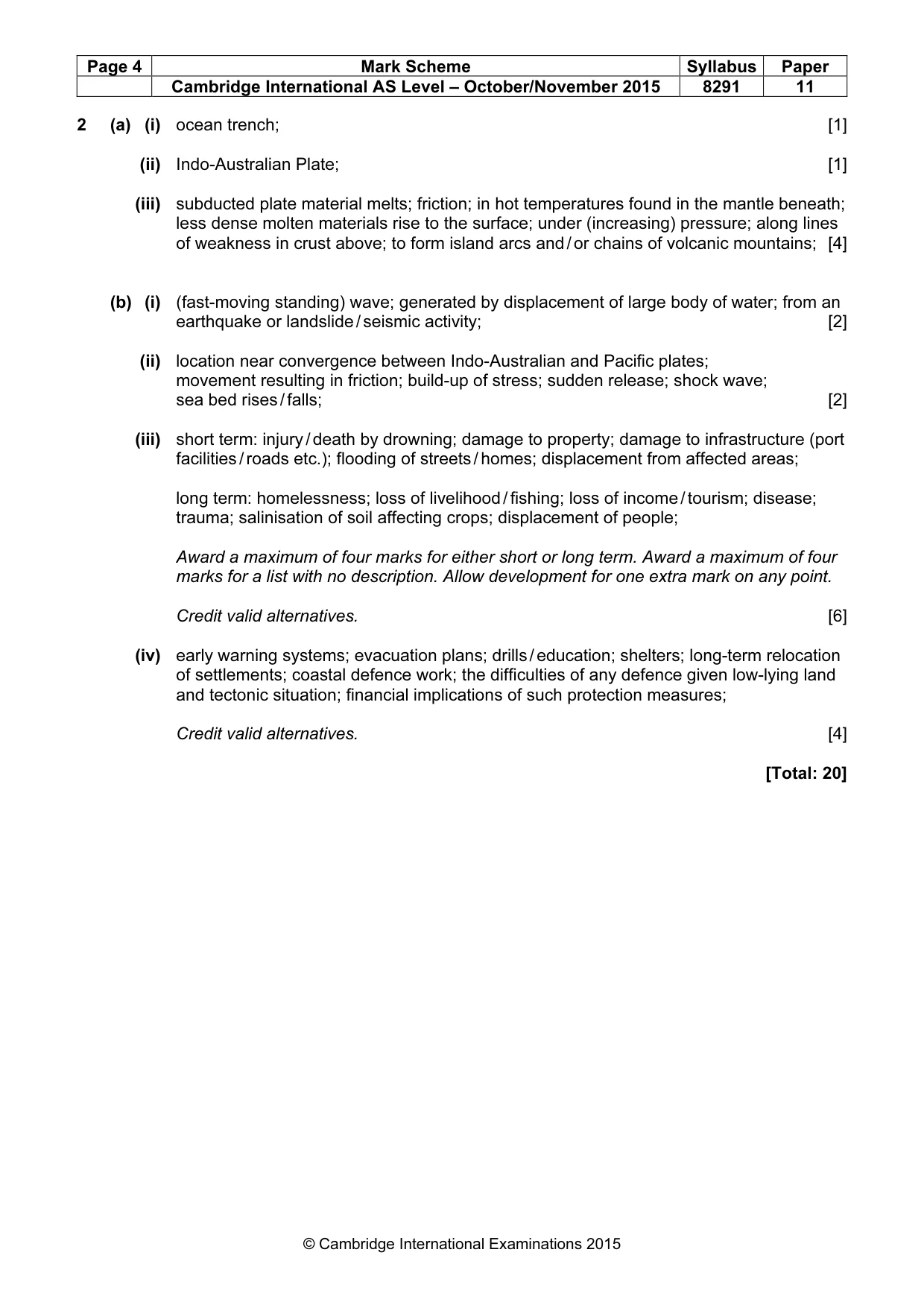
Page 4 Mark Scheme Syllabus Paper Cambridge International AS Level – October/November 2015 8291 11 © Cambridge International Examinations 2015 2 (a) (i) ocean trench; [1] (ii) Indo-Australian Plate; [1] (iii) subducted plate material melts; friction; in hot temperatures found in the mantle beneath; less dense molten materials rise to the surface; under (increasing) pressure; along lines of weakness in crust above; to form island arcs and / or chains of volcanic mountains; [4] (b) (i) (fast-moving standing) wave; generated by displacement of large body of water; from an earthquake or landslide / seismic activity; [2] (ii) location near convergence between Indo-Australian and Pacific plates; movement resulting in friction; build-up of stress; sudden release; shock wave; sea bed rises / falls; [2] (iii) short term: injury / death by drowning; damage to property; damage to infrastructure (port facilities / roads etc.); flooding of streets / homes; displacement from affected areas; long term: homelessness; loss of livelihood / fishing; loss of income / tourism; disease; trauma; salinisation of soil affecting crops; displacement of people; Award a maximum of four marks for either short or long term. Award a maximum of four marks for a list with no description. Allow development for one extra mark on any point. Credit valid alternatives. [6] (iv) early warning systems; evacuation plans; drills / education; shelters; long-term relocation of settlements; coastal defence work; the difficulties of any defence given low-lying land and tectonic situation; financial implications of such protection measures; Credit valid alternatives. [4] [Total: 20]
Mark scheme, page 5
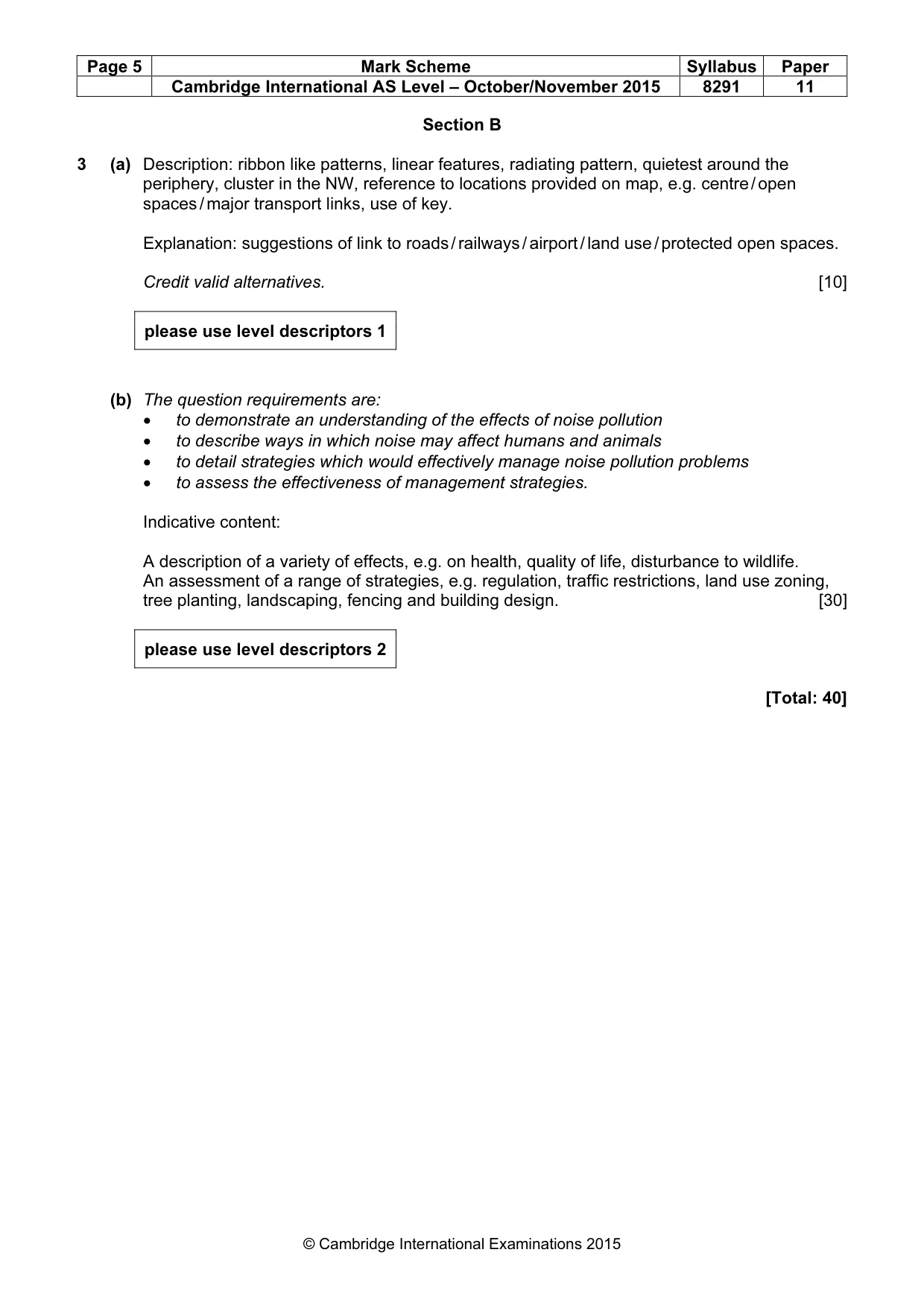
Page 5 Mark Scheme Syllabus Paper Cambridge International AS Level – October/November 2015 8291 11 © Cambridge International Examinations 2015 Section B 3 (a) Description: ribbon like patterns, linear features, radiating pattern, quietest around the periphery, cluster in the NW, reference to locations provided on map, e.g. centre / open spaces / major transport links, use of key. Explanation: suggestions of link to roads / railways / airport / land use / protected open spaces. Credit valid alternatives. [10] please use level descriptors 1 (b) The question requirements are: • to demonstrate an understanding of the effects of noise pollution • to describe ways in which noise may affect humans and animals • to detail strategies which would effectively manage noise pollution problems • to assess the effectiveness of management strategies. Indicative content: A description of a variety of effects, e.g. on health, quality of life, disturbance to wildlife. An assessment of a range of strategies, e.g. regulation, traffic restrictions, land use zoning, tree planting, landscaping, fencing and building design. [30] please use level descriptors 2 [Total: 40]
Mark scheme, page 6
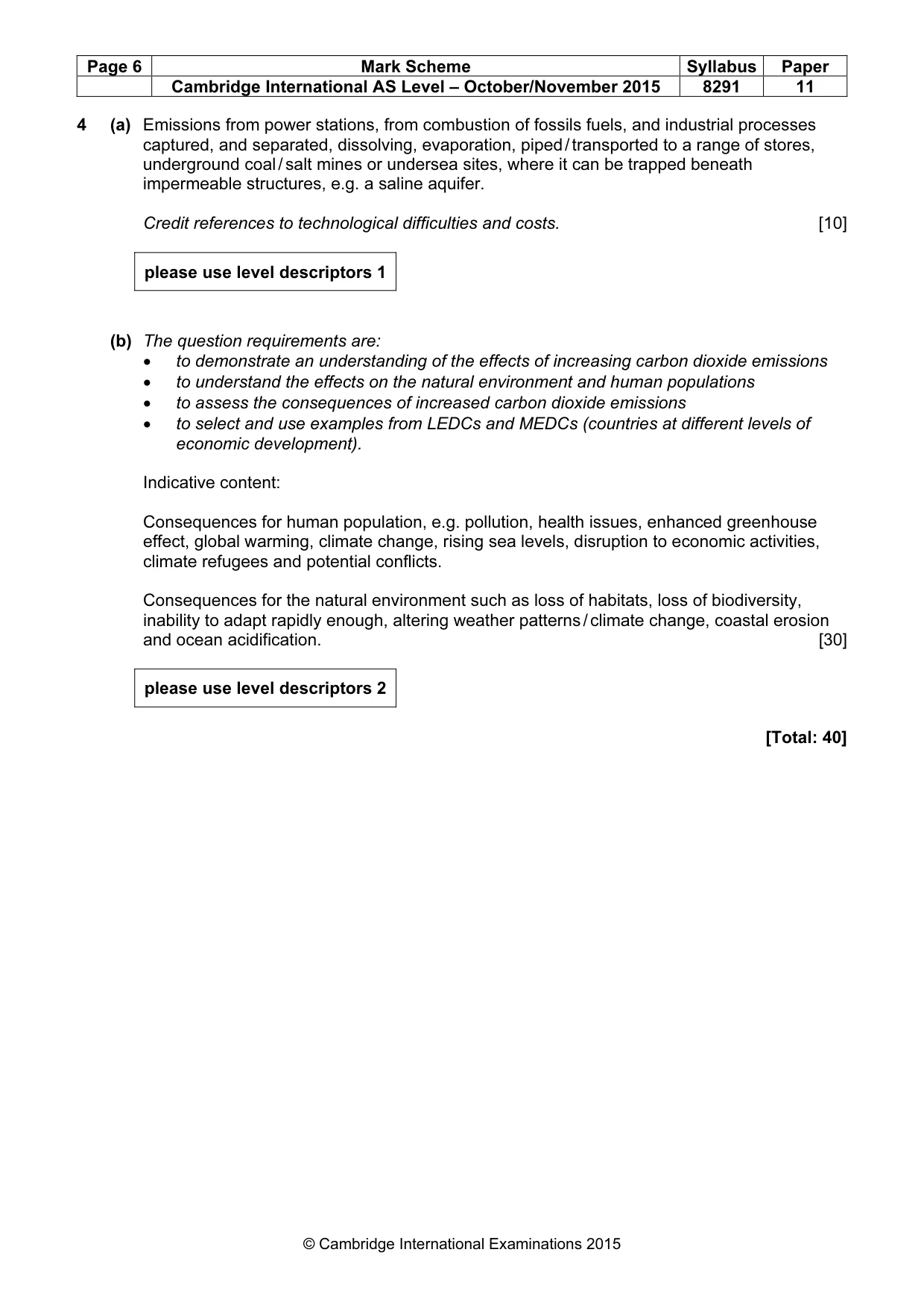
Page 6 Mark Scheme Syllabus Paper Cambridge International AS Level – October/November 2015 8291 11 © Cambridge International Examinations 2015 4 (a) Emissions from power stations, from combustion of fossils fuels, and industrial processes captured, and separated, dissolving, evaporation, piped / transported to a range of stores, underground coal / salt mines or undersea sites, where it can be trapped beneath impermeable structures, e.g. a saline aquifer. Credit references to technological difficulties and costs. [10] please use level descriptors 1 (b) The question requirements are: • to demonstrate an understanding of the effects of increasing carbon dioxide emissions • to understand the effects on the natural environment and human populations • to assess the consequences of increased carbon dioxide emissions • to select and use examples from LEDCs and MEDCs (countries at different levels of economic development). Indicative content: Consequences for human population, e.g. pollution, health issues, enhanced greenhouse effect, global warming, climate change, rising sea levels, disruption to economic activities, climate refugees and potential conflicts. Consequences for the natural environment such as loss of habitats, loss of biodiversity, inability to adapt rapidly enough, altering weather patterns / climate change, coastal erosion and ocean acidification. [30] please use level descriptors 2 [Total: 40]
Mark scheme, page 7
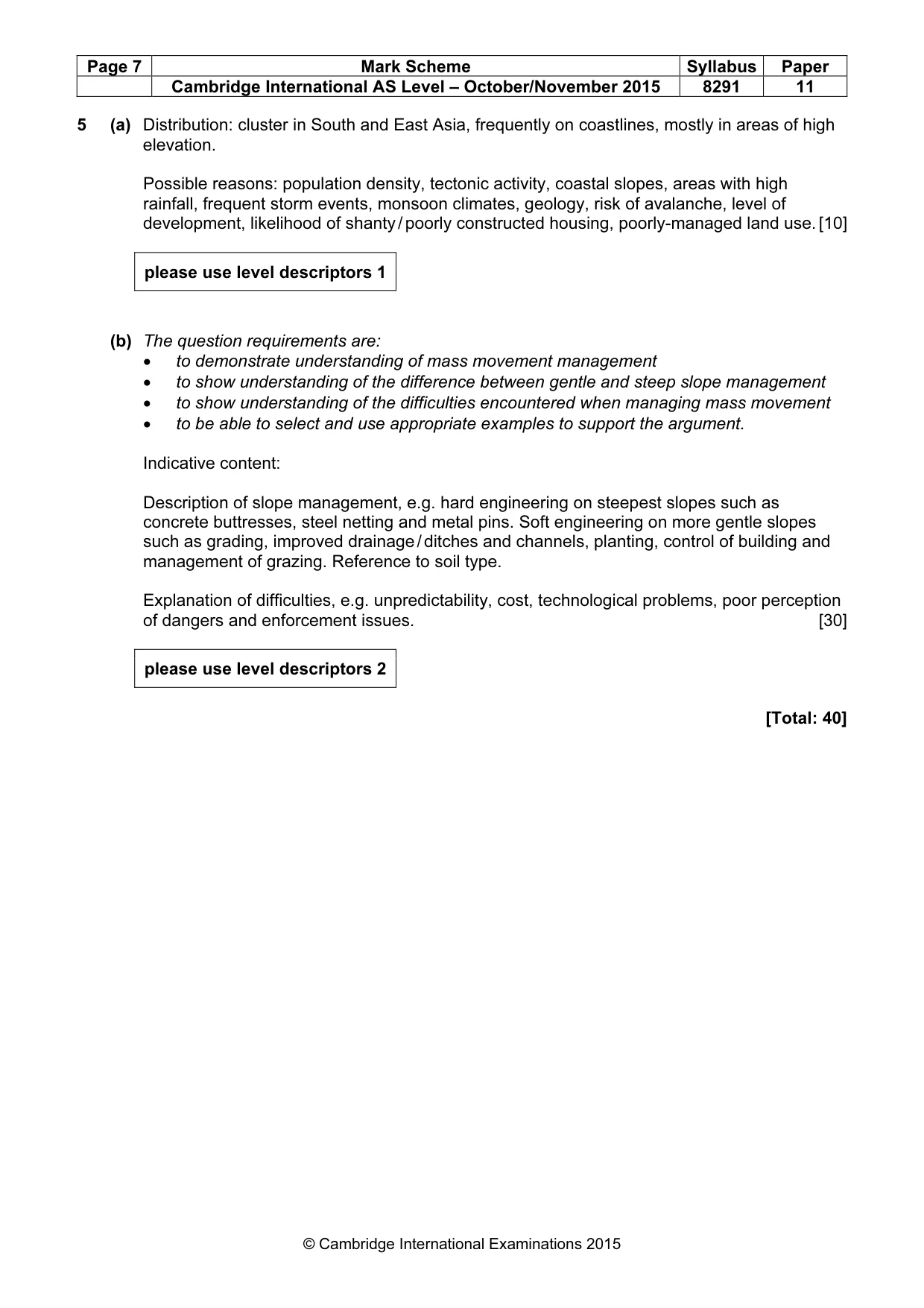
Page 7 Mark Scheme Syllabus Paper Cambridge International AS Level – October/November 2015 8291 11 © Cambridge International Examinations 2015 5 (a) Distribution: cluster in South and East Asia, frequently on coastlines, mostly in areas of high elevation. Possible reasons: population density, tectonic activity, coastal slopes, areas with high rainfall, frequent storm events, monsoon climates, geology, risk of avalanche, level of development, likelihood of shanty / poorly constructed housing, poorly-managed land use. [10] please use level descriptors 1 (b) The question requirements are: • to demonstrate understanding of mass movement management • to show understanding of the difference between gentle and steep slope management • to show understanding of the difficulties encountered when managing mass movement • to be able to select and use appropriate examples to support the argument. Indicative content: Description of slope management, e.g. hard engineering on steepest slopes such as concrete buttresses, steel netting and metal pins. Soft engineering on more gentle slopes such as grading, improved drainage / ditches and channels, planting, control of building and management of grazing. Reference to soil type. Explanation of difficulties, e.g. unpredictability, cost, technological problems, poor perception of dangers and enforcement issues. [30] please use level descriptors 2 [Total: 40]
Mark scheme, page 8
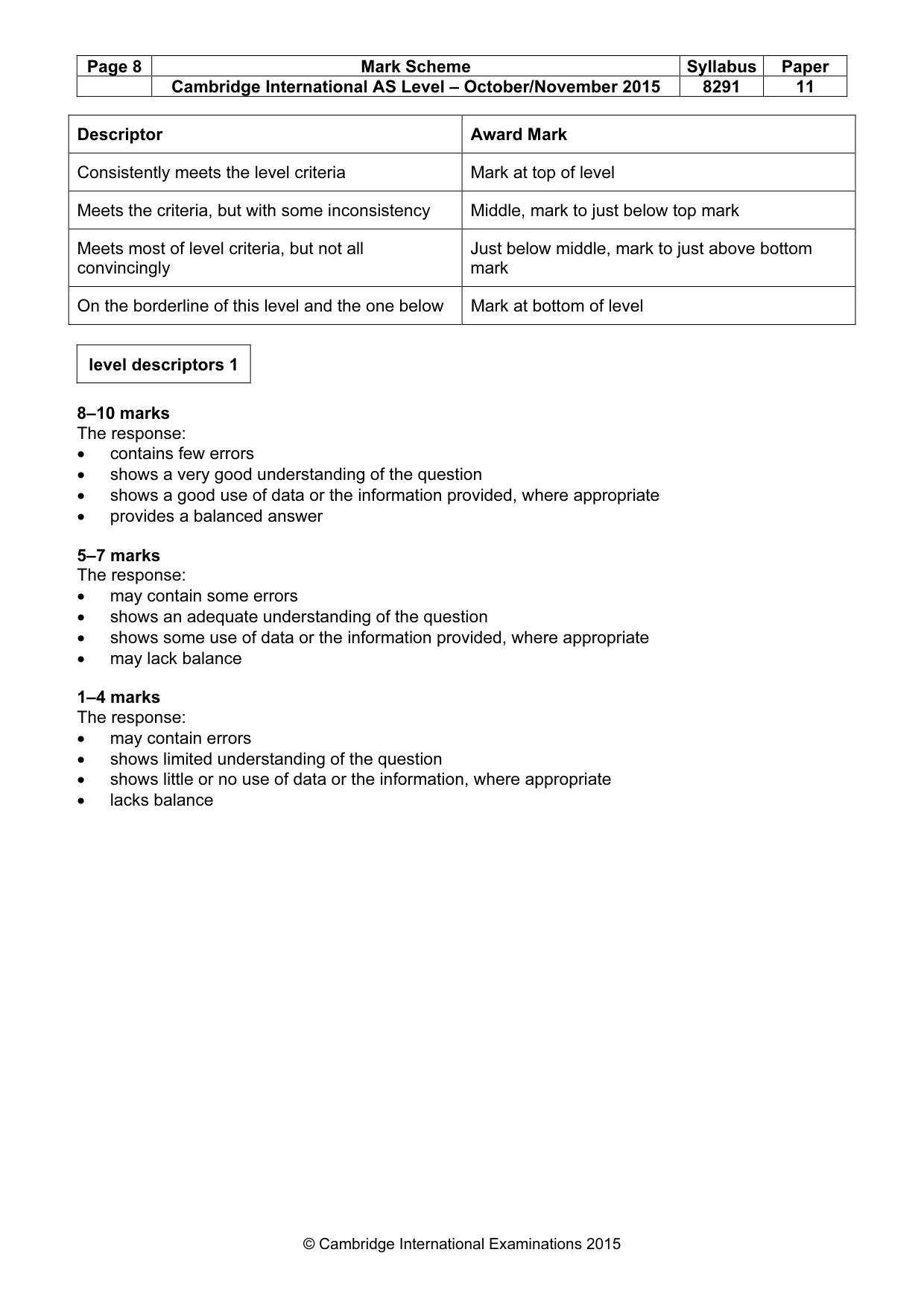
Page 8 Mark Scheme Syllabus Paper Cambridge International AS Level – October/November 2015 8291 11 © Cambridge International Examinations 2015 Descriptor Award Mark Consistently meets the level criteria Mark at top of level Meets the criteria, but with some inconsistency Middle, mark to just below top mark Meets most of level criteria, but not all convincingly Just below middle, mark to just above bottom mark On the borderline of this level and the one below Mark at bottom of level level descriptors 1 8–10 marks The response: • contains few errors • shows a very good understanding of the question • shows a good use of data or the information provided, where appropriate • provides a balanced answer 5–7 marks The response: • may contain some errors • shows an adequate understanding of the question • shows some use of data or the information provided, where appropriate • may lack balance 1–4 marks The response: • may contain errors • shows limited understanding of the question • shows little or no use of data or the information, where appropriate • lacks balance
Mark scheme, page 9
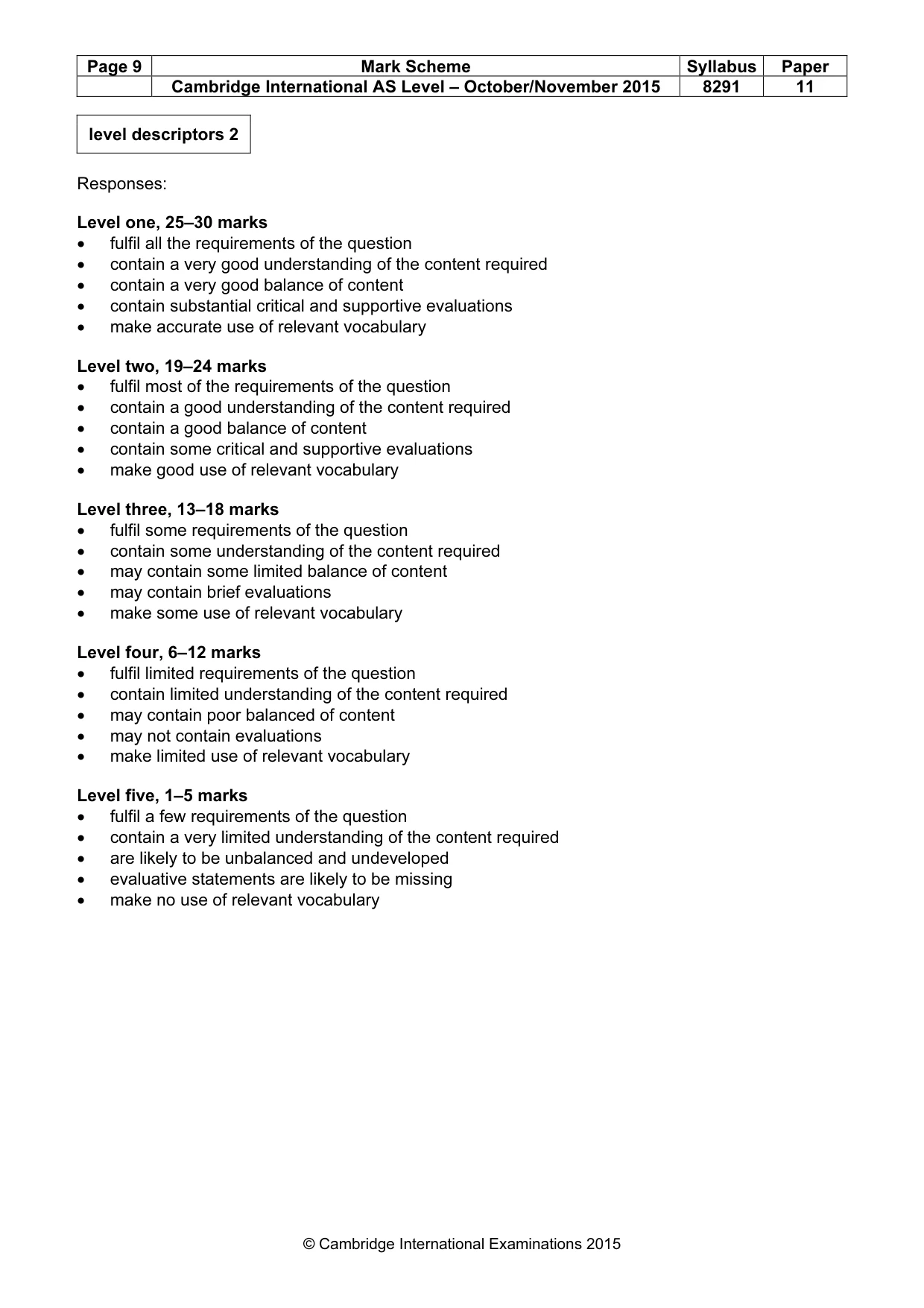
Page 9 Mark Scheme Syllabus Paper Cambridge International AS Level – October/November 2015 8291 11 © Cambridge International Examinations 2015 level descriptors 2 Responses: Level one, 25–30 marks • fulfil all the requirements of the question • contain a very good understanding of the content required • contain a very good balance of content • contain substantial critical and supportive evaluations • make accurate use of relevant vocabulary Level two, 19–24 marks • fulfil most of the requirements of the question • contain a good understanding of the content required • contain a good balance of content • contain some critical and supportive evaluations • make good use of relevant vocabulary Level three, 13–18 marks • fulfil some requirements of the question • contain some understanding of the content required • may contain some limited balance of content • may contain brief evaluations • make some use of relevant vocabulary Level four, 6–12 marks • fulfil limited requirements of the question • contain limited understanding of the content required • may contain poor balanced of content • may not contain evaluations • make limited use of relevant vocabulary Level five, 1–5 marks • fulfil a few requirements of the question • contain a very limited understanding of the content required • are likely to be unbalanced and undeveloped • evaluative statements are likely to be missing • make no use of relevant vocabulary
What you needed in this session
Cambridge’s own grade thresholds for 2015 Oct/Nov, Paper 1 · Variant 1. A higher threshold means an easier paper — the bar moves with how the cohort did.