Cambridge A Level Environmental Management (AS only) 8291 — 2013 Oct/Nov Paper 2 · Variant 1
8291/21/O/N/13 · 80 marks · ≈90 min
The question paper and its mark scheme, free to read here and free to download. This is Cambridge’s own paper, exactly as it was sat.
Question paper12 pages
Mark scheme8 pages
Answers below. Sit the paper first if you are practising.
Paper as text
Question paper, page 1
This document consists of 12 printed pages. DC (NF/SW) 72711/2 © UCLES 2013 [Turn over UNIVERSITY OF CAMBRIDGE INTERNATIONAL EXAMINATIONS General Certificate of Education Advanced Subsidiary Level * 1 5 2 6 8 5 1 3 1 7 * ENVIRONMENTAL MANAGEMENT 8291/21 Paper 2 Hydrosphere and Biosphere October/November 2013 1 hour 30 minutes Additional Materials: Answer Booklet/Paper READ THESE INSTRUCTIONS FIRST Write your Centre number, candidate number and name on all the work you hand in. Write in dark blue or black pen. You may use a soft pencil for any diagrams, graphs, tables or rough working. Do not use staples, paper clips, highlighters, glue or correction fluid. DO NOT WRITE IN ANY BARCODES. Electronic calculators may be used. You may lose marks if you do not show your working or if you do not use appropriate units. Section A Answer all questions. Write your answers in the spaces provided on the question paper. Section B Answer one question from this section. Answer the question on the separate answer paper provided. At the end of the examination, 1. fasten all separate answer paper securely to the question paper; 2. enter the question number from Section B in the grid opposite. For Examiner’s Use Section A 1 2 Section B Total
Question paper, page 2
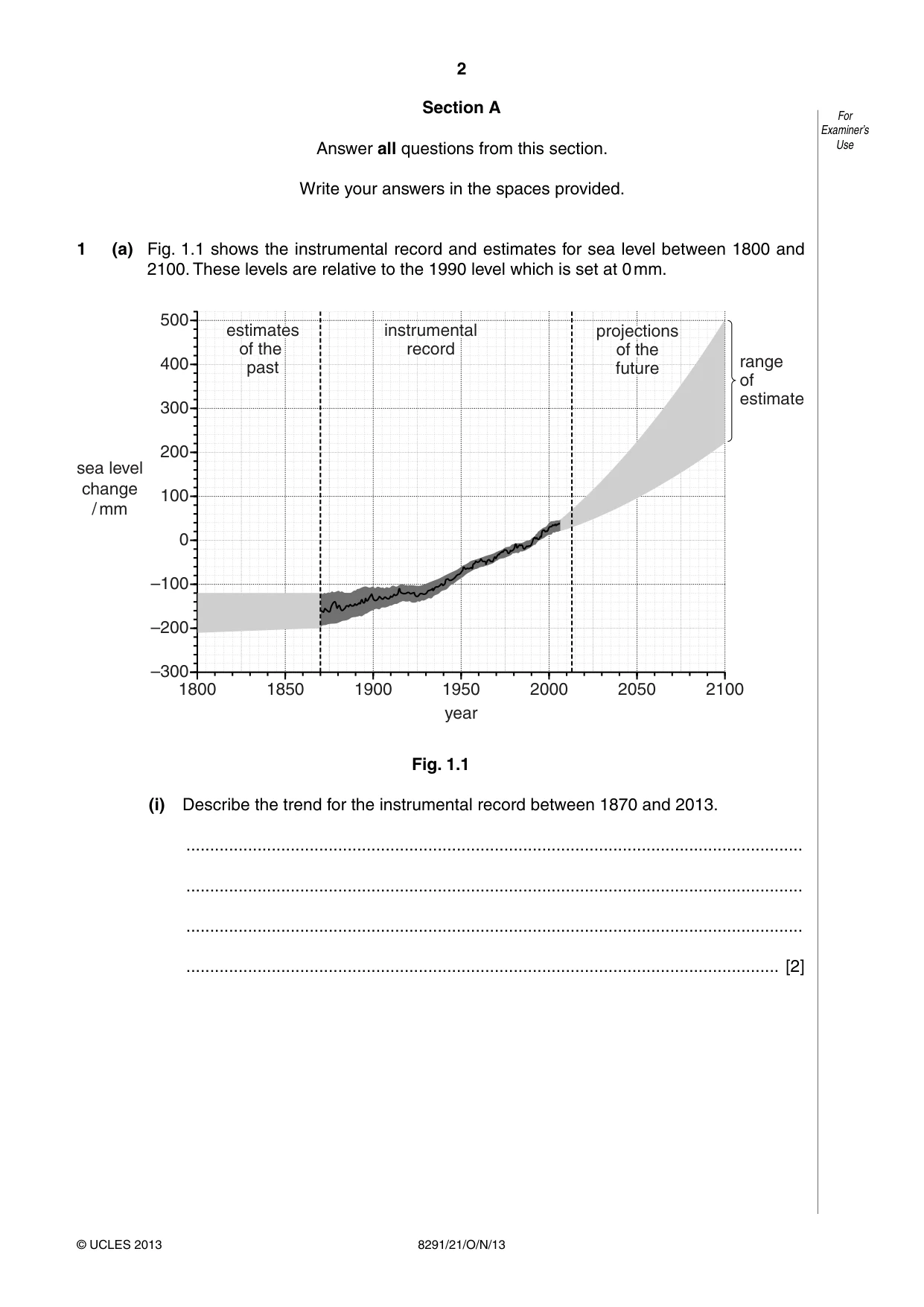
2 8291/21/O/N/13 © UCLES 2013 For Examiner’s Use Section A Answer all questions from this section. Write your answers in the spaces provided. 1 (a) Fig. 1.1 shows the instrumental record and estimates for sea level between 1800 and 2100. These levels are relative to the 1990 level which is set at 0 mm. 1800 1850 1900 1950 year sea level change / mm 2000 2050 2100 500 400 300 200 100 0 –100 –200 –300 estimates of the past instrumental record projections of the future range of estimate Fig. 1.1 (i) Describe the trend for the instrumental record between 1870 and 2013. … … … … [2]
Question paper, page 3
3 8291/21/O/N/13 © UCLES 2013 [Turn over For Examiner’s Use (ii) Suggest two reasons for the increase in sea level between 1930 and 2013. 1 … … … … 2 … … … … [4] (iii) Explain why the range between the low and high estimates increases between 2014 and 2100. … … … … … … … … [3]
Question paper, page 4
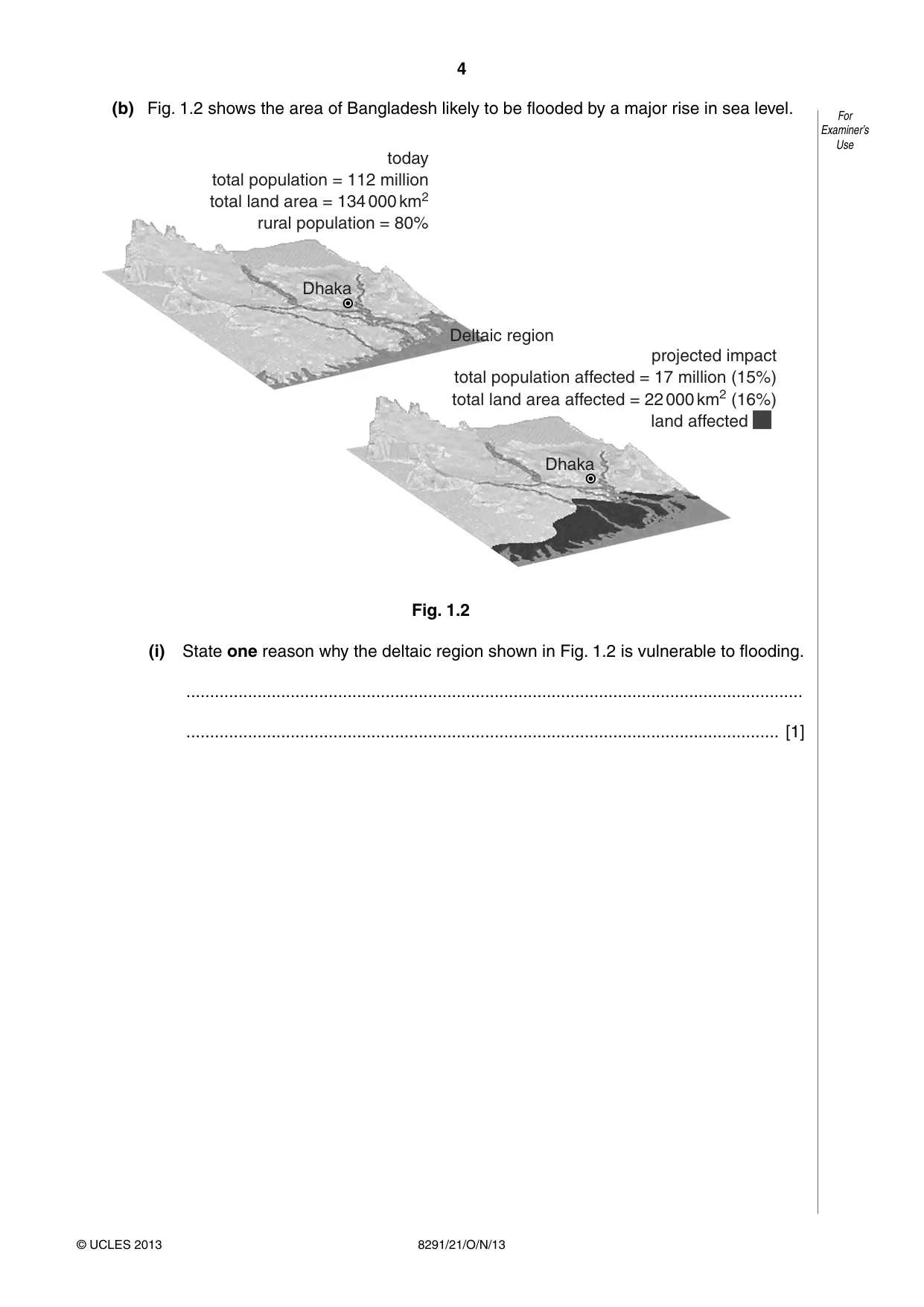
4 8291/21/O/N/13 © UCLES 2013 For Examiner’s Use (b) Fig. 1.2 shows the area of Bangladesh likely to be flooded by a major rise in sea level. Dhaka Deltaic region Dhaka today total population = 112 million total land area = 134 000 km2 rural population = 80% projected impact total population affected = 17 million (15%) total land area affected = 22 000 km2 (16%) land affected Fig. 1.2 (i) State one reason why the deltaic region shown in Fig. 1.2 is vulnerable to flooding. … … [1]
Question paper, page 5
5 8291/21/O/N/13 © UCLES 2013 [Turn over For Examiner’s Use (ii) Describe and explain the ecological and socio-economic effects that sea level rise and flooding might have on Bangladesh. … … … … … … … … … … … … … … … … … … … … … [10] [Total: 20]
Question paper, page 6
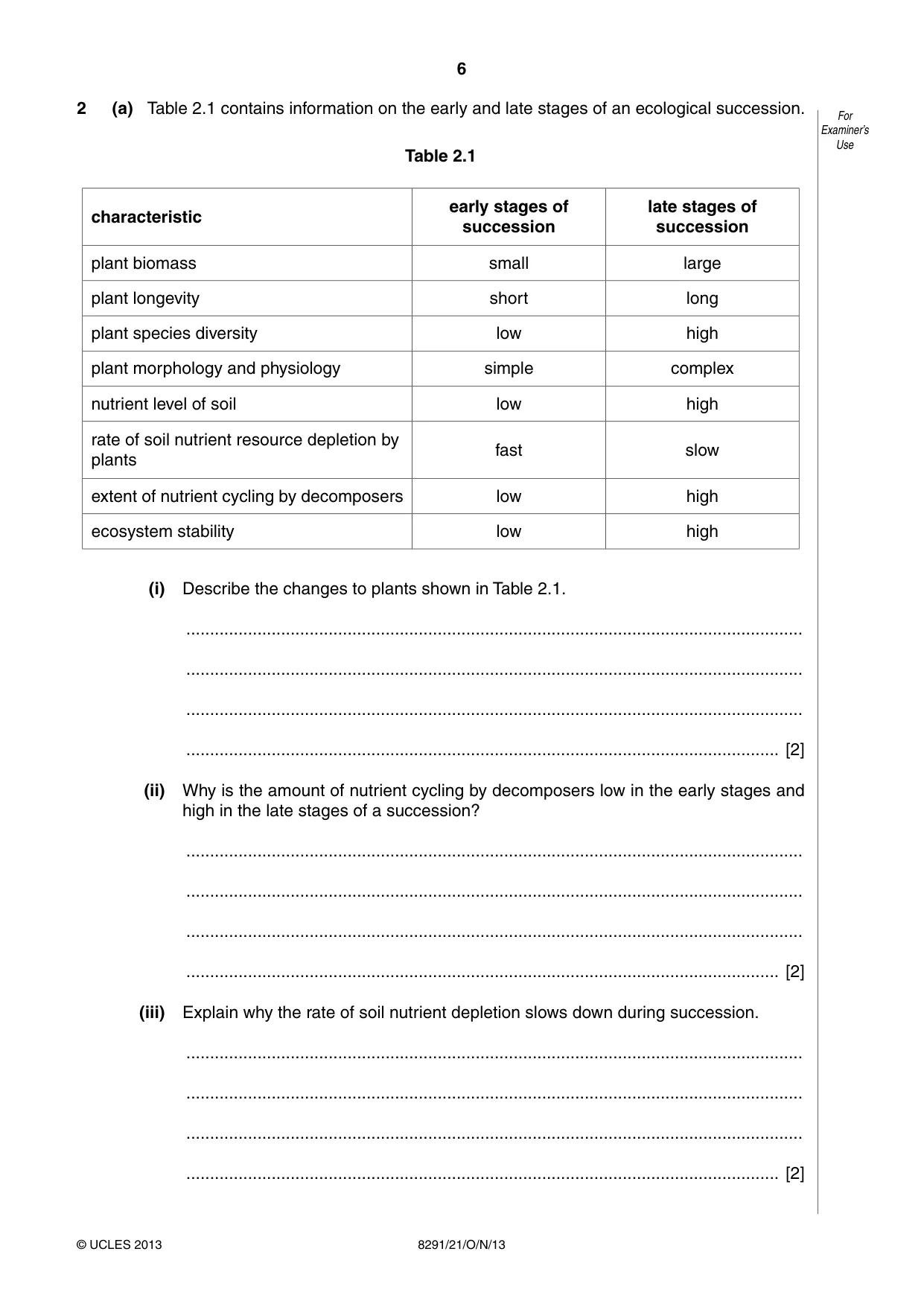
6 8291/21/O/N/13 © UCLES 2013 For Examiner’s Use 2 (a) Table 2.1 contains information on the early and late stages of an ecological succession. Table 2.1 characteristic early stages of succession late stages of succession plant biomass small large plant longevity short long plant species diversity low high plant morphology and physiology simple complex nutrient level of soil low high rate of soil nutrient resource depletion by plants fast slow extent of nutrient cycling by decomposers low high ecosystem stability low high (i) Describe the changes to plants shown in Table 2.1. … … … … [2] (ii) Why is the amount of nutrient cycling by decomposers low in the early stages and high in the late stages of a succession? … … … … [2] (iii) Explain why the rate of soil nutrient depletion slows down during succession. … … … … [2]
Question paper, page 7
7 8291/21/O/N/13 © UCLES 2013 [Turn over For Examiner’s Use (iv) With reference to Table 2.1, explain why ecosystem stability is low in the early stages of a succession and high in the late stages of a succession. … … … … … … … … … … [4]
Question paper, page 8
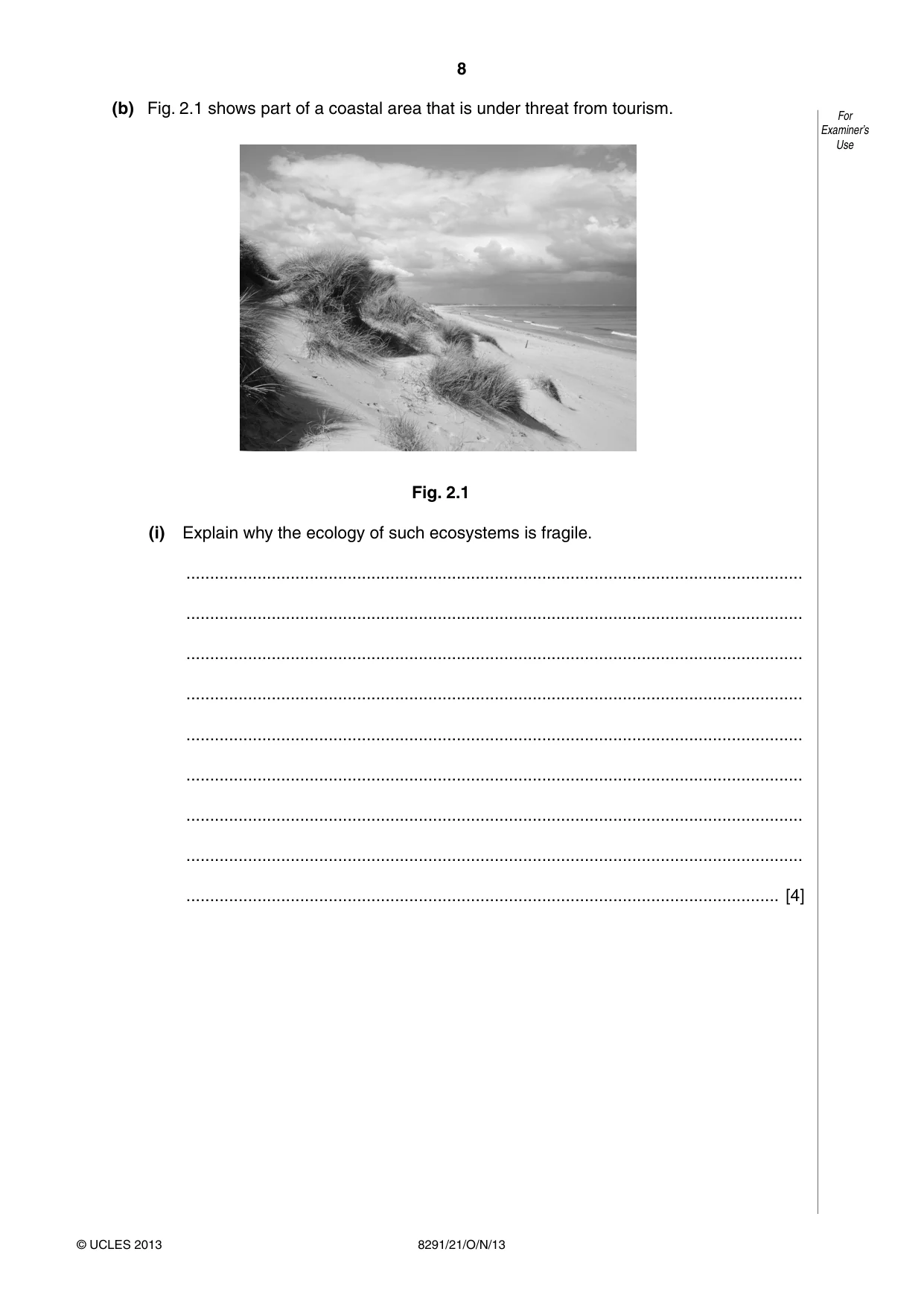
8 8291/21/O/N/13 © UCLES 2013 For Examiner’s Use (b) Fig. 2.1 shows part of a coastal area that is under threat from tourism. Fig. 2.1 (i) Explain why the ecology of such ecosystems is fragile. … … … … … … … … … [4]
Question paper, page 9
9 8291/21/O/N/13 © UCLES 2013 [Turn over For Examiner’s Use (ii) Briefly identify and justify three management strategies that would combine promoting tourism and conserving the ecology of this area. … … … … … … … … … … … … [6] [Total: 20]
Question paper, page 10
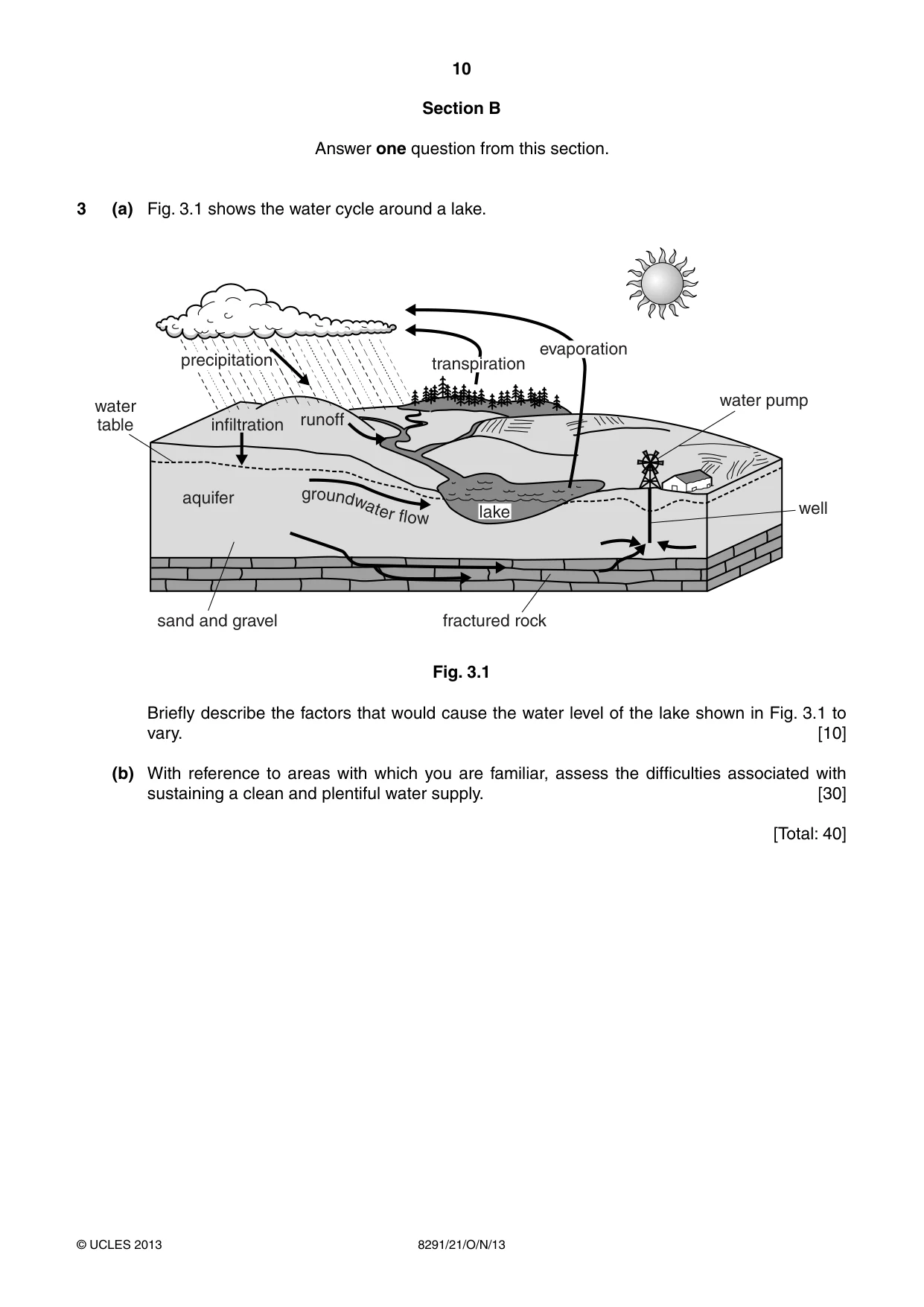
10 8291/21/O/N/13 © UCLES 2013 Section B Answer one question from this section. 3 (a) Fig. 3.1 shows the water cycle around a lake. water pump well evaporation transpiration lake precipitation infiltration runoff g ro u n d w a t e r fl o w aquifer water table sand and gravel fractured rock Fig. 3.1 Briefly describe the factors that would cause the water level of the lake shown in Fig. 3.1 to vary. [10] (b) With reference to areas with which you are familiar, assess the difficulties associated with sustaining a clean and plentiful water supply. [30] [Total: 40]
Question paper, page 11
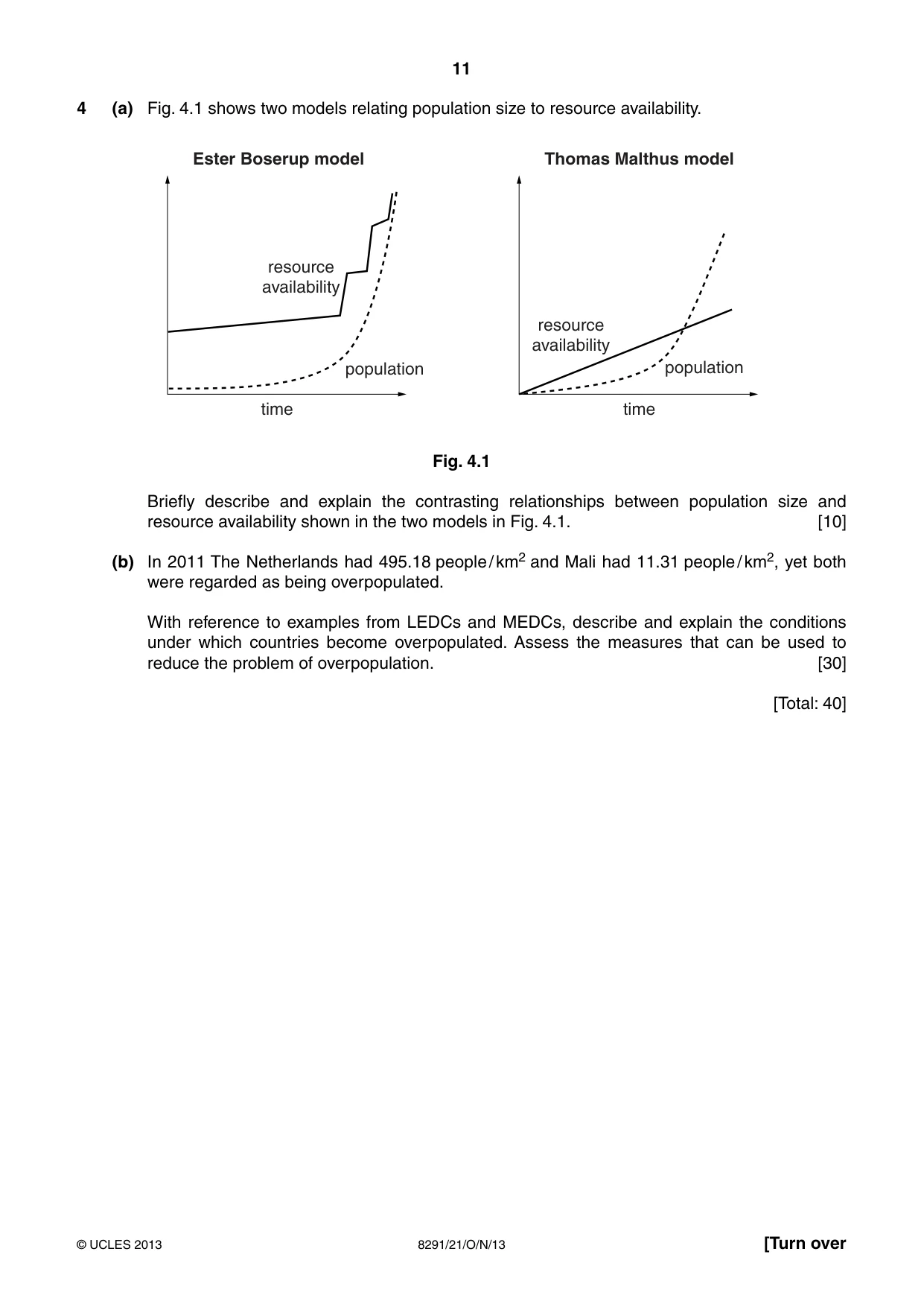
11 8291/21/O/N/13 © UCLES 2013 [Turn over 4 (a) Fig. 4.1 shows two models relating population size to resource availability. population population time time resource availability Ester Boserup model Thomas Malthus model resource availability Fig. 4.1 Briefly describe and explain the contrasting relationships between population size and resource availability shown in the two models in Fig. 4.1. [10] (b) In 2011 The Netherlands had 495.18 people / km2 and Mali had 11.31 people / km2, yet both were regarded as being overpopulated. With reference to examples from LEDCs and MEDCs, describe and explain the conditions under which countries become overpopulated. Assess the measures that can be used to reduce the problem of overpopulation. [30] [Total: 40]
Question paper, page 12
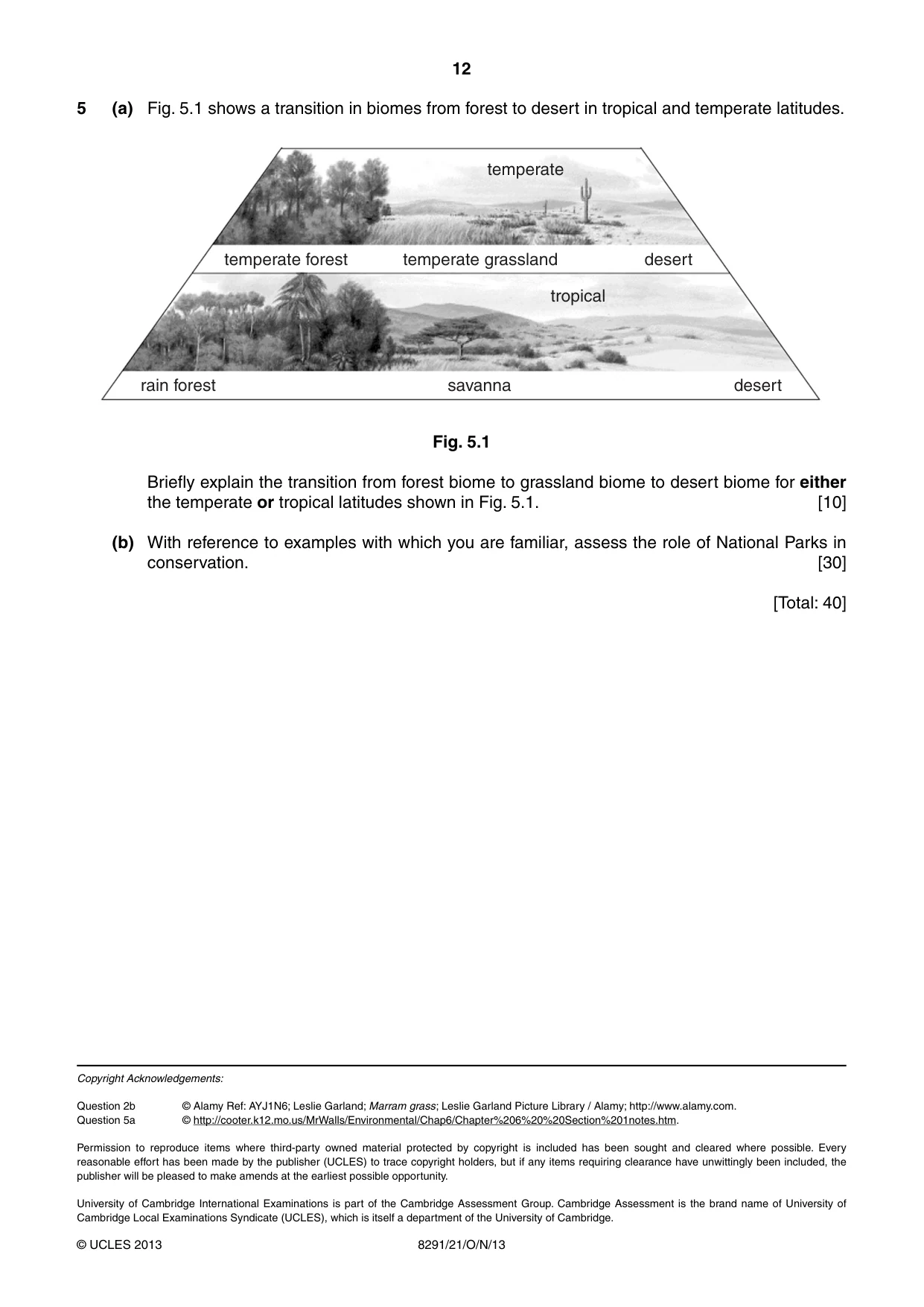
12 8291/21/O/N/13 © UCLES 2013 5 (a) Fig. 5.1 shows a transition in biomes from forest to desert in tropical and temperate latitudes. temperate forest rain forest savanna temperate tropical desert temperate grassland desert Fig. 5.1 Briefly explain the transition from forest biome to grassland biome to desert biome for either the temperate or tropical latitudes shown in Fig. 5.1. [10] (b) With reference to examples with which you are familiar, assess the role of National Parks in conservation. [30] [Total: 40] Copyright Acknowledgements: Question 2b © Alamy Ref: AYJ1N6; Leslie Garland; Marram grass; Leslie Garland Picture Library / Alamy; http://www.alamy.com. Question 5a © http://cooter.k12.mo.us/MrWalls/Environmental/Chap6/Chapter%206%20%20Section%201notes.htm. Permission to reproduce items where third-party owned material protected by copyright is included has been sought and cleared where possible. Every reasonable effort has been made by the publisher (UCLES) to trace copyright holders, but if any items requiring clearance have unwittingly been included, the publisher will be pleased to make amends at the earliest possible opportunity. University of Cambridge International Examinations is part of the Cambridge Assessment Group. Cambridge Assessment is the brand name of University of Cambridge Local Examinations Syndicate (UCLES), which is itself a department of the University of Cambridge.
Mark scheme, page 1
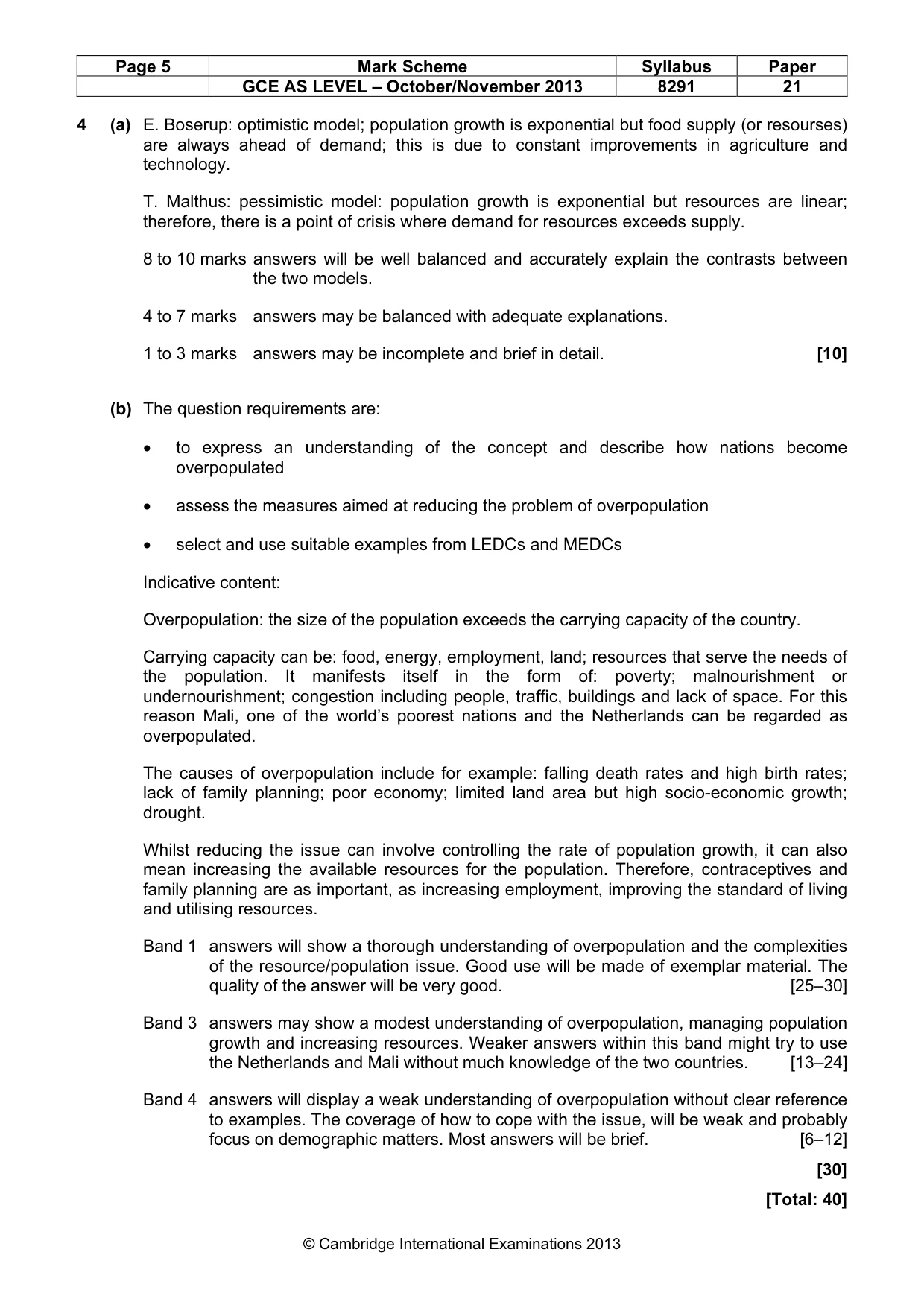
CAMBRIDGE INTERNATIONAL EXAMINATIONS GCE Advanced Subsidiary Level MARK SCHEME for the October/November 2013 series 8291 ENVIRONMENTAL MANAGEMENT 8291/21 Paper 2, maximum raw mark 80 This mark scheme is published as an aid to teachers and candidates, to indicate the requirements of the examination. It shows the basis on which Examiners were instructed to award marks. It does not indicate the details of the discussions that took place at an Examiners’ meeting before marking began, which would have considered the acceptability of alternative answers. Mark schemes should be read in conjunction with the question paper and the Principal Examiner Report for Teachers. Cambridge will not enter into discussions about these mark schemes. Cambridge is publishing the mark schemes for the October/November 2013 series for most IGCSE, GCE Advanced Level and Advanced Subsidiary Level components and some Ordinary Level components.
Mark scheme, page 2
Page 2 Mark Scheme Syllabus Paper GCE AS LEVEL – October/November 2013 8291 21 © Cambridge International Examinations 2013 Section A 1 (a) (i) Overall increase; different rates of increase 1870 to 1930 and 1943 to 2009. [2] (ii) The effects of Global warming; increasing temperatures; thermal expansion of water; melting of ice caps/glaciers. [4] (iii) Up to 2010 sea level rises are recorded and beyond this date they are predicted; increase is dependent upon a number of factors which can vary; with time, the estimates become less precise thus the range increases. [3] (b) (i) The delta is mostly at or near to sea level, thus a major rise would inundate the land/snow melt results in annual river floods. [1] (ii) Description and explanation of both ecological and socio economic effects are required. For example: inundations of salt water into tidal swamps; a loss of freshwater biodiversity; the delta region is no longer habitable for people; loss of fertile, agricultural land and other resources; migration into drier areas; increasing population density; population exceeding the carrying capacity, resulting in poverty. 8 to 10 marks answers show a clear understanding of the likely effects of permanent flooding of the delta with clear references to social, economic and ecological factors. 4 to 7 marks answers show a modest understanding of the possible effects of permanent flooding of the delta. 1 to 3 marks answers show a poor understanding of the effects of flooding. [10] [Total: 20] 2 (a) (i) The less diverse pioneer/early stage community with a low biomass, containing plants which are short lived and simple in morphology and physiology; are replaced in time by a climax/late stage community, increased biomass, more diverse and complex plants. [2] (ii) In the early stages of a succession there is less biomass/limited plant litter to decompose; whereas in the latter stages e.g. woodland, the litter and humus layers are larger. [2] (iii) In the primary stage the plants consume nutrients rapidly, due to increasing growth; more diverse climax communities are maintaining, rather than increasing biomass and more nutrients are available. [2] (iv) Low stability in the pioneer/early stage community as plants are short lived and biomass and diversity are low; the ecosystem is less resistant to change. High stability in the climax/late stage, when plants are long lived, with a high biomass and diversity; the ecosystem is resistant to changes in factors affecting the ecosystem. Ecosystem stability, involves flows that maintain the high biodiversity and biomass, by active nutrient cycling and complex plant morphology and physiology. [4]
Mark scheme, page 3
Page 3 Mark Scheme Syllabus Paper GCE AS LEVEL – October/November 2013 8291 21 © Cambridge International Examinations 2013 (b) (i) It is in a primary/early stage of succession; a pioneer community with coarse grasses growing in loose wind blown sand; the sand is porous with rapid inflitration; nutrients are easily lost; the grasses reintroduce few nutrients; this is a harsh environment with strong onshore winds, wave action and stormy weather which suffers erosion. [4] (ii) Site designation to emphasise the need for conservation. For example, a SSSI or nature reserve; visitor car parks detached from the area; visitor centre offering advice on access and biodiversity; walkways through the dunes to protect the dunes from erosion; observation points or bird hides. Award 1 mark for the identification and 1 mark for the justification for each of three management strategies. [6] [Total: 20]
Mark scheme, page 4
Page 4 Mark Scheme Syllabus Paper GCE AS LEVEL – October/November 2013 8291 21 © Cambridge International Examinations 2013 Section B 3 (a) The lake water level is an interaction of the precipitation, the water table, surface flow and extraction. Candidates should point out the effects of loss and gains to these flows/stores. 8 to 10 marks answers will refer to all flows and stores in Fig 3.1 and relate how they affect rises and falls in the lake level. 4 to 7 marks answers may omit some of flows and stores and infer changes to the lake level. 1 to 3 marks answers may be very general and lack linkages between flows/stores and the lake level. [10] (b) The requirements of the question are: • to select appropriate areas • to understand the demands on the water supply and issues with quality and quantity • assess the difficulties in maintaining a sustainable supply Indicative content: Issues frequently relate to: supply and demand, water pollution, natural problems e.g. periodic or long term drought, maintenance of supply routes. Sustainable supply provided through water storage in reservoirs and lakes, water treatment plants, groundwater extraction, desalinisation. Each has its own difficulties such as; limited sites for water storage, river and ground water pollution, low levels of ground water, cost. Band 1 answers must contain the requirements of the question. For the selected areas water supply issues and the difficulties encountered in overcoming them will be of a very good quality. [25–30] Band 3 answers will contain the three requirements but the answer will be modest in detail. Expect some very general or superficial responses. [13–18] Band 4 answers may be poorly balanced and poor in both analysis and assessments. Many answers at this level will be very brief. [6–12] [30] [Total: 40]
Mark scheme, page 5
Page 5 Mark Scheme Syllabus Paper GCE AS LEVEL – October/November 2013 8291 21 © Cambridge International Examinations 2013 4 (a) E. Boserup: optimistic model; population growth is exponential but food supply (or resourses) are always ahead of demand; this is due to constant improvements in agriculture and technology. T. Malthus: pessimistic model: population growth is exponential but resources are linear; therefore, there is a point of crisis where demand for resources exceeds supply. 8 to 10 marks answers will be well balanced and accurately explain the contrasts between the two models. 4 to 7 marks answers may be balanced with adequate explanations. 1 to 3 marks answers may be incomplete and brief in detail. [10] (b) The question requirements are: • to express an understanding of the concept and describe how nations become overpopulated • assess the measures aimed at reducing the problem of overpopulation • select and use suitable examples from LEDCs and MEDCs Indicative content: Overpopulation: the size of the population exceeds the carrying capacity of the country. Carrying capacity can be: food, energy, employment, land; resources that serve the needs of the population. It manifests itself in the form of: poverty; malnourishment or undernourishment; congestion including people, traffic, buildings and lack of space. For this reason Mali, one of the world’s poorest nations and the Netherlands can be regarded as overpopulated. The causes of overpopulation include for example: falling death rates and high birth rates; lack of family planning; poor economy; limited land area but high socio-economic growth; drought. Whilst reducing the issue can involve controlling the rate of population growth, it can also mean increasing the available resources for the population. Therefore, contraceptives and family planning are as important, as increasing employment, improving the standard of living and utilising resources. Band 1 answers will show a thorough understanding of overpopulation and the complexities of the resource/population issue. Good use will be made of exemplar material. The quality of the answer will be very good. [25–30] Band 3 answers may show a modest understanding of overpopulation, managing population growth and increasing resources. Weaker answers within this band might try to use the Netherlands and Mali without much knowledge of the two countries. [13–24] Band 4 answers will display a weak understanding of overpopulation without clear reference to examples. The coverage of how to cope with the issue, will be weak and probably focus on demographic matters. Most answers will be brief. [6–12] [30] [Total: 40]
Mark scheme, page 6
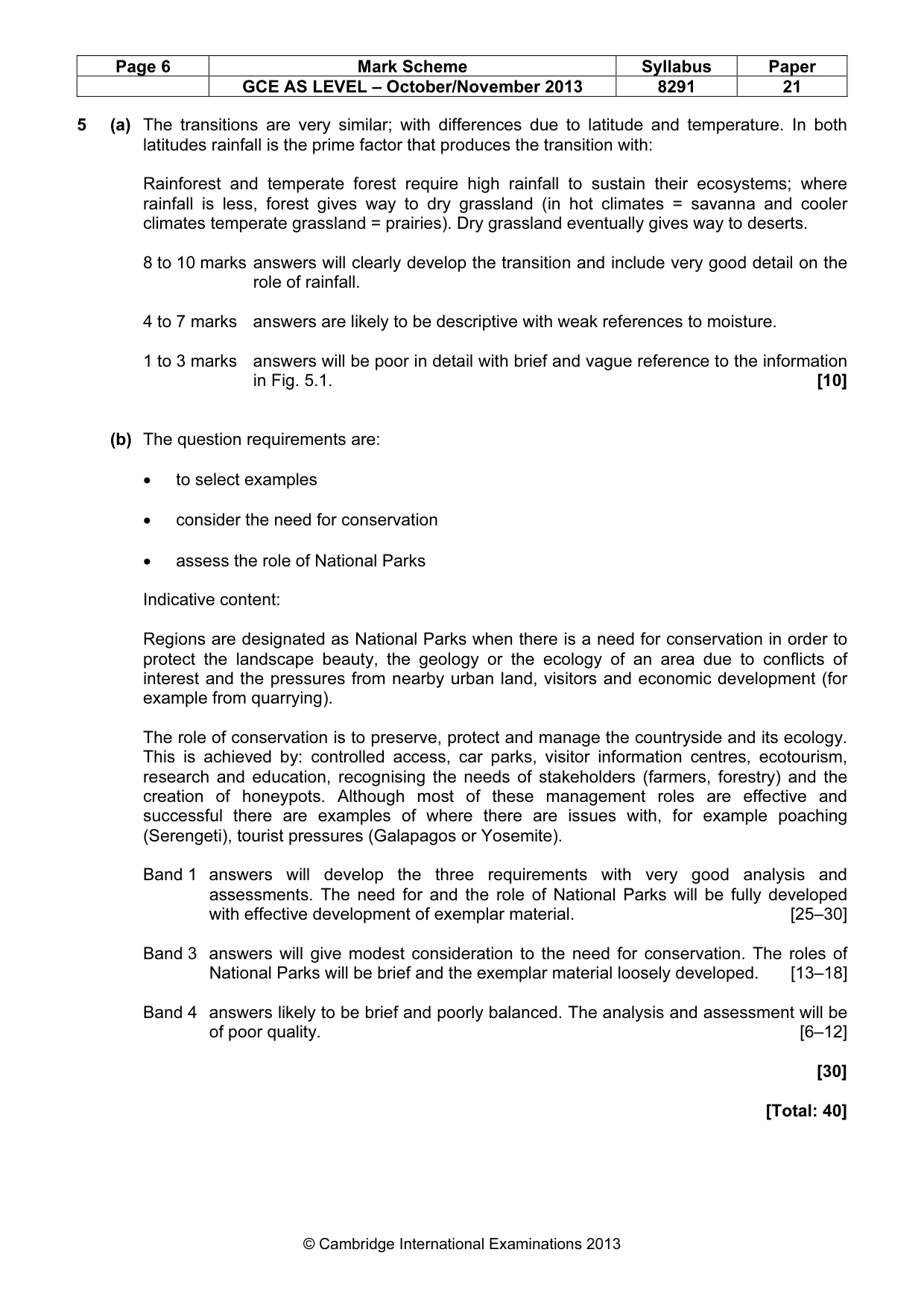
Page 6 Mark Scheme Syllabus Paper GCE AS LEVEL – October/November 2013 8291 21 © Cambridge International Examinations 2013 5 (a) The transitions are very similar; with differences due to latitude and temperature. In both latitudes rainfall is the prime factor that produces the transition with: Rainforest and temperate forest require high rainfall to sustain their ecosystems; where rainfall is less, forest gives way to dry grassland (in hot climates = savanna and cooler climates temperate grassland = prairies). Dry grassland eventually gives way to deserts. 8 to 10 marks answers will clearly develop the transition and include very good detail on the role of rainfall. 4 to 7 marks answers are likely to be descriptive with weak references to moisture. 1 to 3 marks answers will be poor in detail with brief and vague reference to the information in Fig. 5.1. [10] (b) The question requirements are: • to select examples • consider the need for conservation • assess the role of National Parks Indicative content: Regions are designated as National Parks when there is a need for conservation in order to protect the landscape beauty, the geology or the ecology of an area due to conflicts of interest and the pressures from nearby urban land, visitors and economic development (for example from quarrying). The role of conservation is to preserve, protect and manage the countryside and its ecology. This is achieved by: controlled access, car parks, visitor information centres, ecotourism, research and education, recognising the needs of stakeholders (farmers, forestry) and the creation of honeypots. Although most of these management roles are effective and successful there are examples of where there are issues with, for example poaching (Serengeti), tourist pressures (Galapagos or Yosemite). Band 1 answers will develop the three requirements with very good analysis and assessments. The need for and the role of National Parks will be fully developed with effective development of exemplar material. [25–30] Band 3 answers will give modest consideration to the need for conservation. The roles of National Parks will be brief and the exemplar material loosely developed. [13–18] Band 4 answers likely to be brief and poorly balanced. The analysis and assessment will be of poor quality. [6–12] [30] [Total: 40]
Mark scheme, page 7
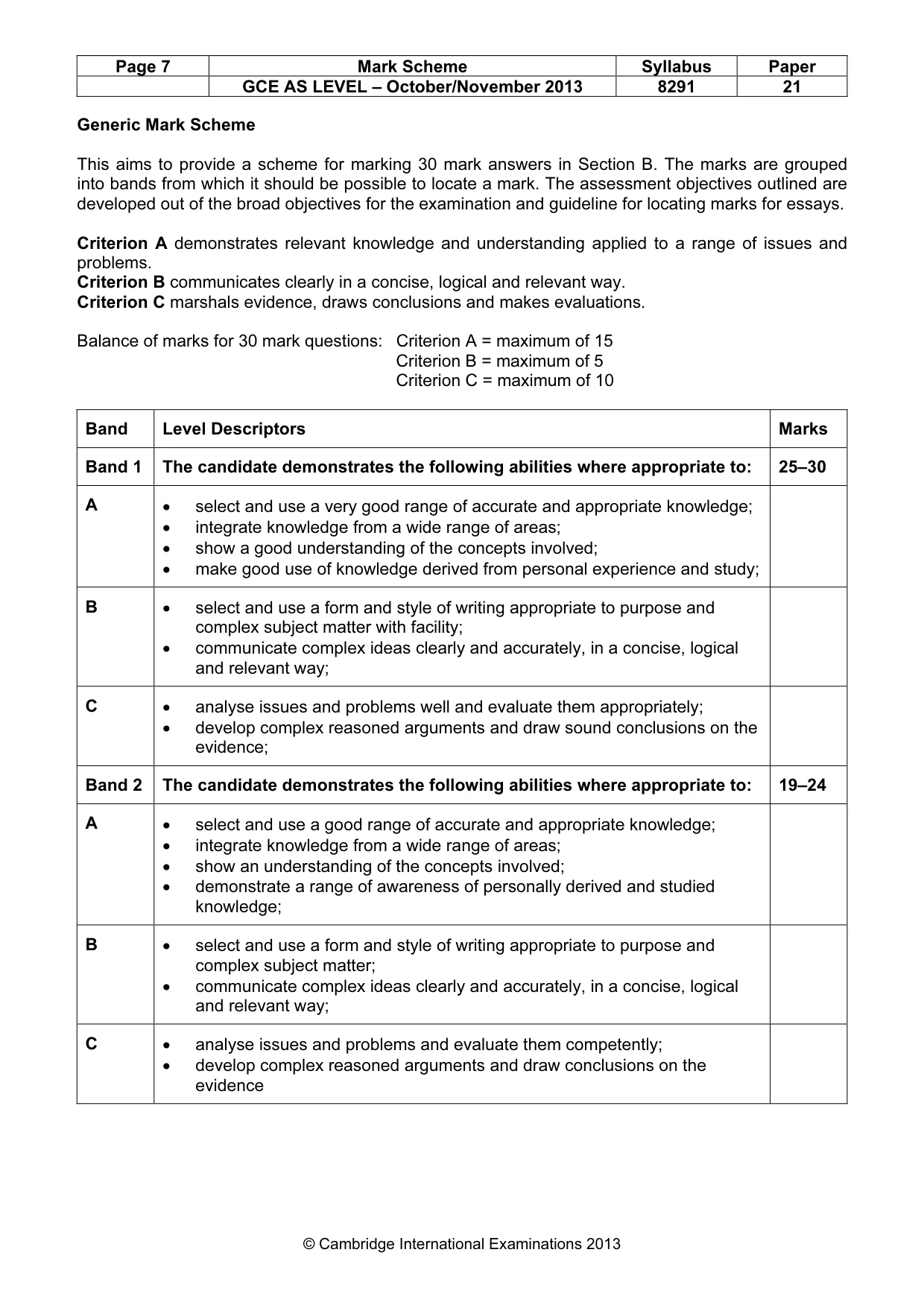
Page 7 Mark Scheme Syllabus Paper GCE AS LEVEL – October/November 2013 8291 21 © Cambridge International Examinations 2013 Generic Mark Scheme This aims to provide a scheme for marking 30 mark answers in Section B. The marks are grouped into bands from which it should be possible to locate a mark. The assessment objectives outlined are developed out of the broad objectives for the examination and guideline for locating marks for essays. Criterion A demonstrates relevant knowledge and understanding applied to a range of issues and problems. Criterion B communicates clearly in a concise, logical and relevant way. Criterion C marshals evidence, draws conclusions and makes evaluations. Balance of marks for 30 mark questions: Criterion A = maximum of 15 Criterion B = maximum of 5 Criterion C = maximum of 10 Band Level Descriptors Marks Band 1 The candidate demonstrates the following abilities where appropriate to: 25–30 A • select and use a very good range of accurate and appropriate knowledge; • integrate knowledge from a wide range of areas; • show a good understanding of the concepts involved; • make good use of knowledge derived from personal experience and study; B • select and use a form and style of writing appropriate to purpose and complex subject matter with facility; • communicate complex ideas clearly and accurately, in a concise, logical and relevant way; C • analyse issues and problems well and evaluate them appropriately; • develop complex reasoned arguments and draw sound conclusions on the evidence; Band 2 The candidate demonstrates the following abilities where appropriate to: 19–24 A • select and use a good range of accurate and appropriate knowledge; • integrate knowledge from a wide range of areas; • show an understanding of the concepts involved; • demonstrate a range of awareness of personally derived and studied knowledge; B • select and use a form and style of writing appropriate to purpose and complex subject matter; • communicate complex ideas clearly and accurately, in a concise, logical and relevant way; C • analyse issues and problems and evaluate them competently; • develop complex reasoned arguments and draw conclusions on the evidence
Mark scheme, page 8
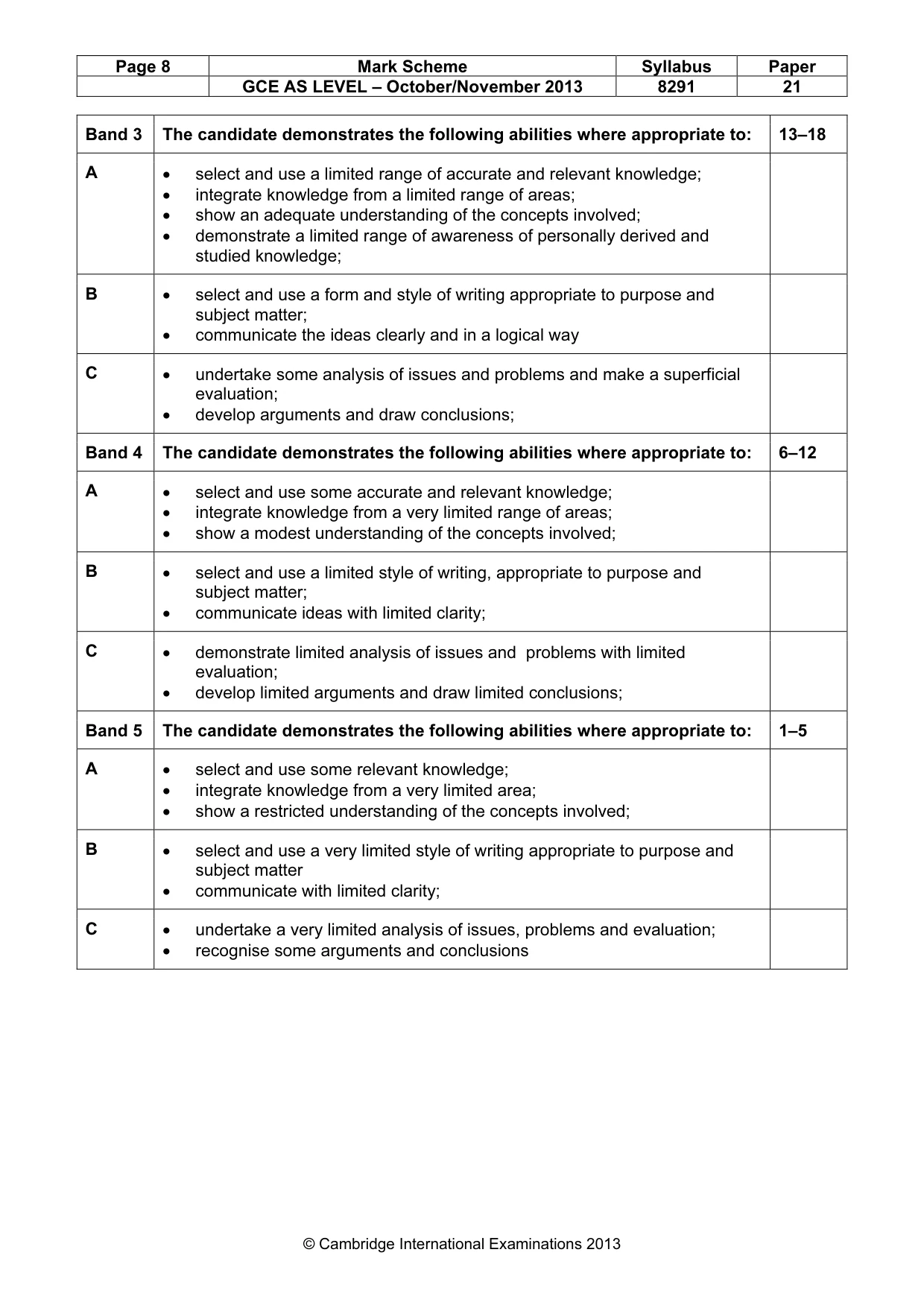
Page 8 Mark Scheme Syllabus Paper GCE AS LEVEL – October/November 2013 8291 21 © Cambridge International Examinations 2013 Band 3 The candidate demonstrates the following abilities where appropriate to: 13–18 A • select and use a limited range of accurate and relevant knowledge; • integrate knowledge from a limited range of areas; • show an adequate understanding of the concepts involved; • demonstrate a limited range of awareness of personally derived and studied knowledge; B • select and use a form and style of writing appropriate to purpose and subject matter; • communicate the ideas clearly and in a logical way C • undertake some analysis of issues and problems and make a superficial evaluation; • develop arguments and draw conclusions; Band 4 The candidate demonstrates the following abilities where appropriate to: 6–12 A • select and use some accurate and relevant knowledge; • integrate knowledge from a very limited range of areas; • show a modest understanding of the concepts involved; B • select and use a limited style of writing, appropriate to purpose and subject matter; • communicate ideas with limited clarity; C • demonstrate limited analysis of issues and problems with limited evaluation; • develop limited arguments and draw limited conclusions; Band 5 The candidate demonstrates the following abilities where appropriate to: 1–5 A • select and use some relevant knowledge; • integrate knowledge from a very limited area; • show a restricted understanding of the concepts involved; B • select and use a very limited style of writing appropriate to purpose and subject matter • communicate with limited clarity; C • undertake a very limited analysis of issues, problems and evaluation; • recognise some arguments and conclusions
What you needed in this session
Cambridge’s own grade thresholds for 2013 Oct/Nov, Paper 2 · Variant 1. A higher threshold means an easier paper — the bar moves with how the cohort did.